The E Factor in Pharmaceutical Chemistry: From Oil Refining to Sustainable API Synthesis
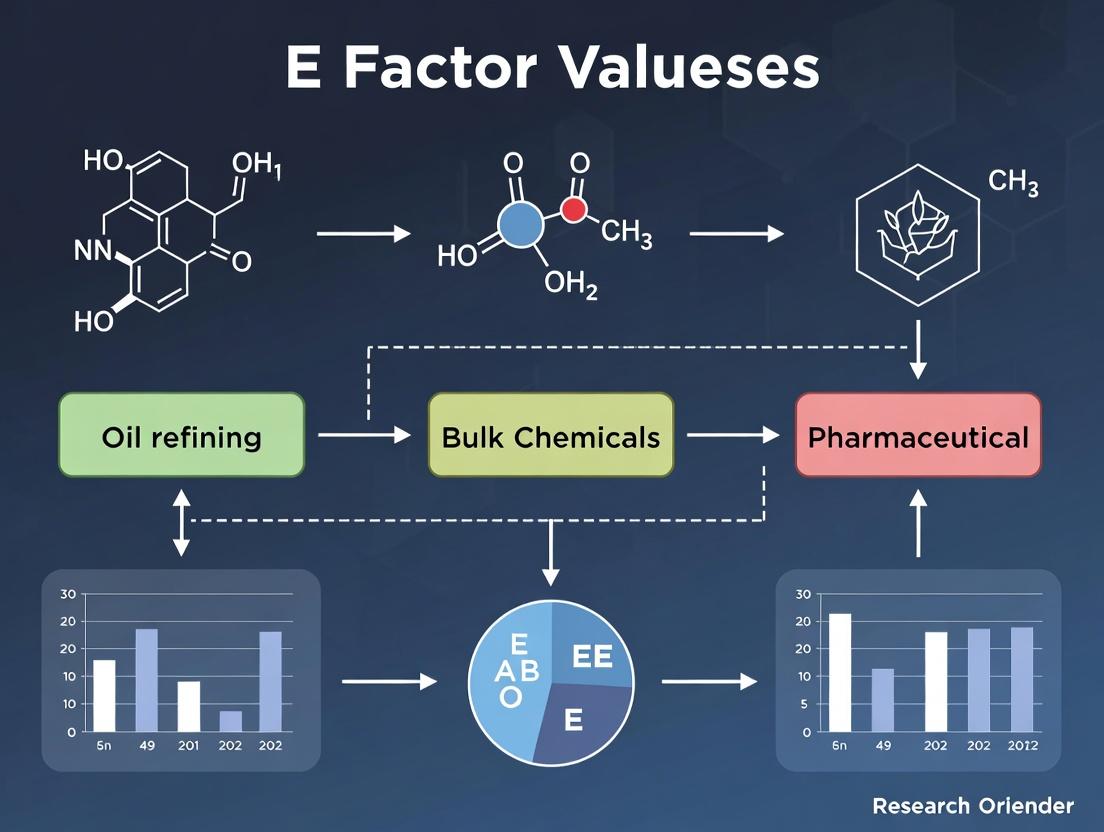
This article explores the critical application of Sheldon's Environmental (E) Factor—a metric of process waste—across chemical manufacturing scales, from bulk petrochemicals to high-value Active Pharmaceutical Ingredients (APIs).
The E Factor in Pharmaceutical Chemistry: From Oil Refining to Sustainable API Synthesis
Abstract
This article explores the critical application of Sheldon's Environmental (E) Factor—a metric of process waste—across chemical manufacturing scales, from bulk petrochemicals to high-value Active Pharmaceutical Ingredients (APIs). Targeted at researchers and drug development professionals, it examines foundational principles, methodological applications in green chemistry, strategies for troubleshooting and optimizing synthetic routes, and comparative validation against other sustainability metrics. The synthesis provides a roadmap for integrating E Factor analysis into pharmaceutical R&D to drive more sustainable and economically viable processes.
Defining the E Factor: A Cross-Industry Metric for Waste and Sustainability
The E Factor, conceived by Roger A. Sheldon in the early 1990s, emerged as a pivotal metric to quantify the environmental impact of chemical processes. Its development was driven by the growing need for a simple, yet powerful, tool to assess the "greenness" of chemical manufacturing across industries. The core premise is that the ideal chemical process should generate minimal waste, with the bulk of reactants incorporated into the final product. The E Factor provides a straightforward measure of this efficiency, catalyzing the principles of Green Chemistry.
The fundamental equation is defined as:
E = (Total waste generated in kg) / (Total product generated in kg)
Where "Total waste" encompasses all non-product outputs, including by-products, spent reagents, solvents, process aids, and energy-generation by-products (when significant). Water is typically excluded from the calculation due to its high mass, except when its use or contamination is a critical issue.
The E Factor Spectrum: From Bulk Chemicals to Pharmaceuticals
The E Factor's utility is most apparent when comparing its values across different sectors of the chemical industry, highlighting intrinsic process inefficiencies and environmental burdens. The following table summarizes typical E Factor ranges.
Table 1: E Factor Values Across Chemical Industries
| Industry Sector | Typical E Factor Range (kg waste / kg product) | Key Drivers of Waste Generation |
|---|---|---|
| Oil Refining | < 0.1 | Large-scale, continuous, highly optimized processes; water is main co-product. |
| Bulk Chemicals | < 1 - 5 | Large-tonnage production, catalytic processes, but stoichiometric inorganic reagents are common. |
| Fine Chemicals | 5 - 50 | Multi-step batch processes, functional group protection/deprotection, varied reagents. |
| Pharmaceuticals (API) | 25 - 100+ | Complex multi-step synthesis, low atom economy, extensive purification, high solvent usage. |
| Biotechnology/Research | Often >> 100 | Small-scale reactions, excess reagents for yield optimization, extensive chromatography. |
Core Equation and Detailed Calculation Methodology
An accurate E Factor calculation requires a detailed process mass inventory. The following experimental protocol outlines the steps for determination.
Experimental Protocol: Determination of Process E Factor
Objective: To calculate the E Factor for a given chemical synthesis or manufacturing process.
Materials & Reagents:
- Analytical balance (high precision)
- Detailed process flow diagram
- Inventory of all input materials (mass)
- Measurement of all output streams (mass)
Procedure:
- Define System Boundaries: Clearly define the start and end points of the process (e.g., from raw material charging to isolated, dried product).
- Mass Input Tabulation: Record the mass (kg) of every material introduced into the reaction and work-up stages. This includes all reactants, catalysts, solvents, and any process aids (e.g., filter aids, drying agents).
- Mass Output Tabulation: Precisely measure the mass (kg) of the isolated, purified final product (with specified purity, e.g., >98%). Collect and quantify all other output streams, including:
- Aqueous waste streams
- Organic waste (spent solvents, mother liquors)
- Solid waste (used catalysts, filtration residues, by-products)
- Emissions (if captured; otherwise, estimated from mass balance)
- Perform Mass Balance: Verify the data by checking: Σ(Mass Inputs) ≈ Σ(Mass Outputs). Significant discrepancies indicate measurement errors or unaccounted losses/emissions.
- Calculate Total Waste: Total Waste (kg) = Σ(Mass of All Outputs) - Mass of Product.
- Compute E Factor: Apply the core equation: E = Total Waste (kg) / Mass of Product (kg).
- Report: Report the E Factor value alongside the defined system boundaries and any notable assumptions (e.g., exclusion of process water).
Visualizing the E Factor Calculation and Industrial Context
The logical flow of the E Factor calculation and its relationship to process efficiency is depicted in the following diagram.
The Scientist's Toolkit: Essential Reagents and Materials for E Factor-Conscious Research
Moving from traditional synthesis towards processes with lower E Factors requires specific tools and reagents. The following table details key research solutions.
Table 2: Research Toolkit for Optimizing E Factor
| Reagent / Material Category | Example(s) | Primary Function in Reducing E Factor |
|---|---|---|
| Catalysts (Heterogeneous) | Immobilized enzymes, polymer-supported reagents, metal-on-solid catalysts | Enable easy recovery, reuse, and minimize metal contamination in waste streams. |
| Alternative Solvents | Water, supercritical CO₂, bio-derived solvents (e.g., 2-MeTHF, Cyrene), ionic liquids | Replace volatile, hazardous, and mass-intensive organic solvents, simplifying recovery and reducing toxicity. |
| Atom-Economical Reagents | Olefin metathesis catalysts, C-H activation catalysts, cascade reaction reagents | Maximize the incorporation of reactant atoms into the final product, minimizing by-product formation. |
| Process Analytical Technology (PAT) | In-line IR/Raman spectroscopy, automated sampling systems | Allows real-time monitoring and precise control of reaction endpoints, reducing excess reagent use and reprocessing. |
| Continuous Flow Systems | Microreactors, packed-bed flow reactors | Enhance heat/mass transfer, improve safety with hazardous reagents, reduce solvent volume, and enable precise reaction control. |
| Alternative Energy Sources | Microwave, ultrasound, mechanochemical (ball mill) equipment | Can accelerate reactions, improve yields/selectivity, and sometimes enable solvent-free conditions. |
Sheldon's E Factor remains a cornerstone metric in Green Chemistry, providing an unambiguous measure of process waste efficiency. Its stark revelation of the waste intensity of pharmaceuticals and fine chemicals has driven significant research into catalytic methods, solvent substitution, and process intensification (e.g., flow chemistry). Modern applications extend the principle to include environmental quotient (EQ) and life cycle assessment (LCA) for a more holistic view. For researchers and drug development professionals, targeting a lower E Factor is synonymous with developing more sustainable, cost-effective, and environmentally responsible chemical processes.
The E Factor, defined as the ratio of the mass of waste produced to the mass of the desired product, is a pivotal metric in assessing the environmental impact of chemical processes. This whitepaper provides an in-depth technical comparison of E Factors across three distinct industrial sectors: oil refining, bulk chemicals, and fine chemicals/pharmaceuticals. The analysis is framed within the context of a broader thesis on the fundamental economic and operational drivers that dictate these values, underscoring the intrinsic relationship between molecular complexity, process intensity, and environmental efficiency.
Quantitative E Factor Data Across Sectors
The E Factor spectrum reveals orders-of-magnitude differences, reflecting the varying process complexities and purification requirements.
Table 1: Comparative E Factors and Key Characteristics
| Sector | Typical E Factor Range | Scale (Annual Tonnage) | Key Drivers of Waste |
|---|---|---|---|
| Oil Refining | <0.1 | 10^6 - 10^8 | Energy consumption, catalyst regeneration, minimal purification. |
| Bulk Chemicals | 1 - 5 | 10^4 - 10^6 | Stoichiometric reagents, moderate purification, solvent use. |
| Fine Chemicals/Pharmaceuticals | 25 - 100+ | 10 - 10^3 | Multi-step synthesis, complex purification, high solvent volumes. |
Table 2: Representative Process Details and Associated Waste
| Sector / Example Product | Typical Steps | Major Waste Components | Approx. Solvent Mass per kg API (Pharma) |
|---|---|---|---|
| Oil Refining / Gasoline | 1-2 (Distillation, Cracking) | Spent catalysts, sludge, CO₂ from energy. | N/A (minimal) |
| Bulk / Ethylene | 1 (Steam Cracking) | Tars, spent caustic wash, CO₂. | N/A (minimal) |
| Pharma / API (Typical) | 6-12+ | Solvents (DMF, DMSO, THF), reagents, by-products, packaging. | 50 - 150 kg |
Detailed Methodologies and Experimental Protocols
Protocol for Determining E Factor in a Pharmaceutical Process
A standardized methodology for calculating the "Process Mass Intensity" (PMI), a related metric, is recommended by the American Chemical Society Green Chemistry Institute Pharmaceutical Roundtable (ACS GCI PR).
- System Boundary Definition: Define the "cradle-to-gate" boundary, starting from purchased materials to the isolated Active Pharmaceutical Ingredient (API).
- Mass Accounting: Accurately weigh all input materials (reagents, solvents, catalysts, processing aids) for a single batch.
- Product Mass: Record the mass of the dried, purified final API product.
- Waste Calculation: Calculate total waste mass as: Total Input Mass - Mass of API.
- E Factor Calculation: Compute E Factor = Total Waste Mass / Mass of API.
- Solvent Contribution: A critical sub-calculation is the solvent E Factor: Mass of Solvents Used / Mass of API.
Protocol for Life Cycle Inventory (LCI) in Oil Refining
For a more comprehensive environmental assessment, a simplified LCI for a refinery can be conducted.
- Functional Unit: Define the basis (e.g., 1 MJ of energy output from gasoline, or 1 kg of refined product).
- Data Collection: Gather operating data for a specified period (e.g., one month):
- Inputs: Mass of crude oil, mass of catalysts, volume of water, energy (natural gas, electricity).
- Outputs: Mass of all saleable products (gasoline, diesel, etc.).
- Non-Product Outputs: Mass of spent catalyst, sludge from wastewater treatment, CO₂ emissions from on-site combustion (calculated from fuel usage).
- Allocation: Allocate waste and emissions to different co-products using an appropriate method (e.g., energy content, mass).
- E Factor Calculation: For a specific product stream: E Factor = (Allocated Waste + Allocated Emissions Mass) / Mass of Product.
Visualizing the E Factor Spectrum and Workflows
The E Factor Industrial Spectrum
Diagram 1: E Factor Industrial Scale-Complexity Trade-off
Typical Pharmaceutical API Synthesis Workflow
Diagram 2: Pharma API Synthesis Waste Generation Workflow
The Scientist's Toolkit: Research Reagent Solutions
Table 3: Essential Materials for Pharmaceutical Process Research & Green Metrics Analysis
| Item / Reagent Solution | Function / Purpose | Key Consideration for E Factor |
|---|---|---|
| Alternative Solvent Guides (e.g., CHEM21) | Provides ranked lists of safer, greener solvents to replace problematic ones (e.g., DMF, DCM). | Directly reduces solvent waste mass and toxicity. |
| Supported Reagents (Silica, Polymer-bound) | Immobilizes reagents, simplifying workup (filtration) and reducing aqueous waste. | Eliminates extraction steps, reduces solvent use for purification. |
| Flow Chemistry Systems | Enables continuous processing with superior heat/mass transfer and safer handling of intermediates. | Reduces solvent volume, improves yield, minimizes scale-up waste. |
| Process Analytical Technology (PAT) | In-line sensors (IR, Raman) for real-time monitoring of reaction endpoints and purity. | Prevents over-processing, reduces failed batches, and optimizes yields. |
| Catalytic Reagents (e.g., Pd/C, Enzymes) | Replaces stoichiometric oxidants/reductants (e.g., metals, borohydrides). | Drastically reduces inorganic salt waste and improves atom economy. |
| Green Metrics Software (e.g., iChemE Calculator) | Automates calculation of E Factor, PMI, Atom Economy, and other sustainability metrics. | Essential for quantitative comparison and optimization of synthetic routes. |
The E Factor spectrum starkly illustrates the environmental efficiency gradient from simple, large-scale hydrocarbon processing to complex, small-scale molecule synthesis. The core thesis is that the high E Factors in pharmaceuticals are not merely a function of industry maturity but are intrinsically linked to the molecular complexity demanded by biological activity and the rigorous purification standards required for human therapeutics. The path toward sustainability in fine chemicals and pharmaceuticals lies in adopting the methodologies outlined in this guide: rigorous metric tracking, solvent and reagent substitution, and the integration of innovative technologies like flow chemistry and catalysis to mimic the efficiency of bulk chemical processes while retaining the precision of molecular synthesis.
Within the broader landscape of industrial chemical synthesis, the Environmental Factor (E Factor)—defined as the mass ratio of waste to desired product—reveals stark contrasts across sectors. While oil refining and bulk chemicals operate with E Factors typically below 5, the pharmaceutical industry consistently exhibits E Factors ranging from 25 to over 100. This whitepaper analyzes the technical and regulatory drivers behind this disparity, focusing on molecular complexity, multi-step purification, and the stringent requirements of drug approval.
Comparative Analysis of Industrial E Factors
The following table summarizes E Factors across key industries, highlighting the outlier status of pharmaceuticals.
Table 1: E Factor Comparison Across Industries
| Industry Sector | Typical E Factor Range | Key Drivers |
|---|---|---|
| Oil Refining | <0.1 | Integrated, catalytic processes; high-volume, simple molecules. |
| Bulk Chemicals | <1 to 5 | Optimized continuous processes; tolerance for minor impurities. |
| Fine Chemicals | 5 to 50 | Increased complexity, batch processes, need for higher purity. |
| Pharmaceuticals (API Manufacturing) | 25 to 100+ | Multi-step synthesis, complex purification, regulatory compliance, rapid process development. |
Core Technical Drivers of High Pharma E Factor
Molecular Complexity & Multi-Step Synthesis
Active Pharmaceutical Ingredients (APIs) are structurally complex, often featuring chiral centers, heterocycles, and sensitive functional groups. This necessitates long synthetic sequences (often 8-15 steps) with inherently low atom economy. Each step involves reagents, solvents, and protective groups, the majority of which become waste.
Intensive Purification & Isolation Protocols
Regulatory mandates for ultra-high purity (>99.0% for APIs) demand rigorous purification after each critical step. Techniques like chromatography, recrystallization, and distillation generate substantial solvent and solid waste.
Table 2: Waste Contribution of Common Purification Techniques
| Technique | Primary Waste Stream | Typical Solvent Use per kg API (L) |
|---|---|---|
| Column Chromatography | Spent silica, solvent | 100 - 1000+ |
| Recrystallization | Mother liquor, washes | 50 - 200 |
| Distillation | High-boiling residues | Varies widely |
Regulatory & Quality Drivers
Good Manufacturing Practice (GMP) requirements prioritize process validation, consistency, and patient safety over waste minimization. Changes to a validated process are costly and require regulatory re-approval, disincentivizing post-approval green chemistry optimization. Furthermore, the use of highly hazardous reagents is often mandated to ensure specific stereochemical outcomes or to avoid potential mutagenic impurities.
Experimental Protocol: Evaluating E Factor in a Typical API Step
This protocol details the measurement of E Factor for a single chemical transformation in API synthesis.
Title: Gravimetric Analysis of Process Step E Factor
Objective: To quantify the mass of waste generated per unit mass of product for a defined synthetic step (e.g., a Suzuki-Miyaura coupling followed by isolation).
Materials & Reagents:
- Starting materials (aryl halide, boronic acid).
- Catalyst (Palladium complex, e.g., Pd(PPh3)4).
- Base (e.g., K2CO3).
- Solvents (Toluene, Ethanol, Water for reaction; Ethyl Acetate, Hexanes for workup/purification).
- Silica gel for chromatography.
- Standard laboratory glassware and equipment (round-bottom flasks, separatory funnel, rotary evaporator, chromatographic column).
Procedure:
- Reaction: Charge the aryl halide (1.0 equiv), boronic acid (1.2 equiv), Pd catalyst (0.02 equiv), and base (2.0 equiv) into a flask. Add degassed toluene/ethanol/water solvent mixture (10 mL per mmol of limiting reagent). Heat at 80°C under N2 for 12 hours.
- Work-up: Cool the reaction mixture. Dilute with ethyl acetate (50 mL) and transfer to a separatory funnel. Wash with water (2 x 30 mL) and brine (1 x 30 mL). Dry the organic layer over anhydrous MgSO4, filter, and concentrate via rotary evaporation to yield a crude solid.
- Purification: Purify the crude material by flash column chromatography on silica gel (eluent: gradient of ethyl acetate in hexanes). Combine pure fractions and concentrate to obtain the isolated product.
- Weighing & Calculation:
- Weigh the isolated, dry product (MassP).
- Record the mass of all input materials excluding solvents used in excess for extraction/washing (MassR).
- Step E Factor = (MassR - MassP) / Mass_P
- For a complete process E Factor, include all solvents, silica gel, and consumables in the waste mass.
The Scientist's Toolkit: Key Reagents for API Synthesis & Analysis
Table 3: Essential Research Reagent Solutions in Pharmaceutical Development
| Reagent/Material | Function in API Development | Typical Use Case |
|---|---|---|
| Palladium Catalysts (e.g., Pd(dppf)Cl2) | Facilitate key C-C/C-N bond formations (cross-couplings). | Suzuki, Heck, Buchwald-Hartwig reactions in core structure assembly. |
| Chiral Resolution Agents (e.g., L-Tartaric Acid) | Separate enantiomers to obtain the therapeutically active stereoisomer. | Resolution of racemic mixtures during early-phase development. |
| High-Performance Liquid Chromatography (HPLC) Grade Solvents | Provide ultra-high purity for analytical testing and final purification. | Assay and impurity profiling of API batches to meet regulatory specs. |
| Silica Gel (40-63 μm) | Solid support for chromatographic purification of intermediates. | Flash column chromatography to remove by-products and unreacted starting materials. |
| Genotoxic Impurity (GTI) Standards | Analytical reference materials to monitor and control mutagenic impurities. | Validated analytical methods per ICH M7 guideline compliance. |
Visualizing the Drivers of Pharmaceutical E Factor
Diagram 1: Drivers of Pharmaceutical E Factor
The pharmaceutical industry's exceptionally high E Factor is an inherent consequence of its mission to deliver structurally complex, ultra-pure, and rigorously safe therapeutics. While oil refining and bulk chemical sectors optimize for volumetric efficiency and atom economy, drug manufacturing is driven by patient safety, regulatory compliance, and speed to market, often at the expense of environmental efficiency. Advancements in continuous manufacturing, biocatalysis, and analytical quality by design (QbD) offer pathways to reduce this waste burden without compromising quality, representing the frontier of sustainable pharmaceutical engineering.
The E Factor (Environmental Factor), introduced by Roger A. Sheldon, is a cornerstone metric in green chemistry, defined as the mass ratio of waste to desired product (kg waste/kg product). While invaluable, the E Factor's focus on mass alone is a critical limitation. It assigns equal weight to benign waste (e.g., NaCl, H₂O) and highly hazardous materials. This whitepaper reframes waste assessment within the thesis of E Factor progression—from oil refining (E ~0.1) to bulk chemicals (E ~1-5) to pharmaceuticals (E ~25-100+) and research activities (E >>100)—by introducing the Environmental Quotient (EQ) and Waste Hazard as essential complementary metrics.
EQ = E Factor × Q where Q is an empirically determined unfriendliness quotient that accounts for the nature of the waste (toxicity, persistence, bioaccumulation, etc.).
This guide provides a technical framework for researchers, especially in drug development, to move beyond mass-based metrics and implement hazard-aware environmental impact assessments.
Quantitative Data: E Factors and Hazard Classifications
The following tables synthesize current data on E Factors and propose a hazard multiplier (Q) framework for common waste streams.
Table 1: Typical E Factors Across Chemical Industries
| Industry Sector | Typical E Factor Range | Primary Waste Components |
|---|---|---|
| Oil Refining | 0.1 - 0.3 | Spent catalysts, acidic gases, metal oxides. |
| Bulk Chemicals | <1 - 5 | Inorganic salts (NaCl, Na₂SO₄), process water, organic by-products. |
| Fine Chemicals | 5 - 50 | Solvents (DMF, THF), metal complexes, halogenated organics. |
| Pharmaceuticals (API) | 25 - >100 | Complex solvents (DCM, DMF, NMP), chromatography eluents, heavy metal reagents. |
| Medicinal Chemistry (Research) | 100 - 1000+ | High-boiling solvents, excess reagents, reaction quenches in small volumes. |
Table 2: Proposed Hazard Multiplier (Q) for Common Waste Classes
| Waste Hazard Class | Description & Example Compounds | Proposed Q Value | Rationale |
|---|---|---|---|
| Innocuous (Q=1) | Water, NaCl, Na₂SO₄, CaCO₃, cellulose. | 1 | Benign, easily treated or disposed. |
| Low Hazard (Q=1-10) | Short-chain alcohols (MeOH, EtOH), acetic acid, acetone. | 2-5 | Some energy recovery potential, low toxicity. |
| Moderate Hazard (Q=10-100) | Halogenated solvents (DCM, CHCl₃), aromatic hydrocarbons (toluene, xylene), bases (pyridine). | 25-50 | Toxic, requires specialized recovery or treatment. |
| High Hazard (Q=100-1000) | Heavy metal salts (Pd, Cr, As), cyanides, persistent bioaccumulative toxins (PBTs), genotoxic impurities. | 100-1000 | Severe environmental and health impact, costly destruction. |
Experimental Protocols for Determining EQ in Pharmaceutical Research
Protocol 3.1: Lifecycle Inventory for a Representative API Synthesis Step
Objective: To calculate the precise E Factor and EQ for a Pd-catalyzed cross-coupling step in drug candidate synthesis.
Methodology:
- Mass Balance: On a 10 mmol scale reaction, record exact masses of all inputs:
- Substrates: Aryl halide (2.12 g), boronic acid (1.83 g).
- Catalyst/Reagents: Pd(PPh₃)₄ (115 mg, 1 mol%), K₂CO₃ (2.76 g, 2.0 equiv).
- Solvent: Toluene (30 mL) and Water (10 mL).
- Work-up/Isolation: 2M HCl (20 mL), Ethyl acetate (3 × 30 mL), MgSO₄ (2 g), silica gel (10 g) for flash chromatography, hexane/ethyl acetate eluents (500 mL total).
Product Isolation: Isolate pure product by flash chromatography. Record final dry mass of product (e.g., 2.15 g).
Waste Calculation:
- Aqueous Waste: Combine all aqueous layers (reaction water, acid quench, aqueous washes). Calculate mass.
- Organic Waste: Combine all spent organic fractions from chromatography and filtrates. Evaporate solvent to determine mass of non-volatile residues.
- Solid Waste: Weigh spent silica gel, MgSO₄, and filter papers.
Hazard Assessment & Q Assignment: Classify each waste stream using safety data sheets (SDS) and GHS classifications. Assign a Q value:
- Spent Toluene/Hexane: Halogen-free organic solvent waste (Moderate Hazard): Q=30.
- Aqueous Layer with K+, Pd traces: Heavy metal traces (High Hazard): Q=100.
- Solid Silica Gel with Organics: Mixed organic/inorganic (Low Hazard): Q=5.
Calculation:
- E Factor = (Total mass of inputs - 2.15 g product) / 2.15 g.
- EQ = Σ (Mass of waste stream * i * Qi) / Mass of product.
Protocol 3.2: Solvent Selection Guide Based on EQ
Objective: To compare the EQ of two common amide coupling solvents, DMF and 2-MeTHF, for a standard peptide bond formation.
Methodology:
- Run identical peptide coupling reactions on a 5 mmol scale using HATU as the coupling agent and DIPEA as the base, in parallel with DMF or 2-MeTHF (20 mL each).
- Work up by dilution with water (50 mL) and extraction with EtOAc (3 × 25 mL).
- The aqueous layer contains the spent solvent (DMF is water-miscible; 2-MeTHF forms a separate layer).
- Isolate and weigh the product from the organic phase.
- Waste Stream Analysis: For DMF, the entire aqueous layer is a single waste stream (Q=50, hard to recycle). For 2-MeTHF, the aqueous layer is primarily water (Q=1), and the organic layer can be distilled and reused (Q for fresh solvent credit).
- Calculate and compare the EQ for both processes, highlighting the advantage of a water-immiscible, biodegradable solvent.
Visualization: From E Factor to EQ in API Development
Title: The EQ Calculation Integrates Mass and Hazard
Title: EQ-Driven Sustainable API Development Workflow
The Scientist's Toolkit: Key Research Reagent Solutions
Table 3: Essential Materials for Hazard-Reduced Medicinal Chemistry
| Item / Reagent | Function & Green Chemistry Rationale | Hazard Reduction Impact |
|---|---|---|
| 2-Methyltetrahydrofuran (2-MeTHF) | Water-immiscible, biobased solvent for extractions, Grignard reactions. Replaces THF (persistent) and halogenated solvents. | Lowers Q factor; derived from renewable resources. |
| Cyclopentyl methyl ether (CPME) | High-boiling, stable, low-peroxide-formation ether solvent. Alternative to Dioxane (carcinogenic) and DIPE. | Lower toxicity (higher Q allowance) versus traditional ethers. |
| Ethyl Lactate | Biodegradable, renewable aprotic solvent with good solubilizing power. Potential replacement for NMP (reprotoxic) or DMF. | Drastically reduces environmental persistence and toxicity (Q). |
| Immobilized Catalysts (e.g., SiliaCat Pd) | Heterogeneous catalysts on silica support for cross-couplings, hydrogenations. Enable filtration recovery and reuse. | Minimizes heavy metal waste, critical for lowering Q. |
| Polymer-Supported Reagents & Scavengers | For catch-and-release purification or quenching excess reagents (e.g., PS-Trisamine, PS-Isocyanate). | Simplifies workup, reduces solvent volume for extraction/purification, lowering E. |
| Water as a Reaction Medium | For reactions amenable to aqueous conditions (e.g., hydrolysis, biocatalysis). | Q = 1 for the bulk medium, eliminating organic solvent hazard. |
| In-line Analytics (FTIR, PAT) | For real-time reaction monitoring to determine endpoint. | Prevents over-use of reagents/solvents and minimizes by-product formation, optimizing both E and Q. |
The Environmental Factor (E Factor), defined as the ratio of mass of waste to mass of desired product, is a critical metric for assessing the environmental efficiency and sustainability of chemical processes. This whitepaper presents current (2024) benchmark ranges across major chemical sectors, framed within a broader thesis that E Factor values trend dramatically lower as one moves from bulk chemical manufacturing toward targeted pharmaceutical research and production. This progression reflects increasing complexity, regulatory scrutiny, and value per unit mass.
2024 E Factor Benchmarks by Industry Sector
The following table summarizes the latest typical E Factor ranges, highlighting the vast disparity between sectors. Data is synthesized from recent industry reports, green chemistry literature, and corporate sustainability disclosures.
Table 1: Current Typical E Factor Ranges by Industry Sector (2024)
| Industry Sector | Typical E Factor Range (2024) | Key Drivers & Context |
|---|---|---|
| Oil Refining & Bulk Petrochemicals | 0.1 - 0.5 | Highly integrated, continuous, large-scale processes. Waste primarily consists of spent catalysts, inorganic salts, and minor process losses. Focus is on energy efficiency and atom economy. |
| Bulk & Industrial Chemicals | 1 - 5 | Includes fertilizers, polymers, and commodity chemicals. Processes are optimized for cost and scale, with significant aqueous waste streams and by-products. |
| Fine Chemicals | 5 - 50 | Multistep batch processes for complex intermediates. Higher purification requirements and lower volumes than bulk chemicals. |
| Pharmaceuticals (Active Pharmaceutical Ingredient - API Manufacturing) | 25 - 100+ | Complex multi-step syntheses with extensive purification, chromatography, and solvent use per kg of final product. This is the most waste-intensive commercial chemical sector. |
| Pharmaceutical Research (Medicinal Chemistry) | 100 - 1000+ | Laboratory-scale synthesis for discovery and early development. Extremely low yields in exploratory steps, high solvent use for purification (flash chromatography), and single-use materials dominate waste generation. |
Thesis Context: The data in Table 1 empirically supports the central thesis: E Factor increases exponentially with the complexity and specificity of the chemical product. The transition from refinery-scale catalysis (E Factor <<1) to bespoke, multi-gram API synthesis (E Factor ~50) and finally to milligram-scale research (E Factor >>100) maps directly to increasing molecular complexity, regulatory purity demands, and the economic tolerance for waste generation.
Experimental Protocol for Determining E Factor in Pharmaceutical Research
To standardize reporting, researchers should adhere to a detailed protocol. The following methodology is adapted from the ACS GCI Pharmaceutical Roundtable recommendations.
Protocol Title: Standard Operating Procedure for Determining Process E Factor in a Medicinal Chemistry Laboratory
1. Objective: To accurately calculate the total E Factor for a single chemical transformation or a multi-step synthetic sequence to a target compound.
2. Scope: Applicable to all solution-phase synthetic chemistry experiments at the laboratory (mg to g) scale.
3. Definitions:
- Product: The purified target compound, dried to constant weight.
- Waste: All materials used in the reaction and work-up that do not appear in the final product. This includes solvents, reagents, catalysts, aqueous washes, silica gel from chromatography, and consumables (e.g., plasticware for filtration). Note: In laboratory settings, consumables are often omitted but should be noted.
4. Materials & Equipment:
- Analytical balance
- Laboratory notebook
- Waste collection containers (for organic, aqueous, and solid waste)
- Drying apparatus (e.g., vacuum desiccator)
5. Procedure: Step 5.1: Planning & Recording.
- Before starting the experiment, record the exact masses/volumes of all input materials (starting materials, reagents, solvents, catalysts) in the notebook.
Step 5.2: Reaction Execution.
- Carry out the synthesis, work-up, and purification as per the experimental procedure.
Step 5.3: Product Isolation & Quantification.
- Isolate and purify the final product.
- Dry the product to constant weight.
- Accurately record the final mass (in kg) of the pure, dry product (Mass of Product).
Step 5.4: Waste Quantification.
- Method A (Direct Measurement): Collect all waste streams (combined organic layers, aqueous layers, solid residues, used silica gel, etc.) separately. Measure their masses or volumes and convert to mass using known densities where applicable. Sum all waste masses to obtain Total Mass of Waste.
- Method B (Input-Output Calculation - Most Common in Labs): Calculate waste mass indirectly:
- Total Mass of Inputs = Σ (mass of all starting materials, reagents, solvents, catalysts).
- Mass of Product = As measured in 5.3.
- Total Mass of Waste ≈ Total Mass of Inputs − Mass of Product.
- Assumption: This method assumes all inputs not incorporated into the product become waste. It is the most practical for laboratory settings.
Step 5.5: Calculation.
- Calculate the E Factor using the formula:
E Factor = (Total Mass of Waste) / (Mass of Product) - Report the E Factor as a dimensionless number, alongside the method used for waste quantification (A or B).
6. Diagram: E Factor Determination Workflow
Title: Laboratory E Factor Calculation Protocol
The Scientist's Toolkit: Essential Research Reagent Solutions for Green Metrics Analysis
Table 2: Key Tools for E-Factor and Sustainability Assessment in Research
| Tool / Reagent Category | Specific Example(s) | Function in Context of E Factor |
|---|---|---|
| Analytical Balances | Micro (0.001 mg), Semi-micro (0.01 mg), Analytical (0.1 mg) | Critical for accurate mass measurement of both inputs and final product, the foundation of all mass-based green metrics. |
| Green Solvent Selection Guides | ACS GCI Pharmaceutical Roundtable Solvent Guide, CHEM21 Guide | Provides ranked lists of solvents based on safety, health, environmental (E Factor impact) and life-cycle criteria to minimize hazardous waste. |
| Catalysis Kits | Commercially available Pd, Ni, Cu, Organocatalyst libraries | Enables high-atom-economy transformations (e.g., cross-couplings), reducing stoichiometric reagent waste and improving E Factor. |
| Supported Reagents & Scavengers | Polymer-supported reagents, silica-bound scavengers (e.g., for amines, acids) | Facilitates purification without traditional work-up/chromatography, reducing solvent and silica gel waste (major contributors to lab E Factor). |
| Chromatography Alternatives | Automated flash systems, prep-HPLC, recrystallization screening kits | Aims to optimize or replace traditional column chromatography, the single largest source of solvent and solid waste in medicinal chemistry. |
| Process Mass Intensity (PMI) Calculators | Custom Excel sheets, MyGreenLab's PI Calculator | Software tools to automate the calculation of E Factor, PMI, and other related metrics from experimental data. |
Visualizing the Thesis: The E Factor Gradient Across Industries
The following diagram logically maps the relationship between industry characteristics and the resulting E Factor, illustrating the core thesis.
Title: Industry Drivers and Resulting E Factor Ranges
Applying E Factor Analysis to Pharmaceutical Process Development
1. Introduction and Context
The E Factor (Environmental Factor) is a fundamental green chemistry metric, defined as the mass ratio of waste to desired product. It provides a stark, quantitative lens on process efficiency. In a broader thesis on industrial waste, E Factor values reveal a compelling hierarchy: oil refining (~0.1) < bulk chemicals (<1-5) < fine chemicals (5-50) < pharmaceuticals (25-100+). This escalation reflects increasing molecular complexity, multi-step syntheses, and extensive purification in pharmaceutical manufacturing. For researchers and drug development professionals, calculating and minimizing the E Factor is not merely an academic exercise but a critical lever for reducing environmental impact, cost, and supply chain vulnerability. This guide provides a detailed methodology for calculating the E Factor for an Active Pharmaceutical Ingredient (API) synthesis, using a published route as a case study.
2. Case Study: Synthesis of Sildenafil (API)
We will analyze a reported synthetic route to Sildenafil, a well-known API. The calculation focuses on the final API manufacturing steps, excluding earlier production of advanced intermediates.
2.1. Reaction Scheme and Stoichiometry The final steps involve the condensation of a pyrazole carboxylic acid with a sulfonamide intermediate, followed by workup and purification.
2.2. Detailed Experimental Protocol
- Reaction: Charge a reactor with 1.0 kg (1.0 eq, 2.92 mol) of the sulfonamide intermediate. Add 15 L of dichloromethane (DCM) as solvent. Add 0.72 kg (1.05 eq, 3.07 mol) of the pyrazole carboxylic acid. Cool the mixture to 0-5°C. Slowly add 0.67 kg (1.2 eq, 3.50 mol) of N-(3-Dimethylaminopropyl)-N'-ethylcarbodiimide hydrochloride (EDC·HCl) as a coupling agent, maintaining temperature below 10°C. Stir the reaction mixture at 20-25°C for 18 hours.
- Workup: Quench the reaction by adding 10 L of water. Separate the organic layer. Wash the organic layer sequentially with 5 L of 5% aqueous sodium bicarbonate solution and 5 L of brine. Dry the organic layer over anhydrous sodium sulfate (1.0 kg used, subsequently filtered off).
- Isolation: Concentrate the DCM solution under reduced volume to ~3 L. Add 10 L of heptane to precipitate the crude product. Filter and wash the solid with 2 L of heptane.
- Purification: Dissolve the wet crude solid in 20 L of ethyl acetate at 50°C. Cool to 20°C, then further to 0-5°C to crystallize the product. Filter, wash the cake with 2 L of cold ethyl acetate, and dry under vacuum at 50°C for 24 hours to yield 1.05 kg of Sildenafil API as a solid.
3. Mass Inventory and E Factor Calculation
The calculation follows the principle: E Factor = Total Waste Mass (kg) / Product Mass (kg). Waste includes all reagents, solvents, and auxiliary materials not incorporated into the final product. Water from aqueous washes is included. Solvents are accounted for by their total input mass, assuming no recovery/recycling for this batch calculation.
Table 1: Input Mass Inventory for Sildenafil Synthesis (Batch Basis)
| Component | Mass (kg) | Role | Fate/Notes |
|---|---|---|---|
| Sulfonamide Intermediate | 1.00 | Reactant | Incorporated into product |
| Pyrazole Carboxylic Acid | 0.72 | Reactant | Incorporated into product |
| EDC·HCl | 0.67 | Coupling Agent | Consumed, forms urea waste |
| Dichloromethane (DCM) | 15.00 | Solvent | Recovered & incinerated |
| Water (quench) | 10.00 | Quenching Agent | Wastewater stream |
| Sodium Bicarbonate (5% aq.) | 5.00 | Wash | Wastewater stream (solid content negligible) |
| Brine | 5.00 | Wash | Wastewater stream |
| Sodium Sulfate | 1.00 | Drying Agent | Solid waste (wet) |
| Heptane (anti-solvent) | 10.00 | Anti-solvent | Sent for recovery |
| Heptane (wash) | 2.00 | Wash | Sent for recovery |
| Ethyl Acetate (recryst.) | 20.00 | Crystallization Solvent | Sent for recovery |
| Ethyl Acetate (wash) | 2.00 | Wash | Sent for recovery |
| Total Input Mass | 72.41 | ||
| Sildenafil API (Product) | 1.05 | Isolated, dry mass |
Total Waste Mass = Total Input Mass - Product Mass = 72.41 kg - 1.05 kg = 71.36 kg
Process E Factor = 71.36 kg / 1.05 kg ≈ 68.0
Table 2: E Factor Breakdown by Waste Category
| Waste Category | Total Mass (kg) | Contribution to E Factor | Examples |
|---|---|---|---|
| Solvents | 49.00 | 46.7 | DCM, Heptane, Ethyl Acetate |
| Aqueous Waste | 20.00 | 19.0 | Quench water, washes |
| Reagents/Byproducts | 1.67 | 1.6 | Urea from EDC, excess acid |
| Auxiliaries | 1.00 | 1.0 | Drying agent (Na₂SO₄) |
| Total | 71.36 | 68.0 |
4. Interpretation and Industry Context
An E Factor of 68 is characteristic of pharmaceutical API synthesis, aligning with the industry's typical range. The breakdown reveals solvents as the dominant waste stream (~69% of total waste mass), highlighting the prime target for green chemistry improvements: solvent selection, reduction, and recycling. Comparing this to E Factors in other sectors underscores the unique environmental challenge in pharmaceuticals.
Table 3: E Factor Comparison Across Chemical Industries
| Industry Segment | Typical E Factor Range | Key Drivers |
|---|---|---|
| Oil Refining | ~0.1 | Highly integrated, catalytic processes. |
| Bulk Chemicals | <1 to 5 | Large-scale, optimized continuous processes. |
| Fine Chemicals | 5 to 50 | Multi-step batch processes, higher purities. |
| Pharmaceuticals | 25 to >100 | Complex multi-step synthesis, stringent purity, regulatory constraints. |
5. Pathways for E Factor Optimization
Diagram 1: Strategic Pathways to Reduce API Synthesis E Factor (100 chars)
Diagram 2: E Factor Calculation Workflow for API Synthesis (99 chars)
6. The Scientist's Toolkit: Key Reagents & Materials for API Synthesis & E Factor Analysis
Table 4: Essential Research Reagent Solutions and Materials
| Item | Function in API Synthesis/Green Metrics | Relevance to E Factor |
|---|---|---|
| Coupling Agents (e.g., EDC, HATU) | Facilitate amide bond formation, a ubiquitous reaction in API synthesis. | Stoichiometric use generates equimolar waste. Catalytic alternatives are a key research target. |
| Green Solvent Selection Guide | A tool (e.g., ACS GCI or Pfizer guide) to choose solvents based on safety, health, and environmental criteria. | Directly targets the largest waste stream. Switching to biodegradable or recyclable solvents reduces environmental impact. |
| Process Mass Intensity (PMI) Calculator | Software/spreadsheet to track all material inputs per unit of product. | PMI = E Factor + 1. Automated calculation aids in rapid comparison of route efficiency. |
| Heterogeneous Catalysts | Reusable catalysts (e.g., immobilized enzymes, metal on support) for key transformations. | Enable recovery and reuse, eliminating waste from homogeneous catalysts/reagents. |
| In-line Analytical Tools (PAT) | Process Analytical Technology (e.g., FTIR, FBRM) for real-time reaction monitoring. | Enables precise endpoint determination, reducing excess reagent use and byproducts, improving yield. |
| Life Cycle Assessment (LCA) Software | Comprehensive environmental impact analysis beyond simple mass metrics. | Puts E Factor into broader context (energy, water, toxicity) for sustainable process design. |
Integrating E Factor with Green Chemistry Principles (Atom Economy, Solvent Selection)
The Environmental Factor (E Factor), defined as the mass ratio of waste to desired product, has become a critical metric for quantifying the sustainability of chemical processes across industries. This whitepaper provides a technical guide for integrating E Factor analysis with the foundational green chemistry principles of atom economy and systematic solvent selection. The discussion is framed within the thesis that E Factor values reveal a stark sustainability gradient—from relatively low-impact bulk chemical and oil refining operations to the extraordinarily waste-intensive pharmaceutical and fine chemical sectors. For researchers and drug development professionals, mastering this integration is key to designing next-generation sustainable synthetic pathways.
The E Factor Gradient: From Refining to Pharmaceuticals
E Factor values vary dramatically across the chemical industry, underscoring the unique sustainability challenges in pharmaceutical research, where complex syntheses and purification-heavy workflows dominate.
Table 1: Industry-Specific E Factor Ranges and Primary Waste Sources
| Industry Segment | Typical E Factor Range (kg waste/kg product) | Primary Waste Components |
|---|---|---|
| Oil Refining | <0.1 | Catalyst fines, spent acids, tars. |
| Bulk Chemicals | <1-5 | Inorganic salts, aqueous streams, by-products. |
| Fine Chemicals | 5-50 | Solvents, spent reagents, packaging. |
| Pharmaceuticals | 25-100+ | Solvents, chromatography media, reaction by-products. |
Core Integration Framework
Atom Economy as the First-Principle Determinant of E Factor
Atom Economy (AE), calculated as (MW of desired product / Σ MW of all reactants) x 100%, defines the theoretical minimum E Factor. A low AE guarantees a high inherent waste burden, primarily from stoichiometric reagents. The experimental E Factor is the sum of this theoretical chemical waste and all process mass intensity contributions (solvents, work-up, purification).
Protocol: Calculating the Atom Economy-Limited Theoretical E Factor
- Define the Reaction Stoichiometry: Map the balanced equation for the longest linear sequence in the synthesis.
- Calculate Molecular Weights: Determine the MW for all stoichiometric reactants and the target product.
- Compute Atom Economy: AE (%) = (MWproduct / Σ MWreactants) x 100.
- Derive Theoretical Minimum E Factor: EFactortheoretical = (1/AE - 1) in mass units. This represents the chemical waste generated per unit mass of product, assuming 100% yield and no process waste.
- Contrast with Experimental E Factor: Measure total mass of all input materials (reactants, solvents, reagents) and subtract the mass of the isolated product. EFactorexperimental = (Total mass in - mass product) / mass product. The difference between experimental and theoretical E Factor quantifies the process waste overhead.
Systematic Solvent Selection: The Major Lever for E Factor Reduction
In pharmaceutical research, solvents often constitute 80-90% of the total mass intensity of a process. Strategic solvent selection is therefore the most impactful action for reducing the experimental E Factor.
Protocol: Implementing a Solvent Selection Guide for E Factor Reduction
- Inventory & Mass Accounting: For each step (reaction, work-up, purification), record the type and mass of every solvent used.
- Apply SHESS (Safety, Health, Environment, Solvent Selection) or CHEM21 Guide: Classify solvents as Preferred, Problematic, or Hazardous. Mandate substitution of problematic (e.g., DCM, DMF, NMP, THF) and hazardous (e.g., benzene, CCl4) solvents with preferred alternatives (e.g., water, ethanol, 2-MeTHF, Cyrene).
- Optimize for Minimal Mass Intensity:
- Concentration: Maximize reaction concentration to minimize solvent mass per unit product.
- Volume Efficiency: Design work-ups that use minimal volumes of wash solvents.
- Recycle/Reuse: Implement in-process solvent recovery, especially for high-volume distillation or extraction solvents.
- Calculate Solvent Contribution to E Factor: EFactorsolvents = (Total mass of solvents used) / (mass of product). Track this metric independently to gauge improvement.
Advanced Experimental Workflow for Integrated Design
The following diagram and protocol outline a circular development process for continuous E Factor improvement.
Diagram Title: Integrated E Factor & Green Chemistry Design Workflow
Protocol: Holistic Process Development with E Factor Tracking
- Route Identification: Based on the target molecule, propose 2-3 synthetic routes. For each, calculate the overall step economy and theoretical cumulative atom economy.
- Theoretical Waste Assessment: Perform the Atom Economy-Limited E Factor calculation (Protocol 3.1) for each route to identify the one with the lowest inherent waste burden.
- Solvent Selection & Process Design: For the chosen route, design each step using the Solvent Selection Guide protocol (3.2). Document all solvent choices and justifications.
- Experimental Execution & Mass Tracking: Conduct the synthesis. CRITICAL STEP: Accurately weigh and record the mass of every input material (reactants, solvents, catalysts, work-up materials, chromatography media) and the mass of the final, dried product.
- E Factor Calculation & Breakdown:
- Calculate the total experimental E Factor.
- Break it down into sub-categories:
E_Factor_stoichiometric(from reaction by-products),E_Factor_solvents,E_Factor_purification(e.g., silica gel, filter aids).
- Iterative Optimization: Use the breakdown to identify the largest waste stream. Redesign that aspect (e.g., switch solvent, employ catalytic over stoichiometric reagents, switch to a crystallization over chromatography) and repeat the cycle.
The Scientist's Toolkit: Key Reagent Solutions
Table 2: Essential Research Materials for Green Chemistry & E Factor Optimization
| Item / Reagent Solution | Function in E Factor Reduction | Example/Note |
|---|---|---|
| Cyrene (Dihydrolevoglucosenone) | Biobased, dipolar aprotic solvent replacement for DMF, NMP, DMAc. | Reduces process hazard profile and lifecycle waste. |
| 2-Methyltetrahydrofuran (2-MeTHF) | Renewable, safer replacement for THF and chlorinated solvents in extractions/grignards. | Forms a separate phase from water, aiding work-up. |
| Silica-Free Purification Media | Reduces solid waste from chromatography. | ISOLUTE HM-N, functionalized polymers, catch-and-release agents. |
| Heterogeneous Catalysts (e.g., Pd/C, immobilized enzymes) | Enable facile recovery/reuse, replacing stoichiometric or homogeneous metal reagents. | Drastically reduces heavy metal waste (E Factor contributor). |
| Switchable Solvents (e.g., CO₂-triggered) | Allow for easy solvent recovery and recycling within a process. | Minimizes net solvent consumption. |
| In-Line Analytical (PAT) | Provides real-time reaction monitoring to minimize over-processing and quench errors. | Reduces failed experiments and unnecessary material use. |
Quantitative Analysis: Case Study Data
A recent study comparing a traditional and a redesigned green synthesis of a common pharmaceutical intermediate illustrates the power of integration.
Table 3: Comparative E Factor Analysis for Sertraline Intermediate Synthesis
| Process Parameter | Traditional Process | Green Redesign (Pfizer) | % Reduction |
|---|---|---|---|
| Overall Atom Economy | 28% | 77% | -- |
| Number of Solvents | 4 (incl. CH₂Cl₂, Hexane) | 1 (Ethanol) | 75% |
| Total Solvent Volume (L/kg API) | ~60,000 | ~6,000 | 90% |
| Purification | Multiple chromatographies | Crystallization | ~100% |
| Theoretical E Factor (from AE) | 2.6 | 0.3 | 88% |
| Reported Experimental E Factor | >40 | ~8 | >80% |
Integrating E Factor metrics with the first principles of atom economy and systematic solvent selection provides a rigorous, data-driven framework for sustainable process design. For pharmaceutical researchers, this integration is not merely an academic exercise but an essential strategy to address the sector's extreme waste profile. By adopting the protocols, workflows, and toolkit items outlined in this guide, scientists can make quantified strides in reducing environmental impact while maintaining efficiency and innovation in drug development.
Tools and Software for Automated E Factor and Life Cycle Inventory (LCI) Estimation
This whitepaper provides an in-depth technical guide on computational tools for automating the calculation of the Environmental Factor (E Factor) and Life Cycle Inventory (LCI) data. The thesis context posits that E Factor values follow a predictable hierarchy across industrial sectors, increasing by orders of magnitude from oil refining (<0.1) to bulk chemicals (1-5) to pharmaceuticals (5-1000+). This gradient underscores the critical need for precise, automated assessment tools, especially in research and drug development, to enable greener process design from the laboratory scale.
Core Tools and Software: A Comparative Analysis
The following table summarizes key software platforms, their primary functions, automation capabilities, and suitability across the thesis-defined sectors.
Table 1: Comparison of Automated E Factor and LCI Estimation Tools
| Software/Tool | Primary Function | Automation & Data Sources | Sector Applicability (Thesis Context) | Key Advantage |
|---|---|---|---|---|
| Ecosolvent | Solvent E Factor & LCI | Automated E Factor calculation from reaction masses; links to EHS databases. | Pharmaceuticals (lab/process) | Specialized for solvent selection in medicinal chemistry. |
| CAPE/OPEN to LCA | Process flow to LCI | Automates LCI generation from process simulation software (Aspen, CHEMCAD). | Bulk Chemicals, Oil Refining | Bridges process engineering with LCA. |
| Sphera LCA (GaBi) | Full LCA | Extensive automated background databases; scriptable scenarios. | All (Oil to Pharma) | Comprehensive, industry-standard database. |
| openLCA | Full LCA | Open-source; can automate via scripting; integrates various LCI databases. | All (esp. research) | Free, flexible, modular platform. |
| Brightway2 | LCA Calculation | Python-based; fully scriptable for automated, high-throughput LCI modeling. | Pharmaceuticals (research) | Programmatic control ideal for research workflows. |
| Chem21 LCA Toolkit | Simplified LCI for Pharma | Pre-screened inventory data for common pharmaceutical reagents. | Pharmaceuticals | Curated, relevant data for synthesis. |
| SimaPro | Full LCA | Automated database links; parameterized unit process modeling. | All (Oil to Pharma) | Robust, widely accepted methodology library. |
Experimental Protocols for Tool Application
Protocol 3.1: High-Throughput E Factor Screening for Route Scouting (Pharmaceuticals)
- Objective: Automatically calculate and compare the E Factor of multiple synthetic routes to a target molecule.
- Materials: Reaction data (SMILES, masses, yields), Ecosolvent or Brightway2 software, Chem21 LCI database.
- Methodology:
- Data Input: For each route, define all reaction steps in a machine-readable format (e.g., CSV), specifying input masses (reagents, solvents), product masses, and yields.
- Tool Setup: In Brightway2, create a project and import the Chem21 database. Write a Python script to iterate over each route dataset.
- Automated Calculation: The script, for each step, searches for LCI data of chemicals, sums the total waste (input mass - product mass), and computes the step E Factor (mass waste / mass product).
- Aggregation: The script aggregates waste across all steps to calculate the total process E Factor for each route.
- Output: Results are tabulated and visualized for comparative analysis.
Protocol 3.2: From Process Simulation to Cradle-to-Gate LCI (Bulk Chemicals)
- Objective: Generate a cradle-to-gate LCI directly from a steady-state process simulation model.
- Materials: Process simulation file (e.g., Aspen Plus), CAPE/OPEN interface, Sphera GaBi LCA software.
- Methodology:
- Simulation Finalization: Ensure the process model is converged, with all mass and energy streams fully characterized.
- Interface Activation: Use the CAPE/OPEN interface in the simulator to export a complete list of unit operations and their connecting streams with all relevant properties (mass flow, composition, temperature, pressure).
- LCI Database Mapping: In the LCA software (e.g., GaBi), the imported flows are automatically mapped to corresponding background LCI datasets (e.g., for electricity grid mix, steam production, raw material extraction).
- System Boundary Definition: Define the cradle-to-gate boundary (e.g., from crude oil extraction to purified bulk chemical).
- Automated Inventory Compilation: The software automatically generates the full LCI, summing all mapped elementary flows (resource use, emissions).
Visualization of Automated Workflows
Diagram 1: High-throughput E factor calculation workflow.
Diagram 2: From process simulation to LCI.
The Scientist's Toolkit: Essential Research Reagent Solutions
Table 2: Key Reagents/Materials for Sustainable Chemistry Assessment
| Item | Function in E Factor/LCI Context |
|---|---|
| LCI Databases (e.g., Chem21, Ecoinvent) | Provide pre-calculated environmental inventory data for raw materials, energy, and waste treatment, essential for automated background system modeling. |
| Process Mass Intensity (PMI) Calculator | A standardized spreadsheet or script to calculate PMI (closely related to E Factor) from experimental masses, forming the primary data input for automation. |
| Solvent Selection Guides (e.g., CHEM21, GSK) | Rank solvents based on safety, health, and environmental (EHS) criteria, informing greener choices that directly lower E Factor and improve LCI. |
| Automation Scripts (Python/R) | Custom scripts to link reaction data, LCI databases, and calculation engines, enabling high-throughput assessment of multiple routes or conditions. |
| Reaction Inventory Template | A structured data capture form (digital or physical) ensuring all input/output masses, solvents, and energy use are recorded for subsequent tool input. |
Within the broader landscape of industrial chemical synthesis, from oil refining to bulk chemicals and specialty pharmaceuticals, the measurement of environmental efficiency is paramount. The pharmaceutical industry, characterized by complex, multi-step syntheses, has adopted two principal metrics: the E Factor and Process Mass Intensity (PMI). This whitepaper provides an in-depth technical analysis of these complementary metrics, detailing their calculation, application, and significance in driving sustainable drug development.
The historical development of efficiency metrics reveals a continuum across chemical industries. Oil refining and bulk chemical production operate with exceptionally low E Factors (often <0.1), reflecting highly optimized, large-scale processes with minimal waste. In stark contrast, pharmaceutical manufacturing, particularly in research and development and early-phase active pharmaceutical ingredient (API) production, historically exhibited E Factors ranging from 25 to over 100. This disparity highlights the unique challenges in Pharma: molecular complexity, stringent purity requirements, rapid process development timelines, and the use of protecting groups. Both PMI and E Factor serve to quantify this waste, providing benchmarks for the industry’s Green Chemistry initiatives.
Definitions and Calculations
E Factor, introduced by Roger Sheldon, is defined as the mass ratio of waste to desired product.
E Factor = (Total waste mass in kg) / (Mass of product in kg)
Process Mass Intensity (PMI), championed by the American Chemical Society Green Chemistry Institute Pharmaceutical Roundtable (ACS GCI PR), is defined as the total mass of materials used to produce a specified mass of product.
PMI = (Total mass of inputs in kg) / (Mass of product in kg)
The key relationship is: PMI = E Factor + 1. The "+1" accounts for the product itself, which is included in the total input mass for PMI but not counted as waste in the E Factor.
Table 1: Comparative Metric Calculation
| Metric | Formula | Components | Typical Pharma Range (API) |
|---|---|---|---|
| E Factor | Waste / Product | All process waste (solvents, reagents, auxiliaries, water) | 25 - 100+ (Research); <10-25 (Process Chemistry) |
| Process Mass Intensity (PMI) | Total Inputs / Product | All raw materials + solvents + water + reagents | 26 - 101+ (Research); <11-26 (Process Chemistry) |
| Relationship | PMI = E Factor + 1 | The product mass is the differentiating term. | N/A |
Methodologies for Data Collection and Calculation
Accurate calculation requires rigorous mass tracking across the synthetic sequence.
Protocol 3.1: Experimental Material Inventory for PMI/E Factor Determination
- Define System Boundary: Typically "cradle-to-gate" for the specific chemical step or entire API synthesis. Include all reaction, workup, and purification steps.
- Weigh All Inputs: Precisely record masses of all starting materials, reagents, catalysts, solvents (for reaction and extraction), and water used in workup.
- Weigh All Outputs: Isolate and weigh the final purified product. Quantify and weigh all identifiable waste streams: aqueous layers, organic mother liquors, solid filter cakes, spent chromatography media, etc.
- Account for Stoichiometry: For non-catalytic reagents, use the theoretical molar amount to calculate the mass contribution to waste.
- Calculate Waste Mass:
Waste = Total Input Mass - Mass of Isolated Product. - Compute Metrics: Apply the formulas in Section 2. The calculation is best performed per synthetic step and then aggregated for the entire sequence.
Table 2: The Scientist's Toolkit for PMI/E Factor Analysis
| Research Reagent / Solution | Function in Context of Green Metrics |
|---|---|
| Electronic Laboratory Notebook (ELN) | Critical for accurate, auditable digital recording of all material masses and process conditions. |
| Process Mass Spectrometry (MS) | Enables real-time tracking of reaction conversion and byproduct formation, informing waste minimization. |
| Analytical Balance (High Precision) | Foundational for obtaining accurate input and product mass data. |
| Life Cycle Assessment (LCA) Software | Extends gate-to-gate PMI to a full environmental footprint (e.g., using Ecoinvent databases). |
| Green Solvent Selection Guides (ACS GCI PR) | Provides data to substitute hazardous, high-PMI solvents (e.g., dichloromethane, DMF) with safer alternatives. |
Complementary Roles in Process Development
PMI and E Factor serve distinct yet complementary roles. PMI is a mass productivity metric directly tied to material costs and resource utilization; it is the preferred metric for process chemists optimizing for overall efficiency. E Factor is an environmental impact metric that starkly highlights the waste generation problem; it is powerful for benchmarking and communicating sustainability goals.
Experimental Protocol 4.1: Comparative Analysis of Route Scouting
- Objective: To evaluate two proposed synthetic routes for an intermediate using PMI and E Factor.
- Method:
- Execute each route (Route A: linear 5-step synthesis; Route B: convergent 3-step synthesis) at laboratory scale (1-10g target).
- Follow Protocol 3.1 for each step and the entire sequence.
- Calculate cumulative PMI and E Factor for each route.
- Perform a contribution analysis to identify steps with the highest mass intensity (often isolation/purification).
- Expected Outcome: Route B, though using a more expensive reagent, may demonstrate a lower overall PMI and E Factor due to fewer steps and higher atom economy, guiding route selection.
Title: Complementary Roles of PMI and E Factor in Process Optimization
Industry Benchmarks and Trends
Recent data from the ACS GCI PR and industry publications show a downward trend in median PMI, reflecting concerted green chemistry efforts.
Table 3: PMI/E Factor Benchmarks Across Industries & Pharma Stages
| Industry / Stage | Typical PMI Range | Typical E Factor Range | Primary Drivers |
|---|---|---|---|
| Oil Refining | ~1.01 - 1.05 | 0.01 - 0.05 | Scale, continuous processing, high atom economy. |
| Bulk Chemicals | 1.1 - 5 | 0.1 - 4 | Optimization for cost, often continuous processes. |
| Pharma (Preclinical R&D) | 50 - 300+ | 49 - 299+ | Speed, molecular complexity, chromatography. |
| Pharma (Process Chemistry) | 10 - 50 | 9 - 49 | Route scouting, solvent selection, green chemistry. |
| Pharma (Commercial API) | <10 - 25 | <9 - 24 | Intensification, recycling, catalysis, cost pressure. |
Advanced Considerations and Limitations
Both metrics are gate-to-gate and measure mass, not environmental impact. A low E Factor/PMI does not necessarily equate to low toxicity or energy usage. Complementary tools are required:
- Life Cycle Assessment (LCA): Accounts for upstream resource extraction and energy use.
- Solvent Environmental Assessment (SEA): Evaluates solvent-related environmental, health, and safety (EHS) impacts.
- CHEM21 Metric Toolkit: A multi-criteria decision-making framework incorporating life cycle thinking.
Title: PMI and E Factor Within a Broader Sustainability Toolkit
PMI and E Factor are foundational, complementary metrics for quantifying the mass efficiency of pharmaceutical processes against the backdrop of far more efficient bulk chemical industries. PMI serves as a direct measure of resource consumption critical for cost and supply chain management, while E Factor powerfully communicates the waste reduction imperative. Their systematic application from early R&D through commercial manufacturing, guided by detailed experimental protocols and integrated with broader impact assessment tools, is essential for the pharmaceutical industry to advance its sustainability and efficiency goals.
The E Factor, defined as the mass ratio of waste to desired product, is a pivotal metric for assessing the environmental impact of chemical processes. Its significance spans industries, from the relatively low E Factors of oil refining (≈0.1) and bulk chemicals (1–5) to the exceedingly high values in pharmaceuticals (25–>100). This whitepaper provides an in-depth technical guide on designing synthetic routes with minimal E Factor, focusing on the dual pillars of convergent synthesis and advanced catalysis. The overarching thesis is that deliberate strategic planning at the route design stage, informed by green chemistry principles, is the most effective lever for waste reduction in research and development, particularly for complex molecules like active pharmaceutical ingredients (APIs).
Core Principles of Low E-Factor Design
Convergent vs. Linear Synthesis
A linear (sequential) synthesis compounds the waste at each step, as the overall yield is multiplicative. A convergent synthesis, where intermediate fragments are built separately and then combined, dramatically improves atom economy and reduces total waste.
Table 1: Quantitative Comparison of Linear vs. Convergent Synthesis for a Hypothetical API
| Synthesis Strategy | Number of Steps | Average Yield per Step | Overall Yield | Estimated E Factor |
|---|---|---|---|---|
| Linear Route | 12 | 85% | 14.2% | ~87 |
| Convergent Route (3+3+3) | 9 (3 fragments of 3 steps) | 85% | 38.7% | ~32 |
| Convergent Route with Catalysis | 9 (with 3 catalytic steps) | 92% (catalytic) / 85% (others) | 53.4% | ~18 |
Catalysis as a Waste-Reduction Engine
Catalytic processes (homogeneous, heterogeneous, biocatalysis) reduce waste by avoiding the use of stoichiometric reagents, enabling fewer steps, and operating under milder conditions.
Table 2: E Factor Impact of Replacing Stoichiometric with Catalytic Methods
| Transformation | Traditional Stoichiometric Reagent | Catalytic Alternative | Typical E Factor Reduction |
|---|---|---|---|
| Oxidation | KMnO₄, CrO₃ | O₂ with Heterogeneous Pt/Pd Catalyst | 5 – 10 units |
| Reduction | NaBH₄ / LiAlH₄ (wasteful workup) | H₂ with Pd/C or Transfer Hydrogenation | 3 – 8 units |
| Cross-Coupling | Stille (R₄Sn), Negishi (R₂Zn) | Suzuki-Miyaura (R-B(OH)₂) | 2 – 5 units (reduced metal waste) |
| Amide Formation | CDI, DCC (generates stoichiometric urea) | Enzymatic (Lipase) | 8 – 15 units |
Experimental Protocols for Key Low E-Factor Strategies
Protocol 1: Telescoped Multi-Step Synthesis Without Intermediate Isolation
Objective: To reduce waste from workup and purification by carrying a crude intermediate directly into the next reaction. Methodology:
- Conduct the first reaction (e.g., a nitro reduction to aniline) in a suitable solvent (e.g., EtOAc/MeOH).
- Upon reaction completion (monitored by TLC/LCMS), do not perform a standard aqueous workup. Instead, directly add the reagents for the subsequent step (e.g., acyl chloride and base for amide formation).
- If necessary, remove the initial solvent in vacuo and replace with the optimal solvent for the second transformation.
- After the final step, perform a single, comprehensive workup and purification (e.g., chromatography or crystallization). Key Consideration: Compatibility of solvents, reagents, and by-products across steps is essential. High-yielding, clean reactions are prerequisites.
Protocol 2: Heterogeneous Catalytic Hydrogenation for Nitro Reduction
Objective: Replace stoichiometric metal reductions (Fe, Zn, Sn in acid) with a catalytic, high-atom-economy process. Methodology:
- Charge a hydrogenation vessel with the nitroarene substrate (1.0 mmol) and 10% Pd/C (5 mol% Pd).
- Add a green solvent (e.g., 2-MeTHF or EtOH, 10 mL).
- Purge the vessel with N₂, then apply a H₂ atmosphere (1–4 bar, balloon or parr apparatus).
- Stir at room temperature for 2–16 hours, monitoring by TLC.
- Upon completion, filter the reaction mixture through a Celite pad to remove the heterogeneous catalyst. The catalyst can potentially be recovered and regenerated.
- Concentrate the filtrate in vacuo to obtain the aniline product, often in high purity without further purification.
Protocol 3: Enzymatic Kinetic Resolution Using Immobilized Lipase
Objective: Perform enantioselective acylations without chiral auxiliaries or metal-based catalysts. Methodology:
- Prepare a mixture of racemic alcohol (2.0 mmol), vinyl acetate (2.4 mmol, as acyl donor), and molecular sieves (3Å) in dry MTBE (10 mL).
- Add immobilized Candida antarctica Lipase B (Novozym 435, 200 mg).
- Stir the mixture at 30°C, monitoring enantiomeric excess (ee) by chiral HPLC or GC.
- Stop the reaction at ≈50% conversion (typically 2–24h) when ee of the remaining (R)-alcohol is >99%.
- Filter to remove the immobilized enzyme (reusable).
- Separate the (R)-alcohol from the (S)-acetate product via flash chromatography or direct hydrolysis.
Visualization of Strategic Concepts
Title: Linear Synthesis Yield Attenuation
Title: Convergent Synthesis Pathway
Title: Low E-Factor Route Design Workflow
The Scientist's Toolkit: Key Research Reagent Solutions
Table 3: Essential Materials for Low E-Factor Research
| Item / Reagent Solution | Function in Low E-Factor Synthesis | Example/Supplier |
|---|---|---|
| Immobilized Catalysts (e.g., Pd/C, PS-TBD, SiliaCat) | Enables facile filtration recovery and reuse, reducing metal/ligand waste. | Sigma-Aldrich, Strem, SiliCycle |
| Biocatalysts (Immobilized Lipases, KREDs, Transaminases) | Provide high enantioselectivity under mild conditions, avoiding heavy metals. | Codexis, Novozymes, Almac |
| Green Solvent Kits | Pre-curated selection of sustainable solvents (Cyrene, 2-MeTHF, CPME) for replacement of hazardous solvents. | Sigma-Aldrich (ACS Green Chemistry), Merck |
| Flow Chemistry Systems (Microreactors) | Enable precise reaction control, safer handling of hazardous intermediates, and easier telescoping. | Vapourtec, Chemtrix, Syrris |
| Polystyrene-Supported Reagents (e.g., PS-NCO, PS-DIEA) | Allow use of excess reagent with simple filtration workup, reducing aqueous waste streams. | TCI America, Argonaut (Biotage) |
| Molecular Sieves (3Å, 4Å) | In-situ water scavenging for equilibrium-driven reactions (e.g., esterifications), avoiding bulky dehydrating agents. | Standard supplier |
| In-situ Reaction Monitoring (ReactIR, FTIR, PAT tools) | Provides real-time data to minimize over-reaction, optimize reaction times, and reduce failed experiments. | Mettler Toledo, Anton Paar |
Designing low E-Factor routes is not merely a regulatory compliance exercise but a fundamental redesign of synthetic logic. The strategic integration of convergent architectures and catalytic key steps forms the cornerstone of sustainable synthesis for pharmaceuticals and fine chemicals. By adopting the experimental protocols and tools outlined, researchers can systematically de-risk the environmental profile of their processes from the earliest stages of development, aligning with the broader industrial trajectory from high-waste linear models to efficient, circular chemistry.
Reducing the Pharmaceutical E Factor: Troubleshooting High-Waste Processes
The E Factor, defined as the mass ratio of waste to desired product, is a pivotal metric for quantifying the environmental impact of chemical processes. Its values span orders of magnitude across industries: from <0.1 in modern oil refining, to 1-5 for bulk chemicals, 5-50 for fine chemicals, and 25-100+ for pharmaceutical manufacturing. This whitepaper addresses the latter extreme, providing a diagnostic framework for researchers and process chemists to identify and remediate high E Factor hotspots, with a focus on solvents, stoichiometry, and purification—the three most significant contributors to waste in API (Active Pharmaceutical Ingredient) development and production.
Solvent Waste: The Primary Contributor
Solvents constitute approximately 50-80% of the total mass waste in pharmaceutical processes. High E Factors often stem from solvent-intensive reactions and, predominantly, purification steps.
Table 1: E Factor Impact of Common Pharmaceutical Solvents
| Solvent | Typical Use Mass (kg/kg API) | PMI* (Ideal) | Typical Recovery Rate (%) | Waste Factor | E Factor Contribution (Range) |
|---|---|---|---|---|---|
| Tetrahydrofuran (THF) | 10-30 | 1.1 | 60-80 | 2.0 - 6.0 | 20 - 180 |
| Dichloromethane (DCM) | 15-40 | 1.2 | 70-85 | 2.1 - 6.9 | 31 - 276 |
| N,N-Dimethylformamide (DMF) | 8-20 | 1.05 | 50-70 | 2.4 - 8.6 | 19 - 172 |
| Diethyl Ether | 20-50 | 1.07 | 40-60 | 4.0 - 12.5 | 80 - 625 |
| Water | 20-100 | 1.00 | 90-98 | 1.0 - 2.2 | 20 - 220 |
| 2-Methyltetrahydrofuran (2-MeTHF) | 10-30 | 1.1 | 75-90 | 1.4 - 4.0 | 14 - 120 |
*Process Mass Intensity (PMI) = total mass in / mass of product (minimum theoretical value).
Experimental Protocol: Solvent Recovery Efficiency Analysis
- Objective: Quantify recoverable vs. waste solvent in a crystallization process.
- Methodology:
- Charge solvent (S) and product (P) into a crystallization vessel. Record masses (mSinitial, mP).
- Perform crystallization, filtration, and cake washing (with solvent W).
- Collect all filtrates (mother liquor + washes). Distill under reduced pressure.
- Accurately measure the mass of recovered solvent (mSrecovered).
- Calculate: Recovery Efficiency (%) = (mSrecovered / (mSinitial + mW)) * 100.
- The waste mass is the deficit. Analyze distillate purity by GC-MS.
Stoichiometry and Auxiliary Reagents
Excess reagents and the use of stoichiometric (rather than catalytic) auxiliaries are the second major hotspot.
Table 2: E Factor Impact of Common Reagent Strategies
| Reagent Class | Example | Typical Stoichiometry (equiv.) | Byproduct Mass (g/mol reagent) | Catalytic Alternative | E Factor Reduction Potential |
|---|---|---|---|---|---|
| Coupling Agents | HOBt, EDCI | 1.2 - 1.5 | ~200 (urea) | Enzymatic catalysis | 50-70% |
| Reducing Agents | NaBH₄, BH₃·THF | 1.5 - 2.0 | Boron salts | Catalytic hydrogenation | 60-80% |
| Oxidants | Jones reagent, m-CPBA | 2.0 - 5.0 | Cr or Chloride salts | O₂ or H₂O₂ catalysis | 70-90% |
| Bases/Sources | Pyridine, KOᵗBu | 2.0 - 3.0 | Salts | Solid-supported bases | 30-50% |
| Protecting Groups | Boc₂O, TMSCl | 1.5 - 2.0 | Siloxanes / CO₂ | Protecting-group-free synthesis | 40-60% |
Experimental Protocol: Atom Economy vs. Real-World E Factor
- Objective: Contrast theoretical atom economy with actual E Factor from a model amide coupling.
- Methodology:
- Perform a model reaction (e.g., Acetic Acid + Benzylamine) using EDCI/HOBt (1.5 equiv. each).
- Calculate theoretical Atom Economy = (MW product / Σ(MW reactants)) * 100.
- After work-up (aqueous washes to remove ureas) and isolation, measure exact mass of isolated product.
- Measure total mass of all waste streams (aqueous layers, solid filter cakes, chromatography residues).
- Calculate Actual E Factor = (Total waste mass) / (Mass of isolated product).
- The discrepancy highlights the "stoichiometry penalty."
Purification: Chromatography as a Critical Hotspot
Flash column chromatography is a major, often dominant, contributor to laboratory-scale E Factors due to high solvent and silica gel consumption.
Table 3: E Factor of Common Purification Methods
| Purification Method | Typical Solvent (L/kg API) | Solid Sorbent (kg/kg API) | Solvent Recovery Possible? | Approx. E Factor Range |
|---|---|---|---|---|
| Flash Chromatography | 100 - 1000 | 20 - 100 | Limited | 50 - 500 |
| Recrystallization | 10 - 100 | 0 | High | 5 - 50 |
| Distillation | 0 - 10 | 0 | Very High | <1 - 5 |
| Centrifugal Partition Chromatography | 50 - 200 | 0 | High | 20 - 100 |
Experimental Protocol: Chromatography Waste Audit
- Objective: Quantify the mass flow of a standard chromatographic purification.
- Methodology:
- Weigh crude material (mcrude) and silica gel (msilica) before packing column.
- Record total volume and type of eluent used (Veluent). Collect all fractions.
- After combining product fractions and solvent removal, weigh pure product (mproduct).
- Recover solvent from product fractions via distillation (msolventrecovered).
- Waste Calculation: E Factor = [(Veluent * ρsolvent) + msilica - msolventrecovered] / mproduct.
The Scientist's Toolkit: Research Reagent Solutions
| Item | Function & Rationale |
|---|---|
| 2-MeTHF or CPME | Biobased, greener ether solvents with better water separation, facilitating recovery and reducing aquatic toxicity. |
| Polymer-Supported Reagents (e.g., PS-BEMP, PS-DCC) | Enables use of stoichiometric reagents with filtration work-up, eliminating aqueous washes and reducing solvent use. |
| Catalytic Reagent Kits (e.g., Fe/Co catalysts for oxidation, Pd nanoparticles for coupling) | Replaces stoichiometric oxidants/reductants, minimizing inorganic salt waste. |
| In-Line ATR-IR & HPLC | Provides real-time reaction monitoring, allowing precise endpoint determination to minimize reagent excess. |
| Microwave & Flow Reactors | Improve heat/mass transfer, allowing higher concentrations and reduced solvent volumes vs. batch. |
| Automated Flash Chromatography with ELSD | Optimizes solvent gradients and fraction collection, reducing solvent use and improving yield vs. manual methods. |
| High-Grade Recycled Solvents | For purification and extraction steps where ultra-high purity is not critical, significantly lowering PMI. |
Diagnostic Workflow & Decision Pathways
Diagram Title: E Factor Hotspot Diagnostic Decision Tree
Diagram Title: Targeted Remediation Protocols for E Factor Hotspots
Systematic reduction of E Factor in pharmaceutical research requires moving beyond yield optimization to a holistic mass efficiency perspective. By conducting rigorous waste audits against the benchmarks provided, researchers can diagnose whether solvents, stoichiometry, or purification are the primary hotspot. Implementing the corresponding experimental protocols and toolkit solutions enables targeted remediation, driving processes from the traditional pharmaceutical E Factor range (>100) toward the more sustainable fine chemical range (<50), without compromising scientific objectives. This approach is essential for aligning early-stage research with the demands of green chemistry and sustainable manufacturing.
The environmental factor (E Factor), defined as the mass ratio of waste to desired product, provides a critical metric for assessing process sustainability across industries. Within a broader thesis on minimizing ecological impact, solvent use is a predominant contributor to waste. E Factor values escalate dramatically across sectors:
- Oil Refining: ~0.1
- Bulk Chemicals: <1–5
- Pharmaceuticals & Research: 25–>100 This exponential increase highlights the disproportionate impact of solvent waste in fine chemical and pharmaceutical research, where solvent mass can constitute 80–90% of total mass input. Strategic solvent selection and recovery are therefore paramount for reducing the E Factor in high-impact sectors.
Solvent Selection Guides (SSGs): A Framework for Sustainable Chemistry
Modern SSGs are multi-attribute decision-making tools that evaluate solvents beyond reaction efficacy to include environmental, health, safety, and life-cycle impacts.
Core Selection Criteria
SSGs integrate quantitative data across several dimensions:
Table 1: Key Criteria in Modern Solvent Selection Guides
| Criterion Category | Specific Metrics | Ideal Range/Property |
|---|---|---|
| Environmental & Health | Global Warming Potential (GWP) | Low (kg CO₂-eq) |
| Ozone Depletion Potential (ODP) | 0 | |
| Carcinogenicity, Mutagenicity, Reprotoxicity (CMR) | Non-classified | |
| Persistence, Bioaccumulation, Toxicity (PBT) | Low | |
| Process Safety | Flash Point | >60°C (for low hazard) |
| Auto-ignition Temperature | High | |
| Explosion Limits | Narrow or non-flammable | |
| Performance | Boiling Point | Suitable for separation |
| Polarity (log P, δ-Hansen) | Matches reaction needs | |
| Viscosity, Miscibility | Facilitates processing | |
| Life Cycle & Waste | Abundance & Renewability | Biobased, non-food feedstock |
| Energy of Production | Low (MJ/kg) | |
| Ease of Recycling/Incineration | High recovery yield, clean energy |
Application Protocol: Implementing an SSG
Experimental/Methodological Workflow:
- Define Requirements: List all physicochemical needs for the reaction (e.g., polarity, temperature range, inertness) and downstream processing (e.g., extraction, crystallization).
- Initial Screening: Use a database (e.g., CHEM21, Pfizer's SSG, GSK's SOLVENT) to eliminate solvents with severe CMR/PBT classifications or high GWP.
- Performance Matching: Shortlist solvents meeting technical requirements. Employ computational tools (e.g., COSMO-RS) to predict solubilities and reaction outcomes.
- Multi-Criteria Decision Analysis (MCDA): Score shortlisted solvents against weighted criteria from Table 1. Common tools include the Analytical Hierarchy Process (AHP).
- Lab-Scale Verification: Test top 2-3 candidates in the actual reaction system to confirm performance, yield, and product purity.
- Final Selection & Documentation: Choose solvent and document rationale, including trade-offs, for regulatory and lifecycle assessment.
Title: Solvent Selection Guide Workflow
Solvent Recovery Systems: Closing the Loop
Effective recovery minimizes virgin solvent use, directly reducing the E Factor. The choice of system depends on solvent mixture characteristics.
Recovery Technologies & Data
Table 2: Comparative Analysis of Solvent Recovery Methods
| Method | Key Principle | Ideal For | Typical Recovery Yield | Energy Intensity | Capital Cost |
|---|---|---|---|---|---|
| Batch Distillation | Differential boiling points | High-boiling point differences, non-azeotropes | 70–90% | High | Medium |
| Fractional Distillation | Continuous multi-stage separation | Complex mixtures, close boiling points | 85–95% | Very High | High |
| Thin-Film Evaporation | Short-path, rapid heating | Heat-sensitive, viscous streams | 60–85% | Medium | Medium-High |
| Membrane Separation | Selective permeability | Azeotropes, similar boiling points | 50–80% | Low | Medium (OpEx low) |
| Liquid-Liquid Extraction | Differential solubility | Water-miscible organics from aqueous waste | 70–95% | Low-Medium | Low-Medium |
| Adsorption (Carbon, Zeolites) | Surface binding | Dilute vapor streams, VOC capture | 60–90% | Medium (for desorption) | Variable |
Protocol: Designing a Recovery Process
Methodology for Lab-to-Pilot Scale Recovery:
- Waste Stream Characterization:
- Analyze composition via GC-MS/GCFID.
- Determine key physical properties: boiling points, azeotrope formation (via vapor-liquid equilibrium data), mutual solubilities, and thermal stability (TGA/DSC).
- Technology Selection:
- Based on Table 2 and characterization data, select primary recovery method. For complex mixtures, a hybrid approach (e.g., extraction followed by distillation) is modeled.
- Process Simulation & Optimization:
- Use software (Aspen Plus, ChemCAD) to simulate the chosen unit operation. Optimize parameters (e.g., reflux ratio, stages for distillation; membrane type & pressure for permeation) for maximum purity and yield.
- Pilot-Scale Validation:
- Construct a pilot system. For distillation: a packed column with controlled heat input and reflux. For membranes: a cross-flow filtration module.
- Run continuous cycles, monitoring output purity (via chromatography) and yield (mass balance).
- Recycled Solvent Quality Control:
- Establish specifications for critical impurities (water, peroxides, previous reactants). Implement a purification "polishing" step (e.g., molecular sieves for drying, alumina for peroxide removal) if needed.
- Test recycled solvent in the target reaction versus virgin solvent to ensure no adverse effects on yield or purity.
Title: Solvent Recovery System Design
The Scientist's Toolkit: Research Reagent Solutions
Table 3: Essential Materials for Solvent Optimization Studies
| Item / Reagent Solution | Function in SSG/Recovery Research |
|---|---|
| Hansen Solubility Parameter (HSP) Software | Predicts solubility and compatibility of solutes in various solvents, guiding initial SSG selection. |
| COSMO-RS Computational Tool | Provides in-silico predictions of thermodynamic properties (e.g., activity coefficients, vapor-liquid equilibrium) for solvent screening. |
| Green Chemistry Solvent Selection Guides | Curated databases (e.g., CHEM21, ACS GCI) listing solvent profiles with safety and environmental scores. |
| Thermogravimetric Analyzer (TGA) | Determines thermal stability of solvents and mixtures to define safe upper limits for recovery processes. |
| Gas Chromatograph with FID/MS Detectors | Essential for characterizing waste stream composition and assessing purity of recovered solvent. |
| Molecular Sieves (3Å, 4Å) & Alumina | Standard desiccants and adsorbents for "polishing" recycled solvents to remove water and peroxides, respectively. |
| Miniature Distillation/Pervaporation Units | Bench-scale systems for simulating and optimizing recovery processes with minimal material use. |
| Solvent Recycling Metrics Calculator | Template for calculating mass intensity, E Factor reduction, and cost savings from recovery implementations. |
Catalyst and Reagent Optimization to Minimize Stoichiometric Waste
Within the chemical industry, the drive towards sustainable manufacturing is quantified by the Environmental Factor (E Factor), defined as the mass ratio of waste to desired product. This whitepaper provides an in-depth technical guide on optimizing catalysts and reagents to minimize stoichiometric waste, framed within the context of E Factor reduction across key sectors: oil refining, bulk chemicals, and pharmaceuticals. The imperative is greatest in pharmaceutical research, where E Factors can exceed 100, compared to <1 in bulk chemicals and ~0.1 in oil refining. The strategic replacement of stoichiometric reagents with catalytic, selective, and atom-economical alternatives is the core of this optimization.
Quantitative Landscape of Waste Generation
The following table summarizes typical E Factors and primary waste sources across industries, underscoring the need for paradigm-specific optimization strategies.
Table 1: E Factor Analysis and Waste Sources Across Chemical Industries
| Industry Sector | Typical E Factor Range | Primary Source of Stoichiometric Waste | Key Optimization Target |
|---|---|---|---|
| Oil Refining | 0.1 - 0.3 | Inorganic catalysts (e.g., clay treaters), spent acids/bases | Catalyst regeneration, heterogeneous system design |
| Bulk Chemicals | <1 - 5 | Stoichiometric oxidants (e.g., Cr(VI), MnO₂), metal salts | Catalytic oxidation (O₂, H₂O₂), continuous flow systems |
| Pharmaceuticals/ Fine Chemicals | 25 - 100+ | Coupling reagents, protecting groups, chiral resolving agents, stoichiometric reductants (e.g., NaBH₄, LiAlH₄) | Asymmetric catalysis, organocatalysis, biocatalysis, catalytic hydrogenation |
Core Optimization Methodologies
Catalytic Oxidation in Bulk Synthesis
Replacing stoichiometric oxidants like permanganate or dichromate with catalytic systems using O₂ or H₂O₂ is critical.
Experimental Protocol: Catalytic Oxidation of Alcohols to Aldehydes using a Heterogeneous Au/TiO₂ Catalyst with O₂
- Objective: To demonstrate a waste-minimized oxidation.
- Materials: 1-phenylethanol (1.0 mmol), Au/TiO₂ catalyst (1 mol% Au), toluene (5 mL), molecular oxygen (1 atm balloon).
- Procedure: Charge alcohol and solvent to a round-bottom flask equipped with a magnetic stir bar. Add the Au/TiO₂ catalyst. Purge the flask with O₂ for 5 minutes, then fit with an O₂-filled balloon. Heat the mixture to 80°C with vigorous stirring. Monitor reaction progress by TLC or GC-MS.
- Workup: Cool the reaction to room temperature. Filter the mixture through a celite pad to recover the solid catalyst. Concentrate the filtrate under reduced pressure to yield the crude aldehyde.
- Key Metric: The solid catalyst can be recovered, washed, calcined, and reused, dramatically reducing metal waste compared to stoichiometric oxidants.
Asymmetric Catalysis in Pharmaceutical Intermediates
Eliminating diastereomeric salt resolution steps via enantioselective catalysis drastically reduces waste.
Experimental Protocol: Rh-catalyzed Asymmetric Hydrogenation of a Dehydroamino Acid Ester
- Objective: To produce a chiral amino acid derivative with high enantiomeric excess (ee).
- Materials: Methyl (Z)-α-acetamidocinnamate (0.5 mmol), [Rh(COD)((R,R)-Me-DuPHOS)]⁺OTf⁻ (0.5 mol%), degassed methanol (5 mL), H₂ gas (50 psi).
- Procedure: In a glovebox, charge the Rh catalyst and substrate to a Parr reactor vial. Add degassed methanol. Seal the vial, remove from the glovebox, and attach to a hydrogenation apparatus. Purge 3x with H₂, then pressurize to 50 psi. Stir vigorously at room temperature for 12 hours. Carefully vent the hydrogen.
- Workup: Concentrate the reaction mixture directly. Purify the residue by flash chromatography to yield methyl (R)-N-acetylphenylalaninate.
- Key Metric: The chiral ligand and metal are used catalytically, avoiding the 50% theoretical yield limit and copious waste from resolution.
Biocatalytic Desymmetrization
Enzymes offer unmatched selectivity under mild conditions.
Experimental Protocol: Lipase-Catalyzed Kinetic Resolution of a Racemic Secondary Alcohol
- Objective: To obtain both enantiomers of an alcohol via selective acylation.
- Materials: (±)-1-phenylethanol (2.0 mmol), vinyl acetate (1.1 equiv.), immobilized Candida antarctica Lipase B (CAL-B, 50 mg), dry MTBE (10 mL).
- Procedure: Suspend CAL-B in dry MTBE in a flask. Add the racemic alcohol and vinyl acetate. Stir at 30°C. Monitor conversion and enantiomeric excess by chiral HPLC.
- Workup: Filter off the immobilized enzyme (reusable). The filtrate contains the (R)-acetate product and unreacted (S)-alcohol, which can be separated by silica gel chromatography.
- Key Metric: The enzyme is heterogeneous and reusable; vinyl acetate is a "trick" acyl donor as the vinyl alcohol byproduct tautomerizes to acetaldehyde, preventing reversible hydrolysis.
The Scientist's Toolkit: Research Reagent Solutions
Table 2: Essential Catalytic Reagents for Waste Minimization
| Reagent/Catalyst | Primary Function & Role in Waste Reduction | Typical Use Case |
|---|---|---|
| Pd/C (Palladium on Carbon) | Heterogeneous hydrogenation catalyst. Easily filtered and recovered; replaces stoichiometric reductants like tin chloride. | Nitro group reduction, debenzylation. |
| TPAP (Tetrapropylammonium perruthenate) | Catalytic oxidant used with NMO as a co-oxidant. Ruthenium used in low mol% vs. stoichiometric Cr or Mn oxides. | Selective oxidation of primary alcohols to aldehydes. |
| Polymethylhydrosiloxane (PMHS) | Stoichiometric, but benign, reducing agent. Produces innocuous silicate waste compared to metal hydride salts. | Reduction of carbonyls in conjunction with catalysts. |
| Immobilized CAL-B Lipase | Heterogeneous biocatalyst for acylations/hydrolyses. High selectivity and simple recovery/reuse. | Kinetic resolutions, desymmetrizations, polyester synthesis. |
| Organocatalysts (e.g., MacMillan, proline) | Metal-free, often derived from organic scaffolds. Reduce heavy metal contamination; enable novel asymmetric pathways. | Iminium/enamine catalysis, SOMO catalysis. |
Visualizing Optimization Pathways
Title: Strategy for Minimizing Stoichiometric Waste
Title: Experimental Workflow for Catalyst Optimization
The systematic optimization of catalysts and reagents is the most potent lever for reducing stoichiometric waste and improving E Factors. The transition from traditional stoichiometric methodologies to innovative catalytic cycles—encompassing homogeneous, heterogeneous, and biocatalytic strategies—is essential for sustainable chemical manufacturing. This guide provides a framework and practical protocols for researchers to implement these principles, driving efficiency in oil refining, bulk chemicals, and, most impactfully, in pharmaceutical research and development.
Within the industrial and research continuum from oil refining to pharmaceuticals, the environmental and economic burden of separation processes is quantified by the E Factor (kg waste/kg product). While chromatography is a powerful purification tool, its scalability, solvent consumption, and cost are often at odds with Green Chemistry principles, particularly in high-volume sectors. This whitepaper critically examines emerging and re-emerging alternatives to chromatography and innovations in crystallization that can dramatically improve efficiency, reduce E Factors, and streamline the isolation of bulk chemicals, intermediates, and active pharmaceutical ingredients (APIs).
The E Factor Imperative Across Industries
Separation and purification can account for up to 80% of total process mass intensity in fine chemical and pharmaceutical manufacturing. The following table summarizes typical E Factors, highlighting the purification challenge.
Table 1: E Factor Values Across Chemical Industries
| Industry Segment | Typical E Factor (kg waste/kg product) | Primary Purification Challenges |
|---|---|---|
| Oil Refining | <0.1 | Large volumes, energy-intensive distillations. |
| Bulk Chemicals | 1-5 | Solvent recovery, catalyst removal. |
| Fine Chemicals | 5-50 | Complex mixtures, multi-step isolations. |
| Pharmaceuticals (API) | 25-100+ | Chiral separations, stringent purity needs, chromatographic waste. |
Chromatography Alternatives: Technical Evaluation
Chromatography, especially preparative HPLC, is a major contributor to high E Factors in pharmaceuticals due to solvent use and silica gel disposal.
Solvent-Resistant Organic Solvent Nanofiltration (OSN)
OSN utilizes thin-film composite membranes to separate molecules (200-1000 Da) based on size and shape in organic solvents, enabling catalyst recovery and solute concentration.
- Experimental Protocol (Typical Dead-End Cell Filtration):
- Membrane Preparation: A commercial OSN membrane (e.g., DuraMem 300) is solvent-conditioned by soaking in the process solvent for 24 hours.
- Cell Assembly: The membrane is loaded into a high-pressure stirred cell (e.g., 50 mL capacity).
- Filtration: The feed solution (e.g., a post-reaction mixture containing catalyst and product) is added. Pressure (10-30 bar) is applied using nitrogen. Permeate is collected and analyzed by HPLC.
- Analysis: Rejection coefficient (R%) is calculated: R% = [1 - (Cpermeate / Cretentate)] * 100.
Table 2: Performance Comparison of Purification Techniques
| Technique | Typical Throughput | Key Solvent Reduction | Primary Application Scope | Estimated E Factor Contribution |
|---|---|---|---|---|
| Prep HPLC | Low-Medium | Low (High solvent use) | Final API purification, isomers | Very High (>50) |
| OSN | High | High (Continuous, recyclate) | Catalyst recycling, concentration | Low (5-15) |
| Crystallization | Very High | Medium-High | Bulk, intermediates, final API | Medium (10-30) |
| CPC | Medium | Medium | Natural products, chiral sep. | Medium (20-40) |
Centrifugal Partition Chromatography (CPC)
A support-free liquid-liquid separation technique where one liquid phase (stationary) is held in a rotating column by centrifugal force while the other (mobile) is pumped through.
- Experimental Protocol (Separation of Plant Alkaloids):
- Solvent System Selection: Determine a suitable biphasic system (e.g., Hexane:Ethyl Acetate:Methanol:Water 1:1:1:1) using shake-flask tests. Achieve a partition coefficient (K) for target analyte between 0.5 and 2.
- Instrument Setup: Fill the CPC column (e.g., 250 mL rotor) with the stationary phase (upper or lower layer as determined). Set rotational speed (e.g., 1600 rpm) and flow rate (e.g., 10 mL/min).
- Sample Injection: Dissolve crude sample in a 50/50 mix of both phases. Inject via sample loop.
- Elution & Collection: Pump the mobile phase. Collect fractions based on UV signal. Switch phases for dual-mode elution if needed.
- Analysis: Pool fractions and evaporate solvents for yield and purity (HPLC) analysis.
Electrodriven Separations
Includes techniques like Electrodialysis with Filtration Membranes (EDFM) for charged biomolecules.
Advancing Crystallization Efficiency
Crystallization is intrinsically low-waste; its efficiency gains directly lower E Factors. Key advances focus on control and continuous processing.
Continuous Mixed Suspension Mixed Product Removal (MSMPR) Crystallization
- Experimental Protocol (API Continuous Crystallization):
- Saturation Preparation: Prepare a hot, saturated solution of the compound in a chosen solvent in a feed vessel.
- Crystallizer Setup: Equip a jacketed MSMPR vessel with an overhead stirrer, temperature probe, and calibrated feed/product pumps.
- Seeding & Operation: Prime the crystallizer with a seed slurry. Simultaneously pump the hot feed solution into the vessel and withdraw the slurry product at the same rate to maintain constant volume.
- Control: Use Process Analytical Technology (PAT) like Focused Beam Reflectance Measurement (FBRM) and ATR-UV/IR to monitor crystal count and concentration in real-time, adjusting temperature or feed rate to control crystal size distribution (CSD).
- Filtration & Washing: The product slurry is continuously filtered (e.g., using a vacuum belt filter) and washed with an anti-solvent if needed.
PAT and Model-Based Control
Integration of FBRM, Particle Vision Microscopy (PVM), and Raman spectroscopy allows for closed-loop control of supersaturation, targeting desired CSD and polymorphic form.
Visualizing Workflows and Relationships
Purification Technique Decision Tree
Continuous MSMPR Crystallization with PAT Control
The Scientist's Toolkit: Key Research Reagent Solutions
Table 3: Essential Materials for Advanced Purification Research
| Item / Reagent | Function / Purpose | Example Application |
|---|---|---|
| DuraMem or PuraMem Membranes | Solvent-resistant nanofiltration membranes for OSN. | Catalyst recovery, solvent exchange, product concentration. |
| Aqueous & Organic Biphasic Systems | Solvent pairs for CPC (e.g., Arizona systems). | Screening for optimal partition coefficients (K) in CPC separations. |
| Seeds (Tailored Crystals) | Crystallization seeds of specific polymorph and size. | Initiating controlled crystallization in MSMPR or batch processes. |
| PAT Probes (FBRM, PVM) | In-situ monitoring of particle count/size and morphology. | Real-time feedback for crystallization process control. |
| High-Temperature/High-Pressure Vessels | For exploring solubility and crystallization in non-standard solvents. | Processing of high-melting point or poorly soluble compounds. |
| Chiral Selectors (e.g., Diethyl Tartrate) | Additives for chiral resolution via crystallization. | Direct enantiopure crystal production without chromatography. |
| Polymeric Antisolvents | Induces precipitation/crystallization, sometimes recyclable. | Alternative to traditional solvents for reducing E Factor. |
Continuous Processing as a High-Impact Strategy for Waste Reduction
Within the framework of process efficiency quantified by the Environmental (E) Factor—the ratio of waste mass to product mass—continuous processing emerges as a transformative strategy for waste minimization across chemical industries. This whitepaper provides an in-depth technical analysis, demonstrating how continuous flow methodologies fundamentally improve material and energy efficiency, thereby driving down E Factors from oil refining (>0.1) to bulk chemicals (<1–5) and pharmaceuticals (25–100+). For researchers and drug development professionals, the adoption of continuous processing represents a critical lever for achieving sustainable manufacturing goals.
E Factor Context and Industry Benchmarks
The E Factor provides a stark metric for environmental impact across sectors. Continuous processing directly targets the numerator (waste) through precise reaction control, reduced solvent volumes, and integrated separations.
Table 1: E Factor Benchmarks Across Industries and Impact of Continuous Processing
| Industry Sector | Typical Batch E Factor Range | Achievable E Factor with Continuous Processing | Primary Waste Components |
|---|---|---|---|
| Oil Refining | 0.1 – 0.5 | < 0.1 | Catalyst fines, spent acids, sludge |
| Bulk Chemicals | 1 – 5 | 0.5 – 3 | Inorganic salts, solvents, by-products |
| Pharmaceuticals (API) | 25 – 100+ | 5 – 50 | Solvents, reagents, aqueous wastes |
| Fine Chemicals | 5 – 50 | 2 – 25 | Solvents, chromatographic media |
Technical Foundations of Waste Reduction in Flow
Continuous processing reduces waste through intrinsic engineering and chemical principles:
- Enhanced Mass and Heat Transfer: Micro/meso-scale reactors enable rapid mixing and precise temperature control, suppressing side reactions and improving selectivity/yield.
- Reduced Solvent Dominance: Reaction volumes are minimized, and solvent-intensive unit operations like extraction can be performed in-line.
- Safe Handling of Hazardous Reagents: Toxic or unstable reagents can be generated in situ and consumed immediately, avoiding stockpiling and disposal.
- Integrated Real-Time Analytics (PAT): Process Analytical Technology (PAT) allows for immediate feedback and control, minimizing off-spec product.
Experimental Protocols for Flow Chemistry Implementation
Protocol 1: Continuous API Intermediate Synthesis (e.g., Griecostatins)
Objective: Demonstrate waste reduction via a telescoped multi-step synthesis in flow. Materials: See "The Scientist's Toolkit" below. Methodology:
- System Setup: Assemble a flow system with two heated tubular reactors (PFA, 10 mL volume each), a T-mixer for reagent introduction, and two membrane-based liquid-liquid separators.
- Step 1 (Lithiation-Alkylation): Pump Solution A (aryl bromide in THF, 0.5 M) and Solution B (n-BuLi in hexanes, 0.55 M) via syringe pumps at 0.5 mL/min each into the first T-mixer, then into Reactor 1 (25°C, 5 min residence time). Introduce electrophile stream (aldehyde in THF) via a second T-junction immediately downstream.
- In-line Quenching & Separation: The combined stream is mixed with a water stream for quenching. It then passes through the first membrane separator, isolating the organic phase containing the crude alcohol intermediate.
- Step 2 (Oxidation): The organic phase is merged with a stream of oxidation reagent (e.g., NaClO₂, buffered) and directed into Reactor 2 (40°C, 10 min residence time).
- Final Work-up: The output stream passes through a second in-line separator. The product-containing organic phase is directed to a catch vessel, while aqueous waste is collected separately.
- Analysis: Use in-line FTIR after Reactor 2 to monitor conversion. Collect final product for off-line NMR and HPLC analysis. Quantify all input masses and waste output masses to calculate the E Factor.
Protocol 2: Continuous Catalytic Hydrogenation
Objective: Perform a heterogeneous catalytic reduction with enhanced safety and reduced catalyst loading. Methodology:
- Reactor Packing: Pack a column reactor (10 cm x 6 mm ID) with a commercially available Pd/C or PtO₂ catalyst cartridge.
- System Pressurization: Place the entire flow system (HPLC pump, injection loop, column reactor, back-pressure regulator) inside a ventilated enclosure. Pressurize the system with H₂ gas to 10 bar using a gas delivery module.
- Reaction Execution: Pump a solution of the substrate (e.g., nitroarene, 0.1 M in ethanol) through the catalyst cartridge at 0.2 mL/min (residence time ~2 min).
- Product Collection: The output stream, regulated by a back-pressure regulator, is collected in a receiver vessel. The solution is typically pure enough to direct to solvent recovery or subsequent steps without work-up.
- Waste Analysis: Compare catalyst mass and solvent volume used per mole of product to an equivalent batch process.
The Scientist's Toolkit: Key Research Reagent Solutions
Table 2: Essential Materials for Continuous Flow Chemistry Research
| Item | Function & Relevance to Waste Reduction |
|---|---|
| Corrosion-Resistant Syringe Pumps (e.g., Ceramic/PFA wetted parts) | Precise, pulseless delivery of reagents; enables miniaturization and exact stoichiometry, reducing excess. |
| PFA or Hastelloy Tubular Reactors | Chemically inert, allow for rapid heat exchange and high-pressure/temperature operations, enabling novel, cleaner chemistries. |
| In-line Membrane Liquid-Liquid Separators | Continuously separates immiscible phases, enabling telescoping without manual work-up, reducing solvent use. |
| Solid Catalyst Cartridges (e.g., packed-bed columns) | Immobilizes expensive or toxic catalysts, allowing full recovery and reuse, eliminating metal-containing waste. |
| Modular Back-Pressure Regulators (BPR) | Maintains superheated conditions for solvents, prevents degassing, and ensures consistent reactor residence times. |
| Real-time PAT (e.g., Micro-flow FTIR, UV-Vis) | Provides instantaneous reaction monitoring, allowing immediate parameter adjustment to prevent off-spec material generation. |
| Static Mixer Elements | Ensures efficient mixing at micro-scale, achieving high selectivity and yield, minimizing byproduct formation. |
Visualizing the Continuous Advantage: Systems & Pathways
Diagram Title: Core Continuous Processing Workflow for Waste Minimization
Diagram Title: Logical Framework: CP as a Unifying Strategy Across Industries
Continuous processing is not merely an equipment change but a paradigm shift in chemical manufacturing philosophy. By enabling precise, safe, and integrated reactions, it directly attacks the major sources of waste in chemical synthesis, particularly in high-E Factor sectors like pharmaceuticals. The technical protocols and tools outlined provide a roadmap for researchers to implement this high-impact strategy, driving innovation toward sustainable and economically viable processes. The resultant reduction in E Factor is a measurable contribution to the principles of Green Chemistry and sustainable development goals.
Validating E Factor: Comparison with LCA, Cost, and Regulatory Metrics
The drive towards sustainable chemical synthesis has established two principal methodologies for quantifying environmental impact: the E Factor (Environmental Factor) and Full Life Cycle Assessment (LCA). Originating from the pharmaceutical industry, the E Factor provides a rapid, mass-based metric of process efficiency, defined as the mass ratio of waste to desired product. In contrast, Full LCA is a comprehensive, ISO-standardized (ISO 14040/44) framework evaluating potential environmental impacts across a product's entire life cycle, from raw material extraction to end-of-life. This whitepaper examines these tools within the context of chemical synthesis, spanning oil refining, bulk chemicals, pharmaceuticals, and research, elucidating their strengths, limitations, and synergistic application for researchers and drug development professionals.
Core Methodologies
E Factor: Protocol and Calculation
The E Factor calculation is a straightforward mass balance exercise.
Experimental Protocol:
- Define System Boundary: Typically limited to the immediate chemical process or synthetic route (cradle-to-gate for the specific step).
- Quantify Inputs: Accurately measure or calculate the masses of all raw materials, reagents, solvents, and catalysts used in the reaction and work-up.
- Quantify Product Output: Isolate and weigh the mass of the target product(s) with defined purity.
- Calculate Waste Mass: Waste (kg) = Total mass of inputs (kg) - Mass of product (kg). Note: This includes by-products, spent solvents, and process aids.
- Compute E Factor:
E Factor = Total waste mass (kg) / Mass of product (kg)
Simplified Example for an API Intermediate:
- Inputs: Starting material (100 g), Reagent A (75 g), Solvent (500 g).
- Output: Desired product (120 g).
- Waste = (100+75+500) - 120 = 555 g
- E Factor = 555 g / 120 g = 4.6
Full LCA: Protocol and Framework
Full LCA is a multi-stage, iterative process requiring specialized software (e.g., SimaPro, GaBi, openLCA) and databases (e.g., Ecoinvent, Agribalyse).
Experimental Protocol (ISO 14044):
- Goal and Scope Definition:
- Define the study's purpose, functional unit (e.g., "produce 1 kg of 99% pure compound X"), and system boundaries (cradle-to-grave is full LCA).
- Specify impact assessment methods (e.g., ReCiPe, IPCC GWP).
- Life Cycle Inventory (LCI):
- Compile and quantify all material and energy inputs and environmental releases for every unit process within the system boundary. This includes upstream production of chemicals, energy generation, transportation, and waste treatment.
- Life Cycle Impact Assessment (LCIA):
- Translate LCI data into potential environmental impacts (e.g., climate change, freshwater ecotoxicity, water consumption, land use).
- Interpretation:
- Analyze results, check sensitivity, and draw conclusions consistent with the goal and scope.
Comparative Analysis: Strengths and Limitations
Table 1: Comparative Overview of E Factor and Full LCA
| Feature | E Factor | Full Life Cycle Assessment (LCA) |
|---|---|---|
| Primary Metric | Mass of waste per mass of product (kg/kg) | Multiple impact categories (kg CO₂-eq, CTUe, etc.) |
| Typical Value Ranges (Industry-Specific) | Oil Refining: <0.1; Bulk Chemicals: <1-5; Pharmaceuticals: 25-100+; Research: 100-1000+ | Highly variable; depends on chemistry, location, energy grid, etc. |
| System Boundary | Narrow (usually one process step) | Comprehensive (cradle-to-grave) |
| Data Requirements | Simple mass balances from lab/pilot plant | Extensive, requires upstream/downstream process data |
| Time & Resource Cost | Low (hours-days) | High (weeks-months, specialist software) |
| Key Strengths | Simple, rapid, excellent for comparing synthetic routes; drives atom economy & solvent reduction. | Holistic, avoids burden shifting, informs strategic decisions, ISO-standardized. |
| Key Limitations | Ignores toxicity, energy, upstream impacts; mass-based only. | Complex, data-intensive, results can be uncertain and scenario-dependent. |
| Ideal Use Case | Rapid "greenness" screening of research routes & process intensification. | Strategic environmental footprinting of final product systems or major technology shifts. |
Table 2: Illustrative E Factor Ranges Across Industries (Literature Data)
| Industry Sector | Typical E Factor Range | Key Drivers |
|---|---|---|
| Oil Refining | 0.1 - 0.5 | Highly optimized, large-scale, integrated processes. |
| Bulk Chemicals | <1 - 5 | Scale, continuous processing, competitive margins. |
| Pharmaceuticals (API) | 25 - >100 | Complex syntheses, multi-step, stringent purification, batch processes. |
| Fine Chemicals / Research | 100 - 1000+ | Small scale, use of protecting groups, chromatography, one-pot optimization not yet applied. |
Synergistic Application
The tools are not mutually exclusive but complementary. An effective sustainability strategy employs them sequentially.
Synergistic Workflow Protocol:
- Early Research (Route Scouting): Use E Factor to quickly screen and rank multiple synthetic pathways based on mass efficiency. Focus on minimizing steps, solvent volume, and costly purifications.
- Process Development: Optimize the leading 2-3 routes from step 1. Refine E Factor calculations with more precise data. Incorporate rudimentary environmental proxies (e.g., PMI, solvent GHS hazard categories).
- Late-Stage Development & Commercialization: Conduct a streamlined or Full LCA on the final candidate process. This identifies hotspots beyond the plant gate (e.g., carbon intensity of a key reagent, waste treatment impacts) and validates that mass-based improvements yield holistic benefits.
This integrated approach ensures that early, rapid decisions guided by E Factor are later scrutinized and validated by the comprehensive perspective of LCA, preventing sub-optimization.
Visualizing the Complementary Relationship
Title: Synergistic workflow for E Factor and LCA.
The Scientist's Toolkit: Research Reagent Solutions
Table 3: Essential Materials for Sustainable Chemistry Assessment
| Item / Reagent Solution | Function in Assessment |
|---|---|
| Process Mass Intensity (PMI) Calculator | A spreadsheet or software tool to track all input masses against product output. PMI = (Total mass in / Product mass); related to E Factor (E Factor = PMI - 1). |
| Solvent Selection Guides (e.g., ACS GCI, Pfizer) | Charts ranking solvents by health, safety, and environmental criteria. Guides replacement of hazardous (e.g., chlorinated) or wasteful solvents with greener alternatives (e.g., 2-MeTHF, Cyrene). |
| Life Cycle Inventory (LCI) Database | Commercial (Ecoinvent) or public (USLCI, Agribalyse) databases providing pre-calculated environmental flow data for chemicals, energy, materials, and transport. Essential for LCA. |
| LCA Software (e.g., openLCA, SimaPro) | Platforms to model product systems, link LCI data, perform impact calculations, and visualize results. |
| Catalytic Reagents (e.g., Pd catalysts, organocatalysts) | Enable lower-energy pathways, reduce stoichiometric waste, and improve atom economy—directly lowering E Factor and often LCA impacts. |
| Biobased / Renewable Solvents & Feedstocks | Derived from biomass (e.g., ethanol, lactic acid). In an LCA, their use can shift impacts from fossil depletion to potentially lower-carbon biogenic cycles, though land/water use must be assessed. |
| In-line Analytics & Process Intensification (e.g., Flow reactors, PAT) | Technologies that improve yield, reduce solvent use, and minimize energy consumption, positively affecting both E Factor and energy-related LCA impact categories. |
Correlating E Factor Reduction with Cost of Goods (COGs) in API Manufacturing
The Environmental Factor (E Factor), defined as the mass ratio of waste to desired product, provides a critical lens for evaluating process efficiency across the chemical enterprise. Within the broader thesis of industrial synthesis, E Factor values reveal a stark gradient from bulk commodity production to complex pharmaceuticals. The imperative to reduce E Factor in Active Pharmaceutical Ingredient (API) manufacturing is driven not only by environmental sustainability but also by a direct and powerful correlation with the Cost of Goods (COGs). This guide explores the technical and economic linkages between these two metrics, providing a framework for researchers to implement waste-minimizing strategies that yield both ecological and financial returns.
Table 1: E Factor Spectrum Across Chemical Industries
| Industry Segment | Typical E Factor (kg waste/kg product) | Primary Drivers |
|---|---|---|
| Oil Refining & Bulk Chemicals | <1 to 5 | Scale, continuous processing, catalyst efficiency |
| Fine Chemicals | 5 to 50 | Multi-step batch synthesis, higher purities |
| Pharmaceuticals (API) | 25 to >100 | Complex molecular architecture, stringent QA/QC, regulatory constraints, multi-step linear synthesis |
| Research & Development | 100 to 1000+ | Small-scale optimization, frequent changes, focus on speed over yield |
The Direct Economic Link: E Factor and API COGs
In API manufacturing, waste generation is a direct cost sink. The mass intensity of a process dictates the consumption of raw materials, solvents, reagents, and utilities, and governs the size and cost of waste treatment systems. The relationship can be conceptualized as:
Total Process Cost ≈ f(Mass Intensity) = f(E Factor + 1)
A high E Factor indicates poor atom economy, excessive solvent use, and numerous auxiliary materials—all of which inflate COGs. Key cost components impacted include:
- Raw Material Costs: Low atom economy wastes expensive building blocks.
- Solvent Costs: Purchase, recovery (energy), and disposal.
- Energy Costs: For reactions, separations, and solvent recovery.
- Waste Treatment Costs: Incineration, hazardous waste handling, and regulatory compliance.
- Capital Costs: Larger equipment for processing higher volumes of materials.
Methodologies for Correlating E Factor Reduction with Cost Savings
Experimental Protocol: Lifecycle Mass and Cost Inventory Analysis
Objective: To quantify the direct correlation between mass efficiency improvements and cost reduction for a specific API synthesis step.
Materials & Equipment:
- Pilot or commercial batch records.
- Process analytical technology (PAT) data (HPLC, GC, in-situ FTIR).
- Vendor pricing for all input materials (reagents, solvents, catalysts).
- Utility cost models (steam, chilled water, electricity).
- Waste disposal vendor quotes.
- Spreadsheet or process economics software (e.g., SuperPro Designer, ASPEN).
Procedure:
- Baseline Establishment: For a defined API step, catalog the exact masses of all inputs (starting material, reagents, solvents) and all outputs (product, by-products, spent solvents, aqueous waste).
- Calculate Baseline E Factor: E Factor = (Total mass of inputs - Mass of product) / Mass of product.
- Assign Costs: Apply current unit costs to each mass input (purchase) and output (disposal/treatment).
- Implement Green Chemistry Alternative: Redesign the step (e.g., switch to catalytic reaction, use a greener solvent, improve atom economy).
- Re-calculate Metrics: Determine new input/output masses and the revised E Factor.
- Conduct Comparative Cost Analysis: Calculate total cost per kg of product for the old and new processes. Isolate savings from reduced material consumption and waste disposal.
- Sensitivity Analysis: Model how changes in key reagent or solvent costs affect the overall savings, demonstrating supply chain resilience.
Protocol: Techno-Economic Assessment (TEA) of Solvent Recovery
Objective: To evaluate the COG impact of installing solvent recovery (distillation) versus single-use disposal, linking to E Factor reduction.
Procedure:
- Define System Boundary: A single API step generating 10,000 L of waste solvent (e.g., Dichloromethane, DMF) per batch.
- Option A - Disposal Model:
- Measure solvent mass in waste stream.
- Obtain cost for hazardous waste incineration ($/kg).
- Add cost of virgin solvent for next batch.
- Calculate E Factor contribution of this solvent waste.
- Option B - Recovery Model:
- Design distillation recovery system (90% efficiency).
- Model capital expenditure (CAPEX) amortization.
- Calculate operational expenditure (OPEX): energy for distillation, make-up solvent (10%), labor.
- Calculate new, lower E Factor.
- Financial Modeling: Perform Net Present Value (NPV) and payback period analysis comparing Option A vs. B over a 5-year plant lifecycle. The reduction in E Factor directly translates to reduced annual mass flow, justifying CAPEX.
Table 2: Cost Impact Analysis of Solvent Recovery vs. Disposal
| Cost Component | Single-Use Disposal Model | Solvent Recovery (90% eff.) Model | Comments |
|---|---|---|---|
| Virgin Solvent Cost | 100% per batch | 10% make-up per batch | Major driver |
| Waste Disposal Cost | 100% of waste mass | 10% of residual waste mass | High for halogenated solvents |
| Energy Cost | Low | High (distillation) | Depends on solvent B.P. |
| Capital Cost | None | High (amortized) | Key barrier |
| E Factor Contribution | High | Reduced by ~90% | Direct correlation |
| COGs Trend | Higher, volatile | Lower, stabilized | Long-term saving |
The Scientist's Toolkit: Key Reagents & Solutions for Sustainable API Research
Table 3: Research Reagent Solutions for E Factor Reduction
| Item / Solution | Function & Role in E Factor/COGs Reduction |
|---|---|
| Immobilized Catalysts (e.g., Pd on SiO₂, Polymer-Supported Reagents) | Enables facile recovery and reuse of expensive catalysts, reducing metal waste and purifications steps, directly lowering reagent COGs. |
| Switchable or Tunable Solvents (e.g., DMSO/CO₂ systems, Cyrene) | Allows for property changes (e.g., polarity) to facilitate reaction and product separation in one pot, reducing solvent volume and complexity. |
| Continuous Flow Reactor Systems | Improises heat/mass transfer, enables use of more concentrated streams, reduces solvent use, and enhances safety. Lowers E Factor and capital intensity. |
| Bio-Catalysts (Engineered Enzymes) | Offer high chemo-, regio-, and stereo-selectivity under mild conditions, often eliminating protecting groups and reducing steps—a major lever for atom economy. |
| Process Analytical Technology (PAT) | In-line monitoring (IR, Raman) enables real-time reaction control, minimizing by-products, ensuring consistency, and reducing failed batches and waste. |
| Mechanochemistry (Ball Milling) | Conducts reactions in the solid state or with minimal solvent, dramatically reducing the largest contributor to API E Factor. |
Visualization of Core Concepts
Title: E Factor and COGs Relationship Flow
Title: E Factor-COGs Correlation Protocol
Regulatory and Green Chemistry Framework Alignment (FDA, EMA, ACS GCI)
The pursuit of sustainable pharmaceutical manufacturing is inextricably linked to the quantification and reduction of environmental impact. This guide situates itself within a broader thesis positing that E Factor (kg waste/kg product) provides a critical, unifying metric for assessing ecological efficiency across industrial scales—from oil refining (E Factor ~0.1) and bulk chemicals (E Factor 1-5) to the highly regulated pharmaceuticals sector (E Factor 25-100+). Aligning the stringent regulatory frameworks of the FDA (U.S. Food and Drug Administration) and EMA (European Medicines Agency) with the principles of the ACS Green Chemistry Institute (GCI) Pharmaceutical Roundtable is essential for driving industry-wide adoption of green chemistry, ultimately compressing this E Factor gradient in pharmaceutical research and development.
Framework Analysis and Quantitative Comparison
The regulatory and guidance frameworks, while differing in legal authority, share complementary goals of quality, safety, and increasingly, sustainability.
Table 1: Core Principles and Quantitative Guidance Comparison
| Framework | Primary Focus | Key Green Chemistry Levers | Typical Reported E Factor Reduction in Case Studies |
|---|---|---|---|
| FDA (QbD, ICH Q8/Q9/Q10) | Product Quality, Patient Safety | - Process Parameter Understanding- Control Strategy Flexibility- Design Space enabling alternative solvents/reagents | 15-40% reduction in API synthesis steps |
| EMA (ICH, Reflection Papers) | Therapeutic Efficacy, Risk-Benefit | - Justification of Elemental Impurities (ICH Q3D)- Solvent Selection (ICH Q3C) & Nitrosamine Risk- Lifecycle Assessment Encouragement | 20-50% reduction in solvent mass utilized |
| ACS GCI PR Tools | Environmental Impact, Atom Economy | - PMI/Galaxy Score, Process Mass Intensity- Solvent & Reagent Guide Selection- Benign by Design methodology | Target PMI <100 (E Factor ~99) for API; reported 50-80% PMI reduction in optimized routes |
Table 2: Key ICH Guidelines Pertaining to Green Chemistry Alignment
| ICH Guideline | Title | Relevance to Green Chemistry & E Factor |
|---|---|---|
| Q3C (R8) | Impurities: Guideline for Residual Solvents | Drives solvent substitution (Class 1->Class 3) reducing toxicity and waste. |
| Q3D (R2) | Guideline for Elemental Impurities | Encourages catalyst design for easier removal/recovery, reducing heavy metal waste. |
| Q8 (R2) | Pharmaceutical Development | QbD principles enable greener, more robust processes within the defined design space. |
| Q9 (R1) | Quality Risk Management | Allows prioritization of environmental risk alongside traditional quality risks. |
| Q10 | Pharmaceutical Quality System | Supports continuous improvement, including environmental performance. |
| Q12 | Technical and Regulatory Considerations for Pharmaceutical Product Lifecycle Management | Facilitates post-approval changes to implement more sustainable processes. |
| Q14 | Analytical Procedure Development | Promotes QbD for analytical methods, reducing solvent use in QC labs. |
Experimental Protocols for E Factor and PMI Determination
A standardized methodology is required to assess environmental impact consistently across regulatory submissions and internal green chemistry metrics.
Protocol 1: Calculating Process Mass Intensity (PMI) for an API Synthesis Step
- Material Inventory: Record masses (in kg) of all input materials for a defined batch: starting material(s), reagents, solvents, catalysts, and consumables (e.g., filter aids).
- Product Mass: Record the mass (in kg) of the purified product output from the step.
- Calculation: PMI = (Total mass of inputs) / (Mass of product). Note: E Factor = PMI - 1.
- Reporting: Report total PMI, PMI contributions from solvents, reagents, and water separately. This granularity identifies key waste sources.
Protocol 2: Solvent Selection and Justification for Regulatory Filing (Aligned with ICH Q3C)
- Identify Function: Define the solvent's role (reaction medium, extraction, crystallization, wash).
- Consult ACS GCI Solvent Selection Guide: Categorize potential solvents as "Preferred," "Usable," "Hazardous," or "Problematic."
- Cross-Reference ICH Q3C Class: Determine the permissible daily exposure (PDE) and concentration limit for residual solvent.
- Experimental Design: Screen "Preferred" and Class 3 solvents first for the unit operation. Optimize for minimal volume, maximum recovery/recycle.
- Documentation: Justify final solvent choice in the regulatory filing (CTD section 3.2.S.2.3) by balancing synthetic efficiency, safety, quality, and environmental impact.
Protocol 3: Lifecycle Inventory (LCI) Scoping for Priority Reagents
- Gate-to-Gate Boundary: Define the system from reagent manufacture to its delivery at your facility (cradle-to-gate is ideal but data-limited).
- Data Collection: Use commercial LCI databases (e.g., Ecoinvent, USDA) to gather energy, water, and emission data for the production of high-mass or high-impact reagents (e.g., peptide coupling reagents, heavy metal catalysts).
- Impact Assessment (Simplified): Calculate the cumulative energy demand (CED) and global warming potential (GWP) associated with the reagent's production per kg of API.
- Application: Use this data internally to prioritize reagent substitution or externally to support a sustainability claim in an EMA Innovation Task Force briefing.
Signaling Pathways and Workflow Diagrams
Green Chemistry Integrated Drug Development Workflow
Framework Alignment Logic for Sustainability
The Scientist's Toolkit: Essential Research Reagent Solutions
Table 3: Key Reagents and Tools for Green Chemistry Route Development
| Item / Reagent Solution | Primary Function in Green Chemistry Alignment | Example & Rationale |
|---|---|---|
| Catalytic Reagents (Non-Heavy Metal) | Enable atom-economic transformations, reduce stoichiometric waste. | Iron Catalysts: For C-H activation/Oxidation; replace Pd, reduces cost & ICH Q3D concerns. |
| Biocatalysts (Enzymes) | Provide chiral specificity, mild reaction conditions, biodegradable. | Ketoreductases (KREDs): Enantioselective reduction; replaces borane reagents, high atom economy. |
| Sustainable Solvents (Class 3/Preferred) | Reduce toxicity, improve recyclability, align with ICH Q3C. | Cyclopentyl methyl ether (CPME), 2-MeTHF: Replace THF (peroxide risk) & chlorinated solvents. |
| In-Silico Route Scouting Software | Predict efficient synthetic routes and assess green metrics a priori. | AI-based planners: Prioritize routes with higher atom economy and lower predicted PMI. |
| Continuous Flow Reactors | Enhance heat/mass transfer, improve safety, reduce solvent volume. | Lab-scale flow systems: For hazardous intermediates (azides, nitrations), shrinking E Factor. |
| Supported Reagents & Catch-Release Agents | Simplify purification, enable reagent recovery, reduce aqueous waste. | Polymer-bound reagents: For scavenging metals or excess reagents, improving PMI. |
| Process Analytical Technology (PAT) | Enables real-time monitoring for QbD, ensures consistency, minimizes batch failures. | In-line IR/Raman: Optimize reaction endpoints, reducing over-processing waste. |
The Environmental Factor (E-Factor), defined as the mass ratio of waste to desired product, is a pivotal metric for assessing the greenness of chemical processes. Its significance scales dramatically across industries: from oil refining (E-Factor ~0.1) and bulk chemicals (~1-5) to pharmaceuticals (often 25-100+). This high waste generation in Active Pharmaceutical Ingredient (API) synthesis, primarily from complex multi-step syntheses and extensive solvent use, drives the imperative for optimization. This whitepaper presents a comparative case study of a traditional high E-Factor synthesis versus an optimized low E-Factor route for a model API, illustrating principles transferable to modern drug development.
Case Study: Sildenafil Citrate Intermediate Synthesis
We analyze the synthesis of a pyrazole sulfonamide intermediate, a key precursor in sildenafil citrate production, as a representative model.
Table 1: Comparative Process Metrics
| Metric | High E-Factor Route (Classical) | Optimized Low E-Factor Route (Modern) |
|---|---|---|
| Total Steps | 6 linear steps | 3 convergent steps (one-pot) |
| Overall Yield | 18% | 65% |
| Total E-Factor | 87 | 9 |
| Solvent E-Factor Contribution | ~72 | ~5 |
| Key Solvent(s) | Dichloromethane, DMF, Hexane | 2-MeTHF, Water |
| Catalyst/Reagent | Stoichiometric p-TsOH, SOCl₂ | Heterogeneous acid catalyst, catalytic coupling agent |
| Primary Waste Streams | Heavy metal salts, acidic aqueous waste, halogenated organics | Brine, biodegradable organics |
Experimental Protocols
3.1 High E-Factor Protocol (Step 2: Sulfonylation)
- Objective: Attachment of benzenesulfonyl chloride to the pyrazole core.
- Method: Under N₂, dissolve 1.0 eq pyrazole derivative in 20 mL dry DMF. Cool to 0°C. Add 1.5 eq benzenesulfonyl chloride dropwise, followed by 2.0 eq Et₃N. Stir, warming to room temperature over 12 hours. Quench by pouring into 100 mL ice-water. Extract product with 3 x 50 mL DCM. Combine organic layers, wash with brine (50 mL), dry over MgSO₄, filter, and concentrate in vacuo. Purify via silica gel column chromatography (eluent: Hexane/Ethyl Acetate 4:1).
- Waste Generated: Aqueous DMF/amine salts, DCM washings, silica gel column fractions, MgSO₄ solid waste.
3.2 Optimized Low E-Factor Protocol (Convergent One-Pot)
- Objective: Direct coupling of fragments using catalytic, aqueous-compatible conditions.
- Method: Charge a microwave vial with 1.0 eq pyrazole, 1.05 eq phenylboronic acid sulfonate ester, and 5 mol% Cu(II) catalyst. Add 5 mL 2-MeTHF and 5 mL pH 8.0 phosphate buffer. Heat mixture at 80°C for 2 hours with vigorous stirring. Cool, separate organic layer. Aqueous layer extracted once with 5 mL 2-MeTHF. Combined organics are washed with 10 mL brine and concentrated. The crude product is crystallized from a 9:1 mixture of water and ethanol.
- Waste Generated: Aqueous phosphate/brine, spent crystallization mother liquor.
Signaling Pathway & Workflow Visualization
Diagram 1: API Synthesis E-Factor Optimization Workflow (100 chars)
The Scientist's Toolkit: Key Research Reagent Solutions
Table 2: Essential Materials for Green API Synthesis Research
| Item | Function & Rationale |
|---|---|
| 2-Methyltetrahydrofuran (2-MeTHF) | Biosourced, biodegradable solvent. Good substitute for THF, DCM, and ether. Forms azeotropes with water for easy drying. |
| Cyclopentyl Methyl Ether (CPME) | High boiling point, low peroxide formation, stable alternative to ethers and THF for Grignard and lithiation reactions. |
| Polymorphic Screening Kits | Arrays of solvents and crystallization conditions to identify the most efficient, first-choice purification method, replacing chromatography. |
| Heterogeneous Acid/Base Catalysts (e.g., immobilized sulfonic acids, supported amines) | Enable filtration recovery and reuse, replacing stoichiometric, corrosive reagents like AlCl₃ or p-TsOH. |
| Flow Chemistry Reactor System | Enables precise reaction control, safer handling of exotherms/intermediates, and dramatic solvent volume reduction through process intensification. |
| Supported Coupling Reagents (e.g., polymer-bound carbodiimides) | Facilitate amide bond formation with simplified purification (filtration) and reduced reagent waste. |
| Microwave Synthesizer | Accelerates reaction optimization, reduces energy consumption, and often allows for lower solvent volumes. |
Within the chemical industry, from bulk refining to fine pharmaceutical synthesis, the Environmental Factor (E Factor) has been a cornerstone metric for quantifying process greenness. It is defined as the mass ratio of waste to desired product. A broader thesis across sectors reveals a pronounced spectrum: oil refining (E Factor ~0.1), bulk chemicals (E Factor 1-5), pharmaceuticals (E Factor 25-100+), and research-scale chemistry (E Factor potentially >>100). This waste hierarchy underscores the critical need for sustainable design.
However, E Factor is inherently linear—it measures waste output but not its destiny. Emerging Circularity Indicators shift the paradigm from waste minimization to resource retention, evaluating how waste streams can re-enter production cycles. This technical guide explores these nascent metrics and their quantitative and conceptual relationship to the established E Factor, providing a framework for researchers and process chemists to integrate circular thinking into efficiency analysis.
Defining Core Metrics
E Factor: E = (Total mass of waste [kg]) / (Mass of product [kg])
Waste includes all non-product outputs: solvents, reagents, process chemicals, water (in some calculations), and energy-derived waste. The "perfect" E Factor is 0.
Circularity Indicators: A suite of metrics assessing the cyclicity of material flows. Key indicators include:
- Material Circularity Indicator (MCI): A score from 0 (linear) to 1 (fully circular), combining linear flow index and utility.
- Circular Economy Indicator Prototype (CEIP): For chemicals, focuses on renewable feedstocks and end-of-life recyclability.
- Process Mass Intensity (PMI): Complementary to E Factor (
PMI = Total mass in / Mass product; PMI = E Factor + 1), more readily linked to circular input sourcing.
Quantitative Data: Sector-Specific E Factors and Circularity Potential
Table 1: Comparative E Factors and Associated Circularity Levers Across Industries
| Industry Sector | Typical E Factor Range | Primary Waste Components | Key Circularity Indicators & Potential Interventions |
|---|---|---|---|
| Oil Refining | 0.01 - 0.1 | Catalyst fines, spent acids/bases, sludge. | Catalyst Recovery Yield (%): >99% for FCC catalysts. Energy Integration Score. Closed-loop water systems. |
| Bulk Chemicals | <1 - 5 | Reaction by-products, inorganic salts, process water. | Renewable Carbon Content (%): For bio-based routes. By-Product Utilization Rate. Mechanical vapor recompression for solvent recovery. |
| Pharmaceuticals (API mfg.) | 25 - >100 | Solvents (60-80% of waste), reagents, chromatography media. | Solvent Recovery Efficiency (%): Target >70-90% for common solvents (MeOH, IPA, THF, EtOAc). Atom Economy (%) of key steps. |
| Research & Development | 50 - >>1000 | Solvents, disposable labware, purification media. | Green Chemistry Principle Score. Solvent Selection Tool Score. Microscale/flow chemistry adoption rate. |
Table 2: Impact of Circular Strategies on Effective E Factor Reduction
| Circularity Intervention | Experimental/Industrial Context | Measured Impact on Effective E Factor | Key Assumptions/Limitations |
|---|---|---|---|
| Solvent Recovery by Distillation | Pilot-scale API synthesis (100L batch). | 30-40% reduction in E Factor for step. | Recovery purity >99.5%; energy penalty not included in E Factor calc. |
| Catalyst Reuse (Heterogeneous Pd/C) | Cross-coupling in fine chemicals. | Up to 60% reduction in metallic waste E Factor. | Leaching <1 ppm per cycle; maintained activity over 5+ cycles. |
| By-product as Feedstock | Chloride waste from pharmaceutical step used in earlier synthesis. | 15% net reduction in total plant E Factor. | Requires integrated site manufacturing; purification needed. |
| Switch to Renewable Solvent (Cyrene) | Research-scale amide coupling. | E Factor reduced by 20% vs. DMF. | LCA-based benefit; waste is biodegradable; cost factor. |
Experimental Protocols for Measuring Circularity and E Factor
Protocol 4.1: Lifecycle-Inclusive E Factor Determination for a Reaction Step
Objective: To accurately determine the E Factor for a chemical transformation, incorporating upstream burdens and recovery potential.
- Reaction Execution: Perform the synthesis at the target scale. Record exact masses of all input materials (reagents, solvents, catalysts).
- Product Isolation: Isclude all waste streams: aqueous layer, organic mother liquor, solid filter cake, chromatography fractions, etc.
- Waste Quantification: Precisely weigh or estimate all waste output masses. For complex mixtures, use compositional analysis (GC, HPLC).
- E Factor Calculation: Apply the formula
E = (Mass of inputs - Mass of product) / (Mass of product). - Upstream Adjustment (Optional): Incorporate yield-corrected E Factors of key inputs using inventory databases to calculate a cradle-to-gate E Factor.
Protocol 4.2: Determining Solvent Circularity Potential
Objective: To quantify the recoverability and reusability of a process solvent.
- Post-Reaction Quenching & Separation: After reaction/work-up, isolate the primary solvent-containing waste stream.
- Recovery Process Simulation: Subject a quantified aliquot to a defined recovery process (e.g., fractional distillation, nanofiltration).
- Efficiency Analysis: Measure (a) Mass Recovery Yield (%):
(Mass of recovered solvent / Mass in waste stream) * 100. (b) Purity Analysis: Use GC to determine purity against reaction spec. - Reuse Testing: Employ the recovered solvent in a replicate reaction. Compare yield and purity to virgin solvent control.
- Circularity Score Calculation:
Solvent Circularity Score = (Recovery Yield % * Purity Factor * Reuse Performance Factor) / 10000. Purity Factor is 1 if >spec, 0.5 if below.
Visualizing the Relationship: Systems Diagram
Diagram Title: System Flow of E Factor and Circularity Indicators
The Scientist's Toolkit: Research Reagent Solutions for Circular Chemistry
Table 3: Essential Tools and Reagents for Circularity-Focused Process Research
| Item / Solution | Function in Circularity Assessment | Example Product/Supplier |
|---|---|---|
| Solvent Recovery Stations | Bench-scale distillation/evaporation for solvent reuse studies, key for reducing PMI. | Biotage V-10 Touch, BUCHI Rotavapor R-300. |
| Heterogeneous Catalysts | Enables facile catalyst recovery and reuse, minimizing heavy metal waste (E Factor). | Sigma-Aldrich Polymer-supported reagents, Strem Immobilized metal catalysts. |
| Green Solvent Selection Guides | Inform solvent choice based on life-cycle, recyclability, and EHS criteria. | ACS GCI Pharmaceutical Solvent Tool, CHEM21 Selection Guide. |
| Process Mass Intensity (PMI) Calculators | Software to automatically calculate E Factor/PMI from input tables, tracking improvements. | AMTech PMI Calculator, MyGreenLab ACT label. |
| Flow Chemistry Systems | Enables continuous processing, inherently efficient mixing, heat transfer, and integrated separation. | Vapourtec R-Series, Chemtrix Labtrix Start. |
| Analytical Standards for Waste Stream Analysis | Crucial for quantifying recoverable materials in complex waste matrices. | Restek VOC/Pesticide Mixes, Agilent LC/MS Solvent Kits. |
Synthesis and Forward Look
The integration of circularity indicators with E Factor analysis provides a more holistic view of sustainable process design. While E Factor quantifies the magnitude of waste, circularity metrics assess its potential for valorization. For researchers, this means designing experiments and processes not only to minimize waste output but to structure waste for easy re-entry. The future lies in dynamic metrics that combine the directness of E Factor with the systemic vision of circularity, driving innovation in catalyst design, solvent systems, and process integration from the lab bench to full-scale production.
Conclusion
The E Factor remains a powerful, intuitive first-pass metric for quantifying the environmental efficiency of pharmaceutical synthesis, starkly highlighting the waste challenge compared to bulk chemical industries. By moving from foundational understanding through methodological application and systematic optimization, researchers can design processes that are not only greener but often more cost-effective and robust. Future directions must involve the integrated use of E Factor with more comprehensive tools like LCA and circularity metrics, supported by AI-driven route scouting and continuous manufacturing. For biomedical research, adopting an E Factor mindset early in drug development is crucial for building sustainability into the foundation of new therapies, aligning economic goals with environmental imperatives for the future of the industry.