Supercritical Fluid Extraction of Lipophilic Compounds from Biomass: A Green Technology for High-Value Bioactive Recovery
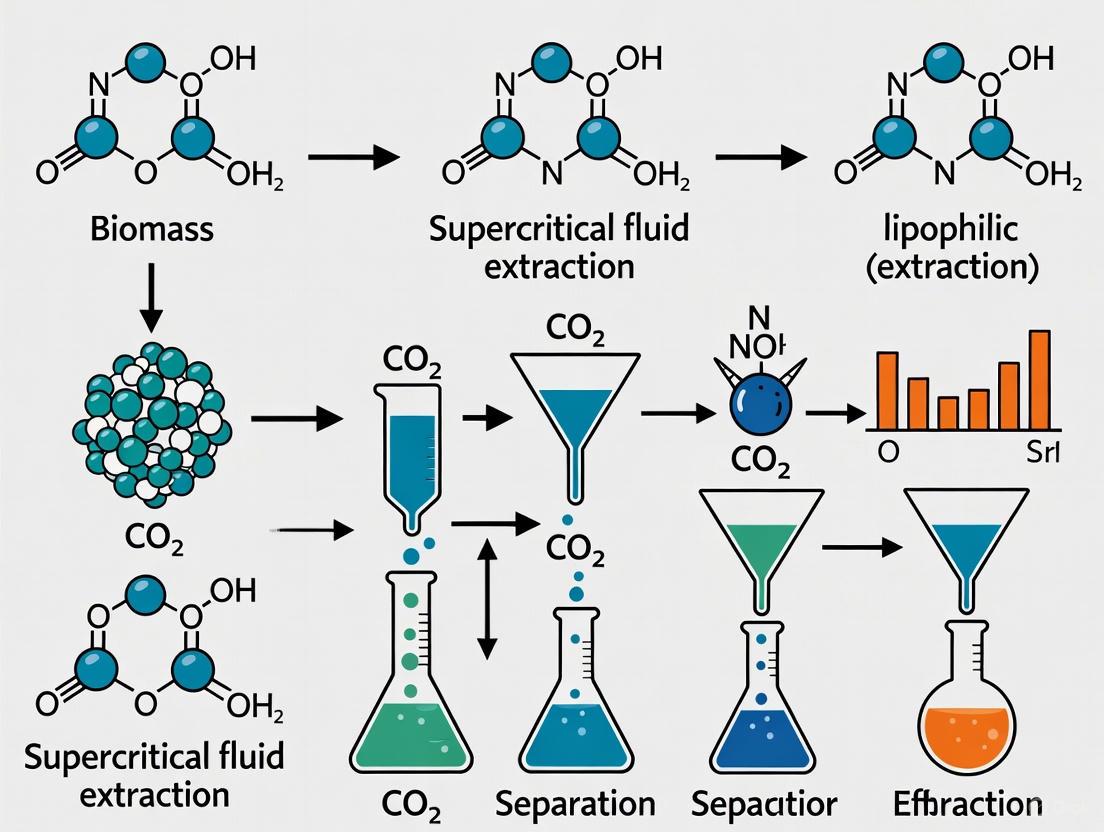
Supercritical fluid extraction (SFE), particularly using carbon dioxide (SC-CO2), has emerged as a sustainable and efficient technology for isolating high-value lipophilic compounds from diverse biomass resources.
Supercritical Fluid Extraction of Lipophilic Compounds from Biomass: A Green Technology for High-Value Bioactive Recovery
Abstract
Supercritical fluid extraction (SFE), particularly using carbon dioxide (SC-CO2), has emerged as a sustainable and efficient technology for isolating high-value lipophilic compounds from diverse biomass resources. This review comprehensively addresses the foundational principles, methodological applications, process optimization, and comparative validation of SFE for researchers and drug development professionals. We explore the unique properties of supercritical fluids that enable selective extraction of lipids, carotenoids, phytosterols, and tocopherols while preserving their bioactivity. The article details operational parameters—pressure, temperature, co-solvents, and flow rates—that critically influence yield and purity, alongside troubleshooting common challenges. By comparing SFE with conventional techniques and highlighting its integration into sequential biorefinery processes, we validate its superiority in extracting thermolabile compounds with minimal environmental impact. The discussion extends to industrial-scale implementation, economic considerations, and future perspectives for adopting SFE in pharmaceutical and nutraceutical development from renewable biomass.
Principles and Potentials: Understanding Supercritical Fluids and Lipophilic Compound Diversity in Biomass
Physicochemical Properties of Supercritical Fluids
A supercritical fluid (SCF) is a substance maintained at temperatures and pressures exceeding its critical point, where distinct liquid and gas phases do not coexist [1]. This state exhibits hybrid properties between those of a liquid and a gas, leading to its unique utility in industrial and laboratory processes, especially the extraction of lipophilic compounds from biomass [2] [3].
The most significant properties include liquid-like densities, which grant SCFs their substantial solvent power, and gas-like low viscosities and high diffusivities, which allow them to penetrate porous solid matrices efficiently [1] [2]. Furthermore, SCFs lack surface tension, and their density—and consequently their solvent strength—can be finely tuned with small changes in pressure and temperature, particularly near the critical point [1].
Table 1: Critical Properties of Common Supercritical Fluids [1]
| Solvent | Molecular Mass (g/mol) | Critical Temperature (K) | Critical Pressure (MPa) | Critical Density (g/cm³) |
|---|---|---|---|---|
| Carbon dioxide (CO₂) | 44.01 | 304.1 | 7.38 | 0.469 |
| Water (H₂O) | 18.015 | 647.096 | 22.064 | 0.322 |
| Ethane (C₂H₆) | 30.07 | 305.3 | 4.87 | 0.203 |
| Propane (C₃H₈) | 44.09 | 369.8 | 4.25 | 0.217 |
| Ethanol (C₂H₅OH) | 46.07 | 513.9 | 6.14 | 0.276 |
Table 2: Comparison of Typical Physical Properties [1] [2]
| Phase | Density (kg/m³) | Viscosity (μPa·s) | Diffusivity (mm²/s) |
|---|---|---|---|
| Gases | ~1 | ~10 | 1–10 |
| Supercritical Fluids | 100–1000 | 50–100 | 0.01–0.1 |
| Liquids | ~1000 | 500–1000 | 0.001 |
Applications in Biomass Research: Extraction of Lipophilic Compounds
Supercritical fluid extraction (SFE) has been recognized as a green and sustainable technique for obtaining lipophilic bioactive compounds from various plant byproducts and lignocellulosic biomass [4] [5]. Its primary purpose is the selective isolation and recovery of high-quality extracts, with augmented purity and concentration of target compounds, while eliminating the need for hazardous organic solvents [4].
In the context of biomass research, SFE is highly effective for extracting a range of lipophilic compounds, including:
- Essential oils and fragrances from flowers and herbs [1] [4].
- Lipids, fatty acids, sterols, and resins from wood waste and sawdust [5].
- Antioxidants such as tocopherols (Vitamin E), polyphenols, and carotenoids from fruit and vegetable byproducts [4] [6] [3].
- Cannabinoids (e.g., CBD, THC) from industrial hemp [7].
A key application is the substitution of synthetic antioxidants and antimicrobials in food and pharmaceutical products. For instance, supercritical extracts from plants like rosemary, sage, and oregano, rich in terpenoids and phenylpropanoids, can be used as natural additives in meat products to prevent lipid and protein oxidation and inhibit microbial growth [6].
Experimental Protocols for SFE of Lipophilic Compounds from Biomass
Standard SFE Protocol Using CO₂
This protocol outlines the optimized procedure for extracting lipophilic compounds from pinewood sawdust, a common lignocellulosic biomass [5].
1. Biomass Preparation:
- Obtain biomass (e.g., Pinus patula sawdust).
- Grind the biomass using a Willey mill.
- Sieve to a uniform particle size of 425 μm.
- Measure and record the moisture content using a moisture balance. Store at 4°C until use.
2. SFE System Setup and Operation:
- Ensure the SFE system is equipped with a CO₂ pump, co-solvent pump, cooling unit, preheater, extraction vessel, back-pressure regulator, and collection vessel(s) [8] [3].
- Cool the CO₂ supply to maintain it as a liquid (e.g., below 5°C) before pumping [8].
- Load the prepared biomass into the extraction vessel.
- Set the operational parameters to the optimized conditions [5]:
- Temperature: 50 °C
- Pressure: 300 bar (30 MPa)
- CO₂ Flow Rate: 3.2 mL/min
- Co-solvent Flow Rate: 2 mL/min (using ethanol, 99.6%)
- Initiate the extraction. The liquid CO₂ is pumped, heated to supercritical conditions, and passed through the biomass matrix, dissolving the target lipophilic compounds.
- The loaded solvent is then passed through a back-pressure regulator into a collection vessel at lower pressure, causing the extracts to precipitate.
- The CO₂ can be recycled or vented.
3. Extract Collection and Analysis:
- Collect the precipitated extract from the collection vessel.
- The extracted lipophilic compounds can be characterized using techniques such as Pyrolysis-Gas Chromatography-Mass Spectrometry (Py-GC/MS), Fourier Transform Infrared (FTIR) spectroscopy, and Thermogravimetric Analysis (TGA) [5].
Protocol Modifications: Use of Co-Solvents
The solvent power of pure supercritical CO₂ is limited for more polar compounds. The incorporation of co-solvents (modifiers) like ethanol, methanol, or water can significantly enhance the extraction efficacy and selectivity for specific bioactive moieties [4].
Procedure:
- Select a food-grade, safe co-solvent such as ethanol for biomass intended for food or pharmaceutical applications [4] [9].
- Use a co-solvent pump to introduce the modifier into the supercritical CO₂ stream at a defined flow rate (e.g., 2 mL/min as in the protocol above) [5] [3].
- Co-solvents like ethanol increase the solubility of polar molecules (e.g., certain polyphenols) and can reduce the required process temperature and pressure [4].
Workflow and Process Optimization Diagrams
The Scientist's Toolkit: Research Reagent Solutions
Table 3: Essential Materials and Equipment for SFE Research
| Item | Function/Application | Example/Specification |
|---|---|---|
| Supercritical CO₂ | Primary solvent for extraction; non-toxic, non-flammable, and easily recyclable [4] [3]. | Food-grade or research-grade liquid CO₂. |
| Co-solvents | Enhance solubility of polar compounds and improve process selectivity [4]. | Ethanol (food-grade), Methanol, Water, Acetone. |
| Biomass Sample | The raw material from which lipophilic compounds are extracted. | Pinewood sawdust [5], rice husk [10], herbal dust [6], industrial hemp [7]. |
| CO₂ Pump | Pumps liquid CO₂ to the required high pressure. | Diaphragm or reciprocating pump with pump head cooling [8]. |
| Co-solvent Pump | Precisely introduces modifiers into the supercritical CO₂ stream. | High-pressure liquid chromatography (HPLC) pump. |
| Extraction Vessel | Contains the biomass sample and withstands high pressure and temperature. | Pressure vessel with quick-release fittings; typically rated for 350-800 bar [8]. |
| Back-Pressure Regulator (BPR) | Maintains system pressure upstream by providing a restriction. | Automated BPR for precise control; requires heating to prevent freezing [8] [3]. |
| Collection Vessel | Collects the precipitate after the pressure is reduced. | Vessel at atmospheric pressure or a series of vessels with descending pressures for fractionation [8]. |
Fundamental Properties and Principles
Supercritical carbon dioxide (scCO₂) is a state of carbon dioxide that exists above its critical temperature of 31.1 °C and critical pressure of 73.8 bar (7.38 MPa) [11] [12] [13]. In this supercritical state, CO₂ exhibits unique physicochemical properties that are intermediate between those of a liquid and a gas, making it an exceptional solvent for green extraction technologies [14] [15].
The solvation power of scCO₂ is highly tunable and predominantly governed by its density, which can be precisely controlled through adjustments in pressure and temperature [11] [14]. This tunability allows for selective extraction of target compounds. Its solvent power is similar to that of n-hexane, making it particularly suited for non-polar to moderately polar lipophilic compounds [14] [16]. The low viscosity and high diffusivity of scCO₂ facilitate superior matrix penetration compared to conventional liquid solvents, resulting in faster extraction rates and more efficient mass transfer [14] [17].
Table 1: Property Comparison of Supercritical CO₂, Liquids, and Gases
| Property | Supercritical CO₂ | Liquid Solvent (e.g., Hexane) | Gaseous Solvent (e.g., N₂) |
|---|---|---|---|
| Density (kg/m³) | Liquid-like (200-900) [14] | High (600-800) | Low (<100) |
| Viscosity (Pa·s) | Gas-like (0.1-0.9 ×10⁻⁴) [17] | High (2-30 ×10⁻⁴) [17] | Very Low (0.1-0.3 ×10⁻⁴) [17] |
| Diffusivity (cm²/s) | High (0.2-0.7 ×10⁻³) [17] | Low (<0.005 ×10⁻³) [17] | Very High (0.1-0.4 ×10⁻³) [17] |
| Solvent Power | Tunable with P/T [11] | Fixed | Generally Low |
| Typical Residual Solvent | Minimal/None [4] [17] | Potential Residue | None |
Application Notes: Extraction of Lipophilic Compounds from Biomass
Supercritical CO₂ extraction has proven highly effective for isolating a wide spectrum of lipophilic compounds from various biomass sources. Its application is a cornerstone of green chemistry in the pharmaceutical, nutraceutical, and food industries [4] [17] [15].
scCO₂ is ideal for extracting non-polar molecules due to its own low polarity. Common target compounds include essential oils, fixed oils (such as triglycerides), waxes, sterols, alkaloids, resins (e.g., cannabinoids), fat-soluble vitamins (e.g., Vitamins A, D, E, K), and antioxidants like carotenoids and tocopherols [4] [16] [15]. These compounds can be efficiently recovered from diverse biomass matrices, including plant leaves and flowers (e.g., hops, rosemary, cannabis), seeds (e.g., sunflower, soybean), fruit peels and pomace, algae, and microbial biomass [4] [16].
Advantages Over Conventional Methods
The primary advantage of scCO₂ over organic solvents like hexane or dichloromethane is its environmental and operational safety. It is non-toxic, non-flammable, and readily available [4] [17]. The extraction process occurs at low temperatures, preventing the thermal degradation of sensitive bioactive compounds [4]. Furthermore, the separation of the extract from the solvent is simplified and energy-efficient; upon depressurization, CO₂ reverts to a gas, leaving behind a high-purity, solvent-free extract [17] [13]. The selectivity of the process can be finely tuned by manipulating pressure and temperature, enabling targeted fractionation of compound classes directly during the extraction process [11] [16].
Experimental Protocols
Standard Operating Procedure for scCO₂ Extraction
This protocol describes a batch-scale supercritical fluid extraction for obtaining lipophilic compounds from dried and milled plant biomass.
Principle: The method leverages the tunable solvating power of scCO₂ to dissolve and transport lipophilic compounds from a solid biomass matrix through a pressurized system, followed by separation via controlled depressurization.
The Scientist's Toolkit: Essential Research Reagents & Materials
| Item | Function/Explanation | Example/Note |
|---|---|---|
| scCO₂ Extraction System | High-pressure system comprising pump, extraction vessel, heater, separator, and CO₂ reservoir. | Systems range from small-scale (≤15 L) to large-scale (>200 L) [18] [19]. |
| Food/Grade CO₂ | Source of supercritical fluid solvent. | Generally Recognized As Safe (GRAS) by the FDA [12]. |
| Co-solvent (e.g., Ethanol) | Modifier to increase polarity of scCO₂ for better extraction of mid-polarity compounds [4] [17]. | Must be HPLC grade; typically added at 5-10% (v/v). |
| Biomass Sample | Source of target lipophilic compounds. | Must be dried and milled to a consistent particle size (e.g., 0.2-0.5 mm) to ensure efficient extraction. |
| Inert Packing Material | (e.g., glass beads) Used to fill dead volume in the extraction vessel, improving flow dynamics. | - |
Procedure:
- Sample Preparation: The biomass (e.g., plant material) must be dried to a moisture content of less than 10% and milled to a consistent particle size (e.g., 0.2-0.5 mm) to ensure efficient diffusion of scCO₂ and to prevent channeling [17].
- System Loading: The prepared biomass is evenly packed into the extraction vessel. Any void volume in the vessel should be filled with an inert packing material like glass beads to minimize solvent hold-up and improve flow dynamics.
- System Pressurization and Heating: The system is sealed, and the temperature of the extraction vessel and downstream lines is set. CO₂ is pumped into the system until the desired operating pressure is achieved. The system is allowed to stabilize at the set temperature and pressure for a brief period (e.g., 15-20 minutes).
- Dynamic Extraction: CO₂ is continuously pumped through the extraction vessel at a constant flow rate. The scCO₂ solubilizes the target lipophilic compounds and carries them out of the vessel into one or more downstream separators.
- Separation and Collection: In the separator, the pressure and/or temperature are controlled to be lower than in the extraction vessel. This reduction in solvent power causes the dissolved compounds to precipitate out of the CO₂ stream and be collected. The now-clean CO₂ can be vented or recompressed and recycled in a closed-loop system [17] [16].
- System Depressurization and Shutdown: After the predetermined extraction time, the CO₂ flow is stopped. The system is slowly and carefully depressurized according to the manufacturer's guidelines. The extract is collected from the separator, and the spent biomass is removed from the extraction vessel.
Workflow Diagram:
Parameter Optimization and Fractionation Protocol
A key advantage of scCO₂ is the ability to fine-tune the process for selectivity. This can be achieved through a cascade fractionation setup using multiple separators in series.
Table 2: Optimization of Key Operational Parameters
| Parameter | Effect on Extraction | Typical Range for Lipophilics | Optimization Guideline |
|---|---|---|---|
| Pressure | Primary control for solvent power/density. Higher pressure increases density and solvating power, allowing dissolution of larger molecules [11] [14]. | 80 - 400 bar [16] | Start at lower pressures (e.g., 80-150 bar) for volatile oils; increase to 250-400 bar for heavier lipids, waxes, and resins [16]. |
| Temperature | Dual effect: increases solute vapor pressure (enhancing solubility) but decreases fluid density (reducing solubility). The net effect depends on the pressure [14]. | 35 - 80 °C | At constant higher pressures (>250 bar), increasing temperature generally increases yield. Near the critical point, the effect is more complex [11]. |
| CO₂ Flow Rate | Affects the kinetics and mode of extraction. A higher flow rate increases the mass transfer rate but may reduce contact time efficiency. | 0.5 - 5 kg/hr (lab-scale) | Optimize for a balance between extraction time and CO₂ consumption. Ensure flow is not so high that it causes channeling in the biomass bed. |
| Extraction Time | Determines process completion. Yield increases with time until the extractable material is depleted. | 30 min - 4 hours | Dependent on flow rate and sample mass. Typically continues until the yield vs. time curve reaches a plateau. |
| Co-solvent | Modifies the polarity of scCO₂, dramatically improving the solubility of more polar lipids (e.g., phospholipids, glycosides) [4] [17]. | 1 - 15% (v/v) | Ethanol (5-10%) is most common for food/pharma applications. Methanol and acetone are also used. |
Cascade Fractionation Workflow: A sophisticated application involves connecting two or more separators in series, each at sequentially lower pressures (and sometimes different temperatures). As the scCO₂ stream expands step-wise, different compound classes precipitate in different vessels based on their solubility. For instance, in hop extraction, volatile aromas might be collected in the first separator at 100 bar and 15°C, while harder resins are collected in a second separator at 50 bar and 40°C [16].
Scaling and Economic Considerations
Transitioning from laboratory to industrial scale is a critical step. Industrial-scale scCO₂ extractors can have vessel volumes exceeding 200 liters [18] [19]. While the fundamental principles remain unchanged, scale-up requires careful engineering to manage heat and mass transfer across larger volumes. The global market for supercritical CO₂ extraction equipment is experiencing robust growth, with a projected compound annual growth rate (CAGR) of 7-9% through 2030 [18] [19]. This growth is driven by rising demand for natural products, stringent regulations on organic solvent residues, and the technology's inherent sustainability. The primary challenge remains the high initial capital investment for high-pressure equipment. However, this is often offset by lower operational costs (especially with closed-loop CO₂ recycling), reduced solvent purchases, and the ability to produce high-value, solvent-free extracts for premium markets [4] [17] [19].
Parameter Relationships Diagram:
Supercritical fluid extraction (SFE), particularly using carbon dioxide (CO₂), has emerged as a cornerstone technology for the sustainable and selective recovery of lipophilic compounds from various biomass feedstocks [20]. As a green alternative to conventional solvent-based techniques, SFE leverages the unique physicochemical properties of supercritical CO₂ (scCO₂)—which combines gas-like diffusivity with liquid-like solvating power—to isolate high-value compounds under mild and tunable conditions [20]. This application note provides a comprehensive guide to the major lipophilic compound classes accessible via SFE, including fatty acids, phytosterols, carotenoids, tocopherols, and resins. It further details optimized protocols for their extraction, targeted at researchers and scientists engaged in developing nutraceuticals, pharmaceuticals, and functional food ingredients. The integration of SFE within biorefinery concepts supports the advancement of a circular bioeconomy, transforming agricultural and microbial residues into high-purity, functional products with minimal environmental impact [20] [21].
Major Lipophilic Compound Classes in Biomass
Biomass is a rich source of diverse lipophilic bioactive compounds, each with distinct chemical structures and health benefits. Their extraction efficiency and stability are highly dependent on the selected method and process parameters [22].
Table 1: Major Lipophilic Compound Classes in Biomass: Sources and Health Benefits
| Compound Class | Key Examples | Primary Biomass Sources | Reported Health Benefits |
|---|---|---|---|
| Fatty Acids | Linoleic acid, α-Linolenic acid, Punicic acid, Paullinic acid [23] [24] [25] | Black currant, Perilla, Pomegranate, Paullinia elegans seeds [23] [24] | Cardiovascular health, anti-inflammatory, skin barrier function [23] |
| Phytosterols | β-Sitosterol, Campesterol, Stigmasterol [22] | Soybean, Avocado, Guarea guidonia seeds, Lucuma seeds [22] [24] [25] | Cholesterol-lowering, anti-inflammatory, prostate health [22] |
| Carotenoids | Lutein, β-Carotene, Lycopene, Fucoxanthin [22] [21] [26] | Spinach, Tomato, Brown seaweeds, microalgae (e.g., Coccomyxa onubensis) [22] [26] | Antioxidant, eye health (macular degeneration), anticancer [22] [26] |
| Tocopherols & Tocotrienols (Vitamin E) | α-Tocopherol, γ-Tocopherol, γ-Tocotrienol [24] | Seeds of Allophylus puberulus, Guarea guidonia, Paullinia elegans [24] | Antioxidant, neuroprotective, skin health [24] |
| Resins & Polyphenolic Lipophilics | Tannins (e.g., ellagitannins, phlorotannins) [27] | Quebracho wood, Mimosa bark, Brown macroalgae [27] | Antioxidant, antimicrobial, protein-binding (tanning) [27] |
Supercritical Fluid Extraction as a Selective Tool
Advantages of SFE for Lipophilic Compound Recovery
SFE offers several critical advantages over traditional solvent extraction (e.g., Soxhlet) for lipophilic compounds:
- Green and Sustainable: scCO₂ is non-toxic, non-flammable, and eliminates the use of harmful organic solvents [6] [25].
- Selectivity and Tunability: By modulating pressure and temperature, the solvating power of scCO₂ can be finely tuned to target specific compound classes [20] [27].
- Preservation of Bioactivity: The mild operating conditions (e.g., low oxygen exposure and moderate temperatures) help preserve the structural integrity and bioactivity of thermally sensitive molecules like carotenoids and polyunsaturated fatty acids (PUFAs) [20] [26].
- No Solvent Residues: The final extracts are free of toxic solvent residues, making them ideal for food, pharmaceutical, and cosmetic applications [20] [6].
Key Parameters Influencing SFE Efficiency
The yield and composition of SFE extracts are primarily controlled by the following parameters:
- Pressure: Increasing pressure enhances the density of scCO₂, thereby increasing its solvating power and improving the recovery of heavier molecules like triglycerides and carotenoids [28] [26] [25].
- Temperature: Temperature has a dual effect; it decreases scCO₂ density but increases the vapor pressure of target compounds. An optimal balance is required for maximum yield [26] [25].
- Co-solvent Modifiers: The addition of small amounts (typically 5-15%) of polar co-solvents like ethanol can significantly improve the extraction efficiency of more polar lipophilic compounds, such as certain phytosterols and polyphenolics [28] [26] [27].
- CO₂ Flow Rate and Extraction Time: These parameters affect the kinetics of the extraction process and are crucial for process economics and scalability [25].
Detailed SFE Protocol for Lipophilic Compounds from Plant Seeds
This optimized protocol for extracting lipophilic compounds from plant seeds (e.g., lucuma) is based on response surface methodology (RSM) and artificial neural network (ANN) modeling [25].
The Scientist's Toolkit: Essential Research Reagents and Equipment
Table 2: Key Research Reagent Solutions and Equipment for SFE
| Item | Function/Application | Example Specifications / Notes |
|---|---|---|
| Supercritical Fluid Extractor | Core system for performing extractions. | Must include high-pressure pump, co-solvent pump, extraction vessel, pressure and temperature controllers, and separator. |
| CO₂ Supply | Primary extraction solvent. | Food-grade or higher (99.95% purity) to prevent contamination [26]. |
| Ethanol (Absolute) | Green polar co-solvent. | Used to modify scCO₂ polarity for enhanced yield of polar lipids [28] [25]. |
| Analytical Mill | Biomass particle size reduction. | Equipped with cooling to avoid thermal degradation (e.g., IKA A-11 basic) [26]. |
| Laboratory Oven | Drying of biomass prior to extraction. | Forced convection oven capable of maintaining 60°C. |
| Sieving Apparatus | Standardization of biomass particle size. | Sieve shaker with standardized mesh sizes (e.g., 0.5 mm) [26] [25]. |
Step-by-Step Experimental Workflow
Biomass Preparation
- Raw Material: Obtain mature plant seeds (e.g., lucuma, Ammodaucus leucotrichus).
- Drying: Dry the seeds in an electric oven at 60°C for approximately 16 hours or until a moisture content of ~5% is achieved [25].
- Milling and Sieving: Grind the dried seeds using an analytical mill and sieve the powder to a homogeneous particle size (e.g., 0.5 mm) to ensure consistent extraction kinetics [26] [25].
SFE System Setup and Operation
- Extraction Vessel Packing: Accurately weigh the prepared biomass (e.g., 5-50 g depending on vessel capacity) and load it into the extraction vessel.
- Parameter Setting: Based on optimization studies, set the SFE unit to the following conditions [28] [26] [25]:
- Pressure: 300 bar
- Temperature: 45-70 °C
- CO₂ Flow Rate: 6 mL/min
- Co-solvent (Ethanol): 0-15% (v/v)
- Dynamic Extraction: Initiate the CO₂ and co-solvent flow. Conduct the dynamic extraction for a predetermined time (e.g., 60-120 minutes), often determined by an overall extraction curve.
- Collection: The extract-laden scCO₂ is passed through a depressurization valve into a separator, where the pressure is reduced, causing the solutes to precipitate. Collect the lipophilic extract in a dark glass vial and store at -18°C until analysis [25].
Extract Analysis
- Gravimetric Analysis: Determine the global extraction yield by the mass of oil obtained per mass of dry biomass [25].
- GC-MS/FID: Analyze the fatty acid profile after derivatization to Fatty Acid Methyl Esters (FAMEs) [24] [25].
- HPLC-DAD/FLD: Quantify tocopherols, tocotrienols, carotenoids (e.g., lutein), and phytosterols [26] [24].
- Spectrophotometry: Determine total phenolic content (Folin-Ciocalteu method) and antioxidant activity (e.g., DPPH, ABTS assays) [28] [26] [25].
Figure 1: SFE Experimental Workflow. This diagram outlines the key stages in the supercritical fluid extraction of lipophilic compounds from biomass.
SFE Optimization and Advanced Biorefinery Concepts
Optimization Using Statistical and Computational Models
Achieving maximum yield and selectivity requires systematic optimization of SFE parameters.
- Response Surface Methodology (RSM): A Box-Behnken Design (BBD) is highly effective for modeling the interactive effects of pressure, temperature, and co-solvent percentage on extraction yield and bioactivity [28] [25]. For instance, optimal conditions for lutein recovery from microalgae were identified as 70 °C, 40 MPa, and 50% ethanol [26].
- Artificial Neural Networks with Genetic Algorithms (ANN+GA): This advanced computational approach has demonstrated superior performance over RSM in some cases, providing a higher coefficient of determination (R² = 0.9999) for predicting optimal conditions for lucuma seed oil extraction [25].
Integrated Biorefinery and Sequential Extraction
To fully valorize biomass, a sequential extraction approach within a biorefinery framework is recommended.
- Concept: After initial SFE of lipophilic compounds (oils, carotenoids), the residual biomass can be subjected to a second extraction step using a different technique, such as Pressurized Liquid Extraction (PLE) with water or ethanol, to recover polar bioactive compounds like phenolics [28].
- Benefit: This cascading approach has been shown to yield extracts with higher phenolic content and enhanced antioxidant activity compared to single-step extractions, ensuring minimal waste and maximizing resource efficiency [28].
Figure 2: Sequential Biorefinery Concept. A cascading extraction process for complete valorization of biomass components.
Application of SFE Extracts in Industry
SFE-derived lipophilic compounds find diverse applications across multiple industries:
- Food & Nutraceuticals: Omega-3 PUFAs from microalgae and phytosterols from seeds are used in functional foods and dietary supplements for their cardiovascular and cholesterol-lowering benefits [21] [6].
- Pharmaceuticals & Cosmetics: Carotenoids like lutein and β-carotene are used in ocular health supplements and skincare products for their antioxidant and UV-protective properties [22] [26] [23]. Tannin extracts serve as active ingredients in pharmaceuticals due to their antioxidant and anti-inflammatory activities [27].
- Material Science & Industrial Products: Tannins are used as bio-based adhesives, resins, and water treatment coagulants, replacing hazardous synthetic chemicals [27]. Seed oils rich in unusual fatty acids (e.g., paullinic acid) are explored for biodiesel and oleochemical production [24].
In the field of supercritical fluid extraction (SFE) of lipophilic compounds from biomass, predicting and correlating solute solubility is a fundamental challenge. The solubility of a solid solute in a supercritical fluid (SCF) is governed by complex thermodynamic relationships and phase behavior. Among SCFs, supercritical carbon dioxide (SC-CO₂) is the predominant solvent used due to its mild critical conditions (Tc = 304.25 K, Pc = 7.39 MPa), low toxicity, and environmental acceptability [29] [30]. For researchers and drug development professionals, accurately modeling this solubility is crucial for the design, optimization, and scale-up of SFE processes, as well as for advanced applications such as particle size engineering of poorly water-soluble Active Pharmaceutical Ingredients (APIs) [31] [32].
The core thermodynamic framework establishes that at equilibrium, the fugacity of the solid solute in its pure solid phase equals its fugacity in the supercritical fluid phase [33]. This relationship leads to the following expression for the solubility of a solid in an SCF:
$$y2 = \frac{P2^{sub}}{P \phi2} \exp\left[\frac{V2^s (P - P_2^{sub})}{RT}\right]$$
Here, (y2) is the mole fraction solubility of the solute, (P2^{sub}) is its sublimation pressure, (φ2) is its fugacity coefficient in the supercritical phase, (V2^s) is its molar volume as a solid, (P) is the system pressure, (R) is the universal gas constant, and (T) is the system temperature [33]. The challenge in applying this equation lies in determining the fugacity coefficient ((φ_2)), which is a measure of the non-ideality of the mixture and is highly dependent on temperature, pressure, and the specific interactions between the solute and CO₂. This is where Equations of State (EOS) become indispensable tools.
Thermodynamic Fundamentals and Solubility Behavior
The Role of Equations of State
Equations of State are mathematical relationships that describe the state of matter under a given set of physical conditions. In the context of SCFs, they are used to calculate the fugacity coefficient of a solute in the supercritical phase. The choice of EOS and its associated mixing rules significantly impacts the accuracy of solubility predictions. The fugacity coefficient is typically calculated using an EOS via the following general equation:
$$\ln \phii = \frac{1}{RT} \int{V}^{\infty} \left[\left(\frac{\partial P}{\partial ni}\right){T,V,n_j} - \frac{RT}{V}\right] dV - \ln Z$$
where (Z) is the compressibility factor [33]. The integration requires an EOS to relate the variables (P), (V), and (T).
Characteristic Solubility Trends
The solubility of a solid solute in SC-CO₂ exhibits distinct and reproducible trends with changes in pressure and temperature, which are directly linked to the solvent's density and the solute's vapor pressure.
- Pressure Effect: At a constant temperature, solubility typically increases sharply with increasing pressure, especially in the critical region of CO₂. This is primarily due to the exponential increase in solvent density with pressure, which enhances its solvating power [32].
- Temperature Effect: The influence of temperature is more complex and gives rise to a characteristic "crossover pressure" phenomenon.
- At lower pressures (below the crossover region), an increase in temperature decreases the solvent density, reducing solubility.
- At higher pressures (above the crossover region), the solute's vapor pressure becomes the dominant factor. An increase in temperature significantly raises the vapor pressure, leading to an increase in solubility [32].
- Cosolvent Effect: The addition of small amounts of a polar cosolvent (e.g., ethanol, methanol) can dramatically enhance the solubility of polar or high-molecular-weight solutes. Cosolvents interact specifically with solute molecules, increasing the polarity of the SC-CO₂ and facilitating the extraction of more hydrophilic compounds [29] [33].
Prominent Equations of State and Correlative Models
Several classes of models are employed to correlate and predict solid solute solubility in SC-CO₂, each with its own advantages, limitations, and appropriate application domains.
Cubic Equations of State
Cubic EOS are widely used in industrial process design due to their relative simplicity and reasonable accuracy.
- Peng-Robinson (PR) and Soave-Redlich-Kwong (SRK): These are the two most common cubic EOS. They require critical properties (Tc, Pc), acentric factor (ω) of the solute, and appropriate mixing rules to describe binary interactions [33] [32]. The PR EOS is often preferred for its better performance in liquid density calculations.
- Predictive SRK (PSRK): This is an advanced version of the SRK EOS that combines it with the UNIFAC group contribution model through a specific mixing rule. This allows for the prediction of phase equilibria, including solid-SCF equilibria, using only group contribution parameters, which is particularly valuable when experimental binary interaction parameters are unavailable [33].
Semi-Empirical Density-Based Models
These models correlate solubility directly with the density of SC-CO₂, bypassing the need for solute physical properties.
- Chrastil Model: One of the earliest and most cited models, it links solubility to solvent density and temperature with three adjustable parameters [31] [34].
- Bartle et al. Model: This model provides an expression that relates the solubility mole fraction to density and the sublimation pressure of the solute [31].
- Méndez-Santiago and Teja (MST) Model: This model is based on the theory of dilute solutions and is widely used to test the self-consistency of experimental solubility data [31] [32].
A novel six-parameter density-based model demonstrated a remarkable overall average absolute relative deviation (AARD) of 8.13% when tested on a database of 100 drugs encompassing 2891 experimental data points, indicating strong global correlation performance [34].
Advanced Equations of State
For systems requiring higher accuracy, more complex, non-cubic EOS are available.
- Perturbed-Chain Statistical Associating Fluid Theory (PC-SAFT): This EOS is based on statistical mechanics and considers molecules as chains of spherical segments with specific interaction potentials. It is particularly effective for describing complex molecules and polymers, often providing superior correlation results compared to cubic EOS, but at the cost of greater computational complexity and a higher number of substance-specific parameters [31].
Table 1: Summary of Key Models for Correlating Solute Solubility in SC-CO₂
| Model Category | Model Name | Key Inputs | Key Output | Advantages | Limitations |
|---|---|---|---|---|---|
| Cubic EOS | Peng-Robinson (PR) | Tc, Pc, ω of solute, mixing rule parameters | Fugacity coefficient, solubility | Relatively simple, widely implemented in software | Requires critical properties, accuracy depends on mixing rules |
| Cubic EOS | Predictive SRK (PSRK) | Group contribution parameters, melting properties | Fugacity coefficient, solubility | Predictive; does not require experimental binary data | Accuracy can be lower than correlated EOS |
| Semi-Empirical | Chrastil | Solvent density, temperature | Solubility | Simple, no solute properties needed | Correlative, requires experimental data to fit parameters |
| Semi-Empirical | MST | Solvent density, temperature, pressure | Solubility | Useful for testing data self-consistency | Correlative, requires experimental data |
| Advanced EOS | PC-SAFT | Pure-component parameters for chain, segment, etc. | Fugacity coefficient, solubility | High accuracy for complex molecules | Computationally intensive, parameter estimation is non-trivial |
Experimental Protocol for Solubility Measurement
A standard dynamic flow method is employed for the experimental determination of solid solute solubility in SC-CO₂. The following protocol details the key steps and considerations.
Materials and Equipment
- Solute: High-purity solid compound (e.g., palbociclib, sulfasalazine). Purity should be verified via HPLC or similar techniques [31] [32].
- Solvent: Food-grade or higher purity carbon dioxide (≥ 99.5%) [31] [32].
- Cosolvent (if used): HPLC or analytical grade, such as ethanol [29].
- Apparatus: A typical setup consists of:
- CO₂ Cylinder and Chiller Unit: To liquefy CO₂ for efficient pumping.
- High-Pressure Pump: To deliver CO₂ at a constant flow rate and compress it to the desired extraction pressure.
- Oven: A thermostatically controlled chamber to house the equilibrium cell.
- Equilibrium Cell (Solubility Column): A high-pressure vessel where the solute is packed, often mixed with glass beads to prevent channeling and ensure efficient contact [32].
- Back-Pressure Regulator: To maintain constant system pressure.
- Sample Collection System: Involves trapping the solute from the expanded CO₂ stream in a solvent like Dimethyl Sulfoxide (DMSO) [32] or on a solid adsorbent [31].
- Analytical Instrument: UV-Vis Spectrophotometer or HPLC for quantifying the amount of solute collected [31] [32].
Table 2: Research Reagent Solutions for SFE Solubility Experiments
| Item | Typical Specification | Function in Experiment |
|---|---|---|
| Carbon Dioxide (CO₂) | Purity ≥ 99.5% | The primary supercritical solvent; its density and solvating power are the key variables under study. |
| Solid Solute (e.g., API) | Purity ≥ 99.0% | The compound whose solubility is being measured; high purity is critical for accurate quantification. |
| Cosolvent (e.g., Ethanol) | Analytical Grade | A modifier added in small quantities to alter the polarity of SC-CO₂ and enhance solute solubility. |
| Collection Solvent (e.g., DMSO) | Analytical Grade | A solvent used to trap the solute after the supercritical mixture is depressurized for subsequent analysis. |
| Glass Beads | Inert, diameter ~2 mm | Used to mix with the solid solute in the equilibrium cell to improve flow distribution and prevent compaction. |
Step-by-Step Procedure
- Sample Preparation: The solid solute is finely ground and homogeneously packed into the equilibrium cell, often mixed with inert glass beads. The exact mass of the solute is recorded [32].
- System Pre-equilibration: The equilibrium cell is placed in the oven and brought to the desired experimental temperature. Liquid CO₂ is pumped through the system until the target temperature and pressure are stable. The system is typically maintained under static conditions (no flow) for a predetermined period (e.g., 60-240 minutes) to ensure equilibrium is reached between the solid solute and SC-CO₂ [31] [32].
- Dynamic Sampling: After equilibrium is attained, SC-CO₂ is allowed to flow dynamically through the cell at a very low flow rate to avoid disturbing equilibrium. The solute-saturated SC-CO₂ is then passed through a back-pressure regulator, where depressurization causes the solute to precipitate.
- Solute Collection: The precipitated solute is collected in a vial containing a known volume of trapping solvent (e.g., DMSO). The collection time and CO₂ flow rate are precisely measured [32].
- Quantitative Analysis: The amount of solute collected is determined analytically. For UV-Vis, the concentration in the trapping solvent is measured against a pre-established calibration curve. The mole fraction solubility ((y2)) is calculated using the equations [32]: (n2 = \frac{C2 \times Vs}{M2}) (n1 = \frac{\rho1 \times Vl}{M1}) (y2 = \frac{n2}{n1 + n2}) where (C2) is the solute concentration (g/L), (Vs) is the solution volume (L), (M2) is the solute molecular weight (g/mol), (ρ1) is the SC-CO₂ density (g/L) at system T and P, (Vl) is the volume (L) of saturated SC-CO₂ sampled, and (M_1) is the molecular weight of CO₂.
- Replication and Validation: Measurements should be performed in triplicate at each temperature and pressure condition. The reliability of the entire apparatus and procedure is often validated by measuring the solubility of a well-known reference compound (e.g., naphthalene) and comparing the results with established literature data [32].
The following workflow diagram illustrates the experimental and modeling process.
Figure 1: Workflow for Measuring and Modeling Solubility in SC-CO₂
Application in Biomass and Pharmaceutical Research
The principles and protocols described herein are directly applicable to the core thesis of SFE of lipophilic compounds from biomass.
- Extraction from Microbial Biomass: SFE is successfully used to extract functional lipophilic compounds from microalgae and cyanobacteria, such as Arthrospira platensis (Spirulina). The solubility of target compounds (e.g., γ-linolenic acid, carotenoids, tocopherols) in SC-CO₂ dictates the extraction yield and can be optimized by tuning pressure, temperature, and cosolvent addition [35].
- Overcoming Biomass Recalcitrance: Lipophilic compounds in biomass are often contained within complex cellular matrices. The adsorption of extracts onto this matrix can reduce apparent solubility and yield. Higher extraction pressures can diminish this adsorption capacity, making the process more dependent on the true solubility in SC-CO₂ [36].
- Pharmaceutical Particle Engineering: For poorly water-soluble drugs like palbociclib and sulfasalazine, knowing their solubility in SC-CO₂ is the first step in manufacturing micro- and nano-particles using techniques like Rapid Expansion of Supercritical Solutions (RESS) or Supercritical Anti-Solvent (SAS) precipitation. These processes can significantly enhance the bioavailability of APIs [31] [32].
Understanding the thermodynamics and phase behavior governing solute solubility in supercritical fluids, particularly SC-CO₂, is fundamental to advancing research in biomass extraction and drug development. While the underlying equilibrium thermodynamics provide a solid theoretical foundation, the practical application relies heavily on the use of robust correlative and predictive models. Cubic Equations of State like Peng-Robinson offer a good balance of simplicity and accuracy for process design, while semi-empirical models are invaluable for efficiently correlating experimental data. Advanced EOS like PC-SAFT push the boundaries of accuracy for complex molecules. The standardized experimental protocol ensures the generation of reliable, high-quality solubility data, which serves as the critical feedstock for these models. By integrating rigorous thermodynamic modeling with precise experimentation, researchers can effectively optimize SFE processes for the recovery of valuable lipophilic compounds from biomass and engineer novel drug formulations with improved therapeutic performance.
Biomass feedstock diversity refers to the utilization of a wide array of biological materials as inputs for bioenergy and bioproducts, encompassing agricultural residues, forestry byproducts, dedicated energy crops, and various organic waste streams [37]. This diversity is paramount for constructing robust and adaptable bio-based economies, reducing vulnerabilities associated with dependence on limited feedstock options. Within this context, supercritical fluid extraction (SFE) has emerged as a pivotal green technology for the selective recovery of lipophilic compounds from these varied biomasses. SFE, particularly using supercritical carbon dioxide (SC-CO₂), is an advanced technique that offers significant benefits over traditional extraction methods, including higher selectivity, enhanced diffusivity, and superior environmental profile [29]. The technology operates by using a fluid above its critical temperature and pressure, where it exhibits unique properties between a gas and a liquid, enabling efficient penetration of biomass matrices and dissolution of target compounds without the thermal degradation associated with conventional methods [38].
The synergy between diverse biomass feedstocks and SFE technology aligns perfectly with the principles of a circular economy, enabling the valorization of waste streams into high-value products. SC-CO₂ is especially advantageous as it is chemically inert, non-toxic, non-flammable, cost-effective, and easily separable from extracts, making it an ideal solvent for producing food-grade and pharmaceutical-grade extracts [29] [39]. Its solvent power can be precisely tuned by adjusting pressure and temperature, allowing for the selective extraction of specific lipophilic compound classes from the complex and varied composition of different biomass feedstocks [16]. This technical note details the specific applications, optimized protocols, and experimental workflows for leveraging SFE to extract valuable lipophilic compounds from four key biomass categories: microalgae, wood waste, agricultural by-products, and medicinal plants.
Lipophilic Compounds in Diverse Biomass Feedstocks
Lipophilic compounds are less hydrophilic or hydrophobic plant constituents, often referred to as "extractives" or "secondary plant metabolites" [16]. They dissolve in fats, oils, lipids, and non-polar solvents and include a vast array of valuable bioactive molecules. The diversity of biomass feedstocks translates directly to a diversity in the profiles of obtainable lipophilic compounds. Table 1 summarizes the primary lipophilic compounds and their industrial applications sourced from the four focused biomass types.
Table 1: Key Lipophilic Compounds and Applications from Diverse Biomass Feedstocks
| Biomass Category | Specific Feedstock Examples | Key Lipophilic Compounds | Primary Industrial Applications | Citations |
|---|---|---|---|---|
| Microalgae | Dunaliella salina, Spirulina | Carotenoids (Astaxanthin, β-Carotene), Essential Fatty Acids (EPA, DHA), Tocopherols | Nutraceuticals, Pharmaceuticals, Food Colorants, Aquafeed | [38] [39] |
| Wood Waste | Bark from Pine, Oak, & Acacia; Cashew Shells | Tannins (Condensed & Hydrolysable), Resin Acids, Sterols, Waxes, Triterpenoids | Leather Tanning, Adhesives, Bioplastics, Coatings, Cosmetics | [38] [27] [16] |
| Agricultural By-products | Jamun Fruit Pulp, Berry Seeds, Tomato Pomace, Corn Stover | Anthocyanins, Phenolic Acids, Flavonoids, Phytosterols, Tocopherols, Oils | Functional Foods, Antioxidants, Nutraceuticals, Food Ingredients | [40] [39] |
| Medicinal & Aromatic Plants | Herbs, Spices, Aromatic Plants | Essential Oils, Oleoresins, Flavonoids, Phenolic Compounds, Fatty Acids | Pharmaceuticals, Cosmetics, Aromatherapy, Natural Preservatives | [41] [29] |
Experimental Protocols for Supercritical Fluid Extraction
Generalized SFE Workflow from Solid Biomass
The following protocol describes a standard workflow for the extraction of lipophilic compounds from solid biomass feedstocks using a lab-scale SFE system. This general procedure can be adapted for microalgae, powdered plant materials, and other solid by-products.
Principle: Bioactive lipophilic compounds are isolated from a solid biomass matrix using supercritical carbon dioxide, with or without a polar co-solvent, under optimized conditions of pressure and temperature. The solvation power of SC-CO₂ is tuned to selectively extract target compounds, which are then separated from the CO₂ in a collection vessel via depressurization [29].
Materials and Equipment:
- Supercritical Fluid Extractor: System comprising CO₂ cylinder, chiller, pump, oven, extraction vessel, pressure regulators, and separator [29].
- Biomass Feedstock: Pre-treated (dried and milled) plant material, microalgae, or agricultural waste.
- Solvents: SFE-grade carbon dioxide (99.9% purity), Food-grade ethanol or other co-solvents.
- Lab Equipment: Analytical balance, Wiley mill or grinder, sieves, moisture analyzer, storage containers.
Procedure:
- Sample Preparation: The biomass samples must be air-dried or oven-dried to a constant moisture content. The dried material is then milled using a Wiley mill or similar grinder and sieved to obtain a uniform particle size (e.g., 20-40 mesh). Consistent particle size is critical for reproducible extraction yields [42] [43].
- System Preparation: Ensure the SFE system is clean and calibrated. Cool the CO₂ chiller to maintain liquid CO₂ feeding to the pump. Set the oven temperature to maintain the extraction vessel above the critical temperature of CO₂ (31.1°C).
- Extraction Vessel Loading: Weigh a precise amount of the prepared biomass sample (e.g., 10 g). Mix the sample with an inert material like glass wool to prevent channeling and compact it evenly into the extraction vessel [40].
- System Pressurization and Heating: Assemble the extraction vessel into the system. Pressurize the system with CO₂ and heat the vessel to the desired temperature. Allow the system to stabilize under the set conditions (e.g., 50°C and 162 bar).
- Dynamic Extraction: Initiate the flow of SC-CO₂ through the extraction vessel at a constant flow rate. If a co-solvent (e.g., ethanol) is used, it is precisely dosed into the CO₂ stream via an HPLC pump, typically at 5-10% of the total flow [40] [16]. The extraction time is recorded.
- Separation and Collection: The solute-laden SC-CO₂ is passed into a separator where the pressure is reduced, and/or the temperature is changed, causing the solubilized extract to precipitate. The extract is collected in the collection vessel, and the CO₂ is vented or recycled.
- Extract Handling: Weigh the collected extract. Dissolve it in a suitable solvent for analysis or store it in an airtight, dark container at low temperatures to preserve bioactivity.
Critical Parameters:
- Pressure and Temperature: These are the most critical factors, directly affecting SC-CO₂ density and solvation power. Higher pressures generally increase solvent density and yield for less volatile compounds [40] [29].
- Co-solvent: The addition of a polar co-solvent like ethanol significantly enhances the extraction yield of more polar lipophilic compounds, such as polyphenols and anthocyanins [40] [16].
- Particle Size and Moisture: Smaller particle sizes increase the surface area for extraction but can cause compaction. Low moisture content is generally preferred for efficient SC-CO₂ penetration [38].
Optimized Protocol for Anthocyanins from Agricultural By-products
This specific protocol is adapted from research on jamun (Syzygium cumini) fruit pulp, an agricultural by-product, and can be applied to other pigment-rich wastes [40].
Optimized Conditions for Maximum Yield:
- Pressure: 162 bar
- Temperature: 50°C
- Co-solvent: Ethanol at a flow rate of 2.0 g/min
- Biomass Preparation: Fruit pulp dried at 40°C to 6% moisture content (w/w), powdered, and sieved through a 40-mesh sieve.
- Extraction Time: As determined by the extraction yield curve (typically until no more extract is recovered).
Analysis of Extracts:
- Total Monomeric Anthocyanin Content (TMAC): Estimated by the pH differential method. Absorbance of the extract is measured at 510 nm and 700 nm in buffers at pH 1.0 and 4.5. TMAC is calculated as cyanidin-3-glucoside equivalents [40].
- Total Phenolic Content (TPC): Determined by the Folin-Ciocalteu method. Absorbance is measured at 754 nm, and results are expressed as gallic acid equivalents (GAE) [40].
- HPLC Analysis: For identification and quantification of individual anthocyanins and phenolic compounds using a C18 reversed-phase column with a UV-Vis detector [40].
The Scientist's Toolkit: Research Reagent Solutions
Successful implementation of SFE protocols requires specific reagents and equipment. Table 2 lists essential materials and their functions for setting up SFE experiments for biomass lipophilics.
Table 2: Essential Research Reagent Solutions for SFE of Lipophilic Compounds
| Item Name | Function/Application | Technical Notes |
|---|---|---|
| SFE-grade CO₂ | Primary solvent for supercritical extraction. | Supplied in a cylinder with a dip tube; purity ≥99.9% is recommended to prevent clogging and contamination [40]. |
| Food-Grade Ethanol | Polar co-solvent (entrainer) for enhancing yield of polar bioactives. | Completely miscible with SC-CO₂; typically used at 5-10% (v/v) to modify solvent polarity without using toxic solvents [16] [39]. |
| Reference Standards | Quantification and identification of target compounds via HPLC/GC. | e.g., Cyanidin-3-glucoside (for anthocyanins), Gallic acid (for phenolics), Astaxanthin, Fatty Acid Methyl Esters [40]. |
| Solid-Phase Extraction (SPE) Cartridges | Post-extraction clean-up and fractionation of crude SFE extracts. | Used to remove impurities or separate compound classes before analysis [39]. |
| Accelerated Solvent Extractor (ASE) | Complementary/alternative technique for broader polarity range. | Uses liquid solvents at high pressure/temperature for sequential extraction post-SFE defatting [38] [16]. |
| De-ashing Cartridges (for HPLC) | Protection of HPLC columns from salt interference. | Removes salts from samples prior to carbohydrate or organic acid analysis to prevent false signals in refractive index detection [43]. |
SFE Process Workflow and Fractionation Logic
The following diagram illustrates the logical workflow and decision-making process involved in the supercritical fluid extraction of lipophilic compounds from diverse biomass feedstocks, from preparation to final product isolation.
SFE Lipophilic Compound Extraction Workflow
The strategic application of supercritical fluid extraction to a diverse range of biomass feedstocks—including microalgae, wood waste, agricultural by-products, and medicinal plants—provides a powerful, sustainable pathway for valorizing biological resources. The tunability of SC-CO₂ allows researchers to selectively target a wide spectrum of valuable lipophilic compounds, from non-polar oils and waxes to more polar polyphenols and pigments, by optimizing parameters such as pressure, temperature, and co-solvent addition. The detailed protocols and workflows outlined in this application note serve as a foundational guide for researchers and industrial scientists aiming to harness this green technology. By integrating SFE into biomass refining processes, the scientific community can contribute significantly to the development of a circular bioeconomy, transforming low-value waste streams into high-value bioactive ingredients for pharmaceuticals, nutraceuticals, and functional foods.
SFE Methodologies and Biomedical Applications: From Laboratory to Industrial Scale
Within the scope of a thesis on the supercritical fluid extraction (SFE) of lipophilic compounds from biomass, a thorough understanding of the core hardware is fundamental to designing reproducible and efficient experiments. SFE technology leverages supercritical fluids, most commonly carbon dioxide (SC-CO₂), whose tunable solvating power is ideal for extracting non-polar to moderately polar molecules from solid matrices [44] [15]. This application note details the key components of an SFE system—extractors, pumps, pressure vessels, and separation units—providing researchers and scientists in drug development with structured data, detailed protocols, and essential tools for their experimental work.
Core SFE System Components and Their Functions
The efficiency of SFE in isolating lipophilic compounds hinges on the integrated operation of its primary components. The system functions by pressurizing and heating the solvent to supercritical conditions, passing it through a biomass-filled vessel for extraction, and then separating the solute from the solvent by manipulating pressure and temperature [44] [45].
Table 1: Key Components of a Supercritical Fluid Extraction System
| Component | Primary Function | Key Characteristics & Specifications |
|---|---|---|
| High-Pressure Pump | Delivers liquid solvent (e.g., CO₂) to the system at a constant, precise flow rate and pressure sufficient to achieve supercritical conditions. | Flow Rate Ranges: Varies by system scale: Analytical (0.2-10 mL/min), Hybrid (0.5-20 mL/min), Semi-Prep (3-50 mL/min), Preparative (5-150 mL/min) [44].Pressure Generation: Typically up to 10,000 psi (690 bar) [45] [46].Features: Often includes built-in Peltier cooling to maintain CO₂ in its liquid state prior to pressurization [44]. |
| Extraction Vessel (Pressure Vessel) | A high-pressure container that holds the solid biomass sample during the extraction process. | Volume Range: From 1 mL for analytical scale up to 2 L for preparative scale [44] [45].Operating Conditions: Must withstand high pressures (e.g., 10,000 psi) and elevated temperatures (typically ambient to 200°C, some up to 240°C) [45] [46].Design: Often equipped with frits (e.g., 5-micron) at the inlet and outlet to retain solid biomass while allowing fluid passage [45]. |
| Extraction Oven | A temperature-controlled enclosure that houses the extraction vessel to maintain the fluid in its supercritical state. | Temperature Range: Typically from ambient to 200°C or 240°C [45] [46].Precision: PID control with precision of ±0.5°C for reproducible results [45].Additional Features: May include a fluid preheater to ensure the CO₂ reaches the set temperature before contacting the sample [45]. |
| Back Pressure Regulator (BPR) / Restrictor Valve | Maintains the required system pressure by providing a restriction at the outlet of the extraction vessel. | Function: Critical for keeping the CO₂ in a supercritical state throughout the extraction vessel [44].Design: Heated (up to 200°C) to prevent freezing and blockage caused by Joule-Thomson cooling during CO₂ expansion [45].Control: Can be manual or automated, allowing precise control over flow rates and system pressure [44] [45]. |
| Separation Unit | The location where the extract is precipitated and collected by altering the pressure and/or temperature of the solvent-solute mixture. | Process: The pressure is reduced, causing the CO₂ to lose its solvating power and release the extracted compounds [44].Collection Options: Can include solid-phase extraction (SPE) cartridges, fractional cyclone separators, or standard glass vials [44] [45].Configuration: Systems can be configured for multiple fractions (e.g., 1, 6, 12, or 54) [44]. |
System Configuration and Scalability
SFE systems are designed for various throughput needs, from analytical-scale method development to preparative-scale production. The choice of system dictates the vessel sizes, CO₂ flow rates, and overall throughput.
Table 2: SFE System Configurations for Different Scales of Work
| System Scale | Typical Extraction Vessel Volumes | CO₂ Flow Rate Range | Primary Application |
|---|---|---|---|
| Analytical | 1 mL, 5 mL, 10 mL [44] | 0.2 - 10 mL/min [44] | Method development, small-scale feasibility studies, and analytical testing. |
| Hybrid | 10 mL, 50 mL, 100 mL [44] | 0.5 - 20 mL/min [44] | Flexible systems that bridge analytical and semi-preparative work. |
| Semi-Preparative | 50 mL, 100 mL, 200 mL [44] | 3.0 - 50 mL/min [44] | Process optimization and production of gram quantities of extract. |
| Preparative | 500 mL, 1 L, 2 L [44] [45] | 5 - 150 mL/min [44] | Large-scale processing for commercial production of bioactive compounds. |
Experimental Protocol: SFE of Lipophilic Compounds from Biomass
The following protocol outlines a standard procedure for extracting lipophilic compounds from a solid biomass sample using a supercritical CO₂ system, detailing the steps from sample preparation to extract collection.
Pre-Extraction Sample Preparation
- Biomass Milling and Sieving: Reduce the particle size of the dried biomass using a mill. Sieve the material to obtain a homogeneous particle size range (e.g., 250-500 µm). Rationale: A smaller, uniform particle size increases the surface area for contact with the supercritical fluid, enhancing extraction kinetics and yield [47].
- Biomass Loading: Weigh a precise amount of the prepared biomass (e.g., 1-10 g for a 50 mL vessel). Fill the extraction vessel, ensuring even packing to avoid channeling. Use inert glass wool or cotton to fill any dead volume. Rationale: Dense, uniform packing prevents the fluid from bypassing the sample, ensuring complete extraction.
Instrument Setup and Extraction Parameters
This protocol is based on a system like the SFT-120XW or JASCO SFE-4000 series, using a 50 mL extraction vessel [44] [45].
- System Check: Ensure the CO₂ supply cylinder is equipped with a dip tube for delivering liquid CO₂ and is adequately filled. Verify that all high-pressure connections are secure.
- Vessel Installation: Place the loaded extraction vessel into the oven and connect it to the fluid inlet and outlet lines.
- Parameter Programming: Set the operational parameters on the system's controller. A typical starting point for lipophilic compounds is:
- Co-solvent Addition (Optional): For more polar lipophilic compounds, a modifier like ethanol can be added at 1-10% (v/v) of the CO₂ flow rate using a secondary modifier pump. The co-solvent reservoir should be filled with HPLC-grade ethanol [44] [15].
- Separation Unit Setup: Connect a suitable collection vial to the outlet of the back-pressure regulator. For this protocol, a simple vial immersed in an ice bath is sufficient. Set the separator pressure to 50-60 bar and temperature to 15°C to ensure complete precipitation of the extract [44].
Execution and Shutdown
- System Pressurization and Stabilization: Start the CO₂ pump and gradually increase the pressure to the setpoint. Allow the system temperature and pressure to stabilize for 10-15 minutes before starting the dynamic extraction timer.
- Dynamic Extraction: Initiate the flow of CO₂ and begin timing the extraction for the prescribed 90 minutes. Monitor system pressure and temperature periodically to ensure stability.
- Extract Collection: The extracted compounds will precipitate in the collection vial as the CO₂ expands and is vented.
- System Depressurization and Shutdown: After the extraction time elapses, stop the CO₂ flow. Gradually depressurize the system according to the manufacturer's instructions. Carefully remove the collection vial and weigh it to determine the extract yield.
- Calculation of Yield: Calculate the extraction yield using the formula:
- Extraction Yield (%) = (Mass of Extract / Mass of Loaded Biomass) × 100
The Scientist's Toolkit: Essential Research Reagent Solutions
Table 3: Key Materials and Reagents for SFE Experiments
| Item | Function/Application | Specification Notes |
|---|---|---|
| Supercritical Fluid | Primary extraction solvent. | Carbon Dioxide (CO₂): Bone dry, 99.99% purity, supplied in a cylinder with a dip tube [45]. |
| Co-solvent/Modifier | Enhances solubility of moderately polar lipophilic compounds. | Ethanol: Food grade or HPLC grade, preferred for its non-toxic profile [27] [15]. Methanol: HPLC grade, for analytical applications. |
| Solid Biomass | The source material for lipophilic compound extraction. | Should be thoroughly dried and milled to a specific, uniform particle size (e.g., 250-500 µm) [47]. |
| Collection Solvent | Aids in trapping the extract from the CO₂ stream. | Placed in the collection vial; often a solvent like ethanol or hexane, selected based on the extract's solubility. |
| Inert Packing Material | Eliminates dead volume in the extraction vessel. | Inert glass wool or sand. |
SFE System Workflow and Component Interaction
The following diagram illustrates the logical flow of material and the functional relationship between the core components of a supercritical fluid extraction system.
Supercritical Fluid Extraction (SFE), particularly using carbon dioxide (SC-CO₂), has emerged as a sustainable and efficient technology for the recovery of lipophilic compounds from various biomass resources. Within a broader thesis on SFE of bioactives, the optimization of critical operational parameters—pressure, temperature, and extraction time—is fundamental to maximizing yield, selectivity, and process economics. SC-CO₂ possesses tunable physiochemical properties; its density and solvating power can be precisely controlled by manipulating pressure and temperature, thereby enabling the selective extraction of target lipophilic compounds [48]. This application note provides a consolidated guide to the systematic optimization of these parameters for researchers and drug development professionals.
The Impact of Operational Parameters on SFE Efficiency
The solubility of a solute in SC-CO₂ is primarily a function of the fluid's density and the vapor pressure of the solute. Pressure and temperature directly influence these properties, while extraction time determines the process duration required to achieve satisfactory recovery.
Pressure (100-400 bar)
Pressure is the most influential parameter for controlling SC-CO₂ density and, consequently, its solvating power.
- General Trend: Increasing pressure at constant temperature increases CO₂ density, which enhances the solvating power and leads to higher extraction yields for most lipophilic compounds [49] [50].
- Quantitative Data: Studies on hemp seed oil and rice bran extract demonstrate that increasing pressure from 100-200 bar to 300-500 bar significantly increases global yield [49] [50]. For instance, in rice bran, an increase from 200 bar to 500 bar elevated the global yield and concentration of γ-oryzanol [50].
- Practical Consideration: While higher pressures generally improve yield, the gains must be balanced against increased energy consumption and equipment costs. Selectivity may also change with pressure.
Temperature (40-70°C)
Temperature exerts a dual effect: it decreases SC-CO₂ density (reducing solvating power) while increasing the vapor pressure of the target solutes (enhancing their volatility).
- Crossover Effect: The interplay between these competing effects leads to a "crossover point" in the pressure-temperature relationship. At higher pressures, the vapor pressure effect often dominates, making increasing temperature beneficial for yield. At lower pressures, the density reduction effect dominates, making increasing temperature detrimental [49].
- Optimization Example: For recovering γ-oryzanol from rice bran, the optimal temperature was identified at 62°C [50]. In hemp seed oil extraction, a temperature of 50°C was part of the optimal set of parameters [49].
Extraction Time
Extraction time determines the duration of contact between the solvent and the biomass, directly impacting the mass transfer of compounds.
- Kinetics: The SFE process typically follows a three-stage kinetic curve: an initial constant extraction rate period, a falling rate period, and a diffusion-controlled period. The goal is to optimize time to maximize recovery during the efficient constant and falling rate periods [48].
- Optimization: Prolonged extraction times yield diminishing returns. For astaxanthin from Corynebacterium glutamicum, 93.3% recovery was achieved with an extended time, but a significant portion (67.5%) was recovered in the first 0.5 hours [51]. For hemp seed oil, the optimal extraction time was found to be 244 minutes [49].
Table 1: Summary of Optimized SFE Parameters for Various Biomass and Target Compounds
| Biomass Source | Target Compound(s) | Optimal Pressure (bar) | Optimal Temperature (°C) | Optimal Time | Key Outcome | Reference |
|---|---|---|---|---|---|---|
| Rice Bran | γ-Oryzanol, Fatty Acids | 500 | 62 | ~3 hours | 17.3% mass yield; 36.6 mg γ-oryzanol/g extract | [50] |
| Hemp Seeds | Oil & Phenolic Compounds | 200 (20 MPa) | 50 | 244 min | 28.83 g/100g oil yield; High TPC & tocopherols | [49] |
| C. glutamicum | Astaxanthin | 550 | 68 | 30 min (initial) | 67.5% astaxanthin recovery | [51] |
| R. toruloides Yeast | Lipids & Carotenoids | Not Specified | Not Specified | Not Specified | Higher unsaturated fatty acids & total carotenoids vs. conventional | [52] |
| A. leucotrichus Fruits | Bioactive Compounds | Optimized via RSM | Optimized via RSM | Optimized via RSM | Maximized yield and bioactivity | [28] |
Experimental Protocol for Parameter Optimization
This protocol outlines a systematic approach using Response Surface Methodology (RSM) to optimize pressure, temperature, and time for a novel biomass.
Materials and Equipment
- SFE System: A commercial SFE system equipped with a CO₂ pump, a co-solvent pump (if applicable), a thermostated extraction vessel, one or more separators, and a back-pressure regulator.
- CO₂ Source: Food-grade or higher purity (≥99.95%) carbon dioxide.
- Biomass: The plant or microbial material of interest, dried and milled to a homogeneous particle size (e.g., 0.2-0.5 mm). Note: Fine particles can cause channeling, while large particles impede mass transfer [48].
- Co-solvent (if required): HPLC-grade ethanol, often used to increase the polarity of SC-CO₂ for more polar compounds [49] [51].
Optimization Procedure
Step 1: Experimental Design
- Select an appropriate experimental design, such as a Central Composite Design (CCD) or Box-Behnken Design (BBD), for the three independent variables: Pressure (X₁), Temperature (X₂), and Time (X₃).
- Define the levels for each variable based on literature and equipment limits (e.g., Pressure: 200, 300, 400 bar; Temperature: 40, 55, 70°C; Time: 60, 150, 240 min) [49] [28].
Step 2: Extraction Runs
- For each experimental run in the design, accurately weigh a known amount of biomass (e.g., 20-50 g) and load it into the extraction vessel.
- Set the system to the specified pressure and temperature conditions. Maintain a constant CO₂ flow rate (e.g., 15 g/min) across all runs for consistency [50].
- Initiate the extraction and collect the extract for the designated time in a pre-weighed collection vial.
- After depressurization, weigh the extract to determine the global yield (mass of extract / mass of dry biomass).
Step 3: Analytical Characterization
- Analyze the extracts for the target lipophilic compounds using appropriate analytical techniques (e.g., GC-FID/MS for fatty acids, HPLC-DAD/ESI-MS2 for phenolic compounds, UHPLC for carotenoids) [49] [52].
- Evaluate bioactivity if relevant (e.g., antioxidant capacity via DPPH/ORAC assays, antiproliferative activity in cell lines) [50].
Step 4: Data Analysis and Model Validation
- Input the experimental data (yields, concentrations, bioactivities) into statistical software.
- Perform multiple regression analysis to fit the data to a second-order polynomial model.
- Analyze the model via ANOVA to assess its significance and the significance of individual terms.
- Generate response surface plots to visualize the interaction effects between parameters.
- Identify the optimal parameter combination that maximizes the desired response(s).
- Conduct a validation experiment at the predicted optimum to verify the model's accuracy.
The Scientist's Toolkit: Essential Research Reagent Solutions
Table 2: Key Reagents and Materials for SFE Research
| Item | Function / Application | Notes |
|---|---|---|
| Supercritical CO₂ | Primary solvent for extraction. | Must be high purity (≥99.95%); non-toxic, non-flammable. |
| Ethanol (HPLC Grade) | Polar co-solvent. | Used to modify SC-CO₂ polarity for enhanced recovery of more polar bioactives (e.g., phenolics) [49] [51]. |
| Phospholipids (e.g., DSPC) | Formulation of nanocarriers. | Used in SFE-based nano-engineering of liposomes for drug delivery applications [53]. |
| Standard Compounds | Analytical calibration. | Pure analytical standards (e.g., γ-oryzanol, α-mangostin, astaxanthin) for quantifying target compounds in extracts. |
| Antioxidant Assay Kits | Bioactivity assessment. | Kits for DPPH, ORAC, or cellular antioxidant activity assays to functionally characterize extracts [50]. |
Workflow and Parameter Interaction Diagrams
The following diagram illustrates the logical workflow for optimizing SFE parameters and the interrelated effects of pressure and temperature.
Diagram 1: SFE Parameter Optimization Workflow
Diagram 2: Parameter Interaction Effects on SC-CO₂ and Yield
Supercritical fluid extraction (SFE), particularly using carbon dioxide (SC-CO₂), is a cornerstone technology for sustainable biomass processing in modern biorefineries. Its utility in extracting lipophilic compounds is well-established. However, the inherent non-polarity of pure SC-CO₂ limits its effectiveness for recovering more polar bioactive molecules, a significant constraint when maximizing the valorization of complex biomass. The strategic use of ethanol as a polar co-solvent modifies the solvation environment of SC-CO₂, thereby enhancing its polarity and expanding its extraction capabilities. This application note details the implementation of co-solvent strategies, providing a structured framework for researchers and scientists to optimize the recovery of a broader spectrum of bioactive compounds, including polyphenols, tocopherols, and other polar molecules, within a rigorous scientific context.
The Scientific Basis for Ethanol as a Co-solvent
Supercritical CO₂ possesses dissolving properties similar to hexane, making it excellent for non-polar solutes but ineffective for many polar bioactive compounds without modification [54]. The addition of ethanol, a polar solvent generally recognized as safe (GRAS), fundamentally alters the thermodynamic properties of the supercritical phase.
Ethanol acts by increasing the polarity of the supercritical fluid, thereby enhancing the solubility of mid- to high-polarity molecules. This occurs through molecular-level interactions, where the ethanol molecules effectively reduce the cohesive energy density of the SC-CO₂ and can form hydrogen bonds with target solutes, facilitating their dissolution [39] [17]. This tunability is a key advantage of SFE, allowing for selective extraction campaigns targeted at specific compound classes. Furthermore, the use of ethanol aligns with green chemistry principles, offering a less toxic and more environmentally benign alternative to conventional organic solvents like methanol or chlorinated compounds [26] [55].
Quantitative Performance Data
The following tables summarize empirical data from recent studies, illustrating the significant enhancement in extraction performance achievable with ethanol co-solvent.
Table 1: Enhanced Recovery of Bioactive Compounds from Plant Seeds Using Ethanol Co-solvent
| Biomass Source | SFE Conditions (Pressure, Temperature) | Co-solvent Proportion | Key Performance Metrics | Reference |
|---|---|---|---|---|
| Hemp Seed | 20 MPa, 50 °C | 10% Ethanol | Oil Yield: Increased from 28.83% to 30.13%Total Phenolic Content: 294.15 mg GAE/kg oilTotal Tocopherols: 484.38 mg/kg oilOxidative Stability Index: 28.01 h | [49] [56] |
| Hemp Seed | 10-20 MPa, 30-60 °C | 2.5-20% Ethanol | Identified 26 phenolic compounds via HPLC-DAD/ESI-MS2; most abundant were N-trans-caffeoyltyramine (50.32 mg/kg), cannabisin B (16.11 mg/kg), and cannabisin A (13.72 mg/kg). | [49] [56] |
Table 2: Enhanced Recovery of Bioactive Compounds from Microbial and Insect Biomass Using Ethanol Co-solvent
| Biomass Source | SFE Conditions (Pressure, Temperature) | Co-solvent Proportion | Key Performance Metrics | Reference |
|---|---|---|---|---|
| Coccomyxa onubensis (Microalgae) | 40 MPa, 70 °C | 50% Ethanol | Lutein Recovery: 66.98%Total Phenols: 36.08 mg GAE/g extractAntioxidant Activity: 2.237 mmol TE/g extract | [26] |
| Black Soldier Fly Larvae | 25-30 MPa, 60 °C | 10% Ethanol | Increased extract yields and concentration of tocopherols and phospholipids in the oil. Improved nutritional indices of the extracted oil. | [57] |
Detailed Experimental Protocols
Protocol 1: Optimizing Co-solvent Proportion for Phenolic Compound Recovery from Hemp Seeds
This protocol is adapted from a study that used Response Surface Methodology to maximize bioactive compound yield [49] [56].
1. Biomass Preparation:
- Begin with whole hemp seeds (Cannabis sativa L.).
- Crush or mill the seeds to a uniform particle size of approximately 500 μm. Sieving is recommended to ensure homogeneity.
- The moisture content of the fresh seeds should be determined and recorded.
2. SFE System Configuration and Co-solvent Introduction:
- Utilize a supercritical fluid extraction system equipped with a co-solvent pump (e.g., an HPLC-type pump).
- Two standard methods for co-solvent addition are:
- Static Doping: Add the calculated volume of ethanol to the extraction vessel containing the biomass prior to pressurization with CO₂.
- Dynamic Doping: Simultaneously actuate the CO₂ and co-solvent pumps, maintaining a fixed ratio of ethanol to CO₂ mass flow throughout the dynamic extraction phase. To maintain a fixed percentage (e.g., 10%) during dynamic flow, calculate the ethanol pump rate as 5% of the CO₂ volume flow rate to replace the co-solvent flushed out [54].
- The CO₂ flow rate should be maintained at a constant 0.25 kg/h.
3. Extraction Procedure:
- Load the prepared biomass (e.g., 10 g) into the high-pressure extractor.
- Set the extraction parameters to the optimized conditions: 50 °C, 20 MPa, and a run time of 244 minutes.
- Initiate the extraction process with the selected co-solvent introduction method.
- The extracted material is collected in glass vials, and the ethanol is subsequently removed using a rotary evaporator at 50 °C for 20 minutes.
4. Analysis of Extracts:
- Gravimetric Analysis: Weigh the oil to determine the percentage yield.
- Total Phenolic Content (TPC): Quantify using the Folin-Ciocalteu assay, expressing results as mg of Gallic Acid Equivalents (GAE) per kg of oil.
- Chromatographic Analysis: Identify and quantify individual phenolic compounds using HPLC-DAD/ESI-MS2.
Protocol 2: Integrated SFE and PLE for Polar Compound Recovery from Insect Biomass
This protocol demonstrates a biorefinery approach for the comprehensive valorization of black soldier fly larvae meal [57].
1. Biomass and Primary SFE with Co-solvent:
- Obtain defatted black soldier fly larvae (Hermetia illucens L.) meal, which can be produced via an initial SFE step with pure CO₂.
- For the co-solvent-enhanced SFE, pack the meal into the extraction cell. Operate the SFE system at 60 °C and 25-30 MPa.
- Introduce ethanol as a co-solvent at a constant flow rate of 1.13 g/min alongside the CO₂ (flow rate 10 g/min) to achieve a 10% co-solvent ratio.
- Conduct the extraction for 90 minutes, including a 20-minute static period at the beginning.
- Collect the oil-rich extract and evaporate the residual ethanol using a rotary evaporator.
2. Sequential Pressurized Liquid Extraction (PLE):
- Use the defatted and SFE-processed larvae meal as the raw material for the subsequent PLE step.
- Employ pressurized ethanol as the solvent for PLE. Typical PLE conditions involve temperatures above the solvent's boiling point (e.g., 60-100 °C) and pressures around 10 MPa.
- This second extraction step targets the recovery of more polar bioactive compounds, such as carotenoids and phenolic compounds, which were not fully extracted by the SC-CO₂/Etanol mixture.
3. Analysis of Extracts:
- Fatty Acid Profile: Analyze the SFE oil by GC-FID.
- Bioactive Compounds: Determine carotenoids, tocopherols, and phenolic compounds in both the SFE oil and the PLE extract using spectrophotometric and chromatographic methods (HPTLC, HPLC).
- Antioxidant Activity: Evaluate using assays such as ABTS or DPPH.
Workflow and Mechanism Visualization
The following diagram illustrates the logical workflow and decision-making process for implementing a co-solvent strategy within a comprehensive biomass valorization framework.
Figure 1: Decision Workflow for Co-solvent and Integrated Process Selection.
The molecular mechanism by which ethanol enhances extraction efficiency is depicted below.
Figure 2: Molecular Mechanism of Polarity Enhancement by Ethanol.
The Scientist's Toolkit: Essential Research Reagents and Materials
Table 3: Essential Reagents and Materials for Ethanol-Modified SFE
| Item | Function/Application in SFE | Notes |
|---|---|---|
| Carbon Dioxide (CO₂) | Primary supercritical solvent. | High purity (e.g., 99.9%) is required to prevent clogging and ensure consistent extract quality. |
| Anhydrous Ethanol | Polar co-solvent for enhancing solubility of bioactive compounds. | GRAS status makes it suitable for food, pharmaceutical, and cosmetic applications. |
| Co-solvent Pump | Precisely introduces and meters ethanol into the supercritical CO₂ stream. | An HPLC-type pump is typically used for accurate and continuous delivery. |
| High-Pressure Extractor | Vessel designed to contain the biomass and withstand SFE operating conditions. | Constructed from stainless steel, with volumes ranging from millilitres (lab) to hundreds of litres (production). |
| Response Surface Methodology (RSM) Software | Statistical tool for optimizing SFE parameters (P, T, co-solvent %, time). | Maximizes extraction efficiency and yield while minimizing experimental runs. |
| Rotary Evaporator | Removes residual ethanol from the collected extract after depressurization. | Ensures the final product is free of solvent residues. |
The valorization of biomass waste represents a critical pathway toward a more sustainable and circular bioeconomy. Conventional extraction methods often fall short, characterized by inefficient compound recovery, high environmental impact, and potential degradation of thermolabile bioactive compounds [58]. Sequential extraction frameworks that integrate Supercritical Fluid Extraction (SFE) and Pressurized Liquid Extraction (PLE) have emerged as a powerful, green alternative. These frameworks enable the comprehensive, selective, and sequential recovery of diverse compound classes from a single biomass feedstock, thereby maximizing resource efficiency and creating new value streams from agricultural and industrial side streams [59].
The fundamental principle of this integrated approach leverages the distinct solvent properties of each technique. SFE, typically using supercritical carbon dioxide (scCO₂), is exceptionally effective for the selective extraction of non-polar to moderately polar lipophilic compounds [6]. Subsequent PLE, which employs liquid solvents at elevated temperatures and pressures, is highly efficient at recovering more polar hydrophilic compounds [59]. When combined sequentially, they facilitate a holistic fractionation of biomass, aligning perfectly with the zero-waste biorefinery concept and offering researchers a robust toolkit for complete biomass utilization.
Theoretical Background and Rationale
Disadvantages of Conventional Extraction Technologies
Traditional solid-liquid extraction methods, such as maceration and Soxhlet extraction, present significant limitations for modern biomass valorization. These methods are typically time-consuming, require large quantities of organic solvents, and often involve high temperatures that can degrade thermolabile bioactive compounds [58]. Soxhlet extraction, while providing high efficiency, risks the degradation of sensitive compounds like catechins and polyphenols due to prolonged exposure to boiling solvents [58]. Furthermore, the use of hazardous solvents like hexane and methylene chloride creates environmental pollution and requires extensive purification steps to remove toxic residues from the final extract, making these methods less suitable for food, pharmaceutical, and cosmetic applications [6] [60].
Supercritical Fluid Extraction (SFE) Fundamentals
SFE uses solvents at temperatures and pressures above their critical point, where they exhibit unique physicochemical properties. Supercritical CO₂ (scCO₂) is the most widely used solvent due to its low critical parameters (31.1°C, 7.39 MPa), non-toxicity, non-flammability, and high availability in pure form [58] [4]. In the supercritical state, CO₂ possesses liquid-like density, gas-like diffusivity and viscosity, and zero surface tension, allowing it to penetrate porous solid matrices effectively [6] [52].
A key advantage of scCO₂ is its tunable solvent power. By simply adjusting pressure and temperature, the density and solvating power of scCO₂ can be fine-tuned for selective extraction [58] [27]. However, scCO₂ is inherently non-polar, making it ideal for recovering lipophilic compounds such as essential oils, lipids, carotenoids, and triterpendiol esters [61]. The addition of small amounts of polar co-solvents (e.g., ethanol) can moderately expand its polarity range [4]. The SFE process is also clean and residue-free, as CO₂ evaporates completely upon depressurization, yielding solvent-free extracts [4].
Pressurized Liquid Extraction (PLE) Fundamentals
PLE, also known as accelerated solvent extraction, uses conventional liquid solvents at elevated temperatures (50-200°C) and pressures (3.5-20 MPa) to maintain the solvent in its liquid state during extraction [59]. The high temperature increases the solubility and mass transfer rate of target compounds, decreases solvent viscosity, and disrupts strong solute-matrix interactions [59]. The applied pressure keeps the solvent liquid above its boiling point, enabling faster extraction with less solvent consumption compared to conventional methods [60].
PLE is exceptionally effective for recovering polar antioxidants such as phenolic compounds, flavonoids, and tannins [59] [27]. The solvent flexibility of PLE allows for the use of green solvents like water and ethanol, making it an environmentally friendly choice for extracting hydrophilic bioactives [59] [60].
Synergistic Benefits of Sequential SFE and PLE
The sequential application of SFE followed by PLE creates a powerful comprehensive extraction system. This integrated framework capitalizes on the complementary nature of the two techniques, allowing for the sequential recovery of lipophilic (SFE) and hydrophilic (PLE) fractions from the same biomass batch [59] [61]. This approach offers several key advantages:
- Selective Fractionation: Enables the production of distinct, chemically defined extracts rich in specific compound classes [61].
- Enhanced Extract Purity: Initial SFE removes lipophilic compounds that could interfere with the subsequent recovery of polar bioactives [59].
- Process Intensification: Eliminates the need for intermediate drying steps, as the CO₂ from SFE evaporates cleanly, leaving a defatted matrix ready for PLE [59].
- Maximized Biomass Valorization: Achieves near-complete utilization of biomass components, supporting zero-waste biorefinery models [59] [62].
Application Notes: Sequential SFE/PLE in Practice
Case Study: Integrated Valorization of Sesame Cake
Sesame cake, a by-product of sesame oil production, represents an abundant and underutilized biomass resource. Rudke et al. demonstrated the successful application of a sequential SFE+PLE protocol for its comprehensive valorization [59].
The optimized sequential process achieved:
- Oily Fraction Yield: 26.77% via SFE (200 bar, 50°C)
- Polar Extract Yield: 29.28% via PLE (100 bar, 55°C, 48% Ethanol)
- High Antioxidant Activity: The PLE extract demonstrated significant antioxidant potential due to its high phenolic content [59].
This case study highlights the framework's ability to transform a single low-value agri-waste into two distinct high-value fractions: a lipid-rich oil and a potent antioxidant extract, significantly enhancing the economic viability of sesame processing.
Case Study: Selective Compound Recovery from Calendula Officinalis
Calendula officinalis (marigold) flowers contain both lipophilic compounds with anti-inflammatory properties (e.g., faradiol esters) and polar antioxidants (e.g., narcissin). A sequential-selective SFE (S³FE) approach was developed to recover these valuable compounds in a two-step process [61]:
- Step 1 (SFE for non-polar compounds): 80°C, 15% EtOH, targeting triterpendiol esters.
- Step 2 (SFE for polar compounds): 40°C, 30% EtOH:H₂O (80:20), targeting flavonoid glycosides like narcissin [61].
This approach underscores the framework's flexibility. By modulating solvent composition and process parameters, selective fractionation of different compound classes can be achieved even within the same extraction technology, and the defatted biomass from an initial SFE step can subsequently be processed with PLE for polar compounds.
Table 1: Economic and Functional Fractions Obtained from Various Biomass Types Using Sequential SFE/PLE
| Biomass Type | SFE Fraction (Lipophilic) | Key Compounds | PLE Fraction (Hydrophilic) | Key Compounds | References |
|---|---|---|---|---|---|
| Sesame Cake | Oily Fraction | Linoleic acid, Oleic acid | Phenolic Extract | Lignans, Phenolic acids | [59] |
| Calendula Flowers | Lipophilic Extract | Faradiol esters, Carotenoids | Polar Extract | Narcissin, Polyphenols | [61] |
| Pachira Aquatica Seeds | Lipid Oil | Unsaturated Fatty Acids | Phenolic Extract | Antioxidant Phenolics | [59] |
| Cocoa Bean Hulls | Lipid Fraction | Cocoa Butter | Antioxidant Extract | Theobromine, Phenolics | [59] |
Experimental Protocols
Generalized Sequential SFE/PLE Workflow
The following workflow diagram outlines the key stages in a comprehensive sequential extraction process for biomass valorization.
Detailed Protocol: Sequential Extraction of Sesame Cake
This protocol is adapted from the work of Rudke et al. and provides a specific, actionable method for researchers [59].
Stage 1: SFE of Oily Fraction
- Biomass Preparation: Begin with sesame cake. Reduce particle size by milling and sieving to a consistent particle size (e.g., 0.5-1.0 mm) to enhance mass transfer.
- SFE Setup: Accurately weigh the prepared biomass (e.g., 5-10 g) and load it into the high-pressure extraction vessel. Avoid over-packing to ensure uniform solvent flow.
- SFE Parameters:
- Extraction Vessel: 100 mL
- Pressure: 200 bar
- Temperature: 50°C
- Solvent: Pure scCO₂
- CO₂ Flow Rate: 5 g/min (or equivalent volumetric flow)
- Extraction Time: 150 minutes (or until exhaustion)
- Separator Conditions: 50 bar, 25°C
- Extraction and Collection: Initiate the CO₂ flow and maintain isobaric and isothermal conditions. The lipophilic compounds will dissolve in the scCO₂ and be carried to the separator. Upon depressurization, the CO₂ loses its solvating power, precipitating the oily fraction in the collection vessel. Weigh the collected extract to determine yield.
- Biomass Recovery: After the SFE cycle is complete and the system is safely depressurized, carefully remove the defatted sesame cake from the vessel. It will be used directly in Stage 2.
Stage 2: PLE of Antioxidant Compounds
- Biomass Transfer: Transfer the defatted sesame cake from Stage 1 into the PLE extraction cell.
- PLE Parameters:
- Pressure: 100 bar
- Temperature: 55°C
- Solvent: Ethanol:Water mixture (48:52 v/v%)
- Solvent Flow Rate: 4 mL/min
- Extraction Time: 60 minutes (or use multiple static cycles)
- Extraction and Collection: Initiate the solvent flow. The heated, pressurized solvent will rapidly extract the polar bioactive compounds. Collect the effluent from the outlet valve in a flask.
- Solvent Removal: Remove the solvent from the extract using a rotary evaporator (e.g., 40°C, under reduced pressure) to obtain a concentrated polar extract. Lyophilization can be used for final drying if a solid powder is desired.
Analytical Procedures for Extract Characterization
- Lipophilic Fraction (SFE Extract):
- Hydrophilic Fraction (PLE Extract):
Table 2: Key Operational Parameters for SFE and PLE in Sequential Frameworks
| Parameter | Supercritical Fluid Extraction (SFE) | Pressurized Liquid Extraction (PLE) |
|---|---|---|
| Primary Solvent | Supercritical CO₂ | Ethanol, Water, Ethanol:Water mixtures |
| Typical Pressure Range | 7.5 - 50 MPa ( often 20-30 MPa) | 3.5 - 20 MPa ( often 10 MPa) |
| Typical Temperature Range | 31 - 80°C | 50 - 200°C ( often 50-80°C for thermolabile compounds) |
| Extraction Time | 30 - 180 min | 5 - 30 min (static) or 30-120 min (dynamic) |
| Co-solvents | Ethanol, Methanol (0-20%) | Water (to modify ethanol polarity) |
| Target Compounds | Lipids, Essential Oils, Carotenoids, Tocopherols | Phenolic Acids, Flavonoids, Tannins, Sugars |
The Scientist's Toolkit: Essential Reagents and Materials
Table 3: Key Research Reagent Solutions for Sequential SFE/PLE
| Item | Function / Application | Notes for Selection |
|---|---|---|
| Carbon Dioxide (CO₂) | Primary solvent for SFE. Food-grade (≥ 99.9% purity) is required to prevent contamination. | Ensure the gas supply is fitted with a siphon tube for liquid withdrawal. |
| Anhydrous Ethanol | Green co-solvent for SFE; primary extraction solvent for PLE. | Use high-purity HPLC or food-grade. Denatured alcohol should be avoided. |
| Water (HPLC Grade) | Component of the solvent system for PLE, used to adjust polarity. | HPLC grade ensures no interference from ions or organics during analysis. |
| Inert Porosity Filters | Placed at the inlet/outlet of extraction vessels to retain biomass particles. | Stainless steel (e.g., 316SS) or cellulose filters, typically 0.5-10 µm porosity. |
| Analytical Standards | For quantification of target compounds (e.g., Gallic acid, Trolox, β-carotene). | Necessary for calibrating analytical instruments and validating methods. |
| Chemical Reagents for Assays | Folin-Ciocalteu reagent, DPPH, ABTS, TPTZ for FRAP assay. | Prepare fresh solutions for accurate assessment of antioxidant activity. |
Troubleshooting and Optimization Guidelines
- Low Extraction Yield in SFE:
- Cause: Inadequate particle size reduction, insufficient pressure, or short extraction time.
- Solution: Reduce particle size, increase pressure to enhance scCO₂ density, and extend the dynamic extraction time. Consider adding a co-solvent like ethanol (5-10%) for more polar lipids [4].
- Poor Recovery of Polar Antioxidants in PLE:
- Extract Degradation:
- Cause: Excessive temperature in PLE or prolonged exposure to light/oxygen during post-processing.
- Solution: For heat-sensitive compounds, use lower PLE temperatures (e.g., 50-60°C). Perform solvent evaporation under reduced pressure using a rotary evaporator and store extracts in amber vials under inert gas or at low temperatures [6].
- Clogging of Flow Lines:
- Cause: Fine biomass particles or precipitated extract.
- Solution: Ensure proper filtering at the vessel outlets. For SFE, sometimes heating the separator can prevent waxes from solidifying and blocking the line.
Supercritical Fluid Extraction (SFE) has emerged as a superior green technology for isolating lipophilic bioactive compounds from plant biomass. This technique offers significant advantages over conventional solvent extraction, including higher selectivity, avoidance of toxic solvent residues, and protection of thermally labile compounds [29]. SFE is particularly well-suited for extracting valuable lipophilic metabolites such as squalene, octacosanol, α-tocopherol (vitamin E), and β-sitosterol from various plant matrices [63]. These compounds demonstrate crucial pharmacological and nutraceutical properties, making them high-value targets for pharmaceutical, cosmetic, and functional food applications.
The growing emphasis on sustainable and environmentally friendly processing technologies has positioned SFE as a cornerstone technique within biorefinery concepts, enabling maximum utilization of plant raw materials with minimal environmental impact [63]. This application note provides detailed protocols and analytical frameworks for researchers targeting these specific bioactive lipids through SFE, with data presentation and methodologies tailored for drug development professionals and scientific investigators.
Target Compound Properties and Biological Significance
The table below summarizes key characteristics and health benefits of the target bioactive lipids.
Table 1: Bioactive Lipids Targeted for Extraction from Plant Matrices
| Compound | Chemical Classification | Key Biological Activities | Potential Applications |
|---|---|---|---|
| Squalene | Triterpene hydrocarbon | Antioxidant, chemopreventive, skin permeation enhancer [63] | Pharmaceutical adjuvants, cosmeceuticals, functional foods |
| Octacosanol | Long-chain aliphatic alcohol | Neuroprotective, enhances physical endurance, lipid-lowering effects [63] | Nutraceuticals for energy metabolism, neurological health supplements |
| α-Tocopherol | Vitamin E isomer | Potent fat-soluble antioxidant, protects against LDL oxidation, supports cardiovascular health [64] [65] | Anti-aging formulations, cardiovascular disease prevention, nutritional supplements |
| β-Sitosterol | Phytosterol | Lowers serum cholesterol, anti-inflammatory, anti-cancer properties [66] | Cholesterol-lowering functional foods, prostate health supplements, anti-inflammatory drugs |
Supercritical Fluid Extraction Fundamentals
Principles and Advantages
SFE utilizes solvents at temperatures and pressures above their critical point, where they exhibit unique properties intermediate between gases and liquids. These supercritical fluids possess liquid-like densities with gas-like diffusivities and viscosities, resulting in superior mass transfer characteristics and penetration capabilities compared to liquid solvents [29] [8].
Carbon dioxide (CO₂) is the most widely used supercritical fluid due to its moderate critical parameters (Tc = 31°C, Pc = 74 bar), non-toxicity, non-flammability, and low cost [4]. SC-CO₂ is particularly effective for extracting non-polar to moderately polar lipophilic compounds. The selectivity and solvent power of SC-CO₂ can be finely tuned by adjusting pressure and temperature, which directly affect fluid density [29]. Furthermore, the addition of small quantities of polar co-solvents (entrainers) such as ethanol, methanol, or water can significantly enhance the extraction efficiency of more polar compounds [4].
System Configuration
A typical SFE system consists of several core components:
- CO₂ Supply and Chiller: Provides and maintains liquid CO₂ for efficient pumping.
- High-Pressure Pump: Delivers the solvent at constant pressure above the critical point.
- Co-solvent Pump: Introduces modifiers into the supercritical CO₂ stream (optional).
- Extraction Vessel: Holds the plant biomass under controlled temperature and pressure.
- Oven/Heating System: Maintains the system above the critical temperature of CO₂.
- Back-Pressure Regulator: Maintains pressure throughout the system.
- Separator/Vessel: Collects extracts after pressure reduction causes solute precipitation [29] [8].
The extraction can be performed in dynamic mode (continuous fluid flow through the matrix) or static mode (fluid equilibrates with the matrix before flow begins) [29].
Optimized SFE Protocols for Target Bioactive Lipids
Sequential Extraction for Comprehensive Lipid Recovery
Research demonstrates that a sequential SFE approach can effectively fractionate different lipid classes from complex plant matrices. The following workflow illustrates this process:
Diagram 1: Sequential SFE Workflow
Compound-Specific Extraction Parameters
The following table summarizes optimized SFE conditions for recovering each target bioactive lipid from various plant sources.
Table 2: Optimized SFE Conditions for Target Bioactive Lipids
| Target Compound | Plant Source | Pressure (MPa) | Temperature (°C) | Co-solvent | Extraction Yield | Reference |
|---|---|---|---|---|---|---|
| Squalene | Pereskia aculeata leaves | 20 | 40 | Propane + CO₂ (40-45%) | Significant recovery in lipophilic fraction [63] | [63] |
| Octacosanol | Pereskia aculeata leaves | 20 | 40 | Propane + CO₂ (40-45%) | Significant recovery in lipophilic fraction [63] | [63] |
| α-Tocopherol | Aspen bark (Populus tremula) | 30 | 40 | None | Maximum vitamin E content in extract [64] | [64] |
| α-Tocopherol | Grape seeds | 25 | 80 | None | High α-tocopherol concentration [65] | [65] |
| β-Sitosterol | Sea buckthorn seeds | 60 | 40 | None | 0.31 mg/g seeds; 0.5% w/w in extract [66] | [66] |
| Lipophilic Fraction | Pinewood sawdust | 30 | 50 | Ethanol (2 mL/min) | 2.5% total lipophilic yield [67] | [67] |
Detailed Step-by-Step Extraction Protocol
Protocol: SFE of Bioactive Lipids from Plant Matrices
I. Sample Preparation
- Drying: Dry plant material (leaves, seeds, bark) at 55°C for 48-72 hours in a circulating air oven to moisture content below 10% [63] [64].
- Communication: Mill or grind dried material using a knife mill or Wiley mill.
- Sieving: Sieve ground material to obtain uniform particle size (425-710 μm / 25-60 mesh) for consistent packing and extraction [63] [67].
- Storage: Store prepared biomass in sealed containers at -5°C until extraction to prevent degradation.
II. SFE System Setup
- Equipment Preparation: Ensure all SFE system components (pumps, extraction vessel, separators, back-pressure regulator) are clean and properly connected.
- Leak Testing: Pressurize the system with CO₂ to target pressure and check for leaks before heating.
- Temperature Stabilization: Set and stabilize oven temperature to desired extraction temperature (typically 40-60°C).
- Co-solvent Preparation: If using co-solvent, prepare appropriate mixture (e.g., food-grade ethanol) and load into co-solvent pump.
III. Extraction Procedure
- Vessel Packing: Weigh prepared plant material (15-100 g depending on vessel capacity) and pack uniformly into extraction vessel.
- System Pressurization: Initiate CO₂ flow and gradually increase pressure to target level (20-30 MPa for non-polar lipids).
- Dynamic Extraction: Commence dynamic extraction with solvent flow rate of 1.5-4.0 mL/min for 60-240 minutes [63] [64] [67].
- Fraction Collection: Collect extract in separator vessel maintained at lower pressure (5-10 MPa) and temperature (25-40°C) to precipitate solutes.
- Process Monitoring: Record pressure, temperature, and flow rate throughout extraction. Monitor extract accumulation.
- Extract Recovery: Weigh collected extract and store in amber vials under inert atmosphere at -20°C for analysis.
IV. Sequential Extraction (Optional)
- Initial Non-polar Extraction: Conduct first extraction stage with pure SC-CO₂ or SC-CO₂/propane mixtures to recover non-polar lipids [63].
- Biomass Recovery: Carefully recover residual biomass from extraction vessel after depressurization.
- Polar Extraction: Reload biomass and conduct second extraction with SC-CO₂ with polar co-solvent (e.g., 5-15% ethanol) to recover more polar compounds [63].
Mass Transfer Mechanisms in SFE
The extraction process in SFE involves several simultaneous mass transfer mechanisms, as illustrated below:
Diagram 2: SFE Mass Transfer Mechanisms
The efficiency of SFE is governed by the interplay between solubility of target compounds in the supercritical fluid and mass transfer resistance within the plant matrix [8]. Understanding these mechanisms is crucial for process optimization:
- Solubility-Controlled Extraction: Initially rapid, governed by dissolution of readily accessible compounds from particle surfaces [8].
- Diffusion-Controlled Extraction: Subsequent slower phase, governed by diffusion of compounds from particle interior to the surface [8].
- Matrix Effects: Interactions between compounds and plant matrix (e.g., desorption from active sites) can further influence extraction kinetics [8].
Process parameters should be optimized based on which mechanism is rate-limiting for specific plant material and target compounds.
The Scientist's Toolkit: Essential Research Reagents and Materials
Table 3: Essential Materials for SFE of Bioactive Lipids
| Category | Specific Items | Function/Application | Notes for Selection |
|---|---|---|---|
| Extraction Solvents | Carbon dioxide (99.9% purity) [63] [64] | Primary supercritical fluid | Technical grade sufficient for pilot-scale; analytical grade for research |
| Food-grade ethanol [4] | Polar co-solvent for enhanced phenolic extraction | Denatured alcohol should be avoided for pharmaceutical applications | |
| Propane (99.9% purity) [63] | Alternative solvent for non-polar compounds | Requires special safety precautions due to high flammability | |
| Analytical Standards | Squalene (≥99.9%) [63] | HPLC/GC quantification | Store under inert atmosphere to prevent oxidation |
| Octacosanol (≥99.9%) [63] | HPLC/GC quantification | May require derivatization for GC analysis | |
| α-Tocopherol (≥99.9%) [63] [64] | HPLC quantification | Light-sensitive; use amber vials | |
| β-Sitosterol (≥95%) [63] [66] | HPLC/GC quantification | Available as mixture with other phytosterols | |
| Chromatography Reagents | HPLC-grade methanol [63] | Mobile phase for HPLC analysis | Low UV cutoff grade for detection at low wavelengths |
| Analytical standards of phenolic acids [63] | Characterization of co-extractives | Include gallic, caffeic, chlorogenic acids for comprehensive profiling | |
| Sample Preparation | Folin-Ciocalteu reagent [63] [65] | Total phenolic content assay | Prepare fresh daily for accurate results |
| DPPH• (2,2-diphenyl-1-picrylhydrazyl) [63] | Free radical scavenging assay | Monitor solution color as indicator of stability |
Analytical Methodologies for Extract Characterization
Compound Quantification
Lipid Profiling by GC-MS/FID:
- Column: Non-polar capillary column (e.g., DB-5, 30 m × 0.25 mm × 0.25 μm)
- Temperature Program: 50°C (hold 2 min), ramp to 300°C at 5°C/min, hold 10 min
- Injector/Detector Temperature: 300°C
- Sample Preparation: Dissolve extract in hexane or chloroform (1-10 mg/mL), filter (0.45 μm)
α-Tocopherol by HPLC-UV:
- Column: C18 reverse phase (e.g., Lichrospher RP18, 5 μm) [65]
- Mobile Phase: 100% methanol [65]
- Flow Rate: 0.6-1.0 mL/min
- Detection: UV at 294 nm [65]
- Quantification: External calibration curve (1-100 μg/mL)
Phytosterol Analysis:
- Method: GC-FID or GC-MS before/after saponification
- Derivatization: BSTFA/TMCS for trimethylsilyl derivatives
- Quantification: Response factors relative to internal standard (5α-cholestane)
Bioactivity Assessment
Antioxidant Capacity:
- DPPH Assay: Measure absorbance decrease at 517 nm after reaction with extract [63]
- ORAC: Fluorescence decay measurement under peroxyl radical attack
- FRAP: Ferric reducing ability of plasma assay
Total Phenolic Content:
- Folin-Ciocalteu Method: Measure absorbance at 765 nm, express as gallic acid equivalents [65]
Supercritical fluid extraction provides an efficient, environmentally sustainable platform for recovering valuable bioactive lipids from plant matrices. The protocols outlined in this application note demonstrate that squalene, octacosanol, α-tocopherol, and β-sitosterol can be selectively extracted using optimized SFE parameters with SC-CO₂, sometimes modified with co-solvents like ethanol or propane. The sequential extraction approach further enables comprehensive fractionation of different lipid classes from the same biomass, aligning with biorefinery principles for maximal resource utilization.
For researchers in pharmaceutical and nutraceutical development, SFE offers significant advantages including elimination of toxic solvent residues, preservation of bioactivity through moderate temperature processing, and tunable selectivity through parameter manipulation. As the demand for natural bioactive compounds continues to grow, SFE technologies represent a compelling green alternative to conventional extraction methods for producing high-purity lipid ingredients for health applications.
The transition of supercritical fluid extraction (SFE) from laboratory research to industrial production is a critical phase in the development of sustainable extraction processes for lipophilic compounds from biomass. Successful scale-up requires careful consideration of interdependent factors across equipment design, process economics, and regulatory compliance. This protocol provides a structured framework for researchers and drug development professionals to navigate this complex transition, with specific application to the extraction of bioactive lipophilic compounds for pharmaceutical and nutraceutical applications. The non-toxic, tunable solvating power of supercritical CO₂ makes it particularly suitable for producing high-purity extracts for human consumption, though this advantage must be balanced against significant capital investment and specialized operational requirements [4].
Equipment Design and Scale-up Methodology
Core Equipment Specifications and Scaling Parameters
Industrial SFE systems are characterized by their high-pressure operational requirements and modular components. The extraction process relies on several integrated subsystems that must be appropriately scaled to maintain process efficiency.
Table 1: Key Equipment Components and Scaling Considerations
| System Component | Function | Scale-up Considerations |
|---|---|---|
| Extraction Vessel | High-pressure chamber containing biomass for compound extraction [68] | Vessel volume scales with production needs; Materials must withstand high pressure (e.g., stainless steel); Industrial systems exceed 200L capacity [18] [69] |
| CO₂ Pump | Pressurizes CO₂ beyond critical point (73.8 bar) [68] | Must maintain pressure at increased flow rates; Precision pumping critical for reproducible results |
| Heating Elements | Maintains supercritical temperature (>31.1°C) [68] | Uniform heat distribution across larger volumes; PID controllers for precise temperature management [68] |
| Separation Vessel | Separates extract from CO₂ through depressurization [68] | Designed for rapid phase transition; Immediate separation post-extraction maximizes yield [70] |
| CO₂ Recovery System | Recaptures and recycles CO₂ after extraction [68] | Essential for economic viability and environmental sustainability; Includes condensers and purification systems [68] |
The scale-up process typically follows established criteria to maintain process performance across different scales. The solvent-to-feed ratio (S/F) has been validated as a reliable scaling parameter, with experiments demonstrating less than 15% error between predicted and actual yields when this ratio is maintained constant [71]. This approach requires careful characterization of extraction kinetics at the laboratory scale to develop accurate overall extraction curves (OECs) that inform larger system design [71].
Scale-up Experimental Protocol
Objective: To validate SFE process parameters at pilot scale (0.5 kg feed capacity) prior to industrial implementation.
Materials and Equipment:
- Ground biomass feedstock (particle size 0.5-3.0 mm to prevent channelling) [71]
- Pilot-scale SFE system with 5L extraction vessel and separation chambers [71]
- High-purity CO₂ supply (99.7%) with co-solvent delivery system [71]
- Analytical balance (± 0.0001 g) for yield determination [71]
Methodology:
- Laboratory-Scale Parameter Optimization
- Conduct initial extractions using laboratory-scale system (25mL vessel) with 5g feed material [71]
- Determine optimal pressure, temperature, and co-solvent concentration for target compounds using Response Surface Methodology [71]
- Develop Overall Extraction Curve (OEC) with samples collected every 30 minutes over 4-hour dynamic extraction [71]
Scale-up Calculation
- Apply constant S/F ratio scaling criterion: ( S/F{\text{pilot}} = S/F{\text{lab}} ) [71]
- Calculate required solvent mass: ( m{\text{solvent, pilot}} = (S/F) \times m{\text{feed, pilot}} )
- Determine extraction time: ( t{\text{pilot}} = t{\text{lab}} \times (V{\text{pilot}}/V{\text{lab}}) \times (f{\text{lab}}/f{\text{pilot}}}) )
Pilot-Scale Validation
- Load extraction vessel with 0.5 kg prepared biomass [71]
- Maintain identical temperature, pressure, and co-solvent conditions from laboratory optimization
- Conduct static extraction (1 hour) followed by dynamic extraction (4 hours) [71]
- Collect extracts at predetermined intervals for yield calculation [71]
- Compare pilot-scale OEC with laboratory prediction; acceptable error <15% [71]
Figure 1: SFE Scale-up Methodology Workflow. This diagram illustrates the systematic approach for transitioning from laboratory optimization to pilot-scale validation of supercritical fluid extraction processes.
Process Economics and Profitability Analysis
Capital and Operational Expenditure
The economic viability of industrial SFE depends on both significant initial investment and carefully managed operational costs. Equipment costs vary considerably based on scale and automation features.
Table 2: Economic Analysis of Industrial SFE Implementation
| Cost Factor | Specifications | Financial Impact |
|---|---|---|
| Equipment Investment | Small-scale (10-80 lbs/day): \$85,000-\$300,000 [68] | High initial capital outlay; industrial systems >\$500,000 [68] |
| Industrial-scale (>200L): >\$500,000 [68] | ||
| Facility Modifications | Reinforced flooring, specialized ventilation [68] | Additional 15-25% of equipment costs [68] |
| CO₂ Consumption | Recirculation rate 80-90% in closed-loop systems [18] | Major operational cost; minimized through efficient recovery |
| Energy Consumption | Nonlinear relationship with scale [72] | MAPE of 7.6% in regression models; optimization potential [72] |
| Maintenance | High-pressure components, pumps, seals [68] | Regular specialized maintenance required; 3-5% of capital cost annually |
| Return on Investment | Favorable for high-value compounds [71] | Positive NPV and attractive ROI demonstrated in feasibility studies [71] |
Profitability Assessment Protocol
Objective: To evaluate the economic feasibility of industrial SFE implementation for specific lipophilic compound production.
Data Requirements:
- Equipment capital costs (including installation and commissioning)
- Operational costs (CO₂, co-solvents, energy, maintenance, labor)
- Projected extract yields and market value
- Facility and utility overheads
Analysis Methodology:
- Capital Cost Estimation
- Obtain quotations for full SFE systems sized for projected production volume
- Include costs for auxiliary equipment (CO₂ storage, purification modules)
- Factor installation costs (20% of equipment cost) and facility modifications
Operational Cost Calculation
- Determine CO₂ consumption based on laboratory S/F ratio and projected throughput
- Calculate energy consumption using regression models that account for nonlinear scaling [72]
- Estimate maintenance costs (3-5% of capital investment annually)
- Include labor costs for specialized operators
Profitability Metrics
- Calculate Return on Investment (ROI): ( \frac{\text{Annual Profit}}{\text{Capital Investment}} \times 100\% )
- Compute Net Present Value (NPV) using discount rate appropriate for pharmaceutical investments
- Determine payback period for capital investment
Sensitivity Analysis
- Model impact of ±10% variation in extract yield on profitability
- Assess effect of ±15% fluctuation in final product market price
- Evaluate consequences of increased energy costs or CO₂ pricing
Economic analyses of SFE processes for high-value bioactive compounds consistently demonstrate financial viability, with one study showing "encouraging values of return on investment (ROI) and net present values (NPV) for all scale-up capacities" [71].
Regulatory Aspects and Quality Control
Industrial SFE implementation for pharmaceutical and nutraceutical applications requires adherence to stringent regulatory standards and comprehensive quality control protocols.
Quality Control Measures
Table 3: Essential Quality Control Protocols for Industrial SFE
| QC Area | Control Measures | Analytical Methods |
|---|---|---|
| Raw Material Assurance | Supplier qualification, contaminant screening [73] | Certificate of Analysis, identity testing, impurity profiling [73] |
| Process Parameters | Real-time monitoring of P, T, flow rate [73] | Automated control systems with data logging [68] |
| Extract Purity | Residual solvent analysis [73] | Gas chromatography for solvent residues [73] |
| Compound Quantification | Cannabinoid, terpene, or target molecule analysis [70] | uHPLC-DAD, GC, validated quantification methods [70] |
| Microbiological Safety | Contamination prevention [73] | CIP systems, automation to minimize handling [73] |
| Stability | Shelf-life determination [73] | Accelerated stability studies under varied conditions [73] |
Regulatory compliance begins with appropriate equipment design and extends through all process phases. Supercritical CO₂ is recognized as environmentally friendly and safe for extractions by regulatory bodies including the FDA, providing a significant advantage over conventional organic solvents [4]. However, this status depends on maintaining rigorous quality standards throughout production.
Analytical Validation Protocol for Extracted Compounds
Objective: To establish validated analytical methods for quantification of target lipophilic compounds in SFE extracts.
Materials:
- Reference standards of target compounds (e.g., cannabinoids, terpenes, phytochemicals)
- HPLC-grade solvents (methanol, acetonitrile, phosphoric acid) [70]
- uHPLC-DAD system with C18 column [70]
- Analytical balance (± 0.0001 g)
Chromatographic Method:
- Column: C18 stationary phase [70]
- Mobile Phase: Two-solvent system gradient program [70]
- Flow Rate: Optimized for compound separation (typically 0.8-1.2 mL/min)
- Detection: DAD with wavelengths optimized for target compounds
- Run Time: 32 minutes for complex mixtures [70]
Validation Parameters:
- Linearity: Prepare standard curves (5-7 concentration levels), ( R^2 > 0.998 ) required [70]
- Accuracy: Intra- and inter-day recovery studies (<±15% deviation) [70]
- Precision: Repeatability (intra-day) and reproducibility (inter-day), RSD <5% [70]
- Limit of Detection (LOD) & Quantification (LOQ): Signal-to-noise ratios of 3:1 and 10:1 respectively [70]
- Specificity: Resolution >1.5 between all compound peaks [70]
Research Reagent Solutions and Essential Materials
Successful implementation of SFE processes requires specific reagents and materials optimized for supercritical operations.
Table 4: Essential Research Reagents and Materials for SFE
| Reagent/Material | Specifications | Function in SFE Process |
|---|---|---|
| Supercritical CO₂ | High-purity (99.7%), contaminant-free [68] [71] | Primary extraction solvent; tunable density for selectivity [4] |
| Ethanol (Co-solvent) | Food-grade, high purity [4] | Enhances solubility of polar compounds; typically 5-15% (v/v) [4] |
| Water (Co-solvent) | HPLC-grade, deionized | Modifies polarity in ethanol-water mixtures (e.g., 30-50% ethanol) [71] |
| Reference Standards | Certified reference materials (e.g., cannabinoids, terpenes) [70] | Quantification and method validation for target compounds [70] |
| Biomass Feedstock | Particle size 0.3-3.0 mm, controlled moisture [71] | Extraction matrix; optimized preparation prevents channelling [71] |
Mathematical Modeling Strategies for SFE Scale-up
Mathematical models are indispensable tools for predicting SFE behavior at industrial scale, reducing experimental requirements and de-risking the scale-up process.
Figure 2: SFE Mathematical Modeling Hierarchy. This diagram classifies the primary modeling approaches used to predict supercritical fluid extraction behavior, with simplified models being most practical for initial scale-up calculations.
The Broken and Intact Cells (BIC) model originally formulated by Sovová has proven particularly valuable for scaling vegetable and biomass substrates [74]. When implementing these models:
- Model Selection Criteria: Choose based on biomass characteristics and extraction mechanism
- Parameter Estimation: Use laboratory-scale OEC data to determine model parameters
- Scale-up Prediction: Apply validated model with scale-up criteria (typically S/F ratio) [71]
- Experimental Verification: Conduct pilot trials to confirm model predictions
Recent advances include integration of machine learning tools to refine solvent tuning and predictive maintenance, further optimizing yield and reducing operational risk [75]. The most successful scale-up implementations combine mathematical modeling with limited experimental validation at intermediate scale.
Industrial scale-up of supercritical fluid extraction for lipophilic compounds from biomass requires systematic approach addressing equipment design, process economics, and regulatory compliance in an integrated framework. By following the protocols outlined in this document—implementing validated scale-up criteria, conducting thorough economic analysis, establishing robust quality control systems, and utilizing appropriate mathematical models—researchers and drug development professionals can successfully transition SFE processes from laboratory discovery to industrial production. The continuing advancement of SFE technology, including increased automation, improved energy efficiency, and enhanced process analytical technology, promises to further strengthen the position of supercritical extraction as a sustainable, efficient method for producing high-value bioactive compounds from biomass resources.
Optimization Strategies and Technical Challenges in SFE Process Development
Response Surface Methodology (RSM) is a powerful collection of statistical and mathematical techniques for developing, improving, and optimizing processes, particularly those where multiple variables influence a performance metric or yield. Within biomass research, especially the supercritical fluid extraction (SFE) of lipophilic compounds, RSM is invaluable for modeling complex interactions between extraction parameters and efficiently identifying optimal conditions. This protocol outlines the application of RSM for maximizing the yield of target compounds, using a case study on the SFE of cannabidiol (CBD) from hemp (Cannabis sativa L.). The methods described provide a framework that can be adapted for optimizing the extraction of various other lipophilic compounds from diverse biomass feedstocks.
Supercritical fluid extraction, particularly using CO₂, has emerged as a superior, environmentally friendly alternative to organic solvents for isolating lipophilic compounds from biomass [76]. The efficiency of SFE is governed by several interdependent parameters, including pressure, temperature, and extraction time [76]. Mastering these variables is crucial for achieving high yields and purity.
RSM excels in this context by providing a structured framework to:
- Model the relationship between multiple independent variables and one or more response variables.
- Understand the interaction effects between different process parameters.
- Identify optimal process conditions with a reduced number of experimental trials compared to one-factor-at-a-time approaches [77].
Common experimental designs within RSM include the Box-Behnken Design (BBD) and the Central Composite Design (CCD), which are ideal for fitting quadratic response surfaces [76] [77].
Case Study: Optimizing CBD Yield from Hemp via SFE
The following section details a specific application of RSM for maximizing the extraction of cannabidiol (CBD), a lipophilic phytocannabinoid, from hemp biomass [76].
The table below summarizes the key independent variables investigated and the optimal conditions determined through RSM optimization.
Table 1: Optimization Parameters and Results for SFE of CBD from Hemp
| Independent Variable | Symbol | Experimental Range | Optimal Condition |
|---|---|---|---|
| Pressure (MPa) | P | 20 – 50 | 48.3 |
| Temperature (°C) | T | 35 – 70 | 60.0 |
| Extraction Time (min) | t | 60 – 120 | 109.2 |
| Response Variable | Result | ||
| CBD Yield (g/kg) | 69.93 ± 0.88 (Experimental Validation) |
Experimental Protocol: RSM-Optimized SFE of CBD
Objective: To extract and maximize the yield of CBD from hemp (Cannabis sativa L.) using SFE with parameters optimized via Response Surface Methodology.
Materials and Reagents
- Biomass: Dried and ground hemp biomass (e.g., Cherrywine variety flowers, 80-mesh particle size) [76].
- Extraction Solvent: Food-grade or higher-purity carbon dioxide (CO₂) for SFE.
- Equipment: Supercritical fluid extraction system (e.g., 10 L capacity, capable of 40 MPa pressure and 60°C), analytical balance, hot air dryer, mechanical grinder, desiccator.
Methodology
Biomass Preparation:
- Dry the hemp biomass in a hot air dryer at 40°C for 48 hours.
- Grind the dried material to a uniform particle size (e.g., 80-mesh) using a mechanical grinder.
- Store the ground biomass in a desiccator at room temperature and controlled humidity (e.g., 14%) until use [76].
Experimental Design (RSM):
- Select independent variables and their ranges based on preliminary experiments (e.g., pressure: 20-50 MPa, temperature: 35-70°C, time: 60-120 min).
- Generate an experimental design (e.g., a Box-Behnken Design with 15 runs or a Central Composite Design with 20 runs) using statistical software (e.g., Minitab, Design-Expert) [76].
- The software will output a randomized run order of experimental conditions to be executed.
Supercritical Fluid Extraction:
- Accurately weigh 1000 g of prepared hemp biomass and load it into the 10 L extraction vessel. Ensure the vessel is properly sealed.
- For each experimental run, set the SFE system to the specified conditions of pressure, temperature, and time as dictated by the RSM design.
- Maintain a constant CO₂ flow rate (e.g., 500 g/min) throughout the extraction. Set the sampler and separator temperatures as required by the system (e.g., 54°C and 30°C, respectively) [76].
- Collect the crude extract and allow it to stand at room temperature for approximately 2 hours to ensure complete vaporization of residual CO₂. Weigh the final extract.
Decarboxylation:
- To convert the naturally occurring cannabidiolic acid (CBDA) into bioactive CBD, subject the crude extract to a heat treatment.
- Heat the extract at 130°C while stirring for 60 minutes in an oven [76].
- Confirm complete conversion of CBDA to CBD via High-Performance Liquid Chromatography (HPLC) analysis.
Analysis and Response Measurement:
- Dissolve the decarboxylated extract in a suitable solvent (e.g., 70% ethanol) to a final concentration of 10 mg/mL. Sonicate for 2 hours and filter through a 0.45 μm syringe filter.
- Analyze the samples using HPLC with a UV/Vis or PDA detector. Use a purified CBD standard to generate a calibration curve for quantification.
- The primary response variable is the CBD yield, calculated in g per kg of dry biomass [76].
Model Fitting and Optimization:
- Input the experimental CBD yield data for each run into the statistical software.
- Perform multiple regression analysis to fit a quadratic model (e.g.,
Y = β₀ + β₁A + β₂B + β₃C + β₁₂AB + β₁₃AC + β₂₃BC + β₁₁A² + β₂₂B² + β₃₃C²where Y is the predicted yield, and A, B, C are the coded variables for pressure, temperature, and time). - Assess the model's adequacy using Analysis of Variance (ANOVA), the coefficient of determination (R²), and lack-of-fit tests.
- Use the software's optimization function (e.g., desirability function) to identify the combination of pressure, temperature, and time that predicts the maximum CBD yield.
Model Validation:
- Perform a confirmation experiment at the predicted optimal conditions.
- Compare the experimental yield with the model's predicted value to validate the model's accuracy. A successful model will have experimental values closely matching the predicted values (e.g., 69.93 ± 0.88 g/kg experimental vs. 70.46 g/kg predicted) [76].
Diagram 1: RSM-SFE optimization workflow. The iterative loop highlights the potential need to refine the experimental design if the initial model is inadequate.
Advanced Applications and Comparative Methodologies
RSM in Conjunction with Other Green Technologies
RSM is also effectively paired with other green extraction techniques for biomass processing:
- Microwave-Assisted Extraction (MAE): RSM can optimize microwave power, extraction time, and solvent-to-solid ratio. For instance, one study achieved maximum flavonoid yields from Avicennia marina stems using water-only extraction at 500 W for 10 minutes [78].
- Deep Eutectic Solvents (DES): As green solvent alternatives, DES can be used for biomass fractionation. RSM optimizes parameters like mass ratio, temperature, and time to maximize cellulose yield from oil palm trunk, with acidic DES (e.g., ChCl-levulinic acid) proving particularly effective [79].
RSM vs. Machine Learning for Process Optimization
While RSM is a robust and widely adopted tool, Artificial Neural Networks (ANN) represent a powerful complementary approach, especially for highly non-linear processes.
Table 2: Comparison of RSM and ANN for Process Optimization
| Feature | Response Surface Methodology (RSM) | Artificial Neural Networks (ANN) |
|---|---|---|
| Primary Strength | Structured approach, excellent for modeling quadratic responses and variable interactions [77]. | excels at modeling complex, non-linear relationships; superior predictive accuracy with large datasets [80] [77]. |
| Model Basis | Pre-defined polynomial (quadratic) equations [77]. | Network of interconnected "neurons" that learn from data [77]. |
| Data Requirement | Efficient with a limited number of experiments from designed arrays (e.g., BBD, CCD). | Requires larger datasets for effective training and validation [77]. |
| Interpretability | High; provides explicit regression equations and clear interaction effects. | Lower "black box" nature; relationships are embedded in the network weights [77]. |
| Best Application | Initial process optimization, understanding variable effects and interactions. | Handling complex, non-linear systems where RSM models are insufficient [80]. |
A hybrid RSM-ANN-Genetic Algorithm (GA) approach is increasingly used, where data from an RSM design trains a more accurate ANN model, which is then optimized using GA to find global optima [80] [77].
Diagram 2: Optimization methodology pathways. A hybrid approach uses data from an initial RSM design to train a more powerful ANN model.
The Scientist's Toolkit: Essential Reagents & Materials
Table 3: Key Research Reagent Solutions for RSM-Optimized SFE
| Item | Function/Description | Application Note |
|---|---|---|
| Supercritical CO₂ | The primary extraction solvent; non-toxic, non-flammable, and tunable solvating power. | Solvating power is adjusted by varying pressure and temperature to target specific lipophilic compounds [76]. |
| Co-solvents (e.g., Ethanol) | A polar modifier added to CO₂ to enhance the extraction efficiency of a broader range of compounds. | Typically used in small percentages (1-10%) to improve yield without compromising the green credentials of the process. |
| Deep Eutectic Solvents (DES) | Green solvents composed of hydrogen bond donors and acceptors; used for biomass pre-treatment or extraction. | Effective for delignification, improving subsequent SFE accessibility. Acidic DES (e.g., ChCl-Lactic Acid) show high efficiency [79]. |
| HPLC-Grade Solvents & Standards | For accurate quantification and purity analysis of the target lipophilic compounds post-extraction. | Essential for generating reliable response data (yield/purity) for the RSM model. Critical for method validation [76]. |
| Statistical Software | Software packages (e.g., Minitab, Design-Expert, STATISTICA) for designing experiments and performing RSM analysis. | Used to generate the experimental design matrix, perform regression analysis, ANOVA, and numerical optimization [76] [78]. |
This application note demonstrates that Response Surface Methodology is a critical tool for the systematic optimization of supercritical fluid extraction processes. The detailed protocol for maximizing CBD yield from hemp provides a replicable template that can be adapted to the SFE of other high-value lipophilic compounds from various biomass sources. Furthermore, the integration of RSM with emerging green solvents and advanced modeling techniques like ANN represents the cutting edge of efficient and sustainable biomass valorization for pharmaceutical and nutraceutical applications.
Biomass pre-treatment is a critical upstream process in biorefining that directly influences the efficiency of downstream extraction and conversion technologies, including supercritical fluid extraction (SFE) of lipophilic compounds. The inherent recalcitrance of lignocellulosic biomass, primarily due to the complex cross-linked structure of cellulose, hemicellulose, and lignin, creates significant barriers to solvent penetration and compound recovery [81]. Effective pre-treatment aims to overcome this recalcitrance by modifying the physical and chemical structure of the biomass to facilitate enhanced access for solvents and catalysts [82] [83].
For researchers focusing on SFE for lipophilic compound recovery, pre-treatment serves three fundamental purposes: (1) increasing the accessible surface area through particle size reduction, (2) standardizing feedstock properties via moisture control to ensure reproducible SFE conditions, and (3) disrupting the cell wall matrix to liberate target compounds from intracellular spaces and reduce mass transfer limitations. These interventions are particularly crucial for SFE processes, where the diffusion of supercritical fluids into the biomass matrix and the subsequent solubilization and recovery of target compounds are heavily dependent on the physical structure and moisture content of the feedstock [81].
This application note provides detailed protocols and analytical frameworks for implementing and characterizing these key pre-treatment strategies, with specific consideration for their impact on downstream SFE efficiency for lipophilic compound recovery.
Biomass Composition and Recalcitrance
Structural Components of Biomass
Lignocellulosic biomass comprises three primary polymeric constituents that form a complex, recalcitrant structure:
- Cellulose: A linear polymer of glucose units forming crystalline microfibrils that provide structural strength [81].
- Hemicellulose: A branched, heterogeneous polymer of various pentose and hexose sugars that forms an amorphous matrix [81].
- Lignin: A complex, aromatic polymer that encapsulates the cellulose and hemicellulose, providing rigidity and resistance to microbial degradation [81].
The distribution and proportion of these components vary significantly across biomass types, as shown in Table 1, which directly influences pre-treatment strategy selection.
Table 1: Typical Lignocellulosic Composition of Common Biomass Types
| Biomass Type | Cellulose (%) | Hemicellulose (%) | Lignin (%) |
|---|---|---|---|
| Hardwood | 40-55 | 24-40 | 18-25 |
| Softwood | 45-50 | 25-35 | 25-35 |
| Grasses | 25-40 | 35-50 | 10-30 |
| Sugarcane Bagasse | 40-45 | 30-35 | 20-30 |
| Wheat Straw | 33-40 | 20-25 | 15-20 |
The Recalcitrance Challenge
The effectiveness of biomass pre-treatment hinges on overcoming the natural recalcitrance of plant cell walls. Advanced imaging techniques, particularly 3D electron tomography, have revealed that this recalcitrance is not merely a function of composition but also of physical accessibility [83]. The pore architecture of native biomass significantly restricts the penetration of catalysts, solvents, and even supercritical fluids. Studies demonstrate a dramatic decrease in biomass surface accessibility to probe sizes above 5-10 nm radius, creating a substantial bottleneck for extraction processes [83]. This physical barrier, combined with the chemical resistance of lignin, necessitates robust pre-treatment protocols to make the biomass amenable to downstream processing.
Pre-treatment Classification and Objectives
Biomass pre-treatment techniques are broadly categorized into physical, chemical, and biological methods, each with distinct mechanisms and outcomes as visualized in Figure 1.
Figure 1: Classification of biomass pre-treatment techniques relevant to SFE processes.
The primary objectives of pre-treatment in the context of SFE for lipophilic compounds include:
- Particle Size Reduction: Increasing surface area to enhance supercritical CO₂ penetration [81].
- Moisture Control: Optimizing water content to prevent ice formation during SFE and manage hydrolytic processes [81].
- Cell Wall Disruption: Breaking lignin-carbohydrate complexes to liberate lipophilic compounds from the biomass matrix [82] [81].
Physical Pre-treatment Protocols
Particle Size Reduction
Principle: Mechanical comminution through milling or grinding reduces particle size, decreases cellulose crystallinity, and increases surface area, thereby enhancing supercritical fluid penetration during SFE [81].
Protocol 1: Standardized Milling and Sieving Procedure
Materials:
- Knife mill or planetary ball mill
- Sieve stack with mesh sizes: 5 mm, 2 mm, 1 mm, 250 μm, 380 μm
- Analytical balance
- Desiccator
Procedure:
- Air-dry raw biomass to moisture content <15% to facilitate brittle fracture.
- Conduct primary size reduction using a knife mill with a 5 mm screen.
- For secondary reduction, use a planetary ball mill with zirconia grinding jars (500 mL capacity) and balls (10 mm diameter).
- Set mill parameters: 300 rpm for 20 minutes with 5-minute rest intervals to prevent heat buildup.
- Collect the milled biomass and sieve through a standardized sieve stack.
- Retain the 250-380 μm fraction for SFE applications, as this provides optimal surface area without excessive energy input.
- Store sieved fractions in a desiccator under nitrogen atmosphere to prevent moisture uptake and oxidative degradation.
Table 2: Energy Consumption and Output Characteristics of Size Reduction Methods
| Method | Energy (kWh/ton) | Final Particle Size (mm) | Cellulose Crystallinity Reduction | Suitability for SFE |
|---|---|---|---|---|
| Chipping | 5-10 | 10-50 | Minimal | Low |
| Hammer Milling | 30-50 | 1-10 | Moderate | Medium |
| Knife Milling | 20-40 | 0.5-5 | Moderate | Medium |
| Ball Milling | 100-200 | 0.1-1.0 | Significant | High |
| Cryo-milling | 150-300 | 0.01-0.1 | Maximum | High (specialized) |
Moisture Control
Principle: Moisture content significantly impacts SFE efficiency by affecting supercritical CO₂ solvation power, compound partitioning, and mass transfer rates. Optimal moisture levels (typically 10-15%) can enhance extraction yields by facilitating matrix swelling and compound desorption, while excessive moisture can cause ice formation and restrict CO₂ diffusion [81].
Protocol 2: Moisture Standardization for SFE Feedstock
Materials:
- Forced-air oven
- Moisture analyzer
- Humidity-controlled chamber
- Hermetic storage containers
Procedure:
- Determine initial moisture content using a moisture analyzer (5 g sample, 105°C until constant weight).
- For high-moisture samples (>15%), employ forced-air drying at 45°C to prevent thermal degradation of target compounds.
- For over-dried samples (<8%), implement equilibration in a humidity-controlled chamber at 60% relative humidity for 24 hours.
- Monitor moisture content gravimetrically until the target 10-15% range is achieved.
- Store standardized biomass in hermetic containers with desiccant packs to maintain consistent moisture until SFE processing.
- For SFE process optimization, prepare calibration samples at 5%, 10%, 15%, and 20% moisture to establish the optimal range for specific biomass types.
Cell Wall Disruption Techniques
Chemical Pre-treatment Methods
Chemical pre-treatments selectively degrade lignin and hemicellulose, increasing porosity and accessibility for SFE. Figure 2 illustrates the mechanism of chemical pre-treatment on lignocellulosic structure.
Figure 2: Mechanism of chemical pre-treatment on lignocellulosic biomass components.
Protocol 3: Dilute Acid Hydrolysis for Cell Wall Disruption
Materials:
- Dilute sulfuric acid (0.5-2% w/w)
- Pressure reactor (Parr reactor or equivalent)
- Vacuum filtration apparatus
- pH meter and neutralization reagents (NaOH, CaCO₃)
Procedure:
- Prepare 100 g of milled biomass (250-380 μm) in a pressure reactor.
- Add 1L of 1% (w/w) sulfuric acid solution to achieve a 1:10 solid-to-liquid ratio.
- Seal reactor and program temperature controller to 160°C with 20-minute residence time.
- After reaction, rapidly cool reactor to room temperature using internal cooling coil.
- Recover solids via vacuum filtration through Whatman No. 1 filter paper.
- Neutralize recovered solids with 0.1M NaOH until pH 5.5-6.0 is achieved.
- Wash with deionized water (3 × 100 mL) to remove residual salts and inhibitors.
- Air-dry treated biomass to 10-15% moisture content before SFE processing.
Protocol 4: Ionic Liquid Treatment for Selective Delignification
Materials:
- 1-ethyl-3-methylimidazolium acetate ([C₂C₁im][OAc])
- Oil bath with temperature control
- Centrifuge and vacuum oven
- Deionized water and antisolvent (ethanol or acetone)
Procedure:
- Charge 500 mg of dried, milled biomass to a 50 mL round-bottom flask.
- Add 10 mL of [C₂C₁im][OAc] to achieve a 1:20 biomass-to-solvent ratio.
- Heat mixture to 120°C with stirring (200 rpm) for 6 hours under nitrogen atmosphere.
- Precipitate regenerated biomass by adding 30 mL of antisolvent (ethanol) with vigorous stirring.
- Recover solids by centrifugation at 5000 × g for 10 minutes.
- Wash precipitate repeatedly with ethanol-water (1:1 v/v) until the supernatant is colorless.
- Dry the regenerated biomass under vacuum at 40°C for 12 hours before SFE.
Table 3: Comparison of Chemical Pre-treatment Methods for SFE Enhancement
| Method | Conditions | Lignin Removal (%) | Hemicellulose Removal (%) | Cellulose Retention (%) | Energy Input |
|---|---|---|---|---|---|
| Dilute Acid | 160°C, 20 min | 20-40 | 80-95 | >95 | High |
| Alkali | 121°C, 60 min | 50-70 | 20-40 | >90 | Medium |
| Organosolv | 180°C, 60 min | 70-90 | 40-60 | >95 | High |
| Ionic Liquid | 120°C, 6 hr | 60-80 | 40-60 | >90 | Medium |
Analytical Methods for Pre-treatment Validation
FTIR Macro- and Micro-Spectroscopy for Composition Analysis
Principle: Fourier Transform Infrared spectroscopy coupled with multivariate calibration enables quantitative determination and spatial visualization of lignocellulosic components in pre-treated biomass [84].
Protocol 5: FTIR Analysis of Pre-treatment Efficiency
Materials:
- FTIR spectrometer with attenuated total reflection (ATR) accessory
- KBr pellets for transmission mode
- Microtome for sectioning (15 μm thickness)
- FTIR microscopic imager
Procedure:
- Prepare standardized KBr pellets containing 2% (w/w) of pre-treated biomass powder.
- Acquire FTIR spectra in transmittance mode (4000-400 cm⁻¹ range, 4 cm⁻¹ resolution, 32 scans).
- For spatial distribution analysis, prepare 15 μm transverse sections using a rotary microtome.
- Collect FTIR micro-spectroscopic images using an FTIR microscopic imager with appropriate aperture settings.
- Apply direct standardization algorithm to correct spectral variations between macro- and micro-spectroscopy [84].
- Utilize established multivariate calibration models for cellulose (R² = 0.933), hemicellulose (R² = 0.878), and lignin (R² = 0.912) to quantify component distribution [84].
3D Electron Tomography for Accessibility Measurement
Principle: Electron tomography provides nanoscale visualization of pore architecture and quantitative assessment of biomass accessibility to catalysts and solvents following pre-treatment [83].
Protocol 6: Image-Based Accessibility Analysis
Materials:
- Transmission electron microscope with tomography capability
- Biomass samples embedded in resin
- Image analysis software (e.g., IMOD, Amira)
Procedure:
- Fix pre-treated biomass samples in glutaraldehyde and embed in LR White resin.
- Collect tilt series images from +60° to -60° at 1° increments.
- Reconstruct 3D tomograms using weighted back-projection or SIRT algorithms.
- Segment tomograms into biomass and void space regions using semi-automatic segmentation methods.
- Compute the Euclidean Distance Transform (EDT) to determine pore size distribution.
- Calculate the Accessible Covering Radius Transform (aCRT) to quantify surface accessibility for different catalyst sizes [83].
- Report accessible surface area as a function of probe radius (1-50 nm) to evaluate pre-treatment efficacy for SFE application.
The Scientist's Toolkit
Table 4: Essential Research Reagent Solutions for Biomass Pre-treatment Studies
| Reagent/Material | Function | Application Notes |
|---|---|---|
| 1-ethyl-3-methylimidazolium acetate ([C₂C₁im][OAc]) | Ionic liquid for selective lignin dissolution | Effective at 120°C; requires antisolvent for biomass regeneration; recyclable but hygroscopic [85] |
| Dilute Sulfuric Acid (0.5-2% w/w) | Acid catalyst for hemicellulose hydrolysis and porosity increase | Generates inhibitors (furfurals, HMF) requiring washing steps; corrosive to equipment [82] |
| Sodium Hydroxide (0.5-4% w/w) | Alkali for lignin disruption and saponification | Causes biomass swelling; effective for hardwoods and agricultural residues [81] |
| Zirconia Grinding Balls (10 mm diameter) | Physical comminution in ball milling | High density for efficient size reduction; minimal contamination compared to steel balls |
| Supercritical CO₂ | Extraction solvent for lipophilic compounds | Non-toxic, tunable solvation power; critical point at 31.1°C and 73.8 bar [86] |
| FTIR Standard Reference Materials | Quantitative compositional analysis | KBr pellets for transmission mode; diamond ATR crystal for rapid analysis [84] |
Application in Supercritical Fluid Extraction
The integration of optimized pre-treatment protocols directly enhances SFE efficiency for lipophilic compound recovery through multiple mechanisms:
- Increased Accessibility: Particle size reduction and cell wall disruption create diffusion pathways for supercritical CO₂, improving penetration into the biomass matrix.
- Compound Liberation: Lignin degradation and hemicellulose removal release bound lipophilic compounds, increasing their availability for extraction.
- Reduced Mass Transfer Limitations: Porosity increase minimizes internal diffusion resistance, allowing more efficient compound solubilization and recovery.
- Process Standardization: Moisture control ensures reproducible SFE conditions and consistent extraction yields.
For SFE process development, we recommend a tiered pre-treatment approach:
- Primary: Particle size reduction to 250-380 μm
- Secondary: Mild chemical pre-treatment (dilute acid or ionic liquid)
- Conditioning: Moisture standardization to 10-15%
This combined approach typically enhances lipophilic compound yields by 30-150% compared to untreated biomass, while reducing SFE process time and solvent consumption.
Effective pre-treatment employing particle size reduction, moisture control, and cell wall disruption is fundamental to optimizing supercritical fluid extraction of lipophilic compounds from biomass. The protocols detailed in this application note provide researchers with standardized methodologies for preparing biomass with enhanced accessibility and extractability. Validation through advanced analytical techniques such as FTIR spectroscopy and electron tomography ensures quantitative assessment of pre-treatment efficacy. Implementation of these strategies within an integrated biorefining framework significantly improves the viability and sustainability of biomass valorization for pharmaceutical and nutraceutical applications.
The efficiency of Supercritical Fluid Extraction (SFE) for isolating lipophilic compounds from biomass is profoundly influenced by the selective use of co-solvents. Supercritical carbon dioxide (scCO₂), while an excellent solvent for non-polar compounds, exhibits limited effectiveness for more polar molecules due to its low polarity [4]. Co-solvents, also called modifiers, are substances added in small quantities to scCO₂ to alter its physicochemical properties and enhance its solvating power [4]. The primary function of a co-solvent is to increase the solubility of target compounds and improve extraction selectivity by modifying the polarity of the supercritical phase [4] [87]. This is particularly crucial for the extraction of polar lipids, carotenoids, phenolic compounds, and alkaloids from complex biomass matrices, where solvent selectivity determines both yield and extract composition [88] [89].
The interaction between co-solvents and solutes occurs through mechanisms such as hydrogen bonding, dipole-dipole interactions, and polarity enhancement. For instance, the addition of even modest amounts of a polar co-solvent like ethanol can increase the solubility of polar compounds in scCO₂ by over an order of magnitude [4]. The degree of improvement depends on the specific co-solvent selected, its concentration, and the nature of the target compounds. A study on lipid extraction from microalgae demonstrated that solvent polarity significantly affects not only the yield but also the composition of the extracted lipids, with non-polar solvents yielding higher amounts of saturated fatty acids while polar solvents extracted more unsaturated varieties [90]. This level of selectivity enables researchers to tailor extraction processes for specific compound classes, making co-solvent selection a critical parameter in SFE method development for biomass applications.
Co-Solvent Selection Criteria
Polarity and Solvent Properties
Polarity Considerations: Polarity matching between the co-solvent, scCO₂ mixture, and target compounds is the fundamental principle governing co-solvent selection. The polarity of a solvent is typically quantified using polarity indexes or solvatochromic parameters. Ethanol, methanol, and acetone are among the most frequently used co-solvents in SFE due to their ability to significantly increase the polarity of scCO₂ [4]. Research on extracting phenolic compounds from Labisia pumila demonstrated that binary solvent mixtures often provide superior extraction efficiency compared to pure solvents. Specifically, a 70% ethanol-water solution proved optimal for extracting phenolic compounds, outperforming both pure organic solvents and water [87]. This enhancement occurs because the optimal combination of organic solvent and water creates a solvent system with complementary polarities that can extract a wider range of bioactive compounds [87] [91].
Solvent Mixtures and Synergistic Effects: The synergistic effect of solvent mixtures was further demonstrated in pitaya extraction, where a ternary mixture of ethanol, methanol, and water (25:25:50) significantly outperformed individual solvents or binary mixtures in extracting antioxidant compounds, phenolics, and betalains [91]. The formulation increased antioxidant activity by up to 25.8%, total phenolics by 23.5%, and betalain content by 22.7-27.0% compared to the least effective solvents [91]. This synergistic effect stems from the complementary polarities of the solvent components, which collectively enhance the extraction process for diverse compound classes [91].
Table 1: Common Co-Solvents and Their Properties in SFE
| Co-Solvent | Polarity Index | Safety Profile | Best For | Typical Concentration |
|---|---|---|---|---|
| Ethanol | 5.2 [87] | GRAS, non-toxic [4] | Phenolics, carotenoids, polar lipids [87] [89] | 5-15% [4] |
| Methanol | 6.6 [87] | Toxic, not for food products [4] | Alkaloids, high-polarity compounds [92] | 1-10% |
| Acetone | 5.4 | Less restricted, residue concerns [4] | Lipids, terpenoids | 1-10% |
| Water | 9.0 [87] | GRAS, safest [4] | High-polarity compounds, as binary component [87] | 1-5% |
| Ethyl Acetate | 4.3 | Food-grade acceptable [88] | Medium-polarity compounds, waxes [88] | 5-15% |
Safety and Regulatory Considerations
Toxicological and Regulatory Aspects: The safety profile of co-solvents is a critical consideration, particularly for extractions intended for food, pharmaceutical, or cosmetic applications. Ethanol stands out as the preferred co-solvent for many applications due to its GRAS (Generally Recognized as Safe) status, low toxicity, and regulatory acceptance [4]. Methanol, while effective for extracting high-polarity compounds like alkaloids [92], poses significant toxicity concerns and should be avoided in extractions for human consumption [4]. The trend toward green extraction techniques emphasizes the use of non-toxic, environmentally friendly solvents that align with the principles of green chemistry [4] [88].
Industry-Specific Considerations: Recent research has explored alternative solvents such as ethyl acetate and bio-based ethanol for SFE applications. In lipid extraction from sugarcane biomass, ethanol demonstrated superior performance for polar isolates rich in glycolipids, while dichloromethane was more effective for non-polar fractions containing glycerolipids, free fatty acids, and phytosterols [88]. However, despite its effectiveness, dichloromethane raises significant toxicity concerns, making ethanol the preferable choice for food and pharmaceutical applications due to its safer profile [88]. The increasing regulatory restrictions on organic solvents in many industries further support the shift toward GRAS solvents like ethanol and water [87].
Experimental Protocols and Optimization Strategies
Protocol 1: Systematic Co-Solvent Screening for Bioactive Compounds
Objective: To systematically evaluate different co-solvents and their optimal concentrations for extracting target bioactive compounds from biomass.
Materials and Equipment:
- Supercritical fluid extraction system with co-solvent delivery capability
- Biomass material (e.g., microalgae, plant leaves, agricultural byproducts)
- scCO₂ (food grade, 99.9% purity)
- Candidate co-solvents (ethanol, methanol, acetone, ethyl acetate, water)
- Analytical equipment (HPLC, GC-MS, spectrophotometer)
Procedure:
- Biomass Preparation: Mill the biomass to a particle size of 315-900 μm to enhance mass transfer while preventing channeling [26]. For seeds or hard materials, optimize crushing time (typically 1-3 minutes) [92].
Co-solvent Preparation: Prepare co-solvent mixtures at varying concentrations. For ethanol-water mixtures, test concentrations of 50%, 70%, and 90% (v/v) [87]. Include pure solvents as controls.
Extraction Parameters: Set SFE operating conditions based on target compounds. For lipophilic compounds from Arthrospira platensis, use pressure of 150-450 bar, temperature of 30-70°C, and co-solvent percentage of 0-53% of CO₂ flow [89].
Experimental Design: Implement a Box-Behnken design or Response Surface Methodology (RSM) to efficiently explore the parameter space with minimal experiments [26] [92]. Include pressure, temperature, and co-solvent concentration as factors.
Extract Analysis: Quantify yields and analyze extract composition using appropriate analytical methods. For phenolic compounds, use Folin-Ciocalteu assay [87]; for carotenoids, use spectrophotometry or HPLC [89]; for lipids, use GC-MS [90] [88].
Optimization Approach: The optimal co-solvent conditions for extracting alkaloids from Sophora moorcroftiana seeds were determined through RSM to be 31 MPa pressure, 70°C temperature, and 162 minutes extraction time [92]. Similarly, for Coccomyxa onubensis microalgae, the co-solvent percentage and temperature were the most significant factors for lutein recovery, with optimal conditions of 70°C, 40 MPa, and 50% (v/v) ethanol [26].
Protocol 2: Scaling Up Co-Solvent Modified SFE
Objective: To translate optimized co-solvent conditions from analytical scale to pilot or industrial scale while maintaining extraction efficiency.
Critical Considerations:
- Mass Transfer Dynamics: At larger scales, particle size distribution and packing density significantly impact extraction curves. Conduct preliminary tests with different particle sizes (100-900 μm) to determine the optimal range for your specific biomass [26] [88].
Co-solvent Delivery: Ensure uniform mixing of co-solvent with scCO₂ across the entire extraction vessel. The co-solvent can be introduced either premixed with CO₂ or directly into the extraction vessel.
Economic Optimization: Use a hybrid approach combining Response Surface Methodology with Cost of Manufacturing (COM) analysis to identify economically viable operating conditions [93]. For lycopene extraction from tomato residues, this method revealed that moderate pressures and temperatures often provide the best compromise between yield and operating costs [93].
Process Monitoring: Monitor extraction curves in real-time to identify the transition from solubility-controlled to diffusion-controlled extraction, optimizing process time and solvent consumption [93].
Figure 1: Systematic workflow for co-solvent selection and optimization in SFE processes.
Analytical Methods for Extract Characterization
Comprehensive Extract Profiling: Rigorous analysis of SFE extracts is essential for evaluating co-solvent effectiveness. Advanced chromatographic techniques provide detailed insights into extract composition and compound recovery.
Table 2: Analytical Methods for Co-solvent Modified Extract Characterization
| Analysis Type | Recommended Method | Key Parameters | Application Example |
|---|---|---|---|
| Total Phenolic Content | Folin-Ciocalteu assay [87] | Gallic acid equivalents, extraction solvent [87] | Labisia pumila leaves extraction [87] |
| Antioxidant Capacity | DPPH, FRAP, ABTS assays [26] [87] | Trolox equivalents, IC50 values [26] | Coccomyxa onubensis extracts [26] |
| Carotenoid Profile | HPLC-DAD/GC-MS [89] | Lutein purity, recovery percentage [26] | Arthrospira platensis SFE [89] |
| Fatty Acid Composition | GC-FID/GC-MS [90] [89] | Saturated/unsaturated ratio, cetane number [90] | Microalgal biodiesel [90] |
| Alkaloid Quantification | UPLC-HR-ESI-MS [92] | Matrine, oxymatrine, sophocarpine, sophoridine [92] | Sophora moorcroftiana seeds [92] |
Lipid Class Characterization: For comprehensive lipid analysis, researchers should employ multiple detection methods to characterize different lipid classes. In sugarcane biomass extraction, dichloromethane enriched isolates in glycerolipids (mono-, di- and triglycerides), free fatty acids, fatty alcohols, phytosterols and hydrocarbons, while ethanol yielded polar isolates rich in glycolipids [88]. This solvent-dependent selectivity highlights the importance of matching analytical techniques with both extraction solvents and target compound classes.
The Scientist's Toolkit: Essential Research Reagent Solutions
Table 3: Key Research Reagent Solutions for Co-solvent Optimization
| Reagent/Category | Function in SFE | Specific Application Examples | Considerations |
|---|---|---|---|
| Food Grade Ethanol | Primary GRAS co-solvent for polarity modification | Phenolic extraction (70% ethanol-water) from Labisia pumila [87] | Highest extraction yield for phenolic compounds [87] |
| HPLC Grade Methanol | High-polarity modifier for analytical applications | Alkaloid extraction from Sophora moorcroftiana [92] | Restricted for food applications due to toxicity [4] |
| Ethanol-Water Mixtures | Tunable polarity solvent systems | Ternary mixtures (25% ethanol, 25% methanol, 50% water) for pitaya compounds [91] | Synergistic effects enhance multiple compound classes [91] |
| Supercritical CO₂ | Primary extraction fluid | Carrier for co-solvents in all SFE applications | GRAS, tunable density with pressure/temperature [4] |
| Analytical Standards | Extract quantification and method validation | Matrine, oxymatrine for alkaloid analysis [92] | Essential for method validation and compound identification |
Co-solvent selection represents a critical optimization parameter in supercritical fluid extraction of lipophilic compounds from biomass. The strategic choice of co-solvent type, concentration, and mixture ratios directly determines extraction yield, selectivity, and final extract composition. Experimental evidence consistently demonstrates that binary and ternary solvent mixtures often outperform pure solvents due to their complementary polarity characteristics [87] [91]. Ethanol-water mixtures, particularly in the 50-70% (v/v) range, have proven exceptionally effective for extracting diverse bioactive compounds while maintaining GRAS status and regulatory compliance [87].
Future developments in co-solvent optimization will likely focus on several key areas. The integration of computational modeling and machine learning approaches promises to enhance prediction of solute-co-solvent interactions in supercritical phases, potentially reducing experimental screening time. Additionally, the exploration of novel solvent systems including natural deep eutectic solvents (NADES) as co-solvents may provide new avenues for sustainable extraction. The continued emphasis on green chemistry principles will further drive the adoption of bio-based solvents and solvent recycling protocols in industrial SFE processes [4] [88]. As these advancements mature, systematic co-solvent optimization will remain essential for developing efficient, selective, and economically viable SFE processes for biomass valorization.
Figure 2: Mechanism of co-solvent effects on supercritical CO₂ properties and extraction efficiency.
Supercritical Fluid Extraction (SFE), particularly using carbon dioxide (SC-CO₂), is a cornerstone technique in green chemistry for isolating lipophilic compounds from biomass. Its appeal for pharmaceutical and nutraceutical applications lies in its selectivity, low operating temperatures that preserve thermolabile bioactives, and the absence of toxic solvent residues [29]. However, translating this technique from analytical scales to robust, industrial-scale processes is often hampered by challenges that suppress yield. Three interconnected phenomena are primarily responsible: matrix effects, solute-matrix interactions, and diffusion limitations. This application note delineates these challenges and provides detailed, actionable protocols to overcome them, enabling researchers to optimize SFE for enhanced recovery of target compounds.
Core Challenges in SFE Yield
Matrix Effects
The physical and morphological characteristics of the biomass matrix directly dictate the accessibility of the supercritical fluid to the solute. A dense, non-porous matrix can severely restrict the fluid's penetration, leading to low yields.
- Particle Size: The particle size of the milled biomass is a critical parameter. A reduction in particle size increases the surface area available for extraction and shortens the internal diffusion path length of the solute within the substrate matrix [94]. Research on the extraction of Peganum harmala and Hippophae rhamnoides L. has demonstrated a direct correlation between decreased particle size and increased extraction yield [94].
- Moisture Content: The moisture level of the feedstock must be carefully controlled. High moisture content can lead to ice formation in equipment during decompression and potentially cause hydrolysis of some bioactive compounds [94]. A recommended maximum moisture content is approximately 13.6 g/100 g dry solid to avoid these issues [94].
Solute-Matrix Interactions
The chemical affinity between the target solute and the biomass matrix can lead to strong binding, requiring significant energy to desorb the compound into the supercritical fluid.
- Polarity Mismatch: Native SC-CO₂ is non-polar, making it an excellent solvent for lipophilic compounds like essential oils and seed oils [29]. However, many valuable bioactive compounds, such as phenolic acids (e.g., gallic acid, caffeic acid), possess moderate to high polarity [95]. The low solubility of these polar compounds in pure SC-CO₂ is a major cause of low yield.
- Solution: The addition of a polar co-solvent, or modifier, such as ethanol, methanol, or water, is the primary strategy to overcome this challenge. Co-solvents dramatically enhance the solubility of polar compounds by increasing the polarity of the supercritical phase and disrupting solute-matrix interactions [27] [49] [95]. For instance, a study on hemp seed oil showed that adding 10% ethanol significantly increased the yield of phenolic compounds without affecting the oil's fatty acid profile [49].
Diffusion Limitations
Mass transfer resistance, both within the particle (internal diffusion) and through the static fluid film surrounding it (external diffusion), often controls the overall extraction rate, especially after the initial period of free solute dissolution.
- Internal Diffusion: This is the diffusion of the solute from the interior of the biomass particle to its surface. It is the rate-limiting step in many SFE processes and is modeled using Fick's second law [94]. The effective diffusivity ((D_e)) is a key parameter used to quantify this internal mass transfer resistance.
- External Mass Transfer: This involves the convection of the solute from the particle surface into the bulk supercritical fluid stream. The flow rate and dynamics of the SC-CO₂ influence this step.
Table 1: Summary of Core Challenges and Mitigation Strategies
| Challenge | Underlying Principle | Impact on Yield | Primary Mitigation Strategy |
|---|---|---|---|
| Matrix Effects | Physical restriction of fluid access | Reduces available surface area for extraction | Particle size reduction & moisture control [94] |
| Solute-Matrix Interactions | Chemical binding/affinity of solute to matrix | Limits desorption of solute into fluid | Use of polar co-solvents (e.g., ethanol) [49] [95] |
| Diffusion Limitations | Mass transfer resistance within particle & to fluid | Slows extraction rate, limits total yield | Optimization of pressure, temperature & flow rate [94] |
Quantitative Effects of Process Parameters
The challenges above are managed by strategically manipulating key SFE process parameters. The following table synthesizes data from multiple studies on how these parameters influence yield and the extraction of target compounds.
Table 2: Effect of SFE Process Parameters on Extraction Yield and Kinetics
| Parameter | Typical Operational Range | Physicochemical Effect | Observed Impact on Yield & Kinetics |
|---|---|---|---|
| Pressure | 15 - 30 MPa [94] (up to 35 MPa [49]) | Increases solvent density, enhancing solvent power and solute solubility [94] [49]. | Generally has a strong positive effect on yield. Identified as the most significant parameter for oil yield in hemp seeds [49]. |
| Temperature | 40 - 60 °C [94] | Dual effect: reduces solvent density but increases solute vapor pressure. The crossover phenomenon (retrograde solubility) is common [94]. | Effect is complex and solute-dependent. For oils, often a positive effect; for thermolabile compounds, lower temperatures are preferred. |
| Co-solvent (Ethanol) | 2.5 - 20% (v/v) [49] (up to 16% v/v [95]) | Increases polarity of SC-CO₂, improving solubility of polar compounds and disrupting matrix interactions [49] [95]. | Significantly enhances yield of phenolic compounds. 10% ethanol in hemp seed extraction increased phenolics without altering oil profile [49]. Optimal for Labisia pumila phenolics was 78% ethanol in water [95]. |
| Particle Size ((d_p)) | 0.3 - 0.9 mm [94] | Smaller particles increase surface area and reduce internal diffusion path length [94]. | A decrease in particle size consistently increases extraction yield and rate [94]. |
| Specific Solvent Consumption (S/F) | 20 - 60 kg CO₂/kg dry solid [94] | Governs residence time and total solvent mass for solute dissolution. | Yield increases with higher specific solvent consumption, as seen in extracts from Senecio brasiliensis and Satureja montana [94]. |
Experimental Protocols
Protocol 1: Optimizing Extraction of Polar Phenolics fromLabisia pumila
This protocol is adapted from research that successfully optimized the SC-CO₂ extraction of gallic acid, methyl gallate, and caffeic acid [95].
4.1.1 Research Reagent Solutions
Table 3: Essential Materials for SFE of Phenolics
| Item | Function/Justification |
|---|---|
| Supercritical Fluid Extraction System | Must include chiller, CO₂ pump, oven, back-pressure regulator, and collection vessel [95]. |
| Commercial-grade Liquefied CO₂ (99.9%) | Primary supercritical solvent. Chilled to -2°C pre-pump [95]. |
| Ethanol (Analytical Grade) | Polar co-solvent to enhance solubility of phenolic compounds [95]. |
| Labisia pumila Leaves | Biomass. Dried to 6% (w/w) moisture, milled, and sieved to 0.5-0.8 mm [95]. |
| HPLC System with C18 Column | For quantification of individual phenolic acids (gallic acid, methyl gallate, caffeic acid) [95]. |
4.1.2 Step-by-Step Procedure
- Sample Preparation: Wash and dry L. pumila leaves until a constant moisture content of ~6% (w/w) is achieved. Pulverize the dried leaves and sieve to a particle size of 0.5-0.8 mm. Store in an airtight container at 4°C [95].
- System Preparation: Weigh 5.0 g of prepared biomass and pack it into the high-pressure extraction vessel. Chill the CO₂ to -2°C using a chiller to maintain its liquid state before pumping [95].
- Extraction Run:
- Set the extraction pressure to 283 bar (28.3 MPa) and temperature to 32°C.
- Set the co-solvent mixture to 78% (v/v) ethanol in water at a concentration of 16% (v/v) of the total supercritical mixture.
- Begin extraction in static mode for 30 minutes to allow for saturation and penetration.
- Switch to dynamic mode for 240 minutes at a total flow rate of 4 mL/min.
- Collect extract fractions every 30 minutes [95].
- Separation and Collection: Depressurize the extractor vessel at ambient conditions. Collect the extract and dry it completely in an oven at 40°C. Store the dried extract at 4°C in the dark prior to analysis [95].
- Analysis: Quantify the target phenolic compounds (gallic acid, methyl gallate, caffeic acid) using a validated HPLC-UV method with a C18 column [95].
Protocol 2: Enhancing Bioactive Recovery in Hemp Seed Oil with Ethanol-Modified SC-CO₂
This protocol demonstrates the use of a co-solvent to overcome solute-matrix interactions for compounds trapped in an oil-rich seed matrix [49].
4.2.1 Step-by-Step Procedure
- Sample Preparation: Crush hemp seeds and sieve to a uniform particle size of 500 μm [49].
- System Preparation: Load the crushed seeds into the extraction vessel. Ensure the fluid flow rate is calibrated to 0.25 kg/h.
- Baseline Optimization (Pure SC-CO₂):
- Using a Box-Behnken Design (BBD), test factors of temperature (30-60°C), pressure (10-20 MPa), and time (120-300 min).
- Identify optimal conditions for maximum oil yield. The study found this to be 50°C, 20 MPa, and 244 minutes, yielding 28.83 g/100 g fresh seeds [49].
- Co-solvent Enhancement:
- Under the optimized conditions (50°C, 20 MPa), introduce ethanol as a co-solvent at proportions of 2.5%, 5%, 10%, and 20%.
- Run the extraction for the determined optimal time.
- Analysis: Compare the yield, Total Phenolic Content (TPC), total tocopherols, oxidative stability, and phenolic profile (via HPLC-DAD/ESI-MS2) across the different co-solvent proportions. The study identified 10% ethanol as optimal, boosting oil yield to 30.13% and TPC to 294.15 GAE mg/kg [49].
Workflow and Parameter Optimization Logic
The following diagram illustrates the logical workflow for diagnosing low SFE yield and selecting the appropriate corrective action based on the underlying challenge.
Successfully mitigating low yield in SFE requires a systematic approach that addresses the specific barriers present in a given biomass system. Matrix effects are managed through mechanical pre-treatment, solute-matrix interactions are overcome with strategic co-solvent selection, and diffusion limitations are minimized by optimizing process parameters like pressure, temperature, and solvent consumption. The protocols and decision framework provided herein offer researchers a clear, actionable path to significantly enhance the recovery of lipophilic and semi-polar compounds, thereby improving the efficiency and economic viability of supercritical fluid extraction in biomass research and development.
Energy Consumption Analysis and Reduction Strategies in Industrial SFE Operations
Supercritical Fluid Extraction (SFE), particularly using carbon dioxide (SC-CO₂), has established itself as a cornerstone technology for the sustainable extraction of lipophilic compounds from biomass. Its appeal in pharmaceutical and nutraceutical research lies in its ability to preserve thermolabile bioactive compounds while eliminating toxic solvent residues [15]. However, as with any industrial process, a comprehensive energy consumption analysis is crucial for both economic viability and environmental sustainability. This application note provides a detailed examination of energy use within industrial SFE operations and presents validated protocols for its reduction, specifically framed within biomass research for drug development.
The global SFE equipment market is experiencing robust growth, with a projected compound annual growth rate (CAGR) of 7-10.8%, potentially exceeding USD 7.9 billion by 2034 [18] [96]. This expansion is largely driven by the pharmaceutical sector, which constituted 39.8% of the market share in 2024, due to its stringent quality requirements and need for high-purity extracts [96]. Despite its green credentials, the technology faces a significant challenge: the substantial energy requirements and associated operating costs can hinder its profitability and scalability [96]. This document addresses this challenge head-on, providing researchers with the data and methodologies to optimize their SFE processes.
Quantitative Analysis of SFE Energy Consumption
Energy consumption in SFE is not a single value but a cumulative outcome of multiple subsystems. The primary energy-intensive components are the CO₂ compression system, the heating system required to maintain supercritical conditions, and the recycling system for used CO₂.
Table 1: Energy Consumption Profile of Key SFE Subsystems
| System Component | Function | Primary Energy Driver | Estimated Contribution to Operational Energy Cost |
|---|---|---|---|
| CO₂ Compression Pump | Increases CO₂ pressure beyond critical point (73.8 bar) | Target extraction pressure; CO₂ flow rate | 40-60% |
| Heating System | Maintains temperature above critical point (31.1°C) | Set extraction temperature; Insulation efficiency | 20-30% |
| CO₂ Recycling/Reliquefaction | Recaptures and reuses CO₂ post-extraction | Scale of operation; System closure efficiency | 15-25% |
| Process Control & Automation | Monitors and adjusts parameters (P, T, flow) | Level of automation; Sensor density | 5-10% |
The compression pump is consistently the most energy-intensive component. The energy required for compression is a direct function of the operating pressure. While higher pressures often increase solvating power and yield for certain lipophilic compounds, they do so at a disproportionately higher energy cost [97] [98]. This creates a key optimization trade-off between yield and efficiency. Furthermore, limitations in recycling CO₂, with recovery rates below 100%, contribute to ongoing operational costs and energy use for sourcing and repressurizing fresh CO₂ [98].
Strategic Pathways for Energy Reduction
Several strategic pathways exist for reducing the energy footprint of SFE operations. These can be categorized into process parameter optimization, technological integration, and system design improvements.
Table 2: Energy Reduction Strategies and Their Implementation
| Strategy Category | Specific Action | Impact on Energy Consumption | Implementation Consideration |
|---|---|---|---|
| Process Optimization | Reducing operating pressure to the minimum effective level | High (direct reduction in compressor load) | Requires yield vs. energy trade-off analysis [97] |
| Optimizing CO₂ flow rate to minimize channelling and reduce cycle time | Medium (reduces total volume to be heated/compressed) | Dependent on biomass matrix particle size and packing [97] | |
| Utilizing co-solvents (e.g., ethanol) to enhance yield at lower pressures | Medium | Can reduce primary energy use but requires post-extraction separation [15] | |
| Technology & Integration | Employing AI for real-time parameter optimization | High (prevents energy waste from suboptimal settings) | Requires initial investment in sensors and software [18] [96] |
| Integrating heat exchangers to capture and reuse thermal energy | Medium | Most feasible in large-scale, continuous systems [99] | |
| Hybridizing with ultrasound to enhance kinetics at milder conditions | Medium | Reduces required extraction time, lowering energy duty [97] | |
| System Design | Investing in high-efficiency compression pumps | Medium (improves baseline efficiency) | High capital cost but long-term payoff [99] |
| Improving system insulation to reduce heat loss | Low to Medium (constant saving) | A simple, low-cost intervention for all systems |
A prominent emerging trend is the use of AI-enabled process optimization. Artificial intelligence and machine learning algorithms can dynamically control pressure, temperature, and flow rates in real-time to achieve target yields with minimal energy expenditure, moving beyond static set-points [96]. Another promising area is process intensification through hybrid models, such as coupling SFE with ultrasound. This combination can disrupt biomass cell walls, enhancing mass transfer and allowing for high-yield extractions at lower pressures and shorter times, thereby conserving energy [97] [99].
Experimental Protocol for Energy Assessment and Optimization
This protocol provides a step-by-step methodology for profiling and optimizing the energy consumption of an SFE process for extracting lipophilic compounds from a biomass sample.
Protocol: Energy Profiling and Optimization of SFE for Biomass
Objective: To quantify the energy consumption of a standard SFE process for lipophilic compound extraction and identify parameters for reduced energy use without compromising yield.
I. Materials and Reagents
- Biomass Sample: Pre-treated (e.g., dried, milled, and sieved) plant material.
- Extraction Solvent: Food-grade or higher purity Carbon Dioxide (CO₂) gas cylinder.
- Co-solvent (Optional): Anhydrous Ethanol (ACS grade).
- SFE System: Industrial or pilot-scale SFE system with variable pressure, temperature, and flow control, and an in-line energy meter.
- Analytical Balance: High-precision (± 0.0001 g).
- Collection Vessels: For fraction collection.
- Analytical Equipment: e.g., HPLC, GC-MS for yield quantification.
II. Methodology
Step 1: Baseline Energy and Yield Profiling
- Biomass Preparation: Fill the extraction vessel with a known mass (e.g., 100 g) of pre-treated biomass. Ensure consistent packing density across runs.
- System Initialization: Set the SFE system to baseline conditions (e.g., 300 bar, 40°C). These are typically high-yield conditions from literature for the target compound [97].
- Extraction Run: Initiate the extraction with a fixed CO₂ flow rate (e.g., 10 kg/hr) for a set duration (e.g., 90 minutes). Simultaneously, start recording cumulative energy consumption from the in-line meter.
- Product Collection: Collect the extract in a pre-weighed vessel. Note the collection time.
- Yield Determination: Weigh the collection vessel to determine total extract mass. Analyze the extract for the target lipophilic compound(s) using HPLC/GC to determine bioactive yield.
- Data Calculation: Calculate the key metrics:
- Total Extraction Yield (%) = (Mass of extract / Mass of biomass) × 100
- Specific Energy Consumption (kJ/g extract) = Total Energy Consumed (kJ) / Mass of Extract (g)
Step 2: Parameter Optimization via Response Surface Methodology (RSM)
- Experimental Design: Utilize RSM software to design a set of experiments (e.g., Central Composite Design) that varies Pressure (P), Temperature (T), and CO₂ Flow Rate (F) around the baseline.
- Execute Experimental Runs: Perform the SFE runs as per the experimental design matrix. For each run, record the total energy consumed and the final yield of the target compound.
- Model Fitting and Analysis: Fit the yield and energy consumption data to a quadratic model. Generate response surface plots to visualize the relationship between parameters and the two responses (yield and energy).
- Identify Optimization Window: Use the model's numerical optimization function to find the parameter combination that maximizes yield while minimizing specific energy consumption.
Step 3: Validation Run
- Confirmatory Experiment: Run the SFE process using the optimized parameters predicted by the RSM model.
- Verification: Measure the actual yield and specific energy consumption. Compare these values to the model's predictions to validate the optimization.
The Scientist's Toolkit: Essential Research Reagent Solutions
Table 3: Key Reagents and Materials for SFE Research
| Item | Function/Application | Notes for Lipophilic Compound Extraction |
|---|---|---|
| Supercritical CO₂ | Primary solvent for extraction. Tunable solvating power via pressure/temperature. | GRAS status; ideal for non-polar to moderately polar lipids. Critical point: 31.1°C, 73.8 bar [15] [98]. |
| Anhydrous Ethanol | Common co-solvent to modify polarity of SC-CO₂. | Enhances extraction efficiency of more polar lipids or compounds embedded in biomass matrix [97] [15]. |
| In-line Energy Meter | Critical for real-time monitoring and profiling of energy use. | Essential for calculating Specific Energy Consumption and for AI-based optimization feedback loops [96]. |
| Biomass Grinding & Sieving Apparatus | Standardizes biomass particle size. | Critical for reproducible kinetics and yield; optimal size is a balance between surface area and flow resistance [97]. |
| High-Pressure Co-solvent Pump | Precisely introduces and mixes co-solvent with SC-CO₂ stream. | Required for experiments utilizing co-solvents like ethanol to ensure homogeneous mixture and repeatable results. |
Workflow and System Diagrams
The following diagrams illustrate the logical workflow for energy optimization and the key parameter relationships in an SFE system.
SFE Energy Optimization Workflow
SFE Parameter Interrelationships
Energy consumption is a critical variable in the economic and environmental calculus of industrial SFE. As the market for this technology grows, driven by demand for natural products in pharmaceuticals and nutraceuticals, the imperative for energy-efficient operations will only intensify [18] [96]. The strategies outlined herein—from systematic parameter optimization using RSM to the adoption of AI and hybrid technologies—provide a clear roadmap for researchers and process engineers. By implementing these protocols, the scientific community can advance the sustainable application of SFE, ensuring its role as a cornerstone technology in the green extraction of valuable lipophilic compounds from biomass for drug development.
In the realm of supercritical fluid extraction (SFE) of lipophilic compounds from biomass, the transition from a research-scale curiosity to a reliable industrial process hinges on the implementation of robust real-time monitoring and process control strategies. Supercritical carbon dioxide (SC-CO₂) extraction presents a clean technology alternative to conventional separation techniques, yet its widespread adoption has been challenged by high energy demands and process variability [72]. The dynamic and transient nature of energy consumption in SFE processes underscores the necessity for advanced control systems [72]. This application note details protocols for integrating real-time monitoring and control mechanisms to ensure the reproducibility and quality consistency of SFE processes, specifically targeting lipophilic compounds from diverse biomass feedstocks. By establishing rigorous quality-by-design principles, researchers and drug development professionals can achieve predictable extraction outcomes, crucial for pharmaceutical and nutraceutical applications.
Core Principles of SFE Process Control
Effective control of the SFE process requires a fundamental understanding of the critical process parameters (CPPs) that directly influence critical quality attributes (CQAs) of the extract. The primary CPPs include pressure, temperature, CO₂ flow rate, and co-solvent composition [100] [4]. These parameters govern the solvating power of the supercritical fluid; for instance, increasing pressure at constant temperature enhances fluid density, thereby improving the solubility of most lipophilic compounds [4].
The behavior of these parameters is often nonlinear and interdependent, making system identification and modeling essential for effective control [72]. Regression analyses have confirmed the existence of significant nonlinearities in SFE energy consumption, necessitating sophisticated control approaches that can adapt to these dynamics [72]. A well-controlled process must maintain these parameters within a predefined "design space" to ensure the consistent recovery of target compounds with the desired purity, potency, and compositional profile.
Experimental Protocol: System Identification for Energy Consumption Modeling
Objective
To identify dynamic models of SFE subprocesses for the development of a real-time energy monitoring and optimization system [72].
Materials and Equipment
- Supercritical CO₂ extraction unit (e.g., SFT-SP Series Processor) [101]
- Data acquisition system capable of recording at 1 Hz frequency
- Power meters for monitoring energy consumption of individual components (pumps, heaters, chillers)
- Biomass feedstock (e.g., 1 kg of dried, ground plant material with controlled particle size) [100]
Methodology
- Experimental Design: Employ a systematic experimental design (e.g., full factorial or Box-Behnken) varying pressure (10-30 MPa), temperature (40-80°C), and CO₂ flow rate. The Box-Behnken design is particularly efficient for modeling nonlinear responses with fewer experimental runs [100].
- Data Acquisition: For each experimental run, acquire time-series data for:
- Energy consumption of the main subprocesses (compression, heating, cooling) [72].
- Process parameters (pressure, temperature, flow rate).
- Model Identification: Use system identification techniques to develop dynamic models for the main subprocesses in closed loop. Regression analysis is applied to establish relationships between process variables and energy consumption.
- Model Validation: Validate identified models using independent test data sets. Performance is evaluated using metrics like Mean Absolute Percentage Error (MAPE). Well-identified models can achieve MAPE as low as 3% for subprocesses and 7.6% for steady-state electricity consumption [72].
Quality Control and Monitoring Protocols
Implementing rigorous quality control measures throughout the SFE process is paramount for ensuring final product quality and consistency.
Table 1: Essential Quality Control Measures for SFE Processes
| Control Stage | Quality Measure | Protocol / Technique | Target |
|---|---|---|---|
| Raw Material | Quality Assurance | Establish robust supplier qualification and conduct quality checks upon receipt [73]. | Ensure biomass is devoid of contaminants and has consistent composition. |
| In-Process | Parameter Optimization | Real-time monitoring and control of pressure, temperature, and flow rate [73]. | Maintain CPPs within the designated design space. |
| Analytical Testing | On-line or at-line chromatography (e.g., SFC) coupled with CDS [102]. | Quantify target compounds and evaluate purity during extraction. | |
| Final Product | Residual Solvent Analysis | Gas chromatography [73]. | Confirm absence of residual co-solvents (e.g., ethanol, methanol). |
| Purity and Identity | Identity testing and impurity profiling via HPLC-CD [73] [103]. | Verify extract authenticity and integrity. | |
| Microbiological Assessment | Microbial limit tests [73]. | Ensure product safety, especially for consumables. |
Protocol: Real-Time Purity Monitoring via Chromatography Data Systems (CDS)
- System Setup: Integrate an online supercritical fluid chromatography (SFC) or HPLC system with the SFE unit. A modern, client-server network CDS is recommended for data security and integrity in regulated environments [102].
- Method Development: Develop an analytical method for the specific target lipophilic compounds (e.g., cannabinoids, essential oils, triterpenoids).
- Automated Sampling: Install an automated sampling valve to periodically inject a small volume of the SFE stream into the analytical system.
- Data Processing and Feedback: The CDS controls the instrument, acquires data, and processes it (peak integration, identification, and calibration) [102]. For open-source and flexible data processing, tools like Appia can be used to convert proprietary manufacturer data into portable formats for easier analysis and sharing [103]. Create a feedback loop where the CDS triggers adjustments to SFE parameters (e.g., pressure, modifier percentage) if the concentration of target compounds deviates from the setpoint.
Equipment and Reagent Solutions
The successful implementation of monitoring and control strategies depends on appropriate equipment and reagents.
Table 2: Key Research Reagent Solutions for SFE of Lipophilic Compounds
| Item | Function / Role | Specification / Example |
|---|---|---|
| Supercritical CO₂ | Primary solvent for extraction. | SFE grade, 99.9% purity, contained in a high-pressure dip tube cylinder [100]. |
| Co-solvents (Modifiers) | Enhance solubility of polar lipophiles. | Food-grade ethanol, methanol, acetone. Ethanol is preferred for its GRAS status [100] [4]. |
| Reference Standards | Calibration of analytical methods. | High-purity isolated target compounds (e.g., betulinic acid, ursolic acid) or certified reference materials [100]. |
| Biomass Grinder | Increase surface area for efficient extraction. | Electric grinder (e.g., Robot-Coupe Blixer) for particle size reduction to ~200 microns [101]. |
SFE System Specifications
Commercial SFE systems, such as the SFT-SP Series, are designed with process control in mind. Key specifications for research-scale systems include [101]:
- Pressure Range: Up to 10,000 psi (69 MPa) to manipulate solvating power.
- Temperature Range: Ambient to 120°C.
- CO₂ Flow Rates: From 200 mL/min to 1500 mL/min, enabling rapid extraction.
- CO₂ Recycle: Optional systems to improve sustainability and reduce operating costs.
- GMP Compliance: Essential for pharmaceutical applications.
Workflow Visualization: Real-Time Monitoring and Control Loop
The following diagram illustrates the integrated workflow for real-time monitoring and control of an SFE process, encompassing the protocols and components described in this document.
Diagram Title: SFE Real-Time Monitoring and Control Workflow
This workflow demonstrates a closed-loop control system. The SFE Process is continuously monitored for parameters and energy use [72]. An integrated CDS (e.g., Agilent OpenLab CDS or open-source Appia) provides purity data [102] [103]. The Process Controller compares this real-time data against the setpoints defined by the Process Model and automatically Adjusts CPPs to maintain the process within the optimal design space, ensuring a consistent Output.
The path to reproducible and high-quality SFE of lipophilic compounds from biomass is paved with diligent process understanding and control. By adopting the system identification, quality control, and real-time monitoring protocols outlined in this application note, researchers can transform SFE from a batch-wise laboratory technique into a robust and predictable unit operation. The integration of advanced CDS for data integrity and the implementation of feedback control loops based on dynamic process models are no longer futuristic concepts but essential components of modern SFE research and development. This approach not only guarantees product consistency but also enhances process efficiency and sustainability, ultimately accelerating the translation of biomass-derived lipophilic compounds into valuable pharmaceutical and nutraceutical products.
Performance Validation and Comparative Analysis: SFE Versus Conventional Extraction Technologies
Within the scope of broader research on supercritical fluid extraction (SFE) of lipophilic compounds from biomass, selecting an optimal extraction technique is paramount. The choice of method directly influences critical outcome metrics such as extraction yield, compound purity, operational efficiency, and environmental sustainability. This Application Note provides a comparative evaluation of four prominent extraction techniques: Supercritical Fluid Extraction (SFE), Soxhlet Extraction, Maceration, and Ultrasound-Assisted Extraction (UAE). Aimed at researchers and drug development professionals, this document summarizes key performance benchmarks and provides detailed, reproducible protocols to guide method selection for the recovery of lipophilic bioactives from plant matrices.
Comparative Performance Benchmarking
The following tables summarize the comparative performance of the four extraction techniques based on yield, purity, operational efficiency, and environmental impact.
Table 1: Quantitative Benchmarking of Extraction Techniques for Lipophilic Compounds
| Extraction Technique | Typical Yield Range | Purity & Selectivity | Extraction Time | Solvent Consumption |
|---|---|---|---|---|
| Supercritical Fluid Extraction (SFE) | Variable, highly optimized [104] | High (No solvent residues, selective for lipophilics) [6] | 20 - 50 min [104] | Low (Mainly CO₂) [6] |
| Soxhlet Extraction | High (exhaustive) [105] | Moderate (co-extraction of impurities, solvent residues) [106] | 4 - 8 hours or more [106] [105] | High [106] [107] |
| Maceration | Moderate to High [106] | Low to Moderate (less selective) [106] | Several hours to days [106] | High [106] |
| Ultrasound-Assisted Extraction (UAE) | Higher than maceration [108] | Moderate (depends on solvent) [108] | Minutes to 1 hour [108] [109] | Low to Moderate [110] |
Table 2: Qualitative and Operational Benchmarking
| Extraction Technique | Key Advantages | Inherent Limitations | Optimal Use Case |
|---|---|---|---|
| SFE | Green process, solvent-free extracts, low degradation risk, tunable selectivity [6] [27] | High capital investment, less effective for polar compounds without modifiers [109] | High-value lipophilic compounds (oils, antioxidants) for food, pharma [6] |
| Soxhlet | Exhaustive extraction, simple operation, high yield [106] [105] | Long time, high solvent use, thermal degradation risk [106] [107] | Exhaustive extraction for yield determination; non-thermolabile compounds [105] |
| Maceration | Equipment simplicity, low cost, no specialized training [106] | Lengthy process, low efficiency, high solvent consumption [106] | Traditional, low-volume preparation; thermolabile compounds at room temp [106] |
| UAE | Rapid, improved yield & efficiency, lower temperature, modular [108] [109] | Potential for radical degradation at high frequency, limited scalability for some systems [109] | Efficient extraction of thermosensitive bioactives; process intensification [108] [110] |
Detailed Experimental Protocols
Protocol for Supercritical Fluid Extraction (SFE)
Application Note: SFE of trans-Resveratrol from Peanut Kernels [104]
- Objective: To obtain a high-purity extract of the lipophilic bioactive compound trans-resveratrol from peanut biomass.
- Materials:
- Biomass: Dried, ground peanut kernels (particle size ~900 µm).
- Extraction Solvent: Supercritical CO₂ (≥ 99.98% purity).
- Modifier: Ethanol (HPLC grade).
- Equipment: Commercial SFE system (e.g., ISCO-SFX220) comprising a CO₂ syringe pump, a modifier pump, an extraction vessel, a pressure restrictor, and a collection vial.
- Optimized Method Parameters [104]:
- Pressure: 7000 psi
- Temperature: 70 °C
- Static Extraction Time: 50 minutes
- Modifier (Ethanol): No significant effect was observed in the optimized model, but 5-10% is typical.
- CO₂ Flow Rate: Maintain a restrictor flow rate of 0.8 mL/min.
- Collection: Extract is trapped in 5 mL of ethanol held at 40 °C.
- Procedure:
- Load approximately 4 g of dried peanut powder into the SFE extraction thimble.
- Place the thimble into the extraction chamber.
- Set the extraction parameters according to the optimized conditions above.
- Initiate the extraction cycle. The system will pressurize, heat, and perform a static extraction.
- Upon completion, depressurize the system and collect the extract solution from the collection vial.
- Adjust the final volume of the trapped solution to 10 mL with ethanol and centrifuge at 9500 rpm for 5 min prior to HPLC analysis.
Protocol for Conventional Soxhlet Extraction
Application Note: Extraction of Antioxidants from Rosemary Leaves [105]
- Objective: Exhaustive extraction of antioxidants (carnosic acid, carnosol) for raw material characterization.
- Materials:
- Biomass: Ground rosemary leaves (610 µm granulometry).
- Solvent: Food-grade ethanol (96% v/v) or other appropriate organic solvent.
- Equipment: Standard Soxhlet apparatus, distillation flask, heating mantle, cellulose thimble.
- Method Parameters [105]:
- Sample Mass: 10 g of ground biomass.
- Solvent Volume: 300 mL.
- Solid-to-Liquid Ratio: 1:12 (g/mL).
- Extraction Time: 8 hours.
- Procedure:
- Mix 10 g of ground biomass with 5 g of an inert material (e.g., pumice stone) to improve solvent flow.
- Transfer the mixture to a cellulose thimble, plugging the top with cotton.
- Place the thimble in the Soxhlet extractor.
- Add 300 mL of solvent to the distillation flask and assemble the apparatus.
- Heat the flask to initiate the solvent reflux cycle. Extraction occurs over typically 8 hours.
- After completion, the extract in the flask is concentrated under vacuum using a rotary evaporator.
- The concentrated extract is stored at 4°C prior to analysis.
Protocol for Maceration
Application Note: Production of Plant Extracts and Absolutes [106]
- Objective: Simple, low-cost extraction of aromatic compounds from plant materials (e.g., violet, osmanthus).
- Materials:
- Biomass: Plant material (flowers, leaves).
- Solvent: Low-boiling, volatile organic solvent (e.g., petroleum ether, hexane, ethanol).
- Equipment: Sealed container, agitation system (optional), filtration unit, vacuum distillation system.
- Method Parameters [106]:
- Particle Size: Ground plant material.
- Solvent Choice: Selected based on target component polarity (e.g., hexane for non-polar lipids).
- Temperature: Ambient or controlled.
- Time: Several hours to days, often with stirring.
- Procedure:
- The ground plant material is immersed in a selected solvent within a sealed container.
- The mixture is allowed to stand for an extended period, with or without agitation, to facilitate mass transfer.
- After maceration, the mixture is filtered to separate the marc (spent solid) from the miscella (solvent-extract solution).
- The solvent is recovered from the miscella via vacuum distillation to obtain a thick, paste-like extract.
- This extract can be further processed with high-purity ethanol to produce an absolute.
Protocol for Ultrasound-Assisted Extraction (UAE)
Application Note: Extraction of Bioactive Compounds from Date Palm Waste [108]
- Objective: Efficient and rapid recovery of phenolic compounds from agro-industrial waste.
- Materials:
- Biomass: Dried and ground date palm spikelets, seeds, or other waste.
- Solvent: Aqueous ethanol (50% v/v) or other green solvents.
- Equipment: Ultrasonic bath or probe system (e.g., 20-40 kHz frequency).
- Optimized Method Parameters [108]:
- Solvent: 50% Ethanol.
- Temperature: 40.8 °C.
- Extraction Time: 21.6 minutes.
- Procedure:
- Weigh a specific amount of ground biomass into a flask or beaker.
- Add the extraction solvent at the predetermined solid-to-solvent ratio.
- Place the mixture in an ultrasonic bath or treat it with an ultrasonic probe, setting the time, temperature, and amplitude (for probes) as per optimized conditions.
- After sonication, filter the mixture to separate the solid residue.
- The filtrate can be concentrated under reduced pressure or analyzed directly.
Workflow and Decision Pathway
The following diagram illustrates a generalized experimental workflow for the extraction and analysis of lipophilic compounds from biomass, integrating common steps across different techniques.
Diagram 1: Generalized Experimental Workflow for Lipophilic Compound Extraction from Biomass.
The Scientist's Toolkit: Key Research Reagent Solutions
Table 3: Essential Materials and Reagents for Extraction Studies
| Item | Typical Specification | Primary Function in Extraction |
|---|---|---|
| Carbon Dioxide (CO₂) | Ultra-high purity (≥ 99.98%) [104] | Primary solvent in SFE; tunable solvation power based on T and P [6]. |
| Ethanol | Food grade (96° v/v) or HPLC grade [105] | Green solvent or modifier; used in SFE (cosolvent), Soxhlet, Maceration, and UAE [108] [105]. |
| Hexane / Petroleum Ether | Laboratory reagent grade [106] | Non-polar solvent; traditionally used for Soxhlet and maceration of lipids [106]. |
| HPLC System with C18 Column | UPLC/HPLC with C18 reverse-phase column [104] [105] | Analytical separation and quantification of target lipophilic compounds in the extract. |
| Cellulose Extraction Thimbles | Suitable size for Soxhlet apparatus [105] | Holds solid biomass during Soxhlet extraction, allowing solvent percolation. |
| Natural Deep Eutectic Solvents (NADES) | Custom-synthesized (e.g., Choline Chloride-based) [108] | Emerging green alternative solvents for UAE and other techniques to improve sustainability [108]. |
This Application Note provides a consolidated framework for comparing SFE, Soxhlet, Maceration, and UAE. The data and protocols confirm that SFE offers a superior combination of high purity, selectivity for lipophilic compounds, and green process credentials, despite a higher initial capital outlay. Soxhlet remains a benchmark for exhaustive recovery, while UAE provides an excellent balance of efficiency and yield enhancement. Maceration offers simplicity at the cost of time and solvent use. The optimal technique is ultimately dictated by the specific research goals, target compounds, and available resources, enabling informed, performance-driven decision-making for biomass extraction projects.
Within the broader context of research on supercritical fluid extraction (SFE) of lipophilic compounds from biomass, preserving the bioactivity of target molecules is paramount. The efficacy of extracted compounds, particularly their antioxidant capacity, is intrinsically linked to the stability of their chemical structure, which can be influenced by extraction and processing conditions. SFE, predominantly using supercritical CO₂ (scCO₂), is recognized as a green and clean technique that avoids toxic solvent residues and preserves the bioactivity of thermo-sensitive compounds [6] [16]. This makes it especially suitable for obtaining lipophilic bioactives, such as essential oils, terpenoids, and carotenoids, from various plant matrices for application in food, pharmaceutical, and nutraceutical industries [6].
A critical challenge in this field is ensuring that the antioxidant potential of these extracts is not only high at the point of extraction but remains stable over time and under various conditions. Antioxidant activity is not a single property but can be measured through multiple mechanisms, including Hydrogen Atom Transfer (HAT) and Single Electron Transfer (SET) [111]. Therefore, a comparative analysis of both the antioxidant capacity and the stability of the compounds responsible for this activity is essential for evaluating the true value of an extraction method like SFE. This document provides detailed application notes and protocols for conducting such an analysis, framed within the practical workflow of a research scientist.
Comparative Analysis of Antioxidant Capacity
The antioxidant capacity of SFE extracts is a key indicator of their potential utility. Various spectrophotometric assays are employed, each based on distinct mechanisms. Understanding the principles, advantages, and limitations of these methods is crucial for selecting the appropriate assay for specific types of SFE extracts [111] [112].
The table below summarizes the fundamental characteristics of common antioxidant assays:
Table 1: Core Spectrophotometric Methods for Determining Antioxidant Activity
| Assay Name | Mechanism | Radical Source/Reagent | Detection Wavelength (nm) | Key Advantages | Primary Limitations |
|---|---|---|---|---|---|
| DPPH [111] [112] | SET / HAT | 2,2-Diphenyl-1-picrylhydrazyl | 515-528 | Rapid, simple, does not require special equipment; high reproducibility. | Limited biological relevance; interference from sample color. |
| ABTS [111] [112] | SET / HAT | 2,2'-Azinobis-(3-ethylbenzothiazoline-6-sulfonic acid) | 734, 815 or 414 | Fast reaction kinetics; applicable for both hydrophilic and lipophilic antioxidants. | Requires generation of radical cation prior to assay; not biologically relevant. |
| FRAP [111] [112] | SET | Ferric (Fe³⁺) to ferrous (Fe²⁺) ion reduction | 593 | Simple, inexpensive, and direct assay; rapid and robust. | Measures only reducing power; non-physiological conditions; slow reaction for some compounds. |
| CUPRAC [111] [112] | SET | Cupric (Cu²⁺) to cuprous (Cu⁺) ion reduction | 450 | Selective for certain antioxidants; compatible with hydrophilic and lipophilic solvents. | Similar to FRAP, it only measures reducing capacity. |
| ORAC [111] | HAT | AAPH generator + fluorescent probe | Fluorescence (Ex ~ 540 nm, Em ~ 565 nm) | Biologically relevant mechanism; measures inhibition of oxidation. | More complex, requires fluorescent detector; results can be variable. |
For a researcher comparing SFE extracts obtained under different parameters (e.g., pressure, temperature, co-solvents), it is recommended to use at least two assays based on different mechanisms (e.g., one HAT-based like ORAC and one SET-based like FRAP or CUPRAC) to obtain a comprehensive profile of the extract's antioxidant activity [111].
Experimental Protocols for Antioxidant Assessment
The following protocols are adapted for analyzing lipophilic SFE extracts. A general workflow for the extraction and bioactivity assessment process is provided below.
Protocol 1: DPPH Radical Scavenging Activity Assay
This is a widely used, simple, and rapid method to determine the free radical scavenging ability of SFE extracts [112].
Principle: The stable purple-colored DPPH• radical is reduced to a yellow-colored diphenylpicrylhydrazine molecule in the presence of an antioxidant, and the change in absorbance is measured [111] [112].
Materials:
- DPPH reagent: 2,2-Diphenyl-1-picrylhydrazyl radical.
- Solvent: Methanol or ethanol (anhydrous).
- Test samples: SFE extracts dissolved in an appropriate solvent (e.g., ethanol).
- Positive controls: Trolox or ascorbic acid standard solutions.
- Equipment: UV-Vis spectrophotometer, microplate reader (optional), vortex mixer, micropipettes, test tubes or cuvettes.
Procedure:
- DPPH Solution Preparation: Prepare a 0.1 mM DPPH solution in methanol. Protect from light and use freshly prepared.
- Sample Preparation: Dissolve the SFE extract in ethanol to prepare a series of concentrations (e.g., 10-100 µg/mL).
- Reaction Mixture: Mix 2 mL of the DPPH solution with 0.5 mL of the sample solution. For the control, mix 2 mL of DPPH solution with 0.5 mL of pure solvent.
- Incubation: Incubate the reaction mixture in the dark at room temperature for 30 minutes.
- Absorbance Measurement: Measure the absorbance of the mixture against a blank (pure solvent) at 517 nm.
- Calculation: Calculate the percentage of DPPH radical scavenging activity using the formula: % Scavenging Activity = [(A_control - A_sample) / A_control] × 100 where Acontrol is the absorbance of the control reaction and Asample is the absorbance in the presence of the sample.
Protocol 2: FRAP (Ferric Reducing Antioxidant Power) Assay
This assay measures the reducing ability of an antioxidant based on the reduction of a ferric tripyridyltriazine (Fe³⁺-TPTZ) complex to its ferrous (Fe²⁺) form [111] [112].
Principle: At low pH, the reduction of the Fe³⁺-TPTZ complex to the intensely blue-colored Fe²⁺-TPTZ by antioxidants is monitored spectrophotometrically [112].
Materials:
- FRAP reagent: Prepared by mixing 300 mM acetate buffer (pH 3.6), 10 mM TPTZ solution in 40 mM HCl, and 20 mM FeCl₃·6H₂O solution in a 10:1:1 ratio. This reagent must be prepared fresh and warmed to 37°C before use.
- Test samples: SFE extracts.
- Standard: FeSO₄·7H₂O or Trolox for preparing a calibration curve.
- Equipment: UV-Vis spectrophotometer, water bath.
Procedure:
- FRAP Reagent Preparation: Prepare the FRAP reagent as described above.
- Sample Preparation: Dilute the SFE extract to an appropriate concentration.
- Reaction: Add 0.1 mL of the sample to 3.0 mL of the pre-warmed (37°C) FRAP reagent. Vortex mix thoroughly.
- Incubation and Measurement: Incubate the reaction mixture at 37°C for 30 minutes. Measure the absorbance at 593 nm against a reagent blank.
- Calibration: Prepare a standard curve using FeSO₄·7H₂O (e.g., 0.1-1.0 mM). Express the results as µmol Fe(II) equivalent per gram of extract or biomass.
The Scientist's Toolkit: Research Reagent Solutions
This section details the essential materials and reagents required for the SFE and subsequent antioxidant analysis workflow.
Table 2: Essential Research Reagents and Materials for SFE and Bioactivity Analysis
| Item Name | Function/Application | Specific Examples & Notes |
|---|---|---|
| Supercritical Fluid Extractor | Core equipment for green extraction of lipophilic bioactives from biomass. | System includes CO₂ pump, co-solvent pump, extraction vessel, pressure and temperature controllers, and separator [16]. |
| Accelerated Solvent Extractor (ASE) | Alternative/complementary pressurized fluid extraction for broader polarity range. | Dionex ASE 350; allows use of various organic solvents at elevated temperatures [16]. |
| CO₂ with Entrainer | Primary supercritical fluid; co-solvents modify polarity to enhance extraction yield/selectivity. | Food-grade CO₂; polar co-solvents (e.g., ethanol, methanol) at 5-10% to extract more polar phenolics [6] [16]. |
| Spectrophotometer / Microplate Reader | Detection and quantification of antioxidant activity in various assays. | Instrument capable of measuring absorbance at specific wavelengths (e.g., 517 nm for DPPH, 593 nm for FRAP, 734 nm for ABTS) [111] [112]. |
| Standard Antioxidant Assay Kits | Ready-to-use reagent kits for standardized and reproducible bioactivity measurement. | Commercial DPPH, ABTS, FRAP, or ORAC assay kits available from suppliers like Sigma-Aldrich. |
| Reference Antioxidants | Positive controls for validating and calibrating antioxidant assays. | Trolox (water-soluble vitamin E analog), Ascorbic Acid, Butylated Hydroxytoluene (BHT) [111] [112]. |
Analysis of Compound Stability
The stability of bioactive compounds post-extraction is critical for their application. Key factors affecting the stability of SFE-derived lipophilic antioxidants include:
- Oxidation: Lipophilic compounds like carotenoids and unsaturated fatty acids are highly susceptible to oxidative degradation when exposed to oxygen, light, and heat, leading to loss of antioxidant activity [6]. This can be evaluated by measuring the formation of primary (peroxide value) and secondary (thiobarbituric acid-reactive substances, TBARS) oxidation products over time [6].
- Structural Integrity: The gentle, low-temperature conditions of SFE help preserve thermo-labile compounds (e.g., certain flavonoids and vitamins) that might be degraded by conventional extraction methods using high heat [6] [16].
- Storage Conditions: To ensure stability, SFE extracts should be stored in airtight, light-resistant containers under inert gas (e.g., N₂) at low temperatures (e.g., -20°C).
A comparative stability study can be designed where SFE extracts and extracts obtained by conventional methods (e.g., Soxhlet) are subjected to accelerated aging conditions (e.g., 40°C, 75% relative humidity). The retention of antioxidant activity (measured via DPPH, FRAP, etc.) and the concentration of key active compounds (via HPLC) are monitored at regular intervals to determine degradation kinetics.
The integration of supercritical fluid extraction with robust, multi-mechanism antioxidant assessment protocols provides a powerful framework for the discovery and development of high-value bioactive extracts from biomass. The "green" nature of SFE not only aligns with modern environmental standards but also plays a crucial role in preserving the native structure and function of delicate lipophilic antioxidants. By employing the detailed protocols and analytical strategies outlined in this document, researchers and drug development professionals can reliably quantify, compare, and validate the bioactivity of their extracts, thereby strengthening the pipeline from biomass feedstock to functional ingredient or therapeutic agent. Future work should focus on standardizing stability testing protocols specifically for SFE extracts and correlating in vitro antioxidant data with more complex in vivo models.
Within the broader context of supercritical fluid extraction (SFE) of lipophilic compounds from biomass, assessing environmental impacts is crucial for developing sustainable research protocols. SFE, particularly using supercritical carbon dioxide (scCO₂), is frequently described as a "green technology" due to its potential to reduce or replace conventional organic solvents [113]. This application note provides a quantitative environmental impact assessment, detailed protocols, and analytical frameworks to guide researchers and scientists in evaluating and optimizing the sustainability of their SFE processes.
A comprehensive review of Life Cycle Assessment (LCA) studies indicates that the environmental performance of SFE technologies is variable, with energy consumption being the dominant environmental hotspot across many applications, including supercritical water gasification and transesterification [113]. The global warming potential of SFE processes can range widely, from 0.2 to 153 kg CO₂eq per kg of input, influenced by factors such as feedstock type, process scale, and specific application [113]. Benchmarking against conventional methods shows that 27 LCA studies report lower environmental impacts for SCF processes, while 18 report higher impacts, particularly in some extraction applications, highlighting the need for careful process design [113].
Quantitative Environmental Impact Profiles
The environmental profile of SFE is shaped by its solvent consumption, energy use, and waste generation. Summarizing quantitative data from LCA studies allows for direct comparison and informed decision-making.
Table 1: Life Cycle Impact Assessment (LCIA) Results for Selected SCF Processes
| SCF Process | Application | Global Warming Potential (kg CO₂eq/kginput) | Primary Environmental Hotspot | Key Influencing Factors |
|---|---|---|---|---|
| Supercritical Gasification | Biomass-to-energy | -0.2 to 5.0 | Energy use | Feedstock composition, scale |
| Supercritical Extraction | Bioactive compounds | 0.2 to 153.0 | Energy use | Feedstock, scale, electricity mix |
| Supercritical Transesterification | Biodiesel production | Not specified | Energy use | Catalyst, reaction conditions |
Table 2: Solvent and Waste Profile Comparison: SFE vs. Conventional Extraction
| Parameter | Supercritical Fluid Extraction (SFE) | Conventional Solvent Extraction |
|---|---|---|
| Primary Solvent | scCO₂ (non-toxic, non-flammable) [114] | Organic solvents (e.g., hexane, methanol, ethanol) |
| Solvent Residue | No solvent residue in final extract [4] | Requires additional steps for solvent removal [17] |
| Solvent Recycling | CO₂ is easily recovered, depressurized, and recirculated [17] [114] | Solvent recovery is often energy-intensive; disposal required |
| Waste Generation | Minimal solvent waste; clean extraction without harmful byproducts [114] | Large amounts of organic waste requiring incineration or disposal [17] |
| Energy Demand | High for compression and heating; main environmental burden [113] | High for solvent removal and purification processes |
Detailed Experimental Protocols for Impact Assessment
Protocol 1: Life Cycle Inventory (LCI) Compilation for SFE
This protocol establishes a standardized methodology for collecting inventory data for an SFE process targeting lipophilic compounds from biomass.
3.1.1 Research Reagent Solutions and Essential Materials
Table 3: Key Research Reagent Solutions for SFE LCI
| Item | Function/Justification | Technical Notes |
|---|---|---|
| CO₂ (High Purity) | Primary supercritical fluid solvent. Its production is a key inventory item. | Critical point: 31.1°C, 73.8 bar [114]. Sourced from gas suppliers. |
| Co-solvent (e.g., Ethanol) | Modifier to enhance solubility of polar lipophilic compounds [4]. | Food-grade, anhydrous. Concentration typically 1-15% of CO₂ flow. |
| Biomass Feedstock | Source of target lipophilic compounds (e.g., oils, waxes, cannabinoids). | Pre-treated (dried, ground) to a defined particle size for consistent extraction. |
| SFE System | High-pressure extraction vessel, pumps, heater, pressure regulators, and separator. | Equipment manufacturing and maintenance contribute to life-cycle impacts. |
3.1.2 Methodology
- Goal and Scope Definition: Define the assessment's purpose, for example, "to compare the environmental impact of SFE and Soxhlet extraction for obtaining seed oil." Establish the system boundary as cradle-to-gate, including biomass cultivation, solvent production, energy consumption during extraction, and waste treatment [113].
- Inventory Data Collection:
- Inputs: Mass and energy required for biomass pre-treatment (drying, grinding). Mass of CO₂ and co-solvents, accounting for recycling rates. Quantity and type of materials for SFE equipment (for capital goods amortization).
- Energy: Electricity consumption (kWh) of the SFE system's pumps, heating elements, and controls, measured with a power meter. The electricity mix (e.g., grid, renewable) is a critical parameter for sensitivity analysis [113].
- Outputs: Mass of the final extract. Mass of spent biomass. Mass of any waste streams from the separation vessels.
- Data Allocation: If multiple products are derived from the biomass, apply allocation rules (mass or economic) to partition the environmental impacts.
Protocol 2: Optimizing SFE for Reduced Energy and Solvent Use
This protocol provides a systematic approach for tuning SFE parameters to minimize environmental impacts while maintaining extraction efficacy for lipophilic compounds.
3.2.1 Workflow for Parameter Optimization
3.2.2 Methodology
- Establish Baseline: Conduct an extraction run at standard conditions for your biomass (e.g., 300 bar, 50°C) with pure scCO₂. Measure the yield and profile of lipophilic compounds.
- Maximize Solvent Recycling: Ensure the SFE system is configured to recirculate CO₂. Measure the flow rate of fresh CO₂ required to maintain system pressure versus using a once-through mode. This directly reduces solvent consumption.
- Optimize with Co-solvent: If yield is low, introduce a food-grade co-solvent like ethanol in small, incremental amounts (e.g., 1%, 5%, 10%). This can significantly enhance the solubility of target compounds, allowing for a reduction in overall pressure or extraction time, thereby saving energy [4]. The co-solvent must be accounted for in the solvent waste inventory.
- Reduce Energy Demand: Systematically lower the extraction pressure and temperature while monitoring yield. The tunable density of scCO₂ means a slightly longer extraction time at a lower, less energy-intensive pressure may achieve a similar yield with a lower carbon footprint [17]. The influence of the electricity mix should be considered in this assessment [113].
The Scientist's Toolkit: Key Research Reagent Solutions
Table 4: Essential Materials for SFE of Lipophilic Compounds from Biomass
| Item | Function in SFE Process | Environmental & Operational Notes |
|---|---|---|
| Supercritical CO₂ | Primary extraction solvent with tunable solvation power by adjusting pressure and temperature. | Non-toxic, non-flammable, and easily separated from the extract, leaving no residue [114] [4]. Critically, it is recyclable within a closed-loop system [17]. |
| Ethanol (as Co-solvent) | A polar modifier added to scCO₂ to increase the solubility of mid-to-low polarity lipophilic compounds. | Considered a green solvent. Its use should be optimized to minimize consumption, as it requires separation from the final product and recovery [4]. |
| Biomass Grinder | Equipment for reducing particle size to increase surface area and improve extraction kinetics. | Energy consumption during this pre-treatment step contributes to the overall energy footprint of the process. |
| High-Pressure Pumps | To pressurize CO₂ beyond its critical pressure (73.8 bar). | The single largest consumer of electricity in the SFE process; efficiency is a key determinant of overall environmental impact [113] [114]. |
| Cyclonic Separators | To separate the extracted compounds from the supercritical CO₂ stream via depressurization. | Enables efficient collection of the extract and clean, particulate-free CO₂ for recycling or release. |
SFE presents a significant opportunity to reduce the environmental footprint of extracting lipophilic compounds from biomass, primarily through the elimination of hazardous organic solvents and the generation of solvent-free products. However, its sustainability is not inherent and is critically dependent on process design and operation. The major environmental burden consistently identified is high energy use, primarily from pressurization requirements. Therefore, future research and development should focus on optimizing process parameters to reduce energy consumption, integrating renewable energy sources, and designing efficient solvent recycling systems to fully realize the green potential of supercritical fluid technology.
For researchers and drug development professionals, the adoption of Supercritical Fluid Extraction (SFE) for obtaining lipophilic compounds from biomass represents a significant technological transition. While traditional extraction methods like solvent extraction and Soxhlet are limited by solvent residues, thermal degradation of compounds, and lengthy processing times, SFE—particularly using supercritical CO₂ (SC-CO₂)—offers a clean, efficient, and tunable alternative [29]. The economic viability of this technology, however, hinges on a thorough understanding of its capital requirements, operational expenditures, and long-term financial returns. This document provides a structured economic framework and detailed protocols to guide the economic evaluation of SFE within a research and development context focused on biomass-derived lipophilic compounds such as essential oils, carotenoids, fatty acids, and bioactive phytochemicals [29] [114].
The principles of SFE are foundational to its economic profile. The process utilizes a fluid, typically CO₂, above its critical temperature (31.1°C) and pressure (73.8 bar) [114]. In this supercritical state, the fluid exhibits gas-like diffusivity and liquid-like density, granting it superior penetration and solvation power. The solvating power can be precisely "tuned" by manipulating the pressure and temperature, allowing for the selective extraction of target lipophilic compounds [114]. This selectivity often reduces downstream purification costs. Furthermore, CO₂ is non-toxic, non-flammable, and evaporates without a trace, leaving a pure, solvent-free extract, which is a significant advantage in pharmaceutical applications [29] [114].
Market Context and Financial Outlook
The broader market trends for SFE technology underscore its growing economic attractiveness. The global supercritical CO₂ extraction equipment market is on a robust growth trajectory, with one report projecting it will grow from USD 0.072 Billion in 2024 to USD 0.105 Billion by 2033, exhibiting a Compound Annual Growth Rate (CAGR) of 7.7% [115]. Another analysis suggests the wider supercritical fluid extraction system market could reach USD 2.5 billion by 2030 [69]. This growth is primarily driven by rising demand in the pharmaceutical, food, and nutraceutical industries for pure, natural, and sustainably produced ingredients [116] [69].
For the biomass sector specifically, the global biomass market is projected to expand from USD 77.481 Billion in 2025 to USD 133.177 Billion by 2033 (CAGR 7.005%) [117]. This creates a substantial and growing feedstock base for SFE processes. The pharmaceutical industry is poised to be a dominant end-user of SFE equipment, driven by its need for high-purity, solvent-free active pharmaceutical ingredients (APIs) and stringent regulatory requirements [69]. The convergence of supportive government policies for renewable energy and waste-to-value solutions further enhances the economic landscape for implementing SFE in biomass processing [117] [118].
Capital Investment Analysis
The initial capital expenditure (CAPEX) is the most substantial financial barrier to implementing SFE technology. This investment encompasses the cost of the extraction system itself and any necessary site modifications.
Equipment Cost Breakdown
SFE systems are available at various scales, from benchtop units for research and method development to large-scale industrial production systems. The cost is heavily influenced by the vessel volume and the degree of automation [75] [69].
Table 1: Supercritical CO₂ Extraction Equipment Cost by Scale
| Equipment Scale | Vessel Volume | Primary Use | Price Range (USD) | Key Characteristics |
|---|---|---|---|---|
| Laboratory | ≤ 15 L | R&D, Method Development, Analytical Extraction | < $100,000 to ~$250,000 | High flexibility, often semi-automated, suitable for process parameter optimization [75] [69]. |
| Pilot | 16 - 100 L | Process Scale-Up, Feasibility Studies, Small-Batch Production | ~$250,000 - $500,000 (Mid-tier) | Bridges gap between lab and production; used for producing samples for clinical trials [75]. |
| Industrial | 101 - 200 L, >200 L | Full-Scale Commercial Production | > $250,000 to several million | High throughput, full automation, often with integrated downstream processing and real-time analytics [75] [69]. |
The market is characterized by a mix of established players, including Waters Corporation, Büchi Labortechnik AG, and Thar Process, Inc., as well as specialized firms like Vitalis Extraction Technology and extraktLAB [115] [75]. The market is moderately concentrated, with the top players accounting for a significant share [69].
Ancillary Capital Costs
Beyond the core extraction unit, researchers and project managers must budget for several ancillary costs:
- Site Preparation: Installation may require reinforced flooring, specialized electrical connections, and ventilation systems to handle potential CO₂ leaks.
- CO₂ Storage and Recycling Infrastructure: A bulk CO₂ storage tank and a recycling system can significantly reduce long-term solvent costs, though they add to the initial investment [114].
- Analytical Equipment: High-Performance Liquid Chromatography (HPLC) or Gas Chromatography (GC) systems are essential for analyzing extract purity and yield, which are critical for process optimization and quality control [29].
Operational Costs Analysis
Operational expenditures (OPEX) for SFE are ongoing and variable, directly influenced by the scale and frequency of extraction runs.
Direct Operational Costs
Table 2: Operational Cost (OPEX) Components for SFE Processes
| Cost Component | Description | Impact Factors |
|---|---|---|
| CO₂ Solvent Consumption | Cost of CO₂ used and lost per cycle. | A closed-loop system with CO₂ recovery can reduce consumption by over 70% [114]. |
| Biomass Feedstock | Cost of raw biomass material. | Using agricultural waste streams (e.g., fruit pomace, seed husks) can reduce costs and align with circular economy goals [117] [114]. |
| Energy Consumption | Electricity for pumps, chillers, and control systems. | The compressor is the largest energy consumer. Energy costs are influenced by process pressure and duration [119]. |
| Labor | Cost of trained personnel to operate and maintain the system. | Automated systems have higher CAPEX but lower long-term labor costs [116]. |
| Maintenance & Downtime | Routine servicing and unscheduled repairs. | High-pressure seals and valves are common maintenance points. Predictive maintenance using AI can minimize downtime [116]. |
Cost Optimization Strategies
- Co-solvent Utilization: While SC-CO₂ is excellent for lipophilic compounds, its polarity is low. The addition of small amounts (1-10%) of a food-grade co-solvent like ethanol can dramatically improve the extraction yield of moderately polar bioactive compounds, thereby improving the process economy without significant cost addition [29].
- Process Intensification: Technological advancements such as continuous flow extraction, as opposed to batch processing, can accelerate cycle times and improve throughput, reducing energy and labor costs per unit of extract [75].
- Feedstock Pre-treatment: Simple steps like milling and drying the biomass feedstock can significantly reduce mass transfer resistance during extraction, leading to shorter extraction times and higher yields [29].
Return on Investment Projections
The return on investment (ROI) for an SFE system is not merely a function of cost savings but is increasingly driven by the ability to produce high-value extracts that command premium prices.
Key Financial Metrics
A comprehensive ROI analysis should project revenues and costs over a 3-5 year horizon and calculate standard financial metrics [119]:
- Payback Period: The time required to recover the initial investment. For SFE systems, this can range from 2 to 5 years, heavily dependent on the value of the extracted products.
- Net Present Value (NPV): The sum of the present values of incoming and outgoing cash flows over the project's lifetime. A positive NPV indicates a profitable project.
- Internal Rate of Return (IRR): The discount rate that makes the NPV of all cash flows equal to zero. An IRR that exceeds the company's hurdle rate signifies a worthwhile investment.
High-Value Product Streams
The economic viability of SFE is profoundly enhanced by targeting high-value markets. For drug development, this includes:
- Pure Active Pharmaceutical Ingredients (APIs): SFE provides a solvent-free extraction method that aligns with stringent pharmacopeia standards, allowing manufacturers to avoid costly solvent residue testing and purification steps [69] [114].
- Bioactive Nutraceuticals: Compounds like astaxanthin, omega-3 fatty acids, and plant sterols extracted via SFE can be marketed as "green" and "chemical-free," appealing to health-conscious consumers and justifying higher price points [29] [114].
- Valorization of Waste Streams: SFE can be applied to agro-industrial by-products (e.g., grape seed oil from pomace) to create new revenue streams from low-cost feedstock, dramatically improving the ROI of the entire operation [114].
Detailed Experimental Protocol for Economic Feasibility Assessment
This protocol provides a step-by-step methodology for researchers to generate the data necessary for a preliminary economic assessment of SFE for a specific biomass and target compound.
Objective: To determine the key performance and cost parameters for extracting a target lipophilic compound from a selected biomass using supercritical CO₂.
6.1 Materials and Reagents Table 3: Research Reagent Solutions and Essential Materials
| Item | Function / Explanation |
|---|---|
| Biomass Feedstock | The raw material containing the target lipophilic compound (e.g., ground seeds, plant leaves, microbial biomass). Must be characterized and pre-processed. |
| Food-Grade CO₂ | The primary supercritical solvent. Chosen for its purity, non-toxicity, and critical properties suitable for heat-sensitive compounds [114]. |
| Food-Grade Ethanol | The most common co-solvent. Used to modify the polarity of SC-CO₂ to enhance the extraction yield of specific target compounds [29]. |
| Analytical Standards | Pure reference compounds of the target lipophilic molecule (e.g., β-carotene, γ-linolenic acid). Essential for quantifying yield and purity. |
6.2 Equipment and Instrumentation
- Laboratory-scale SFE System: Equipped with a CO₂ pump, an extraction vessel (100 mL to 1 L), a pressure regulator, and a separator [29].
- Analytical Balance
- Milling/Grinding Apparatus: To achieve a consistent and optimal particle size for the biomass.
- Oven or Freeze Dryer: For drying the biomass to a specified moisture content.
- HPLC or GC System: For quantifying the target compound in the final extract.
6.3 Procedure
- Feedstock Preparation: Mill the biomass to a homogeneous particle size (e.g., 0.2-0.5 mm) and dry it to a moisture content below 10% to prevent ice formation and clogging during extraction [29].
- System Priming: Load the prepared biomass into the extraction vessel. Ensure the system is leak-free. Cool the chiller and set the oven to the desired initial temperature.
- Static/Dynamic Extraction:
- Pressurize the system to the desired pressure and allow the biomass to equilibrate with the supercritical CO₂ in static mode for a set time (e.g., 15-30 minutes).
- Initiate dynamic extraction by allowing the supercritical CO₂ to flow continuously through the biomass and into the separator. The separator pressure is reduced, causing the CO₂ to gasify and deposit the extract.
- Sample Collection: Collect the extract from the separator at fixed time intervals and weigh it. Analyze each fraction using HPLC/GC to determine the concentration of the target compound.
- Process Optimization: Repeat Steps 2-4 using a Design of Experiments (DoE) approach, varying key parameters:
- Pressure (e.g., 150 - 400 bar)
- Temperature (e.g., 40 - 70 °C)
- CO₂ Flow Rate (e.g., 1 - 10 g/min)
- Co-solvent type and percentage (e.g., 0-10% ethanol)
- Data Recording: For each experimental run, record the total extraction time, total CO₂ consumed, total extract mass, and mass of the target compound obtained.
6.4 Data Analysis and Economic Calculation
- Calculate Yield: Determine the maximum yield of the target compound (mg compound / g dry biomass) under optimal conditions.
- Scale-up Projection: Use the optimized parameters (time, temperature, pressure, flow rate) to project the performance on a pilot or industrial-scale system. Key metrics include:
- Volumetric Throughput (kg biomass / hour / L vessel volume)
- CO₂ Consumption (kg CO₂ / kg biomass)
- Extraction Time per batch/run
- Construct a Pro Forma Financial Model:
- Capital Costs: Use data from Table 1 for the desired scale.
- Operational Costs: Use the scaled-up parameters to estimate CO₂, energy, and labor costs (see Table 2).
- Revenue Projection: Based on the yield and projected annual biomass processing capacity, estimate the annual mass of the target compound produced. Apply the current market price for the compound (e.g., \$/mg for a high-purity API) to project annual revenue.
- ROI Calculation: Input the CAPEX, annual OPEX, and annual revenue into a financial model to calculate the Payback Period, NPV, and IRR.
Workflow and Decision Pathway
The following diagram illustrates the logical workflow for assessing the economic viability of an SFE project, from initial research to a final investment decision.
Diagram: SFE Project Economic Decision Workflow
Supercritical Fluid Extraction presents a compelling and economically viable pathway for the extraction of high-value lipophilic compounds from biomass for pharmaceutical and nutraceutical applications. While the capital investment is substantial, the technology offers significant operational advantages, including high selectivity, minimal environmental impact, and the production of solvent-free, premium-grade extracts. A methodical approach—beginning with laboratory-scale optimization, progressing through rigorous financial modeling that accounts for both costs and high-value revenue streams, and following a clear decision pathway—is essential for de-risking the investment. As market trends continue to favor sustainable and natural ingredients, and as SFE technology itself advances in efficiency and automation, its economic profile is poised to become increasingly attractive for research institutions and drug development companies aiming to lead in the bioeconomy.
Within the context of supercritical fluid extraction (SFE) of lipophilic compounds from biomass, comprehensive analysis of the resultant extracts is paramount. The complex nature of these extracts, which can include lipids, terpenes, carotenoids, and various other bioactive molecules, demands sophisticated analytical techniques for precise characterization [29]. Advanced chromatographic and spectroscopic methods provide the necessary resolution, sensitivity, and structural elucidation capabilities to fully understand extract composition, enabling researchers to correlate extraction parameters with final product quality and bioactivity [120]. This protocol details integrated approaches for analyzing SFE-derived lipophilic compounds, which is especially relevant for applications in pharmaceutical development and nutraceutical research where composition directly influences therapeutic efficacy [55].
Analytical Techniques for Comprehensive Extract Profiling
Separation Sciences
Supercritical Fluid Chromatography-Mass Spectrometry (SFC-MS): SFC has emerged as a powerful technique for the separation of lipophilic compounds due to its high efficiency and throughput [121]. Modern SFC systems demonstrate enhanced robustness and sensitivity, making them suitable for regulated environments [122]. When coupled with mass spectrometry, SFC provides an exceptional platform for lipidomic analysis, capable of separating diverse lipid classes including phospholipids, sphingolipids, glycolipids, and glycerolipids with high quantitative accuracy [121]. The normal-phase separation mechanism of SFC is particularly well-suited for lipid class separation, while its compatibility with MS detection enables both identification and quantification in complex biomass extracts.
Gas Chromatography-Mass Spectrometry (GC-MS): For volatile compounds and fatty acid profiling, GC-MS remains an indispensable analytical tool. Following SFE of Arthrospira platensis (spirulina), researchers have effectively utilized GC-MS and GC with flame ionization detection (GC-FID) to identify and quantify functional lipophilic compounds including fatty acids, carotenoids, and tocopherols [35]. Derivatization techniques may be employed to enhance volatility of certain compounds, and the mass spectrometric detection provides definitive identification capabilities through library matching.
High-Resolution Mass Spectrometry (HRMS): The implementation of HRMS has revolutionized compound identification and characterization by enabling precise determination of molecular weights and elemental composition [120]. This technique is particularly valuable for discovering novel bioactive compounds in SFE extracts and for detailed structural elucidation. When combined with chromatographic separation, HRMS provides unprecedented capability for non-targeted analysis of complex extract mixtures, enabling researchers to comprehensively profile the chemical diversity present in biomass-derived extracts.
Spectroscopic and Thermal Analysis
Fourier Transform Infrared Spectroscopy (FTIR): FTIR spectroscopy provides valuable information about functional groups present in SFE extracts. This technique has been successfully applied to confirm the presence of characteristic lipophilic compound functional groups in extracts from pinewood sawdust and Cannabis Sativa L. [123]. The fingerprint region of FTIR spectra offers distinctive patterns that can aid in preliminary extract characterization and quality assessment.
Thermogravimetric Analysis (TTA) and Differential Scanning Calorimetry (DSC): Thermal analysis techniques provide crucial information about the stability and behavior of SFE extracts under temperature stress. Studies on lipophilic compounds from pinewood sawdust and Cannabis Sativa L. have demonstrated high thermal stability in the range of 250–400°C [123]. Such information is vital for determining appropriate processing, storage, and formulation conditions for extracts intended for pharmaceutical applications.
Pyrolysis Gas Chromatography-Mass Spectrometry (Py-GC/MS): This technique combines thermal decomposition with chromatographic separation and mass spectrometric detection, providing insights into extract composition and thermal degradation patterns. Research has shown that the addition of reagents like Tetramethylammonium hydroxide (TMAH) can significantly affect the detection of thermosensitive compounds such as terpenes, highlighting the importance of method optimization for accurate quantification [123].
Quantitative Analysis of SFE Extract Composition
The table below summarizes representative quantitative data obtained from the analysis of supercritical fluid extracts from various biomass sources, demonstrating the diverse composition achievable through parameter optimization.
Table 1: Quantitative Composition of Lipophilic Compounds from Various Biomass Sources via SFE
| Biomass Source | Target Compounds | Extraction Conditions | Yield/Composition | Analytical Method |
|---|---|---|---|---|
| Arthrospira platensis [35] | Total oleoresin | 60°C, 450 bar, with cosolvent | 4.07% ± 0.14% | Gravimetric analysis |
| Carotenoids | 60°C, 450 bar, with cosolvent | 283 ± 0.10 μg/g | GC-MS/GC-FID | |
| Tocopherols | 60°C, 450 bar, with cosolvent | 5.01 ± 0.05 μg/g | GC-MS/GC-FID | |
| Fatty acids | 60°C, 450 bar, with cosolvent | 34.76 ± 0.08 mg/g | GC-MS/GC-FID | |
| Pinewood sawdust [123] | Lipophilic compounds | 50°C, 300 bar, CO₂ flow 3.2 mL/min, cosolvent 2 mL/min | 2.5% | Gravimetric analysis |
| Cannabis Sativa L. [123] | Lipophilic compounds | 300 bar, CO₂ flow 2 mL/min, cosolvent 1 mL/min | 88% | Gravimetric analysis |
| Terpenes | Optimal SFE conditions | 14.29% | Py-GC/MS |
The composition of SFE extracts varies significantly based on both the biomass source and extraction parameters. The high extraction efficiency (88%) demonstrated for Cannabis Sativa L. highlights the potential of SFE for targeted compound recovery, while the detailed compositional data for Arthrospira platensis showcases the ability to simultaneously extract multiple functional lipophilic compounds [123] [35].
Table 2: Comparison of Extraction Efficiency Between SFE and Accelerated Solvent Extraction (ASE)
| Biomass Source | Target Compounds | SFE Yield | ASE Yield | Notes |
|---|---|---|---|---|
| Pinewood sawdust [123] | Lipophilic compounds | 2.5% | 4.2% | ASE showed higher yield but lower selectivity for thermosensitive compounds |
| Pinewood sawdust [123] | Terpenes | 7.21% | Decreased from 2.01% to 1.69% with TMAH | SFE preserved terpene content more effectively |
Comparative studies between SFE and accelerated solvent extraction (ASE) reveal important trade-offs. While ASE may provide higher overall yields for some biomass sources (4.2% vs. 2.5% for pinewood sawdust), SFE demonstrates superior preservation of thermosensitive compounds like terpenes [123]. This advantage is crucial for pharmaceutical applications where compound integrity directly influences bioactivity.
Experimental Protocols
Integrated SFE-SFC-MS Analysis for Lipidomics
This protocol describes a comprehensive method for extracting and analyzing lipophilic compounds from biomass using supercritical fluid extraction coupled with supercritical fluid chromatography and mass spectrometric detection [121].
Workflow for Integrated SFE-SFC-MS Analysis
Materials and Reagents:
- Biomass sample (dried and powdered)
- Carbon dioxide (CO₂, SFE grade)
- Cosolvents (ethanol, methanol, HPLC grade)
- Reference standards (lipid classes of interest)
- Internal standards (deuterated lipids for quantification)
Procedure:
- Sample Preparation: Biomass should be dried to moisture content below 10% and milled to a consistent particle size (typically 0.2-0.5 mm) to ensure uniform extraction [29].
- SFE Extraction: Load the extraction vessel with prepared biomass. Set initial parameters based on target compounds: pressure 200-300 bar, temperature 40-60°C, CO₂ flow rate 1-3 mL/min [123]. For polar lipids, include a cosolvent such as ethanol at 1-2 mL/min. Perform dynamic extraction for 30-120 minutes depending on sample size.
- Extract Collection: Collect the extract in a suitable solvent trap (often ethanol or methanol) maintained at reduced temperature to prevent volatile compound loss. Concentrate the extract under inert gas if necessary.
- SFC-MS Analysis:
- Column Selection: Use diol, 2-ethylpyridine, or cyano columns for lipid separation [121].
- Mobile Phase: CO₂ with methanol or ethanol modifiers (5-40% gradient) often with ammonium formate or acetate additives.
- MS Conditions: Electrospray ionization in both positive and negative modes with mass range typically 200-1200 m/z. Data-dependent acquisition enables MS/MS fragmentation for structural elucidation.
- Data Processing: Identify lipid species using accurate mass and retention time matching with databases. Quantify using internal standard methods with response factors determined from authentic standards.
Comprehensive Terpene and Volatile Compound Analysis
This protocol details the analysis of thermosensitive compounds such as terpenes from SFE biomass extracts, with particular attention to preserving compound integrity throughout the analytical process [123].
Materials and Reagents:
- SFE extract in appropriate solvent
- Anhydrous sodium sulfate (for water removal)
- Internal standard solution (e.g., deuterated terpenes)
- Derivatization reagents (if needed for specific compounds)
- GC-MS certified solvents (hexane, ethyl acetate)
Procedure:
- Sample Preparation: Pre-concentrate SFE extract if necessary using gentle nitrogen evaporation at low temperature (<30°C). Add internal standards early in the process to account for preparation losses.
- GC-MS Analysis:
- Injector: Pulsed splitless injection at 250°C
- Column: Mid-polarity stationary phase (e.g., 35% phenyl / 65% dimethyl polysiloxane, 30m × 0.25mm × 0.25μm)
- Oven Program: 40°C (hold 2 min), ramp to 160°C at 10°C/min, then to 280°C at 5°C/min (hold 5 min)
- Carrier Gas: Helium, constant flow 1.2 mL/min
- MS Transfer Line: 280°C
- Ion Source: 230°C
- Mass Detection: Scan range 35-350 m/z
- Terpene Quantification: Identify compounds through library matching (NIST, Adams terpene library) and retention index comparison with authentic standards. Quantify using internal standard method with response factors.
Critical Considerations: Avoid the use of basic additives like TMAH (Tetramethylammonium hydroxide) in sample preparation for terpene analysis, as research shows it can lead to significant degradation or complete loss of terpene signals [123].
The Scientist's Toolkit: Essential Research Reagents and Materials
Table 3: Essential Research Reagents and Materials for SFE Extract Analysis
| Category | Item | Specification | Application Notes |
|---|---|---|---|
| Extraction Solvents | Carbon dioxide [29] | SFE grade (99.99%) | Primary extraction fluid; non-toxic, easily removable |
| Ethanol [123] [35] | HPLC grade, >99.5% | Cosolvent for polar compounds; generally recognized as safe (GRAS) | |
| Methanol [121] | LC-MS grade | Cosolvent for SFE; mobile phase modifier for SFC | |
| Chromatography | SFC Columns [122] | Diol, 2-ethylpyridine, cyano | Lipid class separation; normal-phase mechanism |
| HPLC Columns [120] | C18, C8, phenyl | Reversed-phase separation of extract components | |
| GC Columns [35] | Mid-polarity (35% phenyl) | Terpene and volatile compound separation | |
| MS Additives | Ammonium formate/acetate [121] | LC-MS grade | Mobile phase additives for enhanced ionization |
| Reference Standards | Lipid standards [121] | Synthetic purified | Quantification of lipid classes |
| Terpene standards [123] | Natural origin, >95% purity | Terpene identification and quantification | |
| Deuterated internal standards [121] | Isotopically labeled | Quantitative accuracy via isotope dilution | |
| Sample Preparation | Inert gas [35] | Nitrogen (99.999%) | Sample concentration without oxidation |
Analytical Decision Pathway for SFE Extracts
The comprehensive characterization of supercritical fluid extracts from biomass requires a multifaceted analytical approach combining complementary chromatographic and spectroscopic techniques. The protocols outlined herein provide researchers with robust methods for quantifying and identifying lipophilic compounds, with particular attention to preserving compound integrity throughout the analytical process. As SFE technology continues to evolve toward more integrated and sustainable processes [124], advanced analytical techniques will play an increasingly critical role in understanding extract composition and bioactivity, ultimately supporting the development of novel pharmaceutical and nutraceutical products from renewable biomass sources.
Application Notes: Sector-Specific Case Studies
The adoption of Supercritical Fluid Extraction (SFE) using carbon dioxide (SC-CO₂) is advancing across industries focused on natural, high-value lipophilic compounds. Its utility stems from producing solvent-free, thermally sensitive extracts with superior biological activity. The following case studies detail its industrial application.
Pharmaceutical Application: Isolation of Alkaloids fromFritillaria thunbergiiMiq.
1.1.1 Application Overview SFE has been successfully optimized for the extraction of bioactive alkaloids from the bulb of Fritillaria thunbergii Miq., a plant used in Traditional Chinese Medicine for its antitussive and expectorant properties. This SFE protocol offers a green alternative to conventional solvent extraction methods, which use toxic chlorinated solvents and are time-consuming [125].
1.1.2 Key Performance Data Quantitative analysis confirms the efficiency of the optimized SFE process for extracting target alkaloids and the concomitant antioxidant activity of the resulting extract [125].
Table 1: Extraction Yields and Antioxidant Capacity of F. thunbergii SFE Extract
| Parameter | Optimal Yield (mg/g dry biomass) | Antioxidant Capacity (EC₅₀ or FRAP value) |
|---|---|---|
| Total Alkaloids | 3.8 mg/g | - |
| Peimisine | 0.5 mg/g | - |
| Peimine | 1.3 mg/g | - |
| Peiminine | 1.3 mg/g | - |
| DPPH Radical Scavenging | - | EC₅₀ = 5.5 mg/mL |
| ABTS Radical Scavenging | - | EC₅₀ = 0.3 mg/mL |
| FRAP Assay | - | 118.2 mg AAE/100 g |
Nutraceutical & Food Application: Natural Preservatives in Meat Products
1.2.1 Application Overview SFE is increasingly used to obtain natural antioxidant and antimicrobial lipid extracts from herbs and spices for preserving meat products. This application addresses consumer and regulatory pressures to replace synthetic additives like nitrites and BHT, which are associated with health risks [6].
1.2.2 Key Performance Data SFE extracts from plants such as rosemary (Rosmarinus officinalis L.), sage, and oregano have been systematically reviewed for their efficacy in delaying lipid and protein oxidation and inhibiting microbial growth in meat matrices like pork sausages and minced meat [6].
Table 2: Efficacy of SFE Plant Extracts as Additives in Meat Products
| SFE Plant Source | Target Meat Product | Documented Bioactivity |
|---|---|---|
| Rosemary(Rosmarinus officinalis L.) | Various meat products | High antioxidant activity; delays lipid oxidation via free radical scavenging [126] [6]. |
| Sage(Salvia officinalis L.) | Fresh pork sausages, Minced pork meat | Effective as a natural antioxidant, preserving product quality and extending shelf-life [6]. |
| Oregano & Thyme | Various meat matrices | Provides combined antimicrobial and antioxidant effects, inhibiting spoilage and pathogenic bacteria [6]. |
Cosmetic & Nutraceutical Application: Microalgal Biorefinery for High-Value Lipids
1.3.1 Application Overview An integrated biorefinery approach using SFE valorizes microalgal biomass (e.g., Chlorella vulgaris, Spirulina sp., Nannochloropsis sp.) by extracting nutritionally valuable lipids. The residual, lipid-extracted biomass can be further processed via sub-critical Hydrothermal Liquefaction (HTL), aligning with a zero-waste goal [127].
1.3.2 Key Performance Data SFE is particularly effective for extracting polyunsaturated fatty acids (PUFAs) from microalgae. The oil quality from SFE is superior, rich in PUFAs like EPA and DHA, which are essential for human health and highly valued in nutraceutical and cosmetic formulations [127] [128].
Table 3: SFE of Lipids from Microalgal Biomass
| Microalgal Strain | Reported Lipid Yield | Key Lipophilic Compounds | Application Relevance |
|---|---|---|---|
| Chlorella vulgaris | 15 - 50% of dry biomass | Polyunsaturated Fatty Acids (PUFAs) | Nutraceuticals (omega-3), Cosmeceuticals [127]. |
| Spirulina sp. | 15 - 50% of dry biomass | PUFAs, Carotenoids | Anti-inflammatory skincare, Nutritional supplements [127]. |
| Nannochloropsis sp. | 15 - 50% of dry biomass | Eicosapentaenoic Acid (EPA) | Pharmaceutical and nutraceutical applications [127]. |
| Pavlova sp. | High FAME yield (98.7%) | Triglycerides (for biodiesel) | Biofuels, demonstrating process selectivity [128]. |
Experimental Protocols
Protocol 1: SFE of Bioactive Alkaloids from Medicinal Plant Bulbs
This protocol is adapted from the optimization study on Fritillaria thunbergii Miq. [125].
2.1.1 Research Reagent Solutions
Table 4: Essential Materials for SFE of Alkaloids
| Item | Specification / Function |
|---|---|
| Supercritical Fluid Extractor | Pilot-scale system equipped with a co-solvent pump and pressure control (100–400 bar). |
| CO₂ Supply | High-purity (≥ 99.9%) carbon dioxide gas. Primary solvent for extraction. |
| Co-solvent | Absolute Ethanol (with ≤ 4% water). A food-grade, GRAS solvent that modifies the polarity of SC-CO₂ to enhance alkaloid solubility [4] [125]. |
| Raw Material | Dried, powdered bulbs of Fritillaria thunbergii Miq. |
| Solid-Phase Extraction (SPE) Columns | For post-extraction purification of alkaloids prior to UPLC/HPLC analysis. |
2.1.2 Workflow Diagram
2.1.3 Step-by-Step Procedure
- Biomass Preparation: Dry the plant bulbs and grind them into a fine, homogeneous powder to increase the surface area for extraction.
- System Loading: Accurately weigh the powdered biomass and load it into the high-pressure extraction vessel of the SFE system.
- Parameter Setting: Input the optimized operational parameters into the SFE system controller:
- Extraction Time: 3.0 hours
- Temperature: 60.4 °C
- Pressure: 26.5 MPa
- Co-solvent Concentration: 89.3% ethanol in water [125].
- Extraction: Initiate the extraction process. SC-CO₂ and the ethanol modifier are pumped through the biomass bed, dissolving the target alkaloids.
- Collection: The supercritical fluid passes into a separate collection chamber where pressure is reduced, causing CO₂ to revert to gas and separate from the solid crude extract.
- Purification: Re-dissolve the crude extract and pass it through a pre-conditioned Solid-Phase Extraction (SPE) column to isolate and concentrate the alkaloids from other co-extracted compounds.
- Analysis: Analyze the purified extract using Ultra-Performance Liquid Chromatography (UPLC) or High-Performance Liquid Chromatography (HPLC) to quantify peimisine, peimine, peiminine, and total alkaloid content [125].
Protocol 2: SFE of Antioxidant Lipids from Plant Material for Food Preservation
This protocol is based on applications for extracting natural antioxidants from rosemary, sage, and other herbs for use in meat products [6] [129].
2.2.1 Research Reagent Solutions
Table 5: Essential Materials for SFE of Antioxidant Lipids
| Item | Specification / Function |
|---|---|
| Supercritical Fluid Extractor | Industrial or pilot-scale SFE system. |
| CO₂ Supply | High-purity (≥ 99.9%) carbon dioxide gas. |
| Co-solvent (Optional) | Absolute Ethanol (GRAS). Can be used to enhance polyphenol recovery [4]. |
| Raw Material | Dried, milled leaves of rosemary (R. officinalis) or sage (S. officinalis). |
| In-vitro Antioxidant Assays | DPPH, ABTS, FRAP reagents to quantify antioxidant capacity of the extract. |
2.2.2 Workflow Diagram
2.2.3 Step-by-Step Procedure
- Plant Material Preparation: Completely dry the aerial parts (leaves) of the plant and mill them to a consistent particle size.
- System Loading: Load the milled plant material into the extraction vessel, ensuring an even pack to prevent channeling.
- Parameter Setting: Set the SFE parameters. While specific parameters vary, common industrial ranges are:
- Extraction: Conduct the extraction with SC-CO₂.
- Collection: Separate the extracted lipophilic compounds in the collection vessel.
- Characterization: Analyze the chemical profile of the extract using Gas Chromatography-Mass Spectrometry (GC-MS) to identify terpenes and fatty acids. Quantify its in-vitro antioxidant power using standard assays like DPPH radical scavenging [6] [125].
- Application Testing: Incorporate the SFE extract into the target food product (e.g., fresh pork sausages at 0.1–0.5% w/w) and monitor its efficacy by measuring lipid oxidation (e.g., TBARS value), color stability, and microbial growth over the product's shelf-life [6].
Protocol 3: Integrated SFE for Lipids from Microalgal Biomass
This protocol outlines a sequential biorefinery approach for valorizing microalgae, producing multiple value-added products from a single biomass source [127].
2.3.1 Research Reagent Solutions
Table 6: Essential Materials for Integrated Microalgae Biorefinery
| Item | Specification / Function |
|---|---|
| Microalgal Biomass | Chlorella vulgaris, Nannochloropsis sp., etc., cultivated and harvested. |
| Supercritical Fluid Extractor | System capable of handling wet or slightly dried biomass. |
| CO₂ Supply | High-purity (≥ 99.9%) carbon dioxide gas. |
| Hydrothermal Liquefaction (HTL) Reactor | System for processing SFE-residual biomass under subcritical water conditions. |
| Analytical Instruments | GC-FID/MS for fatty acid profiling, Elemental Analyzer for biomass composition. |
2.3.2 Workflow Diagram
2.3.3 Step-by-Step Procedure
- Biomass Cultivation & Harvesting: Cultivate microalgae (e.g., Chlorella vulgaris, Nannochloropsis sp.) in photobioreactors or open ponds. Harvest the biomass, preferably with minimal energy input.
- Pre-processing: Subject the biomass to a mild drying step if necessary, though SFE can be adapted for wet biomass, reducing energy costs.
- SFE of High-Value Lipids: Load the (partially) dried biomass into the SFE system. Extract using SC-CO₂ at typical conditions of 40–60 °C and 20–35 MPa for 1–7 hours. This step selectively recovers a high-quality lipid fraction rich in PUFAs like EPA and DHA [127].
- Collection of Lipid Extract: Recover the first product stream: a high-value oil for nutraceutical or cosmetic applications.
- Valorization of Residual Biomass: Transfer the lipid-extracted residual biomass to a Hydrothermal Liquefaction (HTL) reactor.
- HTL Processing: Process the residual biomass in the HTL unit under subcritical water conditions (e.g., 210–350 °C, inert atmosphere) for approximately 60 minutes. This converts the remaining organic matter (proteins, carbohydrates) into:
- Biocrude: A second product stream for biofuel applications.
- Aqueous Phase: Contains nutrients and can be used for new cultivation cycles or other applications.
- Solids: Can be utilized for their mineral content [127].
- Analysis: Characterize the SFE-derived oil for its fatty acid profile via GC-MS and the HTL biocrude for its higher heating value (HHV). This integrated approach ensures comprehensive utilization of the microalgal biomass.
Conclusion
Supercritical fluid extraction represents a paradigm shift in sustainable biomass valorization, offering unprecedented selectivity and efficiency for recovering high-value lipophilic compounds. The technology's tunable solvation power, enabled by precise control of pressure and temperature parameters, allows for targeted extraction while preserving the structural integrity and bioactivity of thermolensitive compounds. When integrated into sequential biorefinery frameworks, SFE demonstrates superior environmental and economic profiles compared to conventional solvent-based methods, significantly reducing organic solvent consumption by 80-90% and energy requirements by 30-50%. For biomedical and clinical research, these advances translate into cleaner extract profiles with enhanced purity (approximately 95%) suitable for pharmaceutical development, nutraceutical formulations, and functional food applications. Future directions should focus on overcoming scale-up challenges through advanced process intensification, developing intelligent SFE systems with real-time analytics, and expanding applications to novel biomass sources, including extremophile microorganisms and food by-products. The continued evolution of SFE technology promises to accelerate the discovery of novel bioactive lipophilic compounds while aligning with global sustainability imperatives in the pharmaceutical and healthcare sectors.
References
- 1. Supercritical fluid [https://en.wikipedia.org/wiki/Supercritical_fluid]
- 2. 29.1: Properties of Supercritical Fluids [https://chem.libretexts.org/Bookshelves/Analytical_Chemistry/Instrumental_Analysis_(LibreTexts)/29%3A_Supercritical_Fluid_Chromatography/29.01%3A_Properties_of_Supercritical_Fluids]
- 3. What is a Supercritical Fluid? [https://www.scimed.co.uk/education/what-is-a-supercritical-fluid/]
- 4. Supercritical Extraction Techniques for Obtaining ... [https://pmc.ncbi.nlm.nih.gov/articles/PMC11171758/]
- 5. A comparative study of supercritical fluid extraction and ... [https://www.sciencedirect.com/science/article/pii/S2352554122000122]
- 6. Lipid Extracts Obtained by Supercritical Fluid ... [https://pmc.ncbi.nlm.nih.gov/articles/PMC9024703/]
- 7. Optimization of the supercritical extraction and ... [https://www.sciencedirect.com/science/article/pii/S2212982024003421]
- 8. Supercritical fluid extraction [https://en.wikipedia.org/wiki/Supercritical_fluid_extraction]
- 9. The Payments Horizon: What's New and What's Next in 2025 [https://www.sfe.org/aws/SFE/pt/sd/calendar/362826/_PARENT/layout_details/false]
- 10. News & Conferences [https://www.supercriticalfluids.com/news-conferences/]
- 11. Supercritical Carbon Dioxide and Its Potential as a Life- ... [https://pmc.ncbi.nlm.nih.gov/articles/PMC4206850/]
- 12. What Is Supercritical CO2? [https://westairgases.com/blog/what-is-supercritical-co2/]
- 13. Supercritical CO2 → Term [https://pollution.sustainability-directory.com/term/supercritical-co2/]
- 14. Supercritical Fluid - an overview [https://www.sciencedirect.com/topics/biochemistry-genetics-and-molecular-biology/supercritical-fluid]
- 15. Supercritical Fluid Extraction: A Green and Sustainable ... [https://www.ajgreenchem.com/article_221328.html]
- 16. Extraction of lipophilic compounds [https://boku.ac.at/en/cf/alice/equipment-and-services/extraction-of-lipophilic-compounds]
- 17. Solvent Supercritical Fluid Technologies to Extract ... [https://pmc.ncbi.nlm.nih.gov/articles/PMC6152233/]
- 18. Global Market Growth for Supercritical Fluid Extraction [https://www.buffaloextracts.com/knowledge/global-demand-for-supercritical-fluid-extraction-equipment-market-growth-and-opportunities/]
- 19. Supercritical CO2 Extraction Equipment 2025-2033 Trends [https://www.archivemarketresearch.com/reports/supercritical-co2-extraction-equipment-187876]
- 20. Supercritical CO2 technology for biomass extraction: Review [https://www.sciencedirect.com/science/article/pii/S0926669025008945]
- 21. Bioproducts from microalgae biomass: Technology, ... [https://www.sciencedirect.com/science/article/pii/S004565352202001X]
- 22. Major Phytochemicals: Recent Advances in Health Benefits ... [https://pmc.ncbi.nlm.nih.gov/articles/PMC9862941/]
- 23. Bioactive Compounds, Antioxidant Properties, and ... [https://www.mdpi.com/2079-9284/11/5/153]
- 24. Composition of fatty acids, tocopherols, tocotrienols and β- ... [https://pmc.ncbi.nlm.nih.gov/articles/PMC6542901/]
- 25. Optimization of extraction in supercritical fluids in obtaining ... [https://www.frontiersin.org/journals/chemistry/articles/10.3389/fchem.2024.1491479/full]
- 26. Methodological Optimization of Supercritical Fluid Extraction ... [https://pmc.ncbi.nlm.nih.gov/articles/PMC9312109/]
- 27. Supercritical Fluid Extraction—A Sustainable and Selective ... [https://www.mdpi.com/2076-3417/15/11/5914]
- 28. Optimization of supercritical fluid extraction of bioactive ... [https://www.sciencedirect.com/science/article/pii/S0896844624000469]
- 29. Recent Advances in Supercritical Fluid Extraction of Natural Bioactive Compounds from Natural Plant Materials - PMC [https://pmc.ncbi.nlm.nih.gov/articles/PMC7504334/]
- 30. Frontiers | Supercritical Fluids: A Promising Technique for Biomass Pretreatment and Fractionation [https://www.frontiersin.org/journals/bioengineering-and-biotechnology/articles/10.3389/fbioe.2020.00252/full]
- 31. Measuring and modeling the solubility of sulfasalazine in ... [https://pmc.ncbi.nlm.nih.gov/articles/PMC11618352/]
- 32. Solubility of palbociclib in supercritical carbon dioxide from ... [https://www.nature.com/articles/s41598-023-29228-1]
- 33. Prediction of solid solute solubility in supercritical carbon ... [https://www.sciencedirect.com/science/article/abs/pii/S0896844619307375]
- 34. Novel density-based model for the correlation of solid ... [https://comptes-rendus.academie-sciences.fr/chimie/articles/10.1016/j.crci.2016.09.009/]
- 35. Supercritical Carbon Dioxide and Microwave-Assisted Extraction of Functional Lipophilic Compounds from Arthrospira platensis - PubMed [https://pubmed.ncbi.nlm.nih.gov/27164081/]
- 36. Modeling of the Kinetics of Supercritical Fluid Extraction of Lipids from Microalgae with Emphasis on Extract Desorption - PMC [https://pmc.ncbi.nlm.nih.gov/articles/PMC5456766/]
- 37. Biomass Feedstock Diversity → Area [https://energy.sustainability-directory.com/area/biomass-feedstock-diversity/]
- 38. New Trends in Supercritical Fluid Technology and ... [https://pmc.ncbi.nlm.nih.gov/articles/PMC10254675/]
- 39. Valorization of bioactive compounds from food by-products ... [https://www.sciencedirect.com/science/article/abs/pii/S0308814625015286]
- 40. Modeling and optimization of supercritical fluid extraction of ... [https://pmc.ncbi.nlm.nih.gov/articles/PMC4152520/]
- 41. A Bibliometric Analysis of the Supercritical CO2 Extraction ... [https://www.mdpi.com/2311-7524/10/11/1185]
- 42. Quantitative method applicable for various biomass ... [https://www.sciencedirect.com/science/article/abs/pii/S0961953411004685]
- 43. Biomass Compositional Analysis Laboratory Procedures [https://www.nrel.gov/bioenergy/biomass-compositional-analysis]
- 44. Supercritical Fluid Extraction (SFE) Systems - JASCO Inc [https://jascoinc.com/products/chromatography/supercritical-fluid-chromatography/models/supercritical-fluid-extraction/]
- 45. SFT-120XW- Supercritical Fluid Extraction [https://www.supercriticalfluids.com/products/supercritical-fluid-extraction-products/sft-120xw/]
- 46. Spe-ed SFE-2 Supercritical System [https://supercritical.appliedseparations.com/spe-ed-sfe-2-supercritical-system/]
- 47. Impact of extraction techniques on phytochemical ... [https://pmc.ncbi.nlm.nih.gov/articles/PMC12343529/]
- 48. Extraction of Peppermint Essential Oils and Lipophilic ... [https://www.mdpi.com/1420-3049/26/10/2879]
- 49. Optimizing ethanol-modified supercritical CO₂ extraction ... [https://www.nature.com/articles/s41598-025-91441-x]
- 50. Optimization of Supercritical Fluid Extraction for the ... [https://www.mdpi.com/2076-3921/14/2/206]
- 51. Supercritical carbon dioxide extraction of astaxanthin from ... [https://bioresourcesbioprocessing.springeropen.com/articles/10.1186/s40643-025-00882-9]
- 52. Supercritical carbon dioxide extraction of lipids and ... [https://biotechnologyforbiofuels.biomedcentral.com/articles/10.1186/s13068-025-02632-7]
- 53. Nano-engineering of sertraline liposomes using ... [https://www.nature.com/articles/s41598-024-82018-1]
- 54. Why and how are co-solvents sometimes used in SFE ... [https://www.supercriticalfluids.com/why-and-how-are-co-solvents-sometimes-used-in-sfe-processes/]
- 55. Greener Extraction Solutions for Microalgal Compounds [https://pmc.ncbi.nlm.nih.gov/articles/PMC12298023/]
- 56. Optimizing ethanol-modified supercritical CO₂ extraction ... [https://pmc.ncbi.nlm.nih.gov/articles/PMC11904181/]
- 57. Intensification of the SFE Using Ethanol as a Cosolvent ... [https://www.mdpi.com/2304-8158/13/11/1620]
- 58. Valorization of Tropical Biomass Waste by Supercritical ... [https://www.mdpi.com/2071-1050/13/1/233]
- 59. Sequential high-pressure extraction using green solvents ... [https://www.sciencedirect.com/science/article/abs/pii/S0896844624002560]
- 60. Green Extraction of Bioactive Compounds from Plant Biomass ... [https://pmc.ncbi.nlm.nih.gov/articles/PMC8466011/]
- 61. Exploring the Sequential-Selective Supercritical Fluid ... [https://pmc.ncbi.nlm.nih.gov/articles/PMC10609265/]
- 62. Recent advances in the valorization of plant biomass [https://biotechnologyforbiofuels.biomedcentral.com/articles/10.1186/s13068-021-01949-3]
- 63. Application of Sequential Extraction Using Pressurized ... [https://pmc.ncbi.nlm.nih.gov/articles/PMC12251725/]
- 64. Supercritical CO2 extraction of aspen bark (Populus ... [https://www.sciencedirect.com/science/article/abs/pii/S0896844625002141]
- 65. Supercritical Extraction from Vinification Residues: Fatty Acids ... [https://pmc.ncbi.nlm.nih.gov/articles/PMC3349154/]
- 66. β-Sitosterol: Supercritical Carbon Dioxide Extraction from ... [https://pmc.ncbi.nlm.nih.gov/articles/PMC2871141/]
- 67. A comparative study of supercritical fluid extraction and ... [https://www.sciencedirect.com/science/article/abs/pii/S2352554122000122]
- 68. Supercritical CO2 Extraction: Equipment, Process, and ... [https://www.rootsciences.com/blog/supercritical-co2-extraction-cannabis-oil-guide/]
- 69. Supercritical CO2 Extraction Equipment Future-Proof ... [https://www.marketreportanalytics.com/reports/supercritical-co2-extraction-equipment-21772]
- 70. Development and Optimization of Supercritical Fluid ... [https://pmc.ncbi.nlm.nih.gov/articles/PMC8227983/]
- 71. Scale-up approach for supercritical fluid extraction with ... [https://pmc.ncbi.nlm.nih.gov/articles/PMC8338961/]
- 72. Identification of a supercritical fluid extraction process for ... [https://www.sciencedirect.com/science/article/pii/S0360544222009367]
- 73. Supercritical Fluid Extraction: Quality Control Measures [https://www.buffaloextracts.com/knowledge/supercritical-fluid-extraction/]
- 74. Modeling of supercritical fluid extraction bed: A critical review [https://www.sciencedirect.com/science/article/abs/pii/S0263876223002137]
- 75. Supercritical Fluid Extraction System Market Size 2025-2032 [https://www.360iresearch.com/library/intelligence/supercritical-fluid-extraction-system]
- 76. Optimization of Supercritical Extraction of Cannabidiol ... [https://www.mdpi.com/2227-9717/12/11/2498]
- 77. PMC Search Update - PubMed Central [https://pmc.ncbi.nlm.nih.gov/articles/PMC11672994/]
- 78. Optimization of Microwave-Assisted Extraction Process for ... [https://www.ajgreenchem.com/article_221404.html]
- 79. Optimization of cellulose yield from oil palm trunks with... [https://www.degruyterbrill.com/document/doi/10.1515/gps-2024-0252/html?lang=en&srsltid=AfmBOop_PDR3P9ZPdONG8lCVzeTVn2XAgYu66N5pqpeiIiyzg1AnFhM-]
- 80. Optimization of reed-based polyol production driven by ... [https://www.sciencedirect.com/science/article/abs/pii/S0926669024017291]
- 81. Biomass Pretreatment and Characterization: A Review [https://www.intechopen.com/chapters/73215]
- 82. Biomass pre-treatment techniques for the production of ... [https://www.sciencedirect.com/science/article/abs/pii/S0196890422010482]
- 83. Biomass accessibility analysis using electron tomography [https://pmc.ncbi.nlm.nih.gov/articles/PMC4691013/]
- 84. Quantitative visualization of lignocellulose components in ... [https://biotechnologyforbiofuels.biomedcentral.com/articles/10.1186/s13068-018-1251-4]
- 85. Recent developments and emerging methodologies in the ... [https://www.sciencedirect.com/science/article/pii/S294983922500080X]
- 86. Exploring biomass pretreatment methods for sustainable ... [https://link.springer.com/article/10.1007/s43938-025-00084-x]
- 87. Co-Solvent Selection for Supercritical Fluid Extraction (SFE ... [https://www.mdpi.com/1420-3049/25/24/5859]
- 88. Suitability of Solvent-Assisted Extraction for Recovery ... [https://pmc.ncbi.nlm.nih.gov/articles/PMC9455893/]
- 89. Supercritical Carbon Dioxide and Microwave-Assisted ... [https://www.mdpi.com/1422-0067/17/5/658]
- 90. The effect of solvents polarity and extraction conditions on ... [https://www.sciencedirect.com/science/article/pii/S096085242101645X]
- 91. Synergy between solvent polarity and composition for ... [https://www.maxapress.com/article/id/6886cbabfa6c5849d85eac75]
- 92. Optimization of supercritical-CO2 extraction and ... [https://www.nature.com/articles/s41598-022-07278-1]
- 93. Supercritical solvent selection (CO2 versus ethane) and ... [https://www.sciencedirect.com/science/article/abs/pii/S0896844614002939]
- 94. Effect of process parameters on the extraction kinetics ... [https://www.sciencedirect.com/science/article/abs/pii/S0896844624001499]
- 95. Parameter Effects and Optimisation in Supercritical Fluid ... [https://www.mdpi.com/2297-8739/9/12/385]
- 96. Supercritical Fluid Extraction Chemicals Market Size [https://www.gminsights.com/industry-analysis/supercritical-fluid-extraction-chemicals-market]
- 97. Supercritical fluid extraction of seed oils – A short review ... [https://www.sciencedirect.com/science/article/abs/pii/S0924224421001734]
- 98. Supercritical CO2 Technology for Biomass Extraction: Review [https://jdc.jefferson.edu/sdefp/5/]
- 99. Supercritical Fluid Extraction Equipment 2025 Trends and ... [https://www.archivemarketresearch.com/reports/supercritical-fluid-extraction-equipment-495277]
- 100. A comparative study of conventional and supercritical fluid ... [https://pmc.ncbi.nlm.nih.gov/articles/PMC5018615/]
- 101. SFT-SP Series Supercritical Fluid Processors [https://www.supercriticalfluids.com/products/supercritical-fluid-extraction-products/sft-sp/]
- 102. Chromatography Data Systems: Perspectives, Principles, ... [https://www.chromatographyonline.com/view/chromatography-data-systems-perspectives-principles-and-trends]
- 103. Appia: Simpler chromatography analysis and visualization [https://pmc.ncbi.nlm.nih.gov/articles/PMC9844859/]
- 104. Supercritical fluid extraction (SFE) optimization of trans ... [https://pmc.ncbi.nlm.nih.gov/articles/PMC7054580/]
- 105. Comparison between Pressurized Liquid Extraction and ... [https://www.mdpi.com/2304-8158/9/5/584]
- 106. Comparative analysis of extraction technologies for plant ... [https://pmc.ncbi.nlm.nih.gov/articles/PMC11911331/]
- 107. Comparison of supercritical fluid extraction and Soxhlet ... [https://www.sciencedirect.com/science/article/abs/pii/S0147651305001004]
- 108. Comparative evaluation of ultrasound-assisted extraction ... [https://pmc.ncbi.nlm.nih.gov/articles/PMC11904522/]
- 109. Recent advancement in ultrasound-assisted novel ... [https://pmc.ncbi.nlm.nih.gov/articles/PMC10541372/]
- 110. A comprehensive review of ultrasonic assisted extraction ... [https://www.sciencedirect.com/science/article/pii/S1350417723003589]
- 111. Analytical Methods Used in Determining Antioxidant Activity [https://pmc.ncbi.nlm.nih.gov/articles/PMC8037236/]
- 112. Spectrophotometric Methods for Measurement of ... [https://www.mdpi.com/2076-3921/11/11/2213]
- 113. Environmental impacts of supercritical fluids processes [https://www.sciencedirect.com/science/article/pii/S0195925525003038]
- 114. Supercritical Fluid Extraction: A Green Pathway For ... [https://enertherm-engineering.com/supercritical-fluid-extraction-a-green-pathway-for-sustainable-raw-material-processing-in-manufacturing/]
- 115. Supercritical CO2 Extraction Market Size & Share [2033] [https://www.globalgrowthinsights.com/market-reports/supercritical-co2-extraction-machines-market-115192]
- 116. Supercritical CO2 Extraction Machines Market Trends 2025 ... [https://www.linkedin.com/pulse/supercritical-co2-extraction-machines-market-trends-azc5e/]
- 117. Biomass Market Report 2025 (Global Edition) [https://www.cognitivemarketresearch.com/biomass-market-report]
- 118. Biomass Electricity Global Market Report 2025 [https://www.thebusinessresearchcompany.com/report/biomass-electricity-global-market-report]
- 119. Economic Viability of an Extraction Method [https://www.buffaloextracts.com/knowledge/economic-viability-of-an-extraction-method/]
- 120. Advances in Chromatographic Techniques for the ... [https://www.chromatographyonline.com/view/advances-in-chromatographic-techniques-for-the-extraction-and-characterization-of-plant-based-bioactive-compounds]
- 121. Quantitative Lipidomics of Biological Samples Using ... [https://pubmed.ncbi.nlm.nih.gov/39812980/]
- 122. Best of the Week: Supercritical Fluid Chromatography, MS ... [https://www.chromatographyonline.com/view/best-of-the-week-supercritical-fluid-chromatography-ms-data-systems-bioanalytical-lc-ms]
- 123. A comparative study of supercritical and accelerated... fluid extraction [https://openscholar.dut.ac.za/handle/10321/4703?mode=full]
- 124. (PDF) Integrated Supercritical and Bioprocessing Fluid Extraction [https://www.academia.edu/97388235/Integrated_Supercritical_Fluid_Extraction_and_Bioprocessing]
- 125. Optimization of Supercritical Fluid Extraction of Total Alkaloids ... [https://pmc.ncbi.nlm.nih.gov/articles/PMC5456939/]
- 126. Advances in Supercritical Fluid Extraction, DFT, and ... [https://www.sciencedirect.com/science/article/pii/S2590123025034772]
- 127. Valorization of microalgal biomass to value- ... [https://www.sciencedirect.com/science/article/abs/pii/S0959652622034977]
- 128. Comparative study of lipid extraction from microalgae by ... [https://www.sciencedirect.com/science/article/abs/pii/S0960852411011709]
- 129. Green Extraction of Plant Antioxidants: Supercritical ... [https://www.sciencedirect.com/science/article/abs/pii/S2949824425002915]