Mastering Thermal Gradients in Microwave Synthesis: A Scientific Guide for Enhanced Reproducibility and Efficiency
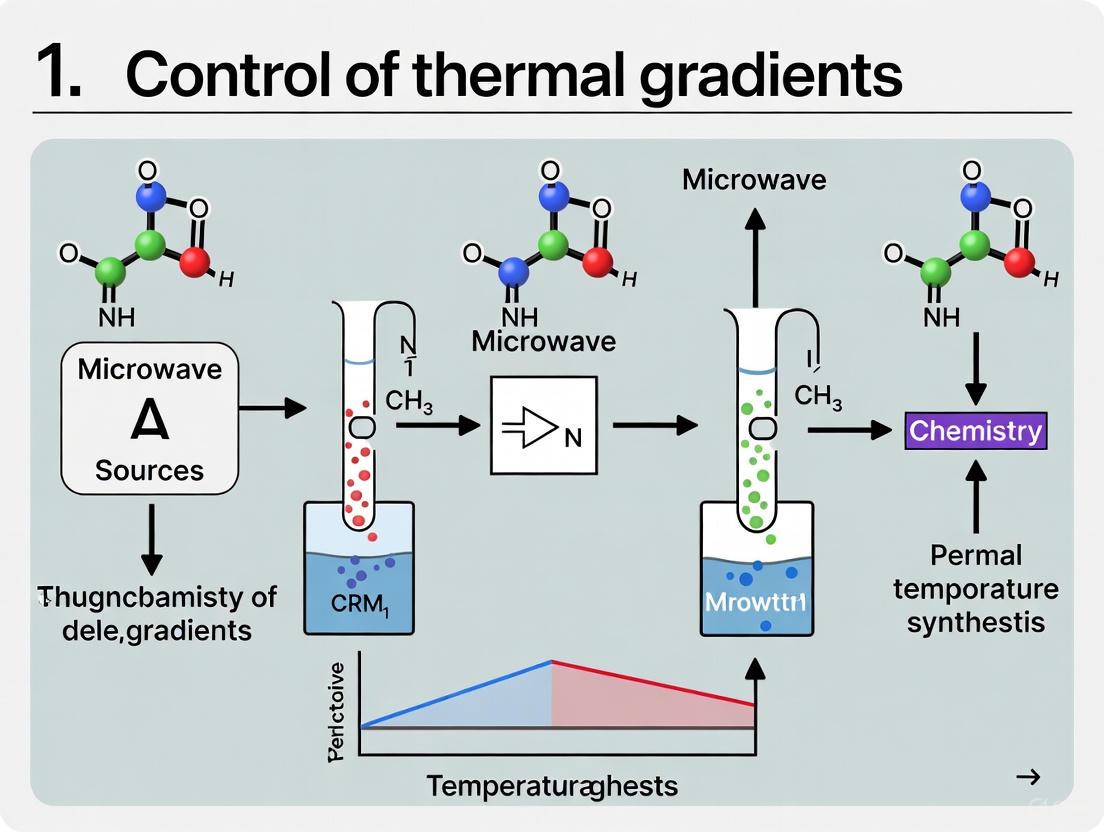
This article provides a comprehensive analysis of thermal gradient control in microwave-assisted synthesis, a critical challenge for researchers and drug development professionals.
Mastering Thermal Gradients in Microwave Synthesis: A Scientific Guide for Enhanced Reproducibility and Efficiency
Abstract
This article provides a comprehensive analysis of thermal gradient control in microwave-assisted synthesis, a critical challenge for researchers and drug development professionals. It explores the fundamental principles of microwave-matter interactions and volumetric heating that differentiate it from conventional methods. The content details advanced methodologies for temperature measurement and process optimization, supported by troubleshooting strategies for heterogeneous and solventless systems. Through comparative validation against conventional heating, the article demonstrates how mastering thermal gradients can lead to accelerated reaction times, higher product yields, improved purity, and the discovery of novel reaction pathways, ultimately advancing sustainable practices in biomedical research and pharmaceutical development.
The Science of Microwave Heating: Understanding Thermal Gradient Fundamentals
Fundamental Principles and Comparison
What is the core difference between volumetric and conventional conductive heating?
Conventional conductive heating relies on heat transfer through physical contact. An external heat source warms the surface of a material, and heat then travels inward via conduction, creating a temperature gradient from the hot surface to the cooler core [1] [2]. This process is often slow and can lead to uneven heating.
In contrast, volumetric heating uses electromagnetic energy (like microwaves or radio frequency) to generate heat throughout the entire volume of a material simultaneously [3] [4]. Energy is transferred at a molecular level, causing polar molecules (such as water) to vibrate rapidly, which generates heat internally through friction [3] [5]. This method bypasses the reliance on slow thermal conduction, leading to rapid and uniform heating.
How do these differences impact practical applications in research?
The distinct mechanisms of these heating methods lead to significantly different outcomes in laboratory and industrial settings, particularly in processes like synthesis, drying, and material processing. The table below summarizes these key differences.
| Characteristic | Volumetric Heating | Conventional Conductive Heating |
|---|---|---|
| Heating Mechanism | Energy penetrates the entire volume, generating heat internally via molecular agitation [3] [5] | Heat transfers from the outside in via physical contact and thermal conduction [1] |
| Heating Uniformity | Highly uniform; minimizes surface-to-core thermal gradients [3] [4] | Inherent thermal gradients; risk of hot spots at surfaces and cooler cores [6] |
| Processing Speed | Very fast; energy delivered directly to the material [3] [6] | Slower; limited by material's thermal conductivity [6] |
| Energy Efficiency | High; energy is absorbed directly by the target material, reducing losses [5] [6] | Lower; significant heat loss to surroundings and equipment [6] |
| Control & Selectivity | High controllability; selective heating of polar components (e.g., water) is possible [5] [6] | Less selective; heats all components in contact with the hot surface uniformly |
Experimental Protocols for Microwave Synthesis
What is a general methodology for microwave-assisted synthesis (MAS) of nanomaterials?
Microwave-assisted synthesis is a prominent application of volumetric heating in materials research. The following workflow details a generalized protocol for synthesizing nanomaterials, such as the ZnS/N-doped carbon composites referenced in the search results [7].
Title: MAS Experimental Workflow
Detailed Protocol:
- Precursor Preparation: Weigh and prepare the metal salts, carbon sources, and any dopants or structure-directing agents. For example, a protocol for ZnS/N-doped carbon composites uses tannic acid, bisphenol S, and EDTA-ZnNa₂ as key reagents [7].
- Reaction Mixture: Combine the precursors in a suitable solvent (e.g., deionized water, acetonitrile) under constant stirring to ensure homogeneity [7] [6].
- Vessel Transfer: Transfer the homogeneous mixture to a dedicated microwave reaction vessel. The vessel must be chemically inert and transparent to microwaves.
- Sealing: Seal the vessel to withstand the pressure and temperature generated during the rapid heating process.
- Reactor Loading: Place the sealed vessel into the cavity of the microwave reactor.
- Parameter Setting: Input the desired synthesis parameters. These are critical for reproducibility and include:
- Temperature: Set the target reaction temperature (e.g., 800°C for the ZBD800 composite) [7].
- Power: Define the microwave power level (Wattage).
- Pressure: Set pressure limits if applicable.
- Hold Time: Program the duration for which the target temperature is maintained.
- Ramp Time: Set the time to reach the target temperature.
- Initiation: Start the microwave irradiation process. The system will heat the mixture volumetrically according to the set parameters.
- Cooling: After the reaction is complete, allow the system to cool to room temperature, often assisted by forced gas or compressed air.
- Work-up: Collect the solid product, which may involve centrifugation, washing with solvent (e.g., ethanol, acetone), and drying [7].
- Characterization: Analyze the final nanomaterial using techniques like SEM, XRD, and vector network analysis to determine morphology, crystal structure, and functional properties like electromagnetic wave absorption [7].
What are the essential reagent solutions for microwave synthesis?
The table below lists key materials and their functions based on the synthesis of advanced composites like ZnS/N-doped carbon.
| Research Reagent / Material | Function in Experiment |
|---|---|
| Metal Salt Precursors (e.g., EDTA-ZnNa₂) | Provides the metal source for forming the inorganic phase (e.g., ZnS nanoparticles) [7]. |
| Carbon Sources (e.g., Tannic Acid, Bisphenol S) | Acts as the organic precursor that forms the porous carbon matrix during pyrolysis; can also serve as a doping agent [7]. |
| Dopants (e.g., Nitrogen) | Introduces heteroatoms into the carbon lattice to modify electronic properties and enhance performance [7]. |
| Microwave-Absorbing Solvents (e.g., Water, Ethylene Glycol) | Polar solvents that couple efficiently with microwave energy, enabling rapid heating of the reaction mixture [6]. |
| Structure-Directing Agents | Helps in forming desired morphologies (e.g., spherical assemblies, porous structures) [7]. |
Troubleshooting Common Experimental Issues
How can I diagnose and fix non-uniform heating in microwave synthesis?
Non-uniform heating, often observed as "hot spots," is a frequent challenge that can compromise experiment reproducibility and product quality.
Title: Hot Spot Diagnosis Guide
Detailed Troubleshooting Steps:
- Cause 1: Inadequate Mixing. Static conditions in the reactor can lead to standing waves and uneven energy distribution.
- Solution: Ensure magnetic stirring is active and functioning correctly. For larger scales, consider systems that rotate or oscillate the sample [3].
- Cause 2: Excessive Sample Size. If the sample is much larger than the penetration depth of the microwave radiation, the center will be shielded and heated only by conventional conduction.
- Cause 3: Poor Dielectric Properties. The material may not couple well with microwaves, or the coupling may be too strong, causing surface heating.
- Solution: Use a microwave-absorbing additive (e.g., carbon) or a susceptor. Alternatively, optimize the solvent system to moderate the absorption rate [6].
Why is my reaction yield low or my product morphology inconsistent?
Inconsistent results often stem from poor control over reaction parameters, which is critical in microwave synthesis due to its rapid kinetics.
FAQ: Controlling Thermal Gradients in Microwave Synthesis
Q: I'm not achieving the expected product morphology. What parameters should I focus on?
- A: Precise control over temperature and time is paramount. Microwave heating is extremely fast, and a delay of seconds in ramping or cooling can significantly impact nucleation and growth kinetics, leading to inconsistent morphology and size distribution [6]. Use reactors with accurate internal temperature monitoring and precise power control.
Q: How can I suppress coke formation in high-temperature catalytic reactions like dry reforming of methane?
- A: A key advantage of microwave heating is its potential to suppress coke formation. The volumetric nature of heating can create unique "non-equilibrium" conditions that prevent the buildup of carbonaceous deposits on catalyst surfaces, a common problem in conventional conductive heating [8]. Ensure your catalyst is designed for good microwave coupling.
Q: The penetration depth of microwaves seems insufficient for my sample. What can I do?
- A: Penetration depth is inversely related to frequency. The 2450 MHz frequency common in laboratory ovens has a lower penetration depth than 915 MHz systems sometimes used industrially [5]. If changing hardware is not possible, consider switching to radio frequency (RF) heating, which uses lower frequencies (e.g., 27.12 MHz) and offers greater penetration for larger samples [5].
Troubleshooting Common Experimental Issues
Temperature Measurement and Control
Q: My microwave synthesis reaction is yielding inconsistent results between runs, even with identical power settings. What could be wrong? A: Inconsistent results often stem from inaccurate temperature measurement, which is the most critical parameter for reproducibility. External infrared (IR) sensors, common in many microwave reactors, can be misled by several factors. For exothermic reactions, the sensor's slow response time fails to detect immediate internal temperature changes. With weakly absorbing reaction mixtures, the vessel wall heats up more than its contents, causing the IR sensor to report a temperature higher than the actual reaction temperature. Conversely, thick vessel walls can insulate the sensor, resulting in a reading lower than the internal temperature [9]. Solution: For accurate monitoring, use a microwave reactor equipped with an internal fiber optic temperature probe in addition to the standard IR sensor. This provides a direct measurement of the reaction mixture temperature [9].
Q: When using 'heating-while-cooling' (simultaneous microwave irradiation and gas cooling), my product yield is lower than expected. Why? A: This occurs because the external IR sensor is measuring the temperature of the cooled vessel wall, not the actual reaction mixture. Consequently, the system may be injecting more microwave power to heat a reaction that is already much hotter internally than recorded. This can lead to unintended thermal degradation of your product or reagents. Under heating-while-cooling conditions, the internal temperature can be up to 60 °C higher than the externally measured IR temperature [9]. Solution: Always use an internal temperature sensor when operating in heating-while-cooling mode to ensure the recorded temperature reflects the true reaction conditions [9].
Heating Uniformity and Efficiency
Q: I am not observing the reported rate enhancements for my microwave-assisted reaction run under reflux. What is the issue? A: The primary advantage of microwave heating is the ability to safely heat reactions far above the boiling point of the solvent in sealed vessels. When operating under open-vessel reflux conditions, the temperature is limited by the solvent's boiling point, just as in conventional oil-bath heating. Therefore, no significant rate enhancement should be expected [9]. Solution: To achieve faster reaction rates, transfer your protocol to a sealed vessel system that can safely withstand elevated temperatures and pressures. As per the Arrhenius equation, even a modest increase in temperature can drastically reduce reaction time [9].
Q: My reaction mixture contains both aqueous and organic phases, and heating is uneven. How can I improve this? A: Uneven heating, or the presence of "cold spots," is typically due to inhomogeneous dielectric properties within the reaction mixture. Different components absorb microwave energy with varying efficiencies. Solution: Consider adding a passive heating element or a microwave-absorbing susceptor (e.g., silicon carbide) to the reaction vessel. Alternatively, ensure efficient stirring to homogenize the temperature and promote even energy distribution [10].
Reaction Optimization and Scalability
Q: I am synthesizing carbon nanomaterials, but the reduction efficiency is low and the process is slow. How can I optimize this? A: For carbon materials like graphene oxide, the key is to balance deoxygenation with the preservation of the material's structural integrity. Solution: Systematically optimize power, temperature, and time. For reduced graphene oxide (rGO), one optimized protocol uses 300 W, 140 °C, for 5 minutes under microwave-hydrothermal conditions. This achieves a high reduction efficiency of 94.56 wt% and a high specific surface area of 845.6 m²/g, making it suitable for energy storage applications [11].
Fundamental Data for Experiment Design
Dielectric Properties of Common Solvents
The dielectric loss factor (εr″) determines a solvent's ability to convert microwave energy into heat. The following table lists values for common solvents to help select the most appropriate one for your synthesis [12].
Table 1: Dielectric Loss Factors (εr″) of Common Solvents at 2.45 GHz
| Solvent | Dielectric Loss Factor (εr″) |
|---|---|
| Dimethyl sulfoxide (DMSO) | ~12.5 |
| Methanol (MeOH) | 11.77 |
| Water (H₂O) | ~12.0 |
| Ethanol (EtOH) | 6.46 |
| Propanol (PrOH) | 3.41 |
| n-Butanol (n-BuOH) | 1.45 |
| 1-Pentanol (1-PentOH) | ~1.1 |
Microwave Heating Mechanisms and Power Dissipation
The power dissipated per unit volume ((Pv)) in a material under microwave irradiation is given by: [ Pv = ωε0εr''E{rms}^2 ] where (ω) is the angular frequency, (ε0) is the permittivity of free space, (εr'') is the dielectric loss factor, and (E{rms}) is the electric field strength [10].
Table 2: Dominant Microwave Heating Mechanisms by Material Type
| Material Type | Dominant Heating Mechanism(s) | Examples & Notes |
|---|---|---|
| Polar Solvents | Dipolar Polarization | Water, alcohols, DMSO. Primary mechanism is molecular rotation. |
| Ionic Solutions | Ionic Conduction & Dipolar Polarization | Aqueous electrolyte solutions (e.g., NaCl, LiPF₆ in carbonates). Heating rate is greater than pure water [10]. |
| Magnetic Materials | Magnetic Loss | Ferrites (e.g., BaFe₁₂O₁₉). Magnetic field (H-field) coupling can be more efficient than electric field (E-field) heating [10]. |
| Conductive Powders | Joule Heating & Magnetic Loss | Metal powders, carbon materials. Involves interfacial (Maxwell-Wagner) polarization [10]. |
Experimental Protocols
Protocol 1: Microwave-Assisted Hydrothermal Synthesis of Reduced Graphene Oxide (rGO)
This protocol is optimized for the rapid, sustainable production of high-quality rGO for electrochemical applications [11].
- Preparation: Disperse graphene oxide (GO) in a suitable solvent (e.g., water) to form a homogeneous precursor solution.
- Reaction Setup: Transfer the GO solution to a sealed microwave-hydrothermal reaction vessel.
- Synthesis Parameters: Place the vessel in the microwave reactor and set the parameters to 300 W, 140 °C, and a 5-minute hold time.
- Cooling and Collection: After the reaction is complete, allow the system to cool to room temperature.
- Post-processing: Collect the resulting solid product by filtration or centrifugation, then wash and dry it.
- Characterization: Validate the success of the reduction using UV-Vis spectroscopy (a red shift to ~268 nm), thermogravimetric analysis (TGA) for high thermal stability, and BET surface area analysis (target ~845 m²/g) [11].
Protocol 2: Optimized Microwave Synthesis of Zeolite Membranes
This protocol highlights the critical parameters for fabricating thin, dense zeolite membranes with reduced synthesis time [12].
- Precursor Gel: Prepare a homogeneous precursor gel for the target zeolite (e.g., NaA).
- Support Preparation: Place a porous α-Al₂O₃ support disc inside the microwave reactor.
- Reaction Setup: Introduce the precursor gel into the reactor, ensuring contact with the support.
- Controlled Heating: Use a microwave system that allows for controlled heating rates, rather than just constant power. This promotes uniform nucleation and growth.
- Short Synthesis Time: Run the synthesis for a significantly reduced time (e.g., 15 minutes for NaA zeolite membranes) compared to conventional hydrothermal methods.
- Result: The resulting membrane should be dense and well-intergrown, with a thickness reduced by nearly 70% and a pervaporation flux improved by over 70% for applications like acetic acid dehydration [12].
Essential Visualizations
Material Interaction with Microwave Fields
Experimental Workflow for Controlled Synthesis
The Scientist's Toolkit: Key Reagents and Materials
Table 3: Essential Research Reagent Solutions for Microwave Synthesis
| Item | Function / Role in Microwave Synthesis | Example Use Case |
|---|---|---|
| Polar Solvents (High εr'') | Strong microwave absorbers; enable rapid and efficient volumetric heating via dipolar polarization. | Methanol or DMSO for homogeneous heating of reaction mixtures [12]. |
| Ionic Solutions / Electrolytes | Enhance heating efficiency through ionic conduction mechanism; can lead to faster heating than pure polar solvents. | Aqueous salt solutions for accelerating reaction kinetics [10]. |
| Microwave-Absorbing Susceptors | Passive heating elements that absorb microwaves and transfer heat to poorly absorbing reaction mixtures; mitigate cold spots. | Silicon carbide (SiC) used to ensure even heating in low-εr'' systems [10]. |
| Sealed Reaction Vessels | Enable superheating of solvents far above their atmospheric boiling point, unlocking faster kinetics as per the Arrhenius law. | Essential for achieving significant rate enhancements over conventional reflux methods [9]. |
| Internal Temperature Probe | Provides accurate, direct measurement of the reaction mixture temperature, critical for reproducibility and kinetic studies. | Fiber optic sensor for reliable temperature control, especially in exothermic or cooling-assisted reactions [9]. |
In microwave-assisted synthesis, thermal gradients—variations in temperature within a reaction mixture—are a critical phenomenon that can significantly impact experimental reproducibility, product yield, and material properties. Unlike conventional heating which transfers energy from the outside-in, microwave irradiation generates heat volumetrically through direct interaction with materials. This creates a unique "inverted" temperature profile where the reaction volume becomes hotter than the vessel walls [13]. While this enables dramatically faster heating rates and reduced reaction times, it also introduces specific challenges in achieving uniform temperature distribution.
Three fundamental factors govern the formation of thermal gradients in microwave systems: field non-uniformity (the uneven distribution of microwave energy within the cavity), penetration depth (how deeply microwaves can propagate into a material before their energy is significantly attenuated), and material-dependent absorption (how different substances convert microwave energy to heat based on their dielectric properties). Understanding and controlling these factors is essential for researchers seeking to optimize synthetic protocols, ensure reproducibility, and exploit the unique advantages of microwave chemistry for developing novel materials and pharmaceutical compounds.
Fundamental FAQ: Understanding Core Concepts
Q1: What causes uneven heating in my microwave synthesis experiments?
Uneven heating, or thermal gradients, primarily stems from three interconnected factors:
- Field Non-Uniformity: Microwave cavities contain standing waves with areas of high and low energy intensity (hot and cold spots). Reaction vessels placed in different positions experience varying field strengths, leading to inconsistent heating [14].
- Limited Penetration Depth: Microwave energy diminishes as it travels through absorbing materials. The "penetration depth" is the distance at which microwave power drops to approximately 37% of its original value. If your reaction mixture is thicker than this depth, the core will be heated less effectively than the edges, creating a significant thermal gradient [14] [13].
- Variable Dielectric Properties: Different materials absorb microwave energy with varying efficiency based on their dielectric loss factor (ε′′). If your reaction contains components with different absorption capabilities, they will heat at different rates, creating localized hot spots and thermal gradients [14] [13].
Q2: How does "penetration depth" specifically affect my reaction scalability?
Penetration depth imposes fundamental physical constraints on scalability. When scaling up from small laboratory vessels to larger production reactors, the penetration depth does not increase proportionally with vessel size. This means that in a larger vessel, the center of the reaction mixture may receive insufficient microwave energy, leading to a cold core and a hot surface. This gradient can cause inconsistent reaction rates, formation of by-products, or incomplete reactions in the cooler regions. Successful scale-up therefore requires careful reactor design, often employing multiple microwave entry points or continuous flow systems to ensure uniform energy distribution throughout the entire reaction volume [14].
Q3: Why do my reactions with different solvents heat so differently under identical microwave power?
This difference arises from material-dependent absorption. The ability of a solvent to convert microwave energy into heat is quantified by its dielectric loss factor (ε′′). Solvents with high loss factors (like water or DMF) heat rapidly, while those with low loss factors (like hexane or toluene) heat slowly. The following table summarizes the heating characteristics of common solvent types:
Table: Dielectric Properties and Heating Characteristics of Common Solvent Types
| Solvent Category | Dielectric Loss Factor (ε′′) | Heating Efficiency | Representative Examples |
|---|---|---|---|
| High Microwave Absorbers | High | Rapid, strong heating | Water, Dimethylformamide (DMF), Ionic Liquids |
| Medium Microwave Absorbers | Medium | Moderate heating | Ethanol, Acetone, Dichloromethane (DMC) |
| Low Microwave Absorbers | Low | Poor, weak heating | Hexane, Toluene, Tetrahydrofuran (THF) |
This variation means that switching from a high-absorbing to a low-absorbing solvent under the same power settings will result in dramatically different maximum temperatures and heating rates, directly affecting reaction kinetics and outcomes [15] [14].
Troubleshooting Guides for Specific Thermal Issues
Problem 1: Inconsistent Results Between Identical Experiments
Observed Symptom: The same reaction run in an identical vessel with identical power and time settings produces different yields or product distributions.
Potential Root Causes:
- Field Non-Uniformity: Slight changes in vessel position within the microwave cavity can expose the reaction to different field strengths.
- Uncontrolled Cooling: The "inverted" temperature profile (hot reactant core, cooler vessel walls) [13] can lead to different cooling rates after irradiation, affecting crystallization or product stability.
Step-by-Step Diagnostic Protocol:
- Reposition the Vessel: Run the experiment again, ensuring the vessel is placed in the exact same location and orientation within the cavity. Many cavities have a rotating turntable for this purpose; ensure it is functioning.
- Verify Calibration: Confirm the calibration of the temperature sensor (e.g., IR or fiber-optic probe). An uncalibrated sensor can lead to incorrect power modulation.
- Standardize Post-Reaction Handling: Implement a consistent post-irruption cooling and handling protocol (e.g., fixed duration of air cooling followed by quenching in a water bath).
- Use an Internal Reference: Employ a chemical reaction with a known outcome as an internal standard to verify the thermal energy delivered to the mixture itself.
Problem 2: Formation of Unwanted By-products or Decomposition
Observed Symptom: The desired product is obtained in low yield alongside decomposition products or unexpected by-products.
Potential Root Causes:
- Localized Overheating (Hot Spots): Certain components of the reaction mixture, such as solid catalysts or ionic reagents, may absorb microwave energy much more efficiently than the solvent, creating microscopic regions of extremely high temperature that can degrade sensitive compounds [14] [13].
- Excessive Power Settings: Applying maximum power (e.g., 300W) indiscriminately can cause rapid, uncontrolled heating that overshoots the desired temperature and leads to thermal decomposition [15].
Step-by-Step Diagnostic Protocol:
- Lower Power and Extend Time: Reduce the microwave power setting (e.g., start at 50-100W) and extend the irradiation time to achieve a more gradual and controlled temperature ramp [15].
- Implement Power Dilution: Use a microwave reactor that offers simultaneous cooling. This maintains a high power level for direct molecular heating while removing excess thermal energy, preventing runaway reactions [15].
- Identify the Absorber: Analyze your reaction mixture to identify the component with the highest dielectric loss. Consider pre-dispersing solid absorbers or switching to a more uniformly absorbing solvent system.
- Monitor Real-Time Temperature: Use a fiber-optic probe to monitor the temperature trajectory. A sudden, sharp spike in temperature is indicative of a hot spot or runaway reaction.
Problem 3: Reaction Fails to Reach Target Temperature
Observed Symptom: The reaction mixture does not heat to the programmed temperature, even after extended irradiation.
Potential Root Causes:
- Low Dielectric Loss of the Reaction Mixture: The overall composition (solvent and solutes) is transparent to microwaves and cannot efficiently convert energy into heat.
- Excessive Heat Loss: The reaction vessel is losing heat to its surroundings faster than the microwave energy can be absorbed.
Step-by-Step Diagnostic Protocol:
- Check Solvent Properties: Consult a table of dielectric loss factors [15]. If your solvent is a low absorber (e.g., toluene), consider switching to a medium absorber or adding a small amount of a high-absorbing cosolvent (e.g., a few drops of water or ionic liquid).
- Add a Passive Heating Element: Introduce a microwave-absorbing material, such as a silicon carbide (SiC) rod or a small amount of magnetic susceptor powder, into the reaction vessel. This "microwave hybrid heating" (MHH) strategy provides a secondary internal heat source [13].
- Verify Insulation: Ensure the reactor insulation is adequate. For solvent-free reactions in solid state, embedding the reactant pellets in a bed of the same powder and surrounding it with an insulator like glass wool can minimize heat loss and homogenize the temperature [13].
- Increase Power Gradually: Systematically increase the microwave power in small increments (e.g., from 50W to 100W, then 150W) while monitoring the temperature response to find the minimum effective power.
The Scientist's Toolkit: Essential Research Reagents & Materials
Table: Key Materials for Managing Thermal Gradients in Microwave Synthesis
| Material/Reagent | Primary Function | Specific Role in Controlling Thermal Gradients |
|---|---|---|
| Silicon Carbide (SiC) | Microwave Susceptor | Provides a uniform, high-temperature heat source under microwave irradiation, used in Microwave Hybrid Heating (MHH) to evenly heat low-absorbing reaction mixtures and eliminate field non-uniformity effects [13]. |
| Ionic Liquids | Polar Solvent/Additive | Acts as a high-efficiency microwave absorber due to its high dielectric loss factor and ionic conductivity. Adding small amounts can dramatically improve heating in otherwise low-absorbing solvents, reducing thermal gradients [13]. |
| Molecular Sieves / Mineral Oxides (e.g., Alumina, Silica) | Solid Support | Used in solvent-free synthesis to adsorb reagents. Provides a large, uniform surface area that couples well with microwaves, promoting even heating and reducing localized hot spots common in solution-phase reactions [15]. |
| Fiber-Optic Temperature Probes | Monitoring Equipment | Provides accurate internal temperature measurement without interfering with the microwave field. Critical for mapping real-time temperature profiles and identifying the formation of thermal gradients during the reaction [13]. |
| Certified Pressure Vessels | Reaction Vessel | Enables the use of low-boiling-point solvents at high temperatures by preventing evaporation. This allows researchers to select solvents based on chemical suitability rather than just boiling point, mitigating gradients caused by solvent reflux dynamics [15]. |
Workflow and System Diagrams
Diagram: Systematic Workflow for Optimizing Thermal Management
Diagram: Microwave Energy Absorption Mechanisms in Materials
Experimental Protocols for Gradient Analysis
Protocol 1: Mapping Temperature Distribution in a Reaction Vessel
Objective: To empirically determine the spatial temperature profile within a microwave reaction vessel under standard operating conditions.
Materials:
- Multi-channel fiber-optic temperature measurement system
- Laboratory microwave reactor
- Appropriate solvent (e.g., water or DMF as a reference absorber)
- Reaction vessel with multiple access ports for probes
Methodology:
- Setup: Position temperature probes at strategic locations within the vessel: one at the geometric center, one near the wall, one at the top, and one at the bottom of the liquid volume.
- Calibration: Calibrate all probes against a standard reference prior to the experiment.
- Irradiation: Fill the vessel with a standard solvent. Subject it to a standard microwave protocol (e.g., heat from ambient to 100°C using 300W maximum power with stirring enabled).
- Data Collection: Record the temperature from all probes simultaneously at 1-second intervals throughout the heating and cooling phases.
- Analysis: Plot temperature versus time for each probe. The difference between the maximum and minimum temperatures at any given time is a direct measure of the thermal gradient magnitude.
Protocol 2: Quantifying the Impact of Stirring on Gradient Reduction
Objective: To evaluate the effectiveness of mechanical agitation in mitigating thermal gradients.
Materials:
- Microwave reactor with variable-speed magnetic stirring
- Fiber-optic temperature probe
- High-viscosity reaction mixture (e.g., a suspension for solvent-free synthesis)
Methodology:
- Baseline Run: Load the vessel with the reaction mixture. Insert the temperature probe at a fixed, off-center position. Run the microwave protocol without stirring and record the temperature.
- Stirred Run: Repeat the experiment under identical microwave parameters but with stirring enabled at a defined, constant rate (e.g., 300 rpm).
- Comparison: Overlay the temperature profiles. The experiment with stirring will typically show a smoother temperature curve and a higher final temperature, as convective mixing distributes heat from localized hot spots to cooler regions, demonstrating gradient reduction. The area between the two curves quantifies the stirring's efficacy.
FAQs: Understanding Core Concepts and Resolving Common Issues
FAQ 1: What is the fundamental difference between the thermal and proposed non-thermal microwave effects?
The thermal effect is the conversion of microwave energy into heat within a material through mechanisms like dipole rotation and ionic conduction, leading to a bulk temperature increase [16] [17] [18]. This is the widely accepted and primary mechanism for reaction acceleration in microwave-assisted synthesis.
In contrast, the proposed non-thermal microwave effect suggests that the electromagnetic field itself can directly influence molecules in ways beyond simple heating, potentially altering reaction pathways, diffusion rates, or transition states without a corresponding change in bulk temperature [16] [19] [18]. The existence of such effects in the condensed phase, particularly in liquids, remains a subject of intense debate [16] [9].
FAQ 2: My reaction proceeds much faster under microwave irradiation than in an oil bath at the same measured temperature. Is this proof of a non-thermal effect?
Not necessarily. This common observation is often attributable to thermal gradients and inefficient heat transfer in conventional heating methods [9] [18]. In an oil bath, heat is applied externally, and the reaction vessel walls can be hotter than the reaction mixture itself. Microwaves, however, heat the entire volume simultaneously (internal heating), potentially creating a more uniform temperature environment and eliminating heat transfer limitations. This can lead to a more efficient reaction at the same measured bulk temperature, but the mechanism is still fundamentally thermal [9]. Apparent rate enhancements can also stem from the rapid heating rates achievable with microwaves, which can quickly surpass the boiling point of solvents in sealed vessels [15].
FAQ 3: How can I design an experiment to reliably test for the presence of non-thermal effects?
To credibly investigate non-thermal effects, you must rigorously control and measure temperature. Key strategies include:
- Using an Internal Temperature Probe: Relying solely on an external IR sensor can be misleading, especially with weakly absorbing mixtures or during exothermic reactions. An internal fiber-optic probe is essential for accurate temperature measurement [9].
- Eliminating Thermal Gradients: Use efficient stirring and consider the penetration depth of microwaves in your reaction mixture to ensure temperature homogeneity [18].
- Comparing Truly Isothermal Conditions: The comparison between microwave and conventional heating must be performed at the same carefully measured internal temperature for the same duration. Any observed difference in reaction rate or selectivity under these strictly controlled conditions could then be considered evidence for a non-thermal effect [9] [18].
FAQ 4: Are non-thermal effects more likely to occur in certain types of reactions or systems?
Some research suggests that systems where the reaction mixture is a weak microwave absorber (e.g., solvent-free conditions, non-polar solvents) may be more prone to exhibit phenomena attributed to non-thermal effects [18]. This is because the microwave energy may interact more directly with the reagents rather than being dissipated as heat by a polar solvent. Reactions involving polar mechanisms, where the transition state has a significantly larger dipole moment than the ground state, have also been proposed as candidates for non-thermal acceleration, as the microwave field could selectively stabilize the transition state [18].
Troubleshooting Guide: Addressing Experimental Challenges
Issue 1: Inconsistent Reproduction of Microwave Results
Problem: Difficulty replicating reaction outcomes (yield, selectivity) between different microwave runs or between microwave and conventional methods.
Solution:
- Verify Temperature Measurement: Ensure you are using an internal temperature sensor (e.g., fiber-optic probe) to obtain a true reading of the reaction mixture temperature, not just the vessel surface [9].
- Standardize Vessel Sealing: For enhanced reactions, always use sealed vessels. Open-vessel (reflux) microwave experiments will not show significant rate enhancement over conventional reflux, as the temperature is limited by the solvent's boiling point [9].
- Control Solvent Polarity: The dielectric properties of the solvent significantly impact heating efficiency. Use solvents with similar microwave absorption characteristics for consistent results. A small amount of a strong microwave-absorbing solvent (like 2-propanol) can be added to a non-polar medium to dramatically improve heating uniformity [18].
- Document All Parameters: Record not just temperature and time, but also microwave power levels and the use of simultaneous cooling ("heating-while-cooling"), as this can affect the power delivered to the mixture [9].
Issue 2: Unexpected Reaction Selectivity or Product Distribution
Problem: A reaction under microwave irradiation produces a different ratio of isomers or by-products compared to conventional heating.
Solution:
- Investigate Heating Rate: A different product distribution can be a result of the very rapid heating rate of microwaves, leading to kinetic versus thermodynamic control of the reaction. This is a thermal effect. For example, a faster heating rate can favor the kinetic product [18].
- Check for "Hot Spots": In heterogeneous mixtures or on solid supports, microwaves can create localized superheated areas ("hot spots") with a temperature much higher than the measured bulk temperature. These can trigger reaction pathways not accessible under uniform conventional heating [16] [18].
- Consider Field-Specific Effects: In solid-state synthesis, the microwave's electric field has been proposed to enhance diffusion and sintering processes at a microscopic level, potentially explaining altered crystallization kinetics and material properties [16] [19].
Experimental Protocols for Differentiating Thermal and Non-Thermal Phenomena
Protocol 1: Isothermal Comparison for a Solution-Phase Reaction
This protocol is designed to test for non-thermal effects in a liquid-phase reaction under rigorously controlled temperature conditions.
Objective: To compare the reaction rate and product distribution of a model reaction under microwave and conventional heating at identical, precisely measured internal temperatures.
Materials:
- Reagents: Appropriate for the chosen model reaction (e.g., reactants, solvent, catalyst).
- Equipment: Dedicated microwave reactor with internal fiber-optic temperature sensor and magnetic stirring; conventional heating system (oil bath) with calibrated thermometer and magnetic stirring.
- Vessels: Sealed microwave reaction vials; equivalent sealed vials for oil bath (e.g., glass pressure tubes).
Methodology:
- Preparation: Prepare two identical reaction mixtures.
- Microwave Experiment: Place one mixture in the microwave reactor. Set the desired target temperature and use the internal probe for control. Monitor and record the reaction time.
- Conventional Experiment: Place the second mixture in the oil bath, pre-heated to the exact same target temperature. Use a calibrated thermometer to verify the internal temperature of the mixture.
- Analysis: After identical reaction times, quench both reactions and analyze yields and product distributions using analytical methods (e.g., HPLC, GC-MS, NMR).
Interpretation: A statistically significant difference in reaction rate or selectivity under these truly isothermal conditions would provide evidence for a non-thermal microwave effect [9] [18].
Protocol 2: Investigating Solid-State Sintering and Crystallization
This protocol examines effects observed in material synthesis, where evidence for non-thermal influences is more frequently reported.
Objective: To compare the crystallization kinetics and activation energy of a ceramic material (e.g., tailing-based glass-ceramics) sintered using microwave and conventional furnaces.
Materials:
- Precursor: Powdered precursor for the target material.
- Equipment: High-temperature microwave furnace; conventional muffle furnace; thermal insulation to minimize temperature gradients.
- Characterization: X-ray Diffraction (XRD), Scanning Electron Microscope (SEM).
Methodology:
- Sample Preparation: Divide the precursor into identical pellets using techniques like electrophoretic deposition to ensure consistent initial pore structure [19].
- Sintering: Subject pellets to microwave and conventional heating at the same target temperatures and dwell times. Temperature measurement must be carefully calibrated in both systems.
- Kinetic Analysis: Measure the degree of crystallization or grain growth at different time intervals for both methods.
- Activation Energy Calculation: Use the kinetic data (e.g., from XRD analysis) to calculate the activation energy for crystallization for both heating methods.
Interpretation: A lower calculated activation energy for the microwave-sintered sample, as has been reported (e.g., a reduction from 375.7 kJ mol⁻¹ to 214.9 kJ mol⁻¹) [19], is often cited as evidence for a non-thermal effect, suggesting the microwave field directly lowers the energy barrier for the process.
Data Presentation: Quantitative Evidence from Literature
The following tables summarize key experimental findings from the literature that are central to the debate.
Table 1: Reported Evidence Supporting Non-Thermal Effects
| System Studied | Controlled Conditions | Key Observation Attributed to Non-Thermal Effect | Reference |
|---|---|---|---|
| Polycondensation of L-lactic acid | Reflux in xylene (142°C) to exclude temperature difference. | Higher molecular weight polymer obtained under microwave irradiation compared to conventional heating at the same temperature. | [19] |
| Sintering of glass-ceramics | Different heating profiles to reach target temperature. | Crystallization activation energy reduced from 375.7 kJ mol⁻¹ (conv.) to 214.9 kJ mol⁻¹ (MW). Enhanced grain growth and material properties. | [19] |
| Protein Unfolding (Citrate Synthase) | Temperature controlled to onset of binding (63°C). | Unfolding occurred at significantly lower temperatures and to a greater degree under MW irradiation. | [19] |
| Electrical Conductivity of NaCl Solution | Electric field intensity on order of 10⁴ V m⁻¹; solution cooled to remove thermal energy. | Resistance increased with temperature under MW, opposite to the decrease observed with conventional heating. | [19] |
Table 2: Studies and Viewpoints Challenging Non-Thermal Effects
| Argument / Study Focus | Key Finding / Conclusion | Reference |
|---|---|---|
| Systematic Analysis of Organic Synthesis | A 2013 essay concluded that the non-thermal microwave effect does not exist in organic synthesis involving liquid phases. Apparent effects are due to inaccurate temperature measurement or specific thermal phenomena (e.g., superheating). | [16] |
| Comparison of Reflux Reactions | A Biginelli reaction under microwave reflux yielded 80%, nearly identical to the 78% from conventional reflux, showing no enhancement when temperature is equalized (limited by boiling point). Significant yield enhancement (78%) only occurred in sealed-vessel microwaving at higher temperatures. | [9] |
| Role of Heating Rate | The ratio of naphthalenesulfonic acid isomers was found to depend only on the heating rate, not the heating mode (microwave vs. conventional), indicating a thermal effect. | [18] |
| Diffusion and Stirring | Microwave irradiation can increase diffusion rates in solvent-free systems, explaining rate enhancements without the need for mechanical stirring. This is often misattributed to a non-thermal effect. | [18] |
The Scientist's Toolkit: Key Research Reagent Solutions
Table 3: Essential Materials for Microwave Synthesis Research
| Item | Function / Explanation |
|---|---|
| Dedicated Microwave Reactor | Provides controlled power, temperature, and pressure. Superior to domestic ovens for reproducible, safe, and accurate research [9]. |
| Internal Fiber-Optic Temperature Probe | Critical for measuring the true internal temperature of the reaction mixture, avoiding errors from IR sensors [9]. |
| Sealed Reaction Vessels | Enable superheating of solvents far above their atmospheric boiling points, which is a major source of rate enhancement and must be controlled for [9] [15]. |
| Polar Solvents (High Microwave Absorbers) | e.g., DMSO, Ionic Liquids, Water. Efficiently convert microwave energy to heat, suitable for general synthesis [18] [15]. |
| Non-Polar / Weak Absorbing Solvents | e.g., Hexane, Toluene. Used in mixtures to modulate heating characteristics or as a "heat sink" for temperature-sensitive reactions [18] [15]. |
| Solid Inorganic Supports | e.g., Alumina, Silica. Used for solvent-free synthesis; their interaction with MWs can lead to "hot spot" formation [18]. |
Experimental and Conceptual Workflows
Diagram 1: Experimental Decision Pathway for Effect Differentiation
Diagram 2: Thermal vs Proposed Non-Thermal Effect Pathways
Advanced Techniques for Controlling and Leveraging Thermal Gradients
In microwave-assisted synthesis, controlling thermal gradients is paramount for reproducibility, safety, and reaction efficiency. Unlike conventional heating, microwave irradiation can create localized "hot spots," leading to significant temperature differences between the bulk solution and reaction sites like catalyst surfaces [20]. Precision temperature monitoring is, therefore, not just beneficial but essential. Two primary non-contact or minimally intrusive methods for this purpose are Fiber-Optics Thermometry and Infrared (IR) Thermography. This technical support center provides troubleshooting and FAQs to guide researchers in selecting and effectively using these critical technologies.
Technology Comparison at a Glance
The table below summarizes the core characteristics of both monitoring methods.
| Feature | Fiber-Optics Thermometry | IR Thermography (Thermal Camera) |
|---|---|---|
| Principle | Contact measurement using light propagation through optical fibers [21]. | Non-contact detection of infrared radiation emitted by a surface [22]. |
| Measurement Type | Point-based or distributed along the fiber [21]. | Full two-dimensional thermal image (thousands of points simultaneously) [22]. |
| Spatial Resolution | High (suitable for specific points like electrode surfaces) [20]. | Varies with camera; can identify hotspots over an area [22]. |
| Ideal for Microwave Environments | Excellent; immune to electromagnetic interference (EMI) [21]. | Suitable, but requires a line-of-sight and can be affected by surface properties [23]. |
| Key Advantage | Direct, accurate temperature measurement at the source, even in high-voltage or EMI-prone environments [21] [20]. | Rapidly scan large areas to visualize thermal gradients and locate unknown hotspots [22]. |
| Key Limitation | Requires physical contact/intrusion into the reaction vessel. | Measures surface temperature only; accuracy depends on surface emissivity [23]. |
| Distance:Size Ratio (D:S) | Not a relevant metric, as it is a contact sensor. | High (e.g., 120:1 for a FLIR E8); allows accurate measurement of small targets from a distance [22]. |
Troubleshooting Guides
Guide 1: Fiber-Optic Temperature Sensor Issues
| Problem | Possible Causes | Solutions |
|---|---|---|
| Erratic or No Signal | - Broken fiber due to excessive bending [24]- Contaminated connector end-face [24]- Sensor damage from harsh chemical or physical environment [25] | - Inspect the fiber for sharp bends or breaks; ensure the bending radius is within specification [24].- Clean the connector end-face with appropriate solvents and lint-free wipes [24].- Verify sensor compatibility with the chemical and temperature environment. |
| Inaccurate Readings | - Incorrect calibration- Poor thermal contact with the measurement point- Sensor degradation over time | - Recalibrate the sensor according to the manufacturer's protocol.- Ensure the sensor probe is securely attached and using thermal paste if necessary.- Check for signs of aging and replace the sensor if needed. |
| Signal Drift | - Temperature fluctuations in the lead-in fiber- Loose connections | - Use a cable with an internal armor or shield to minimize ambient temperature effects.- Check and secure all connections in the system. |
Guide 2: Infrared Thermal Camera Issues
| Problem | Possible Causes | Solutions |
|---|---|---|
| Inaccurate Temperature Readings | - Low emissivity of the target surface (e.g., shiny metal) [23]- Reflected radiation from surrounding hot objects [23]- Camera is out of focus | - Increase surface emissivity by applying matte tape or high-temperature paint [23].- Shield the target from reflective sources or adjust the camera angle.- Carefully focus the camera on the target before measurement. |
| Cannot Detect a Hotspot | - Hotspot is too small for the camera's spatial resolution [22]- Insufficient thermal contrast- The lens is not appropriate for the distance | - Use a camera with a higher resolution or a close-up lens to reduce the spot size [22].- Increase the load on the system to enhance thermal differences.- Use a telephoto lens for long-distance measurements or move closer [22]. |
| Blurry or Unclear Image | - Dirty lens- Incorrect selection of thermal palette or level/span settings | - Clean the camera lens with a specialized lens cleaning kit.- Adjust the palette and level/span to optimize the image for the specific temperature range of interest. |
Frequently Asked Questions (FAQs)
Q1: Why can't I use a conventional thermometer in my microwave synthesis experiment? Conventional thermometers or thermocouples are metal-based and can act as antennas in a microwave field, leading to arcing, significant measurement errors, and damage to the equipment. Both fiber-optic sensors (non-metallic) and IR thermography (non-contact) avoid this interference [21].
Q2: My IR thermometer gives me a single temperature, but my thermal camera shows a range. Which is correct? Both are, but they serve different purposes. An IR thermometer (or "temp gun") provides the average temperature of a single spot. A thermal camera measures the temperature of thousands of points to create a thermal image, revealing gradients and hotspots you might miss with a single-point measurement [22]. For understanding thermal gradients in microwave synthesis, a thermal camera is vastly more informative.
Q3: What is emissivity and why is it critical for IR thermography? Emissivity is a measure of a surface's effectiveness in emitting thermal radiation. A perfect "blackbody" has an emissivity of 1, while a shiny, polished metal can be below 0.1. If the emissivity is set incorrectly on the camera, the temperature reading will be inaccurate [23]. This is a major source of error in IR thermography.
Q4: How do I integrate a fiber-optic sensor into my microwave reactor without affecting the reaction? Most modern microwave reactors are equipped with dedicated ports for fiber-optic probes. The key is to ensure the probe tip is positioned directly at the point of interest, such as immersed in the solution near the catalyst or at the electrode surface, to provide a representative measurement of the localized temperature [20].
Q5: Can I use these methods to validate the temperature of "hot spots" on a catalyst surface? Yes, but it requires careful methodology. Fiber-optic sensors can be placed in close proximity to the catalyst. Advanced IR cameras with high spatial resolution can visualize hot spots on surfaces, provided the emissivity is properly configured and the camera can resolve the small feature sizes [20] [22].
Experimental Workflow for Microwave Synthesis
The diagram below outlines a general workflow for incorporating these monitoring techniques into a microwave synthesis experiment.
The Scientist's Toolkit: Key Research Reagent Solutions
The table below lists essential materials and their functions for precision temperature monitoring in microwave synthesis.
| Item | Function | Key Consideration |
|---|---|---|
| Fiber-Optic Temperature Sensor | Provides direct, EMI-immune temperature measurement at a specific point inside the reaction vessel [21] [20]. | Choose between single-point sensors for specific locations or distributed sensors for profiling gradients along the fiber length [21]. |
| High-Resolution Thermal Camera | Visualizes surface temperature distribution in 2D, enabling hotspot detection and gradient analysis [22]. | Look for a high Distance:Size ratio and spatial resolution suitable for your target size and distance [22]. |
| High-Emissivity Tape/Paint | Applied to low-emissivity surfaces (e.g., glass, metal) to enable accurate IR temperature measurement [23]. | Must be stable and non-reactive at the experimental temperatures. |
| Calibration Reference Source | A blackbody source used to validate and calibrate the accuracy of an IR thermal camera [21]. | Critical for ensuring measurement traceability and accuracy. |
| Zr-MOF Modified Electrode | A specialized research tool that acts as a thermosensitive electrochemical probe for quantifying localized "hot spot" temperatures on electrode surfaces under MW irradiation [20]. | Used in advanced research setups to probe microwave-specific thermal effects at interfaces. |
Controlling thermal gradients is a central challenge in microwave-assisted synthesis. The design of the microwave cavity—the chamber where samples are irradiated—is a critical factor in achieving this control. The two principal cavity types are single-mode and multi-mode, which differ fundamentally in how they distribute electromagnetic energy. Single-mode cavities create a precise, standing wave pattern, while multi-mode cavities generate a complex interference pattern of multiple waves. This technical resource details the characteristics of each design, providing researchers with troubleshooting guides and experimental protocols to optimize thermal uniformity in their microwave synthesis experiments.
Cavity Fundamentals and Comparative Analysis
Core Principles and Definitions
- Single-Mode Cavity: Designed to sustain a single, specific electromagnetic mode (e.g., TE10), this cavity type produces a well-defined, standing wave pattern with distinct electric field nodes (low intensity) and antinodes (high intensity). This allows for highly efficient and focused energy delivery in a localized area, ideal for small-volume reactions [26] [27].
- Multi-Mode Cavity: Designed to excite numerous electromagnetic modes simultaneously, this cavity type creates a complex, three-dimensional pattern of interfering waves. While this can lead to a more averaged energy distribution over a larger volume, it also requires strategies like mode stirrers or sample movement to mitigate inherent field inhomogeneities [28] [27].
Comparative Technical Specifications
The following table summarizes the key differences between single-mode and multi-mode cavities to guide reactor selection.
| Feature | Single-Mode Cavity | Multi-Mode Cavity |
|---|---|---|
| Field Distribution | Precise, standing wave pattern with defined hot/cold spots [27] | Complex, multi-wave interference pattern; averaged but can be irregular [28] |
| Heating Uniformity | High for small, optimally positioned samples; prone to severe gradients otherwise [26] | Improved for large or irregular samples with moving mechanisms [28] |
| Typical Application Scale | Small-volume (e.g., 1-50 mL) research and analytical studies [26] | Large-volume and industrial-scale processing [28] |
| Energy Efficiency | Very high for matched, small samples due to focused energy [26] | Can be lower due to larger cavity volume, but efficiency gains are possible with design optimizations [28] |
| Common Uniformity Solutions | Precise sample positioning, electric field tuning, phase-shifting with multiple waveguides [27] | Mode stirrers, turntables, multiple waveguides [28] |
Troubleshooting FAQs: Addressing Common Experimental Issues
Q1: My synthesis reactions are irreproducible, with variable yields. What is the most likely cause related to my microwave reactor?
- A: The most common cause is non-uniform heating leading to inconsistent thermal profiles between runs. In a single-mode cavity, this is often due to slight variations in sample vial position, volume, or shape, which drastically alters its exposure to the electric field [26]. For multi-mode systems, a faulty mode stirrer or turntable will cause the same hot/cold spots to persist.
- Solution:
- For Single-Mode: Standardize the reaction vessel type, volume, and its precise position within the cavity. Use the same vessel for all comparative experiments [26].
- For Multi-Mode: Verify the mechanical components (stirrer, turntable) are functioning correctly. Ensure the sample size is appropriate for the cavity volume to avoid underloading.
Q2: I observe "hot spots" and thermal runaway in my material processing. How can I mitigate this?
- A: Hot spots occur when a specific region of the sample couples more strongly with the microwave field, leading to localized overheating. This is a direct result of a non-uniform electric field and can be exacerbated by the material's dielectric properties changing with temperature [29] [28].
- Solution:
- Reactor-Level: Implement a rotating electric field using a multi-waveguide system with phase-shifting, which has been shown to reduce the temperature coefficient of variation (COV) to below 5% [27]. Using a mode stirrer in a multi-mode cavity can also help.
- Process-Level: For large-scale processing, using multiple waveguides can improve the average COV by 22% and power absorption efficiency by 53% compared to a single waveguide [28]. Lowering the microwave power and applying it in pulses can allow heat to diffuse more evenly.
Q3: Why does my reaction work well at a 5 mL scale but fail or become inefficient when I scale it up to 50 mL?
- A: This is a classic issue of heating mode and volume mismatch. A single-mode cavity is tuned for a specific volume; changing the volume alters the electromagnetic load, shifting the resonant frequency and field distribution. A volume that is too large will not be heated effectively or uniformly [26].
- Solution:
- Re-optimize the reaction parameters (power, time) and sample positioning when changing scale.
- Consider transitioning to a larger single-mode cavity designed for larger volumes or a multi-mode cavity for scale-up, as multi-mode systems are generally more adaptable to varying load sizes [28].
Experimental Protocols for Enhancing Field Uniformity
Protocol: Optimizing Sample Position in a Single-Mode Cavity
This protocol uses numerical simulation to identify the region of highest electric field intensity for optimal sample placement.
- Principle: The heating rate in microwave processing is directly proportional to the square of the local electric field intensity ((P \propto |E|^2)) [27]. Positioning the sample at an electric field antinode maximizes energy transfer.
- Materials:
- Microwave simulation software (e.g., COMSOL Multiphysics, Ansys HFSS)
- CAD model of the single-mode cavity and waveguide
- Dielectric property data of the sample material
- Methodology:
- Model Setup: Create a computer model of the empty cavity. Set the material properties of the cavity walls (typically perfect electric conductor) and the waveguide port excitation at 2.45 GHz.
- Simulation: Run an electromagnetic simulation to solve for the electric field distribution ((E)-field) within the cavity.
- Analysis: Visualize the (E)-field magnitude. Identify the spatial location of the highest field intensity (antinode). This is the optimal position for a small sample.
- Validation: Experimentally validate by running a standard reaction with the sample placed at the simulated location versus an off-center location and compare the heating rate and reaction yield [26].
Protocol: Achieving Uniformity in Large-Area Heating with a Multi-Waveguide System
This protocol describes a method to create a rotating electric field for uniform large-area heating, suitable for industrial-scale applications.
- Principle: By employing multiple waveguides with a controlled phase shift between them, a rotating electric field can be established. This time-averaged field exposes all areas of the sample to similar energy levels, eliminating static cold spots [27].
- Materials:
- Multi-mode cavity with at least two waveguides.
- Phase-shifting circuitry for each waveguide.
- Large-area sample/substrate.
- Methodology:
- System Design: Install waveguides symmetrically around the cavity. In a study, using double waveguides improved the average coefficient of variance (COV) by 22% and power absorption efficiency by 53% compared to a single waveguide [28].
- Phase Configuration: Apply a 90-degree phase shift between the microwave signals entering adjacent waveguides. This configuration generates the rotating electric field effect.
- Cavity Tuning: Adjust the height of the cavity. Research shows that a slight change in cavity height can alter the electromagnetic field distribution and improve heating parameters [28] [27].
- Performance Measurement: Heat a large, uniform dielectric sample. Use an infrared camera to measure the temperature distribution on the sample surface. Calculate the Coefficient of Variance (COV) of the temperature. A well-tuned system can achieve a COV below 5% [27].
The Scientist's Toolkit: Essential Research Reagent Solutions
The following table lists key materials and components crucial for experimenting with and optimizing microwave reactor cavities.
| Item Name | Function/Explanation |
|---|---|
| Polar Solvent (e.g., Water, DMF) | Efficiently absorbs microwave energy due to high dielectric loss, enabling rapid heating; the volume and type significantly impact the heating rate and profile [26]. |
| WR-340 Waveguide | A standard rectangular waveguide for 2.45 GHz frequency; its dimensions (86.4 mm x 43.2 mm) determine the cut-off frequency and transmission efficiency [27]. |
| Mode Stirrer | A rotating, reflective fan-like structure in multi-mode cavities that constantly reflects microwaves to randomize field patterns and improve heating uniformity [28]. |
| Dielectric Property Probe | Measures the complex permittivity (( \epsilon' - j\epsilon'' )) of materials, which dictates how they interact with and absorb microwave energy [29]. |
| Infrared Thermal Camera | A non-contact tool for visualizing surface temperature distribution, essential for quantifying heating uniformity and identifying hot spots [27]. |
System Workflow and Cavity Field Patterns
The following diagram illustrates the logical decision-making process for selecting and optimizing a microwave cavity based on research goals, incorporating key concepts from this article.
Cavity Selection and Optimization Workflow
Strategic Use of Susceptors and Passive Heating Elements for Selective Heating
Troubleshooting Guides
Common Susceptor Performance Issues
Problem: Inefficient Heating or Low Maximum Temperature
- Possible Cause 1: Inadequate thermal insulation around the susceptor.
- Solution: Ensure a double-layer insulation casket is used. Research shows that using insulation can increase the temperature of a Silicon Carbide (SiC) susceptor from 80°C to over 1000°C [30].
- Possible Cause 2: Susceptor dimensions are not optimal for the microwave cavity and frequency.
- Solution: Optimize susceptor size. A SiC susceptor with a thickness of 10 mm and a cross-sectional area of 625 mm² has been identified as an efficient dimension [30].
- Possible Cause 3: The input microwave power is too low for the desired application.
- Solution: Increase input power. For SiC, the maximum temperature rises significantly with power, from 658°C at 800 W to 1380°C at 2000 W [30].
Problem: Non-Uniform Heating and Thermal Gradients
- Possible Cause 1: Unelectric field distribution within the microwave cavity.
- Solution: Reposition the susceptor within the cavity. Simulation studies recommend optimizing the susceptor's placement to ensure even exposure to the microwave field [30].
- Possible Cause 2: Susceptor morphology is not uniform.
- Solution: Use susceptors with a consistent and appropriate particle size. For example, SiC powder with an average particle size of 280 µm (SiC-P2) achieved superior temperatures (1327°C) due to efficient localized heating [31].
Problem: Excessive Susceptor Mass Loss or Contamination
- Possible Cause 1: Susceptor material is oxidizing or decomposing at high temperatures.
- Solution: Use an inert atmosphere (e.g., Nitrogen, Helium) during processing to prevent oxidation, as outlined in patent designs for susceptor heaters [32].
- Possible Cause 2: Intrinsic susceptibility of the susceptor material to high-temperature degradation.
- Solution: Select a susceptor with higher thermal and chemical stability. Studies show SiC susceptors exhibit lower mass depletion and carbon emissions compared to graphite susceptors under identical conditions [31].
Quantitative Susceptor Performance Data
The table below summarizes key performance metrics for common susceptor materials to aid in selection and troubleshooting.
| Susceptor Material | Highest Temp. Attained (°C) | Highest Heating Rate (°C/s) | Key Characteristics & Notes |
|---|---|---|---|
| SiC Powder (280 µm) | 1327 [31] | Not Specified | Efficient localized heating; lower mass depletion and carbon emissions [31]. |
| Coarse Graphite Powder | Not Specified | 12.64 [31] | High heating rate attributed to microplasma formation [31]. |
| Dense Graphite | Not Specified | 0.179 [31] | Very low heating rate observed for dense structure [31]. |
| SiC (with casket) | 1380 (at 2000W) [30] | Not Specified | Performance is highly dependent on input power and insulation [30]. |
Frequently Asked Questions (FAQs)
Q1: What is the primary mechanism behind susceptor-assisted microwave heating? Susceptors are materials that efficiently absorb microwave energy and convert it into heat, which is then transferred to the target material via radiation and convection. This provides a two-way heating approach (direct microwave absorption and susceptor-derived heat) that enables rapid and uniform heating, which is particularly useful for materials that are poor microwave absorbers at low temperatures [31] [30].
Q2: For controlling thermal gradients, should I choose Silicon Carbide (SiC) or Graphite as a susceptor? The choice depends on your priority:
- Choose SiC for overall temperature uniformity, lower environmental emissions, and minimal mass loss during heating. It is theoretically and experimentally identified as a highly efficient and stable susceptor material [31] [30].
- Choose Graphite if the absolute maximum heating rate is the critical factor, as some graphite powders can achieve extremely high heating rates due to microplasma formation. However, graphite generally has higher mass loss and carbon emissions [31].
Q3: Besides the susceptor material itself, what is the most critical factor for efficient heating? The design of the insulation system is paramount. Proper insulation significantly mitigates heat loss from the susceptor surface. The absence of insulation can lead to drastically lower temperatures, as evidenced by SiC only reaching 80°C without a casket compared to over 1000°C with one [31] [30].
Q4: How do the physical properties of a susceptor, like particle size and morphology, affect its performance? Physical properties significantly impact microwave interaction. The size, shape, and density of susceptor particles influence how microwaves are absorbed and converted to heat. For instance:
- Fine SiC powder (280 µm) achieved 1327°C due to efficient molecular-level heating.
- Coarse graphite powder had a high heating rate (12.64 °C/s).
- Dense graphite had a very low heating rate (0.179 °C/s) [31]. This highlights that a powdered or porous morphology is generally more effective than a solid, dense structure.
Q5: How can I model and predict the performance of a susceptor in my experimental setup? Using 3D multi-physics simulation software (e.g., COMSOL Multiphysics) is an effective strategy. These tools can model the electric field distribution, power absorption, and resultant temperature profiles within the susceptor and the microwave cavity, allowing for the optimization of parameters like input power, frequency, and susceptor placement before physical experiments [30].
Experimental Protocols for Susceptor Analysis
Protocol 1: Evaluating Heating Characteristics of Susceptor Materials
Objective: To compare the heating performance (maximum temperature and heating rate) of different susceptor materials under standardized microwave conditions.
Materials:
- Microwave system operating at 2.45 GHz with variable power.
- Susceptor materials (e.g., SiC powders of varying grain size, graphite powders).
- Double-layer insulation casket (e.g., alumina and ceramic fiber).
- High-temperature thermocouple or infrared pyrometer for data acquisition.
Methodology:
- Setup: Place a fixed mass of the susceptor material within the insulation casket at a predetermined optimized location in the microwave cavity [30].
- Insulation: Ensure the susceptor is fully surrounded by the double-layer insulation to minimize heat loss [31].
- Measurement: Insert the temperature sensor to contact the susceptor bed.
- Irradiation: Expose the setup to a fixed microwave power (e.g., 900 W) for a set duration (e.g., 1200 s) [31].
- Data Collection: Record the temperature at regular intervals (e.g., 1-10 s) to generate a time-temperature profile.
- Analysis: From the profile, determine the maximum attained temperature and the average heating rate (°C/s) within the linear heating region.
Protocol 2: Assessing Susceptor Stability and Mass Loss
Objective: To quantify the mass loss and environmental emissions from susceptors during prolonged microwave heating.
Materials:
- All materials from Protocol 1.
- Precision analytical balance.
- Inert gas supply (e.g., Nitrogen or Helium) [32].
Methodology:
- Initial Weighing: Accurately weigh the susceptor sample using an analytical balance.
- Controlled Atmosphere: Place the setup in a chamber that can be purged with an inert gas to prevent oxidation [32].
- Heating: Irradiate the sample at the desired power and time.
- Final Weighing: After the experiment and cooling, carefully remove the susceptor and weigh it again.
- Calculation: Determine the percentage mass loss due to the heating process.
- Phase Analysis (Optional): Perform X-ray Diffraction (XRD) on the used susceptor to check for any marginal phase transformations or chemical changes [31].
The Scientist's Toolkit: Research Reagent Solutions
| Essential Material | Function in Microwave Hybrid Heating |
|---|---|
| Silicon Carbide (SiC) | An excellent microwave absorber with high thermal stability, low mass loss, and lower carbon emissions. Ideal for achieving high temperatures uniformly [31] [30]. |
| Graphite Powder | A strong microwave absorber capable of achieving very high heating rates, though it may suffer from higher mass loss and require an inert atmosphere to prevent oxidation [31]. |
| Alumina-based Casket | A refractory insulation material that surrounds the susceptor to minimize heat loss, dramatically increasing the maximum temperature achievable by the susceptor [31] [30]. |
| Boron Nitride | A high-temperature material with good thermal stability, often considered in theoretical analyses for its dielectric properties when selecting susceptor materials [30]. |
| Inert Gas (N₂, He) | Used to create an oxygen-free environment around the susceptor during heating, preventing oxidation and combustion of the susceptor material, thereby reducing mass loss and contamination [32]. |
Experimental Workflow and Decision Pathways
Susceptor Selection and Optimization Workflow
Microwave Hybrid Heating Mechanism
Troubleshooting Guides
FAQ 1: How can I prevent uneven heating and hot spots in my microwave synthesis?
Issue: Uneven temperature distribution, leading to localized overheating (hot spots) and underheated regions, which compromises reaction efficiency and product quality.
Solutions:
- Optimize Microwave Power and Use Pulsing: Implement pulsed microwave energy instead of continuous power. Studies show that for a sample with a radius of 2.4 cm, a power-on temperature constraint (ΔTon) of 20 °C and a power-off constraint (ΔTd) of 3 °C resulted in efficient and uniform heating, allowing temperature equalization via conduction during the off-cycles [33].
- Employ Active Stirring: Ensure adequate stirring speed. In the optimization of silver nanoparticle synthesis, a stirring speed of 600 rpm was identified as a critical process parameter to ensure homogeneous mixing, prevent aggregation, and achieve uniform nanoparticle properties [34].
- Utilize Reactor Design Enhancements: Consider advanced reactor designs. A novel microwave reaction cavity with height-controllable liquid metal boundaries (HCLMBs) demonstrated a 201.85% improvement in heating uniformity by dynamically modulating the electromagnetic field distribution [35].
FAQ 2: What is the optimal strategy for scaling up microwave synthesis while maintaining uniformity?
Issue: Successful small-scale reactions fail or yield inconsistent results when scaled up, often due to ineffective microwave penetration and poor heat distribution in larger volumes.
Solutions:
- Match Sample Size to Penetration Depth: Scale your reactor geometry appropriately. Research indicates that pulsed microwave heating is most effective when the sample radius is less than or equal to twice the penetration depth (Dp) of the microwave radiation [33].
- Design-Specific Power and Time Parameters: For the synthesis of MOFs in an optimized waveguide-based reactor, the identified optimal parameters were a microwave power of 200 W and an irradiation time of 100 minutes [36] [37].
- Implement Multi-Physics Modeling: Use simulation tools during the scale-up design phase. Optimizing the reactor's geometric structure through multi-physics numerical simulation can effectively improve heating uniformity before physical prototyping [36].
FAQ 3: How do I accurately measure and control the reaction temperature in a microwave field?
Issue: Inaccurate temperature readings due to interference between metallic sensors and microwave fields, or significant differences between surface and bulk temperature.
Solutions:
- Calibrate for Bulk Temperature: Recognize that surface temperature measured by an IR pyrometer may not represent the bulk temperature where reactions occur. Develop a calibration procedure using multiple independent techniques (e.g., fiber optic sensors, Raman spectroscopy, conventional heating) to establish a reliable relationship between surface and bulk temperature [38].
- Use Non-Interfering Sensors: Always use fiber-optic temperature probes for internal measurements, as they are immune to microwave interference [38].
- Monitor Real-Time Permittivity: Employ setups that allow for in-situ permittivity measurements, as changes in dielectric properties can correlate with phase transitions and provide an indirect method to monitor the process [38].
Experimental Protocols
Protocol 1: Optimizing Pulsed Microwave Heating for a Solid Sample
This protocol is adapted from research on heating precooked mashed potato cylinders to achieve uniform temperature distribution [33].
1. Objectives: To achieve a uniform final temperature (e.g., 60 °C) in a solid sample using pulsed microwave heating while minimizing total processing time.
2. Materials:
- Microwave reactor with pulsed power control capability
- Fiber-optic temperature sensor system
- Sample material (e.g., mashed potato cylinder with known dielectric properties)
- Data acquisition software
3. Method:
- Step 1: Characterize Sample. Determine the penetration depth (Dp) of microwaves into your sample material. The sample radius should ideally be ≤ 2 x Dp [33].
- Step 2: Set Power Constraints. Configure the microwave pulsing parameters.
- Step 3: Run Pulsed Heating Cycle. Initiate the heating process. The microwave power will cycle on and off automatically based on the temperature constraints.
- Step 4: Monitor and Terminate. Continuously monitor the bulk temperature with a fiber-optic sensor. Terminate the process once the target average sample temperature is reached.
4. Data Analysis: Calculate the total processing time and evaluate temperature uniformity by measuring the temperature at multiple points within the sample at the end of the cycle.
Protocol 2: Quality by Design (QbD) Optimization of Nanoparticle Synthesis
This protocol utilizes a QbD approach to robustly optimize a microwave-assisted synthesis, as demonstrated for silver nanoparticles (AgNps) [34].
1. Objectives: To define a robust operating zone for critical process parameters (CPPs) that yields nanoparticles with consistent properties (e.g., size, shape) for a repeatable SERS signal.
2. Materials:
- Microwave synthesizer with temperature and stirring control
- Reagents: silver nitrate and trisodium citrate solutions
- Characterization equipment (e.g., UV-Vis, TEM, Raman spectrometer)
3. Method:
- Step 1: Define Quality Target Product Profile (QTPP). Outline the desired quality of the final product (e.g., "repeatable SERS signal").
- Step 2: Risk Assessment & Parameter Selection. Use an Ishikawa diagram to identify potential Process Parameters (PPs). Critical PPs for AgNps synthesis were [34]:
- Reaction Time
- Reaction Temperature
- Stirring Speed
- Trisodium Citrate Concentration
- Step 3: Screening Design. Perform a preliminary design of experiments (DoE), such as a fractional factorial design, to identify which PPs have a critical impact (become CPPs).
- Step 4: Optimization Design. Use an I-optimal design to model the relationship between the CPPs and the Critical Quality Attributes (CQAs), such as SERS intensity and its variance.
- Step 5: Define Method Operable Design Region (MODR). Establish a MODR, which is a multidimensional combination of CPPs that ensures the CQAs meet desired criteria. For AgNps, a robust operating zone was found at 3.36 min, 130 °C, and 600 rpm [34].
4. Data Analysis: Validate the predicted optimal point by running multiple batches (intra- and inter-batch) and confirming that the variability of the CQAs is below the acceptable limit (e.g., <15% RSD).
Data Presentation
Table 1: Optimized Process Parameters from Various Microwave Synthesis Studies
| Material Synthesized | Microwave Power | Irradiation Time | Temperature | Stirring Speed | Reagent Concentration | Key Outcome | Citation |
|---|---|---|---|---|---|---|---|
| MOFs | 200 W | 100 min | Not specified | Not specified | 50 mM/L | Optimal parameter combination for the specific reactor model | [36] [37] |
| Silver Nanoparticles (AgNps) | Implied by temp | 3.36 min | 130 °C | 600 rpm | Specific (optimized) | Robust operating zone for repeatable SERS substrates | [34] |
| Piperine from Black Pepper | 500 W | 60 sec | Not specified | Not specified | Solvent level: 40 mL | Highest yield of piperine | [39] |
| Precooked Mashed Potato | 250 W (oven setting) | Pulsed (Total: 336 s) | Avg. 60 °C | Not applicable | Not applicable | Most efficient & uniform heating for a 2.4 cm radius sample | [33] |
| Strategy | Mechanism of Action | Experimental Evidence/Result | Citation |
|---|---|---|---|
| Pulsed Microwave Heating | Allows thermal energy equalization via conduction from hot to cold regions during power-off periods. | More uniform temperature distribution than continuous heating; optimal with ΔTon=20°C, ΔTd=3°C. | [33] |
| Advanced Cavity Design (HCLMBs) | Dynamic modulation of cavity boundaries using liquid metal to control the electromagnetic field distribution. | 201.85% improvement in heating uniformity compared to a conventional cavity. | [35] |
| Optimized Stirring | Ensures homogeneous mixing of reagents and eliminates localized concentration/temperature gradients. | A stirring speed of 600 rpm was critical for producing homogeneous AgNps. | [34] |
| Waveguide & Reactor Design | Using a waveguide as a microwave source and optimizing reactor geometry via multi-physics simulation. | Achieved better heating uniformity and microwave utilization for MOF synthesis. | [36] |
Workflow and Relationship Diagrams
Diagram 1: QbD Optimization Workflow
Diagram 2: Pulsed Heating Control Logic
The Scientist's Toolkit: Research Reagent Solutions
Table 3: Key Materials for Microwave Synthesis Optimization
| Item | Function in Optimization | Example from Context |
|---|---|---|
| Trisodium Citrate | Acts as both a reducing and a stabilizing agent in the synthesis of metallic nanoparticles. | Critical reagent for the microwave synthesis of silver nanoparticles (AgNps) [34]. |
| Liquid Metal (e.g., Galinstan) | Used to create reconfigurable cavity boundaries (HCLMBs) to dynamically modulate the electromagnetic field for superior uniformity. | Gallium-based liquid metal enabled a 201.85% improvement in heating uniformity [35]. |
| Fiber-Optic Temperature Sensors | Provide accurate bulk temperature measurement without interfering with the microwave electromagnetic field. | Essential for reliable temperature monitoring and validating thermal models [38]. |
| Standard Dielectric Materials | Materials with known dielectric properties (e.g., mashed potato) used to validate simulation models and heating uniformity. | Used as a model food material to optimize pulsed microwave heating parameters [33]. |
Frequently Asked Questions (FAQs) on Microwave Synthesis Principles
FAQ 1: What is the fundamental difference between microwave heating and conventional heating in material synthesis? Conventional heating relies on conduction and convection, creating a temperature gradient from the outside-in. In contrast, Microwave-Assisted Synthesis (MAS) uses electromagnetic energy (0.3–300 GHz) to generate heat volumetrically within the reaction mixture itself via dipole rotation and ionic conduction mechanisms. This "in-core" heating leads to rapid temperature rises, reduced reaction times, and can result in more uniform nucleation and smaller particle sizes [6] [13].
FAQ 2: Why is controlling thermal gradients critical in microwave synthesis? Effective thermal gradient control is essential for achieving homogeneous products with consistent properties. Inverted thermal gradients (hot in the core, cooler at the vessel walls) can lead to non-uniform particle growth if not managed. Furthermore, localized superheating ("hot spots") can cause unintended phase segregation or non-homogeneous reaction pathways, compromising product quality and reproducibility [6] [13].
FAQ 3: What are the common methods to achieve uniform heating in microwave synthesis? Uniform heating can be promoted by several methods:
- Stirring: Continuously mixing the reaction solution to homogenize temperature.
- Using Microwave-Absorbing Additives: Incorporating materials like silicon carbide (SiC) that absorb microwave energy and help distribute heat, a technique known as Microwave Hybrid Heating (MHH) [13].
- Optimizing Vessel Geometry and Penetration Depth: Using appropriate reaction vessels that are largely transparent to microwaves allows for deeper and more uniform energy penetration into the reaction mixture [13].
FAQ 4: How does the "penetration depth" of microwaves affect the synthesis scale-up? Penetration depth defines the distance at which microwave energy decreases to about 37% of its initial power. It is inversely related to frequency and the dielectric properties of the reaction mixture. A limited penetration depth can create challenges for scaling up reactions, as large volumes may not be heated uniformly, leading to gradient issues and potential failure in reproducing lab-scale results [13].
Troubleshooting Guides for Common Experimental Issues
Issue: Non-Reproducible Product Morphology or Phase Purity
| Symptom | Potential Cause | Recommended Solution |
|---|---|---|
| Inconsistent nanoparticle size and shape between batches | Uncontrolled thermal gradients causing non-uniform nucleation and growth [6]. | Ensure consistent precursor mixing; Use a microwave reactor with temperature and pressure monitoring; Implement a standardized stirring protocol. |
| Appearance of unwanted crystalline phases (e.g., in metal oxides) | Localized superheating ("hot spots") creating metastable or impure phases [13]. | Use a microwave reactor with efficient field distribution; Employ microwave-absorbing additives (e.g., SiC) for homogeneous heating; Optimize microwave power using pulsed irradiation. |
| Failure to form a desired high-entropy oxide (HEO) phase | Insufficient reaction temperature or time for element mixing due to inaccurate temperature measurement [40]. | Calibrate the temperature sensor; For HEOs, consider strategies to lower the synthesis temperature, such as using liquid metal mediators to reduce Gibbs free energy [40]. |
Issue: Inefficient or Incomplete Reactions
| Symptom | Potential Cause | Recommended Solution |
|---|---|---|
| Long reaction times not reduced by microwave | The reaction mixture or solvents have a low dielectric loss factor (tanδ), meaning they are poor microwave absorbers [41]. | Switch to solvents with a higher tanδ (e.g., water, ionic liquids); Use Microwave Hybrid Heating (MHH) with a susceptor [13]. |
| Low yield of target nanomaterial (e.g., carbon dots) | Rapid heating and cooling profiles preventing complete reaction or growth [42]. | Optimize the microwave heating profile (e.g., use a temperature-gradient method [42]); Extress the reaction holding time at the target temperature. |
| Incomplete combustion in Solution Combustion Synthesis (SCS) | Incorrect oxidizer-to-fuel ratio (φ) in the precursor solution [41]. | Recalculate the stoichiometry for the redox reaction between metal nitrates (oxidizer) and organic fuel (e.g., glycine, urea) to achieve the desired φ value. |
The following table summarizes key parameters from documented successful syntheses of various nanomaterials via microwave-assisted routes.
Table 1: Summary of Microwave Synthesis Parameters for Different Nanomaterials
| Material Synthesized | Synthesis Method | Key Precursors | Temperature (°C) | Time | Key Outcomes |
|---|---|---|---|---|---|
| TaC Nanorods [43] | Molten salt-assisted carbothermal reduction & microwave heating | Ta₂O₅, C, NaCl, Ni | 1300 | 20 min | Well-defined 1D nanorods; Enhanced EM wave absorption. |
| Mn₃O₄ Nanoparticles [41] | Microwave-Induced Solution Combustion Synthesis (MISCS) | Mn(NO₃)₂, Glycine | Not Specified | Short duration (typical of SCS) | Crystallite size: ~28 nm; High specific capacitance for supercapacitors. |
| CuO Nanoparticles [41] | MISCS with plant extracts | Cu(NO₃)₂, Moringa oleifera extract | Not Specified | Short duration | Crystallite size: ~15 nm; Effective antibacterial agent. |
| Gradient Ta-C Layer [44] | Microwave Plasma Carburization (MPC) | Ta substrate, CH₄/H₂ gas | 850 - 1000 | Rapid process | Hardness up to 27.02 GPa; Wear rate reduced by three orders of magnitude. |
| High-Entropy Perovskite Oxide [40] | Liquid metal-mediated hydrothermal & calcination | Ga, Ni, Mn, Cr, Ru, La, Fe salts | 400 (Calcination) | Not Specified | Homogeneous 7-metal oxide; Excellent OER electrocatalysis. |
Detailed Experimental Protocols
Principle: An exothermic redox reaction between a metal nitrate (oxidizer) and an organic fuel (e.g., glycine) is ignited by microwave heating, rapidly forming the metal oxide.
Procedure:
- Precursor Preparation: Dissolve stoichiometric amounts of manganese nitrate tetrahydrate (Mn(NO₃)₂·4H₂O) and glycine (C₂H�NO₂) in a minimal amount of deionized water. The stoichiometry is based on propellant chemistry to ensure a balanced redox reaction.
- Mixing: Stir the mixture on a magnetic stirrer until a homogeneous clear solution is obtained.
- Microwave Combustion: Transfer the precursor solution into a crucible and place it in a microwave oven. Heat at a recommended power for a short duration (typically a few minutes).
- Observation and Product Collection: The solution will undergo dehydration, followed by a rapid combustion process, yielding a voluminous solid product. Collect the resulting Mn₃O₄ nanoparticles.
Visual Workflow:
Principle: By systematically controlling the reaction temperature over time, this method allows for the precise study of the bottom-up formation mechanism of CDs, enabling the isolation of intermediates and establishment of structure-property relationships.
Procedure:
- Precursor Mixing: Combine citric acid and meta-dimethylaminophenol in a suitable solvent.
- Temperature-Gradient Program: Instead of a single high-temperature step, program the microwave reactor to follow a specific temperature ramp and hold profile. For example, heat to a lower temperature T₁ and hold to allow initial oligomerization, then ramp to a higher temperature T₂ to promote carbonization.
- Sampling and Analysis: Quench reactions at different stages of the temperature profile. Analyze the intermediates using spectroscopic (NMR, FTIR) and chromatographic techniques to track structural evolution.
- Mechanism Insight: This method helps correlate specific temperature stages with the formation of emissive centers, explaining unique behaviors like excitation-dependent fluorescence.
Visual Workflow:
The Scientist's Toolkit: Research Reagent Solutions
Table 2: Essential Materials for Microwave-Assisted Synthesis
| Reagent/Material | Function in Synthesis | Example Use Case |
|---|---|---|
| Metal Nitrates (e.g., Mn(NO₃)₂, Cu(NO₃)₂) | Acts as the metal precursor and oxidizer in Solution Combustion Synthesis [41]. | Synthesis of Mn₃O₄ or CuO nanoparticles. |
| Organic Fuels (e.g., Glycine, Urea, Citric Acid) | Serves as the reducing agent and fuel in combustion reactions; complexing agent in other syntheses [41] [42]. | Fuel for MISCS; Carbon source in carbon dot synthesis. |
| Liquid Metal Gallium (Ga) | A reactive medium with negative mixing enthalpy, enabling low-temperature formation of complex oxides [40]. | Synthesis of high-entropy oxides (HEOs) at 400°C. |
| Silicon Carbide (SiC) | A microwave susceptor for Microwave Hybrid Heating (MHH); absorbs microwaves and transfers heat uniformly to poorly absorbing reaction mixtures [13]. | Enabling synthesis in non-polar solvents or scaling up reactions. |
| Molten Salts (e.g., NaCl, KCl) | Acts as a high-temperature solvent and template to control the morphology and growth of nanocrystals [43]. | Synthesis of one-dimensional TaC nanorods. |
Within the broader research on controlling thermal gradients in microwave synthesis, solvent-free heterogeneous reaction systems present a unique challenge and opportunity. Thermal gradients—non-uniform temperature distributions within a reaction mixture—are a critical factor influencing reaction efficiency, selectivity, and scalability in microwave-assisted organic synthesis [45]. In conventional heating, thermal energy is transferred conductively from the vessel walls, often creating significant temperature differences within the mixture. In contrast, microwave irradiation delivers energy directly to molecules throughout the volume via dipole rotation and ionic conduction mechanisms [45]. However, even with microwave heating, the use of heterogeneous catalysts and solvent-free conditions can lead to localized "hot spots" due to differences in the dielectric properties of the solid catalyst and the reactant mixture [45]. This case study examines the synthesis of trimethylolpropane triacrylate (TMPTA) as a model system to explore troubleshooting methodologies for managing these thermal gradients and achieving reproducible, high-yielding outcomes.
Troubleshooting Guides and FAQs
This section addresses specific, commonly encountered issues when working with solvent-free, heterogeneous microwave reaction systems.
Frequently Asked Questions
Q1: What does "solvent-free" actually mean in practice, and how can reagents interact effectively without a solvent medium?
A1: A solvent-free reaction is performed "neat," meaning reagents are combined without an additional solvent medium. This approach eliminates potential solvent interference, can improve reaction kinetics, and is aligned with green chemistry principles [46]. Effective molecular interaction is achieved through vigorous mechanical stirring, which ensures sufficient contact between the reactants and the solid catalyst surface [46]. In microwave systems, the direct absorption of energy by the reactants further enhances these interactions.
Q2: Why is my solvent-free reaction yielding significant amounts of intermediate products instead of the final product?
A2: Incomplete conversion is often a symptom of ineffective removal of reaction co-products, such as water in an esterification equilibrium. To drive the reaction to completion, efficient co-product removal is essential [47]. Furthermore, the reaction temperature must be high enough to facilitate this removal but controlled within a narrow range to protect the stability of both the catalyst and the reactants [47].
Q3: We are observing inconsistent results and suspect "hot spots." How can we mitigate this in a solvent-free heterogeneous system?
A3: "Hot spots," or localized areas of overheating, are a known challenge in microwave chemistry, particularly in heterogeneous systems [45]. They arise from differences in the dielectric properties of the catalyst and the reaction mixture. To mitigate this:
- Ensure vigorous and efficient stirring to homogenize the temperature distribution as much as possible.
- Consider the dielectric properties of all components. The presence of a strongly microwave-absorbing catalyst can create localized heating.
- Employ a single-mode microwave reactor if possible. Single-mode systems generate a more homogeneous electromagnetic field compared to multi-mode systems, which have multiple "hot spots" and "cold spots" [45].
Troubleshooting Guide
The table below outlines common problems, their likely causes, and recommended solutions specific to solvent-free heterogeneous microwave synthesis.
Table 1: Troubleshooting Guide for Solvent-Free Heterogeneous Microwave Synthesis
| Problem | Possible Causes | Recommended Solutions |
|---|---|---|
| Low Product Yield | 1. Ineffective co-product (e.g., water) removal.2. Suboptimal reactant molar ratio.3. Catalyst deactivation. | 1. Introduce sub-surface air bubbling to strip water [47].2. Optimize molar ratio (e.g., use a 2-equivalent excess of acid) [47].3. Pre-dry catalysts if sensitive to moisture, and monitor recyclability [47]. |
| Formation of Unwanted By-products/Polymerization | 1. Localized overheating ("hot spots").2. Inadequate inhibition of reactive species.3. Temperature exceeding catalyst/ reactant stability limit. | 1. Improve stirring; use single-mode microwave reactor [45].2. Use a polymerization inhibitor like MEHQ (0.1% mol/mol) with air/O2 to activate it [47].3. Strictly control temperature; for some resins, do not exceed 120°C [47]. |
| Poor Reproducibility | 1. Inhomogeneous energy distribution (multi-mode microwave).2. Inconsistent mixing between liquid and solid phases.3. Variations in catalyst water content. | 1. Use a single-mode microwave reactor for a more uniform field [45].2. Standardize and optimize stirring rate and impeller design.3. Establish a standard protocol for catalyst pre-treatment (drying or used as received) [47]. |
| Slow Reaction Rate | 1. Insufficient microwave power absorption.2. Temperature too low.3. Low catalyst loading. | 1. Ensure reactants/catalyst are sufficiently polar (high loss tangent, tan δ) [45].2. Safely increase temperature to the upper limit of catalyst stability [47].3. Optimize catalyst loading (e.g., 10% w/wtot) [47]. |
Featured Case Study: Synthesis of Trimethylolpropane Triacrylate (TMPTA)
Experimental Protocol
Title: Solvent-Free Esterification of Trimethylolpropane (TMP) with Acrylic Acid using a Heterogeneous Acid Catalyst.
Background: This protocol describes the synthesis of TMPTA via esterification, representative of challenges in controlling equilibria and thermal profiles in solvent-free systems [47].
Materials:
- Reactants: Trimethylolpropane (TMP), Acrylic Acid.
- Catalyst: Amberlite 120 IR (H+) ion exchange resin.
- Inhibitor: 4-methoxyphenol (MEHQ).
- Equipment: Single-mode microwave reactor with temperature control, subsurface air bubbling capability, and mechanical stirring.
Detailed Methodology:
- Reaction Setup: In a microwave reaction vessel, combine TMP (1 mol equiv), acrylic acid (6 mol equiv), MEHQ (0.1% mol/mol relative to acrylic acid), and Amberlite 120 IR (H+) catalyst (10% by total weight of the reaction mixture) [47].
- Heating and Stirring: Place the vessel in the microwave reactor. Initiate vigorous mechanical stirring and subsurface air bubbling at a flow rate of 6 ± 1 Nl/h.
- Microwave Irradiation: Heat the mixture to 120°C under microwave irradiation and maintain this temperature for 4 hours. Caution: Temperature control is critical; exceeding this can degrade the catalyst and promote polymerization [47].
- Work-up: After the reaction time, cool the mixture. Separate the heterogeneous catalyst from the liquid product mixture by filtration.
- Analysis: Analyze the product mixture via 1H NMR to determine hydroxyl group conversion and TMPTA yield [47].
The following tables summarize key optimization data from the TMPTA synthesis case study.
Table 2: Effect of Air Flow and Acid-to-Alcohol Molar Ratio on Reaction Outcome after 4 Hours [47]
| Air Flow Condition | Acid:Alcohol (mol:mol) | TMPTA Yield (%) | -OH Group Conversion (%) |
|---|---|---|---|
| No Air Flow | 3:1 | 16 | 60 |
| No Air Flow | 6:1 | 31 | 72 |
| No Air Flow | 9:1 | 62 | 83 |
| Sub-surface Bubbling | 3:1 | 65 | 87 |
| Sub-surface Bubbling | 6:1 | 92 | 97 |
| Sub-surface Bubbling | 9:1 | 98 | 99 |
Table 3: Comparison of Acidic Ion Exchange Resin Catalysts under Optimized Conditions (120°C, Bubbling, 6:1 Molar Ratio, 10% w/wtot loading) [47]
| Catalyst | Time (h) | TMPTA Yield (%) | -OH Group Conversion (%) |
|---|---|---|---|
| Amberlite 120 IR (H+) | 4 | 92 | 97 |
| Amberlyst 15 | 4 | 85 | 94 |
| Dowex 50WX8 | 6 | 87 | 95 |
The Scientist's Toolkit: Research Reagent Solutions
Table 4: Essential Materials for Solvent-Free Heterogeneous Esterification
| Item | Function / Explanation |
|---|---|
| Amberlite 120 IR (H+) | A strongly acidic, macroreticular ion exchange resin. Functions as a heterogeneous Brønsted acid catalyst, enabling protonation of the carboxylic acid and facilitating the esterification equilibrium. It is easily separated and recycled [47]. |
| 4-Methoxyphenol (MEHQ) | A polymerization inhibitor. The terminal double bond in acrylic acid and its esters is highly reactive and prone to radical polymerization under heat. MEHQ scavenges these radicals. Its effectiveness requires the presence of oxygen, provided by air bubbling [47]. |
| Sub-surface Air Bubbling System | A critical setup for shifting the reaction equilibrium. In the solvent-free esterification, water is a co-product. Bubbling air through the mixture physically strips out the water, driving the equilibrium towards the desired triacrylate product and significantly increasing yield [47]. |
Visualizations: Workflows and Thermal Dynamics
Experimental Workflow for TMPTA Synthesis
The following diagram outlines the logical sequence and decision points in the optimized synthesis of TMPTA.
Thermal Gradient Control in Microwave Systems
This diagram contrasts heat transfer mechanisms and illustrates strategies for managing thermal gradients in heterogeneous systems.
Solving Thermal Gradient Challenges: A Practical Troubleshooting Framework
Identifying and Mitigating Hotspots in Heterogeneous Reaction Mixtures
FAQs on Hotspot Formation and Detection
Q1: What causes hotspots in microwave-assisted synthesis of heterogeneous mixtures? Hotspots, or localized areas of significantly higher temperature, are primarily caused by selective absorption of microwave energy. In a heterogeneous mixture, different components have varying abilities to absorb microwave radiation, dictated by their dielectric properties. Components with a high dielectric loss factor (εr″) absorb energy efficiently and become hot, while materials with low loss factors remain cooler. This can lead to uneven reaction rates, the formation of undesired by-products, and potential safety hazards [12].
Q2: How can I experimentally detect and measure hotspots in my reaction vessel? A key method is using non-contact infrared (IR) temperature sensors. These sensors, often integrated into advanced microwave systems, allow for real-time monitoring of the sample's surface temperature without physical contact. For a more complete thermal profile, researchers can also pause the reaction and use a thermal imaging camera to visualize the temperature distribution across the entire mixture [48].
Q3: Are there specific types of reactions or mixtures more prone to hotspot formation? Yes, mixtures containing both strong microwave absorbers (like polar solvents water or methanol) and transparent or reflective materials (like certain metal catalysts or glass) are particularly susceptible. The stark difference in dielectric properties among components is a primary driver for the development of severe thermal gradients [12].
Troubleshooting Guides for Hotspot Mitigation
Problem: Inconsistent product yield and formation of undesired by-products.
- Potential Cause: Severe hotspots causing non-uniform reaction conditions and secondary reactions.
- Solutions:
- Optimize Impregnation: For reactions involving solid supports, ensure the metal precursor or reactant is uniformly impregnated onto the support material to promote even heating [48].
- Employ Hybrid Heating: Combine microwave irradiation with conventional pre-heating. Bringing the entire reaction mixture to a base temperature before applying microwaves can reduce initial thermal gradients [48].
- Stir Continuously: Use magnetic stirring or mechanical agitation within the microwave reactor to constantly mix the contents and average out temperature differences.
Problem: Poor reproducibility between experimental runs.
- Potential Cause: Uncontrolled and unpredictable hotspot formation due to variable microwave absorption.
- Solutions:
- Use a Single-Mode Microwave Reactor: Single-mode systems create a more predictable and uniform electromagnetic field than multi-mode domestic ovens, offering better control over the reaction [12].
- Control Heating Rates: Avoid maximum power settings. Implement controlled, slower heating ramps to allow heat to dissipate more evenly through conduction, rather than using high power which can exacerbate hotspot formation [12].
- Standardize Vessel Position: Always place the reaction vessel in the same location within the microwave cavity, as the field strength can vary with position.
Problem: Overheating and degradation of specific mixture components.
- Potential Cause: Specific components in the heterogeneous mixture are absorbing excessive microwave energy.
- Solutions:
- Dilute with a Microwave-Transparent Solvent: Using a solvent with a low dielectric loss factor (e.g., n-hexane, dioxane) can reduce the overall heating rate and protect sensitive materials.
- Use Susceptors: Place a material that absorbs microwaves well (e.g., silicon carbide) in the reactor to absorb energy and then re-radiate it as more uniform, conventional heat to the reaction mixture.
- Pulsed Irradiation: Instead of continuous microwave power, use intermittent pulses. This allows time for heat to distribute more evenly throughout the mixture between irradiation cycles.
Dielectric Properties of Common Solvents
The dielectric loss factor (εr″) indicates how efficiently a solvent converts microwave energy into heat. This data is critical for predicting which mixture components may form hotspots.
| Solvent | Dielectric Loss Factor (εr″) | Reference |
|---|---|---|
| Dimethyl sulfoxide (DMSO) | ~12.5 | [12] |
| Water (H₂O) | ~12 | [12] |
| Methanol (MeOH) | 11.77 | [12] |
| Ethanol (EtOH) | 6.46 | [12] |
| Propanol (PrOH) | 3.41 | [12] |
| n-Butanol (n-BuOH) | 1.45 | [12] |
| 1-Pentanol (1-PentOH) | ~1.1 | [12] |
Experimental Protocol: Hotspot Identification and Mitigation
Aim: To identify the presence of hotspots in a heterogeneous reaction mixture and apply strategies to mitigate their effect.
Materials:
- Single-mode microwave reactor with temperature control
- Non-contact IR temperature sensor or thermal imaging camera
- Reaction vessel with magnetic stirrer
- Materials for your specific synthesis (e.g., precursor, catalyst, solvent)
Method:
- Setup: Prepare your heterogeneous reaction mixture according to your standard protocol. Ensure the mixture is well-mixed before beginning.
- Baseline Measurement: Use the IR sensor to scan the surface of the undisturbed mixture at room temperature and note any initial temperature variations.
- Initiate Reaction: Start the microwave irradiation using your standard power and time parameters. Do not stir initially.
- Monitor Hotspots: After 30-60 seconds of irradiation, quickly scan the reaction mixture with the IR sensor or thermal camera. Note the location and relative temperature of any visible hotspots.
- Apply Mitigation: Begin vigorous stirring and reduce the microwave power to a controlled heating rate (e.g., 10 °C/min). Continue to monitor the temperature with the reactor's internal probe and the IR sensor.
- Compare Results: Proceed with the reaction. Analyze the final product for yield and purity and compare it to a run performed without mitigation strategies.
The Scientist's Toolkit: Key Research Reagent Solutions
| Item | Function in Context of Hotspot Mitigation |
|---|---|
| Single-Mode Microwave Reactor | Provides a focused and uniform electromagnetic field, offering superior control over reaction parameters compared to multi-mode systems [12]. |
| Polar Solvents (e.g., H₂O, DMSO) | Act as primary microwave absorbers; their high dielectric loss drives heating but can also initiate hotspot formation [12]. |
| Microwave-Transparent Solvents (e.g., Hexane) | Used to dilute reaction mixtures and moderate the overall heating rate, reducing the risk of severe hotspots. |
| Silicon Carbide (SiC) Susceptors | Placed in the reactor to absorb microwave energy and re-radiate it as uniform, conventional heat, smoothing out thermal gradients. |
| Non-contact IR Temperature Sensor | Critical for the real-time, non-invasive monitoring of surface temperatures to experimentally identify and locate hotspots [48]. |
Hotspot Mitigation Workflow
This flowchart outlines a logical pathway for diagnosing and addressing hotspot issues in microwave-assisted synthesis.
Microwave Heating and Hotspot Formation Mechanism
This diagram illustrates the fundamental principles of how microwave energy interacts with a heterogeneous mixture to create hotspots.
Optimizing Dielectric Properties through Solvent Selection and Reactant Formulation
Troubleshooting Guide: Common Experimental Challenges
Problem: Inaccurate Temperature Measurement Leading to Irreproducible Results
- Issue: The recorded reaction temperature does not match the actual temperature inside the vessel.
- Solution: Use an internal fiber optic temperature sensor in addition to the standard IR sensor. This is crucial for:
- Exothermic reactions, where an external IR sensor has a slow response time.
- Weakly microwave-absorbing mixtures, where the vessel wall becomes hotter than the reaction mixture, causing the IR sensor to overestimate the temperature.
- Experiments using "heating-while-cooling", where the external cooling makes the IR sensor read significantly lower (by up to 60°C) than the actual internal temperature [9].
- Protocol: Simultaneously monitor internal and IR temperatures to gain insights into reaction behavior and ensure accuracy.
Problem: Lack of Rate Enhancement Compared to Conventional Heating
- Issue: Microwave heating in an open-vessel (reflux) setup provides no significant reduction in reaction time.
- Solution: Perform reactions in sealed vessels. Open-vessel microwave heating is temperature-limited by the solvent's boiling point, just like conventional reflux. The key advantage of microwaves—the ability to rapidly superheat solvents far above their boiling points—is only realized in sealed vessels, enabling dramatic rate acceleration according to the Arrhenius law [9].
- Protocol: For a reaction that takes 3 hours at a reflux temperature of 78°C, switching to a sealed vessel allowing a temperature of 120°C can reduce the reaction time to just 10 minutes while maintaining yield [9].
Problem: Poor or Inefficient Heating of the Reaction Mixture
- Issue: The reaction mixture does not heat adequately, even under high microwave power.
- Solution: Optimize the dielectric properties of the reaction mixture. Efficient microwave heating requires the solvent or reactants to absorb microwave energy effectively. This absorption capacity is quantified by the loss tangent (tan δ) [49].
- Protocol:
- Consult tables of loss tangent values to select an appropriate solvent (see Table 1).
- If a low-absorbing solvent is necessary, add small quantities of a high tan δ solvent (a "dopant"), such as an ionic liquid or ethanol, to improve overall absorption.
- Incorporate passive heating elements (e.g., silicon carbide) into the reactor setup if the reactants and solvents are predominantly microwave-transparent [49].
Frequently Asked Questions (FAQs)
FAQ 1: What fundamental property determines how well a solvent will heat under microwave irradiation? The loss tangent (tan δ) is the key property. It measures the efficiency with which a material converts microwave energy into heat. A higher tan δ indicates a stronger heating response [49]. Solvents are often classified as high (tan δ > 0.5), medium (tan δ 0.1 - 0.5), or low (tan δ < 0.1) microwave absorbers.
FAQ 2: What are the molecular mechanisms behind microwave dielectric heating? Heating occurs via two primary mechanisms:
- Dipolar Polarization: Polar molecules (dipoles) in the reaction mixture attempt to realign themselves with the rapidly oscillating microwave field. This molecular rotation generates friction and heat [49].
- Ionic Conduction: Ions present in the solution oscillate back and forth under the changing microwave field. These collisions with surrounding molecules convert kinetic energy into heat [49].
FAQ 3: Why is controlling thermal gradients critical in my microwave synthesis research? Minimizing thermal gradients is essential for reproducibility and product quality. Conventional conductive heating creates hot surfaces, leading to localized overheating and the decomposition of sensitive materials. Microwave "in-core" heating aims to create a more uniform temperature profile throughout the reaction volume by directly exciting molecules, thereby reducing these gradients and resulting in fewer by-products and better control over nanoparticle size and morphology [6] [49].
FAQ 4: My reaction mixture contains both solvents and solid catalysts. How do their dielectric properties interact? The overall heating efficiency is determined by the combined dielectric properties of the entire reaction mixture. A low-absorbing solvent can be effectively heated if a polar substrate, ionic reagent, or a solid catalyst with high dielectric loss (e.g., silicon carbide) is present. The microwave energy will be absorbed by the most lossy component, which then heats the rest of the mixture [49].
Dielectric Properties of Common Solvents
Table 1: Microwave Absorption Efficiency (tan δ) of Common Solvents [49]
| Solvent | Loss Tangent (tan δ) | Classification |
|---|---|---|
| Ethylene Glycol | 1.350 | High |
| Ethanol | 0.941 | High |
| DMSO | 0.825 | High |
| Methanol | 0.659 | High |
| Water | 0.123 | Medium |
| DMF | 0.161 | Medium |
| Acetic Acid | 0.174 | Medium |
| Chloroform | 0.091 | Low |
| Acetonitrile | 0.062 | Low |
| Acetone | 0.054 | Low |
| Tetrahydrofuran (THF) | 0.047 | Low |
| Toluene | 0.040 | Low |
| Hexane | 0.020 | Low |
Table 2: Dielectric Constant and Strength of Selected Materials [50] [51]
| Material | Dielectric Constant (εᵣ) | Dielectric Strength (kV/mm) |
|---|---|---|
| Vacuum | 1.0 | - |
| Air | ~1.0 | 3 |
| Teflon (PTFE) | 2.1 | 19.7 |
| Polyethylene | 2.3 | 18 - 25 |
| Glass | 3.7 - 10 | 5 - 15 |
| Water (20°C) | 80.1 | - |
| Mica | 5 - 9 | 120 - 190 |
| Barium Titanate (BaTiO₃) | 1,200 - 10,000 | - |
Experimental Protocols for Key Measurements
Protocol 1: Measuring and Validating Reaction Temperature
- Objective: To accurately determine the internal temperature of a reaction mixture during microwave irradiation.
- Materials: Microwave reactor with both IR and internal fiber optic temperature sensors, sealed reaction vessels, reactants, and solvent.
- Methodology:
- Prepare the reaction mixture as per standard procedure and load it into a sealed vessel.
- Configure the microwave reactor to simultaneously log data from the external IR sensor and an internal fiber optic probe.
- Run the desired thermal profile (e.g., ramp to temperature, hold for a set time).
- Analyze the data to compare the IR and internal temperature readings throughout the process. This is especially critical during exothermic events or when using the "heating-while-cooling" feature [9].
- Application: This protocol is fundamental for establishing reliable and reproducible temperature conditions for any microwave-assisted synthesis, forming the basis for accurate kinetic studies.
Protocol 2: Screening Solvents for Optimal Dielectric Heating
- Objective: To empirically determine the heating rate of different solvents or solvent mixtures.
- Materials: Microwave reactor, temperature measurement system, sealed vessels, a range of pure solvents and pre-mixed blends.
- Methodology:
- Place a fixed volume (e.g., 10 mL) of a solvent into a reaction vessel.
- Subject the solvent to a fixed microwave power level for a set duration (e.g., 100 W for 60 seconds).
- Record the temperature increase (ΔT) over the irradiation time.
- Repeat for all solvents and mixtures of interest.
- Calculate the heating rate as ΔT/time. Correlate these experimental heating rates with the known loss tangent (tan δ) values of the solvents [49].
- Application: This simple test allows researchers to quickly identify the best solvent system for achieving rapid heating, which is crucial for optimizing reaction times and energy efficiency.
The Scientist's Toolkit: Research Reagent Solutions
Table 3: Essential Materials for Microwave Synthesis Optimization
| Item | Function & Rationale |
|---|---|
| High tan δ Solvents (e.g., DMSO, Ethanol, Ethylene Glycol) | Act as primary microwave absorbers to drive efficient heating of the reaction medium. Used as the main solvent or as a dopant in mixtures [49]. |
| Ionic Liquids | Serve as highly efficient microwave absorbers and catalysts due to their ionic conduction mechanism. They can significantly reduce reaction times and are considered green alternatives [6]. |
| Silicon Carbide (SiC) Passive Heating Elements | Ceramic materials used to heat otherwise low-absorbing reaction mixtures. They absorb microwaves effectively and transfer heat conventionally to the vessel [49]. |
| Water (as a Green Solvent) | A medium-polarity, high dielectric constant solvent. Its properties can be tuned with temperature, making it excellent for sustainable synthesis and hydrothermal methods [6] [50]. |
| Sealed Vessel Reactors | Enable superheating of solvents far above their atmospheric boiling points, unlocking the full kinetic advantage of microwave synthesis as described by the Arrhenius law [9]. |
Microwave Heating Mechanisms and Optimization
Transitioning microwave-assisted synthesis from laboratory research to industrial production presents a significant challenge: managing thermal gradient effects. At the core of this challenge lies the fundamental shift from small-volume, uniform heating to large-scale processes where temperature distribution becomes increasingly difficult to control. While microwave heating offers substantial advantages through rapid, direct energy delivery, scaling introduces complex electromagnetic field distribution patterns that can create localized hot spots, uneven reaction progress, and compromised product quality [52] [28].
The imperative for effective thermal management extends beyond optimizing reaction yields. Within the broader context of thermal gradient control research, precise temperature regulation ensures reproducible results, validates the absence of non-thermal microwave effects, and enables reliable process optimization. For researchers and drug development professionals, understanding and mitigating these gradient effects is essential for harnessing the full potential of microwave technology in sustainable pharmaceutical manufacturing [6] [53].
Troubleshooting Guide: Common Scaling Challenges and Solutions
FAQ 1: Why does my reaction homogeneity decrease when I scale up microwave synthesis?
Problem Analysis: This common issue typically stems from changes in electromagnetic field distribution and penetration depth when moving to larger reaction volumes. In laboratory-scale equipment, the microwave field can often penetrate the entire reaction volume relatively uniformly. However, as vessel size increases, the microwave energy may not penetrate effectively to the center of the vessel, creating thermal gradients where the periphery overheats while the core remains underheated [52] [28].
Solution Approach:
- Optimize reactor geometry: Use wider, shallower vessels rather than tall, narrow containers to improve heating uniformity [52]
- Consider continuous flow microreactors: These systems maintain small reaction volumes even at production scale, effectively circumventing penetration depth limitations [53]
- Implement frequency-selective heating: Utilize multiple frequencies (2, 4, 6, and 8 GHz) matched to the dielectric properties of your reaction mixture for improved heating efficiency [53]
FAQ 2: How can I accurately measure temperature in large-scale microwave reactors?
Problem Analysis: Traditional temperature measurement methods like external thermocouples or infrared sensors often provide inaccurate readings in microwave environments due to field interference and their inability to capture internal temperature variations. This challenge is exacerbated in large vessels where significant thermal gradients can develop [53].
Solution Approach:
- Use non-invasive fluoroptic thermometry: Rhodamine B fluorescent dye or similar probes can provide volumetric temperature mapping without electromagnetic interference [53]
- Implement multiple sensor arrays: Position sensors at strategic locations (center, periphery, top, bottom) to map thermal gradients comprehensively [54]
- Validate measurements: Correlate point measurements with simulation data (COMSOL) to ensure accurate temperature profiling [53] [28]
FAQ 3: What strategies can improve heating uniformity in large microwave cavities?
Problem Analysis: Industrial-scale microwave cavities often develop standing wave patterns that create hot and cold spots. The natural mode patterns in large cavities are rarely ideally suited for uniform heating of specific material geometries [28].
Solution Approach:
- Install mode stirrers or rotating turntables: These mechanically alter field patterns to distribute energy more evenly over time [28]
- Use multiple waveguides with phase control: Implementing double waveguides can improve the coefficient of variance (COV) by 22% and power absorption efficiency by 53% compared to single waveguide systems [28]
- Incorporate reflective surfaces: Spherical reflectors can improve comprehensive evaluation metrics in 81% of cases compared to non-reflective cavities [28]
- Optimize cavity geometry: Adjust the cavity height relative to the wavelength and material load to achieve more favorable field distributions [28]
Table 1: Quantitative Comparison of Scaling Configuration Performance
| Configuration | Temperature Uniformity (COV*) | Heating Efficiency | Maximum Heating Rate | Scalability Potential |
|---|---|---|---|---|
| Single Mode Batch Reactor | 0.35-0.50 | Moderate | ~50°C/s | Limited |
| Multi-Mode Cavity with Stirrer | 0.20-0.30 | Good | ~100°C/s | Good |
| Continuous Flow Microreactor | 0.10-0.20 | Excellent | 153°C/s | Excellent (via numbering up) |
| Multi-Frequency CSRR Array | 0.08-0.15 | Superior | Varies by solvent | Excellent (modular design) |
*Coefficient of Variance (COV): Lower values indicate better temperature uniformity [53] [28]
FAQ 4: How can I transition from batch to continuous flow microwave synthesis?
Problem Analysis: Batch microwave reactors face inherent scaling limitations due to penetration depth constraints and the inverse relationship between optimal reactor size and microwave frequency. Continuous flow systems address these limitations by maintaining small, constant reaction volumes regardless of production scale [53].
Solution Approach:
- Implement planar microwave heaters: Complementary Split Ring Resonators (CSRRs) offer high temperature uniformity with microfluidic flow cells [53]
- Use power dividers and microwave switches: These enable parallel reactor operation, effectively doubling throughput while maintaining individual control [53]
- Optimize flow rates: Balance residence time with heating requirements to achieve complete reactions without degradation
- Design zig-zag channel patterns: These promote mixing and improve heat distribution within the flow path [53]
Table 2: Experimental Parameters for Scaling Methodologies
| Methodology | Optimal Vessel Geometry | Power-to-Volume Ratio | Temperature Control Method | Validation Technique |
|---|---|---|---|---|
| Vessel Geometry Optimization | Wide, shallow vessels (base > height) | 5-15 W/mL | In-situ thermocouple with PID control | SEM morphology analysis [52] |
| Frequency-Selective Heating | CSRR-based microfluidic cell | 5 W incident power | Single center thermocouple with fluorescent validation | COMSOL simulation + Rhodamine B dye [53] |
| Large-Scale Cavity Design | Cylindrical hopper (430mm diameter) | 1 kW for 25 kg material | Multi-point monitoring with reflector optimization | Coefficient of Variance (COV) calculations [28] |
| Parallel Reactor Operation | Multiple identical microreactors | Adjustable per reactor | Independent control via SPDT switch | Comparative yield analysis [53] |
Experimental Protocols for Gradient Analysis and Control
Protocol 1: Vessel Geometry Optimization for Batch Synthesis
Objective: Determine the optimal vessel geometry to minimize thermal gradients in microwave-assisted sol-gel synthesis.
Materials:
- Microwave synthesis system with multimode cavity
- Glass vessels of varying geometries (square base, circular base, wide cylindrical)
- Iron chloride precursor solution (2 mg·mL⁻¹ FeCl₂ in distilled water)
- Reducing mixture (1.5 g Na₂CO₃ + 250 mg glyoxylic acid in 250 mL deionized water)
- Thermocouple or fiber optic temperature sensors
- Thermal imaging camera (optional)
Methodology:
- Prepare precursor solution by combining FeCl₂ solution with reducing mixture in 1:4 volumetric ratio (total volume: 80 mL) [52]
- Distribute equal volumes into different vessel geometries:
- Squared base vessel (270 mL capacity)
- Circular base vessel (100 mL capacity)
- Wide cylindrical beaker (500 mL capacity)
- Seal vessels with temperature-resistant sealing film with minimal penetration for temperature probe
- Position vessels in center of microwave cavity with consistent orientation
- Apply microwave heating at 68°C for 1 hour with continuous temperature monitoring
- Characterize resulting aerogels using SEM to assess morphological homogeneity
- Repeat experiments with increased volume (160 mL) to assess scaling effects
Expected Outcomes: Wide, shallow vessels typically demonstrate superior heating homogeneity with earlier sol-gel transition and improved mechanical properties in the final product [52].
Protocol 2: Temperature Uniformity Validation in Flow Reactors
Objective: Quantify temperature distribution and validate heating uniformity in continuous flow microwave reactors.
Materials:
- Planar microwave heater (CSRR design) operating at 2.45 GHz or multiple frequencies
- PDMS microfluidic cell with zig-zag channel design (0.2 mm width × 0.4 mm height)
- Temperature-dependent fluorescent dye (Rhodamine B)
- Fluorescence microscopy system
- Signal generator (300 kHz - 20 GHz) with power amplifier
- Integrated thermocouple in microfluidic cell
Methodology:
- Fabricate CSRR heaters on Rogers RO4350b substrate with 0.51 mm thickness [53]
- Manufacture PDMS microfluidic cells using 3D-printed mold with 3.5 mm height
- Integrate thermocouple in center of reactor area during PDMS pouring
- Pump reactant solution containing Rhodamine B through microfluidic cell at controlled flow rate
- Apply microwave power at specific frequencies (2, 4, 6, or 8 GHz)
- Record fluorescence intensity maps during operation and convert to temperature distribution
- Correlate fluorescent temperature data with thermocouple readings
- Perform COMSOL simulations of electromagnetic field distribution and temperature profiles
- Compare experimental and simulation results to validate models
Expected Outcomes: Frequency-dependent heating patterns with optimal uniformity achieved when microwave frequency matches the solvent's highest dielectric loss peak [53].
Scaling Methodology Decision Pathway
The Scientist's Toolkit: Essential Research Reagents and Materials
Table 3: Key Research Reagent Solutions for Microwave Synthesis Scaling
| Reagent/Material | Function in Scaling Research | Specific Application Example | Critical Parameters |
|---|---|---|---|
| Complementary Split Ring Resonators (CSRRs) | Planar microwave heaters for focused, efficient energy delivery | Microfluidic reactor integration for continuous flow synthesis | Operating frequency (2-8 GHz), substrate material (Rogers RO4350b) [53] |
| Temperature-Dependent Fluorescent Dyes (Rhodamine B) | Volumetric temperature mapping without electromagnetic interference | Validation of temperature uniformity in microreactors | Concentration sensitivity, temperature coefficient, photostability [53] |
| Polycarbonate Test Materials | Standardized dielectric material for heating uniformity studies | Large-scale cavity performance validation | Dielectric properties (ε=2.35-j2×10⁻⁴), thermal stability [28] |
| Glyoxylic Acid/Sodium Carbonate Redox System | Reducing mixture for sol-gel synthesis consistency studies | Iron aerogel formation in vessel geometry experiments | Concentration optimization (1.5g Na₂CO₃ + 250mg glyoxylic acid/250mL) [52] |
| Polydimethylsiloxane (PDMS) | Microfluidic device fabrication material | Continuous flow reactor manufacturing | Low thermal conductivity (0.15 W/mK), optical clarity [54] |
Thermal Gradient Control Components
Effectively managing thermal gradient effects during microwave synthesis scale-up requires a systematic approach that addresses both electromagnetic field distribution and thermal mass challenges. The strategies presented in this technical support guide emphasize that successful transition from laboratory to industrial scale involves more than simple volume increases—it requires fundamental reconsideration of reactor design, heating methodology, and process validation.
The most promising approaches combine optimized cavity design with advanced temperature monitoring and process intensification strategies such as continuous flow systems. By implementing the troubleshooting guidelines, experimental protocols, and technical solutions detailed in this article, researchers and development professionals can overcome the fundamental challenges of thermal gradient control and harness the full potential of microwave technology for sustainable, efficient chemical synthesis at commercially relevant scales.
Preventing Product Decomposition and Runaway Reactions through Gradient Control
Troubleshooting Guides
Guide 1: Resolving Thermal Runaway in Sealed-Vessel Reactions
Problem: Unexpected temperature or pressure spike during a microwave synthesis reaction, leading to product decomposition or safety hazards.
Explanation: Thermal runaway occurs when an exothermic reaction generates heat faster than the system can remove it. In microwave synthesis, this can be exacerbated by rapid, volumetric heating and the presence of "microwave-absorbing" reagents [6] [55]. The pressure developed can lead to catastrophic equipment failure [56].
Solution Steps:
- Immediately halt irradiation: Use the microwave reactor's emergency stop function.
- Allow controlled cooling: Do not open the vessel manually. Let the reactor's automated cooling system bring the temperature and pressure down to safe levels.
- Check reaction parameters: Review set temperature, microwave power, and addition rates. For future runs, consider a lower power setting or segmented heating profile.
- Re-evaluate reaction hazards: Perform screening tests like Differential Scanning Calorimetry (DSC) to identify decomposition temperatures and adiabatic tests to understand runaway behavior [56].
Preventive Measures:
- Use internal temperature monitoring: An IR sensor alone may not reflect the true internal reaction temperature, especially in exothermic reactions or with thick vessel walls. An internal fiber optic probe is recommended for accurate monitoring [9].
- Start with low power: For new reactions, begin with a low microwave power level (e.g., 50 W) to observe how the reaction mixture responds, reducing the risk of a violent runaway [15].
- Employ pressure relief: Ensure reaction vessels are equipped with approved, calibrated pressure relief mechanisms.
Guide 2: Addressing Inconsistent Results and Poor Product Quality
Problem: Reaction fails to go to completion, yields are low, or the final product is inconsistent between experiments.
Explanation: In microwave synthesis, the key parameter for reproducible results is the reaction temperature [9]. Inaccurate temperature measurement or poor control of thermal gradients within the reaction mixture can lead to inconsistent results. "Heating-while-cooling" protocols can be particularly problematic if not properly monitored, as the external IR sensor may read much lower than the actual internal temperature [9].
Solution Steps:
- Verify temperature measurement: Confirm the reactor's temperature calibration. For critical experiments, use an internal temperature sensor (fiber optic probe) in addition to the standard IR sensor [9].
- Review solvent and absorbing properties: Ensure the solvent/reaction mixture can couple efficiently with microwave energy. Non-absorbing mixtures will heat unevenly.
- Standardize vessel loading: Inconsistent fill volumes or stirring speeds can create thermal gradients, affecting reproducibility.
Preventive Measures:
- Calibrate regularly: Follow the manufacturer's schedule for temperature and pressure sensor calibration.
- Avoid open-vessel for rate enhancement: Open-vessel microwave refluxing offers no significant rate enhancement over conventional heating, as the temperature is limited by the solvent's boiling point. Use sealed vessels to achieve higher temperatures and faster reaction rates safely [9].
- Document parameters meticulously: Record all method parameters, including stirring speed, vessel type, and fill volume, not just temperature and time.
Frequently Asked Questions (FAQs)
FAQ 1: What is the most critical parameter to control for preventing decomposition in microwave synthesis?
The most critical parameter is the accurate measurement and control of the internal reaction temperature [9]. Temperature directly governs reaction kinetics according to the Arrhenius equation. Overestimation of the temperature (e.g., due to a lagging IR sensor) can lead to setting excessively high target temperatures, pushing the reaction towards decomposition pathways. Reliable internal temperature monitoring is essential for safe and reproducible gradient control.
FAQ 2: How do "thermal gradients" lead to runaway reactions?
Thermal gradients are spatial variations in temperature within the reaction mixture. In conventional heating, heat transfers from the outside in, creating a gradient. While microwave heating is often more uniform, it can still create localized "hot spots" if the field distribution is uneven or if certain reagents are strong absorbers [6]. These hot spots can initiate a localized exothermic reaction or decomposition that, due to the poor thermal conductivity of many solvents, is not dissipated and instead triggers a cascade effect throughout the entire mixture, leading to a runaway reaction [55].
FAQ 3: We are scaling up a reaction from the lab. What is the most important safety test to perform?
Before scaling up, a comprehensive hazard assessment is required. This should include adiabatic calorimetry [56]. Tests using devices like a Vent Sizing Package (VSP) or Phi-Tec calorimeter simulate runaway reactions in an insulated (adiabatic) environment, providing critical data on:
- The maximum attainable temperature and pressure.
- The Time to Maximum Rate (TMR), which informs the time window available for emergency intervention. This data is fundamental for designing safety measures such as emergency cooling, quenching, or pressure relief systems.
FAQ 4: Does using a "heating-while-cooling" feature introduce risks?
Yes, it can. The "heating-while-cooling" technique, where the vessel is cooled with compressed air during irradiation, can mask the true reaction temperature. The external IR sensor measures the cooled vessel surface, which can be up to 60°C lower than the actual temperature of the reaction mixture inside [9]. This discrepancy can allow an undetected exotherm to progress to a dangerous point. Always use an internal temperature sensor when applying this technique.
Table 1: Microwave Reaction Time Scaling Compared to Conventional Heating
| Conventional Heating Time | Recommended Starting Microwave Time (Sealed Vessel) |
|---|---|
| 4 hours | 10 minutes |
| 8 - 18 hours | 30 minutes |
| > 18 hours | 1 hour |
Source: Adapted from [15]
Table 2: Guide to Initial Microwave Power Settings for Method Development
| Reaction Condition | Recommended Starting Power |
|---|---|
| New reaction in sealed vessel (safety first) | 50 W |
| Open-vessel, solvent-free (e.g., on mineral oxides) | 25 - 50 W |
| Open-vessel, reflux conditions | 250 - 300 W |
| Mimicking conventional sub-boiling temperatures | 100 W |
Source: Adapted from [15]
Experimental Protocol: Adiabatic Calorimetry for Decomposition Risk Assessment
Purpose: To determine the thermal stability of a reaction mixture and quantify the hazards associated with a potential runaway reaction by measuring key parameters under adiabatic conditions.
Methodology:
- Sample Preparation: Load a representative sample of the reaction mixture (including all reagents, solvents, and potential impurities) into the test cell of an adiabatic calorimeter (e.g., VSP, Phi-Tec, or ARC).
- Heating Regime: The apparatus is heated according to a "heat-wait-search" pattern. It heats the sample slightly, then waits to see if the sample self-heats beyond a defined threshold.
- Adiabatic Operation: Once self-heating is detected, the calorimeter enters adiabatic mode, tracking the sample's temperature and pressure rise without heat loss to the environment.
- Data Collection: The experiment continues until the reaction is complete, recording temperature and pressure over time.
Key Measurements and Outputs:
- Onset Temperature (Tonset): The temperature at which detectable self-heating begins.
- Adiabatic Temperature Rise (ΔTad): The maximum temperature increase possible, indicating the reaction's severity.
- Maximum Pressure: The highest pressure achieved during decomposition.
- Time to Maximum Rate (TMR): The time from Tonset to the point of maximum heat release rate, indicating the reaction's urgency.
Workflow Visualization
Safety Assessment Workflow
The Scientist's Toolkit
Table 3: Key Reagents and Materials for Gradient Control Studies
| Item | Function / Purpose |
|---|---|
| Adiabatic Calorimeter (e.g., VSP, ARC) | Mimics plant conditions to provide accurate data on heat and gas evolution rates during a runaway; essential for vent sizing and TMR determination [56]. |
| Differential Scanning Calorimetry (DSC) | A screening tool using milligram samples to identify temperatures at which materials or mixtures decompose or react exothermically [56]. |
| Internal Fiber Optic Temperature Probe | Provides accurate measurement of the true internal reaction temperature, critical for safe operation when using "heating-while-cooling" or with exothermic reactions [9]. |
| Polar Solvents (e.g., DMF, DMSO, Water) | Couple efficiently with microwave energy, enabling rapid heating. Choice affects maximum attainable temperature and reaction pathway [15]. |
| Certified High-Pressure Vessels | Enable safe superheating of solvents far above their atmospheric boiling points, unlocking faster reaction rates while containing potential over-pressurization [15]. |
| Reactive Chemical Databases (e.g., Bretherick's) | Resources for identifying potentially unstable functional groups and anticipating hazardous interactions during reaction planning [56]. |
Benchmarking Microwave Synthesis: Performance and Outcome Validation
Within the context of a broader thesis on controlling thermal gradients in microwave synthesis research, this technical support center addresses the critical kinetic and energy consumption differences between microwave and conventional heating. A fundamental understanding of these differences is essential for researchers in drug development and chemical synthesis to design efficient and reproducible experiments. Microwave heating, through its volumetric nature, minimizes the thermal gradients commonly encountered in conventional conductive heating, leading to potential enhancements in reaction speed and selectivity. This guide provides targeted troubleshooting and methodologies to navigate these technological landscapes effectively.
Kinetic Comparisons: Key Data and Mechanisms
The rate acceleration observed in microwave-assisted reactions is a well-documented phenomenon. The following table summarizes a direct kinetic comparison from a model reaction system.
Table 1: Kinetic Comparison of Hydrogen-Reduction of FeS-CaO Mixture [57]
| Parameter | Conventional Heating | Microwave Heating |
|---|---|---|
| Initial Rate Controlling Step | Interfacial chemical reaction | Rapid interfacial reaction |
| Later Rate Controlling Step | Gas diffusion (due to Fe shell formation) | Gas diffusion |
| Activation Energy | Not Specified | 22.3 kJ.mol⁻¹ |
| Typical Treatment Time at 750°C | Initial 500 s | Enhanced reaction rate |
The data demonstrates that microwave irradiation enhances the rate of the initial chemical reaction. In conventional heating, the formation of a solid iron (Fe) shell around FeS particles can shift the rate-controlling mechanism from chemical reaction to gas diffusion. In contrast, microwave treatment rapidly progresses the initial chemical step, making gas diffusion the dominant rate-controlling mechanism throughout the process with a lower apparent activation energy [57].
Experimental Protocol: Kinetic Analysis of Hydrogen-Reduction
This protocol is adapted from studies on the hydrogen-reduction of a FeS-CaO mixture [57].
- Objective: To determine the rate-controlling mechanism and kinetics of a solid-state reduction reaction under microwave versus conventional heating.
- Materials:
- FeS powder (purity >99%, grain size <45 μm)
- CaO powder (obtained from calcination of CaCO₃ at 1300°C, grain size <45 μm)
- Hydrogen gas (H₂)
- Stainless steel rotary mixer
- Hydraulic press
- Microwave reactor system equipped with internal temperature monitoring (e.g., fiber optic probe)
- Conventional electric resistance furnace
- Methodology:
- Sample Preparation: Mix FeS and CaO powders thoroughly in an equimolar ratio using a stainless steel rotary mixer for 30 minutes. Compress the mixture into a cylindrical pellet using a hydraulic press.
- Microwave Heating:
- Place the pellet in the microwave reactor.
- Purge the reaction chamber with H₂ gas.
- Irradiate the sample at a fixed power level (e.g., 1275 W, 1125 W, 975 W). Monitor the temperature profile accurately using an internal sensor.
- Hold the sample at target temperatures (e.g., 460°C, 570°C, 750°C) for varying durations.
- Quench the sample and analyze the reduction degree.
- Conventional Heating:
- Place the pellet in the electric resistance furnace.
- Under a continuous H₂ flow, heat the sample to the same target temperatures as in the microwave experiments.
- Hold for varying durations, quench, and analyze.
- Data Analysis: Use the un-reacted core model to analyze the kinetic data. Plot the reduction degree against time and fit the data to chemical reaction and diffusion control models to identify the rate-controlling step.
Essential Research Reagent Solutions
Table 2: Key Materials for Microwave-Assisted Reactions [57] [9] [58]
| Item | Function & Rationale |
|---|---|
| Polar Solvents | Efficiently absorb microwave energy, leading to rapid heating and minimized thermal gradients. |
| Sealed Vessel | Enables superheating of solvents far above their atmospheric boiling points, dramatically accelerating reaction rates via the Arrhenius law [9] [58]. |
| Internal Temperature Probe | Provides accurate measurement of the true reaction mixture temperature, critical for kinetic studies and avoiding errors from surface IR sensors [9]. |
| Doped/Catalyst Materials | Materials like CeO₂ nanorods supported Ni catalysts can be synthesized via microwave for superior properties and used in reactions like dry reforming of methane [59]. |
Troubleshooting Common Experimental Challenges
FAQ 1: My reaction in the microwave is not yielding the expected rate acceleration. What could be wrong?
- Cause A: Inaccurate Temperature Measurement. Using only an external IR sensor can give incorrect readings. This occurs with exothermic reactions, weakly absorbing mixtures (where the vessel heats more than the contents), or thick vessel walls [9].
- Solution: Always use an internal temperature sensor (e.g., fiber-optic probe) simultaneously with the IR sensor to obtain the true reaction temperature [9].
- Cause B: Using an Open Vessel. Performing a reaction under reflux in an open microwave vessel offers no significant rate advantage over conventional reflux, as the temperature is limited by the solvent's boiling point [9] [58].
- Solution: Use a sealed reaction vessel to access higher temperatures and pressures, which is the primary route to the dramatic rate enhancements promised by microwave chemistry [9].
- Cause C: Non-Polar Reaction Mixture. If the reaction mixture does not contain polar molecules or ions, it will not couple effectively with microwave energy, leading to poor heating.
- Solution: Consider adding a microwave-absorbing additive or using a polar solvent that is compatible with your reaction.
FAQ 2: I am observing inconsistent results between microwave batches. How can I improve reproducibility?
- Cause: Inconsistent Power Coupling and Heating. "Hot spots" and non-uniform field distribution can lead to variable results.
- Solution: Ensure consistent sample positioning and vessel type. Use reactors with good field homogeneity. For solid-state reactions, thorough and uniform mixing of reagents is paramount. Pre-mixing the sample with a stainless steel rotary mixer, as done in the kinetic protocol, is a good practice [57].
FAQ 3: Are "specific microwave effects" or non-thermal mechanisms responsible for my observed rate enhancements?
- Answer: The current scientific consensus is that most observed accelerations are thermal/kinetic effects. The primary drivers are the rapid heating and the ability to easily achieve superheated temperatures in sealed vessels, not a direct non-thermal interaction of microwave photons with molecular bonds [58]. Any "specific" effect is likely related to selective heating of specific components in a heterogeneous system (e.g., catalysts) rather than a fundamental non-thermal mechanism [59].
Experimental Workflow for Thermal Gradient Control
The following diagram illustrates the decision-making workflow for designing a synthesis experiment with thermal gradient control in mind.
In microwave-assisted synthesis, controlling thermal gradients is not merely a technical consideration—it is the cornerstone of achieving reproducible, high-quality results in product yield, purity, and crystal structure. Microwave heating operates on the principle of dielectric heating, where microwave energy directly couples with molecules in the reaction mixture, generating heat volumetrically. This stands in stark contrast to conventional heating, which relies on conductive heat transfer from the vessel walls, inevitably creating significant temperature gradients from the surface to the core of the reaction mixture. While microwave processing promises uniform heating, the practical reality is that uncontrolled thermal gradients persist due to factors such as uneven electromagnetic field distribution, variations in the dielectric properties of reaction components, and vessel geometry. For researchers and drug development professionals, mastering the mitigation of these gradients is critical for scaling reactions, ensuring product consistency, and harnessing the full potential of microwave technology to synthesize advanced materials and pharmaceutical compounds.
Troubleshooting Guides and FAQs
This section addresses the most frequent challenges encountered in microwave synthesis laboratories, with a specific focus on issues stemming from poor thermal gradient control.
Frequently Asked Questions (FAQs)
FAQ 1: Why do my results show poor reproducibility despite using identical set temperatures? The core issue often lies in inaccurate temperature monitoring rather than the microwave heating itself. If an external infrared (IR) sensor is used to measure temperature on the vessel surface, it may not reflect the true internal reaction temperature. This discrepancy is pronounced during exothermic reactions, with weakly absorbing reaction mixtures, or when using thick-walled vessels. For true reproducibility, it is strongly recommended to use an internal fiber optic temperature probe in addition to the IR sensor to obtain accurate reaction temperature data [9].
FAQ 2: When employing "heating-while-cooling" (simultaneous microwave irradiation and external air cooling), why does my product purity sometimes drop? The "heating-while-cooling" technique is sometimes used to allow more microwave power to be introduced into the reaction. However, the compressed air cools the vessel wall, causing the external IR sensor to display a significantly lower temperature than the actual mixture inside. In one documented case, this difference reached up to 60 °C [9]. This leads to unintended overheating of the reaction mixture, promoting side reactions and decomposition. To prevent this, always use an internal temperature sensor when applying simultaneous cooling [9].
FAQ 3: Does performing microwave synthesis in open-vessel (reflux) conditions offer any kinetic advantage over conventional oil-bath heating? No. In an open-vessel reflux setup, the reaction temperature is limited by the boiling point of the solvent. Whether this temperature is achieved via microwave irradiation or a conventional oil bath, the reaction kinetics will be identical, as governed by the Arrhenius equation. The primary advantage of microwave heating—rapid superheating of solvents far above their atmospheric boiling points—is only realized in sealed-vessel systems [9]. For example, a Biginelli reaction showed an isolated yield of 78% after 3 hours under conventional or open-vessel microwave reflux. In a sealed microwave vessel at 120 °C, the same yield was achieved in just 10 minutes [9].
FAQ 4: Can microwave synthesis handle the production of complex peptides and sensitive molecules? Yes, but with important caveats. Microwave-assisted peptide synthesis has been successfully used to produce challenging sequences like PrP (90-144) and long peptides of up to 100 amino acids in hours instead of days [60]. However, limitations exist. Some protecting groups can be sensitive to microwave radiation, and highly complex peptides with multiple disulfide bonds may require more refined synthesis conditions that microwave energy alone cannot provide [60]. Similarly, in radiopharmaceutical synthesis, microwave heating was crucial for minimizing thermally mediated degradation impurities in [177Lu]Lu-PSMA-617, significantly improving radiochemical purity compared to classical heating [61].
Troubleshooting Common Experimental Problems
| Problem Observed | Primary Underlying Cause | Recommended Corrective Actions |
|---|---|---|
| Irreproducible Results & Yield Variation [9] | Inaccurate temperature monitoring; uneven heating. | Implement an internal fiber optic temperature probe; ensure consistent vessel positioning and load size. |
| Low Product Purity & Increased Side Products [60] [9] | Localized overheating ("hot spots"); excessive microwave power causing decomposition. | Use lower microwave power with longer run times; employ efficient stirring; consider simultaneous cooling with internal temperature control. |
| Inconsistent Crystal Morphology & Size Distribution [62] [63] | Uncontrolled nucleation due to thermal gradients. | Precise control of heating rate and temperature; use of specific additives (e.g., deliberate water content in α-Fe2O3 synthesis) [62]. |
| Sparking or Arcing Inside Vessel [64] [65] | Presence of conductive materials (e.g., metal stir bars) or sharp points in a strong electromagnetic field. | Use only microwave-compatible materials (e.g., glass, Teflon); avoid sharp edges or points on custom setups. |
| Reaction Not Proceeding / No Heating [64] | Reaction mixture is microwave-transparent (low dielectric loss). | Add a microwave-absorbing solvent or ionic additive; use a passive heating element (e.g., SiC). |
Experimental Protocols for Quality Control
This section provides detailed methodologies for key experiments that exemplify best practices for controlling thermal gradients and achieving superior outcomes.
Protocol: Microwave-Assisted Solid-Phase Peptide Synthesis (SPPS)
This protocol is adapted for the synthesis of difficult peptides, such as A-beta 1-42, achieving a crude purity of 68% in under 4 hours, a significant improvement over traditional methods [60].
1. Resin Preparation:
- Material: Select an appropriate resin (e.g., Rink Amide ProTide LL resin or Wang resin) based on the target peptide's C-terminus.
- Loading: Swell the resin in DMF for 30 minutes before synthesis begins.
2. Deprotection Cycle:
- Reagent: Treat the resin with a 20% piperidine solution in DMF.
- Microwave Conditions: Apply microwave radiation to rapidly heat the mixture, promoting complete removal of the Fmoc protecting group. A flow of nitrogen into the reactor helps evaporate the removed protecting group [60].
- Typical Parameters: 50-60 °C for 1-2 minutes.
3. Coupling Cycle:
- Reagents: Mix a ~4-fold excess of the Fmoc-protected amino acid with activators DIC (diisopropylcarbodiimide) and Oxyma Pure in DMF.
- Microwave Conditions: Under microwave assistance, the coupling reaction time is significantly shortened.
- Typical Parameters: 50-75 °C for ~2-4 minutes per amino acid [60].
4. Cycle Synthesis:
- Repeat the deprotection and coupling steps sequentially to elongate the peptide chain.
5. Cleavage and Purification:
- Cleavage: Use a cleavage cocktail (e.g., TFA/TIS/water) for ~2-3 hours to release the peptide from the resin.
- Precipitation & Purification: Precipitate the crude peptide in cold anhydrous diethyl ether, followed by purification via reverse-phase high-performance liquid chromatography (RP-HPLC) [60].
Protocol: Controlling Morphology in Microwave-Assisted Solvothermal Synthesis of α-Fe₂O₃ Films
This protocol demonstrates how deliberate parameter control, specifically water content, can dictate crystal morphology, validated by thermodynamic modelling [62].
1. Precursor Solution Preparation:
- Solvent System: Prepare a mixed solvent of 1-decanol and ethanol.
- Iron Precursor: Dissolve iron acetylacetonate (Fe(acac)3) in the solvent mixture.
- Morphology Control Agent: Add a controlled, varying amount of water (e.g., from 0.5 mL to 2.0 mL) to different batches. This is the key variable for morphology control [62].
2. Microwave Synthesis:
- Substrate: Place a Si(100) wafer substrate into the microwave vessel.
- Reaction: Transfer the precursor solution to the vessel.
- Conditions: Perform synthesis using a microwave solvothermal system. The specific temperature and time will depend on the system, but the study highlights the importance of the "temperature window compatible with MASS" [62].
3. Analysis and Validation:
- Morphology Analysis: Analyze the resulting films using SEM and TEM. The morphology will evolve with water content: random nanocrystals → spindle-shaped oriented aggregates → large porous flakes [62].
- Pathway Elucidation: Analyze organic by-products using FTIR and GCMS to elucidate the chemical pathways responsible for the morphological changes.
- Thermodynamic Validation: Validate the proposed reaction pathways using equilibrium calculations and thermodynamic modelling [62].
Diagram 1: Morphology Control Pathway in α-Fe₂O₃ Film Synthesis. The flowchart illustrates how varying the amount of added water in the precursor solution directly leads to distinct final morphologies in the synthesized iron oxide films [62].
Data Presentation: Quantitative Comparisons
The following tables consolidate quantitative data from the literature, providing a clear comparison of the performance of microwave-assisted synthesis against conventional methods.
Table 1: Comparative Efficiency Metrics: Microwave vs. Conventional Peptide Synthesis [60]
| Metric | Conventional Method | Microwave-Assisted Method |
|---|---|---|
| Time per Amino Acid Addition | ~120 minutes | < 4 minutes |
| Time for 10-amino acid peptide | ~20 hours | ~20 hours |
| Waste per Amino Acid Addition | ~100 mL | < 5 mL |
| Waste for 10-amino acid peptide | ~1 L | < 50 mL |
| Typical Crude Purity | ~60-70% | 85-91% |
Table 2: Performance of Microwave-Synthesized 3d Transition Metal Oxides for Supercapacitors [63]
| Material | Synthesis Method | Specific Capacitance / Performance | Key Advantage from Microwave Synthesis |
|---|---|---|---|
| 2D δ-MnO₂ | Microwave-assisted & Defect-engineering | High (vs. typical ~250 F/g) | Rapid heating created unique flower-like microsphere structure, enhancing surface area and defects [63]. |
| Various Mn, Fe, Co, Ni Oxides & Composites | Microwave-assisted | Enhanced overall | Precise control of crystallinity & particle size; suppressed agglomeration; increased active sites [63]. |
Table 3: Yield and Purity Improvement in Pharmaceutical Synthesis [9] [61]
| Application / Reaction | Method | Temperature / Time | Yield / Purity Outcome |
|---|---|---|---|
| Biginelli Reaction | Conventional Reflux | 78 °C / 3 h | 78% Isolated Yield [9] |
| Microwave Open-Vessel | 78 °C / 3 h | 80% Isolated Yield [9] | |
| Microwave Sealed-Vessel | 120 °C / 10 min | 78% Isolated Yield [9] | |
| [¹⁷⁷Lu]Lu-PSMA-617 | Classical Heating | 95 °C / 30 min | 9-11% thermally mediated impurities [61] |
| Microwave Heating | Optimized / Short Time | Significant reduction of impurities [61] |
The Scientist's Toolkit: Essential Research Reagents & Materials
This table details key reagents and materials critical for successful and reproducible microwave-assisted synthesis experiments.
Table 4: Essential Reagents and Materials for Microwave Synthesis
| Item | Function / Application | Critical Notes |
|---|---|---|
| Fmoc-Protected Amino Acids | Building blocks for solid-phase peptide synthesis (SPPS) [60]. | Ensure high purity to prevent truncated sequences. |
| DIC (Diisopropylcarbodiimide) & Oxyma Pure | Coupling reagents for activating amino acids in SPPS [60]. | Using Oxyma Pure is preferred as it minimizes the risk of racemization compared to other activators. |
| Rink Amide ProTide LL Resin | A common solid support for peptide synthesis, yielding C-terminal amides upon cleavage [60]. | Choice of resin depends on desired C-terminal functionality. |
| Metal Salts (e.g., Fe(acac)₃, Co(ClO₄)₂) | Precursors for the synthesis of metal oxide nanomaterials and coordination clusters [62] [66]. | High purity is essential for controlling stoichiometry and crystal structure. |
| Polar Solvents (DMF, Water, Ethanol) | The reaction medium in most microwave-assisted syntheses. | The solvent's dielectric properties dictate how efficiently it absorbs microwave energy. |
| Sealed Microwave Vessels | Reaction containers capable of withstanding high temperature and pressure. | Essential for superheating solvents and achieving rate enhancements; must be chemically resistant [9]. |
| Internal Fiber Optic Temperature Probe | For accurate, direct measurement of the reaction mixture temperature [9]. | Critical for reliable data and reproducibility, especially in non-homogeneous mixtures or exothermic reactions. |
Electrochemical Performance Validation of Microwave-Synthesized Energy Materials
Within the broader thesis on controlling thermal gradients in microwave synthesis research, the precise and reproducible electrochemical performance of synthesized materials. Microwave-assisted synthesis (MAS) offers a transformative approach to nanomaterial fabrication by using electromagnetic energy (0.3–300 GHz) to generate internal heat, fundamentally differing from conventional surface-to-core thermal transfer methods [6]. This volumetric heating promises reduced thermal gradients, shorter reaction times, and lower energy consumption [6]. However, practical implementation reveals significant challenges: vessel configuration, reaction scale, and material dielectric characteristics can introduce heterogeneous energy absorption patterns that compromise heating uniformity and process reproducibility [6]. This technical support document provides targeted troubleshooting guidance to help researchers overcome these challenges and achieve reliable electrochemical validation of their microwave-synthesized energy materials.
Troubleshooting Guides & FAQs
Frequently Asked Questions (FAQs)
Q1: Why do my microwave-synthesized electrode materials exhibit inconsistent electrochemical performance between batches?
Inconsistent performance typically stems from uncontrolled thermal gradients during synthesis. Despite MAS's theoretical promise of uniform volumetric heating, practical factors like vessel geometry, precursor distribution, and microwave field inhomogeneity can create localized hot spots or uneven heating [6]. This variability affects nucleation rates, crystallinity, and particle size distribution—critical factors determining electrochemical properties. Implement microwave-absorbing stir bars or cavity rotors to improve heat distribution, and precisely control precursor composition and concentration to ensure uniform dielectric properties throughout the reaction mixture.
Q2: How can I minimize particle agglomeration during microwave synthesis of transition metal oxides?
Particle agglomeration often results from excessive localized heating or rapid nucleation. The unique thermal and non-thermal effects of microwave irradiation can promote oriented attachment and self-assembly of nanocrystals if properly controlled [63]. To suppress agglomeration: (1) Utilize microwave effects that increase activation entropy and reduce activation-free energy, leading to more uniform nucleation [63]; (2) Introduce steric hindrance factors through appropriate capping agents or surfactants; (3) Optimize microwave power settings to avoid rapid superheating that drives uncontrolled particle growth.
Q3: What strategies can improve the cycling stability of microwave-synthesized anode materials like Zn₂GeO₄?
Enhanced cycling stability requires addressing structural degradation mechanisms during charge/discharge cycles. For materials like Zn₂GeO₄ nanowire bundles, microwave synthesis enables unique structural advantages: (1) The minimized particle size and expanded cation transmission channels reduce physical strain during lithiation/delithiation [67]; (2) The buffering effect of bimetallic reactions at different potentials improves structural integrity [67]; (3) Microwave-induced defects and interfaces can be tailored to enhance mechanical stability. Ensure your microwave protocol optimizes these structural characteristics through precise temperature control and reaction time management.
Q4: Why is my specific capacitance lower than literature values for similar microwave-synthesized materials?
Suboptimal capacitance typically indicates insufficient active surface area or poor electrical conductivity. Microwave synthesis creates pronounced interfacial polarization effects and charge accumulation at core/shell interfaces, which significantly influence electrochemical behavior [43]. To enhance capacitance: (1) Leverage microwave parameters that promote crystal defect formation, increasing active sites [63]; (2) Optimize microwave-induced interfacial polarization at material boundaries [43]; (3) Control microwave conditions to maximize specific surface area through morphological tuning.
Advanced Troubleshooting: Performance Optimization
Problem: Poor Rate Capability in Sodium-Ion Battery Cathodes
- Symptoms: Significant capacity drop at high C-rates, voltage polarization
- Root Cause: Inadequate sodium-ion diffusion kinetics, insufficient conductive pathways
- Solutions:
- Implement carbon-coating strategies during microwave synthesis, as demonstrated for Na₃V₂(PO₄)₃/C composites which maintained 96.6% capacity retention after 100 cycles [68]
- Optimize microwave parameters to create open three-dimensional frameworks that facilitate ion transport
- Use microwave-induced self-assembly to enhance crystallographic orientation for improved ion diffusion
Problem: Inconsistent MXene Etching for Supercapacitor Applications
- Symptoms: Variable specific capacitance, incomplete layer separation
- Root Cause: Non-uniform microwave absorption during HF etching process
- Solutions:
- Standardize precursor composition and particle size distribution for consistent microwave coupling
- For Ti₃V₂C₃Tx MXene synthesis, monitor for XRD peak shift to lower angles indicating increased interlayer spacing—a key indicator of successful etching [69]
- Implement sequential microwave power cycling rather than continuous exposure to ensure complete etching without excessive degradation
Quantitative Performance Data
Table 1: Electrochemical Performance Metrics of Selected Microwave-Synthesized Energy Materials
| Material | Application | Key Performance Metric | Value | Synthesis Conditions |
|---|---|---|---|---|
| Na₃V₂(PO₄)₃/C | Sodium-ion Battery Cathode | Initial Discharge Capacity | 119.2 mAh·g⁻¹ at 0.5C | Microwave auxiliary method [68] |
| Na₃V₂(PO₄)₃/C | Sodium-ion Battery Cathode | Capacity Retention | 96.6% after 100 cycles | Microwave auxiliary method [68] |
| (Ti,V) Carbide MXene | Supercapacitor | Specific Capacitance | 465 F·g⁻¹ at 1 mV·s⁻¹ | Microwave-assisted HF etching [69] |
| (Ti,V) Carbide MXene | Supercapacitor | Capacity Retention | 94% after 10,000 cycles | Microwave-assisted HF etching [69] |
| (Ti,V) Carbide MXene | Supercapacitor | Energy Density | 14.4 W·h·kg⁻¹ | Microwave-assisted HF etching [69] |
| Zn₂GeO₄ Nanowire | Lithium-ion Battery Anode | Initial Charge Capacity | 730 mAh·g⁻¹ | Microwave-assisted hydrothermal (150°C, 10 min) [67] |
| Zn₂GeO₄ Nanowire | Lithium-ion Battery Anode | Capacity Retention | 661 mAh·g⁻¹ after 500 cycles | 100 mA·g⁻¹ [67] |
| TaC Nanorods | EMW Absorption | Reflection Loss | -30.5 dB | Molten salt-assisted microwave (1300°C, 20 min) [43] |
Table 2: Impact of Microwave Synthesis on Material Properties and Electrochemical Performance
| Material System | Microwave-Induced Property | Electrochemical Benefit | Validation Method |
|---|---|---|---|
| 3d Transition Metal Oxides (Mn, Fe, Co, Ni) | Controlled crystallinity & particle size distribution [63] | Enhanced specific capacitance, rate capability, cycling stability [63] | Cyclic voltammetry, Galvanostatic charge-discharge |
| δ-MnO₂ microspheres | Increased surface roughness & defect density [63] | Improved surface-area utilization and reactive sites [63] | BET surface area, Electrochemical impedance spectroscopy |
| TaC nanorods | Interfacial polarization effects [43] | Enhanced electromagnetic wave absorption [43] | Radar scattering cross-section simulations |
| SnTe nanocrystals | Reduced thermal conductivity (0.60 W·m⁻¹·K⁻¹) [70] | Enhanced thermoelectric performance (ZT=0.49) [70] | Seebeck coefficient, Thermal conductivity measurements |
Experimental Protocols & Methodologies
Protocol: Microwave-Assisted Synthesis of Zn₂GeO₄ Nanowire Bundles
This protocol demonstrates the synthesis of rice-like Zn₂GeO₄ nanowire bundles for high-performance lithium-ion battery anodes, achieving 730 mAh·g⁻¹ initial capacity with exceptional cycling stability (661 mAh·g⁻¹ after 500 cycles) [67].
Pre-synthesis Preparation:
- Prepare ZIF-8 precursor: Dissolve 1.1 g Zn(NO₃)₂·6H₂O in 40 mL methanol (Solution A). Dissolve 2.4 g 2-methylimidazole in 40 mL methanol (Solution B). Combine solutions with stirring for 2-3 hours. Collect product by centrifugal washing with methanol and dry at 60°C under vacuum [67].
- Prepare Ge-MOF precursor: Disperse 0.2 g GeO₂ in 10 mL deionized water. Add 7.5 g 1,2-diaminocyclohexane (DACH) dropwise. Transfer to 50 mL Teflon-lined autoclave and heat at 180°C for 5 days. Rinse with acetone and deionized water, then dry at 60°C under vacuum to obtain white Ge-MOF precipitate [67].
Microwave Synthesis Procedure:
- Dissolve 0.16 g NaOH in 30 mL deionized water under stirring conditions [67].
- Add 0.16 g ZIF-8 and 0.16 g Ge-MOF to the NaOH solution. Stir for 30 minutes to ensure complete mixing [67].
- Transfer the mixed solution to a glass reaction vessel suitable for microwave irradiation [67].
- React for 10 minutes under continuous magnetic stirring at 150°C using microwave irradiation [67].
- Collect the white precipitate by centrifugation with deionized water. Dry at 60°C overnight under vacuum [67].
- Thermally treat the precursor in a tube furnace at 700°C for 5 hours under N₂ atmosphere to form the final Zn₂GeO₄ product [67].
Critical Thermal Gradient Control Parameters:
- Maintain precise temperature control at 150°C to ensure uniform nanowire formation
- Continuous magnetic stirring is essential to counteract potential thermal gradients
- Optimized precursor ratio (ZIF-8:Ge-MOF:NaOH = 1:1:1 by mass) ensures consistent dielectric properties
Protocol: Microwave-Synthesized Na₃V₂(PO₄)₃/C Cathode for Sodium-Ion Batteries
This protocol produces carbon-coated sodium vanadium phosphate composites with remarkable electrochemical performance, approaching theoretical capacity (117.6 mAh·g⁻¹) with 96.6% capacity retention after 100 cycles [68].
Materials Preparation:
- Vanadium source: V₂O₅ or NH₄VO₃
- Sodium source: NaHCO₃ or NaOH
- Phosphorus source: NH₄H₂PO₄
- Carbon source: Citric acid or glucose
- Solvent: Deionized water
Synthesis Procedure:
- Prepare stoichiometric mixture of vanadium, sodium, and phosphorus precursors in aqueous solution [68].
- Add carbon source (typically 10-15 wt% of final composite) to the solution [68].
- Subject the mixture to microwave irradiation using precisely controlled power and time parameters [68].
- Maintain temperature between 180-220°C during microwave treatment [68].
- Post-synthesis, anneal the material at 600-800°C under inert atmosphere to enhance crystallinity and carbon coating quality [68].
Key Optimization Parameters:
- Precursor composition ratio critical for achieving pure NASICON structure
- Carbon content optimization essential for balancing electronic conductivity and active material density
- Microwave power cycling strategy to prevent localized overheating while ensuring complete reaction
Diagram 1: Microwave synthesis workflow highlighting thermal gradient control points. This diagram illustrates the critical decision points for managing thermal homogeneity during microwave-assisted synthesis of energy materials.
The Scientist's Toolkit: Essential Research Reagent Solutions
Table 3: Key Research Reagent Solutions for Microwave-Assisted Synthesis
| Reagent Category | Specific Examples | Function in Synthesis | Performance Impact |
|---|---|---|---|
| Metal Precursors | Zn(NO₃)₂·6H₂O, GeO₂, V₂O₅, Ta₂O₅ [43] [67] | Source of metallic components in final material | Determines crystal structure, phase purity, and stoichiometry |
| Structure-Directing Agents | 2-methylimidazole, 1,2-diaminocyclohexane (DACH) [67] | Control morphology and create porous frameworks | Influences specific surface area, active site density, and ion transport pathways |
| Carbon Sources | Citric acid, glucose, carbon nanotubes, graphene [68] [63] | Enhance electronic conductivity and structural stability | Improves rate capability, cycling stability, and overall conductivity |
| Molten Salt Media | NaCl, KCl mixtures [43] | Facilitate ion transport and lower synthesis temperature | Enables formation of unique morphologies (nanorods, nanowires) at reduced temperatures |
| Alkaline Modulators | NaOH, KOH, NH₄OH [70] [67] | Control pH and reaction kinetics | Influences particle size, morphology, and crystallinity |
| Microwave Susceptors | Carbon black, SiC, ionic liquids [6] | Enhance microwave absorption and heating efficiency | Improves reaction uniformity and reduces thermal gradients |
Advanced Methodology: Microwave Synthesis of TaC Nanorods
Diagram 2: Synthesis pathway for TaC nanorods showing microwave-induced interfacial effects. This workflow illustrates how precise precursor composition controls morphology development and final performance properties.
Detailed Protocol for TaC Nanorod Synthesis:
- Precursor Preparation: Precisely weigh and mix Ta₂O₅, carbon powder, NaCl, and Ni catalyst in molar ratio 1:8:2:0.08 [43]. Ensure homogeneous mixing through ball milling or mechanical agitation.
- Microwave Processing: Transfer mixture to microwave-compatible crucible. Heat to 1300°C using microwave irradiation with holding time of 20 minutes [43]. Use inert atmosphere (Ar or N₂) to prevent oxidation.
- Product Isolation: Cool reaction mixture to room temperature. Wash repeatedly with deionized water to remove molten salt medium (NaCl). Dry final product at 80°C under vacuum.
- Characterization: Validate successful synthesis through XRD analysis showing pure TaC phase. Use TEM to confirm nanorod morphology and core/shell structure. Electron holography reveals pronounced charge accumulation at Ta₂O₅ shell/TaC core interface, indicative of interfacial polarization effects [43].
Electrochemical Performance Validation:
- Maximum effective absorption bandwidth (EABmax) of 3.0 GHz at simulated thickness of 1.0 mm [43]
- Minimum reflection loss (RLmin) of -30.5 dB [43]
- Radar scattering cross-section (RCS) simulations demonstrate substantial attenuation of backscattered signal [43]
This technical support center is designed within the context of advanced research on controlling thermal gradients in microwave-assisted synthesis. The fundamental principle of this technique, dielectric heating, uses electromagnetic energy (0.3–300 GHz) to agitate polar molecules volumetrically, creating internal heat generation. This is a distinct departure from the surface-to-core thermal transfer of conventional conductive heating methods [6] [71]. Effective control of the resulting thermal profile is paramount, as it directly influences reaction kinetics, product yield, and the overall environmental footprint of the process. The following guides and protocols are designed to help researchers troubleshoot common experimental challenges and quantitatively assess the green credentials of their optimized microwave processes.
Frequently Asked Questions (FAQs)
1. What makes a reaction "well-suited" for microwave-assisted synthesis? Microwave-assisted synthesis is particularly effective for reactions involving polar intermediates or solvents with high dielectric constants, which efficiently convert microwave energy into heat. This includes many cyclization reactions (e.g., quinoline synthesis) and heterocycle formation (e.g., coumarins, imidazoles). Conversely, reactions in non-polar solvents (e.g., hexane, toluene) or highly exothermic reactions with sensitive functional groups are often less suitable and may not benefit from microwave irradiation [71].
2. My microwave synthesis yields are inconsistent. What is the most likely cause? Inconsistent yields are frequently a symptom of uncontrolled thermal gradients or non-uniform energy distribution within the reaction vessel. This can be caused by several factors [6] [71]:
- Inadequate mixing or stirring, leading to hot spots.
- Incorrect choice of solvent with poor microwave-absorbing properties.
- Reflected power due to improper impedance matching between the reaction mixture and the microwave system, a function managed by the autotuning cavity in modern reactors.
3. How can I quantitatively demonstrate the "green" benefits of my microwave process for a lifecycle assessment (LCA)? A robust LCA for a microwave process should be cradle-to-gate and include comparative metrics against conventional synthesis. Key quantitative data to collect includes [72] [6]:
- Total energy consumption (in kJ or kWh per gram of product).
- Reaction time (from hours to minutes).
- Solvent volume used (and its reduction, if any).
- Final product yield and purity.
- E-factor (kg of waste per kg of product).
4. What are the common failure points in a microwave synthesizer that affect thermal control? While magnetron failure will stop heating entirely, issues that specifically impact thermal control often involve the systems designed to manage energy distribution [73] [71]:
- Faulty temperature or pressure sensors, providing incorrect feedback to the control system.
- Issues with the autotuning cavity or frequency stabilization, leading to uneven electromagnetic field distribution and hot spots.
- Inadequate cooling systems, preventing proper temperature ramping and control.
Troubleshooting Guides
Guide 1: Addressing Inconsistent Heating and Thermal Gradients
Problem: The reaction mixture does not heat uniformly, leading to variable results, incomplete reactions, or the formation of side products.
Diagnosis and Resolution:
- Step 1: Verify Mixing Efficiency
- Action: Ensure the magnetic stirring or shaking mechanism is functional and set to an appropriate speed. Visually confirm a vortex is forming in the mixture.
- Rationale: Efficient mixing is critical to dissipate localized hot spots and ensure a uniform temperature throughout the vessel [6].
- Step 2: Assess Solvent Polarity and Properties
- Action: Confirm that the solvent or solvent mixture has a sufficiently high dielectric constant to absorb microwave energy effectively. Consult solvent property tables.
- Rationale: Non-polar solvents heat poorly, while highly polar solvents (like water or DMF) couple efficiently with microwaves, enabling rapid and uniform heating [71].
- Step 3: Check for System Calibration and Power Delivery
- Action: Run a calibration test with a standard solvent (e.g., water) as recommended by the equipment manufacturer. Monitor the power output and reflected power readings.
- Rationale: A malfunctioning autotuning system can result in significant reflected power, reducing the energy delivered to the sample and creating an unstable field [71].
Guide 2: Resolving Low Yield and Poor Product Purity
Problem: The reaction proceeds but yields are lower than expected, or the product requires extensive purification.
Diagnosis and Resolution:
- Step 1: Optimize Reaction Parameters via a Design of Experiment (DoE)
- Action: Systematically vary key parameters—microwave power, temperature, hold time, and concentration—in a structured DoE approach.
- Rationale: Microwave reactions often have different optimal conditions than conventional ones. A DoE efficiently identifies the sweet spot for maximizing yield and selectivity [74].
- Step 2: Evaluate for Product Decomposition
- Action: Use TLC or HPLC to check for decomposition products, especially if high power or extended hold times are used.
- Rationale: The rapid and intense heating of microwaves can sometimes lead to localized overheating, degrading sensitive products. Reducing power and using controlled temperature ramping can mitigate this [6].
- Step 3: Confirm Precursor Solubility and Homogeneity
- Action: Ensure all solid precursors are fully dissolved or uniformly suspended before initiating the reaction.
- Rationale: Inhomogeneous mixtures can lead to uneven reactions and unreacted starting materials, lowering overall yield [6].
Lifecycle Assessment: Quantitative Data for Green Credentials
The following tables summarize key quantitative metrics that demonstrate the environmental advantages of optimized microwave-assisted synthesis, supporting a cradle-to-gate lifecycle assessment.
Table 1: Comparative LCA Metrics for Gram-Scale Organic Anode Synthesis [72]
| Metric | Conventional Synthesis (Milligram Scale) | Optimized Microwave Synthesis (Gram Scale) | Improvement |
|---|---|---|---|
| Energy Consumption | High (Precise data not given) | Significantly Reduced | "Remarkably reduced impacts" |
| Reaction Time | Several hours | 20-30 minutes | ~80-90% reduction |
| Solvent Consumption | High | Reduced | Clear reduction, with potential for recycling |
| Environmental Impact | High (across multiple categories) | Low | Identification of hotspots for further optimization |
Table 2: General Green Chemistry Advantages of Microwave-Assisted Synthesis [6] [71]
| Green Chemistry Principle | Quantitative/Qualitative Benefit of Microwave Synthesis |
|---|---|
| Reduced Energy Consumption | Energy delivered directly to reactants; 80-90% shorter reaction times. |
| Atom Economy & Waste Reduction | Higher yields and selectivity minimize by-products, lowering the E-factor. |
| Safer Solvents & Auxiliaries | Enables use of water, solvent-free conditions, or ionic liquids. |
| Inherently Safer Chemistry | Precise temperature control minimizes decomposition risks. |
Experimental Protocols for Key Experiments
This protocol is a model for scalable, low-environmental-impact material synthesis.
- Objective: Rapid, gram-scale synthesis of disodium naphthalene-2,6-dicarboxylate (Na-NDC) with high phase purity for battery applications.
- Materials: Naphthalene-2,6-dicarboxylic acid precursor, sodium hydroxide, and suitable polar solvent (e.g., water/ethanol mixture).
- Methodology:
- Reaction Setup: Dissolve the precursor and sodium hydroxide in the solvent in a dedicated microwave reaction vessel equipped with efficient stirring.
- Microwave Irradiation: Subject the mixture to microwave irradiation using a controlled power ramp to the target temperature (e.g., 150-200°C).
- Hold Phase: Maintain the temperature for a short hold time (e.g., 20-30 minutes) under active stirring and pressure control.
- Work-up: After rapid cooling, isolate the product via filtration, wash, and dry.
- Characterization: Confirm phase purity and formation using PXRD, FT-IR, and SEM. Evaluate electrochemical performance in half/full cell configurations.
Protocol 2: General Workflow for Optimizing a Microwave-Assisted Reaction
This workflow integrates thermal gradient control with green metrics evaluation.
- Objective: To optimize an unknown microwave-assisted reaction for both yield and environmental performance.
- Materials: Relevant precursors, a high dielectric constant solvent, and a microwave synthesizer with temperature/pressure monitoring.
- Methodology:
- Initial Scouting: Perform a series of small-scale (e.g., 5-10 mL) reactions to identify a viable temperature and time window.
- Parameter Optimization (DoE): Design an experiment to systematically test variables: microwave power (controlling ramp rate), maximum temperature, and hold time.
- Process Monitoring: Record precise energy consumption (in kJ) from the microwave reactor's software for each experiment.
- Analysis & LCA Data Collection: For the highest-yielding conditions, quantify the yield, purity, and total waste generated. Calculate the E-factor and compare energy use to a conventional method.
Workflow and Relationship Visualization
The following diagram illustrates the logical workflow for developing and evaluating an optimized, green microwave synthesis process, emphasizing the control of thermal gradients.
Diagram 1: Green Microwave Process Development Workflow
The Scientist's Toolkit: Key Research Reagent Solutions
Table 3: Essential Materials for Microwave-Assisted Synthesis and LCA
| Item / Reagent | Function / Rationale |
|---|---|
| Polar Solvents (e.g., H₂O, DMF, EtOH) | High dielectric constant enables efficient coupling with microwave energy, enabling rapid and uniform heating [71]. |
| Dedicated Microwave Reactor | Provides precise control over temperature, pressure, and power, with autotuning for efficient energy transfer and safety [71]. |
| Stirring Mechanism | Critical for mitigating thermal gradients and ensuring homogeneity of temperature and concentration [6]. |
| Design of Experiment (DoE) Software | Enables systematic and efficient optimization of multiple reaction parameters (power, time, temp) simultaneously [74]. |
| Lifecycle Assessment (LCA) Database/Software | Allows for the quantitative assessment of environmental impacts (energy, waste) across the synthesis pathway [72]. |
Conclusion
Effective control of thermal gradients is not merely a technical obstacle but a powerful lever to unlock the full potential of microwave-assisted synthesis. By integrating a fundamental understanding of microwave-matter interactions with advanced monitoring and reactor control strategies, researchers can transform gradient challenges into opportunities for precision materials engineering. The validated advantages—dramatically reduced reaction times, enhanced energy efficiency, superior product yields, and the ability to form unique nanostructures—position this technology as a cornerstone for sustainable innovation. Future progress hinges on developing more sophisticated in-situ analytics and scalable reactor designs, promising significant implications for accelerated drug discovery, the development of high-performance biomaterials, and the advancement of green manufacturing protocols in clinical and biomedical research.
References
- 1. Thermal conduction [https://en.wikipedia.org/wiki/Thermal_conduction]
- 2. 1.7: Mechanisms of Heat Transfer [https://phys.libretexts.org/Bookshelves/University_Physics/University_Physics_(OpenStax)/University_Physics_II_-_Thermodynamics_Electricity_and_Magnetism_(OpenStax)/01%3A_Temperature_and_Heat/1.07%3A_Mechanisms_of_Heat_Transfer]
- 3. What is Volumetric Heating? - EnWave Corporation [https://www.enwave.net/what-is-volumetric-heating/]
- 4. Microwave volumetric heating [https://en.wikipedia.org/wiki/Microwave_volumetric_heating]
- 5. Our heating and drying technologies for food & industry [https://www.sairem.com/food-solutions/our-food-and-industrial-heating-technologies/]
- 6. Microwave-assisted synthesis of nanomaterials: a green ... [https://pubs.rsc.org/en/content/articlehtml/2025/su/d5su00584a]
- 7. Temperature-controlled multi-form gradient mesoporous ... [https://www.sciencedirect.com/science/article/abs/pii/S0925963525011938]
- 8. Microwave vs conventional heating in hydrogen production ... [https://www.sciencedirect.com/science/article/pii/S2772443322000423]
- 9. How to avoid erroneous conclusions in microwave synthesis [https://wiki.anton-paar.com/us-en/how-to-avoid-erroneous-conclusions-in-microwave-synthesis/]
- 10. Review on Microwave-Matter Interaction Fundamentals ... [https://pmc.ncbi.nlm.nih.gov/articles/PMC5502878/]
- 11. Systematic Optimization of High-Throughput Microwave ... [https://www.sciencedirect.com/science/article/pii/S2667056925001300]
- 12. Microwave Synthesis in Zeolite and MOF Membranes - PMC [https://pmc.ncbi.nlm.nih.gov/articles/PMC12471940/]
- 13. Contribution of Microwave Irradiation in the Synthesis ... [https://www.preprints.org/manuscript/202511.1382]
- 14. Advanced mechanisms and applications of microwave ... [https://pubs.rsc.org/en/content/articlehtml/2025/na/d4na00701h]
- 15. Getting Started with Microwave Synthesis [https://cem.com/microwave-chemistry/getting-started]
- 16. Non-thermal microwave effect [https://en.wikipedia.org/wiki/Non-thermal_microwave_effect]
- 17. Key Parameters on the Microwave Assisted Synthesis of ... [https://pmc.ncbi.nlm.nih.gov/articles/PMC5733996/]
- 18. Nonthermal Microwave Effect - an overview [https://www.sciencedirect.com/topics/chemistry/nonthermal-microwave-effect]
- 19. Study and application status of the nonthermal effects ... [https://pmc.ncbi.nlm.nih.gov/articles/PMC9180129/]
- 20. Probing the microwave induced overheating at electrode ... [https://www.sciencedirect.com/science/article/abs/pii/S1385894725034692]
- 21. What are the differences between fiber optic temperature ... [https://www.fjinno.net/what-are-the-differences-between-fiber-optic-temperature-measurement-infrared-temperature-measurement-and-wireless-temperature-measurement/]
- 22. What's the Difference Between IR Thermometers and ... [https://www.flir.com/discover/instruments/whats-the-difference-between-ir-thermometers-and-thermal-cameras/?srsltid=AfmBOopf44SZW03AT00LAXGlsDMlxkzzQksiQxA_WdJmSbvLr4mm5Rvv]
- 23. Thermal Cameras Tips to Avoid Common Home Inspection ... [https://www.flir.com/discover/professional-tools/thermal-camera-tips-to-avoid-common-home-inspection-mistakes/?srsltid=AfmBOoqVU3L50q26vhNLki7C4FqcdcfwFgPYHVl4W7O7vJmMiuHbEsIM]
- 24. Fiber Optic Troubleshooting: Expert Guide for Common ... [https://cc-techgroup.com/fiber-optic-troubleshooting/]
- 25. temperature monitoring data centers [https://www.workaci.com/resources/blog/temperature-monitoring-data-centers]
- 26. Single-mode microwave heating for food science research [https://www.sciencedirect.com/science/article/pii/S2950069925000027]
- 27. Uniform temperature distribution in microwave heating ... [https://www.nature.com/articles/s41598-025-03373-1]
- 28. Design of Large-Scale Microwave Cavity for Uniform and ... [https://pmc.ncbi.nlm.nih.gov/articles/PMC8838758/]
- 29. Microwave processing: fundamentals and applications [https://www.sciencedirect.com/science/article/pii/S1359835X99000202]
- 30. Susceptor based design strategies for enhancing ... [https://ui.adsabs.harvard.edu/abs/2024IJTS..19608674M/abstract]
- 31. On heating characteristics and mass depletion of ... [https://www.sciencedirect.com/science/article/abs/pii/S0254058425005747]
- 32. Susceptor heater and method of heating a substrate [https://patents.google.com/patent/US20150096973A1/en]
- 33. Optimization of pulsed microwave heating [https://www.sciencedirect.com/science/article/abs/pii/S026087740600063X]
- 34. Optimisation of a Microwave Synthesis of Silver ... [https://www.mdpi.com/1420-3049/29/14/3442]
- 35. Controllable liquid metal boundaries to improve microwave ... [https://pmc.ncbi.nlm.nih.gov/articles/PMC12209936/]
- 36. Design and process optimization of a new reaction ... [https://www.sciencedirect.com/science/article/pii/S2405844024173355]
- 37. Design and process optimization of a new reaction ... [https://pubmed.ncbi.nlm.nih.gov/39834436/]
- 38. Temperature Assessment Of Microwave-Enhanced ... [https://www.nature.com/articles/s41598-019-47296-0]
- 39. Quality by Design (QbD) Steered Microwave-Assisted ... [https://www.ijpsnonline.com/index.php/ijpsn/article/view/3612?articlesBySimilarityPage=3]
- 40. Liquid metal–induced low-temperature synthesis of tunable ... [https://pmc.ncbi.nlm.nih.gov/articles/PMC12143384/]
- 41. A review on the synthesis of metal oxide nanomaterials by ... [https://pubs.rsc.org/en/content/articlehtml/2023/ra/d2ra07936d]
- 42. Temperature-gradient method for gaining insights into the ... [https://link.springer.com/article/10.1007/s40843-024-3019-0]
- 43. Microwave-assisted synthesis of high-performance TaC ... [https://www.sciopen.com/article/10.26599/JAC.2025.9221130]
- 44. Gradient Ta-C layers via temperature-tuned microwave ... [https://www.sciencedirect.com/science/article/abs/pii/S1005030225007698]
- 45. Microwave-Assisted Synthesis: Can Transition Metal ... [https://pmc.ncbi.nlm.nih.gov/articles/PMC9267986/]
- 46. What is "Solvent free" reaction ???? funny term or fact???..... [https://communities.acs.org/t5/Ask-An-ACS-Chemist/What-is-quot-Solvent-free-quot-reaction-funny-term-or-fact/td-p/6105]
- 47. The Case Study of Trimethylolpropane Triacrylate [https://pmc.ncbi.nlm.nih.gov/articles/PMC10892049/]
- 48. Microwave-assisted enhanced activation of date palm leaf ... [https://www.nature.com/articles/s41598-025-18683-7]
- 49. Microwave-assisted synthesis [https://wiki.anton-paar.com/en/microwave-assisted-synthesis/]
- 50. RayMing PCB: Fundamental Properties of Dielectric Materials [https://www.printedcircuitboard.org/2024/03/fundamental-properties-of-dielectric.html]
- 51. of Insulating Materials... | Electrical4U Dielectric Properties [https://www.electrical4u.com/dielectric-properties-of-insulation/]
- 52. Overcoming Scaling Challenges in Sol–Gel Synthesis [https://www.mdpi.com/3042-5697/1/2/6]
- 53. Scalable frequency selective microwave-assisted reactor ... [https://www.sciencedirect.com/science/article/abs/pii/S0924424725004716]
- 54. A Review of Heating and Temperature Control in Microfluidic ... [https://pmc.ncbi.nlm.nih.gov/articles/PMC4665581/]
- 55. Control Thermal Runaway and Chemical Reaction Hazards [https://www.tuvsud.com/en-id/industries/chemical-and-process/process-safety/chemical-reaction-hazards]
- 56. Reaction / Product testing [https://www.hse.gov.uk/comah/sragtech/techmeasreaction.htm]
- 57. A kinetic comparison between microwave heating and ... [https://www.sciencedirect.com/science/article/abs/pii/S1385894719312501]
- 58. Conventional heating compared to microwave ... [https://chemistry.stackexchange.com/questions/77110/conventional-heating-compared-to-microwave-heating-of-chemical-reactions]
- 59. Exploring the versatile roles of microwave energy in ... [https://www.sciencedirect.com/science/article/pii/S0016236125014097?dgcid=rss_sd_all]
- 60. Microwave-Assisted Peptide Synthesis: A Faster Approach [https://www.creative-peptides.com/resources/microwave-assisted-peptide-synthesis-a-faster-approach.html]
- 61. Improvement of End-of-Synthesis Radiochemical Purity ... [https://pmc.ncbi.nlm.nih.gov/articles/PMC11677419/]
- 62. Chemical pathways to control morphology in microwave ... [https://www.sciencedirect.com/science/article/pii/S2949822825001923]
- 63. Research Progress on Microwave Synthesis of 3d ... [https://www.mdpi.com/1420-3049/30/8/1843]
- 64. Microwave Malfunctions: Troubleshooting Common ... [https://www.allvalleyappliancerepair.com/microwave-malfunctions-troubleshooting-common-problems/]
- 65. How to Troubleshoot Common Microwave Repair Issues [https://appliances-connection.com/common-microwave-repair-issues/]
- 66. Microwave-assisted synthesis, crystal structure and ... [https://pubs.rsc.org/en/content/articlelanding/2009/ce/b815675a]
- 67. Microwave-Assisted Metal-Organic Frameworks Derived ... [https://pmc.ncbi.nlm.nih.gov/articles/PMC10145008/]
- 68. Microwave-Assisted Synthesis of High-Performance ... [https://www.sciencedirect.com/science/article/pii/S1452398125002809]
- 69. Synthesis and electrochemical evaluation of Ti and V- ... [https://pubs.rsc.org/en/content/articlelanding/2025/nj/d5nj00142k]
- 70. 通过超快速微波水热法合成SnTe纳米晶体以提高热电性能 [http://xianghukeji.com/news/detail?id=57]
- 71. Microwave-Assisted Organic Synthesis: An Eco-Friendly ... [https://pmc.ncbi.nlm.nih.gov/articles/PMC12655639/]
- 72. Rapid gram-scale microwave-assisted synthesis of organic ... [https://pubs.rsc.org/doi/d4gc05530f]
- 73. Common Microwave Problems and How to Troubleshoot ... [https://royalelectronicsgroup.com/2025/08/28/common-microwave-problems-and-how-to-troubleshoot-them-at-home/]
- 74. Microwave-assisted extraction: Recent advances in ... [https://www.sciencedirect.com/science/article/pii/S2772826925000677]