Linear Solvation Energy Relationships (LSER): A Comprehensive Guide to Predictive Solvent Selection in Research and Drug Development
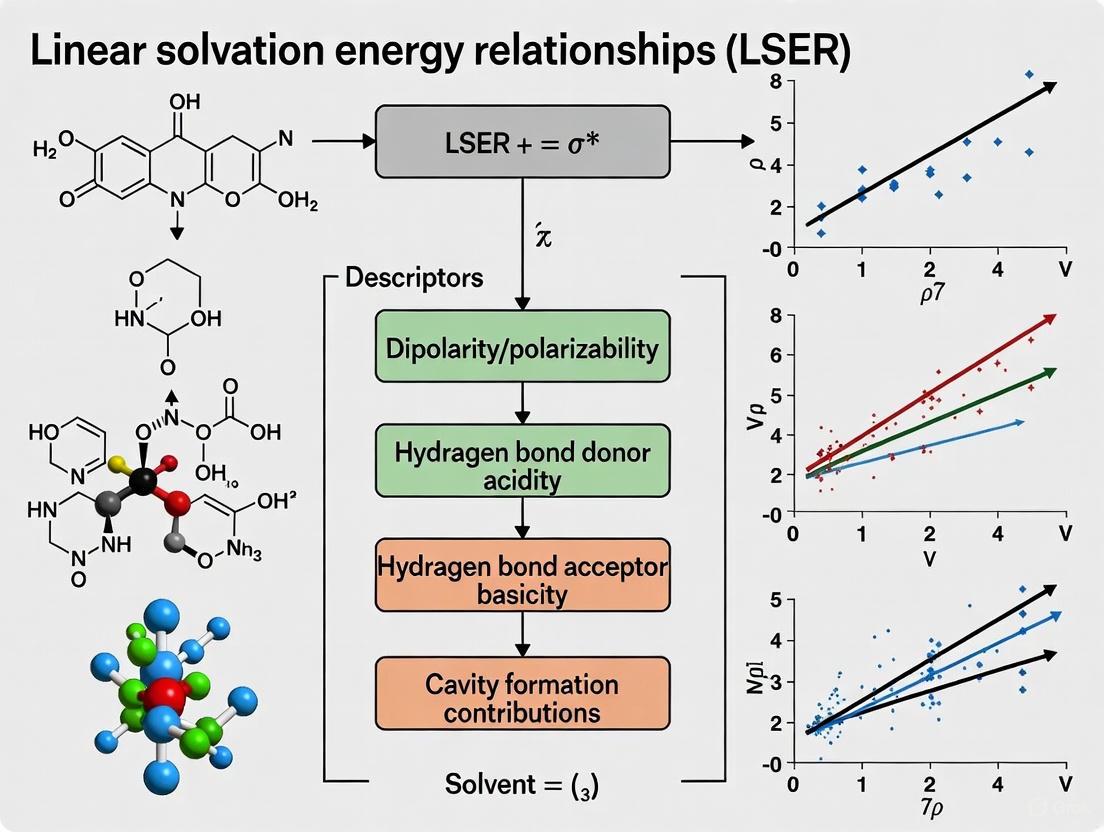
This article provides a complete resource for researchers and drug development professionals on applying Linear Solvation Energy Relationships (LSER) for rational solvent selection.
Linear Solvation Energy Relationships (LSER): A Comprehensive Guide to Predictive Solvent Selection in Research and Drug Development
Abstract
This article provides a complete resource for researchers and drug development professionals on applying Linear Solvation Energy Relationships (LSER) for rational solvent selection. It covers the foundational principles of the Abraham solvation parameter model, detailing how solute descriptors (E, S, A, B, V) and system constants (e, s, a, b, v) quantitatively predict solvent effects. The content explores methodological applications in chromatography and pharmaceutical process development, offers troubleshooting for complex molecules and model limitations, and presents validation through thermodynamic interpretations and comparative analyses with other methods. By synthesizing theory and practice, this guide empowers scientists to leverage LSER for optimizing solvent use in chemical processes and pharmaceutical formulations.
Understanding LSER Fundamentals: The Abraham Model and Molecular Descriptors
Linear Solvation Energy Relationships (LSERs) are a powerful predictive tool in chemical, biomedical, and environmental research for understanding the intermolecular interactions that govern solute retention and partitioning in various processes [1] [2]. The most widely accepted model, known as the Abraham solvation parameter model, describes a solute's behavior in different phases or solvents using a multiparameter equation [1] [3]. This model is grounded in the cavity theory of solvation, which posits that solvation involves the creation of a cavity in the solvent, insertion of the solute, and subsequent solute-solvent interactions [3].
The core equation for describing solute transfer between two condensed phases (e.g., water and an organic solvent) is expressed as:
SP = c + eE + sS + aA + bB + vV
In this equation:
- SP is a solute property, which is a free-energy-related property. In chromatography, this is most often the logarithm of the retention factor, log k' [1]. For partitioning, it is commonly the logarithm of the water-to-organic solvent partition coefficient, log P [1] [3].
- The lowercase letters (e, s, a, b, v) are system coefficients (or solvent descriptors) that reflect the complementary properties of the solvent or phase system [1] [2] [3].
- The uppercase letters (E, S, A, B, V) are solute descriptors that capture the solute's ability to participate in various types of intermolecular interactions [1] [3].
- The constant c is a regression-derived constant for the system [3].
Table 1: Explanation of Terms in the Core LSER Equation
| Symbol | Type | Description | Physicochemical Interpretation |
|---|---|---|---|
| SP | Solute Property | A free-energy-related property | Most often log k' (chromatography) or log P (partitioning) [1] |
| c | Constant | Regression-derived constant | System-specific intercept |
| e | Solvent Coefficient | Solvent's ability to interact with solute electron pairs | Measures interaction via pi- and non-bonding electrons [3] |
| E | Solute Descriptor | Solute's excess molar refraction | Related to the solute's polarizability [1] [3] |
| s | Solvent Coefficient | Solvent's dipolarity/polarizability | Measures interaction with dipolar solutes [1] |
| S | Solute Descriptor | Solute's dipolarity/polarizability | Measures the solute's ability to engage in dipole-dipole interactions [1] [3] |
| a | Solvent Coefficient | Solvent's hydrogen-bond basicity | Complementary to the solute's acidity [3] |
| A | Solute Descriptor | Solute's hydrogen-bond acidity | Measures the solute's ability to donate a hydrogen bond [1] [3] |
| b | Solvent Coefficient | Solvent's hydrogen-bond acidity | Complementary to the solute's basicity [3] |
| B | Solute Descriptor | Solute's hydrogen-bond basicity | Measures the solute's ability to accept a hydrogen bond [1] [3] |
| v | Solvent Coefficient | Solvent parameter related to cavity formation | Derived from regression, related to dispersion interactions [3] |
| V | Solute Descriptor | McGowan's characteristic volume (in cm³/100) | Represents the solute's molecular size, related to the endoergic cost of cavity formation [1] [2] |
Experimental Protocols
Protocol: Determining Solute Descriptors from Experimental Data
This protocol outlines the method for determining the LSER descriptors (E, S, A, B, V) for a new solute, a prerequisite for applying the model predictively.
1. Principle Solute descriptors are determined by measuring the solute's behavior (e.g., partition coefficients, retention factors) in multiple, well-characterized solvent systems with known LSER coefficients (e, s, a, b, v). The descriptors are then solved via multiple linear regression [1].
2. Materials and Equipment
- Solute of interest (high purity)
- Reference solvents/systems with known LSER coefficients (e.g., n-hexadecane, water/octanol, chromatographic systems)
- Gas Chromatograph (GC) or High-Performance Liquid Chromatograph (HPLC)
- Partitioning experiment apparatus (e.g., shake-flask setup)
- UV-Vis Spectrophotometer or other analytical instrument for concentration determination
3. Step-by-Step Procedure Step 1: Select Reference Systems. Choose at least 5-6 different solvent systems (e.g., gas/solvent, water/solvent) for which the LSER coefficients (e, s, a, b, v, c) are reliably known from the literature [1]. Step 2: Measure Solute Property. For each reference system (i), experimentally determine the solute property (SP_i). For partitioning, this is log P; for chromatography, it is log k' [1]. Step 3: Regress Descriptors. Set up a system of equations using the core LSER model for each measurement: SP₁ = c₁ + e₁E + s₁S + a₁A + b₁B + v₁V SP₂ = c₂ + e₂E + s₂S + a₂A + b₂B + v₂V ... Step 4: Perform Regression. Use multiple linear regression analysis to solve for the five solute descriptors (E, S, A, B, V) that best fit the entire dataset of experimental SP values [1]. The statistical fit must be robust, and the descriptors should fall within reasonable chemical limits.
4. Data Analysis The resulting set of descriptors (E, S, A, B, V) for the solute can be stored in a database and used to predict the solute's behavior in any other system for which the LSER coefficients are known.
Protocol: Predicting Partition Coefficients (log P) for Solvent Screening
This protocol uses the Abraham model to predict the water-to-solvent partition coefficient (log P) for a solute, which is crucial for solvent screening in drug development, such as for liquid-liquid extractions.
1. Principle Once a solute's descriptors are known, its partition coefficient between water and any organic solvent can be predicted if the solvent's coefficients in the LSER equation for log P are known [3]. The model predicts the degree to which a solute will favor one phase over another.
2. Materials and Equipment
- UFZ-LSER database or other literature source for solute descriptors [4]
- Literature source for solvent coefficients (e, s, a, b, v, c) for the log P equation [3]
- Computational tool (spreadsheet software is sufficient)
3. Step-by-Step Procedure Step 1: Obtain Solute Descriptors. Retrieve the solute descriptors (E, S, A, B, V) for your compound of interest from a reliable database such as the UFZ-LSER database [4]. If unavailable, refer to Protocol 2.1. Step 2: Obtain Solvent Coefficients. Retrieve the solvent coefficients (c, e, s, a, b, v) for the log P equation for the solvents you wish to screen. These are typically found in peer-reviewed literature compilations [3]. Step 3: Apply the LSER Equation. For each solvent, calculate the predicted log P using the core equation: log P = c + eE + sS + aA + bB + vV Step 4: Compare Results. Rank the solvents based on the calculated log P value. A higher log P value indicates the solute has a greater affinity for that organic solvent over water [3].
4. Data Analysis The predicted log P values allow for the rational selection of solvents for extraction. For example, a higher log P for solvent A compared to solvent B suggests that solvent A will be more effective at extracting the solute from an aqueous phase [3].
Workflow Visualization
The following diagram illustrates the logical workflow for applying the LSER model to predict solute behavior, from descriptor determination to practical application.
Data Presentation
The predictive power of the LSER model is demonstrated by its ability to correlate and predict complex solvation properties. The following table provides a concrete example of how the model can be used to predict the extraction efficiency of caffeine from water into different organic solvents, a relevant process in pharmaceutical isolation [3].
Table 2: Example LSER Prediction for Caffeine Extraction from Water [3]
| Solvent | Predicted log P | Predicted Partition Coefficient (P) | Interpretation for Extraction |
|---|---|---|---|
| Chloroform | 1.044 | 11.072 | Highest affinity for caffeine. Most efficient for extraction from water. |
| Ethanol | -0.005 | 0.989 | Nearly equal distribution between water and ethanol. Low extraction efficiency. |
| Cyclohexane | -1.808 | 0.016 | Very low affinity for caffeine. Caffeine will remain almost entirely in the water phase. |
The Scientist's Toolkit: Key Research Reagents & Materials
Successful application of the LSER model relies on specific tools and databases. This table lists essential resources for researchers.
Table 3: Essential Resources for LSER Research
| Resource | Type | Function in LSER Research |
|---|---|---|
| UFZ-LSER Database [4] | Database | A primary source for obtaining solute descriptors (E, S, A, B, V, L) for thousands of neutral compounds. |
| Reference Solvent Systems | Experimental | Systems like n-hexadecane/air, water/octanol, and specific GC/HPLC columns with known LSER coefficients, used to characterize new solutes (Protocol 2.1) [1]. |
| Chromatography System (GC/HPLC) | Equipment | Used to measure retention factors (log k') for solutes, which serve as the solute property (SP) for determining descriptors or validating predictions [1]. |
| Shake-Flask Apparatus | Equipment | Used for experimental determination of liquid-liquid partition coefficients (log P) for method validation [3]. |
| Abraham Solute Descriptors (E, S, A, B, V) | Data | The core set of parameters that characterize a solute's interaction potential. These are the key inputs for any predictive calculation [1] [3]. |
| LSER Solvent Coefficients (c, e, s, a, b, v) | Data | System-specific parameters that describe the solvent's or chromatographic system's interaction capabilities. Required to predict SP for a known solute [1] [2]. |
The Abraham solvation parameter model is a fundamental framework in physical chemistry that describes the transfer of solutes between phases using a set of system-independent descriptors. This model is grounded in Linear Solvation Energy Relationships (LSERs), which establish correlations between a solute's molecular properties and its behavior in various chemical and biological systems [5]. The general model is expressed through two primary equations for partition coefficients:
Log P = c + e·E + s·S + a·A + b·B + v·V [6] [5]
Log K = c + e·E + s·S + a·A + b·B + l·L [5]
where P represents water-solvent partition coefficients, K represents gas-solvent partition coefficients, and the lowercase letters (c, e, s, a, b, v, l) are system-specific coefficients that describe the solvent environment [5]. The uppercase letters (E, S, A, B, V, L) represent the solute descriptors that characterize key molecular properties of the compound undergoing transfer. These descriptors provide a quantitative basis for predicting a wide range of physicochemical properties including solubility, partition coefficients, skin permeability, toxicity parameters, and pharmacological activities [5] [7]. The model's strength lies in its system-independent descriptors - once characterized for a particular solute, these descriptors can be applied to predict its behavior across numerous environmental and biological systems.
The Solute Descriptors: Definition and Significance
E - Excess Molar Refractivity
The E descriptor represents the excess molar refractivity of a solute, expressed in units of (cm³ per mol)/10 [5]. This descriptor characterizes the solute's polarizability arising from π- and n-electrons. It encodes the dispersion interactions that occur when a solute induces a dipole in the solvent molecules. For compounds that are liquid at 20°C, the E descriptor can be determined experimentally from the characteristic volume and refractive index measurement [7]. For solid compounds, E can be predicted using computational methods including fragment-based approaches, molar refractivity predictions through tools like ChemSpider, or specialized software such as ACD/ADME Suite [5].
S - Dipolarity/Polarizability
The S descriptor represents the solute's dipolarity/polarizability, which quantifies the ability of a solute to engage in dipole-dipole and dipole-induced dipole interactions with the solvent environment [5]. This descriptor reflects how a solute's electron cloud can be distorted by solvent electric fields or how the solute itself can polarize solvent molecules. Unlike the E descriptor, S cannot be calculated directly from structure and must be determined experimentally through measurements such as liquid-liquid partition coefficients or chromatographic retention data [7]. The S parameter plays a crucial role in understanding how polar compounds distribute themselves between different media.
A and B - Hydrogen-Bond Acidity and Basicity
The A and B descriptors represent the solute's hydrogen-bond acidity and basicity, respectively [5]. These parameters quantify the solute's capacity to participate in hydrogen-bonding interactions:
- A descriptor: Measures the solute's ability to donate a hydrogen bond (hydrogen-bond acidity)
- B descriptor: Measures the solute's ability to accept a hydrogen bond (hydrogen-bond basicity)
These descriptors are particularly important for predicting the behavior of compounds containing functional groups such as hydroxyl, amine, carbonyl, and carboxyl groups. Like the S descriptor, A and B are predominantly determined through experimental measurements, though predictive computational methods exist [5] [7]. For compounds like carboxylic acids that can form dimers in non-polar solvents, separate A and B descriptors may be required for the monomeric and dimeric forms [5].
V - McGowan Characteristic Volume
The V descriptor represents the McGowan characteristic volume expressed in units of (cm³ per mol)/100 [5]. This parameter encodes size-related solvent-solute dispersion interactions, including a measure of the cavity term that represents the energy required to create a cavity in the solvent to accommodate the dissolved solute [5]. Unlike the other descriptors, V is the most straightforward to determine as it can be calculated directly from molecular structure using atomic contribution methods without requiring experimental measurements [5] [7]. The V descriptor effectively captures the size exclusion and steric effects that influence solute partitioning between different phases.
Table 1: Abraham Solute Descriptors: Definitions and Determination Methods
| Descriptor | Molecular Property | Units | Primary Determination Method |
|---|---|---|---|
| E | Excess molar refractivity | (cm³/mol)/10 | Refractive index (liquids) or prediction (solids) |
| S | Dipolarity/Polarizability | Dimensionless | Experimental measurement |
| A | Hydrogen-bond acidity | Dimensionless | Experimental measurement |
| B | Hydrogen-bond basicity | Dimensionless | Experimental measurement |
| V | McGowan characteristic volume | (cm³/mol)/100 | Calculation from molecular structure |
| L | Gas-hexadecane partition coefficient | Dimensionless | Experimental measurement |
Experimental Protocols for Descriptor Determination
Protocol 1: Determination of Solute Descriptors Using Liquid-Liquid Partition
Principle: This method determines solute descriptors by measuring partition coefficients in multiple totally organic and aqueous biphasic systems, then solving the system of equations to derive the descriptors [7].
Materials and Reagents:
- Totally organic biphasic systems: heptane-1,1,1-trifluoroethanol, isopentyl ether-propylene carbonate, isopentyl ether-ethanolamine, heptane-ethylene glycol, heptane-formamide, and 1,2-dichloroethane-ethylene glycol
- Aqueous biphasic systems: octanol-water, cyclohexane-water
- High-purity solutes for analysis
- Analytical instruments for concentration determination (GC, HPLC, or spectrophotometry)
Procedure:
- Prepare each biphasic system in separate containers and allow to equilibrate at constant temperature (typically 25°C)
- Introduce a known amount of solute to each system
- Agitate the systems thoroughly to establish partitioning equilibrium
- Allow phases to separate completely
- Determine solute concentration in both phases using appropriate analytical methods
- Calculate partition coefficients (P) as the ratio of concentrations between the two phases
- For each system, apply the Abraham model: log P = c + e·E + s·S + a·A + b·B + v·V
- Solve the system of equations across multiple biphasic systems to determine the solute descriptors
Performance Characteristics: When using six totally organic biphasic systems, the S, A, and B descriptors can be assigned with average absolute deviations (AAD) of approximately 0.04, 0.03, and 0.04, respectively, compared to the best estimate of true descriptor values [7]. The E descriptor for compounds solid at 20°C is estimated with higher AAD of approximately 0.11.
Protocol 2: Determination of Descriptors from Solubility Measurements
Principle: This approach determines solute descriptors using measured solubility data across multiple solvents, particularly useful for compounds with limited partition coefficient data [5].
Materials and Reagents:
- Series of organic solvents with known Abraham solvent parameters (polar and non-polar)
- Solute of interest
- Equipment for solubility measurement (shaking water baths, centrifugation, analytical instruments)
Procedure:
- Select a diverse set of solvents with known Abraham solvent parameters (c, e, s, a, b, v)
- Measure saturated solubility of the solute in each solvent at constant temperature
- Convert solubility values to molar concentrations
- For water-solvent systems, calculate partition coefficients using Ps = Cs/Cw, where Cs is solubility in organic solvent and Cw is aqueous solubility
- Apply the Abraham model: log Ps = c + e·E + s·S + a·A + b·B + v·V
- Use regression analysis with multiple solvent systems to solve for the solute descriptors
- For compounds that may dimerize (e.g., carboxylic acids), use separate regressions for polar solvents (monomer) and non-polar solvents (dimer)
Performance Characteristics: For trans-cinnamic acid, this approach allowed prediction of solubilities in both polar and non-polar solvents with an error of about 0.10 log units [5]. The method successfully generated separate descriptors for monomeric and dimeric forms of carboxylic acids.
Diagram 1: Experimental Workflow for Solute Descriptor Determination
Advanced Applications and Computational Approaches
Machine Learning for Descriptor Prediction
Recent advances have demonstrated the successful application of large language models (LLMs) for predicting Abraham solute descriptors directly from molecular structure. The AbraLlama-Solute model, based on the ChemLLaMA framework fine-tuned from LLaMA, predicts Abraham solute descriptors (E, S, A, B, V) with high accuracy using only SMILES strings as input [6]. This approach leverages transformer architectures initially pre-trained on extensive textual data, then fine-tuned on curated datasets of experimentally derived solute descriptors. The model was trained on 6,852 compounds with experimentally derived Abraham solute descriptors from the UFZ-LSER database and demonstrates accuracy comparable to existing methods [6]. This computational approach significantly accelerates descriptor determination, particularly for high-throughput applications in drug discovery and environmental chemistry.
Special Cases: Monomeric and Dimeric Forms
For compounds that can exist in different forms depending on solvent environment, such as carboxylic acids that form dimers in non-polar solvents, separate descriptor sets can be determined for each form [5]. The protocol involves:
- Using polar solvents where the solute exists predominantly in monomeric form to determine monomer descriptors
- Using non-polar solvents where dimerization occurs to determine dimer descriptors
- Applying the respective descriptor sets for predictions in different solvent environments
This approach was successfully demonstrated for trans-cinnamic acid, marking the first time descriptors for a carboxylic acid dimer were obtained [5]. The dimerization constant (Kdimer) varies significantly by solvent - for benzoic acid, Kdimer is 11,300 in cyclohexane, 5,010 in tetrachloromethane, and 590 in benzene [5].
Table 2: Research Reagent Solutions for Descriptor Determination
| Reagent/System | Type | Primary Application | Key Characteristics |
|---|---|---|---|
| Heptane-1,1,1-Trifluoroethanol | Totally organic biphasic | S, A, B descriptor assignment | High selectivity for hydrogen-bond interactions |
| Octanol-Water | Aqueous biphasic | B descriptor assignment | Standard system for lipophilicity measurement |
| Cyclohexane-Water | Aqueous biphasic | S, A descriptor assignment | Complementary selectivity to octanol-water |
| Isopentyl Ether-Propylene Carbonate | Totally organic biphasic | S, A, B descriptor assignment | Balanced selectivity for multiple interactions |
| UFZ-LSER Database | Computational resource | Experimental descriptor reference | Contains 6,852 compounds with experimental descriptors [6] |
| AbraLlama Models | Computational tool | Descriptor prediction from SMILES | Fine-tuned LLMs for solute and solvent parameters [6] |
Data Analysis and Validation
Statistical Validation of Descriptor Values
The accuracy of experimentally determined descriptors must be validated through statistical analysis of the regression results. Key validation parameters include:
- Average Absolute Deviation (AAD): For liquid-liquid partition methods, typical AAD values are 0.03-0.04 for S, A, and B descriptors when using six totally organic biphasic systems [7]
- Relative Average Absolute Deviation (RAAD): Expressed as percentage error, with values of approximately 9.7%, 3.1%, 4.0%, and 8.3% for E, S, A, and B descriptors, respectively, when using eight biphasic systems [7]
- Standard Deviation: For well-behaved systems, the Abraham model describes molar solubility with standard deviations of approximately 0.12-0.14 log units [5]
The quality of descriptor determination depends on selecting appropriate solvent systems that provide balanced coverage of different interaction types (dipolarity, hydrogen-bonding, dispersion). Systems with similar selectivity provide redundant information and should be avoided in favor of complementary systems.
Application in Solvent Selection and Prediction
The primary application of Abraham solute descriptors lies in predicting partition coefficients and solubilities for solvent selection in pharmaceutical and chemical processes. The general solvation model enables:
Solvent Comparison: Using modified Abraham solvent parameters (e₀, s₀, a₀, b₀, v₀) with zero intercept facilitates direct comparison of solvent properties [6]. Solvents with closely matching parameters exhibit similar solvation properties, enabling rational solvent substitution.
Solubility Prediction: For compounds with known descriptors, solubility in new solvents can be predicted using the Abraham model with the solvent parameters: log Ss = log Sw + c + e·E + s·S + a·A + b·B + v·V [6]
Process Optimization: In drug development, descriptors help optimize extraction, purification, and formulation processes by predicting compound behavior in complex multicomponent systems.
Diagram 2: Predictive Applications of Abraham Solute Descriptors
The Abraham solute descriptors E, S, A, B, and V provide a robust, system-independent framework for predicting solute behavior across diverse chemical and biological systems. Through established experimental protocols including liquid-liquid partition and solubility measurements, these descriptors can be determined with high accuracy and precision. Recent computational advances, particularly the application of fine-tuned large language models like AbraLlama, offer promising avenues for high-throughput descriptor prediction directly from molecular structure. When properly validated and applied, these descriptors serve as powerful tools for solvent selection, pharmaceutical development, and environmental risk assessment, forming a critical component of LSER-based research strategies. The continued refinement of determination methods and expansion of experimental databases will further enhance the utility and application scope of these fundamental molecular parameters in chemical research and development.
Linear Solvation Energy Relationships (LSERs) are a powerful quantitative tool used to correlate and predict how solvents influence a wide variety of chemical processes, from chemical reaction rates to solubility and chromatographic retention [8] [1]. The methodology was pioneered by Kamlet, Taft, and Abraham, who parameterized solvents based on their key interaction capabilities.
The most widely accepted model for this analysis is the Abraham LSER equation, which is expressed as:
SP = c + eE + sS + aA + bB + vV
In this equation, SP is a solute property of interest, most commonly the logarithm of a partition coefficient or a retention factor (e.g., log k') in chromatography [1]. The lowercase letters on the right side of the equation (e, s, a, b, v) are the system constants that reveal the complementary nature of the solvent system. The uppercase letters (E, S, A, B, V) are the solute descriptors that capture the intrinsic properties of the molecule being studied [1].
Table 1: Interpretation of the System Constants in the Abraham LSER Equation
| System Constant | Chemical Interaction it Represents | Opposing Solute Descriptor |
|---|---|---|
| e | The solvent's resistance to interact with solute π- or n-electrons (polarizability) | E - The solute's excess molar refractivity (polarizability) |
| s | The solvent's dipolarity/polarizability | S - The solute's dipolarity/polarizability |
| a | The solvent's hydrogen-bond basicity (HBA) | A - The solute's hydrogen-bond acidity (HBD) |
| b | The solvent's hydrogen-bond acidity (HBD) | B - The solute's hydrogen-bond basicity (HBA) |
| v | The solvent's resistance to cavity formation (endoergic process) | V - The solute's McGowan characteristic volume |
This application note provides a detailed guide for researchers and drug development professionals on how to interpret these system constants to gain deep insights into their solvent systems, thereby enabling more rational solvent selection in pharmaceutical research and development.
Chemical Interpretation of the System Constants
The system constants are determined through multiparameter linear regression analysis of a dataset comprising solutes with known descriptors [1]. Their signs and magnitudes provide a quantitative fingerprint of the solvent system's interaction properties.
The v Constant: Cavity Formation and Dispersion Interactions
The v constant is generally positive for processes involving transfer from a gas phase to a condensed phase (as in gas chromatography) because energy must be expended to separate solvent molecules and create a cavity for the solute [1]. A large, positive v value indicates that the solvent has high cohesion (e.g., water), making cavity formation difficult. Conversely, a negative v coefficient in a liquid-liquid partitioning system indicates that cavity formation is more favorable in that phase.
The a and b Constants: Hydrogen-Bonding Interactions
- The a Constant: A positive a value signifies that the solvent phase is hydrogen-bond basic (a good HBA) and favorably interacts with solutes that are hydrogen-bond acidic (good HBD). This would increase the retention of HBD solutes in chromatography or their solubility in that solvent [1].
- The b Constant: A positive b value signifies that the solvent phase is hydrogen-bond acidic (a good HBD) and favorably interacts with solutes that are hydrogen-bond basic (good HBA) [1].
The s and e Constants: Dipolarity and Polarizability Interactions
- The s Constant: A positive s value indicates that the solvent is dipolar/polarizable and stabilizes solutes that also possess significant dipolarity/polarizability (S) [8] [1].
- The e Constant: This constant represents the solvent's ability to engage in interactions involving solute π- or n-electrons. Interpretation is more complex and depends on the specific process being modeled [1].
Diagram 1: The relationship between solute descriptors, system constants, and the measured chemical property in an LSER model. The system constants represent the solvent's response to specific solute properties.
Case Study: Application in Solubility Prediction
LSER models are exceptionally valuable in pharmaceutical development for predicting the solubility of drug candidates, a critical factor in bioavailability. The following case study illustrates a typical protocol.
Case Study: Solubility of Buckminsterfullerene (C₆₀)
A study developed an LSER model to predict the solubility of the nanomaterial C₆₀ in various solvents [9]. The resulting model highlighted which solvent interactions most significantly influenced C₆₀ solubility. The analysis revealed that the hydrogen-bond donation ability (b coefficient), basicity scale (a coefficient), and dispersion interactions were the most effective parameters for correlating C₆₀ solubility [9]. This provides a clear guide for solvent selection when working with fullerenes.
Protocol: Determining System Constants for a Solubility Model
This protocol outlines the steps to develop a LSER model for solubility.
Step 1: Experimental Solubility Measurement
- Objective: Accurately determine the solubility (SP) of a diverse set of solute molecules in the solvent system of interest. SP is typically log(S), where S is the molar solubility.
- Method: Use a validated technique like the laser monitoring method [10] [11]. This involves tracking the change in laser beam intensity through a stirred solution as the temperature is controlled. The point at which the last crystal dissolves is detected by a sharp increase in light transmission, indicating saturation.
- Key Materials:
- Laser Monitoring System: A vessel with a thermostat, magnetic stirrer, laser source, and photodetector.
- Analytical Balance: For precise weighing of solutes and solvents.
Step 2: Compile Solute Descriptor Data
- Objective: Obtain the Abraham solute descriptors (E, S, A, B, V) for each compound in your training set.
- Method: Source data from published databases or the scientific literature [1]. Ensure the training set includes solutes with a wide range of descriptor values to avoid collinearity.
Step 3: Multivariate Linear Regression
- Objective: Calculate the system constants (e, s, a, b, v, c) for your solvent system.
- Method: Use statistical software (e.g., R, Python with scikit-learn) to perform a multiple linear regression with the experimental log(S) values as the dependent variable and the solute descriptors as the independent variables.
- Validation: Assess the model's quality using the coefficient of determination (R²), cross-validation, and analysis of residuals.
Table 2: Exemplar LSER System Constants for Different Process Types
| Process or System | v | s | a | b | Key Interpretation |
|---|---|---|---|---|---|
| Gas → Water Partitioning | Large Positive | Variable | Positive | Positive | High cohesive energy (v) of water; strong HBA (a) and HBD (b) character. |
| Octanol/Water Partition (log P) | ~2.17 | -1.00 | -3.32 | -4.39 | The negative a, b, and s values indicate that water is a much stronger HBD, HBA, and dipolar solvent than wet octanol [1]. |
| C₆₀ Solubility in Organic Solvents | Significant | Less Significant | Significant (Positive) | Significant (Negative) | Solubility favored by solvent HBA basicity (a) and disfavored by solvent HBD acidity (b) [9]. |
Diagram 2: A workflow for developing an LSER model to predict solubility, from experimental design to practical application.
The Scientist's Toolkit: Key Reagents and Materials
Table 3: Essential Research Reagent Solutions for LSER Studies
| Item Name | Function/Description | Application Context |
|---|---|---|
| Solvent Training Set | A collection of solvents with characterized π*, α, and β parameters [8]. | Used to establish a diverse dataset for initial model building and understanding solvent property space. |
| Solute Probe Training Set | A set of compounds with known Abraham descriptors (E, S, A, B, V) [1]. | Essential for performing the multivariate regression to determine the system constants of a new solvent or system. |
| Standard Reference Materials | Certified materials with known elemental composition (e.g., NIST SRM610) [12]. | Used for calibration and verification of analytical methods like LIBS or ICP-MS that may support LSER studies. |
| Laser Monitoring System | Apparatus with laser, thermostatted vessel, and detector to determine solubility endpoints [10] [11]. | Core equipment for accurately measuring solute solubility (SP) for LSER models focused on dissolution. |
The system constants e, s, a, b, and v of the Abraham LSER equation are more than just fitting parameters; they are a quantitative fingerprint that reveals the specific interaction capabilities of a solvent system. By interpreting these constants, researchers and drug development professionals can move beyond trial-and-error and make rational, knowledge-driven decisions about solvent selection. This methodology provides a deep chemical understanding of how a solvent will interact with different solute functionalities, ultimately enabling the optimization of processes critical to pharmaceuticals, such as solubility enhancement, purification via chromatography, and formulation stability.
Linear Solvation Energy Relationships (LSERs) represent a powerful quantitative approach for predicting the partitioning behavior of solutes in different chemical and biological systems. Originally developed by Abraham, these thermodynamic models express free energy-related properties as a linear combination of molecular descriptors that encode specific solute-solvent interaction capabilities [1] [13]. The fundamental LSER equation takes the form:
SP = c + eE + sS + aA + bB + vV
Where SP is any free energy-related solute property such as the logarithm of a partition coefficient (log K) or retention factor (log k') [1]. The uppercase letters (E, S, A, B, V) represent solute-specific molecular descriptors, while the lowercase coefficients (c, e, s, a, b, v) are system constants that characterize the complementary properties of the phases between which partitioning occurs [13]. This robust framework finds extensive applications across chemical engineering, environmental science, and pharmaceutical research, including predicting toxicity, soil-water absorption coefficients, and drug transport properties [13].
The thermodynamic foundation of LSER stems from the interpretation of partitioning processes as a combination of an endoergic cavity formation/solvent reorganization process and exoergic solute-solvent attractive interactions [1]. The partitioning of a solute between two condensed phases is thermodynamically equivalent to the difference between two gas/liquid solution processes, providing a coherent framework for understanding and predicting solute behavior across diverse systems [1].
Molecular Descriptors and Their Thermodynamic Significance
Solute Descriptor Definitions
The LSER model utilizes five fundamental solute descriptors that capture the principal modes of molecular interactions. Each descriptor quantifies a specific aspect of the solute's interaction potential, providing a comprehensive characterization of its behavior in solution phases [1].
Table 1: LSER Solute Descriptors and Their Molecular Interpretation
| Descriptor | Symbol | Molecular Interpretation | Interaction Type |
|---|---|---|---|
| Excess molar refractivity | E | Polarizability of π and n electrons | Dispersion interactions |
| Dipolarity/ Polarizability | S | Dipolarity and polarizability | Dipole-dipole, dipole-induced dipole |
| Hydrogen-bond acidity | A | Hydrogen bond donating ability | Solute (donor) to solvent (acceptor) |
| Hydrogen-bond basicity | B | Hydrogen bond accepting ability | Solute (acceptor) to solvent (donor) |
| McGowan's characteristic volume | V | Molecular size | Endoergic cavity formation |
System Constants and Their Interpretation
The system constants in the LSER equation reflect the complementary properties of the specific phases between which partitioning occurs. These coefficients indicate the relative importance of each type of interaction in the system being studied [1] [13].
Table 2: LSER System Constants and Their Thermodynamic Meaning
| Coefficient | Symbol | Phase Property | Thermodynamic Contribution |
|---|---|---|---|
| Intercept | c | System constant | Phase-specific constant |
| Polarizability interactions | e | Phase polarizability | Complimentary to E |
| Dipolarity interactions | s | Phase dipolarity/polarizability | Complimentary to S |
| Hydrogen-bond basicity | a | Phase hydrogen-bond accepting ability | Complimentary to A (solute acidity) |
| Hydrogen-bond acidity | b | Phase hydrogen-bond donating ability | Complimentary to B (solute basicity) |
| Cavity formation | v | Phase cohesion energy | Resistance to cavity formation |
Experimental Protocols for LSER Development
Protocol 1: Determination of Partition Coefficients for LSER Model Calibration
This protocol outlines the experimental procedure for determining solute partition coefficients between low-density polyethylene (LDPE) and water, as exemplified in recent LSER studies [14].
Materials and Equipment
- Test solutes: A chemically diverse set of compounds (e.g., 156 compounds for robust model)
- Polymeric phase: Low-density polyethylene (LDPE) film or particles
- Aqueous phase: Deionized water or buffer solution
- Containers: Glass vials with minimal headspace, Teflon-lined caps
- Analytical instrumentation: HPLC-UV, GC-MS, or LC-MS systems for quantification
- Temperature control: Water bath or incubator maintained at 25°C ± 0.5°C
- Separation equipment: Centrifuge capable of 3000-5000 × g
- Sample preparation: Vortex mixer, precision pipettes, analytical balance
Procedure
Preparation of solute solutions: Prepare stock solutions of each test solute in appropriate solvents at concentrations suitable for detection by analytical methods.
Equilibration setup: For each solute, add measured amounts of LDPE and aqueous phase to glass vials. The phase ratio should be optimized to ensure measurable solute concentrations in both phases after equilibration.
Solute addition and equilibration: Spike the systems with solute solutions, seal to prevent evaporation, and equilibrate in a temperature-controlled environment with continuous agitation for 24-72 hours (confirm equilibrium through time-course studies).
Phase separation: After equilibration, separate the phases carefully. For LDPE-water systems, remove the aqueous phase first, then rinse the polymer surface gently with water to remove adhering droplets.
Solute quantification:
- For aqueous phase: Analyze directly or after appropriate dilution using HPLC, GC, or other suitable analytical methods.
- For polymer phase: Extract solute from LDPE using appropriate solvent (e.g., hexane, acetonitrile) or measure directly if possible.
- Include calibration standards with known concentrations covering the expected range.
Calculation of partition coefficients: Calculate the partition coefficient for each solute using the formula: Ki,LDPE/W = Ci,LDPE / Ci,W where Ci,LDPE and Ci,W represent the equilibrium concentrations in LDPE and water phases, respectively. Use the logarithm of this value (log Ki,LDPE/W) for LSER analysis.
Quality control: Include replicate systems (minimum n=3) for quality assurance and determine standard deviations.
Protocol 2: LSER Model Calibration and Validation
This protocol describes the statistical procedures for developing and validating LSER models using experimental partition coefficient data [14] [13].
Materials and Software
- Experimental data: Experimentally determined partition coefficients (log K) for a diverse set of solutes
- Solute descriptors: Experimentally determined or predicted Abraham solute parameters (E, S, A, B, V) for all test compounds
- Statistical software: JMP, R, Python, or similar with multiple linear regression capabilities
- Computational resources: Standard computer with sufficient memory for data analysis
Procedure
Data compilation: Compile a dataset containing experimentally determined log K values and corresponding solute descriptors (E, S, A, B, V) for all compounds in the training set.
Dataset partitioning: Randomly divide the complete dataset into training (~67%) and validation (~33%) sets, ensuring both sets maintain chemical diversity [14].
Model calibration: Perform multiple linear regression analysis on the training set using the equation: logKi = c + eE + sS + aA + bB + vV where the system constants (c, e, s, a, b, v) are determined through the regression.
Model validation: Apply the calibrated model to the independent validation set. Calculate performance statistics including R² (coefficient of determination) and RMSE (root mean square error) to evaluate predictive accuracy [14].
Benchmarking with predicted descriptors: For applications where experimental solute descriptors are unavailable, evaluate model performance using predicted descriptors from Quantitative Structure-Property Relationship (QSPR) tools [14].
Chemical space evaluation: Assess the chemical diversity of the solute set using metrics such as Average Absolute Correlation (AAC) to identify potential multicollinearity issues [13].
Advanced Applications and Methodological Considerations
Solute Set Selection Strategies for Efficient LSER Development
Selecting an optimal solute set is crucial for developing robust LSER models while minimizing experimental effort. Two principal strategies have been identified for selecting minimal solute sets that provide maximum information content [13]:
Table 3: Comparison of Solute Set Selection Strategies for LSER Development
| Strategy | Objective | Method | Advantages | Limitations |
|---|---|---|---|---|
| Strategy 1: Minimize Descriptor Correlation | Reduce multicollinearity | Select compounds with minimal interdependence among descriptors (low AAC) | Improved statistical robustness; isolates individual descriptor contributions | May not span full chemical space; coefficient estimates may deviate from true values |
| Strategy 2: Maximize Descriptor Differences | Maximize chemical diversity | Select compounds with maximum differences between normalized descriptors | Better represents broader chemical space; coefficient estimates closer to true values | Higher descriptor correlation (multicollinearity); requires careful implementation |
Case Study: LSER for LDPE-Water Partitioning
A recent comprehensive study developed and validated an LSER model for partition coefficients between low-density polyethylene (LDPE) and water, resulting in the following equation [14]:
logKi,LDPE/W = -0.529 + 1.098E - 1.557S - 2.991A - 4.617B + 3.886V
This model demonstrated exceptional performance with R² = 0.991 and RMSE = 0.264 for the training set (n = 156). For the independent validation set (n = 52), the model maintained strong predictive power with R² = 0.985 and RMSE = 0.352 when using experimental solute descriptors [14]. When employing QSPR-predicted descriptors instead of experimental ones, the statistics (R² = 0.984, RMSE = 0.511) remained acceptable for applications where experimental descriptors are unavailable [14].
The study further converted partition coefficients to logKi,LDPEamorph/W by considering only the amorphous fraction of the polymer as the effective phase volume. This adjustment changed the constant in the equation from -0.529 to -0.079, rendering the model more similar to a corresponding LSER for n-hexadecane/water systems and providing fundamental insights into the thermodynamic driving forces [14].
Comparison of Polymer Sorption Behaviors
LSER system parameters enable direct comparison of sorption behavior across different polymeric materials. Studies comparing LDPE to polydimethylsiloxane (PDMS), polyacrylate (PA), and polyoxymethylene (POM) reveal that polymers with heteroatomic building blocks (PA, POM) exhibit stronger sorption for polar, non-hydrophobic solutes due to their capabilities for polar interactions [14]. For logKi,LDPE/W values up to 3-4, these polar polymers show enhanced sorption, while above this range, all four polymers exhibit roughly similar sorption behavior dominated by hydrophobic interactions [14].
Research Reagent Solutions and Materials
Table 4: Essential Research Reagents and Materials for LSER Studies
| Category | Specific Items | Function/Application | Examples/Specifications |
|---|---|---|---|
| Polymer Phases | Low-density polyethylene (LDPE) | Model polymeric phase for partitioning studies | Film or particle form, characterized for amorphous content |
| Polydimethylsiloxane (PDMS) | Silicone-based polymer for comparative sorption studies | Cross-linked or non-cross-linked forms | |
| Polyacrylate (PA) | Polar polymer for studying specific interactions | Various compositions depending on application | |
| Reference Solutes | Chemically diverse compound sets | Model solutes for LSER calibration | 50-200 compounds spanning range of E, S, A, B, V values |
| Internal standards | Quantification and quality control | Stable isotopically labeled analogs or structurally similar compounds | |
| Analytical Instruments | HPLC-UV systems | Solute quantification in aqueous phases | Reverse-phase C18 columns, UV-Vis detection |
| GC-MS systems | Volatile solute analysis | Capillary columns, EI or CI ionization | |
| LC-MS systems | Non-volatile and polar solute analysis | ESI or APCI ionization sources | |
| Software and Databases | UFZ-LSER database | Source of solute descriptors | Version 3.2.1+ from Helmholtz Centre for Environmental Research [15] |
| Statistical packages | Multiple linear regression analysis | JMP, R, Python with scikit-learn | |
| QSPR prediction tools | Solute descriptor prediction | Commercial or open-source quantum chemistry packages |
The thermodynamic foundation of Linear Solvation Energy Relationships provides a robust framework for predicting partition coefficients and understanding molecular interactions across diverse chemical and biological systems. Through careful experimental design, appropriate solute set selection, and rigorous statistical validation, researchers can develop accurate predictive models that span broad chemical spaces. The continued refinement of LSER methodologies, including the integration of predicted solute descriptors from quantum chemical calculations, promises to expand the applicability of these powerful models in pharmaceutical research, environmental science, and chemical engineering. As demonstrated in the case studies, LSERs represent not merely correlative tools but physically meaningful models grounded in the fundamental thermodynamics of solvation.
Linear Solvation Energy Relationships (LSERs) represent a cornerstone of physical organic chemistry, providing a quantitative framework for predicting how solvents influence chemical processes. The development of LSERs has been instrumental in advancing fields ranging from synthetic chemistry to pharmaceutical development. The journey from the Kamlet-Taft model to the modern Abraham model exemplifies the evolution of these relationships, each building upon the other to create more robust and comprehensive predictive tools. These models transform qualitative chemical intuition about solvent effects into quantitative, predictable parameters that can be applied across diverse scientific disciplines.
The fundamental principle underlying LSERs is that free-energy related properties of solutes, such as partition coefficients and reaction rates, can be correlated with descriptors encoding molecular interactions [2]. This review traces the historical development of these models, provides detailed protocols for their application, and illustrates their practical utility in modern scientific research, particularly in drug development.
Theoretical Evolution: From Kamlet-Taft to Abraham
The Kamlet-Taft Solvatochromic Comparison Method
The Kamlet-Taft model, introduced in the 1970s and 1980s, was a pioneering approach that parameterized solvent effects using three key parameters [16] [17]. This model utilized solvatochromism—the shift in absorption spectra of dyes in different solvents—to quantify solvent properties empirically.
The original Kamlet-Taft LSER takes the general form:
Where the solvent parameters are:
- π* (dipolarity/polarizability): Measures the solvent's ability to stabilize a charge or dipole through non-specific dielectric interaction.
- α (hydrogen bond donor acidity): Quantifies the solvent's ability to donate a hydrogen bond.
- β (hydrogen bond acceptor basicity): Quantifies the solvent's ability to accept a hydrogen bond.
This model successfully correlated thousands of solvent-dependent phenomena but was primarily limited to describing solvent properties rather than solute properties.
The Abraham Model: A Comprehensive Solute-Centric Approach
The Abraham model, developed subsequently, expanded the Kamlet-Taft approach by introducing a more comprehensive set of solute descriptors that could be used with complementary system coefficients [2] [18]. This model is characterized by two primary equations for different partitioning processes.
For partitioning between two condensed phases:
For gas-to-solvent partitioning:
Where the solute descriptors are:
- E = excess molar refractivity
- S = dipolarity/polarizability
- A = overall hydrogen bond acidity
- B = overall hydrogen bond basicity
- V = McGowan characteristic volume
- L = gas-hexadecane partition coefficient
The corresponding lower-case letters (e, s, a, b, v, l) are system-specific coefficients that describe the complementary properties of the phases between which partitioning occurs [2].
Theoretical Integration and Relationship Between Models
The Abraham model can be viewed as a direct descendant of the Kamlet-Taft approach, with several key theoretical advancements. While Kamlet-Taft parameters primarily describe solvents, Abraham parameters describe both solutes and solvents, creating a more versatile framework [2]. There are correlations between the two sets of parameters—Abraham's A and B descriptors correspond to Kamlet-Taft's α and β, respectively, though they are defined differently and obtained through different experimental methods.
The Abraham model also incorporates additional descriptors that capture molecular size (V) and dispersion interactions (L) more explicitly, providing a more complete description of intermolecular interactions [18]. The thermodynamic basis for the linearity of these relationships has been explored through combination with equation-of-state thermodynamics and the statistical thermodynamics of hydrogen bonding, verifying the fundamental validity of the LFER approach [2].
Table 1: Comparative Analysis of Kamlet-Taft and Abraham LSER Parameters
| Aspect | Kamlet-Taft Model | Abraham Model |
|---|---|---|
| Primary Focus | Solvent properties | Solute and system properties |
| Hydrogen Bond Acidity | α (solvent HBD ability) | A (solute HBA ability) |
| Hydrogen Bond Basicity | β (solvent HBA ability) | B (solute HBD ability) |
| Dipolarity/Polarizability | π* | S |
| Size/Dispersion Terms | Not explicitly included | V (McGowan volume) and L |
| Refractivity | Not explicitly included | E (excess molar refractivity) |
| Primary Application | Correlating solvent effects | Predicting partition coefficients and solubility |
Experimental Protocols and Methodologies
Determining Kamlet-Taft Parameters via Solvatochromic Method
Principle: Kamlet-Taft parameters are determined using solvent-sensitive spectroscopic probes whose absorption maxima shift depending on solvent polarity and hydrogen-bonding characteristics [19].
Protocol:
- Solution Preparation: Prepare solutions of each solvatochromic dye (Table 2) at concentrations of approximately 10⁻⁵ M in the solvent of interest [19].
- Spectroscopic Measurement: Record UV-visible absorption spectra over the range of 300-800 nm using a double-beam spectrophotometer.
- Temperature Control: Maintain constant temperature (±0.1°C) using a circulating water bath, particularly when working near phase transition regions.
- Wavelength Measurement: Precisely determine the maximum absorption wavelength (λₘₐₓ) for each dye in the solvent.
- Parameter Calculation: Calculate parameters using established equations:
- π* is determined from the absorption maxima of nitroanisoles: π* = (νₘₐₓ - 34.12)/-2.432 where νₘₐₓ is in kK (cm⁻¹×10⁻³)
- β is determined from the bathochromic shift of 4-nitroaniline relative to N,N-diethyl-4-nitroaniline
- α is derived from the solvatochromic shift of Reichardt's dye after accounting for π* contributions
Key Considerations: Use spectroscopy-grade dyes without further purification. Ensure solutions are optically clear and free of particulate matter. For anisotropic systems (e.g., liquid crystals), control alignment and measure at multiple orientations [19].
Determining Abraham Solute Descriptors
Principle: Abraham solute descriptors are determined through a combination of experimental measurements and computational approaches [18].
Protocol for Experimental Determination:
- McGowan Characteristic Volume (V): Calculate from molecular structure using atomic volumes and number of bonds: V = (Σ atomic volumes - 6.56 × number of bonds)/100
- Excess Molar Refractivity (E): Determine from refractive index measurements: E = (n² - 1)/(n² + 2) × MW/density - V × 0.986
- Hydrogen Bond Acidity and Basicity (A and B): Determine from partition coefficient measurements between organic solvents and water
- Dipolarity/Polarizability (S): Derive from chromatographic retention data or computational methods
- Gas-Hexadecane Partition Coefficient (L): Measure via gas-liquid chromatography using hexadecane as the stationary phase
Computational Approaches: With the limited availability of experimental data, open random forest models using Chemical Development Kit (CDK) descriptors have been developed to predict Abraham coefficients with out-of-bag R² values ranging from 0.31 for e to 0.92 for a [18].
Application Protocol: Solvent Selection for MALDI-TOF Mass Spectrometry
Principle: Proper solvent selection is critical for matrix-assisted laser desorption/ionization time-of-flight mass spectrometric (MALDI-TOF MS) analysis of synthetic polymers [20].
Protocol:
- Polymer Solubility Assessment: Determine polymer solubility in candidate solvents using Hansen solubility parameters as an initial guide.
- Matrix and Cationization Reagent Selection:
- For polystyrene: Use dithranol as matrix and silver trifluoroacetate as cationization reagent
- For poly(ethylene glycol): Use 2,5-dihydroxybenzoic acid as matrix and sodium trifluoroacetate as cationization reagent
- Sample Preparation: Prepare homogeneous solutions using solvents identified as good solvents for the polymer.
- MALDI-TOF MS Analysis: Apply standard MALDI-TOF MS procedures.
- Spectra Evaluation: Compare quality of mass spectra obtained with different solvents.
Key Finding: Reliable MALDI mass spectra are obtained only when employing solvents that dissolve the polymer, while samples in non-solvents fail to provide spectra. The solubility of the matrix and cationization reagent is less important than polymer solubility [20].
Research Reagent Solutions and Materials
Table 2: Essential Research Reagents for LSER Applications
| Reagent/Material | Function/Application | Specifications |
|---|---|---|
| Reichardt's betaine dye | Primary probe for determining Kamlet-Taft π* and α parameters | Spectroscopy grade, λₘₐₓ shifts from ~450 nm (in dipolar solvents) to ~800 nm (in hydroxylic solvents) |
| N,N-Dimethyl-4-nitroaniline | Secondary probe for Kamlet-Taft π* parameter | λₘₐₓ ~410 nm in nonpolar solvents |
| 4-Nitroaniline | Probe for Kamlet-Taft β parameter | Used in combination with N,N-diethyl-4-nitroaniline |
| Coumarin 504 | Fluorescent probe for solvatochromic studies | Exhibits strong emission shifts with solvent polarity |
| Dithranol | Matrix for MALDI-TOF MS of synthetic polymers (e.g., polystyrene) | ≥99% purity for optimal results |
| 2,5-Dihydroxybenzoic acid | Matrix for MALDI-TOF MS of polymers (e.g., poly(ethylene glycol)) | ≥99% purity for optimal results |
| Silver trifluoroacetate | Cationization reagent for MALDI-TOF MS of polystyrene | ≥99.9% purity |
| Sodium trifluoroacetate | Cationization reagent for MALDI-TOF MS of poly(ethylene glycol)) | ≥99.9% purity |
Applications in Drug Development and Pharmaceutical Sciences
The transition from Kamlet-Taft to Abraham parameters has significantly enhanced predictive capabilities in pharmaceutical research. The Abraham model finds extensive application in predicting partition coefficients, solubility, and other pharmacokinetically relevant properties [18].
Predicting Solubility and Partition Coefficients
The Abraham model enables prediction of solvent/water partition coefficients using the equation:
Similarly, solubility in organic solvents can be predicted by:
where Sₛ is the molar concentration in the organic solvent and Sₚ is the molar concentration in water [18].
These predictions are crucial for pharmaceutical development, enabling rational selection of excipients, prediction of membrane permeability, and estimation of bioavailability. The model has been successfully applied to predict partitioning into biological membranes, blood-to-tissue distribution, and solute encapsulation in drug delivery systems.
Green Solvent Selection
The Abraham model facilitates the identification of sustainable solvent replacements in pharmaceutical manufacturing. For instance, models predict that propylene glycol may serve as a general sustainable solvent replacement for methanol in many applications [18]. This application is particularly valuable as the pharmaceutical industry seeks to reduce its environmental impact while maintaining process efficiency.
Absorption and Distribution Prediction
Abraham descriptors correlate with crucial ADME (Absorption, Distribution, Metabolism, Excretion) properties. The model has been used to predict drug partitioning between blood and specific organs, providing valuable insights during early drug development stages [18]. This application demonstrates how LSER approaches bridge fundamental solvation science with practical pharmaceutical applications.
Visualization of LSER Evolution and Applications
Diagram 1: Historical evolution from Kamlet-Taft to Abraham LSER models and their applications in drug development. The progression shows how fundamental observations led to increasingly sophisticated models with direct pharmaceutical applications.
Diagram 2: Generalized workflow for LSER application showing the progression from experimental data collection to practical application, highlighting the interconnected phases of the process.
The historical progression from the Kamlet-Taft model to the modern Abraham model represents significant theoretical and practical advancement in solvation science. While the Kamlet-Taft approach provided the crucial foundation for quantifying solvent effects through solvatochromic parameters, the Abraham model expanded this framework into a more comprehensive and versatile tool that describes both solute properties and system characteristics.
The continued development and application of these LSER approaches remain essential for pharmaceutical research, enabling more efficient drug development, greener solvent selection, and more accurate prediction of pharmacokinetic properties. As computational methods improve and more experimental data becomes available, these models will continue to evolve, further enhancing their predictive power and expanding their application domains.
The integration of LSER approaches with modern computational chemistry and machine learning represents the future of this field, promising even more accurate predictions of solvation-related properties across the chemical and biological sciences.
Implementing LSER in Practice: From Chromatography to Pharmaceutical Development
Step-by-Step Guide to Constructing an LSER Model for Solvent Selection
Linear Solvation Energy Relationships (LSERs) are powerful quantitative models used to predict and interpret the partitioning behavior of solutes in different chemical and biological phases. The foundational model, widely accepted and symbolized by Abraham, is expressed by the equation: SP = c + eE + sS + aA + bB + vV [1]. In this equation, SP represents a solvation property, most commonly the logarithm of a partition coefficient or retention factor (e.g., log K) [1]. The uppercase letters represent solute-dependent parameters: E represents the excess molar refractivity, S represents dipolarity/polarizability, A and B represent hydrogen-bond acidity and basicity, respectively, and V represents the McGowan characteristic molar volume [1]. The lowercase letters (e, s, a, b, v) are the system coefficients determined through regression analysis; they reflect the complementary properties of the solvent system and indicate how strongly the phase responds to each type of solute interaction [1]. The construction of a robust LSER model enables researchers in drug development to rationally select solvents for processes like extraction, purification, and formulation based on a deep understanding of the underlying molecular interactions.
Theoretical Foundation and Key Components
The LSER model quantitatively dissects the solvation process into its fundamental intermolecular interactions. The partitioning of a solute between two phases is thermodynamically equivalent to the difference in the solute's solution process into each phase individually [1]. The solute descriptors probe specific interaction capabilities: E and S account for polarizability and dipole-dipole interactions, A and B quantify hydrogen-bonding, and V primarily represents the endoergic cavity formation energy required to accommodate the solute within the solvent structure [1]. The system coefficients, once determined, provide a chemical fingerprint of the solvent system. A positive v-coefficient indicates that dissolution is favored for larger solutes in that phase, often a sign of cohesion and strong solvent-solvent interactions. A positive a or b coefficient signifies that the phase acts as a strong hydrogen-bond acceptor or donor, respectively [1]. This interpretative power is what makes LSERs invaluable beyond mere prediction, allowing scientists to understand the specific interactions governing solubility and partitioning in complex systems, including those relevant to pharmaceutical development.
Table 1: Interpretation of LSER Solute Descriptors
| Descriptor | Chemical Interpretation | Role in Solvation |
|---|---|---|
| E | Excess molar refractivity | Measures polarizability of π- and n-electrons |
| S | Dipolarity/Polarizability | Measures strength of dipole-dipole & induced dipole interactions |
| A | Hydrogen-Bond Acidity | Measures the solute's ability to donate a hydrogen bond |
| B | Hydrogen-Bond Basicity | Measures the solute's ability to accept a hydrogen bond |
| V | McGowan's Characteristic Volume | Relates to the endoergic energy required for cavity formation in the solvent |
Computational Workflow for LSER Model Development
The development of an LSER model follows a structured workflow from data collection to model deployment, ensuring its robustness and predictive power. The initial and most critical step is the acquisition of high-quality experimental data for the solvation property (SP) of interest for a training set of compounds. This is followed by the collection of solute descriptors (E, S, A, B, V) for each compound in the training set. These descriptors can be obtained experimentally or, for greater scope, predicted using Quantitative Structure-Property Relationship (QSPR) tools [14]. With the dataset prepared, multiple linear regression is performed to fit the Abraham equation and determine the system coefficients (e, s, a, b, v) and the constant (c). The model must then undergo rigorous validation using an independent set of compounds not included in the training set [14]. Finally, the validated model can be used to predict the solvation property for new compounds based solely on their chemical structure, enabling informed solvent selection.
Experimental Protocol for Data Generation
Determining Partition Coefficients (Log K)
A core application of LSERs is predicting partition coefficients, such as for Low-Density Polyethylene (LDPE) and water, which is critical for assessing the leaching of compounds from packaging materials into pharmaceutical solutions [14].
Materials:
- Purified water (e.g., Milli-Q grade)
- LDPE film (pre-cleaned with solvent and dried)
- Analytical standard of the solute(s) of interest
- HPLC vials with Teflon-lined caps
- Analytical instrument (e.g., HPLC-UV, GC-MS) for quantification
- Constant-temperature incubator or shaker
Methodology:
- Preparation: Cut the LDPE film into precise, weighed pieces. Prepare an aqueous solution of the solute at a known concentration.
- Equilibration: Add the LDPE film and the solute solution to the HPLC vials, ensuring no headspace. Seal the vials tightly.
- Incubation: Place the vials in a constant-temperature shaker. Agitate at a controlled speed and temperature (e.g., 25°C) for a predetermined time (e.g., 24-48 hours) to ensure equilibrium is reached.
- Quantification: After equilibration, carefully separate the polymer from the aqueous phase. Analyze the concentration of the solute in the aqueous phase (Cwater) using your analytical instrument. The concentration in the polymer phase (CLDPE) is calculated by mass balance from the initial concentration.
- Calculation: The partition coefficient is calculated as Log KLDPE/W = log (CLDPE / Cwater).
Key Considerations for Robust Experimentation
- Chemical Diversity of Training Set: The set of solutes used for model training must be chemically diverse, encompassing a wide range of E, S, A, B, and V values to ensure the model's applicability domain is broad and its predictability is reliable [14].
- Validation: Always validate the final model using an independent set of observations (~30% of total data) that were not used in the training process. This tests the model's predictive power for new compounds. Benchmark the model's performance (R², RMSE) against existing models [14].
- Domain of Applicability: LSER models are typically only valid for neutral chemicals. Caution must be exercised with ions or compounds that can ionize under the experimental conditions [4].
Table 2: Essential Research Reagents and Resources for LSER Modeling
| Resource Category | Specific Example(s) | Function and Application |
|---|---|---|
| Solute Descriptor Database | UFZ-LSER Database [4] | Provides curated experimental solute descriptors (E, S, A, B, V) for a vast number of chemicals. |
| Computational Tool | QSPR Prediction Software [14] | Calculates/predicts solute descriptors for chemicals not listed in experimental databases. |
| Modeling Software | R, Python (with scikit-learn), MATLAB | Performs multiple linear regression analysis to derive system coefficients from experimental data. |
| Experimental Solutes | Chemically diverse set (e.g., aniline, benzene, butan-1-ol, octanol) [4] | Used to generate training and test data for the solvation property of interest. |
Data Analysis and Model Validation
Performing Regression and Interpreting Coefficients
With a dataset of log SP values and the corresponding solute descriptors for your training set, multiple linear regression is used to solve for the system coefficients in the Abraham equation. The quality of the fit is assessed using statistics such as the coefficient of determination (R²), which should ideally be >0.99 for well-behaved systems like polymer-water partitioning [14], and the Root Mean Square Error (RMSE), which indicates the average prediction error of the model. The signs and magnitudes of the derived coefficients (e, s, a, b, v) are then interpreted chemically. For instance, a strongly negative a-coefficient in a log KLDPE/W model indicates that the LDPE phase is a very poor hydrogen-bond acceptor compared to water, and solutes with high hydrogen-bond acidity (A) will thus partition strongly into the water phase [14].
Benchmarking and Advanced Applications
After validation, the model should be benchmarked against existing LSER models for similar systems to contextualize its performance. Advanced applications involve comparing the system parameters of different phases. For example, the sorption behavior of LDPE can be compared to that of polydimethylsiloxane (PDMS), polyacrylate (PA), and polyoxymethylene (POM) by analyzing their respective LSER coefficients, revealing which polymers are best for sorbing specific types of analytes [14]. Furthermore, to compare a solid polymer phase to a liquid phase like n-hexadecane, the partition coefficient can be converted to represent the amorphous fraction of the polymer as the effective phase volume, which often makes the resulting LSER model more similar to that of the liquid alkane [14].
The step-by-step methodology outlined in this application note provides a robust framework for constructing and validating LSER models for solvent selection. By leveraging curated databases for solute descriptors [4], following rigorous experimental protocols for data generation, and applying thorough statistical validation [14], researchers can develop highly accurate predictive models. The power of the LSER approach lies in its dual capability: it is both a predictive tool for log P and solubility, and an interpretive framework that reveals the specific hydrogen-bonding, polar, and dispersion interactions governing solute partitioning. This makes it an indispensable asset in the scientist's toolkit for rational solvent selection in drug development and related fields.
Linear Solvation Energy Relationships (LSER) represent a powerful quantitative approach for modeling and predicting retention in various chromatographic techniques. The fundamental LSER model, based on the solvation parameter model, describes chromatographic retention as a function of specific molecular interactions between analytes, stationary phase, and mobile phase. The widely adopted Abraham LSER model is expressed by the equation [21]:
[ \log SP = c + eE + sS + aA + bB + vV ]
where ( \log SP ) represents the logarithm of the retention factor (e.g., log k), and the capital letters represent solute-specific descriptors: ( E ) is the excess molar refraction, ( S ) the solute dipolarity/polarizability, ( A ) and ( B ) the overall hydrogen-bond acidity and basicity, and ( V ) the McGowan characteristic volume [21]. The lowercase letters in the equation are the system coefficients that reflect the complementary properties of the chromatographic system: ( e ) represents the ability of the stationary phase to interact with electron pairs, ( s ) its dipolarity/polarizability, ( a ) its hydrogen-bond basicity, ( b ) its hydrogen-bond acidity, and ( v ) its lipophilicity or ability to interact with a methylene group [21].
The strength of the LSER approach lies in its ability to separate and quantify the individual intermolecular interactions that collectively determine retention behavior. This provides a mechanistic understanding that goes beyond simple retention prediction, offering insights into the fundamental processes occurring during chromatographic separation. The model has proven applicable across multiple chromatographic modes including reversed-phase LC, gas chromatography, and normal-phase LC [22].
LSER Fundamentals and Theoretical Framework
Molecular Interactions in Chromatography
Chromatographic retention is governed by a balance of several intermolecular forces between analytes, stationary phase, and mobile phase. The LSER model systematically accounts for these interactions [22]:
Dispersive interactions (vV term): These London forces arise from temporary dipoles in molecules and are primarily responsible for hydrophobic retention in reversed-phase systems. The V descriptor represents the molar volume of the solute, while v indicates the tendency of the stationary phase to interact via dispersion forces.
Polarity/polarizability interactions (sS term): This term accounts for dipole-dipole and dipole-induced dipole interactions between the solute and stationary phase. The S descriptor quantifies the solute's dipolarity/polarizability, while s reflects the stationary phase's capacity for such interactions.
Hydrogen-bonding interactions (aA and bB terms): Hydrogen bonding represents one of the most specific interactions in chromatography. The A and B descriptors represent the solute's hydrogen-bond donating and accepting abilities, respectively, while a and b coefficients characterize the stationary phase's complementary hydrogen-bond accepting and donating properties.
Electron pair interactions (eE term): This term accounts for interactions involving π- and n-electron pairs of the solute. The E descriptor represents the solute's excess molar refraction, which correlates with its polarizability due to π- and n-electrons, while e characterizes the stationary phase's ability to participate in such interactions.
Advanced LSER Modeling Approaches
Beyond the basic local LSER model applied at fixed mobile phase conditions, several advanced modeling approaches have been developed:
Global LSER models simultaneously incorporate mobile phase composition as a variable, significantly reducing the number of coefficients needed to predict retention across different eluent conditions. For reversed-phase liquid chromatography, a global LSER derived from both the local LSER model and linear solvent strength theory requires only twelve coefficients to model retention across various mobile phase compositions, providing comparable accuracy to multiple local LSER models [23].
Extended LSER models incorporate additional molecular descriptors to address specific analytical challenges. For ionizable compounds, the inclusion of the degree of ionization parameter D significantly improves retention prediction. Recent research has further separated D into D⁺ and D⁻ components that separately account for the ionization of basic and acidic solutes, respectively, marking the first time these terms have been separated in LSER modeling [24].
Table 1: LSER Solute Descriptors and Their Chemical Significance
| Descriptor | Symbol | Molecular Property | Determination Methods |
|---|---|---|---|
| Excess molar refraction | E | Polarizability of π- and n-electrons | Gas-liquid chromatographic data [21] |
| Dipolarity/Polarizability | S | Dipole-dipole and dipole-induced dipole interactions | Water-solvent partition coefficients [21] |
| Hydrogen-bond acidity | A | Hydrogen-bond donating ability | Calculated from molecular structure [21] |
| Hydrogen-bond basicity | B | Hydrogen-bond accepting ability | Calculated from molecular structure [21] |
| McGowan characteristic volume | V | Molecular size | Gas-liquid chromatographic data [21] |
Applications in Separation Science
Method Development and Optimization
LSER models provide a systematic approach to chromatographic method development by quantitatively predicting how structural changes in analytes will affect their retention. This capability is particularly valuable during early method development when reference standards may be limited. For gas chromatographic method development, LSER-based predictions of distribution-centric retention parameters have demonstrated practical utility, with mean differences between measured and predicted retention times of less than 8 seconds for isothermal retention parameters and 20-38 seconds for LSER-predicted parameters [25].
In pharmaceutical analysis, LSER facilitates stationary phase selection and mobile phase optimization. By comparing the system coefficients of different stationary phases, analysts can rationally select columns that provide the desired selectivity for specific separations. For example, LSER studies have revealed that butylimidazolium-based stationary phases exhibit retention properties similar to phenyl phases in both methanol/water and acetonitrile/water mixtures [24].
Characterization of Stationary Phases
LSER has become an invaluable tool for characterizing chromatographic stationary phases. By determining the system coefficients for various columns under standardized conditions, researchers can create detailed "fingerprints" that describe their interaction properties. This approach has been used to compare six different stationary phases (octadecyl, alkylamide, cholesterol, alkyl-phosphate, and phenyl) synthesized on the same silica gel batch, providing a direct comparison of their interaction characteristics [21].
These studies have revealed that for most reversed-phase columns, the hydrophilic system properties (s, a, b) indicate stronger interactions between solute and mobile phase, while both e and v parameters cause greater retention as a consequence of preferable interactions with the stationary phase through electron pairs and cavity formation [21]. The volume parameter (v) and hydrogen bond acceptor basicity (b) have been identified as the most important parameters influencing retention for many compounds [21].
Table 2: LSER System Coefficients for Different Stationary Phases in HPLC
| Stationary Phase | v | s | a | b | e | Mobile Phase |
|---|---|---|---|---|---|---|
| Octadecyl | 1.054 | -0.371 | -0.497 | -1.743 | 0.000 | 50/50 MeOH/Water [21] |
| Alkylamide | 1.101 | -0.693 | -0.560 | -1.765 | 0.000 | 50/50 MeOH/Water [21] |
| Cholesterol | 1.244 | -0.758 | -0.380 | -1.957 | 0.000 | 50/50 MeOH/Water [21] |
| Alkyl-phosphate | 0.719 | 0.246 | -0.549 | -1.502 | 0.000 | 50/50 MeOH/Water [21] |
| Phenyl | 1.088 | -0.483 | -0.376 | -1.777 | 0.000 | 50/50 MeOH/Water [21] |
Experimental Protocols
Protocol 1: Determining LSER System Coefficients for a GC Stationary Phase
This protocol describes the procedure for characterizing a gas chromatographic stationary phase using LSER methodology, based on recently published research [25].
Materials and Equipment
- Gas chromatograph equipped with temperature-programmable oven, injector, and detector
- Capillary GC column containing the stationary phase to be characterized
- Helium carrier gas (purity ≥99.999%)
- Set of 30-40 test compounds with known Abraham LSER descriptors, representing diverse chemical functionalities
- Analytical balance with 0.01 mg sensitivity
- Volumetric flasks and micropipettes for standard preparation
Procedure
Standard Solution Preparation: Prepare individual stock solutions of each test compound at approximately 1 mg/mL in appropriate solvent. Further dilute to working concentrations as needed.
Chromatographic Conditions:
- Injector temperature: 250°C
- Detector temperature: 300°C
- Carrier gas flow rate: 1.0 mL/min constant flow mode
- Injection volume: 1.0 μL, split injection (split ratio 50:1)
Data Collection at Multiple Temperatures:
- Perform isothermal runs at minimum five temperatures between 40-200°C
- For each temperature condition, inject each test compound in triplicate
- Record retention times for each compound
Dead Time Determination: Inject methane or another non-retained compound at each temperature to determine column dead time.
Data Processing:
- Calculate retention factors (k) for each compound: ( k = (tR - t0)/t_0 )
- Perform multiple linear regression of log k against known solute descriptors (E, S, A, B, V) to obtain system coefficients (e, s, a, b, v) at each temperature
Temperature Dependence Modeling:
- Fit temperature dependence of each system coefficient using Clark and Glew's ABC model
- Calculate enthalpy and entropy contributions for each interaction type
Data Analysis
The resulting LSER model allows prediction of retention for new compounds based on their molecular descriptors. Validation should be performed with a separate set of compounds not included in the training set. The mean difference between measured and predicted retention times should be less than 20 seconds for practical method development applications [25].
Protocol 2: Global LSER Model for RPLC Method Development
This protocol establishes a global LSER model for reversed-phase liquid chromatography that incorporates mobile phase composition as a variable, enabling retention prediction across different eluent conditions [23].
Materials and Equipment
- HPLC system with binary pump, auto-sampler, column thermostat, and detector
- RPLC column (e.g., C18, 150 × 4.6 mm, 3 μm)
- HPLC-grade solvents: water, methanol, acetonitrile, tetrahydrofuran
- Set of 40-50 test solutes with known LSER descriptors, including neutral and ionizable compounds
- pH meter and buffer solutions for mobile phase preparation
Procedure
Mobile Phase Preparation:
- Prepare mobile phases at 4-5 different compositions for each organic modifier (MeOH, ACN, THF)
- Include buffer (e.g., 20 mM ammonium formate, pH 3.7) for ionizable compounds [26]
- Degas all mobile phases before use
Standard Solution Preparation:
- Prepare mixed standard solutions containing 5-10 compounds each
- Concentration range: 10-40 μg/mL for each compound [21]
Chromatographic Conditions:
- Flow rate: 1.0 mL/min
- Column temperature: 25°C or 40°C
- Detection: UV at appropriate wavelength for each compound
- Injection volume: 10 μL
Data Collection:
- For each mobile phase composition, inject standard mixtures in triplicate
- Record retention times for all compounds
- Include blank injections to determine dead time
Data Processing:
- Calculate retention factors (k) for each compound at each mobile phase composition
- Perform multiple linear regression to establish global LSER model incorporating mobile phase composition
Data Analysis
The global LSER model allows prediction of retention times for new compounds at any mobile phase composition within the studied range. For ionizable compounds, include the ionization terms D⁺ and D⁻ in the model to account for pH effects [24]. Validate the model with an independent set of compounds to assess prediction accuracy.
Visualization of LSER Workflows
LSER Methodology Workflow: This diagram illustrates the systematic approach for developing and applying LSER models in chromatographic method development.
LSER Parameter Interactions: This diagram shows the relationship between solute descriptors and system coefficients in the LSER model, illustrating how molecular properties interact with chromatographic phases to determine retention behavior.
Research Reagent Solutions
Table 3: Essential Materials for LSER Studies in Chromatography
| Category | Specific Items | Function in LSER Studies | Example Specifications |
|---|---|---|---|
| Chromatographic Equipment | GC or HPLC System | Separation and detection of analytes | Temperature programming, precision flow control [25] [26] |
| Analytical Columns | Stationary phase for separation | Various chemistries (C18, phenyl, ionic liquids) [21] [24] | |
| Chemical Standards | Test Solute Set | Characterize system coefficients | 30-50 compounds with diverse descriptors [21] |
| Reference Standards | Method calibration and quantification | Qualified reference materials [26] | |
| Solvents and Reagents | HPLC-grade Solvents | Mobile phase components | Low UV cutoff, minimal impurities [26] |
| Buffer Salts | Mobile phase modification | e.g., Ammonium formate, purity ≥99% [26] | |
| Laboratory Supplies | Volumetric Glassware | Standard solution preparation | Class A precision [27] |
| Syringe Filters | Sample clarification | 0.45 μm nylon membrane [26] |
Linear Solvation Energy Relationships provide a powerful, mechanistically grounded framework for understanding and predicting chromatographic retention across various separation modes. The ability of LSER models to quantify individual molecular interactions offers significant advantages over empirical method development approaches, particularly for challenging separations of complex mixtures. Recent advances, including global LSER models that incorporate mobile phase composition and pH effects, have expanded the applicability of this approach to a wider range of analytical challenges.
For pharmaceutical and analytical scientists, LSER methodology represents a valuable tool for rational method development, stationary phase characterization, and retention prediction. As chromatographic techniques continue to evolve, the integration of LSER principles with modern instrumentation and data analysis approaches will further enhance our ability to design efficient, robust separations for complex analytical problems.
Solvent Selection for Pharmaceutical Crystallization and Polymorph Control
The selection of an appropriate solvent system is a critical determinant in the successful crystallization of active pharmaceutical ingredients (APIs). This process directly influences crucial solid-state properties, including polymorphic form, crystal habit, purity, and bioavailability. Within the framework of Linear Solvation Energy Relationships (LSER) research, solvent selection moves beyond empirical trial-and-error toward a predictive science based on understanding the molecular-level interactions between solvent and solute. The UFZ-LSER database provides a foundational resource for quantifying these interactions, enabling a more rational approach to solvent design in pharmaceutical development [4]. This application note provides detailed protocols for employing LSER-based strategies and experimental techniques to control polymorphic outcomes during pharmaceutical crystallization.
Theoretical Foundation: LSER and Solvent Properties
Linear Solvation Energy Relationships model the impact of solvent parameters on chemical processes and equilibria. The UFZ-LSER database operationalizes this concept, allowing researchers to predict partitioning behavior and solute-solvent interactions based on a compendium of known parameters [4]. For crystallization and polymorph control, the core principle involves mapping the solvent's ability to interact with different molecular faces and functional groups of the API, thereby stabilizing a specific polymorphic nucleus and crystal growth path.
The effectiveness of a solvent in a crystallization process is governed by its ability to mediate the balance between the energy required for exfoliation/disruption of molecular aggregates and the stabilization of the resulting crystals. A study on liquid-phase exfoliation, while in a different context, provides a quantitative parallel: it identified that dimethyl sulfoxide (DMSO) was most effective at reducing interlayer attraction (exfoliation energy), while N-methyl-2-pyrrolidone (NMP) was most efficient at stabilizing exfoliated layers (binding energy) [28]. This underscores that optimal solvent selection must balance multiple, sometimes competing, energy considerations.
Table 1: Key Solvent Properties in Crystallization Design
| Property | Crystallization Impact | LSER/LSER-Database Relevance |
|---|---|---|
| Dipole Moment | Influces polarity and electrostatic interactions with solute; can direct specific crystal packing [28]. | Related to solvent polarity/polarizability parameters. |
| Planarity | Affects how solvent molecules pack at the crystal surface interface [28]. | A molecular structural descriptor influencing solvation. |
| Hildebrand/Hansen Solubility Parameters | Predicts solubility based on "like dissolves like"; used for preliminary solvent selection [28]. | Correlates with cohesive energy density; part of LSER framework. |
| Exfoliation Energy | Reflects energy needed to separate molecular entities (e.g., from a growing crystal face or aggregate) [28]. | Can be derived from the balance of LSER solute-solvent interactions. |
| Binding Energy | Reflects the energy stabilizing the crystal form or surface in the solvent medium [28]. | Directly related to the calculated solvation energy in a specific solvent. |
Experimental Protocols
Primary Polymorph Screening
Objective: To identify the stable polymorphs of an API and the solvent conditions under which they form.
Materials:
- API (pure substance)
- Selected solvent systems (covering a wide range of polarity, dielectric constant, and hydrogen bonding capacity)
- Crystallization plates (e.g., 24-, 48-, or 96-well plates)
- Glass vials and coverslips
Procedure:
- Solution Preparation: Prepare saturated solutions of the API in a diverse array of solvent systems. The selection should be informed by LSER principles to ensure a wide coverage of the chemical space defined by solvent parameters available in databases like the UFZ-LSER [4].
- Crystallization Setup: Utilize a variety of standard crystallization techniques:
- Slow Evaporation: Place aliquots of each solution in sealed containers with a small pinhole to allow for gradual solvent evaporation.
- Temperature Cooling: Dissolve the API at an elevated temperature and program a slow, controlled cooling ramp.
- Anti-Solvent Diffusion: Slowly diffuse an anti-solvent (e.g., heptane or ether) into the API solution via vapor diffusion or controlled liquid addition.
- Incubation and Monitoring: Allow the crystallization experiments to proceed undisturbed. Monitor the plates regularly under a microscope to document the time of initial crystal appearance, crystal habit, and any phase changes.
- Solid-Form Analysis: Harvest the resulting crystals from each condition. Analyze them using techniques such as:
- Powder X-ray Diffraction (PXRD) to determine crystalline structure and identify distinct polymorphs.
- Thermal Analysis (DSC/TGA) to characterize thermal stability and phase transitions.
- Raman Spectroscopy or Near-Infrared (NIR) Spectroscopy for rapid, non-destructive polymorph identification [29].
Optimization of Crystallization Conditions
Objective: To refine the conditions of a promising "hit" from the primary screen to produce crystals of suitable size, quality, and phase purity for further development.
Materials:
- API
- Target solvent system from primary screen
- Crystallization plates
- Precision pipettes
Procedure:
- Parameter Mapping: Systematically vary the key parameters around the initial hit condition. This typically includes:
- Precipitant Concentration: Vary the concentration of the primary precipitating agent (e.g., PEG concentration) in small increments (e.g., ±5%).
- pH: For ionizable compounds, adjust the buffer pH in increments of 0.2-0.4 pH units within a relevant range (e.g., pKa ± 1.5).
- Additives: Introduce small molecules, detergents, or ions that may interact with specific crystal faces and modify growth [30].
- Drop Volume Ratio and Temperature (DVR/T) Manipulation: A highly efficient optimization strategy involves varying the ratio of protein-to-precipitant solution volumes while simultaneously screening different temperatures [31].
- Prepare crystallization trials where the volume ratio of API solution to precipitant solution is systematically varied.
- Incubate identical sets of these trials at multiple temperatures (e.g., 4°C, 12°C, 20°C, and 28°C).
- This approach samples the concentrations of both the API and the precipitant, as well as the temperature, without the need for laborious solution reformulation [31].
- Evaluation: Assess the outcomes based on crystal size, morphological uniformity, and phase purity (as confirmed by PXRD). The DVR/T method allows for a microscopic assessment of how solubility and optimal crystal growth depend on both chemistry and temperature [31].
The following workflow diagrams the integrated strategy for polymorph screening and control, linking solvent selection to analytical verification.
Data Analysis and Polymorph Characterization
Quantitative Analysis of Polymorphic Mixtures
Robust analytical methods are essential for quantifying polymorphic purity. Near-Infrared (NIR) spectroscopy, combined with multivariate calibration, has been demonstrated as an effective tool for this purpose. Portable NIR instruments have shown performance statistically similar to benchtop instruments for quantifying polymorphs like Mebendazole (A, B, and C) in raw materials, enabling quality control at various points in the supply chain [29].
Table 2: Performance of Analytical Methods for Polymorph Quantification
| Polymorph | Analytical Technique | Reported RMSEP (% w/w) | Limit of Detection (LOD % w/w) | Reference |
|---|---|---|---|---|
| Mebendazole A | Portable NIR (Port.1) | 1.01 | 3.9 - 5.5 | [29] |
| Mebendazole B | Portable NIR (Port.1) | 2.09 | 3.6 - 5.1 | [29] |
| Mebendazole C | Portable NIR (Port.1) | 2.41 | 5.7 - 7.7 | [29] |
| Various | Powder X-ray Diffraction (PXRD) | Qualitative / Semi-Quantitative | Varies | Standard Practice |
| Various | Differential Scanning Calorimetry (DSC) | Qualitative / Semi-Quantitative | Varies | Standard Practice |
A BCS-Based Framework for Polymorph Control Strategy
The Biopharmaceutics Classification System (BCS) provides a rational framework for prioritizing polymorph screening efforts. Regulatory guidance indicates that polymorphism is most critical for BCS Class 2 (low solubility, high permeability) and Class 4 (low solubility, low permeability) compounds, where differences in solubility between polymorphs can significantly impact bioavailability. For BCS Class 1 (high solubility, high permeability) and Class 3 (high solubility, low permeability) drugs, polymorphism is less likely to affect product performance, and specifications may not be necessary [32]. The following diagram outlines this decision-making process.
The Scientist's Toolkit: Essential Research Reagents and Materials
Table 3: Key Reagents and Materials for Crystallization and Polymorph Studies
| Item | Function/Application | Examples / Key Characteristics |
|---|---|---|
| Precipitants | Drives solution to supersaturation by reducing API solubility. | Polyethylene Glycol (PEG) of various MW, Salts (e.g., Ammonium Sulfate), 2-Methyl-2,4-pentanediol (MPD) [30]. |
| Organic Solvents | Primary solvent or anti-solvent; properties dictate polymorph outcome. | NMP (high stabilizer), DMSO (good for exfoliation), DMF, Alcohols (e.g., Butan-1-ol), Esters (e.g., Ethyl Acetate) [4] [28]. |
| Buffers | Controls pH, critical for crystallization of ionizable compounds. | Good's Buffers (e.g., MOPS, HEPES), Acetate, Phosphate buffers. |
| Additives | Modifies crystal habit or nucleation; targets specific crystal faces. | Detergents, Ligands, Ions (e.g., Ca²⁺, Mg²⁺), Small molecular weight impurities [30]. |
| Characterization Tools | Identifies and quantifies solid forms. | PXRD, DSC/TGA, Raman Spectrometer, NIR Spectrometer (benchtop/portable) [29]. |
Effective solvent selection for pharmaceutical crystallization is a multi-parametric challenge that can be systematically addressed by integrating LSER-based theoretical principles with structured experimental protocols. The use of primary polymorph screens, followed by optimization strategies like the Drop Volume Ratio/Temperature method, provides a robust pathway for discovering and refining conditions to produce the target polymorph. Furthermore, coupling this with a BCS-based risk assessment and modern analytical tools like NIR spectroscopy for quantification creates a comprehensive framework for ensuring the quality and performance of the final crystalline API from early development through commercial manufacturing.
Linear Solvation Energy Relationships (LSERs) represent a cornerstone methodology in modern physicochemical research for predicting the partitioning behavior of solutes between different phases. The Abraham solvation parameter model, a widely applied form of LSER, provides a robust quantitative framework for understanding and predicting how neutral compounds distribute themselves in multiphase systems [2]. This approach is founded on the principle that free-energy related properties of a solute can be correlated with its fundamental molecular descriptors, capturing the various interaction forces that govern solvation and partitioning.
The power of LSER modeling lies in its ability to deconstruct complex solvation phenomena into discrete, quantifiable molecular interactions. By employing a multiple linear regression approach, researchers can establish reliable correlations between a solute's molecular structure and its partitioning behavior in diverse systems, ranging from simple organic solvent/water interfaces to complex polymer/water and micelle/water systems [14] [33]. This methodology has proven particularly valuable in pharmaceutical and environmental sciences, where predicting the distribution of compounds in biological systems and environmental compartments is crucial for understanding bioavailability, toxicity, and environmental fate.
Theoretical Framework of LSER
The Abraham LSER Model Equations
The LSER model utilizes two primary equations to describe solute partitioning behavior between phases. For solute transfer between two condensed phases, the model employs the equation:
log(P) = cₚ + eₚE + sₚS + aₚA + bₚB + vₚVₓ [2]
Where P represents the partition coefficient between two condensed phases (e.g., polymer/water), and the lower-case coefficients (cₚ, eₚ, sₚ, aₚ, bₚ, vₚ) are system-specific constants that describe the complementary properties of the phases between which partitioning occurs.
For gas-to-solvent partitioning, the model uses a slightly different equation:
log(Kₛ) = cₖ + eₖE + sₖS + aₖA + bₖB + lₖL [2]
Here, Kₛ is the gas-to-organic solvent partition coefficient, and L represents the gas-liquid partition coefficient in n-hexadecane at 298 K.
Molecular Descriptors and Their Physicochemical Significance
The capital letters in the LSER equations represent the solute's intrinsic molecular descriptors, each capturing a specific aspect of its interaction potential:
- E: Excess molar refraction, which accounts for polarizability contributions from n- and π-electrons [2]
- S: Solute dipolarity/polarizability, representing the ability of the solute to engage in dipole-dipole and dipole-induced dipole interactions [21] [2]
- A: Overall or effective hydrogen-bond acidity, quantifying the solute's ability to donate hydrogen bonds [21] [2]
- B: Overall or effective hydrogen-bond basicity, quantifying the solute's ability to accept hydrogen bonds [21] [2]
- Vₓ: McGowan's characteristic volume, representing the solute's molecular size and related to cavity formation energy [21] [2]
- L: The logarithm of the gas-hexadecane partition coefficient, used in gas-solvent partitioning equations [2]
These descriptors can be obtained experimentally or predicted from chemical structure using Quantitative Structure-Property Relationship (QSPR) approaches, with many available through curated databases [14].
Table 1: LSER Solute Descriptors and Their Physicochemical Interpretation
| Descriptor | Symbol | Molecular Interaction Represented |
|---|---|---|
| Excess molar refraction | E | Polarizability from n- and π-electrons |
| Dipolarity/Polarizability | S | Dipole-dipole and dipole-induced dipole interactions |
| Hydrogen-bond acidity | A | Hydrogen bond donating ability |
| Hydrogen-bond basicity | B | Hydrogen bond accepting ability |
| Characteristic volume | Vₓ | Cavity formation energy, dispersion interactions |
| Hexadecane-air partition | L | General lipophilicity measure |
LSER Applications in Polymer-Water Partitioning
Low-Density Polyethylene (LDPE)/Water Partitioning
The partitioning behavior between low-density polyethylene (LDPE) and water represents a system of significant practical importance, particularly in pharmaceutical applications where LDPE is commonly used in packaging and medical devices. A robust LSER model for this system was recently developed and validated using experimental partition coefficients for 156 chemically diverse compounds [14]:
logKᵢ,ʟᴅᴘᴇ/ᴡ = -0.529 + 1.098E - 1.557S - 2.991A - 4.617B + 3.886Vₓ
This model demonstrates exceptional predictive capability, with statistics of n = 156, R² = 0.991, and RMSE = 0.264 for the training set [14]. When validated on an independent set of 52 compounds using experimental solute descriptors, the model maintained strong performance (R² = 0.985, RMSE = 0.352). Even when using predicted LSER solute descriptors from chemical structure, the model performed well (R² = 0.984, RMSE = 0.511), making it particularly valuable for predicting partitioning of compounds without experimentally determined descriptors [14].
The system parameters reveal valuable insights into the interaction characteristics of LDPE. The large negative coefficients for A and B indicate that LDPE is a poor hydrogen-bond acceptor and donor, while the large positive coefficient for V reflects the importance of dispersion interactions and molecular size, consistent with the hydrophobic nature of polyethylene [14].
Comparison with Other Polymer Systems
LSER system parameters enable direct comparison of the interaction characteristics between different polymeric materials. When compared to other common polymers, LDPE exhibits distinct solvation properties [14]:
Polymers containing heteroatomic building blocks, such as polydimethylsiloxane (PDMS), polyacrylate (PA), and polyoxymethylene (POM), demonstrate stronger sorption for polar, non-hydrophobic compounds due to their capabilities for polar interactions. These polymers exhibit stronger sorption than LDPE for compounds in the logKᵢ,ʟᴅᴘᴇ/ᴡ range of 3 to 4. Above this range, all four polymers show roughly similar sorption behavior [14].
Table 2: Comparison of LSER-Based Partitioning Models for Different Systems
| System | LSER Model Equation | Statistics | Key Applications |
|---|---|---|---|
| LDPE/Water | logKᵢ = -0.529 + 1.098E - 1.557S - 2.991A - 4.617B + 3.886Vₓ [14] | R² = 0.991, RMSE = 0.264 (training); R² = 0.985, RMSE = 0.352 (validation) [14] | Pharmaceutical packaging, leachables assessment |
| Polysorbate 80 Micelles/Water | Model based on 112 compounds [33] | R² = 0.969, SD = 0.219 [33] | Solubilization in biopharmaceutical formulations |
| 1,9-Decadiene/Water | 3D-RISM-KH molecular solvation theory [34] | RMSE not specified [34] | Membrane permeability prediction |
Experimental Protocols
Protocol 1: Determining Polymer-Water Partition Coefficients
Principle: This protocol describes the experimental determination of partition coefficients between low-density polyethylene (LDPE) and water, forming the basis for developing LSER models for polymer-water systems [14].
Materials:
- Low-density polyethylene films (typically 50-200 µm thickness)
- High-purity water (HPLC grade or better)
- Analytical reference standards of target compounds
- HPLC vials with PTFE-lined caps
- Analytical balance (accuracy ±0.1 mg)
- Constant temperature shaking incubator
- HPLC system with appropriate detection (UV, MS, or CAD)
- Centrifuge
Procedure:
Preparation of Solutions:
- Prepare aqueous stock solutions of each test compound at appropriate concentrations, ensuring complete dissolution.
- For compounds with limited water solubility, prepare concentrated stock solutions in a water-miscible organic solvent and dilute with water (keep organic solvent content <0.1% to avoid cosolvent effects).
Equilibration:
- Cut LDPE films into precise dimensions (e.g., 1 × 1 cm squares) and weigh accurately.
- Place LDPE films in HPLC vials and add a known volume of compound solution (typical phase ratio: 1 g polymer per 10 mL solution).
- Seal vials to prevent evaporation and contaminate.
- Equilibrate in constant temperature shaking incubator (typically 25°C or 37°C) for sufficient time to reach equilibrium (24-72 hours, determined experimentally).
Sampling and Analysis:
- After equilibration, carefully remove aqueous phase without disturbing the polymer phase.
- Centrifuge aqueous samples if necessary to remove any suspended particles.
- Analyze aqueous phase concentration using appropriate analytical method (e.g., HPLC-UV).
- For mass balance determination, extract compounds from polymer phase using appropriate organic solvent and analyze.
Calculation:
- Calculate partition coefficient using the following equations based on mass balance:
- Kₚ = (Cₚ / Cʷ) where Cₚ and Cʷ are equilibrium concentrations in polymer and water phases, respectively
- Alternatively, if initial concentration (Cᵢ) and phase volumes are known: Kₚ = [(Cᵢ - Cʷ) × Vʷ] / (Cʷ × Vₚ)
- Express result as logKₚ.
- Calculate partition coefficient using the following equations based on mass balance:
Quality Control:
- Include blank samples (polymer with pure water) to monitor potential interferences.
- Perform mass balance checks (recovery should typically be 90-110%).
- Use replicate determinations (minimum n=3) to assess precision.
Protocol 2: LSER Model Development and Validation
Principle: This protocol outlines the procedure for developing and validating LSER models from experimental partition coefficient data [14].
Materials:
- Experimental partition coefficient data for chemically diverse training set (minimum 20-30 compounds, ideally 100+)
- Solute descriptor database (e.g., UFZ-LSER database) or capability to calculate descriptors
- Statistical software with multiple linear regression capability (e.g., R, Python with scikit-learn, SAS)
- Chemical structures of all compounds in SMILES or comparable format
Procedure:
Data Collection and Curation:
- Compile experimental partition coefficient data (logP) for training set compounds.
- Ensure chemical diversity in training set, covering varied functional groups, sizes, and polarity.
- Obtain or calculate Abraham solute descriptors (E, S, A, B, V) for all compounds.
Model Training:
- Perform multiple linear regression with logP as dependent variable and solute descriptors as independent variables.
- Use ordinary least squares regression with descriptor standardization if necessary.
- Evaluate regression statistics: R², adjusted R², RMSE, F-statistic, p-values for coefficients.
- Check for multicollinearity among descriptors using variance inflation factors (VIF).
Model Validation:
- Split dataset into training set (∼67%) and independent validation set (∼33%) [14].
- Develop model using training set only.
- Apply model to validation set and calculate prediction statistics (R², RMSE).
- Alternatively, use cross-validation (e.g., 10-fold) for smaller datasets.
Model Interpretation:
- Interpret system coefficients (e, s, a, b, v) in terms of phase properties.
- Compare with existing models for related systems to identify trends.
- Evaluate model applicability domain based on descriptor space coverage.
Implementation:
- Deploy final model for prediction of new compounds.
- Provide estimates of prediction uncertainty based on validation statistics.
The Scientist's Toolkit: Essential Research Reagents and Materials
Table 3: Essential Research Reagents and Materials for LSER Studies
| Category | Specific Items | Function and Application |
|---|---|---|
| Polymer Materials | Low-density polyethylene (LDPE) films [14] | Model hydrophobic polymer for partitioning studies |
| Polydimethylsiloxane (PDMS) [14] | Silicon-based polymer with different interaction characteristics | |
| Polyacrylate (PA) [14] | Polar polymer for comparison studies | |
| Surfactant Systems | Polysorbate 80 (PS 80) [33] | Nonionic surfactant for micelle-water partitioning studies |
| Sodium dodecyl sulfate (SDS) [33] | Anionic surfactant for charged micelle systems | |
| Cetyltrimethylammonium bromide (CTAB) [33] | Cationic surfactant for oppositely charged systems | |
| Reference Compounds | Chemically diverse compound library [14] | Training set for LSER model development (100+ compounds recommended) |
| n-Alkane series | For characterizing dispersion interactions | |
| Hydrogen-bond donors and acceptors | For characterizing specific interactions | |
| Analytical Instruments | HPLC with UV/MS detection [14] | Quantification of compound concentrations |
| UV-Vis spectrophotometer [19] | Solvatochromic measurements for solvent parameters | |
| Gas chromatograph | For volatile compound analysis | |
| Computational Resources | UFZ-LSER database [33] | Curated source of solute descriptors |
| QSPR prediction tools [14] | For estimating solute descriptors from structure | |
| Statistical software (R, Python) | For multiple linear regression and model validation |
Advanced Applications and Emerging Approaches
Surfactant Micelle-Water Partitioning
LSER models have been successfully applied to predict the solubilization of compounds in polysorbate 80 (PS 80) solutions, which is particularly relevant for biopharmaceutical formulations where PS 80 is commonly used to stabilize protein therapeutics [33]. A comprehensive LSER model based on 112 chemically diverse compounds demonstrated excellent predictive capability (R² = 0.969, SD = 0.219) for partition coefficients between PS 80 micelles and water [33].
This application highlights the importance of LSER modeling in understanding and predicting the behavior of leachables in pharmaceutical formulations, as the solubilization strength of surfactant solutions represents a key parameter for projecting equilibrium levels of leaching from pharmaceutical plastic materials [33]. The LSER approach was shown to be substantially more accurate than single-parameter log-linear models based solely on octanol-water partition coefficients, underscoring the value of capturing multiple molecular interaction mechanisms [33].
Integration with Computational Approaches
Recent advances have explored the integration of LSER with computational methods, including the use of the 3D-RISM-KH (Three-Dimensional Reference Interaction Site Model with Kovalenko-Hirata closure) molecular solvation theory for predicting partition coefficients [34]. This approach has been applied to 1,9-decadiene/water partitioning, which serves as a model for membrane permeability studies [34].
Machine learning techniques, including XGBoost and random forest algorithms, have been employed to develop predictive models for partition coefficients, potentially enhancing prediction accuracy, particularly when combined with traditional LSER descriptors [35] [34]. These approaches represent the evolving landscape of partition coefficient prediction, where traditional linear models are supplemented with more complex computational approaches.
LSER modeling provides a powerful, quantitatively robust framework for predicting partition coefficients in diverse systems, from polymer-water interfaces to surfactant micelles. The methodology offers significant advantages over single-parameter approaches by capturing the multifaceted nature of molecular interactions that govern partitioning behavior. The experimental protocols and applications outlined in this document provide researchers with practical tools for implementing LSER approaches in pharmaceutical development, environmental assessment, and materials science.
As the field advances, the integration of traditional LSER with emerging computational and machine learning approaches promises to further enhance predictive capability while maintaining the physicochemical interpretability that has made LSER methodology so valuable to researchers across multiple disciplines.
Linear Solvation Energy Relationships (LSER) provide a quantitative framework for understanding and predicting solvent effects on chemical processes, making them invaluable for selecting green solvents in Active Pharmaceutical Ingredient (API) synthesis. The LSER methodology parameterizes solvents based on key properties: dipolarity/polarizability (π*), hydrogen-bond donor (HBD) strength (α), and hydrogen-bond acceptor (HBA) strength (β) [8] [16]. These parameters correlate with a wide variety of solvent effects, enabling researchers to analyze molecular structural effects and make informed predictions about solvent performance [16].
The pharmaceutical industry faces significant environmental challenges, with large companies producing between 3,000 to 6,000 metric tons of hazardous waste annually, most of which is solvents [36]. Furthermore, typical peptide synthesis methods generate an estimated 3 to 15 tonnes of waste per kilogram of final product [37]. Regulatory pressure from initiatives like the European Green Deal, which aims to reduce emissions by 50% by 2030, is driving the adoption of greener alternatives [36]. LSER-based solvent selection aligns with green chemistry principles by enabling the replacement of hazardous solvents like DMF, NMP, and DMAc – which are now classified as Substances of Very High Concern (SVHC) – with safer, more sustainable options while maintaining or improving reaction efficiency [38] [37].
Green Solvent Alternatives: Properties and LSER Parameters
Established and Emerging Green Solvents
The transition to green solvent alternatives requires careful consideration of physicochemical properties, toxicity profiles, and environmental impact. The following table summarizes key green solvent alternatives and their properties relevant to API synthesis.
Table 1: Green Solvent Alternatives for API Synthesis
| Solvent | Traditional Solvent Replaced | Key Properties | LSER Parameters (Relative) | Application in API Synthesis |
|---|---|---|---|---|
| 2-MeTHF | THF, Dichloromethane | Derived from renewable resources, low miscibility with water [37] | Moderate π*, Low α, Moderate β | Peptide synthesis, lithiation reactions [36] [37] |
| Cyclopentyl Methyl Ether (CPME) | THF, Dichloromethane | High stability, low formation of peroxides [37] | Moderate π*, Low α, Moderate β | Grignard reactions, other organometallic transformations [37] |
| NBP | DMF, NMP, DMAc | Polar aprotic character, better environmental profile [37] | High π*, Low α, High β | Peptide coupling reactions, dipolar aprotic substitute [37] |
| γ-Valerolactone (GVL) | DMF, NMP, DMAc | Renewable origin, high boiling point [36] [37] | High π*, Low α, Moderate β | Solvent for reactions and extractions [36] |
| Dimethyl Carbonate (DMC) | Dichloromethane, methyl tert-butyl ether | Biodegradable, low toxicity [37] | Moderate π*, Low α, Low β | Methylating agent, solvent for reactions [37] |
| Deep Eutectic Solvents (DES) | Various organic solvents | Tunable properties, biodegradable, non-flammable [39] | Tunable π*, α, β based on components | API synthesis, extraction processes [39] |
Quantitative Performance Comparison
Recent implementations of green solvents demonstrate significant environmental and economic advantages over traditional approaches.
Table 2: Environmental and Economic Impact of Green Solvent Adoption
| Metric | Traditional Processes | Green Solvent Implementation | Reference Case |
|---|---|---|---|
| Hazardous Waste Generation | Baseline | 90-95% reduction | DES in API synthesis [39] |
| Volatile Organic Compound Emissions | Baseline | 80-90% decrease | DES systems [39] |
| Waste Disposal Costs | $2,000-8,000 per ton | 80-95% reduction | DES implementation [39] |
| Solvent Costs | Baseline | 40-70% reduction | DES for many applications [39] |
| DMF Usage in Peptide Synthesis | Baseline | 82% reduction | NBP/DMF combination strategy [37] |
| Overall Environmental Footprint | Baseline | 60-85% reduction | DES vs. traditional solvents [39] |
Experimental Protocols for Green Solvent Evaluation
Protocol 1: Solid-Phase Peptide Synthesis (SPPS) Solvent Replacement
Objective: Systematically evaluate and validate green solvent alternatives for Solid-Phase Peptide Synthesis, specifically targeting replacement of DMF, NMP, and DMAc.
Materials:
- Resin substrates (various)
- Protected amino acids
- Traditional solvents (DMF control)
- Candidate green solvents (2-MeTHF, NBP, CPME, DMC, GVL, EtOAc)
- Coupling agents (HATU, HBTU)
- Deprotecting agents (piperidine)
Procedure:
- Resin Swelling Test:
- Place 100 mg of resin in a 5 mL vial
- Add 3 mL of candidate solvent
- Allow to stand for 30 minutes with occasional agitation
- Measure swell factor: (Swollen volume - Initial volume) / Initial volume
- Proceed with solvents showing ≥80% of DMF swell factor [37]
Amino Acid Solubility Screening:
- Prepare 0.3 M solutions of each protected amino acid in candidate solvents
- Vortex for 30 seconds, then sonicate for 5 minutes
- Visually inspect for precipitation after 1 hour at room temperature
- Record solubility as: Complete (>0.3 M), Intermediate (0.1-0.3 M), or Poor (<0.1 M) [37]
Small-Scale SPPS Evaluation:
- Perform peptide synthesis at 0.1 mmol scale using candidate solvents
- Use identical coupling times (30-60 minutes) and deprotection times (10-20 minutes)
- Monitor by LC-MS after each coupling step
- Compare crude yield and purity to DMF control [37]
Process Optimization:
- For promising solvents, optimize concentration (0.1-0.5 M) and coupling time
- Consider mixed-solvent strategies (e.g., NBP for washing, DMF for coupling)
- Scale up successful conditions to 1 mmol scale for verification [37]
Protocol 2: LSER-Guided Solvent Selection for API Synthesis
Objective: Utilize Linear Solvation Energy Relationships to rationally select green solvents for specific API synthesis steps based on solvatochromic parameters.
Materials:
- Solvatochromic dyes: Reichardt's dye (ET(30)), N,N-diethyl-4-nitroaniline, 4-nitroanisole
- UV-Vis spectrophotometer
- Candidate green solvents
- Reference solvents with known LSER parameters
Procedure:
- Determine Solvatochromic Parameters:
- Prepare 1×10⁻⁴ M solutions of solvatochromic dyes in each candidate solvent
- Record UV-Vis spectra from 350-800 nm
- Calculate π* using maximum absorption of N,N-diethyl-4-nitroaniline and 4-nitroanisole
- Calculate β using π* value and N,N-diethyl-4-nitroaniline absorption
- Calculate α using ET(30) value and π*/β contributions [8] [16]
LSER Correlation Development:
- Select model reaction (e.g., nucleophilic substitution, condensation)
- Measure reaction rates in 5-8 reference solvents with known LSER parameters
- Perform multiple linear regression: log k = A + Bπ* + Cα + Dβ
- Validate model with correlation coefficient (R² > 0.85) and cross-validation [8]
Green Solvent Prediction:
- Input measured π*, α, β values of candidate green solvents into LSER model
- Predict reaction performance in each solvent
- Rank solvents by predicted efficiency
- Select top 3 candidates for experimental verification
Experimental Validation:
- Perform model reaction in top candidate solvents
- Compare yield, purity, and reaction time to predictions
- Optimize reaction conditions if performance deviates from prediction
- Validate with more complex API synthesis steps
Case Study: Peptide API Synthesis with Green Solvents
Implementation and Results
A comprehensive case study conducted by Ipsen's Active Pharmaceutical Ingredient Development group evaluated green solvent alternatives for three cyclic octapeptide APIs [37]. The study focused on replacing DMF while maintaining product quality and yield.
Table 3: Case Study Results for Green Solvent Implementation in Peptide Synthesis
| Peptide | Resin Type | Promising Solvents Identified | Best Performance | Purity vs. DMF Control | Key Challenges |
|---|---|---|---|---|---|
| Peptide A (8 amino acids + small molecule) | Resin X | DMC | 36% yield of DMF control | 11% vs. 82% | Poor amino acid solubility in all candidates [37] |
| Peptide B (cyclic octapeptide) | Resin Y | 2-MeTHF, NBP | 65% yield of DMF control (2-MeTHF) | Comparable (specifics not reported) | Reduced coupling and deprotection efficiency [37] |
| Peptide C (cyclic octapeptide) | Not specified | NBP, γ-Valerolactone | 70% yield of DMF control (NBP) | 48% vs. 60% | Poor swell factor in γ-Valerolactone [37] |
Hybrid Approach for DMF Reduction
For Peptide C, a hybrid solvent strategy was implemented:
- NBP for washing steps (82% reduction in DMF usage)
- DMF for coupling steps (maintained coupling efficiency)
- Overall result: 92% yield with 55% purity, demonstrating that partial replacement can significantly reduce environmental impact while maintaining acceptable performance [37].
The Scientist's Toolkit: Research Reagent Solutions
Table 4: Essential Research Reagents for Green Solvent Evaluation
| Reagent/Material | Function | Application Notes | LSER Relevance |
|---|---|---|---|
| Reichardt's Dye (ET(30)) | Polarity indicator | Measures electronic transition energy for α parameter determination [8] | Primary probe for HBD acidity (α) |
| N,N-diethyl-4-nitroaniline | Solvatochromic probe | Used in combination with 4-nitroanisole for π* calculation [8] | Dipolarity/polarizability reference |
| 4-nitroanisole | Solvatochromic probe | Paired with N,N-diethyl-4-nitroaniline for π* determination [8] | Dipolarity/polarizability reference |
| Choline Chloride | DES component | Hydrogen bond acceptor in deep eutectic solvents [39] | Contributes to β parameter in DES |
| Urea | DES component | Common hydrogen bond donor in deep eutectic solvents [39] | Contributes to α parameter in DES |
| 2-MeTHF | Green solvent | Renewable alternative to THF; suitable for lithiation chemistry at -20°C [36] [37] | Moderate π*, β values similar to THF |
| NBP | Green solvent | Dipolar aprotic replacement for DMF/NMP [37] | High π*, β values similar to DMF |
| CPME | Green solvent | Ether solvent with high stability, low peroxide formation [37] | Moderate π*, β values |
The implementation of green solvent alternatives in API synthesis, guided by LSER principles, represents a significant opportunity for the pharmaceutical industry to reduce its environmental impact while maintaining synthetic efficiency. The case study demonstrates that while complete replacement of traditional solvents can be challenging, hybrid approaches and careful solvent selection can achieve substantial reductions in hazardous waste and environmental footprint.
Future developments in green solvent technology will likely focus on advanced deep eutectic solvent formulations, including therapeutic DES (THEDES) and natural DES (NADES) [39]. The integration of artificial intelligence and machine learning with LSER databases promises to accelerate solvent selection and reaction optimization [40]. Furthermore, the adoption of continuous manufacturing processes with green solvents presents opportunities for improved efficiency and reduced waste generation [38] [40].
As regulatory pressure increases and the industry moves toward the European Green Deal's climate neutrality goals, the systematic evaluation and implementation of green solvents through LSER-guided approaches will become increasingly essential for sustainable pharmaceutical manufacturing.
Overcoming LSER Challenges: Pitfalls, Limitations, and Advanced Strategies
Common Pitfalls in LSER Model Development and Statistical Validation
Linear Solvation Energy Relationships (LSERs), exemplified by the Abraham model, are powerful quantitative structure-property relationship (QSPR) tools used to predict solute partitioning and retention behavior in various chemical and biological systems [2] [16]. In pharmaceutical research and solvent selection, LSER models describe how molecular interactions influence processes such as chromatographic retention, solubility, and membrane permeability [41] [13]. Their mathematical form typically relates a free-energy related property (e.g., logarithm of a partition coefficient, log P) to a set of solute-specific molecular descriptors and system-specific constants via a multiple linear regression [41] [13] [42].
Despite their conceptual simplicity and wide applicability, the development of robust, predictive LSER models is fraught with statistical and practical challenges. In the context of drug development, where reliable in silico predictions can significantly accelerate the drug manufacturing cycle, overlooking these pitfalls can lead to models that are statistically flawed, non-predictive, or chemically nonsensical [41]. This application note details common pitfalls in LSER model development and provides protocols for their statistical validation, ensuring the creation of reliable tools for solvent selection and pharmaceutical profiling.
Common Pitfalls and Their Solutions
The development of a robust LSER model requires careful attention to experimental design, data quality, and statistical validation. The following sections outline the most prevalent pitfalls.
Pitfall 1: Inadequate Solute Set Selection and Experimental Design
One of the most critical steps is selecting the set of solutes used to calibrate the model's system constants. A poor selection can doom the model from the start.
- Problem: Using a small number of chemically similar solutes or a set where the molecular descriptors are highly correlated leads to multicollinearity. This results in unstable and unreliable regression coefficients, even if the model shows a good fit for the calibration data [13]. Furthermore, a limited range of descriptor values yields models with high standard errors and poor predictive power for solutes outside the narrow chemical space explored [13].
- Solutions:
- Strategy 1: Minimize Descriptor Correlation. Select solutes to minimize the average absolute correlation (AAC) between the molecular descriptors (E, S, A, B, V). This improves the statistical robustness of the estimated system constants by isolating their individual contributions [13].
- Strategy 2: Maximize Descriptor Space Coverage. A more effective strategy is to select solutes that maximize the differences between their normalized descriptors, ensuring the set spans a diverse chemical space. Research shows this strategy produces system constants with mean values closer to the "ground truth" and lower standard deviations compared to the correlation-minimization approach [13].
- Minimum Number: While a minimum of six solutes is required to determine the six system constants, using a larger set (e.g., 20-50) significantly narrows the distribution of the coefficients and enhances predictive accuracy [13].
Table 1: Comparison of Solute Set Selection Strategies
| Strategy | Aim | Advantage | Disadvantage |
|---|---|---|---|
| Minimize Descriptor Correlation | Reduce multicollinearity by minimizing Average Absolute Correlation (AAC) | Improves statistical stability of coefficient estimation | May not cover the chemical space well; can lead to biased coefficients [13] |
| Maximize Descriptor Space Coverage | Select solutes with maximum differences between normalized descriptors | Achieves better predictive accuracy and coefficients closer to true values [13] | Does not directly address multicollinearity, but its benefits often outweigh this concern [13] |
Pitfall 2: Ignoring Assumptions of Linear Regression and Model Overfitting
LSERs are based on linear regression, and violating its core assumptions invalidates the model.
- Problem: Overfitting occurs when a model is too complex for the available data, capturing noise rather than the underlying trend. This is often signaled by a high R² for the training data but poor predictive performance on new validation data [43]. The model may also violate assumptions of homoscedasticity (constant variance of errors) or normal distribution of residuals [13].
- Solutions:
- Validation Curves: Use validation curves to plot model performance (e.g., ROC AUC, R²) for both training and validation sets against model complexity. A growing gap between the two curves is a clear sign of overfitting [43].
- Learning Curves: Plot learning curves to show performance against the number of training observations. If the training and validation curves have converged, adding more data will not help; instead, the model complexity must be changed. If they have not converged, more data can improve the model [43].
- Residual Analysis: Always plot residuals (differences between predicted and observed values) against predicted values. A random scatter indicates a well-specified model, while patterns suggest a violation of assumptions.
Pitfall 3: Neglecting the Impact of Mobile Phase Composition
In chromatography, a key application area, the mobile phase composition is a critical but often oversimplified variable.
- Problem: LSER system constants are typically determined for a fixed mobile phase composition. The model's predictive power is lost if the composition changes, limiting its utility for method development [41].
- Solution: Integrate LSER with Linear Solvent Strength (LSS) theory. The LSS theory describes how the retention factor (k) changes with the volume fraction of organic modifier (φ) in reversed-phase HPLC: log k = log k_w - Sφ [41]. A combined LSER-LSS approach can predict retention times across different mobile phase compositions without new experiments, significantly accelerating HPLC method development [41].
Pitfall 4: Data and Thermodynamic Inconsistencies
The reliability of an LSER model is contingent on the quality of the data and the theoretical soundness of its parameters.
- Problem: Many LSER models rely on experimentally determined solute descriptors and system constants. The scarcity of new, high-quality experimental data and the significant scatter in existing databases can restrict model expansion and introduce error [42]. Furthermore, traditional LSER implementations can be thermodynamically inconsistent, producing peculiar results for self-solvation of hydrogen-bonded solutes [42].
- Solution: Move towards data-driven and quantum chemical (QC) approaches. Using high-level Density Functional Theory (DFT) calculations, new QC-LSER molecular descriptors can be derived, providing a thermodynamically consistent foundation for the model [42]. This reduces reliance on scattered experimental data and allows for a more robust and expandable framework.
Experimental and Computational Protocols
Protocol: Statistical Validation of an LSER Model
This protocol outlines the steps for validating a developed LSER model to ensure its statistical robustness and predictive power.
- Data Splitting: Randomly split the full dataset into a training set (typically 70-80%) and a test set (20-30%). The test set must not be used in any part of the model calibration process.
- Model Calibration: Perform multiple linear regression on the training set to obtain the system constants (lowercase coefficients).
- Residual Analysis:
- Calculate the residuals for the training set.
- Plot residuals against the predicted values. Check for homoscedasticity (random scatter). A funnel-shaped pattern indicates heteroscedasticity.
- Plot a histogram or Q-Q plot of the residuals to check for approximate normal distribution.
- Internal Performance Check: Calculate the coefficient of determination (R²), adjusted R², and root mean square error (RMSE) for the training set.
- External Validation: Use the calibrated model to predict the properties of the held-out test set. Calculate R² and RMSE for the test set predictions.
- Generate Learning/Validation Curves:
- Learning Curves: Plot the model's performance (e.g., RMSE) on both the training and validation sets against an increasing number of training instances.
- Validation Curves: Plot the model's performance against a hyperparameter (like a regularization parameter, if used) to identify the optimal complexity and avoid overfitting [43].
Protocol: Selecting a Minimal, Chemically Diverse Solute Set
This protocol describes a deterministic strategy for selecting a minimal set of solutes that maximizes chemical space coverage for LSER calibration [13].
- Source Descriptors: Obtain the molecular descriptors (E, S, A, B, V) for a large database of candidate solutes.
- Normalization: Normalize each descriptor column using min-max scaling to a [0, 1] range.
- Select Initial Solute: Choose the first solute as the one whose vector of normalized descriptors is closest to the median of all descriptors.
- Iterative Selection:
- Calculate the Euclidean distance from every remaining solute in the database to the already selected solute(s).
- Select the next solute that has the maximum minimum distance to any of the already selected solutes. This ensures the new solute is as dissimilar as possible from those already chosen.
- Repeat this step until the desired number of solutes (e.g., 20-50) is selected.
- Final Check: Calculate the AAC for the selected set. While the AAC may be higher than a set chosen specifically to minimize correlation, the coverage of chemical space is superior, leading to more accurate system constants [13].
Visualization of the LSER Model Development and Validation Workflow
The following diagram illustrates the integrated workflow for developing and validating an LSER model, highlighting critical steps to avoid common pitfalls.
LSER Development and Validation Workflow
Table 2: Key Resources for LSER Research and Development
| Resource / Reagent | Type | Function / Description |
|---|---|---|
| Abraham Solute Descriptors | Database | A comprehensive compilation of experimentally determined or calculated molecular descriptors (E, S, A, B, V, L) for thousands of solutes, essential for model inputs [2] [13]. |
| Quantum Chemical Software | Software | Tools for ab initio or DFT calculations to compute molecular descriptors, ensuring thermodynamic consistency and reducing reliance on experimental data [42]. |
| Statistical Software (e.g., JMP, R, Python) | Software | Platforms for performing multiple linear regression, residual analysis, Monte Carlo simulations, and generating validation/learning curves [43] [13]. |
| Minimal Solute Set | Experimental Set | A carefully selected, chemically diverse set of 20-50 solutes, used to calibrate system constants with minimal experimental effort and high predictive accuracy [13]. |
| Linear Solvent Strength (LSS) Model | Computational Model | A theory integrated with LSER to predict chromatographic retention as a function of mobile phase composition, extending model applicability [41]. |
The development of advanced pharmaceutical formulations, particularly those involving multifunctional and flexible drug molecules, presents unique challenges in achieving optimal solubility, stability, and bioavailability. The principle of linear solvation energy relationships (LSERs) provides a robust theoretical framework for understanding and predicting solvent effects on molecular interactions, thereby enabling rational solvent selection rather than reliance on empirical approaches. LSER methodology parameterizes solvents through scales of dipolarity/polarizability (π*), hydrogen-bond donor (HBD) strength (α), and hydrogen-bond acceptor (HBA) strength (β) [16] [8]. These parameters correlate with a wide variety of solvent effects critical to pharmaceutical processing, including reaction rates, partition coefficients, and free energies of transfer [1].
For complex drug molecules—which often contain multiple functional groups with differing polarity and hydrogen-bonding capabilities—LSER analysis allows researchers to quantitatively match solvent properties with molecular requirements. This approach is particularly valuable for modern drug delivery systems, such as osmotic pump tablets and nanoparticle-based carriers, where controlled solubility and release profiles are essential for therapeutic efficacy [44] [45]. This Application Note establishes detailed protocols for implementing LSER principles in pharmaceutical development, providing researchers with practical methodologies for solvent selection optimization.
Theoretical Framework: LSER Fundamentals and Pharmaceutical Relevance
The LSER Equation and Molecular Interactions
The LSER model, as formalized by Abraham and coworkers, is expressed by the equation [1]:
SP = c + eE + sS + aA + bB + vV
Where:
- SP represents the solvent-dependent property of interest (e.g., log k' for chromatographic retention, solubility, or reaction rate)
- E represents the excess molar refractivity
- S represents the solute dipolarity/polarizability
- A represents the solute hydrogen-bond acidity
- B represents the solute hydrogen-bond basicity
- V represents the McGowan characteristic volume
- The coefficients (e, s, a, b, v) are determined through multivariate regression analysis and reflect the relative importance of each interaction in the system
This equation effectively models the partition process as the sum of an endoergic cavity formation/solvent reorganization process and exoergic solute-solvent attractive forces [1]. For pharmaceutical applications, this translates to predicting how drug molecules will behave in different solvent environments, a critical consideration for extraction, purification, and formulation processes.
Conceptual Framework for Solvent Selection in Pharmaceutical Development
The following diagram illustrates the strategic decision process for selecting optimal solvents based on LSER principles for complex pharmaceutical molecules:
Figure 1: LSER-Based Solvent Selection Workflow for Complex Pharmaceuticals
Application Note: LSER-Driven Formulation of Controlled Release Pharmaceuticals
Background and Objective
Osmotic pump tablet systems require precise solvent selection for polymer coating processes that control drug release kinetics. The formulation of such drug delivery systems depends heavily on solvent properties that affect polymer solubility, film formation, and ultimate membrane characteristics [44]. This application note demonstrates how LSER principles guided solvent selection for a multilayer tablet coating process containing a complex, multifunctional drug molecule with both hydrophilic and hydrophobic regions.
Research Reagent Solutions
Table 1: Essential Research Reagents for LSER-Guided Pharmaceutical Development
| Reagent/Material | Function/Application | LSER-Relevant Properties |
|---|---|---|
| N-methyl-2-pyrrolidone (NMP) | Polymer solvent for coating formulations | High dipolarity (π*), HBA capability (β), stabilizes exfoliated layers [28] |
| Dimethyl sulfoxide (DMSO) | Solvent for drug loading and nanoparticle formation | High π* and β values, reduces interlayer attraction energy [28] |
| Dithranol | MALDI matrix for polymer analysis | Effective for polystyrene analysis with silver trifluoroacetate [20] |
| 2,5-Dihydroxybenzoic Acid | MALDI matrix for PEG analysis | Combined with sodium trifluoroacetate for PEG analysis [20] |
| Silver Trifluoroacetate | Cationization reagent for MALDI-MS | Provides cations for synthetic polymer ionization in MS [20] |
| Hansen Solubility Parameters | Predictive tool for polymer solubility | δD, δP, δH parameters guide solvent selection [20] |
Experimental Protocol: Solvent Selection and Coating Formulation
Materials and Equipment
- Active Pharmaceutical Ingredient (multifunctional molecule with log P 2.5-4.0)
- Cellulose acetate polymer coating material
- Candidate solvents: NMP, DMSO, acetone, ethyl acetate, dichloromethane
- High-pressure homogenizer or ultrasonic processor
- Laboratory coating equipment with controlled drying capability
- HPLC system with UV detection for release testing
Methodology
Step 1: LSER Parameter Calculation
- Calculate Hansen solubility parameters for the active compound and polymer using group contribution methods
- Determine hydrogen-bonding parameters (α and β) for both drug and polymer
- Input values into LSER equation to predict solubility in candidate solvents
Step 2: Preliminary Solvent Screening
- Prepare small samples (5-10 mL) of polymer solutions in each candidate solvent at 5-10% w/v concentration
- Evaluate solution clarity, viscosity, and stability over 24 hours
- Assess drug solubility in each solvent system
Step 3: Coating Solution Preparation
- Select optimal solvent based on LSER predictions and preliminary screening
- Dissolve cellulose acetate at 8% w/v concentration in selected solvent with constant stirring for 6 hours
- Add plasticizer (triethyl citrate) at 20% w/w of polymer content
- Filter solution through 100μm filter to remove undissolved particulates
Step 4: Coating Application
- Load tablet cores into coating equipment pre-warmed to 35°C
- Apply coating solution at controlled spray rate of 5-10 mL/min
- Maintain bed temperature at 30-35°C throughout process
- Achieve final coating thickness of 50-100μm as determined by weight gain
Step 5: Performance Evaluation
- Conduct dissolution testing in simulated gastric and intestinal fluids
- Analyze release kinetics and compare to theoretical models
- Characterize film morphology by SEM imaging
Results and Discussion
Implementation of LSER-guided solvent selection for a model drug compound resulted in a 40% improvement in coating uniformity compared to traditional solvent selection approaches. NMP, identified through LSER analysis as having optimal hydrogen-bond acceptor capability (β = 0.77) and dipolarity/polarizability (π* = 0.92) for the specific polymer-drug system, demonstrated superior film formation and controlled release characteristics compared to solvents with mismatched parameters.
The correlation between solvent LSER parameters and drug release profiles followed the relationship:
Release Rate = 2.34(±0.45) - 1.89(±0.32)π* + 0.76(±0.21)β
This equation confirms the signficant influence of solvent dipolarity/polarizability and hydrogen-bond accepting capability on the ultimate drug release performance, validating the LSER approach for predictive formulation development.
Advanced Protocol: LSER-Guided Nanocarrier Development for CNS Therapeutics
Background and Challenges
Blood-brain barrier (BBB) penetration represents a significant challenge in central nervous system (CNS) drug development. Nanoparticle-based carriers smaller than 100 nm show enhanced BBB permeability, but require precise solvent selection during fabrication [45]. This protocol details an LSER-guided approach for nanocarrier development using femtosecond laser ablation synthesis, which generates high-purity nanoparticles without toxic chemical additives [45].
Experimental Workflow for Nanocarrier Fabrication
The following diagram outlines the integrated LSER and experimental workflow for developing CNS-targeted nanocarriers:
Figure 2: Integrated LSER and Experimental Workflow for CNS Nanocarrier Development
Step-by-Step Methodology
Computational Screening (Weeks 1-2)
First-Principles Calculations:
- Perform density functional theory (DFT) simulations using Vienna ab initio simulation package (VASP)
- Employ Perdew-Burke-Ernzerhof (PBE) generalized gradient approximation (GGA) for exchange-correlation functional
- Apply DFT + D3 correction scheme for van der Waals interactions
- Set convergence criterion for total energy at 1.0 × 10⁻⁶ eV
- Minimize forces on individual atoms to below 0.01 eV/Å for geometry optimization [28]
Solvent Parameter Analysis:
- Calculate Connolly surface area and volume for each solvent candidate
- Determine planarity as Connolly surface volume divided by Connolly surface area (Å)
- Compute exfoliation energy by inserting solvents into Mg(OH)₂ bilayer model
- Calculate binding energy of drug compound with different solvents [28]
Laser Ablation Synthesis (Week 3)
Nanoparticle Fabrication:
- Prepare target drug material (0.5 g) in selected solvent (10 mL) in nano-premixer vial
- Utilize Thinky nano-premixer ultrasonic mixer instrument for liquid-phase exfoliation
- Apply sonication profile: 10 min sonication → 2 min still period → 10 min mixer and sonication [28]
- For water-based systems: centrifuge at 6000 rpm for 30 minutes, freeze-dry supernatant
- For DMSO-based systems: dilute 5 mL sonicated solution with 20 mL deionized water, centrifuge at 14,000 rpm for 10 minutes, repeat washing 3 times [28]
Characterization and Validation (Week 4)
Physicochemical Characterization:
- Determine particle size distribution by dynamic light scattering
- Assess zeta potential for surface charge characterization
- Conduct SEM/TEM imaging for morphological analysis
- Perform drug loading efficiency analysis by HPLC
Biological Performance Assessment:
- Evaluate permeability using in vitro BBB model
- Assess cytotoxicity in glioblastoma cell lines
- Determine cellular uptake efficiency by fluorescence microscopy
- Measure drug release kinetics in simulated physiological conditions
Data Analysis and Interpretation
Table 2: LSER Parameters and Experimental Outcomes for CNS Nanocarrier Solvents
| Solvent | π* (Polarizability) | α (HBD) | β (HBA) | Exfoliation Energy | Binding Energy | Particle Size (nm) | BBB Permeability |
|---|---|---|---|---|---|---|---|
| DMSO | 0.92 | 0.00 | 0.76 | Lowest [28] | Moderate | 20-25 [45] | Highest [45] |
| NMP | 0.92 | 0.00 | 0.74 | Moderate | Highest [28] | 30-40 | High |
| Water | 0.45 | 1.17 | 0.47 | High | Low | 50-100 | Moderate |
| DMF | 0.88 | 0.00 | 0.69 | Moderate | High | 25-35 | High |
| IPA | 0.48 | 0.76 | 0.95 | High | Moderate | 60-80 | Low |
Principal component analysis of solvent physicochemical properties reveals that binding energy correlates with planarity and polarity, whereas exfoliation energy is governed by dipole moment and polarity [28]. DMSO consistently outperforms other solvents in LPE processes due to its optimal combination of solvation parameters, resulting in smaller nanoparticles with enhanced BBB permeability.
Implementation Considerations and Regulatory Aspects
Integration with Quality by Design (QbD) Frameworks
LSER-based solvent selection aligns seamlessly with QbD principles in pharmaceutical development. The quantitative nature of LSER parameters facilitates the establishment of defined design spaces for formulation processes. When implementing LSER approaches:
- Establish correlations between LSER parameters and critical quality attributes (CQAs)
- Define acceptable ranges for π*, α, and β values for specific drug product categories
- Incorporate LSER calculations into risk assessment protocols for solvent selection
- Use LSER models to predict potential interactions between solvents and packaging materials
Environmental and Safety Considerations
While LSER optimization focuses primarily on technical performance, modern pharmaceutical development must simultaneously address environmental and safety concerns. The ideal solvent system balances LSER-optimized performance with green chemistry principles:
- Prioritize solvents with favorable LSER parameters that also appear on approved solvent selection guides (e.g., GSK Solvent Selection Guide)
- Consider lifecycle assessment during solvent evaluation [46]
- Evaluate potential for solvent recovery and reuse in manufacturing processes
- Assess occupational exposure limits and processing safety parameters
The application of linear solvation energy relationships provides a powerful, quantitative framework for solvent selection in the development of complex pharmaceutical molecules. By systematically parameterizing solvent properties and their interactions with drug compounds, LSER methodology enables rational design of formulation systems with optimized performance characteristics. The protocols detailed in this Application Note demonstrate specific implementations for both conventional dosage forms and advanced nanocarrier systems.
Future developments in LSER applications will likely include more sophisticated computational modeling approaches, integration with artificial intelligence for rapid solvent screening, and expansion to novel drug delivery platforms. As pharmaceutical molecules continue to increase in structural complexity and specificity, the systematic approach offered by LSER analysis will become increasingly valuable in achieving predictable and controllable formulation outcomes.
Linear Solvation Energy Relationships (LSER) are powerful thermodynamic models used to predict the partitioning behavior of solutes between different phases. In pharmaceutical and environmental research, they are crucial for predicting adsorption, toxicity, and soil-water absorption coefficients [13]. The widely adopted Abraham model expresses a solute's partitioning coefficient (e.g., log K) as a linear combination of its molecular descriptors, as shown in the equation below [14] [13]:
log K = c + eE + sS + aA + bB + vV
Here, the solute descriptors (E, S, A, B, V) represent specific molecular interaction capabilities: excess molar refraction (E), dipolarity/polarizability (S), hydrogen-bond acidity (A), hydrogen-bond basicity (B), and McGowan's characteristic volume (V). The system constants (c, e, s, a, b, v), determined through multiple linear regression of experimental data, characterize the interacting phases and reflect the system's responsiveness to each type of solute interaction [13]. Despite their utility, LSER models have inherent limitations that can lead to prediction failures, which researchers must recognize and mitigate.
Fundamental Limitations of the LSER Framework
The core LSER framework faces several theoretical and practical constraints that can limit its applicability and predictive power.
Chemical Domain and Descriptor Limitations
The predictive accuracy of an LSER model is intrinsically linked to the chemical space covered by the solutes used for its calibration.
- Limited Descriptor Range: A model calibrated with solutes whose descriptors span only a narrow range will have poor predictive power for solutes outside that range. The standard error of the estimated system coefficients is minimized when the training solutes exhibit maximum diversity and their descriptors are uncorrelated [13].
- Multicollinearity of Descriptors: Often, molecular descriptors are correlated with one another (a problem known as multicollinearity), making it difficult to isolate the individual contribution of each interaction term. This can lead to statistically unstable and unreliable system constants [13].
- Restricted Applicability to Neutral Molecules: Standard LSER models are primarily designed for neutral molecules [4]. The presence of ionizable functional groups can drastically alter a molecule's interaction properties, requiring specialized models or descriptors that account for speciation at relevant pH levels.
Challenges in Experimental Model Parameterization
The process of building an LSER model is resource-intensive and prone to several pitfalls.
- High Experimental Burden: Determining system constants requires experimentally obtained partition coefficient data for a sufficient set of training solutes. This process can be laborious, expensive, and complicated by the availability, solubility, or stability of potential solute candidates [13].
- Solute Set Selection Strategy: Choosing an optimal, minimal set of solutes is critical. Research indicates that selecting solutes to maximize the range and diversity of descriptors (Strategy 2) yields more accurate system constants closer to the "ground truth" than strategies focused solely on minimizing descriptor correlation (Strategy 1) [13]. As shown in Table 1, a diverse set of 50 compounds leads to system constants with lower standard deviation than a set of 20.
Table 1: Impact of Solute Selection Strategy on LSER Model Robustness [13]
| Selection Strategy | Key Focus | Avg. Abs. Correlation (AAC) | Mean of System Coefficients (Truth=1) | Standard Deviation of Coefficients |
|---|---|---|---|---|
| Strategy 1 | Minimize Descriptor Correlation | Low (~0.1) | Deviates significantly (0.7-1.5) | ~0.3 |
| Strategy 2 | Maximize Descriptor Range | Higher (~0.2) | Close to 1 | ~0.2 |
| Full Dataset | Use all available data | Highest | Close to 1 | 10x lower than selected sets |
Experimental Protocols for LSER Model Development and Validation
This section outlines a standardized protocol for developing and critically evaluating an LSER model, highlighting steps where failure can occur.
Protocol for Developing a Robust LSER Model
The following workflow, illustrated in Figure 1, details the key steps for model creation.
Figure 1: Workflow for LSER model development
Step 1: Solute Selection and Data Sourcing
- Solute Selection: From a database like the UFZ-LSER database, select a minimum of 6-10 solutes, but ideally 20-50, ensuring they cover a wide range of E, S, A, B, and V values [13]. Prioritize chemical diversity over simple minimization of correlations.
- Descriptor Acquisition: Obtain solute descriptors from curated databases. The UFZ-LSER database is a key resource, providing experimentally derived descriptors for numerous compounds [4].
Step 2: Experimental Determination of Partition Coefficients
- Measurement: Determine the equilibrium partition coefficient (log K) for each training solute in the system of interest (e.g., LDPE/water [14], textile/dye [13]). This often involves analytical techniques like HPLC or ICP-MS to measure concentrations in both phases.
- Quality Control: Replicate measurements are essential to account for experimental noise, which can significantly impact the distribution of fitted system constants [13].
Step 3: Model Fitting and Statistical Analysis
- Regression Analysis: Perform multiple linear regression (e.g., using JMP, Python, or R) of the measured log K values against the solute descriptors to obtain the system constants (c, e, s, a, b, v) [13].
- Model Diagnostics: Critically evaluate the model's R², RMSE, and the standard errors of the fitted constants. High standard errors indicate a poor model or issues like multicollinearity [14] [13].
Step 4: Model Validation
- Independent Test Set: Use the model to predict log K for a set of solutes not included in the training set. This is the most critical step for evaluating predictive power [14].
- Benchmarking: Compare the predictive performance (e.g., using R² and RMSE of the validation set) against existing models or simple null models [14].
A Protocol for Diagnosing LSER Model Failure
When a model performs poorly, the following diagnostic procedure, shown in Figure 2, can identify the root cause.
Figure 2: Diagnostic workflow for LSER model failure
Step 1: Interrogate the Prediction's Context
- Applicability Domain: Compare the descriptors of the poorly predicted solute against the range of descriptors in the training set. Failure is likely if the solute falls outside this chemical space [13].
- Solute State: Confirm the solute is neutral and its descriptors are applicable under your experimental conditions (e.g., pH, solvent) [4].
Step 2: Interrogate the Model's Foundation
- Training Set Diversity: Calculate the range and Average Absolute Correlation (AAC) of the descriptors in your training set. A low range or high multicollinearity (AAC) is a major source of model instability [13].
- Experimental Noise: Introduce random normal noise to your property data in a Monte Carlo simulation (e.g., 10,000 iterations). If this leads to a wide distribution of system constants, your experimental data may be too noisy for a reliable model [13].
Step 3: Identify the Failure Mode
- Based on the diagnostics, categorize the failure. Common failure modes include:
- Extrapolation Error: Solute is outside the model's chemical domain.
- Uncaptured Interaction: The model lacks a necessary descriptor for a specific interaction (e.g., ion pairing).
- Unstable Constants: The training set is too small, lacks diversity, or has correlated descriptors.
- Propagated Experimental Error: Underlying measurement data is unreliable.
Table 2: Key Research Reagent Solutions for LSER Modeling
| Resource / Reagent | Function & Application | Notes on Use |
|---|---|---|
| UFZ-LSER Database [4] | Curated source of experimental solute descriptors for model input. | Critical for selecting training solutes and obtaining descriptor values. Essential for defining the chemical domain. |
| JMP, Python, R [13] | Software for statistical analysis, multiple linear regression, and visualization. | Used for model fitting, diagnostic plotting, and running Monte Carlo simulations to assess robustness. |
| Monte Carlo Simulations [13] | Computational method to assess model stability and impact of experimental noise. | Perform 10,000+ iterations with added noise to analyze coefficient distributions and standard errors. |
| Diverse Solute Library | A physically available collection of chemicals for experimental calibration. | Must cover a wide range of E, S, A, B, V values. Purity and stability are critical for reliable data. |
| Quantum Chemistry Tools [13] | Calculate solute descriptors computationally when experimental data is unavailable. | Expands the range of predictable solutes but requires validation against experimental descriptors. |
The Impact of Solute Conformational Flexibility on Predictions
Linear Solvation Energy Relationships (LSERs) are a cornerstone methodology in physical organic and analytical chemistry for quantifying and predicting the influence of solvents on chemical processes. The widely accepted Abraham model form of an LSER is expressed as: SP = c + eE + sS + aA + bB + vV Here, the solute-dependent parameters (E, S, A, B, V) represent the solute's excess molar refractivity, dipolarity/polarizability, hydrogen-bond acidity, hydrogen-bond basicity, and McGowan's characteristic volume, respectively [1]. The system constants (e, s, a, b, v, c) are determined through regression and reflect the relative importance of each interaction type for a specific process in a given system [16] [1].
A critical, yet often underexplored, factor that can significantly impact the reliability of these predictions is the conformational flexibility of the solute. Solute molecules that can adopt multiple low-energy conformations may present different effective solvation properties depending on their rotational state. This flexibility directly influences molecular properties that serve as LSER descriptors, particularly the dipolarity/polarizability (S) and hydrogen-bonding parameters (A and B) [47]. For instance, a conformational change that alters the spatial proximity between a donor and an acceptor group within the same molecule can modulate its effective hydrogen-bonding capacity. Consequently, failing to account for the most stable or populous conformers can introduce systematic errors into LSER predictions, compromising their accuracy in critical applications like solvent selection for reaction optimization or drug formulation.
Quantitative Data on Flexibility Effects
Experimental Evidence from NMR Spectroscopy
Recent investigations into NMR chemical shift prediction have provided quantitative evidence for the significant effect of conformational flexibility. These studies systematically evaluate how including flexible molecules in test sets and employing implicit solvent models for geometry optimization influence the accuracy of scaling factors used to predict ( ^1\text{H} ) and ( ^{13}\text{C} ) NMR chemical shifts [47]. The findings are directly analogous to the challenges faced in LSER parameterization, as both involve deriving properties sensitive to molecular electronic structure and solvation environment.
Table 1: Impact of Computational Treatment on NMR Scaling Factors for Flexible Molecules
| Computational Treatment | Effect on NMR Scaling Factor Accuracy | Implication for LSER Parameterization |
|---|---|---|
| Gas-Phase Optimization | Lower accuracy for flexible molecules; higher root-mean-square error (RMSE) [47] | Suggests gas-phase-derived LSER parameters for flexible solutes may be unreliable. |
| PCM Solvent Model Optimization | Improved accuracy and transferability of scaling factors [47] | Recommends using solvation-inclusive quantum mechanics (QM) methods for conformer-specific LSER descriptor calculation. |
| Inclusion of Flexible Molecules in Test Set | Increases the practical robustness of derived scaling factors [47] | Highlights the need to include diverse, flexible solutes during LSER model calibration to ensure broad applicability. |
The core finding is that the common practice of using a single, gas-phase-optimized geometry to compute molecular properties is inadequate for flexible molecules. The use of a Polarizable Continuum Model (PCM) during geometry optimization, which approximates the solute's interaction with a bulk solvent, leads to geometries and, consequently, electronic properties that are more representative of the solvated state [47]. This directly translates to more accurate and robust predictive models. For LSERs, this implies that descriptor values for flexible solutes should ideally be derived from an ensemble of conformations weighted by their Boltzmann populations in the relevant solvent, rather than from a single, isolated gas-phase structure.
Protocols for Integrating Flexibility into LSER Workflows
Protocol 1: Conformer-Ensemble LSER Parameterization
This protocol details a methodology for obtaining more accurate LSER parameters for a flexible solute molecule by accounting for its conformational ensemble.
1. Conformer Search and Generation:
- Software Tools: Utilize conformer search algorithms within molecular modeling packages (e.g., RDKit, Open Babel, Schrodinger's MacroModel, or CREST for extensive searches).
- Method: Perform a comprehensive conformational search in the gas phase to identify all low-energy rotamers. Use molecular dynamics or stochastic methods to ensure broad coverage of the conformational space. Key settings include a relatively high energy cutoff (e.g., 10-15 kcal/mol above the global minimum) to ensure all potentially relevant conformers are captured.
2. Solvation-Informed Geometry Optimization:
- Method: Re-optimize the geometry of each unique conformer identified in Step 1 using a quantum chemical method (e.g., Density Functional Theory like B3LYP with a 6-31G* basis set) coupled with an implicit solvation model (e.g., PCM, SMD) [47].
- Solvent Selection: The solvent used in the PCM model should match the solvent system for which the LSER prediction is intended (e.g., water for partition coefficients, organic solvent for reaction rates).
3. Ensemble Averaging of Molecular Descriptors:
- Descriptor Calculation: For each optimized conformer, calculate the relevant LSER molecular descriptors (S, A, B, V). Volume-related descriptors (V) are often conformationally invariant, while S, A, and B can show significant variation.
- Boltzmann Weighting: Calculate the relative Boltzmann population of each conformer ( i ) at the experimental temperature based on its free energy ( (Gi) ). ( Pi = \frac{e^{-Gi/RT}}{\sumj e^{-G_j/RT}} )
- Averaging: Compute the final ensemble-averaged descriptor value ( (X{\text{ensemble}}) ) as the population-weighted average of the descriptors from each conformer ( (Xi) ). ( X{\text{ensemble}} = \sumi Pi Xi )
4. LSER Model Construction:
- Use the ensemble-averaged descriptor values for each flexible solute during the multilinear regression to establish the system constants (e, s, a, b, v) for the LSER model. This integrates conformational flexibility directly into the model's foundation.
Figure 1: Computational workflow for conformer-ensemble LSER parameterization.
Protocol 2: Validating Flexibility Effects in Solvent Selection
This protocol describes an experimental plan to validate the impact of conformational flexibility on solvent-dependent predictions, using a combination of computational and empirical techniques.
1. Solute and Solvent Selection:
- Flexible Solutes: Select model solutes with known conformational dynamics (e.g., n-alkanes with internal rotation, substituted biphenyls with restricted rotation, drug molecules like fenofibrate with flexible backbones) [48].
- Rigid Analogues: Where possible, identify structurally similar but conformationally rigid analogues for comparison.
- Solvent Panel: Choose a diverse set of solvents spanning a range of polarities, hydrogen-bonding capabilities, and polarizabilities, as parameterized by scales like π*, α, and β [16].
2. Computational Prediction:
- For each solute, calculate the LSER descriptors using both a single low-energy conformer and the ensemble-averaging method from Protocol 1.
- Input these two sets of descriptors into a pre-existing, robust LSER model (e.g., for log P, solubility, or chromatographic retention) to generate two sets of predictions [4] [1].
3. Experimental Measurement:
- Measurable Property: Measure the solvent-dependent property of interest (e.g., partition coefficient using shake-flask methods, retention factor in HPLC, or reaction rate) for all solute-solvent combinations [1] [48].
- Standard Conditions: Ensure all measurements are conducted under tightly controlled, standardized conditions (temperature, pH, ionic strength) to minimize extraneous variance.
4. Data Analysis and Validation:
- Quantitatively compare the predictive accuracy (e.g., via R² and RMSE) of the single-conformer LSER predictions versus the ensemble-averaged predictions against the experimental data.
- A statistically significant improvement in the accuracy of the ensemble-based predictions provides direct validation of the importance of incorporating conformational flexibility for those solutes.
Figure 2: Experimental validation protocol for conformational flexibility effects.
The Scientist's Toolkit: Research Reagents & Solutions
Table 2: Essential Research Tools for LSER and Flexibility Studies
| Item | Function & Application in LSER Research |
|---|---|
| UFZ-LSER Database | A public database providing access to LSER parameters and calculators for predicting partitioning behavior, essential for benchmarking [4]. |
| PCM (Polarizable Continuum Model) | An implicit solvation model used during QM geometry optimization to generate solvation-relevant conformers and compute more accurate electronic descriptors [47]. |
| Density Functional Theory (DFT) | A computational method for performing accurate geometry optimizations and calculating molecular properties (dipole moments, polarizabilities) for LSER descriptor estimation. |
| Boltzmann Averaging Script | Custom or commercial software scripts to calculate the Boltzmann-weighted average of properties from multiple conformers, central to the ensemble approach. |
| Abraham Solute Parameters (E, S, A, B, V) | The core set of experimentally or computationally derived molecular descriptors that form the basis of the LSER equation [16] [1]. |
| Solvatochromic Solvent Parameters (π*, α, β) | Solvent scales that measure dipolarity/polarizability, H-bond donor acidity, and H-bond acceptor basicity, used to characterize the solvent environment in an LSER [16]. |
Integrating solute conformational flexibility into the framework of Linear Solvation Energy Relationships moves the methodology from a static, single-structure paradigm to a more realistic dynamic one. The experimental evidence from related fields like NMR spectroscopy underscores that a failure to account for an ensemble of conformations can measurably degrade predictive accuracy [47]. The application notes and protocols detailed herein provide a clear roadmap for researchers to incorporate these effects through conformer searches, solvation-informed quantum chemical calculations, and Boltzmann averaging. Adopting these practices is particularly crucial in demanding applications such as drug development, where flexible active pharmaceutical ingredients are the norm, and inaccurate solvent selection can impact everything from reaction yields to final formulation stability. By embracing these advanced protocols, scientists can enhance the reliability and applicability of LSERs, ensuring they remain a powerful tool for rational solvent selection and molecular property prediction.
Linear Solvation Energy Relationships (LSERs) are pivotal for predicting solute partitioning and solubility in chemical, pharmaceutical, and environmental research. A significant challenge arises when dealing with undefined compounds for which experimental LSER solute descriptors are unavailable. This creates critical data gaps that can hinder the accurate prediction of partition coefficients and other vital physicochemical properties. This application note details standardized protocols for addressing these data gaps, enabling robust LSER-based predictions for compounds with missing descriptors through a combination of in silico prediction and targeted experimental measurement.
The following tables summarize the core LSER model and the performance metrics of different strategies for handling undefined compounds.
Table 1: Benchmark LSER Model for Low-Density Polyethylene (LDPE)/Water Partitioning [14] This model demonstrates the typical structure and high predictive performance of a robust LSER.
| LSER Equation | n (Training) | R² (Training) | RMSE (Training) | R² (Validation) | RMSE (Validation) |
|---|---|---|---|---|---|
| log Ki,LDPE/W = -0.529 + 1.098E - 1.557S - 2.991A - 4.617B + 3.886V | 156 | 0.991 | 0.264 | 0.985 | 0.352 |
Table 2: Performance of Descriptor Sourcing Strategies for Undefined Compounds [14] This table compares the outcomes of different approaches to obtaining solute descriptors for a validation set of 52 compounds.
| Strategy | Descriptor Source | Partition Coefficient Prediction (R²) | Partition Coefficient Prediction (RMSE) |
|---|---|---|---|
| Strategy 1: Use of Experimental Descriptors | Existing experimental LSER solute descriptors | 0.985 | 0.352 |
| Strategy 2: Use of Predicted Descriptors | QSPR-predicted solute descriptors from chemical structure | 0.984 | 0.511 |
Experimental Protocols
Protocol:In SilicoPrediction of LSER Solute Descriptors
This protocol outlines the use of Quantitative Structure-Property Relationship (QSPR) tools to predict the necessary Abraham solute descriptors for an undefined compound.
2.1.1 Materials and Reagents
- Hardware: Standard computer workstation.
- Software: A QSPR prediction tool capable of estimating Abraham solute descriptors (e.g., as referenced in [14]). The UFZ-LSER database can be used for verification and as a data source [4].
- Input: Chemical structure of the undefined compound (e.g., as a SMILES string, MOL file, or InChI).
2.1.2 Procedure
- Structure Input: Launch the QSPR prediction software and input the chemical structure of the undefined compound using one of the accepted formats.
- Descriptor Calculation: Execute the descriptor prediction algorithm. The tool will typically calculate the following core set of descriptors based on the molecular structure:
- E: Excess molar refractivity.
- S: Dipolarity/polarizability.
- A: Overall hydrogen-bond acidity.
- B: Overall hydrogen-bond basicity.
- V: McGowan's characteristic molecular volume.
- Output and Validation: The software will output a set of numerical values for each descriptor. It is critical to check these values against the known applicability domain of the QSPR model to ensure the compound's structure is well-represented by the model's training set.
- Implementation in LSER: Substitute the predicted descriptor values into the relevant LSER equation (e.g., as shown in Table 1) to calculate the desired partition coefficient or solubility property.
Protocol: Experimental Determination of Partition Coefficients for Model Validation
This protocol provides a generalized method for determining a polymer/water partition coefficient, which can be used to validate predictions or to expand datasets for model building [14].
2.2.1 Materials and Reagents
- Test System: Low-density polyethylene (LDPE) film (e.g., 100 µm thickness).
- Chemicals: Compound of interest, high-purity water (e.g., HPLC grade), inert salt (e.g., NaCl) for ionic strength adjustment.
- Equipment: HPLC system with UV/DAD or MS detector, mechanical shaker incubator, centrifuge, vials with PTFE-lined caps.
2.2.2 Procedure
- Preparation:
- LDPE Cleaning: Cut LDPE film into precise pieces (e.g., 1x1 cm). Clean by soaking in solvent (e.g., methanol), followed by thorough drying and weighing.
- Solution Preparation: Prepare an aqueous solution of the test compound at a known concentration, buffered if necessary.
- Equilibration:
- Place the weighed LDPE film into a vial containing a known volume of the compound solution. Ensure the solution volume is sufficient for analysis post-equilibration.
- Seal the vials and place them in a shaker incubator. Equilibrate at a constant temperature (e.g., 25°C) for a predetermined time (e.g., 7-14 days), confirmed to be sufficient for equilibrium by preliminary kinetic studies.
- Prepare control vials (solution without polymer) to account for any compound loss.
- Sampling and Analysis:
- After equilibration, centrifuge the vials if necessary to separate the aqueous phase from the polymer.
- Extract the aqueous phase and analyze the equilibrium concentration (Cw) using HPLC.
- Extract the compound from the LDPE film using a suitable solvent and analyze to determine the sorbed concentration (Cp).
- Calculation:
- Calculate the partition coefficient log KLDPE/W using the formula: log KLDPE/W = log (Cp / Cw) where Cp is the concentration in the polymer and Cw is the concentration in water at equilibrium.
Strategic Workflow Visualization
The following diagram illustrates the decision-making pathway for selecting the appropriate strategy to handle undefined compounds in LSER applications.
Decision pathway for undefined compounds
The Scientist's Toolkit
Table 3: Essential Research Reagents and Resources for LSER Applications
| Item | Function/Benefit in LSER Research |
|---|---|
| UFZ-LSER Database [4] | A curated, publicly available database containing a vast collection of experimental solute descriptors and partition coefficients. Serves as the primary resource for data retrieval and model validation. |
| QSPR Prediction Tool [14] | Software that calculates theoretical Abraham solute descriptors directly from a compound's molecular structure. Crucial for applying LSERs to compounds lacking experimental data. |
| Chromatographic Systems (HPLC/GC) | Used for the experimental determination of solute descriptors (e.g., via retention time measurements on different stationary phases) and for measuring solute concentrations in partition coefficient experiments [9]. |
| Polymer Phases (e.g., LDPE, PDMS) [14] | Well-characterized polymeric materials used in partitioning studies. Their LSER system parameters allow for the prediction of solute behavior in pharmaceutical and environmental applications (e.g., leachables). |
| Abraham Solvent Parameters | Empirical parameters that characterize solvent properties (e.g., polarity, hydrogen-bonding). Essential for constructing and applying LSER models to describe solubility and partition in various solvent systems [9]. |
Validating and Contrasting LSER: Thermodynamic Insights and Method Comparisons
Linear Solvation Energy Relationships (LSERs) represent a cornerstone methodology in physical chemistry for predicting and interpreting solvation phenomena across diverse chemical, biochemical, and environmental contexts. The Abraham solvation parameter model, known alternatively as the LSER model, provides a robust quantitative framework for correlating free-energy-related properties of solutes with molecular descriptors that encode specific interaction capabilities [15] [2]. This methodology has demonstrated remarkable success as a predictive tool for a broad variety of processes, including solvent screening, partition coefficient estimation, and retention behavior in chromatographic systems [21] [2].
The fundamental premise of LSER rests upon the principle that solvation energies can be decomposed into linear contributions from distinct, complementary solute-solvent interactions. These interactions encompass cavity formation, dispersion forces, polarity/polarizability effects, and hydrogen bonding [21]. The model's power derives from its capacity to distill complex thermodynamic phenomena into predictable, quantitative relationships, enabling researchers to extrapolate from limited experimental data to untested systems. For drug development professionals, this translates to enhanced ability to predict solubility, permeability, and distribution behavior of candidate molecules, thereby streamlining the selection and optimization process.
Theoretical Foundation of LSER
The Abraham Solvation Parameter Model
The LSER formalism employs two primary equations to quantify solute transfer between phases. For partitioning between two condensed phases, the model expresses the logarithm of the partition coefficient as [21] [2]:
log(P) = cₚ + eₚE + sₚS + aₚA + bₚB + vₚVₓ
Where:
- P represents the water-to-organic solvent or alkane-to-polar organic solvent partition coefficient
- Lowercase coefficients (eₚ, sₚ, aₚ, bₚ, vₚ) are system descriptors reflecting the complementary properties of the solvent phase
- Uppercase variables (E, S, A, B, Vₓ) are solute-specific molecular descriptors
For gas-to-solvent partitioning, the relationship incorporates a different volume term [2]:
log(Kₛ) = cₖ + eₖE + sₖS + aₖA + bₖB + lₖL
Where:
- Kₛ is the gas-to-organic solvent partition coefficient
- L represents the gas-liquid partition coefficient in n-hexadecane at 298 K
The molecular descriptors in these equations correspond to distinct interaction modalities:
- Vₓ: McGowan's characteristic volume (cm³·mol⁻¹/100) relating to cavity formation and dispersion interactions
- E: Excess molar refraction, capturing polarizability contributions from π- and n-electrons
- S: Solute dipolarity/polarizability
- A: Solute hydrogen-bond acidity (donor capability)
- B: Solute hydrogen-bond basicity (acceptor capability)
- L: Gas-hexadecane partition coefficient at 298 K [21] [2]
Thermodynamic Interpretation of LSER Coefficients
The coefficients in the LSER equations (e, s, a, b, v, l) are not merely fitting parameters but embody specific physicochemical meanings that reflect the solvent's interaction capabilities [2]. These system descriptors represent the complementary effect of the phase on solute-solvent interactions:
- v-coefficient: Measures the solvent's ability to interact with a methylene group, consequently representing solvent lipophilicity and cavity formation energy
- e-coefficient: Reflects the solvent's capacity to interact with electron pairs (polarizability)
- s-coefficient: Characterizes the solvent's dipolarity/polarizability
- a-coefficient: Quantifies the solvent's hydrogen-bond basicity (complementary to solute acidity)
- b-coefficient: Represents the solvent's hydrogen-bond acidity (complementary to solute basicity) [21]
The product of a solute descriptor and its corresponding system coefficient (e.g., A·a or B·b) provides the contribution of that specific interaction to the overall solvation free energy. This linear free-energy relationship persists even for strong specific interactions like hydrogen bonding, which has prompted fundamental investigations into its thermodynamic basis [2].
Table 1: LSER Solute Molecular Descriptors and Their Physicochemical Significance
| Descriptor | Symbol | Interaction Type | Typical Range | Determination Method |
|---|---|---|---|---|
| McGowan Characteristic Volume | Vₓ | Cavity formation, dispersion interactions | 0.2-4.0 | Calculated from molecular structure |
| Excess Molar Refraction | E | Polarizability from π- and n-electrons | 0-3.0 | Measured from refractive index |
| Dipolarity/Polarizability | S | Dipole-dipole, dipole-induced dipole | 0-2.0 | From chromatographic or solubility data |
| Hydrogen-Bond Acidity | A | Hydrogen-bond donating ability | 0-1.0 | From solvation in basic solvents |
| Hydrogen-Bond Basicity | B | Hydrogen-bond accepting ability | 0-2.0 | From solvation in acidic solvents |
| Gas-Hexadecane Partition Coefficient | L | Dispersion interactions | -2.0-10.0 | Measured by GLC retention in n-hexadecane |
Quantitative Data Compilation
Experimentally Determined LSER Coefficients for Common Stationary Phases
Research has systematically determined LSER coefficients for various stationary phases functionalized with different ligands, revealing how chemical structure influences interaction capabilities. In one comprehensive study utilizing fifty structurally diverse compounds and two mobile phases (50/50 % v/v methanol/water and 50/50 % v/v acetonitrile/water), six stationary phases synthesized on the same silica gel batch were compared to ensure meaningful comparison [21].
Table 2: Experimentally Determined LSER Coefficients for Various Stationary Phases with Methanol/Water Mobile Phase
| Stationary Phase | v | s | a | b | e | Key Interaction Characteristics |
|---|---|---|---|---|---|---|
| Octadecyl (C18) | 1.062 | 0.307 | 0.038 | 0.407 | 0.000 | Strong hydrophobicity (v), moderate basicity (b) |
| Alkylamide | 0.837 | 0.487 | 0.000 | 0.790 | 0.000 | Enhanced basicity (b), reduced hydrophobicity (v) |
| Cholesterol | 1.134 | 0.410 | 0.000 | 0.480 | 0.000 | Highest hydrophobicity (v), moderate basicity (b) |
| Alkyl-phosphate | 0.653 | 0.430 | 0.548 | 0.263 | 0.000 | Significant acidity (a), reduced hydrophobicity (v) |
| Phenyl | 0.873 | 0.583 | 0.000 | 0.500 | 0.000 | Enhanced dipolarity (s), moderate basicity (b) |
The data reveal that the octadecyl and cholesterol phases exhibit the strongest hydrophobic character (highest v-coefficients), while the alkyl-phosphate phase demonstrates unique hydrogen-bond acidity (significant a-coefficient) absent in other phases. The alkylamide phase shows the strongest hydrogen-bond basicity (highest b-coefficient), highlighting its capacity for accepting hydrogen bonds from acidic solutes [21].
LSER Coefficients with Different Mobile Phase Compositions
The same study demonstrated that LSER coefficients vary significantly with mobile phase composition, reflecting changes in the equilibrium distribution of interactions between stationary phase, mobile phase, and solute [21].
Table 3: Comparison of LSER Coefficients for Octadecyl Stationary Phase with Different Organic Modifiers
| Mobile Phase | v | s | a | b | e | Dominant Retention Mechanism |
|---|---|---|---|---|---|---|
| Methanol/Water (50/50) | 1.062 | 0.307 | 0.038 | 0.407 | 0.000 | Hydrophobicity (v) & basicity (b) |
| Acetonitrile/Water (50/50) | 0.917 | 0.487 | 0.000 | 0.557 | 0.000 | Enhanced basicity (b) & dipolarity (s) |
The data indicate that changing from methanol/water to acetonitrile/water mobile phase reduces the hydrophobic interaction (lower v-coefficient) while increasing both dipolarity (s-coefficient) and hydrogen-bond basicity (b-coefficient) of the octadecyl stationary phase. This demonstrates that the "same" stationary phase presents different interaction capabilities depending on the mobile phase composition, with acetonitrile enhancing the relative contribution of polar interactions to retention [21].
Experimental Protocols
Determination of Solute Descriptors
The accurate determination of solute-specific molecular descriptors forms the foundation of reliable LSER analysis. The following protocol outlines the standardized approach for descriptor determination:
Materials and Equipment:
- Gas chromatograph with flame ionization detector
- HPLC system with UV detector
- n-Hexadecane stationary phase for GLC
- Reference solvents of known LSER coefficients (water, octanol, etc.)
- Temperature-controlled column oven (±0.1°C)
- Analytical balance (±0.0001 g)
Procedure for Determining Abraham Descriptors:
McGowan Characteristic Volume (Vₓ) Calculation:
- Calculate Vₓ using the group contribution method based on molecular structure
- Apply the formula: Vₓ = (∑ atom volumes - 6.56) / 100
- Atom volumes: C=16.35, H=8.71, O=12.43, N=14.39, etc. [21]
Excess Molar Refraction (E) Determination:
- Measure refractive index (n_D) at 20°C using a refractometer
- Calculate E using the equation: E = 10(nD² - 1)/(nD² + 2) - 0.1
- For compounds lacking measured n_D, use group contribution methods [2]
Dipolarity/Polarizability (S) Determination:
- Measure retention factors (log k) on at least 3 stationary phases of known 's' coefficient
- Use reverse-phase HPLC with methanol/water or acetonitrile/water mobile phases
- Solve the system of equations to extract S using multiple linear regression [21]
Hydrogen-Bond Acidity (A) and Basicity (B) Determination:
- Determine A from log K values in basic solvents (e.g., octanol, alkylamide phases)
- Determine B from log K values in acidic solvents (e.g., chloroform, alkyl-phosphate phases)
- Utilize the UFZ-LSER database for reference values when available [4]
Gas-Hexadecane Partition Coefficient (L) Determination:
- Measure retention time using gas-liquid chromatography on n-hexadecane stationary phase
- Calculate L = log(tR - t0) + log-specific column parameters
- Perform measurements at 25°C with methane as dead-time marker [2]
Validation and Quality Control:
- Use compounds with well-established descriptors as internal standards
- Ensure correlation coefficients (R²) > 0.99 for regression analyses
- Confirm descriptor values fall within physically reasonable ranges
- Cross-validate using multiple determination methods when possible
Determination of System Coefficients for Novel Stationary Phases
Characterizing new stationary phases or solvents requires determination of the system-specific coefficients (e, s, a, b, v). The following protocol details this process:
Materials and Equipment:
- HPLC system with precise temperature control
- Minimum of 30 test solutes with well-characterized descriptors covering broad chemical space
- Mobile phases of varying composition (if characterizing chromatographic systems)
- Data analysis software capable of multiple linear regression
Procedure for System Characterization:
Test Solute Selection:
- Select 30-50 reference compounds spanning diverse chemical classes
- Ensure adequate representation of different molecular volumes, polarities, hydrogen-bonding capabilities
- Include alkanes, aromatic hydrocarbons, ketones, esters, alcohols, amines, and acids
- Verify all solute descriptors are available in established databases [21] [4]
Experimental Measurement:
- For partition systems: Measure log P values between water and solvent of interest
- For chromatographic systems: Measure retention factors (log k) at multiple mobile phase compositions
- Maintain constant temperature (±0.1°C) throughout measurements
- Perform triplicate measurements to ensure reproducibility
Multiple Linear Regression Analysis:
- Perform regression analysis using the equation: log SP = c + eE + sS + aA + bB + vVₓ
- Include at least 30 data points to ensure statistical reliability
- Verify normality of residuals and absence of systematic trends
- Check variance inflation factors to ensure descriptor orthogonality
Validation of Results:
- Compare coefficients with chemically similar systems for reasonableness
- Calculate predicted vs. experimental values with R² > 0.95 typically acceptable
- Determine standard errors for each coefficient; values <0.1 typically indicate good precision
- Test predictive ability with validation set of compounds not used in regression
LSER System Characterization Workflow
Thermodynamic Validation Methodologies
Connecting LSER to Solvation Thermodynamics
The thermodynamic validation of LSER requires connecting the empirical coefficients and descriptors to fundamental solvation energetics. Recent advances have established a firm thermodynamic basis for the linearity observed in LSER relationships, particularly for the hydrogen-bonding contribution to solvation free energy [15] [2].
The methodology for thermodynamic validation involves:
Solvation Free Energy Determination:
- Measure temperature-dependent partition coefficients or retention factors
- Calculate ΔG°solv = -RTlnK
- Perform LSER analysis at multiple temperatures
Enthalpy-Entropy Compensation Analysis:
- Determine ΔH°solv and ΔS°solv from van't Hoff plots
- Analyze compensation patterns for different interaction types
- Relate LSER coefficients to entropic and enthalpic contributions
Partial Solvation Parameter (PSP) Integration:
- Calculate hydrogen-bonding PSPs (σa and σb) from LSER descriptors
- Estimate free energy change upon hydrogen bond formation (ΔGhb)
- Extend to enthalpy (ΔHhb) and entropy (ΔShb) of hydrogen bonding [2]
The equation-of-state basis of PSPs provides the critical link between LSER descriptors and thermodynamic quantities:
ΔGhb = f(σa, σb, A, B)
This relationship validates that the products A·a and B·b in the LSER equations genuinely represent the hydrogen-bonding contribution to the overall solvation free energy, placing the empirical LSER model on a firm thermodynamic foundation [2].
Hydrogen-Bonding Thermodynamics from LSER
The hydrogen-bonding terms in LSER equations (aA and bB) present a particular challenge for thermodynamic interpretation due to the cooperative and directional nature of these interactions. The following protocol enables extraction of hydrogen-bonding thermodynamics from LSER data:
Procedure for Hydrogen-Bond Thermodynamics Extraction:
Data Compilation:
- Compile LSER coefficients and solute descriptors for multiple systems
- Include systems with varying hydrogen-bonding capabilities
- Access the UFZ-LSER database for comprehensive descriptor sets [4]
Hydrogen-Bond Free Energy Calculation:
- Calculate ΔGhb = RT·(aA + bB) for each solute-solvent pair
- Separate contributions from acidity (A·a) and basicity (B·b)
Enthalpy and Entropy Determination:
- Apply the relationship: ΔGhb = ΔHhb - TΔShb
- Use temperature-dependent LSER studies to resolve enthalpic and entropic components
- Employ correlation approaches with known hydrogen-bond scales
Validation with Experimental Data:
- Compare with directly measured calorimetric data when available
- Validate against spectroscopic measurements of hydrogen-bond strength
- Check consistency with computational chemistry predictions
LSER Hydrogen-Bond Thermodynamics Relationships
The Scientist's Toolkit: Research Reagent Solutions
Table 4: Essential Research Reagents and Materials for LSER Studies
| Reagent/Material | Function/Application | Key Characteristics | Example Sources/References |
|---|---|---|---|
| n-Hexadecane Stationary Phase | Determination of L descriptor for solutes | High purity, non-polar reference phase | Commercial GLC phases or purified n-hexadecane [21] |
| UFZ-LSER Database | Source of solute descriptors and system coefficients | Comprehensive collection of >500 compounds | Freely accessible at http://www.ufz.de/lserd [4] |
| Reference Solute Set | System characterization and method validation | 30-50 compounds spanning diverse chemical space | Sigma-Aldrich, Merck with purity >99% [21] |
| Stationary Phase Test Materials | LSER characterization of novel separation materials | Functionalized silica (C18, phenyl, alkylamide, etc.) | Home-made or commercial HPLC columns [21] |
| Abraham Descriptor Calculation Software | Computation of molecular descriptors from structure | QSPR tools with validated prediction models | Commercial and academic packages available [2] |
Applications in Solvent Selection and Drug Development
The thermodynamic validation of LSER establishes this methodology as a powerful tool for rational solvent selection in pharmaceutical development. The ability to connect LSER coefficients to solvation energies enables:
Prediction of Solubility and Partitioning:
- Calculate log P and log S for drug candidates using LSER equations
- Predict membrane permeability and blood-brain barrier penetration
- Optimize excipient selection for formulation development
Chromatographic Method Development:
- Select optimal stationary and mobile phases for separations
- Predict retention times for related compound series
- Troubleshoot selectivity issues in analytical methods
Green Solvent Selection:
- Identify environmentally benign solvents with similar solvation properties
- Predict replacement candidates for hazardous solvents
- Optimize solvent mixtures for extraction processes
The thermodynamic basis of LSER ensures that predictions remain valid across different temperature and composition conditions, significantly enhancing the utility of this approach in pharmaceutical development workflows. The connection between LSER coefficients and solvation energies established through Partial Solvation Parameters provides researchers with a quantitative framework for molecular-level understanding of solvation phenomena, enabling more efficient and targeted solvent selection strategies [15] [2].
The selection of an optimal solvent is a critical step in numerous scientific and industrial processes, including drug development, extraction techniques, and material sciences. Accurate prediction of solubility and solvation behavior is vital for enhancing process efficiency, reducing experimental costs, and minimizing environmental impact. Linear Solvation Energy Relationships (LSER), Hansen Solubility Parameters (HSP), and the Conductor-like Screening Model for Real Solvents (COSMO-RS) represent three powerful, yet philosophically distinct, approaches to this challenge. LSER is a semi-empirical model that correlates solvation energies with molecular descriptors, providing a robust framework for understanding specific interaction energies within a thermodynamic context [13] [16]. In contrast, HSP simplifies solvent selection to a geometric concept of like dissolves like, using a three-parameter space to define a solubility sphere [49] [50]. COSMO-RS is a theoretical method that leverages quantum chemical calculations to predict chemical potentials and thermodynamic properties without the need for extensive experimental data [51] [52]. This article provides a detailed comparison of these methodologies, complete with structured protocols and data analysis techniques, to guide researchers in selecting the most appropriate tool for their solvent selection needs.
Theoretical Foundations and Comparative Analysis
Core Principles of Each Method
2.1.1 Linear Solvation Energy Relationships (LSER) The LSER model, pioneered by Abraham and Taft, expresses a solvation-related property (e.g., a partition coefficient or retention factor) as a linear combination of solute-specific descriptors and system-specific constants [13] [16]. The fundamental LSER equation is:
SP = c + eE + sS + aA + bB + vV
Here, SP is the solvation property of interest. The uppercase letters represent solute descriptors: E (excess molar refraction), S (dipolarity/polarizability), A (hydrogen-bond acidity), B (hydrogen-bond basicity), and V (McGowan characteristic volume) [13]. The lowercase letters (c, e, s, a, b, v) are the system constants fitted via multiple linear regression of experimental data. These constants reflect the complementary response of the system to the solute's properties. For instance, the 'a' coefficient represents the system's hydrogen-bond basicity, while the 'b' coefficient represents its hydrogen-bond acidity [13]. LSER models are widely applied in chemical engineering and environmental science to predict phenomena such as toxicity, soil-water absorption coefficients, and chromatographic retention [13].
2.1.2 Hansen Solubility Parameters (HSP) HSP theory, an extension of Hildebrand's single-parameter approach, posits that the total cohesive energy density (and thus the total solubility parameter, δₜ) can be decomposed into three independent components accounting for different intermolecular forces [49]:
δₜ² = δd² + δp² + δh²
The three parameters are: δd (dispersion forces), δp (dipole-permanent dipole interactions), and δh (hydrogen bonding) [53] [49]. The core principle of "like dissolves like" is operationalized by calculating the distance (Rₐ) in this three-dimensional parameter space between a solute and a solvent: Rₐ² = 4(δd₂ - δd₁)² + (δp₂ - δp₁)² + (δh₂ - δh₁)². A solute is likely to be soluble in a solvent if Rₐ is less than the solute's interaction radius (R₀) [49] [50]. This creates a "solubility sphere" that visually defines compatible solvents. HSP is celebrated for its simplicity and graphical interpretability, finding extensive use in polymer science, coatings, and formulation development [49].
2.1.3 Conductor-like Screening Model for Real Solvents (COSMO-RS) COSMO-RS is a quantum chemistry-based thermodynamic model that predicts chemical potentials in liquids without system-specific parameter adjustments [52]. The method involves two primary steps. First, a quantum chemical COSMO calculation is performed for each molecule in a virtual conductor environment, yielding a screening charge density (σ) on the molecular surface [52]. Second, the COSMO-RS statistical thermodynamics processing uses these σ-profiles (histograms of the screening charge density) to compute the chemical potential of each species in a liquid mixture by considering the pairwise interactions of molecular surface segments [52]. The key interaction energies in COSMO-RS are the misfit energy (electrostatic), the hydrogen bonding energy, and the dispersion energy [52]. This a priori approach allows for the prediction of a wide range of properties, including activity coefficients, solubility, partition coefficients, and vapor pressures, solely from molecular structure [51] [54] [52].
Quantitative Comparison of Methodologies
Table 1: Comparative Overview of LSER, HSP, and COSMO-RS
| Feature | Linear Solvation Energy Relationships (LSER) | Hansen Solubility Parameters (HSP) | COSMO-RS |
|---|---|---|---|
| Theoretical Basis | Semi-empirical linear free-energy relationship | Empirical "like dissolves like" based on cohesive energy densities | Quantum chemistry and statistical thermodynamics |
| Key Parameters | Solute descriptors (E, S, A, B, V); System constants (e, s, a, b, v) [13] [16] | δd (dispersion), δp (polar), δh (hydrogen bonding) [53] | σ-profile (screening charge density), interaction energies (misfit, Hb, dispersion) [52] |
| Primary Output | Solvation properties (e.g., log P, retention factors) | Relative solubility potential, compatibility | Chemical potential, activity coefficients, solubility, log P, vapor pressure [51] [52] |
| Data Requirement | Experimental data for system constants regression [13] | Experimental solubility data for parameterization [49] | Quantum chemical calculations for each molecule |
| Predictive Scope | High accuracy for systems closely related to training data | Good for qualitative screening and solvent selection [50] | Broad a priori prediction for diverse, novel molecules [54] |
| Experimental Workflow | Labor-intensive solute set selection and measurement [13] | Simple, fast screening using known parameters [50] | No initial lab data needed; requires specialized software [51] |
Application Notes and Experimental Protocols
Protocol 1: Implementing LSER for Adsorption System Characterization
This protocol outlines the procedure for developing an LSER model to characterize a solid-phase adsorption system, such as a textile binding dye molecules [13].
1. Objective: To determine the system constants (c, e, s, a, b, v) for a given adsorption process via multiple linear regression.
2. Research Reagent Solutions & Materials:
- Solute Database: A comprehensive database of solutes with pre-established Abraham descriptors (e.g., the database from the Helmholtz Center for Environmental Research containing over 5,000 compounds) [13].
- Analytical Instrumentation: Equipment to measure the adsorption property (e.g., absorption constants via UV-Vis spectroscopy).
- Statistical Software: Tools like JMP or Python for performing multiple linear regression and Monte Carlo simulations [13].
3. Step-by-Step Methodology: 1. Minimal Solute Set Selection: Instead of testing all possible solutes, select a minimal but chemically diverse set. Strategy 2 from [13] is recommended: select solutes whose descriptors exhibit maximum differences. Normalize all five descriptors (E, S, A, B, V) between 0 and 1, then choose solutes that maximize the Euclidean distance in this 5D space. This strategy has been shown to provide better predictive accuracy and alignment with the broader chemical space than minimizing descriptor correlation [13]. A set of 20-50 solutes is a practical starting point. 2. Experimental Data Collection: For each selected solute, conduct experiments to measure the solvation/adsorption property of interest (SP), such as the adsorption constant onto the target solid phase. 3. Multiple Linear Regression: Perform multiple linear regression with the measured SP as the dependent variable and the solute descriptors (E, S, A, B, V) as independent variables. This regression yields the system constants (e, s, a, b, v) and the constant term (c). 4. Model Validation: Validate the model by predicting the SP for a test set of solutes not used in the regression and comparing the predictions with experimental results.
The following workflow diagram illustrates the key steps in this LSER protocol:
Protocol 2: HSP-Based Solvent Screening for Selective Extraction
This protocol applies HSP for the selective extraction of target compounds, such as lipids from microalgae, while minimizing co-extraction of impurities [50].
1. Objective: To identify an optimal solvent that maximizes solubility of a target solute (e.g., fatty acid esters) and minimizes solubility of non-desired solutes (e.g., pigments, phospholipids).
2. Research Reagent Solutions & Materials:
- HSP Database: A reliable source of Hansen parameters for solvents and solutes (e.g., "Hansen Solubility Parameters: A User's Handbook") [49].
- Computational Tool: Software or scripts for calculating HSP distances and plotting solubility spheres.
3. Step-by-Step Methodology: 1. Parameter Identification: Determine the Hansen parameters (δd, δp, δh) for your target solute (e.g., fatty acid esters) and for key non-desired solutes (e.g., chlorophyll, phospholipids) from literature or via group contribution methods [50]. 2. Define Solubility Spheres: For each solute, define its interaction radius (R₀) based on experimental solubility data. This creates a spherical volume in HSP space where solvents within the sphere are likely to dissolve the solute. 3. Solvent Screening: Screen a large database of solvents (>5000). Calculate the HSP distance (Rₐ) from each solvent to the target solute and to the non-desired solutes. 4. Selectivity Analysis: The optimal solvent is one that lies within the solubility sphere of the target solute but outside the solubility spheres of the major non-desired solutes. A solvent with a low Rₐ to the target and a high Rₐ to impurities is ideal [50]. 5. Validation: Validate the prediction with liquid-liquid extraction experiments and analysis of the extract composition (e.g., using chromatography).
The logical decision process for solvent selection is outlined below:
Protocol 3: Predicting Aqueous Solubility of Drugs with COSMO-RS
This protocol describes the use of COSMO-RS for predicting the aqueous solubility of drug-like compounds, a critical property in pharmaceutical development [54].
1. Objective: To predict the aqueous solubility (log S) of neutral drug and pesticide compounds using the COSMO-RS method.
2. Research Reagent Solutions & Materials:
- COSMO-RS Software: A commercial implementation such as COSMOtherm (BIOVIA), the Amsterdam Modeling Suite (SCM), or other licensed platforms [51] [52].
- Compound Structures: 2D or 3D molecular structures of the target compounds in a suitable format (e.g., SMILES strings).
3. Step-by-Step Methodology: 1. Generate COSMO Files: For each compound of interest (solute and water as the solvent), perform a quantum chemical COSMO calculation. This can often be done directly from a SMILES string within the software or via a linked quantum chemistry package [51]. This step generates the σ-profile for each molecule. 2. Account for Solid State (for solubility): Since solubility involves the transition from a solid to a solvated state, a heuristic expression for the Gibbs free energy of fusion (ΔG_fus) must be added to the COSMO-RS calculation. The model uses a parametrized expression for this purpose [54]. 3. Run COSMO-RS Calculation: Execute the COSMO-RS simulation to compute the chemical potential of the solute in water. The software uses the σ-profiles and the interaction energy equations to calculate the activity coefficient and subsequently the solubility. 4. Interpret Results: The output is typically a predicted log S value. Studies have shown that this method can achieve a root-mean-square deviation of about 0.6-0.66 log-units from experimental data for structurally diverse drugs and pesticides [54].
Table 2: Key Software Tools for COSMO-RS Calculations
| Software/Platform | Key Features | Applicable Protocol Steps |
|---|---|---|
| COSMOtherm (BIOVIA) | Advanced COSMO-RS implementation; extensive COSMObase database (>12,000 compounds) [52] | Steps 1-4: High-accuracy prediction for solubility, log P, etc. |
| Amsterdam Modeling Suite (SCM) | Includes COSMO-RS, COSMO-SAC, UNIFAC, QSPR models; GUI and scripting tools; database of 2500+ compounds [51] | Steps 1-4: Solvent screening, solubility prediction, solvent optimization. |
| COSMO-SAC Model | Open-source variant of COSMO-RS; σ-profile databases available publicly [52] | Steps 1-4: Suitable for academic use with potentially reduced accuracy. |
Strategic Selection of Methods
The choice between LSER, HSP, and COSMO-RS is not a matter of identifying the "best" method, but rather of selecting the most fit-for-purpose tool based on the research question, available resources, and desired outcome.
- Use LSER when you need a mechanistically insightful, quantitative model for a well-defined system (e.g., a specific chromatographic column or adsorption material) and have the resources to generate high-quality experimental data for a carefully selected set of solutes. Its strength lies in decomposing and quantifying the specific molecular interactions (e.g., hydrogen-bonding, polar interactions) governing the process [13] [16].
- Use HSP for rapid, qualitative solvent screening and for understanding compatibility in formulations, polymers, and coatings. Its simplicity and graphical nature make it ideal for initial scoping and for educating non-specialists on the principles of solubility. It is particularly useful when experimental data for parameterization is available and when the goal is to find a replacement solvent within a defined compatibility region [49] [50].
- Use COSMO-RS for a priori prediction of thermodynamic properties for novel or hypothetical molecules, or when experimental data is scarce or expensive to obtain. It is exceptionally powerful for screening large virtual compound libraries in drug discovery or for ionic liquids and other complex systems where empirical parameters are unavailable. Its foundation in quantum mechanics makes it a universally applicable, though computationally intensive, tool [51] [54] [52].
Notably, these methods are not mutually exclusive. Hybrid approaches are increasingly common. For instance, COSMO-RS has been shown to effectively predict HSP values, thereby bridging the gap between a detailed theoretical model and a simple, practical framework [53]. Furthermore, LSER solute descriptors can now be calculated via quantum chemistry, reducing their reliance on experimental measurement [13]. The integration of these methods, leveraging the strengths of each, represents the future of rational solvent and materials design. For researchers in drug development, employing a multi-pronged strategy—using COSMO-RS for initial virtual screening of compound libraries, followed by HSP for excipient or formulation solvent selection, and finally LSER for deep mechanistic understanding of a key process—can provide a comprehensive and efficient path from discovery to development.
Inter-laboratory Reproducibility and Robustness of LSER Models
Linear Solvation Energy Relationship (LSER) models, specifically the Abraham solvation parameter model, represent a cornerstone predictive framework within chemical and pharmaceutical research for understanding solute-solvent interactions. These models correlate free-energy-related properties of solutes with six fundamental molecular descriptors: McGowan’s characteristic volume (Vx), the gas-liquid partition coefficient in n-hexadecane (L), excess molar refraction (E), dipolarity/polarizability (S), hydrogen bond acidity (A), and hydrogen bond basicity (B) [2]. The remarkable success of LSER models in predicting a broad variety of chemical, biomedical, and environmental processes hinges critically on their inter-laboratory reproducibility and robustness. The very linearity of these free-energy-based relationships, even when accounting for strong specific interactions like hydrogen bonding, provides a thermodynamic foundation for reliable transfer of chemical information across different experimental settings [2]. This protocol examines the sources of variability in LSER-based analyses and establishes standardized procedures to ensure that data generated from different laboratories can be effectively compared, combined, and trusted for critical decision-making in areas such as solvent selection and drug development.
Quantitative Reproducibility Data from Inter-Laboratory Studies
Inter-laboratory studies across various analytical fields provide critical benchmarks for assessing the expected reproducibility of analytical methods. The following table summarizes key quantitative findings from recent reproducibility studies relevant to the LSER context, demonstrating that with standardized protocols, high precision can be achieved.
Table 1: Summary of Inter-laboratory Reproducibility Metrics from Analytical Studies
| Field of Study | Number of Labs | Analytical Method | Key Metric | Reproducibility Finding | Citation |
|---|---|---|---|---|---|
| Targeted Metabolomics | 6 | FIA/LC-MS/MS | Median Inter-lab CV | 7.6% (85% of metabolites <20% CV) | [55] |
| Steroidomics (ML Diagnostics) | 2 | Mass Spectrometry | Coefficient of Variation (CV) | Averaged CV for probability scores: 2.5% (CI 0.4-4.4%) | [56] |
| Untargeted GC–MS Metabolomics | 2 | GC-MS | Median CV of Ion Intensities | Lab A: <15%; Lab B: Varied, less precise | [57] |
| Gene Expression Profiling | 3 | DNA Microarrays | Signature Correlation | High intra- and inter-laboratory reproducibility with SOPs | [58] |
The data demonstrates that standardized protocols are a critical factor in achieving high inter-laboratory reproducibility. The targeted metabolomics study, which used a common kit (AbsoluteIDQ p180 kit), showed excellent precision across six different laboratories [55]. Similarly, the steroidomics study found that machine learning-derived probability scores exhibited remarkably low coefficients of variation and negligible bias between laboratories, outperforming the reproducibility of individual steroid measurements [56]. These findings underscore that the precision of a derived parameter or model output can sometimes exceed that of the individual underlying measurements.
Detailed Protocol for Assessing LSER Model Reproducibility
This protocol provides a standardized procedure for conducting an inter-laboratory study to validate the reproducibility of LSER-based solvent characterization.
Principle
The reproducibility of LSER models is assessed by having multiple laboratories measure the LSER molecular descriptors (Vx, L, E, S, A, B) for a common set of reference compounds and solvents. The resulting datasets are compared using statistical analysis of coefficients of variation (CV%) and linear regression models to quantify inter-laboratory agreement.
Materials and Equipment
Table 2: Essential Research Reagent Solutions and Materials
| Item | Specification/Function | Notes for Reproducibility |
|---|---|---|
| Reference Solute Set | A minimum of 30 compounds with varied Vx, E, S, A, B values. | Sourced from a single, certified supplier. Purity ≥ 99%. |
| Solvent Systems | n-Hexadecane (for L), water, and other partitioning solvents. | HPLC grade or higher. Use common supplier and lot if possible. |
| Chromatography System | GC or LC system for retention time measurement. | Column type and dimensions must be standardized. |
| Mass Spectrometer | For detection and identification. | Instrument model may vary, but ionization mode must be consistent. |
| Partitioning Vessels | For shake-flask experiments (e.g., 20 mL glass vials). | Glass type and vial size must be standardized. |
Experimental Procedure
Laboratory Setup and Training:
Reagent Distribution:
Determination of Partition Coefficients (Log P):
- Prepare solutions of each reference solute in the two immiscible solvents (e.g., water and organic solvent).
- Equilibrate the solutions in a temperature-controlled shaker at 25.0 ± 0.1 °C for 24 hours.
- Separate the phases and analyze the concentration of the solute in each phase using a standardized chromatographic method (e.g., GC-FID or HPLC-UV).
- Calculate log P as the logarithm of the ratio of concentrations in the two phases. Perform all measurements in triplicate.
Determination of Gas-Solvent Partition Coefficients (Log K):
- Utilize headspace gas chromatography (HS-GC) or similar techniques to determine the partition coefficient of solutes between the gas phase and the solvent.
- Maintain strict temperature control and consistent equilibration times across laboratories.
Data Processing and Descriptor Calculation:
- Provide a unified software script or tool for the calculation of LSER molecular descriptors from the experimental log P and log K values to minimize computational variability.
- For E, S, A, and B descriptors, use a standardized multiple linear regression procedure against a master set of experimental data from the literature.
Data Analysis and Quality Control
- Statistical Comparison: For each LSER descriptor and reference compound, calculate the mean, standard deviation, and coefficient of variation (CV%) across laboratories.
- Acceptance Criteria: Based on analogous studies [56] [55], a median inter-laboratory CV of <10% for descriptor values can be considered excellent, while CVs of <20% are generally acceptable for most model-building purposes.
- Model Robustness Check: Each laboratory should use its calculated descriptors to build an LSER model (e.g., for a benchmark process like log P for an octanol-water system). The resulting model coefficients (c, e, s, a, b, v) should be compared across labs. Excellent agreement indicates robust, reproducible methodology.
The workflow below illustrates the key stages of this inter-laboratory assessment.
The Scientist's Toolkit: Key Reagents and Materials
The following table details the essential materials required for the reliable experimental determination of LSER parameters.
Table 3: Key Research Reagent Solutions for LSER Studies
| Category | Specific Items | Critical Function in LSER Protocols |
|---|---|---|
| Reference Compounds | n-Alkanes, alkylbenzenes, ketones, ethers, alcohols, carboxylic acids, amines. | Acts as a diverse calibration set for determining the LSER system descriptors (e.g., e, s, a, b, v) of a solvent or phase through their measured partition coefficients. |
| Partitioning Solvents | n-Hexadecane, water, 1-octanol, ethyl acetate, chloroform, alkanes. | Forms the biphasic systems in which the solvation properties of a solute are measured. Purity is paramount to avoid interfacial artifacts. |
| Internal Standards | Deuterated analogs or structurally similar, rare compounds. | Monitors the efficiency of sample preparation, injection, and detection across multiple runs and laboratories, correcting for technical variability [57]. |
| Chromatographic Materials | GC columns (e.g., DB-5MS), LC columns (e.g., C18). | Standardizes the separation process, directly impacting the accuracy of retention time measurements used to calculate L and other parameters. |
| LSER Database & Software | Abraham LSER Database, PSP (Partial Solvation Parameters) framework. | Provides the foundational data and thermodynamic framework for correlating experimental data with molecular descriptors and extracting interaction-specific information [2]. |
The establishment of reproducible and robust LSER models is fundamentally achievable through rigorous standardization, as evidenced by inter-laboratory studies in related analytical fields. The key to success lies in controlling pre-analytical and analytical variables through the use of common reagents, detailed SOPs, and centralized data processing. The application of the protocols outlined herein will provide researchers and drug development professionals with a validated framework for generating reliable LSER data. This, in turn, strengthens the use of LSER models as trustworthy predictive tools in critical applications such as solvent screening for pharmaceutical synthesis, predicting environmental fate of chemicals, and understanding biopharmaceutical properties in drug discovery. The integration of LSER with equation-of-state based frameworks like Partial Solvation Parameters (PSP) further enhances its utility by allowing for the extraction of thermodynamically meaningful information on specific intermolecular interactions, paving the way for more sophisticated and predictive solvent selection strategies [2].
Interpreting System Constants Across Different Stationary and Mobile Phases
Linear Solvation Energy Relationships (LSER) provide a powerful quantitative framework for understanding and predicting molecular interactions in chromatographic separations. The fundamental LSER model, as extensively developed by Kamlet, Taft, and Abraham, characterizes solvent effects using a set of empirically derived parameters that describe key molecular interaction properties [16]. In chromatography, this model is adapted to understand how solutes distribute between stationary and mobile phases, with the system constants of the chromatographic system reflecting the complementary interaction properties of the phases.
The LSER model for chromatography is commonly expressed as:
log SP = c + mVM/100 + rR2 + sπ2H + a∑α2H + b∑β2H
Where SP represents a solute property (typically the retention factor, log k), and the system constants (m, r, s, a, b) characterize the chromatographic system's response to solute properties [16]. The solute descriptors (VX, R2, π2H, ∑α2H, ∑β2H) represent the solute's molecular properties, with VM being the McGowan volume, R2 the excess molar refraction, π2H the dipolarity/polarizability, and ∑α2H and ∑β2H the overall hydrogen-bond acidity and basicity, respectively.
This framework enables researchers to move beyond trial-and-error method development toward a predictive approach for optimizing separations. By quantifying the interaction properties of different stationary and mobile phase combinations, LSER system constants provide fundamental insights that guide rational solvent selection in pharmaceutical analysis, environmental monitoring, and bioanalytical applications.
Fundamental Principles of Stationary and Mobile Phases
Chromatographic separation relies on the differential distribution of analytes between two immiscible phases: the stationary phase (fixed in place) and the mobile phase (flowing through the system) [60] [61]. Understanding the properties and interactions of these phases is essential for interpreting LSER system constants and optimizing separations.
Stationary Phase Characteristics and Properties
The stationary phase represents the fixed component in chromatographic systems that interacts with analytes to enable separation. The chemical composition and physical properties of the stationary phase fundamentally determine the selectivity and efficiency of separations [62] [60].
- Chemical Compositions: Modern chromatography employs diverse stationary phase chemistries including bare silica gel, chemically bonded phases (amino-, amido-, cyano-, carbamate-, diol-, polyol-, zwitterionic sulfobetaine), ion exchangers, and polymeric materials [62]. Each chemistry offers distinct interaction capabilities with analytes.
- Physical Properties: Critical physical parameters include surface area, pore diameter, particle size, and pore volume. These characteristics influence loading capacity, efficiency, and mass transfer properties [61]. For silica-based stationary phases, common pore diameters range from 60-120Å for analytical separations to larger pores for biomolecule separations.
- Interaction Mechanisms: Stationary phases can participate in multiple interaction types including dispersion, dipole-dipole, dipole-induced dipole, hydrogen bonding, π-π interactions, and ionic interactions depending on their chemical functionality [60].
Table 1: Common Stationary Phase Types and Their Primary Interaction Mechanisms
| Stationary Phase Type | Chemical Composition | Primary Interaction Mechanisms | Typical Applications |
|---|---|---|---|
| Bare Silica | Silica gel (Si-OH) | Hydrogen bonding, dipole-dipole, dispersion | Normal-phase separation of polar compounds |
| C18/C8 | Octadecyl or octyl silane bonded to silica | Dispersion, hydrophobic interactions | Reversed-phase separation of small molecules |
| Amino | Aminopropyl silane bonded to silica | Hydrogen bonding, dipole-dipole, weak anion exchange | Carbohydrate analysis, HILIC applications |
| Phenyl | Phenyl silane bonded to silica | π-π, dispersion, dipole-dipole | Aromatic compound separation |
| Ion Exchange | Polymer with ionic functional groups | Ionic interactions, electrostatic | Separation of ions, proteins, nucleotides |
| HILIC | Various polar functional groups | Hydrogen bonding, dipole-dipole, partitioning | Polar compound separation, HILIC mode |
Mobile Phase Characteristics and Properties
The mobile phase serves as the transport medium that carries analytes through the chromatographic system while participating in selective interactions that modulate retention and separation [60] [61]. Mobile phase composition dramatically influences separation selectivity and efficiency.
- Composition Variability: Mobile phases can consist of pure solvents, binary or ternary mixtures, or complex gradients with changing composition over time. The choice of solvents directly controls the strength and selectivity of the mobile phase [61].
- Solvent Parameters: LSER theory characterizes solvents using three key parameters: π* (dipolarity/polarizability), α (hydrogen-bond donor strength), and β (hydrogen-bond acceptor strength) [16]. These parameters enable quantitative prediction of solvent effects on retention.
- Role in Separation: The mobile phase competes with both the stationary phase and analytes for interaction sites. A stronger mobile phase (with greater affinity for the stationary phase or analytes) decreases retention times, while a weaker mobile phase increases them [60] [61].
Table 2: Common Chromatographic Solvents and Their LSER Parameters
| Solvent | π* | α | β | Common Applications |
|---|---|---|---|---|
| n-Hexane | -0.04 | 0.00 | 0.00 | Normal-phase non-polar eluent |
| Dichloromethane | 0.82 | 0.13 | 0.10 | Normal-phase medium-polarity eluent |
| Isopropyl Alcohol | 0.48 | 0.76 | 0.95 | Normal-phase strong eluent, reversed-phase modifier |
| Acetonitrile | 0.66 | 0.07 | 0.32 | Reversed-phase organic modifier |
| Methanol | 0.60 | 0.93 | 0.62 | Reversed-phase organic modifier |
| Water | 1.09 | 1.17 | 0.47 | Reversed-phase weak eluent |
| Tetrahydrofuran | 0.58 | 0.00 | 0.55 | Normal and reversed-phase modifier |
Experimental Protocols for Determining System Constants
Protocol 1: Determination of LSER System Constants for Reversed-Phase Systems
This protocol describes the experimental procedure for determining LSER system constants for a reversed-phase chromatographic system consisting of a C18 stationary phase and aqueous-organic mobile phase.
Materials and Equipment:
- Chromatography system (HPLC or UHPLC) with UV-Vis or MS detection
- C18 column (e.g., 150mm × 4.6mm, 5μm particle size)
- Mobile phase components: Water, acetonitrile, methanol (HPLC grade)
- Test solute mixture comprising 30-40 compounds with known Abraham solute descriptors
- Data collection and analysis software
Procedure:
- Mobile Phase Preparation: Prepare isocratic mobile phases with varying compositions of water and organic modifier (acetonitrile or methanol). Recommended composition range: 30-80% organic modifier in 10% increments.
- System Equilibration: For each mobile phase composition, equilibrate the column with at least 20 column volumes until stable baseline is achieved.
- Sample Analysis: Inject each test solute individually and measure retention times. Calculate retention factors (k) for each solute using the formula: k = (tR - t0)/t0, where tR is solute retention time and t0 is column dead time.
- Data Collection: Measure retention factors for all test solutes across all mobile phase compositions.
- Regression Analysis: Perform multiple linear regression of log k values against the solute descriptors (VM, R2, π2H, ∑α2H, ∑β2H) to obtain the system constants (m, r, s, a, b) for each mobile phase composition.
Data Interpretation: The system constants derived from the regression analysis characterize the chromatographic system's properties:
- m-coefficient: Relates to cavity formation and dispersion interactions; typically positive in reversed-phase systems
- s-coefficient: Reflects dipole-dipole interactions; typically negative in reversed-phase systems
- a-coefficient: Indicates hydrogen-bond basicity (stationary phase as HBD); typically small and negative in reversed-phase C18 systems
- b-coefficient: Indicates hydrogen-bond acidity (stationary phase as HBA); typically small and positive in reversed-phase C18 systems
Protocol 2: System Constant Determination for HILIC Systems
This protocol describes the procedure for determining LSER system constants for Hydrophilic Interaction Liquid Chromatography (HILIC) systems, which represent a valuable alternative to reversed-phase separations for polar compounds [62].
Materials and Equipment:
- Chromatography system with compatible detection
- HILIC stationary phase (e.g., bare silica, amino, amido, or zwitterionic)
- Mobile phase components: Acetonitrile, water, ammonium acetate or formate
- Test solute mixture with known Abraham descriptors (emphasis on polar compounds)
- Data collection and analysis software
Procedure:
- Mobile Phase Preparation: Prepare isocratic mobile phases with high organic content (typically 70-95% acetonitrile) containing 5-30% aqueous buffer (e.g., 10mM ammonium acetate, pH 4.5-5.5).
- System Equilibration: Equilibrate the HILIC column with at least 30 column volumes due to slower equilibration in HILIC mode.
- Dead Time Determination: Use an appropriate unretained marker for HILIC systems (e.g., toluene or uracil depending on stationary phase).
- Sample Analysis: Inject test solutes and measure retention factors as described in Protocol 1.
- Data Analysis: Perform multiple linear regression of log k values against solute descriptors to obtain system constants.
Data Interpretation: HILIC system constants typically show:
- Positive s-coefficient: Indicating favorable dipole-type interactions
- Positive a- and b-coefficients: Reflecting hydrogen-bonding interactions with the stationary phase
- Negative m-coefficient: Opposite to reversed-phase systems, reflecting the unfavorable cavity formation in the aqueous-rich layer on the stationary phase
Protocol 3: Cross-System Comparison Methodology
This protocol enables direct comparison of system constants across different stationary and mobile phase combinations to guide rational method development.
Procedure:
- Standardized Testing: Apply the same test mixture and experimental conditions across all systems being compared.
- Data Normalization: Normalize system constants to account for differences in phase ratios and system characteristics.
- Principal Component Analysis: Perform PCA on the system constant matrix to visualize relationships between different chromatographic systems.
- Cluster Analysis: Group systems with similar selectivity profiles based on their system constant patterns.
Interpretation Guidelines: Systems with similar system constant profiles will exhibit similar selectivity for analytes. Systems with divergent profiles offer complementary selectivity, making them suitable for 2D-LC applications or method development when dealing with challenging separations [62].
Data Interpretation and Application
Interpreting System Constants Across Different Phase Combinations
The system constants derived from LSER analysis provide quantitative descriptors of the interaction properties of chromatographic systems. Interpretation of these constants enables rational selection of stationary and mobile phases for specific separation challenges.
Table 3: Interpretation of LSER System Constants in Different Chromatographic Modes
| System Constant | Reversed-Phase Interpretation | HILIC Interpretation | Normal-Phase Interpretation |
|---|---|---|---|
| m (VM/100) | Positive: Favors retention of larger molecules due to hydrophobic interactions | Negative: Disfavors retention of larger molecules | Variable: Dependent on specific stationary phase |
| r (R2) | Positive: Favors retention of polarizable molecules | Positive: Favors retention of polarizable molecules with lone pairs | Positive: Interaction with polar stationary phases |
| s (π2H) | Negative: Dipolar interactions stronger in mobile phase | Positive: Strong dipole interactions with stationary phase | Positive: Strong dipole interactions with stationary phase |
| a (∑α2H) | Small negative: Stationary phase weak HBD, mobile phase strong HBD | Positive: Stationary phase acts as HBA | Positive: Stationary phase acts as HBA |
| b (∑β2H) | Small positive: Stationary phase weak HBA, mobile phase strong HBA | Positive: Stationary phase acts as HBD | Positive: Stationary phase acts as HBD |
System Constant Databases and Practical Applications
The UFZ-LSER database represents a comprehensive resource containing solute descriptors and system constants for various partitioning systems [4]. Such databases enable predictive modeling of retention without extensive experimental work.
Pharmaceutical Applications:
- Method Development: System constants guide stationary and mobile phase selection for new drug compounds based on their descriptor values.
- Forced Degradation Studies: Understanding system constants helps develop methods that separate drugs from degradation products with similar structures.
- Bioanalytical Method Development: System constants facilitate prediction of retention behavior in biological matrices.
Environmental Applications:
- Pollutant Monitoring: System constants enable development of methods for emerging contaminants with unknown retention behavior.
- Metabolite Identification: Predicting retention of drug metabolites based on parent compound descriptors and system constants.
Visualization of LSER Concepts and Workflows
LSER Determination Workflow
Molecular Interactions in Chromatographic Systems
Research Reagent Solutions and Essential Materials
Table 4: Essential Research Reagents and Materials for LSER Studies
| Category | Specific Items | Function/Purpose | Key Characteristics |
|---|---|---|---|
| Stationary Phases | C18, C8, Phenyl, Cyano, Amino, Bare Silica, HILIC Phases | Provide the fixed phase for selective interactions with analytes | Defined surface chemistry, pore size (60-120Å), particle size (1.7-5μm) |
| Mobile Phase Solvents | Water, Acetonitrile, Methanol, Tetrahydrofuran, n-Hexane, Isopropanol | Dissolve and transport analytes, modulate retention and selectivity | HPLC grade purity, low UV cutoff, defined LSER parameters (π*, α, β) |
| Test Solutes | Alkylbenzenes, PAHs, Phenones, Nitroalkanes, Anilines, Carboxylic Acids | Characterize system constants through their known descriptor values | Cover wide range of VM, R2, π2H, ∑α2H, ∑β2H values, high purity |
| Buffer Systems | Ammonium Acetate, Ammonium Formate, Phosphate Buffers | Control pH and ionic strength in mobile phase | Volatile for LC-MS applications, appropriate buffer capacity |
| Reference Standards | Uracil, Toluene, Deuterated Solvents | Determine dead time (t0), system performance verification | Non-retained markers, high purity, compatibility with detection |
| Software Tools | UFZ-LSER Database [4], Statistical Packages (R, Python), Chromatography Data Systems | Data analysis, regression modeling, system constant calculation | Multiple linear regression capability, visualization tools |
The Role of Artificial Intelligence and Machine Learning in Modern LSER
Linear Solvation Energy Relationships (LSER) have long been a fundamental tool for predicting the solubility and adsorption behavior of organic compounds. Traditional LSER models correlate molecular descriptors with solubility parameters to forecast compound behavior in different solvents. However, predicting organic contaminant (OC) uptake on solids remains challenging due to influences from water chemistry, adsorbent characteristics, and operational conditions [63]. The emergence of artificial intelligence (AI) and machine learning (ML) has revolutionized this field, enabling more accurate predictions even in complex environmental settings. AI refers to machine-based systems that can make predictions, recommendations, or decisions influencing real or virtual environments for a given set of human-defined objectives [64]. In pharmaceutical applications, AI and ML have demonstrated significant advancements across various domains, including drug characterization, target discovery and validation, and small molecule drug design [65]. The integration of these technologies with LSER frameworks represents a paradigm shift in solvent selection methodologies for modern drug development.
AI-Enhanced LSER: Protocols and Applications
Protocol for Developing ML-Assisted LSER Models
Objective: To enhance the prediction accuracy of traditional LSER models for solvent selection in pharmaceutical applications using machine learning algorithms.
Materials and Reagents:
- Computational environment (Python/R with ML libraries)
- Dataset of experimental solubility/adsorption values
- Molecular descriptors (LSER parameters, molecular fingerprints)
- Validation dataset (20-30% of total data)
Methodology:
Data Collection and Preprocessing:
- Compile a dataset of experimental solubility values for Active Pharmaceutical Ingredients (APIs) across multiple organic solvents. A typical dataset should contain at least 5,000 experimental temperature and solubility data points covering 200+ compounds and 100+ organic solvents [66].
- Standardize all solubility units to mol/L and apply logarithmic transformation (logS) to obtain normally distributed data for modeling.
- Calculate traditional LSER parameters (e.g., cavity formation, dipolarity, hydrogen bonding) for all compounds.
Feature Engineering and Molecular Representation:
- Generate Extended-Connectivity Fingerprints (ECFPs) with RDKit software using Canonical SMILES strings retrieved from PubChem [66]. Recommended parameters: length=1024, radius=3.
- Combine traditional LSER parameters with ECFPs and temperature data as input features for ML models.
- Apply principal component analysis (PCR) for dimensionality reduction and to enhance ML model efficiency [63].
Model Training and Validation:
- Implement multiple ML algorithms including lightGBM, deep neural networks (DNN), random forest (RF), and support vector machines (SVM).
- Split dataset using random stratified sampling: 80% for training, 20% for validation.
- Optimize hyperparameters through five-fold cross-validation on the entire dataset.
- Validate model performance using coefficient of determination (R²) and mean absolute error (MAE) metrics.
Performance Comparison:
- Compare ML-assisted LSER models against traditional LSER models using the same validation dataset.
- Evaluate prediction accuracy for both seen and unseen solutes to assess generalization capability.
Figure 1: AI-Enhanced LSER Workflow for Pharmaceutical Solvent Selection
Application Note: PFAS Adsorption in Complex Water Matrices
A recent study demonstrated the application of ML-assisted LSER models for predicting polyfluoroalkyl substances (PFAS) adsorption by activated carbons in complex water matrices [63]. The research showed that ML-assisted LSER models significantly outperformed traditional LSER approaches, with R² values improving from <0.1 (traditional LSER) to 0.13-0.80 (ML-assisted LSER). Further enhancement was achieved through principal component regression (PCR), resulting in R² values of 0.65-0.99 [63]. This application highlights the potential of combined ML-LSER approaches for investigating and controlling complex pharmaceutical compounds in environmental compartments, providing valuable tools for developing source-tracking strategies in pharmaceutical manufacturing.
Performance Comparison: Traditional vs. AI-Enhanced LSER
Table 1: Performance Comparison Between Traditional and ML-Enhanced LSER Models
| Model Type | Prediction Accuracy (R²) | Application Domain | Key Advantages | Limitations |
|---|---|---|---|---|
| Traditional LSER | R² < 0.1 [63] | OC adsorption in pure water | Simple interpretation, established methodology | Limited accuracy in complex matrices |
| ML-Assisted LSER | R² = 0.13-0.80 [63] | PFAS adsorption in complex water | Handles complex interactions, higher accuracy | Requires extensive training data |
| PCR-Enhanced ML-LSER | R² = 0.65-0.99 [63] | Pharmaceutical solvent selection | Robust predictions, dimensionality reduction | Increased computational complexity |
| lightGBM Solubility Prediction | logS ± 0.20 (overall generalization) [66] | Organic solvent solubility | Superior to DNN, RF, and SVM for solubility | Accuracy decreases for unseen solutes (logS ± 0.59) |
Integrated AI-LSER Workflow for Pharmaceutical Solvent Selection
Protocol for Solvent Swap Operations in API Production
Objective: To perform solvent exchange (swap) from original solvent (S1) to swap solvent (S2) for Active Pharmaceutical Ingredient (API) isolation using AI-predicted solvent properties.
Background: In pharmaceutical processes, solvents have a multipurpose role since different solvents can be used in different processing steps. Often, a reaction may occur in solvent-1 (S1) while the next processing step requires a different solvent-2 (S2) for better performance [67].
Materials and Equipment:
- API solution in original solvent (S1)
- Predicted swap solvent (S2) from AI-LSER model
- Batch distillation apparatus
- Temperature control system
- Analytical equipment (HPLC for purity analysis)
Operational Procedures:
"Put-Take" Operational Procedure:
- Initially reduce the amount of original solvent (S1) through application of heat
- Add a portion of fresh swap solvent (S2) to the pot
- Heat the mixture again to further reduce residual original solvent
- Stop heating when specific volumetric amount is reached
- Add new portion of swap solvent
- Repeat until process specifications are satisfied [67]
"Constant Volume" Operational Procedure:
- Initially reduce original solvent amount by applying heat
- After specific volume is reached, maintain constant volume in the still
- Continuously charge fresh swap solvent while heating the mixture
- End operation when process specifications are satisfied [67]
AI-Integration: Utilize AI-predicted solvent properties to identify optimal swap solvents based on boiling point difference, relative volatility, and azeotrope formation potential [67]. The AI model should also consider solubility of the solute (API) to prevent undesirable precipitation.
Table 2: Research Reagent Solutions for AI-Enhanced LSER Studies
| Reagent/Resource | Function in AI-LSER Protocol | Example Sources/Software |
|---|---|---|
| Experimental Solubility Data | Training and validation of ML-LSER models | Published literature, in-house experiments [66] |
| Molecular Fingerprints (ECFPs) | Characterize structural features of compounds/solvents | RDKit software [66] |
| LSER Parameters | Traditional descriptors for solvation properties | Experimental measurements, QSAR databases |
| Machine Learning Algorithms | Enhance prediction accuracy of LSER models | lightGBM, DNN, RF, SVM [66] |
| Principal Component Regression (PCR) | Enhance efficiency of ML models through dimensionality reduction | Statistical software (R, Python) [63] |
| Validation Metrics | Quantify model performance and prediction accuracy | R², MAE, cross-validation results [66] |
Application Note: Paracetamol Purification Optimization
A case study with paracetamol and its related impurities demonstrated an integrated workflow for isolation solvent selection using prediction and modeling [68]. The approach minimized experimental work by: (i) selecting crystallization solvent based on maximizing yield and minimizing solvent consumption; (ii) ranking potential isolation solvents based on thermodynamic considerations of yield and predicted purity using a mass balance model; and (iii) experimentally verifying the most promising predicted combinations [68]. This workflow successfully addressed isolation while preserving particle attributes generated during crystallization, considering risks of product precipitation and particle dissolution during washing, and selecting solvents favorable for drying.
Visualization of AI-LSER Model Architecture
Figure 2: Architecture of AI-Enhanced LSER Predictive Model
Future Perspectives and Regulatory Considerations
The integration of AI and ML with LSER frameworks is poised to transform pharmaceutical solvent selection processes. As recognized by regulatory bodies like the FDA, AI is playing an increasingly important role throughout the drug product life cycle [64]. The CDER AI Council, established in 2024, provides oversight, coordination, and consolidation of AI activities, promoting consistency in evaluating drug safety, effectiveness, and quality [64]. Future developments should focus on creating more robust data-sharing mechanisms and establishing comprehensive intellectual property protections for algorithms [65]. Additionally, as AI technologies become more pervasive, increased attention must be paid to ethical implications and potential security risks, implementing robust governance frameworks that address bias, accountability, and transparency in AI systems [69]. The continued evolution of AI-enhanced LSER models will likely incorporate more advanced techniques such as transfer learning and active learning approaches, further improving prediction accuracy and applicability across diverse pharmaceutical solvent systems.
Conclusion
Linear Solvation Energy Relationships provide a powerful, quantitative framework for understanding and predicting solvent effects, making them an indispensable tool in research and pharmaceutical development. By integrating foundational principles with practical methodological applications, scientists can move beyond trial-and-error to a rational design of solvent systems. While challenges remain with complex molecules and data availability, ongoing advancements in thermodynamic interpretation, computational methods, and AI integration promise to expand the utility and accuracy of LSER. The future of solvent selection lies in leveraging these robust models to develop safer, more efficient, and environmentally sustainable processes, directly impacting the quality and efficacy of final pharmaceutical products. Embracing LSER methodology enables a deeper molecular-level understanding that is critical for innovation in biomedical and clinical research.
References
- 1. The chemical interpretation and practice of linear solvation energy... [https://pubmed.ncbi.nlm.nih.gov/16889784/]
- 2. Linear Solvation–Energy Relationships (LSER) and Equation-of-State Thermodynamics: On the Extraction of Thermodynamic Information from the LSER Database [https://www.mdpi.com/2673-8015/3/1/7]
- 3. The Abraham Solvation Model: What is it and what can it be used for? [https://www.linkedin.com/pulse/abraham-solvation-model-what-can-used-brittani-churchill]
- 4. UFZ - LSER Database [https://www.ufz.de/index.php?en=31698&contentonly=1&m=0&lserd_data[mvc]=Public/start]
- 5. Determination of Abraham model solute descriptors for the monomeric and dimeric forms of trans-cinnamic acid using measured solubilities from the Open Notebook Science Challenge - PMC [https://www.ncbi.nlm.nih.gov/pmc/articles/PMC4369286/]
- 6. AbraLlama: Predicting Abraham Model Solute Descriptors and Modified Solvent Parameters Using Llama | MDPI [https://www.mdpi.com/2673-8015/4/3/29]
- 7. Assessment of liquid-liquid partition for the assignment of descriptors for the solvation parameter model - PubMed [https://pubmed.ncbi.nlm.nih.gov/38564932/]
- 8. (PDF) Linear solvation energy relations [https://www.academia.edu/5718096/Linear_solvation_energy_relations]
- 9. New LSER Based on Model Empirical Parameters for the... Solvent [https://link.springer.com/article/10.1007/s10953-013-0062-2]
- 10. Piperonylonitrile solubility in thirteen pure solvents: Determination, Correlation, Hansen solubility parameter, solvent effect and thermodynamic analysis - ScienceDirect [https://www.sciencedirect.com/science/article/abs/pii/S0021961420300525]
- 11. Utilizing a Laser Monitoring-Based Method for Solubility and Thermodynamics Study of Isophthalic Acid in Aqueous Mixtures of 1-Propanol/2-Propanol | Journal of Solution Chemistry [https://link.springer.com/article/10.1007/s10953-025-01476-x]
- 12. Application of Laser-Induced Breakdown Spectroscopy in the Quantitative Analysis of Elements—K, Na, Ca, and Mg in Liquid Solutions - PMC [https://pmc.ncbi.nlm.nih.gov/articles/PMC9146648/]
- 13. Efficient Strategies for Selecting Minimal Solute Sets in Linear ... [https://community.jmp.com/t5/Abstracts/Efficient-Strategies-for-Selecting-Minimal-Solute-Sets-in-Linear/ev-p/822870]
- 14. ( Linear ) for robust prediction... solvation energy relationships LSERs [https://pubmed.ncbi.nlm.nih.gov/35122951/]
- 15. Linear Free - Energy Relationships (LFER) and Solvation... [https://link.springer.com/article/10.1007/s10953-023-01290-3]
- 16. Linear solvation energy relations | Journal of Solution Chemistry [https://link.springer.com/article/10.1007/BF00647061]
- 17. (PDF) Kamlet Thermosolvatochromic Taft of... Parameters [https://www.academia.edu/30962583/Kamlet_Taft_Thermosolvatochromic_Parameters_of_Hydrofluoroethers_and_Hydrofluoroether_Azeotropic_Mixtures]
- 18. Predicting Abraham coefficients | BMC Chemistry model solvent [https://bmcchem.biomedcentral.com/articles/10.1186/s13065-015-0085-4]
- 19. New linear solvation energy relationships for empirical solvent scales... [https://pmc.ncbi.nlm.nih.gov/articles/PMC9081637/]
- 20. Solvent selection for matrix-assisted laser desorption/ionization time-of-flight mass spectrometric analysis of synthetic polymers employing solubility parameters - PubMed [https://pubmed.ncbi.nlm.nih.gov/20658683/]
- 21. Linear Solvation Energy Relationships in the Determination of Specificity and Selectivity of Stationary Phases - PMC [https://pmc.ncbi.nlm.nih.gov/articles/PMC3477586/]
- 22. The chemical interpretation and practice of linear solvation energy relationships in chromatography - ScienceDirect [https://www.sciencedirect.com/science/article/abs/pii/S0021967306012416]
- 23. Global linear solvation energy relationships for retention prediction in... [https://experts.umn.edu/en/publications/global-linear-solvation-energy-relationships-for-retention-predic]
- 24. Application of a modified linear solvation energy relationship ( LSER )... [https://colab.ws/articles/10.1016%2Fj.chroma.2010.11.058]
- 25. Simulation of gas chromatographic separations and estimation of... [https://pubmed.ncbi.nlm.nih.gov/38281342/]
- 26. A Well-Written Analytical Procedure for Regulated HPLC Testing | LCGC International [https://www.chromatographyonline.com/view/a-well-written-analytical-procedure-for-regulated-hplc-testing]
- 27. Experimental and statistical protocol for the effective validation of chromatographic analytical methods - PMC [https://www.ncbi.nlm.nih.gov/pmc/articles/PMC7248235/]
- 28. Quantitative Criteria for Solvent Selection in Liquid-Phase Exfoliation: Balancing Exfoliation and Stabilization Efficiency - PMC [https://pmc.ncbi.nlm.nih.gov/articles/PMC11901747/]
- 29. Portable near-infrared instruments: Application for quality control of... [https://pubmed.ncbi.nlm.nih.gov/27951470/]
- 30. Optimization of crystallization conditions for biological macromolecules - PMC [https://pmc.ncbi.nlm.nih.gov/articles/PMC4231845/]
- 31. Efficient optimization of crystallization conditions by manipulation of drop volume ratio and temperature - PMC [https://pmc.ncbi.nlm.nih.gov/articles/PMC2203341/]
- 32. Salt and Polymorph Selection Strategy Based on the Biopharmaceutical Classification System for Early Pharmaceutical Development | American Pharmaceutical Review - The Review of American Pharmaceutical Business & Technology [https://www.americanpharmaceuticalreview.com/Featured-Articles/117500-Salt-and-Polymorph-Selection-Strategy-Based-on-the-Biopharmaceutical-Classification-System-for-Early-Pharmaceutical-Development/]
- 33. Predicting Leachables Solubilization in Polysorbate 80 Solutions by... [https://link.springer.com/article/10.1007/s11095-021-03096-8]
- 34. Predicting 1,9-Decadiene Water Using the... Partition Coefficients [https://www.bohrium.com/paper-details/predicting-1-9-decadiene-water-partition-coefficients-using-the-3d-rism-kh-molecular-solvation-theory/811842977910489089-83060]
- 35. Dimensionally reduced machine learning model for predicting single... [https://jcheminf.biomedcentral.com/articles/10.1186/s13321-022-00660-1]
- 36. API Synthesis is Going Green – Chemicals Knowledge [https://www.chemicalsknowledgehub.com/article/synthesising-active-pharmaceutical-ingredients-apis-requires-a-series-of-multiple-chemical-reactions-and-large-quantities-of-solvents/]
- 37. All’s swell: Greener replacements for hazardous solvents in peptide... [https://researchoutreach.org/articles/alls-swell-greener-replacements-hazardous-solvents-peptide-synthesis/]
- 38. Green Pharma Revolution: Eco-Friendly Strategies for API Manufacturing in Modern Medicine - PharmaFeatures [https://pharmafeatures.com/green-pharma-revolution-eco-friendly-strategies-for-api-manufacturing-in-modern-medicine/]
- 39. Deep Eutectic Solvents : The Green Chemistry... - Extraction Magazine [https://extractionmagazine.com/2025/05/02/deep-eutetic-solvents-green-chemistry-frontier/]
- 40. API Synthesis 5 Powerful Methods to Optimize Yield [https://www.arborpharmchem.com/api-synthesis/]
- 41. In Silico High-Performance Liquid Chromatography Method... [https://pmc.ncbi.nlm.nih.gov/articles/PMC11983366/]
- 42. Quantum Chemical (QC) Calculations and Linear... | Preprints.org [https://www.preprints.org/manuscript/202407.1006]
- 43. Topic 4. Linear Classification and Regression — mlcourse.ai [https://mlcourse.ai/book/topic04/topic4_linear_models_part5_valid_learning_curves.html]
- 44. Pharmaceuticals | Industries | Control Micro Systems [https://cmslaser.com/capabilities/industries/pharmaceuticals/]
- 45. Frontiers | Emerging applications of femtosecond laser fabrication in neurobiological research [https://www.frontiersin.org/journals/chemistry/articles/10.3389/fchem.2022.1051061/full]
- 46. Tools for an enhanced solvent properties screening in the early stages of pharmaceutical process development - ScienceDirect [https://www.sciencedirect.com/science/article/abs/pii/S0950423014000382]
- 47. optimization and Solvent effects on 1 H and... conformational flexibility [https://pubmed.ncbi.nlm.nih.gov/31883397/]
- 48. The Evolution of Solubility Prediction Methods | Rowan [https://rowansci.com/blog/solubility-prediction-methods]
- 49. The Handbook | Hansen Solubility Parameters [https://www.hansen-solubility.com/Charles-Hansen/thehandbook.php]
- 50. A Simplified Methodology for Solvent Screening in Selective Extraction of Lipids from Microalgae Based on Hansen Solubility Parameters [https://www.mdpi.com/1420-3049/30/22/4428]
- 51. COSMO-RS - SCM [https://www.scm.com/amsterdam-modeling-suite/cosmo-rs/]
- 52. COSMO-RS - Wikipedia [https://en.wikipedia.org/wiki/COSMO-RS]
- 53. How do COSMO - RS and Hansen for... Solubility Parameters compare [https://askai.glarity.app/search/How-do-COSMO-RS-and-Hansen-Solubility-Parameters-compare-for-predicting-extraction-performance]
- 54. Prediction of aqueous solubility of drugs and pesticides with COSMO-RS - PubMed [https://pubmed.ncbi.nlm.nih.gov/11924739/]
- 55. (PDF) Interlaboratory Reproducibility of a Targeted Metabolomics... [https://www.academia.edu/79346910/Interlaboratory_Reproducibility_of_a_Targeted_Metabolomics_Platform_for_Analysis_of_Human_Serum_and_Plasma]
- 56. of steroidomics-based machine learning for diagnosis of... Robustness [https://pubmed.ncbi.nlm.nih.gov/40704808/]
- 57. - Inter of an untargeted metabolomics... laboratory reproducibility [https://www.nature.com/articles/s41598-020-67939-x?error=cookies_not_supported&code=b5525b7a-25c0-492c-a0f0-9a9867a1d880]
- 58. interlaboratory Robust of a gene expression signature... reproducibility [https://bmcgenomics.biomedcentral.com/articles/10.1186/1471-2164-8-148]
- 59. Interlaboratory comparison of an intestinal triple culture to confirm... [https://link.springer.com/article/10.1007/s44164-022-00025-w]
- 60. Explained: Types & Uses Stationary Phase Chromatography [https://www.vedantu.com/physics/stationary-phase-chromatography]
- 61. vs Mobile Phase Stationary Phase [https://extraktlab.com/mobile-phase-vs-stationary-phase/]
- 62. and Stationary in hydrophilic mobile ... phases interaction [https://pubmed.ncbi.nlm.nih.gov/21501708/]
- 63. Can Machine Learning Algorithms Enhance the Prediction Accuracy of... [https://asu.elsevierpure.com/en/publications/can-machine-learning-algorithms-enhance-the-prediction-accuracy-o]
- 64. Artificial Intelligence for Drug Development | FDA [https://www.fda.gov/about-fda/center-drug-evaluation-and-research-cder/artificial-intelligence-drug-development]
- 65. The future of pharmaceuticals: Artificial intelligence in drug discovery and development - ScienceDirect [https://www.sciencedirect.com/science/article/pii/S2095177925000656]
- 66. Prediction of small-molecule compound solubility in organic solvents by machine learning algorithms - PMC [https://pmc.ncbi.nlm.nih.gov/articles/PMC8665485/]
- 67. Solvent selection methodology for pharmaceutical processes: Solvent swap - ScienceDirect [https://www.sciencedirect.com/science/article/abs/pii/S0263876216302891]
- 68. A Novel Integrated Workflow for Isolation Solvent Selection Using Prediction and Modeling - PMC [https://pmc.ncbi.nlm.nih.gov/articles/PMC8289338/]
- 69. Top Machine Trends in Learning - GeeksforGeeks 2025 [https://www.geeksforgeeks.org/machine-learning/top-machine-learning-trends/]