Life Cycle Assessment of Ionic Liquids vs. Conventional Solvents: A Green Chemistry Perspective for Pharmaceutical Research
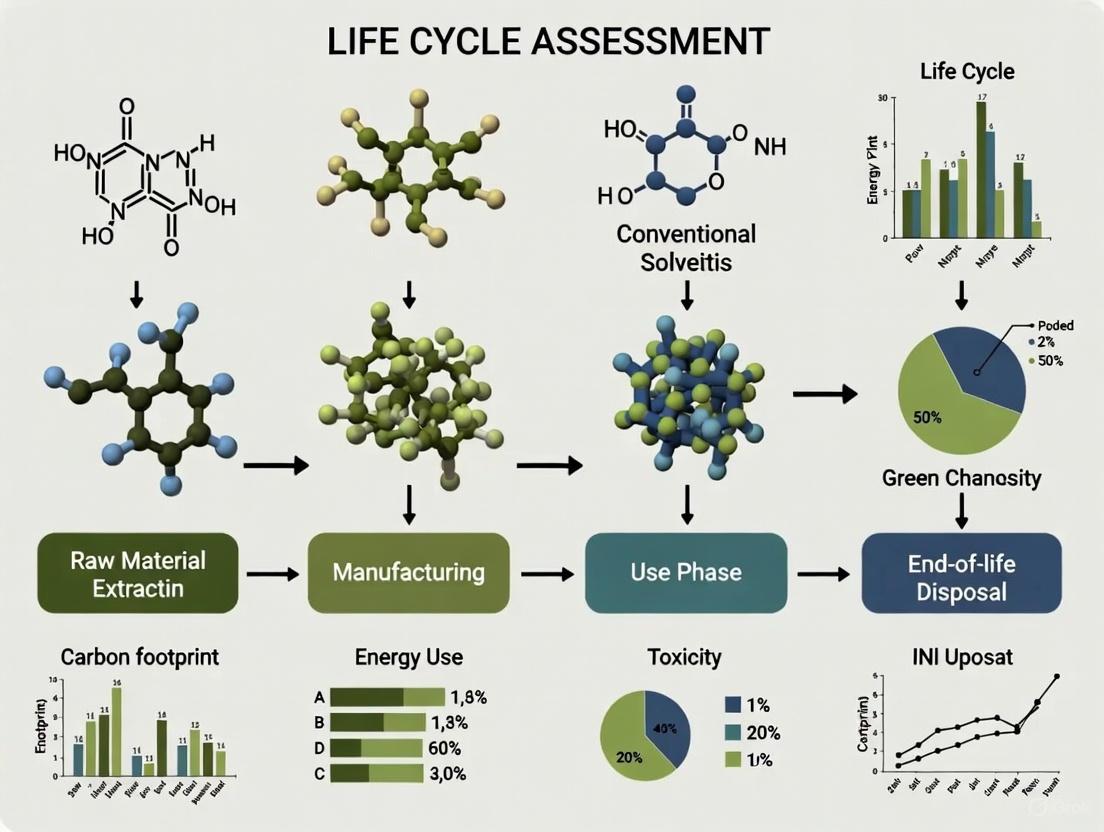
This article provides a comprehensive life cycle assessment (LCA) comparing ionic liquids (ILs) with conventional solvents, specifically for researchers and professionals in drug development.
Life Cycle Assessment of Ionic Liquids vs. Conventional Solvents: A Green Chemistry Perspective for Pharmaceutical Research
Abstract
This article provides a comprehensive life cycle assessment (LCA) comparing ionic liquids (ILs) with conventional solvents, specifically for researchers and professionals in drug development. It explores the foundational principles of ILs and LCA methodology, detailing their unique properties and applications in pharmaceuticals, such as enhancing drug solubility and serving as active pharmaceutical ingredients. The content addresses critical environmental challenges, including toxicity and energy-intensive production, and presents optimization strategies via next-generation bio-ILs and process improvements. Through comparative LCA case studies, it validates the environmental profile of ILs against traditional solvents, offering a balanced perspective on their sustainability and guiding informed, eco-conscious solvent selection in biomedical research and development.
Ionic Liquids and LCA Demystified: Core Concepts for Green Solvent Evaluation
Ionic Liquids (ILs) are a class of organic salts characterized by their low melting point, often defined as being below 100°C. Their unique nature arises from their composition of large, asymmetric organic cations and smaller inorganic or organic anions, which hinders efficient crystal packing and results in a liquid state over a wide temperature range [1] [2]. The core concept that elevates ILs beyond mere solvents is their status as "designer solvents." This paradigm signifies that their physicochemical properties—including hydrophobicity, viscosity, solvent capacity, and melting point—can be finely tuned by selecting and modifying the constituent cation-anion pairs [1] [3]. This tunability allows researchers to design a solvent with specific characteristics tailored for a particular application, moving away from a one-size-fits-all approach to a bespoke methodology in process and product development.
The evolution of ionic liquids is categorized into four distinct generations, reflecting a maturation in their design philosophy [1]:
- First-generation ILs were primarily explored as green reaction media, focusing on their unique physical properties like low volatility.
- Second-generation ILs were engineered with specific application-oriented properties for catalysis and electrochemical systems.
- Third-generation ILs, also known as task-specific ILs, incorporate bio-derived and functionalized ions for biomedical and environmental applications, emphasizing improved biocompatibility.
- Fourth-generation ILs represent the current frontier, focusing on sustainability, biodegradability, and multifunctionality, often derived from renewable feedstocks.
Generations and Properties of Ionic Liquids
The following table summarizes the key characteristics of each generation of ionic liquids, illustrating the evolution of their design philosophy and application scope.
Table 1: Generations of Ionic Liquids and Their Core Characteristics
| Generation | Primary Design Focus | Example Components | Key Properties | Representative Applications |
|---|---|---|---|---|
| First | Green solvents / Physical properties | Imidazolium, Pyridinium, Pyrolidinium cations with e.g., [BF₄]⁻, [PF₆]⁻ anions [3] | Low volatility, non-flammability, high thermal stability [4] | Replacement for volatile organic compounds (VOCs) in synthesis [1] |
| Second | Application-specific performance | Functionalized cations/anions for specific catalysis or electrochemistry [1] | Tunable polarity, high electrochemical stability, tailored solvation [1] | Catalysis, electrolytes for batteries and supercapacitors [1] |
| Third | Task-specific / Biocompatibility | Cholinium, amino acid, sugar-derived ions [1] [5] | Biocompatibility, often lower toxicity, task-specific functionality (e.g., drug solubilization) [1] [2] | Drug delivery systems, biomass processing, pharmaceutical synthesis [1] [2] |
| Fourth | Sustainability & Multifunctionality | Glycerol-, fatty acid-, and other bio-derived ions [1] [5] | Biodegradability, derived from renewable feedstocks, multifunctional designs [1] [5] | Green catalysis, sustainable material production, circular economy processes [1] [5] |
The properties of ILs are direct consequences of their tunable structures. Key properties include:
- Low Volatility and Non-flammability: Due to their ionic nature and extremely low vapor pressure, ILs do not readily evaporate, reducing air pollution and fire hazards compared to conventional solvents like toluene or acetone [4] [1].
- High Thermal Stability: Many ILs are stable over a wide temperature range, often exceeding 300°C, making them suitable for high-temperature processes [1] [5].
- Tunable Viscosity: Viscosity is a critical property for mass transfer and process design. IL viscosity can range from 20 to over 1000 cP and is highly dependent on temperature, pressure, and molecular structure. Machine learning models are now being employed to accurately predict this complex property [3].
- Wide Electrochemical Window: This property makes ILs particularly valuable for electrodeposition and energy storage applications like batteries and supercapacitors [1] [6].
The Generational Evolution of Ionic Liquids
The diagram below illustrates the evolutionary pathway of ionic liquids, from their initial discovery to the current sustainable focus.
Life Cycle Assessment: Ionic Liquids vs. Conventional Solvents
The "green" credentials of ILs must be validated through Life Cycle Assessment (LCA), a comprehensive methodology for evaluating environmental impacts across a product's life cycle, from raw material extraction ("cradle") to final disposal ("grave") [4]. LCA studies frequently reveal that the initial perception of ILs as universally green is an oversimplification. While they excel in operational safety (non-volatility), their production and end-of-life phases can be environmentally intensive.
Comparative LCA Data: Key Studies
The table below summarizes findings from key LCA studies comparing ionic liquids with conventional molecular solvents.
Table 2: Life Cycle Assessment Comparison of Ionic Liquids and Conventional Solvents
| Solvent System | Application | Key LCA Findings | Dominant Impact Contributors | Reference |
|---|---|---|---|---|
| [Bmim]Br (Ionic Liquid) | Production of Acetylsalicylic Acid (ASA) | Higher environmental impacts than toluene, especially in ecotoxicity categories. | Raw material extraction and solvent synthesis. Impact reduced significantly with solvent recovery. | [4] |
| Toluene (Conventional VOC) | Production of Acetylsalicylic Acid (ASA) | Lower overall environmental impact compared to [Bmim]Br in a single-use scenario. | – | [4] |
| [C₂C₁im][OAc] (Ionic Liquid) | Production of Lignocellulosic Films | "Unexpectedly high environmental burdens," substantially higher than commercial cellophane. | Energy-intensive IL recovery (freeze crystallization, solvent evaporation) and IL production itself. Electricity consumption was a key driver. | [7] |
| [Bmim][BF₄] (Ionic Liquid) | Cyclohexane Synthesis & Diels-Alder Reaction | "Highly likely to have a larger life cycle environmental impact" than conventional methods. | Synthesis of the IL itself. | [8] |
A critical insight from LCA is that the recyclability and reuse of ILs are paramount to their environmental competitiveness. For example, the LCA of [Bmim]Br for acetylsalicylic acid production showed that solvent recovery could make its environmental impact comparable to, or even lower than, toluene [4]. Similarly, the energy-intensive recovery of [C₂C₁im][OAc] via freeze crystallization was the primary source of its high environmental impact in lignocellulosic film production [7].
LCA Methodology and Workflow
A standard LCA for evaluating ionic liquids versus solvents follows a systematic workflow, as outlined below.
Experimental Protocols and Applications
Detailed Protocol: Synthesis of Glycerol-Derived ILs ([N20R]X)
This protocol for synthesizing fourth-generation, bio-based ILs is adapted from recent research [5].
- Objective: To synthesize a family of glycerol-derived ammonium-based ionic liquids ([N20R]X) with varying alkyl chains (R) and anions (X⁻) via a ring-opening reaction.
- Materials (Research Reagent Solutions):
- Glycidyl Methyl Ether or Epichlorohydrin: Starting material (renewable platform molecules).
- Triethylamine: Nucleophile and ammonium cation precursor.
- Hydrochloric Acid (HCl): Brønsted acid catalyst and anion source (for chloride ILs).
- Anion Exchange Resins: For metathesis to obtain other anions (e.g., triflate, bistriflimide, formate, lactate).
- Solvents: Methanol, Diethyl Ether (for purification).
- Equipment: Round-bottom flask, reflux condenser, magnetic stirrer with heating plate, separatory funnel, rotary evaporator, high-vacuum line, NMR spectrometer for characterization.
- Step-by-Step Methodology:
- Reaction Setup: Glycidyl methyl ether (5 mmol) and triethylamine (7.5 mmol, 50% excess) are placed in a round-bottom flask.
- Acid Addition: Hydrochloric acid (5 mmol) is added slowly and dropwise with continuous stirring. Note: Controlled addition is critical to minimize byproduct formation.
- Reaction Progression: The reaction mixture is heated to 80°C and stirred for 48 hours. The progression is monitored by thin-layer chromatography (TLC) or NMR.
- By-product Formation: The reaction typically yields the desired IL ([N201]Cl) alongside by-products like triethylammonium chloride and 1-chloro-3-methoxypropan-2-ol (R0Cl).
- Purification: After cooling, the crude mixture is washed with diethyl ether to remove organic impurities. The ionic liquid is then dried under high vacuum at elevated temperature (e.g., 60°C) for several hours to remove residual volatiles.
- Anion Metathesis (if required): To obtain ILs with anions other than chloride, the chloride precursor is dissolved in a minimal amount of water and stirred with an excess of the appropriate salt (e.g., potassium triflate) or passed through an ion-exchange column. The resulting IL is extracted with an organic solvent (e.g., dichloromethane), washed with water, and dried under vacuum.
- Characterization: The final product is characterized by ¹H and ¹³C NMR to confirm structure and purity. Physicochemical properties such as density, viscosity, and thermal stability (via TGA) are measured.
Application Protocols
A. Application as Solvent and Catalytic Medium:
- Objective: To utilize a glycerol-derived IL as a recyclable medium for Pd nanoparticle-catalyzed Heck–Mizoroki coupling [5].
- Methodology: The reaction is set up by dissolving the aryl halide and alkene substrates in the glycerol-derived IL. A Pd catalyst precursor is added, and the reaction is heated with stirring. After completion, the product is extracted using an organic solvent (e.g., ethyl acetate), which is immiscible with the IL. The remaining IL phase, containing the Pd nanoparticles, is washed and can be directly reused for subsequent reaction cycles. Research demonstrated quantitative yields and selectivity over multiple recycles.
B. Application in Transdermal Drug Delivery:
- Objective: To formulate an IL-based transethosome for the transdermal delivery of insulin [2].
- Methodology: A biocompatible IL (e.g., cholinium or lipid-derived) is combined with phospholipids and ethanol in an aqueous buffer. Insulin is dissolved in this mixture. The solution is then processed using a probe sonicator or high-pressure homogenizer to form small, uniform vesicles (transethosomes). The formulation achieves high drug encapsulation efficiency (∼99%) and demonstrates enhanced skin permeability in ex vivo and in vivo models, providing prolonged glycemic control.
The Scientist's Toolkit: Key Research Reagents
Table 3: Essential Reagents for Ionic Liquid Research and Application
| Reagent / Material | Function in Research | Example Use-Case |
|---|---|---|
| Imidazolium Salts (e.g., 1-Ethyl-3-methylimidazolium acetate) | Versatile, widely studied IL cations for dissolution and catalysis. | Dissolving cellulose and lignocellulose for bio-based film production [7]. |
| Cholinium Chloride | A cheap, biodegradable, and low-toxicity HBA for forming Deep Eutectic Solvents (DES) and bio-ILs. | Forming third-generation ILs/DES for transdermal drug delivery and green synthesis [2] [6]. |
| Bio-Derived Feedstocks (e.g., Glycerol, Amino Acids, Sugars) | Renewable starting materials for synthesizing sustainable fourth-generation ILs. | Creating glycerol-derived ILs with tunable properties for solubilization and catalysis [5]. |
| Anion Exchange Resins | To perform anion metathesis, allowing access to a wide array of ILs from a single cationic precursor. | Converting a chloride IL to a bistriflimide IL to modify hydrophobicity and viscosity [5]. |
| Machine Learning Algorithms (e.g., Random Forest, CatBoost) | To predict complex physicochemical properties of ILs, such as viscosity, from structural data. | Accurately predicting the viscosity of imidazolium-based ILs and their mixtures under varying conditions [3]. |
Ionic liquids have firmly established themselves as a transformative class of materials, evolving from simple green solvent replacements to sophisticated, task-specific agents underpinning innovation across pharmaceuticals, energy, and sustainable technology. The "designer solvent" concept is the cornerstone of their utility, allowing for unprecedented customization. However, Life Cycle Assessment provides a crucial, sobering perspective, demonstrating that the green profile of an IL is not inherent but is a function of its entire lifecycle—from the resource intensity of its production to the efficiency of its recovery and reuse. The future of ILs lies in the continued development of fourth-generation solvents: bio-based, biodegradable, and designed for minimal environmental footprint from cradle to grave. Their successful integration will depend on synergistic advances in sustainable synthesis, energy-efficient recycling technologies, and the intelligent application of computational design tools.
What is a Life Cycle Assessment? The ISO 14040/44 Framework from Cradle to Grave
In the pursuit of sustainable chemistry, researchers and drug development professionals are increasingly tasked with evaluating the environmental footprint of their choices. Life Cycle Assessment (LCA) provides a robust, scientific methodology for this purpose, offering a cradle-to-grave perspective on products and processes. This guide explores the LCA framework as defined by the ISO 14040 and 14044 standards, with a specific focus on its application in comparing the environmental performance of ionic liquids against conventional solvents, providing the experimental and data-handling protocols essential for rigorous comparative analysis.
Understanding the LCA Framework: ISO 14040/14044
Life Cycle Assessment (LCA) is a methodology for assessing the environmental impacts associated with all the stages of a commercial product, process, or service's life, from raw material extraction ("cradle") through manufacture, distribution, and use to recycling or final disposal ("grave") [9]. The International Organization for Standardization (ISO) provides the foundational guidelines and requirements for conducting an LCA in the ISO 14040 and 14044 standards [10] [11] [12].
These international standards ensure that LCA studies are comparable, credible, and conducted with rigor [11]. The process is structured into four interdependent phases, as illustrated below.
The Four Phases of an LCA According to ISO 14040/44
Goal and Scope Definition: This foundational phase establishes the study's purpose, intended audience, and the product system to be assessed [13] [12]. A critical element is defining the functional unit, which quantifies the performance of the product system, ensuring different systems are compared on an equivalent basis [9]. The system boundary is also delineated, specifying which life cycle stages and processes are included [13].
Life Cycle Inventory (LCI): This phase involves the compilation and quantification of all relevant inputs (e.g., energy, resources) and outputs (e.g., emissions, waste) for the product system throughout its life cycle [13] [9]. Data can be collected from bills of materials, utility bills, procurement records, or secondary sources like LCA databases [13].
Life Cycle Impact Assessment (LCIA): Here, the LCI data is translated into potential environmental impacts. This involves classifying emissions into specific impact categories and using scientific models to quantify their contributions [13] [12]. Common categories include [13]:
- Global Warming Potential (Climate Change): Measured in kg CO₂-equivalent, it quantifies greenhouse gas emissions.
- Eutrophication: Measures potential impacts from excessive nutrient releases.
- Acidification: Measures emissions that cause acidifying effects on the environment.
- Photochemical Ozone Creation Potential (Smog Formation): Measures emissions that contribute to ground-level ozone.
Interpretation: The final phase involves evaluating the results from the LCI and LCIA in relation to the goal and scope [11]. This includes identifying significant issues, conducting sensitivity analyses, drawing conclusions, and making recommendations, all while considering limitations to avoid misleading conclusions [13].
Comparative LCA: Ionic Liquids vs. Conventional Solvents
Ionic liquids (ILs) are salts that are liquid below 100°C, characterized by properties such as negligible vapor pressure, high thermal stability, and tunable miscibility, making them potential green solvents [14]. However, their "green" credentials must be validated through a comparative LCA against the conventional solvents they aim to replace.
The table below summarizes a high-level comparison of key characteristics, which an LCA would quantitatively assess across the entire life cycle.
Table 1: Solvent Characteristics for LCA Comparison
| Characteristic | Ionic Liquids | Conventional Solvents (e.g., VOCs) | LCA & Experimental Consideration |
|---|---|---|---|
| Vapor Pressure | Negligible [14] | High | LCIA: Contributes to smog formation & human health impacts. LCI: Different handling and emission controls needed. |
| Thermal Stability | High [14] | Variable | LCI: Influences energy requirements for processing and recovery. |
| Tunability | High (designer solvents) [14] | Low | Scope: A single LCA may not cover all applications. Multiple scenarios for different IL structures may be needed. |
| Synthesis Route | Often complex, multi-step | Mature, petrochemical-based | LCI: Inventory must include all precursor chemicals and energy for synthesis. This is a key hotspot for ILs. |
| Toxicity (Eco) | Ranges from low to high [14] | Often high | LCIA: Critical for human and ecological toxicity impact categories. Requires specific toxicity data. |
| Biodegradability | Ranges from low to high [14] | Often low | LCIA: Affects end-of-life impacts. Key for waste treatment modeling. |
Experimental Protocols for Comparative LCAs
To populate the Life Cycle Inventory (LCI) with primary data, specific experimental protocols are required. The following methodology, inspired by studies comparing solvents in catalytic applications, provides a template [15].
Protocol: Catalytic Oxidation of Olefins for Solvent Comparison
- Objective: To compare the environmental and performance profiles of ionic liquids versus conventional solvents (e.g., acetonitrile, toluene) in a model oxidation reaction.
- Reaction System: Oxidation of olefins (e.g., cyclohexene) or organosulfur substrates using catalysts like oxovanadium(IV) complexes and oxidants like tert-butyl hydroperoxide (TBHP) [15].
- Experimental Workflow:
- Setup: Conduct parallel reactions in selected ILs and conventional solvents under identical conditions (temperature, catalyst loading, substrate-to-oxidant ratio).
- Monitoring: Track reaction progress (e.g., via GC-MS) to determine key performance metrics: conversion, yield, and selectivity.
- Separation & Recovery: Post-reaction, separate the product and recover the catalyst and solvent. For ILs, leverage their low volatility for easy distillation of products/remaining oxidant, followed by IL reuse. For conventional solvents, standard separation techniques like distillation are applied.
- Data Collection for LCI: Record all material inputs (substrates, solvents, oxidants), energy inputs (heating, stirring, distillation), and outputs (product mass, waste streams) for the functional unit (e.g., per 1 kg of product).
The Scientist's Toolkit: Research Reagent Solutions
For researchers designing these experiments, the following table details key materials and their functions.
Table 2: Essential Research Reagents for Solvent LCA Studies
| Reagent / Material | Function in Experimental LCA | Rationale |
|---|---|---|
| Imidazolium-based ILs | Tunable solvent for reaction medium. | Exemplifies "designer solvent" properties; allows study of structure-activity relationships [14]. |
| Oxovanadium(IV) Complexes | Catalyst for selective oxidation reactions. | Model catalyst used in comparative studies of solvent efficiency [15]. |
| Tert-butyl hydroperoxide (TBHP) | Oxidant. | Often more efficient in IL systems compared to H₂O₂, a key performance variable for LCI [15]. |
| Model Substrates | Reaction feedstock for standardized testing. | Allows for consistent comparison of solvent performance across different studies [15]. |
| Life Cycle Inventory Database | Source of secondary data for upstream/downstream processes. | Provides background data (e.g., energy grid impacts, chemical synthesis) when primary data is unavailable [13]. |
Interpreting Comparative LCAs and Future Directions
The interpretation phase is where the story of the data emerges. A comparative LCA might reveal that while the use phase of an IL is advantageous due to low emissions and high recyclability, its production phase has a significantly higher energy and resource burden than a conventional solvent [14]. This highlights the importance of the cradle-to-grave perspective to avoid burden shifting.
Future research is focused on mitigating the high environmental footprint of IL production by developing less-toxic, bio-derived ILs from sources like amino acids and choline, and creating innovative IL-composites with materials like MOFs to enhance efficiency and reduce material usage [14]. For drug development professionals, this means that solvent choices must be evaluated not just on reaction yield, but on a full LCA to make truly sustainable decisions.
Ionic Liquids (ILs), a class of materials often termed "designer solvents," are salts that exist in a liquid state at relatively low temperatures, typically below 100 °C [16] [17]. Their unique physicochemical properties, primarily their negligible vapor pressure and high thermal stability, have positioned them as potential green alternatives to conventional volatile organic compounds (VOCs) in a wide range of industrial and research applications [1] [17]. This guide provides an objective comparison of the environmental performance of ILs against traditional solvents, framed within the context of Life Cycle Assessment (LCA) research. It synthesizes experimental data on their key properties, assesses their sustainability profile, and details the methodologies used to evaluate their promise and limitations for researchers and drug development professionals.
The evolution of ILs is categorized into generations, each with a distinct environmental and functional focus, which is visualized in the diagram below.
Core Properties: A Data-Driven Comparison with Conventional Solvents
The environmental promise of ILs is rooted in their measurable physical and chemical properties, which differ significantly from those of traditional solvents. The following table summarizes a quantitative comparison of these key characteristics.
Table 1: Comparative Properties of Ionic Liquids and Conventional Solvents
| Property | Ionic Liquids | Conventional Solvents (e.g., Water, Acetone, Toluene) | Experimental Measurement & Citation |
|---|---|---|---|
| Vapor Pressure | Negligible | High, volatile | Method: Thermogravimetric Analysis (TGA) under vacuum. Finding: ILs exhibit no detectable mass loss due to evaporation at room temperature, confirming negligible vapor pressure [17]. |
| Thermal Stability | High (decomposition typically >200-400°C) | Low (boiling points typically <150°C) | Method: Dynamic TGA at 10°C/min. Finding: Onset decomposition temperature ((T_{onset})) for 1-butyl,3-methylimidazolium tetrafluoroborate ([bmim][BF4]) is ~400°C [18] [17]. Dicationic ILs can exceed 468°C [17]. |
| Flammability | Non-flammable | Often flammable or combustible | Method: Standard flammability tests (e.g., ignition susceptibility). Finding: ILs are classified as non-flammable due to their ionic nature and lack of volatile components [17]. |
| Liquid Range | Wide (>200°C) | Narrow | Method: Differential scanning calorimetry (DSC) and TGA. Finding: The liquid range is defined from melting point to decomposition temperature. ILs like [C4(MIM)2][NTf2]2 have a range from ~0°C to 468°C [18] [17]. |
| Tunability | Highly tunable via ion selection | Fixed for a given solvent | Method: Synthesis and characterization of ILs with different cation-anion pairs. Finding: Properties like viscosity, hydrophilicity, and toxicity can be tailored. For example, switching anions can drastically alter thermal stability [1] [16] [17]. |
Experimental Protocols for Key Properties
The data in Table 1 is derived from standardized experimental protocols. A critical protocol for establishing the core environmental promise of ILs is the measurement of their thermal stability.
Protocol 1: Measuring Short- and Long-Term Thermal Stability via TGA
- Objective: To determine the short-term decomposition temperature and predict long-term stability under operational conditions.
- Methodology: Thermogravimetric Analysis (TGA).
- Procedure:
- Short-Term Stability ((T{onset})): A small sample (5-10 mg) of IL is placed in a TGA instrument. The temperature is increased dynamically (e.g., at 10 °C/min) under an inert atmosphere. The onset decomposition temperature ((T{onset})) is determined by the software as the intersection of the baseline weight and the tangent of the weight-loss curve as decomposition begins [17].
- Long-Term Stability (MOT): The same TGA data is used for kinetic analysis. The activation energy ((E)) of decomposition is calculated using isoconversional methods, which are superior to simple Arrhenius models. The pre-exponential factor ((A)) is determined using tools like the compensation effect or master plots. These parameters are used to calculate the Maximum Operating Temperature (MOT) for a given operational time (e.g., 10 hours) using the formula: (MOT = \frac{E}{R \cdot [4.6 + \ln(A \cdot t{max})]}), where (R) is the universal gas constant and (t{max}) is the desired operational time [17].
Life Cycle Assessment: A Holistic Environmental Perspective
While ILs offer significant advantages during the use phase due to their non-volatility and stability, a complete Life Cycle Assessment (LCA) reveals a more complex environmental picture. An LCA study comparing ILs (Bmim HSO4, Hmim HSO4, Bmim Br, Bmim Cl) with conventional sulfuric acid (H2SO4) for metal leaching from electronic waste provided critical insights [19].
Table 2: LCA Impact Comparison: ILs vs. Conventional Solvent in Metal Leaching
| Impact Category | Performance of ILs vs. H2SO4 | Primary Reasons |
|---|---|---|
| Human Toxicity | Significantly Higher | Toxicity of raw materials like 1-methylimidazole and glyoxal used in IL synthesis. |
| Marine/Freshwater Ecotoxicity | Significantly Higher | Same as above; potential aquatic toxicity of the ILs themselves. |
| Global Warming | Comparable or Higher | Energy-intensive synthesis processes for IL precursors. |
| Acidification | Lower | Avoided emissions associated with conventional acid production. |
| Use-Phase Emissions | Lower | Negligible vapor pressure prevents atmospheric release during use. |
The LCA concluded that the core environmental challenge for ILs lies in their production phase. The synthesis of cations like 1-methylimidazole and anions involving sulfuric acid contributes heavily to toxicity impact categories [19]. However, the study also highlighted a path to sustainability: recycling and recovery of ILs can dramatically reduce their lifetime impact. A sensitivity analysis showed that recovering 90% of the IL from the leaching solution could reduce the environmental impacts by up to 89%, making them competitive with or superior to the conventional process [19]. This underscores that the "green" credential of an IL is not inherent but is determined by its entire life cycle, including its synthesis, use, and end-of-life recycling.
Performance in Application: Industrial and Biomedical Case Studies
The properties of ILs translate into tangible performance benefits across diverse fields. The following table compares IL-based systems to conventional alternatives in specific applications, supported by experimental data.
Table 3: Application Performance: ILs vs. Conventional Systems
| Application | IL-Based System & Performance | Conventional System & Performance | Experimental Summary & Citation |
|---|---|---|---|
| Heat Transfer Fluids | System: Amino Acid Anion IoNanofluid (AAIL INF).Thermal Conductivity: 21-40% enhancement over base IL.Viscosity: ~20 mPa·s at 300K. | System: [bmim][BF4] IoNanofluid.Viscosity: ~110 mPa·s at 300K. | Method: AAILs (e.g., with glycinate/arginate anions) were synthesized. 0.05 wt% MWCNT was added. Properties were measured with a thermal analyzer and viscometer. Finding: AAIL INFs showed lower viscosity, higher thermal conductivity, and superior colloidal stability (30 days) [18]. |
| Drug Delivery (Transdermal) | System: Ionic Liquid as Permeation Enhancer.Performance: Significantly improved skin permeability and drug solubility. | System: Traditional organic solvents/surfactants.Performance: Limited efficacy, potential for skin irritation. | Method: In vitro permeation studies using skin models. Finding: ILs like cholinium oleate act as effective permeation enhancers by disrupting the stratum corneum, fluidizing lipids, and creating diffusional pathways [20]. |
| Drug Repurposing | System: Nano-scale Ionic Liquids for Antifungal therapy.Performance: 100% survival rate in mouse model of cryptococcal meningitis vs. 50% with unformatted drug. | System: Oral administration of unformatted Benzimidazole.Performance: 50% survival rate in the same model. | Method: A drug was converted into a nano-scale IL and administered orally to infected mice. Finding: The IL formulation enabled targeted delivery to the brain, drastically improving efficacy and survival with good safety [21]. |
The Scientist's Toolkit: Essential Research Reagents and Materials
For researchers entering the field of ILs, the following reagents and materials are fundamental for synthesis, formulation, and characterization.
Table 4: Key Research Reagent Solutions for Ionic Liquid Research
| Reagent/Material | Function & Explanation | Example in Context |
|---|---|---|
| Imidazole Derivatives | Precursors for Cations. Used to synthesize common cations like 1-butyl-3-methylimidazolium ([C4C1im]+). The alkyl chain length can be tuned to modify properties. | [C4C1im][N(Tf)2] is a widely used hydrophobic IL with high stability [16]. |
| Amino Acids (e.g., Glycine, Arginine) | Source for "Green" Anions. Used to create third-generation ILs with low toxicity and good biodegradability. | 1-ethyl-3-methylimidazolium glycinate is an AAIL used to formulate low-viscosity, high-thermal conductivity nanofluids [18]. |
| Choline | Biocompatible Cation. A vitamin B-related compound used to form biocompatible ILs (third-generation) for pharmaceutical applications. | Cholinium oleate is used in transdermal drug delivery systems as a permeation enhancer [20]. |
| Multi-Walled Carbon Nanotubes (MWCNT) | Nanoadditive for Property Enhancement. Added in small quantities (0.025-0.1 wt%) to ILs to form IoNanofluids, significantly boosting thermal conductivity. | Used in AAILs to create heat transfer fluids with 21-40% higher thermal conductivity [18]. |
| Tetrahydrofuran (THF) / Dichloromethane (DCM) | Purification & Processing Solvents. Used to wash and extract organic impurities from synthesized ILs after reaction cycles. | Used to purify [C6C1im][N(Tf)2] after its use as a solvent in the esterification of curcumin [16]. |
Challenges and Future Prospects
Despite their promise, ILs face challenges that must be addressed to fully realize their potential as green solvents. Key issues include:
- Complex Life Cycle Impact: As LCA studies show, the "green" nature of ILs is not inherent and is heavily dependent on the energy and toxicity burdens of their synthesis [19]. Future development must focus on atom-efficient synthesis pathways and bio-derived ionic species.
- Biocompatibility and Toxicity: While third-generation ILs exhibit improved profiles, toxicity remains a concern, particularly for imidazolium and pyridinium-based cations [20]. Ongoing research is essential to establish comprehensive toxicological databases.
- Cost and Scalability: High production costs can be a barrier to industrial adoption. Developing efficient recycling and recovery protocols is critical for economic and environmental sustainability [19].
The future of IL development lies in the fourth generation, which focuses on sustainability, biodegradability, and multifunctionality [1]. By integrating IL design with circular economy principles—emphasizing recycling, low-impact feedstocks, and safe-by-design molecules—ILs can truly become key enablers of a sustainable and technologically advanced future.
The reputation of ionic liquids (ILs) as "green solvents" has traditionally rested on one prominent feature: their negligible vapor pressure. This property significantly reduces the risk of atmospheric emissions and inhalation exposure compared to conventional Volatile Organic Compounds (VOCs), aligning with the principles of green chemistry by mitigating air pollution and improving workplace safety [22] [23]. However, a comprehensive life cycle assessment (LCA) necessitates looking beyond this single attribute. A truly sustainable evaluation must consider the entire lifespan of a solvent, from its initial synthesis to its ultimate fate in the environment. This analysis reveals that the environmental profile of ILs is complex; their low volatility does not automatically equate to being universally environmentally benign. The significant energy input required for their production and challenges in managing them at the end-of-life present substantial environmental trade-offs that must be quantified and compared to traditional solvents [24] [25]. This guide objectively compares the performance and environmental hotspots of ILs against conventional solvents, providing researchers with the data and methodologies needed for informed, sustainable solvent selection.
Environmental Hotspot Analysis: Ionic Liquids vs. Conventional Solvents
The environmental performance of ionic liquids and conventional solvents can be directly compared by examining key impact categories across their life cycles. The following table synthesizes quantitative and qualitative data to highlight these critical differences.
Table 1: Environmental Hotspot Comparison: Ionic Liquids vs. Conventional Solvents
| Impact Category | Ionic Liquids (ILs) | Conventional Volatile Organic Compounds (VOCs) |
|---|---|---|
| Atmospheric Emissions | Negligible emissions due to immeasurably low vapor pressure; eliminates solvent inhalation and smog formation [22] [23]. | High emissions due to significant volatility; contributes to air pollution, smog, and workplace hazards [22]. |
| Production Phase | High energy intensity; multi-step synthesis and purification lead to a high embodied energy footprint. Life cycle assessments (LCA) indicate this is a major environmental burden [24] [25]. | Variable energy intensity; while production can be energy-intensive, many established processes are highly optimized. |
| End-of-Life Fate & Toxicity | High persistence and potential toxicity; designed for stability, leading to low biodegradability and potential to accumulate in aquatic and terrestrial ecosystems [22] [25]. Ecotoxicity is dependent on cation/anion structure [22]. | Variable persistence and toxicity; many are biodegradable, but some (e.g., chlorinated solvents) are persistent and highly toxic. |
| Aquatic Impact Pathway | Primary pathway is through solubility in water [22]. Toxicity mechanisms include cell membrane damage and oxidative stress in aquatic organisms [25]. | Impact occurs through both atmospheric deposition and direct discharge into water bodies. |
| Recyclability & Circularity | High potential for recycling (e.g., antisolvent precipitation, distillation) due to non-volatility, which simplifies recovery from reaction mixtures [24] [23]. However, biomass-derived impurities can affect purity upon reuse [24]. | Recycling is often energy-intensive due to volatility, frequently making distillation the only viable option. |
Experimental Insights: Quantifying Environmental Impact
Assessing the Ecotoxicity of Ionic Liquids
The toxicity of ILs is not uniform; it is highly tunable based on their chemical structure. Research has established clear structure-activity relationships (SARs), which are crucial for designing safer ILs.
- Experimental Protocol for Ecotoxicity Assessment: A common protocol involves evaluating the toxicity of ILs towards aquatic organisms like the freshwater phytoplankton Selenastrum capricornutum. The standard methodology is the algae growth inhibition test [22].
- Ionic Liquids: A series of imidazolium-based ILs with varying alkyl chain lengths (e.g., [C₂mim][Br], [C₄mim][Br], [C₆mim][Br]) are prepared in concentration gradients.
- Control: A control group with no IL is maintained.
- Exposure: Algae are exposed to the IL solutions under controlled light and temperature conditions for a set period, typically 72 hours.
- Endpoint Measurement: The inhibitory effect on algal growth is measured by quantifying the biomass, for instance, through cell counting or chlorophyll fluorescence.
- Data Analysis: The concentration causing 50% growth inhibition (EC₅₀) is calculated. Results consistently show that toxicity increases with the alkyl chain length of the cation, a phenomenon linked to rising hydrophobicity and enhanced damage to cell membranes [22] [25].
Evaluating Recyclability in Biomass Pretreatment
The economic and environmental viability of ILs in industrial processes hinges on efficient recycling. The following workflow visualizes a standard protocol for IL recovery and reuse in a biorefinery setting, a major application area.
Diagram 1: IL Recycling Workflow
- Detailed Methodology:
- Separation: After the pretreatment of lignocellulosic biomass (e.g., wood, straw) with an IL like [BMIM]Cl or [EMIM][CH₃COO], the mixture is separated. The biomass residue (rich in cellulose) is filtered out [24].
- Lignin and Sugar Removal: The recovered IL solution contains dissolved lignin, hemicellulose sugars, and other impurities. An antisolvent such as water, acetone, or ethyl acetate is added to precipitate these dissolved components. The precipitates are then removed via filtration or centrifugation [24].
- IL Concentration: The diluted IL solution (e.g., in water) is concentrated. This is typically done using vacuum distillation or evaporation, which leverages the IL's non-volatility to remove the volatile antisolvent and water [24].
- Purity Analysis & Reuse: The recycled IL is analyzed for purity (e.g., using HPLC to measure sugar and lignin content) before being reused in a new pretreatment cycle. Studies show that ILs can often be recycled 5-10 times, though a gradual decline in pretreatment efficiency can occur due to the accumulation of stubborn impurities [24].
The Scientist's Toolkit: Key Reagents for IL Research
Table 2: Essential Research Reagents for Ionic Liquid Environmental Assessment
| Reagent / Material | Core Function in Research |
|---|---|
| Imidazolium-Based Salts (e.g., 1-Butyl-3-methylimidazolium chloride, [C₄mim]Cl) | The most widely studied class of ILs; used as a model system for probing fundamental properties, toxicity, and applications in catalysis and biomass processing [1] [24]. |
| Choline-Based Ionic Liquids | A key component of "third-generation" ILs; derived from a natural, biodegradable cation, they are designed for lower toxicity and enhanced sustainability [16]. |
| Antisolvents (e.g., Water, Acetone, Ethyl Acetate) | Critical for IL recycling protocols; used to precipitate solutes like lignin from IL solutions, enabling the recovery and purification of the solvent for reuse [24]. |
| Model Organisms (e.g., Selenastrum capricornutum, Daphnia magna) | Standardized aquatic organisms used in ecotoxicological bioassays to quantify the inhibitory effects and lethal concentrations (EC₅₀/LC₅₀) of ILs [22]. |
The comparison reveals a clear dichotomy: ionic liquids excel in eliminating VOC emissions and offer unparalleled recyclability potential, but their environmental footprint is heavily influenced by energy-intensive production and uncertain end-of-life fate. The "green" label is not an inherent property but a conditional one, dependent on the specific IL's structure and the efficiency of its life cycle management.
Future progress depends on the development of next-generation ILs, such as those derived from bio-based sources like choline and amino acids, which are engineered for lower toxicity and better biodegradability [16]. Furthermore, integrating artificial intelligence and machine learning to model toxicity and optimize recycling processes presents a powerful strategy for designing smarter, more sustainable ILs [25]. For researchers and drug development professionals, this underscores the necessity of adopting a holistic LCA perspective. Solvent selection must prioritize not just performance in the reaction flask, but also its origins and its ultimate destiny in our environment.
Evaluating the sustainability of solvents, particularly emerging classes like Ionic Liquids (ILs), requires looking far beyond a single metric like global warming potential. The claim of ILs as "green" solvents, often based solely on their non-volatility, presents an incomplete picture. A comprehensive Life Cycle Assessment (LCA) reveals that their environmental footprint can be substantial and, in some cases, exceed that of the volatile organic compounds they are intended to replace [4] [26]. This shift in perspective is critical for researchers and drug development professionals aiming to make truly sustainable choices. The entire lifecycle—from raw material extraction and energy-intensive synthesis to use and end-of-life fate—must be considered to avoid problem-shifting, where improving one environmental aspect worsens another [26]. This guide provides a structured, data-driven comparison of solvents across the key impact categories of Ecotoxicity, Resource Use, and Human Health, offering a protocol for holistic environmental decision-making.
Decoding LCA Impact Categories: A Guide for Scientists
The ReCiPe method is a widely used LCA methodology that translates inventory data into environmental impact scores. It operates at two levels: midpoint indicators, which pinpoint specific environmental problems, and endpoint indicators, which aggregate these into three overarching areas of protection [27].
Table 1: Key LCA Impact Categories for Solvent Assessment
| Environmental Dimension | Impact Category (Midpoint) | Abbreviation | Unit | Relevance to Solvents |
|---|---|---|---|---|
| Ecosystem Quality | Freshwater Ecotoxicity | ETP-fw | kg 1,4-DCB eq | Evaluates toxic effects on freshwater organisms; critical for ILs and solvent disposal. |
| Marine Ecotoxicity | ETP-m | kg 1,4-DCB eq | Measures impact of toxic substances on marine ecosystems. | |
| Terrestrial Ecotoxicity | ETP-t | kg 1,4-DCB eq | Assesses toxic effects of chemical emissions on soil ecosystems. | |
| Land Use | m² a crop eq | Quantifies habitat loss and transformation due to resource extraction. | ||
| Resource Scarcity | Fossil Resource Scarcity | ADPf | kg oil eq | Measures depletion of fossil fuels (e.g., for energy or solvent synthesis). |
| Mineral Resource Scarcity | ADPm | kg Cu eq | Quantifies depletion of abiotic mineral resources. | |
| Human Health | Human Carcinogenic Toxicity | HTP-c | kg 1,4-DCB eq | Evaluates emissions of substances with potential to cause cancer. |
| Human Non-carcinogenic Toxicity | HTP-nc | kg 1,4-DCB eq | Assesses substances harmful to human health without causing cancer. | |
| Fine Particulate Matter Formation | PMFP | kg PM2.5 eq | Measures emissions leading to PM2.5, affecting air quality and health. |
These midpoint indicators ultimately contribute to three key endpoint categories:
- Human Health (HH): Expressed in Disability-Adjusted Life Years (DALY), it quantifies potential impacts on human health, such as disease burdens from toxic emissions or particulate matter [7] [28].
- Ecosystem Quality (EQ): Expressed as species lost per year, it aggregates impacts on biodiversity across aquatic and terrestrial ecosystems [7].
- Resource Scarcity (RS): Expressed in monetary costs, it measures the increased cost of future resource extraction due to the depletion of fossil, mineral, and water resources [7].
Comparative LCA Data: Ionic Liquids vs. Conventional Solvents
The Case of Imidazolium-Based Ionic Liquids
A cradle-to-gate LCA comparing the production of the ionic liquid 1-butyl-3-methylimidazolium bromide ([Bmim]Br) with toluene revealed that the ionic liquid has a higher environmental impact in most categories, particularly those related to ecotoxicity [4]. The study concluded that solvent recovery is a crucial parameter that can make the use of ionic liquids an attractive alternative comparable to toluene [4].
Table 2: LCA Impact Comparison for Acetylsalicylic Acid Production using [Bmim]Br vs. Toluene
| Impact Category | Ionic Liquid ([Bmim]Br) | Conventional Solvent (Toluene) | Key Driver for Ionic Liquid Impact |
|---|---|---|---|
| Global Warming | Higher | Lower | Energy-intensive synthesis steps |
| Human Toxicity | Higher | Lower | Complex synthesis requiring hazardous precursors |
| Aquatic Ecotoxicity | Significantly Higher | Lower | inherent toxicity of the ionic liquid itself |
| Fossil Resource Scarcity | Higher | Lower | High energy consumption |
A more recent LCA of lignocellulosic films produced using 1-ethyl-3-methylimidazolium acetate ([C2C1im][OAc]) found "unexpectedly high environmental burdens," which were substantially higher than those of commercial cellophane in every category assessed, including HH, EQ, and RS. The dominant contributors were consistently the production of the ionic liquid itself and the high energy consumption during recovery stages, such as freeze crystallization and solvent evaporation [7].
Bio-based Solvents: A Promising Alternative?
The search for greener solvents has also focused on bio-based options. An LCA of the biomass-derived solvent γ-valerolactone (GVL) used in the synthesis of metal halide perovskite layers demonstrated its advantage over traditional dipolar aprotic solvents. When used for synthesizing MAPbI3, GVL reduced the overall environmental impact by 17.8% and 15.9% compared to γ-butyrolactone (GBL) and N,N-dimethylformamide (DMF), respectively [28]. Similarly, for a different perovskite (FAPbI3), the reduction was 23.4% and 18.4% compared to GBL and DMF [28]. This highlights that bio-based solvents can offer tangible benefits across multiple impact categories.
However, being bio-based is not an automatic guarantee of sustainability. A study on deep eutectic solvents (DES) for extracting polyphenols found that a specific DES (choline chloride-1,6-hexanediol) performed worse in all studied environmental impact categories compared to both ethanol 20% and water [29]. The primary contributors were the production of virgin raw materials for the DES and the energy-intensive purification steps, underscoring the importance of a full LCA.
Experimental Protocols for Solvent LCA
Adhering to standardized methodologies is paramount for ensuring the credibility and comparability of LCA results. The following protocol, consistent with the ISO 14040:2006 standard, outlines the critical steps [30] [27].
Phase 1: Goal and Scope Definition
- Goal: Clearly state the intended application and decision context (e.g., "To compare the environmental performance of ILs versus conventional solvents for a specific chemical synthesis").
- Functional Unit: Define a quantifiable benchmark for comparison. In solvent LCAs, this is often based on the mass of the final product (e.g., 1 gram of a synthesized active pharmaceutical ingredient or 1 gram of a perovskite layer) [28] or the quantity of processed material (e.g., valorization of 1 Mg of agro-industrial residue) [31].
- System Boundary: Specify the lifecycle stages included. A "cradle-to-gate" approach is common, encompassing raw material extraction, manufacturing of all chemicals (including the solvent), and the process itself, excluding use and end-of-life phases [28] [4].
Phase 2: Life Cycle Inventory (LCI) This phase involves compiling and quantifying all relevant inputs (energy, raw materials) and outputs (emissions to air, water, soil) throughout the defined system boundary. For novel solvents like ILs, this can be a major challenge. Strategies include:
- Process Simulation: Using software like Aspen Plus to model energy and mass balances for foreground system data [7].
- Laboratory Data: Using primary data from controlled lab-scale experiments [7].
- Secondary Data: Sourcing background data (e.g., for electricity generation or chemical precursors) from commercial databases like Ecoinvent [7].
Phase 3: Life Cycle Impact Assessment (LCIA) The LCI data is translated into potential environmental impacts using a characterized methodology.
- Selection of Method: The ReCiPe 2016 method is widely used and recommended for its comprehensive set of midpoint and endpoint indicators [7] [27].
- Calculation: Software tools like SimaPro or OpenLCA are typically used to calculate the impact category scores [7] [4] [27].
Phase 4: Interpretation This involves analyzing the results, identifying environmental "hotspots," evaluating data quality and completeness, and drawing robust, evidence-based conclusions. Sensitivity analyses should be conducted to test how key assumptions (e.g., solvent recovery rate) affect the overall results [26].
The Scientist's Toolkit: Essential Reagents and Software for LCA
Table 3: Key Research Reagents and Software for Conducting Solvent LCAs
| Item Name | Function/Application | Relevance to LCA |
|---|---|---|
| Imidazolium-Based ILs (e.g., [Bmim]Br, [C2C1im][OAc]) | Commonly studied ILs for dissolution and reaction processes. | Model compounds for assessing LCA impacts of IL synthesis and application; data is more readily available [4] [7]. |
| γ-Valerolactone (GVL) | Bio-based solvent derived from lignocellulosic biomass. | A benchmark for comparing the performance of emerging bio-solvents against conventional and IL options [28]. |
| Conventional Solvents (e.g., Toluene, DMF, GBL) | Standard VOCs used in industrial synthesis and processing. | Baseline comparators for evaluating the relative "greenness" of novel solvents [28] [4]. |
| SimaPro | Professional LCA software. | Used to model the product system, manage inventory data, and perform impact assessments using methods like ReCiPe [7]. |
| OpenLCA | Open-source LCA software. | An alternative for conducting LCA modeling and calculations, promoting accessibility [4] [27]. |
| Ecoinvent Database | Extensive life cycle inventory database. | Provides critical background data on energy, materials, and chemicals, ensuring comprehensive and standardized assessments [7]. |
The evidence clearly demonstrates that the sustainability profile of a solvent is complex and cannot be captured by a single attribute like being "bio-based" or "non-volatile." To make genuinely sustainable choices in research and drug development, the following practices are recommended:
- Adopt a Multi-Category Perspective: Always evaluate solvents beyond GWP. Impact categories like freshwater ecotoxicity, human toxicity, and fossil resource scarcity are often decisive and can reveal significant hidden burdens, particularly for ILs [7] [4].
- Prioritize Solvent Recovery: The energy required for solvent recovery and recycling is frequently the dominant environmental hotspot. Process optimization and the integration of low-carbon energy sources are essential to reduce the overall footprint of both IL and conventional solvent processes [7] [4].
- Use Standardized LCA Protocols: Employ established standards (ISO 14040) and methods (ReCiPe) to ensure results are robust, credible, and comparable across different studies. This is crucial for advancing the field and avoiding misleading claims [30] [27] [26].
- Scrutinize Bio-Based Claims: While bio-based solvents like GVL show promise, their environmental performance is not guaranteed. A full LCA is necessary to validate their advantages over other alternatives, including water and aqueous solvent mixtures [28] [29].
From Theory to Practice: Applying LCA to Ionic Liquids in Pharmaceutical Sciences
The pharmaceutical industry faces significant environmental challenges, with solvent use accounting for over half the input mass and associated waste in most manufacturing processes for Active Pharmaceutical Ingredients (APIs) [32]. Traditionally, the assessment of "green" solvents has focused primarily on operational hazards, but this provides an incomplete picture of environmental impact. Life Cycle Assessment (LCA) has emerged as an essential tool for quantifying the comprehensive environmental footprint of solvents from raw material extraction through manufacturing, use, and disposal [4].
This guide provides a structured framework for researchers and drug development professionals to apply LCA methodologies in evaluating ionic liquids (ILs) and deep eutectic solvents (DES) against conventional molecular solvents. As the field moves toward circular economy principles grounded in resource efficiency, waste minimization, and material regeneration [32], rigorous LCA becomes indispensable for making truly sustainable solvent selections in pharmaceutical development.
LCA Methodology: A Standardized Framework for Solvent Assessment
Life Cycle Assessment follows international standards (ISO 14040) and employs a systematic "cradle-to-gate" or "cradle-to-grave" approach to quantify environmental impacts [4]. For pharmaceutical solvent assessment, the process can be broken down into four iterative phases.
Phase 1: Goal and Scope Definition
The initial phase establishes the precise parameters of the assessment. Researchers must define a functional unit that enables fair comparison between different solvents, such as "the quantity of solvent required to produce 1 kg of acetylsalicylic acid API" [4]. System boundaries must be clearly delineated - whether focusing solely on manufacturing impacts ("cradle-to-gate") or including use and disposal phases ("cradle-to-grave"). Critical decisions in this phase include selecting relevant impact categories (global warming potential, human toxicity, aquatic ecotoxicity, etc.) that align with the assessment's environmental objectives [4].
Phase 2: Life Cycle Inventory
This data collection phase quantifies all relevant energy and material inputs and environmental releases associated with the solvent throughout its life cycle. For ILs like 1-butyl-3-methylimidazolium bromide ([Bmim]Br), this includes quantifying all synthetic precursors, energy requirements for synthesis and purification, water consumption, and emissions from manufacturing facilities [4]. For conventional solvents like toluene, the inventory includes crude oil extraction, refining processes, transportation, and potential recovery operations. The inventory phase relies on specialized LCA databases combined with primary manufacturing data when available.
Phase 3: Impact Assessment
During this phase, inventory data is translated into environmental impact indicators. The LCA practitioner classifies emissions into impact categories (e.g., CO₂ equivalents for global warming potential) and characterizes their relative contributions using established factors [4]. Studies consistently show that different solvent classes exhibit distinct impact profiles - for instance, ILs typically have higher impacts in ecotoxicity categories compared to conventional solvents, primarily due to their complex synthesis requirements [4].
Phase 4: Interpretation
The final phase involves critical review of the results to draw meaningful conclusions. Sensitivity analysis tests how robust findings are to variations in data inputs or assumptions. For solvent assessments, this typically includes evaluating how different recycling rates or energy sources affect overall environmental performance [4]. The interpretation phase should deliver actionable insights to guide sustainable solvent selection and identify opportunities for process improvement.
Comparative LCA Data: Ionic Liquids vs. Conventional Solvents
Environmental Impact Profiles
Quantitative LCA studies enable direct comparison of the environmental performance of different solvent classes across multiple impact categories. The table below summarizes key findings from comparative assessments of ionic liquids versus conventional molecular solvents.
Table 1: Comparative Environmental Impact Profiles of Different Solvent Classes
| Impact Category | Ionic Liquids | Conventional Solvents | Deep Eutectic Solvents | Notes |
|---|---|---|---|---|
| Global Warming Potential | Higher [4] | Lower [4] | Intermediate (estimated) | IL synthesis is energy-intensive |
| Human Toxicity Potential | Significantly higher [4] | Lower [4] | Lower [33] | IL precursors often hazardous |
| Aquatic Ecotoxicity Potential | Significantly higher [4] | Lower [4] | Lower [33] | IL synthesis contributes substantially |
| Resource Consumption | Higher [4] | Moderate [4] | Lower [34] | DES often use bio-based materials |
| Biodegradability | Variable, often poor [33] | Generally poor [33] | Generally higher [33] | DES components often natural products |
Process-Specific LCA Comparisons
The environmental performance of solvents varies significantly depending on the specific application and process conditions. The table below compares LCA results for different solvent systems in specific pharmaceutical manufacturing contexts.
Table 2: Process-Specific LCA Comparisons of Solvent Systems
| Application | Solvent System | Key LCA Findings | Critical Factors |
|---|---|---|---|
| Acetylsalicylic Acid Production | [Bmim]Br (IL) vs. Toluene | IL process had higher environmental impacts, especially in ecotoxicity categories [4] | Solvent recovery could make IL competitive |
| Cyclohexane Synthesis | [Bmim][BF₄] (IL) vs. Industrial Gas Process | Industrial gas process was greener than IL-based approach [35] | Energy intensity of IL synthesis decisive |
| Diels-Alder Reaction | [Bmim][BF₄] (IL) vs. Molecular Solvents | Comparable life cycle impact across solvent systems [35] | Similar performance in this application |
| Pharmaceutical Microextraction | DES vs. IL vs. Conventional | DES showed lower environmental impact with comparable performance [33] | Lower toxicity and biodegradability advantageous |
Experimental Protocols: Methodologies for LCA Data Generation
Laboratory-Scale Solvent Synthesis and Assessment
For novel solvent systems, particularly ILs and DES, researchers must generate primary data for LCA inventories. The following protocols outline standardized approaches for generating comparable data.
Protocol 1: Synthesis Life Cycle Inventory for Ionic Liquids
- Objective: Generate inventory data for IL synthesis with focus on 1-butyl-3-methylimidazolium-based compounds
- Materials: Imidazole, halogenated alkane precursors, anion exchange reagents, organic solvents for purification
- Methodology:
- Document all material inputs with precise mass balances
- Quantify energy consumption for each reaction and purification step
- Monitor and characterize all waste streams (aqueous, organic, solid)
- Determine product yield and purity through validated analytical methods
- Calculate material and energy inputs per functional unit (kg) of final IL
- Data Collection: Continuous monitoring of electricity consumption, solvent recovery rates, water usage, and emissions
Protocol 2: Green Solvent Performance Assessment
- Objective: Evaluate solvent performance in specific pharmaceutical processes
- Materials: Target API, candidate solvents (IL, DES, conventional), analytical standards
- Methodology:
- Determine solubility profile of API in each solvent system
- Assess extraction or reaction efficiency under standardized conditions
- Quantify solvent recovery potential and energy requirements
- Evaluate solvent stability under process conditions
- Compare performance metrics against conventional solvents
- Analysis: HPLC/GC for quantification, calorimetry for energy assessment, lifetime studies for stability
Environmental Impact Testing Protocols
Protocol 3: Biodegradability and Ecotoxicity Assessment
- Objective: Determine environmental fate and effects of solvent systems
- Materials: Test solvents, reference compounds, standardized aquatic organisms (daphnia, algae)
- Methodology:
- Conduct ready biodegradability tests (OECD 301)
- Perform aquatic toxicity assays (OECD 202, 203)
- Determine bioaccumulation potential (OECD 305)
- Assess mobility in soil/water systems
- Data Application: Direct input to LCA impact assessment for toxicity categories
Implementation Guide: Applying LCA to Solvent Selection
Implementing LCA findings into practical solvent selection decisions requires a structured approach that balances environmental performance with technical requirements. The following workflow provides a systematic method for integrating LCA data into pharmaceutical development decisions.
Integrating LCA with Traditional Solvent Selection Criteria
Effective solvent selection requires combining LCA findings with other critical assessment frameworks:
- Environmental, Health, and Safety (EHS) Profile: Evaluate occupational hazards, exposure potential, and safety concerns [36]
- Technical Performance: Assess solubility, selectivity, reaction efficiency, and separation characteristics [33]
- Economic Viability: Consider solvent cost, recovery efficiency, and equipment requirements [34]
- Regulatory Compliance: Ensure alignment with REACH, ICH guidelines, and other regulatory frameworks [36]
Table 3: Research Reagent Solutions for LCA Solvent Assessment
| Reagent/Resource | Function in Assessment | Application Context |
|---|---|---|
| 1-butyl-3-methylimidazolium salts | Model IL system for comparative studies | Baseline for IL environmental performance [4] |
| Choline chloride-based DES | Representative DES for green solvent comparison | Low-cost, low-toxicity green solvent option [33] |
| GSK/CHEM21 Solvent Guide | Structured solvent selection framework | EHS and preliminary environmental screening [36] |
| LCA Software (OpenLCA) | Quantifying environmental impacts | Modeling cradle-to-gate environmental impacts [4] |
| Hansen Solubility Parameters | Predicting solvent performance | Initial screening of solvent-solute compatibility [36] |
Life Cycle Assessment provides an essential evidence-based framework for evaluating the true environmental footprint of pharmaceutical solvents. The data consistently demonstrate that early claims of ILs as universally "green" solvents require careful nuance - while they offer advantages in non-volatility and tunability, their life cycle environmental impacts can exceed those of conventional solvents, particularly in ecotoxicity categories [4]. DES emerge as promising alternatives with superior environmental profiles including lower toxicity, better biodegradability, and significantly lower production costs [33] [34].
The future of sustainable pharmaceutical manufacturing lies in integrating LCA during early process development rather than as a retrospective assessment. Critical research needs include developing more comprehensive datasets for emerging solvent systems, improving recycling and recovery technologies for ILs, and establishing standardized assessment methodologies that enable direct comparison across studies. As the field advances, LCA will play an increasingly vital role in guiding the pharmaceutical industry toward truly sustainable solvent selection aligned with circular economy principles [32].
In the pursuit of sustainable pharmaceutical manufacturing, the comparison of ionic liquids (ILs) and deep eutectic solvents (DES) against conventional organic solvents has gained significant traction. However, these comparisons often yield contradictory or misleading conclusions when based on inconsistent parameters. A functional unit in Life Cycle Assessment (LCA) provides a standardized basis for quantifying the performance of alternative solvents, enabling fair comparisons based on equivalent service or output. Without this standardized basis, comparisons risk favoring solvents that appear superior on a mass basis but prove inefficient in actual pharmaceutical applications. This guide establishes rigorous methodological frameworks for comparing solvent performance in pharmaceutical contexts, ensuring that environmental claims—particularly those regarding "green" solvents—are validated through scientifically sound and comparable data.
Theoretical Framework: Defining Functional Units for Pharmaceutical Solvents
The Core Concept of Functional Units
A functional unit provides a quantified reference to which all inputs and outputs in an LCA are normalized, ensuring different systems are compared on the basis of equivalent function. In pharmaceutical solvent applications, this moves beyond simple mass-to-mass comparison to performance-based metrics. Common functional units include "per kilogram of active pharmaceutical ingredient (API) produced," "per mole of API dissolved," or "per unit of solubility capacity." This approach prevents burden shifting where a solvent might appear advantageous based on one parameter (e.g., low volatility) while being disadvantaged in others (e.g., high embedded energy in production).
Hierarchy of Functional Units for Solvent Assessment
The table below outlines common functional unit approaches for pharmaceutical solvent comparisons:
Table 1: Common Functional Unit Approaches in Pharmaceutical Solvent Assessment
| Functional Unit Type | Description | Applicable Context | Key Advantages |
|---|---|---|---|
| Mass of API Produced | Normalizes impacts per kilogram of purified API | Process-scale LCAs of entire synthetic pathways | Comprehensive; reflects overall process efficiency |
| Solubility Capacity | Based on saturation point (e.g., mg API per mL solvent) | Early-stage solvent screening for formulations | Directly measures primary solvent function |
| Molar Solubility | moles of API dissolved per liter of solvent | Fundamental physicochemical comparison | Eliminates molecular weight bias in API comparison |
| Therapeutic Efficacy | Relates to bioavailability enhancement (e.g., permeability coefficients) | Formulation development for poorly soluble APIs | Connects solvent choice to clinical performance |
Experimental Protocols for Solvent Performance Comparison
Solubility Determination Methods
Standardized experimental protocols are essential for generating comparable data. For solubility measurements—a fundamental solvent property—the following methodology provides reliable results:
Materials and Equipment:
- Analytical balance (±0.1 mg accuracy)
- Thermostated shaking water bath (±0.1°C stability)
- 0.22 μm syringe filters
- HPLC system with UV detection or other validated quantification method
- Sealed vials with chemical-resistant septa
Procedure:
- Prepare solvent systems (conventional organic, ILs, or DES) in triplicate.
- Add excess API to each solvent system to ensure saturation.
- Equilibrate samples in thermostated shaking water bath at specified temperature (typically 25°C, 37°C for pharmaceutical relevance) for 24-72 hours with continuous agitation.
- After equilibration, allow undissolved API to settle or centrifuge briefly.
- Filter supernatant through 0.22 μm filter to remove residual solids.
- Dilute filtrate appropriately and quantify dissolved API concentration using validated analytical method (e.g., HPLC-UV).
- Repeat at minimum three independent replicates for statistical significance.
This method has been applied in studies comparing API solubility in conventional solvents versus DES, revealing solubility enhancements up to 12-fold for ibuprofen in therapeutic DES systems compared to pure API [37].
Life Cycle Assessment Methodology
For comprehensive environmental comparison, standardized LCA protocols must be implemented:
Goal and Scope Definition:
- Define functional unit (e.g., "production of 1 kg of acetylsalicylic acid")
- Establish system boundaries (cradle-to-gate recommended)
- Identify impact categories of interest (global warming, ecotoxicity, etc.)
Inventory Analysis:
- Quantify all material and energy inputs for solvent production
- Document chemical yields and recycling efficiencies
- Account for waste treatment and disposal requirements
Impact Assessment:
- Calculate characterized impacts for each category
- Normalize and weight results if required by decision context
A representative LCA comparing the ionic liquid [Bmim]Br with toluene in acetylsalicylic acid production demonstrated the critical importance of system boundaries. When considering only direct emissions, ILs appeared favorable, but when production impacts were included, ILs showed higher environmental impacts across multiple categories, particularly ecotoxicity [4].
Diagram 1: LCA Methodology Flow
Comparative Data: Ionic Liquids, DES, and Conventional Solvents
Solubility Performance Comparison
Experimental data reveals significant differences in solvent performance across API classes:
Table 2: Comparative Solubility Data for Pharmaceutical Compounds in Alternative Solvents
| API | Conventional Solvent | Ionic Liquid | DES | Experimental Conditions |
|---|---|---|---|---|
| Artemisinin | Toluene: 25 mg/mL | - | - | 278-313K, binary mixtures [38] |
| Itraconazole | Water: 0.001 mg/mL | - | ChCl-MA: 22 mg/mL (22,000× increase) [39] | Room temperature |
| Ibuprofen | - | - | Menthol-IBU: 12× increase vs pure API [37] | Permeability: 14×10⁻⁵ cm/s (3× increase) |
| Raloxifene | - | - | Supercritical processing with machine learning optimization [40] | 313-343K, 100-240 bar |
Environmental Impact Profiles
The environmental performance of solvents varies significantly depending on the impact category considered:
Table 3: Comparative Environmental Impacts of Solvent Systems (Normalized per kg API)
| Impact Category | Toluene | [Bmim]Br (IL) | 30% MEA | DES (ChCl-Urea) |
|---|---|---|---|---|
| Global Warming Potential | Baseline | +43% higher vs MEA [41] | Reference | Data limited |
| Human Toxicity | Moderate | Significantly higher [4] | Lower | Generally lower |
| Aquatic Ecotoxicity | Moderate | Substantially higher [4] | Lower | Promising profile |
| Resource Depletion | Petroleum-based | Higher energy in production | Moderate | Biobased components |
The Scientist's Toolkit: Essential Reagents and Materials
Table 4: Essential Research Reagents for Solvent Comparison Studies
| Reagent/Material | Function in Assessment | Example Specifications |
|---|---|---|
| Pharmaceutical Grade Solvents | Reference standards for comparison | USP/Ph.Eur. grade (e.g., ethanol, acetone, IPA) [42] |
| Ionic Liquids | Alternative solvent evaluation | High purity (>97%), e.g., [Bmim]Br, [TBA][Cl] [43] |
| DES Components | Formulate eutectic solvents | Choline chloride, urea, menthol, pharmaceutical-grade HBD/HBA [39] |
| Model APIs | Solubility and performance testing | Varying hydrophobicity/logP (e.g., artemisinin, raloxifene) [38] [40] |
| Analytical Standards | Quantification of solubility | Certified reference materials for HPLC/GC calibration |
| SIFT-MS System | Residual solvent analysis | High-throughput alternative to GC-FID [44] |
Advanced Methodologies: Computational and Modeling Approaches
Predictive Solubility Modeling
Computational approaches significantly reduce experimental burden in solvent screening:
COSMO-RS (Conductor-like Screening Model for Real Solvents): This ab initio computational method predicts solubilities without experimental input by representing solvents and solutes as interacting surfaces. Studies have demonstrated its effectiveness in ranking solvent performance for APIs, identifying promising DES-API combinations that exceeded conventional solvent performance [39].
Machine Learning Applications: Advanced regression models including Gaussian Process Regression (GPR) and Elastic Net Regression (ENR) have been applied to correlate and predict API solubility, with GPR achieving impressive prediction accuracy (R² = 0.977) for raloxifene solubility in supercritical CO₂ [40].
Diagram 2: Modeling Approach Selection
Environmental Impact Modeling
Life cycle inventory modeling requires specialized software and databases:
- Software: OpenLCA, Gabi, SimaPro
- Databases: Ecoinvent, USDA LCA Commons
- Impact Methods: ReCiPe, TRACI, CML-IA
Establishing appropriate functional units is fundamental to fair solvent comparisons in pharmaceutical applications. Based on the current evidence, the following best practices are recommended:
- Select function-based units (e.g., per kg API produced) rather than mass-based units (per kg solvent) to prevent misleading conclusions.
- Include full life cycle impacts in environmental assessments, as production phases often dominate impact profiles for ILs.
- Consider solvent recovery and recycling potential, which dramatically improves environmental performance of both ILs and conventional solvents.
- Integrate computational screening with experimental validation to efficiently identify promising solvent candidates.
- Contextualize solubility enhancements with permeability and bioavailability considerations, particularly for DES formulations.
Through standardized methodologies and comprehensive assessment frameworks, researchers can make meaningful comparisons between traditional and emerging solvent systems, driving genuinely sustainable innovation in pharmaceutical manufacturing.
Ionic liquids (ILs), defined as salts with melting points below 100°C, have emerged as significant enablers in pharmaceutical development, particularly for addressing the critical challenge of poor drug solubility. Their unique properties—including negligible vapor pressure, high thermal stability, and tunable physicochemical characteristics—position them as potential alternatives to conventional organic solvents in drug formulation [45] [46]. Within the context of life cycle assessment (LCA) research, which systematically evaluates environmental impacts across a product's life stages, ILs present a complex profile. While initially hailed as "green solvents," some LCA studies indicate that processes using ILs may have a larger environmental impact than conventional methods, highlighting the need for careful design and evaluation [35] [47]. This comparison guide objectively examines the performance of IL-based strategies against traditional approaches in drug solubilization and delivery, with particular focus on Active Pharmaceutical Ingredient-Ionic Liquids (API-ILs), to inform sustainable research and development decisions.
Ionic Liquid Fundamentals and Biocompatibility Generations
The evolution of ionic liquids can be categorized into three generations, each with distinct biocompatibility profiles and pharmaceutical applications. Understanding this progression is essential for selecting appropriate ILs for drug development.
Table 1: Generations of Ionic Liquids in Pharmaceutical Applications
| Generation | Key Characteristics | Example Components | Pharmaceutical Suitability |
|---|---|---|---|
| First Generation | Low melting point, high thermal stability; sensitive to air/water; poor biodegradability; aquatic toxicity [48] [46]. | Dialkyl-imidazolium or alkyl-pyridinium cations with anions like PF₆⁻ or BF₄⁻ [46]. | Limited due to toxicity; early exploration as drug reservoirs [46]. |
| Second Generation | Air- and water-stable; tunable physical/chemical properties [48] [46]. | Various cations/anions with enhanced stability [48]. | Adjustable properties but often high toxicity and poor biodegradability [48]. |
| Third Generation (Bio-ILs) | Designed with biologically active ions; low toxicity; good biodegradability; often from natural, renewable sources [48] [46]. | Cholinium, amino acids, fatty acids, carboxylic acids [48] [46]. | High suitability for pharmaceuticals; improves solubility, stability, and delivery [46]. |
Figure 1: The evolution of ionic liquids across three generations, showing a progression towards greater biocompatibility and pharmaceutical applicability.
The modular structure of ILs, consisting of asymmetric organic cations paired with organic or inorganic anions, enables precise tuning of their properties for specific pharmaceutical tasks [45] [48]. This tunability is central to their function as "designer solvents." A critical advancement is the development of Active Pharmaceutical Ingredient-Ionic Liquids (API-ILs), where the drug itself forms either the cation or anion of the IL. This strategy can overcome issues like polymorphism, poor solubility, and low bioavailability inherent to many solid-state Active Pharmaceutical Ingredients (APIs) [45] [48]. The emergence of third-generation ILs, or Bio-ILs, marks a significant step toward sustainability. Derived from natural and renewable sources like choline, amino acids, and fatty acids, these ILs address the toxicity and environmental concerns associated with earlier generations, making them particularly suitable for biomedical applications [46].
Performance Comparison: ILs vs. Conventional Solubilization Techniques
Approximately 40% of marketed drugs and nearly 90% of drug candidates fall into the poorly water-soluble category, making solubilization a critical bottleneck in drug development [49]. Traditional techniques include salt formation, micronization, cyclodextrin inclusion, solid dispersions, and the use of co-solvents or surfactants [49]. This section compares IL-based approaches against these conventional methods.
Table 2: Ionic Liquids vs. Conventional Solubilization Techniques
| Technique | Mechanism of Action | Advantages | Limitations/Challenges |
|---|---|---|---|
| Salt Formation | Increases solubility and dissolution rate via salt formation [49]. | Well-established technology; often high success rate. | Limited to ionizable APIs; potential for conversion back to less soluble form. |
| Solid Dispersions | Disperses drug at molecular level in polymeric carrier [49]. | Can significantly enhance dissolution rate. | Physical instability; potential for drug crystallization; limited drug loading. |
| Lipid-Based Formulations | Enhances solubilization and absorption via lipid digestion [50]. | Can enhance bioavailability; leverages natural digestion. | Low drug loading capacity; sub-par physical stability [50]. |
| Ionic Liquids (ILs) | Disrupts crystal lattice; alters drug's physicochemical properties; improves solvation [45] [48]. | Tunable properties; can address non-ionizable drugs; overcomes polymorphism in API-ILs [45] [48]. | Variable toxicity profiles requires careful design; long-term stability data needed. |
| API-ILs | API becomes ion; eliminates crystalline lattice; enhances permeability [48] [51]. | Can simultaneously improve solubility & permeability; addresses multiple barriers. | Challenging handling of liquid forms requires solidification [50] [51]. |
A key advantage of ILs is their ability to improve the solubility of poorly soluble drugs not just as solvents or additives, but by transforming the drug into an ionic liquid form (API-IL). For instance, a lipophilic API-IL of the drug chlorpromazine was developed and successfully processed into solid microparticles, leading to enhanced drug release profiles [50]. Similarly, the synthesis of a metformin docusate API-IL significantly enhanced the intestinal permeability of metformin, a BCS Class III drug, by 2.4 to 6.3-fold compared to the conventional metformin hydrochloride salt [51]. This demonstrates the potential of API-ILs to improve the absorption of drugs beyond just solubility-limited compounds.
Experimental Protocols and Key Methodologies
Protocol: Synthesis of a Metformin Docusate API-IL and Solidification via Spray-Encapsulation
This protocol is adapted from a study that successfully enhanced the intestinal permeability of metformin [51].
- Synthesis of Metformin Docusate API-IL: The lipophilic ionic liquid of metformin is synthesized via a metathesis reaction. Metformin hydrochloride is reacted with sodium docusate in a suitable solvent, such as water or a water/acetone mixture. The reaction mixture is stirred for several hours (e.g., 4-6 hours) at room temperature. The resulting metformin docusate IL, which separates as a dense liquid, is washed multiple times with purified water to remove sodium chloride and other water-soluble impurities. The final product is then dried under vacuum to remove residual solvents and water [51].
- Preparation of Liquid Formulation (LBF): The liquid metformin docusate API-IL can be mixed with a Lipid-Based Formulation (LBF) containing permeation enhancers like Labrasol and Peceol. This step is performed by simple mixing to form a homogeneous solution [51].
- Solidification via Spray-Encapsulation:
- Polymer Solution Preparation: Dissolve a polymer (e.g., ethylcellulose or cellulose acetate) in an appropriate volatile solvent (e.g., acetone or a mixture of acetone and ethanol).
- Feed Solution Preparation: The liquid API-IL or API-IL/LBF mixture is then dispersed into the polymer solution under vigorous stirring to form a homogeneous feed for spray drying.
- Spray Drying: The feed solution is processed through a spray dryer. The operating parameters (inlet temperature, feed flow rate, atomization pressure) are optimized to produce dry, free-flowing polymeric microparticles encapsulating the API-IL. The result is a solid powder with superior handling properties compared to the neat liquid IL [50] [51].
- In Vitro Release and Permeability Testing:
- Release Studies: The release profile of the spray-encapsulated API-IL is evaluated using dissolution apparatus in media such as phosphate buffer (pH 6.8) and fasted state simulated intestinal fluid (FaSSIF) [50] [51].
- Permeability Studies: The intestinal permeability is assessed using ex vivo models like Ussing chambers fitted with rat intestinal mucosae. The apparent permeability coefficient (Papp) of the formulated API-IL is compared to that of the conventional API salt (e.g., metformin HCl) to quantify enhancement [51].
Protocol: Evaluating Cytotoxicity and Structure-Activity Relationships of ILs
This protocol is based on research that systematically linked the cationic alkyl chain length of ILs to their biocompatibility [52].
- IL Library Design: Establish a library of ILs with diverse combinations of structural modules: cationic side chain (C, varying alkyl chain length), cationic head (H, e.g., imidazolium, pyridinium), and anion (A, e.g., chloride, dicyanamide) [52].
- In Vitro Cell Viability Screening (2D Cultures):
- Expose various cell lines (e.g., bEnd.3, 4T1, HepG2) to ILs from the library at a range of concentrations (e.g., 25, 100, 400, 1600 μM).
- After a standard incubation period (e.g., 24 hours), assess cell viability using a standard assay like the cell counting kit-8 (CCK-8).
- Analyze data to determine the relationship between IL structure (particularly alkyl chain length) and reduction in cell viability [52].
- Advanced 3D Model Validation:
- Confirm findings from 2D screens using more complex models such as three-dimensional (3D) cell spheroids or patient-derived organoids.
- Treat these models with representative ILs (e.g., a short-chain IL like C3MIMCl and a long-chain IL like C12MIMCl).
- Use live/dead staining assays to visualize and quantify viability and morphological damage, providing a more physiologically relevant toxicity profile [52].
- Characterization of IL Nanoaggregates:
- To understand the mechanism of cellular interaction, characterize the formation of IL nanoaggregates in aqueous solution using Cryogenic Transmission Electron Microscopy (Cryo-TEM).
- Perform Molecular Dynamics (MD) simulations to model the self-assembly and structure of these nanoaggregates [52].
Figure 2: A workflow for systematically evaluating the biocompatibility and cellular interactions of ionic liquids, from library design to in vivo validation.
The Scientist's Toolkit: Key Research Reagents and Materials
Table 3: Essential Reagents for IL-Based Pharmaceutical Research
| Reagent/Material | Function/Application | Examples |
|---|---|---|
| Cations for Bio-ILs | Forms the cationic component of biocompatible ILs; often derived from natural sources. | Cholinium, betainium, amino acid-based cations [48] [46]. |
| Anions for Bio-ILs | Pairs with the cation to fine-tune IL properties like solubility and toxicity. | Amino acids, fatty acids (e.g., geranate), docusate, salicylate [48] [51] [46]. |
| Spray-Encapsulation Polymers | Solidifies liquid API-ILs into handleable powders; controls drug release. | Ethylcellulose, cellulose acetate, methacrylate-based polymers [50] [51]. |
| Permeation Enhancers | Incorporated into formulations to improve absorption across biological barriers. | Labrasol ALF, sodium docusate, Peceol [51]. |
| Lipid-Based Formulation Components | Co-formulated with API-ILs to enhance solubilization and absorption. | Medium-chain triglycerides, surfactants, co-surfactants [50]. |
| Biorelevant Dissolution Media | In vitro testing of drug release in physiologically simulated conditions. | Phosphate Buffer (pH 6.8), Fasted State Simulated Intestinal Fluid (FaSSIF) [50] [51]. |
Life Cycle Assessment and Environmental Considerations
The "green" credentials of ILs require careful evaluation through Life Cycle Assessment (LCA). An LCA study comparing the IL 1-butyl-3-methyl-imidazolium tetrafluoroborate ([Bmim][BF₄]) with conventional molecular solvents in two applications found that processes using the IL were highly likely to have a larger life cycle environmental impact [35]. This underscores that low vapor pressure alone does not define sustainability. The environmental burden of IL synthesis, which often involves energy-intensive steps and hazardous precursors, can outweigh the benefits during the use phase [35] [47]. However, the LCA also noted that the result could change with improved separation efficiency, stability, and recyclability of ILs [35]. This highlights the critical importance of developing third-generation Bio-ILs from renewable resources and designing IL-based processes with recycling and end-of-life in mind to truly realize their potential as sustainable enablers in the pharmaceutical industry [48] [46].
Ionic liquids, particularly API-ILs and third-generation Bio-ILs, have proven their efficacy as powerful enablers in drug solubilization and delivery. They offer distinct advantages over conventional techniques, including the unique ability to simultaneously improve multiple suboptimal drug properties like solubility, permeability, and polymorphism. The experimental data confirms that IL-based strategies can successfully enhance the in vitro release and ex vivo permeability of challenging APIs [50] [51]. However, their integration into mainstream pharmaceutical development must be guided by a comprehensive understanding of their structure-activity-toxicity relationships [52] and a honest appraisal of their full life cycle environmental impact [35]. Future research should prioritize the design of inherently safe and biodegradable Bio-ILs, develop efficient and scalable recycling protocols, and generate robust long-term toxicological data. By addressing these challenges, ILs can transition from being promising enabling technologies to forming the backbone of more effective and sustainable drug development paradigms.
Life Cycle Assessment (LCA) is a standardized methodology for evaluating the environmental impacts associated with a product or process throughout its entire existence [53]. In pharmaceutical development, where processes are often material and energy-intensive, LCA provides a critical framework for quantifying environmental footprints and identifying opportunities for sustainable innovation. The definition of system boundaries—what stages of a product's life are included in the assessment—represents one of the most fundamental decisions in conducting an LCA, directly influencing the scope, insights, and applicability of the results.
The choice between different system boundaries represents a trade-off between comprehensiveness and practicality. For drug development professionals and researchers, this decision must align with the specific goals of the assessment, whether for internal process optimization, regulatory compliance, or comprehensive environmental reporting. This guide focuses on two central approaches in LCA scoping: Gate-to-Gate and Cradle-to-Grave, with particular emphasis on their application in evaluating ionic liquids as potential green solvents against conventional solvents in pharmaceutical processes.
Defining Gate-to-Gate and Cradle-to-Grave Approaches
Cradle-to-Grave: The Comprehensive Life Cycle
The Cradle-to-Grave approach constitutes a full life cycle assessment that analyzes a product's environmental impact from raw material extraction ("cradle") through to its final disposal ("grave") [54] [53]. This comprehensive scope encompasses every stage of the product's lifecycle, providing a complete picture of its environmental footprint.
For a pharmaceutical product, a Cradle-to-Grave assessment would include:
- Production Stages: Extraction, processing, and distribution of raw materials; synthesis of active pharmaceutical ingredients (APIs); manufacturing of final drug products [54]
- Distribution Stages: Transportation, warehousing, wholesale distribution, and retail until the product reaches end-users [54]
- Consumption Stages: Product use and maintenance during its lifecycle [54]
- End-of-Life Stages: Waste management, including recycling, reuse, or final disposal of the product and its packaging [54]
This approach is particularly valuable for product developers in the pharmaceutical industry, as design decisions—such as solvent selection or excipient choice—can significantly influence environmental impacts across all lifecycle stages [54]. For instance, changing a material may affect not only manufacturing efficiency but also product recyclability or transportation requirements due to differences in weight or hazardous handling needs.
Gate-to-Gate: The Focused Assessment
In contrast, the Gate-to-Gate approach assesses only a partial life cycle, typically focusing on a single value-adding process or a specific manufacturing facility [54] [53]. The analysis begins at the input "gate" of the process (e.g., when materials enter a production facility) and concludes at the output "gate" (e.g., when the intermediate or final product leaves the facility).
Gate-to-Gate assessments are particularly useful for:
- Materials manufacturers who lack information about how their products will be used downstream [54]
- Internal process optimization where the focus is on improving specific manufacturing steps [53]
- Business-to-business communication of environmental data for inclusion in customers' more comprehensive LCAs [54]
- Early sustainability efforts when companies want to focus resources on understanding and improving their direct operations before expanding to full lifecycle assessments [54]
In pharmaceutical contexts, a Gate-to-Gate assessment might focus solely on the API synthesis step or a specific purification process, excluding upstream raw material production and downstream formulation, distribution, use, and disposal.
Table 1: Core Characteristics of LCA System Boundaries
| Aspect | Gate-to-Gate | Cradle-to-Grave |
|---|---|---|
| Scope | Single process or facility [53] | Entire product lifecycle [54] |
| Lifecycle Stages Included | Manufacturing & processing only [54] | Raw material extraction, manufacturing, transportation, use, disposal [54] [53] |
| Data Requirements | Limited to specific process | Extensive, cross-value chain |
| Typical Applications | Internal optimization, B2B communication [54] | Environmental product declarations, consumer communication, holistic improvement [54] |
| Pharmaceutical Context | API synthesis step, purification process | Full drug lifecycle from chemical synthesis to patient use and disposal |
LCA System Boundaries in Solvent Selection for Pharmaceutical Development
The Ionic Liquids vs. Conventional Solvents Debate
The pharmaceutical industry faces significant environmental challenges related to solvent use. Solvents can constitute 80-90% of the total mass used in API production, generating substantial waste [4]. The United States pharmaceutical industry alone generated 88 million kg of waste in 2008, with methanol, toluene, dichloromethane, and acetonitrile representing the most widely used solvents [4]. In this context, ionic liquids (ILs)—salts that are liquid below 100°C—have emerged as potential "green" alternatives to conventional volatile organic compounds (VOCs) due to their negligible vapor pressure, non-flammability, and thermal stability [4] [14] [23].
However, claims of environmental superiority require rigorous validation through LCA. The choice between Gate-to-Gate and Cradle-to-Grave boundaries significantly influences how ionic liquids are assessed relative to traditional solvents. A Gate-to-Gate assessment might focus solely on the immediate safety benefits (non-flammability, reduced volatility) during manufacturing, while a Cradle-to-Grave assessment would also consider the potentially energy-intensive production of ionic liquids and their environmental persistence if released [4] [14].
Comparative LCA Studies: Insights from Different Boundaries
Research comparing ionic liquids with conventional solvents illustrates how system boundaries shape environmental conclusions:
A Cradle-to-Gate assessment of 1-butyl-3-methylimidazolium bromide ([Bmim]Br) versus toluene in acetylsalicylic acid production found that the ionic liquid had higher environmental impacts in most categories, particularly ecotoxicity [4]. This study highlighted that the "green" credentials of ionic liquids must be evaluated beyond their operational phase to include their synthesis. However, the same study found that solvent recovery could dramatically improve this profile, potentially making ionic liquids competitive with conventional solvents—an insight that might be missed in a narrower Gate-to-Gate assessment [4].
Similarly, a Cradle-to-Gate LCA comparing 1-butyl-3-methylimidazolium tetrafluoroborate ([Bmim][BF4]) with molecular solvents for cyclohexane manufacture and Diels-Alder reactions concluded that processes using ionic liquids generally had a larger environmental impact than conventional methods [35]. This comprehensive view encourages researchers to focus on improving separation efficiency, stability, and recyclability to enhance the environmental profile of ionic liquids [35].
A more recent study that incorporated monetization of environmental externalities found that the total cost of protic ionic liquids like triethylammonium hydrogen sulfate ([TEA][HSO4]) could be more than double the direct production costs when environmental impacts were accounted for [55]. This approach, which essentially follows Cradle-to-Gate boundaries with extended accountability, provides a more realistic comparison of true costs.
Table 2: LCA Findings for Ionic Liquids vs. Conventional Solvents in Pharmaceutical Contexts
| Study Focus | System Boundary | Key Findings | Implications for Pharmaceutical Development |
|---|---|---|---|
| Acetylsalicylic acid production using [Bmim]Br vs. toluene [4] | Cradle-to-Gate | Ionic liquid had higher environmental impacts, especially in ecotoxicity categories; solvent recovery crucial for competitiveness | Manufacturing benefits of ILs may be offset by production impacts; recovery systems essential |
| Cyclohexane manufacture and Diels-Alder reactions using [Bmim][BF4] [35] | Cradle-to-Gate | IL-based processes generally had larger environmental impact than conventional methods | ILs not automatically "greener"; focus needed on recyclability and separation efficiency |
| Protic ILs for biomass pretreatment [55] | Cradle-to-Gate with monetization | Total monetized cost (including externalities) of [TEA][HSO4] was competitive with conventional solvents | Environmental externalities significantly impact true cost; some ILs can be economically and environmentally viable |
Experimental Protocols for LCA in Pharmaceutical Solvent Evaluation
Conducting a Gate-to-Gate LCA for Solvent Comparison
Goal and Scope Definition
- Define the functional unit (e.g., production of 1 kg of API)
- Set the system boundaries to include only the specific manufacturing process where solvents are used
- Identify impact categories relevant to the process (e.g., energy consumption, waste generation)
Inventory Analysis
- Collect data on all material and energy inputs within the defined process boundaries
- Quantify emissions and waste streams from the process
- For ionic liquids versus conventional solvents, measure: solvent quantities required, energy for separation/recovery, water consumption, and any catalyst requirements [4]
Impact Assessment and Interpretation
- Calculate category indicator results (e.g., energy consumption per kg API)
- Compare alternative solvents (e.g., ionic liquids vs. VOCs)
- Interpret results for the specific process optimization, identifying "hot spots" within the manufacturing step
Conducting a Cradle-to-Grave LCA for Solvent Comparison
Goal and Scope Definition
- Define the functional unit (e.g., delivery of therapeutic dose over complete treatment regimen)
- Set system boundaries to include all lifecycle stages: raw material extraction, solvent production, API synthesis, formulation, packaging, distribution, use, and end-of-life disposal [54] [53]
- Identify comprehensive impact categories (global warming potential, human toxicity, ecotoxicity, resource depletion)
Life Cycle Inventory
- Collect data across the entire value chain
- Include: raw material extraction for solvent production, transportation impacts, manufacturing emissions, distribution logistics, use-phase impacts, and disposal consequences [54] [53]
- For ionic liquids, pay particular attention to synthesis impacts and end-of-life fate due to potential persistence [4] [14]
Impact Assessment and Interpretation
- Calculate comprehensive environmental profiles
- Conduct sensitivity analysis for key parameters (e.g., solvent recovery rates, energy sources)
- Interpret results for strategic decision-making and environmental product declarations
The Scientist's Toolkit: Key Reagents and Materials
Table 3: Research Reagent Solutions for LCA in Pharmaceutical Solvent Evaluation
| Reagent/Material | Function in LCA Context | Application Notes |
|---|---|---|
| Imidazolium-based ILs(e.g., [Bmim]Br, [Bmim]BF4) [4] [35] | Potential green solvent replacements for VOCs | Assess synthesis impacts and recyclability; monitor ecotoxicity [4] [14] |
| Protic Ionic Liquids(e.g., [TEA][HSO4], [HMIM][HSO4]) [55] | Biomass processing and pharmaceutical synthesis | Often have lower toxicity and better biodegradability profiles [55] |
| Amino Acid-Derived ILs [14] | Biocompatible alternatives for pharmaceutical applications | Derived from renewable resources; generally lower toxicity [14] |
| Conventional Molecular Solvents(e.g., toluene, acetonitrile, DMF) [4] | Baseline comparison for LCA studies | Account for VOC emissions, waste generation, and recovery efficiency [4] |
| LCA Software Tools(e.g., OpenLCA) [4] | Modeling and impact calculation | Essential for inventory analysis and impact assessment across defined system boundaries |
The choice between Gate-to-Gate and Cradle-to-Grave LCA approaches depends fundamentally on the assessment goal. For pharmaceutical developers evaluating ionic liquids versus conventional solvents, each approach offers distinct advantages:
Gate-to-Gate assessments provide focused insights for process chemists and engineers seeking to optimize specific manufacturing steps, particularly when data availability is limited or when comparing immediate operational impacts [54]. They are invaluable for internal decision-making and supplier evaluations.
Cradle-to-Grave assessments deliver comprehensive environmental profiles essential for strategic planning, environmental product declarations, and holistic sustainability assessments [54] [53]. They prevent burden shifting between lifecycle stages and identify unexpected impact hotspots.
For ionic liquids specifically, the Cradle-to-Grave perspective is particularly crucial, as their environmental advantages may not manifest in the use phase but rather through enhanced recyclability and reduced emissions over multiple lifecycles [4] [23]. Conversely, a narrow Gate-to-Gate view might miss significant impacts from energy-intensive synthesis or potential end-of-life concerns [4] [14].
Pharmaceutical companies should consider implementing both approaches—using Gate-to-Gate for internal process optimization and Cradle-to-Grave for strategic decision-making and external reporting. This dual perspective ensures that solvent selection decisions balance immediate operational benefits with long-term environmental responsibilities, driving the industry toward truly sustainable pharmaceutical development.
Life Cycle Assessment (LCA) is a standardized methodology (ISO 14040/44) for evaluating the environmental impacts of products or processes throughout their entire life cycle, from raw material extraction to disposal [56]. For ionic liquids (ILs)—salts in the liquid state below 100°C with unique properties like low vapor pressure—conducting a credible LCA is essential to verify their purported "green" credentials against conventional solvents [57] [41]. However, the assessment is fraught with complexities, primarily due to uncertainties in their synthesis and inventory data. A core challenge lies in the fact that the environmental burden of IL production can be substantial, and ILs, despite operational advantages, do not automatically qualify as sustainable solvents [57] [41]. This guide objectively compares the LCA performance of ILs and conventional solvents, detailing the data sources, methodological challenges, and protocols needed for accurate evaluation.
LCA Fundamentals and Framework for Solvent Comparison
A standardized LCA format provides the foundation for credible and comparable assessments. The framework comprises four iterative stages, as defined by ISO 14040/44 [56]:
- Goal and Scope Definition: This initial phase establishes the LCA's purpose, the intended audience, and the functional unit—a quantified measure of the system's performance that serves as a basis for all calculations. Critically, it also defines the system boundaries, determining which life cycle stages (e.g., cradle-to-gate vs. cradle-to-grave) and processes are included. For ILs, this must encompass the entire synthesis pathway.
- Life Cycle Inventory (LCI): This involves the meticulous compilation of all energy, water, and material inputs, as well as emissions and waste outputs, for every process within the system boundaries. Creating a reliable inventory for ILs is a significant hurdle due to data gaps for novel synthesis routes.
- Life Cycle Impact Assessment (LCIA): In this stage, inventory data are translated into potential environmental impacts using standardized LCIA methods and characterization factors. Common methods include ReCiPe 2016 and the Environmental Footprint (EF) v3.1, which aggregate data into impact categories like Global Warming Potential (GWP) and Human Toxicity [58] [27].
- Interpretation: Findings from the inventory and impact assessment are synthesized to draw conclusions, identify hotspots, and provide recommendations. This phase must include sensitivity and uncertainty analyses to ensure the robustness of the results, a step particularly crucial for early-stage IL processes [59].
The following workflow diagram visualizes the LCA process and the specific challenges that arise when applying it to ionic liquids.
Constructing a life cycle inventory for ILs requires integrating data from multiple sources, each with varying reliability.
- Process Simulation Software: Tools like Aspen-HYSYS are used to model scaled-up production processes for ILs that are at a low Technology Readiness Level (TRL). These models generate forecasted data on energy and material flows when industrial data is unavailable, but introduce foreground uncertainty [59].
- LCA Databases: Background databases such as ecoinvent provide life cycle inventory data for standard chemicals, energy grids, and transportation. These databases are essential for modeling the upstream supply chain of IL precursors.
- Scientific Literature: Peer-reviewed articles often provide the only available data on laboratory-scale synthesis for novel ILs. This data must be carefully scaled and can have significant data quality issues.
- Patents and Industrial Reports: These can offer insights into commercial or pilot-scale production processes, though information is often fragmented or proprietary.
Common IL Synthesis Pathways and LCA Implications
The environmental profile of an IL is intrinsically linked to its synthesis pathway. The choice of precursors, reaction steps, and purification methods significantly influences the LCA results. The table below summarizes the primary synthesis routes.
Table 1: Common Ionic Liquid Synthesis Pathways and LCA Considerations
| Synthesis Method | Description | Key LCA Considerations | Example ILs |
|---|---|---|---|
| Metathesis & Anion Exchange | A two-step process: 1) quaternization of a cation precursor (e.g., methylation of imidazole); 2) anion exchange with a salt. | High energy and solvent use for purification; generates stoichiometric waste salts [57]. | [BMIM][BF₄], [BMIM][PF₆] [59] |
| Carbonate-Based Synthesis (CBILS) | A halide-free route using dialkyl carbonates for quaternization. | Avoids halide waste streams; considered a greener alternative to metathesis [57]. | Choline acetate [57] |
| Acid-Base Neutralization | Direct reaction of a cationic base with an acid. | Atom-efficient; minimal waste generation; often simpler inventory [57]. | Protic Ionic Liquids |
The following diagram maps the common synthesis pathways, highlighting the material and energy inputs that must be captured in a life cycle inventory.
Quantitative Comparison: ILs vs. Conventional Solvents
Objective comparison requires quantitative data structured by impact category. The following tables consolidate experimental and LCA data from the literature, using a functional unit of 1 kg of solvent produced for cradle-to-gate impacts and 1 MWh of electricity for a process application.
Table 2: Cradle-to-Gate Impact Comparison for Solvent Production (per kg) [41] [59]
| Impact Category (Midpoint) | Unit | IL [BMIM][OAc] | IL [BMIM][BF₄] | Conventional Solvent (Ethanol) | Conventional Solvent (Sulfuric Acid) |
|---|---|---|---|---|---|
| Global Warming Potential (GWP) | kg CO₂ eq | 25 - 40 | 30 - 50 | 2.5 - 4.0 | 0.2 - 0.5 |
| Fossil Resource Scarcity | kg oil eq | 60 - 100 | 75 - 120 | 4 - 7 | 0.5 - 1.0 |
| Human Carcinogenic Toxicity | kg 1,4-DCB eq | 5 - 15 | 8 - 20 | 0.5 - 1.5 | 0.1 - 0.3 |
| Freshwater Ecotoxicity | kg 1,4-DCB eq | 2 - 6 | 3 - 8 | 0.3 - 0.8 | 0.05 - 0.1 |
Table 3: Process-Based Impact Comparison: CO₂ Capture (per MWh electricity) [41]
| Impact Category | Unit | IL [Bmim][OAc] Process | 30% MEA Process | Unabated Power Plant |
|---|---|---|---|---|
| Global Warming Potential | kg CO₂ eq | ~450 | ~315 | ~900 |
| Human Health Damage | DALY* | 0.0018 | 0.0012 | - |
| Ecosystem Quality Damage | species.yr | 0.00025 | 0.00016 | - |
| *DALY: Disability-Adjusted Life Years |
Key Comparative Insights:
- Production Burden: Data in Table 2 confirms that the production of many common ILs carries a significantly higher environmental burden across multiple impact categories compared to conventional solvents like ethanol and sulfuric acid [41]. This is primarily attributed to their complex, multi-step synthesis.
- Operational Advantages: In application (Table 3), IL-based processes can reduce operational emissions (e.g., GWP compared to an unabated plant). However, they may still underperform conventional processes (e.g., amine-based CO₂ capture) when the full life cycle, including solvent production, is considered [41].
- The "Green" Paradox: The case of [Bmim][OAc] illustrates that an IL celebrated for its low volatility and biodegradability can be the worst-performing option in a full LCA, underscoring the critical need for cradle-to-grave analysis over a narrow focus on operational safety [41].
Methodological Challenges and Protocols for Accurate LCAs
Critical Challenges in IL LCA
- Data Availability and Quality: Many ILs are at a low TRL, meaning no industrial-scale production data exists. LCAs must rely on scaled-up laboratory data or process simulation, introducing foreground uncertainty [59]. Background data for specialized IL precursors may also be missing from LCA databases.
- Uncertainty in Inventory and Impact Assessment: A significant challenge is the failure to account for uncertainty in both foreground (process) and background (supply chain) data. One study on IL production showed that ignoring foreground uncertainty can underestimate the predicted variance of environmental impacts by a factor of two [59].
- Lack of IL-Specific Characterization Factors: Common LCIA methods may lack characterization factors for the specific ions or degradation products of ILs, leading to an underestimation of their ecotoxicity potential [57].
- Defining System Boundaries and End-of-Life: The end-of-life phase for ILs is often poorly defined. While their low volatility is an advantage, their potential degradation in ecosystems and the energy cost of recycling are critical factors that are often excluded or based on uncertain assumptions [57].
Protocol for Uncertainty Quantification and Sensitivity Analysis
To enhance the reliability of LCA for ILs, a robust protocol incorporating Global Sensitivity Analysis (GSA) is recommended. The following workflow details this protocol, which couples process simulation with LCA to identify key drivers of environmental impact.
Experimental Protocol Steps:
- Model and Inventory Creation: Develop a detailed process model in a simulator (e.g., Aspen-HYSYS) for the IL synthesis. Use this model to generate the life cycle inventory, integrating background data from databases like ecoinvent [59].
- Parameter Selection: Identify key uncertain input parameters from both the foreground system (e.g., reaction conversion, separation efficiency, heating/cooling duties) and the background system (e.g., environmental impacts of precursor chemicals from the database) [59].
- Uncertainty Propagation: Model these parameters using appropriate probability distributions. Employ Monte Carlo simulation to propagate the uncertainty through the LCA model, generating a probability distribution for the final environmental impact scores.
- Global Sensitivity Analysis (GSA): Perform a variance-based GSA (e.g., calculating Sobol indices) on the results. This quantifies how much each uncertain input parameter contributes to the total variance in the output (e.g., Global Warming Potential). This step reveals the most influential parameters, moving beyond a simple ranking to a quantitative contribution analysis [59].
- Interpretation and Decision Support: Focus research and data collection efforts on the parameters identified by GSA as the most influential. This ensures that resources are allocated to reducing the uncertainty that matters most, leading to more robust and decision-relevant LCA results.
The Scientist's Toolkit: Essential Reagents and Materials
The following table details key materials and reagents commonly used in the synthesis and LCA-based evaluation of ionic liquids.
Table 4: Essential Research Reagent Solutions for IL Synthesis and LCA
| Reagent/Material | Function in IL Synthesis | Function in LCA/Considerations |
|---|---|---|
| 1-Methylimidazole | Cation precursor for imidazolium-based ILs (e.g., [Cₙmim][X]). | A major hotspot in LCA; energy-intensive production contributes significantly to GWP and fossil resource scarcity [59]. |
| Halogenated Alkanes (e.g., Bromoethane) | Alkylating agent for quaternization in metathesis routes. | Generates halide waste, impacting ecotoxicity. Handling and disposal emissions must be inventoried. |
| Lithium Bis(trifluoromethylsulfonyl)imide (Li[Tf₂N]) | Source of [Tf₂N]⁻ anion for metathesis. | The production of fluorinated anions is resource-intensive and can lead to the release of persistent degradation products [57]. |
| Choline Chloride | Low-cost, biodegradable cation precursor for "greener" ILs and Deep Eutectic Solvents (DES). | Often derived from bio-based sources, potentially reducing fossil-based impacts. A key component in Natural Deep Eutectic Solvents (NADES) [60]. |
| Dialkyl Carbonates (e.g., Dimethyl Carbonate) | Green alkylating agent in halide-free CBILS synthesis. | Avoids generation of hazardous halide waste, improving the LCA profile of the synthesis pathway [57]. |
| Macroporous Resin (e.g., for recycling) | Solid support for adsorbing and recovering ILs from aqueous streams. | The production and use of the resin must be included in the LCA; can be an impact hotspot in recycling processes [29]. |
Navigating Challenges and Designing Sustainable Ionic Liquid Solutions
Ionic liquids (ILs), a class of materials often referred to as "designer solvents," have emerged as potential green alternatives to conventional organic solvents in numerous industrial and pharmaceutical applications [1] [61]. Their appealing properties—including negligible vapor pressure, high thermal stability, non-flammability, and tunable solubility—initially supported their green credentials [4] [24]. However, this perception is paradoxical. While their low volatility improves workplace air quality, many ILs demonstrate significant toxicity and environmental ecotoxicity [62] [63]. Their high solubility in water and ability to penetrate biological membranes raise concerns about their potential impact on ecosystems and human health [62]. Consequently, the scientific community has shifted focus from assuming ILs are inherently green to understanding and mitigating their toxicity through structure-activity relationships (SARs) and comprehensive life cycle assessment (LCA) [4] [59]. This guide objectively compares the ecotoxicological profiles of ILs and conventional solvents, providing the data and methodologies essential for sustainable solvent selection in research and development.
Toxicity Comparison: Ionic Liquids vs. Conventional Solvents
The following tables summarize key toxicity and environmental impact data, facilitating a direct comparison between ionic liquids and conventional solvents.
Table 1: Cytotoxicity Comparison (Mammalian Cell Lines)
| Solvent Type | Specific Compound/Category | Typical Cytotoxicity (IC50/CC50) | Common Cell Lines Tested | Key Determinants |
|---|---|---|---|---|
| Ionic Liquids | Imidazolium-based (e.g., [BMIM][Cl]) | Wide range (µM to mM), highly tunable [62] | IPC-81 (Rat leukemia), HeLa, Caco-2, HepG2 [62] [64] | Cation alkyl chain length, anion hydrophobicity [62] [63] |
| Conventional Solvents | Toluene, DMSO, DMF [4] | Varies, often in mM range [65] | Various mammalian lines | Chemical class; Aromatic solvents often more toxic [65] |
Table 2: Ecotoxicity and Environmental Impact Profile
| Parameter | Ionic Liquids | Conventional Volatile Organic Solvents |
|---|---|---|
| Aquatic Toxicity (e.g., V. fischeri) | pLC50 varies significantly with structure; MLP models achieve high prediction accuracy (R² = 0.98) [63] | Generally well-characterized; e.g., chlorinated solvents are toxic and persistent [65] |
| Persistence & Mobility | Often persistent; high water solubility promotes mobility in aquifers [62] | High volatility leads to air pollution and smog formation; some (e.g., TCE) are persistent groundwater contaminants [65] |
| LCA Impact (e.g., Human Toxicity) | Can be higher than toluene in production phase; recycling is crucial to reduce impact [4] | Impacts often from VOC emissions and resource use in production [4] [65] |
| Primary Exposure Route | Ingestion, dermal absorption (low volatility) [62] | Inhalation (high volatility), dermal absorption [65] |
Structure-Activity Relationships Governing IL Toxicity
The toxicity of ILs is not random; it is systematically governed by their chemical structures, allowing for predictive design of safer compounds.
Role of the Cation:
- Alkyl Chain Length: The most documented SAR. Increasing the alkyl chain length on the cation (e.g., in imidazolium, pyridinium) leads to a dramatic increase in toxicity, a phenomenon often termed the "side chain effect" [62] [63]. Longer chains enhance lipophilicity, facilitating easier disruption of cell membranes [62].
- Cation Core: The type of cationic head group (e.g., imidazolium, pyridinium, ammonium, phosphonium) influences toxicity, with phosphonium-based ILs often being more toxic than their imidazolium counterparts for a given alkyl chain length.
Role of the Anion: The anion can modulate the overall toxicity of the IL. While the cation often has a dominant effect, the anion's influence on lipophilicity, solubility, and specific biological interactions is significant [63]. For instance, anions like [PF₆]⁻ can hydrolyze to release toxic hydrogen fluoride, while [BF₄]⁻ is more stable but can also decompose under certain conditions [59].
Mechanistic Insights: The amphiphilic nature of ILs allows them to penetrate and disrupt lipid bilayers of cellular membranes, a primary mechanism of their cytotoxicity [62]. Machine learning models combined with quantum chemical calculations, such as electrostatic potential (ESP) analysis, reveal that specific electronic features on the cation and anion are correlated with their ability to inhibit enzymes like acetylcholinesterase (AChE) [63].
Experimental Protocols for Toxicity Assessment
Cytotoxicity Assay Protocol (Eukaryotic Cells)
This protocol is standardized from a comprehensive dataset encompassing 3837 experimental entries [62] [64].
- Cell Line Preparation: Select relevant cell lines (e.g., IPC-81 rat leukemia cells, HeLa human cervical cancer cells, Caco-2 human epithelial colorectal adenocarcinoma). Culture cells in appropriate media (e.g., RPMI-1640 for IPC-81) supplemented with fetal bovine serum (FBS) and antibiotics in a humidified incubator at 37°C with 5% CO₂ [62].
- Compound Exposure: Prepare a dilution series of the IL or conventional solvent in the culture medium. Expose cells at a defined density (e.g., 10,000 cells/well in a 96-well plate) to the test compounds for a standardized incubation time (typically 24-72 hours) [62].
- Viability Measurement:
- Assay Selection: Use a colorimetric or fluorometric assay. The MTT assay is common, which measures the reduction of a yellow tetrazolium salt to purple formazan by metabolically active cells.
- Procedure: Add MTT reagent to each well after the incubation period. Incubate for 2-4 hours. Stop the reaction with a solubilization buffer (e.g., SDS in DMF/HCl).
- Data Acquisition: Measure the absorbance at 570 nm using a microplate reader. Calculate the half-maximal inhibitory concentration (IC₅₀), half-maximal cytotoxic concentration (CC₅₀), or half-maximal effective concentration (EC₅₀) from the dose-response curve [62] [64].
Ecotoxicity Assay Protocol (Vibrio fischeri)
The bioluminescence inhibition test using the marine bacterium Vibrio fischeri is a standard and rapid ecotoxicity assay [63].
- Bacterial Reconstitution: Rehydrate freeze-dried V. fischeri bacteria according to the manufacturer's instructions.
- Exposure Test:
- Sample Preparation: Prepare a series of IL or solvent concentrations in a sodium chloride solution (e.g., 2% NaCl) to maintain osmotic balance.
- Luminescence Measurement: Mix the bacterial suspension with the test solution and measure the initial luminescence (I₀) immediately.
- Incubation: Incubate the mixture at 15°C for 30 minutes.
- Final Measurement: Measure the final luminescence (Iₜ) after the incubation period.
- Data Analysis: Calculate the percentage inhibition of luminescence as (I₀ - Iₜ)/I₀ × 100%. The EC₅₀ is the concentration causing a 50% reduction in luminescence, often reported as pLC₅₀ (-logEC₅₀) for modeling purposes [63].
Life Cycle Assessment: A Holistic Environmental Perspective
Evaluating the "green" nature of ILs requires a cradle-to-grave perspective via Life Cycle Assessment. An LCA study comparing the IL [Bmim]Br with toluene in the production of acetylsalicylic acid (aspirin) revealed that the production phase of the IL had a higher environmental impact than toluene in several categories, including human toxicity and aquatic ecotoxicity [4]. This underscores that low volatility alone does not define sustainability.
- The Crucial Role of Recycling: The same LCA study demonstrated that solvent recovery is a critical parameter. Implementing recovery processes for ILs can make their environmental profile comparable or even superior to conventional processes using toluene [4]. This highlights the importance of closed-loop systems in industrial applications.
- Uncertainty in Early-Stage Assessment: For emerging IL technologies, global sensitivity analysis (GSA) in LCA is vital. It helps quantify how uncertainties in foreground process data (e.g., reaction yields, energy demands) and background data (e.g., upstream chemical production) contribute to the overall uncertainty in environmental impact scores, enabling more reliable decision-making [59].
The Scientist's Toolkit: Essential Research Reagents & Materials
Table 3: Key Reagents for Ionic Liquid Toxicity and Application Research
| Reagent/Material | Function/Application | Examples & Notes |
|---|---|---|
| Imidazolium-Based ILs | Benchmark compounds for SAR studies; common solvents | [BMIM][Cl], [EMIM][OAc]. Study the effect of alkyl chain length and anions. [1] [24] |
| Cell Lines for Cytotoxicity | In vitro models for human and mammalian toxicity | IPC-81, HeLa, HepG2, Caco-2. Choose based on tissue relevance (e.g., Caco-2 for gut barrier studies). [62] |
| Vibrio fischeri Reagents | Standardized kit for rapid ecotoxicity screening | Commercial test kits (e.g., based on ISO 11348). Essential for initial environmental hazard assessment. [63] |
| Machine Learning Tools | In silico toxicity prediction and SAR analysis | RDKit (for descriptor calculation), Random Forest/MLP models (for building predictors). [63] |
| LCA Software & Databases | Holistic environmental impact assessment | OpenLCA software coupled with databases like ecoinvent for modeling impacts from production to disposal. [4] [59] |
Workflow and Relationship Diagrams
SAR and Toxicity Prediction Workflow
Life Cycle Assessment of ILs vs Conventional Solvents
Confronting IL toxicity requires a multifaceted approach that moves beyond simplistic "green" labeling. The toxicity of ILs is a tunable property, dictated by predictable structure-activity relationships where cation alkyl chain length and anion nature are primary levers. While ILs offer safety advantages like non-flammability, their potential for aquatic toxicity and high embedded energy in production must be critically evaluated against conventional solvents, using robust LCA methodologies. The future lies in the integrated use of machine learning for toxicity prediction, high-throughput experimental validation, and life-cycle thinking to design the next generation of ILs that are not only highly functional for applications in drug development and biomass processing but also demonstrably sustainable and safe.
Ionic liquids (ILs) have been heralded as environmentally friendly replacements for conventional solvents, primarily due to their negligible vapor pressure and low flammability [1]. This perception has driven their adoption across pharmaceuticals, energy storage, and biomass processing. However, a growing body of life cycle assessment (LCA) research reveals a more complex reality: the significant energy burden associated with IL synthesis and recycling often outweighs these benefits, challenging their status as inherently "green" solvents [26].
The environmental profile of any solvent must be evaluated across its entire life cycle—from raw material extraction and manufacturing to use, recovery, and ultimate disposal [66]. For ILs, this comprehensive assessment exposes critical sustainability trade-offs. While ILs eliminate concerns about atmospheric VOC emissions during use, their production and purification often involve energy-intensive processes and multi-step synthesis routes that generate substantial waste [26]. This article examines the quantitative evidence of these energy burdens and compares the full life cycle environmental impacts of ILs against conventional molecular solvents.
Life Cycle Assessment: A Framework for Comparison
Life cycle assessment provides a standardized methodology for evaluating the environmental impacts of products or processes across their entire life cycle [26]. When applied to solvents, LCA quantifies impacts from raw material acquisition, manufacturing, transportation, use, and end-of-life treatment [66]. For ILs, this framework is particularly crucial as it reveals environmental hotspots that are not apparent when focusing solely on operational benefits.
The LCA process comprises four interdependent phases, each presenting specific challenges when applied to ILs, as detailed in Table 1.
Table 1: Key Challenges in LCA of Ionic Liquids
| LCA Phase | Specific Challenges for Ionic Liquids | Consequences for Assessment |
|---|---|---|
| Goal & Scope | Defining functional units for multifunctional ILs; determining system boundaries for complex synthesis pathways [26] | Inconsistent comparison bases between studies; difficulty in benchmarking performance |
| Inventory Analysis | Lack of industrial-scale manufacturing data; confidentiality barriers; complex synthesis trees [26] | Reliance on laboratory-scale or simulated data with uncertain scalability |
| Impact Assessment | Missing characterization factors for human toxicity and ecotoxicity of many ILs [26] | Incomplete impact profiles; potential underestimation of toxicity impacts |
| Interpretation | Data quality variability; sensitivity to allocation methods for co-products [26] | Uncertain reliability of conclusions and recommendations |
A critical limitation in current IL assessment is the scarcity of characterization factors for toxicity impacts, which means that many LCA studies may underestimate the full environmental burden of ILs that show concerning toxicity profiles in biomedical studies [26].
The Synthesis Burden: Energy-Intensive Production
The production of ILs consistently emerges as a dominant contributor to their overall environmental footprint across multiple impact categories [7]. Unlike conventional solvents that may be derived from relatively straightforward chemical processes, IL synthesis typically involves multiple reaction steps, energy-intensive purification, and often requires volatile organic solvents for separation and cleaning [26].
Case Study: [C₂C₁im][OAc] for Lignocellulosic Films
A recent LCA of 1-ethyl-3-methylimidazolium acetate ([C₂C₁im][OAc]) production for lignocellulosic film manufacturing revealed strikingly high environmental impacts driven primarily by the synthesis phase [7]. The production of the IL itself contributed significantly to global warming potential, human health impacts, and ecosystem quality degradation, overshadowing impacts from biomass feedstock preparation [7].
The synthesis pathway for this common IL involves a multi-step process beginning with the dissolution of 1-ethylimidazole in methanol, followed by reaction with dimethyl carbonate under pressure at 140°C, addition of acetic acid, and final purification through filtration and methanol evaporation [7]. Each step consumes substantial energy and reagents, with cumulative impacts that challenge the green credentials of the resulting solvent.
Comparative LCAs: ILs Versus Molecular Solvents
Early LCA comparisons between ILs and molecular solvents raised fundamental questions about IL sustainability. A seminal study comparing 1-butyl-3-methyl-imidazolium tetrafluoroborate ([Bmim][BF₄]) with conventional solvents for cyclohexane production and Diels-Alder reactions found that processes using ILs were "highly likely to have a larger life cycle environmental impact" than conventional methods [35]. The industrial gas-phase process for cyclohexane synthesis proved significantly greener than the IL-based alternative [35].
Similarly, when benchmarked against commercial cellophane, lignocellulosic films produced using [C₂C₁im][OAc] demonstrated substantially higher environmental impacts in every category assessed, including global warming potential, human health, ecosystem quality, and resource scarcity [7]. This finding challenges the assumption that bio-based materials inherently equate to more sustainable options.
The Recycling Imperative: Energy Costs of Recovery
The high cost and environmental impact of IL manufacturing create a strong imperative for efficient recycling, but recovery processes themselves carry significant energy burdens [67]. Various techniques have been developed for IL recovery, each with distinct operational principles and energy requirements, as summarized in Table 2.
Table 2: Ionic Liquid Recovery Methods and Energy Considerations
| Recovery Method | Operating Principle | Applications | Energy Considerations |
|---|---|---|---|
| Distillation | Separation based on volatility differences | Purification from low-volatility contaminants [67] | High energy due to heating; vacuum distillation often required |
| Membrane Separation | Selective passage through semi-permeable barriers | Aqueous IL solutions; nanoparticle separation [67] | Lower energy than thermal methods; fouling reduces efficiency |
| Extraction | Solvent partitioning based on affinity | Product separation from IL phase [67] | Energy for solvent recovery; potential cross-contamination |
| Adsorption | Adhesion to solid surfaces | Removal of impurities from ILs [67] | Regeneration energy for adsorbents; limited capacity |
| Aqueous Two-Phase Systems | Phase separation in aqueous solutions | Biomolecule separation; recovery from water [67] | Moderate energy; often requires additional separation steps |
Case Study: Freeze Crystallization and Evaporation
The energy intensity of IL recovery is clearly demonstrated in lignocellulosic film production, where IL recycling employs a combination of freeze crystallization and evaporation [7]. This hybrid approach is necessary to separate the IL from aqueous processing streams while avoiding thermal degradation that can occur with conventional distillation.
In this process, the aqueous mixture containing water, dimethyl sulfoxide (DMSO), and the ionic liquid undergoes freeze crystallization to selectively remove water as ice, followed by evaporation to recover the IL and DMSO [7]. Despite its advantages for product stability, this multi-stage recovery process contributes substantially to the overall energy burden, with electricity consumption for recovery identified as a dominant environmental hotspot [7].
The following diagram illustrates the complete workflow for IL-based film production and recycling, highlighting the energy-intensive steps:
Quantitative Impact Comparison
The environmental burden of IL synthesis and recycling manifests across multiple impact categories. Recent research provides quantitative data that enables direct comparison between IL-based processes and conventional alternatives.
Table 3: Environmental Impact Comparison: IL-Based vs. Conventional Processes
| Process Description | Impact Category | IL-Based Process Impact | Conventional Process Impact | Key Contributors to IL Impact |
|---|---|---|---|---|
| Lignocellulosic film production using [C₂C₁im][OAc] (per functional unit) [7] | Global Warming Potential | Significantly higher | Lower (commercial cellophane) | Electricity consumption, IL production |
| Human Health (endpoint) | Significantly higher | Lower | IL synthesis, energy-intensive recycling | |
| Ecosystem Quality (endpoint) | Significantly higher | Lower | IL production, freeze crystallization | |
| Resource Scarcity (endpoint) | Significantly higher | Lower | Energy consumption, raw materials for IL | |
| Cyclohexane production [35] | Overall life cycle impact | Higher | Lower (gas-phase process) | Multi-step IL synthesis, purification |
| Diels-Alder reaction [35] | Overall life cycle impact | Comparable | Comparable | Solvent production, separation energy |
The table reveals a consistent pattern: unless IL separation efficiency, stability, and recyclability are significantly improved, processes utilizing ILs generally demonstrate larger environmental impacts than conventional alternatives [35]. The notable exception of comparable impacts in the Diels-Alder reaction suggests that specific applications may exist where ILs can compete environmentally, but these appear to be the exception rather than the rule.
The Researcher's Toolkit: Ionic Liquids in Practice
Essential Research Reagents
Table 4: Common Ionic Liquids and Research Applications
| Ionic Liquid | Chemical Structure | Common Research Applications | Environmental Considerations |
|---|---|---|---|
| 1-Ethyl-3-methylimidazolium acetate ([C₂C₁im][OAc]) | Imidazolium-based cation with acetate anion | Biomass processing, lignocellulose dissolution [24] [7] | High energy burden in production and recovery [7] |
| 1-Butyl-3-methylimidazolium chloride ([C₄C₁im]Cl) | Imidazolium-based cation with chloride anion | Cellulose dissolution, organic synthesis [1] | Energy-intensive synthesis; toxicity concerns [26] |
| 1-Butyl-3-methylimidazolium tetrafluoroborate ([Bmim][BF₄]) | Imidazolium-based cation with BF₄ anion | Electrochemistry, catalysis [1] [35] | High environmental impact in LCA studies [35] |
| Triethylammonium hydrogen sulfate ([TEA][HSO₄]) | Protic ionic liquid | Cost-effective biomass pretreatment [24] | Lower cost but still requires energy recovery |
Experimental Protocol: IL Synthesis and Recycling
Synthesis of 1-Ethyl-3-methylimidazolium acetate ([C₂C₁im][OAc]) Experimental protocol based on laboratory-scale synthesis with industrial simulation [7]
- Reaction Setup: Charge a pressure reactor with 1-ethylimidazole dissolved in methanol as solvent
- Alkylation: Introduce dimethyl carbonate in molar excess (typically 1.2:1 ratio) to drive the quaternization reaction
- Heating Phase: Heat the reaction mixture to 140°C with continuous stirring under autogenous pressure for 4-8 hours
- Anion Exchange: After cooling, add stoichiometric acetic acid to form the acetate salt
- Purification: Remove byproducts and unreacted starting materials through vacuum filtration
- Solvent Removal: Evaporate methanol under reduced pressure using rotary evaporation
- Drying: Further dry the product under high vacuum at elevated temperature (60-80°C) for 24 hours
Recycling via Freeze Crystallization-Evaporation Hybrid Method Protocol for recovery from aqueous processing streams [7]
- Collection: Combine aqueous waste streams from cellulose regeneration baths
- Concentration: Pre-concentrate the IL solution using mild evaporation (40-50°C) to reduce processing volume
- Freeze Crystallization: Cool the concentrated solution to -5°C to -10°C to form ice crystals, selectively removing water
- Separation: Separate ice crystals from the concentrated IL solution using vacuum filtration or centrifugation
- Evaporation: Remove residual water and co-solvents (e.g., DMSO) using falling-film evaporation at 60-80°C under reduced pressure
- Quality Control: Analyze recovered IL purity through NMR, HPLC, or conductivity measurements before reuse
The comprehensive LCA evidence demonstrates that the energy burden of IL synthesis and recycling presents a significant challenge to their sustainability credentials. While ILs offer valuable technical properties including low volatility, thermal stability, and tunable solvation [1], these advantages must be balanced against substantial environmental impacts from energy-intensive production and recovery processes [7].
Current research indicates that the environmental performance of IL-based processes could be improved through several key strategies:
- Development of low-energy recycling technologies that reduce the burden of recovery
- Integration of renewable energy sources to power synthesis and recycling operations
- Design of next-generation ILs with improved biodegradability and reduced toxicity [24]
- Process optimization to minimize IL usage and maximize recycling efficiency
The scientific community must move beyond simplistic claims of ILs as inherently "green" solvents and instead focus on holistic environmental assessment and targeted applications where their unique properties provide net environmental benefits. Only through rigorous life cycle thinking can we unlock the true potential of ionic liquids as sustainable solutions for the chemical industry and beyond.
Ionic liquids (ILs) have undergone a significant evolution, transitioning from first-generation salts with unique physical properties but poor biodegradability to the current third and fourth-generation of sustainable, bio-based ILs (Bio-ILs) designed for specific functionalities and environmental compatibility [1] [68]. This progression addresses growing ecological concerns and regulatory pressures, particularly in industries such as pharmaceuticals, where replacing traditional organic solvents is paramount [69]. Bio-ILs derived from natural, renewable resources like amino acids, choline, and glycerol represent a paradigm shift. These solvents are engineered to offer the well-known advantages of ILs—such as low volatility, high thermal stability, and tunable solvation power—while mitigating the toxicity and environmental impact associated with conventional ILs and organic solvents [70] [71] [68]. Framed within the context of life cycle assessment (LCA) research, this guide objectively compares the performance of these three prominent categories of Bio-ILs, providing researchers with the data and protocols needed to inform sustainable solvent selection.
Comparative Analysis of Key Bio-Based Ionic Liquids
The following section provides a detailed, data-driven comparison of three major classes of Bio-ILs, focusing on their synthesis, properties, and performance.
Physicochemical Properties and Performance
Table 1: Comparative Physicochemical Properties of Bio-ILs
| Bio-IL Category | Example Structure | Viscosity (mPa·s, at 25°C) | Thermal Decomposition Onset (°C) | Key Solubility Characteristics |
|---|---|---|---|---|
| Amino Acid-Based ILs | [Emim][Gly] | 486 [72] | 150 - 286 (varies with cation) [72] | Hydrophilic AA anions (e.g., Asp, Glu) often insoluble in chloroform [72] |
| [P4444][Lys] | >344 [72] | >200 [72] | Tunable hydrophilicity/hydrophobicity based on AA side chain [70] | |
| [N2222][L-Ala] | 81 [72] | 162 [72] | ||
| Choline-Based ILs | [Ch][Gly] | 121 [72] | ~200 [72] | Generally high aqueous solubility [68] |
| [Ch][Trp] | 5640 [72] | >200 [72] | ||
| Glycerol-Derived ILs | [N201][Lactate] | 300 - 189,000 [71] [5] | Up to 399 [71] [5] | Tunable for solubilizing phenolic acids & as catalytic media [71] |
- Viscosity Insights: Viscosity is a critical property influencing application efficiency. Amino Acid-Based ILs can exhibit high viscosity due to strong hydrogen-bonding networks, though selection of cations like tetraethylammonium ([N2222]) can yield lower viscosities [72]. Choline-Based ILs show a wide viscosity range, heavily influenced by the anion; for instance, tryptophan elevates viscosity significantly [72]. Glycerol-Derived ILs offer a broad viscosity spectrum, which can be tuned for specific process needs [71].
- Thermal Stability: Most Bio-ILs are stable well above room temperature. The thermal stability of Amino Acid-Based ILs is highly dependent on the cation, with phosphonium variants often offering superior stability [72]. Both Choline and Glycerol-Derived ILs generally demonstrate good thermal resilience, with decomposition temperatures around or above 200°C [71] [72].
Table 2: Application Performance in Key Areas
| Application | Bio-IL Type | Reported Performance | Comparative Advantage |
|---|---|---|---|
| Drug Solubility & Delivery | Choline-Based | Enhanced transdermal delivery of small/large molecules [68] | GRAS-status cation; improves bioavailability and permeability [68] |
| Amino Acid-Based | Improved solubility for poorly soluble drugs [68] | Low toxicity, high biodegradability, and chiral recognition potential [72] [68] | |
| Catalysis / Organic Synthesis | Glycerol-Derived | Quantitative yield and selectivity in Heck–Mizoroki coupling; recyclable catalytic media [71] [5] | Tunable properties for specific reactions; high sustainability profile [71] |
| Metal Ion Extraction | Amino Acid-Based | Effective extraction of various metal ions [70] | Functional groups from AAs (e.g., carboxyl, amine) act as metal coordination sites [70] |
| Biomass Pretreatment | All Types (Research Focus) | Deconstruction of lignocellulosic biomass [24] | Lower ecotoxicity than conventional ILs; effectiveness in dissolving cellulose/lignin [24] |
Synthesis and Experimental Protocols
The synthesis of Bio-ILs is a critical step that defines their purity, properties, and ultimate suitability for application. Below are detailed protocols for the primary synthesis routes.
Synthesis of Amino Acid-Based Ionic Liquids (AAILs)
Protocol 1: Synthesis of AAILs with an Amino Acid Anion This two-step method is common for producing AAILs where the amino acid serves as the anion [72].
- Ion Exchange: The starting organic halide (e.g., 1-ethyl-3-methylimidazolium chloride, [Emim]Cl) is first converted to its corresponding hydroxide ([Emim]OH) using an ion-exchange resin.
- Neutralization: The [Emim]OH solution is then stirred with a slight stoichiometric excess of the desired neutral amino acid (e.g., glycine) in an aqueous or aqueous-organic medium at room temperature for several hours. The reaction is:
[Emim]OH + H₂N-CH(R)-COOH → [Emim][H₂N-CH(R)-COO] + H₂OThe water and volatile components are removed under high vacuum to obtain the pure AAIL [72].
Protocol 2: Synthesis of AAILs with an Amino Acid Cation This single-step method involves acidifying the amino acid to form the cation.
- Acidification: The neutral amino acid is directly treated with a strong acid (e.g., sulfuric acid, nitric acid). The amino group is protonated to form a cationic species, with the acid's anion as the counter-ion [72].
- To minimize hydrogen bonding and reduce the melting point, the amino acid can first be esterified before being converted into an ionic salt via metathesis reactions [72].
Synthesis of Choline-Based Bio-ILs
Choline-based Bio-ILs are typically synthesized via a straightforward neutralization reaction, leveraging choline's "generally regarded as safe" (GRAS) status [68].
- Preparation of Choline Hydroxide: If not commercially sourced, choline hydroxide can be prepared from choline chloride ([Ch]Cl) via metathesis using silver oxide (Ag₂O) or an anion-exchange resin in the hydroxide form.
- Neutralization: An aqueous or alcoholic solution of choline hydroxide is mixed with a slight molar excess (e.g., 1.05 equivalents) of the desired acid (e.g., amino acid, fatty acid, carboxylic acid). The mixture is stirred for 12-24 hours at room temperature or at a moderate temperature (e.g., 40°C).
- Purification: The resulting solution is filtered to remove any unreacted acid, and the solvent is evaporated under high vacuum to yield the pure choline-based Bio-IL [68].
Synthesis of Glycerol-Derived Ionic Liquids
Recent research demonstrates two efficient pathways for synthesizing glycerol-derived ILs [71] [5].
Protocol 1: From Glycidyl Ethers
- Reaction Setup: Triethylamine and a glycidyl ether (e.g., glycidyl methyl ether) are combined.
- Ring-Opening: A controlled, slow addition of a Brønsted acid (e.g., HCl) is crucial. The acid catalyzes the ring-opening of the epoxide by triethylamine.
- Optimization: The reaction proceeds at 80°C for 48 hours with a 50% excess of triethylamine to maximize the yield of the ammonium salt [N20R]Cl and minimize byproducts like 1-chloro-3-methoxypropan-2-ol and triethylammonium chloride [5].
Protocol 2: From Epichlorohydrin This route is often pursued due to the lower cost and wider commercial availability of epichlorohydrin.
- Nucleophilic Substitution: Epichlorohydrin undergoes a substitution reaction with triethylamine to form a quaternary ammonium intermediate.
- Hydrolysis / Anion Exchange: The chloride anion from the intermediate can be used directly or exchanged for other anions (e.g., triflate, bistriflimide, lactate) via metathesis to fine-tune the IL's properties [5].
Diagram 1: Synthesis Pathways and Applications of Bio-ILs. This chart outlines the primary synthetic routes from renewable feedstocks to final applications, highlighting the methodological diversity for each Bio-IL category.
Environmental and Economic Assessment from an LCA Perspective
A life cycle assessment (LCA) provides a holistic view of the environmental and economic viability of Bio-ILs, extending beyond laboratory performance.
- Feedstock and Waste Management: The environmental burden of solvent production is heavily influenced by raw materials and waste generation [73]. Using renewable feedstocks like waste glycerol from biodiesel production or abundant amino acids can significantly reduce the carbon footprint. For instance, altering waste disposal from landfilling to incineration and sourcing raw materials sustainably can reduce the total carbon footprint of glycerol purification processes by 39% and ozone layer depletion by 54% [73].
- Recycling and Circular Economy: A key challenge for ILs at an industrial scale is recyclability. Efficient recovery methods such as antisolvent precipitation, membrane separation, and distillation are critical for reducing both the environmental impact and the operational cost of Bio-IL-based processes [24]. The development of Bio-ILs with improved recyclability is a major research focus aimed at enabling circular economy principles in industries like biomass pretreatment [24].
- Market Viability and Cost Analysis: The global market for green and bio-solvents is projected to grow at a CAGR of 11.5% from 2025 to 2029, reaching nearly USD 9.23 billion, underscoring the commercial traction of these alternatives [74]. While production costs for Bio-ILs can be higher than for conventional solvents, strategic expansions in production facilities (e.g., by companies like Sekab and BioAmber) are improving availability and driving down costs, making them increasingly competitive [74].
The Scientist's Toolkit: Essential Research Reagents and Materials
Table 3: Key Reagents for Bio-IL Research
| Reagent / Material | Function in Bio-IL Research | Example Use Case |
|---|---|---|
| Choline Chloride ([Ch]Cl) | Cation precursor for synthesis | Starting material for choline-based Bio-ILs via hydroxide formation or metathesis [68] |
| Amino Acids (e.g., Gly, Ala, Pro) | Anion or cation precursor | Provide biodegradable, low-toxicity ions; enable property tuning via side-chain selection [70] [72] |
| Glycerol, Glycidyl Ethers, Epichlorohydrin | Renewable platform molecules | Core building blocks for synthesizing glycerol-derived IL scaffolds [71] [5] |
| Triethylamine | Reagent for cation formation | Used in synthesis of ammonium-based cations, e.g., in glycerol-derived ILs [5] |
| Anion Exchange Resins | Purification and ion metathesis | Converts halide salts (e.g., [Ch]Cl) to hydroxide or other anionic forms [72] [68] |
| Antisolvents (e.g., Water, Ethyl Acetate) | Precipitation and purification | Key for recovering and recycling ILs after reactions or extractions [24] |
Bio-ILs derived from amino acids, choline, and glycerol present a compelling and sustainable alternative to conventional solvents, with demonstrated efficacy in drug delivery, catalysis, and environmental remediation. Their key advantages lie in their tunable physicochemical properties, reduced ecotoxicity, and derivation from renewable resources.
Future research will focus on overcoming remaining challenges, particularly in scalability, cost reduction, and the development of efficient closed-loop recycling systems to maximize their lifecycle benefits [24] [74]. The integration of computational design, hybrid solvent systems, and renewable energy into production processes will further solidify the role of Bio-ILs in enabling a sustainable technological future across pharmaceutical, energy, and chemical industries [69] [1].
In the context of life cycle assessment (LCA) research comparing ionic liquids (ILs) to conventional solvents, the energy-intensive nature of IL recovery emerges as a critical determinant of their overall environmental footprint. While ILs offer significant advantages in applications ranging from lignocellulosic biomass pretreatment to demulsification processes, their commercial viability and sustainability credentials depend heavily on efficient recycling strategies [24]. The high production costs of ILs, primarily driven by energy-intensive recovery and purification processes, can offset their initial performance benefits unless efficient recycling loops are established [24]. This guide objectively compares the energy efficiency of various IL recovery methods, providing experimental data and methodologies to inform researcher selection of optimal recovery strategies based on technical performance, energy consumption, and economic feasibility within a comprehensive LCA framework.
Ionic Liquid Recovery: Techniques and Energy Considerations
Efficient IL recovery is paramount for reducing both the cost and environmental impact of processes utilizing these solvents. Research indicates that without effective recycling, ILs can demonstrate higher eco-toxicity impacts than conventional solvents [24]. The recovery process typically focuses on separating ILs from water, organic compounds, or biomass-derived impurities, with energy consumption varying significantly based on the technique employed.
Established Recovery Methods
Antisolvent Precipitation: This method utilizes a counter-solvent, typically water or ethanol, to precipitate ILs from solution. The energy demand primarily stems from subsequent solvent removal, often requiring evaporation or distillation steps. The method's efficiency is highly dependent on the IL-solvent miscibility and the precipitation kinetics [24].
Membrane Separation: Leveraging pressure-driven processes, membrane techniques separate ILs based on molecular size and charge. This method generally offers lower energy requirements compared to thermal processes, but faces challenges with membrane fouling and long-term stability when processing complex biomass-derived solutions [24].
Distillation: Traditional thermal separation effectively recovers ILs from volatile contaminants but consumes substantial energy due to the high boiling points of many ILs. This method becomes particularly energy-intensive for ILs with thermal degradation points close to the target separation temperature [24].
Comparative Analysis of IL Recovery Techniques
Table 1: Quantitative Comparison of Primary IL Recovery Methods
| Recovery Method | Typical Energy Consumption | IL Purity After Recovery | Recovery Efficiency (%) | Key Limitations |
|---|---|---|---|---|
| Antisolvent Precipitation | Moderate to High (due to solvent recycling) | Moderate to High (depends on antisolvent purity) | >90% for multiple cycles [24] | Solvent contamination, high purity antisolvent required |
| Membrane Separation | Low to Moderate | Moderate (can be affected by fouling) | 85-95% [24] | Membrane fouling, limited to specific IL mixtures |
| Distillation | High (thermal energy required) | High | >95% [24] | Thermal degradation risk for some ILs |
| Ion Exchange | Low (chemical energy) | High | ~97% for demulsification [75] | Requires additional chemicals, generates waste streams |
Table 2: Performance Comparison of Halide vs. Non-Halide ILs in Demulsification Recovery
| Ionic Liquid Type | Demulsification Efficiency (%) | Recovery Potential | Recycling Considerations |
|---|---|---|---|
| Halide-based ILs (HILs) | 97.7% within 20 min at 500 mg/L [75] | High | Recyclable via water-free inversed ion exchange mixed with salts [75] |
| Non-Halide ILs (Non-HILs) | 85.2% within 20 min at 500 mg/L [75] | Moderate | Generally lower recycling efficiency observed |
Experimental Protocols for IL Recovery Assessment
Demulsification Efficiency Testing
Objective: To evaluate the efficiency of ionic liquids in recovering oil from oil-in-water emulsions (O/W-EMUL) and assess their recyclability potential.
Materials:
- Ionic liquids (both halide and non-halide types)
- Synthetic oil-in-water emulsion
- Tube and bottle test apparatus
- Centrifuge for separation acceleration
- Analytical equipment for oil concentration measurement
Methodology:
- Prepare O/W emulsion with standardized stabilizers to simulate petroleum sector conditions [75].
- Add ILs at concentration of 500 mg/L to the emulsion.
- Conduct bottle tests with continuous agitation for 20 minutes at ambient temperature.
- Measure oil separation efficiency quantitatively through gravimetric analysis or spectroscopy.
- For recycling assessment, recover ILs through ion exchange methods and reestablish IL anion part using water-free inversed ion exchange mixed with salts [75].
- Repeat demulsification tests with recycled ILs to assess performance retention.
Data Analysis:
- Calculate demulsification efficiency (D%) using formula: D% = (Oil recovered/Initial oil) × 100
- Compare performance between fresh and recycled ILs
- Evaluate kinetics by measuring D% at regular time intervals
Biomass Pretreatment IL Recovery Protocol
Objective: To assess IL recovery efficiency and purity after lignocellulosic biomass pretreatment.
Materials:
- ILs such as 1-butyl-3-methylimidazolium chloride [BMIM]Cl or 1-ethyl-3-methylimidazolium acetate [EMIM][CH3COO]
- Lignocellulosic biomass (e.g., corn stover, switchgrass)
- Antisolvents (water, ethanol)
- Filtration or centrifugation equipment
- Analytical equipment for IL purity assessment (HPLC, NMR)
Methodology:
- Conduct biomass pretreatment with selected IL at optimal conditions (temperature, time, solid loading) [24].
- Separate pretreated biomass from IL solution through filtration or centrifugation.
- Apply antisolvent to precipitate remaining IL from solution.
- Recover IL through evaporation or membrane processes.
- Analyze recovered IL for purity, focusing on contamination from lignin residues, sugars, or proteins [24].
- Reuse recovered IL for multiple pretreatment cycles while monitoring performance degradation.
Data Analysis:
- Quantify IL recovery yield gravimetrically
- Assess IL purity through chromatographic methods
- Monitor enzymatic hydrolysis efficiency of pretreated biomass across multiple IL recovery cycles
Process Optimization Workflow for Energy-Efficient IL Recovery
The following diagram illustrates a systematic approach to optimizing energy efficiency in ionic liquid recovery processes, integrating real-time monitoring and closed-loop control strategies adapted from industrial energy management practices [76].
IL Recovery Optimization Workflow
This workflow emphasizes continuous monitoring and improvement, enabling researchers to systematically identify and target the most energy-intensive steps in their specific IL recovery processes for maximum impact.
Decision Framework for IL Recovery Method Selection
The selection of an appropriate IL recovery method involves multiple technical and economic considerations. The following diagram outlines a logical decision pathway based on IL properties, contamination type, and energy constraints.
IL Recovery Method Decision Pathway
The Researcher's Toolkit: Essential Materials for IL Recovery Studies
Table 3: Essential Research Reagents and Equipment for IL Recovery Experiments
| Item | Function/Application | Key Considerations |
|---|---|---|
| Halide-based ILs (e.g., [BMIM]Cl) | High-efficiency demulsification; biomass pretreatment | Higher demulsification efficiency (∼97.7%) but potential environmental concerns [75] |
| Non-Halide ILs (e.g., [EMIM][CH3COO]) | Greener alternative for various applications | Lower demulsification efficiency (∼85.2%) but improved environmental profile [75] |
| Antisolvents (Water, Ethanol) | IL precipitation and purification | Purity critical for final IL quality; energy-intensive to recycle [24] |
| Ion Exchange Resins | IL recycling via anion exchange | Effective for reestablishing IL anion composition; generates secondary waste [75] |
| Membrane Filtration Systems | Energy-efficient separation of ILs from solutions | Subject to fouling; requires careful pore size selection [24] |
| Real-time Energy Monitoring Equipment | Track energy consumption of recovery processes | Essential for optimizing energy efficiency and LCA calculations [76] |
The energy efficiency of IL recovery processes substantially influences the overall life cycle assessment of ionic liquids compared to conventional solvents. Current research indicates that no single recovery method outperforms others across all applications; rather, the optimal strategy depends on specific IL properties, contamination profiles, and purity requirements. Halide-based ILs generally demonstrate higher efficiency in applications like demulsification but raise environmental concerns that must be weighed against performance benefits. The development of closed-loop optimization systems, incorporating real-time energy monitoring and predictive adjustments, represents the most promising avenue for advancing IL recovery energy efficiency. Future research should prioritize integrated approaches that combine mechanistic understanding of IL behavior with advanced process control technologies to develop recovery strategies that are simultaneously energy-efficient, economically viable, and environmentally sustainable.
Ionic liquids (ILs), a class of materials composed entirely of ions with melting points below 100°C, have undergone significant evolution, marked by a distinct generational shift that reflects a growing emphasis on sustainability and circularity [1]. This progression provides critical context for understanding the emergence of biodegradable ILs and their role in closed-loop systems.
- First-generation ILs were primarily explored as green solvents due to their low volatility, replacing hazardous organic solvents.
- Second-generation ILs were engineered with specific physicochemical properties for applications in catalysis and electrochemical systems.
- Third-generation ILs incorporated bio-derived and task-specific functionalities for biomedical and environmental applications.
- Fourth-generation ILs represent the current frontier, focusing explicitly on sustainability, biodegradability, and multifunctionality [1].
This review focuses on fourth-generation ILs, objectively comparing their performance against conventional solvents and earlier IL generations through the lens of Life Cycle Assessment (LCA). It details experimental protocols for assessing biodegradability and recycling efficiency, providing researchers and drug development professionals with a comprehensive toolkit for implementing circular design principles in solvent selection and process development.
Performance Comparison: Biodegradable ILs vs. Conventional Solvents
Environmental and Physicochemical Properties
The design of biodegradable ILs often incorporates bio-derived feedstocks to improve environmental compatibility. For instance, a 2025 study detailed a new family of bio-based ILs derived from glycerol, a renewable platform molecule [5]. The properties of these glycerol-derived ILs can be tuned through structural modifications, as shown in Table 1, which summarizes key performance metrics against conventional molecular solvents and a common imidazolium-based IL.
Table 1: Comparative Properties of Ionic Liquids and Conventional Solvents
| Solvent Type | Example | Density (g cm⁻³) | Viscosity (Pa·s) | Thermal Stability (°C) | Air/Water Stability | Biodegradability |
|---|---|---|---|---|---|---|
| Biodegradable IL | Glycerol-derived [N202]Lactate [5] | 1.15 | 0.6 | ~250 (Decomp.) | Stable | High (Bio-based core) |
| Conventional IL | 1-butyl-3-methylimidazolium bromide ([Bmim]Br) [4] | 1.10 (Est.) | 0.7 (Est.) | >200 | Stable | Low (Persistent) |
| Molecular Solvent | Toluene [4] | 0.87 | 0.0006 | Low (Flammable) | Volatile, Flammable | Moderate |
Experimental data for glycerol-derived ILs showed viscosities ranging from 0.3 to 189 Pa·s, densities from 1.03 to 1.40 g cm⁻³, and thermal stability up to 672 K (≈399°C), demonstrating a wide operational window [5]. In application testing, these ILs outperformed traditional solvents like methanol and dimethyl sulfoxide (DMSO) in solubilizing bioactive hydroxycinnamic acids [5].
Life Cycle Assessment (LCA) and Environmental Impact
Claims of ILs as "green solvents" require validation through Life Cycle Assessment (LCA), a comprehensive method for evaluating environmental impacts from cradle to grave. Multiple LCA studies reveal a common finding: the production phase of many ILs carries a significant environmental burden.
A seminal 2008 study comparing 1-butyl-3-methylimidazolium tetrafluoroborate ([Bmim][BF₄]) to molecular solvents for cyclohexane production and a Diels-Alder reaction found that IL-based processes were highly likely to have a larger life cycle environmental impact than conventional methods [35]. A 2017 LCA of 1-butyl-3-methylimidazolium bromide ([Bmim]Br) versus toluene in the production of acetylsalicylic acid (aspirin) confirmed this trend, showing the ionic liquid had higher environmental impacts, especially in ecotoxicity categories [4].
The primary environmental hotspots in IL production are the synthesis of the cation and anion precursors and the high energy consumption involved [4] [35]. This impact is illustrated in the following LCA system boundary diagram for a typical IL:
However, the LCA also shows that solvent recovery is a crucial parameter that can make ILs competitive [4]. The high stability of ILs, which necessitates energy-intensive production, also enables multiple reuses, amortizing the initial environmental cost. A 2025 LCA of lignocellulosic film production using 1-ethyl-3-methylimidazolium acetate ([C₂C₁im][OAc]) concluded that electricity consumption and IL production were the dominant contributors to environmental impact, but the study included only a single recycling cycle [7]. With optimized recovery, the environmental profile improves significantly.
Experimental Protocols for Evaluating Biodegradability and Recycling
Synthesis of Biodegradable Ionic Liquids
Protocol 1: Synthesis of Glycerol-Derived ILs from Glycidyl Ethers [5]
- Objective: To synthesize a biodegradable ammonium-based IL ([N20R]X) from renewable glycidyl ethers.
- Materials and Reagents:
- Glycidyl methyl ether (or other glycidyl alkyl ethers)
- Triethylamine (≥99%)
- Hydrochloric acid (concentrated, for chloride salts)
- Sodium triflate, lithium bistriflimide, etc. (for anion metathesis)
- Diethyl ether, ethyl acetate (for purification)
- Procedure:
- Add glycidyl methyl ether (5 mmol) and triethylamine (7.5 mmol, 1.5 eq) to a round-bottom flask.
- Slowly add concentrated HCl (5 mmol) dropwise with stirring at 0°C. Note: Controlled addition minimizes byproduct formation.
- Heat the reaction mixture to 80°C and stir for 48 hours.
- Monitor reaction progress by ¹H NMR spectroscopy. Key byproducts are 1-chloro-3-methoxypropan-2-ol (R0Cl) and triethylammonium chloride.
- After completion, cool the mixture to room temperature.
- Purify the crude product [N201]Cl by washing with diethyl ether and recrystallization from ethyl acetate/ethanol.
- For other anions (X⁻), perform anion metathesis by dissolving [N201]Cl in water and adding a solution of sodium salt (NaX) in stoichiometric amount. Extract the resulting IL into dichloromethane, wash with water, and dry under vacuum.
- Key Data: This protocol yields [N201]Cl with an isolated yield of 82%. The structure is confirmed by ¹H and ¹³C NMR, and purity is assessed by elemental analysis [5].
Closed-Loop Recycling in Metal Recovery
Protocol 2: IL-Mediated Metal Recycling from Lithium-Ion Battery Cathodes [77]
- Objective: To recover strategic metals (e.g., Co, Li, Ni) from spent LIB cathode materials using hydrophobic ILs in a closed-loop process.
- Materials and Reagents:
- Spent NMC-type Li-ion battery cathode material (black mass)
- Hydrophobic IL (e.g., phosphonium-based [Cyphos IL 101] or ammonium-based [Aliquat 336])
- Mineral acid (e.g., HCl, for leaching)
- Reducing agent (e.g., H₂O₂)
- Stripping agent (e.g., acid solution)
- Procedure:
- Pre-treatment: Discharge, dismantle, and separate the cathode active material to produce "black mass" [77] [78].
- Leaching: Leach the black mass using a hydrophilic IL (e.g., [Bmim]HSO₄) or a deep eutectic solvent as an acid alternative, often with H₂O₂ as a reductant, at 80-100°C for several hours [77] [79].
- Solvent Extraction: a. Prepare an aqueous feed solution from the leachate containing metal ions (e.g., Co²⁺, Li⁺). b. Mix the aqueous phase with the hydrophobic IL extractant (e.g., [Cyphos IL 101]) in a 1:1 phase ratio. c. Stir vigorously for a predetermined time (e.g., 60 min) at ambient temperature to allow complex formation and transfer of metals to the IL phase. d. Separate the two phases by centrifugation or gravity separation.
- Stripping and IL Regeneration: a. Contact the metal-loaded IL phase with an acidic stripping solution (e.g., 0.5 M H₂SO₄). b. Stir to back-extract the metals into the aqueous phase. c. Separate the regenerated IL, which can be reused in subsequent extraction cycles.
- Metal Recovery: Recover pure metal salts from the stripped aqueous solution via electrowinning or precipitation [77].
- Key Data: Phosphonium and ammonium-based ILs show high extraction efficiency (>90% for Co(II)) and selectivity. The process operates at lower temperatures than pyrometallurgy and generates less secondary pollution compared to conventional hydrometallurgy [77] [79]. A critical parameter is IL reusability, with studies showing stable performance over a limited number of cycles (e.g., 3-5) before efficiency drops due to viscosity increase and cross-contamination [77].
The following workflow visualizes this closed-loop recycling process:
The Scientist's Toolkit: Key Reagents and Materials
Table 2: Essential Research Reagents for Biodegradable IL and Circular Systems Research
| Reagent/Material | Function/Application | Key Characteristics & Sustainability Considerations |
|---|---|---|
| Glycerol & Derivatives (e.g., Glycidyl Ethers, Epichlorohydrin) [5] | Renewable starting material for synthesizing bio-based IL cations. | Biodegradable backbone; reduces reliance on fossil-fuel-derived precursors. |
| Amino Acids (e.g., L-Proline, L-Lysine) | Natural cations/anions for designing low-toxicity, chiral ILs. | Readily available, biodegradable, and offer chiral environments for synthesis. |
| Choline Chloride | Key component for both biodegradable ILs and Deep Eutectic Solvents (DES). | Low-cost, low-toxicity, and biodegradable. Often paired with bio-derived hydrogen bond donors. |
| Phosphonium-based ILs (e.g., [Cyphos IL 101]) [77] | Hydrophobic extractants for selective metal separation and recovery. | High chemical stability and extraction efficiency for transition metals; reusability is key for lifecycle impact. |
| Hydrophobic Anions (e.g., Bistriflimide [NTf₂]⁻) [5] | Imparts low viscosity and hydrophobicity to ILs for extraction applications. | High stability, but environmental persistence is a concern. Use requires careful closed-loop design. |
| Hydrophilic Anions (e.g., Lactate, Formate) [5] | Provides biodegradability and low toxicity in water-miscible ILs. | Bio-derived anions significantly improve the environmental profile of the IL. |
| Deep Eutectic Solvents (DES) [79] | Often used as greener leaching agents in hydrometallurgy alongside or in place of ILs. | Typically cheaper and less toxic than many ILs, but can suffer from component separation. |
The objective comparison presented in this guide demonstrates that while fourth-generation biodegradable ILs show significant promise in reducing toxicity and enhancing biodegradability, their status as "green" solvents is not automatic. LCA studies consistently highlight that the substantial environmental footprint of IL production must be offset through high recyclability and reuse within rigorously designed closed-loop systems [4] [7] [35]. The future of ILs in a circular economy hinges on integrating renewable feedstocks with energy-efficient recycling protocols, transforming them from mere solvent replacements into key enablers of sustainable chemical processes.
The Verdict: Comparative LCA Studies and Real-World Impact Data
The pharmaceutical industry, a cornerstone of modern healthcare, faces a significant environmental challenge rooted in its manufacturing processes. Solvents constitute up to 80-90% of the total mass used in the production of active pharmaceutical ingredients (APIs), generating millions of kilograms of waste annually [4] [80]. For decades, volatile organic compounds (VOCs) like toluene, methanol, and dichloromethane have been the industry's standard solvents. However, their toxicity, flammability, and status as major sources of environmental pollution have prompted the search for safer, more sustainable alternatives [4] [81]. Ionic liquids (ILs)—organic salts liquid at room temperature with negligible vapor pressure and non-flammability—have emerged as promising "green" replacements for traditional VOCs [4] [82]. Yet, their environmental credentials cannot be taken at face value. This guide provides an objective, data-driven comparison based on Life Cycle Assessment (LCA) studies, offering researchers and drug development professionals a scientific basis for sustainable solvent selection.
Methodology: How LCA Quantifies Environmental Performance
Life Cycle Assessment (LCA) is a standardized methodology (ISO 14040) that evaluates the potential environmental impacts of a product or process throughout its entire life cycle, from raw material acquisition ("cradle") to production, use, and final disposal ("grave") [4] [55]. When comparing solvents, a "cradle-to-gate" approach is often used, assessing everything from resource extraction to the production of the ready-to-use solvent.
Key LCA Impact Categories for Solvent Comparison
The following impact categories are particularly relevant for comparing ILs and VOCs:
- Global Warming Potential (GWP): Measures greenhouse gas emissions, contributing to climate change.
- Human Toxicity Potential (HTP): Assesses impacts on human health from exposure to toxic substances.
- Aquatic Ecotoxicity Potential (AETP): Evaluates the harmful effects of chemical releases on aquatic ecosystems.
- Resource Depletion: Consumes the use of non-renewable resources like fossil fuels.
Experimental Protocols in LCA Studies
The comparative data presented in this guide are derived from LCA studies that follow a rigorous, multi-stage protocol. The workflow below visualizes this standardized process.
1. Goal and Scope Definition: The study's purpose and system boundaries are defined. For solvent comparison, this typically involves a "cradle-to-gate" approach [4]. The functional unit—a standardized measure of performance, such as "per kg of solvent produced" or "per kg of API synthesized"—is established to ensure fair comparisons [4] [55].
2. Life Cycle Inventory (LCI): This phase involves detailed data collection on all material and energy inputs (e.g., fossil fuels, minerals, water) and environmental outputs (e.g., emissions to air, water, and soil) for each process within the defined system boundary [55]. For novel ILs, this often requires scaling up laboratory-scale synthesis procedures using process simulation software like Aspen-HYSYS to create industrial-scale inventory data [55].
3. Life Cycle Impact Assessment (LCIA): The inventory data is translated into potential environmental impacts using characterized models for the various impact categories (e.g., GWP, HTP, AETP). Software tools like OpenLCA are commonly used for this modeling [4].
4. Interpretation: Results are analyzed to identify environmental hotspots, compare alternatives, and draw conclusions. This stage is iterative, often leading to a refinement of the goal or inventory to explore optimization scenarios, such as solvent recycling [4] [80].
Quantitative LCA Data: ILs vs. VOCs
This section presents synthesized experimental data from peer-reviewed LCA studies, providing a direct, quantitative comparison of the environmental performance of ILs and VOCs.
Table 1: Cradle-to-Gate Environmental Impact of Solvent Production (Per kg of solvent)
| Impact Category | Toluene (VOC) | [Bmim]Br (IL) | Notes & References |
|---|---|---|---|
| Global Warming Potential | Baseline | Higher than Toluene | Consistent finding across multiple ILs [4] |
| Human Toxicity Potential | Baseline | Higher than Toluene | [4] |
| Aquatic Ecotoxicity Potential | Baseline | Significantly Higher than Toluene | ILs can have a much greater impact in ecotoxicity categories [4] |
Table 2: LCA of Acetylsalicylic Acid Production using Different Solvents [4]
| Parameter | Process with Toluene (VOC) | Process with [Bmim]Br (IL) | Process with Recycled [Bmim]Br |
|---|---|---|---|
| Overall Environmental Impact | Baseline | Higher than Toluene | Comparable or lower than Toluene |
| Major Impact Contributors | VOC emissions, energy use | Raw material extraction, synthesis energy, toxicity | Energy for recovery process |
| Key Finding | -- | Impact shifts from use-phase to production phase. | Recycling is crucial to make ILs competitive. |
Table 3: Monetized Cost Analysis of Biomass Pretreatment Solvents (Including Externalities) [55]
| Solvent | Type | Direct Production Cost (USD/kg) | Monetized Externalities (USD/kg) | Total Monetized Cost (USD/kg) |
|---|---|---|---|---|
| [TEA][HSO4] | Protic IL | ~1.24 | Can exceed direct cost | Lowest among assessed solvents |
| [HMIM][HSO4] | Protic IL | ~1.24 | Can exceed direct cost | Higher than [TEA][HSO4] |
| Acetone | Conventional VOC | ~1.3-1.4 | Included in assessment | Higher than [TEA][HSO4] |
| Glycerol | Renewable Solvent | Market price | Included in assessment | Highest among assessed solvents |
Critical Analysis of Comparative Findings
The "Green" Illusion: Production vs. Use Phase Impacts
A central finding across LCA studies is that the "green" label for ILs primarily applies to the use phase. Their low volatility and non-flammability indeed reduce inhalation risks and atmospheric VOC emissions compared to solvents like toluene [4] [80]. However, LCA reveals that this benefit comes at a cost: environmental impacts are shifted upstream to the production phase [80]. The synthesis of ILs, particularly the complex cations like imidazolium, is often energy-intensive and relies on fossil-fuel-derived feedstocks, leading to higher impacts in categories like global warming and ecotoxicity [4] [55]. This underscores that a solvent's safety in the lab does not automatically equate to overall environmental sustainability.
The Game Changer: Solvent Recovery and Recycling
The data in Table 2 highlights the most critical factor in determining the sustainability of ILs: recyclability [4] [80]. Due to their negligible vapor pressure, ILs cannot be distilled like traditional VOCs. Instead, promising separation technologies include:
- Liquid-Liquid Extraction: Using water or organic solvents to separate the product from the IL [80].
- Nanofiltration: Using membranes to recover ILs from reaction mixtures [4].
- Biphasic Systems: Designing ILs that form separate phases with the product upon changes in temperature or composition, enabling automatic product purification and IL reuse [80].
LCA studies show that with multiple (e.g., 10) effective recycling loops, the high initial environmental impact of IL production can be amortized, making their lifecycle performance comparable or even superior to VOC-based processes [4].
Toxicity and Biodegradability: An Unresolved Challenge
While VOCs are known for their respiratory toxicity and neurotoxic effects (e.g., toluene) [81], ILs present a different set of challenges. Studies indicate that many ILs, especially those with long alkyl chains or aromatic cations, can be highly toxic and poorly biodegradable [82] [55]. For instance, 1-butyl-3-methylimidazolium chloride ([Bmim]Cl) has been identified as a potential weak to mild skin sensitizer [82]. Their stability, often touted as an advantage, becomes a liability if they persist in the environment. This necessitates a careful, case-by-case assessment of IL toxicity rather than a blanket assumption of safety.
The Scientist's Toolkit: Research Reagents & Solutions
Table 4: Essential Materials for Solvent LCA Research
| Reagent/Solution | Function in LCA Comparison | Example from Literature |
|---|---|---|
| Imidazolium-based ILs | Common model ILs for benchmarking against VOCs due to well-understood properties. | 1-butyl-3-methylimidazolium bromide ([Bmim]Br) [4] |
| Protic Ionic Liquids | Often simpler and cheaper to synthesize; evaluated for specialized applications. | Triethylammonium hydrogen sulfate ([TEA][HSO4]) [55] |
| Traditional VOCs | Baseline solvents for comparative LCA. | Toluene, Acetone [4] [55] |
| Process Simulation Software | Scaling up lab-scale synthesis data to create life-cycle inventory data for novel solvents. | Aspen HYSYS [55] |
| LCA Software | Modeling and calculating environmental impacts from inventory data. | OpenLCA [4] |
The head-to-head LCA comparison reveals a nuanced reality: Ionic liquids are not inherently "greener" than volatile organic compounds. Their environmental performance is highly dependent on their molecular structure, the energy intensity of their production, and, most importantly, their potential for recovery and reuse within a process. The following diagram summarizes the key decision factors revealed by LCA studies.
For researchers and drug development professionals, the path forward involves:
- Prioritizing Recyclable IL Systems: Focus research on ILs and processes that facilitate easy separation and recovery.
- Adopting a Holistic LCA Perspective: Make solvent choices based on full lifecycle data rather than single attributes like volatility.
- Exploring Next-Generation ILs: Invest in developing ILs from renewable feedstocks with designed-in biodegradability and lower toxicity profiles.
The future of sustainable solvents lies not in finding a universal "green" replacement, but in designing tailored solutions where the solvent's properties—be it an IL or a improved VOC—are perfectly matched to an efficient, minimized, and recyclable process flow.
The quest for sustainable alternatives to conventional plastics has positioned bio-based materials as frontrunners in materials science. Among these, lignocellulosic films derived from cellulose and lignin have emerged as promising candidates due their abundance, renewability, and biodegradability [83]. The ionic liquid 1-ethyl-3-methylimidazolium acetate ([C2C1im][OAc]) has gained significant attention as a "green solvent" for processing lignocellulosic biomass, prized for its exceptional ability to dissolve cellulose and lignin under relatively mild conditions [7] [84]. Its non-volatility, thermal stability, and recyclability further contribute to its green credentials [85] [86].
However, the assumption that bio-based automatically equates to sustainable requires rigorous examination through life cycle assessment (LCA) methodologies. This case study critically evaluates the environmental footprint of [C2C1im][OAc] in lignocellulosic film production, challenging preconceived notions of greenness by quantifying impacts across multiple environmental categories and comparing them against conventional benchmarks. Framed within broader research on LCA of ionic liquids versus conventional solvents, this analysis provides evidence-based insights for researchers, scientists, and industry professionals seeking truly sustainable material solutions [87] [88].
Experimental Protocols and Methodologies
Life Cycle Assessment Framework
The environmental assessment of [C2C1im][OAc] in lignocellulosic film production followed established LCA methodology based on the ISO 14040/14044 standards [19]. The study employed the ReCiPe 2016 framework at the hierarchist perspective, evaluating impacts across multiple categories [87] [89] [7]:
- Global Warming Potential (GWP): Measured in kg CO₂ equivalents
- Human Health (HH): Quantified as potential disease burden
- Ecosystem Quality (EQ): Assessed as biodiversity loss
- Resource Scarcity (RS): Measured as economic cost of resource depletion
The system boundaries encompassed all stages from raw material extraction through ionic liquid production, film fabrication, and end-of-life processing, including a single recycling cycle for the ionic liquid [7].
Film Fabrication Process
The experimental protocol for producing lignocellulosic films followed a meticulously controlled laboratory procedure [7] [83]:
- Polymer Dissolution: Cellulose and organosolv pine lignin (92:8 ratio) were dissolved in [C2C1im][OAc] with dimethyl sulfoxide (DMSO) as a co-solvent (xDMSO = 0.4) at 70°C until complete dissolution
- Solution Casting: The resulting dope solution was cast into films using controlled deposition techniques
- Coagulation: Films were immersed in water baths to regenerate cellulose and remove solvents
- Drying: Vacuum drying was employed to remove residual moisture
The optimal composition (92% cellulose, 8% lignin) was determined through mechanical testing, demonstrating superior tensile strength (93.15 MPa) and Young's modulus (8.54 GPa) compared to commercial cellophane [7].
Ionic Liquid Recycling Protocol
A critical component of the assessment involved ionic liquid recovery through a multi-stage process [7]:
- Freeze Crystallization: The aqueous mixture (water, DMSO, IL) was processed through freeze crystallization to selectively separate water
- Solvent Evaporation: Subsequent evaporation steps recovered DMSO and concentrated the ionic liquid
- Purification: Final purification ensured ionic liquid quality for reuse
This recovery process was identified as a significant environmental hotspot due to its energy intensity, particularly the freeze crystallization and evaporation stages [87].
Diagram 1: Experimental workflow highlighting environmental hotspots in lignocellulosic film production using [C2C1im][OAc].
Comparative Environmental Performance
Impact Category Analysis
When benchmarked against commercial cellophane, the lignocellulosic films produced with [C2C1im][OAc] demonstrated substantially higher environmental impacts across every category assessed [87] [89] [7]. The table below summarizes the key environmental impact comparisons:
Table 1: Environmental impact comparison between [C2C1im][OAc]-based lignocellulosic films and commercial cellophane
| Impact Category | Lignocellulosic Films with [C2C1im][OAc] | Commercial Cellophane | Primary Contributors for IL Process |
|---|---|---|---|
| Global Warming Potential | Significantly Higher | Lower | Electricity consumption, IL production |
| Human Health Impact | Significantly Higher | Lower | IL production, energy-intensive stages |
| Ecosystem Quality | Significantly Higher | Lower | Solvent recovery processes |
| Resource Scarcity | Significantly Higher | Lower | Raw materials for IL synthesis |
| Process Energy Demand | High (Freeze crystallization, evaporation) | Lower | Ionic liquid recovery stages |
The analysis revealed that electricity consumption and ionic liquid production were consistently the dominant contributors across all impact categories, overshadowing the comparatively negligible impacts of lignin and cellulose feedstocks [87]. The high energy intensity of solvent recovery, particularly freeze crystallization and evaporation for ionic liquid recycling, emerged as the primary driver of these environmental burdens [7].
Comparison with Other Ionic Liquids
While comprehensive LCA data for multiple ionic liquids in film production is limited, insights can be drawn from related applications. Research on valuable metal leaching from electronic wastes with various ionic liquids provides instructive comparisons:
Table 2: Environmental impact comparison of ionic liquids in different applications
| Ionic Liquid | Application | Key Environmental Findings | Recovery Impact |
|---|---|---|---|
| [C2C1im][OAc] | Lignocellulosic film production | High impacts across GWP, HH, EQ, RS categories | 90% recovery reduces impacts significantly |
| Bmim HSO₄ | E-waste metal leaching | High human toxicity, marine/freshwater ecotoxicity | 90% recovery reduces impacts by ~89% |
| Hmim HSO₄ | E-waste metal leaching | Notable eutrophication, photochemical ozone creation | Recovery dramatically improves profile |
| Bmim Br | E-waste metal leaching | Significant ecotoxicity impacts | Recycling essential for sustainability |
| Bmim Cl | E-waste metal leaching | High resource consumption impacts | Recovery improves viability |
The consistency of findings across applications underscores that ionic liquids generally incur substantial environmental impacts from production, with recovery and recycling being essential to mitigate these burdens [19]. The environmental footprint of [C2C1im][OAc] in lignocellulosic film production aligns with this broader pattern observed across ionic liquid applications.
The Scientist's Toolkit: Research Reagent Solutions
Successful research into ionic liquid-based lignocellulosic films requires specific reagents and materials with distinct functions:
Table 3: Essential research reagents for ionic liquid-based lignocellulosic film production
| Reagent/Material | Function | Specifications & Notes |
|---|---|---|
| 1-ethyl-3-methylimidazolium acetate ([C2C1im][OAc]) | Primary solvent for cellulose and lignin dissolution | Hygroscopic; requires drying to <1% water content via Schlenk line at 45°C [83] |
| Organosolv Pine Lignin | Polymer component providing UV blockage, antioxidant properties | Sulfur-free; high aliphatic/ phenolic OH groups (1.88 mmol g⁻¹) by ³¹P NMR [83] |
| Dimethyl Sulfoxide (DMSO) | Co-solvent reducing viscosity, facilitating lignin dissolution | xDMSO = 0.4 reduces pure IL viscosity from 17.8 to 9.2 mPa s at 70°C [83] |
| Cellulose (Microcrystalline) | Primary polymer for film matrix | High purity; moisture-sensitive requiring pre-drying [7] |
| Acetone-Water Mixture (1:1 v/v) | Anti-solvent for lignin precipitation and recovery | Enables fractional separation after dissolution; standard lignin recovery method [84] |
Mechanistic Insights and Structural Impacts
Dissolution Mechanism
The effectiveness of [C2C1im][OAc] in dissolving lignocellulosic biomass stems from its unique molecular interactions. The acetate anion breaks the extensive intermolecular hydrogen bonding network within cellulose, forming new bonds with the polymer's hydroxyl groups [83] [84]. Simultaneously, the imidazolium cation engages in hydrophobic interactions with the lignin and cellulose structures [83]. This dual mechanism enables comprehensive biomass dissolution that many conventional solvents cannot achieve.
The addition of DMSO as a co-solvent further enhances this process by solvating the anions and cations of [C2C1im][OAc], reducing solution viscosity and facilitating more homogeneous polymer dissolution [83]. This synergistic solvent system enables practical processing conditions while maintaining the integrity of the biopolymers.
Lignin Structural Considerations
The structural integrity of lignin during processing significantly influences its valorization potential. Lignin is an amorphous aromatic polymer composed of p-hydroxyphenyl (H), guaiacol (G), and springyl (S) units connected primarily through ether (β-O-4) and carbon-carbon bonds [84]. The β-O-4 bond is particularly important as it represents the most abundant connection between lignin units and its cleavage is a key step in lignin degradation [84].
During ionic liquid processing, lignin condensation reactions can occur, potentially hindering subsequent valorization efforts [90]. Maintaining lignin's structural integrity while achieving efficient separation from cellulose remains a significant challenge in ionoSolv processes, with important implications for the economic viability and environmental footprint of the overall process [90].
Diagram 2: Molecular interaction mechanism of [C2C1im][OAc] with lignocellulosic biomass components during dissolution and film formation.
This life cycle assessment demonstrates that employing [C2C1im][OAc] for lignocellulosic film production incurs significantly higher environmental impacts compared to conventional cellophane across all evaluated categories [87] [89] [7]. These findings challenge the assumption that bio-based materials inherently equate to sustainable alternatives and highlight the critical importance of considering entire production processes rather than merely feedstock origin.
The energy-intensive stages of ionic liquid recovery, particularly freeze crystallization and solvent evaporation, emerge as primary environmental hotspots that must be addressed through technological innovation [7]. Process optimization, increased energy efficiency, integration of low-carbon power sources, and improved ionic liquid recycling efficiency represent essential strategies for realizing the environmental potential of lignocellulosic film technologies [87] [90].
Future research should prioritize the development of less energy-intensive separation techniques, alternative ionic liquids with lower environmental footprints, and integrated biorefinery approaches that maximize the value derived from all biomass components [90] [84]. As the field advances, comprehensive life cycle assessments must remain an integral component of technology development to ensure that promising laboratory innovations translate to genuinely sustainable industrial processes.
The quest for sustainable materials is driving innovation in polymer science, particularly within the pharmaceutical and packaging industries where the environmental impact of conventional plastics is a growing concern. Ionic liquids (ILs), a class of salts that are liquid at room temperature, have emerged as versatile additives and plasticizers for biopolymers. This guide provides an objective, data-driven comparison between IL-based biopolymer materials and conventional plastics, focusing on performance metrics relevant to researchers and drug development professionals. The analysis is framed within the broader context of life cycle assessment, highlighting how ILs can contribute to reducing the environmental footprint of plastic materials.
Performance Benchmarking: IL-Biopolymer Composites vs. Conventional Plastics
The following tables summarize key performance metrics, comparing IL-enhanced biopolymer films to common conventional plastics, based on experimental data from recent research.
Table 1: Mechanical and Thermal Properties
| Material Type | Tensile Strength (MPa) | Elongation at Break (%) | Key Findings / Other Properties | Source |
|---|---|---|---|---|
| PVA/IL Organic Ionic Gel | 3.01 | 820 | Outstanding transparency and impact resistance. | [91] |
| Gelatin/[Ch][Sal] IL Film | - | - | Enhanced flexibility and mechanical strength. | [92] |
| PBS/PLA/IL Blend | - | - | Tailored Young's modulus and enhanced biodegradation rate. | [93] |
| Conventional LDPE | 7 - 18 | 100 - 1000 | High flexibility, good impact strength. | [94] |
| Conventional PET | 55 - 75 | 50 - 150 | High strength and rigidity, excellent barrier properties. | [94] |
Table 2: Barrier and Functional Properties
| Material Type | Oxygen Barrier | Water Vapor Barrier | Key Functional Advantages | Source |
|---|---|---|---|---|
| IL-Biopolymer Films | Good | Improved vs. neat biopolymer | Enhanced antimicrobial activity, oxidative resistance, and improved gas barrier. | [92] |
| Conventional PE/PP | Poor | Excellent | Inert, chemically resistant, but no inherent antimicrobial properties. | [92] [94] |
Table 3: End-of-Life and Environmental Properties
| Material Type | Biodegradability | Recyclability (Chemical) | Key Environmental Findings | Source |
|---|---|---|---|---|
| IL-Biopolymer Films | High (tailorable) | - | Can be designed for reduced eco-toxicity and faster disintegration in compost. | [92] [93] |
| PBS/PLA/IL Blend | High | - | Shows higher weight loss and faster fragmentation during composting. | [93] |
| Conventional PE/PP | Very low / non-biodegradable | Limited | Persists in environment for hundreds of years; contributes to plastic pollution. | [92] [95] |
| Conventional PET | Very low | High (via glycolysis) | ILs can be used as catalysts to depolymerize PET under milder conditions. | [95] |
Experimental Protocols for Key Performance Assessments
To ensure the reproducibility of the benchmarked data, this section details the standard experimental methodologies employed in the cited studies.
Protocol for Fabricating and Testing IL-Biopolymer Films
A. Film Preparation (Solvent Casting) This is a common method for creating biopolymer films, as used in the development of gelatin-IL films [92].
- Solution Preparation: A biopolymer (e.g., gelatin, PVA) is dissolved in a suitable solvent (e.g., water, ethylene glycol) at an elevated temperature with mechanical stirring to create a homogeneous solution.
- IL Incorporation: A specific weight percentage of the ionic liquid (e.g., 60-100% w/w of choline salicylate relative to gelatin) is added to the biopolymer solution and mixed thoroughly.
- Casting and Drying: The homogeneous mixture is poured into a petri dish or similar mold and dried in an oven at a controlled temperature (e.g., 70°C) to form a free-standing film.
B. Mechanical Testing
- Tensile Strength and Elongation: Film specimens are cut into standardized dumbbell shapes and tested using a universal testing machine. The test measures the force required to break the specimen (tensile strength) and the extent to it stretches before breaking (elongation at break) [91].
C. Barrier Property Testing
- Water Vapor Transmission Rate (WVTR): The film is sealed over a cup containing a desiccant and placed in a controlled humidity environment. The weight gain of the cup is measured over time to determine the rate of water vapor permeation.
- Oxygen Transmission Rate (OTR): The film is mounted in a test cell, creating a barrier between an oxygen stream and a nitrogen stream. A sensor measures the amount of oxygen that permeates through the film over time.
Protocol for Assessing (Bio)degradation
A. Disintegration in Compost This method evaluates the rate of material breakdown under simulated industrial composting conditions [93].
- Sample Preparation: Test materials are cut into small, standardized pieces.
- Composting: Samples are placed in biomesh bags and buried in mature compost within a controlled reactor, typically maintained at 58°C ± 2°C and a relative humidity of around 50-65%.
- Monitoring: At regular intervals, samples are retrieved, carefully cleaned, and weighed to determine the percentage of weight loss over time.
B. Abiotic Hydrolysis This test assesses the chemical degradation of polymers, such as PLA, in aqueous environments [93].
- Incubation: Film samples are immersed in buffers of different pH (e.g., neutral pH 7, basic pH 10-11) and held at a constant temperature (e.g., 58°C or 70°C).
- Analysis: Samples are removed periodically to monitor changes in physical integrity, molecular weight (via Gel Permeation Chromatography), and thermal properties (via Differential Scanning Calorimetry).
Protocol for Catalytic Plastic Waste Degradation Using ILs
This protocol outlines the use of ILs as catalysts for chemical recycling, such as the glycolysis of PET [95].
- Reaction Setup: PET waste is ground into small flakes or powder. A typical reaction mixture consists of PET flakes, ethylene glycol (the glycolysis agent), and a small percentage of a Lewis acidic IL (e.g., [bmim][ZnCl3]) as a catalyst.
- Depolymerization: The reaction is carried out in a batch reactor at a specific temperature (e.g., 190°C) for a set time (e.g., 2 hours) under an inert atmosphere with constant stirring.
- Product Separation: After the reaction, the mixture is cooled. The monomeric product, bis(2-hydroxyethyl) terephthalate (BHET), can be separated via filtration or crystallization. The IL catalyst can often be recovered from the filtrate and reused.
Visualizing the Role of ILs in Material Life Cycles
The following diagram illustrates the comparative life cycles of conventional plastics and IL-biopolymer composites, highlighting key stages where ILs introduce functional and environmental advantages.
Figure 1: Material Life Cycle Comparison. This diagram contrasts the linear "take-make-dispose" model of conventional plastics with the more circular and sustainable pathways enabled by ILs, including the development of enhanced biopolymer composites and the catalytic recycling of existing plastic waste.
The Scientist's Toolkit: Key Research Reagents and Materials
Table 4: Essential Reagents for IL-Biopolymer Research
| Reagent / Material | Function in Research | Example & Notes | |
|---|---|---|---|
| Biopolymers | The sustainable base material for composite films. | Gelatin, Polyvinyl Alcohol (PVA), Polylactic Acid (PLA), Poly(butylene succinate) (PBS). Chosen for their biodegradability and renewable origins. | [92] [93] |
| Ionic Liquids (ILs) | Act as plasticizers, compatibilizers, antimicrobial agents, or catalysts. | Imidazolium-based (e.g., [bmim][BF₄]), Choline-based (e.g., Choline Salicylate), Phosphonium-based. Cation-anion selection dictates functionality (e.g., Lewis acidic ILs like [bmim][ZnCl₃] for catalysis). | [92] [96] [95] |
| Solvents | For dissolving biopolymers and ILs during processing. | Water, Ethylene Glycol (EG). EG is used in PVA/EG/IL double-network organic ionic gels. | [91] |
| Catalytic Reagents | For chemical recycling (depolymerization) studies. | Ethylene Glycol. Used in glycolysis to break down PET into its monomer BHET. | [95] |
| Analytical Standards | For quantifying degradation products and monomer purity. | Bis(2-hydroxyethyl) terephthalate (BHET). The target monomer for PET glycolysis. | [95] |
The experimental data demonstrates that IL-based biopolymer materials present a compelling alternative to conventional plastics, particularly for applications where sustainability and specialized functionality are priorities. While they may not yet match the ultimate tensile strength of engineering plastics like PET, their mechanical performance is often sufficient for many packaging and biomedical uses. More importantly, they offer significant advantages in flexibility, barrier enhancement, and inherent antimicrobial properties. Crucially, their end-of-life profile is superior, with demonstrably higher biodegradability and the potential for chemical recycling via IL-catalyzed processes. For the pharmaceutical industry, which is grappling with significant Scope 3 emissions from plastic waste, integrating IL-based materials represents a promising pathway toward developing high-performance, sustainable single-use systems that align with net-zero ambitions.
Ionic liquids (ILs), a class of salts that are liquid below 100 °C, have emerged as transformative materials across diverse scientific and industrial fields. Their unique physicochemical properties, including negligible vapor pressure, high thermal stability, and tunable solubility, initially earned them the "green solvent" label [1] [97]. This perception is now being critically re-evaluated. While ILs offer significant functional advantages in catalysis, energy storage, and pharmaceuticals, concerns about their potential environmental toxicity and persistence are growing [98] [97]. This guide objectively compares the performance of ILs with conventional and other green solvents, providing a framework for researchers and drug development professionals to make informed decisions based on life cycle assessment (LCA) principles.
The evolution of ILs is categorized into generations, reflecting a conscious shift towards sustainability. The first generation was primarily valued for its unique physical properties. The second generation offered tunable chemical properties for specific applications. The third generation incorporates bio-derived ions and task-specific functionalities for biomedical and environmental uses, while the fourth generation focuses explicitly on sustainability, biodegradability, and multifunctionality [1] [97]. This progression highlights the field's response to environmental concerns, aiming to design ILs that retain performance benefits while mitigating ecological threats.
Functional Advantages and Performance Benchmarks of ILs
The case for using ILs rests on their unparalleled performance in specific, demanding applications. Their key advantage is customizability; by selecting different cation-anion combinations, properties such as hydrophobicity, viscosity, and solvation power can be finely tuned for a specific task [1]. This section compares their performance against conventional solvents in key sectors relevant to drug development and industrial research.
Application-Based Performance Comparison
Table 1: Performance Comparison of Ionic Liquids, Conventional Solvents, and Green Solvents in Key Applications
| Application Area | Ionic Liquids (ILs) | Conventional Solvents (e.g., VOCs) | Other Green Solvents (e.g., Bio-based) |
|---|---|---|---|
| Chemical Synthesis & Catalysis | High stability, tunable acidity/basicity, improved reaction selectivity, recyclable catalytic systems [1] [99]. | Good solvation power, but often volatile, flammable, and difficult to recover [100]. | Often biodegradable, but may lack the broad performance spectrum and high thermal stability of ILs [100] [69]. |
| Energy Storage (Electrolytes) | Non-flammable, wide electrochemical windows, high thermal stability enhancing battery safety and energy density [1] [99]. | Often flammable (e.g., in Li-ion batteries), posing safety risks, with narrower operational windows [99]. | Limited data on widespread use; performance in high-voltage systems often inferior to ILs [101]. |
| Pharmaceutical Manufacturing | Enhance drug solubility and stability, improve targeted drug delivery, serve as antimicrobial agents or Active Pharmaceutical Ingredients (APIs) [1] [69]. | Toxicity and residual solvent limits are major concerns (e.g., Class 1 solvents per ICH guidelines) [69]. | Low toxicity and biodegradable (e.g., Ethyl Lactate, D-Limonene), but may not improve drug delivery like task-specific ILs [69] [101]. |
| Gas Separation / CO2 Capture | High CO2 solubility, tunable chemistry for selective capture, low energy requirement for regeneration due to low volatility [1] [99]. | Amine-based processes are corrosive, volatile, and suffer from solvent degradation, requiring high regeneration energy [99]. | Emerging options exist, but ILs currently offer superior tunability and absorption rates for specific gases [99]. |
| Biomass Processing | Effectively deconstruct recalcitrant lignocellulosic biomass (e.g., [BMIM]Cl, [EMIM]OAc) under mild conditions [24]. | Harsh conditions often required; some solvents are ineffective or generate inhibitors for downstream fermentation [24]. | Supercritical CO2 is effective for extraction but less so for breaking down crystalline cellulose structures [69]. |
Key Technological Drivers
The market growth for ILs, projected to reach USD 136.18 million by 2034 at a CAGR of 8.32%, is fueled by their superior performance in several high-value areas [99]:
- Safer Electrolytes: Growing concerns over flammability in lithium-ion batteries are propelling the adoption of non-volatile ILs as safer alternatives with higher thermal stability [99] [102].
- Advanced Drug Formulation: The pharmaceutical industry is expanding the use of ILs to improve the solubility and stability of active pharmaceutical ingredients (APIs), directly enhancing drug efficacy and patient outcomes [1] [102].
- Intelligent Solvent Design: The integration of Artificial Intelligence (AI) and molecular modeling is accelerating the design of novel ILs with predicted physicochemical properties, moving beyond trial-and-error approaches [99].
Environmental Costs and Life Cycle Assessment
The initial "green" label applied to ILs has been seriously questioned by recent ecotoxicological and environmental fate studies. A comprehensive LCA must consider not just application performance, but also synthesis, environmental impact, and end-of-life.
Environmental Impact and Toxicity Profile
Table 2: Environmental and Economic Profile: ILs vs. Alternative Solvents
| Parameter | Ionic Liquids (ILs) | Conventional Solvents (VOCs) | Other Green Solvents |
|---|---|---|---|
| Ecotoxicity | Varies widely; imidazolium and pyridinium-based ILs can be highly toxic and poorly biodegradable. Newer amino acid/choline-derived ILs show lower toxicity [98] [97]. | Often toxic and harmful to aquatic life [100]. | Generally low ecotoxicity and high biodegradability are key selling points [69] [101]. |
| Persistence (P) & Bioaccumulation (B) | Evidence of persistence in water and soil; potential for bioaccumulation. A pressing concern for older IL types [98]. | High volatility leads to atmospheric pollution and smog formation, but many degrade in the atmosphere [100]. | Designed to have low persistence and minimal bioaccumulation potential [103]. |
| Environmental Footprint | High footprint from energy-intensive synthesis and purification unless recycled. Impact is offset with efficient recycling [24]. | High footprint from fossil fuel extraction and processing, and from VOC emissions [100] [103]. | Lower carbon footprint due to renewable feedstocks; footprint depends on agricultural practices [101] [103]. |
| Production Cost | High cost, a major barrier; driven by expensive feedstocks and multi-step synthesis. Recycling is key to economics [24] [97]. | Low cost due to mature, large-scale petrochemical processes and economies of scale [100]. | Currently higher than conventional solvents, but costs are decreasing with improved technologies [100] [101]. |
Critical evidence now shows that ILs are beginning to be detected in various environmental matrices, and some have even been found in human blood, underscoring the urgency of understanding their environmental pathway and toxicological profile [98]. The (eco)toxicity of ILs is strongly structure-dependent, with factors like cation chain length and anion composition playing critical roles [97]. While the low volatility of ILs prevents atmospheric pollution, this property increases their potential for persistence in aquatic and terrestrial environments if released, creating a different kind of environmental hazard [98] [97].
The Critical Role of Recycling in LCA
For IL-based processes, Life Cycle Assessment (LCA) and Techno-Economic Analysis (TEA) consistently show that the environmental and economic viability is heavily contingent on efficient recovery and recycling [24]. Without recycling, the high eco-toxicity impact and cost of ILs often negate their functional benefits compared to conventional solvents. Advanced recycling strategies are therefore a major research focus:
- Antisolvent Precipitation: Using water or other solvents to precipitate dissolved biomass components, allowing IL recovery.
- Membrane Separation: Employing nanofiltration or other membranes to separate ILs from process streams.
- Distillation: Utilizing the low volatility of ILs to separate them from more volatile impurities or water [24].
Decision Framework: When to Choose Ionic Liquids
The choice to use an IL should be the conclusion of a systematic decision-making process. The following framework, visualized in the diagram below, helps determine when their functional advantages truly outweigh their environmental costs.
Interpreting the Decision Workflow
The decision tree guides researchers through critical questions:
- Performance Necessity: First, establish if the application demands a unique property that only ILs can provide. This includes absolute requirements for safety (non-flammability), high thermal stability, or a tunable property (e.g., solvation power, acidity) that is unavailable in other solvent classes [1] [99]. If not, a conventional or standard green solvent is preferable.
- 'Greener' IL Option: If IL-specific properties are needed, the next step is to investigate whether a third or fourth-generation IL can be used. These are derived from renewable sources (e.g., amino acids, choline, sugars) and are designed for lower toxicity and better biodegradability, thus mitigating environmental costs [1] [97].
- Recycling Feasibility: The final and crucial gate is assessing the feasibility of a closed-loop recycling process. As LCA studies indicate, the environmental burden of IL production can be amortized over multiple reuse cycles. If an efficient recovery method (e.g., antisolvent precipitation, membrane separation) is integral to the process design, the functional advantages of the IL are more likely to justify its initial cost and footprint [24].
Specific Use-Cases Where ILs Shine
Based on this framework, ILs are justified in these representative scenarios:
- Next-Generation Battery Electrolytes: Where high energy density and absolute safety (non-flammability) are paramount, surpassing the capabilities of organic electrolytes or safer but less performant green solvents [99].
- Pharmaceutical Processing as APIs: When ILs are not merely solvents but are designed as Active Pharmaceutical Ingredients (APIs) to enhance bioavailability or provide dual functionality, a use-case beyond the scope of conventional or bio-based solvents [97].
- High-Efficiency CO2 Capture Systems: In industrial carbon capture, where the tunable chemistry and low energy penalty for regeneration of ILs can offer a life-cycle advantage over volatile, corrosive amine-based systems [99].
- Biorefining with Integrated IL Recycling: In lignocellulosic biomass pretreatment using processes like Ionosolv, where the IL is specifically designed for high recyclability and efficient recovery within a closed-loop system, minimizing fresh IL input and waste [24].
Experimental Protocols for Evaluating ILs
For researchers conducting comparative assessments, the following protocols provide a methodological foundation.
Protocol 1: Evaluating IL Recyclability in Biomass Pretreatment
This protocol assesses the sustainability of ILs by measuring performance over multiple reuse cycles [24].
- Pretreatment: Mix 5 g of dried, milled lignocellulosic biomass (e.g., switchgrass) with 50 g of IL (e.g., [EMIM][OAc]) in a round-bottom flask. Heat the mixture to 120 °C with stirring for 3 hours under an inert atmosphere.
- Separation: After pretreatment, add 150 mL of an antisolvent (e.g., deionized water/acetone mixture) to the warm mixture to precipitate the biomass components. Filter the suspension through a Büchner funnel, collecting the filtrate containing the recovered IL.
- IL Recovery: Concentrate the filtrate by rotary evaporation to remove the volatile antisolvent. Further dry the recovered IL under high vacuum at 70 °C for 24 hours to remove residual water.
- Analysis and Reuse: Weigh the recovered IL to determine the mass balance. Analyze its purity via HPLC or NMR spectroscopy to quantify accumulated impurities (e.g., sugars, lignin derivatives). The recovered IL is then reused in the next pretreatment cycle (return to Step 1). Key metrics include % IL Recovery, Enzymatic Hydrolysis Sugar Yield of the pretreated biomass, and Purity Profile over multiple cycles.
Protocol 2: Assessing (Eco)Toxicity of ILs
This protocol outlines a standard bioassay to evaluate the environmental impact of ILs compared to conventional solvents [98] [97].
- Test Organisms: Select organisms from different trophic levels. Standard models include the freshwater bacterium Vibrio fischeri (for bioluminescence inhibition tests), the water flea Daphnia magna (for acute immobilization test), and a plant like Lemna minor (duckweed, for growth inhibition test).
- Sample Preparation: Prepare a series of aqueous solutions of the IL or conventional solvent (e.g., toluene as a VOC reference) at different concentrations (e.g., 0.1 mg/L to 1000 mg/L). Use a solvent-free control.
- Exposure and Incubation: Expose groups of test organisms to each concentration and the control under standardized conditions (e.g., 20 °C, 16:8 light:dark cycle) for a specified duration (e.g., 24h for Daphnia, 72h for Lemna). For V. fischeri, the exposure is typically 30 minutes.
- Endpoint Measurement: Measure the relevant toxicological endpoint for each organism:
- V. fischeri: Measure the percentage inhibition of bioluminescence.
- D. magna: Record the percentage of immobilized organisms.
- L. minor: Count frond (leaf) number and measure chlorophyll content.
- Data Analysis: Calculate the EC50 (Effective Concentration at 50% effect) or LC50 (Lethal Concentration for 50%) values for each solvent. Compare these values to determine the relative toxicity. A lower EC50/LC50 indicates higher toxicity.
The Scientist's Toolkit: Key Research Reagents & Materials
Table 3: Essential Reagents for Ionic Liquid Research
| Reagent / Material | Function in Research | Example Use-Case |
|---|---|---|
| Imidazolium-Based ILs (e.g., [BMIM]Cl, [EMIM]OAc) | Versatile, widely studied solvents with high dissolution power for polar compounds. | Benchmark solvents for lignocellulosic biomass pretreatment and organic catalysis [1] [24]. |
| Choline-Based ILs (e.g., Choline Acetate) | "Greener" alternatives with lower toxicity and biodegradability, derived from renewable choline. | Used in biomass processing and synthesis where a lower environmental footprint is desired [97]. |
| Amino Acid-Based ILs | Next-generation, bio-derived ILs designed for low ecotoxicity and high biocompatibility. | Explored in pharmaceutical applications and as biodegradable solvents for extractions [97]. |
| Protic Ionic Liquids (PILs) (e.g., [TEA][HSO4]) | Often lower-cost ILs with a transferable proton, useful in acid-catalyzed reactions. | Cost-effective biomass pretreatment with selective lignin removal [24]. |
| Antisolvents (e.g., Acetone, Water, Ethanol) | Used to precipitate solutes from IL solutions, enabling the recovery and recycling of the IL. | Critical in IL recycling protocols after biomass pretreatment or synthesis reactions [24]. |
| Activated Carbon / Adsorbents | Used to purify recycled IL streams by removing colored impurities and degradation products. | Purification step in IL recovery processes to maintain performance over multiple cycles [24]. |
The question of when the functional advantages of ILs outweigh their environmental costs does not have a universal answer. The balance is tipped by specific application requirements, the selection of inherently "greener" IL structures, and, most critically, the integration of efficient recycling protocols into the process design. For applications where performance and safety are non-negotiable—such as next-generation batteries, advanced drug delivery, or efficient carbon capture—the unique properties of ILs can provide a compelling justification. In these cases, the functional advantage is clear, and the environmental cost can be managed and mitigated through conscious IL design and robust closed-loop life cycle management.
The future of ILs lies in the continued development of the fourth generation—ILs that are not only high-performing but also biodegradable, derived from renewable feedstocks, and designed for easy recycling [1]. As AI-driven design and scalable, sustainable synthesis methods mature [99], the economic and environmental costs of these advanced ILs will fall, broadening the range of applications where their balance is unequivocally positive. For the researcher today, a disciplined, LCA-informed approach is essential to leverage the remarkable capabilities of ILs truly and responsibly.
Ionic liquids (ILs) have been widely promoted as sustainable alternatives to volatile organic compounds (VOCs), celebrated for their low volatility and tunability. However, a growing body of life-cycle assessment (LCA) research reveals a more complex environmental narrative, challenging the assumption that ILs are inherently green. This critical guide examines the ecological footprint of ILs versus conventional solvents, providing researchers and drug development professionals with data-driven insights for sustainable solvent selection.
The Environmental Balance: Weighing ILs Against Conventional Solvents
Life-cycle assessment provides a "cradle-to-grave" methodology for evaluating the environmental impacts of products. Applied to ionic liquids, LCA studies consistently show that their production phase is often disproportionately energy- and resource-intensive. Consequently, an IL's green credentials are not a given but depend heavily on its specific application, synthesis pathway, and potential for recycling.
The table below summarizes key findings from comparative LCA studies of ILs and conventional solvents in specific processes.
Table 1: Environmental Impact Comparison of Ionic Liquids vs. Conventional Solvents
| Application | Ionic Liquid | Conventional Solvent | Key LCA Finding | Crucial Factor |
|---|---|---|---|---|
| Acetylsalicylic Acid Production [4] | [Bmim]Br | Toluene | Higher environmental impact for IL, especially in ecotoxicity categories. | Solvent recovery via recycling can make IL impact comparable to toluene. |
| General Solvent Applications [35] | [Bmim][BF4] | Various Molecular Solvents | Processes using ILs are highly likely to have a larger life-cycle environmental impact. | Impact may change if IL separation efficiency and recyclability are improved. |
| Lignocellulosic Film Production [7] | [C2C1im][OAc] | N/A (Benchmarked vs. Cellophane) | "Unexpectedly high environmental burdens" driven by IL recovery. | Energy-intensive freeze crystallization and solvent evaporation are primary hotspots. |
| Biomass Pretreatment [55] | [TEA][HSO4], [HMIM][HSO4] | Acetone, Glycerol | Total monetized cost (including externalities) can more than double the direct production cost. | Protic IL [TEA][HSO4] was found to have the lowest total cost among the four solvents studied. |
Behind the Data: Key LCA Methodologies and Protocols
The comparative data in LCA studies are derived from standardized, systematic methodologies. Understanding these protocols is essential for interpreting results and assessing their relevance to your research.
Table 2: Experimental Protocols in Ionic Liquid Life-Cycle Assessment Studies
| LCA Component | Standardized Protocol | Application in IL Studies |
|---|---|---|
| Goal & Scope | ISO 14040/14044 Standards | Defines the study's purpose, audience, and system boundaries (e.g., "cradle-to-gate"). |
| Life-Cycle Inventory (LCI) | Data collection on all energy/material inputs and environmental releases. | Uses process simulation software (e.g., Aspen Plus/HYSYS) to model scaled-up IL synthesis and recycling when industrial data is scarce [7] [55]. |
| Life-Cycle Impact Assessment (LCIA) | ReCiPe 2016 (or similar) methodology. | Translates LCI data into impact categories (e.g., Global Warming Potential, Human Toxicity, Ecosystem Quality) [7]. |
| Impact Interpretation & Monetization | Analysis of hotspots and contribution to total impact. | Converts environmental impacts into a monetary value to estimate the "true cost" including externalities [55]. |
Understanding Impact Pathways and Research Workflows
The following diagrams illustrate the core environmental challenge with ILs and the standard LCA workflow used to evaluate them.
Environmental Impact Pathways of ILs
LCA Workflow for IL Evaluation
ILs in Focus: Pharmaceutical and Biomedical Applications
Despite lifecycle challenges, ILs offer compelling functional advantages in pharmaceuticals, driving research into their sustainable application.
- Drug Synthesis: ILs serve as green solvents and catalysts, enabling faster reaction times, higher yields, and reduced use of volatile solvents. For example, the synthesis of the NSAID Pravadoline in [C₄C₁im][PF₆] achieved a 95% yield and allowed for easy solvent recycling [104].
- Drug Delivery and Formulation: ILs enhance the solubility of poorly water-soluble drugs, mitigate polymorphism issues, and can be designed as active pharmaceutical ingredients (API-ILs), improving bioavailability [16] [105].
- Biomedical Applications: Certain ILs exhibit antimicrobial activity and can stabilize proteins, expanding their utility beyond traditional solvent roles [16].
The Scientist's Toolkit: Research Reagents and Solutions
For researchers exploring ILs, understanding key materials is crucial. The following table details common components and their functions in experimental settings.
Table 3: Key Research Reagents in Ionic Liquid Applications
| Reagent / Material | Function / Relevance |
|---|---|
| Imidazolium Cations (e.g., 1-Butyl-3-methylimidazolium) | A widely studied cation class; the alkyl chain length can be tuned to modify properties like viscosity and hydrophobicity [7] [3]. |
| Anions (e.g., Chloride, Acetate, Tetrafluoroborate) | Paired with cations to determine overall IL characteristics such as solubility, toxicity, and thermal stability [1] [104]. |
| Deep Eutectic Solvents (DES) | Often discussed alongside ILs; simpler, often cheaper mixtures of H-bond donors/acceptors, considered a "greener" alternative in some applications [60]. |
| Machine Learning (ML) Models (e.g., Random Forest, CatBoost) | Used to predict key IL properties like viscosity, reducing the need for extensive lab experimentation and aiding in the design of tailored ILs [3]. |
| Process Simulation Software (e.g., Aspen Plus/HYSYS) | Critical for scaling up IL synthesis and recycling processes, and for generating life-cycle inventory data for LCA studies [7] [55]. |
The evidence from life-cycle assessment mandates a shift in perspective: ionic liquids should be considered functional solvents, not inherently green solvents. Their application is justified where their unique properties—non-volatility, high solvation power, and tunability—solve a critical problem that conventional solvents cannot. For researchers, the path forward involves selecting ILs not on hype, but on a balanced evaluation of functionality, a complete life-cycle footprint, and a viable recycling strategy.
Conclusion
The life cycle assessment of ionic liquids reveals a nuanced picture: while they offer significant functional advantages over conventional solvents, particularly in pharmaceutical applications like drug delivery, their environmental sustainability is not a given. Their 'green' status is highly dependent on their specific structure, the energy intensity of their production and recycling, and their ecotoxicity. The future lies in the rational design of next-generation, less toxic bio-ILs from renewable sources and the integration of process optimizations and low-carbon energy to mitigate high-impact hotspots. For researchers and drug development professionals, this underscores the necessity of adopting a holistic LCA perspective—looking beyond a single property like volatility—to make truly sustainable solvent choices that align with the principles of green chemistry and responsible innovation.
References
- 1. A review on the evolution of ionic liquids: Sustainable ... [https://www.sciencedirect.com/science/article/pii/S2589234725000892]
- 2. Ionic liquid-based transdermal drug delivery systems for ... [https://pubs.rsc.org/en/content/articlehtml/2025/cc/d5cc03935e]
- 3. New insight into viscosity prediction of imidazolium-based ... [https://www.nature.com/articles/s41598-025-08947-7]
- 4. Comparative life cycle assessment of the use of an ionic ... [https://www.sciencedirect.com/science/article/abs/pii/S0959652617303219]
- 5. Glycerol-derived ionic liquids: a new family of high-potential ... [https://pubs.rsc.org/en/content/articlehtml/2025/su/d5su00393h]
- 6. Design Strategy and Application of Deep Eutectic Solvents ... [https://pmc.ncbi.nlm.nih.gov/articles/PMC10096871/]
- 7. the case of 1-ethyl-3-methylimidazolium acetate [https://pubs.rsc.org/en/content/articlehtml/2025/su/d5su00212e]
- 8. Life cycle assessment of an ionic liquid versus molecular ... [https://asu.elsevierpure.com/en/publications/life-cycle-assessment-of-an-ionic-liquid-versus-molecular-solvent/]
- 9. - Life - Wikipedia cycle assessment [https://en.wikipedia.org/wiki/Life-cycle_assessment]
- 10. ISO 14040:2006 - Life cycle assessment [https://www.iso.org/standard/37456.html]
- 11. Explained: LCA standards [https://helpcenter.ecochain.com/en/articles/9515835-explained-lca-standards]
- 12. Understanding LCA Standards: ISO 14040/14044 [https://help.covetool.com/en/articles/8814594-understanding-lca-standards-iso-14040-14044]
- 13. What is Life ( Cycle )? Assessment LCA [https://sphera.com/resources/glossary/what-is-a-life-cycle-assessment-lca/]
- 14. Environmental applications and toxicity of ionic liquids [https://www.sciencedirect.com/science/article/abs/pii/S2213343724027702]
- 15. Ionic liquids vs conventional solvents: A comparative study ... [https://www.sciencedirect.com/science/article/pii/S0926860X20302155]
- 16. Ionic Liquids in Pharmaceutical and Biomedical Applications [https://pmc.ncbi.nlm.nih.gov/articles/PMC10818567/]
- 17. Thermal Stability of Ionic Liquids: Current Status and ... [https://www.mdpi.com/2227-9717/9/2/337]
- 18. Heat transfer fluids: amino acid anion ionic liquid based ... [https://pubs.rsc.org/en/content/articlehtml/2025/ra/d5ra03752b?page=search]
- 19. Life cycle analysis of the ionic liquid leaching process ... [https://www.sciencedirect.com/science/article/abs/pii/S0959652622009817]
- 20. An insight into pharmaceutical challenges with ionic liquids [https://www.frontiersin.org/journals/bioengineering-and-biotechnology/articles/10.3389/fbioe.2024.1454247/full]
- 21. Nano-scale ionic liquids prove key to drug repurposing [https://www.pharmacy.arizona.edu/news/2024/nano-scale-ionic-liquids-prove-key-drug-repurposing]
- 22. Environmental fate and toxicity of ionic liquids: A review [https://www.sciencedirect.com/science/article/abs/pii/S0043135409006137]
- 23. How Ionic Liquids Can Drive Sustainable Chemistry [https://hidenisochema.com/news-press/how-ionic-liquids-can-drive-sustainable-chemistry/]
- 24. Advances in ionic liquid recycling for lignocellulosic biomass ... [https://pubs.rsc.org/en/content/articlehtml/2025/gc/d5gc03051j?page=search]
- 25. Emerging impacts of ionic liquids on eco-environmental ... [https://pubs.rsc.org/en/content/articlelanding/2021/cs/d1cs00946j]
- 26. State-of-the-art and limitations in the life cycle assessment ... [https://www.sciencedirect.com/science/article/abs/pii/S0959652619301507]
- 27. Life Cycle Assessment (LCA) Challenges in Evaluating ... [https://pmc.ncbi.nlm.nih.gov/articles/PMC12472179/]
- 28. Assessment of the environmental and human health impact in ... [https://pubs.rsc.org/en/content/articlehtml/2025/gc/d5gc03582a]
- 29. Life cycle assessment and yield to optimize extraction time ... [https://www.sciencedirect.com/science/article/pii/S004896972407195X]
- 30. A life cycle assessment approach to minimize ... [https://www.nature.com/articles/s41598-025-95682-8]
- 31. Life cycle assessment and eco-efficiency of biorefineries ... [https://www.sciencedirect.com/science/article/pii/S0959652625012454]
- 32. Solvent Selection for Circular Designs - Bridging Process ... [https://pubmed.ncbi.nlm.nih.gov/40936236/]
- 33. Green solvents in microextraction of pharmaceuticals [https://www.sciencedirect.com/science/article/pii/S2772577425000928]
- 34. Deep eutectic solvents vs ionic liquids: cost and performance [https://eureka.patsnap.com/report-deep-eutectic-solvents-vs-ionic-liquids-cost-and-performance-comparison]
- 35. Life cycle assessment of an ionic liquid versus molecular ... [https://pubmed.ncbi.nlm.nih.gov/18441827/]
- 36. Solvent Replacement Strategies for Processing ... [https://www.mdpi.com/2673-8015/4/2/18]
- 37. A comparison between pure active pharmaceutical ... [https://pubmed.ncbi.nlm.nih.gov/28189620/]
- 38. Experimental and model-based approach to evaluate ... [https://www.sciencedirect.com/science/article/pii/S0928098724001386]
- 39. Tailor-made solvents for pharmaceutical use ... [https://pmc.ncbi.nlm.nih.gov/articles/PMC6977171/]
- 40. Intelligence modeling of solubility of raloxifene and density ... [https://www.nature.com/articles/s41598-025-18223-3]
- 41. A life cycle approach to solvent design: challenges and ... [https://pubs.rsc.org/en/content/articlelanding/2021/re/d0re00409j]
- 42. Comparing Pharmaceutical Grade Solvents: Pros & Cons [https://simplesolvents.com/simple-solvents-blog/comparing-pharmaceutical-grade-solvents-2/]
- 43. Ionic Liquids as Environmental Pollutants—Analysis of the ... [https://pmc.ncbi.nlm.nih.gov/articles/PMC10301483/]
- 44. A Comparison of GC-FID and SIFT-MS Performance [https://www.mdpi.com/2673-9623/3/2/18]
- 45. Role and Recent Advancements of Ionic Liquids in Drug ... [https://pmc.ncbi.nlm.nih.gov/articles/PMC9963759/]
- 46. Recent Advances in Biocompatible Ionic Liquids in Drug ... [https://www.mdpi.com/1999-4923/15/4/1179]
- 47. Life cycle assessment of an ionic liquid versus molecular ... [https://www.semanticscholar.org/paper/Life-cycle-assessment-of-an-ionic-liquid-versus-and-Zhang-Bakshi/a60cf1c812e869d4223a917a4e1fc5ba1471ccf1]
- 48. An Overview on the Role of Ionic Liquids and Deep ... [https://pmc.ncbi.nlm.nih.gov/articles/PMC11946670/]
- 49. Solubilization techniques used for poorly water-soluble drugs [https://www.sciencedirect.com/science/article/pii/S2211383524003484]
- 50. Development of polymer-encapsulated microparticles of a ... [https://pubmed.ncbi.nlm.nih.gov/39491654/]
- 51. Solidified ionic liquid-based formulations of metformin with ... [https://www.sciencedirect.com/science/article/pii/S0378517325004867]
- 52. Cationic alkyl chain length and nanoaggregate form of ... [https://www.nature.com/articles/s41467-025-62206-x]
- 53. Life Cycle Assessment (LCA) – Everything you need to know [https://ecochain.com/blog/life-cycle-assessment-lca-guide/]
- 54. Cradle to Gate vs. Cradle to Grave: What's the Difference? [https://www.earthster.org/post/cradle-to-gate-vs-cradle-to-grave-what-s-the-difference]
- 55. Role of life-cycle externalities in the valuation of protic ionic ... [https://pubs.rsc.org/en/content/articlehtml/2020/gc/d0gc00058b]
- 56. Everything You Need to Know About Mastering LCA Format [https://ecochain.com/blog/lca-format/]
- 57. Ionic liquids: Implementing objectives of sustainability for the next generation chemical processes and industrial applications - ScienceDirect [https://www.sciencedirect.com/science/article/abs/pii/S2452223622000372]
- 58. Explained: LCIA methods [https://helpcenter.ecochain.com/en/articles/9055669-explained-lcia-methods]
- 59. Global Sensitivity Analysis in Life-Cycle Assessment of Early ... [https://pmc.ncbi.nlm.nih.gov/articles/PMC10170515/]
- 60. Exploring ionic liquids and deep eutectic solvents for emerging contaminant removal from water and wastewater | npj Materials Sustainability [https://www.nature.com/articles/s44296-024-00042-8]
- 61. Drug Synthesis Using Ionic Liquids Through Green Approch [https://juniperpublishers.com/napdd/NAPDD.MS.ID.555653.php]
- 62. A comprehensive dataset on cytotoxicity of ionic liquids [https://www.nature.com/articles/s41597-024-04190-3]
- 63. Ionic liquid toxicity prediction and mechanism research ... [https://www.sciencedirect.com/science/article/abs/pii/S0009250925014903]
- 64. A comprehensive dataset on cytotoxicity of ionic liquids [https://pubmed.ncbi.nlm.nih.gov/39695170]
- 65. Some Solvents [https://greensciencepolicy.org/harmful-chemicals/some-solvents/]
- 66. The green solvent: a critical perspective - PMC [https://pmc.ncbi.nlm.nih.gov/articles/PMC8482956/]
- 67. Techniques for recovery and recycling of ionic liquids [https://www.sciencedirect.com/science/article/pii/S0048969724013779]
- 68. Recent Advances in Biocompatible Ionic Liquids in Drug ... [https://pmc.ncbi.nlm.nih.gov/articles/PMC10145603/]
- 69. Eco-friendly alternatives to conventional solvents [https://www.sciencedirect.com/science/article/pii/S2772826925000859]
- 70. a critical review of amino acid-based ionic liquids versus ... [https://www.sciencedirect.com/science/article/pii/S2772422025000394]
- 71. a new family of high-potential renewable ionic solvents [https://pubs.rsc.org/en/content/articlelanding/2025/su/d5su00393h]
- 72. Diversity of Potential (Bio)Technological Applications ... [https://www.mdpi.com/2076-3417/15/3/1515]
- 73. Evaluating the environmental impact of crude glycerol ... [https://www.sciencedirect.com/science/article/pii/S0959652623046437]
- 74. Green And Bio Solvent Market Size 2025-2029 [https://www.technavio.com/report/green-and-bio-solvents-market-industry-analysis]
- 75. Evaluation of the efficiency of ionic liquids in ... [https://www.sciencedirect.com/science/article/pii/S2352186421006519]
- 76. Strategies to Optimize Energy Management in Process ... [https://imubit.com/article/energy-management-process-industries/]
- 77. Ionic liquids-mediated technologies for metals recycling ... [https://www.sciencedirect.com/science/article/abs/pii/S1383586625026875]
- 78. Lithium-ion battery recycling: a perspective on key ... [https://www.nature.com/articles/s44296-025-00083-7]
- 79. Research progress of ionic liquids in recycling waste ... [https://www.sciencedirect.com/science/article/abs/pii/S1383586625034471]
- 80. Ecological assessment as balancing act between ... [https://www.sciencedirect.com/science/article/abs/pii/S0959652621026688]
- 81. Volatile Organic Compounds (VOCs) as Environmental ... [https://pmc.ncbi.nlm.nih.gov/articles/PMC8700805/]
- 82. Evaluation of Skin Sensitization Induced by Four Ionic ... [https://pmc.ncbi.nlm.nih.gov/articles/PMC11938944/]
- 83. Fabricating lignocellulosic films as potential biobased plastics [https://pubs.rsc.org/en/content/articlehtml/2025/su/d5su00197h]
- 84. A Review: Using Ionic Liquids for Lignin Extraction from ... [https://pmc.ncbi.nlm.nih.gov/articles/PMC12196028/]
- 85. Green Analytical Approaches and Eco-Friendly Solvents [https://www.orientjchem.org/vol41no2/green-analytical-approaches-and-eco-friendly-solvents-advancing-industrial-applications-and-environmental-sustainability-a-comprehensive-review/]
- 86. Recent advances of greener pretreatment technologies ... [https://www.sciencedirect.com/science/article/pii/S2666086520300382]
- 87. Unveiling the environmental costs of lignocellulosic film ... [https://pubs.rsc.org/en/content/articlelanding/2025/su/d5su00212e]
- 88. Life cycle assessment of an ionic liquid versus molecular ... [https://asu.elsevierpure.com/en/publications/life-cycle-assessment-of-an-ionic-liquid-versus-molecular-solvent]
- 89. the case of 1-ethyl-3-methylimidazolium acetate [https://www.sciencedirect.com/org/science/article/pii/S2753812525001120]
- 90. Challenges and opportunities on the utilisation of ionic ... [https://www.nature.com/articles/s44296-024-00015-x]
- 91. Ionic liquid-reinforced transparent, stretchable, conductive ... [https://www.sciencedirect.com/science/article/abs/pii/S1385894724057164]
- 92. Exploring the role of ionic liquids in biopolymer films for ... [https://www.sciencedirect.com/science/article/abs/pii/S0141813025078407]
- 93. Impact of Ionic Liquids on the (bio)degradability of Poly ... [https://www.frontiersin.org/journals/materials/articles/10.3389/fmats.2022.975438/full]
- 94. Bioplastics and biodegradable plastics: A review of recent ... [https://www.sciencedirect.com/science/article/abs/pii/S0048969725005467]
- 95. Recent advances in plastics waste degradation using ionic ... [https://www.sciencedirect.com/science/article/abs/pii/S0141391023000721]
- 96. Ionic Liquids as Designed, Multi-Functional Plasticizers for ... [https://pmc.ncbi.nlm.nih.gov/articles/PMC10855424/]
- 97. Ionic Liquids Toxicity—Benefits and Threats - PMC [https://pmc.ncbi.nlm.nih.gov/articles/PMC7504185/]
- 98. Ionic liquids as potentially hazardous pollutants: Evidences ... [https://www.sciencedirect.com/science/article/pii/S0304389422011463]
- 99. Ionic Liquids Market Size to Hit USD 136.18 Million by 2034 [https://www.precedenceresearch.com/ionic-liquids-market]
- 100. Green Solvents Market Research 2025-2035 [https://finance.yahoo.com/news/green-solvents-market-research-2025-084800250.html]
- 101. Green and Bio-Based Solvent Market Size & Share Report ... [https://www.metastatinsight.com/report/green-and-bio-based-solvent-market]
- 102. Ionic Liquids Market Size, Share & Growth Forecast Report ... [https://www.theinsightpartners.com/reports/ionic-liquids-market]
- 103. Renewable Solvents → Term [https://energy.sustainability-directory.com/term/renewable-solvents/]
- 104. The Role of Ionic Liquids in the Pharmaceutical Field [https://www.mdpi.com/1422-0067/21/21/8298]
- 105. Ionic liquids: An innovative approach in drug delivery [https://www.sciencedirect.com/science/article/pii/S2590238524002376]