Ionic Liquids vs. Supercritical Fluids: A Comparative Analysis of Extraction Efficiency for Pharmaceutical and Biomedical Applications
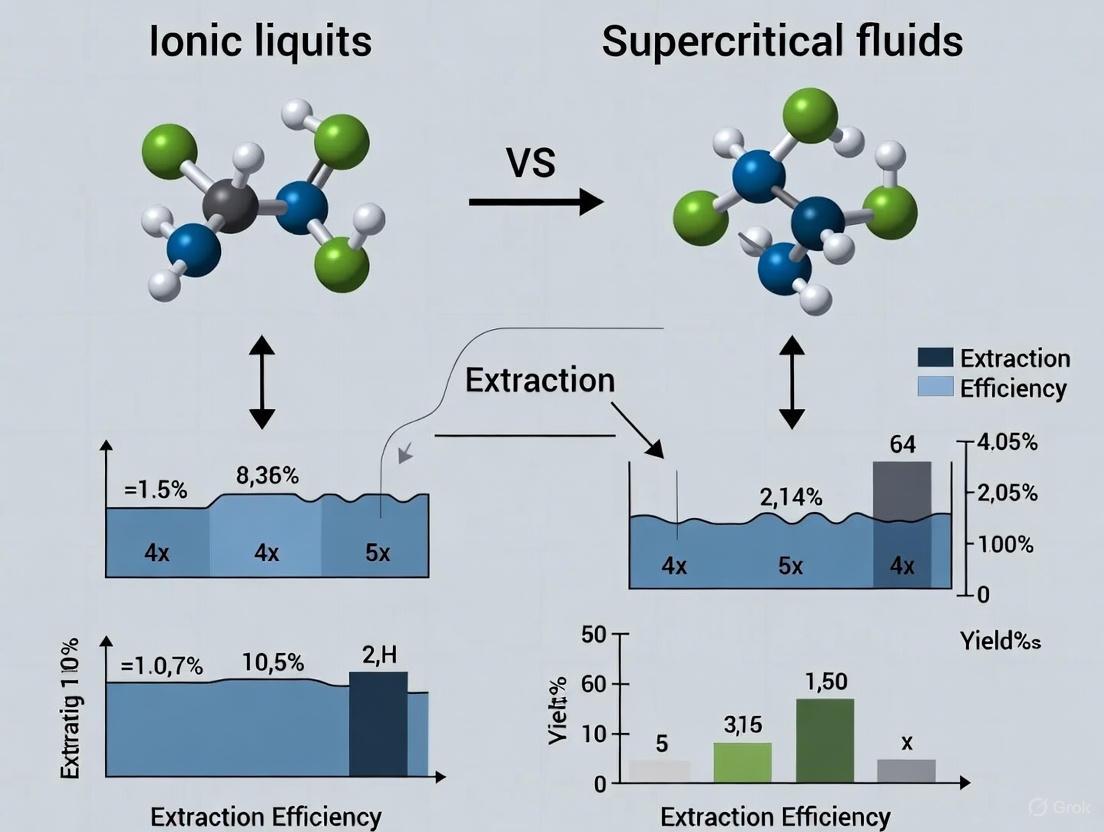
This article provides a comprehensive comparison of two advanced, green extraction technologies: Ionic Liquids (ILs) and Supercritical Fluids, with a focus on supercritical carbon dioxide (scCO₂).
Ionic Liquids vs. Supercritical Fluids: A Comparative Analysis of Extraction Efficiency for Pharmaceutical and Biomedical Applications
Abstract
This article provides a comprehensive comparison of two advanced, green extraction technologies: Ionic Liquids (ILs) and Supercritical Fluids, with a focus on supercritical carbon dioxide (scCO₂). Tailored for researchers, scientists, and drug development professionals, it explores the foundational principles, unique properties, and mechanisms of action of both methods. The scope ranges from methodological applications for specific compound classes (e.g., polyphenols, essential oils, drugs) to advanced optimization strategies, including experimental design and machine learning. It concludes with a rigorous, multi-factorial validation of efficiency, selectivity, scalability, and environmental impact, offering critical insights for selecting and optimizing extraction processes in biomedical research and natural product drug discovery.
Green Solvents Unveiled: Core Principles and Properties of ILs and Supercritical Fluids
The shift toward sustainable and efficient chemical processes has propelled the development of green extraction technologies. Among the most promising contenders are ionic liquids (ILs), celebrated as "designer solvents" for their tunable nature, and supercritical CO₂ (scCO₂), recognized as a versatile and tunable medium [1] [2]. These alternatives address the significant limitations of conventional organic solvents, which are often characterized by toxicity, volatility, and environmental persistence [3] [4]. The choice of extraction medium is crucial in industries ranging from pharmaceuticals and nutraceuticals to fragrances and food, as it directly impacts the yield, purity, and biological activity of isolated compounds [3]. This guide provides an objective comparison of ionic liquids and supercritical CO₂, focusing on their extraction efficiency, operational mechanisms, and practical applications, supported by experimental data and protocols for researchers and development professionals.
Principles and Tunability of Extraction Media
Ionic Liquids: Designer Solvents
Ionic liquids are salts that exist in a liquid state below 100°C, typically composed of large, asymmetric organic cations and organic or inorganic anions [1]. Their moniker, "designer solvents," stems from the ability to tailor their physicochemical properties by selecting different combinations of cations and anions.
- Principles: The liquid state at low temperatures results from the irregular sizes of the constituent ions, which impede the formation of a stable crystalline lattice [1]. The extraction mechanism involves the dissolution of target compounds through various interactions, including hydrogen bonding, π-π interactions, and electrostatic forces.
- Tunability: Properties such as hydrophilicity, lipophilicity, viscosity, and density can be fine-tuned by modifying the alkyl chain length on the cation or by selecting different anions [1]. For instance, imidazolium-based ILs are common, but cations can also be derived from pyridine, pyrrolidine, or phosphonium. Anions like bis(trifluoromethanesulfonyl)imide ([NTf₂]⁻) or acetate ([CH₃COO]⁻) confer different polarities and solvation capabilities [4] [1].
Supercritical CO₂: A Tunable Physicochemical Medium
Supercritical CO₂ is carbon dioxide held at a temperature and pressure above its critical point (Tc = 31.1°C, Pc = 7.38 MPa), where it exhibits properties intermediate between a gas and a liquid [4] [5].
- Principles: In this state, CO₂ possesses a high diffusion coefficient like a gas and a density comparable to a liquid, allowing for deep penetration into solid matrices and efficient solubilization of compounds [5]. The primary mechanism for extraction is based on the solubility of target analytes in the supercritical fluid.
- Tunability: The solvation power of scCO₂ is highly adjustable through changes in pressure and temperature. Increasing the pressure at a constant temperature dramatically increases the density of scCO₂, thereby enhancing its ability to dissolve non-polar compounds [5] [6]. The addition of small proportions of polar co-solvents, or "modifiers" like ethanol, can extend its applicability to more polar molecules, such as phenolic compounds [6].
Comparative Analysis: Extraction Efficiency and Performance
The following tables summarize key performance metrics and operational parameters for IL and scCO₂ extraction, based on experimental data from recent research.
Table 1: Quantitative Comparison of Extraction Performance
| Performance Metric | Ionic Liquids (ILs) | Supercritical CO₂ | Experimental Context |
|---|---|---|---|
| Solvent Power/Tunability | Very high; adjustable via ion selection [1] | High; adjustable via pressure, temperature, and co-solvents [5] [6] | Fundamental property |
| Selectivity | High; can be designed for specific analyte interactions [4] | Moderate to high; depends on parameter tuning and matrix [5] | Fundamental property |
| Extraction of Polar Compounds | Excellent; especially with hydrophilic ILs [4] | Poor without modifiers; good with ethanol co-solvent [6] | Hemp seed oil phenolics increased with 10% ethanol [6] |
| Extraction of Non-Polar Compounds | Good; with lipophilic ILs [3] | Excellent for low-polarity molecules [5] | Tannin extraction efficiency [5] |
| Typical Extraction Time | 30 mins - several hours [4] | 2 to 5 hours [6] | Optimized SFE for hemp seed oil took 244 min [6] |
Table 2: Operational and Economic Considerations
| Parameter | Ionic Liquids (ILs) | Supercritical CO₂ |
|---|---|---|
| Initial Investment | Low to moderate (standard lab equipment) | High (high-pressure equipment) |
| Operational Cost | Moderate (IL synthesis/purchase); cost-saving if recycled [1] | Moderate (energy for compression) |
| Solvent Recovery | Required; can be complex (e.g., distillation, back-extraction) but enables recycling [1] | Simple; CO₂ evaporates upon depressurization, leaving no residue [6] |
| Environmental Impact | "Green" but requires lifecycle assessment; some ILs are toxic and non-biodegradable [4] | Excellent; CO₂ is non-toxic and can be sourced from waste streams; no solvent waste [5] [6] |
| Process Safety | High; non-flammable, negligible vapor pressure [1] [7] | High; non-flammable, though high-pressure systems require safety protocols |
Detailed Experimental Protocols
Protocol: Extraction of Bioactives using Ionic Liquids
This general protocol is adapted from methods used for extracting phenolic compounds and other bioactive ingredients from natural products [4].
- IL Selection and Preparation: Select an IL based on the hydrophilicity/lipophilicity of the target compound. For polar compounds, hydrophilic ILs like those with chloride ([Cl]⁻) or acetate ([CH₃COO]⁻) anions are effective. Synthesize or purchase the IL, and dry it under vacuum if necessary.
- Sample Preparation: The plant material (e.g., leaves, seeds) is dried and ground to a fine powder (e.g., 500 μm) to increase the surface area for extraction.
- Extraction Process: Mix the powdered sample with the IL in a predetermined solid-to-liquid ratio (e.g., 1:10 to 1:50 w/v). The mixture is stirred (e.g., 300-600 rpm) at an optimized temperature (e.g., 30-60°C) for a set period (30 mins to several hours).
- Separation: The mixture is centrifuged (e.g., 4000 × g for 15 min) to separate the solid residue from the IL extract.
- Analyte Recovery: The target compounds are recovered from the IL phase. This can be achieved by:
- Back-Extraction: Adding water or an organic solvent immiscible with the IL (e.g., ethyl acetate) and shaking to partition the analytes into the new phase.
- Solid-Phase Extraction (SPE): Passing the IL extract through a cartridge that retains the analytes, which are then eluted with a suitable solvent.
- Precipitation: Adding an anti-solvent to precipitate the compounds.
- IL Recycling: The recovered IL can often be purified by washing, evaporation, or distillation for reuse, which is critical for economic and environmental sustainability [1].
Protocol: Optimized scCO₂ Extraction of Hemp Seed Oil with Ethanol Modifier
This protocol is based on a detailed study optimizing the recovery of bioactive-rich oil from hemp seeds [6].
- Sample Preparation: Hemp seeds are crushed and sieved to a uniform particle size of 500 μm.
- Equipment Setup: The extraction is performed in a supercritical fluid extraction system. The crushed seeds are loaded into the high-pressure extraction vessel.
- Optimized Extraction Parameters: The following conditions were identified as optimal via Response Surface Methodology:
- Temperature: 50°C
- Pressure: 20 MPa
- Time: 244 minutes
- CO₂ Flow Rate: 0.25 kg/h
- Co-solvent Addition: To enhance the yield of polar phenolic compounds, food-grade ethanol is added as a modifier at a concentration of 10% by weight of CO₂.
- Extraction and Collection: The scCO₂, now carrying the dissolved oil, is passed from the extraction vessel into a separator. The pressure is reduced, causing the CO₂ to revert to its gaseous state and evaporate, leaving behind the extracted hemp seed oil in the collection vessel.
- Analysis: The oil is analyzed for yield, total phenolic content (TPC), tocopherols, and oxidative stability. The study reported a yield of 30.13%, with a TPC of 294.15 mg GAE/kg oil and 26 identified phenolic compounds [6].
Workflow and Pathway Visualization
The following diagram illustrates the logical workflow and key decision points for selecting and applying these solvent systems in an extraction process.
The Scientist's Toolkit: Key Research Reagent Solutions
Table 3: Essential Materials for IL and scCO₂ Extraction
| Reagent/Material | Function in Extraction | Example Applications |
|---|---|---|
| Imidazolium-based ILs (e.g., [C₄mim][Cl], [C₂mim][OAc]) | Versatile, water-stable solvents; cations provide a platform for tuning properties via alkyl chain length and anion pairing. | Extraction of polyphenols, flavonoids, and alkaloids from plant materials [4] [1]. |
| Deep Eutectic Solvents (DES) | A sub-class of IL analogues; low-cost, biodegradable, often prepared from natural compounds (e.g., choline chloride + urea). | Green extraction of cannabinoids, phenolic compounds, and polysaccharides [4]. |
| Supercritical CO₂ | Primary extraction fluid for non-polar to moderately polar compounds; non-toxic and easily removed. | Extraction of oils, essential oils, tannins, and lipophilic antioxidants (e.g., from hemp seed, spices) [5] [6]. |
| Ethanol (as co-solvent) | A polar modifier added to scCO₂ to increase its solvation power for mid- to high-polarity molecules. | Enhancing the recovery of phenolic compounds in hemp seed oil [6] and other polar bioactives. |
| Switchable Solvents | Solvents that can change hydrophilicity/hydrophobicity in response to a trigger like CO₂; simplify recovery and recycling. | Emerging application in extraction and separation processes [4]. |
Ionic liquids and supercritical CO₂ represent two powerful, yet distinct, pathways toward greener and more efficient extraction processes. The choice between them is not a matter of superiority but of strategic application.
Supercritical CO₂ extraction is the definitive choice for non-polar to moderately polar compounds where the absolute purity of the extract (free of solvent residue) is paramount, as in the food, cosmetic, and pharmaceutical industries. Its principal advantages are its clean, solvent-free operation and tunability via pressure and temperature, though it requires significant capital investment.
Ionic liquids offer unparalleled selectivity and flexibility for challenging separations, particularly for polar and hydrophilic bioactive compounds. Their "designer" nature allows chemists to craft a solvent for a specific task. The ongoing research focuses on mitigating their limitations through the development of cheaper, biodegradable ILs (like many Deep Eutectic Solvents) and improving recycling protocols to enhance their economic and environmental footprint.
Future trends point toward hybrid systems that leverage the strengths of both technologies. For example, using ILs as selective co-solvents or catalysts within scCO₂ systems could open new frontiers in separation science, enabling the efficient and sustainable extraction of a wider range of high-value chemicals for drug development and beyond [2].
Historical Development and Acceptance in Green Chemistry and Pharmaceutical Applications
The adoption of green chemistry principles has catalyzed a significant shift in pharmaceutical research and development, driving the search for sustainable alternatives to traditional volatile organic solvents. Among the most promising alternatives are ionic liquids (ILs) and supercritical fluids (SCFs), which have revolutionized extraction methodologies central to drug discovery and production [8]. Ionic liquids, often termed "designer solvents," are salts that remain liquid at relatively low temperatures and boast negligible vapor pressure and high thermal stability [9]. Supercritical fluids, particularly supercritical carbon dioxide (scCO₂), represent a state of matter achieved above its critical temperature and pressure, exhibiting unique solvating properties with liquid-like densities and gas-like diffusivities [10]. This guide provides a comparative analysis of these two solvent systems, evaluating their extraction efficiency, applications, and practical implementation within the pharmaceutical industry to inform researchers and drug development professionals.
Historical Development and Industrial Acceptance
The parallel development of ILs and SCFs has been profoundly influenced by the broader green chemistry movement, which gained formal structure in the 1990s.
The Rise of Green Chemistry
The modern environmental movement, sparked in the 1960s by works such as Rachel Carson's Silent Spring, laid the groundwork for a new chemical philosophy [11]. The U.S. Pollution Prevention Act of 1990 marked a critical policy shift from pollution control to pollution prevention [11]. In 1991, Paul Anastas, then at the U.S. Environmental Protection Agency (EPA), coined the term "green chemistry," and in 1998, together with John Warner, he outlined the 12 Principles of Green Chemistry [11] [8] [12]. These principles provided a framework for designing chemical products and processes that reduce or eliminate the use and generation of hazardous substances, creating a demand for innovative solvents like ILs and SCFs [8].
Development of Ionic Liquids
The history of ionic liquids dates back to 1914 with the report of [EtNH₃][NO₃], but their potential as solvents was not extensively explored until the 1970s, when they were investigated for electroplating applications [13]. A significant breakthrough came in 1982 with the development of dialkylimidazolium chloroaluminate melts, which offered greater stability and a broader liquid temperature range [13]. Initially referred to as "nonaqueous ionic liquids," these compounds were later recognized for their "designer solvent" capabilities, where physical properties could be finely tuned by selecting different cation-anion pairs [13]. The evolution of ILs is categorized into three generations:
- First Generation: Focused on applications in electrochemistry, with limited emphasis on environmental compatibility [14].
- Second Generation: Featured air- and water-stable ILs (e.g., with [BF₄]⁻ and [PF₆]⁻ anions) with tunable physicochemical properties for specific applications [14].
- Third Generation: Emphasizes biocompatibility, utilizing natural sources like amino acids and choline to create ILs with low toxicity and good biodegradability, making them suitable for pharmaceutical and biomedical uses [14].
Development of Supercritical Fluids
The practical application of supercritical fluids, particularly scCO₂, began in the 1970s and 1980s with its use for decaffeinating coffee and extracting hops [10]. The appeal of scCO₂ lies in its moderate critical parameters (31.4 °C and 74.8 bar), low cost, non-toxicity, and non-flammability [10] [9]. Over recent decades, SFE technology has matured significantly, with ongoing research optimizing process parameters such as pressure, temperature, and flow rate to enhance extraction efficiency and enable industrial-scale applications, from botanicals to materials science [10].
Timeline of Key Milestones
Table 1: Historical Development of Ionic Liquids and Supercritical Fluids
| Year | Ionic Liquids Milestone | Supercritical Fluids Milestone | Green Chemistry Context |
|---|---|---|---|
| 1914 | First IL, [EtNH₃][NO₃], described [13] | ||
| 1970s | Development of chloroaluminate ILs for electroplating [13] | Initial industrial SFE processes (e.g., decaffeination) [10] | |
| 1990 | Pollution Prevention Act passed [11] | ||
| 1991 | Term "Green Chemistry" coined by P. Anastas [11] | ||
| 1998 | 12 Principles of Green Chemistry published [11] | ||
| 2000s | Emergence of 3rd Gen. (Biocompatible) ILs [14] | Widespread optimization & scaling of SFE [10] | Presidential Green Chemistry Challenge Awards [11] |
| 2020s | Application in drug delivery, stabilization of proteins [14] | Advanced kinetics modeling & ANN for SFE optimization [10] | Integration into pharmaceutical industry standards [8] |
Comparative Analysis of Extraction Performance
Extraction efficiency is a critical metric for evaluating solvent performance. The following experimental data and protocols illustrate how ILs and SCFs compare in real-world applications.
Experimental Protocol: Ionic Liquid-Based Extraction
A study extracting essential oil from Polygonum minus provides a clear protocol for IL-based extraction [15].
- Objective: To compare the efficiency of various ILs and organic solvents in extracting essential oil using different methods.
- Materials: Plant material (P. minus), ILs including [AMIM]Ac, [BMIM]Cl, and [HMIM]Ac, and organic solvents (toluene, pentane, hexane).
- Methodology: Four techniques were employed:
- Microwave-assisted extraction (ILMAE): Plant material mixed with aqueous ILs and heated to 60°C for 5-8 minutes.
- Ultrasonic-assisted extraction (ILUAE): Extraction using an ultrasonic probe.
- Mechanical stirring: Stirring with ILs or solvents for one hour at room temperature.
- Reflux extraction: Heating the mixture at 60°C for one hour.
- Analysis: The extracted essential oil was analyzed using Gas Chromatography-Mass Spectrometry (GC-MS).
Experimental Protocol: Supercritical Fluid Extraction
Research on the supercritical fluid extraction of cherry seed oil outlines a standard SFE protocol [10].
- Objective: To optimize the SFE process for cherry seed oil yield using kinetic modeling and artificial neural networks (ANN).
- Materials: Cherry seeds, carbon dioxide (99.9%), high-pressure extraction apparatus.
- Methodology: The Box-Behnken experimental design was used to vary pressure (200-350 bar), temperature (40-70°C), and CO₂ flow rate (0.2-0.4 kg/h). The mean particle size of the plant material was 741 μm, and extractions ran for 4 hours.
- Analysis: Total extraction yield was measured at set time intervals to establish kinetic curves. The data was fitted to mass-transfer kinetic models and optimized via ANN.
Comparative Performance Data
Table 2: Extraction Performance Comparison: Ionic Liquids vs. Supercritical Fluids
| Extraction Parameter | Ionic Liquids (e.g., [AMIM]Ac) | Supercritical CO₂ |
|---|---|---|
| Typical Extraction Time | 5-21 minutes (ILMAE) [15] | 180-240 minutes [10] |
| Typical Temperature | 60°C [15] | 40-70°C [10] |
| Key Solvation Property | High, tunable polarity [14] [9] | Lipophilic, similar to toluene [10] |
| Optimal Yield Example | 0.91% EO from Dryopteris fragrans in 14.2 min [15] | Varies with pressure/temperature; model-optimized [10] |
| Mass Transfer Rate | Very high (accelerated by microwave) [15] | High initially (CER period), then slows [10] |
| Influencing Factors | Cation/anion structure, water content, solid/liquid ratio [15] | Pressure, temperature, CO₂ flow rate, particle size [10] |
| Selectivity | Tunable for specific analytes via ion selection [14] | Good for lipophiles; tunable with pressure/co-solvents [10] |
The following workflow diagrams summarize the key experimental steps for each extraction method.
Extraction Workflows
Diagram 1: Ionic liquid extraction workflow.
Diagram 2: Supercritical fluid extraction workflow.
The Scientist's Toolkit: Research Reagent Solutions
Selecting the appropriate reagents is fundamental to designing efficient extraction processes. The following table details key materials and their functions.
Table 3: Essential Research Reagents and Materials
| Reagent/Material | Function in Extraction | Example Applications & Notes |
|---|---|---|
| Imidazolium-based ILs ([AMIM]Ac, [BMIM]Cl) | Versatile, tunable solvents with high solvation power for diverse compounds. | [AMIM]Ac showed high efficiency for essential oil extraction [15]. |
| Supercritical CO₂ | Non-toxic, non-flammable, tunable solvent for lipophilic compounds. | Ideal for oils, fragrances, and heat-sensitive compounds [10] [9]. |
| Co-solvents (e.g., Ethanol) | Modifies polarity of scCO₂ to enhance solubility of more polar molecules. | Used in SFE to increase yield of specific bioactive compounds. |
| Brønsted Acidic ILs | Serves as both solvent and catalyst, e.g., in esterification reactions. | Can accelerate reaction rates and improve yields in synthetic pathways [14]. |
| Deep Eutectic Solvents (DES) | Biocompatible, biodegradable solvents often derived from natural sources. | Considered 3rd generation ILs; lower toxicity and cost [16]. |
Ionic liquids and supercritical fluids represent two powerful, yet distinct, pillars of green extraction technology in the pharmaceutical industry. The choice between them is not a matter of superiority but of strategic application. Ionic liquids excel in tunability and processing speed for a wide range of polarities, particularly with advanced assistance methods like microwaves, making them ideal for high-value, specialized extractions and reactions where solvent design is critical [14] [15]. Supercritical CO₂ offers an unparalleled green profile for non-polar to moderately polar compounds, providing a clean, residue-free extraction that is highly scalable for industrial processes involving lipophilic active ingredients [10] [9].
For researchers, the decision pathway is clear: employ SC-CO₂ for efficient, large-scale isolation of lipophilic compounds where ultra-purity is key, and leverage ILs for challenging separations of polar molecules, catalytic processes, or when the biological activity of the IL itself can be harnessed. The future of pharmaceutical extraction lies not only in the continued refinement of these individual technologies but also in the exploration of their synergistic potential, such as IL-scCO₂ hybrid systems, to further advance the goals of sustainable and efficient drug development.
In the pursuit of sustainable and efficient separation technologies, ionic liquids (ILs) and supercritical fluids (SCFs) have emerged as two prominent classes of green solvents, each with a unique set of physicochemical properties. The performance of these solvents in extraction processes is directly governed by their core physical properties, including viscosity, diffusivity, polarity, and solvation power. For researchers and drug development professionals, selecting the optimal solvent requires a deep understanding of how these properties interrelate and influence extraction efficiency, selectivity, and scalability. This guide provides a comparative analysis of these critical properties, supported by experimental data and methodologies, to inform solvent selection for specific research applications in extraction efficiency.
Fundamental Properties Comparison
The efficacy of ionic liquids and supercritical fluids in extraction is dictated by their fundamental physical properties. The table below provides a quantitative comparison of these key parameters, which are foundational to predicting solvent behavior in experimental settings.
Table 1: Comparative Physical Properties of Ionic Liquids and Supercritical Fluids
| Property | Ionic Liquids (ILs) | Supercritical Fluids (SCFs) | Impact on Extraction Efficiency |
|---|---|---|---|
| Viscosity | High (e.g., 50–1000 cP) [17] [18] | Low (e.g., 50–100 μPa·s, similar to gases) [19] [20] | High IL viscosity can limit mass transfer and diffusion rates. Low SCF viscosity enhances penetration into porous matrices. |
| Diffusivity | Low (due to high viscosity and strong ionic interactions) [17] | High (e.g., 0.01–0.1 mm²/s, between liquids and gases) [19] | Higher diffusivity of SCFs improves mass transfer of solutes from solid matrices, speeding up extraction kinetics. |
| Polarity | Highly tunable; can be designed from hydrophobic to hydrophilic. [17] [21] [22] | Generally low for scCO₂; tunable with density and modifiers. [23] [19] | Tunable polarity allows selective extraction of target compounds based on their polarity. |
| Solvation Power | High for a wide range of polar and ionic compounds; can dissolve biopolymers like cellulose. [21] [18] [22] | Tunable with pressure and temperature; high for non-polar solutes in scCO₂. [23] [19] [20] | Tunable solvation enables selective fractionation and extraction of diverse compound classes. |
| Typical Density (kg/m³) | High (e.g., 1000–1500) [18] | Intermediate and tunable (e.g., 100–1000) [19] | Density directly correlates with solvation power in SCFs, allowing precise control. |
| Vapor Pressure | Negligible [23] [17] [22] | High, but fluid reverts to gas upon depressurization [20] | Near-zero vapor pressure of ILs simplifies containment and enables high-temperature operation. Easy separation of solute from SCF solvent. |
Experimental Protocols for Property Investigation
Protocol for Probing Solvation Power and Selectivity in Supercritical CO₂
The solvation power of supercritical carbon dioxide (scCO₂) is highly dependent on its density, which is a function of temperature and pressure. This protocol outlines a standard procedure for investigating this relationship.
- Objective: To determine the correlation between scCO₂ density/pressure and its extraction efficiency for non-polar compounds.
- Materials: Supercritical fluid extraction (SFE) system comprising a CO₂ pump, a co-solvent pump (for modifier studies), a pressurized extraction vessel, a heating oven, a back-pressure regulator, and a collection vessel. [23] [20]
Methodology:
- System Preparation: The biomass (e.g., milled plant material) is loaded into the extraction vessel. The system is brought to the desired temperature (e.g., 40–60°C) and pressure using the CO₂ pump and oven.
- Extraction: ScCO₂ is pumped through the biomass bed at a constant flow rate. The pressure is systematically varied (e.g., from 100 to 400 bar) while maintaining a constant temperature.
- Fraction Collection: The solute-laden scCO₂ is passed through a back-pressure regulator into a collection vessel, where depressurization causes the solute to precipitate.
- Analysis: The extracted yield and chemical profile (e.g., via HPLC or GC-MS) are analyzed for each pressure condition.
Key Experimental Parameters:
Protocol for Assessing Tunable Polarity in Ionic Liquid-Based Systems
The "designer solvent" nature of ILs allows for the systematic study of cation-anion combinations on extraction selectivity.
- Objective: To evaluate the effect of IL hydrophobicity/hydrophilicity on the extraction efficiency of polar and ionic target compounds (e.g., polyphenols, APIs).
- Materials: A series of ILs with common cations (e.g., 1-butyl-3-methylimidazolium, [BMIM]⁺) but different anions (e.g., Cl⁻, PF₆⁻, [Tf₂N]⁻), a shaking incubator or mixer, and analytical equipment (e.g., spectrophotometer, HPLC). [17] [21] [22]
- Methodology:
- Liquid-Liquid Extraction: An aqueous solution containing the target solute is mixed with a pre-selected IL in a vial.
- Equilibration: The mixture is vigorously agitated and then allowed to settle for phase separation.
- Quantification: The concentration of the solute remaining in the aqueous phase is measured. The partition coefficient (K) is calculated as K = CIL / Cwater, where C is the solute concentration in the IL and water phases, respectively.
- Comparison: The procedure is repeated for different ILs, and the partition coefficients are compared to establish structure-property relationships.
- Key Experimental Parameters:
- Anion Selection: A primary driver for IL polarity and hydrophobicity (e.g., [BF₄]⁻ is more hydrophilic than [PF₆]⁻). [17] [21]
- Alkyl Chain Length: Increasing the alkyl chain on the cation generally increases hydrophobicity. [17]
- Water Content: Even small amounts of water can significantly alter IL polarity and transport properties, requiring careful control. [21]
Research Reagent Solutions and Materials
Successful experimentation with these advanced solvents requires specific reagents and instrumentation. The following table details key materials and their functions in related research.
Table 2: Essential Research Reagents and Materials for IL and SCF Studies
| Reagent/Material | Function in Research | Example Applications |
|---|---|---|
| Supercritical CO₂ | Primary solvent for SFE; non-toxic, non-flammable, and tunable. [19] [20] | Decaffeination, extraction of essential oils and lipids, particle formation via RESS. [23] [20] |
| 1-Butyl-3-methylimidazolium-based ILs | Versatile, widely studied IL platform; anion choice dictates polarity and application. [17] [21] | Dissolution of cellulose ([BMIM]Cl), extraction of metal ions, and as a medium for catalytic reactions. [21] [18] |
| Co-solvents (e.g., Ethanol, Methanol) | Modifiers added in small quantities (1–10%) to scCO₂ to enhance solubility of polar molecules. [23] [20] | Extraction of medium-polarity compounds like polyphenols and tannins, where pure scCO₂ is ineffective. [5] |
| Fluorinated Anion ILs (e.g., [PF₆]⁻, [Tf₂N]⁻) | Forms hydrophobic and thermally stable ILs, immiscible with water, for extracting non-polar organics from aqueous matrices. [17] [21] | Liquid-liquid extraction of pharmaceuticals, fragrances, and organic contaminants from water. [17] [22] |
| Specialty Surfactants | Stabilizes water-in-scCO₂ microemulsions, allowing scCO₂ to dissolve polar species like metal ions and biomolecules. [23] | Creating nanoscale reactors in scCO₂ for synthesis, recovery of precious metals from aqueous streams. [23] |
Advanced Systems and Synergistic Applications
The combination of ILs and SCFs can create synergistic systems that leverage the advantages of both solvents. A prominent example is the use of ILs in the formation of water-in-scCO₂ (W/C) microemulsions. [23] In these systems, a polar water core, stabilized by surfactants and often containing dissolved ILs, is dispersed within the continuous scCO₂ phase. This creates nanodomains that can solubilize polar compounds, thereby overcoming the inherent limitation of scCO₂'s low polarity. The ILs incorporated into the microemulsion can enhance the system's catalytic performance and stability. These hybrid systems find innovative applications in catalytic reactions, material synthesis, and the extraction of a broader range of compounds, including precious metals. [23]
Another advanced application is the use of supercritical fluid impregnation, where scCO₂ acts as a carrier to deliver active substances, such as drugs or antimicrobial agents, into polymeric or solid matrices. The high diffusivity and absence of surface tension allow scCO₂ to penetrate complex porous structures without causing damage. Upon depressurization, the scCO₂ diffuses away, leaving the active compound impregnated within the matrix. This technique is highly relevant for developing drug-delivery systems and functionalized materials. [20]
The pursuit of efficient, sustainable, and selective extraction techniques has led to the adoption of two prominent green technologies: ionic liquids (ILs) and supercritical carbon dioxide (scCO₂). While both are considered environmentally friendly alternatives to conventional organic solvents, their fundamental mechanisms for disrupting biological structures and liberating target compounds differ profoundly. Understanding these molecular-level interactions is crucial for researchers and drug development professionals to select the optimal method for specific applications, whether extracting bioactive compounds from plant matrices, microalgae, or developing advanced drug delivery systems. This guide provides a detailed comparison of their operational principles, supported by experimental data and protocols, to inform method selection in pharmaceutical and nutraceutical development.
Molecular Mechanisms of Ionic Liquids in Cell Wall Disruption
Mechanism of Membrane Disruption by Cationic Alkyl Chains
Ionic liquids disrupt cellular structures through a multi-stage process dominated by their amphiphilic nature. The mechanism is primarily governed by the length of the cationic alkyl chain, which determines their cytotoxicity and effectiveness in permeabilizing cell walls [24].
Key Steps in IL-Membrane Interaction:
- Electrostatic Attachment: Positively charged imidazolium heads of ILs are initially attracted to the negatively charged surfaces of bacterial membranes or plant cell walls through electrostatic forces [25].
- Flip Motion and Reorientation: Upon attachment, IL molecules undergo a flip motion to find optimal orientation at the lipid bilayer interface [25].
- Hydrogen Bond Formation: ILs form key hydrogen bonds with lipid head groups, stabilizing their position and facilitating subsequent penetration [25].
- Hydrophobic Penetration: The hydrophobic alkyl chains penetrate the non-polar core of the lipid bilayer, disrupting tail ordering and membrane integrity [25] [24].
The following diagram illustrates this sequential disruption process:
The Critical Role of Alkyl Chain Length and Nanoaggregate Formation
Recent research reveals that ILs interact with cells as nanoaggregates rather than individual molecules, with aggregate size and behavior dictated by cationic alkyl chain length [24].
Table 1: Effect of Ionic Liquid Alkyl Chain Length on Properties and Bioactivity
| Alkyl Chain Length | Nanoaggregate Size | Cellular Localization | Biological Effect | Relative Cytotoxicity |
|---|---|---|---|---|
| Short Chain (C1-C4, e.g., C3MIMCl) | ~5 nm [24] | Restricted to intracellular vesicles [24] | Minimal membrane disruption, low toxicity | Low (≈100% cell viability at 400 μM) [24] |
| Long Chain (≥C8, e.g., C12MIMCl) | ~12.5 nm [24] | Accumulates in mitochondria [24] | Induces mitophagy and apoptosis | High (<5% cell viability at 400 μM) [24] |
| Very Long Chain (C16, e.g., HDPI) | Forms micellar structures [26] | Interacts with bacterial membranes [26] | Physical disruption of cytoplasmic membranes | High antimicrobial activity [26] |
ILs with intermediate chain lengths (C12-C16) demonstrate optimal antimicrobial efficacy, as their amphiphilic balance allows efficient membrane penetration without precipitation. This property is exploited in drug delivery systems where ILs functionalized onto mesoporous silica nanocarriers enhance antibiotic transport across bacterial cell walls [26].
Molecular Mechanisms of Supercritical CO₂ in Matrix Penetration
Fundamental Principles and Tunable Solvation
Supercritical CO₂ exists as a fluid above its critical temperature (304.1 K) and pressure (7.4 MPa), exhibiting unique properties that enable deep matrix penetration [27] [28]:
- Zero surface tension and low viscosity permit infiltration of microporous structures inaccessible to liquid solvents [27]
- High diffusivity (approximately 10-100 times greater than liquids) accelerates mass transfer and extraction kinetics [27]
- Tunable density and solvation power controlled by simple adjustments in pressure and temperature [27]
Sequential Mechanism of Matrix Penetration and Compound Extraction
The extraction process involves a coordinated sequence of physical penetration and solubilization events:
In decellularization applications, scCO₂ demonstrates unique capabilities by penetrating tissues, dissolving intracellular components, increasing cell membrane fluidity to accelerate rupture, and removing immunogenic substances while preserving bioactive extracellular matrix components [29]. The same penetrative properties make it effective for extracting functional triacylglycerols from microalgae and tannins from plant materials without thermal degradation [5] [28].
Experimental Protocols for Method Evaluation
Protocol for Assessing IL Antibacterial Efficacy
Objective: Evaluate the bactericidal activity of dicationic ionic liquids against Gram-negative bacteria (E. coli) [25].
Materials:
- Dicationic ionic liquids (e.g., DCIL-1, DCIL-3, DCIL-5 with varying functional groups)
- E. coli culture (ATCC standard strain)
- Luria-Bertani (LB) broth and agar
- 96-well microtiter plates
- Spectrophotometer for optical density measurement
Methodology:
- Grow E. coli overnight in LB broth at 37°C with shaking
- Dilute culture to approximately 10⁵ CFU/mL in fresh medium
- Add ILs at concentrations ranging from 25-1600 μM to bacterial suspensions
- Incubate at 37°C for 24 hours with constant shaking
- Measure optical density at 600 nm to determine growth inhibition
- Perform live/dead staining or colony counting for viability assessment
- Conduct molecular dynamics simulations to correlate antibacterial activity with functional groups and hydrophobic character [25]
Key Parameters: IC₅₀ values, minimum inhibitory concentration (MIC), correlation with IL lipophilicity and functional groups
Protocol for Determining Solubility in scCO₂
Objective: Measure drug solubility in supercritical CO₂ for pharmaceutical process design [27].
Materials:
- Supercritical fluid extraction system with pressure and temperature control
- High-purity CO₂ (99.99%)
- Model drug compounds (e.g., pharmaceutical solids)
- Analytical balance (±0.0001 g)
- High-performance liquid chromatography (HPLC) system for quantification
Methodology:
- Load known quantity of drug into extraction vessel
- Pressurize system with CO₂ to target pressure (e.g., 10-30 MPa)
- Maintain constant temperature (e.g., 313-333 K) with precision ±0.1 K
- Allow system to equilibrate for predetermined time (typically 30-120 minutes)
- Expand scCO₂ through restrictor valve to precipitate dissolved solute
- Collect solute in trapping solvent or device
- Quantify dissolved drug gravimetrically or via HPLC analysis
- Validate measurements with machine learning models (XGBoost, CatBoost) using input parameters T, P, Tc, Pc, ρ, ω, MW, and Tm [27]
Key Parameters: Solubility (mol/mol or g/L), temperature and pressure dependence, crossover pressure
Performance Comparison: Quantitative Data Analysis
Table 2: Comparative Performance Metrics for Extraction Applications
| Application | Technology | Extraction Yield | Process Conditions | Key Advantages | References |
|---|---|---|---|---|---|
| Functional TAGs from Microalgae | scCO₂ | 1.8-2.5 times conventional methods | 30-50 MPa, 40-60°C | No solvent residues, high purity extracts, room temperature processing | [28] |
| Tannin Recovery from Biomass | scCO₂ with ethanol cosolvent | Selective fractionation achievable | 25-35 MPa, 50-80°C | Tailored extracts, reduced energy consumption, preserved tannin quality | [5] |
| Antibacterial Activity | DCIL-5 (2-hydroxy-3-phenoxypropyl) | Highest bactericidal activity (DCIL-5 > DCIL-1 > DCIL-3) | N/A (direct application) | Functional groups enhance membrane disruption, high against E. coli | [25] |
| Drug Solubility Prediction | Machine Learning (XGBoost) with scCO₂ | R² = 0.9984, RMSE = 0.0605 | N/A (predictive model) | High reliability for pharmaceutical process design | [27] |
| Wound Healing Biomaterial | scCO₂-processed ADM | Accelerated wound closure, enhanced collagen deposition | 20-30 MPa, 35-40°C | Preserved structural integrity, enhanced biocompatibility, superior to commercial ADMs | [29] |
The Scientist's Toolkit: Essential Research Reagents and Materials
Table 3: Key Research Reagents and Materials for Extraction Studies
| Reagent/Material | Function/Application | Specific Examples | Critical Parameters |
|---|---|---|---|
| Imidazolium-Based ILs | Cell membrane disruption, antimicrobial studies | C3MIMCl (short chain), C12MIMCl (long chain), HDPI (C16 with propargyl group) [24] [26] | Alkyl chain length (C1-C16), counterion (Cl⁻, Br⁻), functionalization |
| Dicationic Ionic Liquids | Enhanced antibacterial efficacy | DCIL-1, DCIL-3, DCIL-5 with varied functional groups [25] | Functional groups (2-hydroxybutyl, 2-hydroxy-3-phenoxypropyl), relative hydrophobicity |
| Supercritical CO₂ | Green solvent for extraction and processing | High-purity carbon dioxide (≥99.99%) [27] | Critical temperature (304.1 K), critical pressure (7.4 MPa), density tunability |
| Mesoporous Silica Nanocarriers | Drug delivery vehicle for IL-functionalized systems | mSiO₂ (110 nm average size) [26] | Pore size, surface area, azide modification for click chemistry |
| Machine Learning Algorithms | Predicting drug solubility in scCO₂ | XGBoost, CatBoost, LightGBM, Random Forest [27] | Input features: T, P, Tc, Pc, ρ, ω, MW, Tm |
The molecular mechanisms of ILs and scCO₂ reveal complementary strengths for different extraction scenarios. ILs function through direct molecular interactions with cellular structures, where cationic alkyl chain length dictates their disruptive capability and cytotoxicity. In contrast, scCO₂ operates through physical penetration and tunable solvation, leveraging its unique supercritical properties to extract compounds while preserving delicate molecular structures.
For researchers designing extraction protocols, the choice between these technologies should consider:
- Target compounds: ILs excel for membrane-associated compounds, while scCO₂ better suits thermally labile, non-polar molecules
- Scale requirements: scCO₂ has established industrial applications, while IL applications are often at research scale
- Purity specifications: scCO₂ leaves no solvent residues, while ILs may require removal steps
- Cost considerations: scCO₂ requires high capital investment, while ILs can be cost-effective at smaller scales
The integration of machine learning approaches with both technologies, particularly for predicting solute behavior in scCO₂, represents the next frontier in rational extraction process design, offering researchers powerful tools to optimize conditions before experimental validation.
The pursuit of efficient, selective, and environmentally sustainable techniques is a cornerstone of modern drug discovery. This guide provides an objective comparison of two advanced extraction technologies: ionic liquids (ILs) and supercritical fluids (SCFs), with a particular focus on supercritical carbon dioxide (scCO₂). Both are celebrated as green solvents and have revolutionized the isolation of natural products and the engineering of drug particles. Their unique physicochemical properties offer distinct pathways to overcome the limitations of conventional organic solvents, which are often toxic, volatile, and environmentally persistent [30]. This article systematically compares their principles, performance, and practical applications by synthesizing current research data and experimental protocols, providing a clear framework for researchers and drug development professionals to select the appropriate technology.
Fundamental Comparison of Ionic Liquids and Supercritical Fluids
Definition and Core Properties
Ionic Liquids (ILs) are organic salts composed entirely of ions that are liquid below 100 °C [30]. They possess near-zero vapor pressure, high thermal stability, and tunable physicochemical characteristics, which can be customized by selecting different cation-anion combinations for specific applications [31] [13]. Their negligible volatility eliminates inhalation risks and solvent loss to the atmosphere, a significant advantage over traditional solvents [31].
Supercritical Fluids (SCFs) are substances maintained at temperatures and pressures above their critical point, where they exhibit properties intermediate between a gas and a liquid. scCO₂ is the most widely used supercritical fluid due to its mild critical temperature (304.1 K) and pressure (7.4 MPa), low toxicity, and non-flammability [27]. It offers high diffusivity, low viscosity, and zero surface tension, which facilitate rapid penetration into solid matrices [27] [5]. Its solvent power is highly tunable through adjustments in pressure and temperature [27].
Table 1: Fundamental Characteristics of Ionic Liquids and Supercritical CO₂
| Characteristic | Ionic Liquids (ILs) | Supercritical CO₂ (scCO₂) |
|---|---|---|
| Chemical Nature | Organic salts (ions) | Non-polar molecule |
| Vapor Pressure | Negligible [31] [30] | Tunable with pressure; high in gaseous state |
| Tunability | High (via cation/anion selection) [31] | High (via pressure & temperature) [27] |
| Polarity | Adjustable from polar to non-polar | Inherently low; often requires co-solvents [30] |
| Typical Operating Conditions | Ambient temperature and pressure | High pressure (>7.4 MPa), moderate temperature (>304 K) [27] |
| Key Advantage | Designer solvents, high solvation power | Selective, facile solvent removal |
Comparative Advantages and Limitations
The selection between ILs and scCO₂ is often dictated by the nature of the target compound and process requirements.
Ionic Liquids excel at extracting a wide range of bioactive compounds, including polar molecules like flavonoids and alkaloids, due to their customizable solvation properties. However, their status as "green" solvents is context-dependent. While they reduce air pollution, their synthesis can be energy-intensive, and some ILs demonstrate toxicity and poor biodegradability, necessitating a full lifecycle assessment [30]. A significant challenge is their high cost compared to conventional solvents, though recovery and reuse strategies can mitigate this [31].
Supercritical CO₂ is ideal for non-polar to moderately polar compounds, such as essential oils and tannins [5] [15]. Its primary advantage is the ease of solvent removal via depressurization, yielding a solvent-free extract. The main limitations are the high energy required to maintain pressure and its poor solubility for highly polar drugs without using co-solvents like ethanol or methanol [30]. Furthermore, experimental determination of drug solubility in scCO₂ can be costly and time-consuming, driving the development of machine learning models for prediction [27].
Table 2: Comparative Advantages and Limitations in Drug Discovery
| Aspect | Ionic Liquids | Supercritical Fluids |
|---|---|---|
| Extraction Selectivity | High, tunable for specific solute-solvent interactions [31] | High, tunable with density (P/T) [5] |
| Solvent Removal | Can be complex; requires separation steps [31] | Simple and complete upon depressurization |
| Energy Consumption | Low operational energy; potential high synthesis energy [30] | High (for pressurization and heating) [30] |
| Environmental Impact | Low air emissions; potential aquatic/soil toxicity [30] | Generally low; CO₂ can be recycled |
| Capital Cost | Moderate (for synthesis/purification) | High (for high-pressure equipment) |
| Operational Cost | Moderate (cost can be offset by recycling) [31] | Moderate to high (energy-intensive) |
Extraction Efficiency and Applications: Experimental Data and Protocols
Extraction of Bioactive Natural Products
Experimental data from various studies highlights how the choice of solvent and method directly impacts the yield and quality of natural product extracts.
Ionic Liquid-Assisted Extraction has been successfully applied to diverse plant materials. In a comparative study, ILs were used to extract essential oil from Polygonum minus using methods like microwave-assisted (ILMAE) and ultrasonic-assisted extraction (ILUAE). The performance of ILs varied significantly with their anion and cation composition. For instance, 1-allyl-3-methylimidazolium acetate ([AMIM] Ac) delivered the highest extraction efficiency under optimized ILMAE conditions (60°C, 21 min) [15]. The study concluded that the combination of a Clevenger apparatus with ILMAE was the most effective overall technique [15].
Supercritical Fluid Extraction has proven highly effective for recovering specific compound classes. Research on tannin recovery from biomass demonstrates SFE's selectivity. By manipulating parameters like pressure, temperature, and solvent composition (e.g., using CO₂ with ethanol or water as co-solvents), operators can selectively isolate specific tannin fractions while preserving their biological activity [5]. This tunability makes SFE a promising sustainable alternative for producing high-quality tannin extracts for pharmaceutical and industrial applications [5].
Table 3: Experimental Yield Data for Different Extraction Techniques
| Target Compound/Plant | Extraction Method | Solvent/Medium | Key Performance Data | Source |
|---|---|---|---|---|
| Polygonum minus (Essential Oil) | IL-Microwave Assisted | [AMIM] Ac | Highest yield under optimized conditions (60°C, 21 min) | [15] |
| Polygonum minus (Essential Oil) | IL-Ultrasonic Assisted | [BMIM] Cl | Lower yield compared to [AMIM] Ac under same conditions | [15] |
| Polygonum minus (Essential Oil) | Conventional Organic Solvent | Hexane, Toluene | Lower yield compared to optimized ILMAE | [15] |
| Tannins from various biomass | Supercritical Fluid Extraction | scCO₂ with ethanol/water | Tailored extracts with high purity, preserving tannin quality. | [5] |
Detailed Experimental Protocols
To ensure reproducibility, below are generalized protocols for IL-based and SCF-based extraction, synthesized from the reviewed literature.
Protocol 1: Ionic Liquid-based Microwave-Assisted Extraction (ILMAE) [15]
- Sample Preparation: The plant material (e.g., Polygonum minus) is washed, dried at 45°C, and ground to a powder of 60–80 mesh size.
- IL Solution Preparation: An aqueous solution of the selected ionic liquid (e.g., [AMIM] Ac) is prepared at an optimized concentration.
- Extraction Setup: The plant powder is mixed with the IL solution at a predetermined solid-liquid ratio in a specialized microwave vessel.
- Microwave Extraction: The mixture is heated in a microwave apparatus (e.g., Anton Paar synthos 3000) under controlled conditions, typically at 60°C for 5-21 minutes, with continuous stirring.
- Separation and Analysis: The resulting mixture is filtered through a nylon membrane filter (0.02 mm). The filtrate, containing the essential oil or target extract, is collected and can be stored at 4°C prior to analysis by GC-MS.
Protocol 2: Supercritical Fluid Extraction (SFE) for Tannins [5]
- Sample Preparation: The biomass resource is dried and milled to a specific particle size to maximize surface area.
- Extraction Vessel Loading: The prepared biomass is loaded into the high-pressure extraction vessel.
- System Pressurization and Heating: The system is pressurized with CO₂ to the target pressure (e.g., 10-30 MPa) and heated to the target temperature (e.g., 40-60°C) using a pump and oven. A co-solvent like ethanol can be introduced using a second pump if needed.
- Static/Dynamic Extraction: The scCO₂ is allowed to permeate the biomass under static conditions for a set time, followed by a dynamic extraction phase where fresh scCO₂ continuously flows through the sample, dissolving the target compounds.
- Collection: The dissolved extract is separated from the scCO₂ by depressurization into a collection chamber. The scCO₂ can be liquefied and recycled.
The Scientist's Toolkit: Key Research Reagent Solutions
Selecting the appropriate reagents and materials is critical for designing and executing successful extraction experiments. The following table details key solutions used in the featured studies.
Table 4: Essential Research Reagents and Materials for Advanced Extraction
| Reagent/Material | Function in Research | Example Applications |
|---|---|---|
| Imidazolium-based ILs ([AMIM]+, [BMIM]+) | Versatile, tunable solvent; cation structure influences solubility and toxicity. | [AMIM] Ac for essential oil extraction [15] |
| Anions for ILs (Acetate, Cl-, NTf₂-) | Modifies IL polarity, hydrophobicity, and hydrogen-bonding capacity. | Acetate for high extraction efficiency [15] |
| Supercritical CO₂ | Primary supercritical fluid; tunable solvent power with low environmental impact. | Extraction of tannins, essential oils, and drugs [27] [5] |
| Co-solvents (e.g., Ethanol) | Modifies polarity of scCO₂ to enhance solubility of polar compounds. | Extraction of polar bioactive compounds [30] |
| Model Plant Materials | Standardized natural product source for method development and comparison. | Polygonum minus, eucalyptus, tannin-rich bark [5] [15] |
Ionic liquids and supercritical fluids each offer a powerful and complementary toolkit for advancing drug discovery. The choice between them is not a matter of overall superiority but depends on the specific requirements of the application. Ionic liquids shine as "designer solvents" for their unparalleled tunability and effectiveness in extracting a wide range of polar bioactive compounds, though their green credentials depend on sustainable synthesis and recycling. Supercritical CO₂, on the other hand, offers an unmatched pathway for obtaining solvent-free extracts of non-polar to moderately polar compounds, with superior selectivity and minimal environmental footprint, albeit with higher initial energy input. Future progress will likely hinge on hybrid approaches that combine the strengths of both technologies, the development of more biodegradable and cost-effective ILs, and the integration of smart technologies like machine learning to optimize SFE processes predictively [27]. By understanding their distinct advantages and limitations, researchers can strategically deploy these green solvents to streamline the path from natural product isolation to advanced particle engineering.
From Theory to Practice: Methodologies and Target-Specific Applications in Drug Development
Supercritical fluid carbon dioxide (scCO₂) extraction has emerged as a cornerstone technology for the selective and environmentally friendly isolation of valuable compounds, positioning itself as a key green alternative to conventional organic solvents. The optimization of this process is paramount for enhancing yield, selectivity, and economic viability in research and industrial applications. This guide provides a systematic comparison of scCO₂ technology, with a particular focus on its optimization through the precise control of pressure and temperature, and the strategic use of co-solvents. Furthermore, it contextualizes this technology within the broader research landscape by comparing it with ionic liquids (ILs), another prominent class of green solvents. The objective analysis and experimental data presented herein are designed to inform the decisions of researchers, scientists, and drug development professionals in selecting and refining their extraction methodologies.
Fundamental Principles of scCO₂ Extraction
A supercritical fluid is any substance at a temperature and pressure above its critical point, where it exhibits unique properties intermediate between a gas and a liquid. scCO₂ is the most widely used supercritical fluid due to its advantageous critical parameters (31.1 °C, 73.8 bar), which allow for extractions under mild thermal conditions, preserving thermolabile compounds [32].
The solvent power of scCO₂ is primarily governed by its density, which is highly tunable with small changes in pressure and temperature. This tunability is the foundation for process optimization and selective extraction.
- Solvating Power: The solvating strength of scCO₂ is directly related to its density. Higher densities, typically achieved by increasing pressure, enhance the solvent's ability to dissolve target compounds [32].
- Selectivity: By fine-tuning pressure and temperature, operators can adjust the density to preferentially dissolve specific compound classes while leaving others behind, enabling sophisticated fractionation protocols [33].
- Mass Transfer: scCO₂ possesses gas-like diffusivity and low viscosity, which facilitate rapid penetration into solid matrices and improve extraction kinetics compared to liquid solvents [33].
Its status as a "green" solvent is cemented by its non-toxic, non-flammable, and recyclable nature. Being gaseous at ambient conditions, CO₂ leaves zero solvent residue in the extract, ensuring high purity and eliminating the need for costly and energy-intensive solvent removal steps [32] [34].
Optimizing Key Operational Parameters
The efficiency of scCO₂ extraction is controlled by manipulating key operational parameters. Understanding their individual and interactive effects is crucial for process optimization.
The Interplay of Pressure and Temperature
Pressure and temperature are the primary levers for controlling scCO₂ density and, consequently, its solvating power. However, their relationship is complex, as they also influence the vapor pressure of the solutes.
Table 1: Effects of Pressure and Temperature on scCO₂ Extraction Efficiency
| Parameter | Primary Effect on scCO₂ | Impact on Extraction Yield | Experimental Evidence |
|---|---|---|---|
| Pressure Increase | Increases fluid density, enhancing solvating power. | Generally increases yield, especially for higher molecular weight and less volatile compounds. | Cocoa butter yield increased from ~22% at 20 MPa to ~54% at 35 MPa (60°C, 20h) [35]. |
| Temperature Increase | At constant pressure, decreases density but increases solute vapor pressure. | Variable effect: can decrease yield (via density drop) or increase it (via vapor pressure). A crossover pressure often exists. | In spearmint leaf extraction, yield increased from 100 to 200 bar but dropped at 300 bar, indicating a complex interplay [32]. |
| Crossover Pressure | The pressure where temperature effect shifts. | Below it, yield is dominated by density; above it, yield is dominated by vapor pressure. | Critical for targeting specific compounds; allows for selective fractionation by adjusting T and P [33]. |
The Strategic Use of Co-solvents
While scCO₂ is excellent for lipophilic compounds, its effectiveness for polar molecules is limited. This drawback is overcome by using small volumes (typically 1-15%) of a co-solvent, or modifier, which is added to the main CO₂ stream to alter the solvent properties of the supercritical phase.
- Mechanism: Co-solvents primarily work by increasing the polarity of the scCO₂ mixture, thereby improving the solubility of polar target compounds. They can also interact specifically with solute molecules or the plant matrix through hydrogen bonding or dipole-dipole interactions [13].
- Common Co-solvents: Ethanol is the most prevalent co-solvent due to its safety, low cost, and green credentials. Other modifiers include methanol, acetone, and water.
- Synergy with ILs: Research into ILs as co-solvents for scCO₂ is a growing field. A key advantage of this combination is that while CO₂ is highly soluble in many ILs, most ILs are not measurably soluble in scCO₂. This allows the IL to act as a stationary co-solvent or even a supported liquid membrane within the extraction vessel, enhancing selectivity without contaminating the final extract [13].
Experimental Protocols for Method Optimization
To provide a concrete foundation for the discussed parameters, below are detailed methodologies from key studies.
Protocol: scCO₂ Extraction of Cocoa Butter
This protocol demonstrates the systematic investigation of pressure, temperature, and flow rate [35].
- Objective: To investigate the effects of scCO₂ process variables on the yield and composition of cocoa butter from cocoa nibs.
- Materials: Cocoa liquor, Liquid CO₂ (99.9% purity).
- Equipment: Supercritical fluid extraction system equipped with an intelligent HPLC pump for CO₂ delivery and a cooling jacket.
- Method:
- Loading: Cocoa liquor is loaded into the extraction vessel.
- Extraction: CO₂ is compressed to the desired pressure (20 and 35 MPa) and pumped through the extractor at controlled flow rates (0.5, 1.0, 2.0, 4.0 mL/min) and temperatures (50 and 60 °C).
- Collection: The extract (cocoa butter) is collected in a separator, and the CO₂ is vented.
- Analysis: The yield is determined gravimetrically. The extract is analyzed for triglycerides (TG) and fatty acids (FA) profile using HPLC and GC, respectively.
- Key Finding: The optimum conditions for maximum yield were found to be 35 MPa, 60 °C, and a flow rate of 2 mL/min. The study also confirmed that lower molecular weight TGs and FAs showed higher selectivity under these conditions [35].
Protocol: Comparison of scCO₂, Liquid CO₂, and Solvent Extraction
This study highlights the importance of matrix preparation and provides a direct performance comparison [33].
- Objective: To compare the efficiency of scCO₂, liquid CO₂, and sequential solvent extraction (hexane, acetone) for recovering chemicals from a commercial slow pyrolysis liquid of beech wood.
- Sample Preparation: The pyrolysis liquid was adsorbed onto SiO₂ powder at different loadings (0.5:1 and 1.5:1 w/w). This step was critical to control the extraction mechanism (dissolution vs. diffusion).
- Method:
- scCO₂ Extraction: Performed at 30 MPa and 50°C.
- Liquid CO₂ Extraction: Conducted at 6 MPa and 25°C.
- Solvent Extraction: Sequential extraction with hexane followed by acetone.
- Analysis: Extracts were analyzed by GC-MS/FID to identify and quantify chemical families.
- Key Finding: The first three hours of the scCO₂ extraction were controlled by dissolution, after which diffusion became the rate-limiting factor. scCO₂ demonstrated high selectivity for aldehydes, ketones, and furans, while solvent extraction was more effective for heavier sugars and phenolics [33].
Ionic Liquids vs. Supercritical CO₂: A Comparative Analysis
Within the paradigm of green chemistry, both Ionic Liquids (ILs) and scCO₂ have emerged as powerful alternatives to volatile organic solvents. The table below provides a structured comparison of their properties and applications in extraction.
Table 2: Comparative Analysis: Ionic Liquids vs. Supercritical CO₂ for Extraction
| Aspect | Ionic Liquids (ILs) | Supercritical CO₂ (scCO₂) |
|---|---|---|
| Definition | Salts that are liquid below 100°C, composed of large organic cations and inorganic/organic anions. | Carbon dioxide held above its critical temperature and pressure (31.1°C, 73.8 bar). |
| Solvent Properties | Low vapor pressure, non-flammable, high thermal/chemical stability, tunable polarity/functionality. | Tunable density/solvating power, gas-like diffusivity, low viscosity, zero surface tension. |
| Primary Mechanism | Solubilization and interaction with solutes via hydrogen bonding, π-π, and ionic interactions. | Dissolution into the supercritical phase based on solute volatility and solvent density. |
| Key Advantages | Infinitely tunable ("designer solvents"), excellent for polar compounds, high thermal stability. | Solvent-free extracts, low-temperature operation, non-toxic, inexpensive, easily separated. |
| Key Challenges | High cost, potential toxicity (ecotoxicity), lack of comprehensive property data, high viscosity. | High capital investment for equipment, low polarity (requires modifiers), high pressure operation. |
| Ideal for Compounds | Polar compounds, essential oils, phenolics, alkaloids; often used with MAE/UAE [15]. | Lipophilic compounds: essential oils, fats, waxes, cannabinoids, carotenoids [34]. |
| Synergistic Use | Can be used as a co-solvent or immobilized medium in scCO₂ extraction to enhance polarity [13]. | CO₂ can be used to extract products from ILs or precipitate solutes, facilitating separation [13]. |
The Scientist's Toolkit: Essential Reagents and Materials
Selecting the appropriate reagents and materials is fundamental to designing a successful and reproducible scCO₂ extraction experiment.
Table 3: Key Research Reagent Solutions for scCO₂ Extraction
| Item | Function & Importance | Examples & Notes |
|---|---|---|
| Carbon Dioxide (CO₂) | The primary supercritical solvent. Purity is critical to avoid contamination and blockages. | Research-grade CO₂ (99.99% purity). Often sourced from cryogenic liquid cylinders. |
| Co-solvents/Modifiers | Enhance solubility of polar compounds and improve overall yield and selectivity. | Ethanol (most common, green), Methanol, Acetone, Water. Must be HPLC grade. |
| Ionic Liquids | Function as "designer" co-solvents or stationary phases to selectively target specific analytes. | Imidazolium-based (e.g., [BMIM][NTf2], [AMIM][Ac]); choice of anion dictates hydrophilicity [15]. |
| Solid Sorbents | Used for sample preparation to control moisture or to fractionate extracts on-line. | Silica gel, Sodium sulfate (for moisture control), Diatomaceous earth. |
| Analytical Standards | Essential for calibrating equipment and quantifying extracted compounds. | Pure standards of target analytes (e.g., fatty acids, terpenoids, phenolics). |
| Matrix Preparation Tools | Homogeneous particle size is crucial for reproducible mass transfer and kinetics. | Freeze dryer (for moisture control), Analytical mill/mortar and pestle, Sieves. |
Workflow and Selectivity in scCO₂ Extraction
The following diagram illustrates a generalized optimization workflow and the conceptual relationship between solvent strength and selectivity in scCO₂ systems, particularly when using ionic liquid co-solvents.
Diagram 1: scCO₂ Method Development Workflow (Max Width: 760px)
Diagram 2: Selectivity Mechanism with IL Co-solvent (Max Width: 760px)
The optimization of scCO₂ extraction is a multifaceted process that hinges on the deliberate control of physical parameters and the strategic enhancement of solvent chemistry. As demonstrated, pressure and temperature are fundamental for manipulating solvent density and vapor pressure to target specific compound classes. The incorporation of co-solvents, including the innovative use of ionic liquids, effectively expands the application of scCO₂ to a wider range of polar molecules, overcoming its primary limitation.
When viewed within the broader context of green extraction technologies, scCO₂ and ILs are not mutually exclusive but are often complementary. scCO₂ excels as a clean, tunable bulk extraction medium for lipophilic substances, while ILs offer unparalleled selectivity and solvation for polar compounds. The future of efficient and sustainable extraction lies not in a single technology, but in the intelligent integration of these approaches, such as using ILs as immobilized co-solvents in scCO₂ systems or in hybrid sequential extraction workflows. For researchers in drug development and natural product chemistry, mastering these parameters and understanding this comparative landscape is essential for developing efficient, scalable, and environmentally responsible extraction processes.
The extraction of bioactive compounds from natural products is a critical step in drug discovery and development. Traditional extraction methods often involve large volumes of volatile organic solvents, presenting environmental concerns and potential health hazards. In recent years, ionic liquids (ILs) have emerged as promising alternative solvents due to their unique properties, including negligible vapor pressure, low flammability, high thermal stability, and tunable physicochemical characteristics [36]. When combined with enhanced extraction techniques such as microwave and ultrasound, IL-based methods demonstrate remarkable improvements in extraction efficiency and yield [37] [15].
This guide provides a comparative analysis of ionic liquid-assisted techniques, focusing specifically on microwave and ultrasound enhancements. We objectively evaluate their performance against conventional methods and other advanced techniques like supercritical fluid extraction (SFE), supported by experimental data and detailed methodologies to assist researchers in selecting optimal approaches for their specific applications.
Performance Comparison: Ionic Liquid-Assisted vs. Alternative Techniques
The integration of ionic liquids with microwave and ultrasound technologies has demonstrated significant advantages in extraction efficiency. The table below summarizes key performance metrics from recent studies.
Table 1: Comparative Extraction Efficiencies of Various Techniques
| Extraction Technique | Target Compounds | Source Material | Extraction Yield | Key Advantages |
|---|---|---|---|---|
| ILs-Ultrasonic/Microwave (UMAE) [37] | Rutin, Quercetin | Velvetleaf Leaves | Rutin: 5.49 mg/g (2.01x HRE), Quercetin: 0.27 mg/g (2.34x HRE) | Rapid (12 min), high yield increase, synergistic effect |
| ILs-Microwave (MAE) [15] | Essential Oil | Polygonum minus | High (vs. organic solvents) | Shorter time (21 min), lower temperature (60°C), higher quality |
| Heating Reflux (HRE) [37] | Rutin, Quercetin | Velvetleaf Leaves | Rutin: ~2.73 mg/g (baseline), Quercetin: ~0.115 mg/g (baseline) | Conventional baseline, simple equipment |
| SFE with CO₂ [10] | Seed Oil | Cherry Seeds | Varies with pressure/flow rate | Solvent-free, tunable selectivity, good for lipophilic compounds |
| Combined IL-SFE [38] | Six Cannabinoids | Cannabis sativa L. | High yields for all six | Synergistic, solvent-free, avoids further processing |
Analysis of Comparative Performance
The data reveals that IL-assisted enhanced techniques consistently outperform conventional methods. The most striking advantage is the dramatic reduction in extraction time while simultaneously increasing yield. For instance, IL-UMAE achieved a 2.34-fold increase in quercetin yield in just 12 minutes compared to conventional heating reflux extraction [37]. Similarly, IL-MAE for essential oil extraction from Polygonum minus required only 21 minutes, significantly less than traditional methods, while also preserving the quality of thermally sensitive compounds [15].
When compared to other advanced techniques like SFE, IL-assisted methods show complementary strengths. SFE using supercritical CO₂ is excellent for lipophilic compounds like cherry seed oil and offers tunable selectivity by adjusting pressure and temperature [5] [10]. However, the combination of IL pre-treatment with SFE creates a synergistic effect, as demonstrated in cannabinoid extraction, where it eliminated the need for additional processing steps and resources [38].
Experimental Protocols and Methodologies
Ionic Liquid-based Simultaneous Ultrasonic and Microwave Assisted Extraction (ILs-UMAE)
This protocol outlines the optimized method for extracting flavonoids from velvetleaf leaves, demonstrating the synergistic combination of ILs with both ultrasonic and microwave energy [37].
- Primary Reagents:
- Ionic Liquid: 1-butyl-3-methylimidazolium bromide ([C₄mim]Br)
- Plant Material: Dried, powdered velvetleaf leaves (40-60 mesh)
- Standards: Rutin and quercetin for HPLC quantification
Equipment:
- Simultaneous ultrasonic/microwave extracting apparatus (e.g., CW-2000)
- HPLC system with UV detector
- HiQ sil-C18 reversed-phase column
Step-by-Step Procedure:
- Preparation: Dry plant material and powder it to a particle size of 40-60 mesh.
- IL Solution Preparation: Prepare an aqueous solution of 2.00 M [C₄mim]Br.
- Sample Loading: Mix 1.0 g of powdered plant material with 32 mL of the IL solution in the extraction vessel.
- Extraction: Place the vessel in the UMAE apparatus. Irradiate the mixture for 12 minutes at 60°C with a microwave power of 534 W and a fixed ultrasonic power of 50 W.
- Post-Processing: After irradiation, cool the extracts to 25°C, dilute to 50 mL with water, and filter through a 0.45-μm membrane.
- Analysis: Analyze the filtrate using HPLC with a mobile phase of methanol-acetonitrile-water (40:15:45, v/v/v) with 1.0% acetic acid at a flow rate of 1 mL/min. Detect at 360 nm.
The following workflow diagram illustrates the ILs-UMAE process:
Ionic Liquid-based Microwave-Assisted Extraction (ILs-MAE)
This protocol is optimized for the extraction of essential oils from Polygonum minus, highlighting the efficiency of IL-MAE [15].
- Primary Reagents:
- Ionic Liquid: 1-allyl-3-methylimidazolium acetate ([AMIM]Ac)
- Plant Material: Dried, powdered Polygonum minus (60-80 mesh)
Equipment:
- Microwave apparatus (e.g., Anton Paar synthos 3000)
- Clevenger apparatus
- GC-MS system
Step-by-Step Procedure:
- Preparation: Wash and dry plant material, then powder to 60-80 mesh.
- Mixing: Mix the plant material with an aqueous solution of [AMIM]Ac in a microwave vessel.
- Extraction: Attach a Clevenger apparatus. Heat the mixture at 60°C for 21 minutes under microwave irradiation with continuous stirring.
- Separation: The essential oil is separated from the IL-water mixture in the Clevenger apparatus.
- Storage and Analysis: Collect the essential oil and store at 4°C. Analyze chemical constituents using GC-MS.
The Scientist's Toolkit: Key Research Reagent Solutions
Successful implementation of IL-assisted techniques requires specific reagents and tools. The following table lists essential solutions for these advanced extraction protocols.
Table 2: Essential Research Reagents for IL-Assisted Extraction
| Research Reagent | Function & Application Note | Example from Literature |
|---|---|---|
| Imidazolium-based ILs ([Cₙmim]X) | Versatile solvents; cation alkyl chain length (n) and anion (X) dictate solvation power and selectivity. | [C₄mim]Br for flavonoid extraction [37]; [AMIM]Ac for essential oils [15]. |
| Simultaneous UMAE Apparatus | Integrates microwave heating with ultrasonic cavitation for synergistic mass transfer enhancement. | CW-2000 instrument used for ILs-UMAE of rutin and quercetin [37]. |
| Microwave Reactor with Stirring | Provides controlled and uniform microwave heating with agitation for consistent results. | Anton Paar synthos 3000 used in IL-MAE of Polygonum minus [15]. |
| Aqueous Biphasic System (ABS) | Used for post-extraction purification, separating target compounds from ILs and impurities. | Used to purify flavonoids after IL-UAE from Apocynum venetum [36]. |
| HPLC/GC-MS Systems | Critical for the separation, identification, and quantification of extracted compounds. | HPLC-UV for flavonoids [37]; GC-MS for essential oil components [15]. |
Ionic liquid-assisted techniques, particularly when enhanced by microwave and ultrasound energy, represent a significant advancement in extraction technology. The experimental data and protocols presented in this guide objectively demonstrate their superior performance in terms of speed, yield, and selectivity compared to many conventional methods. While techniques like SFE remain highly effective for specific compound classes, the tunability of ILs and the synergistic effects of combined energy inputs offer a powerful and flexible toolkit for researchers. The ongoing development of these methods, including the novel combination of ILs with SFE, continues to push the boundaries of efficient and sustainable extraction for drug development and other scientific fields.
The pursuit of efficient and sustainable methods for extracting bioactive compounds from natural sources represents a critical frontier in pharmaceutical and nutraceutical research. Bioactive compounds such as polyphenols, essential oils (EOs), and active pharmaceutical ingredients (APIs) possess remarkable therapeutic potential but often present significant extraction challenges due to their complex chemical structures, sensitivity to heat, and instability. Within this context, two advanced extraction technologies have emerged as particularly promising: ionic liquids (ILs) and supercritical fluids (SCFs). These methods are revolutionizing green chemistry by offering enhanced efficiency, selectivity, and environmental compatibility compared to conventional organic solvents. This guide provides a comprehensive objective comparison of these technologies, focusing on their application performance across different categories of bioactive compounds, supported by experimental data and detailed methodologies to inform research and development decisions.
Fundamental Principles and Characteristics
Ionic Liquids (ILs) are often termed "designer solvents" due to their highly tunable nature. They are salts that exist in a liquid state below 100°C, typically composed of bulky, asymmetric organic cations and organic or inorganic anions. This structural combination inhibits crystal formation, resulting in their liquid state. Their most significant advantage lies in their customizability; by selecting different cation-anion pairings, researchers can precisely engineer properties such as polarity, hydrophobicity, viscosity, and solvation capacity for specific target compounds [14] [9]. ILs are further categorized into generations: the first generation focused on stability and unique physical properties, the second generation introduced functionalization for specific chemical tasks, and the third generation emphasizes low toxicity and good biodegradability using natural source ions [14].
Supercritical Fluids (SCFs) represent a state of matter achieved when a substance is heated and compressed above its critical temperature and pressure, causing it to exhibit properties intermediate between a gas and a liquid. Supercritical CO₂ (scCO₂) is the most widely used supercritical fluid in extraction processes due to its moderate critical parameters (31.1°C and 73.8 bar), non-toxicity, non-flammability, and low cost [10]. In this state, CO₂ possesses liquid-like densities that confer high solvating power, coupled with gas-like low viscosity and high diffusivity, which promote exceptional penetration into solid matrices and enhanced mass transfer rates [10]. The solvating power of scCO₂ can be finely adjusted by manipulating pressure and temperature, enabling selective extraction.
Comparative Technical Advantages
Table 1: Core Characteristics of Ionic Liquids and Supercritical Fluids
| Characteristic | Ionic Liquids (ILs) | Supercritical Fluids (scCO₂) |
|---|---|---|
| State/Composition | Organic salts (cations & anions) liquid at low temperatures | Substance above its critical temperature and pressure |
| Tunability | High (via cation/anion selection) | Moderate (via pressure & temperature adjustment) |
| Volatility | Extremely low (negligible vapor pressure) | Low in supercritical state |
| Thermal Stability | High | Dependent on critical point of fluid |
| Solvation Power | High and designable for specific compounds | Good for non-polar compounds; can be modified with co-solvents |
| Environmental Impact | Third-generation ILs show improved biodegradability & low toxicity | Excellent (CO₂ is non-toxic, non-flammable, and recyclable) |
| Key Advantage | Structural designability for task-specific applications | Superior mass transfer and penetration capabilities |
Extraction Performance and Efficiency Across Bioactive Compound Classes
Polyphenols and Tannins
Polyphenols, including the commercially significant class of tannins, are widely valued for their antioxidant, anti-inflammatory, and antimicrobial properties. Their extraction presents challenges due to their diverse polarity and molecular weight distribution.
Supercritical Fluid Extraction shows particular promise for tannin recovery. SFE using scCO₂, sometimes with ethanol or water as co-solvents, can selectively isolate specific tannin fractions by adjusting pressure and temperature parameters [5]. This method effectively preserves tannin quality while reducing energy consumption and contamination risks compared to conventional solvent extraction. SFE is recognized as an eco-friendly and efficient technique, though its industrial application for tannins remains in earlier stages of development compared to other botanical compounds [5].
Ionic Liquids have demonstrated exceptional efficiency as solvents for extracting various polyphenolic compounds. Their high designability allows for the creation of ILs with optimal polarity for dissolving specific polyphenol structures. The tunable nature of ILs enables them to form strong hydrogen bonds with phenolic hydroxyl groups, facilitating excellent extraction yields. Furthermore, ILs can stabilize these often-sensitive compounds during the extraction process, maintaining their bioactivity [14].
Table 2: Performance Comparison for Polyphenol and Tannin Extraction
| Extraction Technology | Target Compounds | Reported Advantages | Considerations |
|---|---|---|---|
| Supercritical CO₂ with Co-solvents | Tannins (condensed & hydrolyzable), Proanthocyanidins | Tailored selectivity for specific fractions, high purity extracts, avoids thermal degradation [5]. | Limited industrial solutions currently available; often requires polarity modifiers for higher MW tannins. |
| Ionic Liquids (e.g., Imidazolium, Choline-based) | Various plant polyphenols, Flavonoids | High solvation capacity and designability, stabilizes sensitive compounds, high extraction yields [14]. | Cost of ILs can be prohibitive; need for recovery and recycling to improve economics; potential toxicity concerns with some early-generation ILs. |
Essential Oils (EOs)
Essential oils are complex volatile mixtures of terpenes, terpenoids, and phenylpropenes, known for their antimicrobial, anti-inflammatory, and anxiolytic activities [39] [40]. Their volatility and sensitivity to heat make extraction method selection crucial.
Supercritical Fluid Extraction with scCO₂ is highly effective for EO extraction. The gas-like penetration allows scCO₂ to access oil glands and cavities in plant material efficiently, while the liquid-like solvation power dissolves and extracts volatile oils. A significant advantage is the simultaneous extraction of volatile aromatics and heavier lipophilic compounds (like waxes and pigments), which can be separated in subsequent steps. Furthermore, the low-temperature process prevents thermal degradation of delicate aromatic compounds, preserving the oil's native fragrance profile [39] [10].
Ionic Liquids find application in EO extraction primarily as advanced solvents in supported liquid membranes or in absorption processes for recovering volatile aromatics from vapors. Their negligible vapor pressure means they do not contaminate the essential oil with solvent residues—a common issue with conventional organic solvents. Furthermore, ILs can be designed to have selective affinity for specific classes of volatile compounds, enabling fractionation of complex EO mixtures [13] [14].
Table 3: Performance Comparison for Essential Oil Extraction
| Extraction Technology | Target Compounds | Reported Advantages | Considerations |
|---|---|---|---|
| Supercritical CO₂ | Volatile oils, terpenes, sesquiterpenes, aromatic compounds | Preserves thermolabile aroma compounds, no solvent residue, high penetration efficiency, superior quality extract [39] [10]. | High initial equipment cost; co-extraction of waxes may require secondary purification. |
| Ionic Liquids (as absorbers or in membranes) | Volatile aromatic compounds from plant matrices | Negligible volatility prevents contamination, high selectivity for target volatiles is possible [13] [14]. | Less direct as a primary extraction method for bulk plant material; potential viscosity challenges. |
Active Pharmaceutical Ingredients (APIs) and Metal Ions
The extraction and purification of APIs, including high-value molecules from natural sources or synthetic reaction mixtures, demand high purity and efficiency. Metal ion recovery is also relevant in pharmaceutical contexts, such as in diagnostics or catalyst removal.
Ionic Liquids excel in this domain. They serve multiple roles: as green solvents for API synthesis, as catalysts to enhance reaction rates and yields, and as extraction solvents for product separation and purification [14]. Their functionality is demonstrated in processes like the esterification of curcumin, where ILs act as recyclable reaction media, reducing reaction time to 15 minutes and achieving a 98% yield [14]. ILs like [P₈₈₈₈][Oleate] can also complex with metal ions such as Co²⁺, with thermodynamics revealing the extraction as an endothermic, entropy-driven reaction [41].
Supercritical Fluid Extraction is particularly valuable for the purification and crystallization of APIs using techniques like supercritical antisolvent (SAS) precipitation. scCO₂ can also extract lipophilic APIs directly from biological or plant matrices efficiently and without organic solvent residues, which is crucial for pharmaceutical applications [10] [9].
Table 4: Performance Comparison for APIs and Metal Ion Extraction
| Extraction Technology | Target Compounds | Reported Advantages | Considerations |
|---|---|---|---|
| Ionic Liquids (Functionalized) | APIs (e.g., curcumin derivatives), Metal ions (e.g., Co²⁺) | Can act as solvent & catalyst; enhances reaction kinetics & yield; selective complexation of metals; recyclable [41] [14]. | Requires thorough purification to remove IL traces from final API; potential toxicity of ILs must be assessed. |
| Supercritical CO₂ (e.g., SFE, SAS) | Lipophilic APIs, for purification and particle design | Creates solvent-free high-purity products; excellent for controlling API polymorphism and particle size [10] [9]. | Less effective for highly polar ionic APIs without modifiers; high-pressure operation required. |
Experimental Protocols and Methodologies
Protocol for Supercritical Fluid Extraction of Cherry Seed Oil
This protocol, based on the optimization study by Pavlic et al., outlines the key steps for extracting lipophilic bioactives using scCO₂, demonstrating the critical parameters that influence yield [10].
- Sample Preparation: The raw plant material (e.g., cherry seeds) is milled using a hammer mill. The mean particle size is determined by sieving. A standardized particle size (e.g., ~0.74 mm) is recommended for reproducible results. Approximately 130 g of the prepared material is loaded into the extraction vessel.
- Extraction Setup: The high-pressure extraction system is assembled, typically consisting of a CO₂ cylinder, a cooled diaphragm compressor, an extractor vessel with a heating jacket, one or more separators, and a flowmeter. The extractor is sealed and brought to the desired temperature using the heating jacket.
- Parameter Optimization: According to the Box-Behnken experimental design, key parameters are set:
- Pressure: Adjusted to levels between 200 and 350 bar.
- Temperature: Set within a range of 40°C to 70°C.
- CO₂ Flow Rate: Controlled between 0.2 and 0.4 kg/h.
- Dynamic Extraction: Liquid CO₂ is pumped through the system, heated, and pressurized into its supercritical state before entering the extractor. The scCO₂ passes through the plant material, dissolving the target compounds. The solute-laden scCO₂ is then expanded into a separator, where a decrease in pressure causes the solubilized extract to precipitate. The extracted mass is measured at set time intervals (e.g., 15, 30, 45, 60, 90, 120, 180, and 240 minutes) to construct a kinetic curve.
- Analysis: The total extraction yield is calculated. Kinetic modeling (e.g., using the Sovová’s mass-transfer model) and artificial neural network (ANN) analysis can be applied to optimize the process for the initial slope of the extraction curve, which is associated with the solubility-controlled phase and is economically favorable for industrial scale-up [10].
Protocol for Ionic Liquid-Based Extraction of Cobalt Ions
This protocol details a liquid-liquid extraction process for metal ions using a specific IL, highlighting the thermodynamic analysis involved [41].
- Ionic Liquid Preparation: The IL [P₈₈₈₈][Oleate] is selected and used as received or synthesized. Its structure is confirmed via spectroscopy (e.g., FTIR, NMR).
- Aqueous Feed Preparation: An aqueous solution of the target metal salt (e.g., CoCl₂ or Co(NO₃)₂) is prepared at a specific concentration. The effect of accompanying anions (Cl⁻ or NO₃⁻) and the presence of salting-out agents (e.g., NaCl, KCl, NH₄Cl) can be investigated by adding these to the feed solution.
- Liquid-Liquid Extraction: Equal volumes of the IL and the aqueous feed solution are combined in a vial. The mixture is vigorously agitated using a vortex mixer or shaking platform for a predetermined time to ensure sufficient contact and mass transfer between the two phases.
- Phase Separation: The mixture is allowed to settle or is centrifuged to achieve complete phase separation. The hydrophobic IL phase, which now contains the complexed metal ions, will form a distinct layer from the aqueous phase.
- Analysis and Modeling:
- Conductivity Analysis: Used to monitor the uptake of the metal salt into the IL phase.
- FTIR Spectroscopy: Employed to confirm the complexation between the Co²⁺ ion and the IL molecules.
- Thermodynamic Analysis: The extraction is studied at different temperatures. A van ‘t Hoff analysis is performed on the equilibrium data, which reveals the extraction to be an endothermic and entropy-driven process. Statistical analysis is used to distinguish between different extraction mechanisms and identify the stoichiometry of the complex (e.g., a 1:2 Co:IL complex for CoCl₂) [41].
The Scientist's Toolkit: Key Reagents and Materials
Table 5: Essential Research Reagents and Materials for IL and SFE Studies
| Item | Function/Application | Examples & Notes |
|---|---|---|
| Ionic Liquids | Tunable solvents for extraction, reaction media, or catalysts. | Imidazolium-based (e.g., [C₄C₁im][NTf₂]): Common for synthesis & extraction [14].Ammonium-based (e.g., [P₈₈₈₈][Oleate]): Used for metal ion complexation [41].Choline-based: Third-generation ILs with lower toxicity [14]. |
| Supercritical CO₂ | Primary solvent for SFE; non-toxic, tunable, and recyclable. | Requires high-purity CO₂ (99.9%). Critical point: 31.1°C and 73.8 bar, making it suitable for heat-sensitive compounds [10]. |
| Co-solvents (Modifiers) | Enhance solubility of polar compounds in scCO₂. | Ethanol, methanol, water. Added in small percentages (1-10%) to modify polarity and increase yield of target compounds like polyphenols [5]. |
| Salting-Out Agents | Influence metal ion partitioning in IL-based aqueous systems. | NaCl, KCl, NH₄Cl. Their effectiveness is linked to cation hydration energy; higher hydration energy promotes higher metal ion uptake by the IL [41]. |
| High-Pressure Extraction System | Core equipment for SFE processes. | Includes compressor, extractor vessel with heating jacket, pressure control valves, and separator. Must withstand pressures up to 100 MPa [10]. |
The comparative analysis of ionic liquids and supercritical fluids reveals that neither technology holds universal superiority; rather, their value is context-dependent on the target bioactive compound and the specific research or production objectives. Supercritical CO₂ extraction demonstrates exceptional capability for extracting lipophilic and volatile compounds like essential oils and certain lipids, offering a clean, solvent-free product with minimal thermal degradation. Its industrial application is well-established for several natural products. Ionic liquids, with their immense structural diversity and tunability, provide a powerful platform for tackling more challenging extractions, including specific polyphenols, metal ions, and even serving as dual solvent-catalysts in API synthesis. The emergence of third-generation ILs with improved toxicological profiles further expands their potential in pharmaceutical applications.
Future research will likely focus on overcoming the primary challenges of cost and scalability. For ILs, this involves developing more efficient recycling protocols and designing cheaper, biodegradable structures. For SFE, efforts will continue towards optimizing process economics and energy consumption. A highly promising trajectory lies in the development of hybrid IL-SCF systems, leveraging the strengths of both technologies—such as using ILs for selective dissolution and scCO₂ for subsequent product recovery and purification—to create next-generation, highly efficient, and sustainable extraction processes for the full spectrum of bioactive compounds.
Within the broader investigation of ionic liquids versus supercritical fluids for extraction efficiency, supercritical carbon dioxide (scCO₂) extraction emerges as a particularly powerful green technology. Its tunable physicochemical properties allow for the selective recovery of bioactive compounds from plant matrices, offering a compelling alternative to conventional organic solvents and ionic liquids. This case study focuses on the specific application of an optimized scCO₂ process for extracting functional phenolic acids from Labisia pumila (locally known as 'Kacip Fatimah'), a herb renowned for its use in traditional medicine [42] [43]. The objective is to provide a detailed account of the methodology, performance, and selectivity of scCO₂, presenting a direct comparison with other extraction techniques where applicable. By framing this within the context of extraction efficiency research, this analysis aims to deliver a objective comparison of the technology's capabilities, supported by experimental data and optimized protocols.
Experimental Protocols and Methodologies
Sample Preparation
The optimized protocol begins with the preparation of Labisia pumila leaves. The leaves are typically dried and ground to a specific particle size to maximize the surface area for extraction and enhance mass transfer. A particle size of <2.7 mm has been used effectively in related SFE studies on botanical materials [44]. The moisture content of the plant material should be controlled (e.g., <10%) to prevent water from interfering with the scCO₂ solvating power and the subsequent collection process [44].
scCO₂ Extraction with Co-solvent: Optimized Protocol
The core methodology for the selective extraction of phenolic acids from Labisia pumila involves scCO₂ augmented with a polar co-solvent. The following is a detailed, step-by-step protocol based on the optimized conditions from the literature [42] [43].
- Equipment Setup: The SFE system must comprise a CO₂ pump, a co-solvent pump, an extraction vessel equipped with temperature control, a separating chamber, and back-pressure regulators. A cold separator (separating chamber) positioned immediately after the extraction vessel is recommended to maximize yield and reduce dry ice formation during depressurization [44].
- Optimized Extraction Parameters: The following parameters were established as optimal through Response Surface Methodology (RSM) [43]:
- Pressure: 283 bar
- Temperature: 32 °C
- Co-solvent Composition: 78% (v/v) ethanol-water mixture.
- Co-solvent Concentration: 16% (v/v) of the total supercritical mixture.
- CO₂ Flow Rate: Maintain a constant flow rate (e.g., 2 L/min) [45].
- Extraction Time: A dynamic extraction time is applied, typically ranging from 50 to 180 minutes, depending on the sample size [45] [46].
- Procedure:
- The prepared Labisia pumila powder is loaded into the extraction vessel.
- The system is brought to the set temperature and pressure.
- SC-CO₂ and the ethanol-water co-solvent are pumped simultaneously through the vessel at the predetermined flow rates and concentration.
- The solute-laden supercritical mixture is passed into the separating chamber, where the pressure is reduced. This drop in pressure causes the CO₂ to lose its solvating power, precipitating the extracted phenolic acids and other compounds.
- The extract is collected from the separator, while the CO₂ reverts to a gaseous state and can be vented or recycled.
- The extract is then stored at low temperatures (e.g., 4 °C) prior to analysis [46].
Analytical Methods for Quantification
The evaluation of extraction efficiency and the quantification of specific phenolic acids were performed using the following analytical techniques:
- High-Performance Liquid Chromatography (HPLC): Used for the identification and quantification of specific phenolic acids, namely gallic acid, methyl gallate, and caffeic acid [42] [43].
- Antioxidant Capacity Assays: The biological activity of the extracts was evaluated using standard assays to confirm the functionality of the extracted compounds.
The diagram below illustrates the logical workflow of the optimized scCO₂ extraction and analysis process.
Performance Data and Comparative Analysis
Extraction Yield and Phenolic Acid Recovery
The optimized scCO₂ extraction process demonstrated high efficiency in recovering bioactive phenolic acids from Labisia pumila. The quantitative results under optimal conditions are summarized in the table below.
Table 1: Extraction Yield and Phenolic Acid Recovery using Optimized scCO₂ [43]
| Performance Metric | Value (Mean ± SD) | Unit |
|---|---|---|
| Total Extraction Yield | 14.051 ± 0.76 | % (g/g) |
| Gallic Acid Yield | 1.2650 ± 0.10 | % (g/g) |
| Methyl Gallate Yield | 0.441 ± 0.29 | % (g/g) |
| Caffeic Acid Yield | 1.382 ± 0.37 | % (g/g) |
Comparative Extraction Efficiency: scCO₂ vs. Other Techniques
A preliminary study compared the effectiveness of different co-solvents in the scCO₂ system for extracting phenolic compounds and their associated antioxidant capacity. The results highlight the superior performance of specific solvent systems.
Table 2: Comparison of Co-solvent Effects on Phenolic Compound Extraction and Antioxidant Activity [42]
| Co-solvent Type | Total Phenolic Content (TPC) | DPPH Radical Scavenging Activity | Key Findings |
|---|---|---|---|
| 70% Ethanol-Water | High | High | Superior in combining high yield of phenolic compounds with strong antioxidant capacity. |
| 100% Ethanol | Moderate | Moderate | Effective, but lower than aqueous-ethanol mixtures. |
| 100% Methanol | Moderate | Moderate | Similar to ethanol, but with greater toxicity concerns. |
| 70% Methanol-Water | Moderate | Moderate | Less effective than the equivalent ethanol-water system. |
| 100% Water | Low | Low | Least effective co-solvent under tested conditions. |
When placed in the broader context of extraction technologies, scCO₂ exhibits distinct advantages and trade-offs compared to conventional methods and ionic liquids.
Table 3: Objective Comparison of scCO₂ with Alternative Extraction Technologies
| Extraction Technology | Key Advantages | Key Limitations | Selectivity for Phenolics |
|---|---|---|---|
| Optimized scCO₂ with Co-solvent | Green, tunable selectivity, low solvent residue, moderate temperature, high purity extracts [47] [44]. | High capital cost, co-solvent required for polar phenolics, more complex process optimization [42]. | High (Tunable via pressure, temperature, and co-solvent) [42] [43]. |
| Ionic Liquids | High solvating power, tunable, low volatility [47]. | High cost, potential toxicity, difficult recycling, limited long-term stability data. | Potentially high, but less established for industrial-scale botanical extraction. |
| Maceration / Soxhlet | Simple equipment, low technical barrier, high capacity [47]. | Long extraction times, high solvent consumption, high temperatures (Soxhlet), poor selectivity, solvent residues [47]. | Low to Moderate (Highly dependent on solvent choice). |
| Ultrasound-Assisted Extraction | Faster than conventional methods, improved yield [47]. | May require large solvent volumes, potential for free radical formation degrading sensitive compounds. | Moderate. |
The Scientist's Toolkit: Essential Research Reagents and Materials
The successful execution of the optimized scCO₂ extraction and analysis requires a specific set of reagents and equipment. The following table details these essential items and their functions.
Table 4: Key Research Reagent Solutions for scCO₂ Extraction of Phenolic Acids
| Item | Function / Role | Specification / Note |
|---|---|---|
| Supercritical Fluid Extractor | Core system for performing the extraction. | Must include CO₂ and co-solvent pumps, temperature-controlled vessel, and separator [44]. |
| Carbon Dioxide (CO₂) | Primary supercritical fluid solvent. | High purity (≥ 99.9%) [46]. |
| Ethanol (Absolute) | Green polar co-solvent to enhance phenolic acid solubility. | Analytical grade, used in water mixtures (e.g., 70-78% v/v) [42] [43]. |
| HPLC System with DAD | Quantification of specific phenolic acids (gallic, caffeic, methyl gallate). | C18 column; requires reference standards for calibration [42] [44]. |
| Reference Standards | Identification and quantification of target analytes. | Gallic acid, methyl gallate, caffeic acid (≥95% purity) [42]. |
| Folin-Ciocalteu Reagent | Determination of Total Phenolic Content (TPC). | -- |
| DPPH Reagent | Assessment of free radical-scavenging antioxidant activity. | (2,2-Diphenyl-1-picrylhydrazyl) [42] [45]. |
Discussion
Mechanistic Insights and Selectivity of scCO₂
The superior performance of the scCO₂ system with 70-78% ethanol-water as a co-solvent can be attributed to the synergistic effects between the supercritical CO₂ and the modifier. SC-CO₂ is highly effective for non-polar compounds, but its ability to dissolve polar molecules like phenolic acids is limited. The addition of a polar co-solvent like ethanol-water significantly alters the polarity of the supercritical mixture, thereby enhancing the solubility of target phenolic acids [42]. Water, in small amounts, can swell the plant matrix, facilitating better penetration of the fluid and improving extraction yields [43]. The tunable nature of the scCO₂ process allows for selective extraction by carefully adjusting parameters like pressure and temperature, which control the density and solvating power of the fluid [44] [5]. This selectivity is a key advantage over conventional methods like maceration or Soxhlet extraction, which often lead to co-extraction of unwanted compounds such as waxes and chlorophyll, requiring additional purification steps [47].
Positioning within Green Extraction Technology
In the context of comparing ionic liquids and supercritical fluids, this case study demonstrates that scCO₂ presents a robust and environmentally friendly solution. While ionic liquids are also touted as green solvents due to their low volatility, concerns regarding their potential (eco)toxicity, complex synthesis, and biodegradability remain [47]. In contrast, scCO₂ uses CO₂, which is non-toxic, non-flammable, and readily available. The only other solvent involved is ethanol, a generally recognized as safe (GRAS) solvent, making the overall process exceptionally clean and suitable for producing high-purity extracts for pharmaceutical and nutraceutical applications [42] [44]. The main drawback of scCO₂ is its high initial capital investment for equipment compared to conventional extraction setups. However, this can be offset by lower operational costs due to reduced extraction times and the avoidance of costly solvent removal and disposal processes [47] [5].
This detailed case study unequivocally demonstrates that optimized supercritical carbon dioxide extraction is a highly effective and selective technology for recovering functional phenolic acids from Labisia pumila. The optimized conditions of 283 bar, 32°C, and a 78% ethanol-water co-solvent facilitate the high-yield recovery of gallic acid, caffeic acid, and methyl gallate, with the extracts exhibiting significant antioxidant capacity. When objectively compared to other techniques, scCO₂ stands out for its green credentials, tunable selectivity, and ability to produce clean, high-quality extracts. While the choice between supercritical fluids and ionic liquids will depend on the specific application, cost considerations, and desired extract profile, this study provides compelling data that positions scCO₂ as a superior and sustainable alternative for the efficient extraction of sensitive bioactive compounds in drug development and functional food ingredient research.
This case study investigates the mechanism by which ionic liquids (ILs) enhance the extraction efficiency of essential oils from Amomi fructus, a valued plant in Traditional Chinese Medicine. Through a comparative analysis of microwave-assisted ionic liquid treatment followed by hydro-distillation (MILT-HD) and other extraction techniques, we present experimental data demonstrating ILs' superior performance in yield, energy efficiency, and environmental impact. The core mechanism—disruption of cellulose hydrogen-bonding networks in plant cell walls—is elucidated through density functional theory (DFT) and molecular dynamics (MD) simulations, providing a molecular-level understanding of IL efficacy. This work aims to inform researchers, scientists, and drug development professionals in selecting and optimizing extraction technologies for natural products.
Amomi fructus is renowned for its essential oil, which possesses significant biological activities, including anti-fungal, anti-bacterial, and anti-inflammatory properties [48] [49]. Conventional extraction methods like hydro-distillation (HD) are often inefficient, time-consuming, and energy-intensive, presenting a bottleneck for industrial applications [48] [3].
Ionic liquids (ILs) and supercritical fluids (SCFs), particularly supercritical CO₂, have emerged as advanced alternatives. SCFs offer high transport rates but are limited by moderate solubility and the need for specialized, costly equipment [50] [51]. ILs—salts that are liquid at room temperature—are considered green solvents due to their low volatility, thermal stability, and recyclability [52]. Their exceptional ability to dissolve biomass components like cellulose makes them particularly promising for enhancing essential oil extraction [53] [52].
This case study directly compares IL-assisted extraction with supercritical fluid methods, focusing on the extraction of essential oil from Amomi fructus. We provide optimized experimental protocols, quantitative data on efficiency, and a detailed exploration of the mechanism by which ILs disrupt plant cell walls to facilitate oil release.
Comparative Extraction Technologies & Performance Data
Table 1: Comparison of Core Extraction Technologies
| Extraction Technology | Fundamental Principle | Key Advantages | Inherent Limitations |
|---|---|---|---|
| Hydro-Distillation (HD) | Volatile compounds are co-distilled with water vapor via application of heat. | Simple equipment, low operational cost [3]. | Long extraction time, high energy consumption, risk of thermal degradation of compounds [48] [52]. |
| Supercritical Fluid Extraction (SFE) | A fluid (e.g., CO₂) is heated and pressurized beyond its critical point, exhibiting gas-like diffusivity and liquid-like density for enhanced solubility and mass transfer [51]. | High selectivity, minimal solvent residue, superior for thermally labile compounds [3]. | Requires special and expensive equipment; high operating pressures; moderate solubility for some compounds can be a limiting factor [50] [51]. |
| Ionic Liquid-Based Extraction (MILT-HD) | ILs pre-treat plant material, disrupting the cell wall structure. Combined with microwave or ultrasound energy, this facilitates the release of essential oils [48] [52]. | High extraction yield, significantly reduced extraction time and energy consumption, "green" solvent profile [48] [53]. | Cost of ILs, need for optimization of multiple process parameters (e.g., IL type, ratio, power) [48]. |
Quantitative Performance Comparison
Experimental data from optimized procedures demonstrates the clear advantages of IL-assisted methods.
Table 2: Experimental Performance Data for Amomi Fructus Essential Oil Extraction
| Extraction Method | Reported Yield (%) | Extraction Time | Energy Consumption | Key Chemical Components Identified |
|---|---|---|---|---|
| Hydro-Distillation (HD) | Baseline yield [48] | Several hours [48] | High [48] | Bornyl acetate, camphor, borneol, limonene, camphene [54]. |
| MILT-HD (Optimized) | Enhanced yield vs. HD [48] [53] | Dramatically reduced (e.g., 2-4 min microwave pre-treatment) [48] | Reduced energy demands and CO₂ emissions [48] | Profile similar to HD, but with potentially higher concentrations of key actives due to faster, milder extraction [48]. |
| Pressurized Hot Water Extraction (PHWE) | N/A for direct yield comparison | Rapid [50] | N/A | Camphor, α-pinene, camphene, 1-myrcene, d-limonene, borneol, bornyl acetate [50]. |
Experimental Protocols: MILT-HD of Amomi fructus
Materials and Reagent Solutions
Table 3: Key Research Reagents and Materials
| Reagent/Material | Specification/Function |
|---|---|
| Amomi fructus | Dried ripe fruit, purchased from a certified Chinese medicinal pharmacy [48]. |
| Ionic Liquids | 1-butyl-3-methylimidazolium Bromide ([C4mim]Br), 1-Octyl-3-methylimidazolium Bromide ([C8mim]Br), 1-butyl-3-methylimidazolium chloride ([C4mim]Cl), 1-allyl-3-methylimidazolium chloride ([Amim]Cl). Function: Primary agent for cell wall disruption [48] [53]. |
| Deionized Water | Solvent for the hydro-distillation stage [48]. |
| Anhydrous Sodium Sulfate | Used to dehydrate the collected essential oil [48] [53]. |
Optimized MILT-HD Procedure
- Sample Preparation: Precisely weigh 10g of Amomi fructus and the selected ionic liquid [48].
- Microwave-Assisted Ionic Liquid Treatment (MILT):
- Combine the plant material and IL in a 250 mL reaction flask.
- Place the flask in a microwave oven (e.g., 800 W maximum power) connected to a Clevenger apparatus.
- Irradiate the mixture at the optimized critical process parameters (CPPs): an IL ratio of 70%, microwave irradiation power of 160 W, and time of 4 minutes [48]. This pre-treatment is critical for disrupting the cell wall.
- Hydro-Distillation (HD):
- After MILT pre-treatment, add 60 mL of deionized water to the flask to create a slurry.
- Transfer the flask to an electric stove and connect it to the Clevenger apparatus.
- Heat at 100°C until no more essential oil is collected [48].
- Oil Collection and Analysis:
Analytical and Validation Methods
- Kinetic Modeling: A first-order kinetic model (
Y_t = Y_eo[1 - exp(-k × t)]) is used to fit the extraction process, whereY_tis the yield at timet,Y_eois the equilibrium yield, andkis the mass transfer coefficient. IL-assisted methods significantly increase thekvalue, indicating faster mass transfer [48] [53]. - Process Optimization: A Box-Behnken Design (BBD) under the Design of Experiment (DoE) framework is employed to optimize the three CPPs (IL ratio, microwave time, microwave power). Multivariate analysis (MVA) and response surface methodology (RSM) are then used to model the effects of these parameters on responses (yield, mass transfer coefficient) and determine the optimum conditions [48].
- Mechanism Validation:
- Scanning Electron Microscopy (SEM): Reveals physical destruction of the plant cell wall structure after IL treatment [48] [53].
- Fourier Transform Infrared Spectroscopy (FTIR): Detects changes in chemical functional groups, particularly the disruption of hydrogen-bonding networks in cellulose [48] [52].
The Mechanism of Ionic Liquids in Enhancing Extraction
The primary mechanism by which ILs enhance essential oil yield is through the destruction of the cellulose hydrogen-bond network in the plant cell wall, which is the main barrier to oil diffusion [48] [55].
Molecular-Level Interaction Visualization
The following diagram illustrates the multi-scale mechanism of IL action, from the macroscopic experimental workflow down to the key molecular interactions.
Theoretical Calculations of the Mechanism
The proposed mechanism, illustrated above, is substantiated by advanced theoretical calculations:
- Density Functional Theory (DFT) Calculations: DFT analyses reveal that ILs form strong non-covalent interactions with cellulose polymer chains. The imidazolium cations and their associated anions (e.g., Cl⁻, Br⁻) engage electrostatically and through van der Waals forces with the hydroxyl groups of cellulose, which facilitates the cleavage of cellulose chains and disrupts its crystalline structure [48] [53] [52].
- Molecular Dynamics (MD) Simulations: MD simulations track the dynamic evolution of the cellulose structure in the presence of ILs. They quantify the degree of destruction of the hydrogen bond structure by showing a significant reduction in the number and stability of hydrogen bonds within cellulose over time, confirming that ILs effectively break down the structural integrity of the plant cell wall [48] [56].
This mechanistic understanding, achieved through a combination of theoretical modeling and experimental validation, explains why IL-assisted methods lead to more efficient and rapid release of essential oils from plant matrices.
This case study demonstrates that ionic liquids are a highly effective and efficient technology for the extraction of essential oil from Amomi fructus. Compared to traditional HD and capital-intensive SFE, the optimized MILT-HD method provides a superior combination of enhanced yield, reduced extraction time, and lower environmental impact.
The core innovation lies in the detailed understanding of the mechanism: ILs act by disrupting the hydrogen-bond network of cellulose in the plant cell wall, as confirmed by DFT calculations and MD simulations. This molecular-level insight provides a rational basis for the selection and further optimization of ILs in natural product extraction.
For researchers and drug development professionals, these findings underscore the potential of IL-assisted extraction as a powerful and "greener" tool for obtaining high-quality plant essential oils for pharmaceutical and nutraceutical applications.
Mastering the Process: Troubleshooting Common Challenges and Advanced Optimization Strategies
Navigating the High Setup Cost and Technical Complexity of SFE Systems
The pursuit of efficient and sustainable extraction techniques for natural products is a cornerstone of modern pharmaceutical and nutraceutical research. Among the most promising green technologies are Supercritical Fluid Extraction (SFE) and Ionic Liquid (IL)-based extraction. While SFE, particularly with CO₂, offers an environmentally friendly alternative to conventional solvents, its path to adoption is fraught with challenges related to high capital investment and operational complexity. This guide objectively compares the extraction efficiency of SFE and IL systems, providing a detailed analysis of their performance, costs, and technical requirements to inform strategic decisions in research and development.
Core Technology Comparison
The following table summarizes the fundamental characteristics, advantages, and limitations of SFE and Ionic Liquid extraction technologies.
Table 1: Fundamental Comparison of SFE and Ionic Liquid Extraction Technologies
| Aspect | Supercritical Fluid Extraction (SFE) | Ionic Liquid (IL) Extraction |
|---|---|---|
| Principle | Uses a fluid (e.g., CO₂) above its critical temperature and pressure, possessing gas-like diffusivity and liquid-like solvating power [57]. | Uses organic salts liquid at room temperature to dissolve target compounds via mechanisms like hydrogen bonding and π-π interactions [31]. |
| Solvent Nature | Often CO₂, which is non-toxic, non-flammable, and easily removed from the extract [57]. | Tunable organic salts with negligible vapor pressure and high thermal stability [9]. |
| Key Advantage | Superior selectivity for non-polar compounds; tunable with co-solvents [3] [57]. | High solubility for a wide range of polar and non-polar compounds; designable for task-specific applications [31]. |
| Primary Limitation | High initial equipment cost and technical complexity; lower efficiency for polar molecules without modifiers [3] [57]. | Potential toxicity concerns; high cost of ionic liquids; challenges in solvent recovery and recycling [30] [31]. |
| Green Credentials | Avoids large volumes of toxic organic solvents; uses recyclable CO₂ [3] [57]. | Elimates volatile organic compound (VOC) emissions; potential for recyclability [30] [31]. |
Extraction Performance and Economic Data
A critical comparison of extraction yields and key economic parameters reveals the practical trade-offs between these two methods.
Table 2: Quantitative Comparison of Extraction Performance and Economic Factors
| Parameter | Supercritical Fluid Extraction (SFE) | Ionic Liquid (IL) Extraction |
|---|---|---|
| Typical Yield of Cannabinoids | High yields achieved, often with ethanol as a co-solvent [58]. | Effective extraction demonstrated, with yields enhanced when combined with SFE in a hybrid system [58]. |
| Yield of Polyphenols | Effective, but often requires polar co-solvents (e.g., 5-60% ethanol) for good recovery [57]. | High efficiency for various polyphenols and flavonoids due to strong solute-solvent interactions [31]. |
| Extraction of Tannins | A promising and eco-friendly method, allowing selective isolation of specific tannin fractions by adjusting parameters [5]. | Highly effective, as ILs can dissolve lignocellulosic biomass, providing better access to embedded compounds like tannins [31]. |
| Equipment Startup Cost | Very high (complex high-pressure pumps, pressure cells, and control systems) [57]. | Low to Moderate (can often be integrated into existing glassware or standard lab setups) [31]. |
| Solvent Cost | Low (for CO₂) [57]. | High (purchase price of ILs is significantly higher than conventional solvents) [31]. |
| Solvent Recyclability | Excellent (CO₂ is easily recovered and recycled within the system) [57]. | Possible but challenging (requires additional separation steps like distillation or membrane processes) [31]. |
| Operational Complexity | High (requires precise control of pressure and temperature; skilled operation needed) [57]. | Moderate (similar to conventional liquid extraction, but recovery adds complexity) [31]. |
Decision Workflow and Experimental Protocols
Technology Selection Workflow
The following diagram outlines a logical decision-making process for selecting an extraction technology based on research priorities and constraints.
Detailed Experimental Protocols
Protocol 1: Standard Supercritical CO₂ Extraction with Cosolvent
This protocol is adapted for the extraction of moderately polar compounds like cannabinoids or polyphenols from plant matrices [58] [57].
- Step 1: Sample Preparation. The plant material (e.g., industrial hemp) is dried and ground to a consistent particle size (e.g., 0.5-1.0 mm) to maximize surface area for extraction.
- Step 2: System Preparation. The SFE system is pressurized and heated to the desired operational conditions. For cannabinoid extraction, typical conditions are a pressure of 250-300 bar and a temperature of 50-60°C [58].
- Step 3: Dynamic Extraction. Supercritical CO₂ is passed continuously through the extraction vessel containing the plant material. A polar co-solvent like ethanol (5-15% by weight) is often added via a secondary pump to enhance the solubility of target compounds [57].
- Step 4: Separation and Collection. The solute-laden CO₂ is expanded into a separator at lower pressure, causing a drop in solvating power and precipitating the extract. The CO₂ can be liquefied and recycled [57].
- Step 5: Analysis. The collected extract is weighed to determine yield and analyzed using techniques like High-Performance Liquid Chromatography (HPLC) to quantify specific compounds.
Protocol 2: Ionic Liquid-Based Pretreatment Followed by SFE (IL-SFE)
This hybrid protocol, as demonstrated for cannabinoids, leverages the strengths of both technologies, mitigating the polarity limitation of pure SFE [58].
- Step 1: IL Pretreatment. The dried, ground plant material is mixed with a selected ionic liquid (e.g., 1-ethyl-3-methylimidazolium acetate). The mixture is heated (e.g., 80°C) and stirred for a set time (e.g., 1-2 hours). This pretreatment disrupts the plant cell wall structure, enhancing access to the embedded compounds [58].
- Step 2: SFE Extraction. The IL-pretreated biomass is directly transferred to the SFE vessel. Supercritical CO₂ is then passed through the biomass under optimized conditions (e.g., 100-150 bar, 40°C). The scCO₂ efficiently penetrates the IL-biomass matrix, dissolving the target compounds and carrying them away without dissolving the IL itself [58].
- Step 3: Collection. The extract is collected as a solvent-free solid upon depressurization, requiring no further processing to remove ILs or organic solvents [58].
- Step 4: IL Recovery. The remaining ionic liquid can be recovered from the spent biomass and recycled for subsequent extractions, improving process sustainability and cost-effectiveness [58].
The workflow for this advanced hybrid protocol is illustrated below.
The Scientist's Toolkit: Key Research Reagent Solutions
Selecting the appropriate solvents and modifiers is crucial for optimizing extraction efficiency. The following table details key reagents used in SFE and IL extraction.
Table 3: Essential Reagents for Advanced Extraction Protocols
| Reagent/Solution | Function/Principle | Application Example |
|---|---|---|
| Supercritical CO₂ | Primary solvent in SFE; non-polar, with tunable density and solvating power controlled by temperature and pressure [57]. | General extraction of lipophilic compounds like essential oils and non-polar cannabinoids [57]. |
| Ethanol (as SFE co-solvent) | Polar modifier that increases the polarity of supercritical CO₂, enhancing the extraction yield of medium-polarity compounds [57]. | Extraction of polyphenols and cannabinoids from plant materials like grape marc or hemp [58] [57]. |
| 1-Ethyl-3-methylimidazolium acetate ([C₂C₁Im][OAc]) | Aprotic Ionic Liquid effective in dissolving lignocellulosic biomass by breaking hydrogen bonds, providing access to embedded metabolites [58] [31]. | Pretreatment of cannabis or wood biomass to significantly improve the subsequent SFE yield of bioactive compounds [58]. |
| Choline Acetate ([Ch][OAc]) | Biocompatible, protic Ionic Liquid; generally less toxic and derived from renewable resources [58] [31]. | A greener alternative for biomass pretreatment, suitable for extractions targeting pharmaceutical or food applications [58]. |
| Deep Eutectic Solvents (DES) | Mixtures of hydrogen bond donors and acceptors; similar to ILs but often cheaper, biodegradable, and less toxic [30]. | Considered as a sustainable solvent alternative for extracting polar compounds like flavonoids and phenolic acids [30]. |
The choice between SFE and Ionic Liquid technologies is not a simple binary decision but a strategic one based on project-specific goals. SFE presents a superior, cleaner path for extracting non-polar to moderately polar compounds but demands significant upfront investment and technical expertise. Ionic liquids offer unparalleled flexibility and efficiency for a broader polarity range, especially with complex biomass, though concerns about cost and toxicity require careful solvent selection and recycling plans. The emerging hybrid IL-SFE approach demonstrates that the future of extraction lies in leveraging the synergies between these technologies, potentially overcoming their individual limitations to achieve new levels of efficiency and sustainability in natural product research.
The pursuit of efficient, sustainable, and safe extraction technologies is a cornerstone of modern chemical research and industrial application, particularly in pharmaceuticals and natural product development. Among the most promising alternative solvents are ionic liquids (ILs) and supercritical fluids (SCFs), each offering a compelling set of advantages over conventional organic solvents. ILs are organic salts liquid below 100°C, renowned for their negligible vapor pressure, high thermal stability, and tunable physicochemical properties based on cation-anion combinations [13] [31]. Supercritical fluids, particularly supercritical carbon dioxide (scCO₂), are substances heated and compressed above their critical point, exhibiting unique gas-like diffusivity and liquid-like density, which grant superior penetration and solvation power [59].
However, despite their significant potential, the widespread industrial adoption of ILs is hampered by three primary challenges: high cost, high viscosity, and uncertain toxicity profiles. This guide objectively compares the performance of ILs and SCFs, focusing on extraction efficiency within the context of overcoming these limitations. By presenting experimental data and methodologies, we provide researchers and drug development professionals with a clear framework for solvent selection and process optimization.
Comparative Performance Analysis: Ionic Liquids vs. Supercritical Fluids
The following tables provide a quantitative comparison of the key solvent properties and extraction performance metrics for ILs and scCO₂, synthesizing data from recent experimental studies.
Table 1: Comparison of Fundamental Solvent Properties
| Property | Ionic Liquids (ILs) | Supercritical CO₂ (scCO₂) |
|---|---|---|
| Vapor Pressure | Negligible [31] | High (dependent on T and P) |
| Thermal Stability | High (often >300°C) [13] | Function of critical point (31.1°C, 7.39 MPa) |
| Tunability | Very High (via cation/anion selection) [13] [31] | Moderate (via pressure and temperature) |
| Viscosity | High (typically 20-1000 cP) [60] | Low (near gas-like) |
| Diffusivity | Low | High (between gas and liquid) |
| Polarity | Can be designed from hydrophobic to hydrophilic [31] | Generally non-polar, but tunable [59] |
| Green Credentials | Mixed (non-volatile but potential aquatic toxicity) [13] [31] | High (non-toxic, non-flammable) [59] |
Table 2: Extraction Performance Metrics from Experimental Studies
| Extraction Target | Solvent & Method | Key Performance Metrics | Reference |
|---|---|---|---|
| Essential Oil from Polygonum minus | [AMIM][Ac] with Microwave-Assisted Extraction (ILMAE) | Highest efficiency under optimized conditions: 21 min, 60°C [15] | |
| Essential Oil from Polygonum minus | Organic Solvents (Toluene, Hexane) with MAE | Lower efficiency compared to ILMAE [15] | |
| Natural Bioactives | IL-based Ultrasound/Microwave Extraction | Higher yield, reduced time & energy vs. conventional methods [31] | |
| Natural Bioactives | scCO₂ Extraction | High-purity extracts, free of toxic solvents; preserves thermolabile compounds [59] | |
| Caffeine from Coffee | scCO₂ Extraction | Up to 99% selective recovery of caffeine [59] | |
| Functional Ingredients | Combined IL & scCO₂ System | Reaction in IL, product extracted with scCO₂ with no IL cross-contamination [61] |
Addressing the Core Challenges of Ionic Liquids
The Cost Challenge
A major barrier to the industrial application of ILs is their high cost compared to traditional organic solvents [13]. This challenge is being addressed through two key strategies:
- Solvent Recycling and Reusability: The economic viability of IL-based processes hinges on effective recovery. Research has demonstrated successful recycling of ILs using methods such as distillation, membrane separation, back-extraction, and adsorption, which can significantly reduce the overall process cost [31].
- Process Intensification: Combining ILs with advanced extraction techniques like microwave-assisted (MAE) or ultrasound-assisted extraction (UAE) drastically reduces process time, energy consumption, and solvent volume, thereby improving the overall cost-effectiveness [31] [15]. For instance, one study achieved high extraction efficiency for essential oils in just 21 minutes using ILMAE [15].
The Viscosity Challenge
The high viscosity of ILs—often two to three orders of magnitude greater than conventional solvents—can impede mass transfer and increase energy consumption in processes like pumping and mixing [62] [60]. Promising solutions include:
- Formulation of Mixtures: Creating ternary mixtures of IL-IL-water has been shown to be an effective method for tailoring and reducing the viscosity of the system [62].
- Heating and CO₂ Saturation: Elevated temperatures significantly lower IL viscosity. Furthermore, dissolving CO₂ under pressure into ILs has been proven to markedly reduce viscosity, enhancing mass transfer rates. Advanced predictive models, such as those combining the ε*-modified Sanchez–Lacombe equation of state with Free Volume Theory, are being developed to accurately model this effect for process design [63].
- Machine Learning for Prediction and Design: Computer-aided molecular design (CAMD) using Group Contribution (GC) methods combined with machine learning algorithms (e.g., ANN, XGBoost, LightGBM) allows for the in-silico design of novel ILs with inherently lower viscosity before synthesis [62] [60].
The Toxicity and Environmental Impact Challenge
The early "green" label for ILs has been nuanced by studies showing that their toxicity is highly dependent on the cation and anion structure [13] [31]. Mitigation strategies focus on:
- Developing Third-Generation ILs: The field has evolved towards designing biocompatible ILs with low toxicity and biodegradable side chains, intended for use as active pharmaceutical ingredients (APIs) and other biological applications [31].
- Toxicity Assessments: Ongoing research involves systematic toxicity profiling against various organisms (e.g., freshwater snails, zebrafish) to establish structure-activity relationships and guide the design of safer ILs [13].
- Combination with Benign Solvents: A prominent solution is the creation of hybrid systems. The unique property of scCO₂ being highly soluble in ILs while ILs are not measurably soluble in scCO₂ allows for clean product extraction, leaving the IL behind for reuse and preventing environmental release [13] [61].
Detailed Experimental Protocols
Protocol 1: Ionic Liquid-Microwave Assisted Extraction (ILMAE)
This protocol, adapted from a study on extracting essential oil from Polygonum minus, demonstrates an intensified process that addresses cost and time limitations [15].
Workflow Overview
Key Steps Explained:
- Sample Preparation: The plant material is washed, dried at 45°C for ~12 days, and ground to a powder of 60-80 mesh size.
- IL Solution Preparation: An aqueous solution of the selected IL (e.g., 1-allyl-3-methylimidazolium acetate, [AMIM][Ac]) is prepared at an optimized concentration.
- Microwave-Assisted Extraction: The plant powder is mixed with the IL solution in a dedicated microwave vessel (e.g., Anton Paar Synthos 3000). The mixture is heated to 60°C for a short duration (e.g., 21 minutes) with stirring.
- Filtration and Separation: The resulting mixture is filtered through a nylon membrane filter (0.02 µm). The essential oil is separated from the aqueous IL phase and stored at 4°C.
- IL Recycling: The filtered IL solution can be processed (e.g., via distillation or back-extraction) for reuse in subsequent extraction cycles, which is critical for cost management [31].
Protocol 2: Combined IL Reaction and scCO₂ Extraction
This advanced protocol leverages the complementary strengths of both solvents, effectively mitigating IL viscosity and toxicity concerns [61].
Workflow Overview
Key Steps Explained:
- Reaction Phase: The chemical reaction (e.g., a catalytic synthesis or CO₂ fixation) is carried out in the neat IL, which serves as an excellent reaction medium.
- Supercritical Extraction: The reactor is pressurized with CO₂ until it reaches supercritical conditions. The scCO₂ dissolves extensively in the IL, significantly lowering its viscosity and enhancing mass transfer.
- Selective Product Separation: The dissolved product is extracted into the scCO₂ phase. A key advantage is that the IL has negligible solubility in the scCO₂, resulting in a pure product stream with no IL contamination.
- Product and Solvent Recovery: The scCO₂ stream is depressurized, causing the CO₂ to revert to a gas and the product to precipitate in high purity. The CO₂ can be recycled, and the IL is left behind in the reactor, ready for reuse.
The Scientist's Toolkit: Key Research Reagents & Materials
Table 3: Essential Reagents for IL and SCF Research
| Item | Function/Application | Example Compounds |
|---|---|---|
| Imidazolium-Based ILs | Versatile, widely studied cations; tunable properties with different anions. | 1-Butyl-3-methylimidazolium ([BMIM]+) with [Tf2N]-, Cl-, [Ac]- [15] [60] |
| Ammonium & Phosphonium ILs | Often used for higher hydrophobicity and thermal stability. | Trihexyl(tetradecyl)phosphonium ([P6,6,6,14]+) |
| Supercritical CO₂ | Green extraction solvent; viscosity reducer for ILs. | Carbon dioxide (high purity grade) [61] [59] [63] |
| Co-solvents/Modifiers | Modify polarity and solvation strength of scCO₂ or ILs. | Ethanol, Methanol, Water [59] |
| Model Plant Material | Standardized biomass for benchmarking extraction methods. | Polygonum minus, Dryopteris fragrans, Eucalyptus globulus leaves [31] [15] |
The limitations of cost, viscosity, and toxicity present significant but not insurmountable challenges for the application of ionic liquids in extraction technologies. A comparative analysis reveals that ILs and supercritical fluids are not merely competitors but often highly complementary. ILs offer unparalleled tunability and performance as reaction and extraction media, while scCO₂ provides an environmentally benign and efficient means of product recovery and purification.
The path forward lies in the strategic combination of these solvents within intensified processes, the application of predictive modeling for designing next-generation ILs, and a steadfast commitment to comprehensive lifecycle and toxicity assessments. By adopting these strategies, researchers and industry professionals can fully harness the potential of ILs, paving the way for more sustainable and efficient processes in drug development and beyond.
Experimental Design and Response Surface Methodology (RSM) for Parameter Optimization
In the pursuit of sustainable chemistry, the selection of extraction solvents plays a pivotal role in reducing environmental impact and enhancing efficiency. Ionic liquids (ILs) and supercritical fluids have emerged as transformative alternatives to conventional volatile organic compounds, redefining the landscape of green extraction technologies [9] [30]. These solvents are particularly valuable in pharmaceutical and nutraceutical development, where the purity and bioactivity of natural extracts are paramount.
The optimization of extraction parameters for these solvents—ionic liquids and supercritical fluids—requires sophisticated experimental design strategies. Response Surface Methodology (RSM) has proven to be an indispensable statistical tool for modeling and optimizing complex extraction processes, enabling researchers to efficiently navigate multivariable experimental spaces and identify optimal conditions for maximum yield, potency, and selectivity of bioactive compounds [64] [65]. This guide provides a comprehensive comparison of these two green extraction technologies through the lens of experimental design and optimization.
Theoretical Foundations of Green Extraction Solvents
Ionic Liquids: Designer Solvents for Extraction
Ionic liquids are a class of salts that exist as liquids at or below 100°C, composed entirely of ions—typically an organic cation and an inorganic or organic anion [66] [67]. Their distinguishing features include negligible vapor pressure, high thermal stability, and non-flammability, which enhance safety in chemical processes compared to traditional organic solvents [9]. Perhaps their most valuable property is their "designer" nature—their physicochemical characteristics such as polarity, hydrophobicity, and viscosity can be finely tuned by selecting appropriate cation-anion combinations or incorporating functional groups [9] [30].
This tunability makes ILs particularly versatile for extracting diverse classes of natural products. For example, imidazolium-based ILs have demonstrated remarkable effectiveness in extracting lichen metabolites, flavonoids, alkaloids, phenolics, and terpenoids [66]. However, the environmental credentials of ILs require careful evaluation based on their specific structure, as some hydrophobic ILs may persist in the environment or exhibit toxicity, particularly with longer alkyl chains [30].
Supercritical Fluids: Sustainable Solvation Technology
Supercritical fluids are substances maintained above their critical temperature and pressure, where they exhibit unique properties intermediate between gases and liquids [68]. Supercritical carbon dioxide (SC-CO₂) is the most widely used supercritical fluid in extraction processes due to its mild critical conditions (Tc = 31.1°C, Pc = 73.8 bar), non-toxic nature, and absence of residual solvent in extracts [68].
SC-CO₂ possesses the diffusivity and viscosity of a gas while maintaining the density and solvating power of a liquid [68]. Its solvation capacity can be precisely tuned by adjusting pressure and temperature—increasing pressure enhances density and solvating power, enabling selective extraction of different compound classes [5] [68]. While excellent for non-polar compounds, the low polarity of SC-CO₂ can be modified with polar co-solvents like ethanol or methanol to improve extraction of more polar bioactive molecules [30] [68].
Experimental Design Framework for Extraction Optimization
Fundamentals of Response Surface Methodology
Response Surface Methodology is a collection of statistical and mathematical techniques for developing, improving, and optimizing processes where multiple variables influence a response of interest [64] [69]. The main objective of RSM is to determine the optimum operational conditions for the system or to define a region that satisfies the process specifications through designed experiments.
In extraction optimization, RSM typically involves:
- Identifying critical process parameters (e.g., temperature, pressure, time, solvent-to-material ratio)
- Designing experiments using structured approaches (e.g., Central Composite Design, Box-Behnken)
- Fitting mathematical models (usually second-order polynomials) to experimental data
- Analyzing response surfaces to locate optimal conditions
- Validating predictions with confirmatory experiments [64] [65]
For instance, in optimizing SC-CO₂ extraction of Zanthoxylum bungeanum pericarp, researchers employed RSM with three key parameters—pressure (X₁), temperature (X₂), and time (X₃)—to model oil yield as the response [65]. The generated model enabled prediction of optimal conditions (30 MPa, 43°C, 75 minutes) that achieved an impressive 11.07% extraction yield [65].
Comparative Experimental Design Strategies
The experimental design approach must be tailored to the specific characteristics of each extraction technology. The table below outlines key considerations for both IL and SFE optimization:
Table 1: Experimental Design Considerations for IL and SFE Extraction
| Aspect | Ionic Liquid Extraction | Supercritical Fluid Extraction |
|---|---|---|
| Critical Parameters | IL structure, concentration, temperature, time, liquid-to-solid ratio | Pressure, temperature, time, CO₂ flow rate, co-solvent percentage |
| Common Responses | Extraction yield, antioxidant activity, total phenolic content, target compound purity | Extraction yield, selectivity, compound composition, bioactivity |
| Model Validation | Comparison with conventional solvents, statistical significance (R², p-value) | Comparison with traditional methods, reproducibility testing |
| Special Considerations | IL recovery and recyclability, toxicity assessment | Phase behavior studies, thermodynamic modeling |
Workflow for Extraction Optimization
The following diagram illustrates the systematic workflow for optimizing extraction parameters using RSM:
Comparative Experimental Protocols
Microwave-Assisted Ionic Liquid Extraction
Objective: Optimize extraction of bioactive compounds from orange peel using choline chloride-ethylene glycol natural deep eutectic solvent (NADES) [64].
Materials:
- Plant Material: Dried orange peel powder (40 mesh)
- NADES Preparation: Choline chloride (hydrogen bond acceptor) and ethylene glycol (hydrogen bond donor) in 1:2 molar ratio, heated at 60-80°C with stirring until homogeneous liquid forms
- Equipment: Microwave extractor (e.g., Ethos, Milestone), rotary evaporator, centrifugation equipment
Experimental Setup:
- Fixed Parameters: NADES type (choline chloride:ethylene glycol, 1:2), 50% water content
- Variables for Optimization:
- Rising time (X₁): 5-45 minutes
- Temperature (X₂): 15-95°C
- Liquid-to-solid ratio (X₃): 10-70 mL/g
- Holding time (X₄): 5-45 minutes
- Response Measurements: Extraction yield (%), DPPH radical scavenging activity (%), ABTS assay (%), total phenolic content (mg GAE/g), total flavonoid content (mg QAE/g)
RSM Implementation:
- Design: Face-Centered Central Composite Design (FCCD) with 6 center points
- Model Fitting: Second-order polynomial equation
- Validation: Comparison with Artificial Neural Network (ANN) model
- Optimal Conditions: 13 min rising time, 52°C, 21 min holding time, 20 mL/g liquid-to-solid ratio [64]
Supercritical Fluid Extraction Optimization
Objective: Maximize yield and bioactive compound recovery from Zanthoxylum bungeanum pericarp using SC-CO₂ [65].
Materials:
- Plant Material: Dried Zanthoxylum bungeanum pericarp, ground to appropriate particle size
- Extraction Solvent: Food-grade CO₂ with ethanol as potential co-solvent
- Equipment: Supercritical fluid extraction system with pressure and temperature control, CO₂ pump, co-solvent addition capability, separation vessel
Experimental Setup:
- Fixed Parameters: CO₂ flow rate, particle size, collection parameters
- Variables for Optimization:
- Pressure (X₁): 20-40 MPa
- Temperature (X₂): 35-55°C
- Extraction time (X₃): 45-105 minutes
- Co-solvent (ethanol) percentage: 0-15%
- Response Measurements: Extraction yield (%, w/w), limonene content, linalool content, hydroxy-α-sanshool content, bioactivity assays
RSM Implementation:
- Design: Central Composite Design (CCD) or Box-Behnken Design
- Model Fitting: Quadratic model relating parameters to responses
- Optimal Conditions: 30 MPa pressure, 43°C temperature, 75 minutes extraction time [65]
- Validation: Confirmatory runs at predicted optimum conditions
Performance Comparison and Applications
Quantitative Comparison of Extraction Efficiency
Table 2: Performance Comparison of Ionic Liquid vs. Supercritical Fluid Extraction
| Performance Metric | Ionic Liquid Extraction | Supercritical Fluid Extraction | Conventional Solvent Extraction |
|---|---|---|---|
| Typical Extraction Yield | 31.54% (orange peel) [64] | 11.07% (Z. bungeanum) [65] | Varies by compound and solvent |
| Extraction Time | Minutes to hours (13-21 min microwave) [64] | 45-105 minutes [65] | Hours to days (24h maceration) [66] |
| Temperature Range | 15-95°C [64] | 35-55°C [65] | Room temperature to solvent boiling point |
| Solvent Consumption | Moderate (20 mL/g) [64] | Low (CO₂ recycled) | High |
| Energy Consumption | Moderate (microwave assisted) | High (compression needs) | Low to moderate |
| Selectivity | Tunable by IL structure | Tunable by P/T conditions | Fixed by solvent choice |
| Solvent Recovery | Required (evaporation) | Automatic (depressurization) | Required (distillation) |
| Operator Safety | Moderate (low volatility) | High (closed system) | Low (VOC exposure) |
| Capital Cost | Low to moderate | High | Low |
| Environmental Impact | Variable (depends on IL) | Low (non-toxic CO₂) | High (VOC emissions) |
Applications in Pharmaceutical and Nutraceutical Development
Ionic Liquid Applications: ILs have demonstrated exceptional capability in extracting sensitive bioactive compounds. For example, IL-based microwave extraction achieved high recovery of phenolic compounds from orange peel with significant antioxidant activity (DPPH: 73.30%, ABTS: 72.16%) [64]. Similarly, ILs extracted a diverse array of secondary metabolites from the lichen Stereocaulon glareosum, including phenolic compounds, dibenzofurans, depsides, and depsidones, which possess valuable antibiotic, antitumor, and antiviral properties [66].
Supercritical Fluid Applications: SC-CO₂ excels in extracting lipophilic compounds while preserving their bioactivity. The technology effectively recovered limonene, linalool, and hydroxy-α-sanshool from Z. bungeanum, with the extract demonstrating significant gastric protective effects in biological studies [65]. SC-CO₂ has also been applied to tannin recovery from biomass, with the advantage of preserving tannin quality while reducing energy consumption and contamination compared to conventional methods [5].
The Scientist's Toolkit: Essential Research Reagents and Materials
Table 3: Essential Research Reagents for Green Extraction Optimization
| Reagent/Material | Function | Example Applications |
|---|---|---|
| Choline Chloride | Hydrogen bond acceptor in NADES | Formation of natural deep eutectic solvents with HBDs [64] |
| Ethylene Glycol | Hydrogen bond donor in NADES | Component of NADES for phenolic compound extraction [64] |
| Supercritical CO₂ | Primary extraction solvent | Non-polar compound extraction, tunable with pressure/temperature [68] |
| Ethanol (Food Grade) | Polar co-solvent | Modifies SC-CO₂ polarity for enhanced phenolic compound recovery [68] |
| Imidazolium-based ILs | Tunable extraction solvents | [Bmim]BF₄, [Bmim]Br for lichen metabolite extraction [66] |
| Standard Antioxidants | Analytical reference standards | Trolox, ascorbic acid for calibration of antioxidant activity assays [64] |
| Folin-Ciocalteu Reagent | Phenolic content quantification | Total phenolic content determination in plant extracts [64] |
| DPPH Radical | Antioxidant activity assessment | Free radical scavenging capacity measurement [64] |
Advanced Optimization Approaches
Response Surface Methodology vs. Artificial Neural Networks
While RSM remains the cornerstone of extraction optimization, recent advances have introduced Artificial Neural Networks (ANNs) as a powerful alternative. A comparative study of orange peel extraction optimization demonstrated that ANN showed higher R² values and lower statistical error parameters compared to RSM, suggesting potentially superior predictive capability for complex multivariable extraction processes [64].
The following diagram illustrates the relationship between key process parameters and extraction outcomes for both IL and SFE technologies:
Future Trends in Extraction Optimization
The future of extraction optimization lies in hybrid approaches that combine the strengths of multiple technologies. Emerging trends include:
- Integration of ILs with SFE: Using ionic liquids as co-solvents or modifiers in supercritical fluid extraction to enhance polarity range [30]
- Machine Learning Integration: Combining RSM with artificial intelligence for more accurate prediction models [64]
- In-line Analytics: Coupling extraction processes with real-time monitoring techniques for dynamic optimization
- Greenness Assessment: Incorporating environmental impact metrics as additional responses in optimization protocols [30]
This comparative analysis demonstrates that both ionic liquids and supercritical fluids offer compelling advantages over conventional extraction solvents, with their respective strengths making them suitable for different applications in pharmaceutical and nutraceutical development. Ionic liquids excel in tunability and extraction efficiency for polar bioactive compounds, while supercritical fluids provide superior environmental profile and selectivity for lipophilic compounds.
Response Surface Methodology serves as a powerful framework for optimizing both technologies, enabling researchers to systematically navigate complex parameter spaces and identify conditions that maximize yield, bioactivity, and process efficiency. The experimental protocols and comparative data presented in this guide provide researchers with practical frameworks for implementing these green extraction technologies in their own discovery and development workflows.
As green chemistry continues to evolve, the integration of these solvents with advanced optimization methodologies will play an increasingly vital role in sustainable pharmaceutical and nutraceutical manufacturing.
The Role of Machine Learning in Predicting Drug Solubility in scCO₂
The pharmaceutical industry increasingly relies on supercritical carbon dioxide (scCO₂) as a green solvent for processes such as particle engineering and drug extraction. A critical parameter for the efficiency of these processes is the accurate determination of drug solubility in scCO₂. Traditional experimental methods are costly and time-consuming, while conventional thermodynamic models often struggle with the complex, non-linear relationships governing solubility. Machine Learning (ML) has emerged as a powerful tool to overcome these limitations, enabling rapid and reliable solubility predictions that are essential for the design and optimization of pharmaceutical processes. This capability is particularly vital for processing poorly soluble drugs (BCS classes II and IV), where enhanced solubility directly impacts drug efficacy and production efficiency [27].
The evolution of predictive modeling marks a shift from empirical correlations and equation-of-state methods to data-driven ML approaches. Earlier models were often system-specific and relied on simplifying assumptions that compromised accuracy. In contrast, modern ML models can learn directly from experimental data, capturing intricate patterns without predefined physical equations. This advancement allows researchers to predict solubility for structurally diverse compounds beyond the original training data, providing a more flexible and powerful computational framework for pharmaceutical engineering [27] [70].
Machine Learning Models for Solubility Prediction
Prominent ML Algorithms and Performance
Several advanced machine learning algorithms have been successfully applied to predict drug solubility in scCO₂. Ensemble methods, which combine multiple base models to improve predictive accuracy and robustness, are particularly prominent.
Table 1: Performance Comparison of Key Machine Learning Models for Drug Solubility in scCO₂
| Machine Learning Model | Reported R² Value | Reported RMSE | Key Advantages | Dataset Characteristics |
|---|---|---|---|---|
| XGBoost | 0.9984 [27] | 0.0605 [27] | High predictive accuracy, handles complex non-linear relationships [27] | 1726 data points, 68 drugs [27] |
| Ensemble (XGBR+LGBR+CATr) | 0.9920 [70] [71] | 0.08878 [70] [71] | Combines strengths of multiple models, enhanced robustness [70] | 110 experimental samples, 4 drugs [70] |
| Quantile Gradient Boosting (QGB) | 0.985 [72] | N/R | Provides insights into prediction uncertainty [72] | Paracetamol solubility data [72] |
| Support Vector Machine (SVM) | High (exact value N/R) [73] | N/R | Effective for smaller datasets, uses kernel functions for non-linearity [73] | Lornoxicam solubility data [73] |
| CatBoost-alvaDesc | N/R | 0.12 log units [27] | Strong performance using molecular descriptors [27] | 187 drugs [27] |
Abbreviations: N/R = Not explicitly reported in the search results.
The XGBoost model demonstrates superior performance, achieving an exceptionally high R² and low RMSE on a large dataset encompassing 68 different drugs. This highlights its capability to model the complex thermodynamics of scCO₂ systems accurately [27]. For specific applications, such as predicting the solubility of paracetamol, the Quantile Gradient Boosting (QGB) model has shown excellent performance, while Support Vector Machines (SVM) have been effectively applied to model the solubility of drugs like Lornoxicam [72] [73]. Furthermore, advanced ensemble frameworks that integrate multiple regressors (e.g., XGBoost, LightGBM, and CatBoost) and optimize them with bio-inspired algorithms like the Hippopotamus Optimization Algorithm (HOA) have achieved state-of-the-art predictive accuracy [70].
Input Features and Model Optimization
The predictive power of these ML models hinges on the careful selection of input features and model optimization strategies. Commonly used input parameters can be categorized as follows:
- Process Conditions: Temperature (T), pressure (P), and scCO₂ density (ρ) [27] [72].
- Drug-Specific Properties: Molecular weight (MW), melting point (Tm), critical temperature (Tc), critical pressure (Pc), and acentric factor (ω) [27] [70].
Incorporating both state variables and drug-specific physicochemical properties allows the models to capture more nuanced relationships influencing solubility, significantly improving generalizability beyond the training data [27].
To ensure model robustness and prevent overfitting, researchers employ rigorous techniques such as k-fold cross-validation and hyperparameter tuning using optimization algorithms. For instance, the Whale Optimization Algorithm (WOA) has been used to tune the hyperparameters of ensemble models like Random Forest and Gradient Boosting for predicting paracetamol solubility [72]. Data preprocessing steps, including outlier detection with the Isolation Forest algorithm and data normalization, are also critical for maintaining model integrity, especially with smaller datasets [72].
Experimental Protocols and Workflows
Data Acquisition and Model Development Workflow
The development of a reliable ML model for scCO₂ solubility prediction follows a systematic workflow from data collection to model deployment.
Diagram 1: Workflow for developing an ML model for scCO₂ solubility prediction. The process involves data preparation, model training, and validation [27] [72].
A typical experimental protocol begins with compiling a large dataset of high-quality experimental solubility measurements from literature or original research. For example, one study compiled 1726 data points for 68 drugs [27]. The data is then preprocessed to handle outliers and normalized to ensure stable model performance [72]. The subsequent steps involve selecting the most relevant input features, choosing an appropriate ML algorithm, and systematically tuning its hyperparameters using optimization techniques to minimize the prediction error, often the Mean Squared Error (MSE) [27] [72]. The model is trained and validated using methods like k-fold cross-validation to ensure its robustness and generalizability [70]. Finally, the model's applicability domain is defined using tools like William's plot to identify which future predictions fall within the reliable scope of the model [27].
The Scientist's Toolkit: Key Reagents and Materials
Table 2: Essential Research Reagents and Solutions for scCO₂ Solubility and ML Studies
| Reagent/Material | Function/Description | Example Application/Justification |
|---|---|---|
| Supercritical CO₂ | Primary green solvent; tunable solvation power with T and P [27]. | Main solvent for drug dissolution in supercritical processes like RESS and SAS [27]. |
| Pharmaceutical Compounds | Solutes of interest (e.g., Rifampin, Sirolimus, Paracetamol, Lornoxicam). | Model drugs for solubility measurement and model training [70] [72] [73]. |
| Ionic Liquids (e.g., [AMIM][Ac]) | Green co-solvents or alternative solvents for extraction. | Used in IL-assisted extraction to enhance yield and replace toxic organic solvents [15]. |
| Organic Solvents (e.g., Methanol, Hexane) | Reference solvents for conventional extraction. | Used in traditional methods like Soxhlet and reflux for performance comparison [3] [15]. |
Integration with Broader Research Context
Machine Learning in the Context of Green Extraction Technologies
The application of ML in scCO₂ solubility prediction sits at the intersection of two major trends in modern chemical research: the adoption of green alternative solvents and the use of data-driven modeling. Supercritical fluids and ionic liquids are both recognized as environmentally friendlier solvents compared to traditional volatile organic compounds. While scCO₂ is prized for its tunable properties and ability to produce solvent-free products, ionic liquids are valued for their negligible vapor pressure and design versatility [3] [13].
Machine learning acts as a powerful enabler for these technologies. For scCO₂ processes, ML accurately predicts the crucial parameter of drug solubility, reducing the need for extensive experimentation. In ionic liquid applications, ML can help screen and design optimal IL structures for specific extraction tasks, predicting their performance and properties. This computational approach accelerates the development of sustainable pharmaceutical manufacturing processes by making the application of green solvents more efficient and predictable [27] [15].
The following diagram illustrates how these research domains interconnect.
Diagram 2: The relationship between machine learning and green solvents. ML supports the application of both scCO₂ and ionic liquids by providing key predictive capabilities [27] [13] [15].
Comparative Analysis with Ionic Liquid Extraction
While this article focuses on scCO₂, a comparative view with ionic liquid (IL)-based extraction provides a broader perspective on green solvent technologies. ILs are salts that are liquid at room temperature and are considered green due to their non-volatility and tunability. Their efficiency has been demonstrated in various extraction protocols, such as ionic liquid-based microwave-assisted extraction (ILMAE), which achieved high extraction yields for essential oils from plants like Polygonum minus in remarkably short times (e.g., 21 minutes) [15].
The table below summarizes a comparison based on extraction efficiency and process characteristics.
Table 3: Comparison of scCO₂ and Ionic Liquids for Extraction Applications
| Feature | Supercritical CO₂ Extraction | Ionic Liquid-Assisted Extraction |
|---|---|---|
| Solubility Prediction | Accurately modeled by ML using drug properties and state variables [27]. | Depends on IL structure (anion/cation); ML can be used for IL selection [15]. |
| Process Efficiency | High; solubility can be tuned by pressure and temperature [27]. | High with methods like ILMAE; very short extraction times reported [15]. |
| Typical Solutes | Wide range of pharmaceutical compounds [27]. | Essential oils, bioactive compounds from plants [15]. |
| Key Advantage | Green, tunable solvent that leaves no residue [27] [3]. | Non-volatile, thermally stable, and highly designable solvents [13] [15]. |
| Modeling Approach | ML models (XGBoost, Ensemble) predict solute solubility in scCO₂ [27] [70]. | Relationship between IL structure and extraction efficiency is key [15]. |
A significant difference lies in the phase behavior of IL-scCO₂ systems. Research has consistently shown that while CO₂ is highly soluble in many ionic liquids, most ILs themselves have negligible solubility in scCO₂. This unique property allows for the creation of biphasic systems where scCO₂ can be used to extract compounds from the IL phase without cross-contamination, or to precipitate products from IL solutions [13]. This synergy opens avenues for combined processes that leverage the advantages of both green solvents.
Machine learning has undeniably transformed the prediction of drug solubility in supercritical CO₂, moving the field beyond the limitations of traditional empirical and thermodynamic models. Among the various algorithms tested, ensemble methods like XGBoost and hybrid ensembles have proven to be the most accurate and reliable, providing researchers and pharmaceutical developers with a powerful tool for process design and optimization.
The integration of ML modeling with green solvent technologies like scCO₂ and ionic liquids represents the future of sustainable pharmaceutical engineering. As research progresses, the fusion of accurate predictive models with environmentally benign processes will continue to drive innovation, leading to more efficient drug development, reduced environmental impact, and enhanced product efficacy. Future work will likely focus on expanding model applicability to a wider range of complex drug molecules and further integrating ML into the holistic design of green pharmaceutical processes.
The pursuit of efficient, sustainable, and selective extraction techniques is a central challenge in modern chemical research and drug development. Two advanced solvent systems—Ionic Liquids (ILs) and supercritical CO₂ (scCO₂)—have individually demonstrated significant advantages over conventional organic solvents. ILs, salts in a liquid state below 100°C, offer negligible vapor pressure, high thermal stability, and tunable physicochemical properties based on their anion-cation combinations [13]. scCO₂, a solvent state of carbon dioxide above its critical temperature (31.1 °C) and pressure (7.39 MPa), provides gas-like diffusivity, liquid-like density, and easily tunable solvating power, all while being non-toxic, non-flammable, and readily removable from the extract [74].
Independently, each technology has limitations. The high viscosity of ILs can hinder mass transfer, while the relatively low polarity of scCO₂ can restrict its ability to dissolve highly polar molecules [13]. This guide explores the emerging paradigm of hybrid and sequential approaches that combine an IL pre-treatment step with a subsequent scCO₂ extraction. This synergy leverages the strengths of each solvent to achieve superior extraction efficiency, selectivity, and alignment with green chemistry principles compared to either method alone.
Comparative Analysis: Standalone vs. Hybrid Techniques
The following table summarizes the core characteristics, advantages, and limitations of IL and scCO₂ extraction when used independently.
Table 1: Comparison of Standalone Ionic Liquid and Supercritical CO₂ Extraction Techniques
| Feature | Ionic Liquid (IL) Extraction | Supercritical CO₂ (scCO₂) Extraction |
|---|---|---|
| Solvation Mechanism | High ionic strength and polarity disrupt plant cell walls and solvate target compounds via ion-dipole interactions [13]. | Tunable density and solvating power; primarily dissolves non-polar to moderately polar compounds [74]. |
| Key Advantages | - Tunable solvent properties (e.g., polarity, hydrophobicity) [13]- Negligible vapor pressure, non-flammable [13]- High thermal stability | - Fast extraction kinetics due to low viscosity and high diffusivity [3]- Solvent-free final product [3]- Mild critical temperature (31.1°C) [74] |
| Inherent Limitations | - High viscosity impedes mass transfer and processing [13]- Difficult and energy-intensive purification (e.g., distillation) [13]- Potential unknown toxicity and high cost [13] | - Limited effectiveness for polar compounds without modifiers [74]- High capital cost for pressure-rated equipment- High pressure operation required (e.g., 8-30 MPa) [74] |
| Typical Applications | - Extraction of polar bioactive compounds (e.g., polyphenols)- Catalyst in chemical reactions- Electrolytes | - Extraction of non-polar lipids, essential oils, and fragrances [3] [75]- Decaffeination of coffee |
The sequential IL-scCO₂ process is designed to overcome the individual limitations outlined in Table 1. The IL pre-treatment swells and disrupts the plant matrix, creating pathways for the subsequent scCO₂. The scCO₂ then acts as an effective extraction fluid for the target analytes and, crucially, can be used to separate these analytes from the IL, as ILs generally have no measurable solubility in scCO₂ [13]. This facilitates the recovery of a pure extract and the recycling of the IL.
Table 2: Quantitative Performance Comparison: Conventional, Standalone Green, and Hybrid Techniques
| Extraction Method | Target Compound | Key Performance Metrics | Reference |
|---|---|---|---|
| Soxhlet (Conventional) | Curcuminoids | Long extraction times (hours), risk of thermal degradation, use of toxic volatile organic compounds (VOCs) like hexane. [75] | |
| Ultrasound-Assisted | Curcuminoids | Reduced time and solvent consumption vs. Soxhlet. Yield and selectivity highly dependent on solvent choice. [75] | |
| scCO₂ (Standalone) | Poly(TFEMA) Polymer | Requires high pressures (e.g., ~18.5 MPa at 31.5°C). Addition of 20 wt% toluene cosolvent reduced required pressure by ~40%. [74] | |
| IL Pre-treatment + scCO₂ (Hybrid) | Model Bioactive Compounds | Enhanced yield of non-polar compounds from plant matrices; Efficient separation of extract from IL solvent; Potential for IL recycling. [13] |
Experimental Protocols for Hybrid Extraction
To implement a hybrid IL-scCO₂ extraction in a research setting, a clear, sequential protocol is essential. The following workflow details the key stages, from sample preparation to final analysis.
Stage 1: Ionic Liquid Pre-treatment
Objective: To disrupt the robust plant cell wall structure, enhancing the accessibility of intracellular compounds for the subsequent scCO₂ extraction [13].
- Sample Preparation: The plant material (e.g., turmeric rhizome, leaves) is first dried and ground to a consistent particle size (e.g., 0.1-0.5 mm) to maximize surface area [75].
- IL Selection and Preparation: A suitable IL is selected based on the target compound's polarity and the plant matrix. Hydrophilic ILs like 1-butyl-3-methylimidazolium chloride ([C₄mim][Cl]) are often effective for breaking down lignocellulosic structures. The IL is used as received or with minimal drying to remove residual water.
- Pre-treatment Process: The ground plant material is mixed with the IL at a optimized solid-to-liquid ratio (e.g., 1:10 to 1:20 w/w). The mixture is heated (e.g., 50-90 °C) and stirred for a predetermined time (e.g., 30-120 minutes) to allow for effective matrix dissolution and cell wall disruption [13].
Stage 2: Supercritical CO₂ Extraction
Objective: To efficiently extract the target compounds from the pre-treated matrix and separate them from the IL.
- Loading: The IL-pre-treated slurry is transferred to the extraction vessel of a supercritical fluid extraction system.
- Extraction Parameters: The system is pressurized and heated to supercritical conditions. For non-polar compounds, neat scCO₂ is used. For more polar targets, a polar co-solvent (e.g., 5-15% ethanol) may be added to the CO₂ stream.
- Pressure: 10 - 30 MPa (Adjustable based on target solubility; higher pressure increases solvent density and power) [74].
- Temperature: 40 - 60 °C (A balance between increasing solute vapor pressure and decreasing solvent density) [74].
- CO₂ Flow Rate: 1 - 5 g/min (Optimized for contact time and process efficiency).
- Extraction Time: 60 - 180 minutes (Typically determined by exhaustive extraction in method development).
- Separation and Collection: The CO₂ stream, now laden with the dissolved target compounds, passes from the extraction vessel into a separator at a lower pressure. The drastic drop in CO₂ density causes the solutes to precipitate and be collected in a trap. The IL, being non-volatile and insoluble in scCO₂, remains in the extraction vessel, achieving a clean separation [13].
The Scientist's Toolkit: Essential Research Reagents & Materials
Successful implementation of this hybrid technology requires specific reagents and equipment. The table below lists the core components of the research toolkit.
Table 3: Essential Research Reagent Solutions for Hybrid IL-scCO₂ Extraction
| Item Name | Function/Description | Research Considerations |
|---|---|---|
| Imidazolium-Based ILs (e.g., [C₄mim][Cl], [C₄mim][BF₄]) | Pre-treatment solvent; disrupts plant cell walls via strong ion-dipole interactions. [13] | - Cation alkyl chain length influences hydrophobicity and viscosity. [13]- Anion choice (e.g., Cl⁻, BF₄⁻, PF₆⁻) dictates polarity, hydrophilicity, and cost. [13] |
| High-Purity CO₂ (≥99.99%) | The supercritical fluid extraction medium. | Purity is critical to avoid contamination of extracts and clogging of the system's restrictor. |
| Polar Modifiers (e.g., Ethanol, Methanol) | Co-solvents added to scCO₂ (typically 1-15%) to enhance its polarity and solubility for mid-to-high polarity compounds. [74] | Ethanol is preferred for food/pharma applications due to its low toxicity. It can increase extraction pressure requirements. [74] |
| scCO₂ Extraction System | High-pressure apparatus consisting of a CO₂ pump, heated extraction vessel, pressure control valve, and collection vessel. | Systems must be constructed of corrosion-resistant materials (e.g., 316 stainless steel) compatible with both scCO₂ and potentially corrosive ILs. |
| Analytical Instruments (HPLC-DAD, GC-MS) | For quantifying extraction yield, purity, and identifying extracted compounds. | Essential for method validation and comparing the efficiency of hybrid versus standalone techniques. |
Mechanistic Insights: How the Hybrid System Works
The enhanced performance of the sequential IL-scCO₂ method is rooted in complementary molecular-level interactions, which can be visualized as a two-stage process.
- Stage 1: Matrix Disruption. The IL, particularly hydrophilic variants like [C₄mim][Cl], acts as a powerful cell wall disruptor. Its ions form strong hydrogen bonds and engage in ion-dipole interactions with the hydroxyl groups of cellulose and lignin. This breaks the native hydrogen-bonding network, leading to matrix swelling, loss of crystallinity, and ultimately, the release of intracellular compounds into the IL phase [13].
- Stage 2: Extraction and Separation. The pre-treated, swollen matrix offers low resistance to the subsequent scCO₂. The supercritical fluid, with its gas-like diffusivity and liquid-like density, readily penetrates the matrix. Its solvating power, primarily through dispersion interactions, can be tuned by adjusting pressure and temperature to selectively dissolve the target non-polar to moderately polar compounds (e.g., curcuminoids, essential oils) [74]. A critical feature of this system is the asymmetric miscibility: CO₂ is highly soluble in the IL, which can even reduce the viscosity of the IL phase and aid mass transfer, but the IL has no measurable solubility in the scCO₂ phase [13]. This allows the scCO₂ to strip the target compounds out of the IL, leaving the purified IL behind for potential recovery and reuse.
The hybrid extraction approach of IL pre-treatment followed by scCO₂ extraction represents a powerful synergy that transcends the capabilities of either technology used in isolation. It successfully addresses key challenges in solid-liquid extraction: enhancing the recovery of compounds from robust plant matrices and enabling a clean, efficient separation of the final product from the solvent.
For researchers and drug development professionals, this sequential method offers a versatile and sustainable platform. The tunability of both ILs and scCO₂ allows for extensive optimization for specific plant matrices and target compounds, ranging from non-polar fragrances to more polar pharmaceuticals. Future research will likely focus on overcoming the current barriers to large-scale industrial adoption, primarily the high cost and uncertain toxicological profile of some ILs. The development of cheaper, biodegradable ILs (e.g., derived from natural sources) and the optimization of closed-loop IL recycling processes within the scCO₂ system will be critical steps forward [13]. As these innovations progress, hybrid IL-scCO₂ extraction is poised to become a cornerstone technology for green and efficient product isolation in the scientific and industrial communities.
Head-to-Head Validation: A Multi-Factor Framework for Comparing Extraction Performance
In the pursuit of sustainable chemistry, ionic liquids (ILs) and supercritical fluids (SCFs), particularly supercritical CO₂, have emerged as leading alternatives to traditional organic solvents for extraction processes [76]. For researchers and drug development professionals, selecting the optimal solvent system requires a rigorous comparison based on standardized performance metrics. This guide provides an objective, data-driven comparison of ILs and SCFs across the critical dimensions of yield, purity, selectivity, and energy consumption, synthesizing current research to inform laboratory and process decisions.
Comparative Performance Metrics
The following tables summarize the comparative performance of ionic liquids and supercritical fluids across key metrics, based on experimental data from recent research.
Table 1: Comparison of Extraction Yield and Purity
| Extraction System | Target Compound | Reported Yield | Reported Purity/Quality | Key Experimental Conditions |
|---|---|---|---|---|
| Supercritical CO₂ | Carnosic acid (from Rosemary) | Up to 23% higher than ethanol extraction [68] | High (Superior organoleptic profile) [68] | Not specified in detail [68] |
| Supercritical CO₂ with Co-solvent | Tannins (from Biomass) | Highly variable based on parameters [5] | High (Preserved structure & function) [5] | Pressure: 100-300 bar, Temperature: 40-70°C, Co-solvent: Ethanol/Methanol [5] [68] |
| Ionic Liquids (Task-Specific) | Various Polarity Compounds | High yields comparable/greater than traditional solvents [76] | High (Tunable for specific impurities) [76] | Room temperature, Ambient pressure, IL tailored to solute [76] |
Table 2: Comparison of Selectivity and Energy Consumption
| Extraction System | Selectivity Mechanism | Energy Consumption & Environmental Profile |
|---|---|---|
| Supercritical Fluids | Tunable density via pressure/temperature adjustment [68]; Co-solvent addition [5] | High energy for pressurization; CO₂ is non-toxic, reusable, and leaves minimal residue [76] [68] |
| Ionic Liquids | Designer solvent properties (e.g., hydrophobicity/hydrophilicity) [76] | Lower operational energy (often ambient conditions); High synthesis energy; Non-volatile, recyclable, but requires synthesis [76] |
Experimental Protocols for Key Studies
Protocol for Supercritical Fluid Extraction of Tannins
The following methodology is adapted from research on the sustainable recovery of tannins from biomass resources [5].
- Sample Preparation: The biomass source (e.g., quebracho wood, mimosa bark) is dried and ground to a consistent particle size (e.g., 0.5-1.0 mm) to maximize surface area.
- Extraction Setup: The prepared biomass is packed into a high-pressure extraction vessel. The system is brought to the desired operating temperature using a thermostatic jacket.
- Pressurization and Extraction: Supercritical CO₂ is pumped into the vessel until the target pressure is achieved. A polar co-solvent like ethanol or methanol (typically 5-15% by volume) is often added to the CO₂ stream to enhance the solubility of polar tannin compounds.
- Process Parameter Control: Key parameters are actively managed:
- Pressure: Controlled between 100 and 300 bar to modulate solvent density and solvating power.
- Temperature: Maintained between 40°C and 70°C, balancing solubility and compound stability.
- CO₂ Flow Rate: Adjusted to ensure efficient mass transfer.
- Collection: The CO₂-rich extract is passed through a separation vessel where a reduction in pressure causes the tannins to precipitate. The extracted tannins are collected, and the CO₂ is potentially recycled.
- Analysis: The yield is determined gravimetrically. Purity and structural analysis (to distinguish between hydrolysable and condensed tannins) are performed using techniques like HPLC-MS and NMR spectroscopy [5].
Protocol for Extraction Using Ionic Liquids
This protocol outlines the use of task-specific ionic liquids as extraction media, as explored in green chemistry innovations [76].
- Ionic Liquid Selection: An IL is selected based on the "designer solvent" principle. For hydrophobic compounds (e.g., oils), a hydrophobic IL like ([BMIM][PF₆]) is chosen. For polar molecules, a hydrophilic IL like ([BMIM][BF₄]) may be used.
- Extraction Process: The solid sample (e.g., plant material, pharmaceutical intermediate) is mixed directly with the ionic liquid. The mixture is agitated using a magnetic stirrer or shaken in an incubator. Extraction is typically performed at ambient pressure and at a mild temperature (e.g., 25-60°C) for a defined period.
- Separation: After extraction, the mixture is centrifuged to separate the solid residue from the IL-containing solute.
- Analyte Recovery: The target compound is recovered from the ionic liquid phase. This can be achieved through several methods, including:
- Liquid-Liquid Extraction: Using a immiscible organic solvent.
- Precipitation: By adding an anti-solvent.
- Distillation: If the solute is volatile.
- IL Recycling: The used ionic liquid can often be regenerated and purified (e.g., via washing and vacuum drying) for reuse in subsequent extraction cycles.
- Analysis: The extracted solute is analyzed for yield and purity using standard analytical methods (e.g., GC, HPLC). The stability of the solute in the IL medium can also be assessed [76].
Workflow and Property Relationships
The diagrams below illustrate the fundamental workflows and the relationship between solvent properties and extraction performance for both techniques.
SFE vs IL Extraction Workflow
Solvent Property and Performance Relationship
The Scientist's Toolkit: Key Research Reagents and Materials
This table details essential materials and their functions for experiments involving ionic liquids and supercritical fluids.
Table 3: Essential Reagents and Materials for Extraction Research
| Item Name | Function/Application in Research |
|---|---|
| Supercritical CO₂ | The most common supercritical fluid; serves as a non-toxic, non-flammable, and tunable primary solvent for extraction [76] [68]. |
| Ethanol (as Co-solvent) | A polar modifier added to SC-CO₂ to significantly increase the solubility of medium- and high-polarity compounds like tannins and antioxidants [5] [68]. |
| Imidazolium-based ILs (e.g., [BMIM][X]) | A versatile class of ionic liquids whose properties (hydrophilicity/hydrophobicity) can be finely tuned by selecting the appropriate anion [X], making them ideal "designer solvents" [76]. |
| High-Pressure Extraction Vessel | A robust reactor designed to withstand the high pressures (e.g., 73.8 bar and above) required to contain and utilize supercritical fluids [68]. |
| Co-solvent Pump | A precision pump used to introduce a precise, low volume percentage of a polar modifier (e.g., ethanol) into the supercritical CO₂ stream [5]. |
| Back-pressure Regulator | A critical device used to maintain consistent pressure within the extraction system and to control the depressurization of the fluid into the collection chamber [68]. |
The choice between ionic liquids and supercritical fluids is not a matter of declaring a universal winner but of matching the solvent's strengths to the application's priorities. Supercritical CO₂ extraction excels in applications where high purity, minimal solvent residues, and the processing of heat-sensitive compounds are critical, provided the energy infrastructure for high-pressure operation is available [76] [68]. In contrast, ionic liquids offer unparalleled flexibility as tunable, task-specific solvents for complex separations, operating effectively under mild conditions, which can be a significant energy advantage for specific laboratory or industrial processes [76]. For researchers, the decision matrix should weigh the need for tunable selectivity against operational constraints, particularly energy consumption and capital investment, to select the most efficient and sustainable pathway for their specific extraction challenge.
Comparative Analysis of Extraction Kinetics and Mass Transfer Rates
The pursuit of efficient and sustainable extraction techniques is a cornerstone of modern chemical and pharmaceutical research. Within the context of a broader thesis comparing ionic liquids and supercritical fluids for extraction efficiency, this guide provides an objective comparison of their performance, with a specific focus on extraction kinetics and mass transfer rates. These parameters are critical for scaling laboratory processes to industrial production, impacting both cost and final product quality. While supercritical fluids, particularly supercritical CO₂ (SC-CO₂), represent a mature green extraction technology, ionic liquids offer a promising alternative with high solvation power for a diverse range of compounds. This analysis summarizes the foundational principles, experimental data, and protocols essential for researchers and drug development professionals to evaluate these solvents.
Fundamental Principles and Comparative Mechanics
The kinetics of an extraction process describe the rate at which a target compound is removed from the solid matrix, while the mass transfer rate governs the movement of the solute from the solid phase into the solvent. These dynamics are intrinsically linked to the physicochemical properties of the solvent used.
Supercritical Fluid Extraction (SFE): This technology utilizes a fluid, typically CO₂, above its critical temperature (31.1 °C) and pressure (73.8 bar) [68]. In this supercritical state, the fluid exhibits unique properties: gas-like viscosity and diffusivity promote rapid penetration into the plant matrix, while liquid-like density provides high solvating power [57] [77]. A key advantage is the "tunable" density, which can be precisely controlled by adjusting the pressure and temperature, allowing for selective extraction of target compounds [68] [77]. The mass transfer mechanism in SFE is generally considered to follow a three-period model: a constant extraction rate (CER) period governed by convection, a falling extraction rate (FER) period, and a final diffusion-controlled (DC) period [10].
Ionic Liquid Extraction (ILE): Ionic liquids (ILs) are salts that are liquid below 100 °C. Their extraction mechanism is based primarily on their high solvation power and structural versatility. Their polarity and solubility properties can be finely tuned by selecting different cation-anion combinations, enabling them to dissolve a wide range of materials from polar to non-polar. The mass transfer in ILE is largely driven by the ability of the IL to disrupt the plant cell wall matrix and solvate the target molecules, a process that can be influenced by viscosity and the presence of water or other modifiers.
The following diagram illustrates the core mechanistic differences in how these two solvents interact with a solid sample matrix to facilitate mass transfer.
Quantitative Performance Data Comparison
The performance of SFE is well-documented with quantitative data, particularly regarding the impact of process parameters on kinetics. The following table consolidates key experimental findings from SFE studies, which can serve as a benchmark for comparison. It should be noted that while ionic liquids are recognized for their tunability, comprehensive and directly comparable public datasets on their extraction kinetics for a wide range of compounds are less prevalent in the gathered literature.
Table 1: Experimental Data on Supercritical Fluid Extraction Kinetics and Yield
| Target Compound / Source | Key Operational Parameters (Pressure, Temperature, Co-solvent) | Extraction Yield (Comparative/Quantitative) | Key Kinetic/Mass Transfer Observations | Reference Source |
|---|---|---|---|---|
| Cherry Seed Oil | 200-350 bar, 40-70 °C, CO₂ flow rate 0.2-0.4 kg/h | Total yield measured at intervals up to 240 min. | Extraction curve shows distinct CER, FER, and DC periods. Initial slope of SFE curve (indicator of initial mass transfer rate) maximized at high pressure and flow rate with lower temperature. | [10] |
| Polyphenols (e.g., EGCG) from Tea Leaves | Not specified in excerpt, often uses ethanol co-solvent. | 722 mg EGCG/g of extractable solids (SFE) vs. 54 mg EGCG/g (conventional solvent extraction). | SFE was significantly more effective, demonstrating superior mass transfer efficiency and preservation of heat-labile compounds. | [57] |
| Phenolic Compounds from Spearmint Leaves | 200 bar, 40-60 °C | Highest yield observed at 200 bar and 60°C. | Increased temperature accelerated mass transfer and improved yield, indicating a strong temperature dependence on solubility and kinetics. | [57] |
| Essential Oils (General) | 100 to 300 bar, 40 °C | Solubility increased significantly with pressure. | Demonstrates the direct relationship between fluid density (controlled by pressure) and solvating power, a key factor in the constant extraction rate period. | [68] |
| Antioxidants from Rosemary | SC-CO₂ vs. Ethanol | SC-CO₂ produced up to 23% more carnosic acid than ethanol. | Highlights SFE's selectivity and efficiency in extracting specific bioactive compounds with high mass transfer rates. | [68] |
Table 2: Comparative Analysis of Solvent System Characteristics
| Characteristic | Supercritical CO₂ | Ionic Liquids (General) |
|---|---|---|
| Solvation Power / Selectivity | Tunable via density (pressure/temperature). Excellent for non-polar, lipophilic compounds. Can be modified with polar co-solvents (e.g., ethanol). | Highly tunable via cation/anion selection. Can be designed for polar, non-polar, and hydrophilic compounds. |
| Diffusivity | High (gas-like). Promotes rapid penetration into matrices. | Low to Moderate. Higher viscosity can limit intra-particle diffusion. |
| Viscosity | Low (gas-like). Reduces resistance to flow and mass transfer. | High. Can impede flow and slow down mass transfer unless mitigated. |
| Key Mass Transfer Driver | Convective flow and high diffusivity in matrix pores. | Molecular diffusion and matrix disruption via solvent-solute interactions. |
| Industrial Scalability | Well-established for certain applications (e.g., decaffeination, hop extraction). High initial capital cost. | Emerging. Challenges include cost, viscosity management, and recycling. |
Detailed Experimental Protocols
To ensure reproducibility and provide a clear basis for comparison, detailed methodologies from key studies are outlined below.
Protocol for SFE Kinetics Modeling of Cherry Seed Oil
This protocol, based on the work of Pavlić et al., details how to model the kinetics of an SFE process, which is essential for understanding mass transfer rates [10].
- 1. Plant Material Preparation: Receive cherry seeds as an industrial by-product. Mill the seeds using a hammer mill and determine the mean particle size (e.g., 741 μm) by sieving through a vibro-sieve set. Particle size is a critical parameter influencing internal diffusion resistance.
- 2. Supercritical Fluid Extraction Setup: Perform extractions using a high-pressure extraction apparatus. The system consists of a CO₂ cylinder, a diaphragm compressor, an extractor vessel (e.g., 200 mL) with a heating jacket, a separator, and flow/pressure control valves.
- 3. Experimental Design & Execution: Load the extractor vessel with a precise mass of milled seeds (e.g., 130.0 g). Organize experiments according to a Box-Behnken design to efficiently study multiple parameters. Independently vary:
- Pressure: 200, 275, and 350 bar.
- Temperature: 40, 55, and 70 °C.
- CO₂ Flow Rate: 0.2, 0.3, and 0.4 kg/h.
- Keep other variables like particle size and total extraction time (e.g., 4 hours) constant.
- 4. Yield Measurement & Kinetics Modeling: Measure the total extraction yield (Y) at consecutive time intervals (e.g., 15, 30, 45, 60, 90, 120, 180, and 240 min). This data generates the extraction kinetic curve. Apply five well-known empirical kinetic models and three mass-transfer kinetics models based on Sovová’s solution of SFE equations to the experimental data. Use statistical tests (R², SSE, AARD) to evaluate the model's fit.
- 5. Optimization via Artificial Neural Network (ANN): Use the initial slope of the SFE curve as an output variable in an ANN optimization. The goal is to identify the set of parameters (pressure, temperature, flow rate) that maximizes the initial mass transfer rate.
Protocol for Tannin Recovery Using SFE
This protocol illustrates the application of SFE for recovering a specific class of compounds, tannins, where selectivity is key [5].
- 1. Raw Material Selection and Preparation: Select tannin-rich biomass such as quebracho wood, mimosa bark, or oak galls. Dry the plant material and mill it to a uniform particle size to ensure consistent extraction.
- 2. SFE System Configuration with Co-solvent: Employ an SFE system capable of delivering a co-solvent. Since tannins are polar compounds, pure SC-CO₂ is ineffective. A polar co-solvent like ethanol or methanol must be added, typically using an additional pump to mix it with CO₂ (e.g., 5-15% by weight).
- 3. Parameter Optimization for Selectivity: Systematically investigate parameters to maximize yield and purity:
- Pressure: Adjust to control SC-CO₂ density (e.g., 100-350 bar).
- Temperature: Optimize to balance solubility and prevent degradation (e.g., 40-70 °C).
- Co-solvent Type and Percentage: Test different percentages of ethanol to modify the solvent's polarity.
- 4. Extraction and Fraction Collection: Conduct the extraction in a continuous flow process. The SC-CO₂ with co-solvent passes through the biomass in the extraction vessel, dissolving the tannins. The solution is then expanded into a separator at lower pressure, causing the tannins to precipitate for collection.
- 5. Extract Analysis: Analyze the collected extracts for total phenolic content, specific tannin composition (e.g., ratio of condensed vs. hydrolysable tannins), and antioxidant activity to evaluate the selectivity and efficiency of the process.
The workflow for a typical SFE process, from preparation to analysis, is visualized below.
The Scientist's Toolkit: Essential Research Reagents and Materials
Table 3: Key Reagent Solutions for Extraction Research
| Item | Function/Application in Research |
|---|---|
| Supercritical CO₂ (≥99.9%) | The primary solvent in SFE. Its high purity ensures no contamination of extracts and predictable solvation behavior. [10] |
| Food-Grade Ethanol | The most common co-solvent for SFE. Used to modify the polarity of SC-CO₂, enabling the extraction of mid- to high-polarity compounds like polyphenols and tannins. [5] [57] |
| Ionic Liquids (e.g., Imidazolium-based) | Tunable solvents for ILE. Selected based on their cation-anion combination to target specific solute-solvent interactions (e.g., hydrogen bonding, π-π interactions). |
| Standardized Plant Materials | Milled and sieved biomass (e.g., cherry seeds, tea leaves, specific bark) with a certified mean particle size. Essential for obtaining reproducible kinetics data and validating methods. [10] |
| Chemical Standards for Calibration | High-purity analytical standards (e.g., epigallocatechin gallate (EGCG), catechin, gallic acid, specific tannins). Used to quantify and identify compounds in the extract via HPLC, GC-MS, etc. [57] |
The pursuit of sustainable and efficient separation techniques is a cornerstone of green chemistry, particularly in industries such as pharmaceuticals, food, and fragrances. The environmental and economic profiles of extraction processes are largely dictated by solvent selection and operational energy demands. Traditional volatile organic compounds (VOCs) are increasingly being replaced by advanced solvents like ionic liquids (ILs) and supercritical fluids (SCFs), praised for their unique properties and potential for reduced environmental impact [3] [76]. ILs are organic salts liquid at room temperature, characterized by their non-volatility, non-flammability, and high thermal stability [78] [76]. Supercritical carbon dioxide (scCO₂), the most prominent SCF, is renowned for its non-toxicity, non-flammability, and easily tunable solvent strength [5] [79]. This guide provides a objective comparison of these two solvent classes, focusing on their recyclability, energy consumption, and overall environmental footprint as determined by lifecycle assessment (LCA) studies, to inform researchers and development professionals in their solvent selection process.
Technical Comparison: Ionic Liquids vs. Supercritical Fluids
The following table summarizes the key characteristics of ionic liquids and supercritical fluids, highlighting the critical differences in their operation, environmental footprint, and economic performance.
Table 1: Comparative overview of ionic liquids and supercritical fluids for extraction processes.
| Aspect | Ionic Liquids (ILs) | Supercritical Fluids (SCFs, e.g., scCO₂) |
|---|---|---|
| Fundamental Nature | Salts in liquid state, often composed of organic cations and inorganic/organic anions [76]. | Substances above their critical temperature and pressure, exhibiting properties of both liquids and gases [79]. |
| Solvent Recyclability | Technically possible and improves process sustainability, but recovery can be energy-intensive (e.g., requiring back-extraction or distillation) [58] [78]. | Inherently high; CO₂ is easily recovered by depressurization. The solvent is gaseous at ambient conditions, leaving virtually no residue in the extract [80] [79]. |
| Primary Energy Demand | High energy consumption is often linked to their synthesis from primary materials and subsequent recycling phases [78]. | Energy demand is primarily from maintaining high pressure (compressors and pumps). Overall, processes can be highly energy-efficient [80] [79]. |
| Lifecycle Assessment (LCA) Findings | LCA studies indicate higher environmental impacts in categories like global warming and ecotoxicity compared to conventional solvents, mainly due to energy-intensive synthesis [78]. | Generally favorable LCA profile due to low toxicity and high efficiency. The primary environmental impact is often linked to the energy source for compression [5]. |
| Key Economic Consideration | High cost of initial synthesis is a barrier; economic viability is tightly coupled to effective recycling and reuse over multiple cycles [58] [78]. | High capital investment for high-pressure equipment is balanced against lower operational costs (cheap solvent, no solvent disposal fees) [5]. |
| Synergistic Application | Effective as a pre-treatment biomass agent. The system allows scCO₂ to penetrate the IL phase, extract dissolved compounds, and be recovered free of IL contamination [58]. | Serves as an efficient extraction medium in combined approaches, benefiting from reduced viscosity of ILs and enabling clean product recovery [80] [58]. |
Lifecycle Assessment and Economic Performance
A comparative cradle-to-gate LCA of acetylsalicylic acid production revealed that the use of the IL [Bmim]Br resulted in significantly higher environmental impacts across most categories, including global warming potential and human toxicity, compared to the conventional solvent toluene [78]. The study identified that the production phase of [Bmim]Br was the dominant contributor to these impacts, contributing over 99% to the total in several categories [78]. This underscores that the "green" credential of ILs is heavily contingent on minimizing impacts from their synthesis.
The economic case for ILs is also closely tied to their recyclability. While ILs can be recycled, the processes involved (e.g., back-extraction with volatile solvents or distillation) can be tedious and resource-intensive, potentially negating the original solvent reduction benefits [58]. In contrast, the economics of SFE processes are characterized by high initial capital investment for pressure vessels and pumps, but lower operational costs linked to the inexpensive and reusable CO₂ solvent [5].
Notably, process intensification by combining ILs and scCO₂ can dramatically improve both economic and environmental metrics. A conceptual design for Levodopa production using this hybrid technology demonstrated a 24% reduction in energy consumption and a 90% decrease in variable costs (excluding raw materials) for a key process section, compared to a conventional route [80]. This synergy leverages the high solubility and mass transfer advantages of a homogeneous IL-reactant system, followed by a clean separation induced by scCO₂, which forces the system to split into phases, allowing product recovery without IL contamination [80].
Experimental Protocols for Performance Evaluation
Protocol: IL-Based scCO₂ Extraction of Cannabinoids
A novel hybrid methodology demonstrates the effective combination of ILs and scCO₂ for the extraction of bioactive compounds [58].
- 1. Objective: To extract six cannabinoids (CBD, CBDA, Δ9-THC, THCA, CBG, CBGA) from industrial hemp (Cannabis sativa L.) using an IL-based pre-treatment followed by dynamic scCO₂ extraction.
- 2. Materials & Pre-treatment:
- Biomass: Dried and ground industrial hemp.
- IL Pre-treatment: Hemp biomass is mixed with a selected IL (e.g., 1-ethyl-3-methylimidazolium acetate, choline acetate). The pre-treatment time and temperature are optimized system parameters.
- 3. Extraction:
- The IL-pre-treated biomass is loaded into a supercritical extraction vessel.
- scCO₂ is pumped through the vessel at defined operational parameters (e.g., pressure of 250-350 bar, temperature of 40-60°C).
- The dynamic extraction continues for a set period, with the scCO₂ flowing continuously through the biomass and into a separate collection vessel.
- 4. Separation & Collection:
- The scCO₂, now containing the dissolved cannabinoids, passes into a separator where pressure is reduced.
- This causes the CO₂ to lose its solvating power, precipitating the pure, solvent-free cannabinoid extract in the collection vessel.
- The CO₂ is recompressed and recycled.
- 5. IL Recovery: The remaining IL can be recovered from the spent biomass and recycled for subsequent extraction batches, reducing costs and improving sustainability [58].
Workflow Diagram: Combined IL-ScCO₂ Extraction
The diagram below illustrates the integrated experimental workflow for the combined ionic liquid and supercritical CO₂ extraction process.
Protocol: Lifecycle Assessment for Solvent Comparison
To objectively evaluate the environmental footprint of a solvent, a standardized LCA protocol can be employed [78].
- 1. Goal and Scope Definition:
- Objective: Compare the environmental impacts of a conventional process (using a VOC like toluene) with a process using an alternative solvent (IL or scCO₂).
- System Boundary: A "cradle-to-gate" approach is typical, encompassing raw material acquisition, solvent production, and the manufacturing process up to the final product.
- 2. Lifecycle Inventory (LCI):
- Compile and quantify all energy and material inputs (e.g., fossil fuels, minerals, water) and environmental outputs (e.g., emissions to air, water, solid waste) for each process within the system boundary.
- 3. Lifecycle Impact Assessment (LCIA):
- Translate the LCI data into potential environmental impacts using established categories such as global warming potential, human toxicity, aquatic ecotoxicity, and energy consumption.
- 4. Interpretation:
- Analyze the results to identify the key drivers of environmental impact (e.g., energy-intensive IL synthesis) and provide a clear comparison to support decision-making.
The Scientist's Toolkit: Key Research Reagent Solutions
The table below lists essential materials and their functions in experimental setups for evaluating ionic liquids and supercritical fluids.
Table 2: Key reagents and equipment for research on ionic liquids and supercritical fluid extraction.
| Item Name | Function/Application in Research |
|---|---|
| Imidazolium-Based ILs (e.g., 1-ethyl-3-methylimidazolium acetate) | Serves as a highly effective solvent for pre-treating and dissolving lignocellulosic biomass, breaking hydrogen bonds to improve access to embedded compounds like cannabinoids [58]. |
| Choline-Based ILs (e.g., Choline Acetate) | Often considered a more biodegradable and less toxic alternative to imidazolium ILs, used as a pre-treatment agent for biomass [58]. |
| High-Purity Carbon Dioxide (CO₂) | The standard solvent for SFE; its purity is critical to avoid contamination of the final extract [5] [79]. |
| Co-solvents (e.g., Ethanol) | Added in small quantities to scCO₂ to modify its polarity and enhance the extraction yield of more polar bioactive compounds [3] [4]. |
| Supercritical Fluid Extraction System | Specialized high-pressure equipment typically consisting of a CO₂ pump, a pressurized extraction vessel, temperature-controlled ovens, and a pressure-controlled separator [58] [5]. |
Preservation of Thermolabile Compounds and Final Extract Quality in Biomedical Applications
The extraction and preservation of thermolabile compounds, such as polyphenols, flavonoids, and essential bioactive molecules, are critical in biomedical research and pharmaceutical development. These compounds are often susceptible to degradation when exposed to high temperatures or harsh chemical environments, leading to reduced bioactivity and therapeutic efficacy. The choice of extraction technology profoundly influences not only the yield but also the structural integrity and final quality of the extract. Within this context, Ionic Liquids (ILs) and Supercritical Fluids (SCFs), particularly supercritical CO₂ (scCO₂), have emerged as premier green alternatives to conventional volatile organic solvents. This guide provides an objective, data-driven comparison of these two advanced technologies, focusing on their efficiency in preserving thermolabile compounds and the resulting extract quality for biomedical applications.
Ionic Liquids (ILs)
Ionic liquids are a class of salts that exist in a liquid state below 100 °C, often at room temperature. They are composed of large, asymmetric organic cations and organic or inorganic anions, a structure that impedes crystal formation and results in their low vapor pressure. Their most distinctive feature is their tunability; by selecting different cation-anion combinations, properties such as polarity, hydrophobicity, viscosity, and solvation power can be precisely tailored for specific extraction tasks, earning them the moniker "designer solvents" [13] [14] [81]. This tunability is particularly advantageous for dissolving a wide range of biomolecules, including those that are otherwise intractable, like cellulose and chitin, by disrupting their strong hydrogen-bonding networks [82]. The third generation of ILs, often derived from natural sources like choline, emphasizes biocompatibility and low toxicity, making them increasingly suitable for pharmaceutical applications [14] [81].
Supercritical Fluids (SCFs)
Supercritical fluids are substances maintained at temperatures and pressures above their critical point, where they exhibit unique properties intermediate between those of gases and liquids. They possess liquid-like densities, which grant them high solvating power, and gas-like viscosities and diffusivities, which allow for exceptional penetration into solid matrices and efficient mass transfer. Carbon dioxide (scCO₂) is the most widely used SCF in the food and pharmaceutical industries due to its low critical parameters (31.1 °C, 73.8 bar), non-toxicity, and chemical inertness [3] [5] [79]. The solvating power of scCO₂ can be finely adjusted by modulating pressure and temperature, enabling highly selective extractions. Crucially, its low operational temperatures help prevent the thermal degradation of sensitive compounds, and the final product is easily separated from the solvent by simple depressurization, leaving no residual solvent behind [5] [9].
Comparative Extraction Performance and Experimental Data
Extraction of Tannins and Polyphenols
Tannins, a diverse group of polyphenolic compounds, are highly valued for their antioxidant, anti-inflammatory, and anticancer properties. However, their complex structure and sensitivity to heat make their extraction challenging.
Experimental Protocol for SFE of Tannins (Adapted from [5]):
- Sample Preparation: Biomass (e.g., quebracho wood, pine bark) is dried and ground to a particle size of 106–500 µm.
- SCF System Setup: The extraction vessel is loaded with the biomass. The system is pressurized and heated to the desired supercritical conditions.
- Extraction: scCO₂, often with a co-solvent like ethanol (5–20%), is pumped through the vessel. Typical operating conditions range from 40–70 °C and 100–400 bar.
- Separation & Collection: The solute-laden scCO₂ is passed into a separation chamber at a lower pressure, causing the tannins to precipitate and be collected. The CO₂ is condensed and recycled.
Experimental Protocol for IL-based Extraction of Polyphenols:
- IL Selection & Preparation: A hydrophilic IL, such as 1-butyl-3-methylimidazolium chloride ([C₄C₁im]Cl) or acetate ([C₄C₁im][OAc]), is selected [14].
- Dissolution: The plant material is mixed with the IL, typically at a concentration of 5–15% (w/w), and heated to 50–90 °C with stirring for 30 minutes to several hours.
- Analyte Regeneration: The extracted compounds are recovered by adding an anti-solvent (e.g., water, ethanol), which causes them to precipitate from the IL solution.
- Separation & IL Recycling: The mixture is centrifuged or filtered. The recovered IL is purified (e.g., via vacuum distillation) for reuse [14].
Table 1: Comparative Performance in Tannin/Polyphenol Extraction
| Extraction Technology | Target Compound | Yield (%) | Purity / Bioactivity Notes | Key Operational Conditions |
|---|---|---|---|---|
| SCF (scCO₂ + EtOH) | Condensed Tannins | Varies by source; highly tunable [5] | Preserved oligomeric structures; high antioxidant activity [5] | 40–70 °C, 100–400 bar, 5-20% Co-solvent [5] |
| Ionic Liquids | Curcumin Diacetate | Up to 98% yield reported [14] | Maintained biological activity; high selectivity [14] | [C₄C₁im][N(Tf)₂], 15 min reaction time [14] |
Processing of Thermolabile Biopolymers
The production of pure, unaltered biopolymers for biomedical scaffolds is a stringent test of an extraction technology's gentleness.
Case Study: Green Processing of Porous Chitin Structures [82] This study exemplifies a synergistic combination of ILs and SCFs.
- Dissolution: Chitin from crab shells was dissolved in the IL 1-butyl-3-methylimidazolium acetate ([bmim][Ac]) at high concentrations (>10 wt%).
- Regeneration: The chitin was regenerated in ethanol, forming a gel.
- IL Removal & Drying: The IL was removed using a combination of Soxhlet extraction with ethanol and successive near-critical washing with CO₂/EtOH mixtures. The final drying step used pure scCO₂ under supercritical conditions.
- Results: The process produced ultralight, mesoporous chitin structures with high surface areas. Crucially, the SCF drying step prevented the pore collapse associated with conventional air drying, and the extracted chitin showed no cytotoxic effects on fibroblast-like L929 cells, confirming its biocompatibility [82].
Table 2: Comparison for Handling Thermolabile Biopolymers
| Parameter | Ionic Liquids (ILs) | Supercritical Fluids (SCFs) |
|---|---|---|
| Dissolution Power | Excellent for hard-to-dissolve polymers (chitin, cellulose) via H-bond disruption [82] | Limited for high MW polymers; effective for impregnation and drying [82] |
| Pore Structure Preservation | Good, but subsequent drying is critical | Excellent; SCF drying avoids liquid surface tension, preventing pore collapse [82] |
| Residual Solvent | Risk of IL retention requires rigorous purification [82] | Virtually none; scCO₂ evaporates completely [82] |
| Biocompatibility of Product | Demonstrated after complete IL removal [82] | Consistently high, no toxic solvent traces [82] |
Essential Research Reagent Solutions
The following toolkit outlines key reagents and their functions for implementing IL and SCF extraction methodologies in a research setting.
Table 3: Research Reagent Solutions for Advanced Extraction
| Reagent/Material | Function in Extraction | Specific Examples & Notes |
|---|---|---|
| Imidazolium-based ILs | Versatile solvent for polar and non-polar compounds; can be functionalized. | 1-Butyl-3-methylimidazolium ([C₄C₁im]) with [BF₄]⁻, [PF₆]⁻, [Cl]⁻, [OAc]⁻ anions. [13] [14] |
| Biocompatible ILs (3rd Gen) | Low-toxicity solvents for pharmaceuticals and biomedicine. | Choline, amino acid, or fatty acid-based ILs (e.g., choline acetate). [14] [81] |
| Supercritical CO₂ | Primary solvent for non-polar to moderately polar compound extraction. | Technical or food-grade CO₂; requires co-solvent for polar molecules. [5] [79] |
| Co-solvents (Modifiers) | Enhance solvation power of scCO₂ for polar molecules. | Ethanol, methanol, water (1-20% of total solvent volume). [5] |
| Anti-solvents | Precipitate extracted compounds from IL solution for recovery. | Water, ethanol, acetone. Choice depends on IL and analyte solubility. [14] [82] |
Workflow and Decision Pathway
The following diagram illustrates a generalized experimental workflow for the extraction and preservation of thermolabile compounds, integrating steps specific to IL and SCF technologies.
Generalized Workflow for Thermolabile Compound Extraction
Both Ionic Liquids and Supercritical Fluids present powerful, green alternatives to conventional extraction solvents, with distinct strengths for preserving thermolabile compounds in biomedical applications.
- Ionic Liquids excel through their unmatched tunability and high solvation power for a vast spectrum of compounds, including challenging biopolymers. Their role as both solvents and catalysts can streamline synthetic and extraction processes. The primary considerations for their use are the imperative for complete removal from the final product and the ongoing development of cost-effective, biodegradable variants.
- Supercritical Fluids, particularly scCO₂, offer an inherently gentle and clean platform. The low-temperature operations and absence of organic solvent residues are ideal for preserving the integrity of fragile bioactive molecules. SCF technology is unparalleled for creating high-purity extracts and processing porous biomaterials without structural damage.
The choice between these technologies is application-dependent. For tasks requiring the dissolution of recalcitrant materials or highly tailored solvent environments, ILs are superior. For applications where utmost purity, avoidance of any liquid solvent, and preservation of physical structure are paramount, SCFs are the preferred choice. As the field advances, the synergistic combination of these two technologies, as demonstrated in the processing of chitin, represents a promising frontier for developing next-generation extraction processes in biomedical research and pharmaceutical development.
The selection of an optimal extraction technology is a critical determinant of success in research and drug development. The efficiency, purity, and scalability of isolating bioactive compounds from natural sources hinge on a precise alignment between the target molecule's properties, specifically its polarity, and the selectivity of the extraction method. Within the realm of green chemistry, two advanced techniques have garnered significant attention: Ionic Liquids (ILs) and Supercritical Fluid Extraction (SFE), particularly using supercritical CO₂ (scCO₂). This guide provides an objective, data-driven comparison of these technologies, framing them within the context of a broader thesis on extraction efficiency. By comparing their fundamental principles, experimental protocols, and suitability across scales, this analysis aims to equip researchers and scientists with the information necessary to make an informed selection for their specific applications.
Ionic liquids and supercritical fluids represent distinct classes of solvents with unique physicochemical properties. ILs are organic salts liquid at room temperature, often termed "designer solvents" due to the vast number of possible cation-anion combinations, allowing for fine-tuning of their polarity and solvation properties [83] [13]. Their non-volatility, high thermal stability, and exceptional ability to dissolve a wide range of materials—from small organic compounds to biopolymers—make them versatile media for extraction [83].
Supercritical fluids, on the other hand, are substances maintained above their critical temperature and pressure, exhibiting properties between those of a gas and a liquid. scCO₂ is the predominant solvent for SFE due to its moderate critical parameters (31.1 °C, 72.8 bar), non-toxicity, and non-flammability [84]. Its key advantage is "tunable density"; by simply adjusting pressure and temperature, the solvent strength can be precisely controlled to achieve selective extraction [10] [84]. The following table summarizes their core characteristics.
Table 1: Core Characteristics of Ionic Liquids and Supercritical Fluids for Extraction
| Feature | Ionic Liquids (ILs) | Supercritical CO₂ (scCO₂) |
|---|---|---|
| Physical State | Liquid molten salts | A compressible liquid/dense gas mesophase |
| Key Property | Tunable polarity via ion selection | Tunable density via pressure & temperature |
| Volatility | Negligible [83] | Highly volatile upon depressurization [84] |
| Typical Solvent Power | Broad; can dissolve polar, non-polar, and polymeric compounds [83] | Primarily non-polar; limited to small, non-polar molecules without modifiers [84] |
| Selectivity | High, achieved through task-specific design of the IL [83] | High, achieved by targeting specific densities for solute solubility [84] |
| Green Credentials | Elimates volatile organic compound (VOC) emissions; but requires assessment of toxicity and biodegradability [83] [13] | Uses non-toxic, reusable CO₂; eliminates organic solvent residues [10] [84] |
Suitability Analysis by Target Molecule Polarity
The polarity of the target bioactive compound is the most critical parameter for technology selection. The solvation power of each method dictates its applicability across different chemical classes.
Technology Selection Based on Molecule Polarity
Ionic Liquids (ILs) for Medium to High Polarity Molecules: ILs excel at extracting medium to high polarity compounds. Their high polarity and ability to form hydrogen bonds make them particularly effective for extracting various phenolic compounds, alkaloids, proteins, amino acids, and nucleic acids [83]. The solvent's properties can be customized; for instance, imidazolium-based ILs are often employed for their strong solvation capabilities towards a wide array of bioactive molecules [83].
Supercritical CO₂ (scCO₂) for Low Polarity Molecules: The non-polar nature of scCO₂ makes it an ideal solvent for extracting non-polar to low-polarity compounds. It is exceptionally effective for lipids, oils, fats, essential oils, carotenoids, tocopherols, and phytosterols [10] [5] [84]. Its selectivity allows for the targeted recovery of these lipophilic compounds without co-extracting more polar contaminants.
Modified scCO₂ for Broadened Polarity Range: The polarity range of scCO₂ can be significantly extended by adding a small percentage (1-10%) of a polar co-solvent, or "modifier," such as ethanol or methanol [5] [84]. This approach enables the extraction of more polar molecules, including many tannins and flavonoids, while retaining the core advantages of SFE [5].
Table 2: Suitability for Bioactive Compound Classes by Polarity
| Compound Class | Polarity | Ionic Liquids (ILs) | Supercritical CO₂ (scCO₂) |
|---|---|---|---|
| Lipids, Oils, Waxes | Non-polar | Limited suitability | Excellent [10] [84] |
| Carotenoids, Tocopherols | Low polarity | Limited suitability | Excellent [10] [84] |
| Tannins (Condensed) | Medium-High polarity | Excellent [83] | Good (with polar modifiers like ethanol/methanol) [5] |
| Alkaloids | Medium-High polarity | Excellent [83] | Good (with modifiers) [84] |
| Phenolic Acids | Medium-High polarity | Excellent [83] | Good (with modifiers) [84] |
| Proteins, Amino Acids | High polarity | Excellent [83] | Not suitable |
| Nucleic Acids | High polarity | Excellent [83] | Not suitable |
Figure 1: A decision workflow for selecting between Ionic Liquids and Supercritical Fluid Extraction based on the polarity of the target molecule.
Experimental Protocols and Key Parameters
A successful extraction requires careful optimization of process parameters. Below are detailed methodologies for key experiments cited in the literature, highlighting critical variables.
Protocol for Supercritical Fluid Extraction of Oils
This protocol is adapted from a study optimizing the SFE of cherry seed oil, which utilized kinetics modeling and response surface methodology [10].
- Objective: To extract lipophilic compounds (oils) from a plant matrix using scCO₂ and model the extraction kinetics.
- Materials:
- High-Pressure Extraction Apparatus: Consisting of a CO₂ cylinder, compressor, extraction vessel (e.g., 200 mL), separator, and back-pressure regulator [10].
- Plant Material: Cherry seeds, milled and sieved to a defined particle size (e.g., mean particle size of 0.74 mm) [10].
- Solvent: Food-grade carbon dioxide (99.9%) [10].
- Methodology:
- Loading: Load the extraction vessel with a known mass of plant material (e.g., 130.0 g).
- Pressurization & Heating: Set the compressor to the desired pressure (e.g., 200-350 bar) and heat the extractor to the target temperature (e.g., 40-70 °C).
- Dynamic Extraction: Initiate the CO₂ flow at a defined rate (e.g., 0.2-0.4 kg/h). The solvating power is controlled by the density of scCO₂, which is a function of the set pressure and temperature.
- Fraction Collection: At set time intervals (e.g., 15, 30, 45, 60, 90, 120, 180, and 240 min), collect and weigh the extract from the separator to determine the total yield over time and establish the kinetic curve [10].
- Analysis: The extraction curve is typically divided into three periods: Constant Extraction Rate (CER), Falling Extraction Rate (FER), and Diffusion Controlled (DC). Mass-transfer kinetic models are then applied to fit the experimental data [10].
- Key Optimizable Parameters:
- Pressure: Directly influences scCO₂ density and solvating power. Higher pressure typically increases yield for non-polar compounds [10] [84].
- Temperature: Has a dual effect; it reduces density but increases solute vapor pressure. An optimal balance must be found [10] [84].
- CO₂ Flow Rate: Affects the kinetics and the equilibrium of the process. Higher flow rates can reduce extraction time but may not be solvent-efficient [10].
- Particle Size: Smaller particles reduce internal diffusion resistance but can cause channeling [10].
Protocol for Ionic Liquid-Based Solid-Liquid Extraction
This protocol is based on the widespread application of ILs for extracting bioactive compounds from biomass, as comprehensively reviewed in [83].
- Objective: To extract medium-to-high polarity bioactive compounds (e.g., tannins, alkaloids) using an IL-based solvent system.
- Materials:
- Ionic Liquid: Select an IL based on the target compound's polarity. For instance, imidazolium-based ILs like [CₙC₁im][Cl] are commonly used for their high solvation capacity [83].
- Plant Material: The biomass (e.g., bark, leaves) should be dried and ground to a fine powder to maximize surface area.
- Extraction Vessel: A simple glass reactor equipped with stirring and temperature control (e.g., water bath).
- Methodology:
- Solution Preparation: Prepare an aqueous solution of the IL or use it as a pure solvent. Concentration and pH can be adjusted for optimal extraction.
- Solid-Liquid Contact: Mix the plant material with the IL solution in the reactor. Stir continuously at a defined temperature (e.g., 30-60 °C) for a set period.
- Separation: After extraction, separate the liquid phase from the solid residue via filtration or centrifugation.
- Recovery of Target Compound: Recover the extracted compound from the IL phase. This can be achieved through several methods:
- Back-extraction with an organic solvent immiscible with the IL.
- Precipitation by adding an anti-solvent (e.g., water).
- Direct chromatography on the IL solution.
- IL Recycling: The IL can potentially be recovered and reused by evaporating the anti-solvent, which is a key economic and environmental consideration [83].
- Key Optimizable Parameters:
- IL Structure (Cation/Anion): The primary determinant of selectivity and solvation power. This is the core "designer solvent" aspect [83].
- IL Concentration: Using ILs in aqueous solution can leverage their hydrotropic properties to enhance extraction while reducing cost and viscosity [83].
- Temperature: Increased temperature generally improves extraction kinetics and yield.
- Solid-to-Liquid Ratio: Must be optimized for efficiency and to avoid saturation of the solvent.
Hybrid Approaches and Advanced Applications
The combination of ILs and SFE can create synergistic processes that leverage the strengths of both technologies. A prominent application is in integrated reaction-separation systems.
Figure 2: A hybrid process workflow combining the catalytic capabilities of Ionic Liquids with the purification power of supercritical CO₂.
- The Principle: This hybrid approach exploits the high solubility of scCO₂ in ILs and the non-solubility of ILs in scCO₂ [13] [61]. A catalytic reaction (e.g., a synthesis or biotransformation) is first carried out in the IL, which serves as an excellent medium for catalysts and enzymes. Following the reaction, scCO₂ is used to extract the non-polar product from the IL phase [61].
- The Outcome: The product is isolated in the scCO₂ stream, and upon depressurization, a pure product is obtained, and the CO₂ is recycled. The IL, now free of product, remains in the reactor and can be reused [61]. This process provides a clean alternative to traditional organic solvent extraction and minimizes cross-contamination and waste.
Scalability and Industrial Considerations
Transitioning from laboratory to industrial production presents distinct challenges and cost structures for each technology.
Supercritical Fluid Extraction (SFE):
- Scale-Up Status: SFE is a mature technology with well-established industrial-scale applications, particularly in the food (e.g., decaffeination, hop extraction), nutraceutical, and flavor/fragrance industries [84].
- Economic Considerations: The primary barrier is the high initial capital investment for high-pressure equipment [84]. However, operational costs can be favorable due to the low cost of CO₂, its reusability, and reduced downstream processing (as no solvent residues need to be removed from the product) [10] [84]. Process optimization using kinetic models and artificial neural networks (ANN) is crucial for economic feasibility on a large scale [10].
Ionic Liquids (ILs):
- Scale-Up Status: The use of ILs in extraction is predominantly at the laboratory and pilot scale. Widespread industrial adoption is currently limited [83] [13].
- Economic Considerations: The major hurdle is the high cost of most ILs compared to conventional solvents [83] [13]. This makes IL recovery and recycling paramount for any commercial process. Furthermore, a lack of comprehensive data on toxicity and environmental impact, despite their non-volatility, requires careful evaluation before large-scale deployment [83] [13].
Table 3: Scalability and Economic Factors
| Factor | Supercritical Fluid Extraction (SFE) | Ionic Liquids (ILs) |
|---|---|---|
| Technology Readiness Level | High (Commercial) [84] | Medium (Lab/Pilot) [83] |
| Establishment Cost | High capital investment [84] | Moderate (extraction vessel), but high solvent cost [13] |
| Operational Cost | Moderate (energy, CO₂) [84] | Highly dependent on IL recyclability and number of cycles [83] |
| Solvent Recovery | Inherent and easy (depressurization) [84] | Possible but adds complexity to the process (e.g., anti-solvent, distillation) [83] |
| Key Challenge for Scale-Up | High pressure engineering and design [84] | Cost-effective synthesis and closed-loop recycling of ILs [83] [13] |
The Scientist's Toolkit: Essential Research Reagents & Materials
The following table details key materials and reagents essential for conducting experiments with ionic liquids and supercritical fluids.
Table 4: Research Reagent Solutions for Extraction Experiments
| Reagent/Material | Function in Experiment | Example & Notes |
|---|---|---|
| Ionic Liquids (ILs) | Tunable solvent for extraction. Choice dictates polarity and selectivity. | 1-Alkyl-3-methylimidazolium ([CₙC₁im]⁺) salts (e.g., with Cl⁻, [NTf₂]⁻) are a versatile starting point [83]. |
| High-Purity CO₂ | The supercritical solvent for SFE. Purity is critical to avoid blockages. | 99.9% Food or Technical Grade. Must be free of moisture and oils for consistent results [10]. |
| Polar Modifiers | Co-solvents added to scCO₂ to increase its polarity and extract a wider range of compounds. | Ethanol, Methanol. Typically added at 1-10% (v/v) [5] [84]. |
| IL Recovery Solvents | Anti-solvents used to precipitate and recover target compounds from the IL phase. | Water, Diethyl Ether, Ethyl Acetate. Choice depends on the miscibility with the IL and the solubility of the target [83]. |
| Solid-Phase Extraction (SPE) Cartridges | Used for post-extraction clean-up or fractionation of extracts, especially from IL solutions. | C18, Silica gel. Useful for separating the target molecule from the IL or for further purification [83]. |
Conclusion
The comparative analysis reveals that both Ionic Liquids and Supercritical Fluids present powerful, complementary tools for modern green extraction, yet they serve distinct application niches. scCO₂ excels as a selective, clean, and scalable technology for non-polar to moderately polar compounds, with its tunability and absence of solvent residues being major advantages for pharmaceutical processing. ILs, with their unparalleled designer solvent capability, offer a potent solution for disrupting robust plant matrices and extracting polar bioactive molecules, especially when combined with energy-assisted methods. The future of extraction lies in leveraging their synergies—such as using ILs as co-solvents in SFE or in sequential extraction protocols—and in integrating smart optimization tools like machine learning to predict solubility and customize processes. For drug development, this progression promises more efficient isolation of high-purity bioactive compounds, reduced environmental footprint, and accelerated discovery of novel clinical candidates from natural sources.
References
- 1. A review on assessment of ionic liquids in extraction ... [https://pmc.ncbi.nlm.nih.gov/articles/PMC11915085/]
- 2. Ionic liquids and supercritical carbon dioxide: green and... [https://www.degruyterbrill.com/document/doi/10.1515/revce-2015-0078/html?lang=en&srsltid=AfmBOorU_iLSDGpcpTuiKNluYhWV-yLQv3MTbK7gLQeYmsPbVhHMh3Pq]
- 3. Comparative analysis of extraction technologies for plant ... [https://pmc.ncbi.nlm.nih.gov/articles/PMC11911331/]
- 4. A review of green solvents for the extraction and separation ... [https://www.sciencedirect.com/science/article/abs/pii/S0308814625009549]
- 5. Supercritical Fluid Extraction—A Sustainable and Selective ... [https://www.mdpi.com/2076-3417/15/11/5914]
- 6. Optimizing ethanol-modified supercritical CO₂ extraction ... [https://www.nature.com/articles/s41598-025-91441-x]
- 7. Advances in Synthesis and Ignition Performance of Ionic ... [https://www.mdpi.com/1420-3049/30/8/1789]
- 8. Evolution of green chemistry and its multidimensional impacts [https://pmc.ncbi.nlm.nih.gov/articles/PMC6323129/]
- 9. Ionic Liquids and Supercritical Fluids: Revolutionizing Green ... [https://www.primescholars.com/articles/ionic-liquids-and-supercritical-fluids-revolutionizing-green-chemistry-123719.html]
- 10. Supercritical Fluid Extraction Kinetics of Cherry Seed Oil [https://pmc.ncbi.nlm.nih.gov/articles/PMC8307763/]
- 11. The History of Green Chemistry [https://www.acs.org/green-chemistry-sustainability/what-is-green-chemistry/history-of-green-chemistry1.html]
- 12. The Greening of Chemistry [https://www.sciencehistory.org/stories/magazine/the-greening-of-chemistry/]
- 13. A review of ionic liquids towards supercritical fluid ... [https://www.sciencedirect.com/science/article/abs/pii/S0896844607002033]
- 14. Ionic Liquids in Pharmaceutical and Biomedical Applications [https://pmc.ncbi.nlm.nih.gov/articles/PMC10818567/]
- 15. Comparative assessment of various extraction approaches for ... [https://jksus.org/comparative-assessment-of-various-extraction-approaches-for-the-isolation-of-essential-oil-from-polygonum-minus-using-ionic-liquids/]
- 16. Eco-friendly alternatives to conventional solvents [https://www.sciencedirect.com/science/article/pii/S2772826925000859]
- 17. Introduction to ionic liquids, applications and micellization ... [https://www.sciencedirect.com/science/article/abs/pii/S0167732223022535]
- 18. Ionic liquids in polymer technology - RSC Publishing [https://pubs.rsc.org/en/content/articlehtml/2025/gc/d4gc05445h]
- 19. Supercritical fluid [https://en.wikipedia.org/wiki/Supercritical_fluid]
- 20. What is a Supercritical Fluid? [https://www.scimed.co.uk/education/what-is-a-supercritical-fluid/]
- 21. Ionic liquid [https://en.wikipedia.org/wiki/Ionic_liquid]
- 22. Editorial: Properties and Applications of Ionic Liquids in ... [https://pmc.ncbi.nlm.nih.gov/articles/PMC7769932/]
- 23. Advances and applications of supercritical carbon dioxide ... [https://www.sciencedirect.com/science/article/abs/pii/S0896844625000907]
- 24. Cationic alkyl chain length and nanoaggregate form of ... [https://www.nature.com/articles/s41467-025-62206-x]
- 25. A Mechanistic Insight into the Effect of Functional Groups ... [https://pubmed.ncbi.nlm.nih.gov/40455420/]
- 26. Ionic liquid modified mesoporous silica nanocarriers for ... [https://pubs.rsc.org/en/content/articlehtml/2025/ma/d4ma01267d]
- 27. Predicting drug solubility in supercritical carbon dioxide ... [https://www.nature.com/articles/s41598-025-24006-7]
- 28. Advancements in non-thermal technologies for enhanced ... [https://pmc.ncbi.nlm.nih.gov/articles/PMC11342120/]
- 29. Supercritical Carbon Dioxide-Processed Acellular Dermal ... [https://pmc.ncbi.nlm.nih.gov/articles/PMC12192833/]
- 30. Green solvents and their role in modern sample ... [https://link.springer.com/article/10.1007/s44371-025-00325-6]
- 31. Ionic liquids-based extraction of natural products from plants [https://www.sciencedirect.com/science/article/abs/pii/S0167732225003939]
- 32. Supercritical Carbon Dioxide Extraction of Bioactive ... [https://www.gavinpublishers.com/article/view/supercritical-carbon-dioxide-extraction-of-bioactive-compounds]
- 33. Comparison of supercritical CO2, liquid CO2, and solvent ... [https://www.sciencedirect.com/science/article/abs/pii/S0961953415301999]
- 34. Botanical Innovation: New Extraction Technologies In 2025 [https://bedrockbotanicals.com/botanical-innovation-new-extraction-technologies-in-2025/]
- 35. The effect of flow rate at different pressures and ... [https://pmc.ncbi.nlm.nih.gov/articles/PMC4921079/]
- 36. Ionic Liquid Solutions as a Green Tool for the Extraction ... [https://pmc.ncbi.nlm.nih.gov/articles/PMC6100307/]
- 37. Optimization of Ionic Liquid Based Simultaneous Ultrasonic [https://pmc.ncbi.nlm.nih.gov/articles/PMC4163383/]
- 38. Combined ionic liquid and supercritical carbon dioxide ... [https://pubs.rsc.org/en/content/articlelanding/2021/gc/d1gc03516a]
- 39. Essential Oils: Pharmaceutical Applications and ... [https://pmc.ncbi.nlm.nih.gov/articles/PMC8001530/]
- 40. An Overview of the Potential Therapeutic Applications ... [https://www.mdpi.com/1420-3049/26/3/628]
- 41. Thermodynamics and physical properties of an ionic liquid- ... [https://www.sciencedirect.com/science/article/pii/S277242202400020X?via%3Dihub]
- 42. Co-Solvent Selection for Supercritical Fluid Extraction ... [https://pubmed.ncbi.nlm.nih.gov/33322389/]
- 43. Parameter Effects and Optimisation in Supercritical Fluid ... [https://doaj.org/article/31b7f12de49644c28974b11b4d86e78b]
- 44. Development and Optimization of Supercritical Fluid ... [https://pmc.ncbi.nlm.nih.gov/articles/PMC8227983/]
- 45. Supercritical Carbon Dioxide Extraction of Bioactive ... [https://pmc.ncbi.nlm.nih.gov/articles/PMC3211014/]
- 46. Optimization of supercritical-CO2 extraction and ... [https://www.nature.com/articles/s41598-022-07278-1]
- 47. Comparative analysis of extraction technologies for plant ... [https://www.frontiersin.org/journals/chemistry/articles/10.3389/fchem.2025.1536590/full]
- 48. Exploring the Mechanism of Ionic Liquids to Improve ... [https://pmc.ncbi.nlm.nih.gov/articles/PMC9457939/]
- 49. Progress of chemical components and biological activities ... [https://www.biotechmedjournal.com/journals/abb/abb-aid1015.php]
- 50. Rapid analysis of essential oil from Fructus Amomi by ... [https://www.sciencedirect.com/science/article/pii/S0731708505000130]
- 51. Ionic Liquid Enhanced Supercritical Fluid Extraction [https://jagworks.southalabama.edu/theses_diss/14/]
- 52. Ionic liquid ultrasound-assisted hydrodistillation high ... [https://www.sciencedirect.com/science/article/abs/pii/S1383586624042436]
- 53. The Fennel (Foeniculi fructus) Essential Oil Case [https://www.mdpi.com/1420-3049/26/11/3169]
- 54. [Chemical Constituents of Fructus Amomi] [https://pubmed.ncbi.nlm.nih.gov/10743216/]
- 55. Exploring the Mechanism of Ionic Liquids to Improve ... [https://doaj.org/article/7a15db03f0074d549850ad6244567cb3]
- 56. Exploring the Mechanism of Ionic Liquids to Improve ... [https://pubmed.ncbi.nlm.nih.gov/36080281/]
- 57. Supercritical Fluid Extraction - an overview [https://www.sciencedirect.com/topics/agricultural-and-biological-sciences/supercritical-fluid-extraction]
- 58. Combined ionic liquid and supercritical carbon dioxide based ... [https://pmc.ncbi.nlm.nih.gov/articles/PMC8667783/]
- 59. Researching the potential of the application of supercritical ... [https://www.ainia.com/en/ainia-news/researching-the-potential-of-the-application-of-supercritical-fluid-extraction-in-food-industry/]
- 60. New insight into viscosity prediction of imidazolium-based ... [https://www.nature.com/articles/s41598-025-08947-7]
- 61. Supercritical fluids in ionic liquids - TUE Research portal [https://research.tue.nl/en/publications/supercritical-fluids-in-ionic-liquids/]
- 62. Modeling study on the density and viscosity of ionic liquid- ... [https://www.sciencedirect.com/science/article/abs/pii/S0378381225002596]
- 63. Viscosity prediction of CO 2 -saturated imidazolium-based ... [https://pubs.rsc.org/en/content/articlehtml/2025/cp/d5cp01170a]
- 64. Implementation of RSM and ANN Optimization Approach for ... [https://pmc.ncbi.nlm.nih.gov/articles/PMC11325521/]
- 65. Application of response surface methodology (RSM) for ... [https://www.sciencedirect.com/science/article/pii/S2590157522001894]
- 66. Are Ionic Liquids Better Extracting Agents Than Toxic ... [https://www.frontiersin.org/journals/chemistry/articles/10.3389/fchem.2020.00450/full]
- 67. Review of current technologies and future trends in ionic ... [https://www.sciencedirect.com/science/article/abs/pii/S1383586625012870]
- 68. Supercritical Fluid Extraction: A Green and Sustainable ... [https://www.ajgreenchem.com/article_221328.html]
- 69. Experimental Design and Optimization of Recovering ... [https://www.mdpi.com/1420-3049/27/1/29]
- 70. High-Fidelity Prediction of Drug Solubility in Supercritical ... [https://www.sciencedirect.com/science/article/pii/S0928098725003197]
- 71. High-fidelity prediction of drug solubility in supercritical ... [https://pubmed.ncbi.nlm.nih.gov/41077161/]
- 72. Machine learning estimation and optimization for ... [https://www.nature.com/articles/s41598-025-19873-z]
- 73. Development of machine learning predictive models for ... [https://www.frontiersin.org/journals/chemistry/articles/10.3389/fchem.2025.1683695/full]
- 74. Cloud Point Behavior of Poly(trifluoroethyl methacrylate) in ... [https://pmc.ncbi.nlm.nih.gov/articles/PMC11944558/]
- 75. Revolutionizing Curcumin Extraction [https://pmc.ncbi.nlm.nih.gov/articles/PMC12238703/]
- 76. Exploring Ionic Liquids and Supercritical Fluids: Innovations in [https://www.primescholars.com/articles/exploring-ionic-liquids-and-supercritical-fluids-innovations-in-green-chemistry-127260.html]
- 77. Solvent Supercritical Fluid Technologies to Extract ... [https://www.mdpi.com/1420-3049/22/7/1186]
- 78. Comparative life cycle assessment of the use of an ionic ... [https://www.sciencedirect.com/science/article/abs/pii/S0959652617303219]
- 79. The Great Versatility of Supercritical Fluids in Industrial ... [https://www.mdpi.com/2227-9717/12/11/2402]
- 80. Process intensification by combining ionic liquids and ... [https://www.sciencedirect.com/science/article/abs/pii/S0255270108001670]
- 81. Ionic liquids revolutionizing biomedicine: recent advances and ... [https://pubs.rsc.org/en/content/articlehtml/2023/cs/d3cs00510k]
- 82. Green processing of porous chitin structures for biomedical ... [https://www.sciencedirect.com/science/article/pii/S1742706110004514]
- 83. Ionic-Liquid-Mediated Extraction and Separation Processes for Bioactive Compounds: Past, Present, and Future Trends - PMC [https://pmc.ncbi.nlm.nih.gov/articles/PMC5447362/]
- 84. Solvent Supercritical Fluid Technologies to Extract Bioactive Compounds from Natural Sources: A Review - PMC [https://pmc.ncbi.nlm.nih.gov/articles/PMC6152233/]