Ionic Liquids in Nanomaterial Synthesis: Advanced Methods and Biomedical Applications for Drug Development
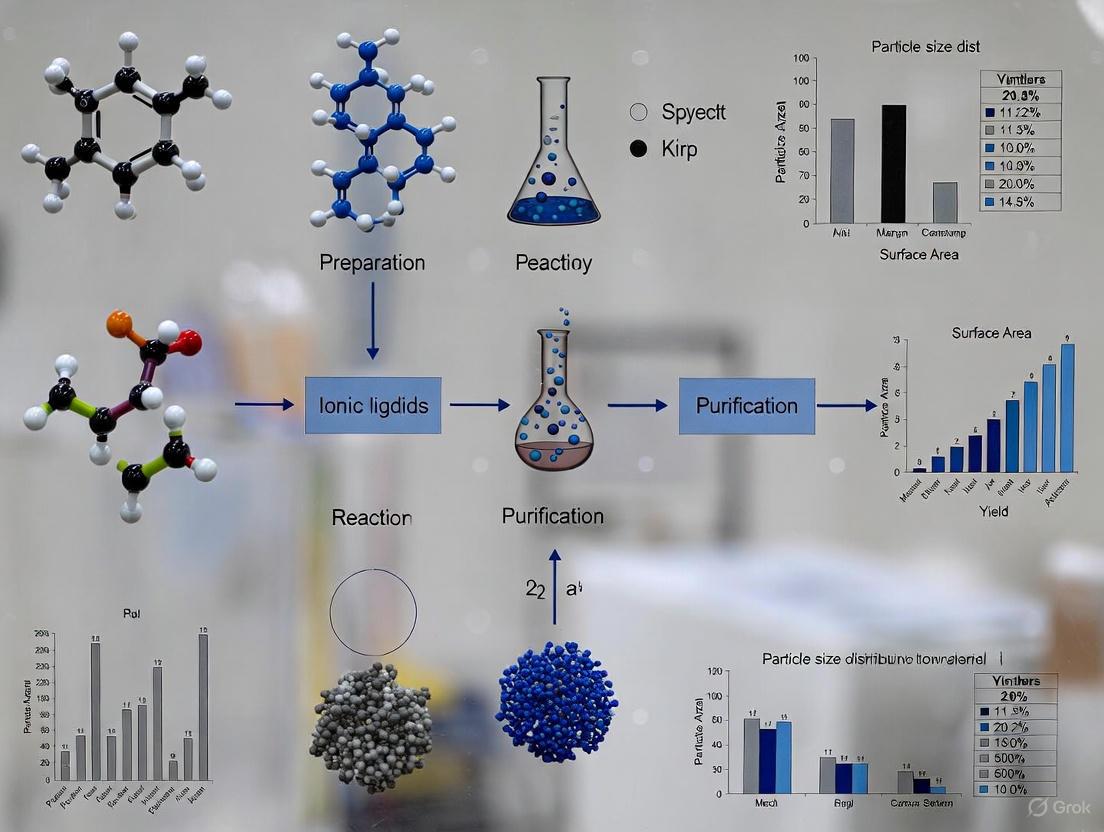
This article provides a comprehensive overview of the use of ionic liquids (ILs) as a transformative platform for the synthesis of nanomaterials, with a special focus on applications in drug...
Ionic Liquids in Nanomaterial Synthesis: Advanced Methods and Biomedical Applications for Drug Development
Abstract
This article provides a comprehensive overview of the use of ionic liquids (ILs) as a transformative platform for the synthesis of nanomaterials, with a special focus on applications in drug development and biomedical research. It explores the foundational principles of ILs, including their tunable physicochemical properties and role as green solvents. The content details advanced methodological approaches for creating metallic, metal oxide, and polymeric nanoparticles, highlighting their use in drug repurposing, intravenous drug delivery, and catalytic applications. The article further addresses key challenges in nanomaterial synthesis, offering troubleshooting and optimization strategies, and concludes with a comparative analysis of biological versus chemical synthesis methods to validate the performance and sustainability of IL-assisted nanomaterials.
Ionic Liquids as Nanomaterial Synthesis Media: Properties, Principles, and Green Chemistry Advantages
Ionic Liquids (ILs) are a class of purely ionic, salt-like materials that are liquid at unusually low temperatures. By official definition, they are ionic compounds that are liquids below 100 °C [1]. Many are liquid even at room temperature or below 0 °C, possessing a wide liquid range of 300–400 °C between their melting point and decomposition temperature [1]. In contrast to conventional salts like sodium chloride (NaCl, m.p. 801 °C), ionic liquids typically consist of bulky, asymmetric organic cations combined with organic or inorganic anions [1] [2]. This molecular asymmetry results in low lattice energies, inhibiting crystallization and leading to their low melting points [1].
The combinatorial variety of cations and anions allows for the theoretical design of up to 10^18 different ionic liquids, making them highly tunable or "designer" solvents [1] [3]. This tunability enables scientists to tailor their physical and chemical properties—such as hydrophobicity, viscosity, and solvation ability—for specific applications, a feature central to their use in advanced fields like nanomaterial synthesis [3] [4].
Fundamental Building Blocks: Cations and Anions
The properties of an ionic liquid are determined by the selection of its constituent cation and anion. The cation often has a strong impact on the IL's stability and physical properties, while the anion tends to dominate the chemical functionality and reactivity [1].
Common Cation Classes
The most prevalent cations are nitrogen-containing heterocycles, though other types are also widely used. The table below summarizes the key cation classes and their characteristics.
Table 1: Common Cation Classes in Ionic Liquid Synthesis
| Cation Class | Example Structure(s) | Key Characteristics |
|---|---|---|
| Imidazolium | 1-Ethyl-3-methylimidazolium ([EMIM]+),1-Butyl-3-methylimidazolium ([BMIM]+) | Most widely used class; good stability and conductivity; easily functionalized [2] [5]. |
| Pyridinium | 1-Butylpyridinium ([C₄py]+) | Early class used in electrodeposition; moderate viscosity [5]. |
| Ammonium | Tetraalkylammonium ([N₂₂₂₂]+),Cholinium ([Chol]+) | Often derived from inexpensive starting materials; used in biopolymer processing [2] [6]. |
| Phosphonium | Trihexyl(tetradecyl)phosphonium ([P₆,₆,₆,₁₄]+) | Often higher thermal stability than ammonium analogs [2] [7]. |
| Pyrrolidinium | 1-Butyl-1-methylpyrrolidinium ([BMPyrr]+) | Often larger electrochemical windows; useful in electrochemistry [2] [6]. |
Common Anion Classes
The anion plays a critical role in defining the IL's water stability, coordination strength, and hydrophilicity/hydrophobicity.
Table 2: Common Anion Classes in Ionic Liquid Synthesis
| Anion Class | Example Structure(s) | Key Characteristics |
|---|---|---|
| Halometallates | Tetrachloroaluminate ([AlCl₄]⁻),Tetrachloroferrate ([FeCl₃Br]⁻) | Early anions for ILs; often moisture sensitive; used in electrodeposition and catalysis [8] [5]. |
| Fluorinated Complex Ions | Hexafluorophosphate ([PF₆]⁻),Tetrafluoroborate ([BF₄]⁻),Bis(trifluoromethylsulfonyl)imide ([TFSI]⁻ or [NTf₂]⁻) | Air- and water-stable; hydrophobic; [NTf₂]⁻ confers low viscosity and high stability [2] [4]. |
| Carboxylates & Sulfonates | Acetate ([OAc]⁻),Octanoate ([OOc]⁻),Trifluoromethanesulfonate ([OTf]⁻) | Often hydrophilic; good solvents for biopolymers; [OAc]⁻ is excellent for cellulose dissolution [6]. |
| Amino Acids | L-Lysinate ([Lys]⁻) | Derived from biological sources; can impart biocompatibility [6]. |
Key Physicochemical Properties
The unique utility of ionic liquids in nanomaterial synthesis stems from a combination of extraordinary physicochemical properties.
Table 3: Key Physicochemical Properties of Ionic Liquids and Their Implications for Nanomaterial Synthesis
| Property | Description | Implication for Nanomaterial Synthesis |
|---|---|---|
| Negligible Vapor Pressure | Effectively non-volatile at room temperature, with vapor pressure as low as 10⁻¹⁰ Pa [2] [3]. | Enables high-temperature reactions without solvent loss; reduces solvent emissions for a safer, greener workspace [3]. |
| High Thermal Stability | Chemically stable over a wide temperature range, often up to 300-400 °C before decomposition [1] [3]. | Allows use as reaction media in high-temperature synthesis (e.g., hydrothermal methods); enhances process safety [4]. |
| Wide Electrochemical Window | Electrochemically stable over a large voltage range, typically >4 V [3]. | Ideal electrolyte for electrodeposition of metals and semiconductors that are otherwise difficult to plate [2] [3]. |
| Good Ionic Conductivity | Conduct electricity via ion mobility, though viscosity can be a limiting factor [3]. | Serves as both solvent and electrolyte in electrochemical synthesis of nanoparticles [8] [3]. |
| Tunable Solvation | Can dissolve a wide range of polar and non-polar compounds, from organic molecules to biopolymers and gases [2] [3]. | A single IL can solvate diverse precursors; miscibility can be tuned to create biphasic systems for product separation [1] [3]. |
| Structuring and Templating | Can form extended hydrogen-bonded networks and polar/non-polar domains [8] [9]. | Acts as a soft template or structure-directing agent to control nanoparticle size, morphology, and crystallinity [8] [4]. |
Quantitative data from recent studies illustrate how the choice of ions directly influences physical properties. For instance, the density of [EMIM][OAc] is reported at approximately 1.102 g·cm⁻³ at 25°C, while its viscosity can be significantly affected by minor water content [6]. Increasing the alkyl chain length on the cation or anion generally decreases density and surface tension but increases viscosity [6].
Experimental Protocols in Nanomaterial Synthesis
Protocol: Synthesis of Metal Nanoparticles in Ionic Liquids
This protocol outlines the use of imidazolium-based ILs as a stabilizing medium for the synthesis of noble metal nanoparticles (e.g., Au, Pt) [8] [4].
1. Materials
- Ionic Liquid: e.g., 1-Butyl-3-methylimidazolium bis(trifluoromethylsulfonyl)imide ([BMIM][NTf₂])
- Metal Precursor: e.g., Hydrogen tetrachloroaurate(III) trihydrate (HAuCl₄·3H₂O) for gold nanoparticles
- Reducing Agent: e.g., Sodium borohydride (NaBH₄)
- Solvents: Ethanol (absolute), deionized water
- Equipment: Schlenk line, ultrasonic bath, centrifuge, vacuum oven
2. Procedure 1. Drying: Dry the ionic liquid under high vacuum (<1 mbar) at 60-80 °C for at least 12 hours to reduce water and volatile impurities [6]. 2. Preparation: In an inert atmosphere glove box, dissolve 0.1 mmol of the metal precursor (HAuCl₄) in 10 g of the dried IL within a 50 mL Schlenk flask. 3. Reduction: Quickly add a freshly prepared, ice-cold aqueous solution of NaBH₄ (* 1.0 mmol* in 2 mL deionized water) to the stirred IL mixture. The reduction is typically instantaneous, indicated by a color change. 4. Stirring: Continue stirring the reaction mixture for 2 hours at room temperature to ensure complete reduction and formation of stable nanoparticles. 5. Sepation: Transfer the mixture to centrifuge tubes. Add 20 mL of ethanol and centrifuge at 12,000 rpm for 20 minutes to isolate the nanoparticles. 6. Washing: Carefully decant the supernatant. Re-disperse the nanoparticle pellet in fresh ethanol and repeat the centrifugation/washing cycle three times to remove residual IL and reaction by-products. 7. Drying: Transfer the final nanoparticle product to a vacuum oven and dry at 40 °C for 6 hours.
3. Notes
- The IL [BMIM][NTf₂] can be recovered from the combined supernatants by rotary evaporation of the volatile solvents and vacuum drying for reuse [4].
- The low surface tension and protecting electrostatic shell formed by the IL's ions help control particle growth and prevent agglomeration [8].
Protocol: Ionic Liquid-Assisted Microwave Synthesis of Semiconductor Nanoparticles
This method leverages the high microwave absorptivity of ILs to rapidly synthesize semiconductor nanocrystals like GaN [8] [4].
1. Materials
- Ionic Liquid: e.g., 1-Butyl-3-methylimidazolium hexafluorophosphate ([BMIM][PF₆])
- Semiconductor Precursor: e.g., Gallium(III) chloride (GaCl₃) and liquid ammonia (NH₃)
- Equipment: Microwave reactor with Teflon-lined vessels, centrifuge, vacuum desiccator
2. Procedure 1. Precursor Formation: In a first step, react 5 mmol of GaCl₃ with an excess of liquid ammonia at -35 °C to form a Ga(NH₂)₃ intermediate [8]. 2. Microwave Reaction: Transfer the intermediate to a microwave vessel containing 5 g of [BMIM][PF₆]. Seal the vessel and place it in the microwave reactor. 3. Heating: Heat the mixture under microwave irradiation to 300 °C and maintain this temperature for 1 hour. 4. Work-up: After cooling to room temperature, add 20 mL of acetone to the reaction mixture and centrifuge at 10,000 rpm for 15 minutes. 5. Purification: Discard the supernatant and re-disperse the pellet in fresh acetone. Repeat the centrifugation and washing steps twice. 6. Drying: Dry the purified GaN nanoparticles in a vacuum desiccator overnight.
3. Notes
- The ionic liquid acts as a reactive solvent and structure-directing agent, facilitating the formation of single-crystalline nanoparticles in the 3–8 nm diameter range [8].
- Combining ILs with microwave irradiation significantly reduces reaction times and often improves product yield and crystallinity [4].
Visualization of Workflows
Ionic Liquid Roles in Nanoparticle Synthesis
The following diagram illustrates the multiple roles an ionic liquid can play during the synthesis and stabilization of nanoparticles.
Experimental Workflow for NP Synthesis
This flowchart outlines a generalized experimental workflow for synthesizing nanoparticles using ionic liquids.
The Scientist's Toolkit: Key Research Reagents and Materials
The following table lists essential materials and their functions for researchers working with ionic liquids in nanomaterial synthesis.
Table 4: Essential Research Reagent Solutions for IL-Based Nanomaterial Synthesis
| Reagent/Material | Function/Application | Example(s) |
|---|---|---|
| Imidazolium Salts | Versatile, widely-used cations for forming stable ILs with a range of anions. | [BMIM][BF₄], [EMIM][OAc] [6] [4] |
| Fluorinated Anion Salts | Provide hydrophobic, air-stable, and low-viscosity ILs for high-temperature applications. | LiNTf₂, KPF₆ (for anion metathesis) [2] [6] |
| Metal Salts | Act as precursors for the formation of metal or semiconductor nanoparticles. | HAuCl₄, AgNO₃, GaCl₃ [8] [4] |
| Strong Reducing Agents | Initiate the reduction of metal ions to zero-valent atoms for nanoparticle nucleation. | NaBH₄, LiAlH₄, H₂ gas [8] [4] |
| Functionalized ILs | ILs with specific groups (e.g., thiol, amino) for enhanced nanoparticle stabilization. | Task-specific ILs [3] [7] |
| Protic Ionic Liquids | Used for electrodeposition of metals; can be easily synthesized by acid-base reaction. | Ethylammonium nitrate (EAN) [8] [5] |
Ionic liquids (ILs), a class of organic salts with melting points below 100 °C, have emerged as a cornerstone of green chemistry and advanced materials synthesis. Their unique physicochemical profile—characterized by negligible vapor pressure, high thermal stability, and tunable solvation properties—makes them superior alternatives to conventional volatile organic solvents (VOSs) [8] [10]. The structure of ILs, comprising large, asymmetric organic cations and smaller inorganic or organic anions, dictates their properties. This modularity allows them to be engineered as "designer solvents" for specific applications, from catalysis and synthesis to the burgeoning field of nanomaterial design [11] [10]. Within nanotechnology, ILs serve multiple roles: as functional solvents, templates, and stabilizing agents, enabling precise control over the size, morphology, and characteristics of nanomaterials [8] [12]. This application note details the quantitative properties of ILs and provides standardized protocols for their application in nanomaterial synthesis.
Quantitative Property Data
The utility of ILs in green chemistry and nanomaterial synthesis is grounded in their measurable and tunable physicochemical properties. The following tables summarize key data essential for experimental design.
Table 1: Thermal Properties of Representative Ionic Liquid Families
| IL Family | Example Anion | Decomposition Onset (°C) | Melting Point (°C) | Glass Transition (°C) | Reference |
|---|---|---|---|---|---|
| Sulfonate-based (Allyl Imidazolium) | Triflate (OTf) | > 350 | 51.2 | - | [13] |
| Sulfonate-based (Allyl Imidazolium) | Tosylate (OTs) | > 350 | 126.1 | -37.4 | [13] |
| Sulfonate-based (Allyl Imidazolium) | Methylsulfate (MeSO₄) | > 350 | - | -54.6 | [13] |
| Perarylphosphonium | Bistriflimide (NTf₂) | Up to 450* | Varies | Varies | [14] |
| Glycerol-derived Ammonium | Lactate | Up to 399 | - | - | [15] |
Note: Genuinely high thermal stability under isothermal conditions.
Table 2: Viscosity and Conductivity Ranges of Common ILs
| IL Family | Typical Viscosity Range (cP) | Key Influencing Factors | Application Implication | Reference |
|---|---|---|---|---|
| Imidazolium-based | 20 - >1000 | Temperature, Anion type, Alkyl chain length | High viscosity can limit mass transfer; can be mitigated by heating or anion selection. | [16] |
| Bio-based (e.g., Glycerol) | 0.3 - 189 Pa·s | Anion (e.g., Lactate vs. Triflate) | Tunable for specific processes like solubilization or catalysis. | [15] |
Experimental Protocols
Protocol 1: Synthesis of Gold Nanoparticles (AuNPs) Stabilized by an Ionic Liquid
This protocol describes the generation of stable, surface-clean Au nanoparticle films using ionic liquids as confining and stabilizing media [8].
- Primary Application: Creating decorated ionic carpet structures for sensing or catalytic applications.
- Principle: Sputter deposition of gold onto IL films forms confined nanoparticles, with IL anions forming a protective electrostatic shell that prevents agglomeration.
Workflow: Synthesis of Gold Nanoparticles (AuNPs) Stabilized by an Ionic Liquid
Required Materials:
- Ionic Liquids: 1-Butyl-3-methylimidazolium bis(trifluoromethylsulfonyl)imide ([BMIM][NTf₂]) or 1-Butyl-3-methylimidazolium tetrafluoroborate ([BMIM][BF₄]) [8].
- Substrate: P-type Silicon (Si) wafer.
- Target: High-purity (99.99%) Gold target for sputtering.
- Equipment: Sputter deposition system, high-vacuum pump.
Step-by-Step Procedure:
- Substrate Coating: A clean Si wafer is coated with a thin, uniform film of the chosen ionic liquid (e.g., [BMIM][NTf₂] or [BMIM][BF₄]).
- Sputter Deposition: The IL-coated substrate is placed in the sputter deposition chamber. The chamber is evacuated to high vacuum. Gold is then sputtered onto the IL film. The deposition time and power control the final size and density of the nanoparticles.
- In-situ Formation & Stabilization: The deposited gold atoms nucleate within the IL matrix to form nanoparticles. The IL forms a protective electrostatic shell around the NPs, confining them and preventing coalescence and agglomeration [8].
- Characterization: The resulting NPs can be characterized by Transmission Electron Microscopy (TEM) for size and distribution, and UV-Vis spectroscopy for plasmonic properties.
Protocol 2: Synthesis of GaN Nanoparticles Using an Ionic Liquid Medium
This two-step, IL-based method produces single-crystalline Gallium Nitride (GaN) nanoparticles, a valuable wide-bandgap semiconductor [8].
- Primary Application: Production of high-quality semiconductor nanocrystals.
- Principle: An ionic liquid acts as a reactive medium and morphology controller during the microwave-assisted nitridation of a gallium intermediate.
Workflow: Synthesis of GaN Nanoparticles Using an Ionic Liquid Medium
Required Materials:
- Gallium Source: e.g., Gallium trichloride (GaCl₃).
- Nitrogen Source: Liquid ammonia (NH₃).
- Ionic Liquid: Not specified in excerpt, but acts as the microwave-absorbing medium [8].
- Equipment: Microwave reactor, high-speed centrifuge, Schlenk line for air-sensitive techniques, liquid ammonia condenser.
Step-by-Step Procedure:
- Precursor Synthesis: In the first step, a gallium source is reacted in liquid ammonia at a temperature of -35 °C to form a gallium amide intermediate, Ga(NH₂)₃.
- Microwave-Assisted Nitridation: The intermediate (Ga(NH₂)₃) is mixed with the ionic liquid and heated in a microwave reactor. The typical reaction condition is 1 hour at 300 °C. The IL facilitates heat transfer and helps control particle growth.
- Work-up and Purification: After cooling, the reaction mixture is centrifuged. The synthesized GaN nanoparticles are separated from the ionic liquid and any unreacted starting materials by repeated cycles of centrifugation and washing with an appropriate solvent.
- Characterization: The final product consists of single-crystalline GaN nanoparticles with diameters of 3-8 nm, exhibiting a blue-shifted band gap compared to bulk GaN [8]. Characterization is typically done via X-ray Diffraction (XRD) and TEM.
The Scientist's Toolkit: Key Research Reagent Solutions
Table 3: Essential Ionic Liquids and Their Functions in Nanomaterial Synthesis
| Reagent Solution | Chemical Class | Primary Function in Nanosynthesis | Example Use-Case |
|---|---|---|---|
| Imidazolium ILs (e.g., [BMIM][X]) | Aprotic IL | Stabilizer & Template: Low surface tension increases nucleation rates; cation-anion shell provides electrostatic stabilization against aggregation [8]. | Synthesis of Au, Pt, and metal oxide nanoparticles. |
| Choline-Based ILs | Protic / Aprotic IL | Biocompatible Solvent: Low toxicity profile enhances suitability for bio-hybrid materials and drug delivery systems [17]. | Stabilization of biologics, enhancing permeability. |
| Ammonium-Based Bio-ILs (e.g., Glycerol-derived) | Bio-based IL | Green Solvent & Catalytic Medium: Derived from renewable resources; tunable properties for solubilization and as a recyclable reaction medium [15]. | Solubilizing hydroxycinnamic acids; Pd-nanoparticle catalyzed Heck coupling. |
| Siloxy-functionalized Imidazolium ILs | Functionalized IL | Property Tuner: Alkoxy/siloxy substituents enhance thermal stability and lower viscosity for specific processing needs [8]. | Tailoring electrolyte properties in energy storage. |
| Ionic Liquid Surfactants (e.g., [ProC₁₀][FeCl₃Br]) | Magnetic IL | Drug Nano-carrier: Combines surface activity with magnetic properties for targeted delivery and controlled release [8]. | Nano-delivery systems for hydrophobic drugs. |
Structure-Property Relationships in Ionic Liquids
The "designer solvent" nature of ILs stems from a deep understanding of how cation and anion structure influences bulk properties. This relationship is key to selecting or synthesizing the right IL for a nanomaterial application.
Diagram: Structure-Property Relationships of Ionic Liquids
This tunability allows for the rational design of ILs. For instance, extending the alkyl chain on an imidazolium cation generally increases viscosity and hydrophobicity [16], while the choice of anion is a primary factor dictating thermal stability and miscibility with other solvents [8] [13]. Furthermore, the classification of anions as kosmotropic (structure-makers) or chaotropic (structure-breakers) in aqueous solutions extends to their interactions with biomolecules and surfaces, influencing protein stability and nanomaterial dispersion [11].
In the synthesis of nanomaterials, Ionic Liquids (ILs) have transcended their traditional role as mere green solvents to emerge as versatile, multifunctional agents that precisely control material formation. Their unique combination of designable cation-anion pairs, negligible volatility, wide electrochemical windows, and strong solvation capabilities allows them to function as dynamic templates, surfactants, and even molecular precursors [18] [19]. This shift enables unprecedented control over the morphology, structure, and physicochemical properties of advanced nanomaterials [18]. The multifunctionality of ILs stems from their complex intermolecular interactions—including electrostatic forces, hydrogen bonding, and van der Waals forces—with reactants, solvents, and growing nuclei [18]. By leveraging these interactions, ILs facilitate the "tailoring" and "assembly" of nanomaterial structures, leading to enhanced performances in catalysis, sensing, drug delivery, and optoelectronics [18] [17]. This Application Note details the experimental protocols and mechanistic insights underpinning these advanced roles, providing a practical toolkit for researchers engaged in the synthesis of functional nanomaterials.
Application Notes & Experimental Protocols
ILs as Templates and Structure-Directing Agents
Application Note: ILs serve as dynamic templates for synthesizing porous materials and controlling nanomaterial morphology. Their ion structure and interaction strength direct the self-assembly process, creating well-defined pores and specific nanostructures like molecular sieves and metal-organic coordination polymers [18].
Mechanistic Insight: The structure-direction phenomenon arises from the balance of Coulombic forces, hydrogen bonding, and van der Waals interactions between IL ions and the inorganic or organic precursors. This balance organizes the material framework around the IL micelles or ions, which can be removed post-synthesis to reveal tailored porous architectures [18].
Diagram: Workflow for template-directed synthesis using ILs. The process involves self-assembly guided by IL-precursor interactions, followed by template removal.
Protocol 1: Ionothermal Synthesis of Molecular Sieves Using ILs as Template-Solvents
- Objective: To synthesize a molecular sieve using an IL as both solvent and structure-directing agent.
Materials:
- 1-Butyl-3-methylimidazolium bromide ([Bmim]Br)
- Tetraethyl orthosilicate (TEOS) as silica source
- Sodium aluminate as aluminum source
- Hydrofluoric Acid (HF, 48% aqueous solution) as mineralizing agent
- Autoclave with Teflon liner
- Programmable furnace
- Centrifuge
- Solvents: Ethanol, deionized water
Procedure:
- Precursor Gel Preparation: Inside a fume hood, combine 2.0 g of [Bmim]Br, 1.0 g of TEOS, and 0.1 g of sodium aluminate in a 50 mL beaker. Stir vigorously for 1 hour at room temperature until a homogeneous gel forms.
- Mineralizer Addition: Carefully add 0.2 g of HF to the gel. Caution: HF is highly toxic and corrosive; use appropriate PPE. Continue stirring for an additional 30 minutes.
- Ionothermal Synthesis: Transfer the final mixture to a Teflon-lined stainless-steel autoclave, filling it to 70% capacity. Seal the autoclave and place it in a preheated oven at 180°C for 72 hours.
- Product Recovery: After cooling to room temperature, open the autoclave and collect the solid product by centrifugation at 10,000 rpm for 10 minutes.
- Purification: Wash the precipitate three times with a 1:1 (v/v) mixture of ethanol and deionized water to remove residual IL and other reactants.
- Template Removal: Dry the product at 100°C for 6 hours, then calcine in a muffle furnace at 550°C for 6 hours (heating rate: 2°C/min) to remove the organic template and stabilize the pore structure.
- Characterization: Analyze the product using X-ray diffraction (XRD) for phase identification and nitrogen physisorption for surface area and pore size distribution.
Key Parameters for Success:
- The anion type and alkyl chain length of the IL are critical for directing the final pore structure [18].
- Strict control of crystallization temperature and time is essential for obtaining a pure, crystalline phase.
ILs as Surfactants and Surface Modifiers
Application Note: ILs function as surfactants and surface modifiers to stabilize nanoparticles, control their size and morphology, and prevent aggregation. Their amphiphilic nature allows them to form micelles and microemulsions, providing a confined reaction environment for nucleation and growth [18] [20].
Mechanistic Insight: ILs adsorb onto nanoparticle surfaces through electrostatic interactions and hydrogen bonding. The bulky, asymmetric organic cations create a steric and electrostatic barrier that prevents particle agglomeration. By adjusting the IL's hydrophilicity/lipophilicity balance, one can control the nanoparticle's dispersibility in different media [18] [20].
Protocol 2: Synthesis of Metal Oxide Nanoparticles Using ILs as Shape-Directing Surfactants
- Objective: To synthesize uniform metal oxide (e.g., ZnO) nanoparticles using an IL as a capping agent to control shape and size.
Materials:
- 1-Hexadecyl-3-methylimidazolium chloride ([C₁₆mim]Cl) as surfactant
- Zinc acetate dihydrate as metal precursor
- Sodium hydroxide as precipitating agent
- Ethanol
- Three-neck flask
- Reflux condenser
- Magnetic stirrer with heating
- Ultrasonic bath
Procedure:
- Micelle Formation: Dissolve 1.0 g of [C₁₆mim]Cl in 40 mL of ethanol in a three-neck flask. Heat the solution to 60°C with vigorous stirring (500 rpm) for 20 minutes to ensure complete dissolution and micelle formation.
- Precursor Addition: Add 0.5 g of zinc acetate dihydrate to the solution. Use an ultrasonic bath to sonicate the mixture for 15 minutes to achieve a uniform dispersion.
- Precipitation: Slowly add a solution of 0.2 g of sodium hydroxide in 10 mL of ethanol dropwise over 30 minutes using a dropping funnel. A milky suspension will form.
- Reaction and Aging: Fit the flask with a reflux condenser and reflux the mixture at 80°C for 3 hours under continuous stirring.
- Product Isolation: Cool the mixture to room temperature. Collect the white precipitate by centrifugation at 12,000 rpm for 15 minutes.
- Purification: Wash the nanoparticles sequentially with ethanol and deionized water (three times each) to remove the IL surfactant and other by-products.
- Drying: Dry the final product in a vacuum oven at 60°C overnight.
- Characterization: Use Transmission Electron Microscopy (TEM) to analyze particle size and morphology. Thermogravimetric Analysis (TGA) can confirm the presence and quantity of the surface-bound IL.
Key Parameters for Success:
- The critical micelle concentration (CMC) of the IL dictates the nucleation density; operating above the CMC is crucial for obtaining monodisperse particles [20].
- The alkyl chain length of the IL cation influences the size and shape of the nanoparticles. Longer chains typically lead to smaller particles due to stronger steric stabilization [18].
ILs as Functional Precursors
Application Note: ILs can act as reactants, incorporating their ions directly into the material's skeleton. This is prominent in the synthesis of metal-organic complexes and polyoxometalates (POMs), where the IL cation or anion becomes an integral part of the final structure, imparting unique electronic or catalytic properties [18].
Mechanistic Insight: In this role, the IL ion (usually the cation) coordinates with metal centers or interacts with POM clusters via electrostatic interaction and coordination bonding, forming the backbone of hybrid materials like IL-metal organic coordination polymers [18].
Protocol 3: Synthesis of an IL-Polyoxometalate (IL-POM) Hybrid Catalyst
- Objective: To synthesize a hybrid catalyst where an IL cation is incorporated as the counterion of a polyoxometalate anion.
Materials:
- 1-Butyl-3-methylimidazolium chloride ([Bmim]Cl)
- Phosphomolybdic acid hydrate
- Diethyl ether
- Round-bottom flask
- Magnetic stirrer
- Separatory funnel
Procedure:
- Dissolution: Dissolve 1.0 g of [Bmim]Cl in 20 mL of deionized water in a 100 mL round-bottom flask.
- Reaction: Add a solution of 2.5 g of phosphomolybdic acid in 20 mL of deionized water to the IL solution dropwise with constant stirring. Immediate formation of a colored precipitate (often yellow) is observed.
- Stirring: Continue stirring the reaction mixture at room temperature for 4 hours to ensure complete precipitation.
- Isolation: Filter the precipitate under vacuum using a Büchner funnel.
- Washing: Wash the solid thoroughly with copious amounts of deionized water (until the filtrate is neutral) and then with 20 mL of diethyl ether to remove residual moisture.
- Drying: Dry the resulting IL-POM hybrid solid in a vacuum desiccator overnight.
- Characterization: Confirm the structure using Fourier-Transform Infrared Spectroscopy (FTIR) to detect the characteristic peaks of both the POM anion and the IL cation. Powder XRD can verify the crystallinity of the hybrid material.
Key Parameters for Success:
- The stoichiometric ratio between the IL and the POM is critical for achieving a pure phase without residual starting materials.
- The structure of the IL cation can be tailored to control the solubility and hydrophobicity of the resulting hybrid catalyst for specific reaction media [18].
Table 1: Summary of IL Roles, Effects, and Corresponding Material Properties
| IL Role | Example IL Used | Key Interactions | Synthesized Material | Resulting Material Property Enhancement |
|---|---|---|---|---|
| Template/Structure Director | [Bmim]Br | Electrostatic, H-bonding | Molecular Sieves / Zeolites | High surface area (>500 m²/g), controlled pore size, improved adsorption selectivity [18] |
| Surfactant/Modifier | [C₁₆mim]Cl | Steric hindrance, Electrostatic | Metal Oxide Nanoparticles (e.g., ZnO) | Uniform morphology (e.g., spherical, rods), reduced particle size (<50 nm), high dispersion stability [18] [20] |
| Functional Precursor | [Bmim]Cl | Ionic, Coordination | IL-POM Hybrids | High catalytic activity in oxidation reactions, enhanced stability and recyclability [18] |
| Reaction Medium (Solvent) | Various (e.g., [Bmim][PF₆]) | Solvation, Polarity | Metal-Organic Complexes | Improved crystal quality, controlled morphology, high photocatalytic activity [18] |
Table 2: Key Parameters for Machine Learning-Based Viscosity Prediction of Imidazolium-based ILs [16]
| Input Parameter | Symbol | Impact on Viscosity (η) | Remarks |
|---|---|---|---|
| Temperature | T | Strong inverse relationship | Most significant influencing factor |
| Critical Temperature | Tc | Direct relationship | Correlates with cohesive energy density |
| Critical Pressure | Pc | Direct relationship | Indicator of intermolecular forces |
| Acentric Factor | ω | Complex relationship | Reflects molecular shape and polarity |
The Scientist's Toolkit: Essential Research Reagent Solutions
Table 3: Key Ionic Liquids and Their Functional Applications in Nanomaterial Synthesis
| Reagent Solution | Chemical Structure | Primary Function in Synthesis | Key Application Note |
|---|---|---|---|
| Imidazolium-based ILs (e.g., [Bmim]Br) | Organic cation with alkyl chains & inorganic anion | Template, Solvent | The anion type (e.g., Br⁻, PF₆⁻) and alkyl chain length are key for directing porous structures and tuning polarity [18]. |
| Long-chain ILs (e.g., [C₁₆mim]Cl) | Cation with long hydrophobic tail (& chloride anion | Surfactant, Surface Modifier | Forms micelles; alkyl chain length controls nanoparticle size and stabilization via steric effects [18] [20]. |
| Choline-based ILs (e.g., Choline Geranate) | Biocompatible cation & organic acid anion | Permeation Enhancer, Drug Carrier | Ideal for biomedical applications; enhances solubility and stability of biologics and improves skin permeability [17] [21]. |
| Task-Specific ILs (e.g., Metal-containing ILs) | Custom cation/anion with functional groups | Functional Precursor, Co-reactant | Designed to incorporate specific elements (e.g., metals) or functional groups (e.g., -SH, -NH₂) directly into the material matrix [18]. |
The strategic application of ILs as templates, surfactants, and precursors provides a powerful and versatile toolbox for the rational design and synthesis of functional nanomaterials. Moving beyond their role as solvents, ILs enable precise control over the critical parameters of material synthesis—morphology, particle size, porosity, and surface functionality—by exploiting their tunable physicochemical properties and diverse intermolecular interactions. The protocols and data summarized herein offer a foundational guide for researchers to leverage these multifunctional roles, accelerating the development of next-generation nanomaterials for catalysis, drug delivery, electronics, and beyond. Future developments will likely focus on the AI-guided design of task-specific ILs and their integration into scalable, sustainable manufacturing processes [19] [16].
Structural Organization of ILs and Their Role in Directing Nanostructure Formation
The capacity of Ionic Liquids (ILs) to direct the formation of nanostructures stems from their inherent tendency toward nanoscale self-organization. In the bulk state, many ILs do not form homogeneous liquids but rather exhibit a nanosegregation of their polar and non-polar regions, creating a distinct bi-continuous network [22]. This network consists of polar domains populated by the charged head groups of the cations and the anions, coexisting with non-polar domains formed by the alkyl chains of the cations [23] [22]. The characteristic scale of this intermediate ordering increases as a power function with the growing length of the cation tails [22]. This intrinsic nanostructure provides a pre-organized template that can guide the synthesis and assembly of nanomaterials, dictating final architecture properties such as particle size, morphology, and crystallographic phase [24]. By understanding and manipulating the structural organization of ILs, researchers can precisely control the outcome of nanomaterial synthesis for applications ranging from energy storage and conversion to drug development [23] [25].
Fundamental Principles of Nanostructure Formation in ILs
The driving force for self-assembly in ILs is the spontaneous solvophobic segregation of charged and uncharged groups into polar and apolar domains [23]. The degree of nanostructuring is not static but is influenced by several key factors:
- Ion Structure and Geometry: The volume ratio of uncharged to charged groups (Valkyl:Vpolar) within the ions is a primary determinant of segregation strength. ILs with longer cation alkyl chains or bulky, weakly coordinating anions exhibit more pronounced nanostructuring [23] [24]. The geometry of the cation is also critical; for instance, phosphonium-based cations can facilitate nanostructure formation even with relatively short alkyl chains [23].
- Thermodynamic Conditions: Temperature and pressure are powerful tools for modulating IL nanostructure. Thermal fluctuations at high temperatures tend to make ILs more homogeneous, while cooling enhances the segregation of domains [23]. Furthermore, applied pressure can dramatically reshape these self-assembled structures. For example, compression can force lamellar-type phases with small anions, creating channels for anisotropic anion diffusion, whereas bulky anions may lead to interconnected 3D phases that render ion transport independent of pressure [23].
The unique solvation environments created by these nanostructures, including the potential for hydrogen bonding, π-π interactions, and electrostatic forces, allow ILs to act as dynamic reaction media that precisely regulate nucleation kinetics and interfacial behaviors during nanomaterial growth [24] [19].
Experimental Protocols for Investigating and Utilizing IL Nanostructure
Protocol: Dielectric Spectroscopy for Probing Charge Transport in Nanostructured ILs
This protocol details the use of dielectric spectroscopy to study ion dynamics and charge transport mechanisms in self-assembled ILs, particularly under high-pressure conditions [23].
1. Principle: Dielectric spectroscopy measures the dielectric properties of a medium as a function of frequency. This allows for the decoupling of dc-conductivity (ion diffusion) from structural relaxation dynamics (viscosity-controlled motion), revealing the dominant charge transport mechanism through the nanostructures [23].
2. Materials:
- Dielectric Spectrometer: Novo-Control GMBH Alpha dielectric spectrometer or equivalent, with a frequency range of 10–1 to 107 Hz.
- High-Pressure Cell: Unipress setup or equivalent, capable of controlling pressure with a resolution of 1 MPa.
- Electrodes: Stainless steel electrodes (diameter = 15 mm).
- Temperature Control: Novocool system or Weiss fridge, with an accuracy of 0.1 K.
- Sample: Anhydric, high-purity ionic liquid (e.g., [P666,14][SCN]).
3. Procedure:
- A. Sample Loading: Place the IL sample between two stainless steel electrodes, using a quartz ring as a spacer to maintain distance.
- B. Quenching: Quench the sample to a low temperature (e.g., 201 K) to form a glassy state and ensure consistent thermal history.
- C. Compression: Transfer the capacitor to the high-pressure chamber and compress the sample to the desired pressure using silicone oil as the pressure-transmitting medium.
- D. Data Collection:
- Increase the temperature to the target isotherm.
- Collect dielectric data across the full frequency range (0.1 Hz to 10 MHz) during isothermal decompression.
- For studies in the supercooled liquid state (T < TLL), ensure the temperature is maintained below the liquid-liquid transition temperature.
- E. Data Analysis:
- Extract the dc-conductivity (σdc) from the low-frequency plateau of the conductivity spectra.
- Model the dielectric loss spectra to determine the characteristic times for structural (α-) relaxation.
4. Key Observations: In amphiphilic ILs like [P666,14][SCN], a transition in the charge transport mechanism is observed. At high temperatures (T > 210 K), conductivity is coupled to viscosity (vehicle mechanism). In the nanostructured supercooled state (T < 210 K), ion diffusion becomes decoupled and is much faster than structural dynamics [23].
Protocol: Electrochemical Synthesis of Metal Nanostructures in ILs
This protocol describes a general electrochemical approach for synthesizing metal nanoparticles (NPs) in ILs, which can serve as a stabilizing agent and template [26].
1. Principle: Electrochemical reduction of metal ions at an electrode surface leads to the formation of metal atoms that nucleate and grow into nanoparticles. The IL's nanostructure, high viscosity, and ion structure act as a dynamic template and stabilizer, controlling nucleation kinetics and preventing nanoparticle agglomeration [27] [26].
2. Materials:
- Electrochemical Setup: Potentiostat/Galvanostat.
- Electrodes: Working electrode (e.g., conductive substrate like glassy carbon), counter electrode (e.g., platinum wire), and reference electrode (e.g., Ag/Ag+).
- Electrolyte: High-purity IL (e.g., 1-butyl-3-methylimidazolium tetrafluoroborate, [BMIM][BF4]) serving as the electrolyte and solvent.
- Precursor: Metal salt (e.g., HAuCl4 for gold NPs) dissolved in the IL.
- Inert Atmosphere: Glove box or Schlenk line for operation under argon or nitrogen.
3. Procedure:
- A. Electrolyte Preparation: Dissolve the metal salt precursor in the dry IL inside an inert atmosphere glove box. A typical precursor concentration is 10-50 mM.
- B. Cell Assembly: Assemble the three-electrode electrochemical cell with the prepared electrolyte.
- C. Electrodeposition:
- Apply a constant potential (potentiostatic mode) or current (galvanostatic mode) to reduce the metal ions. A common approach is to use a potential slightly negative of the formal potential of the metal ion.
- The process time (typically seconds to minutes) directly controls the particle size and density.
- D. Recovery: After deposition, carefully remove the working electrode, and rinse it with a dry volatile solvent (e.g., acetone) to remove residual IL and recover the nanoparticles.
4. Key Parameters: The size, shape, and size distribution of the nanoparticles are influenced by the IL's cation/anion structure, the deposition potential/current, the process duration, and the temperature [27] [26]. The use of pulsed electrodeposition techniques can yield a narrower size distribution.
Table 1: Key Experimental Techniques for Characterizing IL Nanostructure and Resulting Nanomaterials
| Technique | Measured Parameters | Information Gained on Nanostructure | Key References |
|---|---|---|---|
| Dielectric Spectroscopy | DC conductivity, relaxation times | Charge transport mechanism, ion dynamics under pressure/temperature | [23] |
| Small-/Wide-Angle X-ray Scattering (SAXS/WAXS) | q-range: 0.13–0.8 Å (SAXS), 0.6–4.9 Å (WAXS) | Nanoscale periodicity of polar/apolar domains, local ordering | [23] |
| High-Pressure Rheology | Viscosity, shear modulus | Mechanical properties of self-assembled nanostructures under compression | [23] |
| Electrochemical Analysis | Nucleation & growth curves, cyclic voltammetry | Kinetics of nanomaterial formation, nanoparticle size distribution | [26] |
Data Presentation and Analysis
The following tables consolidate quantitative data and key reagent information relevant to the field.
Table 2: Selected Ionic Liquids and Their Role in Directing Nanostructure Formation
| Ionic Liquid | Cation Type | Anion Type | Key Role in Nanostructuring | Resulting Nanomaterial/Properties |
|---|---|---|---|---|
| [P666,14][SCN] | Tetra(alkyl)phosphonium | Small, linear (Thiocyanate) | Forms lamellar-type phases under pressure; enables decoupled ion transport in supercooled state. | Model system for studying charge transport in nanostructured ILs. |
| [P666,14][TCM] | Tetra(alkyl)phosphonium | Bulky (Tricyanomethanide) | Drives formation of interconnected 3D phases; ion transport becomes pressure-independent. | Model system for pressure-resistant conductive phases. |
| [BMIM][BF4] | Imidazolium | Tetrafluoroborate | Serves as electrolyte and structuring agent in anodization; controls nucleation. | WO₃ nanoplates with enhanced photoelectrocatalytic performance [28]. |
| Choline Chloride-Urea DES | Quaternary Ammonium | Chloride / Molecular | Low-cost eutectic mixture with H-bond network; acts as soft template for porous structures. | Porous semiconductors, metal oxides. [24] |
Table 3: The Scientist's Toolkit: Essential Research Reagent Solutions
| Reagent / Material | Function / Role in Experiment | Example Application |
|---|---|---|
| Trihexyl(tetradecyl)phosphonium-based ILs (e.g., [P666,14][DCA]) | Model amphiphilic ILs with a strong tendency to form well-defined polar/apolar nanostructures. | Fundamental studies on the relationship between ion structure, self-assembly, and charge transport [23]. |
| 1-Butyl-3-methylimidazolium ([BMIM]+) ILs (e.g., with [BF4]-, [PF6]-) | Versatile, low-viscosity ILs with good transport properties; can act as solvent, template, and stabilizer. | Electrochemical synthesis of metal NPs; sol-gel and hydrothermal synthesis of semiconductor NPs [27] [28]. |
| Metal Salt Precursors (e.g., HAuCl₄, AgNO₃) | Source of metal ions for the formation of metallic nanostructures via chemical or electrochemical reduction. | Preparation of gold and silver nanoparticles for catalytic or biomedical applications [27] [25]. |
| Block-Copolymer Surfactants (e.g., Pluronics) | Soft templates to generate ordered mesoporosity in combination with ILs or in conventional sol-gel processes. | Synthesis of mesoporous metal oxide films and particles with high surface area [27]. |
Workflow and Pathway Visualizations
The following diagram illustrates the decision pathway for selecting an appropriate IL and synthesis strategy based on the desired nanomaterial morphology.
Diagram 1: IL Selection and Nanostructure Formation Pathway. This workflow guides the selection of ionic liquids based on the intended mechanism of nanostructure formation and the resulting material morphology.
The experimental workflow for synthesizing and characterizing nanomaterials using ionic liquids involves several key stages, as shown below.
Diagram 2: General Workflow for Nanomaterial Synthesis in ILs. This diagram outlines the critical steps from ionic liquid preparation to final nanomaterial characterization, highlighting key sub-tasks at each stage.
Ionic liquids (ILs), a class of materials with melting points below 100°C, have garnered significant attention in nanotechnology and pharmaceutical research due to their exceptional properties, including negligible vapor pressure, high thermal stability, and tunable physicochemical characteristics [29]. However, their widespread application has been hampered by a critical challenge: many conventional ILs, particularly first-generation imidazolium-based varieties, demonstrate poor biodegradability and inherent toxicity to ecological systems and biological organisms [29] [30]. This toxicity profile poses substantial limitations for their use in pharmaceutical applications and nanomaterial synthesis for biomedical purposes.
In response to these challenges, the scientific community has developed advanced bio-based and biocompatible ionic liquids (Bio-ILs) derived from renewable biological sources. These third-generation ILs utilize naturally occurring, biocompatible ions such as choline, amino acids, fatty acids, and nucleotides to create environmentally benign alternatives with significantly reduced toxicity profiles [29] [31]. The strategic design of Bio-ILs represents a paradigm shift in ionic liquid technology, aligning with the principles of green chemistry while maintaining the versatile functionality that makes ILs valuable across numerous scientific disciplines, particularly in nanomaterial synthesis and drug delivery systems.
Design Principles and Components of Bio-ILs
Cation Selection for Enhanced Biocompatibility
The rational design of biocompatible ionic liquids begins with the careful selection of cationic components derived from natural, renewable sources. Choline, a water-soluble essential nutrient and precursor to phospholipids in biological membranes, serves as a foundational cation for numerous Bio-IL formulations [29] [32]. Recognized as "Generally Regarded as Safe" (GRAS) by the United States Food and Drug Administration, choline-based cations offer high biocompatibility and low toxicity [29]. Additionally, amino acid-based cations—created by modifying the carboxylic acid group of natural amino acids—provide a versatile platform for Bio-IL design, offering inherent biodegradability and molecular diversity [29] [31]. These cations can be tailored to specific applications by adjusting their hydrophobic/hydrophilic properties through side chain modifications, enabling precise control over the resulting IL's physicochemical behavior.
Anion Engineering for Reduced Environmental Impact
The anionic component of Bio-ILs plays an equally crucial role in determining their environmental impact and biological compatibility. Research has demonstrated that anions derived from natural carboxylic acids (e.g., lactate, acetate), fatty acids (e.g., oleate, laurate), and amino acids significantly reduce toxicity compared to conventional anions like hexafluorophosphate or bistriflimide [29] [33]. Recent innovations have explored more complex biological anions, including nucleotides such as cytidine 5'-monophosphate (CMP), which offer enhanced biocompatibility for pharmaceutical applications [31]. The selection of appropriate anion-cation combinations allows researchers to fine-tune properties such as solubility, viscosity, and thermal stability while maintaining low environmental impact and cytotoxicity.
Table 1: Key Components in Biocompatible Ionic Liquid Design
| Component Type | Example | Primary Pharmaceutical Benefit | Additional Advantages |
|---|---|---|---|
| Choline-based Cations | Choline | High biocompatibility, low toxicity | Enhanced solubility for APIs |
| Amino Acid-based Cations | Glycine, Proline | Biodegradability and adjustable properties | Improved absorption |
| Fatty Acid-based Anions | Oleate, Laurate | Enhanced membrane permeability | Better delivery of hydrophobic drugs |
| Carboxylate-based Anions | Acetate, Lactate | Reduced toxicity | Increased solubility for various APIs |
| Nucleotide-based Anions | Cytidine 5'-monophosphate (CMP) | High biocompatibility, low cytotoxicity | Biomimetic properties |
Quantitative Comparison of Bio-IL Properties
The tunable nature of Bio-ILs enables researchers to engineer specific physicochemical properties suited to particular applications, especially in nanomaterial synthesis and drug formulation. Systematic studies have revealed how structural modifications influence critical parameters such as density, viscosity, and thermal stability.
Recent research on glycerol-derived ILs demonstrates this tunability, with density values ranging from 1.03–1.40 g cm−3 and viscosity varying from 0.3–189 Pa s depending on alkyl chain length and anion selection [15]. Thermal stability profiles are equally adjustable, with some Bio-IL formulations remaining stable at temperatures up to 672 K [15]. This property flexibility enables researchers to select or design Bio-ILs with optimal characteristics for specific nanomaterial synthesis protocols, whether requiring low viscosity for improved diffusion or high thermal stability for elevated temperature reactions.
Table 2: Physicochemical Properties of Selected Bio-IL Classes
| Bio-IL Class | Density Range (g cm−3) | Viscosity Range (Pa s) | Thermal Stability | Key Applications |
|---|---|---|---|---|
| Choline-based ILs | 1.05-1.30 | 0.5-150 | Up to 523 K | Drug delivery, biomass processing |
| Amino Acid-based ILs | 1.10-1.35 | 1.0-100 | Up to 573 K | Pharmaceutical formulations, chiral synthesis |
| Glycerol-derived ILs | 1.03-1.40 | 0.3-189 | Up to 672 K | Nanomaterial synthesis, catalysis |
| Nucleotide-based ILs | ~1.20 | Moderate-High | Up to 493 K | Biomedical applications, biosensing |
Experimental Protocols for Bio-IL Synthesis and Application
Protocol 1: Synthesis of Choline-Amino Acid Based Bio-ILs
Principle: This method utilizes a neutralization reaction between choline hydroxide and naturally occurring amino acids to form biocompatible ILs with low toxicity profiles [29].
Materials:
- Choline hydroxide solution (aqueous, 45-50%) or choline bicarbonate
- Amino acids (e.g., glycine, L-proline, L-alanine, L-serine)
- Deionized water
- Rotary evaporator
- High vacuum line
Procedure:
- Dissolve the selected amino acid (50 mmol) in deionized water (20 mL) in a round-bottom flask.
- Slowly add choline hydroxide or choline bicarbonate solution (55 mmol, 10% excess) to the amino acid solution with continuous stirring.
- Maintain the reaction mixture at 40°C for 12-24 hours with constant stirring.
- Remove water using a rotary evaporator at 60°C under reduced pressure.
- Further dry the resulting ionic liquid under high vacuum (0.1-1 mbar) for 24 hours to remove residual water.
- Characterize the final product using 1H NMR, water content analysis, and thermal analysis (TGA/DSC).
Notes: This synthesis route is characterized by its simplicity and avoidance of organic solvents, aligning with green chemistry principles. The resulting choline-amino acid ILs have demonstrated excellent biocompatibility profiles, with cytotoxicity studies showing significantly reduced toxicity compared to conventional imidazolium-based ILs [29].
Protocol 2: Application of Bio-ILs in Nanomaterial Synthesis
Principle: Bio-ILs serve as green solvents and structure-directing agents in the synthesis of luminescent nanophosphors, leveraging their unique properties to control crystal phase, morphology, and ultimately, photophysical properties [34].
Materials:
- Choline-based Bio-IL (e.g., choline oleate)
- Rare-earth precursors (e.g., LnCl₃, where Ln = Eu, Tb, Er, Yb)
- Sodium fluoride or ammonium fluoride
- Ethanol (absolute)
- Autoclave or microwave reactor
Procedure:
- Prepare a 1M solution of the selected Bio-IL in absolute ethanol.
- Add the rare-earth precursor (0.1-0.5 mmol) to the Bio-IL solution (10 mL) with vigorous stirring.
- Add fluoride source (3-5 molar equivalents relative to rare-earth ions) to the solution.
- Transfer the mixture to a Teflon-lined autoclave (for hydrothermal synthesis) or microwave reactor vessel.
- For hydrothermal synthesis: Heat at 180-200°C for 12-24 hours. For microwave synthesis: Heat at 160°C for 30-60 minutes.
- Allow the system to cool naturally to room temperature.
- Recover the nanoparticles by centrifugation at 10,000 rpm for 10 minutes.
- Wash the nanoparticles three times with ethanol and dry under vacuum.
Notes: The choice of Bio-IL significantly influences the morphological and photophysical properties of the resulting nanophosphors. The IL acts as a structure-directing agent, controlling particle size and morphology, while also providing a reaction medium that enhances crystal growth and phase control [34]. This method has been successfully applied to synthesize various nanomaterials, including NaYF₄, NaGdF₄, and Ln₂O₃ nanoparticles doped with luminescent lanthanide ions.
Protocol 3: Formulating Bio-IL-Based Drug Delivery Systems
Principle: Bio-ILs can enhance the solubility, stability, and bioavailability of poorly soluble active pharmaceutical ingredients (APIs), offering a strategic alternative to traditional formulation approaches [29] [33].
Materials:
- Biocompatible IL (e.g., choline geranate, choline oleate)
- Poorly soluble drug (e.g., paclitaxel, doxorubicin, azole antifungals)
- Phosphate buffered saline (PBS, pH 7.4)
- Dialysis membrane (if needed)
Procedure:
- Add the selected Bio-IL (100-500 mg) to a glass vial.
- Heat the Bio-IL to 40-60°C to reduce viscosity if necessary.
- Add the poorly soluble drug (10-50 mg) to the Bio-IL with continuous stirring.
- Maintain the mixture at 40-60°C with stirring until a homogeneous solution forms (typically 30-120 minutes).
- For aqueous formulations, slowly add PBS buffer (pH 7.4) to the drug-Bio-IL solution with vigorous mixing.
- Characterize the formulation for drug content, stability, and in vitro release profile.
Notes: Bio-IL-based formulations have demonstrated remarkable success in enhancing drug delivery. For instance, paclitaxel formulated in Bio-ILs showed comparable antitumor activity to commercial Taxol but with significantly reduced hypersensitivity reactions [33]. Similarly, choline geranate-based ILs have enhanced the transdermal delivery of both small molecules and macromolecules, with studies reporting up to 200% increase in monoclonal antibody absorption [33].
The Scientist's Toolkit: Essential Research Reagents
Table 3: Essential Reagents for Bio-IL Research
| Reagent/Material | Function/Role | Application Notes |
|---|---|---|
| Choline Bicarbonate | Starting material for choline-based cations | Commercial availability; enables simple metathesis reactions |
| Natural Amino Acids | Cation or anion precursors | Provide chiral centers; enhance biodegradability |
| Fatty Acids (e.g., oleic, lauric) | Anion components | Improve membrane permeability; enhance hydrophobic drug solubility |
| Citric Acid | Reducing agent for nanoparticle synthesis | Used in Au-NP synthesis in IL media [35] |
| Lanthanide Salts (e.g., LnCl₃) | Precursors for nanophosphors | Enable synthesis of luminescent nanomaterials in ILs [34] |
| [BMIm]Cl | Conventional IL for comparison studies | Provides baseline for toxicity and performance comparisons |
| Tetrabutylammonium Chloride | Ammonium-based IL | Exhibits restricted nanoparticle mobility in synthesis [35] |
Applications in Nanomaterial Synthesis and Drug Formulation
Nanomaterial Synthesis Using Bio-ILs
Bio-ILs have emerged as powerful tools in nanomaterial synthesis, serving multiple functions as solvents, templates, and stabilizing agents. Their unique properties facilitate the production of nanomaterials with controlled characteristics while reducing environmental impact. In the synthesis of lanthanide-doped luminescent nanophosphors, Bio-ILs have demonstrated exceptional capability in controlling crystal phase, morphology, and ultimately, the photophysical properties of the resulting nanomaterials [34]. The ILs function as "designer solvents" whose properties can be tuned to direct nanoparticle growth, influencing parameters such as size distribution, crystallinity, and surface chemistry.
Similarly, in the synthesis of gold nanoparticles (Au-NPs), Bio-ILs provide a superior reaction environment compared to conventional solvents. Recent studies utilizing in situ liquid-phase STEM microscopy have revealed that ILs such as [BMIm]Cl support dynamic rearrangement, surface diffusion, and coalescence processes during nanoparticle formation [35]. The IL matrix not only stabilizes the growing nanoparticles but also influences their growth kinetics and final morphology, enabling the production of nanomaterials with tailored properties for specific applications in catalysis, sensing, and biomedicine.
Pharmaceutical Applications and Drug Delivery
The implementation of Bio-ILs in pharmaceutical formulations has opened new avenues for addressing longstanding challenges in drug delivery, particularly for poorly water-soluble compounds. Bio-ILs have demonstrated remarkable success in enhancing oral bioavailability of challenging APIs, with certain formulations showing significant improvements in absorption profiles [33]. For sensitive biological molecules such as peptides and proteins, Bio-ILs create a protective environment that mitigates degradation in the gastrointestinal tract, potentially enabling oral delivery of molecules that previously required invasive administration.
In transdermal drug delivery, Bio-ILs have shown exceptional capability in reversibly altering the skin's barrier function without causing permanent damage. This approach has facilitated the delivery of both small molecules and macromolecules, including monoclonal antibodies, with studies reporting absorption increases up to 200% [33]. The mechanism involves temporary disruption of the stratum corneum's highly organized lipid structure, creating pathways for drug permeation while maintaining the tissue's overall integrity and barrier recovery potential.
The development of bio-based and biocompatible ionic liquids represents a significant advancement in material science, effectively addressing the critical toxicity concerns associated with conventional ILs while maintaining their versatile functionality. Through strategic molecular design utilizing naturally derived components such as choline, amino acids, fatty acids, and nucleotides, researchers have created ILs with markedly improved environmental and toxicological profiles. These Bio-ILs have demonstrated considerable promise across diverse applications, from the synthesis of tailored nanomaterials to the enhanced delivery of challenging pharmaceutical compounds.
Future research directions will likely focus on expanding the repertoire of bio-derived ions, refining synthetic methodologies for greater sustainability, and deepening our understanding of the structure-activity relationships that govern Bio-IL behavior in biological systems. As regulatory frameworks evolve to accommodate these novel materials, and as scalability challenges are addressed, Bio-ILs are poised to become indispensable tools in the development of next-generation nanomaterials and pharmaceutical formulations that align with the principles of green chemistry and sustainable technology.
Synthesis Protocols and Breakthrough Biomedical Applications of IL-Derived Nanomaterials
Electrochemical Synthesis of Unique Metallic and Oxide Nanostructures in ILs
The synthesis of functional nanomaterials is a cornerstone of advancements in diverse fields, including catalysis, energy storage, and pharmaceuticals. Electrochemical methods provide unparalleled control over nucleation and growth processes, enabling the production of nanostructures with defined sizes, shapes, and compositions. The utilization of ionic liquids (ILs) as advanced electrolytes has emerged as a transformative approach, granting access to unique metallic and oxide nanostructures that are often unattainable in conventional aqueous or organic media [26]. This application note details the protocols and principles for leveraging the unique properties of ILs—such as their broad electrochemical windows, high ionic conductivity, and inherent stabilizing ability—for the electrochemical synthesis of novel nanomaterials, framed within a broader thesis on sustainable nanomaterial synthesis.
Fundamental Principles and Advantages of ILs as Electrolytes
Ionic liquids offer a distinct environment for electrochemical synthesis due to their unique physicochemical properties, which directly influence the characteristics of the resulting nanomaterials.
- Expanded Electrochemical Window (5–9 V): Unlike water, which electrolyzes around 1.23 V, ILs permit the deposition of highly reactive elements and allow for the application of high overpotentials. This facilitates the controlled nucleation required for nanoscale materials and enables the synthesis of nanostructures from precursors with very negative reduction potentials [26].
- Inherent Nanostabilization: ILs form a protective, dynamic layer on nascent nanoparticle surfaces through electrostatic interactions (anion adsorption and a subsequent cation outer layer) and hydrogen bonding. This supramolecular network stabilizes nanoparticles against agglomeration without the need for additional capping ligands or surfactants, allowing high mobility and accessibility for catalytic applications [36].
- Tunable Solvation Environment: The solvating power, viscosity, and interfacial structure of an IL can be finely adjusted by selecting different cation-anion combinations. This "designer solvent" property allows for task-specific optimization of the synthesis medium to control nanoparticle morphology, size distribution, and crystal structure [26] [36].
- Negligible Volatility and High Thermal Stability: These properties enable electrochemical synthesis to be performed over a wide temperature range under ambient pressure, reducing safety hazards and allowing for high-temperature processes that can improve crystallinity and modify nanoparticle shape [19].
The following diagram illustrates the general experimental workflow and the crucial stabilizing role of the ionic liquid during electrochemical synthesis.
Diagram Title: Workflow and IL Stabilization in Electrochemical Nanosynthesis.
Experimental Protocols
This section provides detailed methodologies for the electrochemical synthesis of various metallic and oxide nanostructures.
Protocol 1: Synthesis of Palladium Nanoparticles in [BMIM][Tf₂N]
Objective: To synthesize catalytic palladium nanoparticles (Pd NPs) of 3-5 nm diameter.
Principle: The electrochemical reduction of a palladium salt in the IL 1-butyl-3-methylimidazolium bis(trifluoromethylsulfonyl)imide ([BMIM][Tf₂N]) leverages the IL's wide electrochemical window to achieve complete reduction and its ionic structure to stabilize the resulting nanoparticles [36].
Materials:
- Ionic Liquid: [BMIM][Tf₂N] (≥99.0%, dried under vacuum at 100 °C for 24 h before use)
- Precursor: Palladium(II) acetate (Pd(OAc)₂, 99.9%)
- Electrodes: Working: Glassy Carbon (GC, 3 mm diameter); Counter: Platinum wire; Quasi-reference: Silver wire.
- Equipment: Potentiostat/Galvanostat, Argon glovebox (H₂O and O₂ < 1 ppm), Ultrasonic bath.
Procedure:
- Cell Preparation: In an argon glovebox, prepare a 10 mM solution of Pd(OAc)₂ in 10 mL of anhydrous [BMIM][Tf₂N]. Stir the mixture at 50 °C for 1 hour until a homogeneous solution is obtained.
- Electrode Setup: Polish the GC working electrode with 0.05 μm alumina slurry, rinse with dry ethanol, and place it in the electrochemical cell along with the Pt counter and Ag quasi-reference electrodes.
- Electrolysis: Perform electrochemical reduction under an inert atmosphere using a chronoamperometry technique. Apply a constant potential of -2.0 V vs. Ag/Ag⁺ for 600 seconds while stirring the solution.
- Product Recovery: After electrolysis, the solution will darken, indicating NP formation. Dilute the resulting colloidal suspension with dry acetonitrile and centrifuge at 12,000 rpm for 15 minutes. Wash the precipitated Pd NPs with acetonitrile twice to remove residual IL and precursors. Redisperse the NPs in a suitable solvent for characterization or use.
Protocol 2: Electrodeposition of Zinc Oxide Nanostructures in [EMIM][EtOSO₃]
Objective: To electrodeposit porous zinc oxide (ZnO) nanofilms on a conductive substrate.
Principle: This method utilizes the oxygen content of a hydrophilic IL like 1-ethyl-3-methylimidazolium ethylsulfate ([EMIM][EtOSO₃]) as a source for oxide formation. Zinc is electrochemically oxidized and subsequently reacts with the IL to form ZnO, with the IL's viscosity and interfacial properties governing the film's nanostructure [26].
Materials:
- Ionic Liquid: [EMIM][EtOSO₃] (≥98.0%, dried under vacuum)
- Precursor: Zinc triflate (Zn(OTf)₂, 99.9%)
- Electrodes: Working: Fluorine-doped Tin Oxide (FTO) glass; Counter: Platinum mesh; Reference: Pt wire pseudo-reference.
- Equipment: Potentiostat, Oven for heating.
Procedure:
- Solution Preparation: Dissolve 50 mM of Zn(OTf)₂ in 15 mL of [EMIM][EtOSO₃] by stirring at 60 °C for 2 hours.
- Electrodeposition: Assemble a three-electrode cell with the FTO substrate. Using a potentiostat, apply a constant current density of 0.1 mA/cm² for 60 minutes at a temperature of 80 °C.
- Post-treatment: After deposition, carefully remove the FTO substrate. Rinse it thoroughly with copious amounts of deionized water to remove IL residues and then dry under a stream of nitrogen. Anneal the film at 350 °C for 1 hour in air to improve the crystallinity of the ZnO.
Data Presentation and Analysis
The following tables summarize key experimental parameters and outcomes for the synthesis of various metallic and oxide nanostructures, as reported in the literature.
Table 1: Electrochemical Synthesis of Metallic Nanoparticles in Ionic Liquids.
| Metal Nanomaterial | Ionic Liquid Used | Electrochemical Method | Key Conditions | Product Characteristics (Size/Morphology) | Application & Performance |
|---|---|---|---|---|---|
| Palladium (Pd) NPs [36] | [BMIM][PF₆] | Potentiostatic | -2.0 V vs. Ag, 60°C | 3-5 nm, spherical | Suzuki coupling; >95% yield |
| Gold (Au) NPs [36] | [BPy][Tf₂N] | Cyclic Voltammetry | Scan to -1.5 V vs. Pt Ref | 10-15 nm, hexagonal plates | Catalytic reduction of 4-nitrophenol |
| Silver (Ag) NPs [36] | [EMIM][Tf₂N] | Galvanostatic | 0.1 mA/cm² | 5-8 nm, spherical | Antibacterial activity |
| Copper (Cu) NPs [36] | Choline Chloride-Urea (DES) | Potentiostatic | -0.9 V vs. Ag QRE | 20-30 nm, dendritic | Electrocatalytic CO₂ reduction |
Table 2: Electrochemical Synthesis of Oxide Nanostructures and Other Materials in Ionic Liquids.
| Material / Structure | Ionic Liquid Used | Electrochemical Method | Key Conditions | Product Characteristics | Application |
|---|---|---|---|---|---|
| Zinc Oxide (ZnO) Films [26] | [EMIM][EtOSO₃] | Galvanostatic | 0.1 mA/cm², 80°C | Porous nanofilm | Photocatalysis |
| Silicon (Si) Nanoparticles [26] | [PP₁₃][Tf₂N] | Cathodic Breakdown | -4.0 V vs. Ref, 2h | 5-10 nm, crystalline | Lithium-ion battery anodes |
| Conductive Polymer Films (e.g., Polypyrrole) [26] | [EMIM][Tf₂N] | Potentiodynamic | 50 mV/s, 25°C | 100-200 nm thick nanofilms | Sensors, Supercapacitors |
The Scientist's Toolkit: Essential Research Reagents and Materials
Table 3: Key Reagents and Materials for Electrochemical Synthesis in ILs.
| Item | Function / Role in Synthesis | Example(s) |
|---|---|---|
| Ionic Liquids | Serves as the electrolyte, solvent, and stabilizer. Its structure dictates the electrochemical window, viscosity, and interfacial properties. | [BMIM][Tf₂N], [EMIM][BF₄], [BPy][Tf₂N] |
| Metal Salts (Precursors) | Source of the metal ions to be electrochemically reduced (for metals) or oxidized (for oxides/metals). | Pd(OAc)₂, H₂PtCl₆, AgTf, Zn(OTf)₂ |
| Working Electrodes | The surface where nucleation and growth of nanomaterials occur. Material choice influences nucleation kinetics. | Glassy Carbon, FTO Glass, Metal Foils (Au, Pt) |
| Counter Electrodes | Completes the electrical circuit, allowing current to flow. Must be inert in the IL. | Platinum Wire/Mesh, Graphite Rod |
| Reference Electrodes | Provides a stable, known potential to control the working electrode potential accurately. | Ag/Ag⁺ (IL-based), Pt Psuedo-reference |
| Anhydrous Solvents | Used for cleaning electrodes and diluting/colloidal suspension for post-synthesis handling. | Dry Acetonitrile, Anhydrous Ethanol |
Troubleshooting and Best Practices
- Moisture Sensitivity: Many ILs and metal precursors are hygroscopic. Strictly perform synthesis and storage in an inert atmosphere (glovebox) or under Schlenk lines to prevent hydrolysis, which can lead to oxide impurities and broadened size distributions.
- IL Purity and Viscosity: Use high-purity ILs to avoid side reactions. For viscous ILs, slight heating or the application of ultrasonic waves can facilitate the dissolution of precursors and improve mass transport during electrolysis.
- Potential Control vs. Agglomeration: If agglomeration occurs despite using an IL, it may indicate that the applied potential is too negative, leading to excessively rapid nucleation. Optimize by using pulsed electrodeposition techniques or by selecting an IL with stronger coordinating anions.
Ionothermal and Solvothermal Methods for Controlled Morphology and Crystallinity
The precise control over nanomaterial morphology and crystallinity is a cornerstone of advanced materials science, directly influencing properties critical for applications in drug delivery, catalysis, and energy storage. Solvothermal synthesis is a versatile method where chemical reactions occur in a closed system (autoclave) using a solvent at temperatures above its boiling point, allowing precise control over the crystallization process of materials like metal oxides [37]. This method enables the production of important metal oxides such as vanadium oxides (VxOy), iron oxides (FexOy), CeO₂, CuO, ZnO₂, TiO₂, and NiO nanoparticles with tailored morphologies and sizes by adjusting key parameters like solvent selection, reaction temperature, and pressure [37]. Ionothermal synthesis represents a significant evolution of this technique, where ionic liquids or low-melting metal salt hydrates replace conventional molecular solvents, serving as both the reaction medium and sometimes as the structure-directing agent or precursor [38]. This approach is particularly valuable for synthesizing structured porous materials like metal-organic frameworks (MOFs) and covalent triazine frameworks (CTFs) while minimizing the use of volatile organic solvents, addressing key challenges in green chemistry and scalable nanomaterial production [38] [39].
The fundamental distinction between these methods lies in their reaction media: solvothermal employs molecular solvents (e.g., water, ethanol, DMF), while ionothermal utilizes ionic compounds (e.g., ionic liquids, molten salt hydrates). This difference profoundly impacts the synthesis outcomes, including crystallization pathways, morphological control, and the final material properties. For researchers in drug development, these techniques offer pathways to create nanocarriers with optimized drug loading capacity, release profiles, and targeting capabilities through precise nanoscale engineering.
Key Principles and Control Parameters
Solvothermal Synthesis Fundamentals
Solvothermal synthesis provides exceptional control over nanoparticle characteristics through careful manipulation of reaction conditions. The formation of crystalline materials occurs through nucleation and growth stages, both heavily influenced by solvothermal parameters. Key advantages include the ability to produce uniform nanostructures with specific crystallographic phases, though challenges remain in scalability and solvent handling [37].
Table 1: Key Control Parameters in Solvothermal Synthesis
| Parameter | Impact on Morphology & Crystallinity | Typical Range |
|---|---|---|
| Solvent Selection | Polarity, viscosity, and coordination ability determine crystal phase, growth direction, and particle size [37]. | Water, alcohols, DMF, DMSO |
| Reaction Temperature | Higher temperatures promote crystallinity and larger crystal sizes; influences reaction kinetics [37]. | 100-250°C |
| Reaction Pressure | Autogenous pressure affects solubility and supersaturation, influencing nucleation rates [37]. | Autogenous (scale with temperature) |
| Precursor Concentration | Higher concentrations increase nucleation density, affecting particle size distribution [40]. | Varies by system (e.g., 0.001-0.1 M) |
| Reaction Duration | Longer times promote Ostwald ripening and improved crystallinity; excessive times cause overgrowth [40]. | Hours to days |
| pH Modifiers | Influence hydrolysis rates of metal precursors, affecting nucleation kinetics [40]. | Acidic to basic conditions |
The solvent properties directly impact the final material characteristics through solvation, viscosity, and coordination effects. For instance, the use of coordinating solvents like dimethylformamide (DMF) can lead to the formation of specific crystal facets by selectively binding to growing crystal surfaces. Temperature governs the reaction kinetics and thermodynamic stability of different crystalline phases, while pressure enables the use of solvents at temperatures far beyond their normal boiling points, facilitating reactions that would otherwise be impossible [37] [40].
Ionothermal Synthesis Fundamentals
Ionothermal synthesis exploits the unique properties of ionic liquids and molten salts, including their negligible vapor pressure, high thermal stability, and tunable physicochemical properties, to create controlled nanomaterial architectures. The ionic medium often acts as both solvent and template, directing the formation of specific porous structures in materials like MOFs and CTFs [38] [39]. A significant advantage is the reduced need for volatile organic solvents, making the process more environmentally friendly and potentially scalable [38].
Table 2: Key Control Parameters in Ionothermal Synthesis
| Parameter | Impact on Morphology & Crystallinity | Typical Examples |
|---|---|---|
| Ionic Liquid Cation | Size, shape, and hydrogen-bonding capability influence pore structure and crystallinity [38] [41]. | Imidazolium, pyridinium, ammonium |
| Ionic Liquid Anion | Nucleophilicity, coordination ability, and hydrogen-bond basicity affect metal-ligand coordination [38] [41]. | Chloride, acetate, tetrafluoroborate |
| Melting Point of Salt Hydrate | Determines minimum operating temperature; lower melting enables milder conditions [38]. | CoCl₂·6H₂O (mp: 86°C) |
| Metal Salt Hydrate Composition | Water of crystallization can participate in structure formation; metal identity defines node properties [38]. | MCl₂·xH₂O (M = Co, Ni, Fe, Zn) |
| Temperature Gradient | Multi-step profiles control nucleation vs. growth stages for improved crystallinity [39]. | 400°C/25h → 450°C/13h → 500°C/1h → 600°C/1h |
| Template Role | Ionic species can be incorporated into framework pores, directing topology [38]. | Structure-directing agents |
The designer solvent nature of ionic liquids allows for unprecedented control over the synthesis environment. By selecting appropriate cation-anion combinations, researchers can create tailored environments that promote the formation of specific crystalline phases or morphologies. For drug delivery applications, this translates to the ability to design nanocarriers with precise pore sizes for drug encapsulation and surface properties that enhance biocompatibility [25] [41].
Experimental Protocols
Ionothermal Synthesis of MOFs with Coordinatively Unsaturated Metal Centers
This protocol describes the ionothermal synthesis of Co₂Cl₂(btdd) (MAF-X27l-Cl), a metal-azolate framework with coordinatively unsaturated metal centers suitable for drug binding and delivery applications [38].
Reagents:
- CoCl₂·6H₂O (≥98% purity)
- H₂btdd (bis(1,2,3-triazolo[4,5-b],[4′,5′-i])dibenzo[1,4]dioxin)
- Dimethyl sulfoxide (DMSO), anhydrous
- Methanol, anhydrous
- Nitrogen gas (for inert atmosphere)
Procedure:
- Preparative Steps: Dry CoCl₂·6H₂O at 80°C under vacuum for 2 hours to remove surface moisture. Place all reagents in a nitrogen-filled glove box to prevent hydration.
- Reaction Mixture Preparation: In the glove box, combine stoichiometric amounts of CoCl₂·6H₂O (164.5 mg, 0.692 mmol) and H₂btdd (100 mg, 0.346 mmol) in a 23 mL Teflon-lined autoclave. Gently mix the solids without additional solvent.
- Ionothermal Reaction: Securely close the autoclave and transfer it from the glove box to a preheated oven at 160°C. Heat the reaction mixture for 48 hours under autogenous pressure.
- Product Recovery: After cooling to room temperature, open the autoclave inside the glove box. Collect the resulting purple crystalline product.
- Purification (Soxhlet Extraction): Transfer the crude product to a Soxhlet extraction thimble. Extract first with anhydrous DMSO (50 mL) for 12 hours to remove unreacted linker and soluble impurities, then with anhydrous methanol (50 mL) for 24 hours to exchange the DMSO and remove residual ionic liquid.
- Activation: Dry the purified product under dynamic vacuum (10⁻⁵ bar) at 120°C for 12 hours to remove all solvent molecules from the pores. Store the activated MOF in a nitrogen-filled glove box.
Characterization: The resulting material should be characterized by PXRD to confirm crystallinity and phase purity, SEM to analyze crystal morphology (typically hexagonal rods of ~5 μm), and N₂ physisorption at 77 K to determine BET surface area (expected ~2300 m²/g) [38].
Ionothermal Synthesis of Phosphazene-Core Covalent Triazine Frameworks
This protocol describes the ionothermal synthesis of porous organic frameworks with phosphazene cores for potential applications in drug delivery systems where high surface area and stability are required [39].
Reagents:
- Hexakis(oxy)hexabenzonitrile phosphazene (HCPz) monomer
- Anhydrous zinc chloride (ZnCl₂, ≥99%)
- Tetrahydrofuran (THF), anhydrous
- Hydrochloric acid (1M solution)
- Deionized water
- Acetone
Procedure:
- Catalyst Preparation: Dry ZnCl₂ powder at 200°C under vacuum for 24 hours to remove trace moisture.
- Reaction Mixture: Combine HCPz monomer with ZnCl₂ at a molar ratio of 1:10 (monomer:ZnCl₂) in an agate mortar. Grind the mixture thoroughly for 20 minutes until homogeneous.
- Ionothermal Reaction: Transfer the mixture to a Pyrex ampule. Seal the ampule under vacuum and place it in a muffle furnace. Apply a gradient temperature program: 400°C for 25 hours, followed by 450°C for 13 hours, then 500°C for 1 hour, and finally 600°C for 1 hour.
- Product Recovery: After cooling to room temperature, carefully break open the ampule. Recover the black solid product.
- Purification: Grind the crude material and wash repeatedly with 1M HCl solution (200 mL) at 60°C for 12 hours to remove ZnCl₂ catalyst. Then wash sequentially with deionized water, THF, and acetone (100 mL each).
- Drying: Dry the purified CTF at 150°C under high vacuum (10⁻⁵ bar) for 24 hours.
Characterization: Successful synthesis yields a material with high surface area (~1000 m²/g), predominantly microporous structure, and excellent thermal stability (up to 500°C), characterized by FTIR, solid-state NMR, and gas adsorption analysis [39].
Solvothermal Synthesis of Metal Oxide Nanoparticles
This general protocol for metal oxide nanoparticle synthesis can be adapted for various metal precursors, with applications in creating inorganic nanocarriers for drug delivery systems [37].
Reagents:
- Metal precursor (e.g., metal chlorides, acetates, or alkoxides)
- Solvent (e.g., ethanol, isopropanol, DMF)
- Structure-directing agent (e.g., oleic acid, cetyltrimethylammonium bromide)
- Washing solvents (e.g., ethanol, acetone)
Procedure:
- Solution Preparation: Dissolve the metal precursor (e.g., 2 mmol) in the selected solvent (20 mL) in a beaker. Add structure-directing agent (e.g., 0.4 mmol) if required.
- Reaction Setup: Transfer the solution to a Teflon-lined autoclave (50 mL capacity), filling to 70-80% of its volume. Seal the autoclave securely.
- Solvothermal Reaction: Place the autoclave in a preheated oven at the target temperature (typically 150-200°C) for 6-24 hours, depending on the desired crystallinity and particle size.
- Cooling and Recovery: After the reaction time, remove the autoclave from the oven and allow it to cool naturally to room temperature. Open carefully and collect the precipitate.
- Washing: Centrifuge the product (10,000 rpm, 10 minutes) and wash sequentially with ethanol and acetone (3 times each) to remove organic residues.
- Drying: Dry the purified nanoparticles at 60°C in a vacuum oven for 6 hours.
Characterization: The resulting metal oxide nanoparticles should be characterized by XRD for phase identification, TEM for size and morphology analysis, and BET for surface area measurement [37].
The Scientist's Toolkit: Essential Research Reagents
Table 3: Key Research Reagent Solutions for Ionothermal and Solvothermal Synthesis
| Reagent Category | Specific Examples | Function in Synthesis |
|---|---|---|
| Ionic Liquids | 1-ethyl-3-methylimidazolium acetate ([emim+][CH3COO−]) | Dissolves biopolymers like cellulose for nanoparticle synthesis; acts as green solvent [41]. |
| Metal Salt Hydrates | CoCl₂·6H₂O, FeCl₂·4H₂O, NiCl₂·6H₂O | Serve as both metal precursor and reaction medium in ionothermal synthesis; low melting points enable moderate temperatures [38]. |
| Organic Linkers | H₂btdd, phosphazene-core nitriles (HCPz), terephthalic acid | Form organic nodes in framework materials; determine pore geometry and functionality [38] [39]. |
| Lewis Acid Catalysts | Anhydrous ZnCl₂ | Catalyzes trimerization of nitriles to form triazine frameworks in ionothermal conditions [39]. |
| Antisolvents | Water, methanol, acetone | Precipitate nanoparticles from ionic liquid or molecular solvent solutions; control particle size [41]. |
| Structure-Directing Agents | Oleic acid, cetyltrimethylammonium bromide (CTAB) | Control crystal growth direction and morphology in solvothermal synthesis [37]. |
Workflow and Parameter Relationships
Synthesis Method Decision Pathway
The workflow illustrates the parameter-driven approach to controlling nanomaterial properties through ionothermal and solvothermal methods. The critical decision point lies in method selection, which dictates the specific parameters available for manipulation and consequently determines the aspects of material structure that can be most effectively controlled. Solvothermal methods excel at controlling crystal phase and particle morphology through solvent and temperature selection, while ionothermal methods provide superior control over porosity and framework topology through ionic liquid design and temperature gradients [37] [38] [39].
Parameter-Property Relationships in Ionothermal Synthesis
The relationship diagram highlights how ionic liquid properties directly influence synthesis conditions and ultimately determine the final material characteristics. The cation structure and anion type particularly affect the coordination environment during crystal growth, directing framework topology and porosity. Viscosity and polarity impact reaction kinetics and precursor solubility, which manifest in the final crystallinity and morphology of the synthesized nanomaterials [38] [39] [41]. These relationships underscore the "designer solvent" approach possible with ionic liquids, where specific material properties can be targeted through rational selection of the ionic medium.
Ionic liquid (IL)-coated polymeric nanoparticles represent a transformative advancement in nanomedicine, designed to overcome the significant biological barriers that hinder conventional intravenous drug delivery. Poly(lactic-co-glycolic acid) (PLGA) nanoparticles are a well-established drug delivery platform due to their exceptional biocompatibility, inherent non-toxicity, superior encapsulation capabilities, and status as an FDA-approved biodegradable polymer [42]. However, after intravenous administration, traditional PLGA nanoparticles are rapidly cleared from the bloodstream due to undesired interactions with immunological components at the nano-bio interface, primarily through serum protein opsonization and subsequent hepatic clearance [43]. As a solution, biomaterial coatings composed of ionic liquids—bulky asymmetric cations and anions that form liquid salts below 100°C—have been engineered to self-assemble onto the surface of polymeric nanoparticles [43] [44]. These IL coatings, particularly choline carboxylates, create a tunable outermost layer that drives significant changes in nanoparticle fate in vivo [43]. The primary mechanism involves enabling red blood cell (RBC) hitchhiking, a process where nanoparticles attach to erythrocytes in whole blood, thereby bypassing clearance mechanisms and leveraging capillary shear forces for targeted delivery to the first organ encountered post-injection [43] [44]. This application note details the protocols and mechanistic insights for developing and characterizing these innovative IL-coated PLGA nanoparticles, framing them within the broader thesis of synthesizing functional nanomaterials using ionic liquids.
Experimental Protocols
Stage 1: Synthesis and Characterization of Choline-Based Ionic Liquids
- Objective: To synthesize choline carboxylate ILs (e.g., choline trans-2-hexenoate, CA2HA 1:2; choline trans-2-butenoate, CA2BE 1:1; choline heptanoate, CAHPA 1:1) via salt metathesis reaction [43] [44].
- Materials: Choline bicarbonate, carboxylic acids (e.g., trans-2-hexenoic acid, trans-2-butenoic acid, heptanoic acid), dichloromethane, deionized water.
- Procedure:
- Dissolve choline bicarbonate in a minimal volume of deionized water.
- Add a stoichiometric amount of the selected carboxylic acid to the solution.
- Stir the reaction mixture vigorously at room temperature for 24 hours to allow complete conversion.
- Extract the formed ionic liquid by repeatedly washing the mixture with dichloromethane to remove water and other by-products.
- Evaporate the dichloromethane under reduced pressure to obtain the pure IL.
- Characterize the final IL product using (^1)H Nuclear Magnetic Resonance (NMR) spectroscopy to confirm chemical structure and purity [44].
- Duration: ~1 week.
Stage 2: Assembly and Dye Encapsulation of Bare PLGA Nanoparticles
- Objective: To fabricate bare, carboxylic acid-terminated PLGA (e.g., Resomer 504H) nanoparticles (NPs) encapsulating a far-red fluorescent dye (e.g., DiD, DiI) via nanoprecipitation and solvent evaporation [43] [44].
- Materials: PLGA (50:50, acid-terminated), organic solvent (e.g., ethyl acetate, acetone), fluorescent dye (e.g., 1,1′-dioctadecyl-3,3,3′,3′-tetramethylindocarbocyanine, 4-chlorobenzenesulfonate, DiD), aqueous surfactant solution (e.g., polyvinyl alcohol, PVA).
- Procedure:
- Dissolve PLGA and the hydrophobic dye in a suitable organic solvent.
- Using a syringe pump or rapid pipetting, add the organic phase dropwise into an aqueous phase containing a surfactant under constant stirring to form an oil-in-water emulsion.
- Subject the emulsion to sonication or homogenization to reduce nanoparticle size.
- Stir the nanoemulsion continuously for several hours to allow for organic solvent evaporation and nanoparticle hardening.
- Concentrate and purify the formed nanoparticles via centrifugation.
- Resuspend the final nanoparticle pellet in saline or buffer for immediate use or further coating.
- Duration: ~7 hours.
Stage 3: Ionic Liquid Coating of PLGA Nanoparticles
- Objective: To modify the surface of bare PLGA nanoparticles with the synthesized choline carboxylate ILs to form IL-PLGA NPs (IL-NPs) [43] [44].
- Materials: Bare PLGA NPs, synthesized choline carboxylate IL, saline buffer (e.g., phosphate-buffered saline).
- Procedure:
- Dilute the prepared bare PLGA nanoparticles in a saline buffer.
- Add a calculated volume of the ionic liquid to the nanoparticle suspension. The IL self-assembles onto the carboxylic-acid terminated PLGA surface via cation-mediated electrostatics [43].
- Incubate the mixture with gentle agitation (e.g., on a rotary shaker) for 1-2 hours at room temperature to allow for complete coating.
- Purify the IL-coated nanoparticles via centrifugation to remove any unbound IL.
- Resuspend the final IL-NPs in an appropriate buffer for characterization and biological testing.
- Duration: ~3 hours.
Stage 4: Physicochemical Characterization of NPs
- Objective: To confirm the successful assembly of the IL coating and determine key nanoparticle properties [43] [44].
- Techniques:
- Dynamic Light Scattering (DLS): Measure the hydrodynamic diameter, polydispersity index (PDI), and zeta potential of both bare and IL-coated NPs. A monodisperse population (PDI < 0.2) with a significant size increase and a shift in zeta potential towards more negative values confirms successful IL coating [43].
- Nuclear Magnetic Resonance (NMR) Spectroscopy: Use (^1)H NMR to verify the presence of both cationic and anionic IL components on the purified nanoparticles [44].
- Transmission Electron Microscopy (TEM): Visualize nanoparticle morphology, size, and uniformity [44].
- Duration: ~1 week.
Stage 5: Ex Vivo Biological Evaluation
- Objective: To assess serum-protein resistance, hemolysis, and RBC hitchhiking efficacy in whole blood [43] [44].
- Materials: Whole blood (e.g., from BALB/c mice or human gender-pooled), fluorescence-activated cell sorting (FACS) buffer, fluorescent plate reader.
- Procedure for RBC Hitchhiking:
- Incubate bare NPs or IL-NPs in saline with freshly drawn, anticoagulated whole blood at varying NP:RBC ratios (e.g., from ~50:1 to 980:1) for 20 minutes at 37°C with rotary mixing [43].
- Isolate and wash RBCs thoroughly to remove unbound NPs.
- Analyze RBC-associated fluorescence using two methods:
- Fluorescence-Activated Cell Sorting (FACS): To determine the percentage of DiD-positive RBC singlets.
- Fluorescence Plate Reader: To quantify the percentage of the total NP dose bound to the isolated RBCs.
- Biocompatibility Tests:
- Hemolysis Assay: Incubate NPs with RBCs and measure hemoglobin release in the supernatant to evaluate membrane disruption.
- Serum Protein Resistance: Incubate NPs in plasma/serum and analyze protein adsorption via SDS-PAGE or other proteomic methods to demonstrate "stealth" properties [45].
- Duration: ~1 week.
Key Data and Findings
The following tables summarize critical quantitative data from the development and evaluation of IL-coated PLGA nanoparticles.
Table 1: Physicochemical Characterization of Bare and IL-Coated PLGA Nanoparticles [43]
| Nanoparticle Type | Hydrodynamic Diameter (nm) | Polydispersity Index (PDI) | Zeta Potential (mV) |
|---|---|---|---|
| Bare PLGA NP | 67.1 ± 9.3 | < 0.2 | -30.7 ± 10.3 |
| CA2HA 1:2 IL-NP | 151.0 ± 19.6 | < 0.2 | -51.6 ± 3.4 |
| CA2BE 1:1 IL-NP | 128.0 ± 26.9 | < 0.2 | -55.4 ± 6.9 |
| CAHPA 1:1 IL-NP | 166.6 ± 37.1 | < 0.2 | -53.0 ± 4.8 |
Table 2: Saturation of IL-NP Binding to Red Blood Cells in Whole Blood [43]
| IL-NP Candidate | Saturation Point (NPs:RBC) in Mouse Blood | Saturation Point (NPs:RBC) in Human Blood |
|---|---|---|
| CA2HA 1:2 | 218 | 218 |
| CAHPA 1:1 | 654 | 218 |
| CA2BE 1:1 | 654 | 218 |
Table 3: Machine Learning Models for Predicting PLGA Nanoparticle Properties [46]
| Machine Learning Model | Test R² for Particle Size | Test R² for Zeta Potential | Mean Absolute Percentage Error (MAPE) for Size |
|---|---|---|---|
| Gaussian Process Regression (GPR) | 0.9427 | 0.9841 | 3.76% |
| Kernel Ridge Regression (KRR) | Data Not Fully Specified | Data Not Fully Specified | Data Not Fully Specified |
| Adaptive Neuro-Fuzzy Inference System (ANFIS) | Data Not Fully Specified | Data Not Fully Specified | Data Not Fully Specified |
Workflow and Mechanism Visualization
IL-NP Synthesis and RBC Hitchhiking Workflow
The following diagram illustrates the comprehensive workflow from nanoparticle synthesis to biological action.
Mechanism of IL-NP Interaction with RBC Membrane
This diagram details the hypothesized molecular and cellular interactions at the nano-bio interface.
The Scientist's Toolkit: Essential Research Reagents and Materials
Table 4: Key Reagent Solutions for Developing IL-Coated PLGA Nanoparticles
| Reagent/Material | Function and Role in Application | Key Notes |
|---|---|---|
| PLGA (50:50, acid-terminated) | Core biodegradable polymer matrix for nanoparticle formation and drug encapsulation. | FDA-approved; degradation products are safe metabolites. Critical for cation-mediated electrostatic coating [43] [42]. |
| Choline Bicarbonate | Cation precursor for synthesizing biocompatible ionic liquids. | Bio-derived molecule; enhances overall biocompatibility of the final coating [43] [44]. |
| Carboxylic Acids | Anion precursors (e.g., trans-2-hexenoic acid) defining the outermost interface. | Anion structure dictates RBC affinity, serum protein repulsion, and hitchhiking efficacy [43]. |
| Fluorescent Dyes (DiD, DiI) | Hydrophobic dyes for nanoparticle tracking and bio-distribution studies. | Encapsulated during nanoprecipitation; essential for FACS analysis and plate reader quantification [43] [44]. |
| Polyvinyl Alcohol (PVA) | Surfactant used in the aqueous phase during nanoprecipitation. | Stabilizes the oil-in-water emulsion, controlling nanoparticle size and preventing aggregation [44] [42]. |
Discussion and Application Notes
The data unequivocally demonstrates that IL coatings fundamentally alter the biological interactions of PLGA nanoparticles. The significant shift in zeta potential to more negative values (Table 1) confirms the anionic outermost layer, which is instrumental in repelling serum proteins and engaging with RBC membranes [43]. The observation of a saturation limit for NP attachment to RBCs (Table 2) is critical; it suggests a specific, receptor-limited interaction rather than non-specific physical adsorption, which would typically increase linearly with dose [43]. This is further supported by the finding that different anions (CA2HA vs. CAHPA/CA2BE) exhibit different saturation points, implying that the anion structure influences the specific membrane components engaged.
A paramount consideration in the design of ILs for biomedical applications is the correlation between structure and biosafety. Comprehensive screening using diverse cell lines, 3D spheroids, and patient-derived organoids has established that cytotoxicity increases with the length of the cationic alkyl chain [47]. ILs with short cationic alkyl chains (scILs, e.g., C1-C4) show minimal cytotoxicity, while those with long chains (lcILs, e.g., C12) induce mitophagy and apoptosis [47]. Therefore, the use of choline-based cations with inherently short alkyl chains is a rational design choice for maximizing biocompatibility.
Emerging variations on this platform, such as Glyco-ILs, where the anion is a sugar derivative, show enhanced affinity for cells overexpressing glucose transporters (GLUTs), such as triple-negative breast cancer cells, while maintaining strong RBC hitchhiking capabilities [48]. This opens avenues for dual-targeting strategies. Furthermore, the application of Machine Learning, particularly Gaussian Process Regression (GPR), presents a powerful tool for optimizing synthesis parameters (e.g., polymer concentration, anti-solvent type) to predict and control critical nanoparticle attributes like size and zeta potential, thereby streamlining development [46].
In conclusion, the protocol for developing IL-coated PLGA nanoparticles provides a robust and tunable platform for advanced drug delivery. By carefully selecting the IL components—prioritizing choline-based cations and engineering the anion structure—researchers can create nanoparticles capable of bypassing biological barriers via RBC hitchhiking, leading to enhanced circulation and targeted organ delivery.
Drug Repurposing and Reformulation Using Nano-Scale Ionic Liquid Technology
Ionic liquids (ILs), particularly in their nano-scale formulations, represent a transformative technological platform for overcoming the significant physicochemical challenges associated with repurposing existing drug compounds. This approach enables researchers to breathe new life into known molecular entities by fundamentally modifying their solubility, permeability, and bioavailability profiles. The integration of ionic liquids within nanocarrier systems creates a powerful synergy that aligns with the broader objectives of nanomaterial synthesis—specifically, the bottom-up engineering of functional materials with tailored properties for targeted applications [49] [50]. Within the context of drug repurposing, this technology platform facilitates the reengineering of existing pharmaceutical agents without modifying their core molecular structure, thereby accelerating the development timeline while significantly reducing associated costs [51] [52].
The evolution of ionic liquids spans multiple generations, progressing from first-generation systems primarily used as green solvents to contemporary third- and fourth-generation ILs specifically engineered for biomedical functionality, sustainability, and multifunctionality [53]. These advanced ionic liquids demonstrate exceptional structural tunability, achieved through customized combinations of organic cations and anions, which enables precise control over their physicochemical properties [49]. When applied to drug repurposing, this tunability allows researchers to design task-specific ionic liquids that address the specific limitations of candidate repurposing drugs, thereby unlocking previously inaccessible therapeutic potential [51] [54].
Application Notes: Therapeutic Implementations
Nano-scale ionic liquid technology has demonstrated remarkable success across multiple therapeutic domains, particularly for infectious diseases and oncology. The following applications highlight the transformative potential of this platform technology in drug repurposing.
Ocular Herpes Simplex Virus (HSV) Therapy
The reformulation of phenylbutyric acid sodium using nano-scale ionic liquid technology has enabled a paradigm shift in ocular HSV treatment. Traditional therapy requires eye drop administration five to nine times daily, creating significant patient compliance challenges and suboptimal therapeutic outcomes. The ionic liquid-based reformulation facilitates sustained drug release, permitting once-daily administration while maintaining therapeutic efficacy. In vivo studies demonstrate excellent efficacy profiles, with research progress now approaching the Investigational New Drug (IND) application stage [51].
Cryptococcal Meningitis Management
For cryptococcal meningitis—a life-threatening fungal infection with high mortality rates among immunocompromised patients—ionic liquid technology has revolutionized the therapeutic potential of anthelmintic benzimidazoles. These deworming agents typically exhibit limited brain translocation due to poor bioavailability. Through conversion to nano-scale ionic liquids coupled with nanoparticle delivery systems, researchers have achieved remarkable outcomes in murine models: untreated animals experience 100% fatality within 20 days, while conventional benzimidazole administration reduces mortality to 50%. The ionic liquid formulation completely eliminates mortality even at 75 days post-infection, with no detectable fungal traces in brain tissue [51].
Oncology Applications
In oncology drug repurposing, ionic liquid technology has enabled the reformulation of sorafenib (a kinase inhibitor used for liver and kidney cancers) into an Active Pharmaceutical Ingredient (API) ionic liquid-based nanoemulsion. This reformulation strategy significantly enhances sorafenib's solubility, permeability, and oral bioavailability, creating new therapeutic opportunities for acute myeloid leukemia (AML) treatment [55]. Similarly, the creation of 9'-substituted Suzuki-coupled noscapine ionic liquids has yielded potent microtubule-targeting anticancer agents with demonstrated efficacy against non-small cell lung cancer (H1299 and A549 cell lines) [54].
Table 1: Quantitative Outcomes of Nano-Scale Ionic Liquid Formulations in Disease Models
| Disease Model | Repurposed Drug | Key Outcome Metrics | Reference |
|---|---|---|---|
| Cryptococcal Meningitis | Benzimidazole anthelmintics | 100% survival at 75 days (vs. 100% mortality in untreated at 20 days) | [51] |
| Ocular HSV | Phenylbutyric acid sodium | Reduced dosing frequency from 5-9x/day to once daily with maintained efficacy | [51] |
| Non-Small Cell Lung Cancer | Noscapine API-IL ([p-NO2-Nos]I) | IC50: 67.84 ± 4.84 µM (48 h); 19.67 ± 3.1 µM (72 h) | [54] |
| Acute Myeloid Leukemia | Sorafenib IL-based nanoemulsion | Enhanced solubility, permeability, and oral bioavailability | [55] |
Experimental Protocols
Protocol: Synthesis of API-Ionic Liquid Conjugates
Principle: Converting poorly soluble drug compounds into ionic liquid forms through quaternization or salt metathesis reactions to enhance their physicochemical properties [54] [56].
Materials:
- Parent drug compound (e.g., noscapine, albendazole, sorafenib)
- Alkyl halide (e.g., methyl iodide for quaternization)
- Dichloromethane (anhydrous)
- Ethyl acetate
- Silica gel for column chromatography
- Rotary evaporator
Procedure:
- Dissolve the drug compound (1 equivalent) in anhydrous dichloromethane under inert atmosphere.
- Add alkyl halide (6.5 equivalents) dropwise with continuous stirring at room temperature.
- Monitor reaction progress by thin-layer chromatography (TLC; mobile phase: 7:3 hexane:ethyl acetate).
- Upon completion (typically 2-4 hours), remove solvent under reduced pressure using a rotary evaporator.
- Wash the crude product 3-4 times with ethyl acetate to remove unreacted starting materials.
- Purify the ionic liquid product using silica gel column chromatography with gradient elution (25-30% ethyl acetate in hexane).
- Characterize the final API-ionic liquid using NMR ( [54] reports ¹H NMR at 400 MHz in CDCl3), high-resolution mass spectrometry (HRMS), and elemental analysis [54].
Validation: The successful formation of the API-ionic liquid is confirmed by characteristic shifts in NMR spectra, correct mass identification in HRMS, and melting point determination (e.g., 81-83°C for noscapine-based ILs) [54].
Protocol: Fabrication of Ionic Liquid-Based Nanoemulsions
Principle: Encapsulating drug-derived ionic liquids within nanoemulsion systems to further enhance bioavailability and enable targeted delivery [51] [55].
Materials:
- API-ionic liquid conjugate
- Biocompatible oils (e.g., medium-chain triglycerides)
- Surfactants (e.g., polysorbate 80, lecithin)
- Co-surfactants (e.g., polyethylene glycol)
- High-pressure homogenizer or probe sonicator
- Dynamic light scattering (DLS) instrument
Procedure:
- Prepare the oil phase by dissolving surfactants and co-surfactants in the biocompatible oil at 60°C.
- Dissolve the API-ionic liquid conjugate in the prepared oil phase.
- Gradually add the aqueous phase (purified water) to the oil phase under continuous high-shear mixing (10,000 rpm for 5 minutes).
- Pre-homogenize the coarse emulsion using a high-speed homogenizer.
- Process the pre-homogenized emulsion through a high-pressure homogenizer (3 cycles at 15,000 psi) or probe sonication (5 minutes at 40% amplitude with pulse mode).
- Characterize the resulting nanoemulsion for particle size, polydispersity index (PDI), and zeta potential using dynamic light scattering.
- Sterilize the final nanoemulsion by filtration through a 0.22 μm membrane for in vitro and in vivo applications [55].
Validation: Successful nanoemulsion formation is confirmed by DLS measurements showing nanoscale particle size (typically 50-200 nm), low PDI (<0.3), and appropriate zeta potential for stability (>±30 mV) [55].
Protocol:In VitroEfficacy Screening for Repurposed Drugs
Principle: Evaluating the therapeutic potential of ionic liquid-formulated repurposed drugs against target disease models [51] [54].
Materials:
- Cell lines relevant to target disease (e.g., H1299 for non-small cell lung cancer)
- Ionic liquid-formulated repurposed drug
- Standard cell culture reagents and equipment
- MTT assay kit or similar viability assay
- Microplate reader
Procedure:
- Culture relevant cell lines in appropriate media under standard conditions (37°C, 5% CO₂).
- Seed cells in 96-well plates at optimized density (5,000-10,000 cells/well) and incubate for 24 hours.
- Treat cells with serial dilutions of the ionic liquid-formulated drug (typically 1-100 μM range).
- Incubate for treatment periods of 48 and 72 hours.
- Assess cell viability using MTT assay: add MTT reagent (0.5 mg/mL final concentration) and incubate for 4 hours.
- Dissolve formed formazan crystals in DMSO and measure absorbance at 570 nm using a microplate reader.
- Calculate IC₅₀ values using non-linear regression analysis of dose-response curves [54].
Validation: The assay is validated by comparison with positive controls (e.g., paclitaxel for cancer cells) and demonstration of concentration-dependent and time-dependent effects. Significant reduction in IC₅₀ values compared to the parent drug indicates enhanced efficacy [54].
Table 2: Key Characterization Techniques for Nano-Scale Ionic Liquid Formulations
| Technique | Parameters Assessed | Optimal Outcomes | Reference |
|---|---|---|---|
| NMR Spectroscopy | Chemical structure, purity, ionic liquid formation | Characteristic peak shifts confirming structure | [54] |
| High-Resolution Mass Spectrometry | Molecular mass, elemental composition | Accurate mass matching theoretical calculation | [54] |
| Dynamic Light Scattering | Particle size, size distribution (PDI) | 50-200 nm size, PDI <0.3 | [55] |
| Zeta Potential Measurement | Surface charge, colloidal stability | >±30 mV for good physical stability | [55] |
| In Vitro Cytotoxicity Assay | IC₅₀ values, therapeutic efficacy | Significant reduction vs. parent compound | [54] |
| In Vivo Efficacy Models | Survival, pathogen load, biomarkers | Improved survival, reduced pathogen load | [51] |
Pathway and Workflow Visualizations
Diagram 1: Workflow for Drug Repurposing Using Nano-Scale Ionic Liquid Technology. This flowchart outlines the systematic approach from candidate selection through to successful reformulation, highlighting key stages in the development process.
Diagram 2: Mechanisms of Enhanced Drug Efficacy. This diagram illustrates the interconnected pathways through which nano-scale ionic liquids improve drug performance, leading to superior therapeutic outcomes.
The Scientist's Toolkit: Essential Research Reagents
Table 3: Essential Research Reagents for Nano-Scale Ionic Liquid Drug Formulation
| Reagent Category | Specific Examples | Function/Purpose | Considerations |
|---|---|---|---|
| Ionic Liquid Precursors | Methyl iodide, ethyl bromide, choline salts | Alkylating agents for API-ionic liquid synthesis | Select based on desired hydrophilicity/lipophilicity balance |
| Pharmaceutical Bases | Noscapine, albendazole, sorafenib, phenylbutyric acid | Core therapeutic agents for repurposing | Prioritize drugs with known safety profiles but delivery limitations |
| Nanocarrier Components | Medium-chain triglycerides, polysorbate 80, lecithin, PEG derivatives | Form nanoemulsion delivery vehicles for API-ILs | Biocompatibility and regulatory status are key considerations |
| Characterization Standards | Deuterated solvents, HPLC standards, size standards | Enable accurate characterization of final formulations | Use certified reference materials for quantitative analysis |
| Cell-Based Assay Reagents | H1299, A549 cell lines, MTT reagent, culture media | In vitro efficacy screening | Select disease-relevant cell models with appropriate biomarkers |
The strategic integration of nano-scale ionic liquid technology with drug repurposing initiatives represents a paradigm shift in pharmaceutical development. This approach leverages the unique advantages of ionic liquids—including their tunable physicochemical properties, enhanced solubility parameters, and biocompatibility—to overcome the fundamental limitations that often restrict the repurposing potential of existing drug compounds. The protocols and applications detailed in this document provide a robust framework for researchers seeking to implement this technology platform across diverse therapeutic areas.
As the field continues to evolve, future advancements will likely focus on the development of increasingly sophisticated fourth-generation ionic liquids with enhanced biodegradability, multifunctionality, and targeted delivery capabilities [53]. The incorporation of computational design approaches, including language models for predicting ionic liquid structures with optimized properties, further expands the potential of this technology platform [57]. Through the continued refinement and application of nano-scale ionic liquid systems, researchers are well-positioned to accelerate the development of repurposed therapies, ultimately expanding treatment options for diseases with significant unmet medical needs.
Catalytic Nanomaterials for Environmental Remediation and Green Chemistry Processes
The integration of catalytic nanomaterials and ionic liquids (ILs) represents a significant advancement in green chemistry and environmental remediation. Ionic liquids, characterized by their unique properties such as negligible volatility, high thermal stability, and exceptional tunability, serve as advanced media and structure-directing agents for nanomaterial synthesis [18]. This synergy enables the precise fabrication of nanomaterials with enhanced catalytic performance for degrading persistent environmental pollutants, aligning with the principles of sustainable chemistry by reducing energy consumption and hazardous waste generation [18] [58].
Research Reagent Solutions
The following table catalogs essential reagents and materials commonly employed in the ionic liquid-assisted synthesis of catalytic nanomaterials.
Table 1: Key Research Reagents for Nanomaterial Synthesis using Ionic Liquids
| Reagent/Material | Function/Application | Specific Example |
|---|---|---|
| Functionalized Ionic Liquids | Serves as solvent, template, structure-directing agent, and surface modifier [18]. | Imidazolium-based ILs (e.g., [Bmim][PF₆]) for synthesizing metal-organic complexes and molecular sieves [18] [19]. |
| Metal Salt Precursors | Provides the metal source for forming the nanomaterial's core structure [18]. | Zinc acetate dihydrate for ZnO nanoparticles; metal oxides for polyoxometalates (POMs) [18] [59]. |
| Reducing/Stabilizing Agents (Green) | Acts as a bioreducing and capping agent to stabilize nanoparticles, enabling eco-friendly synthesis [59] [58]. | Plant extracts (e.g., Tradescantia spathacea), biomolecules, or the ionic liquid itself [59] [58]. |
| Magnetic Nanomaterials (MNMs) | Functions as a high-performance adsorbent and catalyst, allowing for magnetic recovery and reuse [60]. | Iron-based oxides (Fe₃O₄, γ-Fe₂O₃) for removing heavy metals and organic pollutants [60]. |
| Peroxide Oxidants | Used in advanced oxidation processes (AOPs); activated by nanomaterials to generate reactive oxygen species (ROS) [60]. | Peroxymonosulfate (PMS) or hydrogen peroxide (H₂O₂) for catalytic degradation of organic pollutants [60]. |
Synthesis Protocols and Workflows
Ionic Liquid-Assisted Synthesis of Metal Oxide Nanoparticles
This protocol details the synthesis of metal oxide nanoparticles using ionic liquids as green solvents and structure-directing agents, adapting methodologies from recent literature [18] [59].
Materials:
- Metal salt precursor (e.g., zinc acetate dihydrate, Zn(CH₃COO)₂·2H₂O).
- Ionic liquid (e.g., 1-butyl-3-methylimidazolium tetrafluoroborate, [Bmim][BF₄]).
- Aqueous base solution (e.g., 1M NaOH) or plant extract for precipitation.
- Deionized water and ethanol for washing.
Procedure:
- Dissolution: Dissolve 5 mmol of the metal salt precursor in 10 mL of the selected ionic liquid within a 50 mL round-bottom flask. Stir the mixture at 80°C until a homogeneous solution is formed.
- Precipitation: Slowly add 20 mL of an aqueous base solution (e.g., 1M NaOH) or a green plant extract to the stirred solution. The formation of a precipitate indicates nanoparticle nucleation.
- Ageing: Maintain the reaction mixture at 80°C for 2 hours with constant stirring to allow for complete growth and crystallization of the nanoparticles.
- Separation: Cool the mixture to room temperature. Centrifuge the suspension at 10,000 rpm for 15 minutes to separate the nanoparticles.
- Purification: Wash the pellet repeatedly with a 1:1 mixture of deionized water and ethanol to remove residual ionic liquid and other impurities.
- Drying: Dry the purified nanoparticles in an oven at 60°C for 12 hours. Finally, calcine the powder at 400°C for 2 hours in a muffle furnace to obtain the crystalline metal oxide.
Synthesis of Magnetic Nanocomposites for Adsorption and Catalysis
This protocol describes the preparation of a magnetic nanomaterial functionalized with a bio-polymer, such as chitosan, for enhanced pollutant removal and catalytic activity [60].
Materials:
- Iron salts (e.g., FeCl₃·6H₂O and FeCl₂·4H₂O).
- Ammonium hydroxide (NH₄OH, 25-28%).
- Chitosan (medium molecular weight).
- Acetic acid (1% v/v solution).
- Cross-linking agent (e.g., glutaraldehyde, 25% solution).
Procedure:
- Co-precipitation of Magnetic Core:
- Dissolve a 2:1 molar ratio of Fe³⁺ to Fe²⁺ salts (e.g., 4 mmol FeCl₃ and 2 mmol FeCl₂) in 100 mL of deoxygenated deionized water under a nitrogen atmosphere.
- Heat the solution to 80°C with vigorous stirring. Rapidly add 10 mL of NH₄OH solution to precipitate the magnetic iron oxide nanoparticles.
- Continue stirring for 1 hour. Separate the black precipitate (Fe₃O₄) using a magnet and wash with deionized water until the supernatant reaches neutral pH.
Chitosan Functionalization:
- Dissolve 1 g of chitosan in 100 mL of aqueous acetic acid (1%).
- Disperse the freshly prepared Fe₃O₄ nanoparticles into the chitosan solution and sonicate for 30 minutes.
- Add 2 mL of glutaraldehyde solution dropwise to cross-link the chitosan coating.
- Stir the mixture for 12 hours at room temperature.
Recovery and Drying:
- Separate the resulting chitosan-coated magnetic nanoparticles (CS-MNMs) using an external magnet.
- Wash thoroughly with ethanol and water to remove unreacted reagents.
- Dry the final product in a vacuum oven at 50°C for 24 hours.
Performance Data and Applications
Catalytic nanomaterials synthesized via IL-based routes exhibit high efficiency in environmental applications. The following table summarizes quantitative performance data for various nanomaterials in removing different classes of pollutants.
Table 2: Performance of Catalytic Nanomaterials in Environmental Remediation
| Nanomaterial | Target Pollutant | Application/Mechanism | Performance Metric | Key Conditions |
|---|---|---|---|---|
| Chitosan-coated MNMs [60] | Cu(II) ions | Adsorption | 149.25 mg/g adsorption capacity | Aqueous solution |
| Amino-functionalized CF-CB [60] | Cu(II) ions | Adsorption | 158.73 mg/g adsorption capacity | Aqueous solution |
| Magnetic biochar (MMBC-400) [60] | Malachite green (MG) dye | Adsorption + Catalytic degradation | 793.51 mg/g adsorption capacity; >85% degradation | With Peroxydisulfate (PDS) |
| Amino-functionalized CF-CB [60] | Malachite green (MG) dye | Adsorption | 357.16 mg/g adsorption capacity | Aqueous solution |
| IL-surface functionalized nanomaterials [18] | Various organic/inorganic pollutants | Adsorption, Catalysis, Sensing | High activity and selectivity | Tailored for specific contaminants |
| Metal oxide nanoparticles (e.g., ZnO) [59] | Organic dyes, bacteria | Photocatalysis, Antimicrobial action | High degradation efficiency | UV or visible light irradiation |
The primary application of these catalytic nanomaterials is in Advanced Oxidation Processes (AOPs) for degrading recalcitrant organic pollutants. The mechanism involves the activation of oxidants like peroxymonosulfate (PMS) by the nanomaterial to generate highly reactive oxygen species (ROS), such as sulfate (SO₄•⁻) and hydroxyl (•OH) radicals, which mineralize organic contaminants into harmless products like CO₂ and H₂O [61] [60]. Magnetic nanomaterials are particularly advantageous as they can be efficiently recovered post-treatment using an external magnetic field, preventing secondary pollution and enabling reuse [60].
Concluding Remarks
The protocols and data presented herein underscore the transformative potential of combining ionic liquids with catalytic nanomaterials. This approach facilitates green synthesis pathways and yields advanced materials with superior performance in environmental remediation. The unique properties of ionic liquids, such as their domain segregation which induces long-range ordering and stabilizes nanoparticles, are key to achieving precise control over the morphology and functionality of the resulting nanomaterials [18] [62]. Future research should focus on optimizing these synthesis routes for industrial-scale application, conducting comprehensive lifecycle assessments, and further elucidating the long-term environmental fate and biocompatibility of these engineered nanomaterials to ensure their sustainable deployment [58] [60].
Overcoming Synthesis Challenges: A Guide to Optimizing IL-Based Nanomaterial Fabrication
Controlling Nanoparticle Aggregation and Ensuring Long-Term Colloidal Stability
In the synthesis of nanomaterials using ionic liquids (ILs), controlling nanoparticle (NP) aggregation is a fundamental challenge that directly impacts the functionality and applicability of the resulting materials. Ionic liquids, with their unique and tunable physicochemical properties, have emerged as exceptional media for the synthesis and stabilization of metal and metal oxide nanoparticles [53] [25]. Their role extends beyond that of a simple solvent; they can actively direct nanostructure formation, suppress Oswald ripening, and provide exceptional long-term colloidal stability without the need for additional surfactants or stabilizers [63] [64]. This application note details the mechanisms by which ILs impart stability and provides standardized protocols for synthesizing stable NP dispersions, with a specific focus on applications in drug development and pharmaceutical sciences.
Stabilization Mechanisms of Ionic Liquids
The exceptional ability of ILs to prevent nanoparticle aggregation stems from a combination of interrelated stabilization mechanisms, primarily governed by the nanoscale structure of the IL itself.
Nanoscale Domain Segregation and Oscillatory Forces
In ionic liquids with sufficiently long alkyl chains, the strong Coulombic interactions between the charged components of the ions expel the apolar alkyl chains, leading to the formation of a nanostructured liquid composed of alternating polar and apolar domains [62]. When nanoparticles are introduced, they induce the formation of concentric spherical layers of the ionic liquid around them. The nature of the first layer depends on the NP's surface chemistry: hydrophilic NPs attract a first layer rich in the charged portions of the IL, while hydrophobic NPs attract a layer of alkyl groups [62].
This structured layering results in a complex oscillatory potential of mean force between nanoparticles. As two NPs approach, they experience alternating free energy minima (when solvent layers of the same nature overlap) and maxima (when layers of opposite nature overlap) [62]. These multiple free energy barriers provide kinetic stability against aggregation, even when the overall interaction free energy is favorable. The period of these oscillations is proportional to the length of the cation's hydrophobic tail, as demonstrated in imidazolium-based ILs like [C8MIM][TFSI] and [C12MIM][TFSI] [62].
Electrosteric Stabilization
Ionic liquids can form a protective layer on nanoparticle surfaces, creating a barrier that prevents agglomeration. This involves a combination of:
- Electrical Double Layers: The ionic nature of ILs facilitates the formation of electrical double layers around nanoparticles, generating electrostatic repulsion [65].
- Steric Hindrance: The alkyl chains present in the IL cations project into the solution, creating a physical barrier that prevents NPs from coming into close contact [65]. This steric repulsion is particularly effective in ILs with long alkyl chains.
Surface Charge and Ion Layering
For charged nanoparticles, a careful design of the NP-IL interface is critical. Colloidal stability can be achieved by tuning the surface charge density of the NP and the nature of the compensating counterions, effectively controlling the ratio (κ~ion~) between the surface charge density and the maximum charge density of a densely packed counterion monolayer [66]. This tailored ion layering near the NP surface produces a repulsive force that can surpass attractive van der Waals forces, ensuring stability from room temperature up to 200 °C [66].
Experimental Protocols
Protocol 1: Synthesis of Bimetallic Pt/Sn Nanoparticles in [OMA][NTf~2~]
This protocol describes the synthesis of random alloy bimetallic nanoparticles, producing colloidal sols of high stability in ILs for catalytic applications [64].
Research Reagent Solutions
| Reagent/Material | Function in the Protocol |
|---|---|
| Platinum(II) Chloride (PtCl~2~) & Tin(II) Acetate (Sn(ac)~2~) | Metal precursors for bimetallic nanoparticle formation. |
| Methyltrioctylammonium Bis(trifluoromethylsulfonyl)imide ([OMA][NTf~2~]) | Ionic liquid reaction medium; stabilizes nanoparticles via steric and electrostatic effects. |
| Methyltrioctylammonium Triethylborohydride ([OMA][BEt~3~H]) | Reducing agent, converts metal salts to zero-valent metal atoms. |
| Anhydrous Tetrahydrofuran (THF) | Solvent for the reducing agent; used for washing and precipitation. |
| Argon Gas | Creates an inert atmosphere to prevent oxidation during synthesis. |
Step-by-Step Procedure
- Preparation of the Ionic Liquid: Dry and degas the [OMA][NTf~2~] IL under high vacuum (10⁻³ mbar) at 70 °C for 3 hours, followed by further drying at room temperature (10⁻⁴ mbar) for 16 hours [64].
- Precursor Suspension: In an argon atmosphere, combine PtCl~2~ and Sn(ac)~2~ in a molar ratio of 1:1 or 3:1 (total 0.25 mmol) in a Schlenk flask with 4 mL of dried [OMA][NTf~2~]. Stir at 60-80 °C for 2-3 hours under vacuum [64].
- Dispersion: Place the suspension in an ultrasonic bath at room temperature for 1-2 hours to achieve a homogeneous mixture [64].
- Reduction and Nucleation: While vigorously stirring at 60-80 °C, rapidly inject 3 mL of a 1.23 M [OMA][BEt~3~H] solution in THF. The rapid injection is critical for a sharp nucleation event, promoting small size and narrow size distribution. Let the reaction proceed with stirring for 2-3 hours [64].
- Work-up: Cool the mixture to room temperature and remove volatile compounds under vacuum for 0.5 hours. A highly stable colloidal sol of Pt/Sn-based nanoparticles in [OMA][NTf~2~] is obtained [64].
- Isolation (Optional): To precipitate nanoparticles, add 3 mL of anhydrous acetonitrile or THF, then centrifuge (4226 x g, 15 min). Decant the supernatant and wash the precipitate with the same solvent to remove residual IL [64].
Characterization and Expected Outcomes
- Particle Size & Morphology: TEM analysis typically reveals small, uniform nanoparticles with diameters of 2-3 nm [64].
- Crystal Structure & Composition: XRD analysis confirms random alloy formation, indicated by a shift of platinum reflections to lower Bragg angles. Composition is verified by ICP-AES [64].
- Catalytic Performance: The resulting NPs show high activity and selectivity in hydrogenation reactions, such as the conversion of cinnamic aldehyde to the unsaturated alcohol [64].
Protocol 2: Synthesis of Ionic Liquid-Assisted ZnO and Bi~2~O~3~ Nanoparticles
This protocol is optimized for the synthesis of metal oxide nanoparticles with enhanced properties for photocatalytic applications [65].
Research Reagent Solutions
| Reagent/Material | Function in the Protocol |
|---|---|
| Zinc Nitrate Hexahydrate (Zn(NO~3~)~2~·6H~2~O) or Bismuth(III) Nitrate Pentahydrate (Bi(NO~3~)~3~·5H~2~O) | Metal oxide precursors. |
| 1-Butyl-3-methylimidazolium Tetrafluoroborate ([BMIM]-BF~4~) | Ionic liquid acting as a morphology and size-control agent. |
| Sodium Hydroxide (NaOH) | Precipitating agent for metal hydroxide formation. |
| Distilled Water & Ethanol | Solvents for synthesis and washing. |
Step-by-Step Procedure
- Precursor Solution: Dissolve 0.3 M of the metal nitrate (e.g., Zn(NO~3~)~2~ or Bi(NO~3~)~3~) in water [65].
- Ionic Liquid Addition: Add the selected IL (e.g., [BMIM]-BF~4~) at a volume percentage of 1% to the precursor solution. Stir vigorously until a clear, transparent solution is formed [65].
- Precipitation: Adjust the pH of the solution using NaOH, leading to the formation of a white gel (e.g., Zn(OH)~2~ or Bi(OH)~3~). Continue stirring for 2 hours at room temperature [65].
- Aging and Washing: Allow the sol to stand undisturbed for 24 hours. Discard the supernatant, and collect the settled precursor by filtration. Wash thoroughly with distilled water and ethanol to remove impurities and aggregated particles [65].
- Calcination: Dry the precursor at 80 °C for 12 hours and grind into a fine powder. Subsequent heat treatment at 300 °C for 2 hours produces crystallized metal oxide nanoparticles [65].
Characterization and Expected Outcomes
- Crystallinity and Size: XRD analysis shows improved crystallinity. The use of ILs leads to reduced particle sizes compared to conventional methods [65].
- Optical Properties: Band gap energies are lowered (e.g., ZnO-[BMIM]-BF~4~ at 2.50 eV, Bi~2~O~3~-[BMIM]-BF~4~ at 2.20 eV), indicating enhanced light absorption for photocatalysis [65].
- Photocatalytic Activity: Complete degradation of methylene blue can be achieved within 35-40 minutes under UV-B irradiation, demonstrating superior performance [65].
Performance Data and Stability Assessment
The following tables summarize key quantitative data on the stability and performance of nanoparticle dispersions in various ionic liquids.
Table 1: Long-Term Colloidal Stability of Metal Nanoparticles in Tunable Aryl Alkyl Imidazolium Ionic Liquids (TAAILs) [63]
| Ionic Liquid Cation Substituent | Alkyl Chain Length | NP Separation Quality | Key Stabilization Feature |
|---|---|---|---|
| 4-Methoxyphenyl- | C~4~H~9~ to C~11~H~23~ | Good | Negative electrostatic potential at para-position |
| 2,4-Dimethylphenyl- | C~4~H~9~ to C~11~H~23~ | Good | Negative electrostatic potential at para-position |
| 2-Methylphenyl- | C~4~H~9~ to C~11~H~23~ | Significant Aggregation | No negative electrostatic potential at ortho-position |
Table 2: Thermal Stability of Iron Oxide Nanoparticles in EMIM TFSI [66]
| Interface Tuning Parameter | NP Concentration | Stability at Room Temperature | Stability at 200 °C |
|---|---|---|---|
| Optimal surface charge & counterions | 12 vol% (≈30 wt%) | Stable over years | Stable over days |
Table 3: Photocatalytic Performance of IL-Assisted Metal Oxide Nanoparticles [65]
| Photocatalyst | Band Gap (eV) | Time for Complete MB Degradation (UV-B) | Time for Complete MB Degradation (Sunlight) |
|---|---|---|---|
| ZnO-[BMIM]-BF~4~ (1%) | 2.50 | 40 min | 60 min |
| Bi~2~O~3~-[BMIM]-BF~4~ (1%) | 2.20 | 35 min | 60 min |
The Scientist's Toolkit: Essential Research Reagents
Table 4: Key Ionic Liquids and Their Functions in Nanoparticle Synthesis and Stabilization
| Ionic Liquid (Abbreviation) | Key Properties | Primary Function in Nanoparticle Systems |
|---|---|---|
| 1-Octyl-3-methylimidazolium Bis(trifluoromethylsulfonyl)imide ([C~8~MIM][TFSI]) | Nanostructured polar/apolar domains | Generates oscillatory forces for kinetic stability [62]. |
| Methyltrioctylammonium Bis(trifluoromethylsulfonyl)imide ([OMA][NTf~2~]) | Long alkyl chains, high steric bulk | Provides strong steric stabilization for metal NPs [64]. |
| 1-Butyl-3-methylimidazolium Tetrafluoroborate ([BMIM]-BF~4~) | Good solvating power, versatile | Controls morphology and reduces particle size in metal oxide synthesis [65]. |
| Ethylmethylimidazolium Bistriflimide (EMIM TFSI) | Low viscosity, high thermal stability | Base fluid for high-temperature stable colloids (up to 200°C) [66]. |
Visualization of Concepts and Workflows
NP Stabilization Mechanism in ILs
Experimental Workflow for NP Synthesis in ILs
The strategic use of ionic liquids provides a powerful and versatile platform for controlling nanoparticle aggregation and achieving unprecedented long-term colloidal stability. The protocols and data outlined herein offer researchers and drug development professionals a clear roadmap for leveraging the unique properties of ILs—such as their nanostructure-derived oscillatory forces, electrosteric stabilization, and tunable interfacial chemistry—to synthesize high-quality nanomaterials. The integration of these IL-based stabilization strategies is pivotal for advancing applications in drug delivery, catalysis, and diagnostic imaging, where the stability and functionality of nanoparticles are paramount.
Precision Tuning of Nanomaterial Size, Shape, and Crystallinity with IL Selection
Ionic liquids (ILs) have emerged as transformative media for the advanced synthesis of nanomaterials, offering unprecedented control over their critical physical attributes. As salts that remain liquid below 100°C, ILs possess a unique combination of design flexibility, inherent ionic organization, and tunable physicochemical properties that make them ideal for nanomaterial engineering [8]. Their application extends across diverse nanomaterial classes including metallic, metal oxide, and biopolymeric nanoparticles, enabling researchers to precisely manipulate size, shape, and crystallinity through rational IL selection [36] [8].
The fundamental mechanism behind this precise control stems from the IL's ability to form dynamic, structured layers at the nanomaterial interface. These layers create electrostatic and steric barriers that effectively suppress nanoparticle agglomeration while directing anisotropic growth [36] [67]. This structured environment differs fundamentally from conventional solvents, as ILs stabilize nascent nanoparticles without requiring additional capping ligands or surfactants, thereby simplifying synthesis pathways and reducing potential contamination [36]. The extent of this structuring is profoundly influenced by the IL's chemical architecture, particularly the alkyl chain length on cations and the coordination strength of anions, which collectively determine the final nanomaterial characteristics [67].
Mechanistic Insights: How ILs Govern Nanomaterial Formation
Molecular-Level Stabilization Mechanisms
The exceptional capability of ILs to stabilize nanomaterials originates from sophisticated molecular interactions at the nanoparticle surface. When nanoparticles form in IL media, they become surrounded by a protective ionic environment where negatively charged anions initially coordinate with the electron-deficient nanoparticle surface [36]. This interaction establishes an electrical double-layer structure wherein the cations form an outer shell, creating electrostatic repulsion between adjacent nanoparticles that prevents aggregation [36]. This dynamic network, maintained through Coulombic forces and hydrogen bonding, preserves nanoparticle mobility while effectively limiting physical contact.
For ILs with longer alkyl chains (e.g., [OMIM][BF4] versus [BMIM][BF4]), this stabilization mechanism extends beyond simple electrostatic repulsion. The elongated alkyl groups facilitate domain segregation between polar and apolar regions of the IL, generating a highly ordered, multi-layered structure around nanoparticles that propagates several nanometers from the surface [67]. This structured solvation shell creates multiple activation barriers at varying interparticle distances, providing enhanced kinetic stability against aggregation. The superimposed layers of opposing nature (hydrophilic vs. hydrophobic) generate solvent-mediated repulsive forces that effectively overcome van der Waals attraction, thereby maintaining nanoparticle dispersion without supplemental stabilizers [67].
Crystallinity Control Through Ion-Nanoparticle Interactions
The crystalline structure of nanomaterials synthesized in ILs is profoundly influenced by specific ion-nanoparticle interactions that modulate nucleation and growth kinetics. The anion identity particularly affects crystal phase development through its coordination strength with metal precursors and growing crystal faces. For instance, in noble metal nanoparticle synthesis, anions such as tetrafluoroborate (BF₄⁻) and hexafluorophosphate (PF₆⁻) demonstrate varying affinities for different crystal planes, enabling shape-selective growth that yields nanocubes, nanowires, or tetrahedrons [36]. Similarly, in metal oxide systems like ZnO and Bi₂O₃, IL anions influence crystallinity by modifying dehydration and condensation rates during crystal formation, ultimately affecting defect density and phase purity [65].
The IL cation concurrently exerts influence through steric stabilization of specific crystal facets. Bulky organic cations (e.g., imidazolium derivatives) with extended alkyl chains preferentially adsorb onto certain crystal faces, effectively slowing their growth rate relative to other facets [36] [67]. This differential growth rate manipulation enables exquisite morphological control, allowing synthesis of nanorods, platelets, or other anisotropic structures. The combined orchestration of anion coordination and cation steric effects permits unprecedented precision in nanomaterial crystallography, enabling materials with optimized catalytic, electronic, or optical properties tailored for specific applications.
Ionic Liquid Selection Guide
Table 1: Ionic Liquid Selection for Target Nanomaterial Properties
| Target Property | Recommended IL Characteristics | Specific IL Examples | Resulting Nanomaterial Attributes |
|---|---|---|---|
| Small Size (<10 nm) | Short alkyl chains, strong anion coordination | [BMIM][BF₄], [BMIM][PF₆] | Narrow size distribution, high surface area |
| Anisotropic Shapes | Long alkyl chains, domain segregation capability | [OMIM][BF₄], [OMIM][NTf₂] | Nanorods, nanowires, platelet structures |
| Enhanced Crystallinity | Weakly coordinating anions, high thermal stability | [BMIM][NTf₂], [C₄C₁Pyr][NTf₂] | Reduced defects, improved phase purity |
| Metallic Nanoparticles | π-π interaction capability, moderate viscosity | Imidazolium-based ILs | Controlled surface faceting, high catalytic activity |
| Metal Oxide Nanoparticles | Hydrophilic character, hydrogen bonding capacity | [BMIM][Cl], Choline-based ILs | Tunable band gaps, improved photocatalytic performance |
Structure-Property Relationships in IL Selection
The systematic design of nanomaterials requires understanding critical structure-property relationships in ILs. The cation alkyl chain length directly correlates with the degree of domain segregation and the resultant nanoparticle size. Research demonstrates that increasing chain length from butyl (C4) to octyl (C8) in imidazolium ILs enhances the structural organization around nanoparticles, creating more pronounced stabilization barriers and yielding smaller, more uniform particles [67]. For instance, [OMIM][BF₄] produces significantly smaller nanoparticles with narrower size distributions compared to [BMIM][BF₄] due to its enhanced capacity for hydrophobic/hydrophilic domain separation [67].
The anion identity predominantly governs nanoparticle morphology and crystallinity through its coordination strength and surface binding affinity. Weakly coordinating anions like [NTf₂]⁻ typically promote isotropic growth, resulting in more spherical nanoparticles, while strongly coordinating anions such as chloride (Cl⁻) facilitate anisotropic growth through selective facet stabilization [36] [65]. In photocatalytic metal oxides like ZnO and Bi₂O₃, the anion significantly influences band gap engineering; Bi₂O₃ nanoparticles synthesized with [BMIM][BF₄] exhibited a reduced band gap of 2.20 eV compared to those prepared without ILs, enhancing light absorption capabilities [65]. Similarly, the cation core structure (imidazolium, pyrrolidinium, ammonium, phosphonium) affects π-π stacking interactions and hydrogen bonding capacity, further fine-tuning nanomaterial characteristics for specific applications.
Experimental Protocols
General Protocol for Metal Oxide Nanoparticle Synthesis in ILs
Table 2: Key Research Reagent Solutions
| Reagent/Chemical | Function/Purpose | Example Specifications |
|---|---|---|
| Metal Salt Precursor | Provides metal cations for nanoparticle formation | Bi(NO₃)₃·5H₂O, Zn(NO₃)₂·6H₂O, ≥99% purity |
| Ionic Liquid | Solvent, stabilizer, and structure-directing agent | [BMIM][BF₄], ≥98% purity, dried before use |
| Precipitating Agent | Controls nucleation and growth kinetics | NaOH, NH₄OH, tailored to target pH |
| Washing Solvents | Removes impurities and excess IL | Deionized H₂O, absolute ethanol, HPLC grade |
Materials Required:
- Metal salt precursor (e.g., Bi(NO₃)₃·5H₂O or Zn(NO₃)₂·6H₂O)
- Selected ionic liquid ([BMIM][BF₄], [BMIM][PF₆], or [BMIM][Cl])
- Precipitation agent (NaOH solution)
- Distilled water and absolute ethanol for washing
Step-by-Step Procedure:
- Precursor Solution Preparation: Dissolve 0.3 M metal salt in deionized water using magnetic stirring until complete dissolution.
- IL Incorporation: Add ionic liquid at 1% volume percentage to the precursor solution with continuous stirring until a homogeneous, transparent solution forms.
- pH Adjustment: Slowly add NaOH solution to adjust pH, resulting in gel formation. Continue stirring for 2 hours at room temperature to ensure complete reaction.
- Aging and Isolation: Allow the sol to stand undisturbed for 24 hours. Carefully decant the supernatant and collect the settled precursor via filtration.
- Purification: Wash the precipitate multiple times with distilled water and ethanol to remove aggregated particles and organic impurities.
- Drying and Crystallization: Dry the precursor at 80°C for 12 hours, grind into fine powder, and anneal at 300°C for 2 hours to obtain crystallized nanoparticles [65].
Electrochemical Synthesis of Metal Nanoparticles in ILs
Materials Required:
- Metal electrodes (Pd, Pt, Au) or metal salts
- Dry ionic liquid ([BMIM][NTf₂] or [BMIM][BF₄])
- Electrochemical cell with appropriate electrodes
- Inert atmosphere glove box
Step-by-Step Procedure:
- IL Pretreatment: Dry the selected IL under vacuum at 80°C for 24 hours to remove residual moisture.
- Electrolyte Preparation: Dissolve metal salt (if using salt-based approach) in dried IL at 10-50 mM concentration within an inert atmosphere glove box.
- Electrodeposition: Apply controlled potential or current density to initiate metal nucleation and growth. Typical parameters include potentials of -0.5 to -2.0 V vs. pseudo-reference and deposition times of 10-60 minutes.
- Nanoparticle Recovery: Isolate nanoparticles via centrifugation, followed by washing with dry acetone or ethanol to remove excess IL.
- Storage: Redisperse nanoparticles in appropriate solvent or store as powder under inert atmosphere [36].
Characterization and Performance Evaluation
Rigorous characterization of IL-synthesized nanomaterials confirms the precise control achieved through ionic liquid selection. X-ray diffraction (XRD) analyses consistently demonstrate improved crystallinity in IL-derived nanoparticles, with sharper diffraction peaks indicating enhanced structural order [65]. For example, ZnO nanoparticles synthesized with [BMIM][BF₄] exhibited narrower peak widths in XRD patterns, reflecting larger crystalline domains and reduced microstrain compared to conventional synthesis approaches.
Photoluminescence (PL) spectroscopy provides critical insights into the electronic properties and defect states of nanomaterials. IL-assisted synthesis typically results in suppressed defect-related emissions, particularly in metal oxides, indicating superior surface passivation and reduced trap states [65]. Band gap engineering through IL selection represents a particularly powerful capability; Bi₂O₃ nanoparticles synthesized with [BMIM][BF₄] demonstrated a reduced band gap of 2.20 eV compared to 2.50 eV for ZnO with the same IL, enabling tailored light absorption properties for photocatalytic applications [65].
Morphological characterization via scanning electron microscopy (SEM) and transmission electron microscopy (TEM) validates the shape control achievable through IL mediation. Studies consistently show that IL-derived nanoparticles exhibit uniform morphology and reduced agglomeration, with specific anisotropic structures (nanorods, nanowires, platelets) obtainable through appropriate IL selection [36] [65]. The enhanced morphological control directly translates to improved functional performance; photocatalytic testing revealed that IL-synthesized ZnO and Bi₂O₃ nanoparticles achieved complete degradation of methylene blue within 35-40 minutes under UV-B irradiation, significantly outperforming conventionally synthesized counterparts [65].
Advanced Applications and Future Perspectives
The precision tuning of nanomaterials through IL selection enables enhanced performance across diverse applications. In catalysis, IL-derived nanoparticles demonstrate exceptional activity and stability, with palladium nanoparticles in imidazolium ILs achieving outstanding performance in Suzuki-Miyaura coupling reactions due to optimal size distribution and surface faceting [36]. The photocatalytic activity of IL-synthesized metal oxides presents remarkable improvements, with complete dye degradation achieved in significantly reduced timeframes compared to conventional materials [65].
Emerging applications in drug delivery leverage the biocompatibility and surface tunability of IL-derived nanomaterials. Proline-based magnetic ILs serve as efficient nanocarriers, enhancing drug solubility and enabling targeted delivery while reducing toxic side effects [8]. Similarly, energy storage systems benefit from IL-mediated synthesis, with silica nanoparticle-IL hybrid electrolytes demonstrating enhanced ionic conductivity and tunable electrochemical properties for advanced battery applications [8].
Future developments in IL-assisted nanomaterial synthesis will likely focus on multifunctional IL designs that incorporate specific functional groups for advanced directing capabilities. The integration of computational screening methods with experimental validation promises accelerated discovery of optimal IL-nanomaterial combinations for targeted applications. Additionally, the development of recyclable IL systems will address sustainability concerns while maintaining precise control over nanomaterial characteristics, further establishing ILs as indispensable tools in advanced nanomaterial engineering.
Strategies for Minimizing Toxicity and Enhancing Biocompatibility for Clinical Use
The application of ionic liquids (ILs) in the synthesis of nanomaterials for biomedical purposes represents a rapidly advancing field, bridging materials science and clinical medicine. ILs are salts in the liquid state below 100 °C, characterized by combinations of organic cations and organic or inorganic anions [68] [56]. Their unique properties—including low vapor pressure, high thermal stability, tunable solubility, and designable structures—make them exceptionally valuable as solvents, templates, and functional agents in nanomaterial synthesis [18]. However, for successful clinical translation, particularly in drug delivery, therapeutics, and diagnostics, minimizing toxicity and enhancing biocompatibility are paramount. This application note details practical, evidence-based strategies to achieve these goals, framed within a broader research context on the synthesis of nanomaterials using ionic liquids.
A critical understanding is that IL toxicity is not inherent but is primarily a function of their design. The evolution of ILs is categorized into generations: the first focused on functionality as green solvents; the second introduced tunable physical-chemical properties; and the third generation is defined by incorporating biological properties and task-specific functionalities for pharmaceutical and biological applications [68] [53]. The most recent, fourth-generation ILs emphasize sustainability, biodegradability, and multifunctionality [53]. This progression highlights the field's shift towards inherently safer and more biocompatible IL structures.
Quantitative Data on IL Structure-Toxicity Relationships
A systematic understanding of how IL structure influences biological activity is the foundation for rational design. Key structural modules—the cationic head group (H), cationic side chain (C), and anion (A)—can be independently tuned to control toxicity and functionality [47].
The Critical Role of Cationic Alkyl Chain Length
Recent high-throughput screening using an IL library of 61 structurally diverse compounds has unequivocally identified the cationic alkyl chain length ("C" module) as the dominant factor affecting cell viability, overshadowing the effects of the cationic head or anion [47].
Table 1: Impact of Cationic Alkyl Chain Length on Cell Viability
| Alkyl Chain Length (Carbon Number) | Relative Cytotoxicity | Observed Biological Effects |
|---|---|---|
| C1 - C4 | Low to negligible | High cell viability (>80-100%) in 2D cultures, 3D spheroids, and patient-derived organoids. |
| C5 - C7 | Moderate increase | Gradual reduction in cell viability. |
| C8 and above | High | Dramatic decrease in cell viability; induction of mitophagy and apoptosis. |
This structure-toxicity relationship has been validated across multiple biological models, including mouse brain endothelial (bEnd.3) cells, mouse breast cancer (4T1) cells, human hepatocellular carcinoma (HepG2) cells, three-dimensional (3D) cell spheroids, and patient-derived liver cancer organoids [47]. The underlying mechanism involves the formation of IL nanoaggregates in aqueous environments. ILs with long cationic alkyl chains (lcILs, e.g., C12MIMCl) form larger nanoaggregates (~12.5 nm) that accumulate in mitochondria, inducing dysfunction, mitophagy, and apoptosis. In contrast, ILs with short cationic alkyl chains (scILs, e.g., C3MIMCl) form smaller nanoaggregates (~5 nm) that are restricted to intracellular vesicles, demonstrating significantly higher biocompatibility [47].
Selection of Biocompatible Cations and Anions
The choice of cationic head group and anion is crucial for developing low-toxicity, functional ILs.
Table 2: Biocompatible Ionic Liquid Building Blocks
| Component | Recommended Choices | Key Advantages and Functions |
|---|---|---|
| Cations | Cholinium (Choline) | Classified as Vitamin B4, an essential micronutrient; high inherent biocompatibility; often used as the cation for highly biocompatible Amino Acid-ILs [68]. |
| Amino Acid-Based Cations | Derived from natural, non-toxic, and biodegradable amino acids; offers chiral centers and functional groups for tailoring [68]. | |
| Imidazolium/Pyridinium with Short Alkyl Chains (e.g., C1-C4) | Retains useful physicochemical properties while mitigating the high cytotoxicity associated with longer chains [47]. | |
| Anions | Amino Acids (e.g., Alaninate, Glycinate) | Biocompatible, derived from natural metabolites; contribute to low overall toxicity of the IL [68] [47]. |
| Carbohydrates and Organic Acids (e.g., Lactate, Acetate) | Renewable, biodegradable, and generally recognized as safe (GRAS) precursors; enhance the "green" and sustainable profile of the IL [68] [69]. | |
| Fatty Acids | Useful for creating hydrophobic ILs; chain length should be considered in overall toxicity assessment. |
The combination of cholinium cations with amino acid anions is currently considered one of the most effective strategies for producing ILs with low toxicity profiles suitable for biomedical applications [68].
Diagram 1: A workflow for the rational design of biocompatible Ionic Liquids, emphasizing the critical choice of cation, anion, and alkyl chain length, followed by mandatory toxicity assessment.
Experimental Protocols for Synthesis and Characterization
Protocol: Synthesis of Cholinium-Amino Acid Biocompatible ILs
This protocol outlines the synthesis of [Choline][Alanine] as a representative biocompatible IL [68] [69].
Materials:
- Reagent 1: Choline hydroxide aqueous solution (e.g., 45% w/w)
- Reagent 2: Amino Acid (e.g., L-Alanine)
- Equipment: Round-bottom flask, magnetic stirrer, pH indicator, rotary evaporator, high-vacuum line.
Procedure:
- Acid-Base Neutralization: Place an equimolar amount of the amino acid (e.g., 8.91 g, 0.1 mol of L-Alanine) in a round-bottom flask. Slowly add an equimolar amount of choline hydroxide solution (0.1 mol) dropwise under constant magnetic stirring at room temperature.
- Reaction Monitoring: Monitor the reaction pH to ensure it becomes neutral upon complete addition. The reaction is mildly exothermic.
- Water Removal: Remove the water solvent by rotary evaporation at 60-70°C. For complete dryness, further treat the resulting liquid under high vacuum (e.g., <0.1 mbar) for 24-48 hours at 40-50°C to eliminate trace water and volatile impurities.
- Characterization: Confirm the structure and purity of the resulting IL using ( ^1H ) NMR and ( ^{13}C ) NMR spectroscopy. Measure the water content by Karl Fischer titration (<1% w/w is desirable).
Protocol: Characterization of IL Nanoaggregates
Understanding the formation and size of IL nanoaggregates in aqueous solution is critical for predicting biological behavior [47].
Materials:
- Equipment: Cryogenic Transmission Electron Microscope (Cryo-TEM), Dynamic Light Scattering (DLS) instrument, molecular dynamics simulation software.
Procedure:
- Sample Preparation: Prepare an aqueous solution of the IL at a physiologically relevant concentration (e.g., 1-10 mM). Filter through a 0.22 µm membrane to remove particulate contaminants.
- Cryo-TEM Imaging:
- Apply a small volume (3-5 µL) of the sample to a lacey carbon grid.
- Blot and rapidly plunge-freeze the grid in liquid ethane to vitrify the water.
- Transfer the grid to the Cryo-TEM and image at an acceleration voltage of 200 kV. Measure the size of at least 200 nanoaggregates for statistical significance.
- Dynamic Light Scattering (DLS):
- Load the filtered IL solution into a DLS cuvette.
- Measure the hydrodynamic diameter and size distribution at 25°C and 37°C. Perform measurements in triplicate.
- Molecular Dynamics (MD) Simulation:
- Use coarse-grained force fields (e.g., Martini) to simulate the self-assembly of IL molecules in water.
- Analyze the resulting trajectories to determine the average size, morphology, and internal structure of the formed nanoaggregates.
Application-Focused Toxicity Mitigation Strategies
Strategy: Leveraging ILs as Functional Excipients and Drug Carriers
The inherent properties of ILs can be harnessed to improve drug formulations and delivery, while careful design minimizes toxicity.
- Enhanced Drug Solubilization: ILs disrupt the solute lattice and interact with poorly soluble drugs, enhancing their aqueous solubility. This is governed by the IL's ability to form hydrogen bonds and its tunable hydrophobicity/hydrophilicity [56]. Protocol: Screen ILs (preferring scILs and Bio-ILs) as co-solvents by preparing drug-IL-water mixtures and measuring the saturation solubility of the drug. Choline-acetate and cholinium-amino acid ILs have successfully enhanced the solubility of antivirals like acyclovir [56].
- Active Pharmaceutical Ingredient-Ionic Liquids (API-ILs): Anion or cation exchange can transform a toxic crystalline drug into an IL form, potentially improving its bioavailability, altering its release profile, and overcoming polymorphic issues [56].
- scILs as Drug Nanocarriers: As validated in vivo, scIL nanoaggregates can serve as carriers for insoluble drugs (e.g., Megestrol Acetate). They demonstrate enhanced oral bioavailability and superior tolerance compared to commercial tablets, with scILs showing ~30–80 times greater in vivo tolerance than lcILs, irrespective of the administration route (oral, intramuscular, intravenous) [47].
Strategy: Surface Functionalization and Hybrid Material Synthesis
ILs can be used to modify the surface of pre-formed nanomaterials or be incorporated as part of hybrid material skeletons to enhance functionality and biocompatibility [18].
- Surface Modification of Nanomaterials: ILs act as surface modifiers or stabilizers, preventing nanoparticle aggregation and imparting desired surface charges. This can be achieved by physically adsorbing ILs onto nanoparticle surfaces or using ILs with polymerizable groups for covalent attachment [18].
- Synthesis of IL-Metal Organic Complexes: ILs can serve as structure-directing agents or even as reactants that become part of the metal-organic coordination polymer's structure. This can yield materials with excellent properties for drug delivery, biosensing, and tissue engineering [18]. Protocol: For creating an IL-Zn coordination polymer, dissolve a zinc salt (e.g., Zn(BF₄)₂) and an imidazolium-based IL (e.g., 1-butyl-3-methylimidazolium tetrafluoroborate) in a suitable solvent. Solvothermally react the mixture in an autoclave at 100-150°C for 24-48 hours. Characterize the resulting crystals via X-ray diffraction [18].
The Scientist's Toolkit: Essential Research Reagents
Table 3: Key Reagent Solutions for Biocompatible IL Research
| Reagent / Material | Function in Research | Example & Note |
|---|---|---|
| Choline Hydroxide | Cation precursor for highly biocompatible ILs. | Often used as a ~45% aqueous solution. Core building block for Bio-ILs [68]. |
| Natural Amino Acids | Anion or cation precursors for biodegradable, low-toxicity ILs. | L-Alanine, Glycine. Provide functional groups for property tuning [68] [69]. |
| Imidazole Derivatives (Short-Chain) | Cation precursors for ILs with useful physicochemical properties. | 1-Methylimidazole (for MIM C1 ILs). Must be alkylated with short-chain alkyl halides (e.g., Bromoethane, Chlorobutane) [47]. |
| Ion-Exchange Resins | Purification of ILs or exchange of counter-ions to achieve the desired anion. | For example, to convert an IL to a chloride salt form for further reaction. |
| Dialysis Membranes (MWCO: 1-10 kDa) | Purification of IL-functionalized nanomaterials and removal of unbound, potentially toxic small molecules. | Critical step before any in vitro or in vivo testing. |
| Cell Lines for Cytotoxicity Screening | Initial assessment of biocompatibility. | bEnd.3, HepG2, 4T1. Use 2D cultures and 3D spheroids for better predictive value [47]. |
| Mitochondrial Dyes (e.g., JC-1, MitoTracker) | Investigation of subcellular localization and mechanism of toxicity, specifically mitochondrial dysfunction. | Essential for confirming the mechanism of lcIL toxicity [47]. |
Diagram 2: The contrasting cellular fates and toxicity mechanisms of short-chain (scIL) versus long-chain (lcIL) ionic liquid nanoaggregates.
The synthesis of nanomaterials using ionic liquids (ILs) has emerged as a transformative approach in materials science. Ionic liquids, defined as salts with melting points below 100 °C, offer unique advantages as synthesis media, including negligible vapor pressure, high thermal stability, tunable physicochemical properties, and the ability to stabilize nanostructures [70]. Their role extends beyond that of a conventional solvent to encompass structure-directing agent, stabilizer, and sometimes reactant [71]. The optimization of critical reaction parameters—specifically temperature, time, and ionic liquid concentration—is paramount to controlling nucleation, growth kinetics, and the final properties of the synthesized nanomaterials. This protocol details evidence-based strategies for parameter optimization within the context of a broader thesis on nanomaterial synthesis in ionic liquids, providing researchers with a framework for reproducible and efficient nanomaterial fabrication.
The following table synthesizes optimized reaction parameters for different nanomaterial synthesis approaches using ionic liquids, as identified from current literature.
Table 1: Optimization Parameters for Nanomaterial Synthesis in Ionic Liquids
| Synthesis Method | Nanomaterial | Ionic Liquid(s) | Temperature (°C) | Time | Key Findings |
|---|---|---|---|---|---|
| Thermal Synthesis [15] | Glycerol-derived ILs | [N20R]X | 80 | 48 h | Optimal yield (70-82%); lower temps (50°C) gave poorer yields (33%) |
| Thermal Reduction [35] | Gold Nanoparticles (Au-NPs) | [BMIm]Cl, [TBA]Cl | Variable (Hot-injection) | Controlled kinetics | Gradual reduction enabled real-time observation of nucleation/growth |
| Electrochemical Synthesis [70] | Metals, Alloys, Oxides | Various (e.g., Imidazolium, Pyrrolidinium) | Ambient to moderate | Varies by target | Leverages IL's wide electrochemical window for unique nanostructures |
| Microwave-Assisted (MAS) [72] | Metal NPs, CQDs, Nanocomposites | Eco-friendly ILs | Rapid, uniform heating | Drastically reduced | MAS enhances energy efficiency and reduces reaction times vs conventional |
Detailed Experimental Protocols
Protocol 1: Thermal Synthesis of Glycerol-Derived Ionic Liquids and Application in Nanocatalysis
This protocol is adapted from the synthesis of a novel family of bio-based ILs and their use in creating recyclable catalytic systems with Palladium nanoparticles (Pd NPs) [15].
Key Research Reagent Solutions:
- Glycidyl Methyl Ether: Primary precursor for the IL backbone.
- Triethylamine (Et₃N): Ammonium cation source. A 50% excess is used to drive the reaction to completion.
- Hydrochloric Acid (HCl): Brønsted acid catalyst essential for epoxide ring opening and anion source.
- Palladium Precursor (e.g., Pd(OAc)₂): For in-situ generation of Pd nanoparticles.
Methodology:
- Synthesis of [N201]Cl Ionic Liquid:
- In a controlled addition setup, slowly add a mixture of glycidyl methyl ether (5 mmol) and concentrated HCl (5 mmol) to a flask containing triethylamine (7.5 mmol).
- Heat the reaction mixture to 80°C with continuous stirring.
- Monitor the reaction progress. The optimal reaction time is 48 hours.
- After cooling, isolate the [N201]Cl ionic liquid. Typical isolated yields are 70-82%. The formation of by-products like 1-chloro-3-methoxypropan-2-ol and triethylammonium chloride should be monitored by 1H NMR.
- Formation of Pd Nanoparticles and Application in Heck–Mizoroki Coupling:
- Dissolve a palladium precursor (e.g., Pd(OAc)₂) in the synthesized [N201]Cl IL. The concentration of Pd should be optimized for the specific catalytic reaction.
- The IL acts as both the reaction medium and stabilizing agent for the in-situ formation of Pd nanoparticles.
- Add the substrates for the Heck–Mizoroki coupling reaction (e.g., aryl halide and alkene).
- Heat the reaction mixture to the required temperature for the coupling reaction. The IL-based catalytic system has been shown to achieve quantitative yields and selectivity.
- Upon reaction completion, the products can be separated by extraction. The IL phase containing the Pd nanoparticles can be recycled and reused for multiple cycles without significant loss of catalytic activity.
Protocol 2: Citric Acid-Mediated Synthesis of Gold Nanoparticles in Ionic Liquids
This protocol utilizes a hot-injection method in ILs, optimized for controlled kinetics to enable real-time study of nucleation and growth, making it highly reproducible [35].
Key Research Reagent Solutions:
- Chloroauric Acid (HAuCl₄): Gold precursor.
- Citric Acid: Reducing agent.
- 1-Butyl-3-methylimidazolium chloride ([BMIm]Cl) / Tetrabutylammonium chloride ([TBA]Cl): Ionic liquid solvents acting as stabilizers and reaction media. Choice of IL dictates nanoparticle mobility and growth dynamics.
Methodology:
- IL Preparation: Dry the selected ionic liquid ([BMIm]Cl or [TBA]Cl) under vacuum to remove any residual water.
- Hot-Injection Reduction:
- Heat the ionic liquid to a specific temperature in a reaction vessel under inert atmosphere and stirring. The variable temperature profile is key to controlling reduction kinetics.
- Prepare a solution of HAuCl₄ in a small volume of the same IL.
- Rapidly inject the gold precursor solution into the hot IL.
- Separately, inject a citric acid solution (as the reducing agent) into the mixture. The controlled addition and temperature are critical for achieving gradual reduction.
- Growth and Stabilization:
- Maintain the reaction at temperature with continuous stirring. The reaction time will vary based on the desired final nanoparticle size.
- In-situ LP-STEM studies reveal that [BMIm]Cl supports dynamic rearrangement and coalescence at elevated temperatures, whereas [TBA]Cl restricts mobility, leading to different growth profiles.
- After the allotted time, cool the mixture and characterize the Au-NPs. The IL matrix provides excellent stability, preventing agglomeration.
Workflow and Signaling Pathways
The following diagram illustrates the critical decision points and experimental workflow for optimizing the synthesis of nanomaterials in ionic liquids, based on the reviewed methodologies.
The Scientist's Toolkit: Research Reagent Solutions
Table 2: Essential Reagents for Nanomaterial Synthesis in Ionic Liquids
| Reagent / Material | Function / Role in Synthesis | Examples / Notes |
|---|---|---|
| Imidazolium-based ILs | Versatile solvent and stabilizer; cation structure influences domain segregation and NP mobility [62] [35]. | e.g., [BMIm]Cl, [C₈C₁Im][BF₄] (C8). Long alkyl chains (e.g., C8, C12) induce nanostructuring [62]. |
| Ammonium-based ILs | Solvent and stabilizer, often used in electrochemical synthesis and for specific NP growth patterns [70] [35]. | e.g., [TBA]Cl, which can restrict nanoparticle coalescence compared to [BMIm]Cl [35]. |
| Metal Salts | Precursors for the formation of metal or metal oxide nanoparticles. | e.g., HAuCl₄ for Au-NPs [35], Pd(OAc)₂ for Pd-NPs [15]. |
| Reducing Agents | Facilitate the conversion of metal ions to zero-valent atoms for nucleation. | Citric acid (for Au-NPs) [35], or the IL itself can possess reducing properties. |
| Bio-derived IL Precursors | Sustainable alternative for creating IL matrices, aligning with green chemistry principles [15] [72]. | Glycerol, amino acids. Glycerol-derived ILs show low toxicity and high functionality [15]. |
Scalability and Cost-Effectiveness in Transitioning from Lab to Industrial Production
The unique properties of ionic liquids (ILs)—such as their high thermal stability, wide electrochemical window, and designable nature—make them exceptionally valuable in the synthesis of functional nanomaterials [18]. These materials include nanoparticles, metal-organic complexes, and molecular sieves with applications across catalysis, sensing, and drug delivery [18]. However, for laboratory discoveries to achieve commercial impact, they must be transferable to industrial-scale production. This transition requires synthesis protocols that are not only effective but also cost-effective, scalable, and environmentally benign [73]. A significant barrier to the widespread industrial use of ILs has been their high production cost, often resulting from expensive starting materials and complex, multi-step synthetic routes [74]. This application note details validated, scalable protocols and key economic considerations for synthesizing high-purity ionic liquids and employing them in nanomaterial production, providing a clear pathway from the research laboratory to industrial application.
Scalable Synthesis of High-Purity Ionic Liquids
The first critical step is the production of the ionic liquids themselves on a meaningful scale. A key study demonstrates a high-yield protocol for a piperidinium-based IL, designed with the principles of the circular economy in mind [73]. This protocol highlights the importance of a straightforward and eco-friendly method, ensuring that the resulting ILs are suitable for demanding applications like nanomaterial synthesis where purity is paramount [73].
Protocol: Scalable Synthesis of Piperidinium-Based Ionic Liquids
This protocol is adapted from a method noted for its ease of scale-up, sustainability, and cost-effectiveness [73].
- Primary Reaction (Menshutkin Reaction): Formation of the ionic liquid cation via a quaternization reaction.
- Anion Metathesis: Exchange of the halide anion for the desired target anion to yield the final IL.
Step 1: Synthesis of the Chloride/Bromide Intermediate IL
- Reaction Setup: Combine the purified amine (e.g., methyl piperidine) and the alkyl halide (e.g., chloromethane) in a solvent-free system [74]. Using no solvent is a key green chemistry advantage that simplifies purification and reduces waste.
- Reaction Conditions: Heat the mixture to 70-85 °C with continuous stirring for 2-12 hours [74]. Reaction monitoring via ( ^1 )H NMR is recommended to optimize time and temperature for a specific system [74].
- Work-up: Upon completion, the crude chloride/bromide intermediate IL can often be used directly in the next step without further complex purification, as impurities are efficiently removed during the subsequent anion exchange [74].
Step 2: Anion Exchange to Final Ionic Liquid
- Metathesis Reaction: Dissolve the intermediate IL in water. Add an equimolar amount of a salt containing the desired anion (e.g., LiNTf(_2) for the bis(trifluoromethanesulfonyl)imide anion) [74].
- Reaction Conditions: Stir the biphasic mixture at room temperature for 30-60 minutes [74]. The hydrophobic final IL will often separate as a distinct phase.
- Purification: Separate the IL phase and wash it repeatedly with water to remove residual halide salts. The purity can be assessed using a silver nitrate test [74]. Final purification may involve drying under high vacuum at elevated temperature to remove trace water and volatile impurities.
Quantitative Data for Scalable IL Synthesis
Table 1: Comparison of Novel, Cost-Effective IL Syntheses vs. Traditional Literature Methods [74]
| Entry | IL Class | Intermediate IL Structure | Novel Protocol Conditions (Temp, Time, Solvent) | Traditional Literature Conditions (Temp, Time, Solvent) |
|---|---|---|---|---|
| 1 | RTSi-ILs | [DBU-M-TMSi] Cl | 70 °C, 2 h, solvent-free | 60 °C, 48 h, CH(_3)CN [74] |
| 2 | RTim-ILs | [DMMB-im] Br | 85 °C, 12 h, solvent-free | 130 °C, 48 h, solvent-free [74] |
| 3 | RTP-ILs | [TBP888] Br | 135 °C, 12 h, solvent-free | 120 °C, 72 h, petroleum ether/water [74] |
| 4 | RTMim-ILs | [ABM-im] Br | 40 °C, 4 h, CH(_3)CN | 80 °C, 24 h, toluene [74] |
The experimental workflow for this scalable synthesis is outlined below.
Electrochemical Synthesis of Nanomaterials in Ionic Liquids
Ionic liquids serve as superior electrolytes for the electrochemical synthesis of unique nanomaterials due to their wide electrochemical windows, high ionic conductivity, and ability to stabilize nanoparticles [70]. This method allows precise control over the size, shape, and composition of nanomaterials in a single step [70].
Protocol: General Electrochemical Synthesis of Metal Nanoparticles
This protocol describes a "bottom-up" electrochemical approach for creating metal nanoparticles in an IL medium [70].
- Electrolyte Preparation: Purify the chosen ionic liquid (e.g., [BMIm][BF(4)]) under vacuum and heating to remove traces of water. Add a metal salt (e.g., AgNO(3), HAuCl(_4)) as the precursor.
- Electrochemical Cell Setup: A standard three-electrode cell is used. The working electrode is typically an inert metal wire (e.g., Pt) or a substrate where deposition is desired. The counter electrode is a pure metal rod (e.g., Ag), and the reference electrode is an IL-compatible system.
- Electrodeposition: Apply a constant potential or use pulsed electrodeposition. The potential is chosen to reduce the metal ions (M(^{n+})) to their zero-valent state (M(^0)) on the working electrode surface. The ionic liquid acts as both the electrolyte and a stabilizing agent, preventing the agglomeration of formed nanoparticles.
- Recovery and Characterization: After deposition, carefully remove the working electrode, and rinse it with a dry solvent to remove residual IL. The nanoparticles can be scraped from the electrode or characterized directly on the substrate using techniques like SEM, TEM, and XRD.
Nanomaterial Types and Applications
The electrochemical synthesis in ILs can yield a diverse range of nanomaterial dimensions and types [70].
Table 2: Diversity of Nanomaterials Accessible via Electrochemical Synthesis in Ionic Liquids [70]
| Dimensionality | Nanomaterial Type | Example Composition | Potential Application |
|---|---|---|---|
| 0D | Nanoparticles, Quantum Dots | Ag, Si, Ge | Catalysis, Sensing, Drug Loading [18] [70] |
| 1D | Nanowires, Nanorods, Nanotubes | Carbon Nanotubes, Oxide Nanorods | Battery Materials, Electronics [18] [70] |
| 2D | Flat Structures, Nanodiscs, Graphene | Graphene, MoS(_2) | Conductive Films, Sensors [70] |
| 3D | Dendritic Structures, Porous Networks | Porous Cu, Conductive Polymers | Energy Storage, Electrocatalysis [70] |
The following diagram illustrates the decision pathway for selecting an appropriate electrochemical nanomaterial synthesis strategy in ionic liquids.
The Scientist's Toolkit: Key Research Reagent Solutions
The successful synthesis and application of ILs for nanomaterials relies on a core set of reagents and materials.
Table 3: Essential Reagents for Ionic Liquid-Based Nanomaterial Synthesis
| Reagent/Material | Function and Rationale | Example |
|---|---|---|
| Imidazolium Salts | Versatile, widely studied cations for IL formation. Offer good stability and high conductivity for electrochemical synthesis [18] [75]. | 1-Butyl-3-methylimidazolium ([BMIm](^+)) |
| Phosphonium Salts | Used to form ILs with exceptionally high thermal stability, desirable for high-temperature reactions [74] [75]. | Trihexyl(tetradecyl)phosphonium ([P(_{14,666})](^+)) |
| Fluorinated Anions | Provide water stability, hydrophobicity, and enhance the electrochemical window of the IL, crucial for electrosynthesis [74] [75]. | [BF(4)](^-), [PF(6)](^-), [NTf(_2)](^-) |
| Metal Salt Precursors | Source of metal ions for the electrochemical or chemical reduction synthesis of metal nanoparticles and complexes within the IL matrix [70]. | AgNO(3), HAuCl(4), H(2)PtCl(6) |
| Structure Directing Agents | ILs themselves can act as templates or structure-directing agents to control the morphology and porosity of synthesized nanomaterials [18]. | Functionalized ILs (e.g., with long alkyl chains) |
The transition from lab-scale innovation to industrial production in the field of ionic liquid-based nanomaterials is achievable by prioritizing cost-effectiveness and scalability from the outset. The protocols and data summarized herein demonstrate that by employing solvent-free or aqueous reaction systems, optimizing reaction conditions to reduce time and energy consumption, and selecting inexpensive, commercially available starting materials, researchers can develop synthetic routes that are both economically viable and environmentally responsible. The versatility of ILs as solvents, electrolytes, and structural agents ensures that this class of materials will continue to enable the development of next-generation functional nanomaterials for applications ranging from drug development to energy storage.
Validating Performance: Comparative Analysis of IL-Assisted Nanomaterials in Biomedicine and Catalysis
The synthesis of palladium nanoparticles (Pd NPs) is a critical frontier in nanotechnology, with the choice of synthesis method profoundly influencing their physicochemical characteristics and subsequent application performance. Within the broader context of developing sustainable nanomaterial synthesis using ionic liquids, understanding the dichotomy between biological and chemical synthesis pathways is paramount for researchers and drug development professionals. Ionic liquids, with their unique properties such as low vapor pressure and excellent stabilizing capabilities, provide an advanced medium for nanoparticle synthesis and catalysis [76] [77]. This application note provides a detailed comparative analysis of biological versus chemical synthesis methods for Pd NPs, offering structured protocols, performance data, and experimental frameworks to guide research in this evolving field.
Synthesis Mechanisms and Methodologies
Biological Synthesis of Pd Nanoparticles
Biological synthesis, often referred to as green synthesis, leverages the inherent reducing and stabilizing capabilities of biological entities to convert palladium ions into elemental palladium nanoparticles. This approach typically utilizes plant extracts or microorganisms under gentle conditions, offering good biocompatibility [78].
Mechanism: The biomolecules present in biological systems, such as flavonoids, alkaloids, and polyphenolic compounds in plant extracts, are responsible for the reduction of Pd(II) ions to Pd(0). These same biomolecules also act as capping and stabilizing agents, preventing nanoparticle aggregation and controlling growth [79] [80]. In microbial synthesis, enzymes and cellular components facilitate the reduction process [78].
Key Controlling Parameters: The size, shape, and stability of biologically synthesized Pd NPs are influenced by several critical parameters:
- pH: Lower acidic pH (e.g., 2-4) typically results in larger nanoparticles, while higher pH values yield smaller particles [79] [80].
- Temperature: Elevated temperatures (e.g., 60°C) generally promote higher reduction rates and smaller particle sizes [79].
- Reaction Time: Optimal duration is essential for achieving maximum nanoparticle concentration and desired characteristics [79].
- Concentration of Reactants: The ratio of biological extract to metal salt concentration significantly affects nanoparticle morphology and size distribution [79].
Chemical Synthesis of Pd Nanoparticles
Chemical synthesis employs chemical reducing agents, such as sodium borohydride (NaBH₄) or sodium formate, to reduce palladium salts in a controlled environment. This method often requires specific temperature regulation and may involve harsh chemical agents [78] [81].
Mechanism: In a typical chemical reduction, powerful reducing agents directly convert Pd(II) ions to Pd(0) atoms, which then nucleate and grow into nanoparticles. Stabilizing agents or capping ligands are often added to control growth and prevent agglomeration [81]. In one cited approach, Pd(II) in basal mineral medium (BMM) with sodium formate as a reductant formed chemically synthesized Pd NPs (Chem-PdNPs) without microbial culture [78].
Key Controlling Parameters:
- Type and Concentration of Reducing Agent: Determines the reduction kinetics and consequently the nucleation rate.
- Stabilizing Agents: Polymers (e.g., PVP) or surfactants are used to control size and provide steric or electronic stabilization [81].
- Temperature and Pressure: Often require precise control, sometimes under energy-intensive conditions [81].
The following diagram illustrates the key stages and decision points in both synthesis pathways:
Experimental Protocols
Protocol 1: Biological Synthesis of Pd NPs using Plant Extract
This protocol details the synthesis of Pd NPs using Rosa damascena leaf extract, a representative green synthesis method [79].
Materials Required:
- Palladium salt solution (e.g., Pd(NH₃)₄Cl₂·H₂O or Pd(OAc)₂)
- Fresh or dried Rosa damascena leaves (or alternative plant material)
- Deionized water
- Ethanol
- Heating mantle with temperature control
- Centrifuge
- pH meter
- UV-Vis Spectrophotometer
Step-by-Step Procedure:
- Plant Extract Preparation: Wash 10 g of fresh Rosa damascena leaves thoroughly with deionized water. Chop finely and boil in 100 mL deionized water for 10 minutes. Filter the mixture through Whatman No. 1 filter paper to obtain a clear extract.
- Reaction Mixture Setup: Add 5 mL of plant extract to 95 mL of 1 mM palladium salt solution under continuous stirring.
- pH Adjustment: Adjust the pH of the reaction mixture to 4.0 using dilute HCl or NaOH.
- Incubation: Maintain the reaction mixture at 60°C with constant stirring for 2-4 hours. Observe color change indicating nanoparticle formation.
- Purification: Centrifuge the resulting suspension at 10,000 rpm for 15 minutes. Wash the pellet with ethanol and deionized water to remove residual biological components.
- Characterization: Resuspend the purified Pd NPs in deionized water and characterize using UV-Vis spectroscopy (SPR band at 300-350 nm), TEM, and XRD.
Notes: The volume of leaf extract, pH, and temperature are critical parameters analyzed at 300 nm, 320 nm, and 350 nm using a UV-Vis spectrum to characterize Pd NPs at the Surface Plasmon Resonance (SPR) band [79].
Protocol 2: Chemical Synthesis of Pd NPs using Ionic Liquid Medium
This protocol describes the chemical synthesis of Pd NPs in benzyl imidazolium bromide ionic liquid, which can stabilize the nanoparticles and enhance their catalytic performance [76] [77].
Materials Required:
- Palladium acetate (Pd(OAc)₂)
- Benzyl methyl imidazolium bromide ([BnMIm]+Br−) ionic liquid
- Sodium formate or sodium borohydride as reducing agent
- Anhydrous toluene
- TEM grid with holey carbon film
- Nitrogen gas purge system
- Glove box (for oxygen-sensitive procedures)
Step-by-Step Procedure:
- Solution Preparation: Dissolve 10 mg of Pd(OAc)₂ in 5 mL of [BnMIm]+Br− ionic liquid under inert atmosphere.
- Reduction: Add 5 mL of 0.1 M sodium formate solution to the ionic liquid mixture with vigorous stirring.
- Temperature Control: Maintain the reaction at 30°C with continuous stirring for 4-6 hours.
- Purification: Precipitate Pd NPs by adding anhydrous toluene. Recover nanoparticles by centrifugation at 8,000 rpm for 10 minutes.
- Characterization: Redisperse nanoparticles in fresh ionic liquid for characterization. For TEM analysis, deposit a drop of the suspension onto a TEM grid and allow the ionic liquid to form a thin film.
Notes: The ionic liquid serves as both solvent and stabilizing agent, forming a protective layer around the nanoparticles that influences their catalytic properties [77]. The electron beam during TEM imaging can influence nanoparticle dynamics in ionic liquids, a phenomenon that must be considered during characterization [76].
Protocol 3: Catalytic Performance Assessment for Cr(VI) Reduction
This protocol evaluates the catalytic performance of synthesized Pd NPs for chromium reduction, a key environmental application [78].
Materials Required:
- Synthesized Bio-PdNPs or Chem-PdNPs
- Potassium dichromate (K₂Cr₂O₇) as Cr(VI) source
- Sodium formate as electron donor
- Basal Mineral Medium (BMM)
- UV-Vis Spectrophotometer
- 1,5-diphenyl carbazide reagent
- Nitrogen gas for deoxygenation
Step-by-Step Procedure:
- Catalyst Preparation: Resuspend synthesized Pd NPs in 10 mL BMM. For Bio-PdNPs, ensure bacterial cells are heat-killed by autoclaving if microbial synthesis was used.
- Reaction Setup: In 100 mL serum bottles, combine Cr(VI) at desired concentration (e.g., 50-200 mg/L), 5 g/L sodium formate, and Pd NPs catalyst.
- Environment Control: Purge reaction bottles with nitrogen gas to remove dissolved oxygen and seal.
- Reaction Monitoring: Incubate at 30±2°C without shaking. Withdraw 0.2 mL samples at regular intervals.
- Cr(VI) Analysis: Acidify samples with 2 mL of 1 M H₂SO₄, dilute to 10 mL with distilled water, add 0.2 mL of 1,5-diphenyl carbazide solution (15%), and measure absorbance at 540 nm.
- Kinetic Analysis: Calculate Cr(VI) concentration from standard curve and model reduction kinetics using Langmuir-Hinshelwood mechanism.
Notes: The Langmuir-Hinshelwood mechanism successfully models the kinetics, with Bio-PdNPs demonstrating superior rate constants and lower product inhibition compared to Chem-PdNPs [78].
Performance Comparison and Applications
Quantitative Performance Metrics
The catalytic performance of biologically synthesized versus chemically synthesized Pd nanoparticles shows significant differences in key metrics, particularly for environmental applications such as Cr(VI) reduction.
Table 1: Performance Comparison of Bio-PdNPs vs Chem-PdNPs in Cr(VI) Reduction
| Performance Parameter | Bio-PdNPs | Chem-PdNPs | Measurement Context |
|---|---|---|---|
| Rate Constant (k) | 6.37 mmol s⁻¹ m⁻² | 3.83 mmol s⁻¹ m⁻² | Langmuir-Hinshelwood model [78] |
| Cr(VI) Adsorption Constant | 3.11 × 10⁻² L mmol⁻¹ | 1.14 × 10⁻² L mmol⁻¹ | Affinity for Cr(VI) adsorption [78] |
| Cr(III) Adsorption Constant | 2.76 L mmol⁻¹ | 52.9 L mmol⁻¹ | Product inhibition level [78] |
| Particle Size | Smaller, highly dispersed | Larger, agglomerated | TEM analysis [78] |
| Environmental Impact | Low (green synthesis) | Higher (harsh chemicals) | Life cycle assessment [82] |
Advanced Applications in Ionic Liquid Systems
The integration of Pd NPs with ionic liquids has opened advanced application pathways, particularly in catalysis and sustainable chemistry.
Enhanced Catalytic Systems: Pd NPs featuring a distinctive Pd-phosphine surface in ionic liquids demonstrate remarkable performance in semi-hydrogenation reactions. These systems create a "quasi nano-frustrated Lewis pair" architecture where electron donation from ionophilic phosphine species enhances the electron density of Pd NPs, contributing to improved catalytic activity [77]. The ionic liquid forms cages/membranes around the NPs that tune the diffusion affinity of reactants, reactive intermediates, and products for catalytically active sites [77].
Dynamic Nanoparticle Systems: Recent research has revealed that Pd nanoparticles in ionic liquids exhibit non-equilibrium, oscillating behavior when observed using TEM. This dynamic formation and dissolution of nanoparticles represents a nanoscale chemical oscillator, with important implications for catalysis in liquid reactions [76]. The continuous energy flux from electron beams generates alternating reducing and oxidizing species that drive these oscillations, demonstrating the complex interplay between Pd NPs and their ionic liquid environment.
Table 2: Applications of Pd NPs in Different Domains
| Application Domain | Specific Application | Key Performance Metrics | Synthesis Method Advantages |
|---|---|---|---|
| Environmental Catalysis | Cr(VI) reduction to Cr(III) | Higher rate constant, lower product inhibition | Bio-PdNPs show superior performance [78] |
| Organic Synthesis | C-C cross-coupling (Suzuki, Heck) | High conversion yields, recyclability | Both methods effective; chemical offers precise control [79] [81] |
| Biomedical | Antimicrobial, anticancer therapies | Bio-compatibility, targeted activity | Biological synthesis preferred for biomedical use [83] [80] |
| Energy | Hydrogen storage, fuel cells | High surface area, adsorption capacity | Chemical methods offer control over electronic properties [81] |
The Scientist's Toolkit: Essential Research Reagents
Table 3: Essential Reagents for Pd NP Synthesis and Characterization
| Reagent/Material | Function | Application Context |
|---|---|---|
| Palladium Acetate (Pd(OAc)₂) | Pd(II) source for nanoparticle synthesis | Chemical synthesis in ionic liquids [76] |
| Benzyl Methyl Imidazolium Bromide ([BnMIm]+Br−) | Ionic liquid solvent and stabilizer | Creating stable Pd NP dispersions [76] [77] |
| Sodium Formate | Reducing agent for Pd(II) to Pd(0) | Chemical and biological synthesis [78] |
| Rosa damascena Leaf Extract | Biological reducing and capping agent | Green synthesis of Pd NPs [79] |
| 1,5-Diphenyl Carbazide | Chromium complexation for spectrophotometry | Cr(VI) concentration analysis [78] |
| Sodium Borohydride (NaBH₄) | Powerful chemical reducing agent | Rapid nanoparticle nucleation [81] |
| Poly(N-vinyl-2-pyrrolidone) (PVP) | Polymer stabilizing agent | Preventing nanoparticle aggregation [81] |
The comparative analysis of biological versus chemical synthesis methods for palladium nanoparticles reveals a complex trade-off between performance, sustainability, and application-specific requirements. Biological synthesis offers environmentally friendly approaches producing smaller, highly dispersed nanoparticles with superior catalytic performance for specific applications like Cr(VI) reduction, alongside inherent biocompatibility for biomedical applications [78] [83]. Chemical synthesis provides precise control over particle characteristics and advanced functionality, particularly when combined with ionic liquids as sophisticated reaction media [76] [77].
Future research directions should focus on optimizing biological synthesis protocols for enhanced reproducibility, exploring hybrid approaches that combine the advantages of both methods, and further developing ionic liquid systems that provide superior stabilization and functionality to Pd NPs. The integration of Pd NPs with ionic liquids represents a particularly promising avenue for creating advanced catalytic systems with tailored properties for specialized applications in sustainable chemistry, energy storage, and pharmaceutical development.
The synthesis of nanomaterials using ionic liquids (ILs) represents a significant advancement in the field of photocatalysis, offering a pathway to create catalysts with superior properties for environmental remediation. ILs, characterized by their low volatility, high thermal stability, and adaptable solvation properties, serve as versatile media for nanomaterial synthesis [84] [65]. Their unique ability to dissolve various precursors, control crystal morphology, and generate structural defects allows for the creation of nanocatalysts with enhanced light absorption, improved charge separation, and increased active sites [85] [86]. This application note details the protocols for synthesizing and evaluating IL-assisted nanocatalysts, providing a framework for benchmarking their efficiency in degrading pervasive environmental pollutants such as volatile organic compounds (VOCs) and industrial dyes. The data and methodologies presented herein are contextualized within a broader thesis on IL-based nanomaterial synthesis, offering researchers a standardized approach for comparing photocatalytic performance across different catalyst systems.
Experimental Protocols
Synthesis of IL-Assisted Metal Oxide Nanocatalysts
Protocol 1: Synthesis of IL-Mediated Zinc Oxide (ZnO) Nanoparticles This protocol is adapted from studies demonstrating enhanced photocatalytic degradation of methyl orange and methylene blue using IL-assisted ZnO nanoparticles [84] [65].
- Reagents: Zinc nitrate hexahydrate (Zn(NO₃)₂·6H₂O), sodium hydroxide (NaOH), ionic liquids ([BMIM]-BF₄, [BMIM]-PF₆, or [BMIM]-Cl), distilled water, ethanol.
- Equipment: Magnetic stirrer with heating, pH meter, centrifuge, convection oven, muffle furnace.
- Procedure:
- Dissolve 0.3 M of Zn(NO₃)₂·6H₂O in 100 mL of distilled water.
- Add a specific volume percentage (e.g., 0.5%, 1%, or 2%) of the selected ionic liquid to the solution.
- Stir vigorously using a magnetic stirrer until a clear, colorless solution is obtained.
- Adjust the pH of the solution to alkaline conditions (pH ~10-11) by dropwise addition of 1-2 M NaOH solution, leading to the formation of a white Zn(OH)₂ precipitate.
- Continue stirring for 2 hours at room temperature for aging.
- Allow the sol to stand undisturbed for 24 hours.
- Discard the supernatant and recover the settled precursor via filtration.
- Wash the precipitate alternately with distilled water and ethanol 3-4 times using centrifugation (6000 rpm for 10 min) to remove impurities.
- Dry the purified precursor in a convection oven at 80 °C for 12 hours.
- Calcine the dried powder at 300 °C for 2 hours in a muffle furnace to obtain crystallized ZnO nanoparticles.
- Note: For comparison, pure ZnO should be synthesized using the same protocol without the addition of ionic liquids.
Synthesis of IL-Assisted MOF-Polymer Nanohybrids
Protocol 2: Synthesis of IL-PANI/NH₂-MIL-125(Ti) Nanohybrids This protocol is derived from research on ultra-fast photocatalytic degradation of acetaldehyde under high humidity [85].
- Reagents: 2-Aminoterephthalic acid (H₂ATA), titanium isopropoxide (Ti(OiPr)₄), aniline, ammonium persulfate (APS), ionic liquid [EMIM]BF₄, N,N-dimethylformamide (DMF), methanol.
- Equipment: Teflon-lined autoclave, ultrasonic bath, vacuum oven, Schlenk line.
- Procedure:
- Step 1: Preparation of PANI Nanotubes
- Dissolve aniline (0.2 M) and citric acid (0.02 M) in 80 mL of deionized water.
- Slowly add an aqueous solution of ammonium persulfate (APS, 0.25 M) as an oxidant.
- Stir the mixture for 24 hours at room temperature.
- Recover the resulting PANI nanotubes by filtration, washing with water and methanol, and dry under vacuum.
- Step 2: In-situ Grafting of PANI in NH₂-MIL-125
- Dissolve 2 mmol H₂ATA and 0.1 g of the as-prepared PANI in 10 mL of DMF.
- Add 0.5 mL of the ionic liquid [EMIM]BF₄ and sonicate for 30 minutes. The IL interacts with the quinoid unit of PANI, dissolving it into oligomers.
- In a separate vial, mix 2 mmol Ti(OiPr)₄ with 4 mL of methanol.
- Combine the two solutions and stir vigorously for 1 hour to ensure homogeneity.
- Transfer the mixture into a Teflon-lined autoclave and heat at 150 °C for 18 hours.
- After cooling to room temperature, collect the resulting green precipitate by centrifugation.
- Wash the product thoroughly with DMF and methanol to remove unreacted precursors.
- Activate the nanohybrid by solvent exchange with methanol over 24 hours and subsequent drying under vacuum at 100 °C for 12 hours.
- Step 1: Preparation of PANI Nanotubes
Photocatalytic Activity Assessment
Protocol 3: Benchmarking Pollutant Degradation Efficiency A standardized protocol for evaluating photocatalytic performance against model pollutants [85] [84] [65].
- Reagents: Model pollutant (e.g., methylene blue, methyl orange, acetaldehyde), distilled water.
- Equipment: Photoreactor with appropriate light source (UV, visible, or solar simulator), quartz reaction vessel, magnetic stirrer, UV-Vis spectrophotometer or gas chromatograph.
- Procedure for Dye Degradation:
- Prepare an aqueous solution of the target dye (e.g., 10 mg/L methylene blue).
- In the quartz reactor, add 100 mL of the dye solution and a specific mass (e.g., 50 mg) of the photocatalyst.
- Stir the suspension in the dark for 60 minutes to establish adsorption-desorption equilibrium.
- Turn on the light source (e.g., UV-B, UV-A, visible light, or simulated sunlight) to initiate the photocatalytic reaction. Maintain constant stirring.
- At regular time intervals, withdraw 3-4 mL aliquots of the suspension.
- Centrifuge the aliquots to remove catalyst particles.
- Analyze the concentration of the remaining dye in the supernatant using a UV-Vis spectrophotometer by measuring the absorbance at the dye's characteristic wavelength (e.g., 664 nm for methylene blue).
- Calculate the degradation efficiency using the formula: ( \text{Degradation (\%)} = (C0 - Ct)/C0 \times 100 ), where ( C0 ) is the initial concentration and ( C_t ) is the concentration at time ( t ).
- Procedure for Gaseous VOC Degradation:
- Place the catalyst in a sealed chamber with controlled humidity and inject a known concentration of the gaseous pollutant (e.g., acetaldehyde).
- After achieving adsorption equilibrium, irradiate the chamber with a defined light source.
- Monitor the concentration of the pollutant over time using gas chromatography or a dedicated sensor.
- Calculate the degradation kinetic constant by fitting the concentration-time data to a pseudo-first-order model: ( \ln(C0/Ct) = kt ), where ( k ) is the rate constant.
Performance Benchmarking and Data Analysis
The following tables consolidate quantitative performance data for various IL-assisted nanocatalysts, providing a benchmark for comparative analysis.
Table 1: Benchmarking Photocatalytic Dye Degradation by IL-Assisted Nanocatalysts
| Nanocatalyst | Ionic Liquid | Target Pollutant | Light Source | Optimal Catalyst Dosage | Degradation Efficiency / Rate Constant | Key Performance Metrics |
|---|---|---|---|---|---|---|
| ZnO-[BMIM]-BF₄ [84] | [BMIM]-BF₄ | Methyl Orange | UV-vis | 1% IL loading | 100% in 30 min | Band gap: ~2.50 eV; Superior efficiency attributed to enhanced light absorption and reduced e⁻/h⁺ recombination. |
| Bi₂O₃-[BMIM]-BF₄ [65] | [BMIM]-BF₄ | Methylene Blue | UV-B | 1% IL loading | 100% in 35 min | Band gap: 2.20 eV; Excellent stability over multiple cycles. |
| Zn₂SnO₄/SnO₂ [87] | Not Specified | Methylene Blue | Sunlight | 50 mg | 99.1% in 120 min | Heterojunction structure enhances charge separation under natural sunlight. |
| CPB/ZIF-8 [88] | Not Specified | Methyl Orange & Bromocresol Green | Not Specified | Uniform NCs distribution | 1.48x & 1.75x higher rate than CPB | 92% PL quenching indicates efficient charge separation; superior ˙OH radical generation. |
Table 2: Benchmarking Photocatalytic VOC Degradation and Advanced Applications
| Nanocatalyst | Ionic Liquid | Target Pollutant/Application | Experimental Conditions | Performance | Key Enhancement Mechanism |
|---|---|---|---|---|---|
| IL-PANI/NMIL(Ti) [85] | [EMIM]BF₄ | Acetaldehyde (CH₃CHO) | 75% Relative Humidity | 4.2x higher rate than pure MOF; k = 0.262 min⁻¹ | Abundant defects & Lewis acid sites; strengthened Ti-N interface; reduced band gap (1.7 eV). |
| N-doped Ti₃O₅ [89] | Not Applicable | Phenolic Compounds (Industrial Wastewater) | pH=7, 1 g/L catalyst, UV/Visible/Sunlight | ~99.8% degradation in 30 min | Band gap: 2.45 eV; Enhanced performance under neutral conditions and sunlight. |
| NiFe₂O₄@CdS [90] | Not Applicable | H₂ Production (Water Splitting) | Visible Light | 1220.6 μmol g⁻¹ h⁻¹ (H₂ evolution rate) | Core-shell structure reduces charge recombination and photocorrosion. |
The Scientist's Toolkit: Essential Research Reagents
Table 3: Key Research Reagent Solutions and Materials
| Reagent/Material | Function in IL-Assisted Synthesis & Photocatalysis | Exemplary Use Case |
|---|---|---|
| Imidazolium-based ILs (e.g., [BMIM]-BF₄, [EMIM]BF₄) | Serves as solvent, morphology-directing agent, and stabilizer. Prevents nanoparticle agglomeration and promotes the formation of defects [85] [84] [65]. | Used in the synthesis of ZnO nanoparticles and MOF-polymer nanohybrids to control crystallite size and create intimate interfacial contact. |
| Metal Salts (e.g., Zn(NO₃)₂, Ti(OiPr)₄) | Act as the primary metal oxide precursors. The choice of anion (nitrate, chloride, isopropoxide) influences the reaction kinetics and final material morphology [84] [65]. | Standard precursors for the sol-gel or hydrothermal synthesis of metal oxide and MOF-based photocatalysts. |
| Amino-Terephthalate Linker (H₂ATA) | Organic ligand used to construct NH₂-MIL-125(Ti). The amino group functionalization enhances visible-light absorption of the MOF [85]. | A key building block for creating photoactive Ti-based MOFs with tunable properties. |
| Conductive Polymer (e.g., Polyaniline - PANI) | When composited with MOFs or metal oxides, it acts as an electron mediator, facilitating charge transfer and improving the separation of photogenerated electron-hole pairs [85]. | Grafted into NH₂-MIL-125 via IL dissolution to form a defect-rich nanohybrid with superior charge mobility. |
| Sacrificial Electron Donors (e.g., Na₂S, Na₂SO₃) | Essential for photocatalytic hydrogen evolution reactions. They consume the photogenerated holes, thereby preventing the recombination of charge carriers and the photocorrosion of the catalyst (e.g., CdS) [90]. | Used in the H₂ production system with NiFe₂O₄@CdS core-shell nanocatalysts to maintain catalytic activity. |
Workflow and Mechanism Visualization
The following diagrams, generated using Graphviz DOT language, illustrate the core synthesis workflow and the photocatalytic mechanism of IL-assisted nanocatalysts.
Synthesis and Testing Workflow
Synthesis and Testing Workflow Diagram illustrating the key stages from material selection to performance evaluation for IL-assisted nanocatalysts.
Photocatalytic Mechanism
Photocatalytic Mechanism Diagram depicting the light-induced charge generation, separation facilitated by IL-induced defects, and subsequent reactive oxygen species (ROS) generation leading to pollutant degradation.
Ionic liquids (ILs) have emerged as a transformative platform in pharmaceutical sciences, offering innovative solutions to persistent challenges in drug delivery. These organic salts, which are liquid below 100°C, possess unique properties including low volatility, high thermal stability, and exceptional tunability that enable researchers to address fundamental limitations in drug efficacy [91] [92]. Within the broader context of nanomaterial synthesis using ionic liquids, their application significantly enhances key pharmacokinetic parameters—particularly bioavailability, targeting precision, and ultimate therapeutic outcomes—for a wide spectrum of active pharmaceutical ingredients (APIs) [17] [49].
The modular structure of ILs, consisting of asymmetric cations and anions, allows for precise customization of their physicochemical properties to overcome biological barriers that traditionally limit drug performance [17] [93]. This application note provides a structured framework for evaluating how IL-based formulations improve drug delivery efficacy, with specific protocols for quantifying bioavailability enhancements, targeting efficiency, and therapeutic performance across disease models.
Quantitative Efficacy Metrics of Ionic Liquid-Based Drug Delivery Systems
The following tables summarize key quantitative metrics for evaluating IL-based drug delivery systems, encompassing bioavailability enhancements, targeting capabilities, and therapeutic outcomes demonstrated in recent studies.
Table 1: Bioavailability and Solubility Enhancement of IL-Based Formulations
| Therapeutic Agent | Ionic Liquid System | Solubility Enhancement | Bioavailability Improvement | Administration Route |
|---|---|---|---|---|
| Antifungal Benzimidazoles | Nano-IL (Choline-Geranic acid) | Not specified | 100% survival in murine model (vs 50% with free drug); complete fungal clearance from brain | Oral [51] |
| Paclitaxel | Amino acid-based ILs | Significant | Reduced toxicity vs traditional formulation; enhanced antitumor efficacy | Not specified [94] |
| Insulin | CAGE (1:2 choline:geranic acid) | Not specified | Sustained blood glucose reduction over 12 hours (vs 4 hours with subcutaneous injection) | Transdermal [95] |
| Hydrophobic Drugs (General) | Imidazolium-based ILs | Dramatic for BCS Class II/IV drugs | Improved dissolution profiles; enhanced membrane permeability | Multiple [17] |
| Anticancer Drugs (Tegafur, Temozolomide, etc.) | Carbohydrate-aminium ILs (GTA, NTPA) | Enhanced aqueous and organic phase solubility | Improved membrane permeability; computational evidence of enhanced targeting | Computational Study [94] |
Table 2: Therapeutic Outcomes of IL-Based Formulations in Disease Models
| Disease Model | Ionic Liquid Formulation | Therapeutic Outcome | Targeting Mechanism | Reference |
|---|---|---|---|---|
| Ocular HSV Infection | Phenylbutyric acid sodium (IL-reformulated) | "Excellent efficacy"; IND application anticipated | Enhanced corneal permeability | [51] |
| Cryptococcal Meningitis | Nano-IL benzimidazoles | 100% survival at 75 days (vs 100% mortality in untreated) | Blood-brain barrier penetration | [51] |
| Rheumatoid Arthritis | SIHDD-PSA IL patch (Actarit, Ketoprofen) | 5.46x increased in vitro permeability; reduced GI side effects | Transdermal delivery bypassing first-pass metabolism | [96] |
| Oncology Models | API-ILs (Methotrexate, Fluorouracil) | Superior antitumor activity vs free drugs; protection from enzymatic degradation | Enhanced permeability and retention; glucose transporter targeting | [17] [94] |
| Skin Disorders (Rosacea, Onychomycosis) | Choline-geranic acid ILs (CAGE) | Advanced to clinical trials (NCT04886739, NCT05202366) | Stratum corneum modification; enhanced skin penetration | [17] |
Experimental Protocols for Evaluating IL-Based Drug Delivery Systems
Protocol 1: Evaluation of Transdermal Delivery Efficacy Using IL Formulations
Principle: This protocol assesses the ability of IL-based formulations to enhance skin permeation of poorly soluble drugs, using franz diffusion cells and skin model systems to quantify permeation kinetics and barrier disruption mechanisms [95] [96].
Materials:
- Test Formulations: IL-based drug formulations (e.g., CAGE 1:2, API-ILs)
- Control: Conventional drug formulation (e.g., aqueous suspension, organic solvent solution)
- Skin Model: Excised human skin, porcine skin, or synthetic skin equivalents
- Diffusion Cells: Franz-type diffusion cells with standard receptor chambers
- Analytical Instrumentation: HPLC-MS, UV-Vis spectrophotometer
- Supporting Equipment: Temperature-controlled water bath, magnetic stirrers
Procedure:
- Skin Preparation: Prepare skin sections of precise thickness (300-500 μm) using a dermatome. Ensure integrity by visual inspection and exclude damaged specimens.
- Mounting: Secure skin sections between donor and receptor compartments of Franz cells with stratum corneum facing upward. Ensure no air bubbles at interface.
- Receptor Phase Preparation: Fill receptor chambers with appropriate buffer (e.g., PBS, pH 7.4) maintained at 37±0.5°C with continuous stirring.
- Formulation Application: Apply precise volume (typically 100-500 μL) of IL formulation or control to donor compartment. Seal system to prevent evaporation.
- Sampling: Withdraw aliquots (200-500 μL) from receptor chamber at predetermined intervals (0.5, 1, 2, 4, 6, 8, 12, 24 h). Replace with fresh buffer to maintain sink conditions.
- Analysis: Quantify drug concentration in samples using validated analytical methods (HPLC preferred). Calculate cumulative permeation.
- Data Analysis: Determine key parameters including flux (Jss), permeability coefficient (Kp), and enhancement ratio (ER) relative to control.
- Skin Interaction Studies: Post-experiment, analyze skin sections for lipid disruption using FTIR, microscopy, or extraction studies.
Calculation:
- Enhancement Ratio (ER) = (Flux of IL formulation)/(Flux of control formulation)
- Permeability Coefficient (Kp) = (Flux)/(Donor concentration)
Protocol 2: Assessment of Oral Bioavailability Enhancement Using IL Systems
Principle: This protocol evaluates the capability of IL formulations to improve gastrointestinal absorption and systemic exposure of poorly bioavailable drugs using in vitro permeability models and in vivo pharmacokinetic studies [17] [95].
Materials:
- Test Formulations: IL-based drug formulations (API-ILs, choline-based ILs)
- Cell Culture: Caco-2 cell line (for human intestinal model)
- Animal Model: Rodents (rats or mice) suitable for pharmacokinetic studies
- Analytical Instrumentation: LC-MS/MS system
- Supporting Materials: Transwell plates, physiological buffers, anesthesia equipment
Procedure: In Vitro Permeability Assessment:
- Cell Culture: Maintain Caco-2 cells in appropriate medium. Seed on Transwell filters at high density and culture for 21-28 days to allow differentiation.
- TEER Measurement: Monitor transepithelial electrical resistance regularly to confirm monolayer integrity.
- Transport Studies: Apply IL formulation and control to donor compartment. Sample from receiver compartment at timed intervals.
- Analysis: Quantify drug concentrations. Calculate apparent permeability coefficient (Papp).
- Cell Viability: Assess monolayer integrity post-experiment using MTT assay or similar.
In Vivo Pharmacokinetic Evaluation:
- Dosing: Administer IL formulation and control to animal groups (n=6-8) via oral gavage at equivalent doses.
- Blood Collection: Serial blood sampling via catheter at predetermined time points (e.g., 0.25, 0.5, 1, 2, 4, 8, 12, 24 h).
- Sample Processing: Centrifuge blood to obtain plasma. Store at -80°C until analysis.
- Bioanalysis: Extract drugs from plasma and quantify using validated LC-MS/MS methods.
- Pharmacokinetic Analysis: Calculate AUC, Cmax, Tmax, and relative bioavailability.
Calculation:
- Relative Bioavailability (Frel) = (AUCtest × Dosecontrol)/(AUCcontrol × Dosetest) × 100%
Protocol 3: Targeted Delivery Evaluation for Anticancer Applications
Principle: This protocol assesses the tumor-targeting capability and therapeutic efficacy of IL-based anticancer formulations using both computational predictions and in vivo tumor models [25] [94].
Materials:
- Test Formulations: IL-anticancer drug conjugates (e.g., carbohydrate-aminium ILs)
- Cell Lines: Cancer cell lines relevant to study (e.g., MCF-7, HeLa, A549)
- Animal Model: Immunocompromised mice with xenograft tumors
- Analytical Tools: Molecular modeling software (GROMACS, AutoDock), HPLC, histopathology equipment
Procedure: Computational Targeting Assessment:
- Molecular Dynamics: Simulate interactions between IL-drug formulations and model cell membranes (DPPC bilayers) using GROMACS.
- Docking Studies: Perform 1000+ docking runs with AutoDock to identify preferred binding orientations.
- Binding Energy Calculation: Compute interaction energies at B3LYP/6-311++G(d,p) level.
- Solubility Prediction: Calculate partition coefficients (log P) using DFT/SMD models.
In Vivo Targeting Efficacy:
- Tumor Implantation: Inoculate cancer cells subcutaneously in mouse flank. Monitor until tumors reach 100-200 mm³.
- Treatment Groups: Randomize into IL formulation, conventional drug, and vehicle control groups (n=8-10).
- Dosing Administration: Administer formulations via appropriate route (IV, IP, or oral) at equivalent doses.
- Tumor Monitoring: Measure tumor dimensions regularly using calipers. Calculate volume: V = (length × width²)/2.
- Biodegradation Assessment: Monitor animals for signs of toxicity; score using standardized scales.
- Terminal Studies: At endpoint, collect tumors, organs for histopathology, and drug concentration analysis.
- Biodistribution Analysis: Quantify drug levels in tumors and major organs using HPLC-MS.
Calculation:
- Tumor Growth Inhibition (TGI) = [1 - (Vfinaltreated - Vinitialtreated)/(Vfinalcontrol - Vinitialcontrol)] × 100%
- Targeting Index = (AUCtumor/AUCplasma)IL / (AUCtumor/AUCplasma)control
Visualization of Ionic Liquid Mechanisms in Drug Delivery
Diagram 1: IL Drug Delivery Enhancement Mechanisms
Diagram 2: IL Delivery Evaluation Workflow
The Scientist's Toolkit: Key Research Reagents and Materials
Table 3: Essential Research Reagents for IL-Based Drug Delivery Studies
| Reagent/Material | Function/Application | Examples/Specifications | Key References |
|---|---|---|---|
| Choline-Based ILs | Biocompatible cation source; transdermal and oral delivery enhancement | Choline-geranic acid (CAGE), choline-amino acid salts | [17] [95] [93] |
| Imidazolium ILs | Versatile solvents with tunable properties; drug solubilization | 1-butyl-3-methylimidazolium ([C4MIM]) with [BF4], [PF6], [NTf2] anions | [17] [92] [49] |
| API-Ionic Liquids | Active Pharmaceutical Ingredient ILs; combine drug and carrier in one ionic entity | Methotrexate-IL, Paclitaxel-IL, Fluorouracil-IL | [17] [94] |
| Carbohydrate-Based Cations | Targeting moiety for cancer cells (GLUT1 overexpression); enhanced biocompatibility | GTA, NTPA cations from glucose and other sugars | [94] |
| Amino Acid Components | Biocompatible anions/cations; improve biodegradability and reduce toxicity | Amino acid-based anions (e.g., glycine, proline, serine salts) | [93] [49] |
| Franz Diffusion Cells | Standard apparatus for transdermal permeation studies | Vertical glass cells with receptor volume 5-12 mL, effective diffusion area 0.5-2 cm² | [95] [96] |
| Caco-2 Cell Line | Human colon adenocarcinoma; model for intestinal permeability | ATCC HTB-37; requires 21-28 day differentiation | [17] [95] |
| Computational Tools | Molecular modeling of IL-membrane interactions; property prediction | GROMACS, AutoDock, Gaussian (DFT calculations) | [94] [49] |
Assessing Environmental Impact and Sustainability of IL-Based Synthesis Routes
The unique properties of ionic liquids (ILs)—such as their low volatility, high thermal stability, and tunable nature—have established them as transformative media in the field of nanomaterial synthesis [53] [97]. Their role as green solvents is often highlighted, positioning them as alternatives to conventional volatile organic compounds (VOCs) [98] [99]. However, a comprehensive environmental assessment is crucial to validate their sustainable credentials, particularly as their application scales from laboratory research to industrial manufacturing. This application note provides a structured framework for researchers to quantitatively evaluate the environmental impact and lifecycle performance of IL-based synthesis routes for nanomaterials, with a focus on drug development applications. It integrates Life Cycle Assessment (LCA) methodologies with practical experimental protocols to guide the development of truly sustainable nanomanufacturing processes.
Environmental Impact Assessment: A Life Cycle Perspective
A holistic evaluation of IL-based synthesis must extend beyond the reaction flask to include upstream (solvent production) and downstream (recycling and waste treatment) processes. The following sections outline the key impact categories and present quantitative data for informed decision-making.
Life Cycle Impact of IL Synthesis and Performance
The environmental footprint of an IL is dictated by its synthesis and its performance in the application. The table below summarizes the lifecycle impacts of different ILs compared to traditional solvents and processes.
Table 1: Life Cycle Environmental Impact Comparison of IL-based Processes
| Ionic Liquid / Process | Comparison Baseline | Key Impact Findings | Major Impact Drivers | Optimization Strategy |
|---|---|---|---|---|
| Trihexyl(tetradecyl)phosphonium Chloride ([P₆,₆,₆,₁₄]Cl) for PVC Recycling [100] | Low-temperature PVC pyrolysis | 22–819% higher impacts across 18 categories. | High energy requirements and IL losses during process. | Reducing IL losses (8–41% impact reduction) and optimizing energy use (10–58% reduction). |
| Trihexyl(tetradecyl)phosphonium Hexanoate for PVC Recycling [100] | Low-temperature PVC pyrolysis | 7–229% higher impacts than other phosphonium ILs. | Higher inherent footprint of hexanoate anion. | Anion selection; process optimization. |
| 1-Butyl-3-methylimidazolium Acetate ([Bmim][Acetate]) for CO₂ Capture [101] | Conventional amine (MDEA) based CO₂ capture | 5–17% lower impacts in all categories. | 9.4% higher energy efficiency than MDEA process. | Leveraging inherent energy efficiency of IL. |
| Glycerol-derived ILs (e.g., [N20R]X) [15] | Conventional Imidazolium ILs | Reduced toxicity and improved biodegradability profile. | Use of bio-derived renewable feedstock. | Designing for sustainability and functionality. |
Quantitative Green Metrics for Synthesis
The principles of green chemistry can be quantified using specific metrics to compare traditional and IL-mediated syntheses objectively.
Table 2: Green Metrics for Conventional vs. IL-mediated Thiazole Synthesis (Representative Example) [98] [99]
| Metric | Conventional Solvent Synthesis | IL-mediated Synthesis | Improvement |
|---|---|---|---|
| Reaction Temperature | Often requires reflux (>100 °C) | Can proceed at or near room temperature | Reduced energy input |
| Reaction Time | Several hours to days | 20 min - 4 hours | Improved efficiency |
| Yield | Moderate to high (e.g., 70-90%) | High to excellent (e.g., 82-91%) | Enhanced atom economy |
| Solvent Volatility | High (VOCs) | Negligible | Improved workplace safety & reduced emissions |
| Catalyst Requirement | Often required | Often catalyst-free or dual role as solvent/catalyst | Reduced cost and purification steps |
| Solvent Recyclability | Limited, often single-use | Demonstrated for 4-5 cycles without significant loss of efficacy | Reduced waste generation |
Experimental Protocols for Sustainable IL-Based Nanomaterial Synthesis
This section provides detailed, reproducible methodologies for the synthesis and application of IL-based nanomaterials, incorporating sustainability considerations at each step.
Application: Synthesis of nanocatalysts for pharmaceutical pollutant degradation. Principle: The IL acts as a green solvent and templating agent for nanoparticle formation.
Materials:
- Ionic Liquid: Trihexyl(tetradecyl)phosphonium chloride ([P₆,₆,₆,₁₄]Cl), dried at 70°C under high vacuum for 24h.
- Precursor: Bulk Silver Chloride (AgCl), 99%.
- Antisolvent: Ethanol and Acetone, reagent grade.
Procedure:
- In a 50 mL round-bottom flask, mix bulk AgCl with [P₆,₆,₆,₁₄]Cl to achieve a final concentration of 10% w/w.
- Stir the mixture vigorously at 120 °C for 4 hours using a magnetic stirrer with heating.
- After cooling to room temperature, add a sufficient volume of ethanol to precipitate the nanoparticles.
- Separate the nanoparticles via centrifugation at 10,000 rpm for 10 minutes.
- Wash the pellet three times with acetone to remove any residual IL.
- Dry the purified AgCl nanoparticles in an oven at 80 °C for 12 hours, protected from light.
- Characterize the nanoparticles using XRD, TEM, and UV-Vis spectroscopy.
Sustainability Notes:
- The IL can be recovered from the ethanol-acetone washings by rotary evaporation and reused.
- This method avoids the use of hazardous reducing agents and utilizes a non-volatile solvent.
Application: Creation of a sustainable IL platform from renewable resources for solubilization and catalysis. Principle: Utilizing glycerol as a bio-derived platform molecule to create ILs with lower toxicity.
Route A: From Glycidyl Ethers Materials: Glycidyl methyl ether, Triethylamine, Hydrochloric Acid (HCl). Procedure:
- In a controlled addition, slowly add glycidyl methyl ether and HCl to triethylamine (50% excess) at 80°C.
- React for 48 hours with continuous stirring.
- Monitor the reaction by 1H NMR for the formation of the desired [N201]Cl product and by-products (triethylammonium chloride and 1-chloro-3-methoxypropan-2-ol).
- Purify the product via standard extraction and crystallization techniques.
Route B: From Epichlorohydrin Materials: Epichlorohydrin, Triethylamine. Procedure:
- This two-step route involves the initial ring-opening of epichlorohydrin followed by amination.
- Reaction parameters such as temperature, stoichiometry, and solvent are optimized for maximum yield and minimal waste.
Sustainability Notes:
- Glycerol is a renewable feedstock, aligning with circular economy principles.
- The toxicity and environmental impact of these ILs are expected to be lower than conventional imidazolium variants.
The Scientist's Toolkit: Essential Research Reagents
Table 3: Key Reagents for IL-Based Nanomaterial Synthesis and Application
| Reagent / Material | Function in Research | Example Application |
|---|---|---|
| Phosphonium-based ILs (e.g., [P₆,₆,₆,₁₄]Cl) | Versatile solvent and structure-directing agent for nanoparticle synthesis. | Synthesis of AgCl nanoparticles and magnetic nanocomposites for photocatalysis [102]. |
| Imidazolium-based ILs (e.g., [C₄MIM]PF₆) | Alternative reaction medium for organic synthesis, often catalyst-free. | Synthesis of thiazole hybrids and nucleoside-based antiviral drugs [92] [99]. |
| Glycerol-derived ILs (e.g., [N20R]X) | Sustainable, bio-based solvents with tunable physicochemical properties. | Solubilization of bioactive hydroxycinnamic acids; recyclable media for Heck coupling reactions [15]. |
| Choline-based ILs (e.g., Choline Geranate) | Biocompatible ILs for pharmaceutical and biomedical applications. | Enhances transdermal drug delivery and stabilizes biologic formulations [17]. |
| Magnetic Nanoparticles (Fe₃O₄) | Enable facile separation of nanocatalysts from reaction mixtures. | Creation of magnetic nanocomposites (e.g., AgCl@Fe₃O₄) for recyclable photocatalysis [102]. |
Workflow and Impact Pathway Visualization
The following diagrams illustrate the integrated workflow for sustainable IL-based synthesis and the logical framework for its environmental impact assessment.
Figure 1. This workflow integrates the synthesis and application of Ionic Liquids (ILs) with a continuous feedback loop for environmental impact assessment. The process emphasizes critical decision points like IL selection and includes recycling to minimize waste.
Figure 2. The Life Cycle Assessment (LCA) framework provides a systematic method for evaluating the environmental impact of an Ionic Liquid (IL) across its entire life, from raw material extraction (cradle) to waste disposal (grave). This analysis identifies environmental "hotspots" to guide more sustainable process design.
Ionic liquids (ILs) have emerged as transformative media for the synthesis of nanomaterials with tailored properties for biomedical applications. These salts, typically liquid below 100°C, offer unique physicochemical properties including low volatility, high thermal stability, and tunable solubility through customizable cation-anion combinations [53]. Their evolution spans multiple generations: first-generation ILs served primarily as green solvents; second-generation ILs were designed for specific applications in catalysis and electrochemical systems; while third-generation ILs incorporate bio-derived functionalities with focus on reduced toxicity and improved biodegradability for biomedical applications [53] [103]. This case study examines the integrated use of IL-assisted synthesized nanomaterials across in-vitro and pre-clinical testing phases, highlighting methodological protocols, analytical techniques, and translational considerations.
The application of ILs in nanomaterial synthesis provides significant advantages over conventional methods. ILs function as both solvents and structure-directing agents during nanoparticle synthesis, enabling precise control over particle size, morphology, and crystallinity [65]. Their high thermal stability and versatile solvation capabilities make them particularly advantageous for creating stable, uniform nanoparticles for drug delivery, diagnostic imaging, and therapeutic applications [103] [65]. Furthermore, the ability of ILs to stabilize metal nanoparticles by forming protective layers prevents agglomeration through electrical double layers and steric barriers created by the alkyl chains in IL cations [65].
Ionic Liquid-Assisted Synthesis of Metal Oxide Nanoparticles: Protocol
Materials and Reagents
Table 1: Essential Reagents for IL-Assisted Nanoparticle Synthesis
| Reagent | Specifications | Function | Example Sources |
|---|---|---|---|
| Ionic Liquids | >98% purity (e.g., [BMIM]-BF₄, [BMIM]-PF₆, [BMIM]-Cl) | Solvent and structure-directing agent | Sigma-Aldrich [65] |
| Metal Salts | 99.98% purity (e.g., Bi(NO₃)₃·5H₂O, Zn(NO₃)₂·6H₂O) | Nanoparticle precursor | Sigma-Aldrich [65] |
| NaOH | Analytical grade | pH adjustment and precipitation agent | Standard suppliers [65] |
| Distilled Water | HPLC grade | Solvent medium | Standard suppliers [65] |
| Ethanol/Methanol | Anhydrous, 99.8% | Washing and purification | Standard suppliers [65] [104] |
Step-by-Step Synthesis Protocol
Synthesis of Bismuth Oxide (Bi₂O₃) Nanoparticles using ILs [65]:
- Solution Preparation: Dissolve 0.3 M bismuth nitrate (Bi(NO₃)₃·5H₂O) in distilled water using magnetic stirring until complete dissolution is achieved.
- IL Incorporation: Add ionic liquid at a volume percentage of 1% (e.g., [BMIM]-BF₄) to the solution. Continue vigorous stirring until a clear, colorless, and transparent solution forms.
- pH Adjustment: Adjust the pH of the solution using NaOH, resulting in the formation of a white gel-like precursor. Continue stirring for an additional two hours at room temperature to ensure complete reaction.
- Aging and Precipitation: Allow the sol to stand undisturbed for 24 hours to facilitate nanoparticle formation. Carefully discard the supernatant and collect the settled precursor via filtration.
- Purification: Wash the collected precursor multiple times with distilled water and ethanol to remove ionic liquid residues, aggregated particles, and organic impurities.
- Drying and Calcination: Dry the purified precursor at 80°C for 12 hours. Grind the resulting Bi(OH)₃ into a fine powder using a mortar and pestle. Apply heat treatment at 300°C for 2 hours to produce crystallized Bi₂O₃ nanoparticles.
Note: The same procedure applies for zinc oxide nanoparticle synthesis using Zn(NO₃)₂·6H₂O as the precursor. For comparison, synthesize control nanoparticles without ILs using identical parameters [65].
Characterization Techniques
Table 2: Essential Characterization Methods for IL-Synthesized Nanoparticles
| Technique | Parameters Assessed | Protocol Details |
|---|---|---|
| X-ray Diffraction (XRD) | Crystallinity, phase identification, crystal size | Cu Kα radiation (λ=1.540 Å), 10-80° 2θ range, 2°/min speed; crystalline size via Scherrer equation [65] |
| Dynamic Light Scattering (DLS) | Hydrodynamic size distribution, zeta potential | Measurement in aqueous suspension at 25°C; zeta potential values indicate stability (-25 to 5 mV range) [104] |
| Electron Microscopy (SEM/HR-TEM) | Morphology, exact particle size, structure | Sample preparation: sonicate NPs in distilled water (2 mg/mL), deposit on carbon-coated copper grid, air dry [65] [104] |
| FTIR Spectroscopy | Surface functional groups, capping agent identification | Spectral range 400-4000 cm⁻¹; identifies phytochemical capping from green synthesis [104] |
| Photoluminescence (PL) Spectroscopy | Optical properties, band gap energy | Determines light absorption characteristics; IL-modified NPs show reduced band gap (e.g., 2.20-2.50 eV) [65] |
In-Vitro Toxicity Assessment: Protocols and Methodologies
Cell Culture Maintenance
Protocol for Mammalian Cell Culture [104]:
- Cell Lines: Utilize standard mammalian cell lines (e.g., VERO cells ATCC CCL-81, LT cells) stored in cryopreserved condition.
- Culture Conditions: Maintain cells in appropriate media (DMEM/RPMI-1640) supplemented with 10% fetal bovine serum and 1% penicillin-streptomycin at 37°C in a 5% CO₂ humidified incubator.
- Subculturing: Passage cells at 80-90% confluence using 0.25% trypsin-EDTA solution. Centrifuge resulting cell suspension at 1200 rpm for 5 minutes and reseed at appropriate density.
- Cell Seeding for Experiments: Seed cells in 96-well plates at a density of 1×10⁴ cells/well and incubate for 24 hours to allow adherence before nanoparticle exposure.
Cytotoxicity Evaluation Protocols
MTT Assay Protocol [104]:
- Nanoparticle Exposure: Prepare serial dilutions of IL-synthesized nanoparticles (10-480 μg/mL) in complete cell culture medium. Add to pre-seeded cells and incubate for 24-48 hours.
- MTT Application: After treatment, add MTT reagent (0.5 mg/mL final concentration) to each well and incubate for 3-4 hours at 37°C to allow formazan crystal formation.
- Solubilization: Carefully remove medium and add anhydrous DMSO to dissolve formed formazan crystals.
- Absorbance Measurement: Measure absorbance at 570 nm using a microplate reader. Calculate cell viability percentage relative to untreated controls using the formula: Cell Viability (%) = (Absorbance of treated sample / Absorbance of control) × 100
Acridine Orange/Ethidium Bromide (AO/EB) Double Staining [104]:
- Staining Solution: Prepare AO/EB solution by mixing acridine orange (100 μg/mL) and ethidium bromide (100 μg/mL) in phosphate-buffered saline (PBS).
- Cell Staining: After nanoparticle treatment, add AO/EB solution (1:1 ratio) to cells and incubate for 5-10 minutes in the dark.
- Visualization: Observe under fluorescence microscope with appropriate filters. Viable cells appear green with intact nuclei, while apoptotic cells show orange fragmentation and necrotic cells display uniform orange staining.
Advanced In-Vitro Models for Enhanced Predictivity
Conventional 2D monoculture systems often lack physiological relevance. Implement these advanced models for improved predictivity:
Three-Dimensional (3D) Culture Systems [105]:
- Utilize spheroids, organoids, or scaffold-based cultures to better mimic tissue architecture and cell-cell interactions.
- Enable assessment of nanoparticle penetration through multiple cell layers.
Co-culture Models [105]:
- Culture multiple cell types together to simulate tissue interfaces (e.g., epithelial-endothelial barriers).
- Particularly relevant for oral, respiratory, and intravenous exposure routes to nanoparticles.
Flow and Mechanical Stimulation [105]:
- Incorporate dynamic flow conditions using microfluidic systems to simulate blood flow or respiratory conditions.
- Apply mechanical stimuli to better represent in vivo mechanical environments.
In-Vitro Assessment Workflow
Translational Considerations: Bridging In-Vitro and Pre-Clinical Testing
Dosimetry and Concentration Rationale
Table 3: Dosimetry Considerations for In-Vitro to In-Vivo Translation
| Parameter | In-Vitro Considerations | In-Vivo Translation |
|---|---|---|
| Concentration Range | 10-480 μg/mL based on MTT assay results [104] | Adjust based on pharmacokinetic parameters and biodistribution |
| Exposure Duration | 24-48 hours standard; extend for chronic effect studies [104] | Single vs. multiple dosing regimens based on elimination half-life |
| Toxicity Metrics | IC₅₀ values (e.g., 153.3 μg/mL for VERO cells) [104] | LD₅₀ establishment with safety margins |
| Cell Type Variability | Differential sensitivity (e.g., VERO vs. LT cells) [104] | Consider organ-specific toxicity in animal models |
Ionic Liquid Toxicity Profiling
Understanding IL toxicity is crucial for rational design of safer nanomaterials:
Cytotoxicity Mechanisms [106] [107]:
- Many ILs demonstrate cytotoxicity exceeding baseline toxicity predictions
- Structure-activity relationships: Toxicity generally increases with alkyl chain length in cations
- Specific MOAs often remain elusive, though non-specific membrane disruption may contribute
Toxicity Mitigation Strategies [107]:
- Employ third-generation ILs derived from natural sources (amino acids, sugars, choline)
- Utilize biodegradable IL components with lower environmental persistence
- Implement thorough purification protocols to remove residual ILs from nanoparticles
Pre-Clinical Study Design Considerations
Animal Model Selection:
- Choose species relevant to intended exposure route and human pathophysiology
- Consider transgenic models for specific disease applications
Dosing Regimen Development:
- Establish maximum tolerated dose (MTD) based on in vitro IC₅₀ values
- Consider repeated dosing to assess cumulative effects
- Include appropriate vehicle controls and reference materials
Endpoint Selection:
- Incorporate histopathological examination of major organs
- Assess inflammatory markers and organ-specific toxicity
- Evaluate pharmacokinetics and biodistribution of IL-synthesized nanomaterials
Translational Research Pathway
The transition from in-vitro models to pre-clinical animal studies for IL-synthesized nanomaterials requires careful consideration of characterization data, toxicity mechanisms, and physiological relevance. The protocols outlined provide a framework for comprehensive assessment, emphasizing the importance of:
- Thorough physicochemical characterization of IL-synthesized nanomaterials
- Implementation of advanced in-vitro models that better mimic in vivo conditions
- Strategic IL selection to balance functionality with toxicity concerns
- Rational dosimetry based on robust in vitro data
- Careful endpoint selection in animal studies to assess both efficacy and safety
This integrated approach facilitates the development of safer, more effective nanomaterial-based therapeutics while supporting the principles of the 3Rs (Replacement, Reduction, and Refinement) in animal research [105]. As IL technology continues to evolve toward greener, more biocompatible systems, their application in nanomaterial synthesis promises significant advances in drug delivery, diagnostic imaging, and therapeutic interventions.
Conclusion
The integration of ionic liquids into nanomaterial synthesis represents a paradigm shift, offering unprecedented control over material properties while aligning with green chemistry principles. The key takeaways confirm that ILs are not mere solvents but active, multifunctional components that enable the creation of highly efficient, stable, and functional nanomaterials. For biomedical research, this translates to superior drug delivery systems, effective drug repurposing strategies, and novel therapeutic formulations. Future directions should focus on the high-throughput design of next-generation, task-specific ILs with enhanced biocompatibility, the development of universal manufacturing standards, and accelerating the clinical translation of these advanced materials to address complex challenges in targeted therapy, diagnostics, and personalized medicine.
References
- 1. Introduction to Ionic Liquids [https://www.sigmaaldrich.com/SG/en/technical-documents/technical-article/chemistry-and-synthesis/reaction-design-and-optimization/introduction-to-ionic-liquids?srsltid=AfmBOoq9FNZU6r_f7tJJGLk7lVMMbvmqb7n5pXaVgkSPrNf12E8UzI2M]
- 2. Ionic liquid [https://en.wikipedia.org/wiki/Ionic_liquid]
- 3. Ionic Liquids [https://www.huntresearchgroup.org.uk/research/research_il_introduction.html]
- 4. Ionic liquids for nano- and microstructures preparation. Part 2 [https://pubmed.ncbi.nlm.nih.gov/26520242/]
- 5. Ionic liquids: a brief history - PMC [https://pmc.ncbi.nlm.nih.gov/articles/PMC5988633/]
- 6. Physicochemical Properties of 20 Ionic Liquids Prepared ... [https://pmc.ncbi.nlm.nih.gov/articles/PMC11090035/]
- 7. Ionic Liquids: Extraordinary properties and potential for ... [https://cicenergigune.com/en/blog/ionic-liquids-extraordinary-properties-and-potential-for-clean-hydrogen-generation-thermal-energy-storage]
- 8. The application and influence of ionic liquids in ... [https://www.sciencedirect.com/science/article/abs/pii/S2214785321026973]
- 9. Nanoparticles in ionic liquids: interactions and organization [https://pubs.rsc.org/en/content/articlelanding/2015/cp/c5cp01620g]
- 10. Ionic liquids for advanced materials [https://www.sciencedirect.com/science/article/abs/pii/S2588842021000511]
- 11. Computational solvation analysis of biomolecules in ... [https://pmc.ncbi.nlm.nih.gov/articles/PMC5988630/]
- 12. Molecule(s) of Interest: I. Ionic Liquids–Gateway to Newer ... [https://pmc.ncbi.nlm.nih.gov/articles/PMC9696100/]
- 13. Thermal and Electrochemical Properties of Ionic Liquids ... [https://pmc.ncbi.nlm.nih.gov/articles/PMC9864641/]
- 14. ionic liquids with genuinely high degrees of thermal stability [https://pubs.rsc.org/en/content/articlelanding/2018/cc/c8cc01716f]
- 15. Glycerol-derived ionic liquids: a new family of high-potential ... [https://pubs.rsc.org/en/content/articlehtml/2025/su/d5su00393h]
- 16. New insight into viscosity prediction of imidazolium-based ... [https://www.nature.com/articles/s41598-025-08947-7]
- 17. Ionic liquids revolutionizing drug delivery [https://www.sciencedirect.com/science/article/abs/pii/S0168365925009691]
- 18. The synthesis and application of functional materials ... [https://www.sciencedirect.com/science/article/abs/pii/S0167732225006609]
- 19. Ionic liquids: a pitocin for next-generation electronic ... [https://pubs.rsc.org/en/content/articlehtml/2025/im/d5im00098j]
- 20. Ionic liquids self-assembled micelles for transdermal delivery [https://pmc.ncbi.nlm.nih.gov/articles/PMC12270802/]
- 21. Exploring the Biological Activities of Ionic Liquids and Their ... [https://pmc.ncbi.nlm.nih.gov/articles/PMC12031513/]
- 22. Nanostructure self-organization of ionic liquids [https://link.springer.com/article/10.1134/S0036024410060178]
- 23. Self-Assembled Nanostructures in Aprotic Ionic Liquids ... [https://pmc.ncbi.nlm.nih.gov/articles/PMC10450691/]
- 24. Ionic liquids and deep eutectics as a transformative platform ... [https://pubs.rsc.org/en/content/articlehtml/2022/cc/d1cc06543b]
- 25. Ionic liquid-mediated synthesis of metal nanostructures [https://www.sciencedirect.com/science/article/pii/S2772422022000179]
- 26. Electrochemical Synthesis of Unique Nanomaterials in ... [https://www.mdpi.com/2079-4991/11/12/3270]
- 27. Ionic liquids for nano- and microstructures preparation. Part 2 [https://www.sciencedirect.com/science/article/abs/pii/S0001868615001517]
- 28. Ionic liquids and nanotechnology: Synthesis of WO ... [https://www.sciencedirect.com/science/article/pii/S027288422300130X]
- 29. Recent Advances in Biocompatible Ionic Liquids in Drug ... [https://pmc.ncbi.nlm.nih.gov/articles/PMC10145603/]
- 30. Biocompatible ionic liquids and their applications in ... [https://pubs.rsc.org/en/content/articlelanding/2020/gc/d0gc02387f]
- 31. Next-generation biodegradable ionic liquids based on ... [https://www.sciencedirect.com/science/article/abs/pii/S0167732225012784]
- 32. Engineering Biodegradable and Biocompatible Bio - ionic ... Liquid [https://www.nature.com/articles/s41598-017-04280-w?error=cookies_not_supported]
- 33. Biocompatible Ionic Liquids for Drug Delivery [https://allanchem.com/biocompatible-ionic-liquids-drug-delivery/]
- 34. Frontiers | Lanthanide-Doped Luminescent Nanophosphors via Ionic ... [https://www.frontiersin.org/journals/chemistry/articles/10.3389/fchem.2021.715531/full]
- 35. Studying citric acid-mediated synthesis of gold ... [https://pubmed.ncbi.nlm.nih.gov/40664014/]
- 36. Metal nanoparticles in ionic liquids: Synthesis and catalytic ... [https://www.sciencedirect.com/science/article/abs/pii/S0010854521002563]
- 37. Solvothermal synthesis of metal oxide nanoparticles [https://www.sciencedirect.com/science/article/pii/S2211715625004217]
- 38. Ionothermal Synthesis of Metal-Organic Frameworks Using ... [https://pmc.ncbi.nlm.nih.gov/articles/PMC10079605/]
- 39. Ionothermal synthesis of phosphonitrilic-core covalent ... [https://www.sciencedirect.com/science/article/abs/pii/S1385894721037396]
- 40. Controlling the crystallisation of oxide materials by ... [https://pubs.rsc.org/en/content/articlelanding/2016/ce/c6ce01655c]
- 41. Synthesis of Cellulose Nanoparticles from Ionic Liquid ... [https://pmc.ncbi.nlm.nih.gov/articles/PMC9867531/]
- 42. Multifunctional PLGA nanosystems: enabling integrated ... [https://pmc.ncbi.nlm.nih.gov/articles/PMC12488692/]
- 43. Insights into the physicochemical interactions of ionic liquid ... [https://pubs.rsc.org/en/content/articlehtml/2025/na/d5na00233h]
- 44. Development of ionic liquid-coated PLGA nanoparticles for ... [https://pubmed.ncbi.nlm.nih.gov/37468651/]
- 45. Lipidized LL37-loaded PLGA nanocarriers: Bioengineered ... [https://www.sciencedirect.com/science/article/pii/S0378517325005058]
- 46. Predicting PLGA nanoparticle size and zeta potential in ... [https://www.nature.com/articles/s41598-025-06872-3]
- 47. Cationic alkyl chain length and nanoaggregate form of ... [https://www.nature.com/articles/s41467-025-62206-x]
- 48. Glyco Ionic Liquids as Novel Nanoparticle Coatings to ... [https://pubmed.ncbi.nlm.nih.gov/40635271/]
- 49. Ionic liquids revolutionizing biomedicine: recent advances and ... [https://pubs.rsc.org/en/content/articlehtml/2023/cs/d3cs00510k]
- 50. Advancement of bottom-up precipitation synthesis and ... [https://pubs.rsc.org/en/content/articlehtml/2025/ra/d5ra02597d]
- 51. Nano-scale ionic liquids prove key to drug repurposing [https://www.pharmacy.arizona.edu/news/2024/nano-scale-ionic-liquids-prove-key-drug-repurposing]
- 52. Drug Repurposing and Reformulation for Cancer Treatment [https://www.mdpi.com/journal/cancers/special_issues/Drug_Repurposing_Reformulation_Cancer]
- 53. A review on the evolution of ionic liquids: Sustainable ... [https://www.sciencedirect.com/science/article/pii/S2589234725000892]
- 54. Probing into 9'-substituted Suzuki-coupled noscapine ionic ... [https://www.nature.com/articles/s41598-025-94336-z]
- 55. D-PReD Lab Members Honored for Research at 2025 ... [https://www.pharmacy.arizona.edu/news/2025/d-pred-lab-members-honored-research-2025-controlled-release-society-annual-meeting]
- 56. Recent Advances in Ionic Liquids in Biomedicine - PMC [https://pmc.ncbi.nlm.nih.gov/articles/PMC8425867/]
- 57. Generating eco-friendly ionic liquids with enhanced CO2 ... [https://www.sciencedirect.com/science/article/pii/S2949747725000065]
- 58. a green chemistry perspective and sustainability assessment [https://pubs.rsc.org/en/content/articlelanding/2025/su/d5su00584a]
- 59. Advanced Nanocatalysis in Environmental Applications [https://www.mdpi.com/journal/nanomaterials/special_issues/201EVOTX3B]
- 60. A Review on the Application of Magnetic Nanomaterials for ... [https://pmc.ncbi.nlm.nih.gov/articles/PMC12567574/]
- 61. Nanomaterials ROS: a comprehensive review for ... [https://pubs.rsc.org/en/content/articlehtml/2025/en/d5en00049a]
- 62. Domain Segregation in Ionic Liquids Induces Long-Range ... [https://pmc.ncbi.nlm.nih.gov/articles/PMC12371583/]
- 63. Aggregation control of Ru and Ir nanoparticles by tunable ... [https://pubs.rsc.org/en/content/articlelanding/2019/nr/c8nr10286d]
- 64. Synthesis of Bimetallic Pt/Sn-based Nanoparticles in Ionic ... [https://pmc.ncbi.nlm.nih.gov/articles/PMC6231708/]
- 65. Synthesis of Ionic Liquid-Assisted Nanoparticles [https://link.springer.com/article/10.1007/s11270-025-07737-1]
- 66. Structure and thermal stability from 25 to 200 °C [https://www.sciencedirect.com/science/article/abs/pii/S0021979721012467]
- 67. How Domain Segregation in Ionic Liquids Stabilizes ... [https://pmc.ncbi.nlm.nih.gov/articles/PMC11308924/]
- 68. Ionic Liquid-Based Materials for Biomedical Applications - PMC [https://pmc.ncbi.nlm.nih.gov/articles/PMC8471968/]
- 69. Progress in the applications of biocompatible ionic liquids: ... [https://pubs.rsc.org/en/content/articlelanding/2024/gc/d3gc03693f]
- 70. Electrochemical Synthesis of Unique Nanomaterials in Ionic Liquids - PMC [https://pmc.ncbi.nlm.nih.gov/articles/PMC8705126/]
- 71. Ionic liquids and deep eutectics as a transformative platform for the synthesis of nanomaterials - ScienceDirect [https://www.sciencedirect.com/org/science/article/pii/S1359734522009417]
- 72. Microwave-assisted synthesis of nanomaterials: a green chemistry perspective and sustainability assessment - RSC Sustainability (RSC Publishing) DOI:10.1039/D5SU00584A [https://pubs.rsc.org/en/content/articlehtml/2025/su/d5su00584a]
- 73. Easy to scale up synthesis of a high-purity piperidinium ... [https://www.sciencedirect.com/science/article/pii/S2772422023000289]
- 74. Developing New Inexpensive Room-Temperature Ionic ... [https://pmc.ncbi.nlm.nih.gov/articles/PMC7288359/]
- 75. Industrial Applications of Ionic Liquids - PMC [https://pmc.ncbi.nlm.nih.gov/articles/PMC7664896/]
- 76. reversible formation of palladium nanoparticles in ionic liquid [https://pubs.rsc.org/en/content/articlehtml/2025/nr/d4nr04150j]
- 77. Surface palladium nanoparticles in ionic liquids modified with ... [https://pubs.rsc.org/en/content/articlehtml/2025/nr/d5nr00789e]
- 78. Comparative analysis of biological versus chemical ... [https://www.nature.com/articles/s41598-021-96024-0]
- 79. Bottom-up synthesis of palladium nanoparticles [https://www.sciencedirect.com/science/article/abs/pii/S0277538725000403]
- 80. A Review on Introduction of The Palladium Nanoparticles [https://nanoient.org/journals/index.php/jent/article/view/2282]
- 81. Synthesis methods and applications of palladium ... [https://www.frontiersin.org/journals/nanotechnology/articles/10.3389/fnano.2022.1062608/full]
- 82. A review of physical, chemical and biological synthesis ... [https://www.sciencedirect.com/science/article/pii/S000186862300177X]
- 83. A mini review on the synthesis, antimicrobial, and ... [https://link.springer.com/article/10.1007/s44371-025-00101-6]
- 84. Metal Oxide Nanoparticles Synthesized in Ionic Liquids [https://pmc.ncbi.nlm.nih.gov/articles/PMC11923637/]
- 85. IL-assisted synthesis of defect-rich polyaniline/NH 2 [https://www.sciencedirect.com/science/article/abs/pii/S1385894721001893]
- 86. Understanding the roles of ionic liquids in photocatalytic CO 2 ... [https://pubs.rsc.org/en/content/articlehtml/2025/ta/d4ta07837c]
- 87. Nanomaterials, Volume 15, Issue 14 (July-2 2025) [https://www.mdpi.com/2079-4991/15/14]
- 88. Synthesis of CsPbBr 3 decorated ZIF-8 nanocomposite for ... [https://pubs.rsc.org/en/content/articlehtml/2025/na/d5na00217f]
- 89. Photocatalytic performance of N-doped Ti 3 O 5 nano- ... [https://www.nature.com/articles/s41598-025-93414-6]
- 90. Green synthesis of NiFe 2 O 4 @CdS core-shell ... [https://www.sciencedirect.com/science/article/abs/pii/S0360319925046932]
- 91. Ionic liquids: An innovative approach in drug delivery [https://www.sciencedirect.com/science/article/pii/S2590238524002376]
- 92. Role and Recent Advancements of Ionic Liquids in Drug ... [https://pmc.ncbi.nlm.nih.gov/articles/PMC9963759/]
- 93. Recent Advances in Biocompatible Ionic Liquids in Drug ... [https://www.mdpi.com/1999-4923/15/4/1179]
- 94. Combinatorial MD/QM studies to develop novel ionic liquid ... [https://www.nature.com/articles/s41598-024-74250-6]
- 95. Potentials of ionic liquids to overcome physical and ... [https://pmc.ncbi.nlm.nih.gov/articles/PMC10787599/]
- 96. An insight into pharmaceutical challenges with ionic liquids [https://pmc.ncbi.nlm.nih.gov/articles/PMC11333206/]
- 97. and deep eutectics as a transformative platform for the... Ionic liquids [https://pubmed.ncbi.nlm.nih.gov/35080210/]
- 98. Recent trends in ionic -mediated liquid of thiazoles: toward... synthesis [https://pubs.rsc.org/en/content/articlelanding/2025/ra/d5ra05665a]
- 99. Recent trends in ionic liquid-mediated synthesis of thiazoles [https://pmc.ncbi.nlm.nih.gov/articles/PMC12558384/]
- 100. Environmental assessment of a novel ionic-liquid based ... [https://www.sciencedirect.com/science/article/pii/S0048969723026207]
- 101. Technical performance and environmental assessment of ... [https://www.sciencedirect.com/science/article/pii/S2352550923000891]
- 102. Nanomaterial Synthesis in Ionic Liquids and Their Use on ... [https://pmc.ncbi.nlm.nih.gov/articles/PMC7916080/]
- 103. Ionic Liquids in Pharmaceutical and Biomedical Applications [https://pmc.ncbi.nlm.nih.gov/articles/PMC10818567/]
- 104. In vitro cytotoxicity evaluation of green synthesized alumina ... [https://www.nature.com/articles/s41598-024-53204-y]
- 105. Comparison of conventional and advanced in vitro models ... [https://pmc.ncbi.nlm.nih.gov/articles/PMC6214528/]
- 106. The mode of toxic action of ionic liquids: Narrowing down ... [https://www.sciencedirect.com/science/article/pii/S0160412024006755]
- 107. Ionic Liquids Toxicity—Benefits and Threats [https://www.mdpi.com/1422-0067/21/17/6267]