Ionic Liquids in Energy Storage: Advanced Applications in Electrodeposition and Next-Generation Batteries
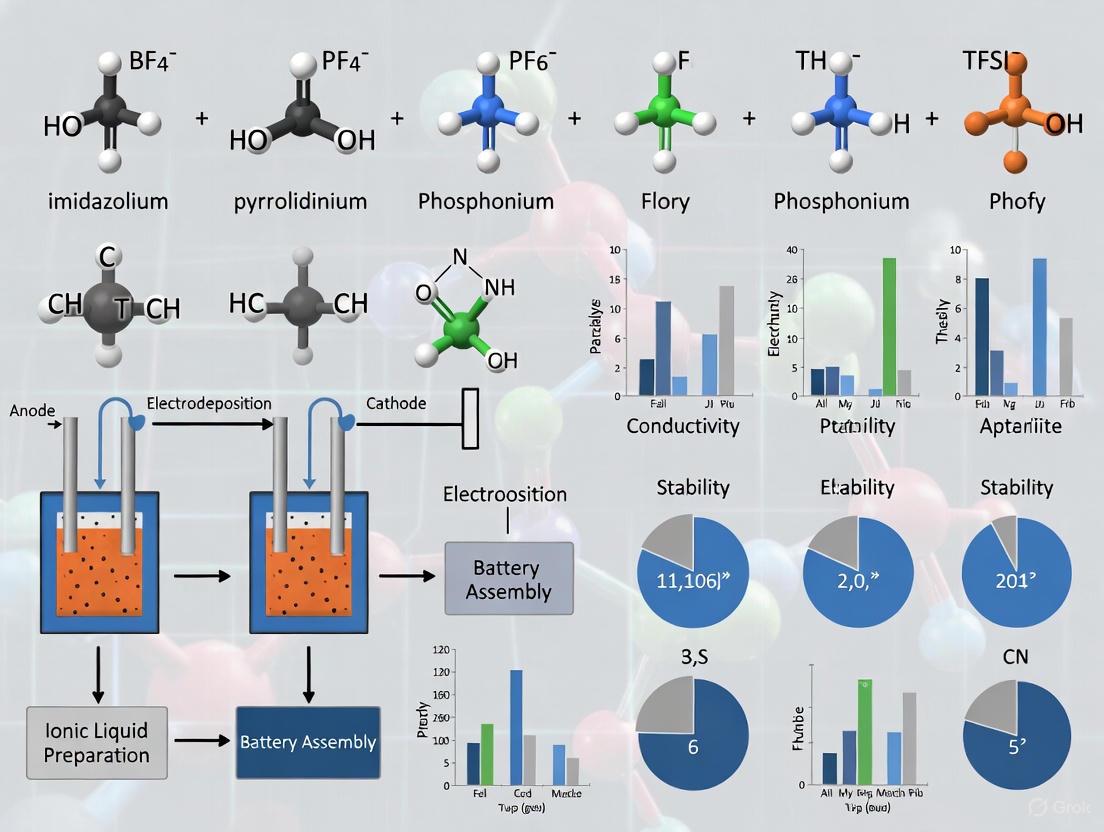
This article provides a comprehensive analysis of ionic liquids (ILs) as key materials for advancing electrochemical technologies, focusing on their foundational properties, methodological applications in metal electrodeposition and battery electrolytes,...
Ionic Liquids in Energy Storage: Advanced Applications in Electrodeposition and Next-Generation Batteries
Abstract
This article provides a comprehensive analysis of ionic liquids (ILs) as key materials for advancing electrochemical technologies, focusing on their foundational properties, methodological applications in metal electrodeposition and battery electrolytes, and strategies for optimizing their performance. It explores the unique physicochemical properties of ILs—including their wide electrochemical windows, high thermal stability, and non-flammability—that make them superior to conventional electrolytes. The content details specific applications in sustainable metal recovery and the development of safer lithium-ion, aluminum, and magnesium batteries, addressing current challenges like viscosity and cost. Through validation techniques such as machine learning for property prediction and comparative analyses with organic electrolytes, this review synthesizes cutting-edge research to guide scientists and engineers in harnessing ILs for more efficient, safe, and sustainable energy storage and conversion systems.
Understanding Ionic Liquids: Fundamental Properties and Electrochemical Advantages
Ionic liquids (ILs) are a class of chemical compounds defined as salts that exist in the liquid state at relatively low temperatures, typically below 100 °C [1] [2]. Often described as "liquid salts" or "designer solvents," their fundamental distinction from conventional salts like sodium chloride lies in their composition of bulky, asymmetrically shaped organic cations and organic or inorganic anions, which inhibits crystal lattice formation and results in low melting points [3] [4]. This molecular structure underpins their status as a versatile platform for tailor-made materials in electrochemistry and beyond.
The historical development of ionic liquids dates back to 1914 with Paul Walden's report on ethylammonium nitrate, which has a melting point of 12 °C [1] [2] [4]. However, significant interest emerged in the latter half of the 20th century, driven by research from the U.S. Air Force Academy seeking replacement electrolytes for thermal batteries [3] [4]. A pivotal advancement occurred in 1992 with the development of ionic liquids featuring 'neutral' and water-stable anions such as hexafluorophosphate (PF₆⁻) and tetrafluoroborate (BF₄⁻), which dramatically expanded their application potential [1].
Fundamental Characteristics and Properties
Ionic liquids possess a suite of extraordinary properties that make them particularly attractive for scientific and industrial applications. Their most prominent characteristics include low or negligible vapor pressure, high thermal stability, non-flammability, wide electrochemical windows, and good ionic conductivity [5] [6] [4]. A key advantage is their tunability; by selecting different cation-anion combinations, properties such as hydrophobicity, viscosity, density, and melting point can be precisely tailored for specific applications [5] [4]. This has earned them the "designer solvents" moniker.
Table 1: Key Properties of Ionic Liquids vs. Traditional Materials
| Property | Ionic Liquids | Conventional Solvents (e.g., Water, Acetonitrile) | Traditional Salts (e.g., NaCl) |
|---|---|---|---|
| Vapor Pressure | Negligible [5] [6] | High, volatile | Very low (solid) |
| Thermal Stability | High (often >300°C) [2] [4] | Low (boils at 100°C) | Very high (melts at 801°C) [3] |
| Flammability | Generally non-flammable [5] | Often flammable | Non-flammable |
| Electrochemical Window | Wide (up to 6 V) [6] | Narrow (~1.23 V for water) | Not applicable (solid) |
| Designability | Highly tunable [4] | Fixed properties | Fixed properties |
The Ionic Liquid Toolkit: Cations, Anions, and Their Combinations
The properties of an ionic liquid are dictated by the structures of its constituent cation and anion. The vast number of possible combinations creates an immense design space, estimated at over 10¹⁸ theoretically possible ionic liquids [2].
Common Cations and Anions
The most prevalent cations in room-temperature ionic liquids (RTILs) are nitrogen-containing heterocycles, such as imidazolium and pyridinium, along with quaternary ammonium and phosphonium ions [1] [6] [4]. Common anions range from simple halides to complex fluorinated or organic ions [1] [5].
Table 2: Common Ions in Ionic Liquid Synthesis and Their Characteristics
| Ion Type | Example Ions | Key Characteristics |
|---|---|---|
| Cations | 1-Alkyl-3-methylimidazolium (e.g., [BMIM]⁺, [EMIM]⁺) [1] [6] | High electrochemical stability, good conductivity, widely studied |
| Pyrrolidinium (e.g., [C₄MPyrr]⁺) [6] [7] | Excellent ionic conductivity, good low-temperature performance | |
| Phosphonium (e.g., [P₆,₆,₆,₁₄]⁺) [1] [7] | High thermal stability (up to 150°C), excellent chemical stability | |
| Quaternary Ammonium (e.g., [N₁₁₁₄]⁺) [7] | Lower viscosity, cost-effective synthesis | |
| Anions | Bis(trifluoromethylsulfonyl)imide ([TFSI]⁻ or [NTf₂]⁻) [5] [6] | Hydrophobic, high electrochemical and thermal stability |
| Tetrafluoroborate ([BF₄]⁻) [1] [6] | Moderate hydrophilicity, good electrochemical stability | |
| Hexafluorophosphate ([PF₆]⁻) [1] [6] | Hydrophobic, widely used in electrochemistry | |
| Halides (e.g., Cl⁻, Br⁻) [1] [5] | Hydrophilic, often used as precursors |
Ion Combination Diagram
Research Reagent Solutions
The selection of ionic liquids for research is critical. The following table details key materials and their functions in electrochemical research.
Table 3: Key Research Reagent Solutions for Electrodeposition and Battery Applications
| Reagent / Material | Chemical Formula / Example | Function in Research |
|---|---|---|
| Imidazolium-based IL | 1-Ethyl-3-methylimidazolium bis(trifluoromethylsulfonyl)imide ([EMIM][TFSI]) [5] [6] | High-stability electrolyte for batteries and supercapacitors; solvent for electrodeposition. |
| Pyrrolidinium-based IL | N-Butyl-N-methylpyrrolidinium bis(trifluoromethylsulfonyl)imide ([C₄MPyrr][TFSI]) [5] [7] | Electrolyte for high-voltage lithium-ion batteries; offers excellent low-temperature performance. |
| Magnesium Source | Magnesium bis(trifluoromethylsulfonyl)imide (Mg(TFSI)₂) [8] | Provides Mg²⁺ ions for the electrodeposition of metallic magnesium or for magnesium battery electrolytes. |
| Lithium Salt | Lithium bis(trifluoromethane sulfonyl)imide (LiTFSI) [6] | The active charge carrier in lithium-ion battery electrolytes based on ionic liquids. |
| Co-solvent | Acetonitrile, Propylene Carbonate [8] [6] | Reduces viscosity of IL-based electrolytes, enhancing mass transport and ion mobility. |
Application Notes in Electrodeposition and Batteries
Electrodeposition of Reactive Metals
Ionic liquids have emerged as revolutionary electrolytes for the electrodeposition of reactive metals like magnesium, aluminum, and lithium, which is difficult or impossible in aqueous media due to water's narrow electrochemical window [8]. A systematic review highlights their role in enabling magnesium electrodeposition from sources like bischofite (MgCl₂·6H₂O), offering a more sustainable pathway compared to energy-intensive industrial methods [8]. The wide electrochemical stability window of ILs prevents water decomposition, allowing for the deposition of these metals. Key operational parameters for successful electrodeposition include temperature control (to manage viscosity), precursor purity, and cell design [8]. Strategies such as using elevated temperatures and co-solvents are effective in mitigating the high viscosity of some ILs, thereby improving ion transport and deposit quality [8].
Mg Electrodeposition Workflow
Battery Electrolytes and Supercapacitors
In energy storage, ionic liquids are primarily employed as advanced electrolytes in lithium-ion batteries, next-generation batteries (e.g., Mg, Na), and supercapacitors [6] [7]. Their non-flammability and negligible vapor pressure directly address critical safety concerns associated with conventional organic electrolytes, which are volatile and prone to causing thermal runaway [6]. Furthermore, their high thermal stability and wide electrochemical windows enable batteries to operate at higher voltages and across a broader temperature range [6] [7].
The global market for ionic liquids in battery applications, valued at USD 111 million in 2024 and projected to grow at a CAGR of 10.2%, reflects this strong technological promise [7]. Imidazolium-based ILs currently dominate the market share (45.2% in 2024), while pyrrolidinium-based ILs are notable for their high ionic conductivity and excellent low-temperature performance [7]. Major application segments include electric vehicle batteries (30.2% share), grid energy storage (26.1% share), and consumer electronics [7].
Table 4: Ionic Liquid Electrolytes in Energy Storage Devices
| Device Type | Role of Ionic Liquid | Key Benefits | Example ILs |
|---|---|---|---|
| Lithium-Ion Battery | Solvent for Li salts, replacing volatile carbonates [6]. | Enhanced safety (non-flammable), higher temperature operation, wider voltage window. | [C₄MPyrr][TFSI] with LiTFSI [6] [7] |
| Magnesium Battery | Electrolyte medium for Mg²⁺ ion transport [8]. | Enables reversible Mg plating/stripping; potential use of hydrated salts. | Mg(TFSI)₂ in [EMIM][TFSI] [8] |
| Electrochemical Capacitor (Supercapacitor) | Pure electrolyte or ion source [6]. | High stability for long cycle life, wide operational temperature range. | [BMIM][BF₄], [EMIM][TFSI] [5] [6] |
| Solid-State Battery | Component in hybrid/composite solid electrolytes [7]. | Improves interfacial contact and ionic conductivity. | Various [TFSI]⁻-based ILs [7] |
Detailed Experimental Protocols
Protocol: Electrodeposition of Magnesium from an Ionic Liquid Electrolyte
This protocol outlines the procedure for the electrodeposition of metallic magnesium, adapted from a recent systematic review [8].
5.1.1 Scope and Application This method describes the setup and execution of magnesium electrodeposition for research purposes, such as creating corrosion-resistant coatings or composite electrode materials. It is suitable for use with various imidazolium or pyrrolidinium-based ionic liquids.
5.1.2 Safety Considerations
- Perform all procedures in an inert atmosphere (e.g., Ar or N₂ glove box) due to the moisture sensitivity of many ionic liquids and magnesium salts.
- Wear appropriate personal protective equipment (PPE), including gloves and safety glasses.
5.1.3 Reagents and Materials
- Ionic Liquid: e.g., 1-Butyl-1-methylpyrrolidinium bis(trifluoromethylsulfonyl)imide ([C₄MPyrr][TFSI]). Dry under vacuum at elevated temperature (e.g., 80-100 °C) for >24 hours before use [8].
- Magnesium Salt: e.g., Magnesium bis(trifluoromethylsulfonyl)imide (Mg(TFSI)₂). Dry thoroughly.
- Co-solvent (Optional): Anhydrous acetonitrile or propylene carbonate, to reduce viscosity.
- Substrates/Electrodes: Working electrode (e.g., Pt, stainless steel, Cu foil); Counter electrode (e.g., Mg ribbon, Pt mesh); Reference electrode (e.g., Ag/Ag⁺).
- Electrochemical Cell: A standard three-electrode cell.
5.1.4 Procedure
- Electrolyte Preparation: Inside the glove box, dissolve the dried Mg(TFSI)₂ salt into the pure ionic liquid at a desired concentration (e.g., 0.1 - 0.5 M). If using a co-solvent, add it at this stage and mix thoroughly.
- Cell Assembly: Place the working, counter, and reference electrodes into the electrochemical cell. Introduce the prepared electrolyte into the cell.
- System Optimization (Key Step):
- Temperature Control: Place the cell in an oven or on a hotplate to maintain a constant elevated temperature (e.g., 50-80 °C). This is critical for lowering viscosity and improving Mg²⁺ ion mobility [8].
- Viscosity Management: Monitor solution viscosity. If too high, consider the addition of a co-solvent (5-20% v/v) [8].
- Electrodeposition:
- First, perform cyclic voltammetry (CV) to identify the reduction potential for Mg²⁺/Mg.
- Then, perform potentiostatic or galvanostatic electrodeposition at the determined conditions for a set duration.
- Post-Processing: After deposition, carefully remove the working electrode from the cell, rinse it with a dry solvent (e.g., anhydrous acetonitrile) to remove residual ionic liquid, and dry under vacuum.
- Analysis: Characterize the magnesium deposit using techniques such as scanning electron microscopy (SEM), energy-dispersive X-ray spectroscopy (EDS), or X-ray diffraction (XRD).
Protocol: Formulating a Safe Lithium-Ion Battery Electrolyte
This protocol provides a methodology for preparing a non-flammable electrolyte for lithium-ion batteries using an ionic liquid as the primary solvent.
5.2.1 Safety Considerations
- Conduct all procedures in an inert atmosphere glove box due to the moisture sensitivity of lithium salts and some ionic liquids.
- Standard battery assembly safety protocols must be followed.
5.2.2 Reagents and Materials
- Ionic Liquid: e.g., N-Butyl-N-methylpyrrolidinium bis(trifluoromethylsulfonyl)imide ([C₄MPyrr][TFSI]). Dry thoroughly before use [6] [7].
- Lithium Salt: Lithium bis(trifluoromethanesulfonyl)imide (LiTFSI).
- Equipment: Vials, magnetic stirrer, moisture-compatible pipettes.
5.2.3 Procedure
- Drying: Place the ionic liquid in a vial and dry under high vacuum at 80-100 °C for at least 24 hours to reduce water content to ppm levels [6].
- Salt Addition: Add the predetermined amount of dry LiTFSI salt to the vial containing the ionic liquid. A typical concentration range is 0.5 M to 1.0 M.
- Mixing: Cap the vial and stir the mixture on a magnetic stirrer with heating (e.g., 50-60 °C) until a clear, homogeneous solution is obtained. This may take several hours due to the high viscosity of the IL.
- Quality Control: The final electrolyte should be a clear, colorless to pale yellow liquid. Its performance should be validated by measuring ionic conductivity and electrochemical stability window before cell assembly.
- Cell Filling: This electrolyte can be used to fill laboratory-scale lithium-ion coin cells or pouch cells for performance and safety testing.
Ionic liquids have firmly established themselves as a cornerstone of modern materials science, evolving from scientific curiosities into indispensable "designer solvents" for electrochemistry. Their unique properties—including unparalleled tunability, intrinsic safety, and wide electrochemical windows—make them particularly transformative for the electrodeposition of reactive metals and the development of next-generation, safer energy storage devices. As fundamental research continues to unravel the intricacies of their behavior and as synthesis costs decrease, the integration of ionic liquids into commercial applications, especially in electric vehicle batteries and grid storage, is poised to accelerate. Their role in enabling sustainable and efficient electrochemical technologies underscores their enduring impact and vast future potential.
Ionic liquids (ILs), defined as salts with melting points below 100 °C, have emerged as a revolutionary class of materials for advanced electrochemical applications. Their unique ionic composition, consisting of organic cations and organic or inorganic anions, confers a suite of tunable physicochemical properties that make them superior to conventional aqueous and organic electrolytes. Within the context of electrodeposition and battery research, three properties are paramount: high ionic conductivity for efficient charge transport, exceptional thermal stability for operational safety at elevated temperatures, and inherent non-flammability to mitigate fire hazards. This application note details the quantitative data, experimental protocols, and practical reagent information essential for researchers leveraging ILs in these cutting-edge fields.
Quantitative Property Analysis of Ionic Liquids
The utility of ILs in electrodeposition and batteries is rooted in their measurable and tunable properties. The data below provides a benchmark for material selection.
Table 1: Key Physicochemical Properties of Common Ionic Liquids
| Ionic Liquid (Example) | Ionic Conductivity (mS/cm) | Electrochemical Window (V) | Thermal Decomposition Onset (°C) | Flammability |
|---|---|---|---|---|
| [Pyr14][NTf2] (1-Butyl-1-methylpyrrolidinium bis(trifluoromethanesulfonyl)imide) | ~1.4 [9] | ~3.5 [9] | >400 [10] | Non-flammable [11] [12] |
| [bmim][NTf2] (1-Butyl-3-methylimidazolium bis(trifluoromethylsulfonyl)imide) | ~4.0 [9] | ~3.0 [9] | ~400 [10] [13] | Non-flammable [11] [12] |
| [bmim][BF4] (1-Butyl-3-methylimidazolium tetrafluoroborate) | ~3.5 [9] | Data not available | ~400 [10] | Non-flammable [11] [12] |
| Conventional Organic Electrolyte (e.g., 1 M LiPF6 in EC/DMC) | ~10 [10] | ≤3.5 [11] [12] | Flash point ~18-30 °C [10] | Flammable [10] [11] [12] |
The properties of ILs span a wide range, influenced by the cation-anion combination. Typically, ILs offer an exceptional balance, with ionic conductivities ranging from 0.1 to 20 mS cm-1 [11] [9] and electrochemical windows of 2 to 6 V [14] [11] [9], significantly wider than aqueous electrolytes (1.2 V). Their thermal decomposition onset temperatures (Tonset) are typically in the range of 200–500°C [10] [13], far exceeding the boiling or flash points of conventional organic electrolytes. A key safety advantage is their non-flammability, a direct result of their negligible vapor pressure [10] [11] [12].
Table 2: Impact of Anion on Thermal Stability of Imidazolium-Based ILs [13]
| Anion | Approximate Decomposition Temperature Tonset (°C) |
|---|---|
| Dicyanamide ([DCA]-) | ~200 |
| Tetrafluoroborate ([BF4]-) | ~350 |
| Hexafluorophosphate ([PF6]-) | ~450 |
| Bis(trifluoromethylsulfonyl)imide ([NTf2]-) | ~450 |
Experimental Protocols
Protocol 1: Electrodeposition of Reactive Metals from Ionic Liquids
The wide electrochemical window of ILs enables the electrodeposition of reactive metals like lithium, aluminum, and rare-earth elements, which is impossible in aqueous solutions due to hydrogen evolution [14].
Workflow: Electrodeposition of Reactive Metals
Detailed Procedure:
Electrolyte Preparation: Inside an argon-filled glovebox (H2O, O2 < 1 ppm), transfer the chosen ionic liquid (e.g., [C4mim]Cl for Al deposition) into a reaction vessel. Dry the IL under vigorous stirring at ~80-100°C under high vacuum for at least 24 hours. Gradually add the anhydrous metal salt (e.g., AlCl3 for aluminum deposition [14]) in a controlled molar ratio to form the final electroplating bath.
Cell Assembly: A standard three-electrode electrochemical cell is used.
- Working Electrode (WE): The substrate for deposition (e.g., copper or steel foil). Clean and polish the substrate before use.
- Counter Electrode (CE): A high-purity metal wire or rod (e.g., platinum or a strip of the metal to be deposited).
- Reference Electrode (RE): An Ag/AgCl or a quasi-reference electrode (e.g., a silver wire). Assemble the cell inside the glovebox to prevent contamination.
Voltammetric Analysis: Before deposition, perform Cyclic Voltammetry (CV) to determine the exact reduction potential of the target metal ion. Typical parameters: scan rate of 10-50 mV/s, potential range tailored to the IL's electrochemical window. The CV will show a clear cathodic peak corresponding to metal ion reduction.
Electrodeposition: Based on the CV results, perform constant potential (potentiostatic) or constant current (galvanostatic) electrodeposition. For a uniform coating, moderate current densities or potentials should be applied. The process can be monitored by tracking the charge passed.
Post-Processing and Characterization: After deposition, remove the working electrode, and rinse it thoroughly with a dry solvent (e.g., acetonitrile) to remove residual IL. Characterize the resulting metal coating using Scanning Electron Microscopy (SEM) for morphology, Energy-Dispersive X-ray Spectroscopy (EDX) for composition, and X-ray Diffraction (XRD) for crystallinity.
Protocol 2: Evaluating Ionic Liquids in Lithium-Metal Battery Cells
ILs are promising electrolytes for safer lithium-metal batteries (LMBs) due to their ability to form stable solid-electrolyte interphases (SEIs) and suppress lithium dendrite growth [15] [10].
Workflow: Battery Cell Testing
Detailed Procedure:
Electrolyte Formulation: In an argon-filled glovebox, prepare the IL-based electrolyte. A common formulation is a 1:1.2:3 molar ratio of LiFSI:DME:TTE, known as a localized high-concentration electrolyte (LHCE) [15]. Pre-dry all components. The high concentration of LiFSI is crucial for forming a stable, anion-derived inorganic SEI.
Electrode and Cell Preparation:
- Cathode: Use a high-energy-density material like LiNi0.8Mn0.1Co0.1O2 (NMC811) coated on an aluminum foil. The typical active material loading should be ≥ 17.1 mg cm-2 for practical relevance [15].
- Anode: Use a thin lithium metal foil (e.g., 20 μm thickness).
- Cell Assembly: Assemble CR2032 coin cells or single-layer pouch cells inside the glovebox. Include a separator (e.g., glass fiber) saturated with the IL electrolyte.
Electrochemical Testing:
- Ionic Conductivity: Use Electrochemical Impedance Spectroscopy (EIS) on a symmetric cell (e.g., stainless steel | electrolyte | stainless steel) over a frequency range (e.g., 1 MHz to 100 mHz) to measure bulk resistance and calculate conductivity.
- Cycling Performance: Cycle the cells between set voltage limits (e.g., 3.0 - 4.3 V for NMC811|Li cells) at various C-rates. Critical metrics to monitor are the Coulombic Efficiency (CE), which should be >99.5% for viable LMBs, and the capacity retention over hundreds of cycles [15].
Post-Mortem Analysis: After cycling, disassemble cells in the glovebox. Analyze the lithium metal anode and NMC cathode surfaces using techniques like SEM to observe dendrite formation or cathode cracking, and X-ray Photoelectron Spectroscopy (XPS) to determine the chemical composition of the SEI and cathode-electrolyte interphase (CEI).
The Scientist's Toolkit: Key Research Reagents
Table 3: Essential Ionic Liquids and Components for Electrodeposition and Battery Research
| Reagent/Solution | Function/Application | Example & Notes |
|---|---|---|
| Aprotic Ionic Liquids | Solvent-free electrolyte for electrodeposition and batteries. Wide electrochemical window and thermal stability. | [Pyr14][NTf2]: High anodic stability, good for high-voltage batteries [9]. [C4mim][BF4]: Common for general electrochemistry [9]. |
| Lithium Salts | Provides Li+ ions for conduction in lithium batteries. | LiFSI (Lithium bis(fluorosulfonyl)imide): Preferred for forming stable SEI; continuous decomposition can cause ion depletion [15]. LiTFSI: Also widely used, offers good stability [10]. |
| Aluminum Chloride (AlCl3) | Key component for creating chloroaluminate ILs used in aluminum electrodeposition. | Must be handled in strict anhydrous conditions. Mixed with [C4mim]Cl to form the active plating bath [14]. |
| Ether Solvents (as Diluents) | Co-solvents in LHCE formulations to reduce viscosity and improve kinetics. | DME (Dimethoxyethane): Used in LHCEs with LiFSI [15]. TTE (1,1,2,2-Tetrafluoroethyl-2,2,3,3-tetrafluoropropyl ether): Non-solvating diluent in LHCEs to maintain local high concentration [15]. |
| Metal Salts | Source of metal ions for electrodeposition. | Anhydrous NiCl2, CuCl2, LaCl3, UCl4: Must be of high purity and thoroughly dried [16] [14]. |
Ionic liquids provide an unparalleled combination of ionic conductivity, thermal resilience, and non-flammability, making them indispensable for advancing the safety and performance of electrodeposition processes and next-generation batteries. Their tunable nature allows for precise customization to meet specific application demands, from depositing high-purity reactive metals for nuclear medicine targets to enabling long-cycling lithium-metal batteries for electric vehicles. By adhering to the detailed protocols and utilizing the recommended reagents outlined in this document, researchers can effectively harness these properties to drive innovation in their electrochemical research and development.
The electrochemical stability window (ESW) is a fundamental parameter defining the voltage range within which an electrolyte remains stable without decomposing. For lithium-ion batteries and supercapacitors, a wide ESW is critical because it directly enables the use of high-voltage electrode materials, thereby significantly increasing the device's energy density, which scales with the square of the operating voltage [17]. Traditional organic liquid electrolytes, while having high ionic conductivity, possess limited ESWs and pose serious safety risks due to their flammability [11] [18].
Ionic liquids (ILs)—molten salts with melting points below 100°C—have emerged as a superior class of electrolytes for high-voltage applications. Their unique cation-anion combinations confer exceptional properties, including wide electrochemical windows (up to 5–6 V), non-flammability, low volatility, and excellent thermal stability [11] [17]. This application note details the role of ILs in extending the ESW and provides standardized protocols for its accurate measurement, framed within ongoing research aimed at developing safer, high-energy-density batteries.
Theoretical Background: The Electrochemical Stability Window
The practical ESW of an electrolyte is the voltage range between its reduction potential (at the anode) and its oxidation potential (at the cathode). Operating a battery beyond this window leads to electrolyte decomposition, causing gas generation, impedance growth, and rapid capacity fade [19].
For solid electrolytes, two distinct stability windows are recognized:
- The Decomposition Window: Determined by the thermodynamic formation energy of the most stable decomposition products. This often provides a conservative, narrow estimate of stability.
- The Intrinsic (Kinetic) Window: Dictated by the (de)lithiation potential of the solid electrolyte itself. This indirect decomposition pathway can have a significant kinetic barrier, resulting in a much wider practical stability window than predicted by thermodynamics alone [20].
Ionic liquids overcome the limitations of aqueous and organic electrolytes. Their wide ESW stems from the high electrochemical stability of their constituent ions, which can be further tuned by selecting specific cation-anion pairs. For instance, pyrrolidinium-based cations generally offer wider windows than imidazolium-based ones, while anions like TFSI− and FSI− are known for their robust stability [11] [17].
Quantitative Data: ESW of Electrolyte Systems
The following tables summarize the ESW for various electrolyte types and specific ionic liquid formulations, providing a comparative overview for researchers.
Table 1: Comparison of General Electrolyte Types for EES Devices
| Electrolyte Type | Typical ESW (V vs. Li+/Li) | Key Advantages | Key Limitations |
|---|---|---|---|
| Aqueous | ~1.2 | High ionic conductivity, low cost, safe | Very narrow ESW limits energy density [11] |
| Organic Liquid | Up to ~3.5 | High ionic conductivity, good electrode wetting | Flammable, toxic, limited ESW [11] [18] |
| Ionic Liquids (Aprotic) | 4.5 – 6.0 | Wide ESW, non-flammable, high thermal stability | High viscosity, higher cost, complex synthesis [11] [17] |
| Solid Polymer (e.g., PEO) | ~4.0 - 5.0 | Enhanced safety, flexibility, suppresses dendrites | Low ionic conductivity at room temperature [19] |
Table 2: Exemplary ESW Values for Solid and Composite Polymer Electrolytes
| Solid Electrolyte/Sample | Composition | Ionic Conductivity (S/cm) | ESW / Eox (V vs. Li+/Li) | Measurement Conditions |
|---|---|---|---|---|
| PEO-based SCE | PEO–LiPCSI | 7.33 × 10⁻⁵ @ 60°C | 5.53 | LSV, 0.2 mV/s, 60°C [19] |
| Polymer Ionic Liquid | PIL-SN-PCE | 6.54 × 10⁻⁴ @ RT | 5.4 | LSV, 1 mV/s [19] |
| Composite Electrolyte | DAVA + ETTMP 1300 / LiPF6 | 7.65 × 10⁻⁴ @ RT | 6.0 | LSV, 100 mV/s [19] |
| Block Copolymer | BCT / LiTFSI | 9.1 × 10⁻⁶ @ 30°C | 5.0 | CV, 1 mV/s, 60°C [19] |
Experimental Protocols for ESW Determination
Accurately determining the ESW is crucial, as improper methods can lead to significant overestimation. Traditional cyclic voltammetry (CV) or linear sweep voltammetry (LSV) on inert electrodes can be misleading due to limited electrode-electrolyte contact area and the short timescale of the experiment, which may not capture slow decomposition reactions [20] [19].
Protocol: Comprehensive ESW Evaluation via Coupled LSV and GCD
This protocol, adapted from recent critical reviews, provides a more reliable assessment of an electrolyte's practical stability window [19] [21].
1. Principle: The method correlates the onset of faradaic reactions in LSV with a descriptor for side reactions derived from galvanostatic charge/discharge (GCD), providing a more realistic ESW by mitigating subjective factors.
2. Materials and Equipment:
- Electrochemical Workstation: Capable of performing LSV, CV, and EIS.
- Test Cell: A symmetric cell (e.g., SS|Electrolyte|SS) or a three-electrode cell with a controlled atmosphere (e.g., Ar-filled glovebox).
- Working Electrode: Inert electrodes (e.g., stainless steel, platinum, or glassy carbon). The surface area and roughness must be documented.
- Counter Electrode: Lithium metal or a similar inert material.
- Reference Electrode: Li+/Li (essential for reporting potentials vs. Li+/Li).
- Ionic Liquid Electrolyte: Must be thoroughly purified and dried to remove water and impurities.
3. Procedure:
- Step 1: Cell Assembly
- Assemble the test cell in an inert atmosphere glovebox (H₂O and O₂ < 1 ppm).
- Ensure good contact between the electrolyte and electrodes. For solid electrolytes, apply isostatic pressure and document it.
Step 2: Linear Sweep Voltammetry (LSV)
- Use a slow scan rate (e.g., 0.1 - 0.5 mV/s) to approach quasi-steady-state conditions and detect slow decomposition processes.
- Perform separate scans for the anodic limit (e.g., from OCP to 6.5 V) and the cathodic limit (e.g., from OCP to -0.5 V).
- Record the current response. The decomposition potential (Edecomp) is typically identified as the voltage at which the current density exceeds a pre-defined threshold (e.g., 0.1 mA/cm²).
Step 3: Galvanostatic Charge-Discharge (GCD)
- Construct a full cell (e.g., carbon-based EDLC) using the IL electrolyte.
- Cycle the cell at a constant current over a range of progressively increasing voltage windows.
- For each voltage window, record the charge and discharge curves.
Step 4: Data Analysis and ESW Determination
- Plot the coulombic efficiency (CE) of the GCD cycles against the maximum cell voltage.
- The voltage at which the CE begins to drop significantly indicates the onset of practical electrolyte decomposition.
- Correlate this voltage with the LSV results. The practical ESW is the range where both methods confirm stability.
Diagram: Experimental Workflow for ESW Determination. This protocol correlates LSV and GCD data for a more accurate and practical ESW value.
Critical Considerations for Accurate ESW Measurement
- Electrode Material: The choice of inert electrode is critical, as its surface chemistry can catalyze decomposition.
- Scan Rate: Slower scan rates are essential for meaningful data, as high rates can artificially widen the apparent ESW.
- Stability vs. Metastability: A wide ESW measured by LSV may indicate kinetic metastability. Long-term cycling tests within the proposed window are necessary to confirm operational stability [19].
The Scientist's Toolkit: Key Research Reagents & Materials
Table 3: Essential Materials for Ionic Liquid Electrolyte Research
| Research Reagent / Material | Function / Application | Key Characteristics & Notes |
|---|---|---|
| Pyrrolidinium-based ILs (e.g., PYR14TFSI) | High-voltage electrolyte base | Wide ESW, good transport properties; a benchmark cation for battery ILs [11] [17]. |
| Imidazolium-based ILs (e.g., EMIM-TFSI) | Electrolyte for supercapacitors | High ionic conductivity; but may have a narrower ESW and lower cathodic stability [11] [17]. |
| Lithium Salts (LiTFSI, LiFSI) | Lithium ion source | High solubility in ILs, good dissociation; contributes to Li+ conduction [18]. |
| Polymer Hosts (PEO, PVDF-HFP) | Matrix for ion-gels/quasi-solid electrolytes | Provides mechanical integrity, reduces electrolyte fluidity, enhances safety [18]. |
| Inorganic Fillers (Li6.4La3Zr1.4Ta0.6O12 - LLZTO) | Filler in Solid Composite Electrolytes (SCEs) | Enhances ionic conductivity, mechanical strength, and interfacial stability [18] [19]. |
Ionic liquids, with their inherently wide electrochemical stability windows, are pivotal enablers for the next generation of high-voltage, high-energy-density batteries. Moving beyond traditional organic electrolytes to IL-based systems—including binary IL-Li salt mixtures, ionogels, and composite electrolytes—addresses the critical challenges of safety and performance. The accurate and reliable determination of the ESO through standardized, rigorous protocols is not merely an academic exercise but a fundamental prerequisite for the rational design and commercial realization of advanced electrochemical energy storage devices. Future research will continue to focus on tailoring IL chemistries to optimize ionic conductivity, reduce cost, and improve compatibility with both lithium metal anodes and high-voltage cathodes like NMC and NCA.
Ionic liquids (ILs) have emerged as a transformative class of electrolytes in electrochemical research, distinguished by their modular nature. This property allows researchers to strategically combine organic or inorganic cations with various anions to precisely tailor physicochemical properties for specific applications, from energy storage to metal electrodeposition. The evolution of ILs has progressed through generations, from initial use as green solvents to advanced applications in catalysis and electrochemical systems, with current research focusing on sustainable, task-specific functionalities [22]. This application note details how specific cation-anion combinations address fundamental challenges in electrodeposition and battery science, providing structured experimental data, validated protocols, and visual guides to empower research and development efforts.
Application Notes: Strategic Cation-Anion Synergy in Action
The intentional pairing of cations and anions in ionic liquids or electrolyte additives enables the targeted optimization of electrochemical interfaces and processes. The following case studies illustrate this principle with quantitative outcomes.
Case Study 1: Suppressing Shuttle Effects in Zn-Iodine Batteries
Background: Aqueous Zn-Iodine batteries offer high capacity but suffer from the polyiodide shuttle effect, where soluble iodine species (e.g., I₃⁻) migrate to the anode, causing capacity decay and low coulombic efficiency [23].
Cation-Anion Strategy: Using Tetramethylammonium Halides (TMAX, X = F, Cl, Br) creates a dual-function additive.
- Cation Role (TMA⁺): The tetramethylammonium cation captures soluble I₃⁻ on the positive electrode, forming a stable solid-phase interhalide complex (TMAI₂X), thereby suppressing the shuttle effect. Concurrently, TMA⁺ adsorbs onto the Zn anode, creating an electrostatic shielding layer that promotes oriented Zn (101) deposition and suppresses dendrite formation [23].
- Anion Role (X⁻): The halide anions (F⁻, Cl⁻, Br⁻) lower the Gibbs free energy differences (ΔG) of the intermediate reaction steps (I⁻ → I₂X⁻ and I₂X⁻ → TMAI₂X), thereby accelerating the conversion kinetics and improving voltage efficiency [23].
Quantitative Performance Data:
Table 1: Electrochemical Performance of ZICBs with TMAX-Modified Electrolytes
| Additive | Specific Current | Average Energy Efficiency | Cycle Life | Capacity Decay Rate |
|---|---|---|---|---|
| TMAF | 0.2 A g⁻¹ | 95.2% | 1000 cycles | 0.1% per cycle |
| TMAF | 1 A g⁻¹ | Not Specified | 10,000 cycles | 0.1‰ per cycle |
| TMACl | 0.2 A g⁻¹ | Lower than TMAF | 1000 cycles | Higher than TMAF |
| TMABr | 0.2 A g⁻¹ | Lower than TMAF | 1000 cycles | Higher than TMAF |
Source: [23]
Case Study 2: Regulating SEI Formation in Lithium Metal Batteries
Background: The unstable Solid Electrolyte Interphase (SEI) and lithium dendrite growth on lithium metal anodes lead to low Coulombic efficiency and safety risks [24].
Cation-Anion Strategy: Using Nitrate Salts (KNO₃, NaNO₃) as additives demonstrates a synergistic cation-anion interaction.
- Anion Role (NO₃⁻): The nitrate anion exhibits moderate adsorption energy, reacting with lithium to form an inorganic-rich, high-quality SEI film. This stable SEI prevents continuous electrolyte decomposition and promotes uniform lithium deposition [24].
- Cation Role (K⁺ vs. Na⁺): Research indicates that the cation significantly influences the additive's effectiveness. While KNO₃ and LiNO₃ show comparable and high performance in Li||S batteries, Na⁺ cations can participate in side reactions, forming compounds like Na₂S₂O₃ and NaN₃, which cause active material loss and capacity decay [24].
Key Finding: The compatibility between the additive's cation and the electrode materials is critical; an ill-suited cation can undermine the beneficial role of the anion [24].
Case Study 3: Enabling Metal Electrodeposition in Non-Aqueous Media
Background: Electrodeposition of reactive metals like magnesium is challenging in aqueous media due to hydrogen evolution and narrow electrochemical windows [8] [25].
Cation-Anion Strategy: The selection of Ionic Liquid Cations and Anions determines the feasibility and quality of deposition.
- Role of the Combination: The wide electrochemical window of ILs, a result of their unique cation-anion pairs, allows for the reduction of metals with very negative redox potentials without solvent decomposition. The ionic liquid's structure also affects transport properties (viscosity, conductivity) and interfacial behavior at the electrode [8] [25] [26].
- Operational Parameters: Key factors for successful deposition include temperature (to mitigate viscosity), precursor purity, and cell architecture. The use of elevated temperatures and co-solvents can further enhance ion mobility and deposition uniformity [8].
Experimental Protocols
Protocol: Evaluating TMAX Additives in Zn-Iodine Batteries
Objective: Assess the efficacy of tetramethylammonium halide (TMAX) additives in suppressing the polyiodide shuttle effect and improving zinc deposition.
Materials:
- Electrolyte: 2 M ZnSO₄ + 0.2 M KI (base electrolyte).
- Additives: Tetramethylammonium fluoride (TMAF), chloride (TMACl), or bromide (TMABr).
- Electrodes: Zinc foil (anode), Carbon felt (cathode).
- Equipment: UV-Vis spectrophotometer, Raman spectrometer, electrochemical workstation.
Procedure:
- Additive Screening:
- Prepare a 10 mM KI₃ solution in water.
- Add 0.1 M of TMAX (TMAF, TMACl, TMABr) to separate vials of the KI₃ solution.
- Observe the formation of a dark green solid precipitate, indicating complex formation [23].
- Centrifuge the mixtures and analyze the supernatants using UV-Vis (288 nm, 350 nm) and Raman spectroscopy (118 cm⁻¹, 136 cm⁻¹ for I₃⁻; 165 cm⁻¹ for I₅⁻) to confirm the reduction of soluble polyiodide signals [23].
- Cell Assembly and Testing:
- Prepare the working electrolyte by adding 0.1 M of the selected TMAX additive to the base electrolyte (2 M ZnSO₄ + 0.2 M KI).
- Assemble coin cells (CR2032) in an argon-filled glovebox using the modified electrolyte.
- Perform galvanostatic charge-discharge testing at specific currents of 0.2 A g⁻¹ and 1 A g⁻¹.
- Monitor cycle life, Coulombic Efficiency, and Energy Efficiency as per Table 1 [23].
- Zn Deposition Analysis:
- Conduct Zn||Zn symmetric cell cycling with the modified electrolyte.
- Analyze the cycled Zn electrodes using Scanning Electron Microscopy (SEM) to observe deposition morphology and X-ray Diffraction (XRD) to confirm the preferred Zn (101) orientation [23].
Protocol: Testing Nitrate Additives in Lithium Metal Batteries
Objective: Systematically evaluate the performance of nitrate and nitrite additives in stabilizing the lithium metal anode.
Materials:
- Base Electrolyte (BE): 1 M LiTFSI in DOL/DME (1:1 v/v).
- Additives: KNO₂, KNO₃, NaNO₂, NaNO₃.
- Electrodes: Lithium metal chips, Copper foil.
- Equipment: Electrochemical workstation, glovebox.
Procedure:
- Electrolyte Preparation:
- Prepare electrolytes with gradient concentrations (0.01 M, 0.05 M, 0.1 M) of each additive in the base electrolyte [24].
- Coulombic Efficiency (CE) Test:
- Assemble Li||Cu half-cells in an argon-filled glovebox.
- Cycle the cells under a current density of 1 mA cm⁻² with a deposition capacity of 1 mAh cm⁻².
- Determine the optimal additive and its concentration based on the highest and most stable CE [24].
- Adsorption Energy Simulation:
- Use molecular simulation software (e.g., GROMACS) to model and compare the adsorption energies of NO₂⁻ and NO₃⁻ anions with Li⁺ ions and on the Li (110) crystal plane [24].
- SEI Characterization:
- After cycling, disassemble cells and harvest the lithium anodes.
- Analyze the SEI composition using X-ray Photoelectron Spectroscopy (XPS) to confirm the formation of an inorganic-rich layer (e.g., Li₃N, LiNₓOᵧ) in the presence of NO₃⁻ [24].
Schematic Diagrams of Mechanisms and Workflows
Synergistic Mechanism of TMAX in Zn-Iodine Batteries
Diagram Title: TMAX Additive Synergistic Mechanism
Workflow for Evaluating Electrolyte Additives
Diagram Title: Additive Evaluation Workflow
The Scientist's Toolkit: Research Reagent Solutions
Table 2: Essential Materials for Featured Experiments
| Reagent / Material | Function / Role | Example Application Context |
|---|---|---|
| Tetramethylammonium Halides (TMAX) | Dual-function additive: cation suppresses shuttle effect and anode dendrites; anion enhances redox kinetics. | High-energy-efficiency Zn-Iodine batteries [23]. |
| Alkali Metal Nitrates (KNO₃, LiNO₃) | Additive for forming inorganic-rich, stable SEI on lithium metal anodes. Improves Coulombic Efficiency. | Lithium Metal and Li-S batteries [24]. |
| Ionic Liquids (e.g., Phosphonium-based) | Electrolyte solvent with wide electrochemical window for electrodeposition of reactive metals. | Low-temperature electrodeposition of Mg, Nd, and other metals [8] [26]. |
| Deep Eutectic Solvents (DES) | Low-cost, tunable non-aqueous electrolyte for electrodeposition and energy storage. | Electrodeposition of Zn, Sn, Ag [25] [27]. |
| Lithium Bis(trifluoromethanesulfonyl)imide (LiTFSI) | Conductive salt with high stability, commonly used in organic and ionic liquid electrolytes. | Base electrolyte for Li metal battery testing [24]. |
The Role of Ionic Liquids in Sustainable and Decentralized Energy Solutions
Ionic liquids (ILs), a class of salts that are liquid at or near room temperature, have emerged as cornerstone materials in the development of sustainable and decentralized energy solutions. Their unique properties—including low vapor pressure, high thermal stability, tunable physicochemical characteristics, and wide electrochemical windows—make them exceptionally suitable for advanced electrochemical applications [25] [28]. This document details specific protocols and applications of ILs within two critical domains: the electrodeposition of strategic metal coatings and next-generation battery technologies, providing researchers with practical experimental frameworks to accelerate sustainable energy innovation.
Ionic Liquids in Advanced Electrodeposition
Electrodeposition using ILs enables the recovery and coating of metals that are challenging or impossible to process in aqueous electrolytes due to water sensitivity or narrow electrochemical windows [25].
The table below compares the four primary electrolyte systems used in metal electrodeposition, highlighting the niche advantages of ILs.
Table 1: Comparison of Electrodeposition Electrolyte Systems
| Electrolyte Type | Key Advantages | Key Limitations | Typical Applications |
|---|---|---|---|
| Aqueous Solutions | Mild operating conditions, high solubility to metal salts, good mass transfer [25] | Narrow electrochemical window, hydrogen evolution side reactions [25] | Common metals (e.g., Zn, Cr, Ni) [25] |
| Ionic Liquids (ILs) | Wide electrochemical window, low volatility, high thermal stability, tunable properties [25] [8] | Higher viscosity, higher cost, complex synthesis [25] [7] | Reactive & refractory metals (e.g., Al, Mg, Ge) [25] [8] |
| Deep Eutectic Solvents (DESs) | Biodegradable, low-cost components, easy preparation [25] | Limited number of well-studied formulations, often high viscosity [25] | Zn, Sn, Ag coatings [25] |
| Molten Salts | High conductivity, very wide electrochemical window, no solvation complexity [25] | High operating temperatures, strong corrosivity, high energy consumption [25] | Rare/refractory metals (e.g., W, Mo, Ti) [25] |
Experimental Protocol: Electrodeposition of Metallic Magnesium from Ionic Liquids
Magnesium is a strategic light metal for weight-critical applications and as an anode material in batteries. Its electrodeposition from ILs offers a low-temperature, non-aqueous alternative to energy-intensive industrial processes [8].
2.2.1 Research Reagent Solutions
Table 2: Essential Reagents for Magnesium Electrodeposition
| Item | Specification / Function |
|---|---|
| Ionic Liquid | e.g., Imidazolium-based (e.g., [BMIM][TFSI]) or Pyrrolidinium-based (e.g., [C₃mpyr][TFSI]). Serves as the electrolyte solvent [8]. |
| Magnesium Source | Anhydrous MgCl₂ or organomagnesium complex (e.g., Mg(TFSI)₂). Provides Mg²⁺ ions for reduction. Purity >99.9% is critical [8]. |
| Co-solvent | Dry, aprotic solvent (e.g., THF, Diglyme). Used to lower overall electrolyte viscosity and improve ion transport [8]. |
| Substrate | Coin-shaped metal working electrode (e.g., Cu, Ni, or Pt) with a diameter of 1-2 cm. Requires meticulous polishing and cleaning [25]. |
| Counter Electrode | High-purity Mg ribbon or rod. Serves as a reversible Mg/Mg²⁺ source [8]. |
| Reference Electrode | Ag/Ag⁺ or Pt quasi-reference electrode. Provides a stable potential reference in non-aqueous media [8]. |
2.2.2 Step-by-Step Methodology
- Electrolyte Preparation: Inside an argon-filled glovebox (H₂O, O₂ < 1 ppm), dry the chosen IL under vacuum at 80-100°C for 24 hours. Add the magnesium precursor (e.g., 0.1-0.5 M Mg(TFSI)₂) to the dried IL. If needed, add a co-solvent (e.g., 20-40 vol%) to reduce viscosity. Stir the mixture at 60°C until a homogeneous, clear solution is obtained [8].
- Cell Assembly: Assemble a standard three-electrode electrochemical cell inside the glovebox. Insert the prepared working, counter, and reference electrodes into the electrolyte solution. Ensure the cell is hermetically sealed before removal for testing [8].
- Cyclic Voltammetry (CV) Screening: Perform CV at a scan rate of 10-50 mV/s between set potential limits (e.g., -1.0 V to -2.5 V vs. Ref.) to identify the Mg deposition and stripping potentials and assess the reaction's reversibility [8].
- Potentiostatic Deposition: Apply a constant potential, typically slightly more negative than the reduction peak identified by CV, for a duration of 15-60 minutes. The charge passed can be used to estimate the deposit mass [8].
- Post-Processing: After deposition, carefully remove the working electrode, rinse it with a dry solvent (e.g., THF) to remove residual electrolyte, and dry under a stream of inert gas [8].
- Characterization: Analyze the deposit using Scanning Electron Microscopy (SEM) for morphology, X-ray Diffraction (XRD) for crystallinity and phase identification, and Energy-Dispersive X-ray Spectroscopy (EDS) for elemental composition [25] [8].
2.2.3 Workflow Visualization
The following diagram outlines the key experimental and optimization workflow for the magnesium electrodeposition protocol.
Ionic Liquids in Next-Generation Batteries
ILs are pivotal in enhancing the safety and performance of batteries, addressing key challenges in electric vehicles and grid storage.
Market and Performance Data for ILs in Batteries
The global market for ILs in battery applications is growing rapidly, driven by their superior safety profile.
Table 3: Ionic Liquids for Battery Applications: Market and Performance Data
| Parameter / Segment | Details |
|---|---|
| Global Market Size (2024) | USD 111 Million [7] |
| Projected Market Size (2034) | USD 314.2 Million [7] |
| CAGR (2025-2034) | 10.2% [7] |
| Leading IL Type by Market Share (2024) | Imidazolium-based (45.2%), due to electrochemical stability and commercial availability [7] |
| Fastest Growing IL Type | Pyrrolidinium-based, prized for high ionic conductivity and low-temperature performance [7] |
| Largest Application Segment | Electric Vehicle Batteries (30.2% share), driven by demand for safety and high voltage [7] |
| Key Safety Advantage | Non-flammability and non-volatility, significantly reducing fire and explosion risks [7] |
Application Note: ILs in Aluminum-Ion Batteries
Aluminum-ion batteries (AIBs) represent a promising post-lithium technology due to aluminum's abundance, safety, and high theoretical capacity [29].
3.2.1 Research Reagent Solutions
- IL Electrolyte: A mixture of 1-Ethyl-3-methylimidazolium chloride ([EMIm]Cl) and anhydrous AlCl₃ is the standard electrolyte. The molar ratio determines the electrolyte's Lewis acidity and overall performance [29].
- Cathode Material: A graphitic foam or felt is commonly used, as it facilitates the intercalation of chloroaluminate anions (AlCl₄⁻) during charging [29].
- Anode: High-purity aluminum foil.
- Separator: Glass fiber filter, resistant to the corrosive IL electrolyte.
3.2.2 Step-by-Step Cell Assembly and Testing Protocol
- Electrolyte Synthesis: In a glovebox, slowly add anhydrous AlCl₃ to [EMIm]Cl in a molar ratio of 1.1:1 to 1.5:1 (AlCl₃:[EMIm]Cl) with constant stirring and cooling to control the exothermic reaction. The resulting liquid is the active chloroaluminate IL electrolyte [29].
- Electrode Preparation: Punch the aluminum foil and carbon felt into disks. Dry all components under vacuum at 120°C overnight to remove moisture.
- Cell Assembly: In a glovebox, assemble a coin cell or Swagelok-type cell in the sequence of aluminum anode, separator (soaked with electrolyte), and carbon felt cathode. Seal the cell hermetically [29].
- Electrochemical Testing: Perform galvanostatic charge-discharge (GCD) cycling at various current densities (e.g., 100-1000 mA/g) between a fixed voltage window (e.g., 1.0-2.5 V) to evaluate capacity, cycling stability, and rate capability [29].
Emerging Tools and Future Perspectives
AI-Driven Design of Ionic Liquids
The vast chemical space of ILs makes them ideal candidates for AI-accelerated design. A recent study demonstrated the use of a fine-tuned GPT-2 model to generate novel IL structures with optimized properties like high CO₂ solubility and low eco-toxicity [30]. An iterative fine-tuning process, where top-performing generated ILs are fed back into the training set, was shown to progressively improve the properties of the AI-designed molecules [30].
4.1.1 AI Design Workflow Visualization
The following diagram illustrates the iterative AI-driven workflow for designing novel ionic liquids.
Challenges and Outlook
Despite their promise, the high cost and complex synthesis of ILs remain barriers to large-scale commercialization [7] [31]. Future research must focus on developing cost-effective, biodegradable ILs and designing integrated processes, such as using ILs for both metal extraction from waste streams and subsequent electrodeposition [32]. Combining AI-driven discovery with robust experimental validation presents a powerful pathway to overcome these challenges and fully unlock the potential of ILs in building a sustainable energy future.
Practical Implementations: Electrodeposition and Battery Electrolyte Applications
Application Note 1: Magnesium Electrodeposition from Ionic Liquids
The recovery of strategic metals like magnesium through sustainable electrochemical routes represents a critical advancement in materials processing for energy and environmental applications. Magnesium's low density (-2.37 V vs. SHE), high volumetric capacity (3833 mAh cm−3), and biocompatibility make it valuable for mobility, energy, and medical applications [8]. Traditional industrial production via thermal reduction of dolomite or electrolysis of anhydrous MgCl2 faces environmental and operational challenges, including high temperatures, significant emissions, and difficulties in precursor dehydration [8]. Ionic liquids (ILs) have emerged as promising alternative electrolytes due to their low volatility, thermal stability, and wide electrochemical windows, enabling efficient electrodeposition in water-free media [8].
Quantitative Analysis of Operational Parameters
Table 1: Key operational parameters for magnesium electrodeposition from ionic liquids [8]
| Parameter | Optimal Range | Impact on Deposition Efficiency |
|---|---|---|
| Temperature | 80°C | Enhances ionic mobility and current density (>1 A dm−2) |
| Viscosity Control | Co-solvent addition | Mitigates transport limitations for uniform ion mobility |
| Precursor Purity | Anhydrous MgCl₂ | Prevents passivation and enables efficient stripping |
| Cell Architecture | Optimized electrode design | Improves interfacial behavior and deposit uniformity |
| Chloride Additives | Tetrabutylammonium chloride | Prevents passivation and enables efficient magnesium stripping |
Experimental Protocol: Magnesium Electrodeposition from Solvate Ionic Liquids
Principle: This protocol describes the reversible electrodeposition and stripping of magnesium from solvate ionic liquid–tetrabutylammonium chloride mixtures, achieving current densities exceeding 1 A dm−2 at 80°C [33].
Materials:
- Magnesium-containing solvate ionic liquids
- Tetra-n-butylammonium chloride (TBACl)
- Argon glovebox (<1 ppm O₂/H₂O)
- DC power source or potentiostat
- Raman spectrometer for structural analysis
- Working electrode: appropriate substrate (e.g., copper, platinum)
- Counter electrode: magnesium ribbon
- Reference electrode: Ag/Ag⁺
Procedure:
- Electrolyte Preparation:
- Prepare solvate ionic liquids under anhydrous conditions within an argon glovebox.
- Analyze solvation structures by Raman spectroscopy to confirm solvent-separated ion pair structure at room temperature.
- Add tetrabutylammonium chloride to the solvate ionic liquids to prevent passivation and enable efficient magnesium stripping [33].
Electrochemical Cell Assembly:
- Assemble a three-electrode electrochemical cell within the argon glovebox.
- Use magnesium ribbon as both counter and reference electrodes, or employ a separate reference electrode (Ag/Ag⁺).
- Ensure all components are thoroughly dried before introduction to the glovebox.
Electrodeposition:
- Maintain electrolyte temperature at 80°C to achieve optimal current densities.
- Apply constant current or potential for deposition, with current densities potentially exceeding 1 A dm−2.
- Monitor deposition efficiency through chronopotentiometry.
Stripping Analysis:
- Perform cyclic voltammetry to study magnesium stripping behavior.
- Analyze the influence of chloride concentration on stripping efficiency.
- Note that addition of TBACl is necessary to prevent passivation and enable efficient stripping [33].
Troubleshooting:
- If passivation occurs during stripping, increase chloride concentration.
- If deposition efficiency is low, optimize temperature and verify electrolyte composition.
- For non-uniform deposits, incorporate co-solvent strategies to mitigate viscosity-related transport limitations [8].
Application Note 2: Critical Metals Recovery from Spent Lithium-Ion Batteries
The recycling of critical elements from spent lithium-ion batteries (LIBs) represents a crucial technological challenge in sustainable resource management. Spent LIBs contain valuable metals, including cobalt (5-20%), nickel (5-10%), manganese (5%), and lithium (1.5-7%), with concentrations significantly higher than in raw ores [34]. Electrochemical recycling technologies offer enhanced selectivity, reduced energy consumption, and superior environmental benefits compared to conventional pyrometallurgical and hydrometallurgical methods [35]. By regulating parameters such as voltage, current, and electrolyte composition, electrochemical methods can selectively dissolve or deposit specific elements, effectively separating multiple metal elements from complex solutions [34].
Quantitative Analysis of Metal Recovery Efficiency
Table 2: Selective electrodeposition performance for cobalt and nickel recovery [36]
| Condition | Applied Potential (V vs Ag/AgCl) | Co/Ni Ratio in Deposit | Purity Achieved |
|---|---|---|---|
| 10 M LiCl electrolyte | -0.75 V | 3.18 | Cobalt: 96.4 ± 3.1% |
| 10 M LiCl electrolyte | -0.60 to -0.55 V | Nickel-selective | Nickel: 94.1 ± 2.3% |
| 0.1 M LiCl electrolyte | -0.8 to -0.55 V | 1-2 | Low selectivity |
| PDADMA-modified electrode | Optimization dependent | Tunable selectivity | Polymer-loading dependent |
Experimental Protocol: Selective Cobalt and Nickel Electrodeposition Through Integrated Electrolyte and Interface Control
Principle: This protocol enables molecular selectivity for cobalt and nickel during potential-dependent electrodeposition through synergistic combination of concentrated chloride electrolytes and polyelectrolyte-modified electrodes [36].
Materials:
- 10 M LiCl solution (high purity)
- Poly(diallyldimethylammonium chloride) (PDADMA)
- Cobalt chloride (CoCl₂)
- Nickel chloride (NiCl₂)
- Electrochemical workstation with three-electrode configuration
- Working electrode (e.g., glassy carbon, copper)
- Counter electrode (platinum mesh)
- Reference electrode (Ag/AgCl)
- Lithium nickel manganese cobalt oxide (NMC) cathode material from spent LIBs
- Inductively coupled plasma optical emission spectroscopy (ICP-OES) for analysis
Procedure:
- Electrolyte Engineering for Speciation Control:
- Prepare 10 M LiCl as background electrolyte to promote formation of distinct metal complexes.
- Confirm formation of anionic cobalt chloride complex (CoCl₄²⁻) while maintaining nickel in cationic form ([Ni(H₂O)₅Cl]⁺) using spectroscopic methods.
- Utilize concentrated chloride to create a separation window of approximately 90 mV between cobalt and nickel deposition potentials [36].
Interfacial Design with Polyelectrolyte Modification:
- Functionalize electrode surface with positively charged PDADMA polyelectrolyte.
- Optimize polyelectrolyte loading to tune cobalt selectivity through electrostatic stabilization of CoCl₄²⁻.
- Characterize modified electrodes using electrochemical impedance spectroscopy.
Sequential Electrodeposition:
- For nickel-selective deposition: Apply moderate potentials (-0.60 to -0.55 V vs Ag/AgCl).
- For cobalt-selective deposition: Apply more negative potentials (-0.65 to -0.80 V vs Ag/AgCl) to leverage anomalous deposition behavior.
- Avoid potentials below -0.80 V vs Ag/AgCl to prevent co-deposition with similar Co/Ni ratios.
Multicomponent Metal Recovery from NMC Cathodes:
- Leach NMC cathode materials from spent LIBs using appropriate hydrometallurgical pretreatment.
- Adjust chloride concentration in leachate to maintain speciation control.
- Perform sequential electrodeposition to recover first nickel then cobalt.
- Analyze deposit composition using ICP-OES and SEM.
Troubleshooting:
- If selectivity decreases, verify chloride concentration and electrode modification quality.
- If deposition efficiency declines, check for competing reactions and optimize applied potential window.
- For industrial application, address background electrolyte costs identified in technoeconomic analysis [36].
The Scientist's Toolkit: Essential Research Reagent Solutions
Table 3: Key reagents and materials for sustainable metal electrodeposition
| Reagent/Material | Function/Application | Key Characteristics |
|---|---|---|
| Solvate Ionic Liquids | Magnesium electrodeposition electrolyte | Low volatility, thermal stability, wide electrochemical window |
| Tetrabutylammonium Chloride (TBACl) | Additive for magnesium stripping | Prevents passivation, enables efficient magnesium stripping |
| Concentrated LiCl (10 M) | Electrolyte for Co/Ni selectivity | Enables speciation control: CoCl₄²⁻ vs [Ni(H₂O)₅Cl]⁺ |
| Poly(diallyldimethylammonium chloride) (PDADMA) | Electrode modifier for selectivity tuning | Positively charged polyelectrolyte for electrostatic stabilization |
| Dimethyl Sulfoxide (DMSO) with BMIMTFSI | Organic/IL electrolyte for lithium electrodeposition | Good LiNO₃ solubility, fine grain formation [37] |
| Lithium Nitrate (LiNO₃) | Lithium salt for electrodeposition | Additive that changes solvation structure, reduces dendrites [37] |
These application notes and protocols demonstrate that ionic liquid-based electrodeposition provides a sustainable pathway for recovering magnesium and critical metals from brines and spent batteries. The integration of innovative electrolyte engineering with interfacial design enables selective metal recovery with high efficiency and purity, contributing to circular economy objectives in materials science and energy storage. Future developments should focus on optimizing process parameters for scalability and reducing costs associated with specialized electrolytes to facilitate industrial implementation.
The global transition to renewable energy and decarbonized transportation has generated an extraordinary demand for efficient, safe, and cost-effective energy storage solutions. While lithium-ion batteries (LIBs) have dominated the market for decades, fundamental limitations including resource constraints, safety concerns from thermal runaway, and theoretical energy density ceilings are driving the search for alternatives [38] [39]. Multivalent metal-ion batteries, particularly those based on aluminum and magnesium, have emerged as promising successors due to their abundant raw materials, enhanced safety profiles, and superior theoretical capacities [38] [40].
Aluminum, the most abundant metal in the Earth's crust, offers a high theoretical volumetric capacity of 8046 mAh cm⁻³, approximately four times that of lithium [38]. Its trivalent redox chemistry enables the transfer of three electrons per atom, while its natural abundance translates to significantly lower raw material costs and established recycling infrastructure [40] [39]. Magnesium batteries also present compelling advantages, including a high volumetric capacity of 3833 mAh cm⁻³ and the absence of dendrite formation, which plagues lithium metal anodes [38] [8].
The integration of ionic liquids (ILs) as electrolytes represents a pivotal innovation in realizing the potential of these multivalent battery systems. These solvents, composed entirely of organic cations and various anions, offer negligible volatility, high thermal stability, and wide electrochemical windows, making them ideally suited for stabilizing reactive metal anodes and facilitating efficient ion transport [41] [42] [8]. This Application Note details the operational principles, material requirements, and experimental protocols for developing high-performance aluminum-ion and magnesium batteries using ionic liquid electrolytes, providing researchers with practical frameworks for advancing beyond lithium-based electrochemistry.
Quantitative Performance Comparison of Battery Technologies
The table below summarizes key performance metrics for lithium, aluminum-ion, and magnesium battery technologies, highlighting the comparative advantages and current limitations of each system.
Table 1: Performance Comparison of Lithium, Aluminum-Ion, and Magnesium Batteries
| Parameter | Lithium-Ion (LIB) | Aluminum-Ion (AIB) | Magnesium-Ion (MIB) |
|---|---|---|---|
| Theoretical Volumetric Capacity | ~2040 mAh cm⁻³ [38] | ~8046 mAh cm⁻³ [38] | ~3833 mAh cm⁻³ [8] |
| Abundance in Earth's Crust | ~0.002% [39] | ~8.3% [38] [39] | ~2.33% [8] |
| Raw Material Cost (Metal) | ~$35,000/ton [39] | ~$2,400/ton [39] | Information Missing |
| Typical Energy Density (Current) | 250-300 Wh/kg [39] | 40-70 Wh/kg [39] | Information Missing |
| Safety Profile | Moderate (Flammable electrolyte, thermal runaway risk) [38] | High (Non-flammable ionic liquid electrolytes, air-stable anode) [38] | High (No dendrite formation) [38] |
| Cycle Life (Current) | 500-1500 cycles [39] | >1000 cycles (Research: 88% capacity after 5000 cycles) [43] | Information Missing |
Ionic Liquid Electrolytes: Composition and Function
Ionic liquids are organic salts that are liquid below 100°C. Their unique properties—including high thermal stability, negligible vapor pressure, and wide electrochemical windows—make them superior electrolytes for managing the highly reactive chemistries of aluminum and magnesium anodes [42] [8]. Unlike conventional organic solvents, the ionic nature of ILs allows them to dissolve significant quantities of metal salts while resisting decomposition at high operating potentials.
In aluminum-ion batteries, the most common and effective electrolyte is a mixture of anhydrous aluminum chloride (AlCl₃) and a chloride-containing ionic liquid, such as 1-butyl-3-methylimidazolium chloride ([BMIM]Cl) [44]. This combination creates a complex equilibrium where the active chloroaluminate species (e.g., AlCl₄⁻, Al₂Cl₇⁻) form, which are crucial for the reversible plating and stripping of aluminum and for intercalation into the cathode [40]. For magnesium batteries, ILs based on pyrrolidinium (e.g., N-propyl-N-methylpyrrolidinium bis(fluorosulfonyl)imide, [C₃mPyr⁺][FSI⁻]) or glyme-Mg salt mixtures have shown promise in enabling reversible magnesium electrodeposition by forming a stable solid-electrolyte interphase (SEI) that suppresses passivation [42] [8].
A critical challenge overcome by ILs is the formation of a passivating layer on the metal anode surface. In magnesium systems, a common blocking layer of MgO/Mg(OH)₂ prevents Mg²⁺ ion transport. Specific IL anions like [FSI]⁻ facilitate the creation of a Li⁺/Mg²⁺-permeable SEI rich in LiF and other inorganic salts, which allows for sustained ion transport and prevents electrolyte breakdown [42]. Similarly, for aluminum, the chloride-based IL environment naturally prevents the formation of a rigid oxide layer, allowing for highly reversible electrochemistry [40].
Application Note 1: The Aluminum-Ion Battery (AIB)
Working Principle and System Components
The rechargeable aluminum-ion battery typically consists of an aluminum metal anode, a graphitic or composite cathode, and an ionic liquid electrolyte containing chloroaluminate anions [40]. During discharge, aluminum is oxidized at the anode: Al → Al³⁺ + 3e⁻. The Al³⁺ ions then migrate through the electrolyte and intercalate into the cathode material. The corresponding cathodic reaction, for instance in a graphitic cathode, involves the intercalation of chloroaluminate anions (AlCl₄⁻) between the graphene layers [40]. This process is reversed during charging.
Key Materials and Optimization Strategies
- Anode: High-purity aluminum foil (≥99.99%) is typically used. Impurities can lead to unwanted side reactions and increased self-discharge [40]. Alloying aluminum with elements like magnesium (5-10 wt%) has been shown to enhance mechanical integrity through solid-solution strengthening, mitigating microstructural damage from volume changes during cycling and improving cycle life [45].
- Cathode: A major research focus is on developing cathodes with wide interlayer spacing to accommodate large chloroaluminate ions. Graphite, vanadium oxide, and MXene-based composites (e.g., Nb₂CTₓ-MoS₂) are prominent candidates [44] [39]. The composite cathode Nb₂CTₓ-MoS₂ exploits the high conductivity and wide interlayer space of MXene (Nb₂CTₓ) and the pseudo-capacitive buffering capability of MoS₂, which controls volume changes during ion intercalation [44].
- Electrolyte: The standard is a molar mixture of 1-ethyl-3-methylimidazolium chloride ([EMIM]Cl) and anhydrous AlCl₃. The ratio is critical; a molar ratio of AlCl₃:[EMIM]Cl greater than 1.0 creates a Lewis-acidic environment necessary for the formation of Al₂Cl₇⁻ species, which participate in the cathodic reactions [40].
Detailed Protocol: Fabrication of an AIB Pouch Cell
Objective: To assemble and test a rechargeable aluminum-ion battery pouch cell using a Nb₂CTₓ-MoS₂ composite cathode and an AlCl₃/[BMIM]Cl ionic liquid electrolyte.
Materials:
- Aluminum foil (0.01 mm thickness, 99.99% purity)
- Anhydrous Aluminum Chloride (AlCl₃) (99.99%)
- 1-Butyl-3-methylimidazolium chloride ([BMIM]Cl) (≥98.0%)
- Carbon paper (as current collector for cathode)
- Celgard 2500 monolayer polypropylene separator
- Aluminum laminated film for pouch cell
- Nb₂CTₓ-MoS₂ composite powder (synthesized as below)
- Poly(vinylidene fluoride) (PVDF) binder
- N-Methyl-2-pyrrolidone (NMP) solvent
Synthesis of Nb₂CTₓ-MoS₂ Composite Cathode:
- Synthesize Nb₂CTₓ MXene using a green etching method [44]:
- In a Teflon bottle on an ice bath, prepare an etching solution of 0.1 M FeCl₃ and 1.2 M tartaric acid in deionized water as a complexing agent.
- Slowly add 2 g of Nb₂AlC MAX phase precursor to the solution with continuous stirring.
- Maintain the reaction at 35°C for 48 hours with stirring.
- Wash the resulting sediment repeatedly with deionized water and ethanol via centrifugation until the supernatant pH is ~6.
- Centrifuge at 3500 rpm for 30 minutes to sediment the multilayered Nb₂CTₓ. Decant the supernatant and collect the sediment.
- Add the sediment to a 20% solution of triethylamine (TEA) in water and stir for 6 hours. TEA acts as an intercalant to stabilize the interlayer spacing.
- Finally, wash with ethanol and dry under vacuum to obtain few-layered Nb₂CTₓ.
- Prepare Nb₂CTₓ-MoS₂ Composite via hydrothermal synthesis [44]:
- Dissolve 4.8 g of Na₂MoO₄·2H₂O and a stoichiometric amount of thiourea in 50 mL deionized water with continuous stirring.
- Add 76 mg of the as-prepared Nb₂CTₓ dispersed in 3 mL of poly(dimethyldiallylammonium chloride) (PDDMAC) (20%).
- Adjust the pH of the mixture to 6.5 using HCl.
- Transfer the mixture to a Teflon-lined stainless-steel autoclave and heat at 180°C for 24 hours.
- Collect the black precipitate, wash thoroughly with water and ethanol, and dry in a vacuum oven.
- Anneal the final product at 400°C under an argon flow.
Electrolyte Preparation (Inside an Ar-filled Glovebox, H₂O & O₂ < 1 ppm):
- Dry the [BMIM]Cl precursor under vacuum at 80°C for 24 hours before use.
- Slowly add anhydrous AlCl₃ powder to the [BMIM]Cl liquid in a glass vial with constant stirring, maintaining the vial in an ice bath to manage the exothermic reaction.
- Aim for a final AlCl₃:[BMIM]Cl molar ratio of 1.3:1 to ensure a Lewis-acidic electrolyte.
Electrode Slurry Preparation and Cell Assembly:
- Prepare the cathode slurry by mixing the active material (Nb₂CTₓ-MoS₂), conducting carbon (Super P), and PVDF binder in a mass ratio of 80:10:10 in NMP solvent. Mix thoroughly to form a homogeneous slurry.
- Coat the slurry onto carbon paper. Dry the coated electrode overnight in a vacuum oven at 80°C.
- Cut the aluminum foil to the desired size for the anode.
- Inside the argon glovebox, stack the electrodes and separator: Al anode | Celgard 2500 separator | Nb₂CTₓ-MoS₂ cathode.
- Place the stack into the aluminum laminated pouch, inject the prepared ionic liquid electrolyte, and seal the pouch using a vacuum sealer.
Electrochemical Testing:
- Perform cyclic voltammetry (CV) typically between 0.1 and 2.5 V at a scan rate of 0.1 mV/s to identify redox peaks.
- Conduct galvanostatic charge-discharge (GCD) cycling at various C-rates (e.g., 0.1C, 0.2C, 0.5C, 1C) within a suitable voltage window (e.g., 0.2-2.5 V) to evaluate capacity, cycle life, and rate capability.
- Perform electrochemical impedance spectroscopy (EIS) before and after cycling over a frequency range from 100 kHz to 10 mHz with a small amplitude perturbation to monitor changes in internal resistance.
Application Note 2: The Magnesium Battery
Working Principle and Challenges
Rechargeable magnesium batteries utilize a magnesium metal anode, a intercalation cathode (e.g., chevrel phase Mo₆S₈), and a magnesium-conducting electrolyte. The core reaction involves the reversible plating and stripping of magnesium: Mg ⇌ Mg²⁺ + 2e⁻ [8]. The primary challenge has been developing electrolytes that enable this reversibility without forming a passivating layer on the anode. Conventional electrolytes form a blocking layer of MgO/Mg(OH)₂, preventing Mg²⁺ transport. Ionic liquids, particularly with FSI⁻ anions, help form a conductive solid-electrolyte interphase (SEI) that allows Mg²⁺ transport [42] [8].
Key Materials and Ionic Liquid Electrolytes
- Anode: High-purity magnesium metal. The quality and surface preparation of the Mg foil are critical for consistent performance.
- Cathode: Materials like chevrel phase (Mo₆S₈), vanadium oxide (V₂O₅), and sulfur are being investigated. These materials require structures that allow for the facile diffusion of the Mg²⁺ ion, which has a high charge density and thus strong interaction with the host lattice.
- Electrolyte: ILs based on magnesium borohydride (Mg(BH₄)₂) in glymes or magnesium bis(trifluoromethanesulfonyl)imide (Mg(TFSI)₂) in pyrrolidinium-based ILs (e.g., [C₃mPyr⁺][FSI⁻]) have shown success. The FSI⁻-based ILs are particularly noted for forming a stable, conductive SEI on the magnesium surface [42] [8].
Detailed Protocol: Magnesium Electrodeposition and SEI Stabilization
Objective: To achieve reversible magnesium plating/stripping and stabilize the Mg anode interface using a [C₃mPyr⁺][FSI⁻]-based ionic liquid electrolyte.
Materials:
- Magnesium foil (high purity)
- N-propyl-N-methylpyrrolidinium bis(fluorosulfonyl)imide ([C₃mPyr⁺][FSI⁻]) ionic liquid
- Magnesium salt (e.g., Mg(TFSI)₂ or Mg(FSI)₂)
- Coin cell or pouch cell hardware
- Glass fiber separator (e.g., Whatman)
Electrolyte Preparation and Anode Pretreatment (In Ar-filled Glovebox):
- Dry the [C₃mPyr⁺][FSI⁻] IL and magnesium salt under vacuum at 80°C for 24 hours.
- Dissolve the magnesium salt in the IL at a typical concentration of 0.3 to 0.5 M.
- Anode Pretreatment (SEI Formation) [42]:
- Immerse the polished magnesium foil in the prepared electrolyte.
- Allow it to react for a predetermined period (from 4 hours to 18 days) without applying an external potential. Studies indicate that a reaction time of ~12 days can lead to the formation of a smoother, more protective SEI layer.
- Remove the foil, gently purge with argon to remove residual electrolyte, and use it as the anode for cell assembly.
Cell Assembly and Testing:
- For symmetric cell tests (Mg | Electrolyte | Mg), assemble coin cells using two pieces of the pretreated Mg foil.
- Perform galvanostatic cycling at a specific current density (e.g., 0.1 to 0.5 mA/cm²). The voltage profile will show a stable overpotential for Mg dissolution (stripping) and deposition (plating) if the SEI is effective.
- For full cells, pair the pretreated Mg anode with a suitable cathode (e.g., Mo₆S₈) and cycle the cell.
- Use X-ray Photoelectron Spectroscopy (XPS) and Fourier-Transform Infrared Spectroscopy (FTIR) on the cycled anodes to characterize the chemical composition of the SEI, confirming the presence of beneficial components like LiF, MgF₂, and breakdown products of the FSI⁻ anion [42].
The Scientist's Toolkit: Essential Research Reagents
Table 2: Key Reagents for Multivalent Battery Research with Ionic Liquids
| Reagent / Material | Typical Function | Key Characteristics & Notes |
|---|---|---|
| Anhydrous AlCl₃ [44] | Electrolyte component for AIBs; forms chloroaluminate anions (AlCl₄⁻, Al₂Cl₇⁻) for charge transport. | Highly moisture-sensitive. Requires handling in inert atmosphere. Lewis acidity dictates electrolyte behavior. |
| [BMIM]Cl / [EMIM]Cl [44] | Ionic liquid solvent/cation for AIB electrolytes. | Must be thoroughly dried before use. The cation influences viscosity, conductivity, and electrochemical stability. |
| Nb₂AlC MAX Phase [44] | Precursor for synthesizing Nb₂CTₓ MXene cathode material. | Etched to produce MXenes with high conductivity and tunable interlayer spacing for ion intercalation. |
| [C₃mPyr⁺][FSI⁻] [42] | Ionic liquid electrolyte for Mg and Li batteries. | Promotes formation of a stable, conductive SEI rich in LiF/MgF₂, suppressing dendrites and enabling reversible metal plating/stripping. |
| Mg(TFSI)₂ / Mg(FSI)₂ [42] [8] | Magnesium salt for MIB electrolytes; source of Mg²⁺ ions. | Determines ion concentration and transport properties. FSI⁻ anion is particularly beneficial for stable SEI formation. |
| Triethylamine (TEA) [44] | Intercalant for MXene synthesis; stabilizes interlayer spacing. | Prevents restacking of MXene layers, maintaining a wide interlayer distance for easier ion insertion. |
| Poly(vinylidene fluoride) (PVDF) [44] | Binder for electrode fabrication. | Chemically stable in ionic liquid electrolytes, ensuring mechanical integrity of the electrode composite. |
Aluminum-ion and magnesium batteries represent a paradigm shift in energy storage, moving beyond lithium towards more abundant and safer materials. The strategic application of ionic liquids as advanced electrolytes is pivotal to unlocking their potential, enabling the formation of stable electrode-electrolyte interfaces and facilitating reversible multivalent ion electrochemistry. While challenges remain—particularly in enhancing the energy density of AIBs and achieving high-voltage operation—the protocols and material strategies outlined here provide a robust foundation for ongoing research and development. The continued optimization of cathode materials, coupled with a deeper understanding of interfacial processes in IL-based electrolytes, will be critical for advancing these promising technologies from the laboratory to commercial reality, ultimately powering a more sustainable energy future.
The global transition to renewable energy has intensified the search for advanced electrical energy storage systems that can provide grid-scale storage, enhance stability, and support decarbonization efforts. Among the most promising technologies are redox flow batteries (RFBs) and metal-air batteries, which offer unique advantages for different applications within the energy storage landscape. RFBs excel in long-duration storage scenarios due to their scalable energy capacity and decoupled power and energy ratings [46]. Metal-air batteries, particularly zinc-air (Zn-air) systems, demonstrate exceptional theoretical energy densities – up to 1220 Wh kg⁻¹ for Zn-air and 8100 Wh kg⁻¹ for aluminum-air (Al-air) systems – making them suitable for applications where high energy density is critical [47]. The integration of ionic liquids (ILs) as electrolytes in these systems presents a transformative approach to overcoming traditional limitations associated with conventional aqueous and organic electrolytes. ILs offer negligible vapor pressure, high thermal stability, and wide electrochemical windows, enabling the electrodeposition of reactive metals and enhancing overall battery performance and sustainability [8]. This article explores the innovative designs of these battery systems and provides detailed application notes and experimental protocols framed within the context of ionic liquids application in electrodeposition and battery research.
Redox Flow Batteries: Design Principles and Applications
Fundamental Architecture and Operating Mechanism
Redox flow batteries are electrochemical energy storage devices characterized by their unique architecture where energy is stored in liquid electrolytes contained in external tanks and pumped through an electrochemical cell during operation. The core components include: (1) electrochemical cells containing electrodes where redox reactions occur, (2) electrolyte storage tanks, and (3) a pumping system for electrolyte circulation [48]. This design fundamentally separates power density (determined by the cell stack) from energy density (determined by electrolyte volume and concentration), allowing for highly flexible system sizing [46].
The operational principle involves reversible redox reactions at both the positive and negative electrodes. During discharge, the anodic electrolyte species undergoes oxidation, releasing electrons to the external circuit, while the cathodic species is reduced by accepting electrons. During charging, these processes are reversed through the application of an external potential [46] [48]. The most commercially developed vanadium RFB (VRFB) utilizes vanadium species in different oxidation states in both half-cells, which minimizes cross-contamination issues [46].
Innovative Design Approaches
Recent innovations in RFB design have focused on overcoming limitations related to cost, performance, and environmental impact. Research efforts are exploring non-vanadium redox-active materials including quinones, iron-based complexes, and iodide compounds, which offer potential for sustainable and cost-effective systems [49]. Iron-based RFBs, in particular, have gained attention due to iron's abundance, low toxicity, and cost advantages [46].
Hybrid flow battery designs represent another innovative approach, combining aspects of conventional batteries with flow battery architecture. These systems typically feature one side with a conventional battery electrode structure instead of a liquid tank, potentially offering long duration storage in space-constrained applications like solar buildings [46]. Additionally, research into membrane-free designs and advanced ion-exchange membranes aims to reduce system costs while maintaining performance [46].
Table 1: Comparison of Redox Flow Battery Chemistries and Performance Characteristics
| Battery Chemistry | Theoretical Energy Density (Wh/L) | Current Efficiency (%) | Voltage Efficiency (%) | Cycle Life (cycles) | Key Advantages | Key Challenges |
|---|---|---|---|---|---|---|
| Vanadium RFB | 15-25 [46] | >95 [46] | 80-90 [46] | >15,000 [46] | Long cycle life, no cross-contamination | High cost, temperature sensitivity of electrolyte |
| All-Iron RFB | 10-20 [46] | 90-95 [46] | 75-85 [46] | >5,000 [46] | Low cost, abundant materials | Hydrogen evolution, precipitation issues |
| Zinc-Bromine RFB | 30-60 [46] | 85-95 [46] | 70-80 [46] | >2,000 [46] | High energy density | Bromine toxicity, complex system design |
| Organic RFB | 10-30 [49] | 90-98 [49] | 75-85 [49] | >5,000 [49] | Sustainable materials, tunable properties | Chemical stability, capacity fade |
Metal-Air Battery Systems: Advanced Configurations
Working Principles and System Architectures
Metal-air batteries utilize a metal anode (typically Zn, Li, or Al) and an air cathode that draws oxygen from the atmosphere as the active cathode material. The fundamental structure comprises: (1) a metal anode, (2) an air cathode with gas diffusion layer, catalytic layer, and current collector, (3) an electrolyte (aqueous or non-aqueous), and (4) a separator [47]. The open cathode structure eliminates the need for expensive cathode active materials, significantly reducing mass and cost while enabling high theoretical energy densities [47].
In aqueous Zn-air batteries, discharge involves zinc oxidation at the anode (Zn → Zn²⁺ + 2e⁻) and oxygen reduction at the cathode (O₂ + 2H₂O + 4e⁻ → 4OH⁻) in alkaline media, with a theoretical voltage of approximately 1.65 V [47]. During charging, these reactions are reversed. The air cathode typically employs a multi-layered design with a gas diffusion layer that enables oxygen penetration while preventing electrolyte leakage, and a catalytic layer containing precious metals or transition metal oxides to accelerate the oxygen reduction reaction (ORR) and oxygen evolution reaction (OER) [47].
Addressing Polarization Challenges
A significant challenge in metal-air batteries is the polarization voltage – the difference between actual operating voltage and theoretical equilibrium voltage – which reduces actual energy efficiency to less than 60% of theoretical values in Zn-air systems [47]. Polarization arises from three primary sources: (1) activation polarization due to slow ORR/OER kinetics, (2) concentration polarization from oxygen diffusion limitations, and (3) ohmic polarization from interfacial resistance and electrolyte conduction [47].
Innovative strategies to mitigate polarization include atomic-level engineering of air cathodes using single-atom catalysts and low-Pt catalysts, biomass-derived 3D porous electrodes, and electrolyte innovations including additives to inhibit corrosion and the application of solid-state electrolytes to improve stability [47]. Research has also explored metal-H₂O₂ battery designs using concentrated liquid oxygen sources to address mass transfer limitations [47].
Table 2: Metal-Air Battery Performance Metrics and Comparison
| Battery Type | Theoretical Energy Density (Wh/kg) | Practical Energy Density (Wh/kg) | Operating Voltage (V) | Cycle Life | Key Advantages | Major Challenges |
|---|---|---|---|---|---|---|
| Zinc-Air | 1220 [47] | 200-300 [47] | 1.0-1.2 [47] | 100-500 (rechargeable) [47] | Abundant materials, high safety, mature technology | Limited power density, carbonation issues |
| Lithium-Air (non-aqueous) | 5900 [47] | 500-800 (experimental) [47] | ~2.5-2.7 [47] | <100 [47] | Ultra-high energy density | Poor cycle life, electrolyte decomposition |
| Aluminum-Air | 8100 [47] | 300-400 [47] | 1.2-1.6 [47] | Primary only [47] | Very high energy density, low cost | Corrosion, primary battery only |
| Magnesium-Air | 2800 [8] | 150-200 [8] | 1.0-1.4 [8] | Primary only [8] | Good energy density, abundant Mg | Slow kinetics, corrosion issues |
Application Notes: Ionic Liquids in Battery Systems
Ionic Liquids as Advanced Electrolytes
Ionic liquids (ILs) are emerging as transformative electrolytes in both RFB and metal-air battery systems due to their unique properties, including negligible vapor pressure, high thermal stability, wide electrochemical windows, and tunable physicochemical characteristics [8]. In RFBs, ILs can serve as green alternative solvents for redox-active species, potentially enhancing solubility, increasing energy density, and extending operational temperature ranges. For metal-air batteries, particularly those involving reactive metal anodes like magnesium, ILs enable electrodeposition processes that are challenging in conventional aqueous or organic media [8].
For magnesium-based systems, ILs address a critical challenge in conventional production methods: the energy-intensive dehydration of magnesium precursors like bischofite (MgCl₂·6H₂O) [8]. The molecular structure of bischofite features strong Mg-O bonds with coordinated water molecules, making stepwise dehydration increasingly energy-intensive and complicating anhydrous MgCl₂ production [8]. IL-based electrodeposition offers a potential pathway for more sustainable magnesium recovery, especially from complex brine resources where conventional methods prove inefficient.
Experimental Protocol: Magnesium Electrodeposition in Ionic Liquids
Principle: This protocol describes the electrodeposition of metallic magnesium from ionic liquid electrolytes, enabling the formation of magnesium layers for battery anode applications or regenerative systems.
Materials:
- Ionic liquids: Common choices include imidazolium (e.g., [EMIM][TFSI]), pyrrolidinium (e.g., [C₃mpyr][TFSI]), or quaternary ammonium-based ILs with appropriate anions (TFSI, BF₄, Cl)
- Magnesium source: Anhydrous MgCl₂, Mg(TFSI)₂, or alternatively, purified bischofite (MgCl₂·6H₂O) after controlled dehydration
- Electrodes: Working electrode (e.g., glassy carbon, platinum, or copper substrate), counter electrode (magnesium or inert electrode), reference electrode (Mg reference or compatible reference)
- Electrochemical cell: Air-tight cell with provisions for moisture exclusion (argon/vacuum atmosphere)
- Co-solvents: (Optional) Acetonitrile, tetrahydrofuran, or other polar aprotic solvents to reduce viscosity
Procedure:
- Moisture Elimination: Dry the ionic liquid under vacuum (60-80°C) for 12-24 hours prior to use. Perform all subsequent steps in an inert atmosphere (argon glove box with <1 ppm H₂O and O₂).
- Electrolyte Preparation: Dissolve the magnesium salt in the purified ionic liquid at concentrations typically ranging from 0.1-0.5 M. Stir the mixture at 40-60°C until complete dissolution (2-6 hours).
- Viscosity Management: For highly viscous ILs, consider elevated temperature operation (60-80°C) or addition of 10-20% (v/v) co-solvent to improve ion transport.
- Cell Assembly: Place the working electrode, counter electrode, and reference electrode in the electrochemical cell. Add the prepared electrolyte solution, ensuring complete immersion of electrodes.
- Electrodeposition: Apply a constant potential or current density suitable for magnesium reduction. Typical deposition potentials range from -1.5 to -2.5 V vs. Fc/Fc⁺ or applicable reference, with current densities of 0.1-5 mA/cm².
- Post-processing: After deposition, carefully remove the electrode, rinse with dry acetonitrile or other appropriate solvent to remove residual IL, and dry under vacuum.
Troubleshooting Notes:
- If no deposition occurs, verify magnesium salt solubility and electrolyte conductivity.
- If dendritic growth appears, optimize current density or apply pulsed electrodeposition.
- If oxidation occurs post-deposition, ensure proper sealing during transfer for characterization.
Experimental Protocol: Standardized Flow Battery Testing
Principle: This protocol establishes standardized procedures for flow battery cycling tests to ensure reproducibility and reliable comparison of novel materials, electrolytes, and cell designs, addressing current inconsistencies in reported methodologies [50].
Materials:
- Flow battery cell (e.g., 3D-printed or commercial design with flow fields)
- Graphite felt electrodes (e.g., SGL GFD or equivalent)
- Ion-exchange membrane (e.g., Nafion 117)
- Electrolyte (commercial or synthesized, e.g., 1.6 M V³⁺/V⁴⁺ in 2.0 M H₂SO₄ for VRFB)
- Peristaltic pump with calibrated flow heads
- Electrochemical workstation or battery cycler
- Tygon tubing (3.2 mm ID) and polyethylene tubing (2.7 mm ID)
- Nitrogen source for electrolyte degassing
Procedure:
- Electrode Preparation: Cut graphite felt electrodes to match active area. Heat treat at 400°C for 24 hours in air to improve hydrophilicity. Handle with gloves to prevent contamination.
- Membrane Pretreatment: For Nafion membranes, boil in 3% H₂O₂ for 1 hour, rinse in deionized water, boil in 0.5 M H₂SO₄ for 1 hour, and store in deionized water until assembly.
- Pump Calibration: Calibrate peristaltic pump flow rates using graduated cylinder and timer at the intended operating flow rate (e.g., 50 mL/min). Record actual flow rates for reporting.
- Cell Assembly: Assemble cell with treated membrane and electrodes according to manufacturer's or design specifications. Use appropriate gaskets to prevent leaks while maintaining proper compression on porous electrodes.
- Electrolyte Degassing: Sparge electrolytes with nitrogen for 15-30 minutes prior to operation to remove dissolved oxygen.
- System Priming: Fill tubing and cell with electrolyte, ensuring no air bubbles remain in the flow path. Circulate electrolyte for 15 minutes prior to electrochemical testing.
- Break-in Procedure: Perform 5-10 charge-discharge cycles at low current density (e.g., 20 mA/cm²) to condition the cell before formal data collection.
- Charge-Discharge Cycling: Conduct cycling at constant current between predetermined voltage limits. Record charge capacity, discharge capacity, voltage efficiency, coulombic efficiency, and energy efficiency for each cycle.
- Repeat Testing: Perform minimum of three replicate tests for each experimental condition to quantify variability.
Reporting Standards: Document electrode type and treatment, membrane type and pretreatment, electrolyte composition, flow rate, current density, temperature range, cell architecture, and all performance metrics with standard deviations [50].
The Scientist's Toolkit: Essential Research Reagents and Materials
Table 3: Research Reagent Solutions for Advanced Battery Development
| Reagent/Material | Function/Application | Examples/Specifications | Key Considerations |
|---|---|---|---|
| Vanadium Electrolyte | Active species for VRFB | 1.6 M V³⁺/V⁴⁺ in 2.0 M H₂SO₄ [50] | Oxidation state balance, temperature sensitivity |
| Imidazolium-based ILs | Electrolyte for metal deposition | [EMIM][TFSI], [BMIM][BF₄] [8] | Water content, viscosity, electrochemical window |
| Nafion Membranes | Ion-exchange membrane | Nafion 117, Nafion 115 [50] | Requires pretreatment, proton conductivity |
| Graphite Felt | Electrode material for RFB | SGL GFD, GFD 4.6 EA [50] | Thermal activation enhances performance |
| Bischofite | Magnesium source for electrodeposition | MgCl₂·6H₂O from brine sources [8] | Dehydration challenges, purity requirements |
| Quinone Compounds | Organic redox-active materials | 9,10-anthraquinone-2,7-disulphonic acid [49] | pH-dependent redox potential, chemical stability |
| Single-Atom Catalysts | Bifunctional air electrodes | Fe-N-C, Co-N-C catalysts [47] | ORR/OER activity, stability in alkaline conditions |
| Peristaltic Pumps | Electrolyte circulation | BT100M with Tygon tubing [50] | Requires regular calibration, tubing replacement |
Schematic Workflows and System Architectures
Integrated Workflow for Advanced Battery Development
Metal-Air Battery Operational Mechanism
Redox Flow Battery System Architecture
Innovative battery designs incorporating advanced materials and system architectures are crucial for meeting diverse energy storage needs in a decarbonized energy landscape. Redox flow batteries offer exceptional scalability and long-duration storage capability, with emerging chemistries beyond vanadium promising enhanced sustainability and cost reduction. Metal-air batteries provide outstanding theoretical energy densities, with ongoing research addressing polarization limitations through advanced catalysts and electrode designs. The integration of ionic liquids as electrolytes in both systems represents a promising research direction, particularly for enabling efficient metal electrodeposition processes and enhancing overall system performance. The experimental protocols and application notes provided herein establish a framework for standardized testing and development, facilitating reproducible research advancement in this critical field. As these technologies continue to mature, they hold significant potential to support global renewable energy integration and grid stabilization efforts, with market projections indicating substantial growth through 2045 [46].
Ionogels and hybrid polymer-ionic liquid composites represent an advanced class of solid-state electrolytes that combine ionic liquids (ILs) with solid matrices. These materials are engineered to meet the demanding requirements of modern electrochemical devices, particularly batteries, by leveraging the non-volatility, high thermal stability, and superior ionic conductivity of ILs within a robust solid structure [51] [52]. Their unique properties address critical challenges in energy storage, such as safety risks from liquid electrolytes and the need for higher energy density [53] [42].
This document provides detailed application notes and experimental protocols for the development and characterization of these materials, contextualized within a broader thesis on the application of ionic liquids in electrodeposition and batteries research. It is structured to serve researchers, scientists, and professionals engaged in the development of next-generation energy storage solutions.
Material Systems and Key Research Reagents
The synthesis and performance of ionogels are fundamentally governed by the selection of their constituent materials. The table below catalogs the essential "Research Reagent Solutions" and their respective functions in formulating these advanced electrolytes.
Table 1: Key Research Reagents for Ionogel and Hybrid Electrolyte Formulation
| Reagent Category | Specific Example(s) | Primary Function | Key Characteristics & Rationale |
|---|---|---|---|
| Ionic Liquid (Solvent) | 1-Ethyl-3-methylimidazolium bis(trifluoromethylsulfonyl)imide (EMIM TFSI); 1-Butyl-1-methylpyrrolidinium bis(trifluoromethylsulfonyl)imide (PYR14TFSI) [53] [54] [55] | Serves as the ion-conducting medium within the solid matrix. | Provides high ionic conductivity, wide electrochemical stability window (~4 V), and non-flammability [52] [42]. |
| Lithium Salt | Lithium bis(fluorosulfonyl)imide (LiFSI); Lithium bis(trifluoromethylsulfonyl)imide (LiTFSI) [53] [55] [42] | Introduces mobile Li+ ions for battery operation. | Determines lithium-ion concentration and transference number; influences solid-electrolyte interphase (SEI) formation [41] [42]. |
| Polymer Matrix | Poly(vinylidene fluoride-co-hexafluoropropylene) (PVDF-HFP); Epoxy Resins (e.g., DGEBA) [53] [55] | Forms the solid, structural scaffold that encapsulates the IL. | Imparts mechanical strength and flexibility; PVDF-HFP offers good chemical stability and processability [53] [55]. |
| Inorganic Fillers | Alumina (Al2O3) nanoparticles; Silica (SiO2) nanoparticles [54] [52] [55] | Enhances mechanical properties and can improve ionic conductivity. | Increases modulus to suppress lithium dendrite growth [52]; disrupts polymer crystallinity to facilitate ion transport [55]. |
| Crosslinker / Precursor | Tetraethyl orthosilicate (TEOS) [54] | Used in sol-gel synthesis to form a silica-based inorganic network. | Creates a porous 3D network for IL confinement, contributing to the mechanical integrity of the ionogel [54]. |
Quantitative Performance Data
The electrochemical and mechanical properties of ionogels are highly dependent on their formulation. The following table summarizes performance data from various reported systems, providing a benchmark for researchers.
Table 2: Performance Comparison of Different Ionogel and Hybrid Electrolyte Formulations
| Electrolyte Composition | Ionic Conductivity | Mechanical Properties | Electrochemical Stability Window | Key Application & Performance |
|---|---|---|---|---|
| PVDF-HFP / PYR14TFSI-LiFSI [53] | > 0.1 mS/cm (after solvent exchange) | N/A | N/A | Composite LTO anode; stable cycling at 5.85 mA/cm² with >99% Coulombic efficiency [53]. |
| Epoxy Resin / EMIMTFSI-LiTFSI / Alumina [55] | 0.085 mS/cm (at 60°C) | Storage Modulus: 1.2 GPa | N/A | Structural supercapacitors; high stiffness for multifunctional applications [55]. |
| Silica-based Ionogel (EMIM TFSI + LiTf) [54] | 58 ± 1.48 μS/cm (at 31 vol% electrolyte) | N/A | 3.5 V | Energy storage devices; optimal concentration for maximizing capacitance and conductivity [54]. |
| Ionic Liquid-based SEI ([C3mPyr+][FSI−]) [42] | N/A | N/A | N/A | Li|LiFePO4 batteries; >1000 cycles with Coulombic efficiency >99.5% [42]. |
| SiO2 Nanoparticle-reinforced Ionogel [52] | N/A | Modulus: 60 MPa | N/A | Li+ batteries; suppressed Li dendrites at 5 C rate and 80°C [52]. |
Detailed Experimental Protocols
Protocol 1: Synthesis of PVDF-HFP based Ionogel for Composite Electrodes
This protocol details the creation of composite electrodes where the ionogel is integrated directly into the electrode slurry, a strategy shown to enable high active material loading (>10 mg/cm²) and stable cycling [53].
Workflow Overview:
Materials:
- Polymer: Poly(vinylidene fluoride-co-hexafluoropropylene) (PVDF-HFP)
- Solvent: Acetone (ACS grade)
- Ionic Liquid Electrolyte: 1 M Lithium bis(fluorosulfonyl)imide (LiFSI) in 1-Butyl-1-methylpyrrolidinium bis(trifluoromethylsulfonyl)imide (PYR14TFSI)
- Active Material: Carbon-coated Lithium Titanate (LTO) or Lithium Iron Phosphate (LFP)
- Conductive Additive: Conductive carbon (e.g., Super P)
- Solvent Exchange Solution: 1 M Lithium perchlorate (LiClO₄) in Propylene Carbonate (PC)
Step-by-Step Procedure:
Ionogel Precursor Preparation: Dissolve PVDF-HFP in acetone at a concentration of 76 g/L. Separately, prepare the 1 M LiFSI in PYR14TFSI solution. Mix the polymer solution and the ionic liquid electrolyte in a mass ratio of 329:53. Vortex the mixture for 10-20 seconds until it appears homogeneous [53].
Dry Powder Homogenization: Precisely weigh the active material (e.g., LTO or LFP) and conductive carbon at an 8:1 mass ratio. Add yttria-stabilized zirconia milling media to the powder mixture and vortex for 10 minutes to ensure a homogeneous distribution. Remove the milling media after mixing [53].
Slurry Formation and Electrode Casting: Add the pre-made ionogel precursor to the dry powder mixture. The volume of ionogel added should be calculated based on the desired final composition. Vortex the combined materials until a well-mixed slurry is formed. Drop-cast 225 µL of the slurry onto a carbon-coated aluminum foil disk (current collector). Allow the electrode to dry at room temperature until the acetone has fully evaporated, followed by baking at 100°C for 3 hours to remove residual solvent [53].
Separator Application: Apply a separator layer of 65 µL of the pure ionogel precursor (without active material) onto the surface of the dried composite electrode. Dry and bake this bilayer structure under the same conditions as in Step 3, resulting in a ~20 µm thick solid electrolyte separator film [53].
Solvent Exchange Process: This critical step replaces bulky ions from the ionic liquid with lithium ions, enhancing Li+ transport.
- Immerse the prepared composite disks (electrode with ionogel separator) in a solution of 1 M LiClO₄ in PC.
- Soak the disks for 3 hours, then transfer them to a fresh batch of the same solution for another 3 hours.
- Perform a final soak in a new solution for 2 hours.
- Upon completion, remove the disks and proceed directly to cell assembly without washing [53].
Cell Assembly and Testing: Assemble coin cells in an argon-filled glovebox. Use lithium metal or a composite LTO electrode as the anode. Include a small amount (e.g., 5 µL) of 1 M LiClO₄ in PC as a wetting agent. Crimp the cell casing at 0.75 tons of force. Perform galvanostatic cycling with potential limitation (e.g., 1.0 V to 2.5 V for LTO vs. Li half-cells) to characterize electrochemical performance [53].
Protocol 2: Formulation and Characterization of Epoxy-Based Hybrid Solid Electrolytes
This protocol outlines the synthesis of mechanically robust, epoxy-based hybrid electrolytes suitable for structural energy storage devices, where the electrolyte must also bear mechanical load [55].
Workflow Overview:
Materials:
- Epoxy Resins: Araldite LY556 (DGEBA-based) and Poly(ethyleneglycol) Diglycidyl Ether (PEGDGE, Mn 500)
- Hardeners: Araldite XB3473 and/or 4,4′-diaminodiphenyl sulfone (DDS)
- Ionic Liquid: 1-Ethyl-3-methylimidazolium bis(trifluoromethylsulfonyl)imide (EMIM TFSI)
- Lithium Salt: Bis(trifluoromethylsulfonyl)imide lithium (LiTFSI)
- Reinforcement: Alumina nanoparticles (< 13 nm)
Step-by-Step Procedure:
Resin Blend Preparation: Prepare two separate epoxy resin systems. For the "L" system, mix the DGEBA-based resin (Araldite LY556) with its recommended hardener (Araldite XB3473) at a 100:23 weight ratio. For the "P" system, mix PEGDGE with the DDS hardener at a 100:35 weight ratio. These systems can be used individually or blended [55].
Electrolyte Component Addition: To the resin blend, add the ionic liquid (EMIM TFSI) and lithium salt (LiTFSI). An example of an optimal formulation (L70P30ILE40Li1MAl2) contains 40 wt.% ionic liquid and 5.7 wt.% lithium salt relative to the total composition [55].
Dispersion of Fillers: Incorporate alumina nanoparticles (e.g., 2 wt.%) into the mixture. Ensure uniform dispersion using mechanical stirring or sonication to prevent aggregation, which can be detrimental to both ionic conductivity and mechanical properties [55].
Curing and Film Formation: Add the appropriate hardener(s) to the mixture and cast it into a pre-defined mold. Cure the resin according to the manufacturer's specifications to form a solid electrolyte film. Post-curing may be required to achieve optimal cross-linking and performance [55].
Characterization:
- Thermo-Mechanical Analysis: Use Dynamic Mechanical Thermal Analysis (DMTA) in single cantilever mode (ASTM 5418) with a temperature ramp of 2°C/min and a frequency of 1 Hz. Determine the glass transition temperature (Tg) from the peak of the tan δ curve and record the storage modulus at room temperature [55].
- Electrochemical Impedance Spectroscopy (EIS): Measure ionic conductivity by applying a small AC voltage amplitude over a frequency range from 1 Hz to 1 MHz [54] [55].
- Cyclic Voltammetry (CV) and Linear Sweep Voltammetry (LSV): Determine the electrochemical stability window of the synthesized electrolyte by running CV and LSV experiments [55].
Application Notes & Performance Optimization
Note 1: Interfacial Engineering for Lithium Metal Anodes
Challenge: The inherent reactivity of lithium metal with electrolytes leads to unstable solid-electrolyte interphase (SEI) formation, dendrite growth, and ultimately, battery failure [42].
Solution and Protocol: Ionic Liquid-based SEI Pretreatment A facile pretreatment process can form a durable and Li+ permeable SEI prior to cell cycling [42].
- Preparation: Inside an argon-filled glovebox, prepare an electrolyte of 1 M LiFSI in N-propyl-N-methylpyrrolidinium bis(fluorosulfonyl)imide ([C3mPyr+][FSI−]).
- Immersion: Immerse a pristine lithium metal foil in the prepared ionic liquid electrolyte.
- Reaction: Allow the lithium foil to react with the electrolyte for a predetermined period (e.g., 12 days), during which a tailored SEI forms chemically. The morphology and composition of the SEI are highly dependent on both the reaction time and the lithium salt used [42].
- Assembly: Remove the pretreated Li foil, assemble the battery, and cycle using standard protocols.
Outcome: This pretreatment results in an SEI that suppresses dendrite formation, enabling long cycle life. Li|LiFePO4 batteries using this approach have demonstrated stable operation for over 1,000 cycles with Coulombic efficiencies >99.5% [42].
Note 2: Optimizing Ionic Conductivity via Electrolyte Concentration
Challenge: The ionic conductivity of an ionogel is not linear with the amount of incorporated ionic liquid electrolyte, due to complex interactions within the polymer matrix [54].
Solution and Findings: Systematically vary the volume percentage (vol%) of the electrolyte solution (ionic liquid + lithium salt) in the ionogel precursor. Studies have shown that performance peaks at a specific concentration.
- Low Concentration (<25 vol%): Results in low ionic conductivity and specific capacitance due to a scarcity of mobile ions for charge transport and double-layer formation [54].
- Optimal Concentration (~31 vol%): Provides an ample quantity of free ions, leading to a homogeneously dispersed network with maximum ionic conductivity and specific capacitance. For a silica-based ionogel with EMIM TFSI and LiTf, values of 58 μS/cm and 45.74 F/g, respectively, were achieved [54].
- High Concentration (>31 vol%): Can lead to the formation of ion pairs and aggregates that impede ion mobility, reducing ionic conductivity [54].
Recommendation: Researchers should identify the critical concentration for their specific ionogel system through a systematic EIS and CV study across a range of electrolyte loadings.
Concluding Remarks
Ionogels and hybrid polymer-ionic liquid electrolytes represent a versatile platform for developing safer, high-performance electrochemical devices. The protocols and optimization strategies detailed herein provide a foundation for synthesizing and characterizing these materials with tailored properties. Key to their success is the intricate balance between ionic conductivity, mechanical robustness, and interfacial stability. Future research directions include the development of novel ionic liquids tailored for specific polymer matrices, the exploration of 3D printing techniques for device fabrication, and the integration of these solid electrolytes into structural batteries and supercapacitors for truly multifunctional applications [52].
Addressing Key Challenges: Viscosity, Cost, and Performance Optimization
In the application of ionic liquids (ILs) in electrodeposition and batteries, their high viscosity presents a significant challenge, impacting processes from manufacturing efficiency to device performance. Ionic liquids, being organic salts liquid at low temperatures, possess unique characteristics including high thermal stability, non-volatility, and excellent ionic conductivity [7]. However, their relatively high viscosity can limit ion mobility, reducing conductivity and hindering operational efficiency in electrochemical systems. This document details practical, experimentally-grounded strategies centered on co-solvents and elevated temperature processing to mitigate these challenges, providing actionable protocols for researchers and scientists.
The Viscosity Challenge in Ionic Liquid Applications
High viscosity in ionic liquids adversely affects their performance in electrodeposition and battery applications. In electrodeposition, high viscosity can cause sluggish ion transport, leading to concentration gradients, irregular deposition, and poor-quality metal deposits with non-uniform morphology and thickness [8]. In battery systems, high viscosity can reduce ionic conductivity, increase internal resistance, and limit rate capability, ultimately impairing the battery's power density and efficiency [7]. Furthermore, from a manufacturing standpoint, highly viscous ionic liquids complicate processes such as filtration, pumping, and cell filling, potentially introducing defects and reducing production yields [8]. Addressing viscosity is therefore critical for enhancing both the performance and manufacturability of ionic liquid-based technologies.
Quantitative Analysis of Viscosity Mitigation Strategies
The effectiveness of elevated temperature and co-solvent strategies is quantified in the table below, summarizing key data from experimental studies.
Table 1: Quantitative Impact of Viscosity Mitigation Strategies on Ionic Liquid Properties
| Strategy | Specific Conditions | Impact on Viscosity | Impact on Conductivity / Performance | Key Application Context |
|---|---|---|---|---|
| Elevated Temperature | Increase from 25°C to 50-80°C | Reduction by 50-90% [8] | Significant improvement in ion mobility and interfacial behavior [8] | Magnesium electrodeposition [8] |
| Co-solvent Addition | 20-40 wt% Organic Solvent (e.g., DME) | Dramatic reduction (specific quantitative data not available in search results) | Enables more uniform ion mobility and deposition [8] | Aluminum-ion and lithium-ion batteries [29] |
| Combined Approach | Elevated Temperature + Co-solvent | Effective mitigation of transport limitations [8] | Enhances efficiency and reproducibility of metal deposition [8] | General electrodeposition processes [8] |
Experimental Protocols
This section provides detailed methodologies for implementing the described viscosity mitigation strategies in a laboratory setting.
Protocol: Formulating Ionic Liquid Electrolytes with Co-solvents for Battery Applications
This protocol outlines the preparation of low-viscosity, high-conductivity electrolytes for use in batteries such as aluminum-ion or lithium-ion systems.
1. Primary Materials:
- Ionic Liquid: e.g., 1-Ethyl-3-methylimidazolium chloride ([EMIm]Cl) for aluminum-ion batteries.
- Co-solvent: Anhydrous Dimethoxyethane (DME), Acetonitrile (ACN), or other appropriate organic solvents with high purity (>99.9%).
- Salts: Anhydrous Aluminum Chloride (AlCl₃) or Lithium Bis(trifluoromethanesulfonyl)imide (LiTFSI).
- Environment: Argon-filled glove box (H₂O, O₂ < 0.1 ppm).
2. Procedure: 1. Drying: Dry all primary materials (ionic liquid, co-solvent, salts) under vacuum at elevated temperatures (e.g., 60-80°C) for at least 24 hours before use to remove trace water. 2. Electrolyte Preparation inside Glove Box: a. Place the predetermined amount of pure ionic liquid into a sealed glass vial. b. Slowly add the co-solvent to the ionic liquid in a dropwise manner while stirring magnetically. The typical co-solvent content ranges from 20 to 40% by weight. c. Gradually add the metal salt (e.g., AlCl₃) to the ionic liquid/co-solvent mixture while continuously stirring. Note: For AlCl₃-based ILs, add the salt slowly to control exothermic reactions. d. Continue stirring until a homogeneous, clear solution is obtained (typically 6-12 hours). 3. Characterization: The resulting electrolyte should be characterized for viscosity, ionic conductivity, and electrochemical stability window prior to use in battery cell assembly.
Protocol: Optimizing Electrodeposition with Elevated Temperature Processing
This protocol describes the setup and procedure for conducting metal electrodeposition (e.g., magnesium) using ionic liquid electrolytes at elevated temperatures.
1. Primary Materials:
- Electrolyte: Pre-formulated ionic liquid electrolyte (e.g., based on Mg(TFSI)₂ in a pyrrolidinium-based IL).
- Substrates: Working electrode (e.g., Cu foil, Pt disk), Counter electrode (e.g., Mg ribbon, Pt mesh), Reference electrode (e.g., Ag/Ag⁺).
- Equipment: Three-electrode electrochemical cell, potentiostat/galvanostat, temperature-controlled hot plate or oven, thermocouple.
2. Procedure: 1. Cell Setup: a. Clean and polish all electrodes according to standard metallographic procedures. b. Assemble the electrochemical cell inside an inert atmosphere glove box. c. Add the prepared ionic liquid electrolyte to the cell. 2. Temperature Control: a. Place the sealed electrochemical cell on a temperature-controlled hot plate or inside an oven. Safety Note: Ensure the sealing can withstand internal pressure changes. b. Set and maintain the temperature at the desired setpoint. Typical operational temperatures range from 50°C to 80°C, depending on the ionic liquid's thermal stability [8]. c. Allow the cell to equilibrate for at least 30-60 minutes to ensure uniform temperature and stable open-circuit potential. Monitor the temperature with a calibrated thermocouple. 3. Electrodeposition: a. Initiate the deposition process using the appropriate electrochemical technique (e.g., potentiostatic, galvanostatic, or pulsed current). b. Note: The viscosity reduction at elevated temperature will typically result in higher deposition currents for the same applied potential. 4. Post-Processing: a. After deposition, retrieve the working electrode from the cell. b. Rinse the deposited substrate thoroughly with a dry, compatible solvent (e.g., anhydrous tetrahydrofuran) to remove residual ionic liquid. c. Characterize the deposit using techniques such as Scanning Electron Microscopy (SEM) and X-ray Diffraction (XRD).
Strategic Workflow and Material Selection
The following diagram illustrates the decision-making workflow for selecting and applying viscosity mitigation strategies in ionic liquid-based applications.
Diagram 1: Viscosity mitigation strategy selection workflow.
The Scientist's Toolkit: Essential Research Reagents and Materials
The table below lists key materials required for implementing the viscosity mitigation strategies discussed in this document.
Table 2: Essential Research Reagent Solutions for Viscosity Mitigation Studies
| Material / Reagent | Typical Function & Application | Critical Notes for Use |
|---|---|---|
| Pyrrolidinium-based ILs (e.g., P₁₄TFSI) | Battery electrolyte base; offers high ionic conductivity and good electrochemical stability [7]. | Often used with Li or Na salts. Low moisture tolerance requires strict anhydrous handling. |
| Imidazolium-based ILs (e.g., EMImCl-AlCl₃) | Electrolyte for electrodeposition of reactive metals (Al, Mg) and battery applications [7] [8]. | Acidity (Lewis/Brønsted) must be carefully controlled. Can be reactive at extreme potentials. |
| Co-solvents (DME, ACN, THF) | Reduces bulk viscosity, enhances ion mobility and charge transfer in batteries and electrodeposition [29] [8]. | Must be rigorously dried and purified. Can potentially narrow electrochemical window. |
| Metal Salts (Mg(TFSI)₂, AlCl₃, LiTFSI) | Provides active metal ions (Mg²⁺, Al³⁺, Li⁺) for the electrochemical process in the ionic liquid [8]. | Purity is paramount. Hygroscopic salts require careful storage and handling in an inert atmosphere. |
| Temperature Control System | Provides precise thermal management during electrolyte processing and electrochemical operations [8]. | Enables viscosity reduction and process reproducibility. System must be compatible with IL's thermal stability limit. |
Overcoming Synthesis Complexity and Cost Barriers for Commercial Scalability
Ionic liquids (ILs) have emerged as a transformative class of materials in electrochemical applications, distinguished by their unique physicochemical properties including low volatility, high thermal stability, and tunable solubility [22]. Their evolution is categorized into four generations, progressing from first-generation ILs used as green solvents to fourth-generation ILs focusing on sustainability, biodegradability, and multifunctionality [22]. In the context of electrodeposition and batteries, ILs serve as versatile electrolytes, facilitating the deposition of reactive metals like lithium, aluminum, and magnesium that are challenging to work with in conventional aqueous or organic media [37] [8] [41]. A primary challenge hindering the commercial scalability of these processes is the synthesis complexity and cost associated with handling reactive metals and maintaining controlled environments. This application note details protocols and strategies designed to overcome these barriers, enabling more practical and economically viable industrial processes.
Table 1: Performance Summary of Metal Electrodeposition in Ionic Liquid Systems
| Metal | Ionic Liquid System | Key Salts / Precursors | Substrate | Temperature | Key Outcome / Deposit Quality | Specific Challenge Addressed |
|---|---|---|---|---|---|---|
| Aluminum | AlCl₃/[EMIm]Cl (60/40 mol%) [56] | Anhydrous AlCl₃ [56] | Low Carbon Steel [56] | Room Temperature [56] | Uniform, dense, and adherent Al layers [56] | Air-free processing via hydrocarbon insulation layer [56] |
| Lithium | DMSO-BMIMTFSI-LiNO₃ [37] | LiNO₃, LiCl, Li₂CO₃ [37] | Copper [37] | Room Temperature [37] | Best results achieved with LiNO₃ salts [37] | Dendrite suppression via electrolyte optimization [37] |
| Magnesium | Various ILs (Systematic Review) [8] | MgCl₂ (e.g., from Bischofite) [8] | Not Specified | Varied (often elevated) [8] | Affected by viscosity, temperature, precursor purity [8] | Mitigation of raw material dehydration complexity [8] |
Table 2: "The Scientist's Toolkit": Essential Research Reagent Solutions
| Reagent / Material | Example Function / Role in Electrodeposition | Key Consideration for Scalability |
|---|---|---|
| Hydrocarbon Layer (n-Decane) [56] | Insulates air-sensitive ionic liquid electrolyte from ambient atmosphere (O₂, H₂O) during electrodeposition [56]. | Eliminates need for full inert-gas enclosure, significantly reducing operational cost and complexity [56]. |
| Lithium Salts (LiNO₃) [37] | Serves as lithium ion source; LiNO₃ specifically can modify solvation structure to suppress lithium dendrite growth [37]. | Promotes uniform ion flow and safer deposition, enhancing process efficiency and battery cycle life [37]. |
| Ionic Liquid Solvent (BMIMTFSI) [37] | Provides a stable, non-aqueous medium with a wide electrochemical window for lithium ion reduction [37]. | Enables low-temperature operation compared to molten salts, reducing energy consumption [37]. |
| Raw Material (Bischofite, MgCl₂·6H₂O) [8] | A low-cost, abundant magnesium source from brine exploitation [8]. | Dehydration to anhydrous MgCl₂ is energy-intensive; direct use or partial dehydration can lower costs [8]. |
| Co-solvents / Additives [8] | Reduce IL viscosity to improve ion transport or act as grain refiners for smoother deposits [8]. | Mitigates transport limitations, enabling more uniform deposits and higher current densities [8]. |
Detailed Experimental Protocols
Protocol 1: Air-Stable Aluminum Electrodeposition for Industrial Processing
This protocol enables the electrodeposition of functional aluminum layers outside a glove box by using a protective hydrocarbon layer, directly addressing cost and complexity barriers [56].
Materials:
- Ionic Liquid: 1-ethyl-3-methylimidazolium chloride ([EMIm]Cl), purity ≥95% [56].
- Salt: Anhydrous aluminum chloride (AlCl₃), purity ≥99% [56].
- Protective Layer: n-Decane (C₁₀H₂₂) [56].
- Substrate: Low carbon steel strip [56].
- Equipment: Potentiostat/Galvanostat, simple argon-filled glove box (for preparation only), standard three-electrode cell [56].
Procedure:
- Electrolyte Preparation (in Argon Glove Box):
- Synthesize the chloroaluminate ionic liquid by slowly mixing anhydrous AlCl₃ and [EMIm]Cl in a molar ratio of 60:40 (mol% AlCl₃). This is a mildly exothermic reaction. Stir until a homogeneous, colorless liquid is formed [56].
- Cell Setup with Air Protection:
- Transfer the prepared AlCl₃/[EMIm]Cl ionic liquid to the electrochemical cell.
- Carefully insulate the electrolyte from air by pouring a layer of n-decane on top of the ionic liquid. The decane forms a floating, protective barrier that neither absorbs significant humidity nor reacts with the ionic liquid [56].
- Assemble the cell with the prepared low carbon steel working electrode, and Al or Pt counter and reference electrodes. The cell is now stable for operation in ambient atmosphere [56].
- Electrodeposition:
- Perform electrodeposition using constant current (galvanostatic) or constant potential (potentiostatic) techniques. For example, a cathodic current can be applied to reduce Al₂Cl₇⁻ ions to metallic aluminum on the steel substrate [56].
- The process can be monitored via cyclic voltammetry prior to deposition, showing Al deposition onset around -200 mV (vs. Al) and a characteristic nucleation loop on the reverse scan [56].
Protocol 2: Lithium Electrodeposition from Organic/Ionic Liquid Electrolytes
This protocol focuses on obtaining uniform, high-quality lithium deposits for battery applications, optimizing electrolyte systems to mitigate dendrite formation [37].
Materials:
- Solvents: Dimethyl sulfoxide (DMSO), 1-Butyl-3-methylimidazolium bis(trifluoromethylsulfonyl)imide (BMIMTFSI) ionic liquid [37].
- Salt: Lithium nitrate (LiNO₃) [37].
- Substrate: Copper plate or foil [37].
- Equipment: Potentiostat (e.g., PARSTAT 4000A), argon-filled glove box (<1 ppm H₂O/O₂), three-electrode cell (Cu WE, Pt CE, Pt QRE) [37].
Procedure:
- Electrolyte Preparation (in Argon Glove Box):
- Prepare the electrolyte solution by dissolving LiNO₃ in the chosen solvent system. Two effective options are:
- Pure Organic: 1M LiNO₃ in DMSO.
- Hybrid Organic/IL: 1M LiNO₃ in a mixture of DMSO and BMIMTFSI [37].
- Ensure complete dissolution of the salt.
- Prepare the electrolyte solution by dissolving LiNO₃ in the chosen solvent system. Two effective options are:
- Electrode Preparation:
- Clean the copper working electrode by abrading with fine abrasive paper, polishing with alumina paste, and sequentially washing with bi-distilled water, absolute ethyl alcohol, and acetone [37].
- Dry the electrode thoroughly and mask it with insulating tape to expose a defined surface area (e.g., 2.0 cm²) [37].
- Cyclic Voltammetry (CV) Analysis:
- Assemble the three-electrode cell inside the argon glove box.
- Run CV scans to characterize the deposition and stripping processes of lithium. Typical parameters might include a scan rate of 10-50 mV/s, scanning from the open circuit potential to negative potentials (for Li deposition) and back [37].
- Galvanostatic Deposition:
- Using a DC power source or potentiostat, apply a constant current density (e.g., 0.1 - 1.0 mA/cm²) to deposit lithium metal onto the copper substrate.
- The DMSO-LiNO₃ and DMSO-BMIMTFSI-LiNO₃ systems have been shown to produce favorable deposits under these conditions [37].
- Post-Processing and Analysis:
- After deposition, purge the sample with an argon stream to remove residual electrolyte.
- For analysis, transfer samples in hermetically sealed glass vials filled with argon to minimize oxidation [37].
- Characterize deposits using SEM for morphology, XRD for phase identification, and ICP-OES for chemical composition [37].
Workflow and Relationship Visualizations
Diagram 1: IL evolution and scalability strategies.
Diagram 2: Air-stable aluminum electrodeposition protocol.
Optimizing Ion Transport and Lithium Transference Numbers through Cation-Anion Selection
In lithium-based batteries, the electrolyte is a critical component responsible for shuttling ions between the electrodes during charging and discharging cycles. The lithium ion transference number (tLi+) represents the fraction of the total ionic current carried by Li+ ions within the electrolyte. A higher tLi+ (closer to 1) significantly reduces concentration polarization at the electrodes, thereby increasing energy density, improving rate capability, and enhancing cycling performance, particularly under high discharge rates [57]. While traditional organic liquid electrolytes face challenges including low lithium transference numbers (often below 0.2) and serious safety risks, ionic liquids (ILs) have emerged as promising alternative electrolytes due to their non-flammability, thermal stability, wide electrochemical windows, and negligible vapor pressure [58] [59].
The selection of cationic and anionic constituents in ILs provides a powerful lever for manipulating ion transport dynamics. This protocol outlines strategic cation-anion selection and provides methodologies for characterizing key electrolyte properties, particularly the lithium transference number.
Key Principles of Cation-Anion Selection
The performance of an ionic liquid electrolyte is profoundly influenced by the chemical structures of its ions. The core strategies for optimization focus on enhancing Li+ mobility while restricting the movement of competing ions.
Cation Selection Guidelines
The cation of the IL plays a crucial role in determining electrochemical stability and transport properties.
Pyrrolidinium vs. Imidazolium: Pyrrolidinium-based cations (e.g., 1-ethyl-1-methylpyrrolidinium, C₂mpyr, and 1-propyl-1-methylpyrrolidinium, C₃mpyr) are generally preferred for lithium metal batteries. They offer wider electrochemical stability windows (up to 5.0 V vs. Li/Li+), higher thermal resistance (up to 385 °C), and, crucially, higher Li+ transference numbers compared to imidazolium counterparts [59]. Although imidazolium-based ILs (e.g., 1-ethyl-3-methylimidazolium, EMIM, and 1-butyl-3-methylimidazolium, BMIM) typically exhibit lower viscosity and higher ionic conductivity, their aromatic structure makes them prone to reduction at negative potentials, limiting their stability against lithium metal [58] [59].
Side Chain Engineering: The length and functionality of alkyl chains on the cation impact physical properties. Shorter alkyl chains (e.g., ethyl vs. butyl or propyl) generally lead to lower viscosity and higher ionic conductivity. Furthermore, incorporating ether-functionalized side chains (e.g., R = MeOCH₂CH₂−) can enhance ionic dissociation and Li+ solubility, improving overall transport characteristics [58].
Anion Selection Guidelines
The anion significantly influences viscosity, conductivity, and lithium-ion coordination.
Fluorinated Anions for Stability and Mobility: Anions such as bis(trifluoromethylsulfonyl)imide (TFSI−) and bis(fluorosulfonyl)imide (FSI−) are excellent choices. They offer high thermal and electrochemical stability, low lattice energy, and promote good ionic conductivity. Their weak coordination with Li+ facilitates higher Li+ mobility [58] [59]. Between them, FSI− often yields higher Li+ transference numbers and lower viscosity compared to TFSI− due to its smaller anionic radius and different coordination chemistry [59].
Anionphilic Concepts for Transference Number Enhancement: A powerful strategy to increase the Li+ transference number involves immobilizing the IL's native anion. Incorporating "anionphilic" functional groups, such as quaternary ammonium sites, into polymer matrices or additives can effectively bind anions (e.g., TFSI−). This reduces the mobility of competing anions, thereby increasing the proportion of current carried by Li+ [60]. Density functional theory (DFT) calculations have confirmed strong binding energies (e.g., 3.93 eV for TFSI− to a quaternized polymer), validating this approach [60].
Table 1: Comparison of Common Ionic Liquid Ions for Lithium Battery Electrolytes
| Ion Type | Specific Ion | Key Advantages | Considerations |
|---|---|---|---|
| Cations | Pyrrolidinium (e.g., PYR₁₄⁺) | Wide ESW, High tLi+, Thermally Stable | Higher viscosity than Imidazolium |
| Imidazolium (e.g., EMIM⁺, BMIM⁺) | Low Viscosity, High Ionic Conductivity | Lower Reductive Stability | |
| Anions | TFSI⁻ | Excellent Stability, Weak Li⁺ Coordination | -- |
| FSI⁻ | Weaker Li⁺ Coordination, Lower Viscosity | -- | |
| FAP⁻ | High Hydrophobicity, Excellent Stability | -- |
Table 2: Impact of Cation-Anion Combinations on Transport Properties (from MD Simulations) [59]
| Ionic Liquid | Cation Type | Anion | Ionic Conductivity (Relative) | Li⁺ Transference Number (tLi+) |
|---|---|---|---|---|
| [C₂mpyr][FSI] | Pyrrolidinium | FSI⁻ | High | Highest |
| [C₂mpyr][TFSI] | Pyrrolidinium | TFSI⁻ | Medium | High |
| [EMIM][FSI] | Imidazolium | FSI⁻ | High | Medium |
| [EMIM][TFSI] | Imidazolium | TFSI⁻ | Medium | Lower |
Experimental Protocols
Protocol 1: Measuring Li+ Transference Number via Bruce-Vincent Method
The Bruce-Vincent method is a widely used electrochemical technique for estimating the Li+ transference number in polymer and hybrid electrolytes [61] [62].
Workflow Overview:
Materials:
- Potentiostat/Galvanostat: Capable of Electrochemical Impedance Spectroscopy (EIS) and chronoamperometry.
- Symmetric Cell: Stainless steel or coin cell hardware with two lithium metal electrodes.
- Electrolyte: The ionic liquid-based electrolyte to be tested.
- Glovebox: Maintained under inert atmosphere (Argon, <1 ppm H₂O and O₂).
Procedure:
- Cell Preparation: In an argon-filled glovebox, assemble a symmetric cell with the configuration Li | Ionic Liquid Electrolyte | Li.
- Initial Impedance Measurement: Using the potentiostat, perform Electrochemical Impedance Spectroscopy (EIS) on the cell with a small amplitude AC signal (e.g., 10 mV) over a frequency range (e.g., 1 MHz to 0.1 Hz). From the Nyquist plot, determine the initial ionic resistance of the electrolyte (R₀) and the initial interfacial resistance (Rₚ,₀).
- DC Polarization: Apply a small constant DC voltage (ΔV), typically < 10 mV, across the cell. Record the resulting current as a function of time. The initial current is I₀, and the steady-state current, after the current stabilizes, is Iₛₛ.
- Final Impedance Measurement: Immediately after the polarization test, perform another EIS measurement under the same conditions as step 2. Determine the steady-state ionic resistance (Rₛₛ) and interfacial resistance (Rₚ,ₛₛ).
- Calculation: Use the Bruce-Vincent equation to calculate the apparent transference number, often referred to as the limiting current fraction (F+):
F+ = [Iₛₛ(ΔV - I₀Rₚ,₀)] / [I₀(ΔV - IₛₛRₚ,ₛₛ)][62].
Important Considerations:
- This method is based on assumptions of ideal ion dissociation (obeying the Nernst-Einstein equation) and is strictly valid for very small polarization potentials.
- In concentrated or highly associated electrolytes (like many ILs), the result is more accurately described as a limiting current fraction (F+) rather than the true thermodynamic transference number (T+), as it can be influenced by ion correlations and associations [61] [62]. For true transference numbers, more complex methods like Hittorf or electrophoretic NMR are recommended.
Protocol 2: Computational Screening of Ion Interactions
Molecular dynamics (MD) simulations and density functional theory (DFT) calculations are powerful tools for predicting and understanding ion-ion interactions and screening candidate ILs prior to synthesis.
Workflow Overview:
Materials:
- Software for DFT: Gaussian 09 or similar quantum chemistry package.
- Software for MD: LAMMPS, GROMACS, or similar molecular dynamics package with appropriate force fields.
- Computational Resources: High-performance computing cluster.
Procedure:
- Ion Structure Optimization:
Binding Energy Calculation:
- Calculate the binding energy (Eb) between ions to assess the strength of their interaction. For example, calculate the Eb between a Li+ ion and the IL anion, or between an "anionphilic" group and the target anion [60].
E_b = E_ion1 + E_ion2 - E_complex- A higher E_b indicates a stronger interaction, which can be used to predict anion immobilization or Li+ solvation energy.
Molecular Dynamics Simulations:
- Build a simulation box containing a realistic mixture of the IL and lithium salt (e.g., 20:1 IL cation:Li+ ratio).
- Assign validated force field parameters and run simulations under periodic boundary conditions at the desired temperature (e.g., 300 K).
- From the trajectory, calculate:
- Mean Square Displacement (MSD): To determine self-diffusion coefficients (D) of Li+, cations, and anions.
- Ionic Conductivity: Calculated from the MSD via the Einstein relation or using the Green-Kubo formalism.
- Li+ Transference Number: Estimated using the following relation:
tLi+ = (σ_Li) / (σ_total) ≈ (D_Li) / (D_cation + D_anion)(Note: This is a simplified approximation) [59]. - Radial Distribution Functions (RDFs): To understand Li+ solvation shells and coordination structures.
The Scientist's Toolkit: Essential Research Reagents and Materials
Table 3: Key Research Reagent Solutions for Ionic Liquid Electrolyte Research
| Reagent/Material | Function/Application | Example & Notes |
|---|---|---|
| Pyrrolidinium Salts | Primary cation for high-stability ILs | N-butyl-N-methylpyrrolidinium ([BMPyrr]⁺); Offers wide ESW and high tLi⁺ [63] [59] |
| Imidazolium Salts | Primary cation for high-conductivity ILs | 1-ethyl-3-methylimidazolium ([EMIM]⁺); Good conductivity but lower reductive stability [59] |
| Fluorinated Anions | Counter-anions for high conductivity & stability | TFSI⁻, FSI⁻, FAP⁻; Weak Li⁺ coordination, low viscosity, high stability [58] [63] |
| Lithium Salts | Li⁺ source in the electrolyte | LiTFSI preferred for high dissociation, stability, and compatibility with ILs [61] |
| Aprotic Solvents | Co-solvents or for solution processing | Dimethyl sulfoxide (DMSO), Acetonitrile (ACN); Used for dissolving salts and fabricating polymer/IL films [61] [37] |
| Lithium Metal | Electrode material for symmetric cells | Used as both counter and reference electrodes in transference number measurements [62] |
The strategic selection of cations and anions in ionic liquids provides a definitive pathway for optimizing lithium transference numbers and overall ion transport in advanced battery electrolytes. A synergistic approach, combining pyrrolidinium cations with weakly coordinating anions (like FSI⁻), and incorporating anionphilic concepts, consistently yields superior performance. The experimental and computational protocols detailed herein—particularly the Bruce-Vincent method for electrochemical characterization and MD/DFT for molecular-level screening—offer researchers a comprehensive toolkit for the rational design and validation of next-generation ionic liquid electrolytes, paving the way for safer, high-energy-density lithium metal batteries.
Enhancing Interfacial Stability and Solid Electrolyte Interphase (SEI) Formation on Electrodes
The performance and longevity of electrochemical energy storage systems, particularly lithium-ion batteries (LIBs), are critically dependent on the stability of the electrode-electrolyte interface. The solid electrolyte interphase (SEI) is a passivation layer that spontaneously forms on the electrode surface during initial cycling cycles, primarily through the reductive decomposition of electrolyte components [64]. An optimal SEI must be electronically insulating to prevent continuous electrolyte breakdown, while maintaining high ionic conductivity to facilitate rapid ion transport, and possess sufficient mechanical robustness to accommodate electrode volume changes during cycling [64].
The application of ionic liquids (ILs) as advanced electrolytes presents a promising pathway to engineer more stable interfaces. Their unique properties—including negligible vapor pressure, high thermal stability, and wide electrochemical windows—make them particularly suitable for forming stable SEI layers and facilitating efficient metal electrodeposition processes, which is highly relevant for next-generation battery technologies [8] [65]. These Application Notes provide a systematic framework for utilizing ILs to enhance interfacial stability and SEI formation, complete with experimental protocols and analytical methodologies.
Theoretical Foundation: SEI in Electrochemical Systems
SEI Formation Mechanisms and Structural Models
The formation of SEI occurs through sequential electrochemical reactions at the electrode-electrolyte interface. The process initiates with the electrochemical reduction of electrolyte components (solvent molecules, lithium salts, and additives), forming an initial passivation layer. This is followed by chemical side reactions that mature and thicken the SEI film [64]. The historical understanding of SEI has evolved through several structural models:
- The "Traditional" Multi-Layer Model: Proposes a compact inner inorganic layer and a porous outer organic layer.
- The Heterogeneous mosaic Model: Suggests a non-uniform structure with nanoscale spatial variations in composition.
- The Dynamic Feedback Model: Emphasizes the continuous evolution and self-healing capabilities of the SEI during cycling [64].
Ionic Liquids as Electrolyte Engineering Tools
Ionic liquids offer significant advantages for interfacial engineering due to their designer nature, where cation-anion combinations can be tailored for specific electrochemical requirements. In magnesium electrodeposition systems, for instance, ILs provide water-free environments essential for depositing reactive metals while simultaneously facilitating the formation of beneficial interfacial layers [8]. Their inherent ionic conductivity eliminates the need for additional conductive salts that might contribute to unstable SEI formation.
Table 1: Key Properties of Ionic Liquid Classes Relevant to Interfacial Engineering
| Ionic Liquid Class | Cation Examples | Anion Examples | Key Electrochemical Properties | Compatibility with Electrode Materials |
|---|---|---|---|---|
| Protic ILs (PILs) | [Dema]+, [EIm]+ | [TfO]-, [TFSI]- | Good proton conductivity, moderate electrochemical windows | Pt, carbon-based materials [65] |
| Aprotic ILs | Imidazolium, Pyrrolidinium, Ammonium | [TFSI]-, [BF4]-, [PF6]- | Wider electrochemical windows, high thermal stability | Li, Mg, graphite, silicon [8] |
| Deep Eutectic Solvents | Choline chloride | Triflate, Acetate | Biodegradable, low cost, moderate electrochemical windows | Various metal electrodes [66] |
Experimental Protocols
Protocol 1: In Situ Analysis of Interfacial Processes in Ionic Liquids
This protocol details the use of in situ Fourier-Transform Infrared (FTIR) Spectroscopy to monitor interfacial reactions during electrochemical operation, adapted from studies on Pt electrodes in protic ionic liquids [65].
Materials and Equipment
- Ionic Liquids: [Dema][TfO], [Dema][TFSI], [EIm][TfO], [EIm][TFSI] (purity >98%)
- Working Electrode: Polycrystalline Pt wire (1 mm diameter)
- Reference Electrode: Hydrogen-saturated palladium (Pd-H) wire
- Counter Electrode: Platinum mesh (3.2 cm² surface area)
- Spectrometer: FTIR with HgCdTe detector
- Electrochemical Cell: In-home-built cell with ZnSe hemisphere as optical window
- Potentiostat: Biologic SP-300 or equivalent
Step-by-Step Procedure
Electrode Preparation:
- Polish the Pt working electrode with alumina suspension (0.3 µm followed by 0.05 µm)
- Sonicate in ultrapure water for 5 minutes to remove residual alumina particles
- Dry under N₂ stream
Electrochemical Activation:
- Immerse the electrode in 0.5 M H₂SO₄ solution
- Cycle potential between 0 and 1.5 V (vs. Pd-H) at 100 mV/s for 20 cycles
- Determine real surface area by integrating hydrogen adsorption charge
In Situ FTIR Measurement:
- Assemble electrochemical cell with ZnSe window
- Introduce oxygen-saturated IL (bubble O₂ for 1 hour before measurement)
- Maintain O₂ atmosphere during measurement (flow rate: 30 mL/min)
- Set FTIR parameters: spectral resolution 2 cm⁻¹, 36 scans per spectrum, p-polarized light
- Perform cyclic voltammetry simultaneously at 2 mV/s
- Collect spectra in external reflection mode at 60° incidence angle
Data Interpretation
- Monitor changes in water signals (≈1600 cm⁻¹, 3000-3500 cm⁻¹) during Pt oxide formation/reduction
- Track anion adsorption/desorption behavior through characteristic vibrational modes
- Correlate spectral changes with specific potential regions in the voltammogram
Protocol 2: Magnesium Electrodeposition from Ionic Liquid Electrolytes
This protocol enables the electrodeposition of metallic magnesium from ionic liquid electrolytes, addressing key challenges in reactive metal deposition [8].
Materials and Preparation
- Magnesium Source: Anhydrous MgCl₂ or organomagnesium compounds
- Ionic Liquid: Appropriately selected based on magnesium salt solubility
- Co-solvent: Dimethoxyethane (DME) or tetrahydrofuran (THF) for viscosity control
- Moisture Control: Perform all procedures in argon-filled glovebox (H₂O, O₂ < 1 ppm)
Electrodeposition Procedure
Electrolyte Preparation:
- Dry ionic liquid under vacuum at 80°C for 24 hours
- Dissolve magnesium precursor at 0.1-0.5 M concentration
- Add co-solvent if needed (typically 10-30% v/v) to reduce viscosity
Cell Assembly:
- Working electrode: Cu foil (1 cm²)
- Counter electrode: Mg ribbon
- Reference electrode: Mg wire pseudo-reference
- Cell configuration: 3-electrode Swagelok-type or equivalent
Electrodeposition Parameters:
- Temperature: 25-100°C (elevated temperatures mitigate viscosity limitations)
- Potential: -0.1 to -0.5 V vs. Mg reference
- Deposition time: 1-5 hours depending on desired thickness
- Charge passed: Monitor for consistency between experiments
Deposit Characterization
- Morphology: SEM imaging of deposit structure
- Composition: XRD for phase identification, EDS for elemental analysis
- Efficiency: Coulometric analysis comparing charge input to magnesium mass deposited
Table 2: Operational Parameters for Magnesium Electrodeposition in Ionic Liquids
| Parameter | Optimized Range | Impact on Deposit Quality | Recommended Optimization Approach |
|---|---|---|---|
| Temperature | 50-100°C | Higher temperatures reduce viscosity, improve mass transport, enable more uniform deposits | Systematic evaluation from room temperature to IL thermal limit |
| Precursor Concentration | 0.2-0.4 M | Balance between sufficient Mg²⁺ availability and solubility limitations | Conduct saturation tests prior to electrodeposition experiments |
| Water Content | < 50 ppm | Critical for metallic Mg deposition; water promotes oxides/hydroxides | Implement rigorous drying protocols for all system components |
| Current Density / Potential | -0.2 to -0.4 V vs. Mg | Controls nucleation density and growth mode; too negative potentials promote dendritic growth | Potentiostatic control preferred over galvanostatic for initial studies |
| Co-solvent Addition | 10-20% v/v | Significantly reduces viscosity but may narrow electrochemical window | Evaluate co-solvent stability in potential window of interest |
Visualization of Interfacial Processes
SEI Evolution Under Different Operating Conditions
Experimental Workflow for Interface Analysis
Research Reagent Solutions
Table 3: Essential Research Reagents for Interfacial Studies in Ionic Liquids
| Reagent/Material | Function/Application | Key Characteristics | Representative Examples |
|---|---|---|---|
| Protic Ionic Liquids (PILs) | Proton carriers for high-temperature fuel cells; study of ORR kinetics | Acidic cation (BH+); thermal stability >100°C; tunable proton availability | [Dema][TfO], [EIm][TFSI] - Enable ORR studies at elevated temperatures [65] |
| Aprotic Ionic Liquids | Electrolytes for metal deposition; SEI formation studies | Wide electrochemical windows; low volatility; high thermal stability | Imidazolium-based ILs with [TFSI]- anions - Suitable for Mg deposition [8] |
| Fluorinated Anions | Anion components for ionic liquids; influence interfacial structure | Strong electron-withdrawing groups; impact adsorption behavior | [TFSI]-, [TfO]- - [TFSI] shows stronger adsorption on Pt surfaces [65] |
| SEI Formation Additives | Electrolyte additives to enhance SEI quality | Preferentially reduce to form beneficial interface components | Vinylene carbonate (VC), Fluoroethylene carbonate (FEC) - Promote stable, flexible SEI [64] |
| Magnesium Precursors | Source of Mg²⁺ ions for electrodeposition studies | Anhydrous conditions critical; determines deposition efficiency | MgCl₂, organomagnesium compounds - Must be rigorously dried [8] |
| Reference Electrodes | Stable potential reference in non-aqueous systems | Compatibility with IL electrolytes; minimal contamination | Pd-H electrode, Mg wire pseudo-reference - Provide stable referencing in ILs [65] |
Data Interpretation and Technical Guidelines
Key Performance Indicators for Interface Quality
When evaluating interfacial stability and SEI formation in ionic liquid systems, researchers should monitor these critical indicators:
- Coulombic Efficiency: Should exceed 99% after formation cycles indicating minimal parasitic reactions
- Interface Resistance: Should stabilize or decrease slightly during cycling (monitored via EIS)
- Voltage Polarization: Minimal increase during cycling indicates stable interface properties
- Deposit Morphology: Dense, uniform metal deposition without dendrites indicates beneficial SEI function
Troubleshooting Common Challenges
- High Viscosity Limitations: Implement elevated temperatures (50-100°C) or co-solvent strategies (10-30% v/v) to improve mass transport [8]
- Anion Interference: Select anions with weaker adsorption characteristics ([TfO]- vs [TFSI]-) to reduce blockage of catalytic sites [65]
- Water Contamination: Employ rigorous drying protocols (vacuum drying at 80°C for 24 hours) to maintain water levels below 50 ppm [8]
- Irregular Deposition: Optimize potential/current density to avoid hydrogen co-evolution and promote uniform nucleation [8] [66]
The strategic application of ionic liquids provides powerful tools for enhancing interfacial stability and engineering high-quality SEI layers in electrochemical systems. The protocols and methodologies outlined in these Application Notes establish a framework for systematically investigating and optimizing these critical interfaces. By leveraging the unique properties of ILs—including their tunable electrochemical characteristics, thermal stability, and compositional diversity—researchers can advance the development of next-generation energy storage systems with improved safety, longevity, and performance characteristics.
Improving Density and Transport Properties via Multi-component Electrolyte System Design
Ionic liquids (ILs), molten salts with melting points below 100 °C, have emerged as a superior class of electrolytes for advanced electrochemical energy storage (EES) devices, including lithium-ion batteries (LIBs) and supercapacitors [11]. Their unique properties, such as negligible vapor pressure, high thermal stability, wide electrochemical windows (up to 5–6 V), and non-flammability, position them as safe "green" alternatives to volatile and hazardous organic electrolytes [11] [67]. The density and transport properties (e.g., ionic conductivity, viscosity, diffusivity) of an electrolyte are critical parameters that directly influence key device performance metrics like energy density, power density, and cycle life [68]. However, predicting and optimizing these properties remains a significant challenge due to the complex intermolecular forces and ion-solvent interactions present in multi-component systems [68]. This Application Note provides a detailed framework for designing and characterizing multi-component ionic liquid-based electrolyte systems, with a focus on controlling their density and transport properties to enhance performance in electrodeposition and battery research.
Key Properties and Design Principles
Ionic Liquid Selection and Tunability
The properties of ILs are fundamentally determined by the selection of their constituent cations and anions. This modular structure allows for precise tuning of physicochemical properties to meet specific application needs [11].
Table 1: Common Ionic Liquid Ions and Their Influence on Properties
| Component | Examples | Typical Property Influence |
|---|---|---|
| Cations | Imidazolium (Im), Pyrrolidinium (PYR), Pyridinium (PY), Ammonium [11] | Affects electrochemical stability, viscosity, and melting point. PYR often offers wider potential windows [11]. |
| Anions | Bis(trifluoromethanesulfonyl)imide (TFSI), Tetrafluoroborate (BF₄⁻), Hexafluorophosphate (PF₆⁻) [11] | Influences ionic conductivity, hydrophobicity, and Li-ion solvation capability. TFSI is common for its stability and conductivity [11]. |
The wide electrochemical stability window of ILs (up to 6.0 V) is a key advantage, enabling higher operating voltages and thus greater energy densities in EES devices [11] [67]. ILs are categorized into aprotic, protic, and zwitterionic types, with aprotic ILs being most relevant for battery applications due to their wide stable potential windows [11].
Density and Transport Fundamentals
In multi-component electrolyte systems, properties like density and viscosity do not follow simple rule-of-mixtures due to significant intermolecular interactions.
Density Modeling: The density of an electrolyte solution (( \rho )) can be described by a model that accounts for molar concentrations and a densification parameter (( \alpha )) which captures the volume change due to ion-solvent interactions like solvation shell formation [68]: [ \rho = \frac{X{\text{salt}} \sum{i=1}^{N{\text{ion}}} Mi + \sum{j=1}^{N{\text{solv}}} Xj Mj}{v} ] [ v = X{\text{salt}} \sum{i=1}^{N{\text{ion}}} vi^0 + \sum{j=1}^{N{\text{solv}}} Xj vj^0 + X{\text{salt}} \sum{i=1}^{N{\text{ion}}} \alphai X_{\text{solv}} ] Here, ( X ) is molar concentration, ( M ) is molecular weight, and ( v^0 ) is the standard molar volume [68]. The ( \alpha ) parameter is often determined empirically and is positive for densification, a phenomenon where attractive forces lead to a reduction in molar volume as illustrated below.
Figure 1: Molecular interactions like ion-dipole forces lead to the formation of solvation shells around ions, causing local densification and a non-linear increase in overall solution density [68].
Transport Properties: Key transport properties include ionic conductivity, viscosity, and the diffusion coefficients of ions. These properties are often interlinked; for instance, high viscosity generally correlates with lower ionic conductivity [11] [67]. Computational frameworks like COMSOL [69] and Cantera [70] can model these properties using mechanisms defined by Fick's Law, Maxwell-Stefan, or Mixture-Averaged diffusion models.
High-Throughput Screening and Data-Driven Design
Conventional one-factor-at-a-time approaches are inefficient for optimizing multi-component electrolyte systems due to the vast combinatorial space. High-throughput screening (HTS) and data-driven methods are accelerating this discovery process.
Automated Robotic Screening Platform
A developed HTS system can prepare and electrochemically characterize over 400 electrolyte samples per day [71]. The core of this system is a microplate-based electrochemical cell (E-microplate) assembled in an argon-filled glovebox, integrated with a liquid handling dispenser and a multi-channel electrochemical analyzer.
Figure 2: Automated workflow for high-throughput electrolyte screening, enabling rapid evaluation of thousands of multi-component formulations [71].
Protocol: High-Throughput Screening for Coulombic Efficiency
Objective: To identify synergistic combinations of electrolyte additives that enhance the coulombic efficiency (CE) of lithium metal electrodes [71].
Materials:
- High-Throughput Screening System: As described in Section 3.1.
- E-microplates: 96-well polypropylene plates configured as electrochemical cells.
- A-microplates: Plates containing stock solutions of candidate additives.
- Base Electrolyte: A standard electrolyte (e.g., 1 M LiPF₆ in carbonate solvent).
- Additive Library: A collection of ~14 potential additives (e.g., Li salts like LiBOB, LiBr, and solvents like FEC, DMC) [71].
Procedure:
- System Setup: Assemble the HTB-system inside an argon-filled glovebox to maintain an inert atmosphere.
- Plate Loading: Load E-microplates (containing electrodes and separators) and A-microplates (containing additive solutions) onto the stacking rack.
- Automated Dispensing: The robotic arm transports an E-microplate to the dispensing station. The liquid handler precisely injects a specific combination of additives from the A-microplate into each well of the E-microplate, creating 2002 unique combinations for a 14C5 library [71].
- Electrochemical Cycling: The E-microplate is moved to the electrochemical analyzer. Cycle the cells using a predefined protocol (e.g., lithium deposition at 3 mA/cm² for a set capacity, followed by stripping).
- Data Collection & Analysis: The system automatically records the CE for each cycle. The average CE from the second and third cycles is used to evaluate performance [71]. The top-performing combinations are identified for validation in standard coin cells.
Experimental Protocols for Density and Transport Characterization
Protocol: Density Measurement and Model Fitting
Objective: To experimentally determine the density of a multi-component electrolyte and fit the data to a predictive density model [68].
Materials:
- Analytical balance (precision ±0.1 mg)
- Volumetric flask or oscillating U-tube densitometer
- Temperature-controlled bath
- Anhydrous solvents and high-purity salts (e.g., LiPF₆, LiFSI, NaPF₆)
- Argon glovebox
Procedure:
- Solution Preparation: Inside an argon glovebox, prepare a series of electrolyte solutions with varying salt concentrations in a single solvent (e.g., LiPF₆ in Propylene Carbonate from 0.5 M to 1.5 M). Accurately record the mass of each component.
- Density Measurement: Transfer each solution to a pre-weighed volumetric flask at a constant temperature (e.g., 25 °C). Measure the mass of the solution to calculate density (( \rho = m/V )). Alternatively, use an automated densitometer.
- Data Fitting: For each data set, use non-linear regression to fit the experimental density values to the model described in Section 2.2 to determine the empirical densification parameter (( \alpha )).
- Model Validation: Extend the methodology to multi-solvent mixtures (e.g., 1:1:1 vol% EC/DEC/DMC). Compute the molar fractions from volumetric concentrations, then predict the density using the previously determined ( \alpha ) parameters and validate against experimental measurements [68].
Table 2: Example Density Data and Model Parameters for LiPF₆-based Electrolytes (at ~25 °C) [68]
| Salt | Solvent | Concentration (M) | Measured Density (g/cm³) | Predicted Density (g/cm³) | Error (%) |
|---|---|---|---|---|---|
| LiPF₆ | Ethylene Carbonate (EC) | 1.0 | ~1.41 | ~1.41 | < 1.0 |
| LiPF₆ | Propylene Carbonate (PC) | 1.0 | ~1.33 | ~1.33 | < 1.0 |
| LiPF₆ | EC/DEC/DMC (1:1:1 vol%) | 1.2 | ~1.30 | ~1.30 | < 1.0 |
| LiFSI | Diglyme | 1.0 | ~1.18 | ~1.18 | < 1.5 |
Protocol: Characterizing Transport Properties
Objective: To measure key transport properties—ionic conductivity, viscosity, and transference number—for a multi-component IL electrolyte.
Materials:
- Potentiostat/Galvanostat with impedance capability
- Conductivity cell with platinum electrodes
- Viscometer (e.g., cone-and-plate or microfluidic)
- Symmetric cell (e.g., Li|Electrolyte|Li)
Procedure:
- Ionic Conductivity:
- Fill the conductivity cell with the electrolyte.
- Measure the electrochemical impedance spectrum (EIS) over a defined frequency range (e.g., 1 MHz to 1 Hz).
- Determine the bulk resistance (R₅) from the high-frequency intercept on the real axis of the Nyquist plot.
- Calculate conductivity (( \sigma )) using ( \sigma = l / (R_b \times A) ), where ( l ) is the electrode distance and ( A ) is the area.
Viscosity:
- Using a viscometer, measure the dynamic viscosity (( \eta )) of the electrolyte at a controlled temperature.
Lithium Transference Number:
- Assemble a Li|Electrolyte|Li symmetric cell.
- Perform a combination of DC polarization and EIS measurements (e.g., Bruce-Vincent method) to determine the transference number, which quantifies the fraction of current carried by Li⁺ ions.
The Scientist's Toolkit: Research Reagent Solutions
Table 3: Essential Materials for Multi-component Ionic Liquid Electrolyte Research
| Reagent / Material | Function & Application Notes |
|---|---|
| N-butyl-N-methylpyrrolidinium TFSI | A common aprotic IL with high electrochemical stability, suitable as a base electrolyte for high-voltage LIBs [67]. |
| 1-Ethyl-3-methylimidazolium TFSI | An imidazolium-based IL with high ionic conductivity, often used in supercapacitors [11] [67]. |
| Lithium Bis(trifluoromethanesulfonyl)imide (LiTFSI) | A widely used lithium salt with high solubility in ILs, providing Li⁺ ions for conduction in battery electrolytes [67]. |
| Fluoroethylene Carbonate (FEC) | A common solid electrolyte interphase (SEI) forming additive that improves the Coulombic Efficiency and cycle life of lithium metal anodes [71]. |
| Lithium Bis(oxalato)borate (LiBOB) | A multifunctional additive that can stabilize the SEI on the anode and also act as a scavenger for acidic impurities [71]. |
| Choline Geranate (CAGE) | A bio-compatible IL shown to enhance permeability across biological barriers, with potential analogies in modifying electrode interfaces [72]. |
The strategic design of multi-component ionic liquid electrolytes is paramount for developing next-generation energy storage devices with high safety, energy density, and longevity. By leveraging a combination of fundamental density and transport modeling, high-throughput combinatorial screening, and precise experimental characterization, researchers can efficiently navigate the vast compositional landscape. The protocols and data presented herein provide a foundational roadmap for systematically engineering electrolyte systems with optimized properties for specific applications in electrodeposition and advanced battery technologies.
Performance Validation: Computational Models and Comparative Analysis with Conventional Electrolytes
Machine Learning and QSPR Models for Predicting Ionic Liquid Properties and Viscosity
Ionic liquids (ILs), defined as molten salts with a melting point below 100 °C, possess a unique combination of physicochemical properties that make them extremely important in the development of clean and sustainable materials for electrochemical energy storage and conversion devices [73]. They serve as promising electrolyte candidates in rechargeable batteries and supercapacitors due to their high ion conductivity, electrochemical stability, low volatility, and minimal flammability [73] [74]. A unique characteristic of ILs is the extraordinary diversity of their constituent cations and anions, which allows for fine-tuning electrolyte properties for efficient use in electrochemical devices through combinatorial library design [73].
The viscosity of ILs is a crucial property that significantly impacts their performance in battery applications, as it directly influences ionic conductivity—with low viscosity strongly correlated with high ionic conductivity [74]. However, the experimental measurement of viscosity across extensive combinations of ILs at various thermodynamic conditions presents significant challenges [74] [75]. To address this, computational approaches, particularly Quantitative Structure-Property Relationship (QSPR) models enhanced by machine learning (ML), have emerged as powerful tools for predicting IL properties, enabling efficient virtual screening and accelerating the design of novel ILs with tailored characteristics [73] [76].
Machine Learning Algorithms for Ionic Liquid Property Prediction
Machine learning algorithms offer sophisticated computational tools for correlating the structural features of ionic liquids with their physicochemical properties. These algorithms use statistics to process large datasets, transforming input data through task-specific feature extractors to create artificial features that regression algorithms then correlate with the studied property [76]. The application of ML in IL discovery has gained momentum over the past decade, though it remains less extensive compared to other fields such as drug discovery and toxicology research [76].
Deep Learning (DL), a subset of ML characterized by multiple levels of data representation, has revolutionized many fields of artificial intelligence and has shown significant promise in computational chemistry [73]. DL techniques automatically learn specific patterns directly from raw data through multiple non-linear transformations, creating hierarchical internal representations of chemical structures optimized for property prediction problems [73] [76]. This capability for automatic feature extraction enables the building of "direct" QSPR models without using preselected and precomputed numerical molecular descriptors, which is particularly advantageous for ILs since existing descriptor sets were primarily developed for one-component organic molecules [73].
Performance Comparison of ML Algorithms
Table 1: Performance comparison of machine learning algorithms for predicting ionic liquid properties.
| Algorithm | Application Focus | Reported Performance | Key Advantages |
|---|---|---|---|
| Random Forest (RF) | Viscosity of imidazolium-based ILs [75] and IL mixtures [77] | Lowest error for pure IL viscosity [75]; R² = 0.9971 for mixtures [77] | Robust to outliers, handles high-dimensional data well |
| Gradient Boosting (GB) | IL mixture viscosity [77] | R² = 0.9916 [77] | Corrects errors sequentially, strong predictive performance |
| XGBoost (XGB) | IL mixture viscosity [77] | R² = 0.9911 [77] | Improved version of GB with regularization and parallel processing |
| Deep Neural Networks (DNN) | Room-temperature viscosity [74] | R² = 0.99, RMSE = ~45 mPa·s [74] | Automatic feature extraction, handles complex nonlinear relationships |
| Support Vector Machine (SVM) | Multiple IL properties [73] | Competitive performance across properties [73] | Effective in high-dimensional spaces, versatile |
| Least-Squares SVM (LSSVM) | Viscosity and other properties [73] [74] | Comparable to classical QSPR methods [74] | Lower computational requirements than standard SVM |
| Backpropagation ANN (BPANN) | Viscosity prediction [75] | Successfully predicts IL viscosity [75] | Established neural network approach |
| Associative Neural Network (ASNN) | Melting point and other properties [73] | Good predictive ability [73] | Combates overfitting through association |
Experimental Protocols for QSPR Modeling of Ionic Liquid Viscosity
Data Collection and Preparation
Protocol 1: Dataset Compilation from ILThermo Database
Data Extraction: Access the ILThermo database (version 2.0), a comprehensive web database containing thermophysical properties of ILs [73] [74]. As of December 2022, the database contains 2,732 types of ILs with 870,304 data points collected from 4,230 published works [74].
Data Filtering: Extract viscosity data for pure IL systems. For room-temperature viscosity prediction, collect data points measured at or normalized to 25°C [74].
Outlier Handling: Identify and remove outliers using statistical methods such as the Isolation Forest method or leverage analysis [75] [77]. One study reported that approximately 95% of pure IL viscosity data points were statistically valid after outlier removal [75].
Data Splitting: Randomly split the dataset into training and testing sets with a ratio of 80:20 (80% for model training and 20 for testing and validation) [74] [77].
Protocol 2: Data Collection for Specialized Applications
Imidazolium-Based IL Focus: When studying specific IL families like imidazolium-based ILs, compile datasets from multiple literature sources. One study aggregated 4,952 experimental data points for dynamic viscosity of pure imidazolium-based ILs and 1,477 data points for their mixtures [75].
Temperature and Pressure Ranges: Ensure data covers wide temperature and pressure ranges relevant to application conditions. For battery applications, this typically includes temperatures from 253.15K to 373.15K and atmospheric to elevated pressures [75].
Mixture Data Preparation: For IL mixtures, calculate critical properties based on mole fractions of constituent ILs using weighted average techniques, where higher concentration of an IL moves mixture properties closer to that component's properties [75].
Molecular Descriptor Calculation and Selection
Protocol 3: Descriptor Generation Using Dragon Software
Software Utilization: Use Dragon software (version 7 or higher) to generate molecular descriptors [74] [78]. This software can calculate 5,272 molecular descriptors covering constitutional indices, topological indices, connectivity indices, walk and path counts, and other molecular features [74].
Descriptor Reduction: Apply feature selection techniques to reduce descriptor dimensionality:
- Remove molecular descriptor columns with low variance and those containing missing values or empty columns [74].
- Use Pearson correlation to identify descriptors with statistical significance, excluding those with low correlations (<0.20) and high correlations (>0.90) to avoid multicollinearity [74].
- One study successfully reduced the descriptor set to 179 important molecular structure features using this approach [74].
Constitutional Indices Focus: Consider focusing on constitutional indices, as they have been shown to provide well-interpretable clusters of ILs in Principal Component Analysis [78].
Protocol 4: COSMO-SAC Based Descriptor Implementation
Descriptor Calculation: For diffusion coefficient prediction, use descriptors derived from the conductor-like screening segment activity coefficient (COSMO-SAC) theory, including cavity volume (VCOSMO) and charge density distribution area at specific intervals (Sσ) [79].
Interaction Terms: Introduce terms related to interactions between pairs of descriptors to account for ionic interactions [79].
Temperature Incorporation: Include temperature (T) as an additional descriptor for temperature-dependent property predictions [79].
Model Training and Optimization
Protocol 5: Basic Model Training Framework
Data Normalization: Normalize all molecular descriptors and viscosity values using standardization techniques such as the Standard Scaler function from scikit-learn or Min-Max scaling [74] [77].
Algorithm Selection: Choose appropriate ML algorithms based on the dataset size and complexity. For smaller datasets, Random Forest or SVM may perform well, while for large datasets, Deep Neural Networks might be preferable [74] [77].
Hyperparameter Tuning: Implement optimization algorithms such as Glowworm Swarm Optimization (GSO) for hyperparameter tuning [77]. GSO operates by distributing glowworm agents throughout the search space, with attraction drawing them toward better solutions and repulsion preventing overcrowding [77].
Validation Technique: Use k-fold cross-validation (typically 3-fold) to evaluate model performance and prevent overfitting [77].
Protocol 6: Deep Learning Implementation for Viscosity Prediction
Network Architecture: Design a deep neural network with multiple hidden layers. The specific architecture should be determined through experimentation, but deeper networks generally capture more complex relationships [73] [74].
Feature Extraction: Utilize the automatic feature extraction capability of DNNs by feeding raw molecular descriptor data directly into the network, allowing the model to learn relevant feature hierarchies [73] [76].
Regularization: Implement regularization techniques such as dropout layers to prevent overfitting, especially important when working with limited datasets [76].
Binary Classification Extension: For identifying low- and high-viscosity ILs, add a classification head to the model, which can achieve high accuracy (e.g., 93% reported in one study) in categorizing ILs based on viscosity thresholds [74].
Model Validation and Interpretation
Protocol 7: Comprehensive Model Evaluation
Performance Metrics: Calculate multiple performance metrics including:
Comparison with Baseline: Compare ML model performance with traditional methods such as group contribution methods, molecular dynamics simulations, or theoretical equations [79] [75].
External Validation: Validate models using completely independent test sets not used during model development [74].
Visualization: Use Principal Component Analysis (PCA) and other visualization techniques to interpret the distribution of ILs in descriptor space and identify structure-property relationships [78].
Figure 1: Workflow for developing machine learning models to predict ionic liquid viscosity, covering data preparation, feature engineering, and modeling phases.
QSPR Model Applications in Battery Research
Viscosity Prediction for Electrolyte Optimization
In battery applications, the viscosity of IL-based electrolytes plays a critical role in determining ionic conductivity, with lower viscosity generally correlating with higher conductivity [74]. ML and QSPR models enable researchers to predict the viscosity of novel ILs before synthesis, significantly accelerating the electrolyte optimization process. Deep-learning models have demonstrated remarkable accuracy in predicting room-temperature viscosity across a wide range of ILs, achieving R² scores of 0.99 with root mean square errors of approximately 45 mPa·s [74].
The structure-property relationship analysis from DL models provides valuable insights for designing low-viscosity ILs. Grafting IL cations into smaller sizes (e.g., smaller head rings) and short alkyl chains, along with reducing ionization potentials/energies, contributes to lower viscosity. For the same cations, further reducing anions in sizes, chain lengths, and hydrogen bonds can further decrease viscosity [74]. These design principles directly inform the development of improved electrolytes for lithium-based batteries, including Li-O₂ and Li-S systems, where electrolyte performance remains a limiting factor [74].
Multi-Property Optimization for Electrochemical Devices
The development of electrochemical devices requires balancing multiple IL properties beyond viscosity, including density, electrical conductivity, melting point, refractive index, and surface tension [73]. Comprehensive benchmarking studies have systematically compared the predictive performance of QSPR models for six important physical properties of diverse ILs using various ML methods in combination with five types of molecular representations [73].
Table 2: Key ionic liquid properties for battery applications and their prediction using QSPR models.
| Property | Importance in Battery Applications | High-Performance ML Methods | Typical Dataset Size |
|---|---|---|---|
| Viscosity | Determines ionic conductivity; low viscosity desired [74] | RF, DNN, GB, XGBoost [74] [75] [77] | 922 ILs for room temperature [74] |
| Electrical Conductivity | Direct performance metric for electrolytes [73] | LS-SVM, BPNN, KRR [73] | Part of 2,482 ILs in ILThermo [73] |
| Diffusion Coefficient | Affects charge/discharge rates [79] | COSMO-SAC based QSPR [79] | 1,994 data points for 70 ILs [79] |
| Melting Point | Determines liquid range and operating temperatures [73] | ASNN, BPNN, RF [73] | 717 diverse ILs in early study [73] |
| Surface Tension | Important for interface interactions [73] [80] | LS-SVM, PLS, RFR [73] | Part of comprehensive benchmarks [73] |
For high molecular weight ILs being investigated for applications in electrospray propulsion, QSPR models can predict properties such as surface tensions and electrical conductivities, providing valuable insights before synthesis [80]. This approach saves time and resources compared to traditional methods of first synthesizing ILs and then measuring their various properties [80].
Table 3: Essential tools and resources for developing QSPR models for ionic liquid properties.
| Tool/Resource | Type | Function | Application Example |
|---|---|---|---|
| ILThermo (v2.0) | Database | Comprehensive source of thermophysical properties of ILs [73] [74] | Extracting viscosity data for 922 ILs for model training [74] |
| Dragon Software | Descriptor Generator | Calculates 5,272 molecular descriptors for chemical structures [74] [78] | Generating constitutional indices for 172 ILs in PCA analysis [78] |
| Scikit-learn | ML Library | Python library with various ML algorithms and preprocessing tools [74] | Implementing RF, GB, and XGBoost models with StandardScaler [74] [77] |
| COSMO-SAC | Theoretical Model | Provides molecular descriptors based on quantum chemistry [79] | Calculating σ-profiles for diffusion coefficient prediction [79] |
| ILPC (Ionic Liquid PhysicoChemical predictor) | Predictive Tool | Simultaneously predicts four physicochemical properties of ILs [78] | Quick presynthesis screening of ILs with preferred properties [78] |
Machine learning and QSPR models have revolutionized the prediction of ionic liquid properties, particularly viscosity, which is crucial for battery and electrodeposition applications. These computational approaches enable researchers to navigate the vast chemical space of potential ILs efficiently, significantly reducing the time and resources required for experimental screening. The integration of advanced ML algorithms such as Deep Neural Networks, Random Forest, and Gradient Boosting with comprehensive molecular descriptors has achieved impressive predictive accuracy, with R² values exceeding 0.99 in some cases.
As these computational methods continue to evolve, they will play an increasingly vital role in the rational design of task-specific ionic liquids for energy storage applications. The protocols and applications outlined in this document provide researchers with a solid foundation for implementing these powerful tools in their own work, accelerating the development of next-generation electrochemical devices.
Molecular Dynamics (MD) simulations have emerged as a powerful computational technique for investigating atomic-scale phenomena, providing femtosecond-level resolution of molecular behavior. Within the field of electrochemical energy storage, particularly in the application of ionic liquids in electrodeposition and batteries, MD simulations offer unparalleled insight into two critical areas: ion mobility and solvation structures [81]. Understanding these phenomena is fundamental to advancing technologies such as magnesium electrodeposition for batteries, where ionic liquids serve as advanced electrolytes enabling water-free operation and enhanced safety [8]. By capturing the dynamic motion of every atom in a system, MD simulations reveal how ions transport through electrolytes and interact with their solvation environment, information that is crucial for designing next-generation battery materials with improved efficiency and capacity [32].
Fundamental Principles of Ion Mobility and Solvation
Ion Mobility in Electric Fields
Ion mobility describes the movement of charged particles under the influence of an electric field within a medium. In MD simulations, when a constant electric field E is applied, an ion with charge q achieves a terminal drift velocity v, allowing the calculation of its electrical mobility μq through the relationship [82]: μq = v/E
The resulting diffusion coefficient D can be derived from the Nernst-Einstein relation: D = μq · kBT/q where kB is the Boltzmann constant and T is the absolute temperature [82]. This fundamental framework enables researchers to quantify ion transport properties directly from simulation trajectories.
Solvation Structures in Ionic Liquids
Solvation structures refer to the specific organization of solvent molecules around solute ions, critically influencing electrochemical properties. In ionic liquids, which consist entirely of organic cations and inorganic/organic anions, solvation structures are particularly complex due to the intricate interplay of electrostatic interactions, hydrogen bonding, and steric effects [83]. MD simulations capture these structures by tracking the position and orientation of ionic species around target ions, revealing coordination numbers, spatial distribution functions, and binding energies that dictate electrolyte behavior in battery applications.
Computational Methodologies
Force Fields and Interaction Potentials
MD simulations rely on molecular mechanics force fields to compute interatomic interactions. These force fields incorporate multiple terms to capture various physical forces [81]:
- Electrostatic interactions described by Coulomb's law
- Bond stretching and angle bending represented by harmonic potentials
- Van der Waals forces modeled using Lennard-Jones potentials
- Specialized terms for specific molecular geometries
For ion mobility simulations, element-based Lennard-Jones parameters have proven effective for simulating collision cross sections of molecular ions, with studies showing mean unsigned errors of 2.6 Ų for He buffer gas and 4.4 Ų for N₂ buffer gas compared to experimental values [82].
Simulation Protocols for Ion Transport Analysis
Table 1: Key Parameters for Ion Mobility MD Simulations
| Parameter | Typical Value/Range | Purpose/Effect |
|---|---|---|
| Simulation Time | 100 ns | Achieve convergence of collision cross sections to within ±1-2% [82] |
| Buffer Gas Density | ~50 bars | Reduce required simulation time [82] |
| Electric Field | ~10⁷ V/m (10-60 Td) | Achieve measurable drift velocity [82] |
| Cutoff Distance | 12 Å | Balance computational efficiency and accuracy [82] |
| Temperature Control | Berendsen/Noose-Hoover | Maintain constant bath temperature [82] |
| Boundary Conditions | Periodic Boundary Conditions (PBC) | Mimic bulk environment with limited atoms [82] |
The following workflow outlines the comprehensive procedure for conducting MD simulations of ion mobility:
Advanced Sampling Techniques
For processes occurring on longer timescales, such as ion desolvation during electrodeposition, advanced sampling methods enhance conventional MD:
- Metadynamics: Accelerates rare events by adding bias potentials
- Replica Exchange MD: Improves conformational sampling across temperatures
- Umbrella Sampling: Calculates free energy profiles along reaction coordinates
- Steered MD: applies external forces to probe forced dissociation pathways
These techniques enable the investigation of phenomena like the dehydration energy profile of bischofite (MgCl₂·6H₂O), where the stepwise removal of coordinated water molecules becomes increasingly energy-intensive [8].
Application Notes for Battery Research
Analyzing Ionic Liquid Electrolytes
MD simulations provide critical insights into ionic liquid electrolytes for battery applications. Key analysis methods include:
- Radial Distribution Functions (RDFs): Quantify the probability of finding ions or atoms at specific distances from reference species, revealing solvation shell structures
- Mean Squared Displacement (MSD): Calculate diffusion coefficients from particle trajectories using the Einstein relation
- Velocity Autocorrelation Functions: Determine transport properties and spectral densities
- Coordination Number Analysis: Track changes in ion pairing and cluster formation
In magnesium electrodeposition systems, simulations have revealed how elevated temperatures and co-solvent strategies mitigate viscosity-related transport limitations in ionic liquids, enabling more uniform ion mobility and enhancing interfacial behavior [8].
Ion Mobility in Narrow Confinements
MD simulations of ultra-narrow conical nanopores have demonstrated intriguing electrokinetic phenomena such as Inverse Ionic Current Rectification (ICR), where ion current under positive bias electric field (+E from base to tip) significantly exceeds that under negative bias [84]. These studies reveal that ion concentration polarization at the tip region dominates nanodevice conductivity, with cation mobility variation identified as the primary factor influencing the inverse ICR ratio [84].
Table 2: Key Findings from MD Studies of Ion Transport
| Study Focus | Simulation Approach | Key Findings |
|---|---|---|
| Inverse ICR in Conical Nanopores [84] | All-atom MD of KCl solution (0.1 M) in 10° cone angle nanopore | Ion enrichment/depletion reversed under opposite voltage bias; cation mobility varies with cone angle |
| Ion Drift in Buffer Gases [82] | Force field MD with velocity scaling for 15 molecular ions | Simulated collision cross sections consistent with experimental values (mean unsigned error 2.6 Ų for He) |
| Ion Trapping in Ultra-narrow Nanopores [84] | All-atom simulation with varied cone angles (5°, 10°, 15°) | Ion trapping and dehydration cause opposite rectification direction in charged conical nanopores |
Research Reagent Solutions
Table 3: Essential Research Reagents and Computational Tools
| Reagent/Software | Function/Application | Specific Examples |
|---|---|---|
| LAMMPS [84] | Molecular dynamics simulator | Simulates ion transport in nanopores; calculates force fields and integration of equations of motion |
| Visual Molecular Dynamics (VMD) [84] | Trajectory analysis and visualization | Analyzes and visualizes MD simulation results; identifies ion distribution and dynamics |
| Ionic Liquids (ILs) [8] [32] | Electrolyte media for electrodeposition | Enable magnesium electrodeposition at near-room temperature; wide electrochemical windows |
| Inorganic Builder Plugin [84] | Molecular system construction | Builds nanopore systems for MD simulations; creates accurate molecular geometries |
| Web of Science/Scopus [8] | Literature database | Systematic literature review following PRISMA 2020 guidelines; identifies relevant research |
Protocol for Ion Mobility Analysis
System Setup and Preparation
Construct Molecular System
- Build initial coordinates of ions and solvent molecules using builder tools
- For ionic liquid systems, establish appropriate cation-anion ratios reflecting experimental conditions
- Create simulation box with Periodic Boundary Conditions (PBC)
Select Force Field Parameters
- Choose appropriate force field (e.g., CHARMM, AMBER, OPLS)
- Assign partial charges using quantum chemical calculations if needed
- Define bond, angle, and dihedral parameters
Energy Minimization
- Perform steepest descent or conjugate gradient minimization
- Remove bad contacts and steric clashes
- Achieve energy convergence to tolerance (typically 1-10 kcal/mol/Å)
Production Simulation and Analysis
Equilibration Protocol
- Gradually heat system to target temperature (e.g., 298 K) over 100-500 ps
- Apply position restraints to heavy atoms initially, then gradually release
- Equilibrate density in NPT ensemble if needed
Production Simulation
- Run in NVT ensemble with maintained temperature
- Apply electric field for ion mobility studies (e.g., 10⁷ V/m)
- Extend simulation until properties converge (typically 100+ ns)
Trajectory Analysis
- Calculate drift velocity from ion trajectory
- Compute radial distribution functions for solvation structure
- Determine diffusion coefficients from mean squared displacement
- Analyze coordination numbers and residence times
The following diagram illustrates the ion mobility simulation environment setup:
Molecular Dynamics simulations provide powerful methodologies for analyzing ion mobility and solvation structures in electrochemical systems. The protocols outlined in this document enable researchers to obtain quantitative information about ion transport mechanisms, solvation environments, and interfacial phenomena directly relevant to battery performance and electrodeposition processes. As ionic liquids continue to gain prominence in sustainable energy technologies, MD simulations will play an increasingly vital role in optimizing these materials for enhanced efficiency, stability, and capacity. The integration of computational predictions with experimental validation creates a robust framework for advancing the fundamental understanding of electrochemical systems and designing next-generation energy storage technologies.
Electrolytes serve as the critical medium for ion transport in electrochemical devices, directly influencing performance metrics including energy density, safety, operating temperature range, and cycle life. While organic carbonates currently dominate lithium-ion battery technology and aqueous electrolytes find use in other systems, both exhibit significant limitations. Organic carbonates are volatile and flammable, posing safety risks, while aqueous electrolytes offer a narrow electrochemical window, limiting voltage output [85] [86]. Ionic liquids (ILs)—molten salts with melting points below 100°C—have emerged as promising alternatives. Their unique properties, such as non-flammability, negligible vapor pressure, and wide electrochemical stability, make them suitable for next-generation electrodeposition and energy storage applications [13] [85] [86]. This application note provides a structured benchmark of these electrolyte systems, detailing performance data and experimental protocols for their evaluation.
Performance Benchmarking
The following tables provide a quantitative comparison of the core properties and electrochemical performance of ionic liquid, organic carbonate, and aqueous electrolyte systems.
Table 1: Benchmarking of Fundamental Physicochemical Properties
| Property | Ionic Liquids | Organic Carbonates | Aqueous Electrolytes |
|---|---|---|---|
| Typical Composition | e.g., Pyrrolidinium with FSI or Tf₂N anions [85] | LiPF₆ in EC/DEC [86] | H₂SO₄ or KOH in Water |
| Ionic Conductivity (mS/cm) | 1 - 10 [86] | ~10 [86] | >100 [25] |
| Electrochemical Window | ~4.5 - 6.0 V [85] [86] | ~3.0 - 4.5 V [86] | ~1.23 V [85] |
| Thermal Stability | High (up to 400-468 °C for DILs) [13] | Low (Decomposes < 200 °C) [86] | Medium (Limited by boiling point) |
| Flammability | Non-flammable [7] [86] | Highly Flammable [86] | Non-flammable |
| Vapor Pressure | Negligible [85] [86] | High [86] | Medium (Water vapor) |
Table 2: Application Performance in Energy Storage Devices
| Performance Metric | Ionic Liquids | Organic Carbonates | Aqueous Electrolytes |
|---|---|---|---|
| Theoretical Energy Density (Wh/kg) | High (due to high voltage) [85] | Medium (Commercial LIBs) | Low (due to low voltage) |
| Cycle Life (Cycles) | >3000 (demonstrated) [86] | ~500 - 1500 | <1000 |
| Operating Temp. Range | -50 °C to >100 °C [85] | -20 °C to +60 °C | 0 °C to +70 °C |
| Key Safety Profile | Excellent (No thermal runaway) [7] [86] | Poor (Fire risk) [86] | Good |
| Rate Capability | Moderate to High (Viscosity-dependent) [85] | High | Very High |
Experimental Protocols
Protocol: Electrochemical Stability Window (ESW) Determination
Principle: The ESW defines the voltage range within which an electrolyte is neither oxidized nor reduced. It is a critical parameter for predicting the operational voltage of a battery or capacitor [85].
Materials:
- Working Electrode: Glassy Carbon (for inert surface)
- Counter Electrode: Platinum wire
- Reference Electrode: Ag/Ag⁺ (for non-aqueous systems) or Ag/AgCl (for aqueous systems)
- Electrolyte: Ionic liquid, organic carbonate, or aqueous solution to be tested
- Equipment: Electrochemical workstation (e.g., Biologic VMP-3)
Procedure:
- Cell Assembly: In an argon-filled glovebox (for non-aqueous electrolytes), assemble a three-electrode cell with the prepared electrodes.
- Cyclic Voltammetry Setup: Set the scanning potential range from -1.0 V to +1.0 V vs. the open circuit potential (OCP) initially to scout the stability region.
- Voltage Window Expansion: Widen the anodic and cathodic limits in subsequent scans until a sharp increase in current is observed, indicating electrolyte decomposition.
- Data Acquisition: Perform the CV scan at a slow rate (e.g., 1 mV/s) to approximate quasi-equilibrium conditions.
- Analysis: The ESW is determined as the voltage difference between the anodic and cathodic decomposition onset potentials. A typical current density threshold of 0.1 mA/cm² is used to define the onset [85].
Protocol: Electrodeposition of Metals in Ionic Liquids
Principle: This protocol outlines the process for electrodepositing reactive metals like magnesium from ionic liquid electrolytes, which is challenging in aqueous systems due to water reduction [8].
Materials:
- Ionic Liquid Electrolyte: e.g., 1-butyl-1-methylpyrrolidinium bis(trifluoromethylsulfonyl)imide (P₁₄TFSI) with Mg(TFSI)₂ salt [8].
- Substrate: Conducting substrate (e.g., Cu foil, Pt), polished and cleaned.
- Anode: High-purity metal source (e.g., Mg ribbon) or inert electrode.
- Equipment: Potentiostat/galvanostat, vacuum oven, argon glovebox.
Procedure:
- Electrolyte Preparation: Dry the ionic liquid and magnesium salt under vacuum at elevated temperatures (e.g., 80°C) for >24 hours to remove trace water [8].
- Cell Assembly: Assemble the electrodeposition cell (e.g., two-electrode configuration) inside an argon glovebox with O₂ and H₂O levels <1 ppm.
- Electrochemical Cleaning: Perform cyclic voltammetry on the substrate in the IL without metal salt to establish a clean electrochemical background.
- Nucleation Study: Conduct cyclic voltammetry to identify the reduction and oxidation peaks for the target metal. Follow with chronoamperometry to study nucleation and growth mechanisms.
- Galvanostatic Deposition: Apply a constant current density to deposit the metal onto the substrate. The optimal current density is determined from prior voltammetry.
- Post-Processing: Retrieve the coated substrate, rinse with a dry, aprotic solvent (e.g., acetonitrile) to remove residual IL, and dry under inert atmosphere.
The Scientist's Toolkit: Essential Research Reagents
Table 3: Key Reagents for Ionic Liquid Electrolyte Research
| Reagent / Material | Typical Function in Research | Key Considerations |
|---|---|---|
| Pyrrolidinium-based ILs (e.g., P₁₄FSI) | High-voltage electrolyte [85]. Preferred for wide electrochemical windows and good transport properties. | High purity is critical. Often requires drying under vacuum prior to use. |
| Imidazolium-based ILs (e.g., HMIM Cl) | Electrodeposition & conductivity studies [87]. Offer high ionic conductivity. | Can be electrochemically less stable at negative potentials compared to pyrrolidinium. |
| Bis(trifluoromethylsulfonyl)imide (TFSI) Anion | Component for ILs and Li salts [86]. Imparts high stability and low lattice energy. | Hygroscopic; must be handled in a moisture-free environment. |
| Lithium Bis(fluorosulfonyl)imide (LiFSI) | Li⁺ source in IL electrolytes [86]. Provides high ionic conductivity and Al corrosion inhibition. | |
| Poly(ethylene oxide) (PEO) | Polymer matrix for solid composite electrolytes [88]. Host for creating ion-conducting membranes with ILs. | Must be thoroughly dried. |
| Vinylene Carbonate (VC) | Electrolyte additive for SEI formation [86]. Forms a stable solid-electrolyte interphase on anode surfaces. | Used in small percentages (<5 wt%). |
Workflow and Pathway Diagrams
The following diagram illustrates the logical decision-making pathway for selecting an electrolyte system based on the primary research goal, integrating the benchmarked properties.
The experimental workflow for the preparation and electrochemical testing of a hybrid polymer-ionic liquid solid-state electrolyte, a key area of development, is outlined below.
Ionic liquids present a compelling alternative to conventional organic carbonate and aqueous electrolytes, particularly for applications where safety, high voltage, and thermal stability are paramount [7] [13] [85]. The quantitative benchmarks and detailed protocols provided here offer researchers a foundation for evaluating and implementing these advanced electrolytes. While challenges such as viscosity and cost remain, ongoing research into new cation-anion combinations and their use as co-solvents or in solid composites is rapidly advancing the field [31] [88]. The integration of ionic liquids is pivotal for developing next-generation batteries and electrodeposition processes with enhanced performance and safety profiles.
Ionic liquids (ILs) have emerged as a cornerstone of modern electrochemical research, offering a unique combination of thermal stability, negligible volatility, and wide electrochemical windows. These properties position them as superior alternatives to conventional aqueous and organic electrolytes, particularly for applications involving reactive metals and high-energy density batteries [25] [89]. This document provides a detailed framework for the experimental validation of ionic liquids, focusing on three critical performance metrics: ionic conductivity, cyclability, and the capacity for thermal runaway prevention. The protocols outlined herein are designed to generate reproducible, high-quality data for researchers developing next-generation electrodeposition processes and energy storage systems [8].
The Scientist's Toolkit: Essential Research Reagents and Materials
The selection of appropriate ionic liquids and additives is fundamental to experimental success. Their physical and electrochemical properties directly dictate the performance of the electrolyte system. The table below catalogs key materials used in the featured experiments.
Table 1: Key Research Reagent Solutions for Ionic Liquid-Based Electrolytes
| Reagent/Material | Function/Description | Key Characteristics & Considerations |
|---|---|---|
| Pyrrolidinium-Based ILs (e.g., P1x,TFSI) | Primary electrolyte solvent for Li-ion and Li-metal batteries [89]. | High ionic conductivity (~3 mS cm⁻¹ at RT), wide electrochemical stability window, low volatility [89]. |
| Imidazolium-Based ILs | Electrolyte solvent for various electrochemical applications [89]. | Favorable ionic conductivity; note that electrochemical stability may be lower than pyrrolidinium variants [89]. |
| Bis(trifluoromethylsulfonyl)imide (TFSI⁻) Anion | Common anion paired with various organic cations [89]. | Contributes to high oxidative stability and overall electrochemical window of the IL [89]. |
| Lithium Salt (e.g., LiTFSI) | Lithium-ion source for battery electrolyte formulations [89]. | High solubility in many ILs; high concentration can increase viscosity and alter Li+ transport mechanism [89]. |
| Ether-Functionalized Cations | Modified IL cations (e.g., pyrrolidinium) [89]. | Can enhance lithium-ion mobility and interface stability with electrodes [89]. |
| Co-solvents (e.g., carbonates) | Additive to reduce overall electrolyte viscosity [8]. | Improves ion transport and mass transfer but may impact thermal stability and electrochemical window [8]. |
Experimental Protocols
Protocol 1: Ionic Conductivity Measurement
Objective: To determine the ionic conductivity of an ionic liquid-based electrolyte as a function of temperature and lithium salt concentration.
Materials:
- Ionic liquid (e.g., 1-butyl-1-methylpyrrolidinium bis(trifluoromethylsulfonyl)imide, P₁₄,TFSI)
- Lithium salt (e.g., LiTFSI)
- Argon glovebox (H₂O, O₂ < 1 ppm)
- Conductivity cell with platinum electrodes
- Thermostatic water bath
- Impedance Analyzer
Method:
- Electrolyte Preparation: Inside an argon glovebox, prepare a series of electrolyte solutions by dissolving LiTFSI in the purified ionic liquid at varying concentrations (e.g., 0.1 M, 0.5 M, 1.0 M). Stir the mixtures homogenously for 24 hours.
- Cell Assembly: Fill the conductivity cell with the prepared electrolyte, ensuring no air bubbles are trapped between the platinum electrodes.
- Impedance Measurement: Place the cell in a thermostatic bath. Starting from 20 °C, measure the electrochemical impedance spectrum over a frequency range of 1 Hz to 1 MHz with a signal amplitude of 10 mV. Repeat the measurement at temperature intervals of 5 °C up to 80 °C.
- Data Analysis: The impedance spectrum will typically show a linear spike at low frequencies and a semicircle at high frequencies. The ionic conductivity (σ, in S cm⁻¹) is calculated using the formula: σ = L / (R_b × A), where L is the distance between the electrodes (cm), R_b is the bulk resistance (Ω) obtained from the high-frequency intercept of the semicircle with the real axis, and A is the surface area of the electrode (cm²).
Protocol 2: Cyclability and Coulombic Efficiency Testing
Objective: To evaluate the long-term cycling stability and charge-discharge efficiency of a battery employing an ionic liquid electrolyte.
Materials:
- Prepared ionic liquid-based electrolyte
- Electrode materials (e.g., Li metal for anode, LFP or V₂O₅ for cathode)
- Celgard-type separator
- CR2032 coin cell components
- Battery cycler system
- Argon glovebox
Method:
- Cell Fabrication: In an argon glovebox, assemble coin cells using Li metal as the anode, a porous separator, and the prepared cathode. Add a precise volume (e.g., 100 µL) of the ionic liquid electrolyte to ensure full wetting.
- Formation Cycles: Subject the assembled cells to two initial formation cycles at a low current rate (e.g., C/10) between specified voltage limits (e.g., 2.5 V - 3.8 V for LFP/Li) to stabilize the electrode-electrolyte interfaces.
- Long-Term Cycling: Cycle the cells at a higher, more practical current rate (e.g., C/2) for hundreds of cycles. Record the charge and discharge capacity for each cycle.
- Data Analysis: Calculate the Coulombic Efficiency (CE) for each cycle using the formula: CE (%) = (Discharge Capacity / Charge Capacity) × 100. Plot the discharge capacity retention and Coulombic efficiency versus cycle number to assess performance degradation.
Protocol 3: Thermal Runaway Characteristic Gas Detection
Objective: To utilize semiconductor gas sensors for the early detection of characteristic gases produced during the initial stages of thermal runaway in Li-ion batteries.
Materials:
- 18650-type or pouch Li-ion cell
- Thermal chamber
- Semiconductor gas sensors (e.g., for H₂, CO, Dimethyl Carbonate (DMC))
- Data acquisition system
- Heating blanket or high-current source to induce abuse
Method:
- Sensor Calibration: Calibrate the semiconductor gas sensors (H₂, CO, DMC) using standard gas concentrations in air to establish a baseline response (resistance change) for each gas.
- Test Setup: Place the Li-ion cell and the pre-calibrated gas sensors inside a sealed thermal chamber equipped with gas inlet/outlet ports.
- Abuse Test Initiation: Induce thermal abuse by heating the cell at a rate of 5 °C min⁻¹ using a thermal chamber or by externally short-circuiting the cell.
- Real-Time Monitoring: Continuously monitor and record the electrical signal (resistance/current) from each gas sensor simultaneously with the cell's surface temperature and voltage.
- Data Analysis: Identify the sequence and concentration of gas species (H₂, CO, DMC) released. Correlate the first significant sensor response with the cell's temperature and voltage data to determine the early warning capability of the sensor array. For instance, an H₂ sensor may provide a warning over one minute before cell bulging [90].
Data Presentation and Analysis
The following tables consolidate expected outcomes and critical parameters from the described experimental protocols, providing a reference for data interpretation.
Table 2: Ionic Conductivity and Cyclability Performance Metrics
| Electrolyte Formulation | Ionic Conductivity (mS cm⁻¹) @ 25°C | Cycling Coulombic Efficiency (%) | Capacity Retention after 100 cycles | Key Findings |
|---|---|---|---|---|
| Pyrrolidinium-TFSI (Neat) | ~3.0 [89] | N/A | N/A | High intrinsic conductivity, suitable as base electrolyte. |
| Pyrrolidinium-TFSI + 0.5M LiTFSI | ~2.0 (estimated) | >99.5% (with LFP) [89] | >95% (with LFP) [89] | Stable SEI formation, compatible with common cathode materials. |
| Ether-Functionalized Pyrrolidinium + LiTFSI | Varies by design | >99.7% [89] | >98% [89] | Functionalization can enhance Li+ transport and electrode stability. |
| IL + Co-solvent (e.g., carbonate) + LiTFSI | >4.0 (estimated) | ~99.0% | ~90% | Higher conductivity but potentially lower cycling stability due to co-solvent. |
Table 3: Thermal Runaway Characteristic Gases and Sensor Performance
| Gas Species | Origin in Li-ion Battery | Typical Concentration Range | Detection Limit of Semiconductor Sensor | Early Warning Capability |
|---|---|---|---|---|
| Hydrogen (H₂) | Reaction between lithiated anode and electrolyte/impurities (e.g., HF) [90]. | Up to 36.34% (LFP) [90]. | ~26 s from initiation [90]. | Can provide warning >67 s before cell bulge [90]. |
| Carbon Monoxide (CO) | Decomposition of carbonate solvents (e.g., DMC, EC) [90]. | ~7.39% (LFP) to 49.26% (NCM811) [90]. | Data not specified | Key indicator, often released alongside CO₂. |
| Dimethyl Carbonate (DMC) | Solvent volatilization and decomposition [90]. | Ejected during early stages [90]. | 50 ppb [90]. | >15 min preemptive warning possible [90]. |
Workflow and Relationship Visualizations
Application Notes: Market Context and Performance of Ionic Liquids
Ionic liquids (ILs) are advancing as key materials in sustainable electrodeposition and energy storage, offering unique properties like low volatility, high thermal stability, and tunable solubility. The tables below summarize the global market outlook and key application segments.
Table 1: Global Market Outlook for Ionic Liquid Applications
| Market Segment | Market Size (2024) | Projected Market Size (2034) | CAGR | Primary Growth Drivers |
|---|---|---|---|---|
| Overall IL Market | USD 0.79 Billion (2025) [91] | USD 1.64 Billion [91] | 7.52% [91] | Demand for green chemistry alternatives, stringent environmental regulations [92] [91] |
| ILs for Battery Applications | USD 111 Million [7] | USD 314.2 Million [7] | 10.2% [7] | Rise of electric vehicles (EVs), demand for safer, high-performance energy storage [7] [93] |
| U.S. IL Market | USD 882 Million (2023) [92] | Exceed USD 2.8 Billion (2032) [92] | - | Green chemistry solutions, renewable energy advancements [92] |
| Lithium-ion Battery Electrolyte Solvent Market | USD 10.55 Billion [94] | USD 28.12 Billion [94] | 10.30% [94] | Rising global EV adoption and grid-scale energy storage investments [94] |
Table 2: Key Application Segment Analysis for Ionic Liquids in Batteries (2024)
| Segment | Market Share / Characteristics | Remarks |
|---|---|---|
| By Ionic Liquid Type | ||
| Imidazolium-based | 45.2% share [7] | Dominates due to unparalleled electrochemical stability and commercial availability [7]. |
| Pyrrolidinium-based | 29.8% share [7] | Preferred for high ionic conductivity and excellent low-temperature performance [7]. |
| Phosphonium-based | 15.2% share [7] | Ideal for high-temperature processes (up to 150°C) requiring maximum stability [7]. |
| By Application | ||
| Electric Vehicle Batteries | 30.2% share, the largest segment [7] | Driven by automotive industry electrification and paramount safety requirements [7]. |
| Grid Energy Storage | 26.1% share [7] | Growth from renewable energy integration and grid modernization efforts [7]. |
| Consumer Electronics | 19.8% share [7] | Demand for safer, compact batteries with higher energy density [7]. |
Experimental Protocols
Protocol: Formulating an Ionic Liquid-based Electrolyte for Lithium-Ion Batteries
This protocol describes the preparation of a safe, non-flammable electrolyte using Pyrrolidinium-based ionic liquid, ideal for high-temperature battery applications [7] [93].
Research Reagent Solutions:
- Pyrrolidinium Ionic Liquid (e.g., PYR1X TFSI): Serves as the primary, non-flammable solvent matrix [7].
- Lithium Salt (LiTFSI or LiPF6): Provides the charge-carrying Li+ ions [93].
- Ethylene Carbonate (EC): A co-solvent additive to promote stable Solid Electrolyte Interphase (SEI) formation on the anode [93].
Procedure:
- Drying: Place the ionic liquid in a vacuum oven at 80°C for 24-48 hours to reduce water content to below 50 ppm. Handle all materials in an argon-filled glovebox (H₂O, O₂ < 2 ppm) thereafter [93].
- Weighing: Inside the glovebox, accurately weigh the required masses of the dried ionic liquid, lithium salt (target concentration: 0.5 M to 1.0 M), and ethylene carbonate (recommended 5-10% by weight) into a sealed glass vial.
- Mixing: Stir the mixture continuously on a magnetic hotplate at 40-50°C for 12-24 hours until a clear, homogeneous solution is formed.
- Quality Control: Characterize the final electrolyte by measuring its ionic conductivity (target: > 1 mS/cm) and electrochemical stability window (target: > 5 V vs. Li/Li⁺) [93].
Protocol: Electrodeposition of Gallium from Ionic Liquids in Ambient Atmosphere
This protocol enables the electrodeposition of reactive semiconductors like gallium outside an inert glovebox by using a protective hydrocarbon layer [95].
Research Reagent Solutions:
- Chloroaluminate Ionic Liquid: Prepared by mixing 60 mol% anhydrous AlCl₃ with 40 mol% 1-ethyl-3-methylimidazolium chloride (EMIC) in an argon-filled glovebox [95].
- Decane Hydrocarbon Layer: Serves as an effective barrier against ambient moisture and oxygen [95].
- Gallium Metal Source: Used as both a consumable anode and the source of Ga(I) species in the electrolyte [95].
Procedure:
- Electrolyte Preparation: Synthesize the AlCl₃/EMIC ionic liquid inside an argon glovebox. Introduce Ga(I) species into the electrolyte by anodic dissolution of a gallium electrode via cyclic voltammetry (CV), scanning from the open circuit potential (~325 mV) to about 1120 mV vs. Al [95].
- Atmosphere Protection: Carefully overlay the ionic liquid electrolyte in the electrochemical cell with a layer of decane (5-10 mm depth) before removing it from the glovebox [95].
- Electrodeposition in Air: Perform electrodeposition outside the glovebox under the decane layer. Use a standard three-electrode setup: a glassy carbon working electrode, a gallium wire counter electrode, and an aluminum wire reference electrode.
- Deposition Parameters: Apply a constant potential of -500 mV vs. the Al reference electrode. The charge passed during deposition will determine the thickness of the gallium film.
- Post-Processing: Retrieve the substrate, rinse with anhydrous ethanol to remove residual ionic liquid and decane, and dry under a nitrogen stream.
Diagram 1: Ambient Ga electrodeposition workflow.
Technoeconomic Analysis (TEA) Framework
A robust TEA must evaluate production costs against performance benefits in target applications.
Table 3: Key Technoeconomic Factors for Ionic Liquid Commercialization
| Factor | Challenge/Opportunity | Impact & Mitigation Strategy |
|---|---|---|
| Production Cost | High manufacturing costs from complex synthesis and high-purity requirements [7] [91]. | Hinder large-scale adoption. Strategy: Invest in R&D for low-cost synthesis and economies of scale [7]. |
| Scalability | Scaling up tailored IL synthesis presents significant challenges [91]. | Limits commercial availability. Strategy: Develop continuous flow synthesis and modular production units [91]. |
| Performance | Superior safety (non-flammable), wide electrochemical windows, and high thermal stability [7] [93]. | Enables high-performance, safer batteries and efficient electrodeposition, justifying premium applications [92] [7]. |
| Cost-Levelized Recycling | Ionic liquids can be regenerated and reused in processes like metals recovery from spent batteries [96]. | Promising strategy to levelize costs and improve process sustainability over the lifecycle [96]. |
Diagram 2: Technoeconomic analysis framework.
Lifecycle Assessment (LCA) and Sustainability Metrics
The green credentials of ionic liquids must be validated through a holistic Lifecycle Assessment.
Table 4: Lifecycle Stages and Sustainability Metrics for Ionic Liquids
| Lifecycle Stage | Sustainability Considerations | Metrics & Opportunities |
|---|---|---|
| Raw Material & Synthesis | Feedstock source (renewable vs. petrochemical), energy intensity of synthesis, and use of hazardous chemicals [91]. | - CED, GWP- Atom Economy- Use of bio-derived precursors [91]. |
| Application & Use | - Energy Storage: Enhances battery safety/lifetime, enables higher energy density [93].- Electrodeposition: Replaces volatile organic compounds (VOCs) [92] [95]. | - Reduction in VOC emissions- Improvement in energy efficiency |
| End-of-Life & Recycling | Potential for regeneration and reuse, fate in the environment, biodegradability [96]. | - Recycling Rate- % IL Recovered |
Essential Research Reagent Solutions
Table 5: Key Ionic Liquid Classes and Their Functions in Electrodeposition and Batteries
| Ionic Liquid Class (Example) | Key Properties | Primary Research Applications |
|---|---|---|
| Imidazolium-based (e.g., [BMIm][Tf₂N]) | High ionic conductivity, tunable solubility, commercially available [92] [7]. | Solvents & Catalysts, CO₂ Capture [92] [97], Electrolyte additive [7]. |
| Pyrrolidinium-based (e.g., [BMPyr][Tf₂N]) | Remarkable electrochemical stability, good ionic conductivity [92] [7]. | Battery Electrolytes, Supercapacitors [92] [7]. |
| Phosphonium-based | Excellent thermal & oxidative stability [92] [7]. | High-temperature Lubricants, Heat Transfer Fluids, Battery electrolytes for extreme conditions [92] [7]. |
| Ammonium-based | Cost-effective, versatile [92]. | Catalysis, Electroplating, Green Chemistry [92]. |
| Chloroaluminate/Gallate (e.g., AlCl₃/EMIC) | Lewis acidic, capable of dissolving various metal salts [95]. | Electrodeposition of Aluminum, Gallium, and other reactive elements [95]. |
Conclusion
Ionic liquids represent a transformative class of materials with the potential to address critical challenges in electrodeposition and battery technology, primarily through enhanced safety, superior thermal stability, and customizable electrochemical properties. Their application facilitates the development of sustainable metal recovery processes and next-generation batteries based on abundant materials like aluminum and magnesium, moving beyond the limitations of lithium-ion systems. Future progress hinges on overcoming hurdles related to viscosity and cost through advanced optimization strategies and computational design. The integration of machine learning and molecular dynamics will accelerate the discovery of tailored ILs, while continued research into hybrid materials and interface engineering will be crucial for commercialization. These advancements promise to significantly impact the development of safer, more efficient, and sustainable energy storage solutions, solidifying the role of ionic liquids in the future of electrochemistry and renewable energy integration.
References
- 1. Ionic liquid [https://en.wikipedia.org/wiki/Ionic_liquid]
- 2. A Review of the State of the Art on Ionic Liquids and Their ... [https://www.mdpi.com/1996-1073/18/15/4053]
- 3. “What are Ionic Liquids?” – Gebbie Lab – UW–Madison [https://interfaces.che.wisc.edu/what-are-ionic-liquids/]
- 4. Ionic Liquids: Extraordinary properties and potential for ... [https://cicenergigune.com/en/blog/ionic-liquids-extraordinary-properties-and-potential-for-clean-hydrogen-generation-thermal-energy-storage]
- 5. Ionic liquids [https://solvionic.com/en/3-ionic-liquids]
- 6. Ionic Liquids for Energy Storage Applications [https://www.merckmillipore.com/QA/en/technical-documents/technical-article/materials-science-and-engineering/batteries-supercapacitors-and-fuel-cells/ionic-liquids-for]
- 7. Ionic Liquids for Battery Applications Market Size [https://www.gminsights.com/industry-analysis/ionic-liquids-for-battery-applications-market]
- 8. Electrodeposition of Metallic Magnesium in Ionic Liquids [https://www.mdpi.com/2075-163X/15/10/1021]
- 9. Application of Ionic Liquids in Electrochemistry—Recent ... [https://pmc.ncbi.nlm.nih.gov/articles/PMC7763911/]
- 10. Thermal stability of ionic liquids for lithium-ion batteries [https://www.sciencedirect.com/science/article/abs/pii/S1364032124006750]
- 11. Application of Ionic Liquids for Batteries and Supercapacitors [https://pmc.ncbi.nlm.nih.gov/articles/PMC8197857/]
- 12. Application of Ionic Liquids for Batteries and Supercapacitors [https://www.mdpi.com/1996-1944/14/11/2942]
- 13. Thermal Stability of Ionic Liquids: Current Status and ... [https://www.mdpi.com/2227-9717/9/2/337]
- 14. Electrodeposition of metals and alloys from ionic liquids [https://www.sciencedirect.com/science/article/abs/pii/S0925838815311130]
- 15. Application-driven design of non-aqueous electrolyte ... [https://www.nature.com/articles/s41565-025-01935-y]
- 16. Potential Application of Ionic Liquids for Electrodeposition ... [https://www.mdpi.com/1996-1944/13/22/5069]
- 17. Recognition of Ionic Liquids as High-Voltage Electrolytes ... [https://pmc.ncbi.nlm.nih.gov/articles/PMC7214745/]
- 18. Recent Advances in Application of Ionic Liquids ... [https://www.sciencedirect.com/science/article/pii/S2352152X21003984]
- 19. A Critical Review for an Accurate Electrochemical Stability ... [https://pmc.ncbi.nlm.nih.gov/articles/PMC8304043/]
- 20. First-Principles Prediction of the Electrochemical Stability ... [https://pmc.ncbi.nlm.nih.gov/articles/PMC8479866/]
- 21. Establishing a new testing protocol of the electrochemical ... [https://link.springer.com/article/10.1007/s11426-024-2216-7]
- 22. A review on the evolution of ionic liquids: Sustainable ... [https://www.sciencedirect.com/science/article/pii/S2589234725000892]
- 23. Cation-driven phase transition and anion-enhanced ... [https://www.nature.com/articles/s41467-025-59894-w]
- 24. Synergistic N-O-containing anion-cation interaction for ... [https://www.sciencedirect.com/science/article/abs/pii/S2352152X25028798]
- 25. Exploring coating electrodeposition protocols from a cross- ... [https://www.sciencedirect.com/science/article/abs/pii/S1005030225000015]
- 26. Electrochemical Behavior and Electrodeposition in Ionic ... [https://www.nature.com/research-intelligence/nri-topic-summaries/electrochemical-behavior-and-electrodeposition-in-ionic-liquids-micro-278940]
- 27. Recent progress on electrodeposition of metal/alloy films or ... [https://www.sciencedirect.com/science/article/pii/S100363262566849X]
- 28. Exploring ionic liquids: A pathway to sustainable energy ... [https://magnusconferences.com/materials-science/program/scientific-program/2025/exploring-ionic-liquids-a-pathway-to-sustainable-energy-storage]
- 29. Researchers Investigate Ionic Liquids to Enhance Aluminum ... [https://www.geneonline.com/researchers-investigate-ionic-liquids-to-enhance-aluminum-ion-battery-efficiency-and-safety/]
- 30. Generating eco-friendly ionic liquids with enhanced CO2 ... [https://www.sciencedirect.com/science/article/pii/S2949747725000065]
- 31. Ionic Liquids Market Size to Hit USD 136.18 Million by 2034 [https://www.precedenceresearch.com/ionic-liquids-market]
- 32. Research progress of ionic liquids in recycling waste ... [https://www.sciencedirect.com/science/article/abs/pii/S1383586625034471]
- 33. Reversible electrodeposition and stripping of magnesium from... [https://pubs.rsc.org/en/content/articlelanding/2020/ra/d0ra08187f]
- 34. A review on electrochemical recycling of spent lithium-ion ... [https://www.sciencedirect.com/science/article/pii/S1383586625033180]
- 35. Sustainable metal recovery from spent lithium-ion battery ... [https://pmc.ncbi.nlm.nih.gov/articles/PMC12283548/]
- 36. Selective cobalt and nickel electrodeposition for lithium-ion ... [https://www.nature.com/articles/s41467-021-26814-7]
- 37. Organic and Ionic Liquids Electrolyte Solutions as Versatile ... [https://pmc.ncbi.nlm.nih.gov/articles/PMC12195180/]
- 38. Metal-ion batteries for electric vehicles: current state of the ... [https://pmc.ncbi.nlm.nih.gov/articles/PMC9417317/]
- 39. Aluminum Ion Batteries vs Lithium Ion A Comparative Study [https://eureka.patsnap.com/report-aluminum-ion-batteries-vs-lithium-ion-a-comparative-study]
- 40. Towards sustainable energy storage of new low-cost ... [https://www.sciencedirect.com/science/article/abs/pii/S0378775325000047]
- 41. Modeling Lithium Transport and Electrodeposition in Ionic- ... [https://www.frontiersin.org/journals/energy-research/articles/10.3389/fenrg.2021.660081/full]
- 42. Stabilizing lithium metal using ionic liquids for long-lived ... [https://www.nature.com/articles/ncomms11794]
- 43. End of Lithium Batteries? 2025 Model Y May Feature ... [https://www.yeslak.com/blogs/tesla-news-insights/2025-model-y-aluminum-ion-batteries-replace-lithium?srsltid=AfmBOoqtwCWyItwNuNvc8nAZTeAyWBE-GHrDsWmcNsFc88Wg9o47Qppi]
- 44. High performance, low-cost rechargeable aluminum ion ... [https://www.oaepublish.com/articles/energymater.2024.111]
- 45. Electrochemical performance of high-hardness high-Mg ... [https://www.sciencedirect.com/science/article/abs/pii/S0925838825005201]
- 46. Technology Research Roadmap Redox -2045... Flow Batteries 2025 [https://finance.yahoo.com/news/redox-flow-batteries-technology-research-094100043.html]
- 47. Breaking the Polarization Bottleneck: Innovative Pathways ... [https://www.mdpi.com/2313-0105/11/8/315]
- 48. How Redox Works — In One Simple Flow ( Battery ) Flow 2025 [https://www.linkedin.com/pulse/how-redox-flow-battery-works-one-simple-2025-opportunitys-gate-iqcaf]
- 49. Challenges and advances in redox flow batteries utilizing ... [https://pubs.rsc.org/en/content/articlehtml/2025/ta/d5ta00113g]
- 50. Systematic refinement of experimental practices to improve ... [https://link.springer.com/article/10.1007/s44373-025-00036-8]
- 51. Ionic liquid–based solid electrolytes (ionogels) for ... [https://www.sciencedirect.com/science/article/abs/pii/S2468606921000083]
- 52. Emerging applications of tough ionogels | NPG Asia ... [https://www.nature.com/articles/s41427-023-00514-8]
- 53. Composite Ionogel Electrodes for Polymeric Solid-State Li ... [https://pmc.ncbi.nlm.nih.gov/articles/PMC11244546/]
- 54. Investigating the Correlation between Electrolyte ... [https://pmc.ncbi.nlm.nih.gov/articles/PMC10343404/]
- 55. Hybrid Solid Polymer Electrolytes Based on Epoxy Resins ... [https://pmc.ncbi.nlm.nih.gov/articles/PMC11280790/]
- 56. A new method for practical electrodeposition of aluminium ... [https://www.sciencedirect.com/science/article/abs/pii/S138824811400383X]
- 57. Optimizing strategies for high Li+ transference number in ... [https://www.sciencedirect.com/science/article/abs/pii/S2352152X24037964]
- 58. Anion-cation, anion-lithium, cation-lithium and ion pair- ... [https://www.sciencedirect.com/science/article/abs/pii/S0167732217313338]
- 59. and Pyrrolidinium-based ionic liquids with [FSI]− and [TFSI ... [https://www.sciencedirect.com/science/article/abs/pii/S0167732225018963]
- 60. A “cation-anion regulation” synergistic anode host for ... [https://pmc.ncbi.nlm.nih.gov/articles/PMC5834003/]
- 61. Accurate characterization of transference numbers in ... [https://www.sciencedirect.com/science/article/abs/pii/S0378775324001873]
- 62. Transference number measurement [https://lithiuminventory.com/experimental-electrochemistry/transference-number-measurement/]
- 63. The quantitative structure-property relationships for the gas ... [https://www.sciencedirect.com/science/article/abs/pii/S0167732221022984]
- 64. Structure and evolution of solid electrolyte interphase (SEI) ... [https://www.sciencedirect.com/science/article/abs/pii/S2468606925002060]
- 65. Revealing Interfacial Reactions on Pt Electrodes in Ionic ... [https://pmc.ncbi.nlm.nih.gov/articles/PMC10652234/]
- 66. Exploring coating electrodeposition protocols from a cross- ... [https://pure.bit.edu.cn/en/publications/exploring-coating-electrodeposition-protocols-from-a-cross-electr/]
- 67. Ionic Liquids for Energy Storage Applications [https://www.sigmaaldrich.com/US/en/technical-documents/technical-article/materials-science-and-engineering/batteries-supercapacitors-and-fuel-cells/ionic-liquids-for?srsltid=AfmBOoqSz6Rvudeu8uNuQC-kzUK8kOAb56xW0MDjwxg3AbS7pndGnrzE]
- 68. Density Modeling of Battery Electrolyte Mixtures [https://www.mdpi.com/2313-0105/11/2/44]
- 69. Transport Properties [https://doc.comsol.com/5.6/doc/com.comsol.help.battery/battery_ug_chemsptrans.09.056.html]
- 70. Transport Properties — Cantera 3.3.0a1 documentation [https://cantera.org/dev/python/transport.html]
- 71. High-throughput combinatorial screening of multi ... [https://www.nature.com/articles/s41598-019-42766-x]
- 72. Ionic liquids revolutionizing drug delivery [https://www.sciencedirect.com/science/article/abs/pii/S0168365925009691]
- 73. Benchmarking machine learning methods for modeling physical properties of ionic liquids - ScienceDirect [https://www.sciencedirect.com/science/article/abs/pii/S0167732222001532]
- 74. Room temperature ionic liquids viscosity prediction from ... [https://www.oaepublish.com/articles/energymater.2023.38]
- 75. New insight into viscosity prediction of imidazolium-based ... [https://pmc.ncbi.nlm.nih.gov/articles/PMC12218092/]
- 76. A review on machine learning algorithms for the ionic liquid chemical space - PMC [https://pmc.ncbi.nlm.nih.gov/articles/PMC8153233/]
- 77. Computational models based on machine learning and validation for predicting ionic liquids viscosity in mixtures | Scientific Reports [https://www.nature.com/articles/s41598-024-82989-1]
- 78. ILPC: simple chemometric tool supporting the design of ... [https://pmc.ncbi.nlm.nih.gov/articles/PMC4991077/]
- 79. Quantitative structure-property relationship for predicting ... [https://www.sciencedirect.com/science/article/abs/pii/S0167732222000113]
- 80. Predicting Surface Tensions and Electrical Conductivities ... [https://chemrxiv.org/engage/chemrxiv/article-details/64ed27a179853bbd78a1c0a2]
- 81. Molecular dynamics simulation for all - PMC - PubMed Central [https://pmc.ncbi.nlm.nih.gov/articles/PMC6209097/]
- 82. Molecular dynamics simulation of ion mobility in gases - PMC [https://pmc.ncbi.nlm.nih.gov/articles/PMC5812742/]
- 83. Solid polymer electrolyte chemistries tailored by solvation ... [https://www.sciencedirect.com/science/article/pii/S266714172500134X]
- 84. A Molecular Dynamics Study on Ionic Current Rectification ... [https://www.sciencedirect.com/science/article/abs/pii/S0167732223014836]
- 85. Recognition of Ionic Liquids as High-Voltage Electrolytes ... [https://www.frontiersin.org/journals/chemistry/articles/10.3389/fchem.2020.00261/full]
- 86. Beyond Organic Electrolytes: An Analysis of Ionic Liquids ... [https://www.mdpi.com/2313-0105/10/12/436]
- 87. Electrical Conductivity of Ionic Liquids 1-Hexyl-3 ... [https://pmc.ncbi.nlm.nih.gov/articles/PMC10707732/]
- 88. Advances in the application of ionic liquids in PEO-based ... [https://pubs.rsc.org/en/content/articlelanding/2025/ta/d4ta09243k]
- 89. Pyrrolidinium Containing Ionic Liquid Electrolytes for Li- ... [https://pmc.ncbi.nlm.nih.gov/articles/PMC7766901/]
- 90. Detection toward early-stage thermal runaway gases of Li ... [https://www.frontiersin.org/journals/chemistry/articles/10.3389/fchem.2025.1586903/full]
- 91. Ionic Liquids Market, Till 2035 [https://www.rootsanalysis.com/ionic-liquids-market]
- 92. Ionic Liquids: Transforming Sustainability in the U.S. Market [https://roco.global/ionic-liquids-us-market-sustainable-innovation/?srsltid=AfmBOop884sB6HY29vUkFbkHUcxjhRUEnc2kIXk7cYL595K2niusv4a8]
- 93. Ionic liquids as battery electrolytes for lithium ion batteries [https://www.sciencedirect.com/science/article/abs/pii/S0167273823001984]
- 94. Lithium-ion Battery Electrolyte Solvent Market Size to Hit ... [https://www.precedenceresearch.com/lithium-ion-battery-electrolyte-solvent-market]
- 95. Electrodeposition of photovoltaic thin films from ionic ... [https://www.sciencedirect.com/science/article/abs/pii/S1572665719309245]
- 96. Ionic liquids-mediated recovery of metals from spent batteries [https://www.sciencedirect.com/science/article/pii/S2772422023000228]
- 97. Ionic Liquids and Deep Eutectic Solvents for CO2 ... [https://pmc.ncbi.nlm.nih.gov/articles/PMC8399058/]