Green vs. Traditional Synthesis: A Comparative Analysis for Sustainable Drug Development
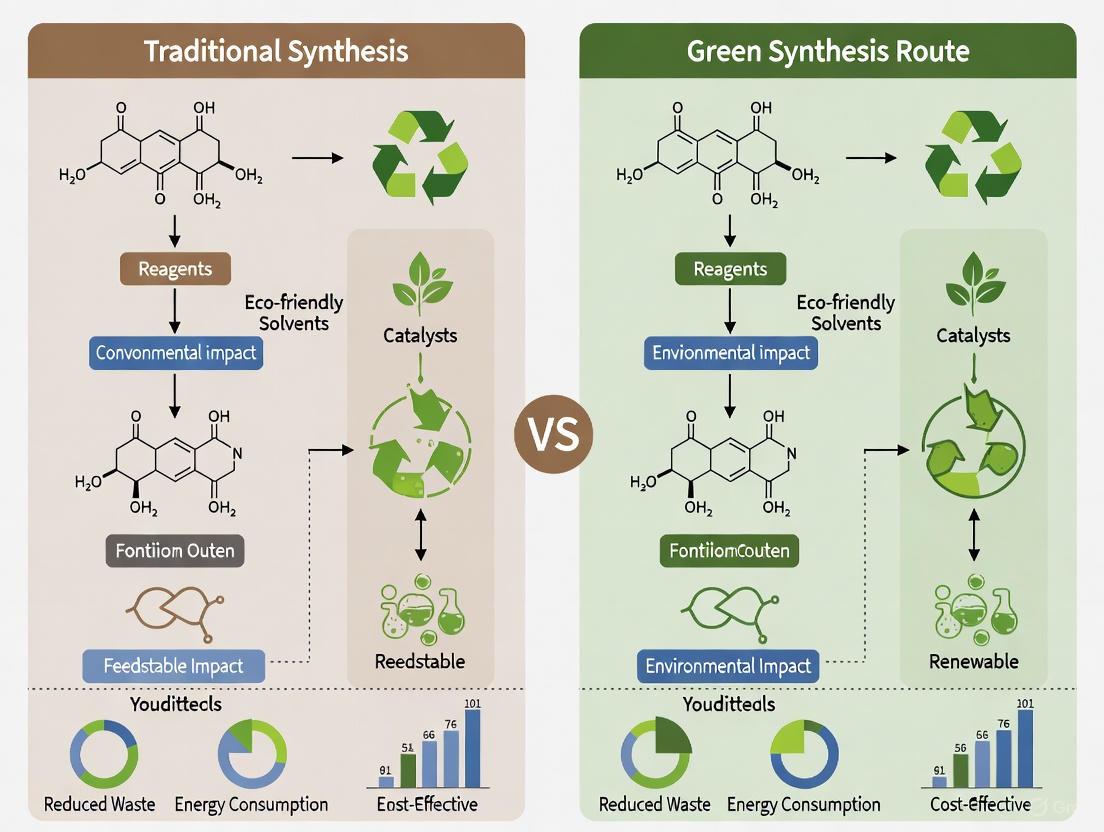
This article provides a comprehensive comparison between traditional and green synthesis routes, tailored for researchers, scientists, and professionals in drug development.
Green vs. Traditional Synthesis: A Comparative Analysis for Sustainable Drug Development
Abstract
This article provides a comprehensive comparison between traditional and green synthesis routes, tailored for researchers, scientists, and professionals in drug development. It explores the foundational principles of green chemistry, showcases cutting-edge methodological applications like solvent-free synthesis and bio-based nanoparticles, and addresses key troubleshooting and optimization challenges. By presenting rigorous validation data and comparative metrics on environmental impact, cost, and performance, this review serves as a strategic guide for integrating sustainable chemistry into biomedical research and development pipelines.
The Principles and Drivers of Sustainable Chemistry in Pharma
The synthesis of nanomaterials, a cornerstone of modern science and industry, has traditionally relied on chemical and physical methods that often involve hazardous substances and energy-intensive processes. In recent years, a paradigm shift has occurred toward green synthesis, an approach rooted in the principles of green chemistry and environmental sustainability. This guide provides an objective comparison of these two synthesis routes, drawing on current research to examine their core principles, methodological protocols, performance outcomes, and environmental impacts. The analysis is particularly relevant for researchers, scientists, and drug development professionals seeking to make informed decisions about nanomaterial production strategies that align with both performance criteria and sustainability goals.
Green synthesis utilizes biological resources such as plant extracts, fungi, bacteria, and algae as replacements for toxic chemical agents traditionally used in nanomaterial production [1]. This approach aims to minimize environmental impact while producing nanoparticles with exceptional biocompatibility and functional properties. In contrast, traditional synthesis methods depend on strong chemical reducing agents, stabilizers, and specialized equipment, often generating hazardous byproducts and consuming significant energy [2]. The following sections provide a detailed comparative analysis of these divergent approaches, supported by experimental data and life cycle assessment studies.
Core Principles and Comparative Analysis
The fundamental distinction between traditional and green synthesis routes lies in their philosophical underpinnings and operational principles. Traditional synthesis prioritizes process efficiency and yield control, while green synthesis emphasizes environmental compatibility and resource sustainability.
Table 1: Core Principles of Traditional vs. Green Synthesis
| Aspect | Traditional Synthesis | Green Synthesis |
|---|---|---|
| Reducing Agents | Synthetic chemicals (sodium borohydride, trisodium citrate) [3] [4] | Natural phytochemicals (polyphenols, flavonoids) or microorganisms [1] [5] |
| Solvents | Often organic, toxic solvents [2] | Aqueous systems, green solvents (water, ethanol) [1] [6] |
| Reaction Conditions | Frequently require high temperature, pressure, and energy input [6] | Ambient temperature and pressure [6] |
| Stabilizing/Capping Agents | Synthetic polymers, surfactants [2] | Natural biomolecules from extracts (proteins, polysaccharides) [1] [7] |
| Environmental Impact | Generates hazardous byproducts; higher energy consumption [2] [8] | Biodegradable byproducts; lower energy requirements [2] [8] |
| Biocompatibility | Often requires post-synthesis modification to improve biocompatibility [3] | Inherently biocompatible due to natural capping agents [3] [4] |
The principles of green synthesis align closely with the 12 Principles of Green Chemistry, which include waste prevention, safer solvents and auxiliaries, and design for energy efficiency [2]. The biological entities used in green synthesis serve dual functions as both reducing and stabilizing agents, facilitating the conversion of metal ions into nanoparticles while simultaneously preventing aggregation through natural capping mechanisms [1]. This integrated approach eliminates the need for additional processing steps often required in traditional synthesis to functionalize nanoparticles for specific applications.
Performance and Environmental Impact: Experimental Data
Comparative studies across multiple nanomaterials consistently demonstrate that green synthesis routes offer significant advantages in terms of reduced cytotoxicity, enhanced biocompatibility, and superior environmental performance.
Cytotoxicity and Biocompatibility
A comprehensive comparative study on metallic nanoparticles (gold, silver, and copper) synthesized through both routes revealed striking differences in biological safety. Cytotoxicity assays on human keratinocytes (HaCaT cells) showed that green-synthesized nanoparticles using Aminated Guar Gum (AGG) retained >63% cell viability, while those synthesized with Terminalia arjuna phytochemicals maintained approximately 57-43% viability. In stark contrast, chemically synthesized counterparts using sodium borohydride (NaBH₄) exhibited markedly lower viability, with Au@NaBH₄ showing only ~9% cell viability [3].
Similarly, research on gold and silver nanoparticles synthesized from floral extracts (H. sabdariffa and P. domesticum) demonstrated "negligible cytotoxicity" in both A549 and HFF cell lines, with AuNPs even enhancing cell viability. Chemically synthesized nanoparticles using trisodium citrate and tannic acid, however, "induced significant cell death" [4].
Functional Performance in Agricultural Applications
In agricultural applications, green-synthesized silver nanoparticles (AgNPs) using Azadirachta indica (neem) leaf extract demonstrated superior performance compared to chemically synthesized counterparts. When used as nanopriming agents for potato seeds under heat stress, green-synthesized AgNPs at an optimal concentration of 5 mg L⁻¹ increased germination by 19% relative to chemical AgNPs and by 50% over hydroprimed controls [9].
Table 2: Comparative Performance of Green vs. Traditional Synthesis
| Application Area | Performance Metric | Green Synthesis Results | Traditional Synthesis Results |
|---|---|---|---|
| Biomedical [3] | Cell Viability (HaCaT) | >63% (AGG); ~57-43% (Phytochemical) | As low as ~9% (NaBH₄) |
| Agriculture [9] | Germination Rate Increase | 50% over control; 19% over chemical AgNPs | Baseline for comparison |
| Agriculture [10] | Seed Yield Increase (Pigeonpea) | 77.41% increase over control | Not reported |
| Antioxidant Activity [5] | IC₅₀ Value (Ag/CeO₂) | 0.086 mg/mL | Not applicable |
| Material Properties [9] | Crystallite Size (AgNPs) | 9.7 nm | 20.6 nm |
| Material Properties [9] | Zeta Potential (AgNPs) | -55.2 mV | -35.7 mV |
| Antimicrobial Activity [7] | MIC (Various Bacteria) | Complete inhibition at 100 μg/mL | Not reported |
Environmental Impact Assessment
Life Cycle Assessment (LCA) studies provide quantitative data on the environmental advantages of green synthesis. An LCA of iron oxide nanoparticles (IONPs) prepared through green synthesis using Cymbopogon citratus extract and sodium carbonate demonstrated significantly lower environmental impacts (1.0 × 10⁻⁹) compared to the coprecipitation method (1.4 × 10⁻⁸) using iron salt precursors and sodium hydroxide [2].
Similarly, an LCA of TiO₂ nanoparticle synthesis showed that "green synthesis contributes to reductions in toxicity and greenhouse gas emissions" compared to traditional chloride routes [8]. The major environmental impact in both processes was attributed to electricity usage and ethanol production, highlighting the importance of energy sources in determining overall sustainability.
Detailed Experimental Protocols
Protocol: Green Synthesis of Metallic Nanoparticles Using Plant Extracts
This representative protocol for synthesizing metallic nanoparticles (e.g., silver, gold, iron) using plant extracts is compiled from multiple recent studies [10] [1] [5].
Plant Extract Preparation
- Collection and Washing: Collect fresh plant leaves (e.g., Terminalia catappa, Azadirachta indica, Matricaria chamomilla) and wash thoroughly with distilled water to remove surface contaminants [10] [5].
- Drying and Size Reduction: Air-dry the plant material at room temperature and cut into small pieces to increase surface area [10].
- Extraction: Boil the plant material in distilled water (typical ratio 1:10 w/v) at 70-80°C for 20-30 minutes using a water bath shaker [10] [5].
- Clarification: Filter the mixture through Whatman No. 1 filter paper, then centrifuge at 1000-5000 rpm for 5-30 minutes to remove debris. The supernatant is stored for further use [10].
Nanoparticle Synthesis
- Precursor Solution: Prepare a 0.01-1 mM aqueous solution of metal salt (e.g., silver nitrate, gold chloride, iron chloride) [10] [5].
- Reaction: Mix the plant extract with the metal salt solution in a ratio typically ranging from 1:1 to 1:5 (v/v) under continuous stirring [10] [1].
- Incubation: Maintain the reaction mixture at 60-70°C with constant stirring for 1-3 hours until a color change indicates nanoparticle formation (e.g., dark brown for silver nanoparticles) [5].
- Purification: Centrifuge the nanoparticle solution at 10,000-15,000 rpm for 10-30 minutes, discard the supernatant, and resuspend the pellet in distilled water or ethanol. Repeat this washing process 2-3 times [5].
- Drying: Dry the purified nanoparticles at 150°C for 2 hours or through lyophilization for powder formation [10].
Protocol: Chemical Synthesis of Silver Nanoparticles
This protocol for chemical synthesis of silver nanoparticles using sodium borohydride as a reducing agent is based on methods referenced in the comparative studies [3].
Preparation of Solutions
- Reducing Agent Solution: Prepare a fresh 0.1 M ice-cold aqueous solution of sodium borohydride (NaBH₄) in distilled water.
- Precursor Solution: Prepare a 1 mM aqueous solution of silver nitrate (AgNO₃) in distilled water.
Reaction Process
- Reduction: Add the sodium borohydride solution dropwise to the silver nitrate solution under vigorous stirring at room temperature.
- Stabilization: Continue stirring for 1-2 hours to ensure complete reduction of silver ions. The solution typically turns yellow, indicating the formation of silver nanoparticles.
- Purification: Purify the nanoparticles using dialysis or repeated centrifugation similar to the green synthesis method.
Characterization and Analytical Methods
Comprehensive characterization is essential for comparing nanoparticles from different synthesis routes. The following analytical techniques provide complementary information about physicochemical properties:
- UV-Visible Spectroscopy: Confirms nanoparticle formation through surface plasmon resonance absorption peaks (typically 400-450 nm for silver nanoparticles, 500-550 nm for gold nanoparticles) [10].
- Dynamic Light Scattering (DLS): Determines hydrodynamic size distribution and particle dispersion in colloidal suspensions [9] [10].
- Zeta Potential Analysis: Measures surface charge and predicts colloidal stability; values exceeding ±30 mV indicate good stability [9].
- Electron Microscopy (SEM/TEM): Provides high-resolution imaging of nanoparticle size, shape, and morphology at the nanoscale [9] [10].
- X-ray Diffraction (XRD): Analyzes crystalline structure, phase composition, and estimates crystallite size using Scherrer's equation [9] [10].
- Fourier Transform Infrared (FTIR) Spectroscopy: Identifies functional groups from biological extracts responsible for reduction and capping of nanoparticles [9] [10] [5].
The Scientist's Toolkit: Essential Research Reagents and Materials
Table 3: Essential Reagents for Green and Traditional Synthesis Research
| Reagent/Material | Function | Green Synthesis Examples | Traditional Synthesis Examples |
|---|---|---|---|
| Reducing Agents | Converts metal ions to elemental nanoparticles | Plant extracts (Terminalia catappa, Azadirachta indica, Matricaria chamomilla) [10] [5] | Sodium borohydride, trisodium citrate, tannic acid [3] [4] |
| Metal Salts | Source of metal ions for nanoparticle formation | Silver nitrate, gold chloride, zinc nitrate, iron chloride [10] [5] | Silver nitrate, gold chloride, zinc nitrate, iron chloride [3] [10] |
| Stabilizing Agents | Prevents nanoparticle aggregation | Natural biomolecules in extracts (proteins, polysaccharides) [1] | Synthetic polymers, surfactants [2] |
| Solvents | Reaction medium | Distilled water, ethanol [1] [5] | Organic solvents, distilled water [2] |
| pH Modifiers | Controls reaction rate and nanoparticle size | Sodium carbonate [2] | Sodium hydroxide [2] |
The comparative analysis presented in this guide demonstrates that green synthesis offers a compelling alternative to traditional methods, particularly for applications requiring high biocompatibility such as drug development, biomedical applications, and agricultural nanotechnology. The significantly reduced cytotoxicity of green-synthesized nanoparticles, combined with their comparable or superior functional performance in many applications, positions this approach as a viable and sustainable synthesis paradigm.
Future research directions should address current challenges in green synthesis, including the standardization of biological extracts, improved control over particle size distribution, and optimization of large-scale production processes. The integration of green chemistry principles with advanced characterization techniques and life cycle assessment will further strengthen the scientific foundation for sustainable nanomaterial production. As the field evolves, the paradigm shift toward green synthesis is likely to accelerate, driven by both performance advantages and growing regulatory and environmental imperatives.
The journey from the publication of Silent Spring to the implementation of the European Green Deal represents a profound shift in environmental and regulatory philosophy, creating a powerful impetus for adopting sustainable scientific practices. Rachel Carson's 1962 landmark book exposed the ecological dangers of indiscriminate pesticide use, fundamentally altering public consciousness and sparking a global regulatory movement that continues to evolve today [11]. The European Green Deal now establishes a modern regulatory framework demanding cleaner production processes across industries, including pharmaceutical development and nanotechnology.
This evolving regulatory landscape has accelerated the transition from traditional chemical synthesis methods to greener alternatives that minimize environmental impact and health risks. Green synthesis approaches have emerged as sustainable pathways for producing advanced materials, including metallic nanoparticles, which are invaluable in drug development, diagnostic applications, and therapeutic technologies. This guide provides an objective comparison between traditional and green synthesis routes, presenting experimental data to help researchers and drug development professionals navigate this transition effectively.
Historical Context: From Scientific Warning to Regulatory Action
The Impact ofSilent Springand Early Regulations
Rachel Carson's Silent Spring served as the catalyst for modern environmental regulation by demonstrating how synthetic chemicals could accumulate in ecosystems with devastating effects. The book's publication sparked immediate international concern, with translations appearing across Europe within years of its release [11]. The Swedish response was particularly significant; they not only adopted Carson's suggested terminology—replacing "pesticides" with the more accurate "biocides"—but also established the world's first comprehensive environmental regulatory agency in 1967 [11]. This early action established the precedent that scientific warnings should trigger regulatory response, a principle that continues under the European Green Deal.
The philosophical shift initiated by Silent Spring fundamentally changed how scientists approach chemical development. Where traditional methods prioritized efficiency and cost above environmental concerns, the new paradigm demanded consideration of ecological impact, biodegradability, and life cycle consequences. This evolving consciousness has now crystallized in comprehensive regulatory frameworks that explicitly favor sustainable synthesis methods.
Methodology: Comparison Framework and Experimental Protocols
Green Synthesis Experimental Protocol
Green synthesis of metal nanoparticles using plant extracts follows a standardized methodology with specific parameters requiring optimization [12] [13]:
Plant Extract Preparation: Fresh plant material (leaves, stems, or flowers) is thoroughly washed with distilled water and dried at 60°C. The dried material is ground into powder, and 10g is mixed with 100mL deionized water. The mixture is boiled for 30 minutes, cooled to room temperature, and filtered through Whatman No. 1 filter paper [13].
Nanoparticle Synthesis: 5mL of plant extract is added to 95mL of metal precursor solution (e.g., 1-3mM AgNO₃ for silver nanoparticles). The mixture is heated to 40-45°C with continuous stirring. Nanoparticle formation is indicated by color change—from pale yellowish to reddish-brown for AgNPs [13].
Parameter Optimization: Critical parameters must be optimized for each system:
Purification: The mixture is centrifuged at 5,000 rpm for 30 minutes, supernatant discarded, and nanoparticles dried at 25°C before characterization [13].
Traditional Synthesis Experimental Protocol
Traditional chemical synthesis employs chemical reducing agents under controlled conditions:
Chemical Reduction: Metal precursor solution (e.g., AgNO₃) is combined with chemical reducing agents such as sodium borohydride (NaBH₄) or trisodium citrate in aqueous solution.
Stabilization: Polymers such as polyethylene glycol (PEG) or polyvinylpyrrolidone (PVP) are added as stabilizing agents to control particle growth and prevent aggregation.
Parameter Control: Reactions typically proceed at room temperature or with mild heating, with pH adjusted using NaOH or HCl.
Purification: Similar centrifugation and washing steps remove excess reagents and reaction byproducts.
Characterization Methods
Both synthesis routes utilize identical characterization techniques for objective comparison:
- UV-Vis Spectroscopy: Confirms nanoparticle formation through surface plasmon resonance peaks [12] [13].
- Electron Microscopy: TEM and SEM analyze morphology, size, and distribution [12].
- Dynamic Light Scattering: Measures hydrodynamic diameter and polydispersity index [12].
- X-ray Diffraction: Determines crystallographic structure [12].
- FTIR Spectroscopy: Identifies functional groups involved in reduction and stabilization [13].
- Zeta Potential Analysis: Evaluates colloidal stability through surface charge measurement [12].
Comparative Analysis: Traditional vs. Green Synthesis
The following tables synthesize experimental data from multiple studies to objectively compare traditional and green synthesis approaches across critical performance parameters.
Table 1: Synthesis Parameter Comparison Between Traditional and Green Routes
| Parameter | Traditional Synthesis | Green Synthesis | Experimental Basis |
|---|---|---|---|
| Reducing Agent | Chemical (NaBH₄, citrate) | Plant phytochemicals (phenols, flavonoids) | [12] [13] [1] |
| Stabilizing Agent | Synthetic polymers (PEG, PVP) | Plant biomolecules (proteins, polysaccharides) | [12] [1] |
| Reaction Temperature | 25-45°C | 40-80°C | [12] [13] |
| Reaction Time | Minutes to 2 hours | 1-24 hours | [12] [13] |
| pH Dependence | Wide range possible | Specific optimal pH for each system | [12] |
| Byproducts | Toxic chemical residues | Biodegradable organic compounds | [1] |
Table 2: Nanoparticle Characteristics and Performance Comparison
| Characteristic | Traditional Synthesis | Green Synthesis | Experimental Evidence |
|---|---|---|---|
| Particle Size | 10-50 nm | 30-80 nm (highly tunable) | AgNPs: 30.8±8.81nm (green) [12] |
| Size Distribution | Narrow (controlled) | Moderate to narrow | PDI: 0.2-0.3 for green AgNPs [12] |
| Shape Control | Excellent | Good (spherical predominant) | Spherical AgNPs and polymorphic CuONPs [12] |
| Stability (Zeta Potential) | High (-30 to -50mV) | Moderate to High (-25 to -78mV) | Ag/CuONPs: -77.9±2.99mV [12] |
| Antioxidant Activity | Limited | Significant | CuONPs showed highest DPPH radical scavenging [12] |
| Cytotoxicity | Higher toxicity observed | Lower cytotoxicity, enhanced biocompatibility | Green AuNPs enhanced cell viability [4] |
| Environmental Impact | High (toxic chemicals) | Low (biodegradable materials) | [1] |
Table 3: Applications Performance Comparison in Biomedical Contexts
| Application | Traditional NPs | Green NPs | Experimental Support |
|---|---|---|---|
| Antibacterial Activity | Potent but non-selective | Potent with improved selectivity | Green AgNPs effective against E. faecalis and P. aeruginosa [13] |
| Catalytic Efficiency | High | Comparable or enhanced | Green AgNPs effective in reducing nitro compounds [13] |
| Wound Healing | Limited by cytotoxicity | Enhanced viability promotion | Green AuNPs enhanced cell viability in A549 and HFF lines [4] |
| Biocompatibility | Moderate to poor | Excellent | Green-synthesized NPs showed negligible cytotoxicity [4] [1] |
| Drug Delivery Potential | Requires surface modification | Inherent functionality | Phytochemicals provide inherent targeting [1] |
Experimental Data Analysis
Synthesis Efficiency and Material Characteristics
Experimental data reveals that green synthesis methods produce nanoparticles with comparable quality to traditional approaches while offering enhanced biocompatibility. Silver nanoparticles synthesized using Cistus creticus L. extract exhibited well-defined spherical morphology with an average size of 30.8±8.81nm, while bimetallic Ag/CuONPs demonstrated exceptional stability with a zeta potential of -77.9±2.99mV [12]. This high negative charge contributes to colloidal stability by preventing aggregation through electrostatic repulsion.
Characterization studies confirm that plant-mediated synthesis produces crystalline nanoparticles with defined surface plasmon resonance peaks. UV-Vis spectroscopy shows characteristic absorbance at 428nm for AgNPs, 219nm and 283nm for CuONPs, and 282nm and 403nm for bimetallic Ag/CuONPs [12]. These signatures confirm successful reduction and formation of distinct metallic nanostructures using green chemistry approaches.
Biological Performance and Environmental Safety
Comparative biological assessment demonstrates significant advantages for green-synthesized nanoparticles. Cytotoxicity studies on A549 and HFF cell lines revealed that green-synthesized gold and silver nanoparticles exhibited negligible cytotoxicity, with AuNPs even enhancing cell viability [4]. In contrast, chemically synthesized counterparts induced significant cell death and increased oxidative states under UV-Vis-NIR radiation [4].
Antioxidant capacity assessment via DPPH assay demonstrated that green-synthesized CuONPs had the highest free radical scavenging activity among the tested nanoparticles [12]. This enhanced bioactivity originates from the phytochemical capping agents that remain on nanoparticle surfaces, providing additional functionality beyond what traditional synthesis methods offer.
The Scientist's Toolkit: Essential Research Reagents
Table 4: Key Research Reagent Solutions for Green Synthesis
| Reagent/Category | Function | Examples & Specific Uses |
|---|---|---|
| Plant Extracts | Reducing & stabilizing agents | Cistus creticus L., Artemisia scoparia, H. sabdariffa extracts for metal ion reduction [12] [13] [4] |
| Metal Precursors | Source of metal ions | AgNO₃ (silver NPs), CuCl₂·2H₂O (copper oxide NPs), HAuCl₄ (gold NPs) [12] [13] |
| pH Modifiers | Control reduction kinetics | NaOH for basic conditions, HCl for acidic conditions [12] |
| Antioxidant Assays | Evaluate bioactivity | DPPH radical scavenging assay to quantify free radical neutralization [12] |
| Characterization Tools | Size, structure, stability | DLS for size, ELS for zeta potential, TEM for morphology [12] [13] |
| Cytotoxicity Assays | Biocompatibility assessment | Cell viability tests (A549, HFF cell lines) [4] |
Workflow Visualization
The following diagram illustrates the integrated experimental-computational workflow for green synthesis and characterization, highlighting the interdisciplinary approach required for modern sustainable nanomaterial development:
Green Synthesis Workflow
The regulatory evolution from Silent Spring to the European Green Deal has fundamentally transformed the scientific landscape, making sustainable synthesis methods increasingly imperative. Experimental evidence demonstrates that green synthesis approaches can produce metallic nanoparticles with comparable structural characteristics to traditionally synthesized counterparts while offering enhanced biocompatibility, reduced environmental impact, and additional biological functionality.
For researchers and drug development professionals, the transition to green synthesis represents both a regulatory necessity and a scientific opportunity. The data presented in this guide indicates that green-synthesized nanoparticles frequently outperform traditional nanoparticles in biomedical applications, particularly where cytotoxicity, antioxidant activity, and environmental safety are concerned. While traditional methods may still offer advantages in precise size control and rapid synthesis, the compelling benefits of green approaches align with both regulatory trends and performance requirements for advanced pharmaceutical applications.
As the European Green Deal continues to shape the regulatory landscape, the scientific community's adoption and refinement of green synthesis protocols will be essential for developing innovative, sustainable, and compliant healthcare solutions.
The pharmaceutical industry faces increasing pressure to balance innovation with environmental responsibility. Green chemistry has emerged as a transformative approach, defined as the design of chemical products and processes that reduce or eliminate the use and generation of hazardous substances [14] [15]. While traditional synthesis methods often prioritize yield and speed, green chemistry principles align environmental goals with economic and operational benefits, creating a compelling business case centered on waste minimization, cost reduction, and ESG (Environmental, Social, and Governance) compliance [16] [17].
The environmental impact of pharmaceutical manufacturing is significant; the industry often has E-Factor values between 25 and 100, meaning 25-100 kg of waste are generated for every 1 kg of active pharmaceutical ingredient (API) produced [14]. Solvents constitute 80-90% of the total mass used in manufacturing processes, highlighting a major area for improvement [14]. This review objectively compares traditional and green synthesis routes, providing experimental data and methodologies to guide researchers, scientists, and drug development professionals in adopting more sustainable and economically viable practices.
Quantitative Comparison of Synthesis Routes
Case Study: Copper Oxide Nanoparticle Synthesis
A direct comparative study synthesized copper oxide nanoparticles (CuO NPs) via green and conventional methods, with detailed characterization of their properties and performance in hydrogen evolution reactions (HER) [18].
Table 1: Comparison of CuO NPs Synthesized via Green vs. Conventional Routes [18]
| Parameter | Green Synthesis (Okra Extract) | Conventional Synthesis (Hydrazine Hydrate) |
|---|---|---|
| Reducing/Stabilizing Agent | Okra extract (polyphenols, flavonoids) | Hydrazine hydrate & EDTA |
| Crystallite Size (XRD) | 39.8 nm | 56.8 nm |
| Dislocation Density | 0.630 × 10⁻⁵ nm⁻² | 0.310 × 10⁻⁵ nm⁻² |
| HER Overpotential | 408.49 mV (at 20 mA cm⁻²) | 342.2 mV (at 20 mA cm⁻²) |
| Cathodic Current Density | 11.3 mA cm⁻² (at -1.3 V) | 15.9 mA cm⁻² (at -1.3 V) |
Experimental Protocol for Green Synthesis (CuOokra)
- Extract Preparation: Fresh okra (Abelmoschus esculentus) fruit is washed and homogenized with deionized water. The mixture is centrifuged, and the supernatant is used as the reducing agent [18].
- Reaction: An aqueous solution of copper salt (e.g., copper sulfate or copper nitrate) is mixed with the okra extract under continuous stirring [18].
- Complexation & Calcination: The formation of a metal-ion complex is followed by calcination at 400°C to obtain crystalline CuO nanoparticles [18].
Experimental Protocol for Conventional Synthesis (CuOhyd)
- Reaction Mixture: A 2:1 solution of Fe²⁺ and Fe³⁺ salts is prepared with the addition of oleic acid under mechanical stirring (1000 rpm) [19].
- Precipitation: Ammonium hydroxide is added to the system until the pH reaches 11 [19].
- Heating & Washing: The reaction mixture is heated to 85°C and maintained for 30 minutes. The resulting product is filtered and washed with ultrapure water until a neutral pH is achieved [19].
Case Study: Iron Nanoparticles for Catalytic Ozonation
Another comparative study prepared iron nanoparticles (Fe-C-NPs) through green and conventional methods for use in catalytic ozonation to remove emerging contaminants [19].
Table 2: Comparison of Iron Nanoparticles for Catalytic Ozonation [19]
| Parameter | Green Fe-C-NPs (Eucalyptus/Mulberry) | Conventional Fe-C-NPs |
|---|---|---|
| Synthesis Route | Eucalyptus or Mulberry leaves extract | Ammonia as reducing agent |
| Composition | Higher Fe and O content | Standard Fe/O ratio |
| Performance in Ultrapure Water | Higher efficiency in degrading contaminants | Lower efficiency compared to green NPs |
| Performance in Secondary Effluent | Equivalent efficiency to conventional NPs | Equivalent efficiency to green NPs |
| Environmental & Cost Impact | Low cost, environmentally friendly, reduces toxic chemical use | Uses toxic ammonia, higher environmental footprint |
Experimental Protocol for Green Fe-C-NPs
- Extract Preparation: Eucalyptus or mulberry leaves are dried and ground. The plant powder is added to boiling water and filtered after cooling to obtain the extract [19].
- Nanoparticle Synthesis: The plant extract is added to an iron salt solution (e.g., FeCl₃) under vigorous stirring. The reaction proceeds until nanoparticle formation is complete, indicated by a color change [19].
- Recovery: The nanoparticles are recovered using magnetic separation or centrifugation, followed by washing and drying [19].
Key Green Chemistry Methodologies and Workflows
Advanced Catalysis
Catalysis plays a pivotal role in driving greener chemical reactions by reducing steps, energy consumption, and unwanted byproducts [15].
Catalysis Comparison Diagram
- Photocatalysis: Utilizes visible light to drive reactions under low temperatures, enabling safer reagents and new synthetic pathways. AstraZeneca has used this to remove several stages from a cancer medicine's manufacturing process [15].
- Electrocatalysis: Employs electricity to drive reactions, replacing harmful chemical reagents and enabling unique reaction pathways under mild conditions [15].
- Biocatalysis: Uses enzymes (proteins) to achieve in a single step what can take many steps using traditional methods, offering more streamlined routes to complex molecules [15].
- Sustainable Metal Catalysis: Replaces scarce precious metals like palladium with earth-abundant alternatives like nickel. This substitution has led to reductions of more than 75% in CO₂ emissions, freshwater use, and waste generation in borylation reactions [15].
Solvent and Reaction Optimization
Solvent selection and reaction engineering are critical, as solvents account for over 60% of all processed materials or waste in pharmaceutical synthesis [20] [14].
Table 3: Green Chemistry Reaction Optimization Techniques
| Technique | Key Feature | ESG & Business Impact | Experimental Protocol Summary |
|---|---|---|---|
| Mechanochemistry [21] | Solvent-free synthesis using mechanical energy (e.g., ball milling) | Reduces solvent waste, enhances safety, lowers disposal costs | Reactants are placed in a ball mill with grinding media. Mechanical energy drives the reaction without solvents. |
| Water-Based Reactions [21] | Uses water as a non-toxic, non-flammable reaction medium | Eliminates toxic organic solvent use, reduces safety risks | Water-insoluble reactants are stirred in water, often achieving acceleration at the water-organic interface. |
| Microwave-Assisted Synthesis [20] [14] | Uses microwave irradiation for rapid, uniform heating | Reduces reaction times (minutes vs. hours), improves energy efficiency, increases yield | Reactions are performed in sealed microwave vessels with polar solvents or reactants that absorb microwave energy. |
| Flow Chemistry [20] [21] | Continuous flow in reactors instead of batch processing | Superior heat/mass transfer, improved safety, easier scaling, reduced waste | Reactants are pumped through a temperature-controlled reactor tube, allowing precise control over reaction time. |
| Deep Eutectic Solvents (DES) [21] | Biodegradable solvents from natural compounds | Enables circular economy, resource recovery from waste, low toxicity | A hydrogen bond acceptor (e.g., choline chloride) and donor (e.g., urea) are mixed to form a low-melting-point solvent. |
The Scientist's Toolkit: Key Research Reagent Solutions
Table 4: Essential Reagents and Materials for Green Synthesis Experiments
| Reagent/Material | Function in Green Synthesis | Example Application |
|---|---|---|
| Plant Extracts (e.g., Okra, Eucalyptus, Mulberry) [19] [18] | Act as reducing and stabilizing agents for nanoparticle synthesis. Rich in polyphenols and flavonoids. | Green synthesis of metal oxide nanoparticles (e.g., CuO, Fe-C-NPs). |
| Nickel Catalysts [15] | Earth-abundant alternative to precious palladium catalysts for cross-coupling reactions. | Borylation and Suzuki reactions, reducing environmental impact. |
| Choline Chloride [21] | A quaternary ammonium salt and common Hydrogen Bond Acceptor (HBA) for Deep Eutectic Solvents (DES). | Forming DES with urea or glycols for eco-friendly extraction. |
| Water [21] | Non-toxic, non-flammable solvent for reactions, replacing volatile organic compounds. | Performing Diels-Alder and other organic reactions in water. |
| Enzymes (e.g., engineered biocatalysts) [15] | Highly specific biological catalysts that streamline synthetic routes. | Synthesizing complex drug molecules in fewer steps than traditional chemistry. |
The Integrated Business and ESG Impact
Adopting green chemistry transcends laboratory research, delivering tangible business and ESG benefits across the pharmaceutical value chain.
Cost Reduction: Sustainability initiatives directly cut operational expenses. Companies focusing on energy efficiency, waste reduction, and logistics optimization can reduce costs by up to 9% [17]. Recovering and reusing solvents, a major waste component, directly improves the bottom line [15].
ESG Compliance and Access to Capital: Strong ESG performance is increasingly linked to financial advantage. Companies with high ESG scores are viewed as lower-risk investments and can benefit from a lower cost of debt—by up to 3% on average [17]. Sustainability-linked loans often carry interest rates that are 2.5–10 basis points lower than standard loans [17]. With stringent regulations emerging, such as California's climate disclosure laws and the EU's Green Deal, proactive adoption of green chemistry ensures compliance and mitigates regulatory risk [16].
Talent Attraction and Retention: A strong sustainability culture is a powerful tool for engaging today's workforce. Companies with robust ESG strategies experience 25% lower turnover among millennial employees, reducing recruitment costs and stabilizing the workforce [17].
The strategic integration of green chemistry principles presents an undeniable business case. It enables the pharmaceutical industry to achieve waste minimization, significant cost savings, and robust ESG compliance, all while driving scientific innovation for a healthier future.
In the evolving landscape of drug development, reducing toxicity and enhancing biocompatibility have emerged as pivotal drivers for clinical success. A fundamental paradigm shift is occurring in how therapeutic nanoparticles are synthesized, moving from traditional chemical methods toward greener alternatives that offer superior safety profiles. This transition addresses a critical challenge in pharmaceutical development: the high failure rate of drug candidates due to safety concerns and unfavorable toxicity profiles. As nanotechnology continues to transform medical applications—from targeted drug delivery to diagnostic imaging—the methods used to create these nano-sized materials significantly influence their biological interactions and therapeutic potential [22].
The comparative analysis between traditional chemical synthesis and green synthesis routes reveals substantial differences in cytotoxicity, environmental impact, and biomedical applicability. Traditional approaches often rely on hazardous chemicals like sodium borohydride (NaBH₄) and hydrazine, which generate toxic byproducts and residual reagents that compromise biocompatibility [3] [22]. In contrast, green synthesis utilizes biological resources such as plant extracts and biodegradable polymers, aligning with green chemistry principles by minimizing waste, reducing energy consumption, and eliminating toxic inputs [1] [23]. This comprehensive guide objectively compares these divergent synthesis pathways through experimental data, methodological protocols, and toxicity assessments, providing researchers with evidence-based insights for selecting optimal synthesis strategies in drug development programs.
Comparative Analysis: Green vs. Traditional Synthesis Methods
Fundamental Principles and Philosophical Frameworks
The philosophical underpinnings of traditional and green synthesis approaches reflect fundamentally different relationships with environmental resources and safety considerations. Traditional chemical synthesis prioritizes precision, reproducibility, and rapid reaction kinetics, often at the expense of environmental compatibility and biological safety [22]. This approach typically employs strong reducing agents like sodium borohydride and synthetic stabilizers such as polyvinylpyrrolidone or cetyltrimethylammonium bromide (CTAB), which persist as potentially toxic residues on nanoparticle surfaces [3] [24]. The operational conditions frequently require high temperature, pressure, and extreme pH levels, consuming substantial energy while generating hazardous waste that necessitates complex disposal protocols [23].
Green synthesis embodies the twelve principles of green chemistry, emphasizing accident prevention, atom economy, and the design of safer chemicals [22]. This framework utilizes renewable biological resources—including plant extracts, microorganisms, and biodegradable polymers—as multifunctional agents that simultaneously reduce metal ions and stabilize resulting nanoparticles [1] [25]. The process occurs under mild, energy-efficient conditions (ambient temperature and pressure) with aqueous solvents, significantly reducing the environmental footprint [23]. The bioactive compounds inherent in biological sources, such as polyphenols, flavonoids, and terpenoids, not only facilitate nanoparticle formation but may also confer therapeutic benefits that enhance biomedical functionality [25] [24].
Quantitative Comparison of Synthesis Methods and Outcomes
Table 1: Comprehensive Comparison Between Green and Traditional Nanoparticle Synthesis Methods
| Parameter | Green Synthesis | Chemical/Physical Synthesis |
|---|---|---|
| Reducing Agents | Natural compounds (e.g., flavonoids, polyphenols, terpenoids) | Toxic chemicals (e.g., NaBH₄, hydrazine, citrate) |
| Stabilizers/Capping Agents | Plant metabolites, proteins, polysaccharides | Synthetic surfactants, polymers, PEG, CTAB |
| Reaction Conditions | Mild (ambient temperature and pressure, aqueous solvents) | Often harsh (high temperature, pressure, extreme pH) |
| Reproducibility | Variable due to biological extract composition | High; well-controlled and standardized |
| Yield | Moderate to low | High |
| Scalability | Challenging due to biological variability | Easily scalable for industrial applications |
| Environmental Impact | Minimal, eco-friendly, biodegradable | High, generates hazardous byproducts |
| Biocompatibility | High, lower cytotoxicity | Requires extensive post-processing for safety |
| Cost Considerations | Low, uses renewable abundant resources | High due to synthetic reagents and energy demands |
| Typical Residual Components | Biologically active phytochemicals | Toxic chemical precursors and stabilizers |
Table 2: Experimental Toxicity Assessment of Metallic Nanoparticles from Different Synthesis Routes
| Nanoparticle Type | Synthesis Method | Cell Line/Model | Cell Viability/ Toxicity Outcome | Key Findings |
|---|---|---|---|---|
| Gold NPs (AuNPs) | Chemical (NaBH₄) | Human Keratinocytes (HaCaT) | ~9% viability | Marked cytotoxicity |
| Gold NPs (AuNPs) | Aminated Guar Gum (AGG) | Human Keratinocytes (HaCaT) | >63% viability | Superior biocompatibility |
| Gold NPs (AuNPs) | Terminalia arjuna (AT) | Human Keratinocytes (HaCaT) | ~43-57% viability | Moderate biocompatibility |
| Silver NPs (AgNPs) | Chemical | Various cell lines | Variable, often <50% viability | Dose-dependent toxicity |
| Silver NPs (AgNPs) | Plant extracts (Ocimum sanctum, Azadirachta indica) | Various cell lines | Significantly higher viability | Enhanced biocompatibility |
| Zinc Oxide NPs (ZnO-NPs) | Chemical precipitation | Human Foreskin Fibroblast-2 (HFF-2) | Substantially reduced viability | Significant cytotoxicity |
| Zinc Oxide NPs (ZnO-NPs) | Punica granatum fruit peel extract | Human Foreskin Fibroblast-2 (HFF-2) | Significantly higher viability | Reduced cytotoxicity, enhanced safety |
The experimental data compiled from multiple studies consistently demonstrates the superior biocompatibility of green-synthesized nanoparticles across different metal types and biological models [3] [25]. The dramatic difference in cell viability—from a mere 9% with traditional chemical synthesis to over 63% with green methods using aminated guar gum—underscores the critical importance of synthesis route selection in pharmaceutical development [3]. This pattern holds true for various metallic nanoparticles, including silver, gold, and zinc oxide, indicating a universal advantage of green synthesis approaches for biomedical applications.
Experimental Protocols and Methodologies
Standardized Green Synthesis Protocol Using Plant Extracts
The green synthesis of metallic nanoparticles using plant extracts follows a meticulously controlled protocol that ensures reproducibility and optimal nanoparticle characteristics [25] [24]. For zinc oxide nanoparticles synthesized with Punica granatum (pomegranate) fruit peel extract, the process begins with plant material preparation: fresh fruit peels are thoroughly washed with distilled water to remove impurities, then dried at 40°C for 48 hours in a controlled environment [25]. The dried material is ground to a fine powder using a mortar and pestle or mechanical grinder, followed by extraction where 150g of the resulting powder undergoes ethanol extraction (70% concentration) in a separation funnel, with the solvent maintained 2cm above the powder level for optimal compound diffusion [25]. The extraction process repeats three times to maximize yield, with the combined extract concentrated using a rotary evaporator to remove alcohol, resulting in a gummy residue reserved for nanoparticle synthesis [25].
For nanoparticle formation, 4g of zinc acetate dihydrate are dissolved in 25mL deionized water to create a 0.5M solution, heated to 70°C with continuous magnetic stirring [25]. The critical synthesis step involves adding 2.5mL of plant extract dropwise to the metal salt solution, facilitating the reduction of zinc ions to zinc nanoparticles through phytochemical interactions. The pH is adjusted to 11 using 1M sodium hydroxide (NaOH) solution to optimize reaction kinetics and nanoparticle properties, followed by refluxing with continuous stirring for 24 hours to complete the reduction and stabilization processes [25]. The resulting white precipitate is isolated via centrifugation at 10,000 rpm for 10 minutes, then washed three times with deionized water to remove unreacted precursors before final processing through freeze-drying to obtain powdered ZnO nanoparticles ready for characterization and application [25].
Comparative Chemical Synthesis Protocol
For objective comparison, traditional chemical synthesis of zinc oxide nanoparticles employs a chemical precipitation method [25]. This approach begins with precursor preparation, dissolving 2g of zinc acetate dihydrate in 15mL deionized water alongside a separate solution of 8g sodium hydroxide (NaOH) in 10mL deionized water [25]. The reaction initiates by gradually adding the NaOH solution to the zinc acetate solution under constant stirring, inducing immediate precipitation through rapid chemical reduction. The mixture undergoes continuous stirring for 2 hours at room temperature to ensure complete particle formation, followed by aging the precipitate for 24 hours to enhance crystallinity and structural stability [25]. The resulting nanoparticles are collected through centrifugation at comparable parameters to the green synthesis method (10,000 rpm for 10 minutes), with the pellet washed multiple times with deionized water and ethanol to remove reaction byproducts before final drying at 60°C for 12 hours [25].
Cytotoxicity Assessment Methodology
The evaluation of nanoparticle biocompatibility employs standardized in vitro assays that provide quantitative data on cellular responses [3] [25]. The MTT (3-[4,5-dimethylthiazol-2-yl]-2,5-diphenyl tetrazolium bromide) assay measures metabolic activity as an indicator of cell viability [25]. This protocol begins with cell seeding, where adherent cell lines (such as Human Foreskin Fibroblast-2/HFF-2 or Human Keratinocytes/HaCaT) are plated in 96-well plates at a density of 1×10⁴ cells per well in complete growth medium, followed by incubation for 24 hours at 37°C with 5% CO₂ to establish monolayer attachment [3] [25]. Treatment application involves exposing cells to varying concentrations of nanoparticles (typically 0-200 μg/mL) suspended in fresh culture medium, with controls receiving nanoparticle-free medium, and incubation continues for 24-72 hours depending on the experimental design [3].
The assessment phase adds 20μL of MTT solution (5mg/mL in PBS) to each well, followed by 4 hours of incubation at 37°C to allow formazan crystal formation through mitochondrial reductase activity in viable cells [25]. The solvent addition step carefully removes the medium and adds 150μL of dimethyl sulfoxide (DMSO) to each well to dissolve the formazan crystals, with gentle shaking for 10 minutes to ensure complete dissolution [25]. Absorbance measurement occurs at 570nm using a microplate reader, with cell viability calculated as a percentage relative to untreated control cells using the formula: % Viability = (Absorbance of treated sample / Absorbance of control) × 100% [3] [25].
Essential Research Reagents and Materials
Table 3: Research Reagent Solutions for Nanoparticle Synthesis and Evaluation
| Reagent/Material | Function and Application | Specific Examples |
|---|---|---|
| Plant Extracts | Natural reducing and stabilizing agents for green synthesis | Punica granatum fruit peel, Terminalia arjuna bark, Aminated Guar Gum (AGG), Azadirachta indica (neem), Ocimum sanctum (tulsi) |
| Metal Salts | Precursors for nanoparticle formation | Zinc acetate dihydrate (for ZnO-NPs), Silver nitrate (for AgNPs), Chloroauric acid (for AuNPs) |
| Chemical Reducing Agents | Traditional reduction of metal ions | Sodium borohydride (NaBH₄), Hydrazine, Trisodium citrate |
| Cell Lines | In vitro toxicity and biocompatibility assessment | Human Keratinocytes (HaCaT), Human Foreskin Fibroblast-2 (HFF-2), Various cancer cell lines for therapeutic efficacy |
| Characterization Equipment | Structural and functional analysis of nanoparticles | UV-Vis Spectrophotometer, Dynamic Light Scattering (DLS), Transmission Electron Microscopy (TEM), Scanning Electron Microscopy (SEM), Fourier-Transform Infrared Spectroscopy (FTIR), X-Ray Diffraction (XRD) |
| Toxicity Assay Kits | Quantitative biocompatibility evaluation | MTT assay kits, Hemolysis assay reagents, Apoptosis detection kits, Reactive Oxygen Species (ROS) detection assays |
| Stabilizing Agents (Traditional) | Surface modification and aggregation prevention | Polyvinylpyrrolidone (PVP), Cetyltrimethylammonium bromide (CTAB), Polyethylene glycol (PEG) |
| Culture Media and Supplements | Cell maintenance and propagation | Dulbecco's Modified Eagle Medium (DMEM), Fetal Bovine Serum (FBS), Penicillin-Streptomycin solution, Trypsin-EDTA |
The selection of appropriate research reagents fundamentally influences both the synthesis outcome and subsequent biological interactions of nanoparticles. Plant extracts serve as multifunctional reagents in green synthesis, providing diverse phytochemicals—including polyphenols, flavonoids, alkaloids, and terpenoids—that simultaneously reduce metal ions and stabilize the resulting nanostructures [25] [24]. Specific plant sources offer distinct advantages; Punica granatum (pomegranate) fruit peel extract contains high concentrations of hydrolyzable tannins (punicalagin, ellagic acid) and flavonoids that demonstrate exceptional reducing capacity while contributing to antioxidant properties in the final nanoparticles [25]. Similarly, Terminalia arjuna bark extract delivers triterpenoid saponins, flavonoids, and tannins that facilitate rapid nanoparticle formation with enhanced biocompatibility profiles [3].
For traditional synthesis, sodium borohydride stands as the predominant reducing agent for metallic nanoparticles due to its strong reduction potential, while stabilizers like polyvinylpyrrolidone prevent aggregation through steric hindrance [3] [22]. Characterization techniques each serve specific analytical purposes: UV-Vis spectroscopy confirms nanoparticle formation through surface plasmon resonance detection; Dynamic Light Scizing determines hydrodynamic size and distribution; electron microscopy provides morphological details at nanoscale resolution; while FTIR identifies functional groups from capping agents on nanoparticle surfaces [3] [25]. Toxicity assessment reagents like MTT enable quantitative measurement of metabolic activity as a viability indicator, while hemolysis assays evaluate blood compatibility—both critical parameters for biomedical applications [25].
Molecular Mechanisms Underlying Differential Toxicity Profiles
The substantial differences in toxicity profiles between green and traditionally synthesized nanoparticles originate from distinct molecular interactions at the bio-nano interface. Traditional chemical synthesis often leaves toxic residual reagents, including sodium borohydride derivatives and synthetic stabilizers, which can initiate oxidative stress responses and membrane damage in biological systems [22]. These nanoparticles typically feature reactive bare surfaces that directly interact with cellular components, generating elevated levels of reactive oxygen species (ROS) that overwhelm antioxidant defenses and trigger inflammatory cascades, apoptosis, and necrotic cell death [3]. The absence of biological capping agents further exacerbates aggregation tendencies, leading to physical membrane disruption and impaired cellular function [23].
Green-synthesized nanoparticles demonstrate fundamentally different biological interactions mediated by their phytochemical capping layers [3] [25]. The natural compounds adsorbed onto nanoparticle surfaces during biological synthesis—including polyphenols, flavonoids, and terpenoids—create a protective barrier that modulates cellular interactions while providing intrinsic antioxidant activity [25] [24]. These bioactive coatings significantly reduce reactive oxygen species generation by scavenging free radicals and enhancing cellular antioxidant defense mechanisms, thereby preventing oxidative damage to lipids, proteins, and DNA [23]. The surface chemistry of green nanoparticles promotes specific receptor-mediated uptake pathways rather than passive membrane penetration, resulting in more controlled intracellular trafficking and reduced physical disruption of cellular structures [1]. Additionally, many phytochemicals inherent to green synthesis, such as the punicalagins in pomegranate extract, possess intrinsic anti-inflammatory properties that further mitigate potential immune activation and contribute to the superior biocompatibility profile observed in experimental models [25].
The comprehensive comparison between green and traditional synthesis methods unequivocally demonstrates that synthesis route selection serves as a critical determinant in balancing therapeutic efficacy with biocompatibility in pharmaceutical development. The experimental evidence reveals that green synthesis approaches consistently yield metallic nanoparticles with significantly reduced cytotoxicity—maintaining cell viability above 63% compared to as low as 9% for traditional chemical methods—while achieving comparable structural characteristics and functional performance [3] [25]. This dramatic differential underscores why reducing toxicity through synthetic route optimization has emerged as a key driver in modern drug development, particularly for nanomedicine applications where biological interactions determine clinical success.
Future advancements in green synthesis will likely focus on standardizing biological extracts to minimize batch-to-batch variability while maintaining the biocompatibility advantages demonstrated in current research [22] [1]. The integration of artificial intelligence and machine learning approaches presents promising opportunities for optimizing green synthesis parameters, predicting biological outcomes, and accelerating the design of novel nanoformulations with enhanced therapeutic indices [26] [27]. Additionally, the development of standardized toxicity assessment protocols specific to nanopharmaceuticals will enable more accurate prediction of clinical performance based on preclinical data [23]. As the pharmaceutical industry increasingly prioritizes both environmental sustainability and patient safety, green synthesis methodologies represent a convergent solution that addresses these dual imperatives while advancing the fundamental goal of drug development: delivering effective therapies with minimal adverse effects.
Innovative Green Methods and Their Biomedical Applications
The pharmaceutical industry, vital for enhancing global health, faces significant environmental challenges, as conventional drug production often generates substantial waste and contributes to greenhouse gas emissions [28] [29]. A primary contributor to this waste is the extensive use of organic solvents, which are embedded in traditional solution-based synthesis pathways. These solvents account for a large portion of the environmental impact and pose safety risks related to handling, disposal, and operator exposure [29]. In response to these challenges, the principles of green chemistry have emerged as a guiding framework, promoting the development of processes that minimize hazardous substance use and waste generation.
Mechanochemistry, which utilizes mechanical energy rather than solvents to drive chemical reactions, represents a paradigm shift in synthetic chemistry. This solvent-free approach employs grinding, milling, or compression to initiate chemical transformations, offering a sustainable alternative that aligns with green chemistry objectives [29] [30]. The potential of mechanochemistry is particularly evident in the synthesis of Active Pharmaceutical Ingredients (APIs), where it can reduce the environmental footprint without compromising product quality or efficacy [28]. This guide provides a comparative analysis of traditional and mechanochemical synthesis routes for APIs, offering objective performance data and detailed methodologies to inform researchers and drug development professionals.
Performance Comparison: Traditional vs. Mechanochemical Synthesis
Extensive research comparing conventional solution-based methods with mechanochemical approaches demonstrates that mechanochemistry consistently adheres more closely to green chemistry principles across multiple metrics [28]. The analysis of nine different APIs confirms that mechanosynthesis generally offers advantages in waste prevention, atom economy, energy efficiency, and reduced environmental impact [28].
Table 1: Comparative Green Metrics for API Synthesis
| Metric | Traditional Synthesis | Mechanochemical Synthesis | Significance |
|---|---|---|---|
| Process Mass Intensity (PMI) | Higher | Significantly Lower | Measures total mass used per mass of product; lower is better [31] |
| E-factor | Higher | Lower | Kilograms of waste per kilogram of product; lower is better [28] |
| Atom Economy (AE) | Varies | Generally Comparable or Improved | Efficiency in incorporating reactant atoms into final product [28] |
| Reaction Time | Hours to Days | Minutes to Hours | Mechanochemistry often demonstrates faster kinetics [32] [30] |
| Solvent Usage | High (Often >90% of mass) | Minimal to None (LAG) or Solvent-Free | Major source of waste reduction [29] [30] |
| Energy Consumption | Moderate to High (Heating/Reflux) | Generally Lower | Milling often requires less energy than heating solvent systems [29] |
| Yield | Varies | Often Comparable or Higher | Dependent on specific reaction optimization [28] [30] |
Beyond these quantifiable metrics, mechanochemistry provides unique operational advantages. It enables reactions involving low-solubility reactants that are challenging in solution, can stabilize reactive intermediates, and can sometimes access unique reaction pathways and selectivity not observed in traditional systems [31] [30]. Furthermore, mechanochemical protocols often eliminate the need for extensive purification steps, such as column chromatography, further simplifying the process and reducing waste [29].
Experimental Protocols in Mechanochemical Synthesis
General Workflow for Mechanochemical API Synthesis
The transition from traditional solution-based synthesis to mechanochemical methods requires a fundamental rethinking of experimental setup. The following workflow outlines a standard protocol for conducting a mechanochemical reaction in a ball mill, which is the most common equipment used in these processes.
Diagram 1: Mechanochemical synthesis workflow.
Detailed Protocol: Synthesis of Metal Complexes (Exemplar)
The following detailed procedure, adapted from the synthesis of Zn(II) and Cu(II) complexes, illustrates a specific mechanochemical application relevant to pharmaceutical coordination chemistry [32].
- Reagents: Zinc acetate dihydrate (110 mg, 0.5 mmol) or copper acetate monohydrate (100 mg, 0.5 mmol), appropriate benzoic acid derivative (1 mmol), anhydrous pyridine (81 μL, 1 mmol).
- Equipment: Retsch MM400 ball mill (or equivalent), 5 mL stainless steel jar, single stainless steel grinding ball (10 mm diameter, 4 g weight).
- Procedure:
- Weigh all solid reagents directly into the 5 mL stainless-steel jar.
- Add the liquid reagent (pyridine) to the jar.
- Place the grinding ball into the jar and securely close the lid.
- Mount the jar securely in the ball mill.
- Mill the reaction mixture at a frequency of 30 Hz for 30 minutes.
- After milling, open the jar and recover the solid product. No further purification is typically required.
- Analysis: The quality of the product is checked by FTIR spectroscopy and Powder X-ray Diffraction (PXRD), comparing the results to calculated diffractograms of the target compound [32].
Advanced Protocol: Mechano-electrochemical Synthesis
A cutting-edge development in the field is the integration of mechanochemistry with electrochemistry. This hybrid technique uses an external power source with a customized mechano-electrochemical cell (MEC) to perform redox reactions under solvent-free or minimal-solvent conditions [31].
- Apparatus: A specialized two-electrode MEC where the stainless-steel milling vial itself acts as one electrode and a graphite rod mounted in the jar's lid acts as the second electrode [31].
- Procedure:
- Load reactants into the MEC.
- Connect the MEC to an external power source.
- Initiate milling while applying a controlled potential.
- The combination of mechanical energy and electrical potential drives the redox transformation.
- Application: This method has been successfully demonstrated for the reduction of aromatic bromides and the oxidative coupling for sulfonamide synthesis, achieving significant reductions in Process Mass Intensity (PMI) compared to traditional electrochemical methods [31].
The Scientist's Toolkit: Essential Research Reagents and Equipment
Successful implementation of mechanochemical API synthesis requires specific reagents and equipment. The table below lists key components for establishing this methodology in a research laboratory.
Table 2: Essential Research Reagent Solutions and Equipment
| Item | Function/Role | Examples & Notes |
|---|---|---|
| Ball Mill | Applies mechanical energy via impact and friction. | Mixer Mills (e.g., Retsch MM 400, MM 500) for impact forces; Planetary Ball Mills (e.g., Retsch PM 100, PM 300) for friction/impact combination [30]. |
| Grinding Jars | Reaction vessels that withstand milling forces. | Materials: Stainless steel, zirconium oxide, tungsten carbide. Size: 1.5 mL to 500 mL. Choice depends on reactivity and scale [32] [30]. |
| Grinding Balls | Transmit energy to reactants; critical for mixing and energy transfer. | Diameter: 5-15 mm is typical. Material should match jar. Number and size affect energy input and yield [30]. |
| LAG Additives | Small quantities of solvent to enhance reaction kinetics/reactivity. | Solvents like water, ethanol, acetonitrile. Used in catalytic amounts (µL to mL per g of reactant) [32]. |
| Piezoelectric Materials | Generate charge under mechanical stress for redox reactions. | An alternative to direct electrochemistry (e.g., BaTiO₃). Can enable "mechanoredox" catalysis [31]. |
| In Situ Monitoring | Provides real-time reaction analysis. | Techniques: Synchrotron PXRD, Raman spectroscopy. Reveals intermediates and kinetics [33]. |
Mechanochemistry presents a robust, solvent-free alternative to traditional synthesis for many APIs, demonstrating clear advantages in waste reduction, energy efficiency, and often reaction speed and selectivity [28] [29]. The experimental data and protocols provided in this guide offer a foundation for researchers to explore and adopt this sustainable technology.
The future of mechanochemistry in pharmaceuticals is bright, with emerging trends focusing on continuous-flow mechanochemistry via twin-screw extrusion for industrial scaling, deeper integration with other energy inputs like photo- and electro-chemistry, and the application of AI-guided discovery to predict and optimize novel mechanochemical reactions [21] [34] [33]. As the field matures and standardization improves, mechanochemistry is poised to move from a niche technique to a cornerstone of sustainable pharmaceutical manufacturing, ultimately enabling the production of lifesaving drugs with a significantly reduced environmental footprint.
The field of organic synthesis is undergoing a significant paradigm shift, moving away from traditional volatile organic compounds (VOCs) toward more sustainable alternatives. Historically, scientists believed water couldn't be as effective as an organic solvent due to the "like dissolves like" principle and the sensitivity of many catalysts and reagents to moisture [35]. However, this perception has been fundamentally challenged by recent research demonstrating that water can be an exceptionally effective reaction medium for numerous organic transformations [35] [36]. This shift, accelerated by international agreements like the Montreal Protocol of 1987 that began phasing out ozone-depleting chemicals, positions water as a cornerstone of green chemistry initiatives across pharmaceutical development and industrial manufacturing [35].
Water offers compelling environmental and safety advantages over conventional organic solvents such as acetone, ethanol, and benzene. It is abundant, non-flammable, non-toxic, and inexpensive [36]. More importantly, using water as a solvent eliminates the generation of hazardous waste associated with VOC disposal and avoids the consumption of finite fossil fuel resources used to manufacture traditional solvents [36]. The transition to aqueous media represents more than just an environmental benefit; it can lead to enhanced reaction rates, improved selectivity, and simplified purification processes, creating both ecological and economic value for chemical industries [35] [36].
Fundamental Concepts: "On-Water" vs. "In-Water" Reactions
The terminology "on-water" and "in-water" describes two distinct mechanistic approaches for carrying out reactions in aqueous environments, each with unique characteristics and advantages.
In-water reactions occur within a homogeneous aqueous medium where water-soluble reactants are dissolved in the bulk water phase. These reactions include various classes such as pericyclic reactions, reactions of carbanion and carbocation equivalents, radical reactions, and oxidation-reduction reactions [35]. The first significant demonstration emerged in 1980 with Diels-Alder cycloadditions in water that exhibited dramatically enhanced reaction rates and selectivity compared to organic solvents [35].
On-water reactions, a concept introduced by Sharpless et al., involve water-insoluble organic compounds that form aqueous suspensions [35]. These heterogeneous systems occur at the interface between water and organic substances, without requiring the organic compounds to dissolve in water [35]. Notable examples include Diels-Alder reactions, 1,3-dipolar cycloadditions, Claisen rearrangements, Passerini, and Ugi reactions [35].
The acceleration of reaction rates in aqueous systems, particularly for "on-water" reactions, can be attributed to unique properties of water. The hydrophobic effect causes non-polar molecules or functionalities to cluster together to reduce the polar/non-polar interfacial area, effectively concentrating reactants and increasing reaction rates [36]. Additionally, hydrogen bonding between water molecules and substrates, particularly stronger in the transition state than at the initial state, contributes to catalytic acceleration [35]. According to the "iceberg model," water molecules form structured clathrate-like clusters around small non-polar solutes, and the breakdown of this structure with increasing temperature contributes to the thermodynamic drivers of these reactions [35].
Table 1: Comparative Characteristics of On-Water and In-Water Reactions
| Characteristic | On-Water Reactions | In-Water Reactions |
|---|---|---|
| System Type | Heterogeneous | Homogeneous |
| Reactant Solubility | Water-insoluble compounds | Water-soluble compounds |
| Reaction Locus | Water-organic interface | Bulk aqueous phase |
| Key Mechanism | Hydrophobic effect & hydrogen bonding at interface | Solvation and interactions in bulk water |
| Rate Acceleration | Dramatically enhanced for interfacial reactions | Moderate enhancement |
| Representative Examples | Diels-Alder, Claisen Rearrangement | Suzuki Coupling, Sonogashira Coupling |
Experimental Performance Data and Comparative Analysis
Extensive research has quantified the performance advantages of aqueous solvent systems across various reaction types. The following data illustrates how water-based methodologies compare favorably with traditional organic solvents in terms of efficiency and reaction acceleration.
Reaction Rate Acceleration and Efficiency
The most significant advantage of aqueous solvent systems is the remarkable acceleration observed in many reaction classes. The Diels-Alder reaction serves as a paradigmatic example, with the on-water version completing in just 10 minutes compared to organic solvents that required several hours [35]. This represents an order-of-magnitude improvement in reaction kinetics, directly translating to reduced processing times and increased throughput in synthetic applications.
Table 2: Quantitative Performance Comparison of Representative Reactions in Water vs. Organic Solvents
| Reaction Type | Conditions | Reaction Time in Organic Solvent | Reaction Time in Water | Yield Improvement |
|---|---|---|---|---|
| Diels-Alder Cycloaddition | On-water | Several hours [35] | 10 minutes [35] | Significant rate acceleration |
| Suzuki-Miyaura Coupling | Surfactant-assisted in-water | 2-4 hours (traditional) | 1-2 hours [36] | Comparable or superior yields |
| Sonogashira Coupling | Surfactant-assisted in-water | 3-6 hours (traditional) | 1-3 hours [36] | Comparable or superior yields |
Surfactant-Enhanced Aqueous Reactions
The incorporation of surfactants has dramatically expanded the scope of water-compatible reactions through the formation of nanomicelles that act as "nanoreactors" for non-polar compounds. These micellar conditions enable higher local substrate concentrations, leading to faster reaction rates and often reduced catalyst loadings [36]. The Lipshutz group at UC Santa Barbara has pioneered "designer surfactants" that, when present in water in very limited quantities, create nanometer-sized micelles that facilitate various important organic transformations, including Suzuki-Miyaura, Sonogashira, Mizoroki-Heck, and Negishi couplings [36]. As researcher Bruce Lipshutz states: "Micellar catalysis is becoming rich with a growing toolbox of technologies that enable just about any reaction to be run in water" [36].
Detailed Experimental Protocols
To facilitate practical implementation of aqueous solvent systems, this section provides detailed methodologies for key reaction types that demonstrate the principles and advantages of water-mediated chemistry.
Protocol 1: On-Water Diels-Alder Cycloaddition
Principle: This protocol leverages the hydrophobic effect at the water-organic interface to accelerate the [4+2] cycloaddition between a diene and dienophile without requiring surfactants or organic co-solvents [35].
Materials and Setup:
- Reaction Vessel: Round-bottom flask with magnetic stir bar
- Aqueous Medium: Deionized water purified through systems like ELGA LabWater purifiers [36]
- Reactants: Water-insoluble diene and dienophile
- Conditions: Ambient temperature or mild heating
Procedure:
- Add 20 mL of deionized water to a 100 mL round-bottom flask.
- Introduce the diene (1.0 mmol) and dienophile (1.2 mmol) to the aqueous phase.
- Stir the heterogeneous mixture vigorously at 500-700 rpm to maximize interfacial contact.
- Monitor reaction progress by TLC or GC-MS.
- Upon completion (typically 10 minutes to 2 hours), extract the product with an environmentally preferable solvent like ethyl acetate.
- Purify the product through standard techniques (crystallization or chromatography).
Key Observations: The reaction typically proceeds with significantly enhanced rates compared to organic solvents, with noted improvements in stereoselectivity in many cases [35].
Protocol 2: Surfactant-Assisted Suzuki-Miyaura Coupling in Water
Principle: This methodology utilizes designer surfactants to create nanomicellar environments that solubilize organic reactants in aqueous media while enabling efficient palladium-catalyzed cross-coupling [36].
Materials and Setup:
- Surfactant Solution: 2 wt% TPGS-750-M in deionized water
- Catalyst System: Palladium source (e.g., Pd(OAc)₂) with appropriate ligand
- Reactants: Aryl halide (1.0 mmol) and boronic acid (1.3 mmol)
- Base: Potassium carbonate or phosphate base
Procedure:
- Prepare a 2 wt% solution of TPGS-750-M surfactant in deionized water (10 mL total volume).
- Add the aryl halide (1.0 mmol), boronic acid (1.3 mmol), and base (2.0 mmol) to the surfactant solution.
- Add the palladium catalyst (1-2 mol%) to the reaction mixture.
- Stir the heterogeneous mixture at ambient temperature or mild heating (40-60°C).
- Monitor reaction completion by TLC or HPLC.
- Upon completion, extract the product directly from the aqueous micellar solution using minimal organic solvent, or simply filter if the product precipitates.
- Recover the aqueous surfactant solution for potential reuse.
Key Advantages: This approach eliminates the need for dry solvents or inert atmosphere, simplifies product isolation, and allows for potential recycling of the aqueous reaction medium [36].
Diagram 1: Micellar Catalysis Workflow in Water
The Research Toolkit: Essential Reagents and Materials
Successful implementation of water-based synthetic methodologies requires specific reagents and materials optimized for aqueous environments. The following table outlines key components of the researcher's toolkit for aqueous phase reactions.
Table 3: Essential Research Reagent Solutions for Aqueous Phase Synthesis
| Reagent/Material | Function/Purpose | Application Examples |
|---|---|---|
| High-Purity Water (e.g., from ELGA systems) | Solvent medium with controlled ionic content | All aqueous phase reactions [36] |
| Designer Surfactants (TPGS-750-M, Nok) | Form nanomicelles for solubilizing organic reactants | Micellar catalysis for cross-coupling reactions [36] |
| Palladium Catalysts (e.g., Pd nanoparticles) | Facilitate cross-coupling reactions in aqueous media | Suzuki, Sonogashira, and Heck couplings [36] |
| Organocatalysts (proline derivatives, amines) | Promote asymmetric transformations in water | Aldol, Michael, and Mannich reactions [37] |
| Salting-In/Salting-Out Agents (e.g., NaCl, LiCl) | Modulate hydrophobic effect and reactant solubility | Tuning reaction rates and selectivity in on-water reactions [36] |
Molecular Insights and Mechanistic Pathways
The remarkable efficiency of water as a reaction medium stems from its unique molecular behavior when interacting with solutes. Advanced computational and experimental studies reveal that water is not an innocent bystander but an active participant in chemical transformations.
Water Structuring at Interfaces
When water interacts with cellulose and other organic materials, it forms structured hydration shells that significantly influence material properties and reactivity [38]. These water molecules organize in layered shells around hydrophobic surfaces, similar to "nesting Russian dolls," with the number of layers directly affecting material flexibility and reactivity [38]. Fewer water layers create stronger bridging structures between fibers through extensive hydrogen bonding, resulting in harder materials, while additional layers increase distance between fibers, creating softer, more flexible structures [38].
The Hydrophobic Effect and Hydrogen Bond Catalysis
In on-water reactions, the hydrophobic effect causes water-insoluble organic reactants to cluster together at the water interface, effectively increasing their local concentration and accelerating reaction rates [36]. Simultaneously, hydrogen bonding between interfacial water molecules and reactants stabilizes transition states, particularly through stronger interactions in the transition state compared to the initial state [35]. This dual mechanism of concentration and catalysis explains the dramatic rate enhancements observed in many on-water reactions.
Diagram 2: On-Water Reaction Acceleration Mechanism
Industrial Applications and Future Outlook
The implementation of water-based synthetic methodologies has profound implications across multiple industries, particularly pharmaceuticals, where solvent use constitutes a significant portion of process mass intensity.
Pharmaceutical Manufacturing
Water-mediated reactions are poised to revolutionize active pharmaceutical ingredient (API) synthesis, with methodologies increasingly adopted for key bond-forming transformations. The dominance of Suzuki and Sonogashira coupling reactions in the literature indicates strong interest in developing aqueous-compatible catalysts for pharmaceutical applications [35]. The Diels-Alder reaction, with its applications in drug development and polymer synthesis, benefits from both enhanced efficiency and reduced environmental impact when performed in water [35].
Technology Adoption Trends
Analysis of the CAS Content Collection reveals that while initial experiments with water as solvent were reported decades ago, substantial increases in journal and patent publications occurred only after 2010 [35]. Patent activity declined between 2008-2018, likely due to economic constraints, technical scaling challenges, and competition from alternative green chemistry approaches, but has shown strong resurgence since 2018, indicating renewed industrial confidence driven by technological advancements [35]. Current literature analysis confirms that oxidation, cyclization, and green chemistry remain leading research priorities, with strong emphasis on alkene synthesis and C-C bond formation reactions [35].
The compelling experimental data and growing industrial adoption of water-based synthetic methodologies underscore a fundamental shift in chemical processing. Water has demonstrably evolved from a solvent once considered incompatible with organic transformations to a powerful medium capable of enhancing reaction rates, improving selectivity, and simplifying purification workflows. The distinction between on-water and in-water reactions provides a conceptual framework for understanding and exploiting the unique properties of aqueous systems, while surfactant technologies have dramatically expanded the scope of compounds amenable to water-based synthesis.
For researchers and drug development professionals, embracing aqueous solvent systems represents both an environmental imperative and a strategic advantage. The continued development of water-compatible catalysts, optimized surfactant systems, and scalable process designs will further accelerate adoption across pharmaceutical and fine chemical industries. As worldwide regulations governing solvent usage become increasingly stringent, particularly in pharmaceutical production, the economic and ecological benefits of water as nature's solvent will become increasingly indispensable to sustainable chemical innovation.
The synthesis of metallic nanoparticles (MNPs) represents a foundational pillar of nanotechnology, with methodologies broadly categorized into traditional (chemical/physical) and green (biological) routes. Traditional methods often involve chemical reductants like sodium borohydride (NaBH₄) or physical processes such as laser ablation, which frequently require high energy, expensive equipment, and produce toxic by-products [3] [39] [40]. In contrast, plant-mediated green synthesis utilizes natural phytochemicals from plant extracts as reducing and stabilizing agents, offering an eco-friendly, cost-effective, and biocompatible alternative [41] [1] [42]. This guide provides a comparative analysis of these routes, focusing on their performance in drug delivery and wound healing applications, supported by experimental data and standardized protocols for researchers and drug development professionals.
Comparative Analysis: Green vs. Chemical Synthesis
The fundamental differences between plant-mediated green synthesis and conventional chemical synthesis extend beyond environmental impact to include the nature of the reagents, reaction conditions, and the resulting nanoparticle characteristics.
Table 1: Fundamental Comparison Between Chemical and Plant-Mediated Green Synthesis
| Parameter | Chemical Synthesis | Plant-Mediated Green Synthesis |
|---|---|---|
| Reducing Agents | Synthetic chemicals (e.g., NaBH₄, citrate) [3] | Natural phytochemicals (e.g., flavonoids, phenolics, alkaloids) [41] [39] |
| Stabilizing/Capping Agents | Synthetic stabilizers (e.g., PVP, CTAB) [42] | Intrinsic plant biomolecules (proteins, polysaccharides) [1] [43] |
| General Cost | Higher (costly reagents) [39] | Lower (abundant, renewable materials) [42] |
| Environmental Impact | High (toxic solvents, hazardous byproducts) [39] [42] | Low (aqueous processes, benign waste) [41] [1] |
| Energy Consumption | Often high (may require high temp/pressure) [40] | Typically low (often occurs at ambient conditions) [42] |
| Biocompatibility | Generally lower (chemical residues) [3] | Generally higher (natural capping agents) [3] [42] |
Experimental Toxicity and Performance Data
Comparative studies directly evaluating nanoparticles from different synthesis routes provide critical data for safety and efficacy, particularly for biomedical applications.
A pivotal 2025 study synthesized Gold (Au), Silver (Ag), and Copper (Cu) nanoparticles via three routes: chemical (NaBH₄), biopolymeric (Aminated Guar Gum - AGG), and phytochemical (Terminalia arjuna bark extract - AT). The cytotoxicity of these nanoparticles on human keratinocytes (HaCaT cells) yielded the following results [3]:
Table 2: Cytotoxicity Comparison of MNPs from Different Synthesis Routes [3]
| Nanoparticle | Synthesis Route | Cell Viability (%) | Toxicity Inference |
|---|---|---|---|
| Gold (Au) | Chemical (NaBH₄) | ~9% | Markedly toxic |
| Biopolymeric (AGG) | >63% | Highly biocompatible | |
| Phytochemical (AT) | ~57% - 43% | Moderately biocompatible | |
| Silver (Ag) | Chemical (NaBH₄) | Significantly Lower | High toxicity |
| Biopolymeric (AGG) | >63% | Highly biocompatible | |
| Phytochemical (AT) | ~57% - 43% | Moderately biocompatible | |
| Copper (Cu) | Chemical (NaBH₄) | Significantly Lower | High toxicity |
| Biopolymeric (AGG) | >63% | Highly biocompatible | |
| Phytochemical (AT) | ~57% - 43% | Moderately biocompatible |
This data conclusively demonstrates that green synthesis routes, both biopolymeric and phytochemical, yield MNPs with significantly reduced cytotoxicity compared to their chemical counterparts, highlighting their superior safety profile for dermatological and wound healing applications [3].
Beyond toxicity, the functional efficacy of green-synthesized MNPs in wound healing has been validated in preclinical models. A study using Glycyrrhiza glabra (licorice) root extract to synthesize silver nanoparticles (AgNPs) demonstrated a significant wound contraction and accelerated healing in excision and incision rat models over 21 days. Histopathological evaluation confirmed complete epithelialization with regenerated hair follicles and higher collagen tissue density [44]. Similarly, a AgNPs-based hydrogel synthesized using Cyperus rotundus extract demonstrated significant wound contraction in an excision wound model, performance was comparable to standard treatments [45].
Experimental Protocols for Plant-Mediated Synthesis
The general workflow for plant-mediated synthesis of metallic nanoparticles is standardized, though specific parameters can be optimized for different metals and plant species.
Standard Workflow for Plant-Mediated MNP Synthesis
The following diagram illustrates the generalized experimental workflow for the plant-mediated synthesis of metallic nanoparticles, from plant preparation to nanoparticle characterization.
Detailed Methodological Steps
- Plant Extract Preparation: The chosen plant part (e.g., leaves, roots, bark) is thoroughly washed, dried, and ground into a fine powder. A specific mass (e.g., 1-10 g) is added to distilled water (e.g., 100 mL) and heated (e.g., 60-80°C for 10-60 minutes) to extract water-soluble phytochemicals. The resulting mixture is filtered to obtain a clear extract [45] [41].
- Nanoparticle Synthesis: The aqueous plant extract is mixed with a solution of the metal salt precursor (e.g., AgNO₃ for AgNPs, HAuCl₄ for AuNPs) under specific conditions of temperature, pH, and agitation. The bioactive compounds (e.g., polyphenols, flavonoids) act as reducing agents, converting metal ions (Ag⁺, Au³⁺) to zero-valent metal atoms (Ag⁰, Au⁰), which nucleate and grow into nanoparticles. The same phytochemicals also act as capping agents, stabilizing the nanoparticles and preventing aggregation [41] [39] [42]. The reaction is often indicated by a visible color change (e.g., colorless to brown for AgNPs, yellow to purple for AuNPs) [45].
- Purification and Characterization: The synthesized nanoparticles are purified via repeated centrifugation and washing. They are then characterized using techniques like UV-Visible Spectroscopy (to confirm surface plasmon resonance), Transmission Electron Microscopy (TEM) for size and morphology, Dynamic Light Scattering (DLS) for hydrodynamic size, Fourier-Transform Infrared Spectroscopy (FTIR) to identify capping agents, and X-ray Diffraction (XRD) to confirm crystallinity [3] [44] [45].
Mechanisms of Action in Wound Healing
Green-synthesized metallic nanoparticles, particularly silver nanoparticles (AgNPs), promote wound healing through multiple synergistic biological mechanisms. The phytochemicals from the plant extract contributing to the synthesis often have intrinsic therapeutic properties, which can augment the activity of the metallic core [44] [45].
Multimodal Wound Healing Mechanisms of AgNPs
The following diagram summarizes the key biological mechanisms through which green-synthesized AgNPs accelerate wound healing.
- Antibacterial Activity: This is a primary mechanism. AgNPs release Ag⁺ ions that generate reactive oxygen species (ROS), causing oxidative damage to proteins, lipids, and bacterial DNA. They also attach to and disrupt the bacterial cell wall/membrane, increasing permeability and leading to cell lysis. This activity is crucial for preventing wound infection [40] [45].
- Anti-Inflammatory Action: AgNPs downregulate key pro-inflammatory cytokines such as TNF-α, IL-1β, and IL-6. By modulating the inflammatory response, they prevent excessive inflammation that can delay healing [40].
- Antioxidant Activity: The phytochemicals capping the green-synthesized AgNPs often possess intrinsic antioxidant properties. They help neutralize excess ROS at the wound site, reducing oxidative stress and protecting surrounding tissues from damage [44] [42] [45].
- Promotion of Cell Proliferation: AgNPs have been shown to activate key cells involved in tissue repair, including fibroblasts (which produce collagen) and keratinocytes (for re-epithelialization), thereby accelerating the reconstruction of damaged tissue [40].
The Scientist's Toolkit: Essential Research Reagents and Materials
This section details key reagents, materials, and instrumentation required for conducting research in plant-mediated MNP synthesis and evaluation for wound healing applications.
Table 3: Essential Research Reagents and Materials
| Item Category | Specific Examples | Function/Purpose in Research |
|---|---|---|
| Plant Material | Glycyrrhiza glabra root [44], Cyperus rotundus rhizome [45], Terminalia arjuna bark [3] | Source of phytochemicals (polyphenols, flavonoids) acting as reducing and capping agents. |
| Metal Salt Precursors | Silver nitrate (AgNO₃) [44] [45], Gold(III) chloride trihydrate (HAuCl₄·3H₂O), Copper sulfate (CuSO₄) [3] | Source of metal ions (Ag⁺, Au³⁺, Cu²⁺) for reduction to zero-valent metal nanoparticles. |
| Cell Culture Lines | Human Keratinocytes (HaCaT) [3] | In vitro model for assessing cytotoxicity and biocompatibility. |
| Characterization Instruments | UV-Vis Spectrophotometer, TEM, DLS/Zeta Potential Analyzer, FTIR, XRD [3] | For confirming NP synthesis, and analyzing size, shape, stability, and functional groups. |
| Formulation Excipients | Carbopol 974P [45] | A gelling agent used to formulate nanoparticle-loaded hydrogels for topical wound application. |
| In Vivo Models | Wistar Albino Rats (Excision/Incision Wound Model) [44] | Preclinical model for evaluating the efficacy of MNP formulations in wound healing. |
The comparative data presented in this guide unequivocally demonstrates that plant-mediated green synthesis of metallic nanoparticles offers a superior alternative to traditional chemical methods for drug delivery and wound healing applications. The key advantages of green synthesis are significantly enhanced biocompatibility, as evidenced by higher cell viability, and multimodal therapeutic efficacy driven by the synergistic effect of the metal core and the bioactive plant capping agents [3] [44] [45]. While challenges in standardization and scalability persist, the integration of plant-mediated MNPs into advanced formulations like hydrogels represents a promising, sustainable, and effective strategy for developing next-generation wound care and drug delivery solutions. Future work should focus on optimizing synthesis protocols for reproducibility and conducting long-term toxicological studies to expedite clinical translation.
Metal-organic frameworks (MOFs) represent a revolutionary class of porous materials that have profoundly impacted heterogeneous catalysis. These crystalline structures, composed of metal ions or clusters coordinated by organic linkers, offer unparalleled design flexibility, ultra-high surface areas, and exceptional porosity [46]. Their emergence addresses critical limitations in traditional homogeneous catalysis, particularly the difficulty of catalyst separation and recovery, while simultaneously overcoming the precision limitations of conventional solid catalysts [47]. The development of MOF-based catalysts aligns with the principles of green chemistry, contributing to more sustainable synthetic methodologies in pharmaceutical development and industrial chemistry [46]. This review objectively examines the catalytic performance of MOF-based heterogeneous catalysts against traditional alternatives, with particular emphasis on quantitative efficiency metrics, experimental methodologies, and their positioning within the broader context of traditional versus green synthesis paradigms.
Performance Comparison: MOF Catalysts vs. Traditional Systems
The distinct structural advantages of MOF-based catalysts—including their tunable pore environments, high density of active sites, and structural regularity—often translate into superior performance in key metrics such as yield, selectivity, and reusability. The following analysis compares MOFs with other catalytic systems using quantitative data from recent studies.
Table 1: Performance comparison of MOF catalysts versus traditional systems in cross-coupling reactions.
| Reaction Type | Catalyst System | Reaction Conditions | Yield (%) | Selectivity | Reusability (Cycles) | Reference |
|---|---|---|---|---|---|---|
| C–O Cross-Coupling | UiO-66-NH₂–Pd | Ethanol, Reflux | 92-98% (for various substrates) | High | 5 cycles, negligible activity loss [48] | [48] |
| Homogeneous Pd(OAc)₂ | Similar conditions | Comparable | Comparable | Not reusable [49] | ||
| C–S Cross-Coupling | Pd-DTPA-MOF | PEG, Reflux | 90-95% (for various substrates) | High | 4 cycles, slight activity loss [49] | [49] |
| Homogeneous Pd Salts | Similar conditions | Comparable | Comparable | Not reusable [49] | ||
| Hydroformylation | MOF via Click-Heterogenization | - | Matches homogeneous counterpart | Matches homogeneous counterpart | Stable reusability, negligible leaching (<0.7 ppm Co) [47] | [47] |
| Traditional Heterogeneous Co Catalyst | - | Lower | Lower | Leaching issues [47] |
The data reveal that MOF-based catalysts achieve performance parity with homogeneous catalysts while offering the decisive advantage of easy recovery and reuse. For instance, UiO-66-NH₂–Pd demonstrated consistent high yield over five reaction cycles with negligible palladium leaching, a critical factor for pharmaceutical applications where metal contamination is a major concern [48]. Similarly, the "click-heterogenization" strategy for embedding molecular catalysts within MOFs successfully bridges the gap between the high precision of homogeneous catalysis and the practical reusability of heterogeneous systems [47].
Table 2: Comparison of catalyst attributes across different material classes.
| Attribute | MOFs | Homogeneous Catalysts | Conventional Heterogeneous Catalysts (Zeolites, SiO₂) |
|---|---|---|---|
| Surface Area (m²/g) | Ultra-high (e.g., ~1200 for UiO-66 [48]) | Not Applicable | Moderate to High |
| Active Sites | Well-defined, high density, tunable | Molecularly defined | Variable, often less defined |
| Pore Tunability | Highly tunable shape, size, functionality | Not Applicable | Limited (e.g., Zeolites) or amorphous (SiO₂) [50] |
| Separation & Recovery | Easy (filtration/centrifugation) | Difficult, costly | Easy |
| Structural Stability | Variable; high for Zr-based (UiO-66) [48] | N/A | Generally High |
| Development & Optimization | Rational design, high exploratory power | Well-established | Mature, but less tunable |
MOFs provide a unique combination of structural tunability and catalytic precision. Their well-defined porous structures act as nanoreactors, stabilizing transition states and reducing activation energy, which is particularly beneficial for multi-component reactions like the Biginelli reaction [50]. This contrasts with zeolites, which face diffusion limitations due to smaller micropores, and mesoporous silica materials, which lack long-range structural order for precise active site control [50].
Detailed Experimental Protocols for Key MOF-Catalyzed Reactions
To ensure reproducibility and provide a clear technical basis for the performance data, this section outlines detailed experimental protocols for synthesizing MOF catalysts and conducting representative catalytic reactions.
- Synthesis of UiO-66-NH₂: Zirconium chloride (ZrCl₄, 2 mmol) is dissolved in a mixture of hydrochloric acid (HCl, 3 mL) and N,N-dimethylformamide (DMF, 15 mL) using ultrasonic treatment. In a separate container, 2-aminobenzene-1,4-dicarboxylic acid (ABDC, 3.5 mmol) is dispersed in DMF (30 mL). The two solutions are combined and subjected to microwave irradiation at 110 °C for 3 hours. The resulting UiO-66-NH₂ solid is recovered by centrifugation, washed twice with water, and dried under vacuum at 150 °C overnight.
- Palladium Functionalization: UiO-66-NH₂ (200 mg) is suspended in water (10 mL). An aqueous solution of H₂PdCl₄ (6.66 mL, 2 mg/mL) is added, and the mixture is gently stirred at room temperature for 24 hours to facilitate Pd deposition. The solid is collected via centrifugation to remove excess metal ions, redispersed in water, and treated with sodium borohydride (NaBH₄, 1 g) under stirring. The reduction is completed by microwave irradiation at 30 °C for 45 minutes. The final UiO-66-NH₂–Pd product is recovered by centrifugation, washed with deionized water, and dried under vacuum at 50 °C.
- Reaction Setup: In a reaction vessel, combine phenol (1.2 mmol), iodobenzene (1 mmol), potassium hydroxide (KOH, 1.1 mmol), and the UiO-66-NH₂–Pd catalyst (20 mg) in ethanol as solvent.
- Reaction Execution: The reaction mixture is agitated under reflux conditions. The reaction progress is monitored by thin-layer chromatography (TLC).
- Workup and Isolation: Upon completion, the catalyst is separated from the reaction mixture using filter paper. The product is purified by washing the organic phase with ethyl acetate and water. The combined organic phase is dried over anhydrous sodium sulfate (Na₂SO₄), and the solvent is evaporated to obtain the pure diaryl ether product.
- Reaction Setup: In a flask, combine elemental sulfur (S₈, 1 mmol), potassium hydroxide (KOH, 0.7 mmol), aryl halides (2 mmol), and Pd-DTPA-MOF catalyst (0.03 g) in polyethylene glycol (PEG) as solvent.
- Reaction Execution: The reaction is carried out under reflux conditions with continuous stirring until completion, as determined by TLC monitoring.
- Workup and Isolation: The mixture is cooled to room temperature. The catalyst is separated by filtration and centrifugation. The resulting solution is extracted with water and hexane. The organic phase is dried over Na₂SO₄, the solvent is removed, and the pure product (e.g., diphenylsulfane) is obtained by recrystallization from ethanol.
Visualizing Catalyst Synthesis and Application Workflows
The following diagrams illustrate the logical workflow for the synthesis of a representative MOF catalyst and its application in a catalytic cycle, highlighting the integration of green and traditional concepts.
MOF Catalyst Workflow. The diagram illustrates the synthesis and application cycle of a MOF catalyst, highlighting the integration of green principles like recyclability.
Catalyst Evaluation Framework. The diagram outlines the multi-faceted approach for evaluating and comparing catalyst performance.
The Scientist's Toolkit: Essential Research Reagents & Materials
The development and application of MOF catalysts rely on a specific set of reagents, materials, and characterization techniques. The following table details key components of the research toolkit for working with MOF-based heterogeneous catalysts.
Table 3: Essential research reagents, materials, and their functions in MOF catalysis research.
| Category | Item | Function in Research | Example from Context |
|---|---|---|---|
| Metal Precursors | Zirconium Chloride (ZrCl₄), Palladium Acetate (Pd(OAc)₂) | Forms the inorganic metal nodes/clusters in the MOF framework; provides catalytic active sites. | ZrCl₄ and H₂PdCl₄ used in UiO-66-NH₂–Pd synthesis [48]. |
| Organic Linkers | 2-Aminoterephthalic Acid (ABDC), Diethylenetriaminepentaacetic Acid (DTPA) | Connects metal nodes to form the porous MOF structure; functional groups (e.g., -NH₂) can enhance stability/catalysis. | ABDC for UiO-66-NH₂ [48]; DTPA for Pd-DTPA-MOF [49]. |
| Solvents & Reagents | N,N-Dimethylformamide (DMF), Ethanol, Polyethylene Glycol (PEG) | Solvent for synthesis; reaction medium for catalysis. PEG is a greener solvent alternative. | DMF for synthesis [48]; Ethanol/PEG for cross-coupling [48] [49]. |
| Characterization Tools | XRD, SEM, BET, FT-IR, XPS, ICP-OES | Determines crystallinity, morphology, surface area, functional groups, elemental composition/state, and metal leaching. | Used to confirm successful synthesis and stability of UiO-66-NH₂–Pd and Pd-DTPA-MOF [48] [49]. |
| Green Alternatives | Aminated Guar Gum (AGG), Plant Extracts | Acts as reducing and stabilizing agents in green synthesis of nanoparticles, reducing toxicity. | AGG and Terminalia arjuna extract for greener MNP synthesis [3]. |
The integration of MOFs into heterogeneous catalysis represents a significant advancement, effectively bridging the gap between the high activity and selectivity of homogeneous catalysts and the easy recovery and reusability of traditional heterogeneous systems. Quantitative data demonstrates that well-designed MOF catalysts, such as UiO-66-NH₂–Pd and Pd-DTPA-MOF, achieve performance metrics on par with homogeneous counterparts while enabling multiple recycling runs—a critical factor for sustainable and cost-effective processes, especially in pharmaceutical development. When viewed through the lens of traditional versus green synthesis, MOFs themselves can be designed and synthesized using principles of green chemistry, while their application promotes atom economy and reduces waste generation. As the field progresses, the rational design of MOF catalysts, informed by a deep understanding of structure-property relationships, will continue to unlock new possibilities for efficient and environmentally benign chemical synthesis.
The field of synthetic route design is undergoing a profound transformation, moving from traditional trial-and-error methods to a precision-driven science powered by artificial intelligence. This paradigm shift is particularly critical in pharmaceutical development, where the optimization of synthetic pathways directly impacts sustainability, cost, and yield. Traditional approaches to drug synthesis have long relied on empirical testing, expert intuition, and heuristic-based retrosynthetic planning, often resulting in prolonged development timelines, high resource consumption, and significant environmental impact [51]. The integration of AI into this domain represents a fundamental change in how chemists approach molecular construction, enabling data-driven decision-making that simultaneously enhances efficiency and reduces ecological footprint.
The growing emphasis on green chemistry principles has further accelerated this transition, creating a pressing need for systematic comparison between conventional and emerging synthetic methodologies. As pharmaceutical companies face increasing pressure to reduce their environmental impact while maintaining innovation in drug development, AI-powered tools offer a promising pathway to reconcile these competing demands [52]. This comparison guide examines the current landscape of synthetic route design through an objective lens, evaluating traditional, green, and AI-enhanced approaches based on quantitative performance metrics, experimental data, and practical implementation considerations. By providing researchers with a comprehensive framework for assessing these methodologies, we aim to facilitate informed decision-making in therapeutic development and contribute to the broader adoption of sustainable practices in pharmaceutical manufacturing.
Quantitative Comparison of Synthetic Approaches
A systematic evaluation of traditional chemical synthesis, green synthesis, and AI-optimized pathways reveals significant differences in performance metrics across multiple dimensions. The following tables summarize key quantitative comparisons based on experimental data from recent studies.
Table 1: Performance Metrics Comparison for Nanoparticle Synthesis
| Synthesis Method | Average Particle Size (nm) | Yield | Cell Viability (%) | Energy Consumption | Toxicity |
|---|---|---|---|---|---|
| Chemical (NaBH₄) | 10-30 [3] | High | ~9-43% [3] | High | High |
| Green (Plant Extract) | 1.8-37 [53] | Moderate-High | >63% [3] | Low | Low |
| AI-Optimized Green | Specific range not available in search results | High | Preserved biocompatibility | Optimized | Minimized |
Table 2: Pharmaceutical Synthesis Route Efficiency Comparison
| Synthesis Approach | Development Timeline | Reaction Yield | Process Sustainability | Scalability | Resource Efficiency |
|---|---|---|---|---|---|
| Traditional Batch | 6-12 months [51] | Variable, often low [52] | Low | Limited | Low |
| Green Chemistry | 3-9 months | Moderate | Improved | Moderate | Moderate |
| AI-Optimized Flow | Significantly reduced [51] | Up to 95% [54] | High (25% improvement) [54] | Enhanced [54] | High |
Table 3: Environmental Impact Assessment
| Method | Green Chemistry Principles Met | Waste Generation | Solvent Usage | Carbon Footprint |
|---|---|---|---|---|
| Traditional Chemical | 2-4/12 | High | High | 55% higher than automotive industry [52] |
| Green Synthesis | 7-9/12 | Moderate | Reduced | Lower |
| AI-Powered Route | 10-12/12 | Minimized | Optimized | Significantly reduced |
The data demonstrates that AI-optimized pathways consistently outperform both traditional and conventional green approaches across multiple performance categories. Particularly noteworthy is the combination of computer-aided retrosynthesis (CAR) with flow chemistry, which has achieved isolated yields of 95% under optimized conditions at 50°C with only 10 minutes residence time [54]. This represents not only a dramatic improvement in efficiency but also a significant advancement in sustainability, with studies reporting a 25% improvement in overall GreenMotion score and nearly double the 'Process' category score [54]. The environmental implications are substantial given that the pharmaceutical industry's emission intensity is approximately 55% higher than that of the automotive sector [52].
Experimental Protocols and Methodologies
AI-Driven Retrosynthesis Planning Protocol
Objective: To identify shared synthetic pathways for multiple active pharmaceutical ingredients (APIs) using computer-aided retrosynthesis (CAR) planning.
Materials:
- Retrosynthesis planning software (e.g., ReaSyn, SynNet, or SynFormer)
- Chemical reaction databases (e.g., Reaxys, SciFinder)
- Target API molecular structures (in SMILES or SDF format)
Procedure:
- Input Target Molecules: Load the molecular structures of target APIs into the CAR platform. The system accepts structures in SMILES format or through a graphical molecule editor.
- Reaction Rule Application: The AI algorithm applies automated reaction rules extracted from literature or manually encoded by expert chemists. Template-based approaches utilize these rules to generate synthetic pathways in a tree format, while template-free methods treat chemistry as a language translation task [55].
- Pathway Evaluation: Generated routes are scored based on multiple criteria including step count, predicted yield, cost, safety, and environmental impact. The system employs Monte Carlo Tree Search (MCTS) to explore multiple retrosynthetic pathways in a tree-like structure [51].
- Shared Route Identification: The algorithm identifies common synthetic intermediates and reaction steps across multiple APIs, enabling the design of convergent synthetic strategies. In one documented case, CAR identified a Hantzsch thiazole synthesis as a shared reaction step for 11 different APIs [54].
- Experimental Validation: The top-ranked synthetic pathways are selected for experimental validation using continuous flow chemistry systems to enhance scalability and yield.
Key Measurements:
- Success rate of pathway generation (ReaSyn: 76.8% on Enamine dataset) [56]
- Isolated yield under optimized conditions
- Process GreenMotion score improvement
- Reduction in development timeline
Green Synthesis of Metallic Nanoparticles Protocol
Objective: To synthesize metallic nanoparticles (gold, silver, copper) using green reducing agents and compare their properties with chemically synthesized counterparts.
Materials:
- Metal salts (chloroauric acid, silver nitrate, copper sulfate)
- Reducing agents:
- Chemical: Sodium borohydride (NaBH₄)
- Green: Aminated Guar Gum (AGG), Terminalia arjuna bark extract
- Plant materials for extract preparation
- Dialysis membrane for purification
- Human keratinocytes (HaCaT) for cytotoxicity assessment
Procedure:
- Plant Extract Preparation: Wash and dry plant materials (leaves, bark, or roots), grind to a fine powder, and prepare aqueous extracts using distilled water at 60°C for 2 hours [3] [1].
- Nanoparticle Synthesis:
- Chemical Route: Prepare 1mM metal salt solution and add 0.1% NaBH₄ dropwise under vigorous stirring until color change indicates nanoparticle formation [3].
- Green Route: Mix plant extract with metal salt solution (1:4 ratio) and incubate at room temperature with continuous stirring. The color change indicates reduction of metal ions to nanoparticles.
- Purification: Centrifuge the nanoparticle solution at 15,000 rpm for 20 minutes, redisperse the pellet in deionized water, and repeat three times [3].
- Characterization: Analyze nanoparticles using UV-Vis spectroscopy, TEM for size and morphology, DLS for hydrodynamic size, FTIR for surface functionalities, and XRD for crystalline structure [3] [53].
- Cytotoxicity Assessment: Culture HaCaT cells in DMEM medium with 10% FBS. Expose cells to various concentrations of nanoparticles for 24 hours and assess viability using MTT assay [3].
Key Measurements:
- Nanoparticle size and size distribution (TEM, DLS)
- Colloidal stability (zeta potential)
- Cytotoxicity (cell viability %)
- Antimicrobial activity (MIC values, inhibition zones)
Visualization of Workflows and Pathways
The integration of AI into synthetic route design creates structured workflows that combine computational prediction with experimental validation. The following diagrams illustrate key processes in AI-powered synthesis planning and optimization.
AI-Powered Synthesis Workflow
Synthesis Approach Evolution
The Scientist's Toolkit: Essential Research Reagents and Solutions
Successful implementation of AI-optimized synthetic routes requires specific reagents, software tools, and analytical methods. The following table details essential solutions for researchers in this field.
Table 4: Research Reagent Solutions for AI-Optimized Synthesis
| Reagent/Category | Function | Specific Examples | Application Context |
|---|---|---|---|
| Retrosynthesis Software | Predicts feasible synthetic routes | ReaSyn [56], Molecular Transformer [51] | AI-driven retrosynthetic analysis for single or multiple APIs |
| Flow Chemistry Systems | Enables continuous synthesis with precise parameter control | Microreactors, continuous stir reactors [54] | Implementation of optimized synthetic pathways with improved yield and sustainability |
| Green Reducing Agents | Eco-friendly alternatives to chemical reductants for nanoparticle synthesis | Aminated Guar Gum (AGG) [3], Terminalia arjuna bark extract [3] | Green synthesis of metallic nanoparticles with reduced cytotoxicity |
| Reaction Databases | Provides training data for AI models and route validation | Reaxys, SciFinder, USPTO [51] | Source of chemical reaction data for machine learning algorithms |
| Characterization Tools | Determines nanoparticle properties and reaction outcomes | UV-Vis, TEM, DLS, XRD, FTIR [3] [53] | Quality assessment of synthesized materials and optimization feedback |
| Biocompatibility Assays | Evaluates cytotoxicity of synthesized compounds | MTT assay, HaCaT cell lines [3] | Safety profiling for pharmaceutical applications |
The comprehensive comparison of synthetic methodologies demonstrates that AI-powered route design represents a significant advancement over both traditional and conventional green synthesis approaches. By leveraging machine learning, retrosynthetic analysis, and predictive optimization, researchers can simultaneously achieve higher yields, reduced environmental impact, and accelerated development timelines. The experimental data reveals that AI-optimized pathways can achieve isolated yields up to 95% while improving GreenMotion scores by 25% [54], addressing both economic and sustainability objectives.
For research teams seeking to implement these methodologies, a phased integration approach is recommended. Beginning with computer-aided retrosynthesis for route identification, followed by green chemistry principles for reagent selection, and culminating in flow chemistry implementation for scalability, this integrated strategy maximizes the benefits of each approach. The tools and protocols outlined in this guide provide a foundation for researchers to navigate this rapidly evolving landscape and contribute to the development of more sustainable pharmaceutical manufacturing practices.
As AI technologies continue to advance, with innovations such as reinforcement learning fine-tuning and goal-directed search algorithms [56], the potential for further optimization of synthetic pathways will expand. The convergence of computational power, large-scale reaction data, and green chemistry principles positions the field for transformative growth, enabling the pharmaceutical industry to meet increasing demands for therapeutic innovation while reducing its environmental footprint.
The rapid growth of electronic waste (e-waste) represents one of the most significant environmental challenges of our time, with approximately 53.6 million metric tonnes produced in 2019 and projections indicating a rise to 74.7 million metric tonnes by 2030 [57]. This waste stream contains a complex mixture of valuable metals alongside hazardous materials, creating both an environmental liability and a substantial economic opportunity—the materials recovered from e-waste were valued at approximately $57 billion in 2019 [57]. Traditional metal recovery methods, including pyrometallurgy and conventional hydrometallurgy, often involve high energy consumption, toxic chemicals, and significant environmental pollution [57]. Within this context, Deep Eutectic Solvents (DES) have emerged as promising green alternatives for sustainable metal recovery, aligning with the principles of circular chemistry by transforming waste into valuable resources while minimizing environmental impact [58] [59].
DES are mixtures of hydrogen bond acceptors (HBAs) and hydrogen bond donors (HBDs) that form eutectic mixtures with melting points lower than their individual components [60]. These solvents offer unique advantages including low toxicity, biodegradability, flexible designability, and property tunability [58] [61]. Their high solubility for metal materials, coupled with their renewable character and potential for recycling, positions DES as transformative agents in advancing sustainable e-waste management practices [58] [59]. This review comprehensively compares the performance of DES against traditional metal recovery methods, providing experimental data and protocols to guide researchers and development professionals in adopting these green solvents.
Performance Comparison: DES vs. Traditional Metal Recovery Methods
Quantitative Performance Metrics
Table 1: Overall Performance Comparison of Metal Recovery Methods
| Method | Key Features | Metal Recovery Efficiency | Environmental Impact | Economic Considerations |
|---|---|---|---|---|
| Pyrometallurgy | High-temperature processes (roasting, smelting) | High purity metals achievable | Significant energy consumption; toxic emissions (carbon, sulfur compounds) [62] | High energy costs; substantial infrastructure investment |
| Traditional Hydrometallurgy | Acid leaching (sulfuric, nitric, hydrochloric acids) | High efficiency for many metals | Highly corrosive, hazardous chemicals; secondary pollution risk [63] | Moderate operational costs; waste management expenses |
| Ionic Liquids (ILs) | Room-temperature liquids; tunable properties | Cu recovery >99% with specific ILs [57] | Lower volatility than conventional solvents; some toxicity/biodegradability concerns [57] | High costs; potential environmental concerns [64] |
| Bioleaching | Microorganism-assisted leaching (e.g., Aspergillus niveus) | Ni: 73.6% (15 days) [64] | Minimal chemical usage; slow process | Low operational costs; high time investment |
| DES-Based Recovery | Tunable, biodegradable, low toxicity | Cu: 100% [63]; Pb: 99.8% [64]; Ni: 100% [63] | Low volatility; biodegradable components; reduced emissions (up to 90% lower carbon vs. smelting) [62] | Low-cost, readily available components [64]; recyclable solvents |
Table 2: Specific DES Performance for Hazardous Metal Recovery from PCBs [64]
| DES Formulation | Lead (Pb) | Chromium (Cr) | Zinc (Zn) | Nickel (Ni) |
|---|---|---|---|---|
| ChCl:AA | Moderate | Low | Moderate | Moderate |
| ChCl:CAA | Good | Moderate | Good | Good |
| ChCl:DCA | 89.5% (99.8% with 40% water) | 55.2% (71.8% with 40% water) | 80.5% (100% with 40% water) | 88.6% (84.9% with 40% water) |
Table 3: DES Performance for Valuable Metal Recovery from Electronic Components
| DES Formulation | Target Component | Copper (Cu) | Nickel (Ni) | Zinc (Zn) | Iron (Fe) |
|---|---|---|---|---|---|
| ChCl:CA (Citric Acid) | MLCCs [63] | 100% | 100% | - | 60% |
| ChCl:GLY-CA (Ternary) | MLCCs [63] | 100% | Moderate | 99% | - |
| ChCl:EG with I₂ | PCBs [57] | >75% | >75% | >75% | - |
Analysis of Comparative Performance
The experimental data demonstrates that DES can match or exceed the efficiency of traditional methods while offering superior environmental profiles. For copper recovery, DES achieve complete (100%) leaching from multilayer ceramic capacitors (MLCCs), outperforming many conventional acid systems [63]. For hazardous metals like lead, the ChCl:DCA system achieves 99.8% recovery with the addition of 40% water, significantly surpassing the performance of some ionic liquids that achieved less than 10% leaching efficiency for Pb under similar conditions [64]. The ternary DES system (ChCl:GLY-CA) shows particular promise, combining high efficiency with reduced viscosity for improved handling and operational efficiency [63].
A key advantage of DES is their tunable selectivity. By adjusting HBA:HBD combinations and ratios, researchers can design solvents targeted for specific metal ions, reducing the need for additional separation steps and simplifying purification processes [58] [60]. This designer solvent capability represents a significant advantage over traditional one-size-fits-all approaches in conventional hydrometallurgy.
Experimental Protocols for DES-Based Metal Recovery
DES Synthesis and Preparation
Protocol 1: Standard DES Preparation Method [60]
Component Selection: Choose appropriate HBA and HBD based on target metals. Common combinations include:
- Choline chloride (HBA) with ethylene glycol, glycerol, or citric acid (HBD)
- Lidocaine (HBA) with oleic acid (HBD) for hydrophobic applications
Molar Ratio Optimization: Use established ratios (e.g., ChCl:EG at 1:2, ChCl:urea at 1:2) or determine optimal ratios experimentally for novel combinations
Mixing Procedure: Combine HBA and HBD in a sealed container with continuous stirring at 60-80°C until a homogeneous, clear liquid forms (typically 30-90 minutes)
Characterization: Confirm formation through melting point determination, viscosity measurement, and FTIR analysis of hydrogen bonding
Alternative Approach: In-situ DES formation by mixing HBA and HBD directly with the sample solution under controlled conditions [60]
Metal Leaching from E-Waste Components
Protocol 2: Acidic DES for PCB Metal Recovery [64]
DES Formulation: Prepare acidic DES using ChCl as HBA with dichloroacetic acid (DCA) as HBD at 1:1 molar ratio
PCB Pretreatment:
- Manually dismantle and separate PCBs from electronic devices
- Size reduction through crushing and milling to increase surface area
- Thermal treatment if necessary to remove organic coatings
Leaching Parameters:
- Temperature: 50°C
- Time: 3 hours
- Oxidant addition: 1.0 M H₂O₂
- Stirring speed: 500 rpm
- Solid-to-liquid ratio: Optimize based on metal content (typically 1:10 to 1:20)
Performance Enhancement: Add 40% water to DES to reduce viscosity and improve metal recovery rates
Mechanism Analysis: Apply shrinking core model to determine rate-controlling steps (diffusion vs. reaction control)
Protocol 3: Ternary DES for MLCC Metal Recovery [63]
DES Design: Prepare ternary DES with choline chloride, glycerol, and citric acid
Component Preparation:
- Manually recover MLCCs from dismantled computer PCBs
- Apply thermal treatment to remove organic contaminants
- Pulverize to appropriate particle size (<100μm recommended)
Leaching Optimization:
- Time: 24 hours (complete leaching profile)
- Moderate temperatures (40-60°C)
- Characterize leaching kinetics to determine optimal duration
Analytical Monitoring: Use atomic absorption spectroscopy or ICP-MS to quantify metal concentration in leachate over time
Metal Recovery and DES Recycling
Protocol 4: Metal Separation and Solvent Regeneration [58]
Metal Recovery from Loaded DES:
- Electrodeposition: Apply controlled potential for selective metal plating
- Precipitation: Adjust pH or add selective precipitants
- Liquid-liquid extraction: Transfer metals to aqueous phase
DES Regeneration:
- Anti-solvent addition: Add water or organic solvents to precipitate impurities
- Filtration: Remove particulate contaminants
- Distillation: Separate volatile components for DES reconstitution
Quality Control: Monitor DES composition and performance through multiple cycles to ensure consistent efficiency
DES Recovery Workflow and Mechanisms
The following diagram illustrates the complete workflow for metal recovery from e-waste using DES, highlighting the key steps and mechanisms involved:
DES Metal Recovery Workflow
The mechanism of metal recovery using DES involves multiple coordinated processes. DES function through hydrogen bond formation between HBA and HBD components, creating a supramolecular network that disrupts metal-oxygen and metal-ligand bonds in e-waste components [58]. The rich ligand environment provides exceptional coordination sites for leached metal ions, facilitating dissolution and stabilization in the solvent medium [58]. The addition of oxidants like H₂O₂ or I₂ enhances leaching efficiency through redox reactions that convert metallic forms to ionic species with higher solubility in DES [57] [64]. The tunable nature of DES allows customizing these interactions for selective metal recovery, where specific HBA:HBD combinations show preferential affinity for target metals based on coordination chemistry, ionic size, and hard-soft acid-base principles [58] [61].
The Scientist's Toolkit: Research Reagent Solutions
Table 4: Essential Reagents for DES-Based Metal Recovery Research
| Reagent Category | Specific Examples | Function | Application Notes |
|---|---|---|---|
| Hydrogen Bond Acceptors (HBAs) | Choline chloride, Lidocaine, Tetramethylguanidine | Forms DES framework with HBDs | Choline chloride most common: low toxicity, biodegradable, affordable [64] |
| Hydrogen Bond Donors (HBDs) | Ethylene glycol, Glycerol, Urea, Citric acid, Acetic acid, Dichloroacetic acid | Modifies DES properties and metal selectivity | Acidic HBDs (citric, dichloroacetic) enhance metal leaching; viscosity modifiers improve handling [64] [63] |
| Oxidizing Agents | H₂O₂, I₂ | Enhance metal leaching through oxidation | Critical for noble metals; concentration optimization required (typically 0.1-1.0 M) [64] |
| Viscosity Modifiers | Water (10-40%), Ethanol | Reduce DES viscosity for improved mass transfer | Significant impact on recovery efficiency; water content optimization essential [64] |
| Metal Precipitation Agents | Oxalic acid, Sodium hydroxide, Sodium borohydride | Recover metals from loaded DES solutions | Selective precipitation enables metal separation; pH control critical |
| DES Regeneration Agents | Anti-solvents (water, ethanol), Activated carbon | Purify and recycle spent DES for reuse | Economic necessity for industrial application; multiple cycles demonstrated [60] |
Deep Eutectic Solvents represent a paradigm shift in sustainable metal recovery from e-waste, offering performance that matches or exceeds conventional methods while significantly reducing environmental impact. Experimental data demonstrates that properly formulated DES can achieve near-complete recovery (90-100%) of valuable and hazardous metals from various e-waste components, including printed circuit boards and multilayer ceramic capacitors [64] [63]. The tunable nature of DES allows researchers to design solvents with specific affinity for target metals, addressing a key limitation of traditional hydrometallurgical processes.
Future development should focus on advancing responsive DES (RDES) that enable reversible transitions between monophasic and biphasic systems upon application of stimuli like CO₂, temperature, or pH changes [60]. These smart solvents further facilitate recycling and reuse, enhancing the economic viability and sustainability of the process. Additionally, research should prioritize ternary DES systems that offer improved physicochemical properties and selectivity compared to binary systems [63]. The integration of renewable energy sources into DES-based recycling plants and the development of global policy frameworks supporting circular chemistry approaches will be essential for widespread adoption [57].
As the field progresses, the combination of DES technology with circular economy principles presents a transformative opportunity to address the growing e-waste challenge while securing valuable metal resources in an environmentally responsible manner. The experimental protocols and performance data presented herein provide researchers and industry professionals with the foundation to advance this promising technology toward industrial implementation.
Overcoming Scalability and Standardization Hurdles in Green Synthesis
Research on medicinal plants and biological extracts faces unique challenges that directly impact the reproducibility of scientific findings. Unlike single chemical entities, plant extracts are complex, multicomponent mixtures where the identities and quantities of all active ingredients are often not fully known [65]. This complexity is further compounded by natural variation in plant materials, where the chemical "fingerprint" of a particular species can vary widely depending on the age of the plant, time of harvest, soil conditions, weather conditions, and other factors [66]. The fundamental issue lies in the fact that studies performed with ill-defined starting materials represent the antithesis of the scientific method, as published research cannot be reproduced by others, potentially misleading those who attempt to build on such non-reproducible data [65].
The concept of standardization has emerged as a crucial strategy to ensure batch-to-batch consistency and reduce this natural variability. Initially championed by European researchers, particularly in Germany, standardization aims to transform highly variable plant materials into consistent, reproducible extracts with reliable therapeutic effects [66]. This comparative guide examines the current methodologies, experimental protocols, and reagent solutions essential for standardizing both plant extracts used in traditional phytopharmacology and biological agents employed in green synthesis of nanoparticles, with a focus on addressing reproducibility challenges across these fields.
Standardization Approaches for Medicinal Plant Extracts
Fundamental Concepts and Classification
Botanical extracts are defined as "the complex, multicomponent mixture obtained after using a solvent to dissolve components of the botanical material" [67]. These extracts can be classified into three main categories according to the European Medicines Agency (EMA): "standardised extracts" where identified constituents fully account for proven therapeutic activity; "quantified extracts" which contain defined amounts of marker compounds; and "other extracts" where the relationship between known constituents and biological activity is not clearly established [67].
A key parameter in describing botanical extracts is the Plant to Extract Ratio (also known as the Drug to Extract Ratio or DER), which represents the ratio of the quantity of botanical starting material used to the quantity of extract obtained [67]. This ratio helps determine raw material equivalents and is part of the strength characterization of an extract, though it cannot solely guarantee phytoequivalence between different extracts [67].
Table 1: Classification of Botanical Extracts by Physical Form
| Physical Form | Definition | Examples | Applications |
|---|---|---|---|
| Liquid | Extracts that remain in liquid state | Fluidextracts, Tinctures | Easy incorporation into liquid formulations |
| Semi-solid | Extracts with soft, viscous consistency | Soft extracts | Ointments, creams |
| Solid | Dry, powdered extracts | Powdered extracts, Dry extracts | Tablets, capsules, solid dosage forms |
Methodologies for Extraction and Standardization
The preparation of medicinal plants for experimental purposes begins with proper collection, authentication, drying, and grinding of plant material, followed by extraction and characterization [68]. The choice of extraction solvent is critical and depends on the nature of the plant material and target compounds. Solvents are selected based on polarity, with common choices including:
- Polar solvents: Water, methanol, ethanol - used for extracting polar compounds [68]
- Intermediate polar solvents: Acetone, dichloromethane - for medium polarity compounds [68]
- Nonpolar solvents: n-Hexane, ether, chloroform - used for extracting nonpolar compounds [68]
Extraction methods include maceration, digestion, decoction, infusion, percolation, Soxhlet extraction, and modern techniques like ultrasound-assisted and microwave-assisted extraction [68]. Following extraction, phytochemical characterization employs chromatographic techniques such as thin-layer chromatography (TLC), high-performance liquid chromatography (HPLC), paper chromatography (PC), and gas chromatography (GC) [68].
Standardization can target active constituents (with proven therapeutic activity), marker compounds (characteristic of the plant but not necessarily active), or focus on eliminating negative markers (unwanted or toxic constituents) [67]. For instance, senna leaf is standardized to sennosides (active laxative constituents), while comfrey extracts have pyrrolizidine alkaloids removed as negative markers [67].
Standardization of Biological Agents in Green Synthesis
Green Synthesis Methods and Reproducibility Challenges
Green synthesis of nanoparticles using biological agents represents an eco-friendly, sustainable alternative to conventional chemical and physical methods [69] [1]. This approach utilizes biological entities including plants, bacteria, fungi, yeast, algae, and actinomycetes as both reducing and stabilizing agents [1]. Plant-based synthesis has gained particular prominence due to its simplicity, cost-effectiveness, and scalability compared to microbial approaches [69].
However, green synthesis faces significant reproducibility challenges stemming from several factors:
- Variability in biological precursors: The composition of plant extracts varies due to seasonality, geographical location, cultivation practices, and extraction methods [1]
- Unquantified active compounds: Many studies rely on qualitative descriptions without quantifying the active compounds facilitating nanoparticle synthesis [1]
- Reaction parameter inconsistencies: Factors like temperature, pH, reaction time, and concentration significantly impact nanoparticle characteristics but are not always rigorously controlled [70]
The reproducibility crisis in green synthesis is particularly evident in plant-mediated approaches, where variations in plant composition lead to challenges in reproducing nanoparticles with consistent size, shape, and properties [1]. This has prompted calls for rigorous characterization and standardization of biological extracts prior to their use in nanoparticle synthesis [1].
Optimization of Critical Parameters
Several critical parameters must be controlled to ensure reproducible green synthesis:
- pH: Influces nanoparticle size, shape, and stability [70]
- Temperature: Affects reaction rate and nucleation processes [70]
- Reaction time: Impacts particle growth and final size distribution [70]
- Precursor concentration: Determines yield and particle characteristics [70]
- Biological agent concentration: Affects reduction rate and stabilization [1]
The biological components responsible for reduction and stabilization include phenolic compounds, flavonoids, terpenoids, proteins, and alkaloids present in plant extracts [69] [1]. These phytochemicals possess oxidation-reduction capabilities and play a crucial role in determining nanoparticle characteristics [1].
Experimental Protocols and Methodologies
Protocol for Standardized Plant Extract Preparation
Objective: To prepare a standardized botanical extract with reproducible phytochemical profile [68] [67]
Materials:
- Authenticated plant material (voucher specimen deposited in herbarium)
- Appropriate extraction solvents (based on target compounds)
- Extraction apparatus (percolator, Soxhlet, or maceration vessel)
- Chromatography equipment for analysis (HPLC, TLC)
- Reference standards for marker compounds
Procedure:
- Plant authentication: Collect plant material and authenticate by a qualified taxonomist. Deposit voucher specimen in herbarium [71]
- Drying and comminution: Dry plant material under appropriate conditions (avoiding degradation) and grind to uniform particle size [68]
- Extraction: Use specified solvent, temperature, and duration. Common methods include:
- Concentration: Remove solvent under reduced pressure at controlled temperature [68]
- Standardization: Adjust extract to predetermined level of marker compounds or active constituents through dilution or concentration [66] [67]
- Characterization: Employ chromatographic fingerprinting and quantitative analysis of marker compounds [65] [68]
Protocol for Green Synthesis of Nanoparticles Using Plant Extracts
Objective: To synthesize reproducible metal nanoparticles using standardized plant extracts [71] [69]
Materials:
- Plant extract (prepared using standardized protocol)
- Metal salt precursor (e.g., AgNO₃, FeCl₃, HAuCl₄)
- pH adjustment solutions (acid/base)
- Temperature-controlled reaction vessel
- Centrifuge for nanoparticle recovery
- Characterization equipment (UV-Vis, FTIR, SEM/TEM)
Procedure:
- Plant extract preparation: Prepare aqueous extract using standardized protocol. Filter through Whatman No. 1 filter paper to remove particulate matter [71]
- Reaction mixture preparation: Mix plant extract with metal salt solution at optimized ratio [71] [69]
- Reaction conditions: Maintain specific temperature (typically 60-80°C), pH, and reaction time with constant stirring [70] [71]
- Monitoring: Observe color change indicating nanoparticle formation. Confirm using UV-Vis spectroscopy [71] [69]
- Recovery: Centrifuge reaction mixture to pellet nanoparticles. Wash to remove biological residues [69]
- Characterization: Analyze using multiple techniques:
Diagram 1: Workflow for standardized plant extract preparation
Comparative Experimental Data: Traditional vs. Green Synthesis
Quantitative Comparison of Standardization Approaches
Table 2: Comparison of Standardization Methods for Plant Extracts
| Parameter | Traditional Standardization | Quantified Extracts | Fingerprint Approach |
|---|---|---|---|
| Basis | Active constituents with proven therapeutic activity | Marker compounds (may not be active) | Comprehensive chromatographic pattern |
| Reproducibility Assurance | High (when active compounds known) | Medium to High | Medium (pattern matching) |
| Analytical Requirements | Validated bioassays or specific chemical assays | Quantitative chemical analysis | Multianalyte profiling (HPLC, LC-MS) |
| Examples | Senna (sennosides), Milk thistle (silymarin) | Echinacea (phenolics/alkylamides), Ginkgo (flavonglycosides) | Complex traditional medicine formulations |
| Limitations | Requires identification of active compounds | Marker may not correlate with activity | Pattern may not reflect biological activity |
Table 3: Comparison of Nanoparticle Synthesis Methods
| Parameter | Chemical Synthesis | Plant-Mediated Green Synthesis | Microbial Synthesis |
|---|---|---|---|
| Reducing Agent | Chemical reductants (e.g., sodium borohydride) | Phytochemicals (phenolics, flavonoids) | Enzymes/proteins from microbes |
| Stabilizing Agent | Synthetic polymers, surfactants | Natural phytochemical capping | Biomolecules from cells |
| Size Control | Precise with advanced methods | Moderate (depends on extract standardization) | Variable |
| Reproducibility Issues | Low (well-controlled parameters) | High (biological variability) | Medium to High |
| Environmental Impact | High (toxic byproducts) | Low (eco-friendly) | Low to Medium |
| Scalability | High | Medium to High | Low to Medium |
Case Study: Experimental Data from Green-Synthesized Iron Oxide Nanoparticles
Recent research demonstrates the potential and challenges of green synthesis. A 2025 study synthesized iron oxide nanoparticles (Fe₃O₄ NPs) using Thevetia peruviana extract [71]. The nanoparticles showed significant biological activities:
- Urease inhibition: 94.78% (IC₅₀ = 24.98 µg/mL)
- α-glucosidase inhibition: 86.09%
- Carbonic anhydrase-II inhibition: 82.98% (IC₅₀ = 24.78 µg/mL)
- Anticancer activity: Particularly against MDR 2780AD (IC₅₀ = 0.39 µg/mL) [71]
Despite these promising results, the authors noted limitations in reproducibility due to potential variability in plant extract composition from environmental factors [71]. This highlights the critical need for standardized protocols in green synthesis approaches.
Diagram 2: Green synthesis workflow showing critical optimization parameters
The Scientist's Toolkit: Essential Research Reagent Solutions
Table 4: Essential Reagents and Materials for Standardization Research
| Reagent/Material | Function | Application Examples | Critical Parameters |
|---|---|---|---|
| Reference Standards | Quantitative calibration | HPLC, GC analysis of marker compounds | Purity, stability, certification |
| Chromatography Columns | Separation of complex mixtures | Phytochemical fingerprinting | Stationary phase, particle size |
| Solvent Systems | Extraction and separation | Maceration, percolation, chromatography | Polarity, purity, toxicity |
| Plant Reference Materials | Method validation | Authentication, comparative studies | Voucher specimens, documentation |
| Metal Salt Precursors | Nanoparticle synthesis | Green synthesis of metal nanoparticles | Purity, solubility, concentration |
| pH Adjusters | Reaction control | Optimization of synthesis parameters | Concentration, buffer capacity |
| Stabilizing Agents | Nanoparticle protection | Preventing aggregation in green synthesis | Biocompatibility, concentration |
The standardization of plant extracts and biological agents remains a critical challenge in achieving reproducibility in both phytopharmacological research and green synthesis of nanomaterials. While significant progress has been made through the development of guidelines like the Consensus statement on the Phytochemical Characterisation of Medicinal Plant extracts (ConPhyMP) [65] and optimized protocols for green synthesis [69] [1], variability in biological starting materials continues to pose challenges.
Future directions should focus on:
- Enhanced characterization of biological extracts prior to use [1]
- Development of validated analytical methods that are publicly available [66]
- Implementation of multi-parameter standardization approaches [67]
- Comprehensive reporting of experimental parameters in research publications [65]
- Investigation of synergistic effects in complex mixtures [65]
By addressing these challenges through rigorous standardization and comprehensive characterization, researchers can enhance the reproducibility and scientific validity of studies utilizing plant extracts and biological agents, ultimately advancing both phytopharmacology and green nanotechnology.
The pharmaceutical industry and chemical manufacturing sectors face increasing pressure to develop production methods that are not only efficient and selective but also environmentally sustainable. Traditional solution-based synthesis, particularly in pharmaceuticals, is notorious for its high waste production, with E-factors (kg waste per kg product) ranging from 25 to over 100 [72]. Within this context, mechanochemistry and flow chemistry have emerged as promising green alternatives that can potentially revolutionize industrial synthesis. Mechanochemistry, defined by IUPAC as "a chemical reaction that is induced by the direct absorption of mechanical energy," eliminates or significantly reduces solvent requirements while enabling novel reaction pathways [73]. Flow chemistry, meanwhile, offers improved process control and safety while facilitating continuous manufacturing. Despite their considerable promise in laboratory settings, scaling these technologies to industrial production presents distinct challenges that must be addressed for widespread adoption. This review objectively compares the performance, scalability, and applications of mechanochemical and flow reactor technologies, focusing on their implementation from laboratory to industrial scale.
Fundamental Principles and Technologies
Mechanochemistry: Beyond the Mortar and Pestle
Mechanochemistry utilizes mechanical energy—through grinding, shearing, or impact—to drive chemical transformations directly. The field encompasses two primary stress types: normal stresses (acting perpendicularly to a plane, including compression and tension) and shear stresses (forces parallel to a plane) [33]. These mechanical forces modify potential energy surfaces, potentially lowering activation barriers and enabling reactions inaccessible through thermal activation alone [33].
Modern mechanochemistry has evolved far beyond simple mortar and pestle techniques. The most common laboratory-scale approach is ball milling (BM), where mechanical energy is transferred to powders through collisions with milling media in enclosed vessels [74]. For scale-up, twin-screw extrusion (TSE) has emerged as a continuous processing technology that provides intensive mixing of materials as they are forced through constrained spaces [75]. Another emerging technology is I-CHEM (Impact in Continuous flow HEated Mechanochemistry), which combines impact forces with continuous flow capabilities [75]. These technologies provide the foundation for transitioning from batch-oriented laboratory synthesis to continuous industrial production.
Flow Chemistry: From Microreactors to Continuous Production
Flow chemistry involves performing chemical reactions in continuously flowing streams within tubular reactors or microstructured devices. This approach offers several fundamental advantages over traditional batch reactions, including enhanced heat and mass transfer due to high surface-to-volume ratios, precise control over reaction parameters (time, temperature, mixing), and the ability to safely handle hazardous intermediates or reagents [76]. The technology enables wider process windows, including the use of solvents at temperatures above their boiling points through system pressurization [76].
Flow systems are particularly valuable for reactions requiring exacting control, such as photochemical transformations where uniform irradiation is critical [76]. The technology naturally aligns with continuous manufacturing paradigms, facilitating easier scale-up from laboratory to production scale compared to batch processes. Recent advances have integrated flow chemistry with high-throughput experimentation (HTE) platforms, enabling rapid screening and optimization of reaction conditions [76].
Comparative Performance Analysis: Quantitative Metrics
Green Chemistry Metrics: Mechanochemistry vs. Traditional Synthesis
Quantitative green metrics demonstrate the significant environmental advantages of mechanochemical approaches over traditional solution-based synthesis. The following table compares these methods for selected Active Pharmaceutical Ingredient (API) syntheses:
Table 1: Green Metrics Comparison for API Synthesis [72]
| API | Synthesis Method | Overall Yield (%) | E-factor | PMI | Principle Green Chemistry Advantages |
|---|---|---|---|---|---|
| Teriflunomide | Traditional Solution | 85% | Not specified | Not specified | - |
| Mechanochemical (BM) | 91% | Not specified | Not specified | Reduced solvent use, higher yield | |
| Leflunomide | Traditional Solution | 85% | Not specified | Not specified | - |
| Mechanochemical (BM) | 98% | Not specified | Not specified | Reduced solvent use, higher yield | |
| General API Manufacturing | Traditional | Variable | 25-100+ | High | - |
| Mechanochemical | Generally higher | Significantly lower | Significantly lower | Waste prevention, energy efficiency, safer solvents |
The superior environmental profile of mechanochemistry is further evidenced by a comprehensive review indicating that ball milling processes generally yield higher results in less time compared to solvothermal processes while requiring minimum or no solvent [73]. This aligns with multiple principles of green chemistry, particularly waste prevention, safer solvent use, and improved energy efficiency.
Flow Reactor Performance Metrics
While specific quantitative metrics for flow reactor performance are highly application-dependent, several generalized advantages emerge from the literature:
Table 2: Flow Reactor Performance Advantages [76]
| Performance Parameter | Advantage over Batch | Industrial Implication |
|---|---|---|
| Heat Transfer | Superior due to high surface-to-volume ratio | Improved temperature control for exothermic reactions |
| Mass Transfer | Enhanced mixing efficiency | Faster reaction rates, reduced byproducts |
| Reaction Time Control | Precise through residence time adjustment | Improved selectivity, reduced decomposition |
| Process Safety | Small reactor volume, containment | Safe handling of hazardous intermediates |
| Photochemical Efficiency | Uniform irradiation | Improved selectivity and scalability |
The combination of flow chemistry with high-throughput experimentation enables rapid process optimization, with one report noting that screening that traditionally required 1-2 years could be reduced to 3-4 weeks [76]. This accelerated development timeline represents a significant advantage for industrial R&D pipelines.
Scaling Challenges and Technological Solutions
Mechanochemistry Scale-up Hurdles
Transitioning mechanochemistry from laboratory to industrial scale presents several distinct challenges:
Heat Management: The "hot-spot" theory suggests that friction induces short-lived microscopic areas of high temperature (>1000°C), creating challenges for temperature-sensitive reactions [75] [74]. At industrial scales, heat dissipation becomes increasingly difficult, potentially affecting product quality and reaction selectivity.
Reaction Monitoring and Control: The enclosed nature of mechanochemical reactors restricts the ability to probe reactions in real-time. Without appropriate monitoring techniques, reaction optimization relies heavily on post-processing analysis, making process control challenging [74].
Equipment Limitations: Traditional ball milling is inherently a batch process with relatively low production rates. Equipment may experience shutdown times, and product decanting can be difficult depending on the physical nature of the resulting material [72].
Product Contamination: Abrasion or leaching of milling media can introduce metal contaminants into products, a significant concern for pharmaceutical applications where metal content is strictly regulated [72].
Flow Reactor Scale-up Considerations
While flow reactors offer inherent advantages for scale-up, several challenges persist:
Solid Handling: Reactions producing solids or involving heterogeneous catalysts risk clogging narrow flow channels, limiting operational longevity and requiring specialized reactor designs.
Pressure Drop: As reactor length increases to accommodate higher throughput, maintaining flow against increasing resistance requires greater pumping capacity and system pressure ratings.
Mixing Efficiency: Scaling mixing efficiency from microreactors to larger diameter tubes is non-trivial, potentially affecting reaction outcomes in mixing-sensitive transformations.
Start-up and Shutdown: Continuous processes require careful management of transition periods to maintain product quality, unlike batch processes with defined beginning and end points.
Enabling Technologies for Industrial Implementation
Several technological advances are addressing these scale-up challenges:
Table 3: Scale-up Solutions for Mechanochemistry and Flow Reactors
| Technology | Application | Scale-up Advantage | Example |
|---|---|---|---|
| Twin-Screw Extrusion (TSE) | Mechanochemistry | Continuous processing, improved scalability | Synthesis of MOFs, APIs [75] [74] |
| Time-Resolved In-Situ (TRIS) Monitoring | Mechanochemistry | Real-time reaction insight, optimization | XRD, Raman spectroscopy of milling reactions [74] |
| Resonant Acoustic Mixing (RAM) | Mechanochemistry | Intensive powder mixing without milling media | Cocrystal formation [33] [74] |
| Continuous Flow Photoreactors | Flow Chemistry | Scalable photochemical processes | Photoredox fluorodecarboxylation (kilogram scale) [76] |
| Tube-in-Tube Reactors | Flow Chemistry | Safe handling of gaseous reagents | Carbonylation, ozonolysis reactions |
Experimental Protocols and Methodologies
Representative Mechanochemical Protocol: Teriflunomide Synthesis
The synthesis of Teriflunomide, an API for multiple sclerosis treatment, illustrates a typical mechanochemical approach:
Equipment: Retsch PM100 Planetary Mill using a stainless-steel grinding bowl with fifty stainless steel balls (5 mm diameter). Alternative setups could use zirconium oxide or Teflon reactors to prevent metal contamination [72].
Procedure:
- Activation Step: Carboxylic acid (5 mmol) was activated with carbonyldiimidazole (CDI, 5 mmol) by milling at 500 rpm for 20 minutes.
- Amide Coupling: Amine hydrochloride (5 mmol) was added to the reaction mixture and ground for 5 hours at 500 rpm.
- Milling Protocol: The milling process included a 1-minute break every 10 minutes, with inversion of the rotation direction after each break to ensure homogeneous mixing [72].
- Product Isolation: The crude product was obtained directly from the milling vessel, avoiding solvent-intensive workup procedures.
Key Advantages: This mechanochemical route achieved a 98% yield of the intermediate Leflunomide, compared to 85% yield for the traditional solution-based process, while eliminating the need for acetonitrile and methanol solvents used in the conventional approach [72].
Representative Flow Chemistry Protocol: Photoredox Fluorodecarboxylation
A published protocol for photoredox fluorodecarboxylation demonstrates the integration of flow chemistry with high-throughput optimization:
Equipment Setup:
- Initial screening: 96-well plate-based photoreactor
- Small-scale flow: Vapourtec Ltd UV150 photoreactor
- Large-scale flow: Custom two-feed setup with peristaltic pumps, fluorinated ethylene propylene (FEP) tubing reactor, and high-power LEDs [76]
Optimization Workflow:
- High-Throughput Screening: 24 photocatalysts, 13 bases, and 4 fluorinating agents screened in parallel using a 96-well plate reactor.
- Batch Validation: Promising conditions validated in batch reactors to confirm performance.
- Design of Experiments (DoE): Systematic optimization of critical parameters (residence time, light intensity, temperature) using statistical methods.
- Stability Studies: Evaluation of reaction component stability to determine feed solution composition and storage requirements.
- Scale-up Implementation: Progressive scaling from 2g to 1.23kg final product, achieving a throughput of 6.56 kg per day [76].
Key Advantages: The flow process enabled safe handling of reactive fluorinating agents, precise control of irradiation, and continuous production at multi-kilogram scale, addressing limitations of the batch photochemical process.
Research Reagent Solutions: Essential Materials and Equipment
Table 4: Key Research Reagents and Equipment for Mechanochemistry and Flow Chemistry
| Reagent/Equipment | Function/Application | Considerations for Scale-up |
|---|---|---|
| Ball Mills (Planetary, Shaker) | Laboratory-scale mechanochemical synthesis | Limited production rates; transition to continuous systems for scale-up |
| Twin-Screw Extruders (TSE) | Continuous mechanochemical processing | Enables industrial-scale production; customizable screw configurations |
| Microreactor Chips (Glass, Silicon) | Small-scale flow reactions | Excellent heat transfer; limited to non-clogging applications |
| Tubular Reactors (FEP, PFA, Stainless Steel) | Larger scale flow processes | Material compatibility with reagents; pressure/temperature ratings |
| Liquid-Assisted Grinding (LAG) Additives | Small solvent quantities in mechanochemistry | Enhances reactivity while maintaining low solvent usage |
| Advanced Milling Media (Zirconia, Teflon) | Grinding balls for ball milling | Reduces product contamination vs. stainless steel |
| Process Analytical Technology (PAT) | In-line monitoring (IR, UV, Raman) | Essential for process control and quality assurance |
| High-Pressure Syringe/Piston Pumps | Precise reagent delivery in flow systems | Maintain consistent flow rates against system pressure |
Integrated Workflows and Scale-up Pathways
The transition from laboratory success to industrial implementation requires carefully planned scale-up strategies. The following diagram illustrates the decision pathway for selecting and scaling mechanochemical and flow processes:
Technology Integration and Hybrid Approaches
The most promising developments in industrial chemical processing often involve integrating multiple technologies to leverage their complementary advantages. For instance, combining mechanochemical pretreatment with flow reactor processing can enhance reaction rates and selectivity while maintaining continuous operation [73]. Similarly, the emerging technology of I-CHEM (Impact in Continuous flow HEated Mechanochemistry) represents a hybrid approach that combines mechanical activation with continuous flow capabilities [75].
Another significant integration opportunity lies in combining high-throughput experimentation platforms with both mechanochemical and flow technologies. This approach enables rapid screening of reaction conditions and materials, accelerating process development while providing data-rich foundation for scale-up decisions [76].
Mechanochemistry and flow reactor technologies offer complementary pathways for transitioning laboratory successes to industrially viable processes with superior environmental profiles compared to traditional solution-based synthesis. Mechanochemistry excels in reducing or eliminating solvent use, accessing novel reaction pathways, and handling solid-state transformations. Flow chemistry provides enhanced process control, safety advantages for hazardous chemistry, and more straightforward scalability for many continuous processes.
The quantitative comparison presented in this review demonstrates that mechanochemical approaches typically show higher yields, reduced E-factors, and better alignment with green chemistry principles compared to traditional synthesis methods [72]. Flow chemistry enables faster optimization cycles through high-throughput experimentation and provides inherent safety advantages for processes involving hazardous intermediates or extreme conditions [76].
Future developments in both fields will likely focus on addressing current scale-up challenges through improved reactor designs, advanced process monitoring technologies, and hybrid approaches that combine the strengths of multiple technologies. As standardization efforts progress and equipment becomes more sophisticated, these green synthesis technologies are poised to transform industrial chemical production across pharmaceutical, materials, and specialty chemical sectors. The continued collaboration between academic researchers, equipment manufacturers, and industrial practitioners will be essential to fully realize the potential of these transformative technologies.
The paradigm of chemical synthesis is progressively shifting from traditional methods toward more sustainable green synthesis routes, a transition critically dependent on advanced kinetic monitoring and byproduct analysis for effective process control. Traditional synthesis methods often rely on toxic reducing agents and energy-intensive conditions, whereas green synthesis utilizes biological materials like plant extracts as reducing and stabilizing agents, offering an eco-friendly, cost-effective alternative with reduced toxic byproducts [39]. This comparative guide objectively evaluates the performance of both synthesis pathways, focusing on the quantitative kinetic data and byproduct profiles essential for developing robust control strategies in pharmaceutical and chemical development. The monitoring of reaction kinetics provides the foundational data required for the synthesis of advanced process control systems, enabling the rational design of operations that ensure product consistency, safety, and efficiency [77].
Comparative Experimental Data: Green vs. Conventional Nanoparticle Synthesis
Catalytic Performance in Micropollutant Degradation
The efficacy of catalysts synthesized via different routes was quantitatively compared by assessing the degradation efficiency of various emerging contaminants in water matrices. Iron nanoparticles (Fe-C-NPs) served as a model system, with conventional nanoparticles (C-Fe-C-NPs) prepared using ammonia and green counterparts synthesized using eucalyptus (E-Fe-C-NPs) and mulberry (M-Fe-C-NPs) leaf extracts [19].
Table 1: Catalytic Ozonation Performance of Conventional vs. Green-Synthesized Iron Nanoparticles for Micropollutant Removal (Adapted from [19])
| Target Contaminant | Water Matrix | C-Fe-C-NPs Efficiency | E-Fe-C-NPs Efficiency | M-Fe-C-NPs Efficiency |
|---|---|---|---|---|
| Malachite Green | Ultrapure Water | Baseline | Equivalent or Better | Equivalent or Better |
| Methylene Blue | Ultrapure Water | Baseline | Equivalent or Better | Equivalent or Better |
| Sulfamethoxazole | Ultrapure Water | Baseline | Equivalent or Better | Equivalent or Better |
| Acetaminophen | Ultrapure Water | Baseline | Equivalent or Better | Equivalent or Better |
| Micropollutant Mixture | Secondary Effluent | Baseline | Equivalent | Equivalent |
Key Findings: Green Fe-C-NPs demonstrated equivalent or superior efficiency compared to conventional nanoparticles in degrading organic contaminants, particularly in cleaner water matrices [19]. In complex secondary effluent, where background organic matter competes for oxidants, the performance converged, highlighting the critical role of the water matrix in process efficiency.
Physical and Chemical Characteristics
Underlying the performance metrics are distinct physicochemical characteristics imparted by the synthesis method.
Table 2: Physicochemical Characterization of Conventional vs. Green-Synthesized Iron Nanoparticles (Data from [19])
| Characterization Parameter | C-Fe-C-NPs | E-Fe-C-NPs | M-Fe-C-NPs |
|---|---|---|---|
| Primary Crystal Structure | Cubic Magnetite | Maghemite | Poorly Crystalline |
| Fe and O Content | Lower | Higher | Higher |
| Surface Composition | Conventional | Rich in Bioactive Compounds | Rich in Bioactive Compounds |
| Typical Size Range | Varies | Often Smaller, Plant-Dependent | Often Smaller, Plant-Dependent |
| Environmental Impact | Uses Toxic Ammonia | Low Cost, Eco-Friendly | Low Cost, Eco-Friendly |
Key Findings: Green synthesis routes yielded nanoparticles with higher iron and oxygen content and surfaces rich in bioactive compounds from the plant extracts, which influence both catalytic activity and biocompatibility [19]. The green synthesis process also avoids the use of toxic ammonia, reducing environmental hazards and potential for harmful byproduct formation [39].
Experimental Protocols for Kinetic and Byproduct Monitoring
Protocol 1: Green Synthesis of Metal Nanoparticles Using Plant Extracts
Objective: To synthesize metal or metal oxide nanoparticles using plant extracts as reducing and capping agents [39].
Materials:
- Metal salt precursor (e.g., AgNO₃, FeCl₃/FeCl₂ mixture, HAuCl₄)
- Fresh plant leaves (e.g., Eucalyptus, Mulberry)
- Deionized water
- Magnetic stirrer with hotplate
- Filtration setup (filter paper or membrane)
- Drying oven
Procedure:
- Plant Extract Preparation: Wash and dry plant leaves. Boil a measured mass of leaves in deionized water for 20-30 minutes. Filter the mixture to obtain a clear extract [19].
- Reaction Setup: Add the metal salt solution dropwise to the plant extract under vigorous mechanical stirring (e.g., 1000 rpm). For iron nanoparticles, use a 2:1 molar ratio of Fe²⁺ to Fe³⁺ salts [19].
- Synthesis and Capping: The phytochemicals (e.g., polyphenols, flavonoids) in the extract spontaneously reduce metal ions to zero-valent metals or metal oxides while simultaneously capping the nanoparticles, preventing aggregation [39].
- Purification: Filter the resulting nanoparticle suspension and wash repeatedly with ultrapure water to remove organic residues [19].
- Drying: Dry the purified nanoparticles in an oven for subsequent characterization and application.
Protocol 2: Monitoring Kinetics via Automated Micro-Reaction Device
Objective: To monitor reaction kinetics in-situ and in real-time, especially for fast reactions, minimizing sampling errors [78].
Materials:
- Automated micro-reaction device with integrated micropumps and valves
- Custom-designed microfluidic chips (PMMA/PDMS substrates)
- Photoelectric sensor or smartphone camera for detection
- Reactant solutions
Procedure:
- Chip Priming: Load reactant solutions into the designated inlets of the micro-reaction chip.
- Automated Initiation: Program the device to mix the reactants (µL scale) with one click, defining parameters like data acquisition interval [78].
- In-Situ Monitoring: The device automatically monitors the reaction from time zero, typically by tracking changes in fluorescence, chemiluminescence, or RGB values from digital images as the reaction progresses [78].
- Data Acquisition: The photoelectric sensor or camera captures continuous data, which is converted into concentration-time plots, allowing direct determination of reaction rates and orders [78].
Protocol 3: Smartphone-Based RGB Analysis for Heterogeneous Reaction Kinetics
Objective: To leverage smartphone cameras as a frugal, accessible tool for kinetic monitoring in both homogeneous and heterogeneous systems, bypassing the need for complex filtration steps [79].
Materials:
- Smartphone with a custom-developed or standard camera application
- Reaction vessel with a constant, uniform background
- Fixed mounting setup for the smartphone
- Python script for automated RGB analysis (optional)
Procedure:
- Calibration: Establish a linear correlation between the intensity of a specific color channel (e.g., Blue channel for 4-nitrophenolate at ~400 nm) and the concentration of the target chromophore [79].
- Kinetic Experiment: Initiate the reaction and start video recording or timed image capture with the smartphone fixed in a stable position.
- Automated Analysis: Use a program to analyze the RGB values of a selected area of the video/images over time. The change in the selected color channel's intensity is tracked.
- Data Processing: Convert the intensity-time data into concentration-time data using the calibration curve. Fit the data to appropriate kinetic models to determine rate constants [79].
Visualization of Workflows and Control Logic
Workflow for Kinetic-Guided Process Control Synthesis
The following diagram illustrates the logical flow from kinetic data acquisition to the implementation of a process control system, which is critical for both traditional and green synthesis routes.
Kinetic-Guided Process Control Workflow
Comparative Green vs Traditional Synthesis Pathways
This diagram contrasts the key stages and inherent characteristics of traditional versus green synthesis pathways, highlighting differences in inputs, byproducts, and monitoring requirements.
Green vs Traditional Synthesis Pathways
The Scientist's Toolkit: Essential Reagents and Monitoring Solutions
Table 3: Key Research Reagent Solutions for Synthesis and Kinetic Monitoring
| Reagent/Material | Function in Research | Application Context |
|---|---|---|
| Plant Extracts (Eucalyptus, Mulberry) | Natural reducing and capping agent for metal ions | Green synthesis of metal and metal oxide nanoparticles [19] [39] |
| Ammonia / Sodium Borohydride | Conventional chemical reducing agent | Traditional nanoparticle synthesis [19] |
| Microfluidic Chips (PMMA/PDMS) | Miniaturized platform for automated reaction control and in-situ monitoring | Real-time kinetic studies with minimal sample volume [78] |
| Smartphone with RGB Analysis | Accessible detector for colorimetric kinetic analysis | Monitoring reactions involving color change, especially heterogeneous systems [79] |
| Pd/C Catalyst | Heterogeneous hydrogenation catalyst | Model reaction system for testing catalyst performance and kinetics [79] |
| 4-Nitrophenyl Acetate (4-NPA) | Model substrate for hydrolysis reactions | Validation of kinetic monitoring methods; studies of catalytic activity [79] |
Quantitative analysis unequivocally demonstrates that green synthesis routes can produce nanoparticles with catalytic efficiencies rivaling or surpassing their conventional counterparts, while offering significant advantages in sustainability and reduced toxicity [19] [39]. The success of process control in both paradigms hinges on robust kinetic monitoring. Advanced tools, from automated micro-reactors to accessible smartphone-based methods, now enable high-fidelity, real-time tracking of complex reactions, facilitating the development of precise control systems [78] [79]. For researchers, the critical step is selecting a monitoring methodology aligned with the reaction's speed and heterogeneity, ensuring the kinetic data collected is sufficient to build predictive models for controllable, scalable, and sustainable chemical processes.
In the pursuit of sustainable pharmaceutical manufacturing, the debate between traditional chemical synthesis and emerging green synthesis routes is increasingly focused on economic viability. For researchers and drug development professionals, the choice of synthesis method involves a complex trade-off between substantial upfront capital investment and the promise of reduced long-term operational costs. Traditional methods, while well-understood and initially less capital-intensive, often incur hidden costs related to waste management, solvent use, and environmental remediation. Green synthesis approaches, particularly those utilizing biological sources or eco-friendly protocols, present a different economic profile characterized by potentially higher initial research and development costs but significantly lower downstream operational expenditures. This comparison guide objectively analyzes the economic performance of both synthesis routes, supported by experimental data and detailed methodologies, to inform strategic decision-making in pharmaceutical development.
Traditional chemical synthesis for drug production relies on controlled chemical reactions, often involving multiple synthetic steps to create chemically stable, well-defined small molecule drugs that are relatively easy to replicate at scale. This method is characterized by well-optimized industrial processes and generally lower capital expenditure due to established protocols and readily available raw materials [80].
Green synthesis represents an eco-friendly and sustainable approach to nanoparticle and pharmaceutical compound production using biological sources such as plant extracts, microorganisms, and biological components. Unlike traditional chemical methods, it aligns with green chemistry principles by reducing toxic reagents, minimizing waste, and lowering environmental impact [81]. While this approach promises significant operational savings and reduced environmental impact, it often requires specialized equipment and expertise, resulting in different capital expenditure requirements [82] [1].
The table below summarizes the fundamental characteristics and economic considerations of each approach:
Table 1: Fundamental Characteristics of Synthesis Methods
| Characteristic | Traditional Chemical Synthesis | Green Synthesis |
|---|---|---|
| Primary Drug Type | Small molecule drugs [80] | Nanoparticles, complex biologics [81] [80] |
| Production Philosophy | Cost-effective, established protocols [80] | Eco-friendly, sustainable principles [81] |
| Scalability | Easier to scale using established protocols [80] | Challenges in consistency and scalability [81] [82] |
| Key Economic Advantage | Lower initial costs, faster production [80] | Reduced waste management, environmental costs [82] |
| Primary Economic Challenge | Environmental compliance, waste disposal [80] | High R&D costs, reproducibility issues [81] [82] |
Quantitative Economic Comparison: Operational Performance Metrics
Direct experimental comparisons between traditional and green synthesis methods reveal significant differences in operational parameters that directly impact both capital and operational expenditures. Research across multiple studies demonstrates that green synthesis methods frequently offer advantages in reaction efficiency, energy consumption, and product yield, though these benefits must be weighed against initial implementation costs.
A comprehensive analysis of pyrazoline derivative synthesis provides illustrative data on how these different approaches perform under operational conditions [83]. The findings demonstrate clear patterns in energy consumption, time efficiency, and production output that directly translate to economic implications for pharmaceutical manufacturing.
Table 2: Performance Comparison of Synthesis Methods for Pyrazoline Derivatives
| Synthesis Method | Temperature (°C) | Reaction Time | Product Yield (%) |
|---|---|---|---|
| Traditional Conventional | Reflux 110°C [83] | 3-7 hours [83] | 55-75% [83] |
| Microwave Irradiation | 20-150°C [83] | 1-4 minutes [83] | 79-89% [83] |
| Ultrasonic Irradiation | 25-50°C [83] | 10-20 minutes [83] | 72-89% [83] |
| Grinding Technique | Room temperature [83] | 8-12 minutes [83] | 78-94% [83] |
| Ionic Liquid | Mixed 100°C [83] | 2-6 hours [83] | 87-96% [83] |
The data reveals that green synthesis methods consistently outperform traditional approaches in key operational metrics. Microwave irradiation reduces reaction time from hours to minutes while maintaining high product yield [83]. Similarly, grinding techniques operate at room temperature, significantly reducing energy requirements while achieving superior yields compared to conventional methods [83]. These operational advantages translate directly to reduced utility costs, higher throughput, and lower physical plant requirements—all contributing to improved operational economics.
Experimental Protocols for Economic Analysis
Protocol 1: Green Synthesis of Metallic Nanoparticles Using Plant Extracts
Objective: To synthesize metallic nanoparticles (silver, gold, copper, or iron) using plant extracts as reducing and stabilizing agents, evaluating both production efficiency and potential biomedical applications [81] [1].
Materials and Equipment:
- Plant material (leaves, roots, or fruits)
- Metal salt precursors (AgNO₃, HAuCl₄, CuSO₄, or FeCl₂)
- Distilled water
- Heating mantle with magnetic stirrer
- Filtration apparatus
- Centrifuge
- Characterization equipment: UV-Vis spectroscopy, TEM, SEM, XRD [81]
Methodology:
- Plant Extract Preparation: Wash and dry plant material, then grind into fine powder. Prepare 10% (w/v) aqueous extract by boiling 10g of powder in 100mL distilled water for 20 minutes. Filter through Whatman No. 1 filter paper [1].
- Nanoparticle Synthesis: Mix plant extract with metal salt solution (1:9 ratio) under continuous stirring at 40°C. Observe color change indicating nanoparticle formation [1].
- Purification: Centrifuge the mixture at 12,000 rpm for 20 minutes. Wash pellet with distilled water and repeat centrifugation three times to remove impurities [1].
- Characterization: Monitor synthesis using UV-Vis spectroscopy. Characterize size and morphology using TEM and SEM. Analyze crystallinity using XRD [81].
- Application Testing: Evaluate antimicrobial efficacy using broth microdilution method or anticancer activity through cell viability assays [1].
Economic Assessment Parameters:
- Raw material costs per batch
- Energy consumption during synthesis
- Personnel time requirements
- Yield and purity achieved
- Waste disposal costs
Protocol 2: Comparative Synthesis of Pyrazoline Derivatives
Objective: To synthesize pyrazoline derivatives using both traditional conventional methods and green approaches (microwave, ultrasonic, or grinding techniques), comparing reaction efficiency, yield, and operational costs [83].
Materials and Equipment:
- Aromatic aldehydes and acetophenone derivatives
- Hydrazine hydrate
- Solvents (ethanol, methanol)
- Conventional reflux apparatus
- Microwave synthesizer
- Ultrasonic bath
- Ball mill or mortar and pestle
- Thin-layer chromatography (TLC) setup
- Melting point apparatus
Methodology:
- Chalcone Preparation (Common Intermediate):
- Conduct Claisen-Schmidt condensation between acetophenone (10 mmol) and aromatic aldehyde (10 mmol) in ethanol (30 mL) with NaOH (5 mL, 40%) as catalyst.
- Stir at room temperature for 12 hours, then pour into ice-water.
- Filter and recrystallize the precipitated chalcone from ethanol [83].
Traditional Pyrazoline Synthesis:
- Mix chalcone (5 mmol) with phenylhydrazine (5 mmol) in ethanol (20 mL).
- Add acetic acid (2-3 drops) as catalyst and reflux for 3-7 hours.
- Monitor reaction by TLC.
- Pour into ice-water, filter, and recrystallize product from ethanol [83].
Green Microwave-Assisted Synthesis:
- Mix chalcone (5 mmol) with phenylhydrazine (5 mmol) in minimal ethanol.
- Subject to microwave irradiation at 300W for 1-4 minutes.
- Monitor reaction by TLC.
- Pour into ice-water, filter, and recrystallize [83].
Comparative Analysis:
- Record reaction time, temperature, and energy consumption for each method.
- Calculate percentage yield and purity for each product.
- Analyze operational costs including energy, solvents, and personnel time.
Economic Assessment Parameters:
- Capital equipment costs (microwave synthesizer vs conventional glassware)
- Energy consumption per gram of product
- Solvent consumption and recovery costs
- Labor costs per batch
- Yield efficiency and purification requirements
Economic Decision Pathway for Synthesis Method Selection
The choice between traditional and green synthesis methods involves evaluating multiple economic and technical factors. The following diagram illustrates the key decision points and considerations for researchers and development professionals:
The Scientist's Toolkit: Essential Research Reagent Solutions
Successful implementation of either traditional or green synthesis routes requires specific reagents and materials optimized for each approach. The following table details essential research reagent solutions and their functions in synthesis protocols:
Table 3: Essential Research Reagent Solutions for Synthesis Methods
| Reagent/Material | Primary Function | Traditional Synthesis Application | Green Synthesis Application |
|---|---|---|---|
| Plant Extracts (e.g., leaves, roots) | Natural reducing and stabilizing agents [1] | Not typically used | Primary for metallic nanoparticle synthesis [1] |
| Metal Salt Precursors (AgNO₃, HAuCl₄) | Source of metal ions for nanoparticle formation [1] | Limited use | Essential for metallic nanoparticle synthesis [1] |
| Microbial Cultures (bacteria, fungi, yeast) | Biological factories for nanoparticle synthesis [1] | Not used | Intracellular/extracellular nanoparticle production [1] |
| Ionic Liquids | Green solvents and catalysts [83] | Limited use | Reaction media for heterocyclic compound synthesis [83] |
| Conventional Solvents (ethanol, methanol) | Reaction media for chemical transformations [83] | Extensive use in reflux processes [83] | Limited use in extraction processes [1] |
| Aromatic Aldehydes/Ketones | Building blocks for heterocyclic synthesis [83] | Essential for pyrazoline derivatives [83] | Similar applications with green activation [83] |
| Hydrazine Derivatives | Nitrogen source for heterocycle formation [83] | Standard reagent for pyrazoline synthesis [83] | Similar applications with green activation [83] |
The economic analysis of traditional versus green synthesis routes reveals a complex landscape where initial capital investment must be carefully balanced against long-term operational savings. Traditional chemical synthesis maintains advantages in immediate scalability and established protocols, particularly for small molecule production where existing infrastructure can be leveraged [80]. However, green synthesis approaches demonstrate compelling operational economics through reduced energy requirements, shorter reaction times, higher yields, and significantly lower environmental compliance costs [83].
For research institutions and pharmaceutical companies, the decision framework involves both technical and economic considerations. Green synthesis methods present particularly compelling value propositions for: (1) nanoparticle production for biomedical applications [81] [1], (2) specialized heterocyclic compounds where green activation methods significantly improve efficiency [83], and (3) applications where environmental regulatory compliance represents a significant cost factor in traditional approaches [82].
The emerging trend toward hybrid approaches that leverage the strengths of both methodologies represents the most promising direction for pharmaceutical development. As green synthesis protocols become more standardized and reproducible [81] [1], and as traditional methods incorporate greener principles to reduce environmental impact, the convergence of these approaches will likely deliver optimal economic viability—balancing manageable capital investment with sustainable operational savings while advancing biomedical innovation.
Green synthesis of metallic nanoparticles (MNPs) using biological resources like plant extracts or microorganisms has emerged as a sustainable alternative to conventional chemical methods, offering advantages in environmental compatibility, reduced toxicity, and enhanced biocompatibility [1] [84]. However, achieving precise control over nanoparticle characteristics—specifically size, morphology, and colloidal stability—remains a significant challenge that directly impacts their performance in biomedical, catalytic, and environmental applications. The nanoparticle size plays a crucial role in regulating biodistribution, cellular uptake, and transport mechanisms, thereby determining therapeutic efficacy [85]. Similarly, morphology and stability influence surface reactivity, catalytic performance, and biological interactions [86].
This guide provides a comprehensive comparison of optimization strategies for green-synthesized nanoparticles, objectively evaluating traditional trial-and-error approaches against emerging data-driven and automated methods. We present systematically organized experimental data and detailed protocols to enable researchers to make informed decisions when fine-tuning green-synthesized nanoparticles for specific applications, particularly in pharmaceutical development and biomedical research.
Comparative Analysis of Green vs. Chemical Synthesis Routes
Fundamental Differences in Synthesis Approaches
Table 1: Comparison of Green and Chemical Synthesis Routes for Metallic Nanoparticles
| Parameter | Green Synthesis | Chemical Synthesis |
|---|---|---|
| Reducing Agents | Plant polyphenols, sugars, algal pigments, microbial enzymes [84] | Sodium citrate, sodium borohydride, other synthetic chemicals [9] |
| Stabilizing Agents | Native phytochemicals (flavonoids, terpenoids), proteins, peptides [1] [7] | Synthetic polymers, surfactants (e.g., CTAB), capping agents [9] |
| Reaction Conditions | Ambient temperature/pressure, aqueous phase, biocompatible [1] | Often require high temperature, pressure, organic solvents [1] |
| Environmental Impact | Minimal toxic waste, biodegradable byproducts [84] | Hazardous chemical waste, energy-intensive [84] |
| Particle Size Range | 9-100 nm (broader distribution without optimization) [87] [88] [9] | 20-100 nm (tighter control but larger sizes common) [9] |
| Shape Control | Moderate (spherical dominant, others possible with optimization) [86] | High (diverse morphologies achievable) [86] |
| Colloidal Stability | -14 to -55 mV zeta potential [88] [9] | -30 to -35 mV zeta potential [9] |
| Biocompatibility | Enhanced due to natural capping agents [1] [7] | Often requires additional functionalization [9] |
| Scalability | Highly scalable but with batch variability challenges [84] | Well-established scale-up processes [84] |
Performance Comparison in Key Applications
Table 2: Experimental Performance Data of Optimized Green-Synthesized Nanoparticles
| Nanoparticle Type | Synthesis Method | Optimal Size (nm) | Morphology | Zeta Potential (mV) | Application Performance |
|---|---|---|---|---|---|
| Silver (AgNPs) from Neem extract [9] | Plant-mediated green synthesis | 9.7 | Spherical | -55.2 | 19% higher germination rate than chemical AgNPs in agricultural nanopriming |
| Silver (AgNPs) from Discopodium penninervium [88] | Statistically optimized plant synthesis | 21.65 | Spherical with some agglomeration | -14.20 | 25 mm inhibition zone against E. coli, 21 mm against S. aureus |
| Silver (AgNPs) from Honey [87] | Honey-mediated with oligochitosan coating | 9.01 | Spherical | Not specified | 3.41-fold enhanced antioxidant activity after chitosan coating |
| Silver (AgNPs) from G. stearothermophilus [7] | Bacterial synthesis | 16-17 | Subspherical | Not specified | 79% DPPH radical scavenging, complete Congo Red degradation in 20 min |
| Chemical AgNPs (citrate reduction) [9] | Conventional chemical synthesis | 20.6 | Spherical | -35.7 | Baseline comparison for agricultural applications |
Key Experimental Protocols for Optimization
Response Surface Methodology (RSM) Optimization
The statistical optimization of silver nanoparticles using Discopodium penninervium leaf extract demonstrates a systematic approach to fine-tuning nanoparticle properties [88]. The methodology involves:
- Experimental Design: A central composite design (CCD) with multiple factors including precursor concentration, pH, temperature, and reaction time.
- Model Development: A quadratic model (p < 0.0001) with high correlation (R² = 0.995) between factors and particle size response.
- Optimization Process: Iterative experiments to minimize particle size, achieving 21.65 nm under optimal conditions.
- Characterization: UV-vis spectroscopy showing surface plasmon resonance peak at 402 nm, XRD confirming face-centered cubic structure with 17.60 nm crystallite size.
This approach enables researchers to identify critical parameters and their interactions, significantly reducing the number of experiments required compared to one-factor-at-a-time optimization.
Biomolecular Capping and Functionalization
The application of oligochitosan coating on honey-derived silver nanoparticles demonstrates a effective strategy for enhancing stability and bioactivity while reducing toxicity [87]:
- Synthesis Protocol: Silver nanoparticles synthesized using cottonwood and rambutan honeys as bioreducing agents.
- Functionalization: Post-synthesis coating with oligochitosan through simple mixing under controlled conditions.
- Performance Enhancement: DPPH assay demonstrated a 3.00-3.41-fold enhancement in antioxidant activity upon chitosan coating.
- Toxicity Reduction: Toxicity assessment using Artemia salina nauplii revealed a substantial 6.12-6.19-fold reduction in toxicity for coated nanoparticles.
This biomolecular capping approach leverages natural polymers to create a protective layer that modulates surface properties without compromising the green synthesis principles.
Machine Learning-Driven Optimization
Recent advances incorporate data-driven optimization approaches like the Prediction Reliability Enhancing Parameter (PREP) method to achieve precise size control with minimal experimental iterations [85]:
- Model Framework: Latent variable models (LVM) capture complex interdependencies between synthesis parameters and nanoparticle properties.
- Optimization Algorithm: The PREP method enhances predictive reliability by combining multiple model alignment metrics.
- Implementation: Applied to thermoresponsive microgels and polyelectrolyte complexes, achieving target particle sizes in just two iterations.
- Efficiency: Significantly reduces the resource-intensive trial-and-error approach traditionally associated with nanoparticle optimization.
Machine Learning Optimization Workflow: This diagram illustrates the iterative process of data-driven nanoparticle optimization, significantly reducing experimental iterations compared to traditional methods [85].
Advanced Optimization Strategies
AI-Driven Robotic Synthesis Platforms
Fully automated experimental systems integrate artificial intelligence modules with robotic platforms for autonomous nanomaterial optimization [86]:
- Platform Architecture: Combines literature mining (GPT models), automated experimentation, and A* algorithm optimization.
- Implementation: Users access synthesis methods through natural language queries, with automated script generation for experimental execution.
- Optimization Efficiency: Comprehensive parameter optimization for Au nanorods achieved across 735 experiments, with reproducibility deviations ≤1.1 nm in characteristic UV-vis peaks.
- Comparative Performance: The A* algorithm demonstrated higher search efficiency compared to Optuna and Olympus, requiring significantly fewer iterations.
This integrated approach addresses the key challenges of reproducibility and scalability in green synthesis while maintaining the eco-friendly advantages of biological synthesis routes.
Critical Parameter Control in Green Synthesis
Table 3: Key Parameters and Their Influence on Nanoparticle Properties
| Parameter | Impact on Size | Impact on Morphology | Impact on Stability | Optimization Strategy |
|---|---|---|---|---|
| pH [84] | Higher pH typically reduces size | Affects shape uniformity through reduction kinetics | Influences surface charge and agglomeration | Systematic screening across physiological range (5-9) |
| Precursor Concentration [88] | Higher concentration increases size and polydispersity | Can promote anisotropic growth at optimal levels | Affects capping efficiency and colloidal stability | Response Surface Methodology for ideal stoichiometry |
| Temperature [7] | Higher temperature decreases size through faster nucleation | Promotes defined crystal facets at elevated temperatures | Enhanced stability through complete reduction | Thermostatic control with ±1°C precision |
| Reaction Time [7] | Extended time can promote Ostwald ripening (size increase) | Can transform initial shapes to thermodynamically stable forms | Prolonged exposure may degrade capping agents | Kinetic studies with timed sampling |
| Biological Extract Concentration [1] | Optimal ratio critical for monodisperse populations | Secondary metabolites influence shape direction | Determines capping density and surface functionality | Standardized extract quantification |
The Scientist's Toolkit: Essential Research Reagents and Solutions
Table 4: Key Research Reagent Solutions for Green Nanoparticle Optimization
| Reagent/Solution | Function | Application Example | Considerations |
|---|---|---|---|
| Plant Extracts (e.g., Neem, Discopodium) [88] [9] | Source of reducing and stabilizing phytochemicals | Primary green synthesis reagent | Standardization required due to seasonal and geographical variations |
| Microbial Culture Supernatants (e.g., Geobacillus) [7] | Extracellular enzymes and metabolites for reduction | Bacterial-mediated nanoparticle synthesis | Requires sterile culture conditions and metabolic optimization |
| Oligochitosan Solution [87] | Biomolecular coating for enhanced stability and reduced toxicity | Post-synthesis functionalization | Molecular weight and degree of deacetylation affect performance |
| pH Buffers (Phosphate, citrate) [84] | Control reduction kinetics and surface charge | Maintaining optimal pH during synthesis | Buffer components may interfere with reduction process |
| Metal Salt Precursors (AgNO₃, HAuCl₄, etc.) [88] | Source of metal ions for nanoparticle formation | All synthesis protocols | Concentration critically influences size and size distribution |
| Ultrapure Water | Reaction medium for aqueous synthesis | All green synthesis protocols | Ionic content affects nucleation and growth kinetics |
The optimization of green-synthesized nanoparticles requires a multifaceted approach that balances precision with sustainability. While traditional green synthesis methods offer superior biocompatibility and environmental benefits, they often face challenges in reproducibility and precise control compared to chemical methods. The integration of statistical optimization, biomolecular engineering, and machine learning-driven approaches effectively bridges this gap, enabling researchers to achieve precise control over size, morphology, and stability while maintaining the inherent advantages of green synthesis.
For researchers selecting optimization strategies, the choice depends on application priorities:
- Biomedical applications benefit from green synthesis with biomolecular capping for enhanced biocompatibility.
- Catalytic and environmental applications may prioritize precise size control through statistical or machine learning optimization.
- High-throughput industrial applications show promise with automated AI-driven platforms for rapid optimization and scaling.
The future of green nanoparticle optimization lies in hybrid approaches that leverage the sustainability of biological synthesis with the precision of data-driven optimization, creating a new paradigm for nanomaterial development that aligns with both performance requirements and environmental responsibility.
Quantitative Metrics and Comparative Efficacy in Biomedical Research
The escalating crisis of antimicrobial resistance necessitates the urgent development of novel therapeutic agents [89]. Among the most promising alternatives are silver nanoparticles (AgNPs), valued for their potent broad-spectrum antimicrobial activity [89] [90]. The synthesis route of AgNPs—primarily categorized into chemical and green methods—significantly influences their physical properties, biological activity, and environmental impact [91] [92]. Chemical synthesis relies on toxic reducing agents like sodium borohydride and stabilizing agents, which can leave hazardous residues and raise toxicity concerns [89] [93]. In contrast, green synthesis utilizes biological materials such as plant extracts, which serve as both reducing and capping agents, providing an eco-friendly, biocompatible, and cost-effective alternative [88] [94]. This guide provides a comparative analysis of the antimicrobial efficacy of green versus chemically synthesized AgNPs, contextualized within a broader thesis on traditional versus sustainable synthesis routes. It is designed to equip researchers and drug development professionals with objective, data-driven insights to inform their experimental and product development strategies.
Synthesis Mechanisms and Characterization
Fundamental Synthesis Pathways
The foundational processes for creating silver nanoparticles differ substantially between chemical and green methods.
- Chemical Synthesis: This is typically a "bottom-up" approach involving the chemical reduction of a silver salt (e.g., AgNO₃) in solution. Strong reducing agents like sodium borohydride (NaBH₄) rapidly reduce silver ions (Ag⁺) to metallic silver (Ag⁰). Subsequent agglomeration forms nanoparticles, which are stabilized by added capping ligands or surfactants (e.g., citrate, dodecanethiol) to control growth and prevent aggregation [89] [92]. An alternative "top-down" approach involves physical methods like laser ablation or mechanical grinding of bulk silver [89] [92].
- Green Synthesis: This biomimetic "bottom-up" approach uses plant extracts (e.g., from Cassia fistula flowers, Discopodium penninervium leaves, or Kappaphycus alvarezii seaweed) as reaction media. The phytochemicals within these extracts—such as polyphenols, flavonoids, terpenoids, and proteins—act as mild, natural reducing agents. These compounds also function as effective capping and stabilizing agents, binding to the nascent nanoparticles' surfaces to control their size and ensure stability without the need for synthetic chemicals [91] [88] [94]. For instance, eugenol in clove extract is a potent reducing and capping agent [93].
The diagram below illustrates the logical workflow and key differentiators between these two synthesis pathways.
Comparative Characterization Profiles
Advanced characterization techniques reveal how the synthesis method affects the nanoparticles' physical and chemical properties, which in turn influence their bioactivity. The table below summarizes typical characterization findings.
Table 1: Comparative Characterization of Green and Chemically Synthesized AgNPs
| Characterization Parameter | Green Synthesized AgNPs | Chemically Synthesized AgNPs |
|---|---|---|
| Typical Size Range | 17-85 nm [91] [88] [95] | 7-44 nm [91] [93] |
| Common Morphology | Spherical, cubical, sometimes irregular with agglomeration [91] [88] [94] | Spherical, highly uniform [93] |
| Crystalline Structure | Face-centered cubic (FCC) [88] [94] | Face-centered cubic (FCC) [88] |
| Key Capping/Stabilizing Agents | Phytochemicals (e.g., polyphenols, flavonoids, proteins) from plant extracts [91] [88] | Synthetic ligands (e.g., citrate, borohydride, glutathione) [89] [93] |
| Surface Charge (Zeta Potential) | Ranges from -14.2 mV to more negative values, indicating moderate stability [88] [93] | Varies with capping agent; can be highly negative with citrate [93] |
Comparative Antimicrobial Performance Data
Direct comparative studies provide the most compelling evidence for evaluating the performance of AgNPs from different synthesis routes. The following table consolidates quantitative data from experimental assays.
Table 2: Experimental Antimicrobial Efficacy of Green vs. Chemical AgNPs
| Synthesis Method / Source | Test Microorganism | Inhibition Zone (mm) | Minimum Inhibitory Concentration (MIC) | Key Experimental Findings |
|---|---|---|---|---|
| Green: Cassia fistula [91] | HEP3B Cancer Cells (Cytotoxicity) | N/A | N/A | Superior dose-dependent cytotoxicity against cancer cells compared to chemical AgNPs. |
| Green: Discopodium penninervium [88] | E. coliS. aureusC. albicans | 25 mm21 mm20 mm | Not Specified | Exhibited good antimicrobial activities against Gram-negative, Gram-positive bacteria, and fungus. |
| Chemical: Sodium Borohydride [93] | Aedes aegypti Larvae | N/A | LC₅₀: 13.43 ppm | Showed larvicidal activity but was less effective than green (clove) and GSH-capped AgNPs. |
| Green: Clove Extract [93] | Aedes aegypti Larvae | N/A | LC₅₀: 4.9 ppm | Most effective larvicidal activity among the tested NPs (green, chemical, capped). |
| Green: Kappaphycus alvarezii [94] | E. coli, K. pneumoniae, S. aureus, B. subtilis, C. albicans | Not Specified | 0.13 mg/mL | Demonstrated potent, broad-spectrum antimicrobial and fungicidal activity. |
| Green: Crataegus monogyna [95] | Staphylococcus aureus (on wool) | 13.5 ± 0.42 mm | Not Specified | Treated textiles showed strong antimicrobial performance. |
| Bimetallic: Euphorbia cactus (Ag/Mn) [96] | E. coliSalmonella TyphiCandida glabrata | 38.15 ± 0.32 mm36.81 ± 0.51 mm35.10 ± 0.39 mm | Not Specified | Superior and broad-spectrum antimicrobial efficacy against bacteria and fungi. |
Detailed Experimental Protocols for Key Assays
To facilitate replication and further research, here are detailed methodologies for two fundamental assays used to generate the comparative data.
This standard method is used to determine the qualitative susceptibility of microorganisms to antimicrobial agents.
- Preparation of Microbial Inoculum: Grow pure cultures of the test bacteria (e.g., E. coli, S. aureus) in a liquid nutrient medium like Luria-Bertani (LB) broth for 18-20 hours at 37°C.
- Standardization: Adjust the turbidity of the bacterial suspension to match the 0.5 McFarland standard, which is approximately 1.5 x 10⁸ CFU/mL.
- Inoculation: Using a sterile swab, evenly spread 100 µL of the standardized bacterial suspension over the entire surface of a Mueller-Hinton agar plate.
- Application of AgNPs: Place sterile 6 mm diameter paper discs on the inoculated agar surface. Pipette 20 µL of the respective AgNP formulation onto each disc.
- Incubation and Measurement: Incubate the plates at 37°C for 24 hours. After incubation, measure the diameter of the zones of inhibition (the clear areas around the discs where bacterial growth is inhibited) to the nearest millimeter.
The MIC is the lowest concentration of an antimicrobial agent that inhibits visible growth of a microorganism.
- Setup: In sterile test tubes or a microtiter plate, prepare a series of dilutions of the AgNP dispersion in a nutrient broth (e.g., LB).
- Inoculation: Add a standardized bacterial inoculum (e.g., 10⁶ CFU/mL) to each tube/well containing the AgNP dilutions.
- Controls: Include a negative control (uninoculated medium) and a positive control (inoculated medium without AgNPs).
- Incubation and Staining: Incubate the test tubes/plates for a specified period. Then, add a small volume (e.g., 30 µL) of resazurin solution to each tube/well. Resazurin is an oxidation-reduction indicator that changes from blue to pink in the presence of metabolically active cells.
- Reading Results: After further incubation, a color change from blue to pink indicates bacterial growth. The lowest concentration of AgNPs that prevents this color change (i.e., where the solution remains blue) is recorded as the MIC.
Mechanisms of Antimicrobial Action
The primary mechanisms by which AgNPs exert their antimicrobial effects are multifaceted and involve both the particulate form and released silver ions. The following diagram and description detail these pathways.
The antimicrobial action is a cascade of events:
- Membrane Disruption: AgNPs and Ag⁺ ions adsorb onto the bacterial cell wall and membrane, disrupting their integrity and increasing permeability, which leads to leakage of cellular contents and eventual cell lysis [89] [90].
- ROS Generation: AgNPs catalyze the production of reactive oxygen species (ROS), such as superoxide radicals and hydrogen peroxide. These cause oxidative stress, damaging lipids, proteins, and DNA [89] [96].
- Protein Inhibition: Released Ag⁺ ions have a high affinity for sulfur-containing groups (thiols) in enzymes and proteins. Binding to these groups denatures proteins and inhibits vital enzymatic functions [89] [90].
- Nucleic Acid Interference: Ag⁺ ions can penetrate the cell and interact with DNA and ribosomes, inhibiting replication, transcription, and protein synthesis [89] [90].
Green AgNPs may exhibit enhanced activity due to the synergistic effect of the attached phytochemicals, which can themselves possess intrinsic antimicrobial and antioxidant properties [91].
The Scientist's Toolkit: Essential Research Reagents
This table lists key materials and their functions for researchers designing experiments in AgNP synthesis and antimicrobial evaluation.
Table 3: Essential Reagents for AgNP Synthesis and Antimicrobial Testing
| Reagent / Material | Function / Application | Examples / Notes |
|---|---|---|
| Silver Nitrate (AgNO₃) | Primary precursor providing silver ions (Ag⁺) for reduction to Ag⁰. | High-purity grade is essential for reproducible synthesis [88] [94] [95]. |
| Sodium Borohydride (NaBH₄) | Strong reducing agent used in chemical synthesis. | Handled with care; generates hydrogen gas and can lead to nanoparticle aggregation if not controlled [93] [92]. |
| Plant Extracts | Bio-reducing and capping agents in green synthesis. | Cassia fistula, Discopodium penninervium, Kappaphycus alvarezii, Crataegus monogyna [91] [88] [94]. |
| Capping Ligands (Chemical) | Stabilize chemically synthesized NPs to prevent aggregation. | Citrate, glutathione (GSH), dodecanethiol, polymers like PVP [93] [92]. |
| Microbial Strains | For evaluating antimicrobial efficacy. | Standard strains: E. coli (Gram-negative), S. aureus (Gram-positive), C. albicans (fungus) [88] [94] [90]. |
| Culture Media | For growing and maintaining test microorganisms. | Mueller-Hinton Agar (for disk diffusion), Luria-Bertani (LB) Broth [90]. |
| Resazurin Dye | Indicator for metabolic activity in MIC assays. | A colorimetric/fluorometric indicator; color change signifies cell viability [90]. |
The consolidated evidence demonstrates that green-synthesized AgNPs consistently match and often surpass the antimicrobial efficacy of their chemically synthesized counterparts. Key advantages of the green route include enhanced biocompatibility, the presence of synergistic phytochemicals contributing to superior antioxidant and anti-inflammatory activities, and a more environmentally sustainable profile [91] [93]. Future research should focus on standardizing green synthesis protocols for batch-to-batch reproducibility, exploring the synergistic effects of AgNP-antibiotic combinations, and conducting comprehensive in vivo toxicological and pharmacokinetic studies to accelerate their clinical translation as next-generation antimicrobial agents [89].
The assessment of biocompatibility and safety is a critical step in the development of medical devices, implants, and nanomaterials, ensuring these products do not elicit adverse biological responses. Cytotoxicity testing, which evaluates the toxicity of materials to cells, forms the foundation of this assessment. Within this field, a significant paradigm shift is underway, moving from traditional synthesis routes to green synthesis approaches for creating biomedical materials. This guide objectively compares the performance of materials derived from these two synthesis pathways, providing researchers and drug development professionals with experimental data and standardized protocols to inform their safety assessments.
The regulatory framework for biocompatibility testing is primarily governed by the ISO 10993 series of standards, which integrate cytotoxicity assessment into a comprehensive risk management process [97] [98]. These standards outline a risk-based approach, emphasizing that testing strategies should be tailored to a device's nature, contact type, and duration of exposure [99]. Cytotoxicity testing is one of the "big three" biocompatibility tests required for almost all medical devices, alongside irritation and sensitization assessments [98].
Cytotoxicity Testing Methods: Principles and Protocols
Cytotoxicity tests evaluate the general toxicity of medical devices and materials by exposing cultured cells to device extracts or the materials themselves, then monitoring cell viability and morphological changes. These tests are highly sensitive, cost-effective, and provide rapid screening for potential material issues early in the development process [99] [98]. The following section details the common classification of these assays and the standard experimental workflows.
Classification of Cytotoxicity Assays
Cytotoxicity assays are typically classified based on their detection endpoints, which include changes in color, luminescence, or fluorescence [100].
- Colorimetric Assays: These include the MTT assay, which measures the activity of mitochondrial enzymes such as succinate dehydrogenase. Viable cells convert the yellow MTT reagent into purple formazan crystals, the production of which is proportional to cell viability and can be quantified by light absorption at 492 nm [100]. Other examples include MTS, XTT, and LDH assays.
- Fluorometric Assays: These assays, such as those using CFDA-AM or alamar blue, rely on fluorescence signals proportional to the number of viable cells. They are generally more sensitive than colorimetric methods [100].
- Luminometric Assays: A key example is the ATP assay, which measures cellular adenosine triphosphate (ATP) levels, one of the most sensitive indicators of cell viability. Damaged cells lose membrane integrity and dramatically reduce ATP synthesis. This assay relies on the reaction of luciferase with luciferin, producing a visible light signal in the presence of ATP [100].
- Exclusion Dye Tests: Simple methods like trypan blue exclusion distinguish live from dead cells based on membrane integrity, but they can be time-consuming and prone to counting errors [100].
Standardized Experimental Protocol: Extract Elution Method
ISO 10993-5 outlines several test methods, with the extract elution method being one of the most common for evaluating the cytotoxic potential of medical device extracts [100] [99]. The following workflow details the standard protocol as employed in evaluations of materials like biodegradable magnesium composites.
Workflow for Extract-Based Cytotoxicity Testing
Key Steps and Reagents:
Sample Preparation and Extraction:
- The test material (e.g., a metal alloy or polymer) is prepared under specified conditions.
- An extract is prepared using an appropriate medium, such as Dulbecco’s Modified Eagle Medium (DMEM) supplemented with fetal bovine serum (FBS), to solubilize both polar and non-polar leachable substances [100] [99]. The inclusion of serum (5-10%) is crucial for extracting non-polar constituents.
- Extraction conditions are exaggerated relative to clinical use. Devices for prolonged contact (>24 hours) are typically extracted for 72 hours at 37°C to maximize potential toxicant release [99].
Cell Culture and Exposure:
- Mammalian cells, commonly L-929 mouse fibroblast cells, are cultured as a monolayer in multi-well plates under standard conditions (37°C, 5% CO₂) [100].
- The prepared extract is applied to the cell monolayer and incubated for a defined period, typically 24 to 72 hours, allowing the cells to divide and interact with the leachables [99].
Assessment and Analysis:
- After incubation, cells are evaluated for cytotoxic effects. This involves:
- Qualitative/Microscopic Evaluation: Visual inspection of the cell monolayer for signs of cytotoxicity, such as aberrant cell morphology, cellular degeneration, and lysis [100].
- Quantitative Analysis: Measurement of cell viability using an assay like MTT. The activity of mitochondrial enzymes converts MTT to purple formazan, which is dissolved and measured spectrophotometrically. Cell viability is expressed as a percentage compared to untreated control cells [100].
- A material is considered cytotoxic if it causes a significant reduction in cell viability or pronounced morphological deterioration compared to controls. For quantitative methods like MTT, viability below 70% is often indicative of cytotoxicity, though passing criteria can vary [99].
- After incubation, cells are evaluated for cytotoxic effects. This involves:
Comparing Synthesis Routes: Traditional Chemical vs. Green Synthesis
The method used to synthesize a material, particularly nanomaterials, profoundly influences its physicochemical properties and, consequently, its biological compatibility. The following table and analysis compare the cytotoxicity outcomes of traditional chemical and green synthesis routes.
Table 1: Comparative Analysis of Traditional Chemical vs. Green Synthesis Routes
| Aspect | Traditional Chemical Synthesis | Green Synthesis |
|---|---|---|
| General Principle | Uses synthetic chemicals and harsh conditions (high temperature, pressure) [69]. | Uses natural resources (plant extracts, microorganisms) as reducing/capping agents under ambient conditions [69]. |
| Cytotoxicity Profile | Higher potential for cytotoxicity due to residual toxic reagents and solvents [101]. | Enhanced biocompatibility; plant phytochemicals can impart antioxidant properties [101]. |
| Experimental Evidence | Chemically synthesized FeO NPs showed 81.5% cell viability in PBMCs at 100 μg/mL [101]. | Green-synthesized FeO NPs showed 94.2% cell viability in PBMCs at 100 μg/mL [101]. |
| Cell Viability Data | Concentration-dependent decline in viability; higher cytotoxicity [101]. | Consistently high cell viability across a range of concentrations [101]. |
| Key Advantage | Well-established, rapid synthesis [69]. | Eco-friendly, cost-effective, and inherently biocompatible [69]. |
| Key Disadvantage | Use of hazardous chemicals poses environmental and toxicity risks [101] [69]. | Scaling up can be challenging; complex mixture of capping agents [69]. |
Analysis of Comparative Data
A direct comparative study on iron oxide nanoparticles (FeO NPs) highlights the safety advantage of green synthesis. The research synthesized FeO NPs using both a chemical method and a green method with an ethanolic extract of Cardiospermum halicacabum [101]. The cytotoxicity of both NPs was evaluated on healthy human peripheral blood mononuclear cells (PBMCs) using the MTT assay after 24 hours of exposure.
The results were striking: at a concentration of 100 μg/mL, green-synthesized FeO NPs achieved a cell viability of 94.2%, whereas chemically synthesized FeO NPs showed a lower viability of 81.5% [101]. The study concluded that the green-synthesized nanoparticles were more biocompatible. This enhanced safety profile is attributed to the plant's phytochemicals, which act as reducing and capping agents, preventing the use of toxic chemicals and often coating the nanoparticle in a layer of biocompatible compounds with intrinsic antioxidant properties [101] [69].
The Scientist's Toolkit: Essential Reagents for Cytotoxicity Testing
Successful execution of cytotoxicity studies requires specific reagents and materials. The following table outlines key solutions and their functions in standard protocols.
Table 2: Key Research Reagent Solutions for Cytotoxicity Testing
| Research Reagent | Function in Cytotoxicity Testing |
|---|---|
| Dulbecco’s Modified Eagle Medium (DMEM) | A standard cell culture medium used as a polar solvent for preparing device extracts [100]. |
| Fetal Bovine Serum (FBS) | Added to extraction media (typically at 5-10%) to facilitate the solubilization of non-polar leachable substances [100] [99]. |
| L-929 Mouse Fibroblast Cells | A standardized, internationally accepted cell line used for in vitro cytotoxicity testing of medical devices [100]. |
| MTT Reagent | (3-(4,5-Dimethylthiazol-2-yl)-2,5-diphenyltetrazolium bromide); a yellow tetrazole that is reduced to purple formazan by metabolically active cells, serving as a key indicator in colorimetric viability assays [100]. |
| Dimethyl Sulfoxide (DMSO) | An organic solvent used to dissolve the insoluble purple formazan crystals produced in the MTT assay prior to spectrophotometric reading [100]. |
Advanced Topics and Future Directions
Machine Learning in Cytotoxicity Optimization
Emerging technologies are refining cytotoxicity assessment. A 2025 study on zinc-based biodegradable metals used machine learning (ML) to optimize testing protocols [102]. Researchers trained a Multilayer Perceptron (MLP) model on data from 51 cytotoxicity experiments. The model indicated that for pure Zn extracts, all cell types (bone-related, endothelial, fibroblasts) have a high probability of non-toxicity at concentrations below 40% [102]. Beyond this threshold, cell viability significantly declined. The "extract concentration" was identified as the most critical predictive factor. This data-driven approach supports the development of a more standardized and reliable framework for evaluating biodegradable metals.
The Regulatory Shift to Animal Alternatives
The regulatory landscape is increasingly embracing New Approach Methodologies (NAMs). Ethical mandates, scientific innovation, and the principles of the 3Rs (Replacement, Reduction, Refinement) are driving a transition away from animal models [98]. ISO 10993-10 now includes OECD-approved in vitro skin sensitization assays in its annexes, and ISO 10993-23 formally recognizes in vitro irritation testing using Reconstructed Human Epidermis (RhE) models [98]. Regulatory bodies like the FDA and EU Notified Bodies are increasingly accepting validated NAMs, especially when supported by a robust risk assessment. This shift offers more human-relevant, faster, and ethically sound testing options [98].
The comparative data and methodologies presented in this guide underscore critical differences in the safety profiles of materials derived from traditional chemical versus green synthesis routes. Key findings indicate that green synthesis consistently produces materials with superior biocompatibility, as evidenced by higher cell viability rates in standardized cytotoxicity tests. The integration of advanced tools like machine learning is beginning to provide data-driven insights to refine testing thresholds and identify critical factors influencing cytotoxicity outcomes.
For researchers and product developers, the evidence supports a strategic pivot towards green synthesis routes for developing safer biomedical materials and nanomaterials. Adherence to evolving ISO standards, particularly the incorporation of a risk-management framework and the use of New Approach Methodologies, is paramount for successful regulatory approval. The ongoing transition to human-relevant, non-animal testing methods not only aligns with global ethical standards but also enhances the predictive accuracy of safety assessments, ultimately leading to safer medical products.
The increasing urgency of environmental sustainability has propelled the chemistry community to adopt greener and more sustainable practices. In the specific context of chemical synthesis, particularly for pharmaceuticals, this shift requires robust, quantifiable metrics to measure environmental impact and drive improvement. The evaluation of a synthesis route's lifecycle and environmental footprint is no longer a peripheral concern but a central pillar of modern process development in the pharmaceutical and fine chemicals industries. This guide objectively compares traditional and green synthesis routes by examining core quantitative metrics: Atom Economy, E-Factor, and Carbon Footprint.
These metrics provide a framework for researchers and drug development professionals to make informed, data-driven decisions. Atom Economy evaluates the intrinsic efficiency of a reaction, the E-Factor measures the actual waste generated, and the Carbon Footprint assesses the contribution to climate change. Used in concert, they offer a comprehensive view of a process's environmental impact, from the molecular level to the overall manufacturing scale. This comparison will detail the principles behind these metrics, present quantitative data from industry and literature, and provide methodologies for their calculation and application in route selection and optimization.
Core Green Metrics: Principles and Calculations
A thorough assessment of a synthesis route's environmental impact begins with understanding and calculating its fundamental green metrics. The following table defines the key performance indicators used in such evaluations.
Table 1: Foundational Green Metrics for Synthesis Assessment
| Metric | Definition | Calculation Formula | Ideal Value | What It Measures |
|---|---|---|---|---|
| Atom Economy (AE) [103] [104] | The efficiency of incorporating starting atoms into the final desired product. | (MW of Desired Product / Σ MW of All Reactants) × 100% | 100% | Intrinsic reaction efficiency at the molecular level. |
| E-Factor [103] [105] | Total waste generated per unit of product. | Total Mass of Waste (kg) / Mass of Product (kg) | 0 | Actual waste production of a process, including solvents and reagents. |
| Process Mass Intensity (PMI) [103] [105] | Total mass of materials used to produce a unit of product. | Total Mass of Materials Used (kg) / Mass of Product (kg) | 1 | Overall resource efficiency; PMI = E-Factor + 1. |
| Reaction Mass Efficiency (RME) [103] [106] | Mass of desired product as a percentage of the total mass of reactants. | (Mass of Product / Σ Mass of Reactants) × 100% | 100% | Practical efficiency, combining yield and stoichiometry. |
These metrics answer different but complementary questions. A reaction can have a perfect Atom Economy but still generate a high E-Factor if it requires large amounts of solvents for purification or employs reagents that are not incorporated into the product. Therefore, a holistic assessment requires looking at all these figures together [103]. For instance, in the pharmaceutical industry, where syntheses are often multi-step and complex, the complete E-Factor (cEF), which includes solvents and water with no recycling, can be vastly higher than the simple E-Factor (sEF) that only considers reagents. Reported average cEF values for 97 Active Pharmaceutical Ingredients (APIs) is 182, highlighting a significant area for improvement [103].
Comparative Analysis: Traditional vs. Green Synthesis Routes
The theoretical principles of green metrics become most powerful when applied to real-world comparisons. The data reveals stark contrasts between industry sectors and, more importantly, between traditional and improved processes within the same sector.
Industry-Wide Environmental Performance
The environmental footprint of chemical manufacturing varies dramatically across different industry sectors, primarily due to the complexity of products and the maturity of processes.
Table 2: E-Factor Across Chemical Industry Sectors [105]
| Industry Sector | Annual Product Tonnage | Typical E-Factor (kg waste/kg product) |
|---|---|---|
| Oil Refining | 10⁶ – 10⁸ | < 0.1 |
| Bulk Chemicals | 10⁴ – 10⁶ | < 1 to 5 |
| Fine Chemicals | 10² – 10⁴ | 5 to > 50 |
| Pharmaceuticals | 10 – 10³ | 25 to > 100 |
The high E-Factors in pharmaceuticals result from multi-step syntheses, complex purification processes, and a heavy reliance on solvents, which can account for 80-90% of the total mass of non-aqueous material used and the majority of the waste generated [103]. This establishes a clear benchmark against which green synthesis innovations must compete.
A 2025 tutorial review provides a clear experimental comparison using the CHEM21 green metrics toolkit to evaluate catalytic methods for synthesizing amines from renewables versus traditional petrochemical routes [106].
- Traditional Routes: Classical methods like the Gabriel synthesis or reductive alkylation often suffer from low atom economy due to stoichiometric waste formation, low selectivity, and reliance on halides as substrates (e.g., in Buchwald-Hartwig or Ullmann reactions), which negatively impacts atom economy [106].
- Green Catalytic Routes: The review focuses on three key catalytic methods applied to renewable platform chemicals derived from biomass:
- Hydrogen-Borrowing Amination of Alcohols
- Reductive Amination of Aldehydes/Ketones
- Hydroamination of Unsaturated Alkanes
Experimental Protocol for Green Metrics Calculation (Based on CHEM21 Toolkit) [106]:
- Define System Boundaries: Clearly identify the start and end points of the process being evaluated (e.g., from biomass-derived platform chemical to final amine).
- Quantify Inputs: Precisely measure all masses involved:
- Reactants: Compounds containing atoms incorporated into the final product.
- Reagents: Compounds consumed but not incorporated (e.g., catalysts, oxidants, reducing agents).
- Solvents: All solvents used in the reaction and work-up/purification.
- Quantify Outputs: Measure the mass of the desired product and all waste streams.
- Calculate Metrics: Use the formulas in Table 1 to compute AE, E-Factor, PMI, and RME.
- Holistic Assessment: Integrate quantitative metrics with qualitative health, safety, and environmental considerations of the chemicals used.
The review demonstrates that by using renewable resources and waste-minimized catalytic pathways, these green routes can significantly reduce the E-Factor and improve atom economy compared to traditional petrochemical-based amine syntheses [106].
Atom-Economical Reaction Examples
The choice of chemical transformation itself is a major determinant of environmental impact. Some reaction types are inherently more atom-efficient than others.
Table 3: Atom Economy of Common Organic Reaction Types [104]
| Reaction Type | Example | Inherent Atom Economy | Green Principle Illustrated |
|---|---|---|---|
| Addition | Diels-Alder Reaction; Catalytic Hydrogenation | High (up to 100%) | Maximizes atom incorporation without byproducts. |
| Rearrangement | Claisen, Beckmann Rearrangements | 100% | All atoms from the starting material are conserved in the product. |
| Coupling | Suzuki-Miyaura, Heck Reaction | Moderate to High | Efficient C-C bond formation with minimal byproducts (e.g., water, boric acid). |
| Substitution | Classical SN2 Reaction | Lower | Generates stoichiometric byproducts from the leaving group. |
| Elimination | Dehydrohalogenation to form alkenes | Lower | Produces stoichiometric byproducts (e.g., HX). |
For example, the Diels-Alder cycloaddition between 1,3-butadiene and ethene to form cyclohexene has a 100% atom economy, as all atoms from the starting materials are incorporated into the product [104]. In contrast, a classic Wittig reaction to form an alkene has low atom economy because atoms from the phosphonium reagent end up as triphenylphosphine oxide waste [104].
Advanced Assessment and Workflow
Moving beyond basic metrics, comprehensive assessment incorporates the nature of waste and the overall efficiency of multi-step synthetic routes.
Limitations and Advanced Metrics
A significant limitation of the basic E-Factor is that it assigns the same weight to all waste, regardless of its environmental toxicity or impact [103] [105]. To address this, the Environmental Quotient (EQ) was proposed, which is the product of the E-Factor (E) and an unfriendly factor (Q) that accounts for the nature of the waste [105]. However, quantifying Q is challenging. Subsequent tools like the Environmental Assessment Tool for Organic Synthesis (EATOS) software assign penalty points to waste based on its human and eco-toxicity, providing a more nuanced view of the potential environmental impact [103] [105].
For a high-level perspective on multi-step syntheses, particularly in pharmaceuticals, the Green Aspiration Level (GAL) benchmark was introduced. This metric is based on the average waste generated per kg of API in a set of commercial manufacturing processes, allowing companies to compare their performance against an industry standard and set meaningful sustainability goals [103].
Workflow for Synthesis Route Assessment
The following diagram visualizes the decision-making workflow for evaluating and selecting synthesis routes based on green metrics, integrating the concepts of atom economy, E-Factor, and lifecycle thinking.
The Researcher's Toolkit for Green Synthesis
Implementing green chemistry principles requires specific reagents, catalysts, and tools. The following table details key solutions used in developing sustainable synthesis routes.
Table 4: Essential Research Reagent Solutions for Green Synthesis
| Tool/Reagent | Function & Rationale | Example Applications |
|---|---|---|
| CHEM21 Metrics Toolkit [106] | A practical guide for evaluating chemical processes, integrating resource efficiency, health, and safety considerations. | Step-by-step assessment of new laboratory-scale reactions; comparing routes for amine synthesis. |
| Solvent Selection Guides [103] | Traffic-light system (Green/Amber/Red) classifying solvents by environmental, health, and safety criteria. | Replacing hazardous "red" solvents (e.g., chlorinated) with "green" alternatives (e.g., 2-MeTHF, CPME) in reaction and work-up. |
| Heterogeneous/Homogeneous Catalysts [106] | Enable catalytic cycles (e.g., hydrogen borrowing) with high atom economy, replacing stoichiometric reagents. | Synthesis of bio-based amines from alcohols or unsaturated compounds without generating stoichiometric waste. |
| Automated High-Throughput Screening (HTS) [107] | Accelerates data acquisition for substrate scope and condition optimization, reducing time and resource consumption. | Rapidly identifying optimal conditions for Cu/TEMPO aerobic oxidation, minimizing solvent and substrate usage. |
| Renewable Platform Chemicals [106] | Starting materials derived from biomass (e.g., sugars, lignin derivatives) to replace fossil-based feedstocks. | Using bio-based alcohols or aldehydes as substrates for catalytic amination reactions. |
The objective comparison of synthesis routes through metrics like Atom Economy, E-Factor, and Carbon Footprint is no longer optional but essential for sustainable chemical development. The data consistently shows that green synthesis routes, characterized by catalytic methods, solvent substitution, and renewable feedstocks, offer a dramatically reduced environmental footprint compared to traditional pathways. This is evident in their higher atom economy, significantly lower E-Factors, and reduced overall process mass intensity.
For researchers and drug development professionals, adopting a metrics-driven framework is the most effective strategy to quantify and validate the sustainability of their processes. By systematically applying these tools—from initial route scouting with atom economy to final process evaluation with comprehensive E-Factor and lifecycle assessment—the chemical industry can meet the dual challenges of economic viability and environmental responsibility.
Spirooxindoles are a significant class of compounds recognized for their unique three-dimensional framework and broad bioactivities, including anticancer, anti-inflammatory, and antimicrobial properties [108] [109]. Their structural complexity, featuring a spiro-fused ring system at the C-3 position of the oxindole core, presents substantial synthetic challenges [110]. Traditionally, synthesizing these compounds has relied on methods involving volatile organic solvents, expensive metal catalysts, and energy-intensive conditions, leading to considerable waste generation and environmental concerns [111] [112].
In contrast, green synthesis approaches aim to overcome these limitations by applying sustainable principles. This case study objectively compares traditional and emerging green synthetic routes for spirooxindole derivatives, focusing on experimental data for yield, efficiency, and waste reduction. The analysis covers multicomponent reactions, innovative catalysis, and solvent-free mechanochemical methods, providing a performance comparison for researchers and drug development professionals.
Green Synthesis Methodologies and Experimental Protocols
Catalytic Multicomponent Reactions in Aqueous Media
Multicomponent reactions (MCRs) are a cornerstone of green synthesis, enabling the construction of complex molecules from three or more starting materials in a single pot, thereby enhancing atom economy and reducing purification steps [108] [112].
Catalyst: Chitosan-Supported Acidic Ionic Liquid A novel catalyst, chitosan-containing an acidic ionic liquid bridge (CS-(M3SP)2-NH₂·HSO₄), was utilized for synthesizing spiro[indoline-3,4′-pyrazolo[3,4-b]quinoline]diones [111].
- Experimental Protocol: The one-pot MCR involved isatin, acenaphthylene-1,2-dione, and 3-methyl-5-amino-1H-pyrazole catalyzed by CS-(M3SP)2-NH₂·HSO₄ in aqueous ethanol at 80°C. The catalyst loading was low, and products were isolated by simple filtration and purified by recrystallization [111].
- Key Green Features: Aqueous medium, reusable heterogeneous catalyst, easy separation.
Catalyst: Cow Manure-Derived Biochar Biochar (CB600) derived from cow manure pyrolyzed at 600°C serves as a robust, renewable basic carbocatalyst [112].
- Experimental Protocol: A mixture of isatin, malononitrile, and a 1,3-dicarbonyl compound was reacted in H₂O/EtOH (7:3, v/v) at 80°C for 2 hours with 10 mg of CB600. Upon reaction completion, the catalyst was separated using a pad of Celite. The mixture was extracted with EtOAc, dried, and concentrated. The crude product was purified via recrystallization from ethanol [112].
- Key Green Features: Waste-derived catalyst, renewable feedstock, aqueous ethanol solvent.
Solvent-Free Mechanochemical Synthesis
Solvent-free reactions represent a paradigm shift in waste reduction, eliminating the need for volatile organic solvents entirely.
- Catalyst: MoO₃/BF₃ Nano-catalyst in a Ball Mill
A MoO₃/BF₃ nano-catalyst was employed in a mixer mill for the Michael–Mannich cyclocondensation synthesis of spirooxindoles and dihydro-2-oxopyrroles [113].
- Experimental Protocol: Equimolar amounts of reactants were placed in a ball-mill jar with the MoO₃/BF₃ nano-catalyst. The reaction proceeded under solvent-free conditions via mechanochemical grinding. The resulting solid was washed with water and ethanol to isolate the pure product [113].
- Key Green Features: Completely solvent-free, minimal energy use, minimal purification.
Biocatalytic Synthesis in Water
Biocatalysis leverages natural enzymes under mild conditions, offering high selectivity and minimal environmental impact.
- Catalyst: Porcine Pancreatic Lipase (PPL)
Lipase from porcine pancreatic lipase (PPL) catalyzes a one-pot tandem synthesis of spirooxindoles from isatins, cycloketones, and malononitriles [114].
- Experimental Protocol: Isatin, malononitrile, and cycloketone were combined in water with 15 mg of PPL and stirred at 40°C. The low solubility of the product in water allowed for isolation by simple filtration, washing, and drying, avoiding chromatographic purification [114].
- Key Green Features: Biocatalyst (enzymes), water as the sole solvent, benign reaction conditions.
Performance Data Comparison
The following tables provide a quantitative comparison of the yields, conditions, and green metrics for various synthesis methods.
Table 1: Quantitative Performance Comparison of Green Synthesis Methods
| Synthetic Method | Catalyst | Reaction Conditions | Average Yield Range | Reaction Time |
|---|---|---|---|---|
| Catalytic MCR (Aqueous) [111] | Chitosan Ionic Liquid (CS-(M3SP)2-NH₂·HSO₄) | H₂O/EtOH, 80°C | Excellent Yields | Short |
| Catalytic MCR (Aqueous) [112] | Cow Manure Biochar (CB600) | H₂O/EtOH, 80°C | High Yields | 2 hours |
| Solvent-Free Mechanochemical [113] | MoO₃/BF₃ Nano-catalyst | Ball Mill, Solvent-free | High Yields | Short |
| Biocatalytic [114] | Porcine Pancreatic Lipase (PPL) | Water, 40°C | 67% - 92% | Reasonable |
Table 2: Green Metric Advantages of Featured Methods vs. Traditional Routes
| Green Method | Reduced Solvent Waste | Catalyst Recyclability | Energy Efficiency | Reduced Purification |
|---|---|---|---|---|
| Catalytic MCR (Aqueous) | High (Aqueous solvent) | High (e.g., Chitosan IL reused 5 times [111]) | Moderate (Heating to 80°C) | High (Simple filtration/recrystallization) |
| Solvent-Free Mechanochemical | Very High (Solvent-free) | High (Recyclable nano-catalyst [113]) | High (No heating required) | High (Simple washing) |
| Biocatalytic | High (Water as solvent) | Moderate | High (Low temperature: 40°C) | Very High (Simple filtration) |
| Traditional Organic Synthesis | Low (Uses VOCs) | Low (Homogeneous catalysts) | Low (Reflux conditions) | Low (Column chromatography) |
The Scientist's Toolkit: Essential Research Reagent Solutions
Table 3: Key Reagents and Catalysts for Green Spirooxindole Synthesis
| Reagent/Catalyst | Function in Synthesis | Green Advantages |
|---|---|---|
| Chitosan Ionic Liquid (CS-(M3SP)2-NH₂·HSO₄) [111] | Heterogeneous acidic promoter for multicomponent domino reactions. | Derived from natural biopolymer (chitosan), reusable, operable in aqueous media. |
| Cow Manure-derived Biochar (CB600) [112] | Basic carbocatalyst for Knoevenagel condensation-based MCRs. | Converts waste into a valuable catalyst, renewable, cost-effective, reusable. |
| MoO₃/BF₃ Nano-catalyst [113] | Acidic nano-catalyst for mechanochemical cyclocondensation. | Enables solvent-free synthesis, recyclable, high activity under mild conditions. |
| Porcine Pancreatic Lipase (PPL) [114] | Biocatalyst for one-pot tandem reactions. | Biodegradable, non-toxic, highly selective, functions in water. |
| Isatin Derivatives [115] [109] | Core building block providing the oxindole scaffold. | Readily available, versatile substrate for constructing diverse spirooxindoles. |
| Malononitrile [116] [112] | Reactant for forming cyano-substituted spiro centers. | Common reagent that facilitates carbon-carbon bond formation in MCRs. |
Reaction Pathway and Workflow Visualization
The synthesis of spirooxindoles via green multicomponent reactions follows a general conceptual workflow, adaptable to specific catalytic systems.
Diagram 1: Generic workflow for green multicomponent synthesis of spirooxindoles, highlighting waste reduction points.
The mechanistic pathway for a typical one-pot, three-component green synthesis involves consecutive condensation and cyclization steps.
Diagram 2: Logical sequence of key bond-forming steps in one-pot spirooxindole synthesis.
This comparison demonstrates that green synthesis methodologies for spirooxindoles consistently deliver high yields while fulfilling critical environmental and economic benefits. Techniques such as aqueous multicomponent reactions, solvent-free mechanochemistry, and biocatalysis effectively address the waste and hazard issues associated with traditional synthesis. The experimental data and protocols provided serve as a validated guide for researchers aiming to incorporate sustainable practices into heterocyclic chemistry and pharmaceutical development. The successful application of waste-derived catalysts like biochar and renewable biocatalysts like lipase points toward a future where drug discovery is intrinsically aligned with the principles of green chemistry.
The pharmaceutical industry stands at a crossroads, balancing the imperative for innovative drug development with the urgent need for environmentally sustainable manufacturing practices. Traditional synthesis routes for pharmaceutical intermediates, while established and reliable, often carry significant environmental burdens and long-term economic costs due to energy-intensive processes and hazardous waste generation. In parallel, green synthesis approaches have emerged as promising alternatives, leveraging principles of green chemistry to minimize ecological impact while potentially offering economic advantages. This guide provides a comprehensive, data-driven comparison of these two paradigms, focusing on their economic viability and experimental efficacy to inform researchers, scientists, and drug development professionals in their synthesis route selection.
The transition toward sustainable pharmaceuticals is increasingly supported by policy frameworks such as the European Pharmaceutical Strategy and the U.S. FDA's Green Chemistry Guidance, which encourage the reduction of environmental impact across the pharmaceutical life cycle [14] [117]. This analysis synthesizes current research to objectively evaluate how green synthesis methods compare with traditional approaches across multiple dimensions including production costs, material efficiency, environmental impact, and performance in pharmaceutical applications.
Methodological Framework for Comparative Analysis
Experimental Design Principles
A robust comparison between traditional and green synthesis routes requires standardized experimental protocols and characterization methodologies. The following framework ensures consistent and reproducible data collection across studies:
2.1.1 Synthesis Protocols
- Traditional Chemical Synthesis: Typically employs chemical reducing agents such as sodium borohydride (NaBH₄) or sodium citrate, often requiring stabilizers and conducted in organic solvents under controlled temperature and pH conditions [3] [9]. These processes frequently involve multiple purification steps and generate significant hazardous waste.
- Green Synthesis: Utilizes biological materials as reducing and stabilizing agents. Plant extracts (e.g., Terminalia arjuna, Azadirachta indica, Artemisia annua hairy roots) or biopolymers (e.g., Aminated Guar Gum) are mixed with metal salt precursors in aqueous solutions, often at ambient temperature and pressure [3] [9] [118]. These processes typically require fewer purification steps and generate biodegradable waste.
2.1.2 Characterization Techniques Comprehensive nanoparticle characterization should include:
- UV-Visible Spectroscopy: Confirms nanoparticle formation through surface plasmon resonance monitoring [3] [10].
- Electron Microscopy (SEM/TEM): Determines size, morphology, and distribution; green synthesis often produces smaller, more monodispersed nanoparticles [3] [9].
- Dynamic Light Scattering (DLS): Measures hydrodynamic size distribution in solution [10] [9].
- Zeta Potential Analysis: Assesses colloidal stability; green-synthesized nanoparticles frequently exhibit higher stability (e.g., -55.2 mV for green AgNPs vs. -35.7 mV for chemical AgNPs) [9].
- X-ray Diffraction (XRD): Determines crystalline structure and phase composition [10].
- Fourier-Transform Infrared Spectroscopy (FTIR): Identifies functional groups from capping agents that contribute to nanoparticle stability [3] [10].
Comparative Workflow
The following diagram illustrates the systematic approach for comparing traditional versus green synthesis routes:
Quantitative Comparison of Synthesis Routes
Economic and Performance Metrics
Table 1: Comprehensive Cost-Benefit Comparison of Traditional vs. Green Synthesis Routes
| Parameter | Traditional Synthesis | Green Synthesis | Experimental Basis |
|---|---|---|---|
| Production Costs | Higher operational costs (energy, purification) | 20-30% reduction in overall production costs [117] | Techno-economic analysis of silver nanoparticle production [9] |
| Material Efficiency | Low atom economy (25-100 E-Factor) [117] | Improved resource utilization | Pharmaceutical industry E-Factor data [14] [117] |
| Waste Generation | 25-100 kg waste/kg API [14] | Significant reduction in hazardous waste | Pharmaceutical manufacturing data [14] [117] |
| Energy Consumption | High (temperature/pressure control) | Reduced (ambient conditions) | Comparative synthesis studies [9] [118] |
| Nanoparticle Size | 20.6 nm (AgNPs) [9] | 9.7 nm (AgNPs) [9] | TEM analysis of silver nanoparticles [9] |
| Colloidal Stability | -35.7 mV zeta potential [9] | -55.2 mV zeta potential [9] | Zeta potential measurements [9] |
| Cytotoxicity | ~9% cell viability (Au@NaBH₄) [3] | >63% cell viability (AGG-derived) [3] | Human keratinocyte (HaCaT) assays [3] |
| Germination Enhancement | 31% improvement over control [9] | 50% improvement over control [9] | Potato seed nanopriming studies [9] |
| Process Steps | Multiple purification and stabilization steps | Simplified process with inherent capping | Experimental protocols [3] [9] |
Material Characteristics and Applications Performance
Table 2: Functional Performance in Pharmaceutical and Agricultural Applications
| Application Metric | Traditional NPs | Green NPs | Test System & Methodology |
|---|---|---|---|
| Cell Viability | Low (~9-43% viability) [3] | High (43->63% viability) [3] | Human keratinocyte (HaCaT) cytotoxicity assays [3] |
| Seed Germination Rate | 19% improvement over control [9] | 50% improvement over control [9] | Potato seed nanopriming at 5 mg L⁻¹ [9] |
| Crop Yield Enhancement | Moderate improvements | 77.4% yield increase in pigeonpea [10] | Field trials with seed priming & foliar application [10] |
| Heat Stress Resilience | Limited data available | 10% higher germination under elevated temperatures [9] | Potato seeds under 32.2°C stress [9] |
| Photocatalytic Activity | Variable performance | High (AuNPs from A. annua) [118] | Methylene Blue degradation assays [118] |
| Metal Uptake Efficiency | 105 ppm Ag in primed seeds [9] | 144 ppm Ag in primed seeds [9] | ICP-MS analysis of nanoparticle uptake [9] |
Experimental Protocols for Key Comparisons
Cytotoxicity Assessment Protocol
Objective: Evaluate biocompatibility of nanoparticles for biomedical applications.
Materials:
- Human keratinocyte (HaCaT) cell line
- Nanoparticle suspensions (0.1-100 μg/mL concentration range)
- Cell culture reagents (DMEM medium, FBS, antibiotics)
- MTT assay kit for cell viability measurement
- Microplate reader
Methodology:
- Culture HaCaT cells in standard conditions (37°C, 5% CO₂)
- Expose cells to nanoparticle suspensions for 24-72 hours
- Assess viability using MTT assay measuring absorbance at 570 nm
- Calculate percentage viability relative to untreated controls
- Perform statistical analysis (ANOVA with post-hoc tests)
Key Findings: Green-synthesized metallic NPs (Au, Ag, Cu) using Aminated Guar Gum or Terminalia arjuna extracts consistently show superior biocompatibility (>63% cell viability) compared to chemically synthesized counterparts (<43% viability, with Au@NaBH₄ as low as ~9%) [3].
Agricultural Efficacy Testing Protocol
Objective: Determine nanoparticle effects on seed germination and plant growth.
Materials:
- Potato seeds (Solanum tuberosum) or pigeonpea seeds (Cajanus cajan)
- Nanoparticle solutions (1-10 mg L⁻¹ concentration in distilled water)
- Growth chambers with temperature control
- Imaging system for germination monitoring
- ICP-MS for elemental analysis
Methodology:
- Surface-sterilize seeds with sodium hypochlorite solution
- Prime seeds by soaking in nanoparticle solutions for 12-24 hours
- Place seeds on moist filter paper in Petri dishes
- Incubate under controlled temperatures (optimal and stress conditions)
- Monitor germination rates daily for 12 days
- Measure radicle length and seedling biomass
- Analyze nanoparticle uptake using ICP-MS
Key Findings: Green-synthesized silver nanoparticles at 5 mg L⁻¹ concentration increased potato seed germination by 50% over hydroprimed controls and demonstrated superior heat stress resilience, maintaining 10% higher germination under elevated temperatures (32.2°C) [9].
The Scientist's Toolkit: Essential Research Reagents
Table 3: Key Reagents for Traditional and Green Synthesis Research
| Reagent/Material | Function | Application Context |
|---|---|---|
| Sodium borohydride (NaBH₄) | Chemical reducing agent | Traditional synthesis of metallic nanoparticles [3] |
| Aminated Guar Gum (AGG) | Biopolymer reducing/stabilizing agent | Green synthesis of gold, silver, copper NPs [3] |
| Terminalia arjuna extract | Phytochemical source of reducers | Green synthesis of metallic NPs with low cytotoxicity [3] |
| Azadirachta indica extract | Source of terpenoids and flavonoids | Green synthesis of stable AgNPs for agricultural use [9] |
| Artemisia annua hairy root extract | Source of phenolic compounds | Green synthesis of AuNPs and AgNPs with photocatalytic activity [118] |
| Zeta potential analyzer | Colloidal stability measurement | Characterization of nanoparticle stability in solution [9] |
| ICP-MS instrument | Elemental uptake quantification | Measurement of nanoparticle absorption in biological systems [9] |
Economic Analysis and Implementation Considerations
Direct and Indirect Cost Factors
The economic advantage of green synthesis routes extends beyond simple production costs. While traditional methods may appear economically favorable initially due to established infrastructure, comprehensive life-cycle analysis reveals different insights:
Capital Investment: Traditional synthesis requires significant investment in environmental controls, waste management systems, and safety infrastructure to handle hazardous materials. Green synthesis typically utilizes simpler equipment and operates under ambient conditions, reducing capital expenditure [9] [117].
Operational Costs: Green synthesis demonstrates clear advantages in operational expenses through reduced energy consumption (ambient temperature/pressure processes), lower waste disposal costs (biodegradable byproducts), and minimized purification requirements (inherent capping agents provide stability) [118] [117].
Regulatory Compliance: Pharmaceutical companies face increasing regulatory pressure to adopt greener processes through initiatives like the FDA's Green Chemistry Guidance and EU REACH regulations. Green synthesis pathways facilitate compliance, potentially reducing approval timelines and associated costs [14] [117].
Scaling Considerations and Industrial Implementation
The transition from laboratory-scale synthesis to industrial production presents distinct challenges for both routes:
Traditional Synthesis Scaling: Well-established scale-up protocols exist, but often face efficiency losses at larger scales with increased waste generation and higher purification demands. The E-factor (kg waste/kg product) typically increases with scale in traditional pharmaceutical manufacturing [14].
Green Synthesis Scaling: While promising, large-scale implementation of green routes requires optimization of biological material supply chains, standardization of extract compositions, and adaptation of continuous flow systems. Recent advances in process intensification and continuous flow chemistry show potential for addressing these challenges [119] [117].
This economic analysis demonstrates that green synthesis routes for pharmaceutical intermediates present a compelling value proposition, offering significant advantages in production costs, environmental impact, and functional performance in specific applications. The higher biocompatibility of green-synthesized nanoparticles makes them particularly advantageous for pharmaceutical applications where cytotoxicity is a critical concern.
Future research should focus on standardizing green synthesis protocols, optimizing large-scale production processes, and developing comprehensive life-cycle assessment tools that capture the full economic and environmental benefits of sustainable approaches. As regulatory pressure for greener pharmaceuticals increases and technological advances address current scaling challenges, green synthesis routes are positioned to become increasingly economically competitive across a broader range of pharmaceutical intermediates.
For researchers and drug development professionals, the integration of green chemistry principles into pharmaceutical development represents both an environmental imperative and an economic opportunity. The experimental data and comparative frameworks presented in this guide provide a foundation for informed decision-making in synthesis route selection.
Conclusion
The transition from traditional to green synthesis is no longer merely an ethical choice but a strategic imperative for the future of sustainable drug development. The synthesis of this analysis confirms that green routes, such as mechanochemistry, plant-mediated nanoparticle synthesis, and AI-optimized pathways, offer compelling advantages in reducing environmental impact, minimizing hazardous waste, and enhancing the biocompatibility of products like antimicrobial nanoparticles and drug intermediates. While challenges in standardization and scalability persist, they are actively being addressed through technological innovation. Future directions must prioritize robust clinical trials for green-synthesized biomaterials, long-term environmental safety assessments, and the development of universally accepted green metrics. The convergence of green chemistry principles with biomedical science paves the way for a new era of therapeutics that are not only effective but also environmentally responsible and economically viable, ultimately benefiting both human health and the planet.
References
- 1. Green-synthesized metal nanoparticles: a promising approach ... [https://pmc.ncbi.nlm.nih.gov/articles/PMC12307466/]
- 2. Environmental Sustainability Evaluation of Iron Oxide ... [https://pmc.ncbi.nlm.nih.gov/articles/PMC8154134/]
- 3. Comparative study on green versus chemical synthesis for ... [https://www.sciencedirect.com/science/article/pii/S2949822825007026]
- 4. Green synthesis of antioxidant and low-toxicity gold ... [https://www.sciencedirect.com/science/article/pii/S2352952025000271]
- 5. Green synthesis of multifunctional Ag/CeO 2 and NiO/CeO 2 ... [https://arabjchem.org/green-synthesis-of-multifunctional-ag-ceo2-and-nio-ceo2-nanocomposites-using-matricaria-chamomilla-extract-as-promising-agents-for-combating-microbial-infections-and-oxidative-stress/]
- 6. Comparison of Conventional Verses Green Synthesis ... [https://imgroupofresearchers.com/green-synthesis-of-nanoparticles/]
- 7. Green synthesis of silver nanoparticles (AgNPs) from G ... [https://microbialcellfactories.biomedcentral.com/articles/10.1186/s12934-025-02815-9]
- 8. Life Cycle Assessment of Green Synthesis of TiO 2 ... [https://www.mdpi.com/2071-1050/16/17/7751]
- 9. Green-synthesized silver nanoparticles for improved heat ... [https://pubs.rsc.org/en/content/articlehtml/2025/ra/d5ra04571a]
- 10. Comparative evaluation of green synthesized and ... [https://www.nature.com/articles/s41598-025-96441-5]
- 11. Silent Spring, an International Best Seller [https://www.environmentandsociety.org/exhibitions/rachel-carsons-silent-spring/silent-spring-international-best-seller]
- 12. Green Synthesis and Comparative Analysis of Silver ... [https://www.mdpi.com/1422-0067/26/6/2518]
- 13. Green synthesis of silver NPs using aqueous extract of ... [https://pmc.ncbi.nlm.nih.gov/articles/PMC12061878/]
- 14. Green Chemistry Approaches in Pharmaceutical Synthesis [https://www.mdpi.com/2673-9623/5/2/13]
- 15. Sustainable drug discovery using Green Chemistry [https://www.astrazeneca.com/content/astraz/what-science-can-do/topics/sustainability/sustainable-drug-discovery-using-green-chemistry.html]
- 16. but Still Potentially Profitable: The State of ESG in 2025 [https://www.corporatecomplianceinsights.com/the-state-of-esg-2025/]
- 17. Business case for ESG: How sustainability drives profit and ... [https://nexioprojects.com/esg-business-case-why-sustainability-drives-profit-resilience-and-growth/]
- 18. Comparing Sustainable and Conventional Methods for ... [https://www.mdpi.com/2073-4344/15/9/823]
- 19. Comparative study of the efficiency of conventional and ... [https://www.sciencedirect.com/science/article/abs/pii/S0920586124000154]
- 20. Recent advances in green chemistry approaches for ... [https://www.sciencedirect.com/science/article/abs/pii/S2950357424000295]
- 21. Green chemistry: Six key trends to watch [https://www.cas.org/resources/cas-insights/green-chemistry-trends]
- 22. Green nanoscience for healthcare - PubMed Central - NIH [https://pmc.ncbi.nlm.nih.gov/articles/PMC12398222/]
- 23. Nanomaterials via Green Synthesis: Insights into ... [https://journalspub.com/publication/ijgc/article=14473]
- 24. A review on green synthesis of silver nanoparticles (SNPs ... [https://pubs.rsc.org/en/content/articlehtml/2025/ra/d4ra07519f]
- 25. Green synthesis and toxicological evaluation of zinc oxide ... [https://www.nature.com/articles/s41598-025-05544-6]
- 26. The future of pharmaceuticals: Artificial intelligence in drug ... [https://www.sciencedirect.com/science/article/pii/S2095177925000656]
- 27. How AI Is Irrevocably Altering the DNA of Drug Development [https://www.drugpatentwatch.com/blog/how-ai-is-already-changing-drug-development/?srsltid=AfmBOoq5Ci8oO5Nsuk0FeYt_sILvOFhR5-k_bNlfbHN_ZeFFMcH2_pac]
- 28. Comparison of traditional and mechanochemical ... [https://www.sciencedirect.com/org/science/article/pii/S2753812524002969]
- 29. The Solvent-Free Revolution: Redefining Green Chemistry ... [https://pharmafeatures.com/the-solvent-free-revolution-redefining-green-chemistry-in-pharmaceuticals/]
- 30. Mechanochemistry - Application [https://www.retsch.com/applications/mechanochemistry/]
- 31. unveiling a new pathway for redox reactions under ... [https://pubs.rsc.org/en/content/articlehtml/2025/gc/d4gc06293k]
- 32. Comparison between mechanochemical and solution ... [https://pubs.rsc.org/en/content/articlehtml/2025/mr/d4mr00150h]
- 33. Moving mechanochemistry forward - RSC Publishing [https://pubs.rsc.org/en/content/articlehtml/2025/mr/d4mr90021a]
- 34. mechanochemical polymer synthesis and recycling [https://pubs.rsc.org/en/content/articlehtml/2025/mr/d5mr90029h]
- 35. How water could replace some organic solvents and make ... [https://www.cas.org/resources/cas-insights/organic-solvents]
- 36. The Power of Water as a Solvent in Green Chemistry [https://www.elgalabwater.com/blog/power-water-solvent-green-chemistry]
- 37. Green Catalysis: Water as a Sustainable Medium in ... [https://pubmed.ncbi.nlm.nih.gov/40119848/]
- 38. Studying Fundamentals of Water as a Solvent Could Lead to ... [https://news.ncsu.edu/2023/05/studying-fundamentals-of-water-as-a-solvent-could-lead-to-greener-cellulose-based-products/]
- 39. A review on the green synthesis of metal (Ag, Cu, and Au) and ... [https://pubs.rsc.org/en/content/articlehtml/2025/na/d5na00037h]
- 40. Recent Advances of Silver Nanoparticles in Wound Healing [https://www.mdpi.com/1422-0067/26/20/9889]
- 41. Green-synthesized metal nanoparticles: a promising ... [https://www.frontiersin.org/journals/bioengineering-and-biotechnology/articles/10.3389/fbioe.2025.1637589/full]
- 42. A Review on Biomedical Applications of Plant Extract ... [https://www.mdpi.com/1424-8247/18/6/820]
- 43. A review on plant metabolite-mediated nanoparticle ... [https://www.frontiersin.org/journals/nanotechnology/articles/10.3389/fnano.2025.1545413/full]
- 44. Wound healing potential of green synthesized silver ... [https://www.sciencedirect.com/science/article/pii/S2773050625000059]
- 45. Cyperus rotundus mediated green synthesis of silver ... [https://www.nature.com/articles/s41598-025-03555-x]
- 46. Advantages of MOFs, COFs, and POPs over other 2D/3D ... [https://www.sciencedirect.com/science/article/abs/pii/S0010854525008458]
- 47. 2025-09-16-Click-Heterogenization - MPI für Kohlenforschung [https://www.kofo.mpg.de/1040007/2025-09-16-Click-Heterogenization]
- 48. Synthesis of an efficient MOF heterogeneous catalyst (UiO ... [https://www.nature.com/articles/s41598-025-14717-2]
- 49. Metal-organic framework (Pd-DTPA-MOF)-based materials ... [https://www.nature.com/articles/s41598-025-20149-9]
- 50. A comprehensive review on the rational design of MOF ... [https://www.sciencedirect.com/science/article/abs/pii/S0277538725001846]
- 51. AI-Driven Optimization of Drug Synthesis Pathways [https://www.preprints.org/manuscript/202502.0911]
- 52. AI-Driven Chemical Design: Transforming the ... [https://www.mdpi.com/2673-9879/5/2/24]
- 53. A Review on Green Synthesis of Copper Nanoparticles ... [https://pubmed.ncbi.nlm.nih.gov/41017091/]
- 54. Design and optimization of a shared synthetic route for ... [https://www.sciencedirect.com/science/article/pii/S0263876225001121]
- 55. Synthetic Route Design - Protheragen [https://wavefunction.protheragen.ai/services/synthetic-route-design.html]
- 56. Reasoning Through Molecular Synthetic Pathways with ... [https://developer.nvidia.com/blog/reasoning-through-molecular-synthetic-pathways-with-generative-ai/]
- 57. advancing e-waste transformation through chemical sciences [https://pubs.rsc.org/en/content/articlehtml/2025/su/d5su90050f]
- 58. Sustainable recovery of metals from e-waste using deep ... [https://www.sciencedirect.com/science/article/abs/pii/S2452223624000348]
- 59. Deep Eutectic Solvents (DESs) in Waste Reduction, By- ... [https://ojs.wiserpub.com/index.php/SCE/article/view/6332]
- 60. Responsive deep eutectic solvents: mechanisms, applications ... [https://pubs.rsc.org/en/content/articlehtml/2025/cc/d4cc05157b]
- 61. Emergence of deep eutectic solvents (DES): chemistry ... [https://www.sciencedirect.com/science/article/pii/S0079642525001641]
- 62. DEScycle's solvent-based e-waste process targets cleaner ... [https://www.astutegroup.com/news/industrial/descycles-solvent-based-e-waste-process-targets-cleaner-metal-recovery/]
- 63. Sustainable Recovery of Cu, Fe, Ni, and Zn from Multilayer ... [https://pmc.ncbi.nlm.nih.gov/articles/PMC12609714/]
- 64. Effectiveness of acidic deep eutectic solvents in recovery ... [https://link.springer.com/article/10.1007/s11356-025-36685-w]
- 65. Best Practice in the chemical characterisation of extracts used ... [https://pmc.ncbi.nlm.nih.gov/articles/PMC9514875/]
- 66. The Benefits and Pitfalls of Standardizing Botanical Extracts [https://www.supplysidesj.com/supplement-regulations/the-benefits-and-pitfalls-of-standardizing-botanical-extracts]
- 67. Understanding plant to extract ratios in botanical extracts [https://www.frontiersin.org/journals/pharmacology/articles/10.3389/fphar.2022.981978/full]
- 68. Preparation of Medicinal Plants: Basic Extraction and ... [https://pmc.ncbi.nlm.nih.gov/articles/PMC7398001/]
- 69. Revisiting the Green Synthesis of Nanoparticles [https://pmc.ncbi.nlm.nih.gov/articles/PMC10444627/]
- 70. Green synthesis of silver nanoparticles: A comprehensive ... [https://www.sciencedirect.com/science/article/pii/S2666934X24000254]
- 71. Green synthesis an eco-friendly route for the ... [https://www.nature.com/articles/s41598-025-02387-z]
- 72. Comparison of traditional and mechanochemical production ... [https://pubs.rsc.org/en/content/articlehtml/2024/su/d4su00385c]
- 73. Linking mechanochemistry with the green chemistry ... [https://pmc.ncbi.nlm.nih.gov/articles/PMC11325060/]
- 74. In-situ monitoring of polymer mechanochemistry: what can be ... [https://pmc.ncbi.nlm.nih.gov/articles/PMC11521884/]
- 75. Prospects for the combination of mechanochemistry and ... [https://www.sciencedirect.com/science/article/abs/pii/S2452223622001262]
- 76. Flow chemistry as a tool for high throughput experimentation [https://pubs.rsc.org/en/content/articlehtml/2025/dd/d5dd00129c]
- 77. A Logical Structure for Process Control System Synthesis [https://www.sciencedirect.com/science/article/pii/S1474667017659524]
- 78. In-situ real-time monitoring of chemical kinetics by an ... [https://www.sciencedirect.com/science/article/abs/pii/S0925400523007840]
- 79. Automated monitoring the kinetics of homogeneous and ... [https://www.nature.com/articles/s41598-022-20123-9]
- 80. Understanding the Different Pathways to Drug Development [https://www.scllifesciences.com/resources/blogs/biological-vs-chemical-synthesis-key-differences-in-drug-development/]
- 81. Green nanoscience for healthcare: Advancing biomedical ... [https://www.sciencedirect.com/science/article/pii/S2215017X25000402]
- 82. Green synthesis of nanoparticles: Current developments ... [https://www.sciencedirect.com/science/article/pii/S2352186422000359]
- 83. Comparison of various synthesis methods and ... [https://pmc.ncbi.nlm.nih.gov/articles/PMC8588918/]
- 84. Sustainable green synthesis of metallic nanoparticle using ... [https://www.sciencedirect.com/science/article/pii/S2213343725016173]
- 85. Data-driven optimization of nanoparticle size using the ... [https://pubs.rsc.org/en/content/articlehtml/2025/nr/d5nr01664a]
- 86. A chemical autonomous robotic platform for end-to- ... [https://pmc.ncbi.nlm.nih.gov/articles/PMC12354731/]
- 87. Green synthesis of nanoparticles using cottonwood and ... [https://www.sciencedirect.com/science/article/pii/S2949822825002035]
- 88. Statistical optimization of eco-friendly synthesized silver ... [https://www.nature.com/articles/s41598-025-29253-2]
- 89. Frontiers | Silver as next-generation nanoparticles ... antimicrobial [https://www.frontiersin.org/journals/cellular-and-infection-microbiology/articles/10.3389/fcimb.2025.1599113/full]
- 90. Antimicrobial Efficiency of 'Green' Silver Nanoparticles ... [https://pmc.ncbi.nlm.nih.gov/articles/PMC12608968/]
- 91. Green and chemical syntheses of silver nanoparticles [https://www.sciencedirect.com/science/article/pii/S2772417424000402]
- 92. Synthesis of silver nanoparticles: chemical, physical and ... [https://pmc.ncbi.nlm.nih.gov/articles/PMC4326978/]
- 93. Comparative assessment of green and chemically ... [https://www.nature.com/articles/s41598-023-35249-7]
- 94. , characterization and Green of... synthesis antimicrobial efficacy [https://link.springer.com/article/10.1007/s11164-024-05298-2]
- 95. Antimicrobial Efficacy of Green Silver Nanoparticles ... [https://www.mdpi.com/2313-7673/10/11/737]
- 96. and scavenging potential of Antimicrobial ... green synthesized [https://peerj.com/articles/20244/]
- 97. ISO 10993-1:2025 Updates —Top 10 Biological Evaluation ... [https://namsa.com/resources/blog/iso-10993-12025top-10-biological-evaluation-essentials-in-the-update/]
- 98. Biocompatibility testing of medical devices [https://senzagen.com/2025/08/19/biocompatibility-testing-of-medical-devices/]
- 99. Cytotoxicity Testing for Medical Devices: A Guide to ... [https://www.mddionline.com/testing/cytotoxicity-testing-for-medical-devices-a-guide-to-compliance-best-practices]
- 100. A review of cytotoxicity testing methods and in vitro study of ... [https://pmc.ncbi.nlm.nih.gov/articles/PMC12534221/]
- 101. Comparison of characteristics and biocompatibility of green ... [https://www.sciencedirect.com/science/article/abs/pii/S0013935121008793]
- 102. Machine learning-based optimization of cytotoxicity testing ... [https://www.sciencedirect.com/science/article/pii/S259000642500376X]
- 103. Metrics of green chemistry: Waste minimization [https://www.sciencedirect.com/science/article/abs/pii/S2452223621001255]
- 104. Atom Economy Green Synthesis in Organic Chemistry [https://www.jocpr.com/articles/atom-economy-green-synthesis-in-organic-chemistry-10314.html]
- 105. Green Chemistry Metrics with Special Reference to ... [https://pmc.ncbi.nlm.nih.gov/articles/PMC6272361/]
- 106. 'Green' synthesis of amines from renewable resources? A ... [https://pubs.rsc.org/en/content/articlehtml/2025/gc/d5gc00924c]
- 107. An automatic end-to-end chemical synthesis development ... [https://www.nature.com/articles/s41467-024-54457-x]
- 108. Spirooxindoles: Recent report of green synthesis approach [https://www.sciencedirect.com/science/article/pii/S2666554923000728]
- 109. One-Step Synthesis of Novel Spirooxindole Derivatives ... [https://www.sciencedirect.com/science/article/abs/pii/S0022286025026924]
- 110. Recent advances in the halogenated spirooxindoles as novel ... [https://pmc.ncbi.nlm.nih.gov/articles/PMC12210377/]
- 111. Promoted synthesis of spirooxindoles in the presence of ... [https://pubs.rsc.org/en/content/articlehtml/2025/ra/d5ra03286e?page=search]
- 112. Biochar: a robust and renewable basic carbocatalyst for ... [https://pmc.ncbi.nlm.nih.gov/articles/PMC12495400/]
- 113. catalyzed synthesis of spirooxindole and dihydro-2-oxopyrrole ... [https://pubs.rsc.org/en/content/articlehtml/2025/ra/d5ra01991e]
- 114. Green Synthesis of Spirooxindoles via Lipase-Catalyzed ... [https://www.mdpi.com/2073-4344/13/1/143]
- 115. New spirooxindole pyrrolidine/pyrrolizidine analogs [https://pubs.rsc.org/en/content/articlehtml/2025/ra/d5ra01632k?page=search]
- 116. Electrochemical synthesis of spirooxindole-pyranopyrazole ... [https://bmcchem.biomedcentral.com/articles/10.1186/s13065-025-01618-8]
- 117. Green Chemistry in Pharmaceutical Manufacturing [https://www.techsciresearch.com/blog/green-chemistry-in-pharmaceutical-manufacturing-a-sustainable-future/4653.html]
- 118. Comparison of silver and gold nanoparticles green ... [https://pmc.ncbi.nlm.nih.gov/articles/PMC11957450/]
- 119. Sustainable Pharma Synthesis: Eco-Friendly Manufacturing [https://www.reachemchemicals.com/blog/practices-in-pharmaceutical-intermediate/]