Green Solvents in Kinetic Studies: A Modern Framework for Sustainable Research and Drug Development
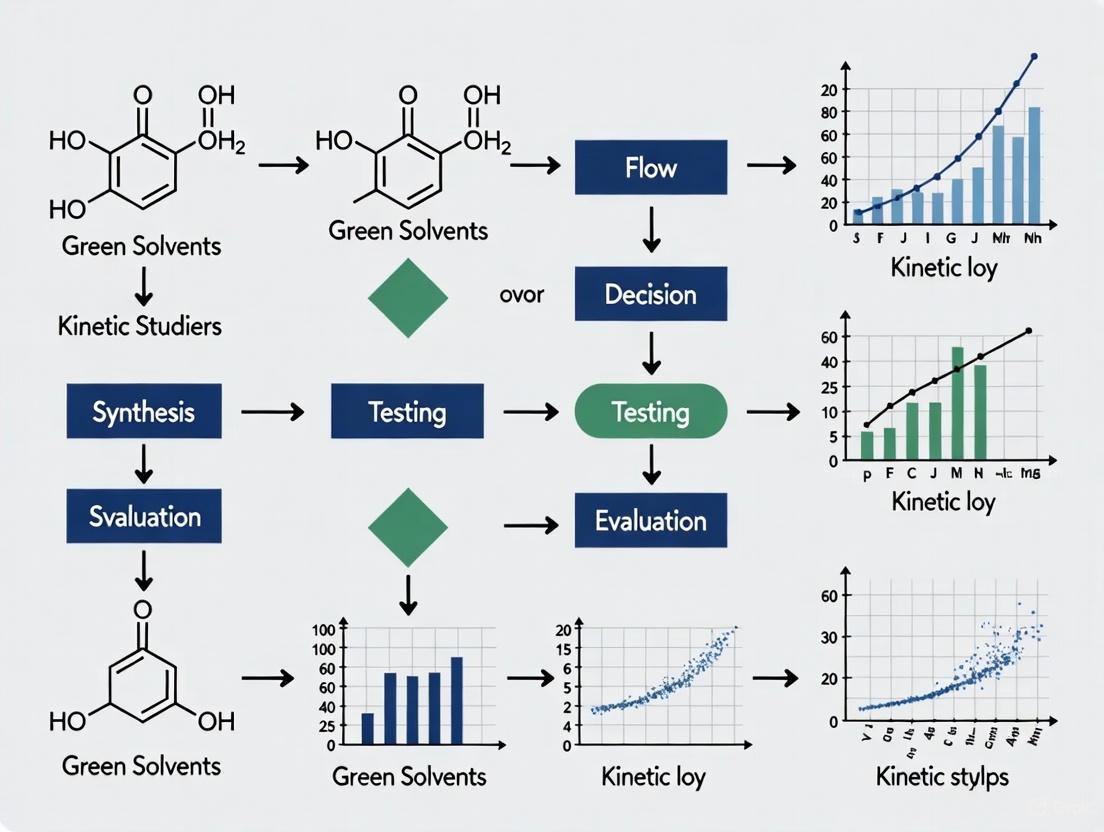
This article provides a comprehensive guide for researchers and drug development professionals on integrating green solvents into kinetic studies.
Green Solvents in Kinetic Studies: A Modern Framework for Sustainable Research and Drug Development
Abstract
This article provides a comprehensive guide for researchers and drug development professionals on integrating green solvents into kinetic studies. It explores the foundational principles defining green solvents—from bio-based options to neoteric fluids—and their direct impact on reaction kinetics and mechanisms. The content delivers practical methodologies for screening and applying these solvents, alongside advanced strategies for optimizing reaction conditions and troubleshooting common pitfalls. Finally, it establishes a rigorous framework for validating solvent performance using modern green chemistry metrics and comparative life-cycle analysis, offering a clear pathway toward more sustainable and efficient research practices in biomedical and pharmaceutical sciences.
Defining Green Solvents: Principles, Properties, and Kinetic Relevance
Core Principles of Green Chemistry Applied to Solvent Selection
In the pursuit of sustainable chemical processes, particularly in kinetic studies and pharmaceutical research, solvent selection represents a pivotal decision point. Solvents are not merely passive spectators in chemical reactions; they influence reaction rates, pathways, and mechanisms while accounting for a significant portion of the environmental footprint in chemical manufacturing. Within the pharmaceutical industry, for instance, solvents comprise approximately 54% of the chemicals and materials used in technological processes, making their sustainable selection a critical concern for green chemistry principles [1]. This technical guide examines the core principles of green chemistry through the lens of solvent selection, providing researchers with a structured framework for identifying and implementing green solvents in kinetic studies and drug development workflows.
Foundational Principles for Green Solvent Evaluation
Defining Green Solvents: Beyond a Single Metric
A green solvent cannot be defined by a single property but must be evaluated relative to alternatives across its entire life cycle. The greenness of a solvent is a multidimensional concept that encompasses environmental impact, human health considerations, and safety profiles [2]. Two primary methodological approaches have emerged for this assessment:
- Environmental, Health, and Safety (EHS) Approach: Evaluates solvents based on their direct hazards, including toxicity, flammability, and environmental persistence [2].
- Life Cycle Assessment (LCA) Approach: Considers the cumulative environmental impacts from solvent production through disposal, including resource depletion, energy consumption, and emissions [2].
No solvent is perfectly "green" in all dimensions, and the optimal choice often depends on the specific application, required properties, and available infrastructure [2].
The CHEM21 Selection Guide: A Practical Framework
The CHEM21 Solvent Selection Guide, developed by a European consortium including pharmaceutical companies and academic institutions, provides one of the most comprehensive frameworks for categorizing solvents based on EHS criteria aligned with the Globally Harmonized System of Classification and Labelling of Chemicals (GHS) [2]. This guide classifies solvents into three distinct categories:
- Recommended: Solvents with favorable safety, health, and environmental profiles (e.g., water, ethanol, 2-methyltetrahydrofuran).
- Problematic: Solvents requiring careful consideration and justification (e.g., acetone, acetic acid).
- Hazardous: Solvents to be avoided or substituted whenever possible (e.g., pentane, dichloromethane) [2].
The CHEM21 system employs a sophisticated scoring methodology that evaluates:
- Safety: Based on flash point, boiling point, auto-ignition temperature, and peroxide formation potential.
- Health: Determined through GHS classification and boiling point considerations.
- Environment: Assessed through environmental toxicity and persistence metrics [2].
Table 1: CHEM21 Solvent Selection Guide Categories and Representative Examples
| Category | Safety Score Range | Health Score Range | Environmental Score Range | Representative Examples |
|---|---|---|---|---|
| Recommended | Lowest risk | Lowest risk | Lowest risk | Water, ethanol, ethyl acetate |
| Problematic | Moderate risk | Moderate risk | Moderate risk | Acetone, acetic acid, isopropanol |
| Hazardous | Highest risk | Highest risk | Highest risk | Pentane, hexane, dichloromethane |
Green Solvent Classes and Properties for Kinetic Studies
Emerging Green Solvent Categories
Contemporary green chemistry research has identified several promising classes of green solvents with particular relevance to kinetic studies and pharmaceutical applications:
- Bio-based solvents: Derived from renewable biomass sources including corn, sugarcane, cellulose, and vegetable oils. This category includes bio-alcohols (bio-ethanol, bio-methanol), bio-glycols, lactate esters, and D-limonene [3].
- Deep Eutectic Solvents (DES): Mixtures of hydrogen bond donors and acceptors that form eutectics with melting points lower than either component. Typical formulations combine quaternary ammonium salts (e.g., choline chloride) with hydrogen bond donors (e.g., urea, glycols, carboxylic acids) in specific ratios [4].
- Ionic Liquids: Tunable salts liquid at room temperature with negligible vapor pressure, offering potential for recyclability and unique solvation environments [5].
- Supercritical Fluids: Particularly supercritical CO₂, which provides excellent mass transfer properties and can be easily removed from reaction products [6].
Quantitative Performance Comparison in Kinetic Applications
The efficacy of green solvents in kinetic applications must be validated through direct comparison with conventional solvents. A quantitative comparison between conventional and bio-derived solvents from citrus waste in esterification and amidation kinetic studies demonstrated that bio-based alternatives could achieve comparable—and in some cases superior—reaction rates and conversions [7]. Similarly, research on the synthesis of highly substituted piperidines found that ethanol, classified as a green solvent, not only provided environmental benefits but actually accelerated reaction rates compared to methanol, a more toxic alternative [8].
Table 2: Green Solvent Classes and Their Applications in Kinetic Studies
| Solvent Class | Representative Examples | Key Properties | Applications in Kinetic Studies |
|---|---|---|---|
| Bio-based Alcohols | Bio-ethanol, Bio-butanol | Low toxicity, biodegradable, renewable | Nucleophilic substitutions, esterifications [3] [8] |
| Lactate Esters | Ethyl lactate | High solvating power, biodegradable | Polymerizations, extractions [9] |
| Deep Eutectic Solvents (DES) | Choline chloride:Urea | Tunable polarity, non-volatile | Biocatalysis, metal-catalyzed reactions [4] |
| Supercritical Fluids | scCO₂ | Tunable density, high diffusivity | Hydrogenations, oxidations [6] |
| Water | - | Non-flammable, non-toxic | Diels-Alder reactions, hydrolysis [4] |
Experimental Protocols for Green Solvent Implementation
Computational Screening Protocol Using COSMO-RS
Advanced computational methods provide powerful tools for preliminary green solvent screening before committing to resource-intensive experimental work:
- Molecular Structure Preparation: Optimize 3D molecular structures of both solutes and potential solvents using density functional theory (DFT) calculations [1].
- COSMO-RS Simulation: Employ the COSMO-RS (Conductor-like Screening Model for Real Solvents) methodology to predict thermodynamic properties, including activity coefficients and solubility [1].
- Affinity Calculations: Compute solute-solvent affinities using advanced quantum chemistry methods to understand intermolecular interactions [1].
- Environmental Assessment: Apply the CHEM21 selection guide or similar framework to evaluate the greenness of top-performing candidates identified through computational screening [2].
- Experimental Validation: Measure solubility and reaction kinetics in the highest-ranking solvent candidates to verify computational predictions [1].
This protocol was successfully applied to identify 4-formylomorpholine (4FM) as an effective green alternative to DMSO and DMF for dissolving aromatic amides, with experimental results confirming the computational predictions [1].
Kinetic Parameter Determination in Green Solvents
For determining kinetic parameters in green solvent systems, the following protocol provides reliable results:
- Reaction Monitoring: Utilize UV-vis spectrophotometry to track reaction progress at wavelengths where products exhibit significant absorbance but starting materials do not [8].
- Temperature Variation: Conduct experiments at multiple temperatures (e.g., 25, 30, 35, and 40°C) to determine Arrhenius parameters [8].
- Data Fitting: Apply appropriate kinetic models (zero, first, or second-order) to absorbance versus time data using established software algorithms [8].
- Parameter Calculation: Determine activation parameters (Ea, ΔSǂ, ΔHǂ, and ΔGǂ) using Arrhenius and Eyring equations [8].
- Solvent Comparison: Repeat the complete protocol in different green solvents to identify optimal reaction media [8].
This methodology revealed that ethanol provided superior reaction rates compared to methanol in the synthesis of substituted piperidines, challenging previous assumptions about optimal solvent choices [8].
The Scientist's Toolkit: Research Reagent Solutions
Table 3: Essential Research Reagents for Green Solvent Kinetic Studies
| Reagent/ Material | Function/Application | Green Considerations |
|---|---|---|
| Bio-derived Ethanol | Solvent for synthesis and kinetic studies | Renewable feedstock, lower toxicity than methanol [8] |
| Oxalic Acid Dihydrate | Homogeneous catalyst for multicomponent reactions | Microbiologically stable, low toxicity, applicable in food and pharmaceutical industries [8] |
| Choline Chloride | Hydrogen bond acceptor for DES formation | Low toxicity, biodegradable, renewable sourcing [4] |
| Ethyl Lactate | Bio-based solvent for extractions and reactions | Derived from renewable resources, biodegradable [9] |
| COSMO-RS Software | Computational solvent screening | Reduces experimental solvent waste through in silico prediction [1] |
| UV-vis Spectrophotometer | Reaction kinetics monitoring | Enables precise concentration measurement without additional reagents [8] |
Visualization of Green Solvent Selection Workflow
The following diagram illustrates the integrated computational and experimental workflow for green solvent selection in kinetic studies:
Green Solvent Selection Workflow
Market Context and Implementation Considerations
Economic and Regulatory Landscape
The global green solvents market, valued at approximately $1.34 billion in 2024 and projected to reach $1.87 billion by 2030, reflects growing industrial adoption across pharmaceutical, coating, and adhesive applications [9]. This growth is driven by:
- Regulatory Pressure: Stringent government regulations limiting hazardous solvent use, particularly under frameworks like REACH in Europe [3] [2].
- Corporate Sustainability Initiatives: Pharmaceutical and chemical companies increasingly adopting green chemistry principles to reduce environmental impact and align with ESG (Environmental, Social, and Governance) criteria [3].
- Performance Validation: Demonstrated efficacy of green solvents in diverse applications, from pharmaceutical synthesis to industrial separations [5].
Implementation Challenges and Solutions
Despite their benefits, green solvents face implementation barriers that require strategic solutions:
- Higher Production Costs: Green solvents often carry premium prices compared to conventional alternatives. For example, ethyl lactate may cost approximately $45.89 per kg compared to $0.98 per liter for benzene [9]. Solution: Focus on life cycle cost analysis that considers waste management, regulatory compliance, and potential process intensification benefits.
- Performance Limitations: Some green solvents may demonstrate limited performance in specific applications compared to established conventional solvents [3]. Solution: Employ binary solvent systems or solvent modifiers to achieve required performance while maintaining improved environmental profiles.
- Supply Chain Maturity: Limited availability of some bio-based solvents in certain regions [3]. Solution: Develop regional sourcing strategies and engage with suppliers to communicate demand projections.
The application of green chemistry principles to solvent selection represents both an environmental imperative and a scientific opportunity for researchers conducting kinetic studies. Frameworks like the CHEM21 Selection Guide provide structured methodologies for evaluating solvent greenness, while emerging computational tools enable efficient screening of potential candidates. The continued development of bio-based solvents, deep eutectic solvents, and water-based reaction systems promises to expand the available toolkit for sustainable kinetic studies.
Future advancements will likely include increased integration of AI-guided solvent selection, broader adoption of mechanochemical (solvent-free) approaches, and development of standardized sustainability metrics specifically tailored for kinetic applications. As these trends mature, the integration of green solvent selection into kinetic studies will evolve from a specialized consideration to a fundamental aspect of research design in pharmaceutical development and beyond.
The transition from traditional solvents to green solvents represents a pivotal shift towards sustainable science, driven by the need to reduce environmental impact and health hazards while maintaining analytical and industrial efficacy [10]. This shift is particularly critical in kinetic studies and drug development, where solvent choice can significantly influence reaction pathways, rates, and scalability. Framed within a broader thesis on discovering green solvents for kinetic studies research, this guide provides an in-depth technical analysis of three key classes: bio-based, neoteric, and aqueous solvent systems. These alternatives are designed to be safer, derived from renewable resources, and capable of minimizing the ecological footprint of chemical processes without compromising performance [11] [10]. Their adoption is essential for developing sustainable synthetic protocols and analytical methods in pharmaceutical and academic research.
Solvent Classification and Core Properties
Green solvents are categorized based on their origin and chemical structure. Understanding their fundamental properties is a prerequisite for selecting the appropriate medium for kinetic studies and other research applications.
Bio-based solvents are obtained from natural and renewable resources, including plants, agricultural waste, or microorganisms [10]. They are classified into three main types:
- Cereal/Sugar-based solvents: Derived from the fermentation of plant sugars from sugarcane, wheat, or corn. Examples include bio-ethanol and ethyl lactate [10].
- Oleo-proteinaceous-based solvents: Derived from oilseed plants like sunflower and soybean, these include fatty acid esters and glycerol derivatives [10].
- Wood-based solvents: Primarily terpenes such as D-limonene (from orange peels) and pinene (from pine oleoresins) [10].
Neoteric Solvents are a class of advanced solvent systems with highly desirable properties that distinguish them from traditional volatile organic compounds (VOCs) [12]. This category includes:
- Ionic Liquids (ILs): Salts that are liquid below 100°C, characterized by negligible vapor pressure, high thermal stability, and tunable solvation capabilities [12] [10].
- Deep Eutectic Solvents (DESs): A combination of a hydrogen bond acceptor (HBA) and a hydrogen bond donor (HBD) that forms a eutectic mixture with a melting point lower than that of its individual components. They share many benefits with ILs but are often cheaper and easier to synthesize [11] [10].
- Supercritical Fluids (SCFs): Substances at temperatures and pressures above their critical point, where distinct liquid and gas phases do not exist. Supercritical CO₂ (scCO₂) is the most prominent example [10].
Aqueous Systems primarily use water as a solvent. Water is a clean, convenient, and non-toxic solvent, particularly effective for extracting strongly polar molecules [11].
Table 1: Comparative Analysis of Key Green Solvent Classes
| Solvent Class | Key Examples | Core Properties | Primary Advantages | Inherent Limitations |
|---|---|---|---|---|
| Bio-based | Bio-ethanol, Ethyl Lactate, D-Limonene | Derived from biomass; variable polarity and volatility [10] | Renewable feedstock; often biodegradable; reduced petrochemical reliance [10] | Performance can be feedstock-dependent; may require purification |
| Neoteric - Ionic Liquids (ILs) | Imidazolium, Pyridinium-based salts | Negligible vapor pressure; high thermal/chemical stability; tunable [12] [10] | Non-volatile; versatile for diverse reactions; can dissolve many compounds [12] | Complex, potentially energy-intensive synthesis; potential toxicity and environmental persistence [10] |
| Neoteric - Deep Eutectic Solvents (DESs) | Choline chloride + Urea/Glycerol | Low volatility; non-flammable; tunable; biodegradable components [11] [10] | Simple synthesis; low cost; often low toxicity and high biodegradability [11] | Can have high viscosity; potential hygroscopicity |
| Neoteric - Supercritical Fluids | scCO₂, scH₂O | Gas-like viscosity and diffusion; liquid-like density; tunable solvation [10] | Rapid extraction kinetics; easy solvent removal (depressurization); non-toxic (CO₂) [10] | High energy for pressurization/heating; low polarity of scCO₂ requires co-solvents for polar compounds [10] |
| Aqueous Systems | Water, Subcritical Water | High polarity; readily available; non-flammable | Non-toxic; inexpensive; safest solvent option [11] | Narrow application range for non-polar compounds [11] |
Quantitative Data for Research Applications
For research scientists, quantitative metrics are vital for solvent selection. The following tables summarize key performance, economic, and environmental data.
Table 2: Kinetic and Performance Metrics for Green Solvents in Catalysis
| Solvent | Reaction Type | Key Performance Metric | Experimental Condition | Reference |
|---|---|---|---|---|
| EtOH | Hydrophosphination of Styrene [13] | 96% Conversion | 5 mol% Cu(acac)₂, 360 nm, 5h [13] | [13] |
| EtOAc | Hydrophosphination of Styrene [13] | 84% Conversion | 5 mol% Cu(acac)₂, 360 nm, 5h [13] | [13] |
| 2-MeTHF | Hydrophosphination of Styrene [13] | 86% Conversion | 5 mol% Cu(acac)₂, 360 nm, 5h [13] | [13] |
| OME3 | Atmospheric OH Oxidation [14] | Rate Coefficient: 1.0 ×10⁻¹¹ cm³ molec.⁻¹ s⁻¹ | 296 ± 2 K [14] | [14] |
| OME4 | Atmospheric OH Oxidation [14] | Rate Coefficient: 1.1 ×10⁻¹¹ cm³ molec.⁻¹ s⁻¹ | 296 ± 2 K [14] | [14] |
Table 3: Environmental, Health, and Economic Projections
| Parameter | Ionic Liquids | Deep Eutectic Solvents | Bio-based Solvents | Supercritical Fluids |
|---|---|---|---|---|
| Global Market Share (2024) [12] | Dominant (51.73%) | Part of "Others" Segment | Growing Segment | Part of "Others" Segment |
| Projected CAGR (2025-2034) [12] | High | High | Fastest Growing | Moderate |
| Vapor Pressure | Negligible [10] | Negligible [10] | Variable | Supercritical state [10] |
| Toxicity Profile | Moderate to High (Structure-dependent) [10] | Generally Low [11] | Generally Low [10] | Very Low (for scCO₂) [10] |
Experimental Protocols and Methodologies
Protocol 1: Assessing Solvent Efficacy in Exploratory Catalysis (Hydrophosphination)
This protocol evaluates green solvents as direct replacements for traditional solvents in a model catalytic reaction, using the hydrophosphination of styrene as a benchmark [13].
Reagents:
- Substrate: Styrene
- Reactant: Diphenylphosphine
- Catalyst: Copper(II) acetylacetonate, Cu(acac)₂
- Solvents for Screening: Ethanol (EtOH), Ethyl Acetate (EtOAc), 2-Methyltetrahydrofuran (2-MeTHF), Heptane, Cyclopentyl methyl ether (CPME), Methyl ethyl ketone (MEK), Dimethyl sulfoxide (DMSO)
Procedure:
- Reaction Setup: In an inert atmosphere glovebox, combine styrene (0.38 mmol), diphenylphosphine (0.38 mmol, 1.0 equiv), and Cu(acac)₂ (0.019 mmol, 5 mol%) in a suitable reaction vial.
- Solvent Addition: Add the solvent under investigation (400 μL) to the reaction mixture.
- Photocatalysis: Seal the vial and irradiate the reaction mixture using a 360 nm UV-A lamp for 5 hours at ambient temperature.
- Analysis: Monitor reaction conversion directly by ³¹P NMR spectroscopy without the need for deuterated solvents. Compare the conversion to that achieved in a control reaction using a traditional solvent like chloroform [13].
Key Findings: This study demonstrated that most green solvents from the CHEM21 guide (e.g., EtOH, EtOAc, 2-MeTHF) afforded comparable or even superior conversion to the traditional solvent chloroform, validating their viability for exploratory catalysis [13].
Protocol 2: Determining Atmospheric Degradation Kinetics
This methodology is crucial for evaluating the environmental impact and tropospheric lifetime of volatile green solvents, such as Oxymethylene Ethers (OMEs) [14].
Reagents:
- Volatile Organic Compound (VOC): e.g., OME3 or OME4
- Oxidant Source: Precursor for hydroxyl radicals (OH) or chlorine atoms (Cl)
- Reference Compound: A VOC with a known rate coefficient for reaction with OH or Cl
Procedure:
- Relative Rate Method (Using an Environmental Chamber):
- Introduce precise amounts of the target VOC (e.g., OME3) and a reference compound into a quartz environmental simulation chamber (e.g., 760 dm³ volume).
- Initiate the reaction by generating OH radicals, typically through photolysis of a precursor like nitrous acid (HONO) or ozone/alkene reactions.
- Monitor the concentrations of both the target and reference VOCs over time using multi-pass FTIR spectroscopy or another suitable analytical technique.
- The rate coefficient kVOC is determined from the relative decay rates of the target and reference compounds, using the known rate coefficient of the reference [14].
- Direct Absolute Method (Using Pulsed Laser Photolysis):
- Use a pulsed laser to generate a precise, short-lived concentration of OH radicals in a mixture containing the VOC.
- Directly monitor the temporal decay of the OH radical concentration using a sensitive laser-based detection method, such as laser-induced fluorescence (LIF), in the presence of varying concentrations of the VOC.
- The absolute rate coefficient is obtained from the pseudo-first-order decay rates of OH as a function of VOC concentration [14].
Key Findings: Application of these techniques to OME3 and OME4 yielded rate coefficients for their reaction with OH radicals, allowing for the estimation of their tropospheric lifetimes (τ ≈1 day) and confirming they are less persistent than some traditional solvents [14].
The Scientist's Toolkit: Research Reagent Solutions
Table 4: Essential Reagents and Materials for Green Solvent Research
| Reagent/Material | Function in Research | Application Example |
|---|---|---|
| Copper(II) acetylacetonate (Cu(acac)₂) | Versatile, air-stable precatalyst for exploratory reactions [13] | Photocatalytic hydrophosphination in green solvents [13] |
| Group 1 Alkoxides (e.g., NaOEt) | Low-toxicity, abundant catalysts for base-mediated reactions [13] | Hydrophosphination catalysis under mild conditions [13] |
| Diphenylphosphine | Model reactant for P-C bond formation studies [13] | Benchmarking solvent performance in hydrophosphination [13] |
| Deuterated Solvents (e.g., CDCl₃) | NMR spectroscopy for reaction monitoring and structural confirmation | Reference for ¹H or ³¹P NMR chemical shifts [13] |
| Hydroxyl Radical (OH) Precursors (e.g., HONO) | Source of the primary atmospheric oxidant for kinetic studies [14] | Determining tropospheric degradation rates of VOCs [14] |
Workflow and Signaling Pathways
The following diagram illustrates the logical workflow for selecting and evaluating a green solvent for kinetic studies, based on experimental goals and solvent properties.
Green Solvent Selection Workflow for Kinetic Studies
The diagram above outlines a systematic approach for researchers to identify the optimal green solvent. The process begins with a clear definition of the experimental goal, which dictates the critical solvent requirements. Based on these requirements, one or more candidate solvent classes are selected from the major green categories. These candidates are then screened experimentally for performance, leading to the evaluation of key kinetic parameters. For volatile solvents, an additional assessment of environmental impact is crucial. The process iterates until a satisfactory solvent meeting all criteria is identified.
The diagram below summarizes the principal atmospheric degradation pathway for volatile green solvents, a key signaling pathway for understanding their environmental fate.
Atmospheric Oxidation Pathway of Volatile Green Solvents
The primary degradation pathway for saturated volatile green solvents like oxymethylene ethers (OMEs) in the troposphere is hydrogen abstraction by the hydroxyl radical (OH) [14]. This initial, rate-determining step generates an organic radical and water. The organic radical rapidly adds molecular oxygen (O₂) to form a peroxy radical (RO₂•). Subsequent atmospheric propagation cycles involving NOₓ and other VOCs can lead to the formation of secondary pollutants, including ozone (O₃) and formaldehyde (HCHO), while also contributing to particulate matter [14]. The rate coefficient k for the initial OH attack is therefore a critical parameter for determining the solvent's atmospheric lifetime and environmental impact.
Critical Solvent Properties Influencing Reaction Kinetics and Mechanisms
The pursuit of green solvents represents a paradigm shift in chemical research and development, driven by increasing regulatory pressures and the scientific community's commitment to sustainability. Within this context, understanding how solvent properties influence reaction kinetics and mechanisms is not merely an academic exercise but a critical requirement for rational green solvent design. The transition from traditional, often hazardous, solvents to safer, renewable alternatives necessitates a deep mechanistic understanding of solvent-solute interactions at the molecular level. This guide provides a comprehensive technical framework for researchers and drug development professionals, focusing on the core solvent properties that dictate reaction pathways and rates, with emphasis on experimental methodologies for their evaluation in the context of green chemistry.
Core Solvent Properties and Their Kinetic Impact
Solvents exert profound influences on chemical reactions through a complex interplay of physicochemical properties. These properties can stabilize or destabilize reactants, transition states, and intermediates, thereby providing kinetic and thermodynamic control over reaction pathways.
Polarity and Dielectric Constant
Solvent polarity, often quantified by the dielectric constant (ε), measures a solvent's ability to reduce electrostatic forces between charged particles. It significantly stabilizes charged transition states or intermediates more than neutral reactants, directly impacting reaction rates.
For SN1 reactions, which proceed through a charged carbocation intermediate, an increase in solvent polarity dramatically accelerates the rate. The solvolysis of tert-butyl chloride* demonstrates this effect: its relative rate increases from 1 in acetic acid (ε=6) to 150,000 in water (ε=78) [15]. The polar solvent stabilizes the carbocation intermediate and the developing charge in the transition state, lowering the activation energy.
Conversely, for SN2 reactions, which typically involve a charged nucleophile and a neutral substrate, increased solvent polarity can decelerate the reaction. A polar solvent stabilizes the ground state (the charged nucleophile) more effectively than the more diffuse, less charged transition state. The reaction of 1-bromobutane with azide ion (N₃⁻) shows a rate 5000 times faster in acetonitrile (ε=38, aprotic) than in methanol (ε=33, protic) [15]. This highlights the combined importance of polarity and the solvent's ability to act as a hydrogen-bond donor.
Hydrogen Bonding Capacity (Protic vs. Aprotic)
The hydrogen bonding capacity of a solvent differentiates protic solvents (e.g., water, alcohols) from aprotic solvents (e.g., DMSO, DMF, acetonitrile).
- Protic solvents solvate anions strongly via hydrogen bonding, effectively shielding them and reducing their nucleophilicity. This is detrimental to reactions where the nucleophile is an anion, such as in SN2 reactions.
- Aprotic solvents, lacking acidic hydrogens, solvate cations strongly but leave anions largely "naked" and highly reactive. This dramatically enhances the rates of reactions with anionic nucleophiles.
This distinction is critical for green solvent selection, where the goal is to maximize efficiency while maintaining safety and sustainability. The use of aprotic solvents like ethyl lactate, a green solvent derived from renewable resources, can be advantageous for reactions requiring high nucleophile reactivity [16].
Molecular Structure and Solvent-Solute Interactions
Specific solvent-solute interactions, such as van der Waals forces, dipole-dipole interactions, and hydrogen bonding, can preferential stabilize certain species. This is evident in equilibrium processes like keto-enol tautomerism.
For a 1,3-dicarbonyl compound, the equilibrium constant, KT = [cis-enol]/[diketo], is highly solvent-dependent. In non-polar solvents like cyclohexane, which cannot compete with intramolecular hydrogen bonding, the cis-enol form is strongly favored (KT=42). In contrast, in highly polar, protic water, which disrupts intramolecular H-bonds and stabilizes the diketo form, the equilibrium shifts dramatically towards the diketo form (K_T=0.23) [15]. This principle is vital for predicting and controlling reaction outcomes in green solvent systems.
Table 1: Summary of Key Solvent Properties and Their Kinetic Effects
| Solvent Property | Chemical Interpretation | Effect on SN1 Kinetics | Effect on SN2 Kinetics | Impact on Equilibria |
|---|---|---|---|---|
| Dielectric Constant (Polarity) | Ability to stabilize charge | Greatly increases rate with higher ε | Decreases rate with higher ε | Shifts equilibria towards the more polar species |
| Hydrogen Bonding (Protic) | Ability to solvate and shield anions | Mild effect | Greatly decreases rate with anionic nucleophiles | Can stabilize or destabilize species via H-bonding |
| Hydrogen Bonding (Aprotic) | Inability to solvate anions; cations are solvated | Mild effect | Greatly increases rate with anionic nucleophiles | Can enhance anion reactivity in equilibria |
Experimental Protocols for Kinetic Analysis in Green Solvents
Accurate determination of reaction kinetics is fundamental to evaluating and selecting green solvents. The following section details established experimental methodologies.
Absolute Rate Coefficient Determination via Pulsed Laser Photolysis (PLP)
Objective: To determine absolute, temperature-dependent rate coefficients (e.g., k(T)) for bimolecular reactions in the gas phase or solution, crucial for assessing the atmospheric impact of solvent emissions [14].
Principle: A short, intense laser pulse initiates the reaction by generating a precise concentration of a reactive species (e.g., OH radicals). The decay of this species or the formation of products is monitored in real-time using a complementary analytical technique.
Detailed Protocol:
- Reactive Species Generation: A pulsed laser (e.g., an excimer laser at 248 nm for ozone photolysis) is fired into a temperature-controlled reaction cell containing a low pressure of the precursor (e.g., N₂O₅ to generate NO₃, or H₂O₂ to generate OH).
- Kinetic Probing: The concentration of the reactive species is monitored as a function of time after the laser pulse. This is typically done using highly sensitive methods like:
- Laser-Induced Fluorescence (LIF): Tuning a probe laser to a specific electronic transition of the species (e.g., OH) and measuring the resulting fluorescence intensity, which is proportional to concentration.
- Absorption Spectroscopy: Measuring the attenuation of a continuous light source (e.g., from a lamp or diode laser) by the species at a specific wavelength.
- Pseudo-First-Order Conditions: Experiments are performed with the volatile organic compound (VOC) substrate (e.g., a green solvent like an oxymethylene ether, OME) in large excess over the reactive radical. Under these conditions, the observed decay of the radical is exponential, with a rate constant k_obs.
- Data Analysis: The bimolecular rate coefficient (k) is obtained from the slope of the linear plot of kobs versus the substrate concentration:
k_obs = k[substrate] + k_0, where k0 is the radical decay rate in the absence of substrate. This is repeated at different temperatures to obtain the Arrhenius parameters (activation energy, Eₐ, and pre-exponential factor, A) [14].
Relative Rate Studies in Environmental Simulation Chambers
Objective: To determine rate coefficients for reactions of interest (e.g., OH + OME) relative to a well-established reference reaction.
Principle: The VOC of interest and a reference compound with a known rate coefficient (kref) are simultaneously exposed to an oxidant (e.g., OH radicals) in a large, inert chamber. The relative decay rates of the two VOCs are measured, allowing for the calculation of the unknown rate coefficient (kunk).
Detailed Protocol:
- Chamber Preparation: Introduce precise amounts of the target solvent (e.g., OME3), a reference compound (e.g., cyclohexane), and an OH radical precursor (e.g., H₂O₂ or methyl nitrite) into a large-volume (e.g., 760 dm³), inert (e.g., quartz or Teflon-coated) environmental simulation chamber [14].
- Reaction Initiation: Initiate photolysis of the OH precursor using UV lamps (e.g., at 365 nm) to generate OH radicals homogeneously throughout the chamber.
- Concentration Monitoring: Periodically sample the chamber atmosphere using a long-path Fourier Transform Infrared (FTIR) spectrometer or Gas Chromatography (GC) to monitor the decreasing concentrations of both the target and reference VOCs.
- Data Analysis: The unknown rate coefficient is determined from the slope (m) of a plot of
ln([OME]_0/[OME]_t)versusln([ref]_0/[ref]_t), where m = kunk / kref. The equation is:ln([OME]_0/[OME]_t) = (k_unk / k_ref) * ln([ref]_0/[ref]_t)[14].
Membrane Crystallization Coupled with Organic Solvent Nanofiltration (OSN)
Objective: To study crystallization kinetics and mechanisms in green solvent systems while achieving zero solvent discharge, aligning with green chemistry principles.
Principle: Organic Solvent Nanofiltration (OSN) is a pressure-driven membrane process that selectively removes solvent from a solution, precisely controlling supersaturation—the driving force for crystallization. This allows decoupling of nucleation and growth stages.
Detailed Protocol:
- Solution Preparation: Dissolve the target compound (e.g., the energetic material ε-CL-20) in a green solvent like ethyl lactate at a known saturation concentration and temperature [16].
- Membrane System Setup: Utilize a solvent-resistant hollow fiber nanofiltration membrane module (e.g., polyimide-based with a 300 Da molecular weight cutoff).
- Supersaturation Generation: Pump the solution through the OSN module. Apply controlled pressure to permeate a portion of the solvent, thereby increasing the concentration of the solute in the recirculating feed stream and generating a uniform, controlled supersaturation.
- Kinetic Monitoring: Track the crystallization process in real-time using:
- In-situ Particle Size Analysis: Using focused beam reflectance measurement (FBRM) or particle vision measurement (PVM).
- Off-line Sampling: Periodically extract slurry samples for analysis of crystal morphology (via microscopy) and polymorphic form (via X-ray diffraction).
- Kinetic Parameter Determination: Fit the experimental data (e.g., concentration vs. time, particle count vs. time) to population balance equations to extract nucleation and growth rates [16].
Signaling Pathways and Workflow Visualizations
The following diagrams, generated using Graphviz DOT language, illustrate the core conceptual relationships and experimental workflows described in this guide.
Solvent Property Influence Map
Green Solvent Kinetic Assessment Workflow
The Scientist's Toolkit: Essential Research Reagents and Materials
The experimental investigation of solvent kinetics requires a suite of specialized reagents, materials, and analytical tools. The following table details key components of a modern research toolkit for this field.
Table 2: Essential Research Reagents and Materials for Solvent Kinetic Studies
| Tool/Reagent | Technical Function & Rationale | Example in Context |
|---|---|---|
| Environmental Simulation Chamber | A large-volume (e.g., 100-1000 L), inert (quartz/Teflon) reactor for studying atmospheric reactions under simulated tropospheric conditions. | Used in relative rate studies to determine the OH rate coefficient for oxymethylene ethers (OMEs) versus a reference compound [14]. |
| Pulsed Laser Photolysis (PLP) System | Generates a precise, short-lived pulse of radicals (e.g., OH) to initiate reaction, allowing direct, time-resolved measurement of absolute rate constants. | Employed for direct determination of k(OH + OME3) over a temperature range (294–464 K), revealing non-Arrhenius behavior [14]. |
| Organic Solvent Nanofiltration (OSN) Membrane | A solvent-resistant membrane (e.g., polyimide) with precise molecular weight cutoff; used to control supersaturation in crystallization kinetics studies. | Key component in a zero-discharge process to study the crystallization kinetics of ε-CL-20 in green solvents like ethyl lactate [16]. |
| Green Solvent Candidates | Bio-based, low-toxicity solvents with favorable environmental, health, and safety (EHS) profiles. | Ethyl lactate, oxymethylene ethers (OMEs), and 2,2,5,5-tetramethyloxolane (TMO) are investigated as sustainable replacements for petrochemical solvents [14] [16]. |
| FTIR Spectrometer | Provides real-time, quantitative monitoring of gas-phase reactant and product concentrations via their unique infrared absorption fingerprints. | Used in chamber studies to track the decay of VOC concentrations (e.g., OMEs, reference compounds) during OH-oxidation experiments [14]. |
| Radical Precursors | Stable compounds that photolyze or decompose cleanly to generate specific radicals for kinetic studies. | Hydrogen peroxide (H₂O₂), methyl nitrite (CH₃ONO), or dinitrogen pentoxide (N₂O₅) are common sources for OH or NO₃ radicals [14]. |
The shift towards green solvents represents a critical evolution in chemical research and industrial processes, driven by increasingly strict regulations on traditional volatile organic compound (VOC) emissions and a growing recognition of their environmental and health impacts. Solvents are emerging as the dominant anthropogenic source of non-methane VOCs, with the landscape of solvent use undergoing a significant transformation as research and industry move away from harmful petroleum-derived solvents toward safer, renewable bio-based alternatives as part of the transition to net-zero emissions [14]. This transition is particularly vital in pharmaceutical development and kinetic studies research, where solvent selection directly influences reaction pathways, environmental footprint, and workplace safety.
Poor air quality, exacerbated by solvent emissions, has been estimated to cause over 400,000 annual deaths in Europe alone [14]. The oxidative breakdown of VOCs in air yields harmful ozone, formaldehyde, and particulates, establishing waste and inefficient use of volatile solvents as well-established sources of harmful atmospheric emissions. Ethers form a significant portion of atmospheric non-methane VOCs and are emitted almost entirely from anthropogenic sources, with many traditional ethereal solvents like 1,4-dioxane and tetrahydrofuran (THF) presenting additional concerns as they are manufactured from unsustainable petrochemical feedstocks, potentially carcinogenic, prone to forming dangerous peroxides, and environmentally hazardous [14].
Environmental and Health Impacts of Traditional Solvents
Atmospheric Degradation and Air Quality Effects
Traditional solvents undergo complex atmospheric degradation processes that significantly impact air quality. A crucial, often rate-determining step in atmospheric VOC oxidation mechanisms is the initial breaking of a C–C or C–H bond, either directly via photolysis or following attack by oxidants such as O₃ or gas-phase free radicals. For saturated VOCs like 1,4-dioxane, THF, and many traditional solvents that lack a near-UV chromophore, the principal breakdown route occurs via bimolecular reaction with the hydroxyl radical (OH), typically proceeding via H abstraction to an organic radical fragment plus H₂O [14].
The atmospheric lifetimes of traditional solvents directly influence their environmental persistence and pollution potential. Research indicates that 1,4-dioxane has an estimated atmospheric lifetime (τ) of approximately 25 hours, while THF is removed more rapidly from the troposphere with τ ≈ 16 hours [14]. These substantial lifetimes allow for significant atmospheric transport and subsequent formation of secondary pollutants through photochemical reactions.
Direct Health and Safety Concerns
Beyond atmospheric impacts, traditional solvents present direct health risks to researchers and manufacturing personnel. Many conventional ethereal solvents are associated with documented health hazards including:
- Carcinogenic potential (e.g., 1,4-dioxane)
- Formation of dangerous peroxides upon storage
- Chronic and acute toxicity profiles
- Environmental persistence leading to bioaccumulation
These health concerns necessitate stringent safety protocols in laboratory and industrial settings and generate substantial regulatory compliance burdens. The movement toward green solvents aims to mitigate these risks while maintaining or enhancing functionality in research applications, particularly in kinetic studies where solvent properties directly influence reaction mechanisms and rates.
Green Solvent Alternatives: Properties and Performance
Oxymethylene Ethers (OMEs) as Sustainable Replacements
Oxymethylene ethers (CH₃O(CH₂O)ₙCH₃, denoted as OMEs) represent a promising class of green solvents that can be synthesized at scale from readily available, renewable, and bio-derivable methanol and formaldehyde. With carbon capture and utilization, circular CO₂-derived "e-methanol" also presents a potential commercially available large-scale feedstock [14]. OMEs have been demonstrated as safer, bio-based alternatives to traditional ethereal solvents with several advantageous properties [14].
Recent laboratory-based investigations into the atmospheric degradation chemistry of OME3 (CH₃O(CH₂O)₃CH₃) and OME4 (CH₃O(CH₂O)₄CH₃) have revealed their enhanced environmental profiles compared to traditional solvents. These studies employed direct, absolute laser-based experiments and complementary relative rate studies to determine atmospheric behavior [14].
Table 1: Kinetic Parameters for Atmospheric Degradation of Traditional and Green Solvents
| Solvent | Rate Coefficient with OH at 296K (10⁻¹¹ cm³ molec.⁻¹ s⁻¹) | Atmospheric Lifetime (Hours) | Photochemical Ozone Creation Potential |
|---|---|---|---|
| OME3 | 1.0 ± 0.2 [14] | ~24 [14] | Considerably smaller [14] |
| OME4 | 1.1 ± 0.4 [14] | ~24 [14] | Considerably smaller [14] |
| 1,4-Dioxane | Literature values available [14] | ~25 [14] | Higher [14] |
| THF | Literature values available [14] | ~16 [14] | Higher [14] |
The atmospheric breakdown of OME3 with OH radicals proceeds with a rate coefficient k(296 ± 2 K) = (1.0 ± 0.2) × 10⁻¹¹ cm³ molec.⁻¹ s⁻¹, a factor of 2 smaller than predicted by structure activity relationships (SARs). Evidence for a complex mechanism was provided by temperature-dependent kinetics (294-464 K), characterized by deviations from Arrhenius-like behavior close to room temperature. Similarly, OME4 reacts with OH radicals with a rate coefficient of k(296 ± 2 K) = (1.1 ± 0.4) × 10⁻¹¹ cm³ molec.⁻¹ s⁻¹ [14].
The photochemical ozone creation potential (POCPE) for OMEs under northwest European conditions is considerably smaller than equivalent metrics for the problematic solvents they may replace, largely owing to their lack of C–C bonds [14]. This structural feature represents a significant advantage in reducing tropospheric ozone formation potential.
Computational Screening for Green Solvent Discovery
Advanced computational methods have emerged as powerful tools for identifying green solvent alternatives without extensive experimental screening. The COSMO-RS (Conductor-like Screening Model for Real Solvents) approach has proven particularly valuable for predicting solubility characteristics and solute-solvent interactions [17] [18].
This quantum-chemistry-derived method computes σ-potential profiles to predict physicochemical properties of solutes in various solvent environments. The model studies neat or multicomponent bulk systems by combining quantum chemistry and statistical thermodynamics, treating molecules as embedded in a perfect virtual conductor with molecular contact interface approximated by discrete segments of a given area [18].
Table 2: Experimentally Determined Solubility of Sulfamethizole in Neat Solvents at 298.15-313.15 K
| Solvent | Solubility Ranking | Green Profile | Notes |
|---|---|---|---|
| N,N-dimethylformamide (DMF) | Highest [18] | Poor [18] | Not considered green |
| Dimethyl sulfoxide (DMSO) | High [18] | Moderate | Common aprotic solvent |
| Methanol | Moderate [18] | Good | Renewable sources possible |
| Acetonitrile | Low-Moderate [18] | Moderate | |
| 1,4-Dioxane | Low [18] | Poor [14] | Problematic traditional solvent |
| 4-Formylmorpholine (4FM) | High (predicted) [18] | Excellent [18] | Identified as green alternative to DMF |
Research applying COSMO-RS and machine learning protocols to sulfamethizole solubility demonstrated that 4-formylmorpholine (4FM) represents a viable green alternative to DMF, fulfilling requirements of both high dissolution potential and environmental friendliness [18]. The experimentally determined order of decreasing sulfamethizole solubility in neat solvents is: N,N-dimethylformamide > dimethyl sulfoxide > methanol > acetonitrile > 1,4-dioxane >> water across all studied temperatures (298.15, 303.15, 308.15, and 313.15 K) [18].
Experimental Methodologies for Solvent Kinetic Studies
Atmospheric Degradation Kinetics Protocols
Determining the atmospheric behavior of green solvents requires specialized experimental approaches. Recent studies of OMEs utilized two well-established kinetic techniques [14]:
1. Environmental Simulation Chamber (ESC-Q-UAIC)
- Chamber Specifications: 760 dm³ quartz chamber equipped with inlet ports, sampling lines, two sets of UV lamps (254 and 365 nm), and multi-pass FTIR instrumentation
- Application: Relative rate determinations of rate constants k(296 ± 2 K) for OH radical reactions
- Methodology: Monitoring of precursors, OMEs, reference VOCs, and oxidation products using FTIR spectroscopy
- Sample Introduction: Liquid samples supplied to the reactor by direct injection or evaporation techniques
2. Pulsed Laser Photolysis (PLP)
- Application: Direct, absolute determinations of temperature-dependent rate constants (294-464 K)
- Methodology: Laser-induced generation of OH radicals followed by time-resolved detection of reactant decay
- Detection: Typically employs laser-induced fluorescence (LIF) or mass spectrometric techniques
In the course of kinetic investigations, researchers often determine additional parameters such as rate coefficients for reactions with chlorine atoms, providing further insight into atmospheric fate in regions where chlorine chemistry is significant. For OME3 and OME4, these were determined as k(296 ± 2 K) = (17 ± 4) × 10⁻¹¹ cm³ molec.⁻¹ s⁻¹ and k(296 ± 2 K) = (19 ± 6) × 10⁻¹¹ cm³ molec.⁻¹ s⁻¹, respectively [14].
Solubility Assessment and Computational Validation
For pharmaceutical applications, solubility determination represents a critical parameter in solvent evaluation. The shake-flask procedure provides a robust experimental method [18]:
Solubility Determination Protocol
- Sample Preparation: Mixtures containing solute solution and undissolved excess solid are prepared in glass test tubes
- Equilibration: Samples are placed in an orbital shaker incubator (60 rpm) for 24 hours to establish equilibrium
- Filtration: Samples are filtered using preheated syringes and syringe filters (0.22 μm PTFE)
- Analysis:
- Spectrophotometric Quantification: Filtrate diluted with methanol and analyzed by UV-VIS spectroscopy at characteristic λmax (e.g., 284 nm for sulfamethizole)
- Density Measurement: Pycnometric measurements determine solution density for molar fraction solubility calculations
- Solid Phase Characterization: Residual solids characterized by FTIR with diamond ATR and DSC (heating rate 5 K/min under N₂ atmosphere) to identify potential phase changes
The integration of experimental data with computational predictions using machine learning approaches like Ensemble Neural Networks Models (ENNM) allows for extensive screening of solvent systems beyond those tested experimentally, significantly accelerating the discovery of green solvent alternatives [18].
Research Reagent Solutions: Essential Materials for Green Solvent Studies
Table 3: Essential Research Reagents and Materials for Green Solvent Investigations
| Reagent/Material | Specifications | Application in Research |
|---|---|---|
| OME3 & OME4 | >97% purity, isolated from blended fuel mix by vacuum distillation [14] | Reference green solvents for kinetic and environmental impact studies |
| Environmental Simulation Chamber | 760 dm³ quartz, UV lamps (254/365 nm), multi-pass FTIR [14] | Atmospheric degradation studies under controlled conditions |
| Pulsed Laser Photolysis System | Laser photolysis source with time-resolved detection capability [14] | Absolute rate constant determinations for radical reactions |
| COSMO-RS Computational Package | Quantum chemistry with statistical thermodynamics implementation [17] [18] | Prediction of solubility and solute-solvent interactions |
| Spectrophotometric System | UV-VIS capability with temperature control [18] | Solubility determination and reaction monitoring |
| Differential Scanning Calorimeter | Calibrated with indium/zinc standards, N₂ purge [18] | Solid-phase characterization and polymorph identification |
The transition to green solvents represents both an environmental imperative and a research opportunity. Oxymethylene ethers demonstrate the potential for designing solvents with improved environmental profiles while maintaining functionality, with atmospheric lifetimes of approximately 1 day and significantly reduced photochemical ozone creation potential compared to traditional solvents like 1,4-dioxane and THF [14]. Computational approaches like COSMO-RS combined with experimental validation provide powerful tools for identifying alternative solvents such as 4-formylmorpholine that offer both high dissolution capacity and environmental compatibility [17] [18].
For researchers engaged in kinetic studies and pharmaceutical development, adopting green solvent principles requires systematic evaluation of both performance and environmental parameters. The experimental methodologies outlined provide robust frameworks for characterizing solvent behavior, while computational tools enable efficient screening of potential alternatives. Implementation of these approaches will advance the broader thesis of sustainable chemistry in research practice, contributing to reduced environmental impact and improved workplace safety while maintaining scientific rigor and experimental effectiveness.
Green Solvent Evaluation Workflow: This diagram illustrates the integrated computational and experimental approach for identifying and validating green solvents, combining screening, kinetic studies, and environmental impact assessment.
OME Atmospheric Degradation Pathway: This diagram shows the primary atmospheric breakdown mechanism of oxymethylene ethers via OH radical reaction, resulting in reduced ozone formation potential compared to traditional solvents.
Methodologies for Screening and Applying Green Solvents in Kinetic Analysis
Experimental Techniques for Measuring Kinetic Parameters in Green Media
The shift toward sustainable laboratory practices has propelled the development and adoption of green media, particularly in the study of reaction kinetics critical to pharmaceutical and chemical research. Traditional volatile organic compound (VOC) solvents are increasingly regulated due to their environmental and health impacts, including contributions to atmospheric pollution and poor air quality [14]. Green solvents, such as oxymethylene ethers (OMEs) and deep eutectic solvents (DESs), are emerging as promising replacements. They are derived from renewable feedstocks, exhibit low volatility, and offer tunable physicochemical properties [14] [19]. However, characterizing kinetic parameters—such as rate constants, degradation rates, and reaction mechanisms—within these novel media requires specialized, sensitive, and adaptable experimental techniques. This guide details the core methodologies enabling accurate kinetic studies in green media, supporting the broader thesis that green solvents are viable, high-performance platforms for kinetic research and sustainable drug development.
Core Kinetic Parameters and Measurement Objectives
Absolute quantification of kinetic parameters is fundamental for understanding reaction behavior in any medium. In green media, objectives extend beyond mere reaction speed to include assessing environmental impact and solvent stability under process conditions.
Table 1: Key Kinetic Parameters and Their Significance in Green Media
| Kinetic Parameter | Symbol | Common Units | Significance in Green Media Research |
|---|---|---|---|
| Hydroxyl Radical Rate Constant | ( k_{OH} ) | cm³ molecule⁻¹ s⁻¹ | Predicts atmospheric lifetime and air quality impact (POCPE) of volatile solvent replacements [14]. |
| Degradation Rate Constant | ( k_{deg} ) | min⁻¹ or s⁻¹ | Determines functional stability of the solvent or solute under operational conditions (e.g., thermal stress) [20]. |
| Transcription Elongation Speed | - | nucleotides/s | Measures the rate of mRNA synthesis, applicable to biocatalysis in green solvents [20]. |
| Initiation Rate / Transcription Rate | - | min⁻¹ | Quantifies the start of a process, such as a chain reaction or gene expression [20]. |
| Thermal Decomposition Temperature | ( T_{dec} ) | °C | Indicates thermal stability range of green media like Deep Eutectic Solvents [19]. |
Experimental Techniques and Detailed Protocols
Accurately measuring the parameters in Table 1 requires a suite of sophisticated techniques. The following section outlines foundational methodologies, ranging from gas-phase radical kinetics to solution-phase molecular probing.
Gas-Phase Radical Kinetics for Environmental Fate Studies
Evaluating the atmospheric impact of novel "green" solvents like Oxymethylene Ethers (OMEs) is crucial. This is primarily done by measuring their reaction rate with the hydroxyl radical (OH), the main atmospheric oxidant [14].
Pulsed Laser Photolysis (PLP) - Absolute Rate Measurement
Objective: To determine absolute rate coefficients for reactions between green solvents and oxidants like OH or Cl atoms over a range of temperatures [14].
- Protocol Details:
- Reactor: A controlled reaction cell, typically equipped with temperature regulation (e.g., 294–464 K) [14].
- Radical Generation: A pulsed laser is fired into the cell to photolyze a precursor molecule (e.g., ( H2O2 ) or ( NO2 )), generating a known, instantaneous concentration of OH radicals [14].
- Reactant Introduction: The volatile green solvent (e.g., OME3) is introduced at a known concentration in an inert carrier gas.
- Detection: The decay of the OH radical concentration is monitored in real-time using a highly sensitive technique like Laser-Induced Fluorescence (LIF). The pseudo-first-order decay rate (( k' )) is measured at different concentrations of the green solvent.
- Data Analysis: A plot of ( k' ) vs. solvent concentration yields a straight line, the slope of which is the absolute bimolecular rate coefficient, ( k ). This method revealed ( k{OH}(296 K) ) for OME3 to be ( 1.0 \times 10^{-11} ) cm³ molecule⁻¹ s⁻¹, indicating a tropospheric lifetime of about 1 day [14].
Environmental Simulation Chamber - Relative Rate Measurement
Objective: To determine reaction rate coefficients relative to a reference compound with a well-known rate constant [14].
- Protocol Details:
- Reactor: A large-volume (e.g., 760 dm³), chemically inert chamber (e.g., quartz) equipped with UV lamps to simulate sunlight and initiate chemistry [14].
- Gas Mixture Preparation: The green solvent and a reference compound (e.g., n-hexane or diethyl ether) are introduced into the chamber in a known carrier gas, often air.
- Oxidant Initiation: OH radicals are generated in situ via photolysis of precursor compounds.
- Concentration Monitoring: The concentrations of the green solvent and the reference compound are tracked over time using analytical techniques like Fourier-Transform Infrared (FTIR) spectroscopy or Gas Chromatography (GC) [14].
- Data Analysis: The relative decay rates of the solvent and reference are plotted. The slope of this relationship, combined with the known rate constant of the reference, gives the absolute rate constant for the green solvent. This technique confirmed the rate coefficient for OH + OME4 to be ( 1.1 \times 10^{-11} ) cm³ molecule⁻¹ s⁻¹ [14].
Single-Molecule Fluorescence In Situ Hybridization (smFISH) for Transcriptional Kinetics
Objective: To achieve absolute quantification of dynamic mRNA expression kinetics (transcription initiation, elongation speed, degradation) within a cellular environment, which can be adapted for biocatalytic studies in green media [20].
- Protocol Details:
- Probe Design: Design multiple sets of short, fluorescently labelled oligonucleotide probes targeting different sub-regions (head, body, tail) of a target mRNA. Each region is labelled with a spectrally distinct fluorophore (e.g., Atto 488, Atto 647N, TAMRA) [20].
- Cell Fixation and Hybridization:
- Cells are collected and fixed immediately with formaldehyde to preserve spatial relationships.
- Fixed cells are permeabilized and hybridized overnight with the probe sets in a buffer containing formamide to control stringency [20].
- Imaging and Analysis:
- Samples are imaged using high-sensitivity, wide-field fluorescence microscopy, often capturing multiple z-planes.
- A custom image analysis program (e.g., in MATLAB) identifies cell boundaries and quantifies fluorescence foci within cells. The intensity is converted to mRNA copy number per cell [20].
- Kinetic Parameter Calculation:
- Elongation Speed: The time lag between the appearance of fluorescence in the "head" vs. the "tail" probe sets is measured. Dividing the genomic distance between these regions by this time lag yields the elongation speed in nucleotides per second [20].
- Transcription/Degradation Rates: By modeling the temporal changes in mRNA counts from different regions after induction, absolute transcription initiation rates (mRNAs/min) and degradation rate constants (min⁻¹) can be calculated [20].
Thermogravimetric Analysis (TGA) for Solvent Thermal Stability
Objective: To determine the thermal stability and decomposition kinetics of green solvents, such as Deep Eutectic Solvents (DESs), which is critical for their application in high-temperature processes [19].
- Protocol Details:
- Sample Preparation: A small, precisely weighed sample (e.g., 5-20 mg) of the DES is placed in a platinum or alumina crucible.
- Temperature Program: The sample is heated under a controlled atmosphere (e.g., N₂) according to a predefined program, typically a constant heating rate (e.g., 10 °C/min) from room temperature to a high limit (e.g., 500°C).
- Mass Measurement: A microbalance continuously measures the mass of the sample as the temperature increases.
- Data Analysis:
- The mass loss curve (TGA) and its derivative (DTG) are plotted.
- The onset decomposition temperature is identified as the point where mass loss begins to deviate significantly from the baseline, indicating the start of thermal degradation. Studies show that certain ethylene glycol-acetate DESs have onset temperatures as high as 130°C, a significant improvement over traditional fluids [19].
- The temperature at the peak of the DTG curve indicates the maximum decomposition rate.
- Kinetic parameters for decomposition can be derived from mass loss data at multiple heating rates.
The Scientist's Toolkit: Research Reagent Solutions
Successful execution of these techniques relies on specific, high-quality reagents and materials.
Table 2: Essential Research Reagents and Materials
| Item | Function / Application | Example from Literature |
|---|---|---|
| Oxymethylene Ethers (OMEs) | Model "green" solvent for kinetic studies; renewable, low particulate emissions, replacement for THF/1,4-dioxane [14]. | OME3 (CH₃O(CH₂O)₃CH₃) and OME4, isolated from commercial blends via vacuum distillation [14]. |
| Deep Eutectic Solvents (DES) | Tunable, biodegradable, low-volatility green media for thermal and kinetic studies [19]. | Ethylene glycol + potassium acetate (5:1 molar ratio) DES, used as a base fluid for nanofluids [19]. |
| Hydroxyl Radical (OH) Precursors | Source of OH radicals for gas-phase oxidation kinetics in PLP and chamber studies [14]. | Hydrogen peroxide (H₂O₂), nitrous acid (HONO), or nitrogen dioxide (NO₂) [14]. |
| Fluorescently Labelled Oligonucleotides | Core component of smFISH; binds specifically to target mRNA sequences for visualization and quantification [20]. | Probes labelled with Atto 488, Atto 647N, or 6-TAMRA, designed using software like Stellaris Probe Designer [20]. |
| Reference Volatile Organic Compounds (VOCs) | Compounds with well-established OH rate constants for relative rate measurements in chamber studies [14]. | n-Hexane, diethyl ether. |
| Nanoparticle Fillers | Used to enhance thermophysical properties of green solvent-based nanofluids for heat transfer studies [19]. | Carbon nanotubes (CNTs), hexagonal boron nitride (h-BN) [19]. |
The accurate measurement of kinetic parameters in green media is foundational to validating their performance as sustainable alternatives in research and industry. Techniques like pulsed laser photolysis and environmental chamber studies provide critical data on environmental fate, while smFISH offers unparalleled insight into biocatalytic processes. Thermal analysis ensures solvents meet stability requirements for practical applications. By leveraging this suite of experimental techniques, researchers can robustly characterize green solvents, driving their adoption and contributing to the development of safer, more efficient, and environmentally responsible chemical processes and therapeutic development pipelines.
Database Screening and Computer-Aided Molecular Design (CAMD) for Solvent Selection
The selection of appropriate solvents is a critical determinant of success in chemical research and development, influencing reaction kinetics, crystallization processes, and ultimate product properties. Within the context of discovering green solvents for kinetic studies research, systematic approaches to solvent selection have become increasingly important as the field moves toward more sustainable and environmentally benign practices. Traditional solvent selection methods, which often rely on iterative experimental trial-and-error, are being superseded by more efficient and predictive computational methodologies [21]. This paradigm shift is driven by the need to replace problematic conventional solvents with safer, bio-based alternatives that maintain performance while reducing environmental impact and health hazards [14] [10].
Computer-Aided Molecular Design (CAMD) represents a sophisticated reverse-engineering approach that enables researchers to design optimal solvent structures computationally before undertaking resource-intensive laboratory synthesis and testing. CAMD techniques "given a set of building blocks and a specified set of target properties, determine the molecule or molecular structure that matches these properties" [21]. This methodology has been successfully applied across various domains, including pharmaceutical drugs, solvents, polymers, refrigerants, and ionic liquids [21]. For kinetic studies specifically, solvent properties significantly influence reaction pathways, rates, and mechanisms, making rational solvent design particularly valuable for optimizing kinetic outcomes while adhering to green chemistry principles.
This technical guide provides an in-depth examination of contemporary database screening and CAMD methodologies specifically contextualized for green solvent selection in kinetic studies research. It integrates theoretical frameworks with practical applications, including quantitative data presentation, detailed experimental protocols, and visualization of key workflows to equip researchers with comprehensive tools for implementing these approaches in drug development and related scientific fields.
Green Solvents in Kinetic Studies
Principles and Characteristics
Green solvents are characterized by their reduced environmental impact, improved safety profiles, and sustainability compared to traditional petroleum-derived solvents. The transition from conventional solvents to green alternatives represents a pivotal shift toward sustainable science, aligning with the 12 Principles of Green Chemistry and Green Analytical Chemistry (GAC) [10]. Key characteristics of ideal green solvents include:
- Biodegradability and low toxicity: Ensuring minimal environmental impact and reduced health risks for researchers [10]
- Low volatility and reduced flammability: Decreasing VOC emissions and improving laboratory safety [10]
- Renewable feedstocks: Derived from non-exhaustible resources such as plant-based materials rather than petroleum [10]
- Compatibility with analytical techniques: Maintaining effectiveness in extraction, separation, and detection processes without compromising analytical performance [10]
The principles of GAC further guide solvent selection toward minimal waste generation, reduced energy consumption, and enhanced safety throughout the analytical process [10]. For kinetic studies specifically, solvent properties must support accurate monitoring of reaction rates while aligning with these sustainability objectives.
Major Classes and Properties
Green solvents encompass several distinct classes, each with unique properties and applications in kinetic studies:
Bio-based solvents: Derived from renewable resources including cereals/sugars, oleoproteinaceous materials, and wood [10]. Examples include bio-ethanol from sugarcane, ethyl lactate from lactic acid, and D-limonene from orange peels [10]. These solvents are particularly valuable for kinetic studies involving bio-catalysis or where petroleum-derived solvent residues might interfere with analysis.
Ionic liquids (ILs): Salts that are liquid below 100°C, characterized by negligible vapor pressure, thermal stability, and tunable physicochemical properties through selection of cation-anion pairs [10]. While often considered green alternatives due to their low volatility, their environmental credentials depend heavily on synthesis pathways and biodegradability [10].
Deep eutectic solvents (DESs): Combinations of hydrogen bond donors and acceptors with similar advantages to ionic liquids but typically simpler synthesis and lower cost [10]. Their tunability makes them particularly suitable for optimizing reaction kinetics.
Supercritical fluids: Substances above their critical point, with supercritical CO₂ being widely used for its non-toxicity, tunable density, and excellent transport properties [10]. The low polarity of scCO₂ often requires polar co-solvents for certain applications but offers advantages for studying diffusion-limited kinetics.
Table 1: Major Green Solvent Classes and Their Key Properties
| Solvent Class | Representative Examples | Key Properties | Relevance to Kinetic Studies |
|---|---|---|---|
| Bio-based solvents | Ethyl lactate, D-limonene, bio-ethanol | Renewable feedstocks, often biodegradable, variable polarity | Suitable for reaction monitoring where petroleum solvents might interfere; sustainable choice for long-term studies |
| Ionic liquids | Imidazolium, pyridinium, phosphonium salts | Negligible vapor pressure, high thermal stability, tunable polarity | Enable high-temperature kinetics without solvent loss; solvation environment can be designed to influence reaction pathways |
| Deep eutectic solvents | Choline chloride-urea, Choline chloride-glycerol | Low volatility, biocompatibility, tunable properties | Can create specific microenvironments that alter reaction rates and mechanisms; useful for biocatalytic kinetics |
| Supercritical fluids | scCO₂, scH₂O, scCH₃OH | Tunable density and solvation power, gas-like transport properties | Study of reactions without liquid-phase mass transfer limitations; fast kinetics in expanded media |
Database Screening Strategies
Compound Library Selection
Effective database screening begins with appropriate compound library selection. Specialized chemical libraries provide curated collections of compounds designed for specific research applications. These libraries typically encompass hundreds of thousands to millions of compounds, systematically organized based on structural and property characteristics [22]. Key considerations for library selection include:
Diversity screening libraries: Collections designed to maximize structural and property diversity, often characterized by excellent Tanimoto similarity scores indicating significant diversity [22]. These libraries are ideal for initial screening when target properties are broad or poorly defined.
Focused and targeted libraries: Libraries designed around specific therapeutic areas, target families (GPCR, kinases, ion channels), or structural motifs (macrocycles, spiro compounds) [22]. For kinetic studies, libraries focused on solvents with specific properties (e.g., hydrogen bonding capability, polarity) are particularly valuable.
Solubility-diverse libraries: Specifically designed to enhance biophysical properties and druggability with emphasis on improved solubility while maintaining drug-like characteristics [22]. These libraries are particularly relevant for kinetic studies where solvent concentration affects reaction monitoring.
3D-pharmacophore based libraries: Designed around distinct protein binding sites with unique spatial geometry, incorporating diversity in potential pharmacophore points [22]. While typically used for drug discovery, this approach can be adapted for solvent selection based on molecular interactions.
Table 2: Key Screening Library Types for Solvent Selection
| Library Type | Key Characteristics | Application in Solvent Selection | Typical Size Range |
|---|---|---|---|
| Diversity Libraries | Broad structural coverage, high Tanimoto similarity scores | Initial screening when target properties are not well-defined | 20,000-100,000 compounds |
| Focused/Targeted Libraries | Designed for specific target families or structural motifs | Selection for specific chemical functionalities or interactions | Varies by focus |
| Solubility-diverse Libraries | Emphasizes predicted high solubility (logSW > -2.0), diverse scaffolds | Kinetic studies where solvent concentration is critical | ~10,000 compounds |
| 3D-Pharmacophore Based | Based on 3D molecular shape and pharmacophore points | Matching solvent properties to specific molecular recognition needs | Smaller, focused sets |
| Natural-Product-Like | Based on natural product scaffolds, high structural complexity | Green solvent selection from bio-renewable sources | ~1,500 compounds |
Screening Criteria and Filters
Systematic application of screening criteria is essential for efficient solvent identification from databases. Multiple filters should be applied sequentially to narrow the candidate pool:
Property-based filters: Implement ranges for key physicochemical parameters including molecular weight (MW ≤ 450), calculated logP (ClogP < 5.0), rotatable bonds (RB < 10), hydrogen bond acceptors (HBA < 10), hydrogen bond donors (HBD ≤ 5), and polar surface area (PSA < 100) [22]. These parameters directly influence solvent behavior in kinetic studies.
Structural filters: Remove compounds with undesirable structural features using REOS (Rapid Elimination of Swill) and PAINS (Pan-Assay Interference Compounds) filters [22]. For kinetic studies, particular attention should be paid to eliminating compounds with reactive functional groups that might participate in the reaction being studied.
Green chemistry filters: Apply additional criteria aligned with green chemistry principles, including biodegradability, low toxicity, and renewable feedstocks [10]. Several green solvent selection guides now provide specific criteria for evaluating environmental and health impacts.
Performance filters: Include parameters specific to the intended kinetic study, such as UV transparency at monitoring wavelengths, chemical stability under reaction conditions, and appropriate viscosity for mixing requirements.
The "Targeted Diversity" approach represents a particularly sophisticated screening strategy, involving "overlaying a chemically diverse space onto a range of distinct target families or sub-families, as well as unique biomolecules" [22]. This enables precision design of discovery libraries containing drug-like molecules tailored for engaging specific biological targets or satisfying specific physicochemical criteria relevant to the kinetic study.
Computer-Aided Molecular Design (CAMD)
Theoretical Foundations
Computer-Aided Molecular Design represents a systematic methodology for designing chemical structures with desired properties through computational means. The fundamental premise of CAMD is reverse property prediction: "given a set of building blocks and a specified set of target properties, determine the molecule or molecular structure that matches these properties" [21]. This approach stands in contrast to traditional forward property prediction, where properties are estimated for known structures.
CAMD integrates structure-based property prediction models with optimization algorithms to identify optimal molecular structures satisfying specified physical, thermodynamic, and environmental constraints [21]. The methodology has evolved significantly since its initial conceptualization by Gani and Brignole in 1983, with applications expanding to include polymer design, solvents for separation, pharmaceutical products, refrigerants, and ionic liquids [21].
The mathematical formulation of a typical CAMD problem can be represented as:
Find the molecular structure M That maximizes objective function f(P₁, P₂, ..., Pₙ) Subject to constraints gⱼ(P₁, P₂, ..., Pₙ) ≤ 0 for j = 1, 2, ..., m Where Pᵢ = φᵢ(M) are property prediction functions And M is constructed from a set of structural groups G
This formulation highlights the dual challenge of CAMD: accurate property prediction and efficient optimization over the space of possible molecular structures.
Property Prediction Methods
Accurate property prediction is fundamental to successful CAMD implementation. Several computational approaches have been developed for this purpose:
Group Contribution (GC) methods: Properties are estimated as the sum of contributions from molecular subgroups, based on the premise that "each group in the molecule has its own contribution towards the property of interest and the overall molecular property is estimated as a function of the individual group contributions" [21]. GC methods offer simplicity and reasonable accuracy for many properties but can struggle with novel structural arrangements or strong intramolecular interactions.
Quantitative Structure-Property Relationships (QSPR): Statistical models correlating molecular descriptors with target properties. Molecular descriptors can range from simple constitutional descriptors to complex electronic or topological indices. QSPR models generally offer higher accuracy than GC methods but require larger training datasets and careful validation.
Connectivity Index (CI) methods: Based on graph-theoretical representations of molecular structure, particularly useful for predicting properties related to molecular size and shape [21].
Molecular descriptors: Comprehensive sets of numerical representations capturing different aspects of molecular structure, including constitutional, topological, electronic, and geometrical features. With advances in machine learning, molecular descriptor-based approaches are becoming increasingly powerful for property prediction in CAMD.
For green solvent design, key properties of interest include atmospheric lifetime, photochemical ozone creation potential (POCPE), toxicity, biodegradability, and reaction kinetics with common oxidants [14]. The integration of multi-dimensional molecular descriptors, including "information theoretic, charge based, constitutional" descriptors of varying dimensionality (1D, 2D, 3D), represents the current state-of-the-art in CAMD property prediction [21].
Optimization Approaches
CAMD problems are typically formulated as Mixed-Integer Non-Linear Programming (MINLP) problems due to the discrete nature of molecular structure generation and continuous property optimization. Several optimization approaches have been developed:
Single-objective optimization: Traditional approach focusing on a single objective function, typically economic criteria or a weighted sum of multiple properties [21]. This approach simplifies the optimization problem but may miss trade-offs between competing objectives.
Multi-Objective Optimization (MOO): Increasingly employed to handle conflicting objectives that cannot easily be combined into a single metric [21]. For green solvent design, typical competing objectives include maximizing solvent performance while minimizing environmental impact and toxicity.
Evolutionary algorithms: Population-based stochastic optimization methods particularly suited to complex, non-convex molecular design spaces [21]. These algorithms can handle multi-dimensional criteria and have demonstrated success in CAMD applications.
Simulated annealing versions: Applied to both weighted sum and sandwich algorithms to increase the likelihood of identifying globally optimal solutions [21].
Comparative analysis of MINLP MOO approaches for CAMD applications has shown that method performance varies significantly based on problem characteristics, with the weighted sum (WS), sandwich algorithm (SD), and non-dominated sorting algorithm-II (NSGA-II) representing the main algorithmic options [21]. For complex solvent design problems involving multiple property constraints and green chemistry objectives, MOO approaches generally outperform single-objective methods.
Experimental Protocols and Validation
Kinetic Characterization of Green Solvents
Comprehensive kinetic characterization is essential for validating green solvent performance. The following protocol outlines key experimental determinations for solvent kinetic assessment:
Objective: Determine rate coefficients for hydroxyl radical (OH) reaction with candidate green solvents and estimate atmospheric lifetimes and photochemical ozone creation potential (POCPE).
Materials and Equipment:
- Isolated solvent samples (purity >97% by GC-FID) [14]
- Environmental simulation chamber (e.g., 760 dm³ quartz chamber with UV lamps, FTIR instrumentation) [14]
- Pulsed laser photolysis (PLP) apparatus for absolute rate determinations [14]
- Reference compounds with known rate coefficients for relative rate studies
Procedure:
- Sample preparation: Isolate and characterize solvent fractions using vacuum distillation, with identification by NMR and APCI-MS analysis [14].
- Relative rate studies: Introduce solvent and reference compounds into environmental simulation chamber. Monitor concentration decay using FTIR spectroscopy during OH-generated photolysis [14].
- Absolute rate determinations: Use pulsed laser photolysis with OH detection to determine temperature-dependent rate coefficients (e.g., 294-464 K range) [14].
- Complementary oxidant studies: Determine rate coefficients for reactions with other atmospheric oxidants, particularly chlorine atoms, using similar methodologies [14].
- Data analysis: Calculate rate coefficients from concentration-time profiles. For OME3 and OME4, typical values are k(OH + OME3) = (1.0 ± 0.2) × 10⁻¹¹ cm³ molec.⁻¹ s⁻¹ and k(OH + OME4) = (1.1 ± 0.4) × 10⁻¹¹ cm³ molec.⁻¹ s⁻¹ at 296 K [14].
Interpretation: Calculate tropospheric lifetimes (τ ≈1 day for OME3 and OME4) and POCPE values. Compare with traditional solvents to assess environmental impact reduction [14].
Crystallization Kinetics Assessment
Crystallization represents an important application domain where solvent selection significantly influences kinetics. The following protocol enables systematic assessment of solvent effects on crystallization kinetics:
Objective: Characterize crystallization kinetics and metastable zone width (MSZW) for model compounds in different green solvents.
Materials and Equipment:
- Model compound (e.g., tolfenamic acid, >99% purity) [23]
- Green solvent candidates (isopropanol, ethanol, methanol, toluene, acetonitrile, ethyl lactate) [23] [16]
- Automated crystallization platform (e.g., Technobis Crystal 16) with turbidity measurement [23]
- Viscosity measurement instrumentation (e.g., Anton Paar Physica MCR301) [23]
Procedure:
- Solution preparation: Prepare solutions at multiple concentrations appropriate for each solvent [23].
- Polythermal experiments: Conduct heating-cooling cycles (e.g., -20 to 50°C) with different cooling rates (0.3, 0.5, 1.0, 1.5, 2.0°C min⁻¹) and constant stirring [23].
- Turbidity monitoring: Record dissolution (Tdiss) and crystallization (Tc) temperatures as transition points in turbidity profiles [23].
- Viscosity measurements: Determine solution viscosities as function of concentration and temperature (10-50°C) [23].
- Diffusion coefficients: Calculate using Stokes-Einstein equation based on viscosity data and molecular radius [23].
- Polymorph characterization: Analyze final crystalline forms by Fourier transform infrared spectroscopy [23].
Data Analysis:
- Calculate critical undercooling ΔTc = Tc - Te, where Te is equilibrium temperature from extrapolating Tdiss to 0°C min⁻¹ [23]
- Determine critical supersaturation Scrit = xa/xc, where xa is actual molar concentration and xc is equilibrium molar concentration at critical temperature [23]
- Compute nucleation kinetics parameters including interfacial tension and critical nucleus radius from MSZW data [23]
Interpretation: Relate crystallization kinetics to solvent properties. Strong solvent-solute interactions typically result in wider MSZWs and higher energy barriers to nucleation, as demonstrated by isopropanol versus acetonitrile for TFA crystallization [23].
Integrated Workflows and Data Integration
CAMD-Solvent Selection Workflow
The integration of CAMD and experimental validation follows a systematic workflow that combines computational prediction with experimental verification. The diagram below illustrates this integrated approach:
CAMD-Solvent Selection Workflow
This workflow initiates with clear definition of solvent requirements based on the specific kinetic study objectives. Parallel computational approaches (database screening and de novo CAMD) generate candidate solvent structures, which undergo rigorous property prediction using group contribution, QSPR, or other methods. Promising candidates then proceed to experimental validation, focusing particularly on kinetic characterization and application-specific performance assessment. The iterative nature of this process enables refinement of computational models based on experimental feedback, continuously improving prediction accuracy.
Solvent-Kinetics Relationship Mapping
Understanding the relationship between solvent properties and kinetic outcomes is essential for rational solvent selection. The diagram below maps these key relationships:
Solvent-Kinetics Relationship Map
This mapping illustrates how fundamental solvent properties influence various kinetic parameters. For example, solvent polarity and hydrogen bonding capability can dramatically influence reaction rates and mechanisms by stabilizing or destabilizing transition states [14]. Viscosity affects diffusion-controlled reactions and nucleation rates in crystallization processes [23]. Understanding these relationships enables researchers to select solvents that not only meet green chemistry criteria but also optimize the kinetic behavior of their specific systems.
Research Reagent Solutions
Successful implementation of database screening and CAMD for solvent selection requires specific research reagents and computational tools. The following table details essential resources for establishing this capability:
Table 3: Essential Research Reagent Solutions for Solvent Screening and Design
| Category | Specific Resources | Function and Application | Key Characteristics |
|---|---|---|---|
| Chemical Compound Libraries | Diverse screening libraries (20K-100K compounds); Focused/targeted libraries; Solubility-diverse libraries [22] | Initial solvent candidate identification; Structure-property relationship studies | High diversity scores (Tanimoto); PAINS and REOS filtered; Optimized solubility profiles |
| Property Prediction Tools | Group contribution methods; QSPR models; Molecular descriptor packages [21] | Prediction of physicochemical properties; Environmental impact assessment | Integration with optimization algorithms; Validation against experimental data |
| CAMD Software Platforms | Custom MINLP MOO algorithms; Evolutionary algorithms; Simulated annealing approaches [21] | De novo molecular design; Multi-objective optimization of solvent properties | Handling of mixed-integer problems; Global optimization capability |
| Experimental Validation Systems | Environmental simulation chambers; Pulsed laser photolysis; Automated crystallization platforms [14] [23] | Kinetic parameter determination; Crystallization behavior assessment | Precise temperature control; Automated data collection; Real-time monitoring capability |
| Analytical Characterization | FTIR spectroscopy; GC-MS; LC-MS; NMR [14] [24] | Solvent purity verification; Reaction monitoring; Impurity identification | High sensitivity and resolution; Compatibility with green solvents |
Database screening and Computer-Aided Molecular Design represent powerful complementary approaches for rational solvent selection in the context of green chemistry and kinetic studies. The integration of computational prediction with experimental validation creates a robust framework for identifying and designing solvents that optimize kinetic outcomes while adhering to sustainability principles. As CAMD methodologies continue to evolve, particularly through advances in multi-objective optimization and machine learning-based property prediction, their application to green solvent design will become increasingly sophisticated and accurate. For researchers engaged in kinetic studies, mastery of these tools provides a significant advantage in developing efficient, environmentally responsible chemical processes and products. The continued refinement of integrated computational-experimental workflows will undoubtedly accelerate the discovery and implementation of novel green solvents across pharmaceutical development, materials science, and industrial chemistry.
The pursuit of green solvents is a cornerstone of sustainable chemistry in pharmaceutical and materials research. This case study examines the kinetic profiling of aza-Michael addition reactions within this context. The aza-Michael reaction, a pivotal method for carbon-nitrogen (C-N) bond formation, is widely used in synthesizing biologically active molecules and polymers. Framed within a broader thesis on discovering green solvents for kinetic studies, this analysis demonstrates how understanding reaction kinetics and solvent effects enables the rational selection of high-performance, environmentally benign solvents, moving beyond traditional, hazardous options.
Kinetic Analysis and Mechanism Elucidation
Understanding the kinetics of the aza-Michael reaction is crucial for its optimization. The reaction rate and mechanism are highly dependent on the solvent environment.
Variable Time Normalization Analysis (VTNA)
Variable Time Normalization Analysis (VTNA) is a powerful tool for determining reaction orders without complex mathematical derivations [25]. It involves measuring reactant and product concentrations over time under varied initial conditions. The core principle is that data from experiments with different initial reactant concentrations will overlap when plotted against a normalized time axis that incorporates the correct reaction order.
For the model aza-Michael addition between dimethyl itaconate and piperidine, VTNA revealed that the reaction order with respect to dimethyl itaconate is consistently 1 [25]. However, the order with respect to the amine varies with solvent polarity:
- In aprotic solvents (e.g., DMSO, DMF), the reaction is trimolecular (second order in amine). A second amine molecule assists in proton transfer during the rate-limiting step [25].
- In protic solvents (e.g., alcohols), the reaction often follows pseudo-second order kinetics. The solvent itself acts as a proton shuttle, making the reaction bimolecular [25].
- In isopropanol, a non-integer order (1.6 with respect to piperidine) is observed, indicating a complex mechanism where solvent- and amine-assisted pathways compete [25].
Determination of Rate Constants
Once the reaction orders are established via VTNA, the rate constant ( k ) can be determined. For a reaction that is first-order in electrophile (e.g., dimethyl itaconate) and second-order in nucleophile (e.g., piperidine), the rate law is: [ \text{Rate} = k[\text{Electrophile}]^1[\text{Nucleophile}]^2 ] Under pseudo-first-order conditions with a large excess of amine, the observed rate constant ( k{obs} ) is related to the true rate constant ( k ) by: [ k{obs} = k[\text{Nucleophile}]^2 ] A plot of ( k_{obs} ) versus ( [\text{Nucleophile}]^2 ) yields a straight line with a slope of ( k ) [25].
Solvent Effects and Green Metric Evaluation
The solvent not only influences the reaction mechanism but also its rate and the overall greenness of the process.
Linear Solvation Energy Relationships (LSER)
Linear Solvation Energy Relationships (LSER) quantitatively correlate reaction rates with solvent properties. Using the Kamlet-Abboud-Taft solvatochromic parameters:
- ( \pi^* ): measures solvent dipolarity/polarizability
- ( \beta ): measures solvent hydrogen-bond accepting ability
- ( \alpha ): measures solvent hydrogen-bond donating ability
For the trimolecular aza-Michael reaction of dimethyl itaconate and piperidine, the following LSER was derived [25]: [ \ln(k) = -12.1 + 3.1\beta + 4.2\pi^* ] This equation indicates the reaction is accelerated by polar, polarizable solvents (( \pi^* )) that are strong hydrogen-bond acceptors (( \beta )). The positive ( \beta ) coefficient suggests hydrogen-bond acceptance stabilizes the proton transfer transition state. The positive ( \pi^* ) coefficient indicates polar transition states are stabilized by polarizable solvents [25].
Solvent Greenness Assessment
The CHEM21 solvent selection guide is a key tool for evaluating solvent greenness, ranking solvents based on Safety (S), Health (H), and Environment (E) profiles, each on a scale from 1 (greenest) to 10 (most hazardous) [25]. A combined score (sum of S, H, and E) or the worst single score facilitates comparison.
Table 1: Kinetic Performance and Greenness of Representative Solvents for Aza-Michael Additions [25]
| Solvent | Rate Constant, ( k ) | Mechanism | CHEM21 Combined Score (S+H+E) | Key Hazards |
|---|---|---|---|---|
| Dimethyl Sulfoxide (DMSO) | High | Trimolecular | 11 | Problematic solvent; penetrates skin barriers |
| N,N-Dimethylformamide (DMF) | Very High | Trimolecular | 14 | Reprotoxic |
| Isopropanol | Moderate | Bimolecular/Pseudo-Second Order | 9 | Flammable |
| Ethanol | Moderate | Bimolecular/Pseudo-Second Order | 7 | Flammable |
| Ethyl Acetate | Lower | Trimolecular | 9 | Flammable |
| Cyclohexane | Lower | Trimolecular | 14 | Highly flammable, aquatic toxicity |
Plotting ( \ln(k) ) against the solvent's greenness score creates a strategic map for solvent selection. Solvents in the top-left quadrant (high rate, low hazard) are ideal, though real-world choices often involve trade-offs [25]. While DMSO is performant, its ability to enhance skin absorption of other chemicals is a concern, designating it as "problematic" [25] [26]. Bio-based solvents like ethyl lactate and 2-methyltetrahydrofuran (2-MeTHF) are promising greener alternatives, offering low toxicity and biodegradable properties [27].
Experimental Protocols for Kinetic Profiling
This section provides detailed methodologies for obtaining the kinetic and solvent data discussed.
Protocol A: General Kinetic Profiling using NMR Spectroscopy
This protocol outlines the procedure for monitoring an aza-Michael reaction to gather kinetic data [25].
Research Reagent Solutions & Materials: Table 2: Essential Materials for Kinetic Profiling
| Reagent/Material | Function | Example/Critical Property |
|---|---|---|
| Dimethyl itaconate | Model Michael acceptor | Electrophile for C-C bond formation |
| Piperidine | Model amine nucleophile | Reactant for C-N bond formation |
| Deuterated Solvent (e.g., DMSO-d₆) | Reaction medium for in-situ NMR | Allows direct reaction monitoring |
| Internal Standard (e.g., 1,3,5-trimethoxybenzene) | Quantitative NMR reference | Inert compound with resolved NMR signal |
| NMR Tube | Reaction vessel for monitoring | Must be suitable for the NMR spectrometer |
Procedure:
- Solution Preparation: Prepare stock solutions of the Michael acceptor (e.g., 0.6 M dimethyl itaconate) and the nucleophile (e.g., 0.6 M to 3.0 M piperidine) in the deuterated solvent of choice [25].
- Reaction Initiation: In an NMR tube, mix appropriate volumes of the stock solutions to achieve the desired initial concentrations. For example, use a large excess of amine (e.g., 5-fold) to establish pseudo-first-order conditions [25].
- Data Acquisition: Place the NMR tube in a pre-heated NMR spectrometer (e.g., at 30°C). Acquire sequential ( ^1H ) NMR spectra at regular time intervals (e.g., every 1-5 minutes initially) [25].
- Data Workup: For each spectrum, integrate the signals corresponding to the starting materials and products. Normalize integrals against the internal standard. Calculate the conversion of the limiting reagent over time.
Protocol B: VTNA for Determining Reaction Orders
This protocol uses data from Protocol A to determine reaction orders [25].
Procedure:
- Multiple Experiments: Repeat Protocol A using at least three different initial concentrations of the nucleophile (e.g., [amine]₀ = 0.6 M, 1.2 M, 1.8 M) while keeping the electrophile concentration constant.
- Plot Conversion vs. Time: Plot the conversion of the electrophile against real time for all experiments. The curves will not overlap.
- Normalize Time Axis: Use a spreadsheet tool to normalize the time axis by ( [\text{Nucleophile}]^n ), where ( n ) is a proposed reaction order. Test different values of ( n ) (e.g., 1.0, 1.5, 2.0).
- Identify Correct Order: The value of ( n ) that causes all conversion-time curves from the different experiments to collapse onto a single master curve is the true reaction order with respect to the nucleophile [25]. For dimethyl itaconate and piperidine in DMSO, ( n = 2 ) achieves this overlap.
Protocol C: Investigating Reaction Reversibility
The aza-Michael reaction can be reversible under certain conditions, which is vital for designing dynamic materials [28].
Procedure:
- Adduct Formation: Synthesize the pure aza-Michael adduct between a model amine (e.g., a dihydropyrimidin-2(1H)-thione derivative) and an acrylate [28].
- Exchange Reaction: Dissolve the pre-formed adduct and a different, but structurally similar, nucleophile in a deuterated solvent (e.g., DMSO-d₆) with a catalyst (e.g., 10 mol% DBU) [28].
- NMR Monitoring: Monitor the reaction mixture by ( ^1H ) NMR at an elevated temperature (e.g., 100°C). The appearance of new signals corresponding to the original nucleophile and a new adduct indicates a reversible exchange reaction [28].
- Kinetic Analysis: Calculate the rate constant ( k_{ex} ) for the exchange reaction from the concentration-time data, which can be on the order of ( 10^{-2} ) L mol⁻¹ min⁻¹ [28].
Advanced Catalytic Systems
While aza-Michael reactions can proceed uncatalyzed, catalysis enhances rates and selectivity. Recent research focuses on sustainable catalysts.
Table 3: Comparison of Sustainable Catalytic Systems for Aza-Michael Reactions
| Catalyst | Type | Key Characteristics | Performance Example | Green Credentials |
|---|---|---|---|---|
| [Cho][Pro] Ionic Liquid | Homogeneous | Biocompatible; acts as solvent & catalyst; stabilizes transition state | ~95% yield in 5 min for benzylamine + acrylonitrile [29] | Derived from choline & amino acids; renewable feedstocks |
| Hydrothermal Carbon (HCC) | Heterogeneous | From chestnut cupule waste; surface area ~53 m²/g; recyclable | Excellent yield over 5 cycles [29] | Biomass waste valorization; circular economy |
| K10 Montmorillonite | Heterogeneous | Natural clay; high surface area (~280 m²/g); Brønsted/Lewis acidity | High activity, but batch-to-batch variability [29] | Abundant natural material |
This case study demonstrates that kinetic profiling, primarily through VTNA and LSER, is indispensable for rational solvent selection in aza-Michael chemistry. The research underscores that reaction mechanisms can shift with solvent polarity, necessitating empirical kinetic analysis. By integrating this understanding with solvent greenness metrics, researchers can replace hazardous, high-performing solvents like DMF with safer, efficient alternatives, advancing the principles of green chemistry in pharmaceutical and polymer development. Future work should focus on broadening the kinetic database for aza-Michael reactions in emerging bio-based solvents and further developing predictive computational models.
Visual Appendix: Experimental and Conceptual Workflows
Diagram 1: Kinetic Profiling and Solvent Selection Workflow. VTNA = Variable Time Normalization Analysis; LSER = Linear Solvation Energy Relationship.
Diagram 2: Solvent-Dependent Mechanisms in Aza-Michael Additions. The solvent environment dictates the reaction pathway by influencing proton transfer in the rate-limiting step.
Leveraging Linear Solvation Energy Relationships (LSERs) to Predict Solvent Effects
Linear Solvation Energy Relationships (LSERs) represent a cornerstone of physical organic chemistry, providing a quantitative framework for predicting how solvents influence chemical processes. The application of LSERs is particularly valuable in the pursuit of green solvents, where the goal is to replace hazardous organic solvents with safer, more sustainable alternatives without compromising performance in applications such as kinetic studies and drug development [30]. The LSER model, also known as the Abraham solvation parameter model, has established itself as a successful predictive tool across chemical, environmental, and biomedical sectors by systematically quantifying the specific intermolecular interactions that govern solvation [31]. This guide examines both the theoretical foundations and practical applications of LSERs, with emphasis on their role in rational solvent selection for kinetic research within green chemistry principles.
The fundamental premise of LSERs is that free-energy related properties of solutes—including partition coefficients, retention factors in chromatography, and reaction rates—can be correlated with molecular descriptors that encode a compound's ability to participate in different types of intermolecular interactions [32] [31]. This approach moves beyond oversimplified solvent descriptors such as dielectric constant alone, offering instead a multiparameter model that captures the nuanced interplay between solute and solvent characteristics.
Theoretical Foundations of LSERs
The LSER Mathematical Framework
The LSER model quantifies solute transfer between phases using two principal equations that correlate free-energy related properties with six fundamental molecular descriptors [31]. For processes involving partition between two condensed phases, the model employs:
log (P) = cp + epE + spS + apA + bpB + vpVx [31]
Where P represents the partition coefficient between two condensed phases (e.g., water-to-organic solvent), and the lower-case letters (cp, ep, sp, ap, bp, vp) are system coefficients characterizing the solvent phase.
For processes involving gas-to-solvent transfer, the model uses:
log (KS) = ck + ekE + skS + akA + bkB + lkL [31]
Where KS is the gas-to-solvent partition coefficient, and the lower-case letters are again the system-specific coefficients.
These linear free-energy relationships have a solid thermodynamic basis, even extending to enthalpic processes through equations of the form:
ΔHS = cH + eHE + sHS + aHA + bHB + lHL [31]
This thermodynamic consistency enables researchers to extract meaningful information about intermolecular interactions from the LSER parameters.
Molecular Descriptors: Chemical Significance
The capital letters in the LSER equations represent solute-specific molecular descriptors that quantify different aspects of molecular interaction potential:
Table 1: LSER Solute Molecular Descriptors
| Descriptor | Chemical Interpretation | Interaction Type |
|---|---|---|
| E | Excess molar refraction | Polarizability from π- and n-electrons |
| S | Dipolarity/Polarizability | Dipole-dipole and dipole-induced dipole |
| A | Hydrogen bond acidity | Solute as hydrogen bond donor |
| B | Hydrogen bond basicity | Solute as hydrogen bond acceptor |
| Vx | McGowan's characteristic volume | Dispersion interactions and cavity formation |
| L | Gas-liquid partition coefficient in n-hexadecane | Overall lipophilicity |
These descriptors originated from the work of physical organic chemists developing solvent scales based on spectroscopy, particularly solvatochromism—the shift in absorption spectra of probes in different solvents [32]. The key conceptual advancement was applying these solvent parameters as estimates of a solute's interaction strength, enabling the broad application of LSERs across chemical disciplines [32].
System Coefficients: Solvent Characterization
The lower-case coefficients in the LSER equations are solvent- or system-specific and represent the complementary property of the phase in solvation interactions [31]. These coefficients are typically determined through multiple linear regression of experimental data and carry specific physicochemical meanings:
Table 2: LSER System Coefficients and Their Interpretations
| Coefficient | Complementary Property | Chemical Significance |
|---|---|---|
| v, l | Solvent cavity formation | Endoergic cost of creating molecular-sized cavities |
| e, e | Solvent polarizability | Ability to stabilize polarizable solutes |
| s, s | Solvent dipolarity | Ability to engage in dipole-dipole interactions |
| a, a | Solvent hydrogen bond basicity | Ability to accept hydrogen bonds from acidic solutes |
| b, b | Solvent hydrogen bond acidity | Ability to donate hydrogen bonds to basic solutes |
The coefficients effectively encode how a solvent responds to each type of solute interaction potential, with the system constants reflecting the difference in solvation properties between two phases [32] [31].
Experimental Protocols for LSER Development
Determining Solute Molecular Descriptors
The accurate determination of solute descriptors forms the foundation of reliable LSERs. The following protocols outline established methodologies for descriptor measurement:
Excess Molar Refraction (E):
- Measure refractive indices at 20°C for sodium D line
- Calculate using E = (nD² - 1)/(nD² + 2) - 0.0004(η - 25) where η is parachor
- Apply appropriate group contribution methods for estimation when experimental data unavailable
Dipolarity/Polarizability (S):
- Employ solvatochromic comparison method with indicator dyes
- Use π* scale based on nitramine UV-Vis absorption shift
- Correlate with spectroscopic measurements of suitable probe molecules
- Apply computational chemistry methods (DFT) for estimating dipole moments
Hydrogen Bond Acidity and Basicity (A and B):
- Determine via solvatochromic comparison method
- Use α scale based on solvatochromic shift of 4-nitroanisole
- Employ β scale from correlation with solvatochromic shift of 4-nitroaniline
- Apply thermodynamic measurements of hydrogen bond complexation
- Utilize NMR chemical shift measurements for relative hydrogen bonding strength
McGowan's Characteristic Volume (Vx):
- Calculate using atomic and group contribution methods
- Apply Vx = (Σatom contributions) - 6.56 for molecules with number of bonds = (number of atoms - 1 + number of rings)
- Verify with experimental density measurements when available
Gas-Hexadecane Partition Coefficient (L):
- Determine via gas-liquid chromatography using n-hexadecane stationary phase
- Conduct equilibrium measurements for gas-hexadecane partitioning
- Apply correlation methods with related partition coefficients
Determining System Coefficients
For characterizing new solvent systems:
- Select a diverse set of probe solutes (minimum 30-40 compounds) spanning wide ranges of E, S, A, B, and Vx values
- Measure partition coefficients or retention factors for each solute in the system of interest using:
- Equilibrium partitioning methods (shake-flask) for liquid-liquid systems
- Gas-liquid chromatography for stationary phase characterization
- Headspace analysis for gas-liquid partitioning
- Perform multiple linear regression using the general LSER equation
- Validate the model with test solutes not included in the training set
- Assess statistical significance of each coefficient and overall model fit
LSERs in Kinetic Studies and Green Solvent Applications
Predicting Solvent Effects on Reaction Rates
LSERs provide powerful tools for predicting and interpreting solvent effects on reaction rates, particularly valuable for green solvent selection in pharmaceutical development. The approach correlates kinetic data with solvation parameters through equations of the form:
log k = log k0 + eE + sS + aA + bB + vV
Where k is the rate constant in the solvent of interest, and k0 is the reference rate constant. The coefficients then reveal which specific interactions dominate the transition state stabilization.
A representative application includes the kinetic study of succinic acid extraction by tridodecylamine in methyl isobutyl ketone (MIBK), where LSER modeling helped elucidate the complexation mechanisms and physical interactions governing the extraction kinetics [33]. Such analyses enable researchers to identify solvent characteristics that optimize reaction rates while minimizing environmental impact.
Green Solvent Selection Framework
The integration of LSERs into green solvent selection involves a systematic approach:
Green Solvent Selection Workflow
This methodology enables researchers to move beyond simple "like dissolves like" heuristics to a quantitatively guided selection process that balances solvation performance with sustainability metrics [30].
The Scientist's Toolkit: Essential Research Reagents and Materials
Successful application of LSERs in green solvent research requires specific experimental tools and reference materials:
Table 3: Essential Research Reagents for LSER Studies
| Reagent/Material | Function in LSER Research | Application Context |
|---|---|---|
| Solvatochromic Probes (e.g., 4-nitroanisole, 4-nitroaniline, Reichardt's dye) | Determination of solvent polarity and hydrogen bonding parameters | Characterization of new solvent systems |
| n-Hexadecane | Reference solvent for lipophilicity measurement (L descriptor) | Gas-liquid partition studies |
| Reference Solutes | Diverse compounds with established descriptors for system characterization | Determination of system coefficients |
| Chromatographic Systems | HPLC/GLC with varied stationary phases | Determination of partition coefficients and retention factors |
| Abraham Parameter Database | Comprehensive collection of solute descriptors | Reference data for model development |
| Statistical Software | Multiple linear regression analysis | Correlation of experimental data with LSER models |
Limitations and Future Perspectives
Current Model Limitations
While powerful, the LSER approach has limitations that researchers must acknowledge:
- Descriptor Availability: Comprehensive solute descriptors are not available for all compounds of interest [32]
- Parameter Interdependence: Some molecular descriptors demonstrate collinearity in certain chemical spaces [31]
- Limited Dynamics: Traditional LSERs treat solvents as static environments, while actual solvation involves dynamic fluctuations [34]
- Context Dependence: System coefficients are specific to particular temperatures and conditions [32]
Emerging Approaches and Integration Opportunities
The field of solvation modeling is evolving toward more sophisticated approaches:
Dynamic Solvation Fields: This emerging paradigm treats solvents as dynamic entities with fluctuating local structures and evolving electric fields, potentially complementing traditional LSERs for systems where temporal effects dominate [34].
Partial Solvation Parameters (PSP): This thermodynamic framework aims to extract and utilize the rich information contained in LSER databases for equation-of-state developments, potentially enabling predictions across wider temperature and pressure ranges [31].
Machine Learning Integration: Combining LSER databases with machine learning algorithms offers promise for more accurate predictions across broader chemical spaces, particularly for green solvent design where multiple sustainability criteria must be optimized simultaneously [34] [30].
The continued development and application of LSERs remains essential for advancing green chemistry initiatives, particularly in pharmaceutical research and development where solvent selection significantly influences process sustainability and environmental impact [30]. As the field progresses, the integration of LSERs with emerging computational and experimental approaches will further enhance our ability to design optimized solvent systems for kinetic studies and beyond.
Optimizing Kinetic Outcomes and Troubleshooting Common Challenges
Integrated Process and Solvent Design for Maximized Reaction Efficiency
The strategic integration of process and solvent design represents a paradigm shift in developing sustainable and efficient chemical manufacturing. This whitepaper details a comprehensive methodology leveraging Computer-Aided Molecular Design (CAMD) to discover and optimize green solvents that enhance reaction kinetics and overall process performance. Framed within a broader thesis on discovering green solvents for kinetic studies, this guide provides researchers and drug development professionals with a rigorous framework to replace problematic traditional solvents with safer, bio-based alternatives. By coupling advanced computational models with experimental validation, this approach simultaneously addresses reaction efficiency, environmental impact, and economic viability, aligning with the principles of green chemistry and sustainable development.
Solvents are ubiquitous in chemical manufacturing processes, including extraction, absorption, crystallization, and reaction. In liquid homogeneous-phase kinetic reactions, solvents exert significant impacts on reaction rate and selectivity, potentially facilitating existing synthetic routes or enabling new pathways [35]. The choice of reaction solvent is therefore critical to product yield, process safety, and economic benefit. However, the traditional approach to solvent selection—relying on extensive, costly kinetic experiments and trial-and-error—is inefficient and impractical for screening thousands of potential candidates.
The chemical industry is increasingly shifting away from harmful, petroleum-derived solvents toward safer, renewable alternatives. For instance, ethereal solvents like 1,4-dioxane and tetrahydrofuran (THF) are common but pose significant health and environmental risks, including potential carcinogenicity and the formation of dangerous peroxides [14]. The development of "green" solvents derived from biomass, such as oxymethylene ethers (OMEs) and ethyl lactate, offers a promising solution, combining low toxicity, biodegradability, and effective performance [14] [16]. This whitepaper establishes a systematic, theoretical methodology for designing and selecting such solvents to maximize reaction efficiency within an integrated process framework.
Core Principles: Solvent Effects on Reaction Kinetics and Mechanisms
A solvent's influence on reaction kinetics is multifaceted, governed by its physical properties and chemical interactions with reactants and transition states.
Key Solvent Properties Influencing Reaction Rates
The following properties are critical descriptors for predicting a solvent's impact on a reaction:
- Infinite Dilution Activity Coefficients (γ∞): This property quantifies non-ideal molecular interactions between solute and solvent at infinite dilution. It is a crucial parameter in reaction mechanism models, as it affects the solvation of reactants and the transition state [35]. The COSMO-SAC (Conduct-like Screening MOdel-Segment Activity Coefficient) model is an efficient tool for its calculation.
- Hydrogen-Bonding Capacity: A solvent's ability to act as a hydrogen-bond donor (HBD) or hydrogen-bond acceptor (HBA) can significantly stabilize or destabilize reactants and transition states through specific interactions, thereby altering the reaction activation barrier [35].
- Solvent Molar Volume: This property is incorporated into primary reaction mechanism models derived from Conventional Transition State Theory (CTST) and influences how molecules pack and interact within the solvent environment [35].
- Solvent Surface Tension: Identified as a influential descriptor for reaction rate constants in systems like Diels-Alder and Menschutkin reactions, surface tension correlates with cohesive energy density and intermolecular forces [35].
The Environmental and Health Imperative
Beyond kinetics, solvent selection must consider environmental, health, and safety factors. The atmospheric fate of solvent emissions is a critical air quality metric. For example, the atmospheric breakdown of potential green solvents like OME3 and OME4 occurs primarily via reaction with hydroxyl (OH) radicals, with estimated tropospheric lifetimes of approximately 1 day [14] [36]. Their Photochemical Ozone Creation Potential (POCPE) is considerably smaller than that of traditional solvents like THF, largely due to their lack of carbon-carbon bonds [14]. This makes them not only efficient reaction media but also environmentally preferable.
Computational Framework: Computer-Aided Molecular Design (CAMD)
Computer-Aided Molecular Design (CAMD) provides a systematic methodology for generating and screening optimal solvent molecules by linking molecular structure to macroscopic properties and performance criteria.
The CAMD Workflow
The following diagram illustrates the integrated, optimization-based framework for reaction solvent design.
Developing a Hybrid Reaction Mechanism Model
A key innovation in modern CAMD is the development of accurate, universal reaction kinetic models. A hybrid methodology combines rigorous theory with data-driven refinement:
- CTST Derivation: Conventional Transition State Theory is used to formulate a primary reaction mechanism model based on fundamental thermodynamic quantities, including infinite dilution activity coefficients and solvent molar volumes [35].
- Knowledge-Based Descriptor Selection: To improve model accuracy, additional empirical descriptors are incorporated based on the solvatochromic equation. These often include hydrogen-bond donor (HBD) and acceptor (HBA) abilities, and solvent surface tension [35].
- Model Evaluation and Regression: Optimal linear regression is performed to identify the model with the highest predictive power (e.g., largest adjusted R²), while significance testing prevents overfitting. This hybrid approach has demonstrated high accuracy (R² > 0.91) and low error (AAPE < 8.1%) for Diels-Alder and Menschutkin reactions [35].
Experimental Protocols and Validation
Computational predictions require rigorous experimental validation to confirm enhanced reaction kinetics and process performance.
Protocol for Determining Atmospheric Reaction Kinetics
For assessing environmental impact and tropospheric lifetime, laboratory-based kinetic studies are essential. The following workflow outlines a combined experimental approach.
Detailed Methodology:
- Solvent Isolation: Target solvents (e.g., OME3, OME4) are isolated from commercial blends using techniques like vacuum distillation. Purity (>97%) is confirmed by Gas Chromatography with Flame Ionization Detection (GC-FID), NMR, and APCI-MS analysis [14].
- Relative Rate Studies: Experiments are conducted in a large-volume (e.g., 760 dm³) quartz environmental simulation chamber equipped with FTIR spectroscopy for monitoring reactant and product concentrations. The decay rate of the target solvent is measured relative to a reference compound with a known OH rate constant [14].
- Absolute Rate Studies: Pulsed Laser Photolysis (PLP) setups are used for direct, absolute measurement of rate coefficients (e.g., k(OH + OME3) over a temperature range (294–464 K). These experiments can reveal complex, non-Arrhenius behavior near room temperature [14].
- Data Analysis: The OH rate coefficient k is determined from the experimental data. The tropospheric lifetime (τ) is then estimated using τ ≈ 1/k[OH], where [OH] is the average tropospheric hydroxyl radical concentration [14] [36].
Protocol for Sustainable Membrane Crystallization
Integrating solvent design with downstream processing is crucial. Membrane crystallization coupled with Organic Solvent Nanofiltration (OSN) is an emerging technology for achieving zero-solvent discharge processes [16].
Detailed Methodology:
- Materials: A solvent-resistant polyimide-based hollow fiber nanofiltration membrane (MW cutoff of 300 Da) is used. Green solvents like ethyl lactate are selected for the crystallization of target compounds (e.g., ε-CL-20) [16].
- Orthogonal Experiments: Multi-index orthogonal experiments are conducted to investigate the influence of key process parameters, including permeation rate, feed rate, temperature, and stirring rate, on crystal morphology and particle size [16].
- Process Analysis: The population balance equation is applied to analyze crystallization growth kinetics. Crystal morphology at different times is analyzed to reveal the microscopic formation mechanism of the final product (e.g., spherical ε-CL-20) [16].
Case Study and Data Presentation
CAMD for Model Reactions
The following table summarizes quantitative results from the application of the hybrid reaction mechanism model to two classic organic reactions, demonstrating its performance against other methods.
Table 1: Comparison of Reaction Mechanism Model Performance for Solvent Design [35]
| Method | Diels-Alder Reaction | Menschutkin Reaction | ||
|---|---|---|---|---|
| R² | AAPE | R² | AAPE | |
| Our Hybrid Method | 0.962 | 1.83% | 0.911 | 8.07% |
| Zhou's Method [4] | 0.923 | 2.57% | 0.292 | 20.22% |
| Folić's Method [3] | 0.654 | 18.75% | - | - |
The CAMD framework, integrated with this model, successfully identified optimal solvent structures:
- Diels-Alder Reaction: Promising solvents contain double bond and carboxyl groups.
- Menschutkin Reaction: Optimal solvents feature nitryl, azyl, and nitrile groups [35].
Green Solvent Kinetic Data
Experimental data for promising green solvents compared to traditional options is critical for assessment.
Table 2: Experimentally Determined Kinetic Parameters for Selected Solvents [14]
| Solvent | Rate Coefficient k(OH) (296 K) (10⁻¹¹ cm³ molecule⁻¹ s⁻¹) | Estimated Tropospheric Lifetime (τ) | Key Environmental Advantage |
|---|---|---|---|
| OME3 | 1.0 ± 0.2 | ~1 day | Lower POCPE; lack of C-C bonds |
| OME4 | 1.1 ± 0.4 | ~1 day | Lower POCPE; lack of C-C bonds |
| 1,4-Dioxane | Literature values [14] | ~25 hours | Problematic: carcinogenic, hazardous |
| Tetrahydrofuran (THF) | Literature values [14] | ~16 hours | Problematic: forms peroxides, hazardous |
The Scientist's Toolkit: Essential Research Reagents and Materials
This table details key reagents and materials essential for conducting research in integrated process and solvent design.
Table 3: Essential Research Reagent Solutions and Materials
| Reagent/Material | Function/Application | Example/Notes |
|---|---|---|
| Oxymethylene Ethers (OMEs) | Green ethereal solvents for reactions and extractions. | OME3, OME4; synthesized from renewable methanol & formaldehyde; lower POCPE than THF/dioxane [14]. |
| Lactate Esters (e.g., Ethyl Lactate) | Green, bio-based solvents for crystallization and synthesis. | Used in sustainable membrane crystallization of ε-CL-20; low toxicity, biodegradable [16]. |
| Solvent-Resistant Nanofiltration Membrane | For Organic Solvent Nanofiltration (OSN) in integrated processes. | Polyimide-based hollow fiber membrane (MW cutoff 300 Da) for solvent recovery and supersaturation control [16]. |
| Reference VOC Compounds | For relative rate kinetic studies in environmental chambers. | Compounds with well-established OH rate constants (e.g., n-hexane) used to determine unknown k(OH) for new solvents [14]. |
| Hydroxyl Radical (OH) Source | For experimental simulation of atmospheric degradation. | Generated in situ via pulsed laser photolysis (PLP) or photochemical systems in environmental chambers [14]. |
Integrated process and solvent design, powered by computational tools like CAMD and validated by robust experimental protocols, provides a transformative pathway for maximizing reaction efficiency while adhering to green chemistry principles. The ability to rationally design solvent molecules that accelerate reaction rates, improve selectivity, and minimize environmental impact marks a significant advancement over traditional trial-and-error methods. Future research will focus on refining predictive models for a broader range of reaction classes, scaling up the synthesis of designed green solvents, and further integrating solvent selection with process optimization to create truly sustainable manufacturing systems for the chemical and pharmaceutical industries.
Balancing Kinetic Performance with Solvent Greenness and Economic Viability
The pursuit of green solvents represents a fundamental shift in chemical research and industrial applications, driven by increasing environmental regulations, growing consumer awareness of chemical impacts, and the scientific community's focus on sustainable practices. In the specific context of kinetic studies, where solvent choice can profoundly influence reaction rates, mechanisms, and analytical outcomes, balancing traditional performance metrics with environmental and economic considerations presents both a challenge and an opportunity for innovation. The global green solvents market, valued at approximately USD 2.2 billion in 2024 and projected to surpass USD 5.5 billion by 2035, reflects the substantial economic and environmental stakes involved in this transition [3]. This growth, propelled by a compound annual growth rate (CAGR) of around 8.7%, signals a fundamental restructuring of chemical industries toward sustainability [3].
The concept of "greenness" in solvents extends beyond simple biodegradability or renewable sourcing. For kinetic studies researchers, it encompasses a complex matrix of properties including reactivity, solvation power, energy requirements, safety profiles, availability, and cost—all of which must be balanced to achieve scientifically valid and environmentally responsible outcomes. The critical perspective offered by practitioners in the field reminds us that a universal "green" solvent remains an unattainable ideal—the modern equivalent of the historical "alkahest"—making context-specific evaluations essential [30]. This technical guide provides a framework for researchers to navigate these competing priorities when selecting solvents for kinetic investigations, with particular attention to experimental design, analytical methodologies, and sustainability metrics relevant to pharmaceutical development and chemical research.
Theoretical Framework: The Performance-Greenness-Economy Triad
The selection of an optimal solvent for kinetic studies requires simultaneous optimization across three interconnected domains: kinetic performance, environmental greenness, and economic viability. This triad forms the foundation for systematic solvent evaluation and selection.
Kinetic Performance Considerations
Solvent effects on reaction kinetics are well-documented but remain challenging to predict quantitatively. The key mechanisms through which solvents influence kinetic parameters include:
Polarity and Solvation Effects: Solvent polarity directly impacts reaction rates by stabilizing or destabilizing transition states relative to reactants. The extent of this effect varies significantly with reaction mechanism, with charge-separated transition states typically exhibiting greater sensitivity to polarity changes [30] [37].
Hydrogen Bonding Capacity: solvents capable of serving as hydrogen bond donors or acceptors can significantly alter activation barriers through specific solute-solvent interactions, particularly for reactions involving proton transfer or species with lone electron pairs [30].
Viscosity and Diffusional Limitations: In diffusion-controlled reactions, solvent viscosity directly impacts encounter frequency and observed rate constants, requiring careful consideration in experimental design and data interpretation [38].
Reactant and Catalyst Solubility: Adequate solubility remains a fundamental prerequisite for obtaining meaningful kinetic data in condensed phases, with poorly soluble reactants potentially introducing mass transfer artifacts that obscure intrinsic kinetics [16].
Defining and Measuring Solvent Greenness
While "green solvent" has become a ubiquitous term, its operational definition encompasses multiple measurable attributes. The principal metrics for assessing solvent greenness include:
Global Warming Potential (GWP): Quantifies greenhouse gas emissions relative to CO₂, accounting for both direct emissions and embodied carbon from production.
Photochemical Ozone Creation Potential (POCPE): Measures potential to contribute to ground-level ozone formation through atmospheric reactions. Recent studies on oxymethylene ethers (OME3 and OME4) demonstrate significantly lower POCPE values compared to traditional ethereal solvents, largely attributable to their lack of C-C bonds [14] [36].
Toxicity and Eco-toxicity Profiles: Encompass human health impacts and environmental effects on aquatic and terrestrial ecosystems.
Biodegradability and Persistence: Determine environmental fate, with readily biodegradable solvents generally preferred.
Renewable Content: Percentage of carbon derived from biomass versus fossil resources.
Life Cycle Assessment (LCA): Holistic evaluation of environmental impacts across the entire solvent life cycle from raw material extraction to disposal.
Economic Viability Factors
Economic considerations extend beyond simple purchase price per liter to include total cost of ownership:
Production Costs: Green solvents typically incur higher production costs than conventional alternatives due to less mature synthesis pathways and smaller production scales. One market analysis notes that the "high cost of production of green solvents" remains a significant market challenge [39].
Purification and Recovery Expenses: Solvents that are easily distilled, extracted, or otherwise purified for reuse offer significant economic advantages in laboratory and industrial settings.
Regulatory Compliance Costs: solvents with favorable environmental and toxicological profiles typically reduce costs associated with permitting, monitoring, reporting, and waste disposal.
Performance Efficiency: A more expensive solvent that enables faster reaction rates, higher yields, or simpler workup procedures may offer superior economic value when total process costs are considered.
Current Green Solvent Classes: Properties and Kinetic Applications
Established Bio-based Solvents
Table 1: Established Green Solvents and Their Properties in Kinetic Studies
| Solvent Class | Representative Examples | Key Properties for Kinetic Studies | Advantages | Limitations |
|---|---|---|---|---|
| Bio-alcohols | Ethanol, Isopropanol | Moderate polarity (ε~20-25), H-bond capability | Low toxicity, renewable, biodegradable | Limited solvation for non-polar compounds |
| Lactate Esters | Ethyl lactate, Methyl lactate | Moderate polarity (ε~10-15), good solvating power | High biodegradability, low toxicity, renewable | Can be susceptible to hydrolysis at extreme pH |
| D-Limonene | (R)-(+)-Limonene | Non-polar (ε~2.4), non-protic | High solvation for non-polar compounds, renewable from citrus | Low flash point, can oxidize in air |
| Glycols and Diols | Propylene glycol, 1,3-Propanediol | High boiling points, strong H-bond capability | Low volatility, high sustainability profile | High viscosity may limit diffusional processes |
| Oxymethylene Ethers | OME3, OME4 | Moderate polarity, no C-C bonds | Low POCPE, renewable feedstocks, reduced particulate formation | Relatively new class with limited application history [14] |
Emerging Solvent Systems
Beyond established bio-based solvents, several emerging solvent systems show particular promise for kinetic studies:
Deep Eutectic Solvents (DES): These mixtures of hydrogen bond donors and acceptors with melting points lower than either component offer highly tunable physicochemical properties. Their applications in extraction processes are well-documented, with growing interest in their potential for kinetic studies of organic transformations [4]. DES systems based on choline chloride with urea, glycols, or carboxylic acids provide non-volatile, non-flammable alternatives for high-temperature kinetic investigations.
Water and Aqueous Systems: The recognition that many organic reactions proceed efficiently "in-water" or "on-water" (at the water-organic interface) has opened new possibilities for kinetic studies in this safest of solvents. The unique properties of water—including its high polarity, strong hydrogen bonding network, and hydrophobic effect—can significantly alter reaction pathways and rates, with documented rate accelerations for processes like Diels-Alder cycloadditions [4].
Solvent-Free Mechanochemical Approaches: While not a solvent per se, mechanochemical approaches using ball milling or grinding eliminate solvent requirements entirely, fundamentally altering reaction kinetics by conducting transformations in the solid state. These methods have demonstrated exceptional utility for reactions involving poorly soluble substrates and have revealed novel reaction pathways not accessible in solution [4].
Experimental Methodologies for Evaluating Solvent Effects on Kinetics
Kinetic Data Collection Methods
Reliable evaluation of solvent effects on reaction kinetics requires robust experimental methodologies capable of generating high-quality, comparable data across different solvent systems.
Spectrophotometric Methods: UV-Vis spectrophotometry remains a workhorse technique for kinetic studies, particularly for reactions involving chromophoric reactants or products. The direct relationship between absorbance and concentration (Beer's Law) enables real-time monitoring of reaction progress without the need for sampling or workup. Modern diode-array instruments facilitate simultaneous monitoring at multiple wavelengths, enabling deconvolution of complex reaction systems with overlapping spectra [38].
Chromatographic Techniques: HPLC, GC, and related separation methods provide exceptional specificity for reaction monitoring, particularly valuable in complex reaction mixtures where spectroscopic interferences would complicate analysis. The primary limitation remains the discrete, rather than continuous, nature of data collection, though automated sampling systems can provide sufficient time resolution for many kinetic processes.
Calorimetric Methods: Isothermal calorimetry directly measures heat flow associated with chemical transformations, providing a universal detection method that requires no chromophores or specific physical properties. Modern microcalorimeters with high sensitivity enable precise kinetic measurements even for moderately slow reactions.
Advanced Spectroscopic Techniques: NMR, IR, and Raman spectroscopy, especially when coupled with flow systems or rapid-scan capabilities, provide detailed molecular-level information about reaction progress and intermediate formation. These techniques are particularly valuable for elucidating mechanistic changes induced by different solvent environments.
Specialized Reactor Systems for Solvent Kinetic Studies
Table 2: Reactor Systems for Solvent Kinetic Studies
| Reactor Type | Application Context | Data Output | Advantages for Solvent Screening | Limitations |
|---|---|---|---|---|
| Batch Reactors | Slow-moderate reactions (t₁/₂ > minutes) | Concentration vs. time profiles | Simple operation, high reproducibility | Limited control for fast reactions, sampling artifacts |
| Continuous Flow Reactors | Fast reactions, precise temperature control | Steady-state concentrations | Excellent heat transfer, precise residence time control | Potential for mixing limitations at very short timescales |
| Stopped-Flow Systems | Very fast reactions (t₁/₂ milliseconds-seconds) | Full timecourse for single reaction | Excellent time resolution for rapid kinetics | Small volumes limit analytical options, single shot per experiment |
| Temperature Scanning Reactors (TSR) | Rapid determination of kinetic parameters across temperatures | Rate constants at multiple temperatures | Efficient data collection, detailed temperature dependence | Complex instrumentation, potential for thermal degradation |
| Membrane Crystallization with OSN | Crystallization kinetics, polymorph studies | Crystal growth rates, morphology | Precise supersaturation control, solvent recovery integration | Specialized equipment requirements, membrane compatibility issues [16] |
Case Study: Kinetic Evaluation of Oxymethylene Ethers as Green Solvent Alternatives
Recent investigations into oxymethylene ethers (OMEn) illustrate a comprehensive approach to evaluating new green solvent candidates. In a 2025 study, researchers employed multiple experimental techniques to characterize the atmospheric degradation kinetics of OME3 and OME4 as potential replacements for problematic ethereal solvents like 1,4-dioxane and tetrahydrofuran [14] [36].
Experimental Protocol:
- Relative Rate Studies: Experiments conducted in a 760 dm³ quartz environmental simulation chamber equipped with multi-pass FTIR instrumentation for monitoring solvent depletion relative to reference compounds with known OH rate constants [14].
Absolute Rate Determination: Pulsed laser photolysis (PLP) systems with OH radical detection via laser-induced fluorescence provided direct, absolute rate measurements across a temperature range (294-464 K), revealing complex non-Arrhenius behavior near room temperature [14].
Product Studies: Complementary analytical techniques including mass spectrometry and chromatography enabled identification of oxidation products and proposed degradation mechanisms.
Key Findings:
- Rate coefficients for OH + OME3 and OH + OME4 were determined as (1.0 ± 0.2) × 10⁻¹¹ and (1.1 ± 0.4) × 10⁻¹¹ cm³ molecule⁻¹ s⁻¹, respectively [14] [36].
- Atmospheric lifetimes of approximately 1 day were estimated for both compounds, significantly shorter than traditional solvents they might replace.
- Photochemical Ozone Creation Potentials (POCPE) were "considerably smaller than equivalent metrics for the problematic solvents they may replace, largely owing to their lack of C–C bonds" [14].
This multi-technique approach provides a template for comprehensive kinetic evaluation of new green solvent candidates, particularly important for understanding environmental impacts.
Integrated Workflows for Solvent Selection and Optimization
The Scientist's Toolkit: Essential Research Reagent Solutions
Table 3: Research Reagent Solutions for Green Kinetic Studies
| Reagent Category | Specific Examples | Function in Kinetic Studies | Green Considerations |
|---|---|---|---|
| Green Solvent Library | Ethyl lactate, Cyrene, 2-MeTHF, CPME, OME3/4 | Systematic screening of solvent effects on reaction rates | Renewable feedstocks, reduced toxicity and environmental impact |
| Biocompatible Catalysts | Enzyme preparations, iron-based catalysts, immobilized metal complexes | Enable alternative reaction pathways with improved kinetics | Reduced heavy metal content, biodegradability |
| Sustainable Bases/Acids | Potassium carbonate, magnesium oxide, solid acid resins | Catalyze specific reaction steps while facilitating separation and reuse | Reduced corrosivity, ease of recovery and recycling |
| Phase-Transfer Catalysts | Quaternary ammonium salts, crown ethers | Facilitate reactions across solvent boundaries, potentially enhancing rates | Potential environmental persistence concerns require careful selection |
| Analytical Reagents | Derivatization agents, internal standards, calibration solutions | Enable precise quantification of reaction progress | Minimize toxic reagents, prioritize aqueous-compatible systems |
Decision Framework for Solvent Selection in Kinetic Studies
The following workflow provides a systematic approach for selecting solvents that balance kinetic performance with greenness and economic factors:
Workflow Description:
Define Kinetic Study Requirements: Establish specific experimental needs including reaction temperature, pH range, analytical compatibility, and required timescale for kinetic measurements.
Identify Minimum Solvation Parameters: Determine critical solvation requirements based on reactant and product polarities, transition state characteristics, and any specific solvation needs (e.g., hydrogen bonding requirements for proton transfer reactions).
Screen for Kinetic Compatibility: Evaluate potential solvent candidates for chemical compatibility with reaction components, absence of interfering spectroscopic properties for monitoring techniques, and appropriate physical properties (viscosity, volatility) for experimental setup.
Assess Greenness Metrics: Apply green chemistry principles to evaluate remaining solvent options using tools like life cycle assessment, environmental factor (E-factor) calculations, and safety-hazard evaluations.
Evaluate Economic Factors: Consider direct costs (purchase price) alongside indirect economic factors including purification requirements, disposal costs, and potential for recovery and reuse within experimental workflows.
This decision framework encourages systematic consideration of all three critical domains—performance, greenness, and economics—rather than defaulting to traditional solvent choices based solely on historical precedent or convenience.
Future Perspectives and Research Directions
The field of green solvent development and application in kinetic studies continues to evolve rapidly, with several promising research directions emerging:
AI-Guided Solvent Selection: Artificial intelligence and machine learning approaches are increasingly being applied to solvent selection and design. These tools can predict solvent effects on reaction rates, optimize solvent mixtures for specific applications, and identify novel solvent candidates that balance multiple performance, environmental, and economic criteria [4]. The development of AI models trained specifically on kinetic data across different solvent environments represents a particularly promising direction for accelerating green solvent adoption.
Advanced Solvent Systems: Current research continues to expand the toolbox of available green solvents, with growing interest in switchable solvents whose properties can be modulated by external stimuli, bio-derived ionic liquids with improved environmental profiles, and tailored solvent mixtures that optimize multiple performance parameters simultaneously.
Integrated Process Design: The most significant advances in balancing kinetic performance with solvent greenness and economic viability may come from integrated process designs that optimize the entire reaction-workup-purification system rather than focusing solely on the reaction step. Membrane crystallization coupled with organic solvent nanofiltration, as demonstrated in ε-CL-20 production, represents one such integrated approach that enables solvent recovery and reuse while maintaining control over kinetic processes [16].
As regulatory pressures on traditional solvents increase and the economic advantages of sustainable processes become more apparent, the careful balancing of kinetic performance with solvent greenness and economic viability will transition from a specialized consideration to a fundamental requirement for chemical research and development. The methodologies and frameworks presented in this guide provide a foundation for researchers to navigate this transition effectively, contributing to both scientific advancement and environmental sustainability.
The transition towards green solvents is a critical objective in sustainable chemical research, driven by stringent environmental regulations and the principles of green chemistry. For researchers in kinetic studies and drug development, this transition presents a unique challenge: replacement solvents must not only be environmentally benign but also maintain precise physicochemical properties to ensure experimental integrity and reproducibility. The core challenge lies in overcoming three interconnected limitations: polarity mismatches that affect solvation and reaction kinetics, viscosity profiles that influence mass transfer and diffusion rates, and catalyst compatibility issues that can compromise reaction efficiency and enantioselectivity. This guide provides a structured framework for researchers to systematically address these limitations, enabling the successful implementation of green solvents in kinetic studies without sacrificing experimental precision or performance.
The selection of green solvents must be guided by a holistic understanding of their environmental impact, safety profile, and technical performance. As highlighted in solvent selection guides, ideal green solvents should exhibit low toxicity, high biodegradability, renewable feedstocks, and minimal environmental persistence [10]. However, for kinetic applications, these environmental attributes must be balanced with precise technical specifications. The following sections provide a comprehensive framework for characterizing solvent properties, designing appropriate experimental methodologies, and selecting compatible catalyst systems to overcome the primary limitations in green solvent implementation.
Fundamental Properties: Polarity and Viscosity
Quantifying Polarity for Solvent Selection
Polarity represents one of the most critical parameters in solvent selection, influencing solvation capacity, reaction rates, and kinetic pathways. For green solvents, polarity must be precisely characterized to identify suitable replacements for conventional solvents. The Hansen Solubility Parameters (HSP) framework provides a quantitative three-dimensional approach to polarity characterization, dividing solvent-solute interactions into dispersive (δD), polar (δP), and hydrogen-bonding (δH) components [40]. This sophisticated characterization enables researchers to map the solubility space of specific compounds and identify green solvents with comparable interaction profiles to conventional solvents.
Table 1: Polarity and Viscosity Profiles of Selected Green Solvents
| Solvent | Hansen δD (MPa¹/²) | Hansen δP (MPa¹/²) | Hansen δH (MPa¹/²) | Viscosity (mPa·s) | Relative Polarity |
|---|---|---|---|---|---|
| 2-Me-THF | 16.0 | 5.7 | 6.3 | 0.58 | Medium |
| CPME | 16.1 | 4.5 | 4.1 | 0.55 | Medium |
| Cyrene | 18.2 | 10.2 | 7.5 | 14.5 | High |
| Ethyl Lactate | 16.0 | 7.6 | 12.5 | 2.2 | High |
| D-Limonene | 16.9 | 1.3 | 0.8 | 0.83 | Low |
| IPA | 15.8 | 6.1 | 16.4 | 2.04 | High |
The data reveals significant variation in polarity profiles among green solvents. For instance, d-limonene exhibits predominantly dispersive character with minimal polar and hydrogen-bonding contributions, making it suitable for non-polar applications typically addressed by hexane or toluene [40]. In contrast, Cyrene and ethyl lactate demonstrate substantial polar and hydrogen-bonding parameters, enabling them to replace polar aprotic solvents like DMF and NMP in various applications [41]. The viscosity range spans nearly two orders of magnitude, from low-viscosity options like CPME (0.55 mPa·s) suitable for diffusion-limited reactions to high-viscosity Cyrene (14.5 mPa·s) requiring specialized mixing approaches [41].
Viscosity Considerations in Kinetic Studies
Viscosity directly influences mass transfer limitations and diffusion rates in kinetic processes, particularly in heterogeneous systems or reactions with rapid elementary steps. The Stokes-Einstein relation establishes the fundamental connection between diffusion coefficients (D) and viscosity (η): D = k₋T/(6πηr), where r represents the hydrodynamic radius of the diffusing species [23]. This relationship explains why high-viscosity solvents can significantly retard reaction rates in diffusion-controlled processes.
Experimental evidence demonstrates the profound impact of viscosity on crystallizability and nucleation kinetics. Studies with tolfenamic acid revealed that solvents with higher viscosity, such as isopropanol, exhibited significantly wider metastable zone widths (24.49-47.41°C) compared to low-viscosity solvents like acetonitrile (8.23-16.17°C) [23]. This directly impacts nucleation kinetics, with higher viscosity correlating with increased interfacial tension and larger critical nucleus radii, thereby reducing nucleation rates. For kinetic studies, this necessitates careful consideration of viscosity effects on reaction monitoring, particularly for rapid reactions where diffusion limitations could mask intrinsic kinetics.
Experimental Methodologies for Solvent Evaluation
Systematic Workflow for Solvent Evaluation
A structured experimental approach is essential for comprehensive solvent evaluation. The following workflow integrates multiple characterization techniques to assess solvent suitability across physicochemical, kinetic, and practical parameters:
Key Experimental Protocols
Hansen Solubility Parameter Determination
The experimental determination of HSP utilizes a binary gradient methodology to establish solubility boundaries [40]. Prepare systematic binary solvent mixtures with varying polarity characteristics. Gradually introduce the target solute (typically 0.1-1.0% w/v) under controlled agitation and temperature (typically 25°C). Record the dissolution endpoint visually or via turbidity measurements. Plot the solubility boundaries in three-dimensional Hansen space, with the sphere center representing optimal solubility parameters. The relative energy difference (RED) quantifies solubility affinity: RED = Rₐ/R₀, where Rₐ is the distance in Hansen space between solvent and solute, and R₀ is the solubility sphere radius. RED < 1.0 indicates high solubility, RED ≈ 1.0 indicates partial solubility, and RED > 1.0 indicates poor solubility [40].
Kinetic Profiling in Alternative Solvents
For kinetic studies, establish comparative rate profiles using pulsed laser photolysis (PLP) or environmental simulation chambers [14]. The PLP method employs laser-induced radical generation with time-resolved detection of reactant decay via spectroscopic methods. For atmospheric kinetic studies, employ quartz environmental simulation chambers (e.g., 760 dm³ volume) equipped with multi-pass FTIR instrumentation for monitoring precursors, solvents, and oxidation products [14]. Determine rate coefficients through absolute (direct kinetic measurement) or relative rate methods (competition kinetics with reference compounds). For example, the rate coefficient for OH + OME3 was determined as k₃(296 K) = (1.0 ± 0.2) × 10⁻¹¹ cm³ molecule⁻¹ s⁻¹ using this approach [14].
Metastable Zone Width Determination
Evaluate crystallizability and nucleation kinetics using polythermal analysis [23]. Prepare solutions at multiple concentrations (e.g., 3-38 g kg⁻¹ depending on solubility). Utilize automated crystallization platforms (e.g., Crystal 16) with optical turbidity detection. Implement heating-cooling cycles between -20°C to 50°C with holding periods at temperature extremes. Apply varying cooling rates (0.3-2.0°C min⁻¹) with constant agitation (700 rpm). Record crystallization temperature (T꜀) as the onset of turbidity decrease below 90% transmission, and dissolution temperature (Tdiss) as complete clarification. The critical undercooling (ΔT꜀ = T꜀ - Tᴇ) defines the metastable zone width, with wider zones indicating slower nucleation kinetics, often associated with higher viscosity solvents [23].
Catalyst Compatibility and Performance
Green Solvent-Catalyst Interactions
Catalyst compatibility represents a significant challenge in green solvent implementation, particularly for asymmetric synthesis where solvent-catalyst interactions can dramatically impact enantioselectivity and reaction rate. Research demonstrates that hydrogen-bonding organocatalysts exhibit particularly sensitive solvent dependencies, with even minor changes in solvent polarity significantly affecting transition state stabilization and stereochemical outcomes [42].
Table 2: Catalyst Performance in Green Solvents
| Reaction Type | Catalyst | Conventional Solvent (Performance) | Green Solvent (Performance) | Key Finding |
|---|---|---|---|---|
| Asymmetric Sulfenylation | (S)-α,α-bis(3,5-dimethylphenyl)-2-pyrrolidinemethanol | Hexane (99% conv., 82% ee) | CPME (99% conv., 83% ee) | Comparable performance with green solvent |
| Asymmetric Sulfenylation | (S)-α,α-bis(3,5-dimethylphenyl)-2-pyrrolidinemethanol | Hexane (99% conv., 82% ee) | Liquid CO₂ (96% conv., 72% ee) | Reduced enantioselectivity |
| Michael Addition | Cinchonine | Toluene (91% conv., 40% ee) | CPME (87% conv., 40% ee) | Maintained enantioselectivity |
| Michael Addition | Cinchonine | Toluene (91% conv., 40% ee) | Solvent-free (88% conv., 14% ee) | Lost enantioselectivity |
The data reveals that cyclopentyl methyl ether (CPME) consistently maintains catalyst performance across multiple reaction classes, serving as a viable replacement for both hexane and toluene while preserving conversion and enantioselectivity [42]. This positions CPME as a versatile green solvent for various catalytic systems. In contrast, liquid CO₂ and solvent-free conditions often result in diminished enantioselectivity despite reasonable conversion rates, highlighting the critical role of solvent-catalyst interactions in stereochemical outcomes. Interestingly, solvent-free conditions enabled significant catalyst loading reduction (from 20 mol% to 1 mol% in some cases), suggesting potential applications where enantioselectivity is less critical [42].
Solvent Effects on Reaction Kinetics
Green solvents can significantly influence reaction rates and mechanisms through solvation effects, hydrogen-bonding interactions, and viscosity-mediated diffusion limitations. Studies on atmospheric degradation kinetics reveal that oxymethylene ethers (OME3 and OME4) exhibit tropospheric lifetimes of approximately 1 day when reacting with hydroxyl radicals, with rate coefficients of k(OH + OME3) = 1.0 × 10⁻¹¹ cm³ molecule⁻¹ s⁻¹ and k(OH + OME4) = 1.1 × 10⁻¹¹ cm³ molecule⁻¹ s⁻¹ [14]. These values were approximately half of those predicted by structure-activity relationships, highlighting the limitations of predictive models for novel green solvents and the necessity for experimental validation.
The photochemical ozone creation potential (POCPE) of green solvents represents another critical kinetic parameter for environmental assessment. OME solvents demonstrate considerably lower POCPE values compared to traditional solvents like tetrahydrofuran and 1,4-dioxane, largely attributable to their lack of C-C bonds [14]. This underscores the importance of molecular structure in environmental impact assessments beyond immediate toxicity concerns.
Research Reagent Solutions
Table 3: Essential Research Reagents for Green Solvent Kinetic Studies
| Reagent | Function/Application | Key Considerations |
|---|---|---|
| Oxymethylene Ethers (OME3/4) | Green solvent replacements for THF, 1,4-dioxane | Low POCPE, ≈1 day atmospheric lifetime, synthesized from renewable methanol/formaldehyde [14] |
| Cyclopentyl Methyl Ether (CPME) | Non-polar solvent replacement for hexane, toluene | Low viscosity (0.55 mPa·s), minimal toxicity, maintains catalyst performance [42] |
| 2-Methyltetrahydrofuran (2-Me-THF) | Renewable solvent for extraction, reaction medium | Derived from biomass, medium polarity, suitable for SPPS [41] |
| Terpene Solvents (d-limonene, pinene) | Bio-based solvents for organic electronics | Renewable feedstocks, low toxicity (LD₅₀ > 2,500 mg kg⁻¹), tunable solubility [40] |
| Hydrogen-Bonding Organocatalysts | Asymmetric synthesis in green solvents | Sensitivity to solvent environment, varying enantioselectivity across solvents [42] |
| Hydroxyl Radical Sources | Atmospheric kinetic studies | Pulsed laser photolysis for absolute rate determinations [14] |
| Deep Eutectic Solvents (DES) | Tunable polar solvents | Biodegradable, low volatility, customizable properties via HBD/HBA selection [10] |
Implementation Strategies
Integrated Solvent Selection Framework
Successful implementation of green solvents requires a systematic selection framework that balances environmental, health, safety, and technical considerations. The ACS GCI Pharmaceutical Roundtable Solvent Selection Tool provides a valuable resource, incorporating 272 solvents characterized by 70 physical properties with environmental impact categories [43]. This tool enables researchers to identify solvents with similar physicochemical properties to conventional solvents while improving environmental profiles.
When implementing green solvents in kinetic studies, adopt a phased approach: (1) Initial screening based on HSP and physicochemical properties; (2) Small-scale kinetic profiling to assess reaction rates and selectivity; (3) Catalyst compatibility testing to evaluate performance maintenance; (4) Process optimization to refine conditions; and (5) Lifecycle assessment to validate environmental benefits [43] [40]. This methodical approach minimizes disruption while ensuring experimental integrity.
Binary Solvent Systems
For applications where single solvents cannot meet all requirements, binary solvent mixtures offer a powerful strategy to fine-tune solvent properties. Research demonstrates that binary mixtures of DMSO with 1,3-dioxolane or 2-Me-THF can closely mimic the polarity and viscosity profile of DMF while offering improved environmental characteristics [41]. These systems enable precise adjustment of solvent parameters to optimize reaction kinetics, solubility, and processing characteristics.
The development of terpene-based binary solvent formulations for organic electronics illustrates the sophistication possible with mixed solvent systems. By combining terpenes (eucalyptol, limonene, pinene, menthone) with appropriate co-solvents (tetralin, indan, ethyl phenyl sulfide), researchers created solvent systems with tailored evaporation profiles and solubility characteristics that matched or exceeded the performance of conventional halogenated solvents in organic photovoltaic fabrication [40]. This approach demonstrates the potential for customized green solvent systems in technically demanding applications.
The successful implementation of green solvents in kinetic studies and pharmaceutical research requires meticulous attention to the fundamental properties of polarity and viscosity, and their profound influence on catalyst compatibility and reaction kinetics. By adopting the systematic experimental frameworks and implementation strategies outlined in this guide, researchers can successfully navigate the transition to sustainable solvents while maintaining the precision and reliability required for kinetic studies. The continued development of sophisticated solvent selection tools and bio-based solvent options promises to further expand the possibilities for green kinetic studies, contributing to the broader adoption of sustainable practices in chemical research and pharmaceutical development.
Systematic Optimization using Variable Time Normalization Analysis (VTNA)
Variable Time Normalization Analysis (VTNA) is a powerful kinetic methodology for determining global rate laws and elucidating reaction mechanisms without prior knowledge of the underlying reaction orders. This approach has emerged as a critical tool in green chemistry, enabling researchers to systematically optimize chemical processes for improved sustainability. By providing a robust, quantitative framework for analyzing reaction kinetics, VTNA facilitates the discovery and implementation of greener solvents and reaction pathways that minimize environmental impact while maintaining efficiency [44] [45].
The fundamental principle of VTNA involves mathematically transforming reaction progress data to identify the concentration-dependent rate law that best describes the system. This technique is particularly valuable in green solvent research, where understanding kinetic parameters allows scientists to predict reaction performance under various conditions, calculate key green metrics, and reduce experimental waste through in silico optimization [45]. As the chemical industry shifts toward bio-based, renewable alternatives to traditional petroleum-derived solvents, VTNA provides the analytical rigor necessary to validate these replacements without compromising performance.
Theoretical Foundation of VTNA
Mathematical Framework
VTNA operates by testing different hypothetical rate laws against experimental concentration-time data. The methodology normalizes time using an integrated form of the proposed rate law, effectively linearizing the reaction progress if the correct model is chosen. The core mathematical approach can be summarized as follows:
For a reaction with rate law: (-d[A]/dt = k[A]^α[B]^β)
The VTNA method defines a normalized time variable: (τ = ∫_0^t [A]^α[B]^β dt)
If the correct reaction orders (α, β) are selected, a plot of concentration versus normalized time (τ) will yield a straight line with slope -k. This transformation effectively decouples the concentration dependence from the temporal evolution of the reaction, allowing for direct comparison of different potential rate laws [44] [46].
Handling Complex Kinetic Scenarios
A significant advantage of VTNA is its ability to address challenging kinetic scenarios commonly encountered in sustainable chemistry research. The methodology has been extended to handle systems with catalyst activation and deactivation processes, which can complicate traditional kinetic analysis. specialized VTNA treatments allow researchers to:
- Remove induction periods or rate perturbations associated with catalyst deactivation from kinetic profiles when the quantity of active catalyst can be measured [46].
- Estimate the activation or deactivation profile of a catalyst when the reaction orders for the main transformation are known [46].
- These advanced applications make VTNA particularly valuable for studying catalytic reactions in green solvents, where catalyst stability and activity may differ significantly from conventional solvent systems.
Practical Implementation of VTNA
Software Tools and Automated Analysis
Recent advancements have made VTNA more accessible through dedicated software platforms. Auto-VTNA is a free, coding-free tool designed for rapid kinetic analysis in a robust, quantifiable manner [44]. This platform automates the application of VTNA, making sophisticated kinetic analysis available to researchers without specialized mathematical backgrounds.
For those working in spreadsheet environments, comprehensive VTNA tools have been developed for applications in greener chemistry optimization. These integrated spreadsheets can interpret reaction kinetics via VTNA, understand solvent effects using linear solvation energy relationships (LSER), and calculate solvent greenness metrics [45]. This combined analytical package permits thorough examination of chemical reactions, enabling researchers to understand, optimize, and greenify their processes.
Experimental Workflow for VTNA
The successful application of VTNA requires careful experimental design and data collection. The following workflow diagram illustrates the key stages in a VTNA investigation:
Key Experimental Parameters for VTNA Studies
Table 1: Essential Experimental Design Parameters for VTNA
| Parameter Category | Specific Variables | VTNA Implementation Considerations |
|---|---|---|
| Reaction Components | Initial concentrations of all reactants | Systematically vary initial concentrations across experiments [45] |
| Catalyst loading (if applicable) | Monitor for activation/deactivation processes [46] | |
| Solvent System | Solvent identity and properties | Characterize using LSER parameters [45] |
| Solvent volume/fraction | Maintain consistency or account for dilution effects | |
| Reaction Conditions | Temperature | Maintain isothermal conditions or account for temperature effects |
| Mixing efficiency | Ensure sufficient agitation to eliminate mass transfer limitations | |
| Data Collection | Analytical method calibration | Ensure quantitative concentration measurements [14] |
| Time points | Collect sufficient data points, especially early in reaction |
VTNA Applications in Green Solvent Research
Case Study: Green Solvent Kinetics and Mechanism Analysis
VTNA has been successfully applied to study crystallization kinetics of energetic materials in green solvents, specifically investigating the formation of spherical ε-CL-20 crystals using ethyl lactate as a sustainable solvent alternative [16]. This research demonstrates how VTNA facilitates the understanding of complex processes in green media, enabling optimization of crystal morphology—a critical factor in materials performance and safety.
In this application, researchers employed multi-index orthogonal experiments to investigate how key process parameters (permeation rate, feed rate, temperature, and stirring rate) influence crystal characteristics. By combining VTNA with population balance equations, they decoupled crystal nucleation and growth kinetics, revealing the microscopic formation mechanism of spherical ε-CL-20 crystals [16]. This approach allowed for the development of a zero-solvent discharge sustainable membrane crystallization process coupled with organic solvent nanofiltration, significantly advancing green manufacturing in energetic materials.
Case Study: Atmospheric Breakdown Kinetics of Green Solvents
VTNA methodologies have been crucial in evaluating the environmental impact of proposed "green" solvents, particularly oxymethylene ethers (OME3 and OME4) as replacements for problematic solvents like 1,4-dioxane and tetrahydrofuran [14]. Laboratory-based experiments using absolute laser-based techniques and relative rate studies determined rate coefficients for the atmospheric oxidation of these compounds by hydroxyl radicals, key parameters for assessing their environmental persistence and air quality impact.
The kinetic data obtained through these methods demonstrated that OME3 and OME4 have atmospheric lifetimes of approximately one day and considerably smaller photochemical ozone creation potentials compared to the traditional solvents they might replace [14]. This application highlights how VTNA-informed kinetic analysis provides essential environmental metrics for evaluating green solvent candidates, supporting the selection of truly sustainable alternatives based on quantitative data rather than presumption.
Integration with Green Chemistry Metrics
A comprehensive approach to green solvent optimization combines VTNA with green metric calculations, enabling simultaneous optimization of both reaction efficiency and sustainability parameters. Research has demonstrated that reaction performance can be predicted and confirmed experimentally for transformations including aza-Michael addition, Michael addition, and amidation reactions [45]. This integrated analytical package allows researchers to:
- Understand the variables controlling reaction kinetics in green solvent systems
- Predict product conversions under new conditions prior to experimentation
- Calculate green chemistry metrics for candidate processes
- Reduce solvent waste through targeted experimental design
Essential Research Reagent Solutions for VTNA Studies
Table 2: Key Reagents and Materials for VTNA Experiments in Green Solvent Research
| Reagent Category | Specific Examples | Function in VTNA Studies |
|---|---|---|
| Green Solvent Candidates | Ethyl lactate, butyl lactate [16] | Sustainable reaction media with low toxicity and biodegradability |
| Oxymethylene ethers (OME3, OME4) [14] | Bio-based alternatives to traditional ethereal solvents | |
| Reference Compounds | Traditional solvents (1,4-dioxane, THF) [14] | Benchmark for kinetic performance and environmental impact |
| Catalytic Systems | Various catalysts for target transformations [46] | Study activation/deactivation kinetics in green media |
| Analytical Standards | Certified reference materials [14] | Accurate quantification of reaction components for kinetic modeling |
| Membrane Materials | Solvent-resistant polyimide membranes [16] | Integration with membrane processes for sustainable operations |
Advanced VTNA Implementation Framework
For complex reaction systems typically encountered in green solvent applications, the following diagram outlines the comprehensive framework integrating VTNA with sustainability assessment:
This integrated approach enables researchers to simultaneously optimize for both kinetic efficiency and sustainability parameters, accelerating the development of truly green chemical processes. The feedback between kinetic analysis and environmental impact assessment ensures that solvent replacements are evaluated holistically rather than based on single parameters.
Validating Performance: Green Metrics and Comparative Life-Cycle Analysis
The drive towards sustainable laboratory practices has made the objective assessment of chemical methods' environmental impact a critical step in research, particularly in the discovery of green solvents for kinetic studies. Relying on claims of "greenness" without standardized, quantitative validation is a significant risk in scientific and drug development fields. This whitepiumar provides an in-depth technical guide to four key assessment tools—AGREE, AES, NEMI, and ChlorTox—enabling researchers to systematically quantify and compare the environmental footprint of their analytical methods and solvent choices. By integrating these tools into the research lifecycle, scientists can make data-driven decisions that align with the principles of Green Analytical Chemistry (GAC) and advance the broader goals of sustainable science.
The Evolution and Principles of Green Assessment
The development of green assessment tools reflects a growing sophistication in capturing the multifaceted nature of environmental impact. The earliest tools, like the National Environmental Methods Index (NEMI), provided a basic, binary evaluation, while modern frameworks like the Analytical GREEnness (AGREE) tool offer a nuanced, quantitative score based on all 12 principles of GAC [47]. This evolution signifies a shift from simple checklists to comprehensive, weighted assessments that can balance different environmental and practical priorities [48].
The core principles underpinning these tools often include the minimization of reagent toxicity, reduction of energy consumption, enhancement of operator safety, and the implementation of waste reduction strategies [49]. A more recent, holistic concept is "whiteness," which expands the evaluation beyond just environmental impact (greenness) to include analytical efficiency (redness) and practical/economic feasibility (blueness) [50]. This RGB model ensures that a method is not only environmentally friendly but also functionally viable and cost-effective, which is crucial for industrial adoption in drug development [51].
Tool-Specific Methodologies and Protocols
National Environmental Methods Index (NEMI)
NEMI is a pioneering pictogram that offers a swift, visual summary of a method's environmental performance based on four criteria [47].
Experimental Scoring Protocol: A checkmark (or green quadrant) is assigned only if the method meets all of the following criteria:
- PBT: None of the chemicals used are Persistent, Bioaccumulative, and Toxic.
- Hazardous: None of the chemicals appear on the U.S. Environmental Protection Agency's (EPA) list of hazardous substances.
- Corrosive: The pH of the waste solution is between 2 and 12.
- Waste: The total waste generated is less than 50 g.
Table 1: NEMI Pictogram Scoring Criteria
| Quadrant | Criterion | Requirement for Green Checkmark |
|---|---|---|
| Top Left | PBT | No persistent, bioaccumulative, toxic chemicals |
| Top Right | Hazardous | No EPA-listed hazardous substances |
| Bottom Left | Corrosive | Waste pH between 2 and 12 |
| Bottom Right | Waste | Total waste generated < 50 g |
Analytical Eco-Scale (AES)
The AES is a semi-quantitative tool that penalizes a method based on the amount and hazard of its reagents, energy consumption, and waste [49].
Experimental Scoring Protocol:
- Start with a baseline score of 100.
- Subtract penalty points for each parameter based on Table 2.
- Interpret the final score:
- > 75: Excellent green method.
- > 50: Acceptable green method.
- < 50: Insufficient greenness.
Table 2: Analytical Eco-Scale Penalty Points
| Parameter | Penalty Points |
|---|---|
| Reagents | |
| > 100 mL | 4 |
| 10 - 100 mL | 3 |
| 1 - 10 mL | 2 |
| < 1 mL | 1 |
| Hazard (per reagent) | |
| High (e.g., concentrated acids/bases) | 6 |
| Medium (e.g., irritants) | 4 |
| Low (e.g., slightly irritant) | 2 |
| Energy (per kWh) | |
| > 1.5 kWh | 3 |
| 0.1 - 1.5 kWh | 2 |
| < 0.1 kWh | 1 |
| Waste | |
| > 10 mL | 4 |
| 1 - 10 mL | 3 |
| < 1 mL | 2 |
Analytical GREEnness (AGREE) Tool
AGREE provides a comprehensive, quantitative assessment by evaluating all 12 principles of GAC, resulting in a score from 0 to 1 [48].
Experimental Scoring Protocol:
- Use the freely available AGREE software.
- Input data related to the 12 GAC principles, such as sample preparation, energy consumption, and waste treatment.
- The tool automatically generates a circular pictogram with 12 segments, each colored from red (0) to green (1), and calculates an overall score in the center.
- The software allows for weighting each principle differently, enabling customization based on specific research priorities.
Chloroform-oriented Toxicity Estimation Scale (ChlorTox Scale)
The ChlorTox Scale quantifies the cumulative chemical risk of all reagents used in a procedure, with chloroform as a reference point for high toxicity [50].
Experimental Scoring Protocol:
- For each reagent, obtain its Safety Data Sheet (SDS).
- Calculate its individual ChlorTox score:
ChlorTox_i = (Volume or Mass of reagent i) * (Hazard Score of reagent i) - The hazard score is based on GHS hazard statements:
- H400, H410 (environmental toxicity): 1 point each.
- H341, H351 (health hazard): 2 points each.
- H331, H311, H301 (acute toxicity): 3 points each.
- H350, H340, H360 (carcinogenicity, mutagenicity): 4 points each.
- H370 (specific target organ toxicity): 5 points.
- Sum the scores for all reagents to get the total ChlorTox score. A lower score indicates a greener method.
Comparative Analysis and Workflow Integration
Tool Comparison for Informed Selection
Table 3: Comparative Analysis of Green Assessment Tools
| Feature | NEMI | Analytical Eco-Scale | AGREE | ChlorTox Scale |
|---|---|---|---|---|
| Type of Output | Qualitative (Pictogram) | Semi-Quantitative (Score) | Quantitative (0-1 Score & Pictogram) | Quantitative (Cumulative Risk Score) |
| Basis of Assessment | 4 binary criteria | Penalty points for reagents, energy, waste | 12 GAC principles | GHS hazard statements & quantities |
| Ease of Use | Very Easy | Easy | Moderate (requires software) | Moderate (requires SDS lookup) |
| Strengths | Quick, visual screening | Good balance of simplicity and detail | Most comprehensive, incorporates all GAC | Excellent for direct reagent hazard comparison |
| Weaknesses | Lacks nuance, no quantity consideration | Does not cover all GAC principles | More complex data input | Focuses primarily on chemical hazards |
Implementation Workflow for Kinetic Studies
The following diagram illustrates a logical workflow for integrating these tools into the development of kinetic studies, ensuring that green principles are considered at every stage.
The Scientist's Toolkit for Green Kinetic Studies
The practical application of these assessment tools requires a set of key reagents and materials. The following table details essential items for a research lab focused on developing green kinetic studies.
Table 4: Essential Research Reagent Solutions for Green Kinetic Studies
| Reagent/Material | Function in Kinetic Studies | Green Considerations & Alternatives |
|---|---|---|
| Bio-based Solvents\n(e.g., Ethyl Lactate, d-Limonene) | Renewable, biodegradable reaction media for monitoring reaction rates [52]. | Derived from biomass; lower toxicity and volatile organic compound (VOC) emissions compared to petroleum-based solvents [52]. |
| Deep Eutectic Solvents (DES) | Tunable, non-flammable solvents for reactions with specialized solvation needs [52]. | Often biocompatible, biodegradable, and made from low-cost, natural precursors [52]. |
| Supercritical CO₂ (scCO₂) | Non-toxic, recyclable medium for homogeneous catalysis and extraction kinetics [52]. | Eliminates organic solvent waste; uses non-toxic CO₂, though requires high-pressure equipment [52]. |
| Safety Data Sheets (SDS) | Primary source for GHS hazard classifications required for ChlorTox and AES calculations [50]. | Critical for objective hazard assessment; always use the most up-to-date version from the supplier. |
| AGREE Software | Free, dedicated software for computing the AGREE score and generating the assessment pictogram [48]. | Enables standardized, reproducible greenness evaluation against the 12 GAC principles [47]. |
The objective quantification of method greenness is no longer optional but a fundamental component of rigorous, sustainable research. The AGREE, AES, NEMI, and ChlorTox tools provide a complementary toolkit, each with distinct strengths. NEMI offers a swift initial screen, AES delivers a straightforward score, AGREE delivers a comprehensive evaluation, and ChlorTox focuses intently on chemical hazard. For researchers discovering green solvents for kinetic studies, employing a multi-tool strategy—beginning with a NEMI check and progressing to AES, ChlorTox, and a final AGREE assessment—ensures that their chosen protocols are not only scientifically sound but also environmentally responsible. By adopting these metrics, the scientific community can make validated contributions to drug development and a more sustainable future.
The transition toward sustainable chemistry has intensified the search for green solvents that can match or exceed the performance of conventional solvents while minimizing environmental and health impacts. This shift is particularly critical in kinetic studies and pharmaceutical development, where solvents are not merely passive media but active participants that influence reaction rates, mechanisms, and product distributions. The concept of "greenness" in solvents encompasses multiple dimensions, including bio-based origins, reduced toxicity, lower volatility, and enhanced biodegradability [52] [53]. Within the context of a broader thesis on discovering green solvents for kinetic studies research, this technical guide provides a comprehensive framework for benchmarking next-generation solvents against traditional benchmarks across kinetic, thermodynamic, and environmental parameters.
The drive for solvent substitution is underpinned by significant regulatory and health imperatives. Traditional solvents such as toluene, N-methylpyrrolidone (NMP), and N,N-dimethylformamide (DMF) face increasing restrictions due to reproductive toxicity and environmental persistence [53]. For instance, REACH regulations have limited NMP and DMF in consumer products to <0.3 wt% [53]. Simultaneously, solvent use accounts for approximately 50% of the total mass of chemicals in many processes, contributing substantially to volatile organic compound (VOC) emissions and environmental pollution [53] [37]. The CHEM21 Solvent Selection Guide has emerged as a harmonized framework for evaluating solvent greenness based on safety, health, and environmental criteria, categorizing solvents as "recommended," "problematic," "hazardous," or "highly hazardous" [53].
This whitepaper establishes rigorous benchmarking protocols that enable researchers to quantitatively compare green solvents against conventional options, with particular emphasis on kinetic performance in chemical reactions and environmental fate in the atmosphere.
Kinetic Performance Benchmarking
Reaction Rate Constants and Atmospheric Lifetime
The reaction kinetics with hydroxyl radicals (OH) serve as a crucial indicator for evaluating atmospheric persistence and overall environmental impact. Quantitative rate constant data enables direct comparison between emerging green solvents and conventional options.
Table 1: Kinetic Parameters for Solvent Degradation with Atmospheric Oxidants
| Solvent | Type | k(OH) (10⁻¹¹ cm³ molec.⁻¹ s⁻¹) | k(Cl) (10⁻¹¹ cm³ molec.⁻¹ s⁻¹) | Atmospheric Lifetime (hours) |
|---|---|---|---|---|
| OME3 | Green | 1.0 ± 0.2 | 17 ± 4 | ~24 |
| OME4 | Green | 1.1 ± 0.4 | 19 ± 6 | ~24 |
| 1,4-Dioxane | Conventional | 1.5* | - | ~25 |
| THF | Conventional | 2.3* | - | ~16 |
| TMO | Green | ~0.7* | - | ~34 |
Note: Values for 1,4-Dioxane, THF, and TMO are estimated from literature data [14].
Oxymethylene ethers (OMEn) represent promising green solvent alternatives synthesized from renewable methanol and formaldehyde [14]. As shown in Table 1, OME3 and OME4 exhibit OH rate coefficients of (1.0 ± 0.2) × 10⁻¹¹ cm³ molec.⁻¹ s⁻¹ and (1.1 ± 0.4) × 10⁻¹¹ cm³ molec.⁻¹ s⁻¹, respectively, at 296 K [14]. These values are approximately half of what structure-activity relationship (SAR) predictions suggest, indicating complex reaction mechanisms that deviate from Arrhenius behavior near room temperature [14]. The corresponding atmospheric lifetimes of approximately one day are comparable to 1,4-dioxane (~25 hours) but longer than tetrahydrofuran (THF, ~16 hours) [14].
The atmospheric oxidation mechanism for ether-based solvents primarily proceeds through H-abstraction from C-H bonds by OH radicals, followed by peroxide formation and subsequent decomposition. The lack of C-C bonds in OMEs reduces the formation of ozone precursors during atmospheric breakdown, significantly lowering their photochemical ozone creation potential (POCPE) compared to conventional solvents [14].
Experimental Kinetics Protocols
Relative Rate Studies in Environmental Simulation Chambers
Objective: Determine bimolecular rate constants for solvent reactions with atmospheric oxidants (OH, Cl) relative to reference compounds with well-established kinetics.
Equipment:
- 760 dm³ quartz environmental simulation chamber [14]
- Multi-pass Fourier Transform Infrared (FTIR) spectrometer for monitoring reactants, products, and intermediates
- UV lamps (254 nm and 365 nm) for radical generation
- Temperature and pressure control systems
- Gas chromatography with flame ionization detection (GC-FID) for solvent quantification
Procedure:
- Introduce precise concentrations of the test solvent and reference compound (e.g., n-hexane for OH kinetics) into the evacuated chamber.
- Initiate photolysis of radical precursors (e.g., H₂O₂ for OH, Cl₂ for atomic chlorine) using UV irradiation.
- Monitor concentration decay of both test solvent and reference compound simultaneously using FTIR spectroscopy at regular time intervals.
- Plot ln([solvent]₀/[solvent]ᵢ) against ln([reference]₀/[reference]ᵢ) to obtain the relative rate coefficient from the slope (ksolvent/kreference).
- Calculate absolute rate coefficient using established values for reference compounds.
Data Analysis: The relative rate method relies on competition kinetics: ln([Solvent]₀/[Solvent]ₜ) = (ksolvent/kreference) × ln([Reference]₀/[Reference]ₜ) where the slope directly gives the ratio of rate coefficients [14].
Absolute Rate Measurements Using Pulsed Laser Photolysis
Objective: Directly determine absolute rate coefficients for solvent-oxidant reactions across a temperature range.
Equipment:
- Pulsed laser photolysis (PLP) system with tunable wavelength capability
- Laser-induced fluorescence (LIF) detection for OH radical monitoring
- High-vacuum system with precise temperature control (294-464 K)
- Mass flow controllers for gas handling
- In-situ UV absorption spectroscopy for solute concentration verification
Procedure:
- Generate OH radicals photolytically by pulsed laser irradiation of precursor molecules (e.g., H₂O₂ or HNO₃) in the presence of solvent vapor and buffer gas.
- Monitor OH decay kinetics via LIF detection at carefully timed intervals after the photolysis pulse.
- Measure pseudo-first-order rate constants (k') at varying solvent concentrations while maintaining excess solvent relative to OH.
- Plot k' against solvent concentration to obtain the bimolecular rate coefficient from the slope.
- Repeat measurements across the temperature range to establish Arrhenius parameters.
Data Analysis: Under pseudo-first-order conditions ([solvent] >> [OH]): ln[OH]ₜ = ln[OH]₀ - k'𝑡 where k' = k_bimolecular[solvent] The bimolecular rate coefficient is determined from the slope of k' versus [solvent] [14].
Environmental Impact Assessment
Comprehensive Environmental Metrics
Beyond reaction kinetics, complete solvent benchmarking requires evaluation of multiple environmental and health parameters that collectively determine sustainability profiles.
Table 2: Comparative Environmental and Health Profiles of Solvents
| Solvent | Category | GWP | ODP | VOC Potential | Toxicity | Biodegradability | POCPE |
|---|---|---|---|---|---|---|---|
| 1,4-Dioxane | Conventional | High | Low | High | Carcinogenic | Slow | High |
| THF | Conventional | Medium | Low | High | Irritant | Medium | High |
| OME3/4 | Green | Low | None | Medium | Low | Fast | Low |
| Ethyl Lactate | Green | Low | None | Low | Low | Fast | Low |
| 2-MeTHF | Green | Medium | None | Medium | Low | Medium | Medium |
| Ionic Liquids | Green | Low | None | Negligible | Variable | Variable | Low |
Green solvents demonstrate distinct advantages across multiple environmental metrics. OMEs exhibit considerably lower photochemical ozone creation potential (POCPE) compared to the solvents they may replace, largely due to their lack of C-C bonds [14]. Bio-based solvents like ethyl lactate and d-limonene offer additional benefits of biodegradability and low toxicity [52]. The CHEM21 solvent selection guide provides a standardized scoring system incorporating safety, health, and environmental criteria, enabling quantitative comparison of solvent greenness [53].
Advanced Separation Technologies
Membrane crystallization coupled with organic solvent nanofiltration (OSN) represents an emerging green technology for solvent recovery and reuse. This process enables precise control over solution supersaturation using only pressure, reducing energy consumption by eliminating need for high-temperature evaporation or cooling [16].
OSN-Membrane Crystallization Protocol:
- Prepare solvent-resistant polyimide-based hollow fiber nanofiltration membrane (MWCO: 300 Da).
- Dissolve solute (e.g., ε-CL-20) in green solvent (e.g., ethyl lactate) at controlled temperature.
- Circulate solution through OSN module while applying controlled pressure to regulate permeation rate.
- Monitor solution supersaturation via in-line spectroscopy or refractometry.
- Induce crystallization through controlled mass transfer at optimal supersaturation levels.
- Characterize crystal morphology, particle size distribution, and polymorphic form.
- Recover and recycle permeate solvent for subsequent batches [16].
This integrated approach achieves zero solvent discharge while producing superior crystal morphology compared to traditional crystallization methods [16].
Research Reagent Solutions
Table 3: Essential Research Reagents for Solvent Kinetics Studies
| Reagent/Material | Function | Application Examples | Key Characteristics |
|---|---|---|---|
| Hydroxyl Radical Precursors (H₂O₂, HNO₃) | Generation of OH radicals for kinetic studies | Pulsed laser photolysis experiments | High purity, precise concentration determination |
| Chlorine Atom Sources (Cl₂) | Generation of atomic chlorine for alternative oxidation studies | Relative rate experiments in simulation chambers | Handling requires specialized safety protocols |
| Reference Compounds (n-hexane, cyclohexane) | Benchmark compounds for relative rate studies | Environmental chamber experiments | Well-established kinetics with OH and Cl |
| Polyimide Hollow Fiber Membranes | Solvent-resistant nanofiltration | OSN-membrane crystallization | MWCO: 300 Da, excellent organic solvent resistance |
| Green Solvents (OME3, OME4, Ethyl Lactate) | Test compounds for benchmarking | Kinetic and environmental impact studies | >97% purity, characterized by NMR and GC-FID |
| FTIR Spectroscopy System | Monitoring reactant and product concentrations | Environmental simulation chamber studies | Multi-pass configuration for enhanced sensitivity |
| Laser-Induced Fluorescence System | OH radical detection | Absolute rate measurements | High temporal resolution for kinetic monitoring |
The comprehensive benchmarking framework presented herein enables rigorous comparison of green solvents against conventional options across kinetic, environmental, and technological parameters. Experimental data demonstrate that green solvents such as oxymethylene ethers can achieve atmospheric lifetimes and kinetic profiles comparable to traditional solvents while offering significantly improved environmental compatibility through reduced photochemical ozone creation potential and safer health profiles.
Future research directions should prioritize several key areas:
- Expansion of kinetic databases to include broader temperature ranges and additional oxidants
- Development of integrated assessment tools combining kinetic parameters with life cycle assessment (LCA) data
- Exploration of solvent mixtures that optimize both reaction kinetics and environmental performance
- Advancement of predictive models using machine learning and quantum chemical calculations
- Standardization of testing protocols to enable direct comparison across research laboratories
The transition to green solvents represents both a scientific challenge and an ethical imperative for the chemical research community. By adopting the benchmarking methodologies outlined in this technical guide, researchers can make informed decisions that align performance requirements with sustainability goals, ultimately advancing the discovery and implementation of green solvents for kinetic studies and broader chemical applications.
The shift toward sustainable industrial processes has intensified the search for safer, bio-based alternatives to problematic petrochemical-derived solvents. This case study, framed within a broader thesis on discovering green solvents, provides a kinetic and air quality impact analysis of Oxymethylene Ethers (OMEs) against traditional ethereal solvents. Ethers represent a significant portion of anthropogenic volatile organic compound (VOC) emissions, with solvents emerging as a dominant non-methane VOC source amid stricter regulations on other emission routes [14]. While widely used in chemical processes, traditional solvents like 1,4-dioxane (dioxane) and tetrahydrofuran (THF) are derived from unsustainable feedstocks, pose health risks, and are environmentally hazardous [14]. OMEs, synthesized from renewable methanol and formaldehyde, have emerged as promising "green" replacements [14]. This study quantitatively compares their atmospheric degradation kinetics, underpinning their environmental footprint and viability for sustainable applications, including pharmaceutical development where solvent use is a major cost and environmental driver [54].
Experimental Protocols and Methodologies
The comparative kinetic data presented in this study are primarily derived from two well-established experimental techniques: relative rate studies in an environmental simulation chamber and direct, absolute laser-based experiments [14]. The following subsections detail these core methodologies.
Relative Rate Studies in a Smog Chamber
This protocol was used to determine the rate coefficients for the reactions of OH radicals with OME3 and OME4 at room temperature (296 ± 2 K) [14].
- Apparatus: Experiments were conducted in a 760 dm³ quartz chamber (ESC-Q-UAIC facility) equipped with UV lamps (254 nm and 365 nm) and multi-pass FTIR instrumentation for monitoring reactant and product concentrations [14].
- Core Principle: The method relies on the competitive reaction of the target compound (e.g., OME3) and a reference compound with a known rate constant, with the same OH radical pool. The decay of both compounds is monitored over time.
- Procedure:
- The chamber is filled with a known mixture of the OME sample and a reference compound.
- OH radicals are generated within the chamber, typically through photochemical means (e.g., using the UV lamps).
- The concentrations of both the OME and the reference compound are monitored as a function of time using FTIR.
- The rate coefficient for the OH + OME reaction is calculated based on the relative decay rates of the two compounds and the known rate coefficient of the reference reaction.
- Application: This protocol was used to determine ( k3 ) for OH + OME3 and ( k4 ) for OH + OME4, and also to measure the rate coefficients for their reactions with chlorine atoms (Cl) [14].
Pulsed Laser Photolysis (PLP) for Absolute Rate Determination
This protocol was used for direct, absolute measurement of the rate coefficient for OH + OME3 across a temperature range of 294–464 K [14].
- Apparatus: The experiments were performed using a pulsed laser photolysis apparatus. A key component is a laser system to generate a precise, short pulse of OH radicals.
- Core Principle: A known, initial concentration of OH radicals is rapidly created by laser photolysis. The subsequent decay of these OH radicals in the presence of a known excess concentration of OME3 is monitored by a highly sensitive detection method.
- Procedure:
- A gas mixture containing an OH precursor and OME3 is introduced into the reaction cell.
- A laser pulse photolyzes the precursor, generating a initial population of OH radicals.
- The temporal decay of the OH concentration is monitored, often via laser-induced fluorescence (LIF).
- Under pseudo-first-order conditions ([OME3] >> [OH]), the decay is exponential. The observed decay rate (( k' )) is plotted against the concentration of OME3, yielding the absolute bimolecular rate coefficient (( k )) from the slope.
- Application: This method provided the absolute value for ( k_3(296 K) ) and was crucial for identifying non-Arrhenius behavior in the reaction's temperature dependence near room temperature [14].
Sample Preparation and Isolation
The OME3 and OME4 samples used in these kinetics studies required isolation from a commercial OME blended fuel mix [14].
- Process: Isolation was achieved via vacuum distillation.
- Identification and Purity Check: Isolated fractions were identified using NMR and atmospheric pressure chemical ionisation mass spectrometry (APCI-MS). Sample purity (>97%) was estimated using a gas chromatograph equipped with a flame ionisation detector (GC-FID) [14].
Diagram 1: Experimental workflow for OME kinetic analysis.
Results & Kinetic Data
This section presents the core quantitative findings from the kinetic studies, comparing the atmospheric reactivity of OMEs against traditional solvents.
Rate Coefficients and Atmospheric Lifetimes
The table below summarizes the experimentally determined rate coefficients for the initial OH-radical attack and the calculated tropospheric lifetimes for OMEs and traditional ethereal solvents [14].
Table 1: Comparative Kinetic Parameters for OH Radical Reaction with Ethereal Solvents at ~296 K.
| Solvent | Chemical Formula | Rate Coefficient, k (OH) (×10⁻¹¹ cm³ molecule⁻¹ s⁻¹) | Estimated Tropospheric Lifetime, τ (hours) |
|---|---|---|---|
| OME3 | CH₃O(CH₂O)₃CH₃ | 1.0 ± 0.2 [14] | ~24 [14] |
| OME4 | CH₃O(CH₂O)₄CH₃ | 1.1 ± 0.4 [14] | ~24 [14] |
| 1,4-Dioxane | C₄H₈O₂ | ~1.6* [14] | ~25 [14] |
| Tetrahydrofuran (THF) | C₄H₈O | ~2.3* [14] | ~16 [14] |
| TMO | C₈H₁₆O | Data from [14] indicates SAR overestimation | Not Specified |
*Note: Values for 1,4-dioxane and THF are representative literature values consistent with the lifetimes cited in the same source [14].
Chlorine Reactivity and Additional Metrics
The reactions with chlorine atoms, another atmospheric oxidant, were also measured, showing OMEs are highly reactive with Cl, which can be significant in specific environments [14].
Table 2: Measured Rate Coefficients for Chlorine Atom Reaction with OMEs at 296 K.
| Solvent | Rate Coefficient, k (Cl) (×10⁻¹¹ cm³ molecule⁻¹ s⁻¹) |
|---|---|
| OME3 | 17 ± 4 [14] |
| OME4 | 19 ± 6 [14] |
A critical air quality metric, the Photochemical Ozone Creation Potential (POCPE), was calculated for Northwest European conditions. The POCPE values for OME3 and OME4 were found to be "considerably smaller" than those for the traditional solvents they are designed to replace [14]. This is largely attributed to their molecular structure, which lacks direct carbon-carbon (C–C) bonds, leading to less efficient ozone production during atmospheric degradation [14].
Discussion: Atmospheric Implications & Green Solvent Profile
Kinetic Analysis and Atmospheric Fate
The experimental data reveals that the atmospheric breakdown of OME3 and OME4 is primarily driven by reaction with the OH radical, with lifetimes of approximately one day. This places them in a similar timeframe as dioxane but makes them less reactive than THF [14]. A key finding is that the measured rate coefficients for OMEs are a factor of 2 smaller than predictions by Structure Activity Relationships (SARs), and the kinetics for OME3 show complex, non-Arrhenius behavior near room temperature [14]. This highlights the critical importance of experimental validation over theoretical prediction for new chemical entities. The high reactivity with chlorine atoms further defines their environmental fate in marine or industrial coastal areas [14].
The Green Solvent Proposition
The case for OMEs as green solvents is built on multiple pillars:
- Renewable Feedstocks: They can be synthesized at scale from bio-derivable or even circular CO₂-derived methanol and formaldehyde [14].
- Improved Air Quality Profile: Their low POCPE is a major advantage, directly contributing to reduced smog formation compared to traditional solvents [14].
- Safer Profile: They are proposed as safer, non-carcinogenic alternatives to problematic solvents like dioxane [14].
This aligns with broader industry trends, where green solvents are driven by increasing environmental regulations and demand for eco-friendly products across pharmaceuticals, paints, coatings, and adhesives [3]. The global green solvents market, valued at USD 2.2 billion in 2024, is projected to surpass USD 5.5 billion by 2035, underscoring the economic and regulatory push towards these alternatives [3].
The Scientist's Toolkit: Research Reagent Solutions
This table details key reagents, materials, and equipment essential for conducting the kinetic and analytical experiments described in this case study.
Table 3: Essential Research Reagents and Equipment for Solvent Kinetic Studies.
| Item Name | Function / Application |
|---|---|
| OME Blended Fuel Mix | The starting material for the isolation of specific OMEn homologues (e.g., OME3, OME4) via distillation [14]. |
| Vacuum Distillation Apparatus | For the separation and purification of individual OME compounds from the commercial mixture based on boiling points [14]. |
| NMR Spectrometer | Used for structural identification and verification of the isolated OME fractions [14]. |
| GC-FID (Gas Chromatograph with Flame Ionization Detector) | Employed for assessing the purity of isolated OME samples and for concentration monitoring during kinetic experiments [14]. |
| Quartz Environmental Simulation Chamber | A large, inert reactor for conducting relative rate studies, allowing for atmospheric simulation and in-situ monitoring of reactions [14]. |
| FTIR Spectrometer | Coupled with the smog chamber for real-time, multi-pass monitoring of reactant decay and product formation [14]. |
| Pulsed Laser Photolysis (PLP) System | For direct, time-resolved measurements of absolute rate coefficients, typically involving a laser for radical generation and a probe for detection [14]. |
| Reference Compounds (e.g., for RR studies) | VOCs with well-established OH rate coefficients (e.g., diethyl ether) used as benchmarks in relative rate experiments [14]. |
Diagram 2: Simplified atmospheric oxidation pathway of OMEs.
This kinetic case study demonstrates that OME3 and OME4 are scientifically validated green solvent candidates with a favorable atmospheric profile. Their controlled reactivity, lower ozone formation potential, and renewable origin make them compelling substitutes for petrochemical-based ethereal solvents like 1,4-dioxane and THF. The experimental protocols and data presented provide a robust framework for the environmental assessment of novel solvents, a process crucial for guiding sustainable decision-making in pharmaceutical development and other chemical industries [54]. As the sector moves towards greener operations, such comparative kinetic analyses are indispensable for ensuring that performance and sustainability goals are met simultaneously.
The transition of green solvents from laboratory research to widespread industrial application is a critical pathway toward achieving sustainable chemistry goals. For researchers in kinetic studies and drug development, this transition necessitates a rigorous dual assessment: evaluating the environmental impact of these solvents and determining their practical scalability. While traditional solvent selection has often prioritized performance and cost, the modern chemical enterprise demands a framework that equally weighs synthetic efficiency, environmental footprint, and commercial viability. This guide provides a technical assessment of these factors, offering researchers a detailed roadmap for selecting, testing, and scaling green solvents, with a specific focus on their application in kinetic studies research.
Green Solvent Classes and Kinetic Performance
Defining Green Solvents
Green solvents are characterized by a set of principles designed to minimize the environmental impact of chemical processes. Key characteristics include low toxicity, high biodegradability, derivation from renewable resources, and low volatility to reduce VOC emissions [10] [52]. Their ideal performance in kinetic studies includes not only efficacy in reaction media but also a minimal interfering footprint in analytical and purification processes.
Major Solvent Classes and Properties
Several classes of green solvents have emerged as promising alternatives to conventional petrochemical-based options. The table below summarizes their key properties and applicability in kinetic research.
Table 1: Major Green Solvent Classes, Properties, and Kinetic Study Applications
| Solvent Class | Key Examples | Typical Properties | Relevance to Kinetic Studies |
|---|---|---|---|
| Bio-based Solvents | Bio-ethanol, Ethyl Lactate, d-Limonene [9] [10] | Biodegradable, low toxicity, often from renewable feedstocks (e.g., corn, sugarcane, citrus) [55] | Ethyl lactate is used in extraction and as a reaction medium; its purity is critical for reproducible kinetics. |
| Oxymethylene Ethers (OMEs) | OME3, OME4 [14] | Lack C-C bonds, lower ozone creation potential (POCPE) than dioxane/THF [14] | Emerging "green" solvent; laboratory kinetics with OH radicals show complex, non-Arrhenius behavior [14]. |
| Ionic Liquids (ILs) | Imidazolium, pyridinium-based salts [11] [52] | Negligible vapor pressure, high thermal stability, tunable polarity [10] | Excellent for high-temperature kinetic studies due to low volatility; cation/anion structure can influence reaction rates. |
| Deep Eutectic Solvents (DES) | Choline chloride + Urea/Glycerol [11] [10] | Low cost, biodegradable components, low volatility, tunable properties [11] | Tunable polarity can be leveraged to study solvent effects on reaction mechanisms and rates. |
| Supercritical Fluids | Supercritical CO₂ (scCO₂) [11] [52] | Non-toxic, non-flammable, tunable density and solvation power [10] | Useful for studying reaction kinetics in a non-polar, homogeneous phase at high pressures. |
| Switchable Solvents | CO₂-triggered hydrophilicity/hydrophobicity [11] | Properties (e.g., polarity) can be switched by an external trigger like CO₂ [11] | Allows for kinetic studies in a biphasic system with easy product separation and solvent recovery post-reaction. |
Quantitative Environmental and Kinetic Assessment
A critical step in solvent assessment is the quantitative evaluation of both environmental impact and intrinsic reactivity. The following data, derived from recent studies, provides a basis for comparison.
Table 2: Experimental Kinetic and Environmental Data for Selected Solvents
| Solvent | Rate Coefficient with OH Radical (k at 296 K, 10⁻¹¹ cm³ molec.⁻¹ s⁻¹) | Atmospheric Lifetime (vs OH) | Photochemical Ozone Creation Potential (POCPE) | Key Environmental Notes |
|---|---|---|---|---|
| OME3 | 1.0 ± 0.2 [14] | ~1 day [14] | "Considerably smaller" than dioxane/THF [14] | Lacks C-C bonds, leading to lower particulate matter generation [14]. |
| OME4 | 1.1 ± 0.4 [14] | ~1 day [14] | "Considerably smaller" than dioxane/THF [14] | Synthesized from renewable methanol & formaldehyde [14]. |
| 1,4-Dioxane | (Literature value) | ~25 hours [14] | High (Reference) | Classified as potentially carcinogenic and environmentally persistent [14]. |
| Tetrahydrofuran (THF) | (Literature value) | ~16 hours [14] | High (Reference) | Petrochemical-derived, forms dangerous peroxides [14]. |
| TMO | Factor of 3 slower than SAR prediction [14] | N/A | N/A | Highlights uncertainty of SAR predictions for new green solvents [14]. |
Experimental Protocols for Scalability and Impact Assessment
Transitioning a solvent from lab-scale kinetic studies to industrial application requires a multi-faceted experimental approach.
Protocol 1: Determining Atmospheric Fate via OH Radical Kinetics
Objective: To determine the absolute rate coefficient for the reaction of a green solvent with the hydroxyl (OH) radical, a key parameter for estimating atmospheric lifetime and environmental impact [14].
Methodology: Pulsed Laser Photolysis (PLP) with Laser-Induced Fluorescence (LIF) Detection
- Apparatus: A reaction cell is equipped with a pulsed laser for photolysis and a continuous-wave probe laser for detection.
- Procedure:
- Precursor Introduction: A precursor for OH radicals (e.g., H₂O₂ or HNO₃) is introduced into the cell with the green solvent vapor in a buffer gas (e.g., N₂ or He).
- Radical Generation: The photolysis laser pulse (e.g., 248 nm for HNO₃) photodissociates the precursor, generating a known initial concentration of OH radicals.
- Kinetic Monitoring: The decay of OH radical concentration is monitored in real-time using LIF. The probe laser is tuned to an OH absorption line, and the resulting fluorescence is detected.
- Data Analysis: The pseudo-first-order rate coefficient (k') is obtained from the exponential decay of the OH LIF signal. This is repeated at various solvent concentrations. The absolute bimolecular rate coefficient (k) is the slope of the plot of k' versus solvent concentration.
- Temperature Dependence: The experiment is repeated over a range of temperatures (e.g., 294–464 K) to assess deviations from Arrhenius behavior and elucidate complex reaction mechanisms [14].
Protocol 2: Industrial Scalability - Life-Cycle Assessment (LCA)
Objective: To quantitatively evaluate the full environmental footprint of a green solvent from production to disposal, identifying potential trade-offs and ensuring genuine sustainability [52].
Methodology: Cradle-to-Gate Life-Cycle Assessment
- Scope Definition: Define system boundaries (e.g., from raw material extraction to purified solvent at the factory gate).
- Life-Cycle Inventory (LCI):
- Data Collection: Compile data on all energy and material inputs (e.g., agricultural land, water, fertilizers for bio-based solvents; energy for synthesis and purification) and emission outputs (e.g., GHG, VOCs, wastewater).
- Impact Assessment: Convert LCI data into potential environmental impacts using established categories (e.g., Global Warming Potential, Abiotic Depletion, Human Toxicity, Ecotoxicity).
- Interpretation: Compare the LCA results with those of the conventional solvent being replaced. This identifies "hotspots" in the green solvent's life cycle and validates its environmental claims beyond simple biodegradability [10] [52].
Protocol 3: Relative Rate Studies in an Environmental Chamber
Objective: To provide a complementary method for determining OH radical rate coefficients and identifying oxidation products.
Methodology: Smog Chamber with FTIR Detection
- Apparatus: A large-volume (e.g., 760 dm³), temperature-controlled quartz chamber equipped with UV lamps for photochemistry and in-situ FTIR spectroscopy for monitoring gas-phase species [14].
- Procedure:
- Chamber Preparation: The chamber is filled with a mixture of the green solvent and a reference compound (with a known OH rate coefficient) in synthetic air.
- OH Radical Initiation: OH radicals are generated by photolying a precursor like methyl nitrite (CH₃ONO) or H₂O₂ with UV lamps.
- Concentration Monitoring: The decay of both the green solvent and the reference compound is monitored simultaneously via their characteristic IR absorption bands.
- Data Analysis: The rate coefficient for the green solvent is calculated relative to the known rate coefficient of the reference compound using the slope from a plot of their concentration decays [14].
Visualization of the Assessment Workflow
The following diagram illustrates the integrated, multi-stage pathway for assessing the scalability and environmental impact of a green solvent, from initial discovery to full industrial implementation.
Green Solvent Assessment Workflow: This roadmap outlines the critical stages for transitioning a solvent from lab to industry, featuring key decision gates.
The Researcher's Toolkit: Essential Reagents and Materials
Successful experimental characterization of green solvents relies on specific reagents and equipment. The following table details key items for a comprehensive assessment.
Table 3: Essential Research Reagent Solutions for Green Solvent Characterization
| Reagent/Material | Function in Experimentation | Specific Application Example |
|---|---|---|
| OH Radical Precursors | To generate a known, controllable concentration of OH radicals for kinetic studies. | Hydrogen peroxide (H₂O₂) or nitric acid (HNO₃) for photolysis in PLP-LIF experiments [14]. |
| Reference Compounds | To act as an internal standard with a known reaction rate in relative rate studies. | Compounds like n-hexane or di-n-butyl ether, used in environmental chamber studies to calculate unknown rate coefficients [14]. |
| Hydrogen Bond Donors/Acceptors | For the synthesis and tuning of Deep Eutectic Solvents (DES). | Choline chloride (HBA), Urea, Glycerol, Oxalic Acid (HBDs) to create DES with specific polarities and viscosities [11] [10]. |
| Supercritical Fluid Equipment | To maintain and manipulate solvents in their supercritical state for extraction or as a reaction medium. | A system comprising a high-pressure pump, a heated reaction cell, and a back-pressure regulator for scCO₂ studies [11] [52]. |
| Ionic Liquid Components | To synthesize tailored ionic liquids with specific properties. | Imidazole, alkyl halides, and various salts (e.g., LiTf₂N) for creating cations and anions with desired solvation and stability properties [11] [56]. |
| Characterized Green Solvent | The subject of the study, requiring high purity and verified structure. | Isolated and purified OME3 or OME4, characterized by NMR, GC-FID, and APCI-MS to ensure >97% purity [14]. |
Experimental Characterization and Scaling Logic
The following diagram maps the logical flow of experiments required to fully characterize a green solvent's properties and define its scaling strategy, directly supporting the workflow in Section 5.
Solvent Characterization Logic: This sequence of experiments ensures a solvent is well-understood before scaling, mitigating downstream risks.
The journey of a green solvent from a laboratory discovery to an industrial mainstay is complex, requiring a methodical and evidence-based approach. For researchers in kinetic studies and drug development, this involves moving beyond simple performance metrics to a holistic evaluation that encompasses environmental fate, synthetic efficiency, and economic practicality. By employing the rigorous experimental protocols, quantitative assessments, and structured workflows outlined in this guide, scientists can make informed decisions that accelerate the adoption of truly sustainable solvents. This disciplined approach is indispensable for aligning chemical innovation with the pressing need for environmental stewardship in the pharmaceutical industry and beyond.
Conclusion
The integration of green solvents into kinetic studies is no longer an alternative but a necessity for sustainable scientific progress. This synthesis demonstrates that a strategic approach—combining foundational knowledge of solvent properties with modern screening methodologies, optimization techniques, and rigorous validation metrics—enables researchers to achieve kinetic efficiency without compromising environmental and health safety. The future of drug development and biomedical research hinges on adopting these principles, with emerging trends pointing toward the increased use of computational prediction, hybrid solvent systems, and a full life-cycle assessment from synthesis to disposal. By embracing this framework, scientists can drive innovation that aligns economic objectives with ecological responsibility, ultimately leading to greener, safer, and more efficient pharmaceutical processes.
References
- 1. New Screening Protocol for Effective Green Solvents ... [https://pmc.ncbi.nlm.nih.gov/articles/PMC9144492/]
- 2. Solvent Selection from the Green Perspective [https://www.chromatographyonline.com/view/solvent-selection-from-the-green-perspective]
- 3. Green Solvents Market Research 2025-2035 [https://finance.yahoo.com/news/green-solvents-market-research-2025-084800250.html]
- 4. Green chemistry: Six key trends to watch [https://www.cas.org/resources/cas-insights/green-chemistry-trends]
- 5. Comparative study on organic solvents and green ... [https://www.sciencedirect.com/science/article/abs/pii/S1383586622010541]
- 6. Trends in the new generation of green solvents ... [https://www.sciencedirect.com/science/article/pii/S2452223622000827]
- 7. A quantitative comparison between conventional and bio- ... [https://xlink.rsc.org/?doi=10.1039/C1GC16299C]
- 8. Effect of Solvents on Kinetics and Mechanistic Investigation ... [https://www.ajgreenchem.com/article_169103.html]
- 9. Global Green Solvents Market Research Report [https://www.marknteladvisors.com/research-library/green-solvent-market.html]
- 10. Green solvents and their role in modern sample ... [https://link.springer.com/article/10.1007/s44371-025-00325-6]
- 11. A review of green solvents for the extraction and separation ... [https://www.sciencedirect.com/science/article/abs/pii/S0308814625009549]
- 12. Neoteric Solvents Market Size and Growth 2025 to 2034 [https://www.towardschemandmaterials.com/insights/neoteric-solvents-market]
- 13. hydrophosphination catalysis with CHEM21 solvents [https://pubs.rsc.org/en/content/articlehtml/2025/gc/d4gc05160b]
- 14. Atmospheric breakdown kinetics and air quality impact ... - ACP [https://acp.copernicus.org/articles/25/9169/2025/]
- 15. Solvent effects [https://en.wikipedia.org/wiki/Solvent_effects]
- 16. Insight into kinetics and mechanism in green solvents [https://www.sciencedirect.com/science/article/abs/pii/S1383586625044582]
- 17. New Screening Protocol for Effective Green Solvents ... [https://pubmed.ncbi.nlm.nih.gov/35630800/]
- 18. Experimental and Theoretical Screening for Green ... [https://www.mdpi.com/1996-1944/14/20/5915]
- 19. on A Novel Organic/Inorganic Experimental Deep... Study Green [https://www.sciepublish.com/article/pii/459]
- 20. Absolute quantitative measurement of transcriptional kinetic ... [https://pmc.ncbi.nlm.nih.gov/articles/PMC5062976/]
- 21. Computer-Aided Molecular Design - an overview [https://www.sciencedirect.com/topics/engineering/computer-aided-molecular-design]
- 22. Screening Libraries. [https://www.chemdiv.com/catalog/screening-libraries/]
- 23. The Influence of Solvent Selection upon the Crystallizability ... [https://pmc.ncbi.nlm.nih.gov/articles/PMC10401637/]
- 24. A spectrum of clues: identifying residual solvent impurities ... [https://www.nelsonlabs.com/a-spectrum-of-clues-identifying-residual-solvent-impurities-using-diverse-analytical-tools/]
- 25. Reaction Optimization for Greener Chemistry with a ... [https://www.mdpi.com/1420-3049/27/23/8427]
- 26. Tools and techniques for solvent selection: green solvent ... [https://sustainablechemicalprocesses.springeropen.com/articles/10.1186/s40508-016-0051-z]
- 27. Eco-friendly alternatives to conventional solvents [https://www.sciencedirect.com/science/article/pii/S2772826925000859]
- 28. Heterocycle-based dynamic covalent chemistry for ... [https://www.nature.com/articles/s41467-025-59027-3]
- 29. Catalytic Innovations in the Aza-Michael Reaction [https://pmc.ncbi.nlm.nih.gov/articles/PMC12250736/]
- 30. The green solvent: a critical perspective [https://link.springer.com/article/10.1007/s10098-021-02188-8]
- 31. Linear Solvation–Energy Relationships (LSER) and ... [https://www.mdpi.com/2673-8015/3/1/7]
- 32. The chemical interpretation and practice of linear solvation ... [https://www.sciencedirect.com/science/article/abs/pii/S0021967306012416]
- 33. Linear Solvation Energy Relationship Modeling and Kinetic ... [https://pubmed.ncbi.nlm.nih.gov/17803280/]
- 34. Dynamic solvation fields: a paradigm shift in solvent effects on ... [https://pubs.rsc.org/en/content/articlehtml/2025/cp/d5cp02863a]
- 35. (747c) Computer-Aided Reaction Solvent Design ... [https://proceedings.aiche.org/conferences/aiche-annual-meeting/2018/proceeding/paper/747c-computer-aided-reaction-solvent-design-integrated-new-reaction-mechanism-model]
- 36. Atmospheric breakdown kinetics and air quality impact of ... [https://egusphere.copernicus.org/preprints/2025/egusphere-2025-866/]
- 37. The green solvent: a critical perspective - PMC [https://pmc.ncbi.nlm.nih.gov/articles/PMC8482956/]
- 38. 17.7: Experimental methods of chemical kinetics [https://chem.libretexts.org/Bookshelves/General_Chemistry/Chem1_(Lower)/17%3A_Chemical_Kinetics_and_Dynamics/17.07%3A_Experimental_methods_of_chemical_kinetics]
- 39. Green Solvents Market Size, Share & Growth Forecast 2035 [https://www.researchnester.com/reports/green-solvents-market/4327]
- 40. High-performing organic electronics using terpene green ... [https://www.nature.com/articles/s41560-022-01167-7]
- 41. Harnessing polarity and viscosity to identify green binary ... [https://pubs.rsc.org/en/content/articlehtml/2021/gc/d1gc00603g]
- 42. Investigating the efficacy of green solvents and solvent-free ... [https://pmc.ncbi.nlm.nih.gov/articles/PMC10918449/]
- 43. Solvent Selection Tool [https://acsgcipr.org/tools/solvent-tool/]
- 44. an automatic VTNA platform for determination of global rate ... [https://www.sciencedirect.com/org/science/article/pii/S2635098X24001657]
- 45. Reaction Optimization for Greener Chemistry with a Comprehensive... [https://pubmed.ncbi.nlm.nih.gov/36500523/]
- 46. Treatments for Catalyst Activation and Deactivation... | CoLab Kinetic [https://colab.ws/articles/10.1002%2Fanie.201903878]
- 47. Guidelines for accurate application of green and white ... [https://www.sciencedirect.com/science/article/abs/pii/S0026265X24000298]
- 48. Greenness evaluation metric for analytical methods and ... [https://pmc.ncbi.nlm.nih.gov/articles/PMC12318332/]
- 49. Green analytical chemistry metrics for evaluating the ... [https://www.sciencedirect.com/science/article/pii/S2095177924001102]
- 50. Comparison of greenness and whiteness of selected ... [https://pubs.rsc.org/en/content/articlehtml/2025/gc/d4gc05097e]
- 51. ChlorTox scale assessment, greenness, and whiteness ... [https://www.sciencedirect.com/science/article/abs/pii/S1386142524009065]
- 52. Green Analytical Approaches and Eco-Friendly Solvents [https://www.orientjchem.org/vol41no2/green-analytical-approaches-and-eco-friendly-solvents-advancing-industrial-applications-and-environmental-sustainability-a-comprehensive-review/]
- 53. miscibility and potential applications of green solvents [https://pubs.rsc.org/en/content/articlehtml/2025/gc/d5gc02901e]
- 54. Leiden researchers pioneer 'green' framework for ... [https://www.universiteitleiden.nl/en/news/2025/10/leiden-researchers-pioneer-green-framework-for-sustainable-drug-development]
- 55. Global Green solvents Market – Driving Sustainability [https://advantiaglobal.com/global-green-solvents-market/]
- 56. Green solvents in membrane separation [https://pubs.rsc.org/en/content/articlelanding/2025/gc/d5gc03161c]