Bridging the Gap: Benchmarking Linear Solvation Energy Relationships (LSER) with Equation-of-State Thermodynamics for Advanced Pharmaceutical Research
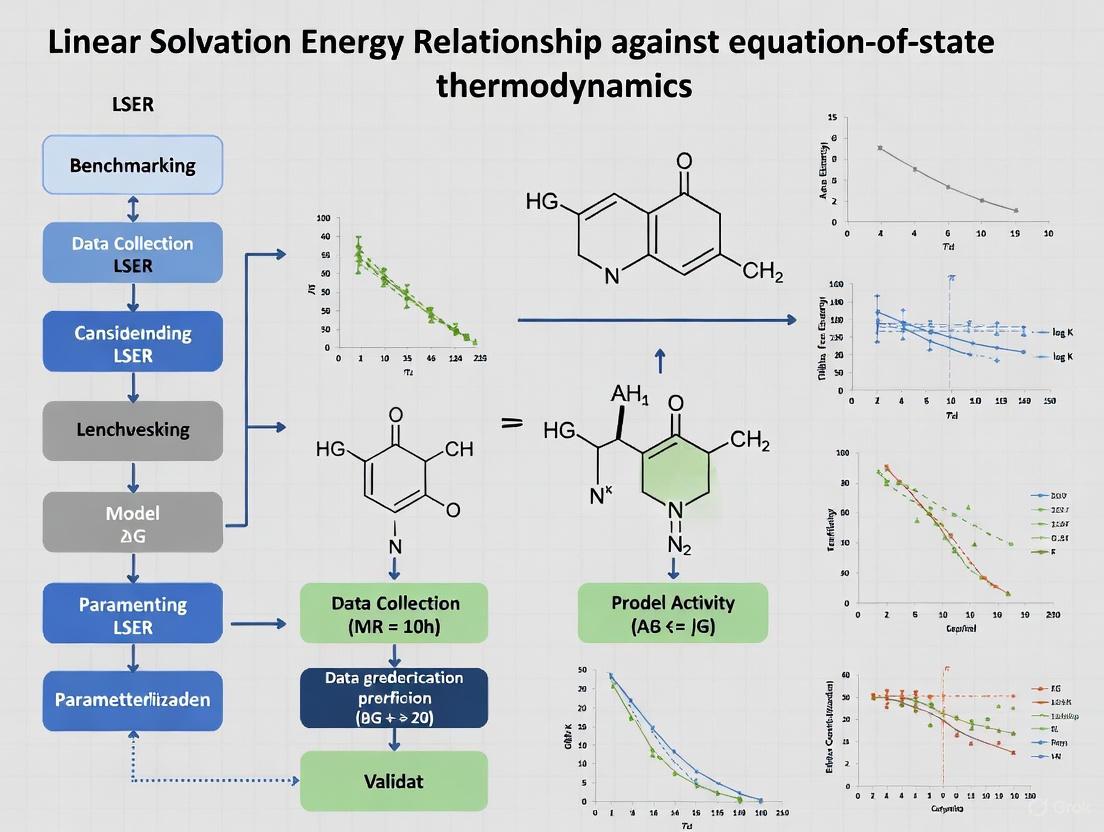
This article explores the critical interconnection between the rich, data-driven Linear Solvation Energy Relationships (LSER) database and the predictive framework of equation-of-state thermodynamics.
Bridging the Gap: Benchmarking Linear Solvation Energy Relationships (LSER) with Equation-of-State Thermodynamics for Advanced Pharmaceutical Research
Abstract
This article explores the critical interconnection between the rich, data-driven Linear Solvation Energy Relationships (LSER) database and the predictive framework of equation-of-state thermodynamics. Aimed at researchers and drug development professionals, it provides a comprehensive guide on extracting and transferring robust thermodynamic information on intermolecular interactions. We cover the foundational thermodynamics explaining LSER's linearity, methodological applications using tools like Partial Solvation Parameters (PSP), strategies for troubleshooting model limitations, and rigorous validation techniques against experimental data. The synthesis of these approaches offers a powerful pathway to enhance the prediction of solute partitioning, solvent screening, and activity coefficients, with significant implications for optimizing drug solubility and formulation.
The Thermodynamic Basis of LSER: Unraveling the Provenance of Linearity
Core Concepts and Fundamental Equations
The Abraham Solvation Parameter Model is a linear free energy relationship (LFER) that quantitatively connects a solute's capacity for specific intermolecular interactions with its equilibrium distribution in biphasic systems [1]. The model's power lies in its ability to separate and quantify the individual contributions of different intermolecular interactions to overall solvation properties.
Two principal equations form the foundation of the model, each applicable to different transfer processes. The first describes the transfer of a neutral solute from the gas phase to a condensed phase [1]:
log SP = c + eE + sS + aA + bB + lL [1]
The second equation applies to solute transfer between two condensed phases [1]:
log SP = c + eE + sS + aA + bB + vV [1]
In these equations, the dependent variable SP represents a free energy-related property, which can be a chromatographic retention factor, partition constant, or solubility [1]. The capital letters (E, S, A, B, V, L) are solute descriptors that quantify the solute's contribution to different intermolecular interactions. The corresponding lowercase letters (e, s, a, b, v, l) are system constants that represent the complementary properties of the specific solvent system [1].
Table 1: Abraham Model Solute Descriptors and Their Chemical Interpretations
| Descriptor | Symbol | Molecular Interaction Represented |
|---|---|---|
| Excess molar refractivity | E | Dispersion and lone-pair electron interactions [1] [2] |
| Dipolarity/Polarizability | S | Dipolarity and polarizability interactions [1] [2] |
| Overall Hydrogen-bond Acidity | A | Solute's ability to donate a hydrogen bond [1] [2] |
| Overall Hydrogen-bond Basicity | B | Solute's ability to accept a hydrogen bond [1] [2] |
| McGowan's Characteristic Volume | V | Dispersion interactions and molecular size; can be calculated from structure [1] |
| Gas-to-hexadecane partition coefficient | L | Determined from experimental gas-to-hexadecane partition coefficients [1] |
Experimental Protocols and Methodologies
Determining System Constants
System constants for a specific solvent or chromatographic system are determined through multiple linear regression analysis using experimentally measured partition coefficients or retention factors for a carefully selected set of calibration compounds [1]. The selection of an appropriate calibration set is critical and must meet specific statistical requirements [1]:
- Number of Compounds: Requires a minimum of 30-40 compounds for reliable regression statistics.
- Descriptor Space Coverage: Compounds must adequately span the chemical space of all solute descriptors (E, S, A, B, V/L).
- Statistical Independence: Descriptors should not be highly correlated with each other to avoid multicollinearity.
- Range of Retention: Should cover a reasonable range of retention factors, typically at least one order of magnitude.
The quality of the regression model is assessed using statistical parameters including the coefficient of determination (R²), Fisher statistic (F), and standard error of the estimate [1]. A plot of experimental versus predicted values for the dependent variable provides visual validation of model quality [1].
Determining Solute Descriptors
For new solutes, descriptors can be determined experimentally by measuring partition coefficients or retention factors in multiple calibrated systems and solving the set of simultaneous equations. The Solver method, implemented as an add-in for Microsoft Excel, is the dominant computational approach for this purpose [1]. This method works by [1]:
- Initial Estimation: Starting with estimated descriptor values, often from group contribution methods.
- Error Minimization: Iteratively adjusting descriptors to minimize the difference between measured and calculated partition coefficients across all systems.
- Constraint Application: Applying known constraints, such as setting A=0 for compounds with no hydrogen-bond donating ability.
Alternatively, descriptors can be estimated using group contribution methods or machine learning approaches that use the molecule's structural information, such as its SMILES code [2] [3].
Determining Solute Descriptors
Benchmarking Against Alternative Thermodynamic Approaches
The Abraham model is frequently benchmarked against other thermodynamic modeling frameworks in solvation research. Two prominent alternatives include Partial Solvation Parameters (PSP) and equations of state like PC-SAFT.
Table 2: Comparison of Abraham Model with Alternative Thermodynamic Approaches
| Feature | Abraham Model | Partial Solvation Parameters (PSP) | PC-SAFT Equation of State |
|---|---|---|---|
| Theoretical Basis | Linear Free Energy Relationship (LFER) [1] | Thermodynamic model with links to COSMO-RS and LSER [4] | Statistical Associating Fluid Theory [5] |
| Primary Applications | Partition coefficients, solubility prediction, ADMET profiling [6] | Phase equilibria, polymer characterization, surface energy prediction [4] | Solubility parameter prediction, phase behavior [5] |
| Treatment of H-Bonding | Separate acidity (A) and basicity (B) descriptors [1] | Converted to free energy terms with enthalpy/entropy decomposition [4] | Explicit association sites for specific interactions [5] |
| Descriptor Source | Experimental determination or group contribution [1] [3] | Can be derived from Abraham descriptors or COSMOments [4] | Fitted from binary experimental data [5] |
| Key Advantages | Well-established with extensive databases; wide applicability [6] | Unified approach for bulk and interfacial properties [4] | Explicitly accounts for molecular association [5] |
The Abraham model demonstrates particular value in pharmaceutical applications where it has been successfully used to predict crucial pharmacokinetic properties including skin permeation, blood-brain distribution, and intestinal absorption [6]. Its ability to predict solvation properties without requiring molecule synthesis makes it particularly valuable in early drug discovery [6].
Research Reagents and Computational Tools
Successful application of the Abraham model requires both experimental materials and computational resources.
Table 3: Essential Research Materials and Tools for Abraham Model Applications
| Reagent/Tool | Function/Purpose | Examples/Specifications |
|---|---|---|
| Calibration Compounds | Determine system constants for new solvents/columns [1] | 30-40 compounds spanning chemical space (e.g., varied E, S, A, B, V values) |
| Chromatographic Systems | Measure retention factors for descriptor determination [1] | RP-HPLC, GC systems with standardized conditions |
| Partitioning Systems | Experimental determination of partition coefficients [1] | Octanol-water, liquid-liquid partition systems |
| Abraham Descriptor Database | Source of known descriptors for calibration compounds [2] | UFZ-LSER database, Wayne State University database [1] |
| Computational Software | Calculate descriptors from structure; predict properties [6] | Absolv, ACD/Percepta, Open Notebook Science models [2] [6] |
| Solver Algorithm | Mathematical optimization for descriptor determination [1] | Microsoft Excel add-in for solving simultaneous equations |
Determining System Constants
Applications in Pharmaceutical and Chemical Industries
The Abraham model has become integral to industrial research and development, particularly in pharmaceutical and agrochemical sectors. In drug discovery, the approach helps predict absorption, distribution, metabolism, excretion, and toxicity (ADMET) properties, enabling more efficient candidate selection and optimization [6]. Major pharmaceutical companies have incorporated Abraham descriptors into their discovery workflows, often resulting in fewer compounds needing synthesis before selecting a clinical candidate [6].
The model also finds application in extractables and leachables studies for pharmaceutical and medical device industries, where it helps evaluate solvent equivalency, develop drug product simulating solvents, and understand extraction efficiency for polymeric materials [7]. In environmental chemistry, the model predicts the distribution and fate of organic compounds, supporting risk assessment for agrochemicals [6].
The integration of Abraham solvation parameters into commercial software platforms such as the ACD/Percepta Platform and Absolv module has further expanded its accessibility and impact, making sophisticated solvation modeling available to researchers without specialized expertise in the underlying mathematics [6].
The Challenge of Extracting Thermodynamic Information from LSER Descriptors
The Linear Solvation Energy Relationship (LSER) model, often called the Abraham model, stands as one of the most successful predictive frameworks in molecular thermodynamics [8] [9]. For decades, researchers across chemical, environmental, and pharmaceutical sciences have relied on its ability to correlate and predict solute transfer processes, such as solvation free energies and partition coefficients, using a set of six empirically-derived molecular descriptors [9] [10]. These descriptors—V, L, E, S, A, and B—characterize key molecular properties including volume, hexadecane-air partitioning, excess molar refraction, dipolarity/polarizability, hydrogen-bond acidity, and hydrogen-bond basicity [8] [9].
Despite its remarkable predictive success and extensive database of parameters, the LSER approach presents a fundamental challenge: extracting true thermodynamic information about specific intermolecular interactions from its descriptors and system coefficients. This limitation becomes particularly significant when attempting to integrate LSER insights with equation-of-state (EoS) thermodynamics, which provides a more fundamental, physics-based framework for modeling fluid behavior across wide ranges of temperature and pressure [9] [10]. This comparison guide examines the core challenges in this integration and evaluates emerging approaches that seek to bridge these powerful methodologies.
Theoretical Foundations: LSER vs. Equation-of-State Frameworks
The LSER Formalism
The LSER model operates through linear equations that describe solute partitioning between phases. For gas-to-solvent transfer, the fundamental equation takes the form:
LogK = c + eE + sS + aA + bB + lL [8] [9]
Where uppercase letters represent solute-specific descriptors and lowercase letters represent solvent-specific coefficients obtained through multilinear regression of experimental data [8]. The model's strength lies in this linear free energy relationship, which efficiently captures the combined effects of diverse molecular interactions without requiring explicit physical models for each interaction type.
Equation-of-State Approaches
In contrast, equation-of-state models like SAFT (Statistical Associating Fluid Theory) and LFHB (Lattice Fluid Hydrogen Bonding) employ a fundamentally different approach based on statistical thermodynamics [9]. These models:
- Separate contributions from different interaction types (dispersion, polar, hydrogen-bonding)
- Derive properties from fundamental molecular parameters
- Can extrapolate beyond fitted conditions using temperature- and density-dependent terms
- Explicitly account for hydrogen-bonding thermodynamics through association models or combinatorial factors [9]
The table below compares the core characteristics of these approaches:
Table 1: Fundamental Comparison Between LSER and Equation-of-State Frameworks
| Characteristic | LSER Model | Equation-of-State Models |
|---|---|---|
| Theoretical Basis | Empirical linear free-energy relationships | Statistical thermodynamics |
| Molecular Descriptors | Six solute descriptors (V, L, E, S, A, B) + solvent coefficients | Molecular parameters (size, energy, association schemes) |
| Temperature Dependence | Limited to original data temperature (typically 298K) | Explicit temperature and density dependence |
| Interaction Resolution | Collective interaction terms | Separated contributions (dispersion, polar, H-bonding) |
| Predictive Scope | Excellent for partitioned properties at standard conditions | Broad range of properties (VLE, LLE, calorimetric) over wide T/P ranges |
| Hydrogen-Bonding Treatment | Embedded in aA + bB terms | Explicit association models with ΔH, ΔS, ΔG |
Core Challenges in Thermodynamic Information Extraction
The Parameter Correlation Problem
A fundamental limitation in extracting specific interaction energies from LSER parameters stems from the statistical correlation between descriptors during the regression process [8] [10]. The coefficients (e, s, a, b, l, v) are determined simultaneously, creating inherent ambiguity in assigning physical significance to individual terms. As noted in recent research, "although there is ambiguity on the physical content of each" coefficient, the model's predictive power remains strong for many applications [8].
Absence of Explicit Temperature Dependence
Traditional LSER models lack explicit temperature dependence in their descriptors and coefficients, limiting their ability to provide the genuine thermodynamic parameters (ΔH, ΔS, ΔG) required for equation-of-state development [10]. While separate LSER equations exist for solvation enthalpies [8], the fundamental connection between free energy and enthalpy parameters remains empirically based rather than thermodynamically rigorous.
Non-Additivity of Hydrogen-Bonding Contributions
The representation of hydrogen-bonding through simple product terms (aA + bB) in LSER models fails to capture the cooperative and competitive nature of actual hydrogen-bonding interactions in condensed phases [9] [10]. In real systems, hydrogen bonds exhibit complex network behavior that cannot be fully described by linear combinations of acidity and basicity parameters.
Context-Dependent Descriptor Significance
Recent research demonstrates that the significance of LSER descriptors can vary dramatically with experimental conditions. In adsorption studies, Abraham descriptors become increasingly important at lower contaminant concentrations, while specific surface area dominates at higher concentrations [11]. This context-dependence challenges the extraction of universal thermodynamic parameters.
Emerging Hybrid Approaches
COSMO-LSER Integration
Recent work has explored combining COSMO-RS (Conductor-like Screening Model for Real Solvents) with LSER descriptors to leverage the strengths of both approaches [9] [12]. COSMO-RS uses quantum-chemical calculations of molecular surface charge distributions (σ-profiles) to predict solvation properties, providing an a priori computational method that complements LSER's empirical basis [9]. This hybrid framework:
- Uses COSMO-derived descriptors to complement or predict LSER parameters
- Provides better separation of specific interaction contributions
- Offers a pathway toward temperature-extended models [9] [12]
The workflow below illustrates how these approaches can be integrated:
Diagram: Integrating LSER, COSMO-RS, and Equation-of-State approaches through Partial Solvation Parameters (PSP).
Partial Solvation Parameters (PSP) Framework
The Partial Solvation Parameters (PSP) approach has been developed specifically to bridge LSER and equation-of-state methodologies [10]. PSPs are designed to extract thermodynamically meaningful information from LSER databases by:
- Defining four interaction-specific parameters (σd, σp, σa, σb) for dispersion, polar, acidity, and basicity contributions
- Establishing connections to solvation free energies and enthalpies
- Enabling estimation of hydrogen-bonding free energies (ΔGhb), enthalpies (ΔHhb), and entropies (ΔShb) [10]
Table 2: Comparison of Traditional and Emerging Approaches for Thermodynamic Information Extraction
| Methodology | Mechanism for Interaction Separation | Temperature Handling | Experimental Data Requirement | Integration with EoS |
|---|---|---|---|---|
| Traditional LSER | Statistical regression of collective terms | Limited to isothermal data | Extensive partitioning data for multiple solutes | Difficult, no direct pathway |
| COSMO-RS | Quantum-chemical surface charge analysis | Explicit via temperature-dependent terms | Minimal (primarily for validation) | Possible but not straightforward |
| PSP Framework | Equation-of-state based decomposition | Explicit through EoS formalism | LSER database plus pure component properties | Direct, native integration |
| COSMO-LSER Hybrid | Combined empirical and quantum-chemical | Limited but extensible | Reduced compared to pure LSER | Emerging, theoretically possible |
Experimental Protocols and Validation
Protocol for LSER Parameter Determination
The established methodology for developing LSER models involves:
- Compiling experimental partition coefficient data (K or P values) for diverse solutes in the system of interest [13]
- Gathering Abraham descriptors (E, S, A, B, V, L) for each solute from databases [14]
- Performing multilinear regression to determine system-specific coefficients (c, e, s, a, b, v, l)
- Validating model performance using leave-one-out cross-validation or external test sets [13] [11]
This protocol was recently applied to study microplastic sorption, yielding models with R² = 0.96 for UV-aged polyethylene [13].
Protocol for Hydrogen-Bonding Energy Validation
Recent research has established protocols for validating hydrogen-bonding interaction energies:
- Computing molecular surface charge distributions using DFT calculations with appropriate basis sets [12]
- Calculating interaction energies for dimer pairs using COSMO-RS or other quantum chemical methods [9] [12]
- Comparing with LSER-derived estimates from aA + bB terms or PSP predictions [12]
- Reconciling discrepancies through examination of conformational effects and solvation contributions [12]
This approach has demonstrated that hydrogen-bonding interaction energies can be approximated by 2.303RTαβ for complementary pairs, providing a bridge between LSER descriptors and quantum-chemical calculations [12].
Table 3: Essential Resources for LSER and Thermodynamic Integration Research
| Resource Category | Specific Examples | Function and Application |
|---|---|---|
| Experimental Data Sources | UFZ-LSER Database [14], IUPAC-NIST Solubility Database | Provide critically-evaluated partition coefficients and solute descriptors for parameter regression |
| Computational Tools | COSMO-RS/COSMOtherm [9], Gaussian, ORCA | Generate quantum-chemical descriptors (σ-profiles) and compute interaction energies |
| Regression & Validation Software | R, Python (scikit-learn), MATLAB | Perform multilinear regression for LSER coefficients and model validation |
| Specialized Descriptors | Abraham descriptors (E, S, A, B, V, L) [8] [14], PSPs (σd, σp, σa, σb) [10] | Characterize solute properties and interaction capabilities for predictive modeling |
| Reference Systems | n-Hexadecane/water partitioning [8], gas/solvent systems | Provide standardized reference states for descriptor determination and model calibration |
The challenge of extracting thermodynamic information from LSER descriptors remains an active research frontier with significant implications for molecular thermodynamics and drug development. While traditional LSER approaches provide excellent predictive power for partition-related properties at standard conditions, their empirical foundation limits thermodynamic interpretability. Emerging hybrid approaches—particularly the PSP framework and COSMO-LSER integration—show promise in bridging this gap by combining the extensive LSER database with more fundamental thermodynamic models [9] [10].
For researchers and drug development professionals, these developments offer a path toward more predictive models that can extrapolate beyond experimentally characterized systems while providing genuine insight into specific molecular interactions. The ongoing integration of machine learning methods with these frameworks [11] further enhances their potential for accelerating molecular design and optimization in pharmaceutical applications.
Equation-of-State Thermodynamics as a Framework for Interpretation
The accurate prediction of solute-solvent interactions and thermodynamic properties is fundamental to advancements in chemical, biomedical, and environmental research. For decades, the Linear Solvation-Energy Relationships (LSER) model, also known as the Abraham solvation parameter model, has served as a primary predictive tool for these interactions [10]. This framework correlates solute transfer properties with molecular descriptors through linear free-energy relationships, offering remarkable success across various applications [10]. Simultaneously, Equation-of-State (EoS) Thermodynamics provides a fundamental approach grounded in statistical mechanics, capable of predicting thermodynamic properties over broad ranges of conditions [10].
This comparison guide objectively benchmarks these complementary frameworks, examining their theoretical foundations, methodological approaches, performance characteristics, and applicability to drug development challenges. We provide experimental data and protocols to facilitate researcher evaluation of these tools for specific scientific applications, particularly focusing on how EoS thermodynamics serves as an interpretive framework for enriching LSER-based predictions.
Methodological Foundations: A Comparative Analysis
Theoretical Principles and Computational Approaches
The LSER and EoS frameworks approach molecular interaction prediction from distinct yet potentially complementary perspectives. The table below summarizes their core characteristics:
Table 1: Fundamental Characteristics of LSER and EoS Thermodynamic Frameworks
| Characteristic | LSER (Abraham Model) | Equation-of-State Thermodynamics |
|---|---|---|
| Theoretical Basis | Linear free-energy relationships; empirical correlations | Statistical mechanics; fundamental thermodynamic laws |
| Primary Inputs | Six solute molecular descriptors (Vx, L, E, S, A, B) [10] | Fundamental variables (P, T, V); intermolecular potential parameters |
| Mathematical Form | Linear equations: log(P) = cp + epE + spS + apA + bpB + vpVx [10] | Analytic equations relating P, V, T; often with parameters for specific interactions |
| Treatment of Interactions | Descriptors for volume, polarity, and hydrogen bonding (acidity/basicity) [10] | Partial Solvation Parameters (PSP): σd, σp, σa, σb for different interaction types [10] |
| Temperature Dependence | Limited to isothermal data (typically 298 K) | Explicitly modeled across temperature ranges |
| Domain of Development | Solvation and partitioning phenomena | Broad material behavior under varying P-T conditions |
Key Research Reagents and Computational Tools
Successful implementation of both frameworks requires specialized parameters and computational approaches:
Table 2: Essential Research Reagents and Tools for Thermodynamic Frameworks
| Resource Type | Specific Examples | Function/Role in Research |
|---|---|---|
| LSER Descriptors | Vx (McGowan volume), E (excess molar refraction), S (dipolarity/polarizability), A (H-bond acidity), B (H-bond basicity) [10] | Quantify specific molecular interaction capabilities for solvation prediction |
| LSER Solvent Coefficients | ep, sp, ap, bp, vp (system descriptors) [10] | Characterize solvent's complementary effect on solute-solvent interactions |
| EoS Parameters | Partial Solvation Parameters (PSP): σd, σp, σa, σb [10] | Bridge LSER information with EoS thermodynamics; estimate ΔGhb, ΔHhb, ΔShb |
| Computational Methods | First-principles molecular dynamics simulations [15] | Generate P-V-T data under extreme conditions for EoS development |
| Machine Learning Frameworks | EOSNN (physics-informed neural networks) [16] | Learn EOS surfaces from diverse data sources with uncertainty quantification |
Experimental Protocols and Performance Benchmarking
Representative Experimental Methodologies
Protocol 1: First-Principles Molecular Dynamics for EoS Development
This protocol outlines the development of an analytic EoS from first principles, as demonstrated for liquid Fe-O alloys under extreme conditions [15]:
- Simulation Setup: Configure molecular dynamics simulations for liquid iron-oxygen alloys (Fe-X wt.% O, where X = 0, 2.8, 6.1, and 9.9) using first-principles methods.
- Condition Specification: Define pressure-temperature conditions matching the system of interest (e.g., Earth's outer core: 136-330 GPa, 4000-6000 K) [15].
- Data Generation: Calculate pressure-volume-temperature (P-V-T) data points across the defined condition range.
- Equation Fitting: Establish an analytic EoS incorporating parameters for P, T, V, and composition variables.
- Property Calculation: Derive thermodynamic properties (density, thermal expansion coefficient, bulk modulus, sound velocity) from the fitted EoS.
- Validation: Compare predicted properties (density-pressure and sound velocity-pressure profiles) against reference data (e.g., Preliminary Reference Earth Model) [15].
Protocol 2: LSER Model Implementation for Solvation Prediction
This protocol describes the standard implementation of the LSER model for predicting solvation properties [10]:
- Solute Characterization: Determine the six molecular descriptors for the solute of interest: Vx, L, E, S, A, and B.
- System Identification: Select the appropriate LFER equation based on the transfer process:
- For condensed phase transfer: log(P) = cp + epE + spS + apA + bpB + vpVx
- For gas-to-solvent partitioning: log(KS) = ck + ekE + skS + akA + bkB + lkL
- Coefficient Application: Apply the known solvent-specific coefficients for the system.
- Calculation: Compute the predicted partition coefficient or solvation free energy.
- Enthalpy Extension: For solvation enthalpies, implement the LSER equation: ΔHS = cH + eHE + sHS + aHA + bHB + lHL [10].
Performance Comparison and Limitations
Table 3: Experimental Performance Comparison of LSER and EoS Frameworks
| Performance Metric | LSER Approach | EoS Approach | Experimental Context |
|---|---|---|---|
| Prediction Accuracy | R² > 0.95 for many solvation properties [10] | Matches PREM data with ~6.1 wt% O in Fe-O systems [15] | Established through extensive validation against experimental data |
| Uncertainty Quantification | Limited to statistical error from regression | Probabilistic models for aleatoric and epistemic uncertainty [16] | EOSNN demonstrates R² 0.83, RMSE 0.52 eV/atom in challenging tests [16] |
| Data Requirements | Requires extensive experimental data for coefficient determination [10] | Can integrate diverse data (static/dynamic compression, ab initio) [16] | EoS benefits from multiple data sources; LSER limited to available solvent coefficients |
| Extrapolation Capability | Limited to chemical space of parametrized descriptors | Physical basis enables better extrapolation to extreme conditions | EoS successfully predicts properties at 1 TPa for aluminum [17] |
| Computational Demand | Low for application after parametrization | High for first-principles development; moderate for application | Machine learning EoS bridges accuracy-efficiency gap [16] |
Integration Pathways: Connecting LSER and EoS Frameworks
The integration of LSER and EoS frameworks leverages the strengths of both approaches, creating a more powerful predictive tool for molecular interactions.
The conceptual workflow above illustrates how Partial Solvation Parameters (PSP) serve as a bridge between LSER descriptors and EoS thermodynamics, enabling enhanced applications across multiple domains [10].
Machine Learning Integration
Machine learning approaches successfully integrate both frameworks while addressing their individual limitations:
Modern machine learning frameworks like EOSNN demonstrate how neural networks can learn EoS surfaces from diverse data sources while incorporating physical constraints, achieving R² scores as high as 0.83 for energy prediction even with limited data [16].
The comparative analysis reveals distinctive advantages for each framework with significant potential for integration:
LSER provides an excellent tool for rapid prediction of solvation and partitioning behavior where molecular descriptors are available and systems fall within parametrized chemical space [10].
EoS Thermodynamics offers a more fundamental approach with better extrapolation capability, explicit temperature dependence, and applicability to extreme conditions [15] [17].
Integration Approaches through Partial Solvation Parameters and machine learning frameworks leverage the rich informational content of LSER databases while providing the physical foundation and extrapolation capability of EoS methods [10] [16].
For drug development researchers, LSER remains immediately valuable for solubility and partitioning prediction, while EoS integration addresses temperature dependence and provides deeper thermodynamic insight into molecular interactions. The ongoing development of hybrid approaches promises increasingly powerful tools for understanding and predicting molecular behavior across the diverse conditions encountered in pharmaceutical research and development.
Hydrogen bonding is a fundamental intermolecular interaction that dictates the structure, stability, and function of biological and chemical systems. Its quantitative description requires a rigorous thermodynamic framework that decomposes the overall interaction energy into entropic and enthalpic components. The strength of hydrogen bonds exhibits significant environmental dependence, varying from approximately 5–6 kcal/mol in isolated gas-phase conditions to about 0.5–1.5 kcal/mol for proteins in aqueous solutions [18]. This substantial reduction in effective strength within biological environments highlights the critical importance of context when applying thermodynamic principles to drug design and biomolecular engineering. Understanding this complex interplay between free energy (ΔG), enthalpy (ΔH), and entropy (ΔS) provides the foundation for predicting molecular behavior across diverse chemical and biological systems.
Two powerful computational approaches have emerged for quantifying these interactions: the Linear Solvation Energy Relationship (LSER) model and COSMO-RS (Conductor-like Screening Model for Real Solvents). LSER employs empirically-derived molecular descriptors to correlate structure with thermodynamic properties, while COSMO-RS utilizes quantum-mechanical calculations to predict solvation behavior [9] [10]. This review benchmarks these complementary methodologies against equation-of-state thermodynamics, evaluating their respective capabilities for dissecting hydrogen bonding contributions to molecular interactions.
Theoretical Frameworks: LSER vs. COSMO-RS
The LSER Approach and Molecular Descriptors
The LSER model, developed by Abraham, quantifies solute transfer between phases using linear free energy relationships. The approach utilizes two primary equations for different transfer processes. For solute partitioning between gas and liquid phases, the model takes the form:
log(K*) = ck + ekE + skS + akA + bkB + lkL [9]
For partitioning between two condensed phases, the relationship becomes:
log(P) = cp + epE + spS + apA + bpB + vpVx [9]
In these equations, the uppercase letters represent solute-specific molecular descriptors: Vx (McGowan's characteristic volume), L (gas-liquid partition coefficient in n-hexadecane), E (excess molar refraction), S (dipolarity/polarizability), A (hydrogen bond acidity), and B (hydrogen bond basicity). The corresponding lowercase letters represent solvent-specific coefficients determined through multilinear regression of experimental data [9]. The hydrogen bonding contribution to solvation free energy is quantified by the term akA + bkB, while a similar formulation with different coefficients applies to solvation enthalpies [9].
Table 1: LSER Molecular Descriptors and Their Physicochemical Significance
| Descriptor | Symbol | Molecular Property Represented |
|---|---|---|
| McGowan's Characteristic Volume | Vx | Molecular size and volume |
| Gas-Hexadecane Partition Coefficient | L | Dispersion interactions |
| Excess Molar Refraction | E | Polarizability from π- and n-electrons |
| Dipolarity/Polarizability | S | Polarity and polarizability |
| Hydrogen Bond Acidity | A | Proton-donating capacity |
| Hydrogen Bond Basicity | B | Proton-accepting capacity |
The COSMO-RS Approach and Sigma Profiles
In contrast to LSER's empirical descriptors, COSMO-RS is an a priori predictive method based on quantum mechanical calculations. The model begins with DFT calculations of individual molecules in a virtual perfect conductor, producing sigma (σ) profiles that represent the probability distribution of polarized surface charge densities [9] [12]. These σ profiles encode information about a molecule's hydrogen bonding capability, polarity, and dispersion interactions. The statistical thermodynamics of molecular surface interactions are then computed, allowing prediction of solvation energies and other thermodynamic properties without experimental input [9].
A key advantage of COSMO-RS for hydrogen bonding analysis is its ability to calculate separate contributions to solvation enthalpy, including specific hydrogen-bonding components [9]. Recent developments have combined COSMO-RS with LSER concepts to create predictive models for hydrogen-bonding interaction energies using the formula:
ΔEHB = c(α1β2 + α2β1)
where c is a universal constant (5.71 kJ/mol at 25°C), and α and β represent molecular descriptors for proton-donating and proton-accepting capacities derived from COSMO-RS calculations [12].
Experimental Methodologies for Hydrogen Bond Quantification
Isothermal Titration Calorimetry (ITC)
ITC directly measures the heat evolved or absorbed during molecular interactions, providing complete thermodynamic characterization of hydrogen bonding in a single experiment [19]. The experimental protocol involves:
- Sample Preparation: Purified antibody (3-7 μM) or Fab fragments (1-9 μM) are dialyzed against phosphate-buffered saline (pH 7.4) to standardize buffer conditions [19].
- Titration Procedure: The sample cell is filled with antibody solution, and the injection syringe contains polysaccharide solution (100-1000 μM for MAbs, 30-500 μM for Fabs). After baseline stabilization, approximately 35 microinjections of constant volume (7-10 μL) are made with 3-minute intervals between injections [19].
- Data Analysis: The resulting isotherm is fitted using appropriate binding models to determine K (binding constant), ΔH (enthalpy change), and N (binding stoichiometry). From these values, ΔG is calculated as ΔG = -RTlnK, and ΔS is derived using ΔG = ΔH - TΔS [19].
ITC studies of antibody-polysaccharide interactions have revealed binding constants in the range of 10⁶ to 10⁷ M⁻¹, with both ΔH and ΔS generally favorable for binding [19].
Molecular Dynamics (MD) Approaches
MD simulations provide an alternative computational method for determining hydrogen bond strengths through analysis of dynamic behavior rather than thermodynamic equilibrium [18]. The methodology includes:
- System Preparation: Initial protein structures (e.g., β-sheet hairpin or α-helix) are minimized in vacuum, then solvated with water molecules for aqueous environment simulations [18].
- Trajectory Analysis: The N—O distance between hydrogen bond donors and acceptors is tracked over time, with rupture events identified when distances exceed critical thresholds (typically >3.4 Å) [18].
- Kinetic Modeling: Mean first passage times for hydrogen bond rupture are calculated at different temperatures, allowing determination of activation energies through Arrhenius-type analysis [18].
This approach has revealed that hydrogen bond rupture in β-sheets occurs with an activation energy of 4.76 kcal/mol under isolated conditions, reduced to 1.58 kcal/mol in aqueous environments [18].
Comparative Analysis: Thermodynamic Insights from Different Methods
Hydrogen Bond Energetics Across Environments
Table 2: Hydrogen Bond Energies Across Different Environments and Measurement Methods
| System/Environment | Method | Energy (kcal/mol) | Contributing Factors |
|---|---|---|---|
| Isolated peptide bonds (gas phase) | Theoretical/Pauling | 5.0-8.0 | Pure enthalpy, minimal entropy effects [18] |
| β-sheet (isolated) | MD Simulations | 4.76 (activation energy) | Direct hydrogen bond enthalpy [18] |
| β-sheet (in water) | MD Simulations | 1.58 (activation energy) | Enthalpy-entropy compensation [18] |
| CCl₄ environment | Experimental (Klotz) | 4.2 | Reduced but present hydrophobic effects [18] |
| Proteins in solution | Experimental (Williams) | 0.5-1.5 | Significant entropy penalty [18] |
| Antibody-PS binding | ITC | ~1.4-2.4 (ΔG) | Combined favorable ΔH and ΔS [19] |
Methodological Comparison for Hydrogen Bond Analysis
Table 3: Comparison of Methodological Approaches for Hydrogen Bond Thermodynamics
| Method | Key Measurables | Strengths | Limitations |
|---|---|---|---|
| LSER | Solvation free energies, partition coefficients | Broad applicability, simple linear relationships, extensive database [9] [10] | Empirical parameters, limited to available descriptors [9] |
| COSMO-RS | Sigma profiles, solvation enthalpies | A priori prediction, separate HB enthalpy contribution [9] [12] | Computational cost, parameterization dependent [9] |
| ITC | K, ΔH, ΔG, ΔS, stoichiometry | Direct measurement, complete thermodynamics in one experiment [19] | Requires substantial sample, limited to measurable interactions [19] |
| MD Simulations | Activation energies, kinetic rates | Atomic-level insight, environment effects, dynamic information [18] | Force field dependent, computationally intensive [18] |
The Scientist's Toolkit: Essential Research Reagents and Materials
Table 4: Essential Research Reagents for Hydrogen Bond Thermodynamics Studies
| Reagent/Material | Function/Application | Example Usage |
|---|---|---|
| VP-ITC Microcalorimeter | Direct measurement of binding thermodynamics | Quantifying antibody-polysaccharide interactions [19] |
| COSMOlogic Software | Quantum chemical calculations and σ-profile generation | Predicting hydrogen-bonding interaction energies [9] [12] |
| CHARMM Package | Molecular dynamics simulations | Calculating hydrogen bond rupture kinetics [18] |
| Sodium Dodecyl Sulfate (SDS) | Model surfactant for micelle formation | Studying hydrophobic and electrostatic interactions [20] |
| Bifonazole | Model drug compound | Investigating drug-micelle interactions [20] |
| Lecithin | Natural phospholipid surfactant | Membrane permeability and ethosomal formulation studies [20] |
Integration with Equation-of-State Frameworks
The integration of LSER and COSMO-RS with equation-of-state models represents a promising frontier for extending hydrogen bonding thermodynamics across wide ranges of temperature and pressure. The LFHB (Lattice-Fluid Hydrogen Bonding) model exemplifies this approach by dividing system Gibbs energy into hydrogen-bonding (ΔGhb) and non-hydrogen-bonding (ΔGLF) contributions [9]. Similarly, Partial Solvation Parameters (PSP) with equation-of-state characteristics enable the estimation of ΔGhb, ΔHhb, and ΔS_hb over broad external conditions [10].
These integrated approaches address a fundamental challenge in molecular thermodynamics: the division of intermolecular interactions into discrete classes based on strength and type, which inevitably involves some degree of arbitrariness [10]. The combination of quantum-chemical methods with statistical thermodynamics provides a pathway toward more systematic classification and prediction of hydrogen bonding contributions in complex systems.
The quantitative analysis of hydrogen bonding thermodynamics reveals a complex interplay between enthalpic and entropic contributions that vary significantly with environmental context. LSER and COSMO-RS offer complementary approaches—empirical and quantum-mechanical, respectively—for predicting these interactions, with each demonstrating strengths for particular applications. ITC provides experimental validation, while MD simulations offer atomic-level insights into dynamic behavior. The ongoing integration of these methodologies with equation-of-state frameworks promises enhanced predictive capability for hydrogen bonding phenomena across the chemical, materials, and biological sciences. As these tools continue to evolve, they will undoubtedly advance fundamental understanding and enable more rational design in pharmaceutical development and biomolecular engineering.
Hydrogen Bond Analysis Framework
This diagram illustrates the interconnected methodologies for hydrogen bond analysis and their relationship to fundamental thermodynamic parameters. The framework highlights how different experimental and computational approaches contribute to understanding the complex interplay between free energy, enthalpy, and entropy across varying environmental conditions.
Verifying the Thermodynamic Basis of LFER Linearity for Strong Specific Interactions
The Linear Free Energy Relationships (LFER) model, particularly the Abraham solvation parameter model, has established itself as a remarkably successful predictive tool across chemical, environmental, and biomedical sciences. Its ability to correlate and predict solute transfer properties across phases relies on a linear relationship between free-energy-related properties and a set of six empirically determined molecular descriptors [10]. A central, and somewhat puzzling, feature of this model is the observed linearity even for processes involving strong specific interactions, such as hydrogen bonding, which are typically associated with complex, non-ideal behavior [9] [10]. This article benchmarks the LSER approach against rigorous equation-of-state (EOS) thermodynamics, examining the thermodynamic validity of this linearity and exploring the potential for a unified framework that leverages the strengths of both methodologies. Such an interconnection is vital for extracting thermodynamically meaningful information on intermolecular interactions from rich LSER databases, ultimately enabling more robust predictions in complex systems like pharmaceutical formulations [10] [5].
Theoretical Foundations: LSER and the Equation-of-State Challenge
The LSER Formalism and Its Molecular Descriptors
The predictive power of the LSER model stems from its two foundational equations that quantify solute partitioning. For transfer between two condensed phases, the relationship is expressed as: log(P) = cp + epE + spS + apA + bpB + vpVx [10]
Here, P represents a partition coefficient (e.g., water-to-organic solvent). The uppercase letters (E, S, A, B, Vx) are the solute's molecular LSER descriptors: excess molar refraction, dipolarity/polarizability, hydrogen-bond acidity, hydrogen-bond basicity, and McGowan's characteristic volume, respectively [9] [10]. The lowercase coefficients (cp, ep, sp, ap, bp, vp) are the system-specific LFER coefficients considered to reflect the complementary effect of the solvent phase on the solute-solvent interactions [10]. A similar equation, utilizing descriptor L (the gas-liquid partition coefficient in n-hexadecane), is used for gas-to-solvent partitioning [9].
Equation-of-State Approaches for Intermolecular Interactions
In parallel, statistical thermodynamic EOS models provide a fundamental basis for describing fluid behavior. These models explicitly account for different types of intermolecular interactions:
- SAFT-based Models: The Statistical Associating Fluid Theory (SAFT) and its variants, like Perturbed Chain-SAFT (PC-SAFT), separate the Helmholtz free energy into contributions from hard-chain reference, dispersion forces, and most notably, association (hydrogen-bonding) terms [9] [5]. These models are highly effective for correlating and predicting phase equilibria and solubility parameters, especially for complex, associating pharmaceuticals [5].
- LFHB Model: The Lattice-Fluid Hydrogen-Bonding (LFHB) model divides the system's Gibbs energy into a hydrogen-bonding term and a term for all other intermolecular interactions [9]. Its statistics are particularly versatile for handling intricate hydrogen-bonding networks, such as those in aqueous and polymer systems [9].
A key distinction is that while EOS models like SAFT and LFHB typically require parameterization from experimental data, the LSER model and the quantum-mechanics-based COSMO-RS offer a more predictive approach, with the latter being one of the best a priori predictive methods for solvation free energies [9].
The Provenance of Linearity: A Thermodynamic Interrogation
The consistent linearity observed in LFER relationships, even for strongly interacting systems, demands a thermodynamic explanation. Research combining EOS solvation thermodynamics with the statistical thermodynamics of hydrogen bonding has verified that there is, indeed, a sound thermodynamic basis for the LFER linearity [10].
The linearity emerges because the solvation process can be conceptually divided into contributions from different interaction types. The products of solute descriptors and solvent coefficients (e.g., akA + bkB for gas-to-solvent partitioning) are assumed to quantify the hydrogen-bonding contribution to the free energy of solvation [9] [10]. The central hypothesis is that the overall solvation property is a sum of these largely independent contributions, each proportional to a specific molecular property of the solute and a complementary property of the solvent. The EOS perspective supports this by showing that the free energy change can be separated into well-defined physical contributions, validating the additive structure of the LSER equations [10].
Experimental and Computational Protocols for Validation
Validating the thermodynamic basis of LFER requires a multi-pronged approach, combining computational predictions with experimental data analysis.
Computational Estimation of Hydrogen-Bonding Contributions
- COSMO-RS Protocol: Calculations are performed using software suites like COSMOtherm. The recommended protocol uses the TZVPD-Fine level for the quantum-chemical calculations that underpin the COSMO-RS method. This approach can be used to predict the hydrogen-bonding contribution to solvation enthalpy, providing an a priori benchmark for comparison with LSER and EOS estimations [9].
- LSER Protocol for Enthalpy: The hydrogen-bonding contribution to solvation enthalpy is calculated using linear relationships of the form:
ΔHsolv = ch + ehE + shS + ahA + bhB + lhL [9]
The coefficients (
ah,bh, etc.) in this equation are determined through multilinear regression of extensive, critically-selected experimental solvation enthalpy data [9].
Equation-of-State Parameterization
- PC-SAFT for Pharmaceuticals: The PC-SAFT EOS is used to predict drug solubility parameters, a property directly linked to solvation thermodynamics. The protocol involves:
- Estimating the pure-component parameters for the drug and solvent from available data or correlations.
- Explicitly considering association interactions between drug-drug and drug-solvent molecules.
- Calculating the solubility parameter, which is derived from the cohesive energy density, and decomposing it into contributions from hard-chain, dispersion, and hydrogen-bonding interactions [5].
- LFHB Calculations: This method estimates key thermodynamic quantities, such as the free energy change (ΔGhb) or enthalpy change (ΔHhb) upon hydrogen bond formation, by fitting its parameters to experimental data (e.g., phase equilibria, calorimetric data) [9].
Comparative Analysis Workflow
The core validation strategy involves an extensive comparison of the hydrogen-bonding contributions to solvation enthalpy predicted by COSMO-RS, LSER, and estimated by LFHB or other EOS models for a wide range of solute-solvent systems. Discrepancies are critically examined against experimental data to refine understanding and model parameters [9].
Figure 1: Workflow for LSER and Equation-of-State Benchmarking. This diagram outlines the process of comparing predictions from different methodologies to verify linearity and extract thermodynamically robust parameters.
Comparative Data: LSER vs. EOS Models for Strong Interactions
Hydrogen-Bonding Contribution to Solvation Enthalpy
A critical comparison of the hydrogen-bonding (HB) contribution to solvation enthalpy reveals the level of agreement between different predictive and correlative models.
Table 1: Comparison of Hydrogen-Bonding Contribution Estimations from Different Models
| Solute-Solvent System | LSER Prediction (ahA + bhB) | COSMO-RS Prediction (TZVPD-Fine) | LFHB EOS Estimation | Level of Agreement |
|---|---|---|---|---|
| Typical System | Calculated from eq. 3 & database descriptors [9] | Computed via COSMOtherm software [9] | Fitted to phase equilibria/calorimetric data [9] | Good agreement in most systems [9] |
| Systems with Strong/Complex HB | Linear model may struggle with cooperativity [9] | A priori prediction from sigma surfaces [9] | Handles cooperative & 3D networks well [9] | Large discrepancies observed [9] |
| Key Strength | Simplicity, extensive database [10] | A priori predictive capability [9] | Versatility for complex networks [9] | Models are largely complementary |
Predicting Pharmaceutical Solubility Parameters
The application of these principles to drug solubility, a key property in pharmaceutical development, highlights the practical value of EOS models.
Table 2: Performance of PC-SAFT EOS in Predicting Drug Solubility Parameters
| Modeling Approach | Basis for Prediction | Handling of Hydrogen-Bonding | Reported Performance | Major Limitations |
|---|---|---|---|---|
| PC-SAFT EOS | Binary experimental solubility data [5] | Explicit association terms for drug-drug & drug-solvent interactions [5] | Provides satisfactory accuracy; critical role of HB confirmed [5] | Requires pure-component parameters |
| Group Contribution (GC) Methods | Pre-defined tables of functional group contributions | Implicit, based on group parameters | Limited accuracy; unreliable for novel drug groups [5] | Fails to capture steric hindrance & intramolecular HB [5] |
| Unconstrained Regression (URA) | Correlates experimental solubility with Hansen terms [5] | Implicit in the regression parameters | Provides comparative predictions [5] | Less fundamental than EOS approaches |
Table 3: Key Research Reagents and Computational Tools
| Item / Resource | Function / Description | Relevance to Research |
|---|---|---|
| LSER Database | A freely accessible database containing Abraham descriptors for thousands of solutes [9]. | The primary source of solute-specific parameters for LFER calculations and model validation. |
| COSMO-RS (e.g., via COSMOtherm) | A quantum-mechanics-based, a priori predictive model for solvation thermodynamics [9]. | Used to compute hydrogen-bonding contributions to solvation enthalpy without experimental data. |
| PC-SAFT Parameters | A set of pure-component parameters (segment number, diameter, dispersion energy, association schemes) for compounds [5]. | Essential for applying the PC-SAFT EOS to predict solubility parameters and phase behavior of pharmaceuticals. |
| LFHB Model Parameters | Parameters for the lattice-fluid and hydrogen-bonding (Veytsman statistics) contributions [9]. | Used to estimate the Gibbs energy, enthalpy, and entropy changes upon hydrogen bond formation in complex systems. |
The verification of the thermodynamic basis for LFER linearity confirms that the model's empirical success is grounded in sound physical principles. The linear relationships hold because they effectively represent the additive nature of different intermolecular interaction contributions to the overall free energy change, even for strong specific interactions [10]. The benchmarking against EOS thermodynamics reveals that while LSER provides a robust and simple predictive framework backed by an extensive database, EOS models offer a more fundamental and versatile approach for extrapolating across temperatures and pressures and for handling highly complex interactions.
The future of this field lies in the development of a unified framework. The perspectives for a COSMO-LSER equation-of-state model are promising [9]. Such a model would integrate the a priori predictive power of COSMO-RS, the rich thermodynamic information and simplicity of the LSER database, and the rigorous statistical thermodynamics of EOS models like LFHB and SAFT. This interconnection would create a powerful tool for molecular thermodynamics, enabling reliable predictions of thermodynamic properties over broad ranges of conditions and for systems with complex, strong specific interactions, ultimately accelerating progress in drug development, material design, and environmental science [9] [10].
From Data to Prediction: Applying Partial Solvation Parameters (PSP) in Practice
Partial Solvation Parameters (PSP) represent a modern thermodynamic framework designed for the integral and coherent characterization of materials, enabling the prediction of their behavior in bulk phases and at interfaces. Conceived as a versatile tool with a sound thermodynamic basis, the PSP approach interconnects various Quantitative Structure-Property Relationship (QSPR)-type databases, facilitating the transfer of molecular information onto a common denominator for broad applications in pharmaceutics, material science, and polymer engineering [21] [10]. This approach shares the versatility of established models like the Hansen Solubility Parameter (HSP) or Linear Solvation Energy Relationships (LSER) but possesses distinct advantages rooted in equation-of-state thermodynamics [21].
A core innovation of the PSP framework is its ability to bridge the gap between the rich thermodynamic information contained in databases like the LSER (Abraham solvation parameter) database and the predictive needs of molecular thermodynamics. It is designed to extract valid thermodynamic information on intermolecular interactions, providing a unified methodology that is well-suited for characterizing both pure fluids and mixtures, as well as describing behavior in bulk phases and at interfaces [10] [22]. The model is characterized by four primary parameters, each quantifying a specific type of intermolecular interaction: σd (dispersion PSP), σp (polarity PSP), σa (acidity PSP), and σb (basicity PSP) [21] [10].
Defining the Four Core Partial Solvation Parameters
The PSP approach deconstructs cohesive energy density into contributions from specific intermolecular forces. Each parameter is defined with a specific thermodynamic meaning and mapping to underlying molecular properties.
Dispersion PSP (σd)
The dispersion PSP, σd, reflects hydrophobicity, cavity effects, and weak non-polar interactions, primarily London dispersion forces [21]. It is calculated from the McGowan volume, Vx, and the excess refractivity, E, LSER descriptors of the compound [21]:
σd = 100 * (3.1 * Vx + E) / Vm
where Vm is the molar volume of the compound. This parameter effectively maps the capacity of a molecule to engage in non-specific, weak attractive interactions.
Polarity PSP (σp)
The polarity PSP, σp, collectively reflects Debye-type (inductive) and Keesom-type (dipolar) polar interactions [21] [10]. It is directly mapped from the polarity/polarizability, S, LSER descriptor [21]:
σp = 100 * S / Vm
This parameter quantifies the energy associated with electrostatic interactions between permanent and induced dipoles.
Acidity and Basicity PSPs (σa and σb)
The acidity (σa) and basicity (σb) PSPs reflect the stronger, specific interactions of the hydrogen-bonding or Lewis acid/base type [21] [10]. They are Gibbs free-energy descriptors, providing the Gibbs free energy change directly upon the formation of a hydrogen bond. They are mapped from the Abraham LSER descriptors A (hydrogen-bond acidity) and B (hydrogen-bond basicity), respectively [21]:
σa = 100 * A / Vm
σb = 100 * B / Vm
The free energy change upon the formation of a hydrogen bond is related to these parameters by the equation [21]:
-ΔGHB = 2 * Vm * σa * σb
Table 1: Definition and Thermodynamic Basis of the Four Core Partial Solvation Parameters
| PSP Symbol | PSP Name | Primary Interactions Mapped | Key LSER Descriptor Counterparts | Defining Equation |
|---|---|---|---|---|
| σd | Dispersion PSP | Hydrophobicity, cavity effects, dispersion | McGowan volume (Vx), Excess refractivity (E) | σd = 100 * (3.1 * Vx + E) / Vm |
| σp | Polarity PSP | Dipolar (Keesom & Debye) interactions | Polarity/polarizability (S) | σp = 100 * S / Vm |
| σa | Acidity PSP | Hydrogen-bond donating (Lewis acid) strength | Hydrogen-bond acidity (A) | σa = 100 * A / Vm |
| σb | Basicity PSP | Hydrogen-bond accepting (Lewis base) strength | Hydrogen-bond basicity (B) | σb = 100 * B / Vm |
Benchmarking PSP against LSER and Hansen Solubility Parameters
The PSP framework does not exist in isolation but rather serves as a connective tissue between other popular predictive models. Benchmarking against Linear Solvation Energy Relationships (LSER) and Hansen Solubility Parameters (HSP) reveals both the unifying character and the distinct advantages of the PSP approach.
Conceptual and Thermodynamic Comparison
The table below provides a high-level comparison of the three approaches, highlighting their core constituents and thermodynamic foundations.
Table 2: Benchmarking PSP against LSER and Hansen Solubility Parameters (HSP)
| Feature | Partial Solvation Parameters (PSP) | Linear Solvation Energy Relationships (LSER) | Hansen Solubility Parameters (HSP) |
|---|---|---|---|
| Core Constituents | σd, σp, σa, σb | Vx, E, S, A, B [10] | δd, δp, δh [22] |
| Thermodynamic Basis | Equation-of-state thermodynamics [21] [10] | Linear free-energy relationships [21] | Hildebrand solubility parameter (empirical extension) [21] |
| Handling of H-Bonding | Two separate Gibbs free-energy parameters (σa, σb) for acidity & basicity [21] | Two separate descriptors (A, B) for acidity & basicity [21] | Single combined parameter (δh) for all hydrogen bonding [21] |
| Primary Output | Activity coefficients, solubility, surface energy, phase equilibria [21] | Partition coefficients (P, Ks), solvation enthalpies [10] | Miscibility, solubility in solvents [22] |
| Key Advantage | Unified thermodynamic model for bulk & interface; parameters are inter-convertible [21] | Vast database of descriptors for numerous compounds; high predictive success [10] | Intuitive and widely adopted, especially in polymer and coating industries [22] |
Advantages of PSP in a Pharmaceutical Context
The application of PSP in pharmaceutics offers specific advantages. A key benefit is the direct calculation of different surface energy contributions from the same set of parameters used to predict bulk properties like solubility, providing a holistic material characterization [21]. Furthermore, the strong thermodynamic foundation of PSP allows for the estimation of properties over a broad range of external conditions (e.g., temperature, pressure), which is a limitation of many purely empirical or QSPR models [10].
Perhaps the most significant operational advantage is the convertibility of parameters. The PSP framework allows parameters to be "readily converted to either classical solubility or LSER parameters," making it a unifying platform rather than a competing model [21]. This enables researchers to leverage the extensive existing data from HSP and LSER studies within a more rigorous thermodynamic framework.
Experimental Determination of Partial Solvation Parameters
Primary Workflow: Inverse Gas Chromatography (IGC)
The primary experimental method for determining the PSPs of solid materials, such as active pharmaceutical ingredients (APIs), is Inverse Gas Chromatography (IGC) [21] [22]. In IGC, the solid drug compound of interest is packed into a chromatography column, and known probe vapors are injected into the carrier gas flowing through it. The retention time or volume of these probes is directly related to their interaction energy with the solid stationary phase.
The experimental workflow for determining PSP via IGC can be summarized as follows:
Diagram 1: IGC Workflow for PSP Determination
The underlying principle is that the measured activity coefficients at infinite dilution (γ∞) for a set of probe molecules with known LSER descriptors are fitted to a model to back-calculate the PSPs of the solid drug material [21]. A key finding is that "only a few probe gases were needed to get reasonable estimates of the drug PSPs," enhancing the method's practicality [21].
In Silico Determination from LSER Database
For compounds where experimental IGC data is unavailable, PSPs can be calculated in silico if the Abraham LSER descriptors (Vx, E, S, A, B) are known [21] [10]. These descriptors are freely available for a large number of compounds in public databases [21]. The calculation involves applying the defining equations for σd, σp, σa, and σb presented in Section 2.1. However, it is important to note that for complex drug molecules, an in silico calculation of LSER parameters may not reflect experimentally obtained activity coefficients as accurately, which has been attributed to "the complexity of the drug structures" [21].
Applications and Experimental Data in Pharmaceutics
The PSP framework has demonstrated significant utility in addressing critical challenges in drug development, notably the prediction of solubility and surface energy, which are vital for formulation design.
Predicting Drug Solubility in Solvents
The PSP approach has been proven successful in predicting drug solubility in various solvents [21]. The methodology involves using the PSPs of the drug and the solvent to calculate an activity coefficient, which is then used to predict solubility. This provides a more thermodynamically rigorous pathway for excipient and solvent screening compared to simple "like-dissolves-like" rules.
For instance, in a study investigating the solubility of Itraconazole in 14 different monosolvents, a related LSER analysis (KAT-LSER) revealed that the "solute-solvent interaction (43.94%) was much higher than that of solvent-solvent interaction (16.59%)" [23]. This highlights the critical importance of specific drug-solvent interactions, which are precisely what the σa and σb parameters are designed to capture. The study further used thermodynamic models like the van't Hoff and modified Apelblat equations to correlate experimental solubilities, a process that can be enhanced and unified through the PSP framework [23].
Table 3: Key Research Reagents and Solutions for PSP-Based Experiments
| Reagent / Material | Function in PSP Context | Specific Example / Note |
|---|---|---|
| Inverse Gas Chromatograph | Primary instrument for experimental determination of solid-state drug PSPs [21]. | Measures retention times of probe vapors on a column packed with the drug. |
| Probe Vapors | Molecular probes with known LSER descriptors to characterize the drug's surface. | Examples include n-alkanes (for σd), dichloromethane (for σp), chloroform (for σb), and ether (for σa). |
| Abraham LSER Database | Source of molecular descriptors for in silico calculation of PSPs [21] [10]. | Freely accessible database containing Vx, E, S, A, B for thousands of compounds. |
| COSMO-RS Software Suites | Quantum-chemical tool for calculating σ-profiles, an alternative path to PSPs [21]. | Software like TURBOMOLE or DMol3 can be used [21]. |
Calculating Surface Energy Contributions
A specific advantage of the PSP framework is its ability to calculate different surface energy contributions directly. Since the same set of intermolecular interactions governs both bulk solubility and surface adhesion, the σd, σp, σa, and σb parameters can be used to estimate the respective components of a solid drug's surface energy [21]. This is particularly valuable in formulation development for predicting powder flow, compactability, and coating adhesion, where surface interactions are paramount.
Partial Solvation Parameters represent a significant advancement in the thermodynamic toolkit available to researchers. By offering a unified, equation-of-state-based framework, PSPs integrate the rich informational content of established databases like LSER while overcoming several of their limitations, particularly the separation of hydrogen-bonding into acid-base components and the provision of a coherent link between bulk and interfacial phenomena. The parameters σd, σp, σa, and σb provide a comprehensive molecular fingerprint that enables the prediction of key pharmaceutical properties like solubility and surface energy. As the field moves towards more rational and efficient design of drug products and materials, the PSP approach holds considerable promise for broad application, offering a common thermodynamic language for the scientific community.
Mapping LSER Molecular Descriptors to Equation-of-State PSPs
Linear Solvation Energy Relationships (LSER) and equation-of-state-based Partial Solvation Parameters (PSP) represent two powerful approaches for understanding and predicting solvation phenomena in chemical and biological systems. The LSER model, also known as the Abraham solvation parameter model, has established itself as a remarkably successful predictive tool across chemical, biomedical, and environmental applications [10]. Meanwhile, the newer PSP framework, grounded in equation-of-state thermodynamics, offers a versatile approach for extracting thermodynamic information from existing databases like LSER [10] [24]. This guide provides a comprehensive comparison of these complementary approaches, focusing specifically on the mapping relationships between LSER molecular descriptors and equation-of-state PSPs, with particular emphasis on their theoretical foundations, practical applications, and performance characteristics for researchers, scientists, and drug development professionals.
The fundamental challenge addressed by both frameworks lies in characterizing solute-solvent interactions, which are omnipresent in natural and industrial processes. As noted in recent literature, "Almost all the chemical processes, which occur in nature, whether in animal or vegetable organisms or in non-living surface of the Earth ... take place between substances in solution" [10]. Both LSER and PSP approaches aim to quantify these interactions, but they differ significantly in their theoretical foundations and practical implementation. This comparison will objectively evaluate their respective strengths and limitations, providing experimental data and methodologies to guide researchers in selecting the appropriate framework for specific applications.
Theoretical Foundations and Comparative Framework
LSER Model Fundamentals
The Abraham LSER model correlates free-energy-related properties of solutes with six fundamental molecular descriptors through two primary linear relationships [10]. For solute transfer between two condensed phases, the model employs:
log(P) = cp + epE + spS + apA + bpB + vpVx [10]
For gas-to-solvent partitioning, the relationship becomes:
log(KS) = ck + ekE + skS + akA + bkB + lkL [10]
In these equations, the uppercase letters represent solute molecular descriptors: Vx (McGowan's characteristic volume), L (gas-liquid partition coefficient in n-hexadecane at 298 K), E (excess molar refraction), S (dipolarity/polarizability), A (hydrogen bond acidity), and B (hydrogen bond basicity) [10] [8]. The lowercase coefficients are solvent-specific parameters determined through multilinear regression of experimental data. The remarkable feature of these relationships is that the coefficients are considered solvent descriptors uninfluenced by the solute, containing chemical information about the solvent or phase in question [10].
PSP Framework Fundamentals
Partial Solvation Parameters were designed as a thermodynamic framework to facilitate information exchange between various quantitative structure-property relationship (QSPR) databases and equation-of-state developments [10] [24]. The PSP approach characterizes molecules through four key parameters:
- σd: Dispersion PSP, mapping the McGowan characteristic molecular volume Vx and the excess refractivity E LSER descriptor [24]
- σp: Polarity PSP, mapping the polarity/polarizability S LSER descriptor [24]
- σa: Acidity or hydrogen-bonding donor capacity PSP, mapping the acidity A LSER descriptor [24]
- σb: Basicity or hydrogen-bonding acceptor capacity PSP, mapping the basicity B LSER descriptor [24]
A crucial advancement in PSP development was their extension into an equation-of-state framework, which significantly broadens their application range across various conditions and phases [24]. This theoretical foundation enables PSPs to handle complex systems that challenge traditional approaches, including ionic liquids and supercritical fluids like carbon dioxide [24].
Conceptual Mapping Between Frameworks
The relationship between LSER descriptors and equation-of-state PSPs can be visualized as a systematic transformation between two complementary characterization systems:
This conceptual mapping illustrates how information from LSER descriptors is systematically transformed into the PSP framework, preserving the essential characterization of molecular interactions while enabling application within equation-of-state thermodynamics.
Quantitative Descriptor Mapping and Performance Data
Molecular Descriptor Correlations
The mapping between LSER molecular descriptors and PSP parameters follows systematic relationships grounded in their respective physical interpretations. The following table summarizes the primary correlation mappings between these frameworks:
Table 1: Correlation Mapping Between LSER Descriptors and PSP Parameters
| LSER Descriptor | PSP Parameter | Interaction Type Mapped | Theoretical Basis |
|---|---|---|---|
| Vx (McGowan volume) | σd | Dispersion interactions | McGowan characteristic volume calculated from atomic increments [24] |
| E (Excess refraction) | σd | Dispersion interactions | Excess molar refractivity [24] |
| S (Polarity/polarizability) | σp | Polar interactions | Dipolarity/polarizability descriptor [24] |
| A (Hydrogen bond acidity) | σa | Hydrogen-bonding donor capacity | Hydrogen bond acidity [24] |
| B (Hydrogen bond basicity) | σb | Hydrogen-bonding acceptor capacity | Hydrogen bond basicity [24] |
| L (Hexadecane partition) | Multiple | Combined interaction assessment | Gas-liquid partition coefficient in n-hexadecane [10] |
Performance Comparison in Practical Applications
Recent studies have evaluated the performance of both LSER and PSP frameworks in predicting key thermodynamic properties. The following table compares their performance across several critical application domains:
Table 2: Performance Comparison of LSER and PSP Frameworks in Practical Applications
| Application Domain | LSER Performance | PSP Performance | Key Findings |
|---|---|---|---|
| Solvation free energy prediction | Requires 6 solvent-specific parameters [8] | Requires 3 solvent-specific parameters [8] | PSP reduces parameter requirements while maintaining accuracy |
| Hydrogen-bonding energy prediction | Indirect through A and B descriptors [10] | Direct prediction via σa and σb [12] | PSP enables direct ΔGhb = 2.303RT(α1β2 + α2β1) calculation [12] |
| Ionic liquid characterization | Limited by "chameleonic" behavior [24] | Rationalizes complex behavior [24] | PSP successfully models non-ideal systems inconceivable under regular solution theory [24] |
| Solubility parameter estimation | Not directly applicable | Resolves enigmatic discrepancies [24] | PSP provides consistent interpretation of CO2 solubility parameters (6.14-17.85 MPa⁰·⁵) [24] |
| Temperature and pressure extension | Limited to isothermal conditions | Broad range via equation-of-state [24] | PSP framework enables extrapolation beyond standard conditions |
Experimental Protocols and Methodologies
LSER Molecular Descriptor Determination Protocol
The experimental determination of LSER molecular descriptors follows standardized protocols that have been refined over decades of research:
McGowan Characteristic Volume (Vx) Calculation: Determine using atomic contribution methods based on molecular structure alone through trivial arithmetic with atomic increments [24].
Excess Molar Refraction (E) Measurement: Obtain using refractive index data measured at 20°C for the sodium D line, representing the polarization contribution of n- and π-electrons [8].
Dipolarity/Polarizability (S) Determination: Derive from solvatochromic comparison using indicator dyes that exhibit solvatochromic shifts in different solvents [8].
Hydrogen Bond Acidity (A) and Basicity (B) Characterization: Measure through solvatochromic parameters of indicators or via chromatographic measurements using specific stationary phases [8].
Gas-Hexadecane Partition Coefficient (L) Determination: Obtain experimentally through gas-liquid chromatography using n-hexadecane as the stationary phase at 298 K [10].
This comprehensive protocol requires extensive experimental data collection across multiple systems, which represents both a strength (comprehensive characterization) and limitation (data intensity) of the LSER approach.
PSP Parameterization Experimental Workflow
The experimental workflow for determining Partial Solvation Parameters leverages existing LSER data while incorporating additional computational and theoretical elements:
This workflow highlights the integrated experimental-computational nature of PSP determination, which represents a key advantage in terms of efficiency and extendability beyond standard conditions.
Hydrogen-Bonding Interaction Energy Protocol
A critical experimental advancement in solvation thermodynamics is the protocol for predicting hydrogen-bonding interaction energies, which bridges LSER and PSP approaches:
Molecular Descriptor Determination: Characterize each hydrogen-bonded molecule by its acidity (proton donor capacity, α) and/or basicity (proton acceptor capacity, β) using LSER A and B descriptors or PSP σa and σb parameters [12].
Interaction Energy Calculation: For two interacting molecules (1 and 2), calculate the overall hydrogen-bonding interaction energy using the relationship: E_HB = c(α1β2 + α2β1), where c is a universal constant equal to 2.303RT = 5.71 kJ/mol at 25°C [12].
Self-Association Energy: For identical molecules, calculate the self-association energy as 2cαβ, which provides a fundamental characterization of pure component behavior [12].
Conformational Dependence Assessment: Account for the role of conformational changes on hydrogen bonding using quantum chemical calculations of molecular surface charge distributions [12].
This protocol demonstrates the successful integration of LSER-derived descriptors with PSP-based energy calculations, offering a simplified yet accurate approach for predicting hydrogen-bonding contributions to solvation thermodynamics.
Research Reagent Solutions and Essential Materials
Successful implementation of LSER-PSP mapping requires specific research reagents and computational tools. The following table details essential materials and their functions in experimental protocols:
Table 3: Essential Research Reagents and Computational Tools for LSER-PSP Studies
| Category | Specific Material/Tool | Function in Research | Application Context |
|---|---|---|---|
| Reference Solvents | n-Hexadecane | Determination of L descriptor through gas-liquid partition coefficients [10] | LSER descriptor characterization |
| Indicator Compounds | Solvatochromic dyes (e.g., nitroanilines, betaines) | Measurement of dipolarity/polarizability (S) and hydrogen-bonding descriptors [8] | LSER experimental parameterization |
| Computational Tools | COSMO-RS model | Generation of sigma-profiles for electrostatic interaction characterization [12] [8] | PSP parameter determination |
| Quantum Chemistry Software | DFT packages with appropriate basis sets | Calculation of molecular surface charge distributions [12] | Hydrogen-bonding descriptor determination |
| Reference Data Sources | LSER database [10] | Source of critically compiled experimental solute transfer data | Both LSER and PSP parameterization |
| Equation-of-State Platforms | PSP-compatible thermodynamic models | Implementation of partial solvation parameters in property predictions [24] | PSP application and validation |
Applications in Pharmaceutical and Materials Development
Drug Development Applications
The mapping between LSER descriptors and PSP parameters offers significant advantages in pharmaceutical development, particularly in predicting solute partitioning and solubility behavior:
Bioavailability Prediction: PSP parameters derived from LSER descriptors enable more accurate prediction of membrane permeability and absorption characteristics through their equation-of-state temperature and pressure extensibility [24].
Formulation Optimization: The PSP framework successfully models complex ionic liquid systems, providing insights for salt selection and polymorph control in drug formulation [24].
Solvent Selection: The reduced parameter requirements of the PSP approach (3 parameters versus 6 for LSER) streamline solvent screening processes for pharmaceutical crystallization and extraction processes [8].
Materials Design and Characterization
In materials science, the LSER-PSP mapping enables advanced characterization of complex systems:
Ionic Liquid Design: The "chameleonic" behavior of ionic liquids, which complicated LSER characterization, can be rationalized through the PSP framework, supporting the design of task-specific ionic liquids [24].
Polymer and Coating Development: PSP parameters derived from LSER descriptors facilitate the prediction of solubility and compatibility in polymer systems and coating formulations, extending beyond the limitations of Hansen solubility parameters [24].
Green Chemistry Applications: The improved characterization of supercritical fluids like carbon dioxide through PSP approaches supports the optimization of green chemistry processes including extraction and reaction engineering [24].
This comparison demonstrates that both LSER and PSP frameworks offer distinct advantages for researchers and drug development professionals. The LSER model provides a well-established, extensively parameterized approach with comprehensive experimental backing. Meanwhile, the PSP framework offers theoretical advantages through its equation-of-state foundation, reduced parameter requirements, and enhanced extrapolation capabilities.
The mapping between LSER molecular descriptors and equation-of-state PSPs represents an important advancement in molecular thermodynamics, enabling information transfer between these complementary approaches. This integration leverages the extensive existing LSER database while extending its application range through the PSP framework. Current research continues to refine these mappings, particularly for complex systems exhibiting strong specific interactions and non-ideal behavior.
For researchers selecting between these approaches, the decision should consider specific application requirements: LSER for systems with extensive experimental data at standard conditions, and PSP for applications requiring temperature and pressure extension or facing data limitations. The ongoing development of both frameworks promises continued advancement in our ability to predict and optimize solvation phenomena across chemical, pharmaceutical, and materials science applications.
The accurate prediction of partition coefficients is a fundamental challenge in chemical research and drug development, directly impacting fields ranging from environmental fate modeling to pharmaceutical bioavailability. Two prominent approaches for modeling solvation and partitioning are the Linear Solvation Energy Relationship (LSER) and the Partial Solvation Parameter (PSP) methods. LSER, particularly the Abraham model, is a highly successful, empirically-based method that correlates solute transfer with molecular descriptors [10] [8]. In contrast, the PSP approach is grounded in equation-of-state thermodynamics, aiming to provide a coherent framework for pure fluids and mixtures with a sound thermodynamic basis [4]. Framed within a broader thesis benchmarking LSER against equation-of-state thermodynamics, this guide provides a practical, objective comparison of these methodologies, complete with experimental protocols and data to inform their application.
Theoretical Foundation and Key Concepts
Linear Solvation Energy Relationships (LSER)
The Abraham LSER model describes the partitioning of a solute between two phases using a multivariate linear equation. For a partition coefficient ( P ), the general form is: [ \log(P) = cp + epE + spS + apA + bpB + vpV_x ] The solute descriptors are [8] [25]:
- ( V_x ): McGowan's characteristic volume
- ( E ): Excess molar refraction
- ( S ): Polarity/Polarizability
- ( A ): Hydrogen-bond acidity
- ( B ): Hydrogen-bond basicity
- ( L ): The gas-hexadecane partition coefficient (used in place of ( V_x ) in some forms)
The system parameters (lowercase letters, e.g., ( vp, ap )) are solvent-specific coefficients determined by multilinear regression of experimental data [10]. These parameters represent the complementary effect of the solvent phase on the different interaction modes.
Partial Solvation Parameters (PSP)
The PSP approach defines four parameters that map to the LSER descriptors but are derived from a equation-of-state perspective [26] [4]. For a compound with molar volume ( V_m ), the PSPs are:
- Dispersion PSP (( \sigmad )): Reflects hydrophobicity, cavity effects, and dispersion interactions. ( \sigmad = 100 \times \frac{3.1 Vx + E}{Vm} ) [4]
- Polarity PSP (( \sigmap )): Reflects dipolar (Debye and Keesom) interactions. ( \sigmap = 100 \times \frac{S}{V_m} ) [4]
- Acidity PSP (( \sigma{Ga} )) and Basicity PSP (( \sigma{Gb} )): Gibbs free-energy descriptors for hydrogen-bonding/Lewis acid-base interactions. ( \sigma{Ga} = 100 \times \frac{A}{Vm} ); ( \sigma{Gb} = 100 \times \frac{B}{Vm} ) [4]
A key advantage of PSPs is their ability to directly estimate the Gibbs free energy change upon hydrogen bond formation [4]: [ -\Delta G{HB} = 2 Vm \sigma{Ga} \sigma{Gb} = 20000 \sqrt{AB} ]
Comparative Performance Analysis
Quantitative Comparison of Calculated Partition Coefficients
The table below summarizes published performance data for LSER and PSP models in predicting various partition coefficients.
Table 1: Performance Benchmarking of LSER and PSP Models
| Application | Model Type | Dataset Size (n) | Accuracy (R²) | Error (RMSE) | Source/Notes |
|---|---|---|---|---|---|
| LDPE/Water Partitioning | LSER | 156 | 0.991 | 0.264 | [27] |
| LDPE/Water Partitioning (Validation) | LSER | 52 | 0.985 | 0.352 | Independent validation set [27] |
| LDPE/Water Partitioning (QSPR Descriptors) | LSER | 52 | 0.984 | 0.511 | Using predicted LSER descriptors [27] |
| Octanol/Water Partitioning | LSER | 981 | N/R | 0.49 (SD) | "Training set" [28] |
| Octanol/Water Partitioning | LSER | 146 | N/R | ~0.5 (est.) | Test set with pesticides [28] |
| Drug Solubility/Solvent Selection | PSP | N/R | Good Performance | N/R | Based on iGC data; good solubility prediction [4] |
Abbreviations: LDPE (Low-Density Polyethylene), R² (Coefficient of Determination), RMSE (Root Mean Square Error), SD (Standard Deviation), N/R (Not Reported), iGC (Inverse Gas Chromatography).
Qualitative Comparison of Model Characteristics
Table 2: Characteristic Comparison between LSER and PSP Approaches
| Feature | LSER (Abraham) | PSP |
|---|---|---|
| Theoretical Basis | Empirical, extrathermodynamic | Equation-of-state thermodynamics |
| Core Descriptors | ( V_x ), ( E ), ( S ), ( A ), ( B ), ( L ) | ( \sigmad ), ( \sigmap ), ( \sigma{Ga} ), ( \sigma{Gb} ) |
| Handling of HB | Separate Acidity (A) and Basicity (B) | Free energy descriptors; allows direct calculation of ΔG_HB |
| Primary Strength | Excellent predictive accuracy within its domain, extensive database | Thermodynamic consistency, transferability between properties |
| Primary Limitation | Requires extensive experimental data for regression | newer, smaller database; requires conversion from LSER or QC |
| Ideal Application | Rapid solvent screening where experimental LSER coefficients exist | Systems requiring thermodynamic consistency (e.g., VLE, surfaces) |
Experimental and Calculation Protocols
Protocol 1: Determining LSER Descriptors and Calculating Partition Coefficients
This protocol is adapted from methodologies used in USGS and pharmaceutical studies [28] [4].
Objective: To estimate a partition coefficient (e.g., Log K_OW) using the LSER model. Required Reagents & Data Sources:
- LSER Solute Descriptors: Obtain from the UFZ-LSER database [14] or predict via QSPR tools if experimental values are unavailable [27].
- LSER System Parameters: For the solvent system of interest (e.g., octanol/water), obtain from curated literature (e.g., Abraham compilations).
- Software: Standard statistical software (R, Python) or a spreadsheet application capable of multiple linear regression.
Procedure:
- Descriptor Acquisition: For the solute of interest, retrieve its molecular descriptors ( E ), ( S ), ( A ), ( B ), and ( V_x ) from a curated database like the UFZ-LSER [14].
- System Parameter Acquisition: Retrieve the pre-calculated system-specific coefficients (( ep ), ( sp ), ( ap ), ( bp ), ( vp ), ( cp )) for the partition process you are modeling (e.g., octanol/water) from the literature.
- Calculation: Compute the partition coefficient by applying the LSER equation:
log(P) = c_p + e_p*E + s_p*S + a_p*A + b_p*B + v_p*V_x - Validation (if possible): For critical applications, consult consolidated datasets that combine multiple estimation methods and experimental data to assess potential variability, which can exceed 1 log unit [29].
Protocol 2: Calculating Partial Solvation Parameters (PSP) and Activity Coefficients
This protocol is based on pharmaceutical research applying PSP to drug solubility [4].
Objective: To calculate the PSPs for a compound and use them to predict activity coefficients or solubility. Required Reagents & Data Sources:
- Solute and Solvent Data: Molar volume (( Vm )), and LSER descriptors (( Vx ), ( E ), ( S ), ( A ), ( B )) for the compound(s) of interest.
- Software: A spreadsheet application or computational environment for implementing the PSP equations.
Procedure:
- Data Collection: Obtain the solute's molar volume (( Vm )) and its LSER descriptors (( Vx ), ( E ), ( S ), ( A ), ( B )) [14] [4].
- Calculate PSPs: Use the definitions in Section 2.2 to compute the four Partial Solvation Parameters:
- ( \sigmad = 100 \times (3.1 Vx + E) / V_m )
- ( \sigmap = 100 \times S / Vm )
- ( \sigma{Ga} = 100 \times A / Vm )
- ( \sigma{Gb} = 100 \times B / Vm )
- Estimate Hydrogen-Bonding Energy (Optional): Calculate the free energy of hydrogen bonding using: ( \Delta G{HB} = -20000 \sqrt{AB} ) The enthalpy can be estimated as ( \Delta H{HB} = -30450 \sqrt{AB} ), assuming a standard entropy change [4].
- Predict Mixture Properties: Use the PSPs in the framework of an equation-of-state or activity coefficient model (e.g., the provided combinatorial and residual contributions) to calculate activity coefficients and predict solubility [4].
Integrated Workflow and Visualization
The following diagram illustrates the logical relationship and data flow between the LSER and PSP approaches, highlighting their interconnectedness.
Diagram Title: LSER and PSP Interconnection and Workflow
Table 3: Key Resources for LSER and PSP Research
| Resource Name / Type | Function / Purpose | Availability / Example |
|---|---|---|
| UFZ-LSER Database | Curated database of LSER solute descriptors for thousands of compounds. | Freely available online [14] |
| Abraham Solute Descriptors | The core set of molecular parameters (E, S, A, B, V, L) for LSER calculations. | Compiled in literature and databases [8] [4] |
| Inverse Gas Chromatography (iGC) | Experimental technique for determining LSER descriptors and PSPs for novel solids (e.g., drugs). | Laboratory technique [4] |
| COSMO-RS / Quantum Chemistry | Computational method for generating σ-profiles; can be used for PSP determination. | Commercial & academic software (e.g., TURBOMOLE) [26] [4] |
| Consolidated Log KOW Data | Reference data with reduced uncertainty via consensus modeling from multiple methods. | Found in recent literature reviews [29] |
LSER and PSP offer distinct but complementary paths for predicting partition coefficients and solvation properties. The LSER model excels in accuracy and simplicity for direct prediction within well-characterized systems, making it a robust tool for initial solvent screening and environmental partitioning estimates [27] [28]. The PSP approach offers deeper thermodynamic insight, seamlessly connecting solvation data with phase equilibria and surface properties, which is valuable for complex formulation design and fundamental material characterization [4]. The ongoing research integrating LSER's extensive data with the thermodynamically consistent PSP framework, often facilitated by quantum chemical calculations, promises to enhance the robustness and predictive scope of solvation thermodynamics for researchers and drug developers [26] [10] [25].
Accurately predicting the partitioning of organic compounds between polymeric materials and aqueous phases is a critical challenge in pharmaceutical development. It is essential for assessing the leaching of substances from packaging and delivery devices into drug formulations, directly impacting patient safety and product quality. This case study benchmarks two prominent thermodynamic approaches for predicting polymer-water partition coefficients (Kpw): Linear Solvation Energy Relationships (LSER) and Equation-of-State (EOS) Thermodynamics. Framed within a broader thesis on benchmarking their respective capabilities, we objectively compare their performance, experimental data requirements, and applicability for pharmaceutical researchers.
Theoretical Frameworks and Benchmarking Thesis
The selection of a predictive model is not merely a technical choice but a strategic one, influencing experimental design, data interpretation, and regulatory submissions. This comparison is structured around a core thesis: while LSERs offer a highly accurate, data-driven tool for direct Kpw prediction, EOS-based methods provide a more fundamental thermodynamic connection to underlying intermolecular interactions, with Partial Solvation Parameters (PSP) serving as a key bridge between the two paradigms.
Linear Solvation Energy Relationships (LSER)
The Abraham LSER model is a free-energy relationship that correlates a solute's partitioning behavior with its molecular descriptors [10]. For polymer-water systems, the model is typically expressed as [30] [31]:
log K_pw = c + eE + sS + aA + bB + vV
The system-specific coefficients (c, e, s, a, b, v) are solvent (or polymer) descriptors, representing the complementary effect of the phase on solute-solvent interactions [10].
Equation-of-State Thermodynamics and Partial Solvation Parameters (PSP)
EOS thermodynamics aims to describe system properties based on molecular parameters and statistical mechanics. The PSP framework is designed to extract and utilize thermodynamic information from databases like LSER within an EOS context [10] [32]. PSPs characterize a molecule's interaction capacity through four parameters:
- σd: Represents dispersive interactions.
- σp: Represents polar interactions (Keesom and Debye).
- σa & σb: Represent hydrogen-bonding acidity and basicity, used to estimate the free energy (ΔGhb), enthalpy (ΔHhb), and entropy (ΔShb) of hydrogen bond formation [10].
The central challenge, and the focus of ongoing research, is the "safe extraction and transfer of information" from the empirically successful LSER descriptors into the thermodynamically rigorous PSP framework [10].
Experimental Data and Model Performance Comparison
This section compares the quantitative performance of LSER and EOS/PSP models using recent experimental data.
Key Experimental Protocols for Partition Coefficient Determination
Generating reliable data for model calibration and validation requires rigorous experimental methods. Key protocols from the cited studies include:
- Polymer Purification: Polymers like LDPE are purified via solvent extraction (e.g., sequential washing with acetonitrile, dichloromethane, and n-hexane) to remove oligomers and additives, which can alter sorption properties. Studies show sorption of polar compounds can be up to 0.3 log units lower in non-purified LDPE [30].
- Co-solvent Method: A common technique for determining Kpw, particularly for hydrophobic compounds. It involves using a water-miscible organic solvent (e.g., methanol) to increase solute solubility and facilitate partitioning experiments. The measured log Kpw in the co-solvent mixture is then extrapolated to a 0% co-solvent condition [33].
- Direct Partitioning Experiments: For a diverse set of compounds, polymers are equilibrated with aqueous solutions. Post-equilibration, solute concentrations in the water and polymer phases are analyzed via techniques like HPLC or GC-MS to determine the equilibrium partition coefficient [30].
LSER Model Performance and Experimental Data
LSERs have been extensively and successfully calibrated for specific polymer-water systems. The table below summarizes robust LSER models from recent studies.
Table 1: Experimentally Calibrated LSER Models for Polymer-Water Partitioning
| Polymer | LSER Model | Chemical Domain | Performance (R² / RMSE) | Experimental Basis | Source |
|---|---|---|---|---|---|
| Low-Density Polyethylene (LDPE) | log K_{LDPE/W} = -0.529 + 1.098E - 1.557S - 2.991A - 4.617B + 3.886V |
159 compounds; MW: 32-722; log K_O/W: -0.72 to 8.61 | R² = 0.991, RMSE = 0.264 (Training) | Partition coefficients determined for chemicals spanning wide polarity range; LDPE purified by solvent extraction [30]. | |
| LDPE (Independent Validation) | Application of model above to 52 compounds | Diverse compounds from training set | R² = 0.985, RMSE = 0.352 (Exp. Descriptors) R² = 0.984, RMSE = 0.511 (Pred. Descriptors) | Validation set was excluded from initial model calibration [31]. | |
| Polydimethylsiloxane (PDMS) | System parameters available for comparison [31] | PAHs and PCBs | Not fully specified in excerpts | "Best available" Kpw values proposed based on critical literature assessment and new experimental data; PDMS Kpw values found independent of supplier [34]. |
The exceptional accuracy of the LDPE LSER model, validated on a large and chemically diverse dataset, demonstrates its power as a predictive tool. The slight performance drop when using predicted instead of experimental solute descriptors highlights the importance of descriptor quality [31].
EOS/PSP and Alternative Model Performance
While the search results provide less quantitative performance data for pure EOS/PSP models, they offer insights into the progress and context of this approach, as well as other predictive methods.
Table 2: Performance of EOS/PSP and Other Predictive Models
| Model Type | Key Outputs / Capabilities | Status & Performance | Thesis Context |
|---|---|---|---|
| EOS/PSP | Estimation of ΔGhb, ΔHhb, ΔS_hb; Connection to EOS properties [10]. | Under active development; progress is "rather slow" due to difficulty reconciling information from different databases and QSPR approaches [10]. | Aims for fundamental thermodynamic understanding and broad applicability across conditions. |
| COSMO-RS | Prediction of partition coefficients in aqueous-organic biphasic systems [35]. | RMSD < 0.8 when using experimental equilibrium data; accuracy decreases (RMSD up to 1.09) in fully predictive mode for systems with strong polarity [35]. | Fully predictive, quantum-chemistry based alternative. |
| log K_O/W Correlation | Simple linear regression against octanol-water partition coefficients. | For LDPE: R²=0.985, RMSE=0.313 for nonpolar compounds. Performance weakens significantly for polar compounds (R²=0.930, RMSE=0.742) [30]. | Simple baseline model; insufficient for polar pharmaceutical analytes. |
The PSP framework is being developed specifically to act as a versatile tool for extracting the rich thermodynamic information embedded in the LSER database and related sources for use in EOS developments [10] [32]. Research has confirmed a thermodynamic basis for the linearity of LSER models, even for strong specific interactions like hydrogen bonding, providing a foundation for this interconnection [10].
Comparative Analysis and Discussion
Visualizing the Model Interconnection
The following diagram illustrates the conceptual relationship and information flow between the LSER and EOS/PSP approaches, as outlined in the benchmarking thesis.
Decision Framework for Pharmaceutical Applications
The choice between LSER and EOS/PSP depends on the project's stage and goals. The following workflow can guide researchers in selecting the appropriate modeling strategy.
The Scientist's Toolkit: Essential Research Reagents and Materials
Successful application of these models, particularly experimental calibration, relies on specific materials and protocols.
Table 3: Essential Research Reagents and Materials for Polymer-Water Partitioning Studies
| Category | Item / Solution | Specification / Function | Considerations for Pharmaceutical Research |
|---|---|---|---|
| Polymer Materials | Low-Density Polyethylene (LDPE) | Standardized polymer for partitioning; requires purification [34] [30]. | Supplier can impact K_pw by up to 0.3 log units; standardization is key [34]. |
| Polydimethylsiloxane (PDMS) | Silicone rubber used in sheets or SPME fibers [34]. | K_pw values are largely independent of supplier, ideal for standardization [34]. | |
| Butyl Rubber (BR) | Novel passive sampler with different affinity spectrum [33]. | Log K_pw for PAHs: 3.0-4.6 (Single-network), 3.0-3.7 (Triple-network) [33]. | |
| Experimental Reagents | Purification Solvents | Acetonitrile, Dichloromethane, n-Hexane; used to extract oligomers and additives from polymers [34] [30]. | Critical for obtaining pristine polymer and reproducible K_pw values. |
| Co-solvent (Methanol) | Increases solubility of hydrophobic analytes in aqueous phase for K_pw determination [33]. | Enables study of low-solubility drug compounds and impurities. | |
| Aqueous Buffers | Control pH and ionic strength of the aqueous phase to mimic physiological or formulation conditions [30]. | Essential for simulating real-world pharmaceutical applications. | |
| Computational Tools | LSER Solute Descriptors | Experimental or QSPR-predicted values for E, S, A, B, V [30] [31]. | Accuracy is higher with experimental descriptors (RMSE 0.352 vs. 0.511 with predicted) [31]. |
| LSER System Parameters | Polymer-specific coefficients (e.g., s, a, b, v) from calibrated models [10] [30]. | Freely accessible web databases exist for many system parameters [31]. |
This case study demonstrates that both LSER and EOS/PSP frameworks offer distinct and complementary value for pharmaceutical materials research. LSERs currently provide a robust, high-accuracy solution for direct K_pw prediction where calibrated models exist, as evidenced by the exceptional performance for LDPE (R² > 0.99, RMSE ~0.3). In contrast, the EOS/PSP approach is a promising pathway for fundamental thermodynamic understanding, capable of estimating interaction energies and extending predictions beyond the calibration range of LSERs, though it remains an area of active development.
For pharmaceutical scientists, the immediate practical choice is often a well-validated LSER model for its predictive power and operational simplicity. However, for problems requiring deep thermodynamic insight or prediction for novel polymer systems where no LSER exists, investing in the EOS/PSP framework is a strategically sound decision. The ongoing research to interconnect these two paradigms promises to further enhance the accuracy and fundamental basis of predicting the fate of chemicals in pharmaceutical products.
Estimating Solvation Properties Over a Broad Range of Conditions
The accurate estimation of solvation properties across diverse conditions represents a critical challenge in fields ranging from environmental chemistry to pharmaceutical development. Two powerful computational frameworks have emerged for this purpose: Linear Solvation Energy Relationships (LSER) and equation-of-state thermodynamics. While LSER provides a highly successful empirical approach based on linear free-energy relationships, equation-of-state methods offer a more fundamental thermodynamic foundation with potentially broader predictive capability across different conditions. Understanding the relative strengths, limitations, and appropriate application domains of these approaches is essential for researchers relying on computational predictions of solvation behavior.
The LSER model, also known as the Abraham solvation parameter model, has demonstrated "remarkable success as a predictive tool for a broad variety of chemical, biomedical and environmental processes" [10]. This approach correlates free-energy-related properties of solutes with their molecular descriptors through linear relationships that have proven exceptionally valuable for predicting partition coefficients and other solvation-related properties. Meanwhile, equation-of-state based approaches like Partial Solvation Parameters (PSP) have been developed to extract the rich thermodynamic information contained within LSER databases and enable predictions across wider ranges of temperature and pressure [10].
This comparison guide objectively evaluates the performance of these competing frameworks, providing researchers with the experimental data and methodological insights needed to select the optimal approach for their specific solvation property estimation challenges.
Fundamental Principles and Theoretical Foundations
LSER Methodology Framework
The LSER approach operates on the principle that free-energy-related properties of solutes can be correlated with fundamental molecular descriptors through linear equations. The model utilizes two primary equations for different phase transfer scenarios [10]:
For solute transfer between two condensed phases: log(P) = cp + epE + spS + apA + bpB + vpVx [10]
For gas-to-organic solvent partitioning: log(KS) = ck + ekE + skS + akA + bkB + lkL [10]
Where the capital letters represent solute-specific molecular descriptors:
- Vx: McGowan's characteristic volume
- L: gas-liquid partition coefficient in n-hexadecane at 298 K
- E: excess molar refraction
- S: dipolarity/polarizability
- A: hydrogen bond acidity
- B: hydrogen bond basicity
The lowercase coefficients (cp, ep, sp, etc.) are system-specific descriptors that "contain chemical information on the solvent/phase in question" and are determined through fitting experimental data [10]. This parameterization makes LSER particularly valuable for predicting partition coefficients in well-characterized systems.
Equation-of-State Thermodynamics Framework
Equation-of-state approaches, particularly the Partial Solvation Parameters (PSP) framework, are designed to extract and generalize the thermodynamic information embedded in LSER databases. PSPs are characterized by their "equation-of-state thermodynamic basis, which permits their estimation over a broad range of external conditions" [10]. The PSP framework utilizes four key parameters:
- σd: Dispersion PSP reflecting weak dispersive interactions
- σp: Polar PSP collectively reflecting Keesom-type and Debye-type polar interactions
- σa and σb: Hydrogen-bonding PSPs reflecting acidity and basicity characteristics, respectively
These parameters enable the estimation of key thermodynamic quantities such as the free energy change upon hydrogen bond formation (ΔGhb), along with corresponding enthalpy (ΔHhb) and entropy (ΔShb) changes [10]. This thermodynamic foundation potentially allows for extrapolation beyond the conditions at which original measurements were made.
Table 1: Fundamental Principles of LSER and Equation-of-State Approaches
| Feature | LSER Framework | Equation-of-State (PSP) Framework |
|---|---|---|
| Theoretical Basis | Linear free-energy relationships | Equation-of-state thermodynamics |
| Primary Parameters | Solute descriptors (Vx, L, E, S, A, B) and system coefficients | Partial Solvation Parameters (σd, σp, σa, σb) |
| Temperature Dependence | Limited to original measurement conditions | Explicitly parameterized for broad conditions |
| Molecular Interactions Captured | Volume, refraction, dipolarity, H-bond acidity/basicity | Dispersion, polar, H-bond acidity/basicity |
| Free Energy Calculation | Directly from linear equations | Through thermodynamic relationships |
Methodological Comparison: Performance and Applications
LSER Experimental Protocols and Performance
The development and validation of LSER models follows a rigorous experimental protocol centered on measuring partition coefficients for diverse compound sets. A representative example comes from the robust prediction of partition coefficients between low-density polyethylene (LDPE) and water [31]:
Experimental Protocol:
- Compound Selection: Curate a chemically diverse set of compounds (n = 156+ in comprehensive studies) covering varied molecular volumes, polarities, and hydrogen-bonding capabilities
- Partition Coefficient Measurement: Experimentally determine partition coefficients (logK) between target phases using validated analytical methods
- Descriptor Determination: Obtain experimental LSER solute descriptors for each compound or predict them using QSPR tools when experimental data is unavailable
- Model Fitting: Perform multiple linear regression to determine system-specific coefficients using the standardized LSER equation
- Validation: Reserve a significant portion of observations (∼33% in robust studies) for independent validation of prediction accuracy
Performance Metrics: In the LDPE/water partitioning study, the LSER model demonstrated exceptional performance with experimental descriptors: R² = 0.991, RMSE = 0.264 for the training set and R² = 0.985, RMSE = 0.352 for the validation set [31]. When using predicted rather than experimental descriptors, the model still maintained strong performance: R² = 0.984, RMSE = 0.511 [31], indicating the method's utility even for compounds with incomplete experimental characterization.
Equation-of-State Protocols and Implementation
The implementation of equation-of-state approaches for solvation property estimation involves different methodological considerations, particularly when integrating with LSER data:
PSP Determination Protocol:
- LSER Data Integration: Extract relevant thermodynamic information from LSER databases containing solute descriptors and system coefficients
- Parameter Reconciliation: Resolve differences in how intermolecular interactions are classified between different thermodynamic scales and databases
- PSP Calculation: Determine the four Partial Solvation Parameters based on equation-of-state principles and LSER molecular descriptors
- Condition Extension: Apply temperature and pressure dependencies based on the equation-of-state framework to extend predictions beyond standard conditions
Implementation Considerations: A significant challenge in PSP development is that "information from the existing polarity scales and databases in the open literature cannot easily be used" due to differences in how intermolecular interactions are divided into various classes based on interaction strength [10]. This reconciliation process requires careful thermodynamic analysis to ensure consistent parameterization across different data sources.
Comparative Performance Analysis
Table 2: Performance Comparison for Partition Coefficient Prediction
| Performance Metric | LSER with Experimental Descriptors | LSER with Predicted Descriptors | Equation-of-State PSP (Theoretical) |
|---|---|---|---|
| Accuracy (R²) | 0.985-0.991 [31] | 0.984 [31] | Dependent on parameterization quality |
| Precision (RMSE) | 0.264-0.352 [31] | 0.511 [31] | Not fully benchmarked in search results |
| Chemical Domain Applicability | Excellent for characterized chemical space | Good, with some error increase | Potentially broad with proper parameterization |
| Condition Range | Limited to measurement conditions | Limited to measurement conditions | Designed for broad condition ranges |
| Implementation Complexity | Moderate | Low to Moderate | High (requires reconciliation of multiple data sources) |
Integration with Drug Design and Advanced Applications
Relevance to Pharmaceutical Development
The estimation of solvation properties plays a crucial role in drug design and development, where "comprehensive thermodynamic evaluation is vital early in the drug development process to speed drug development towards an optimal energetic interaction profile while retaining good pharmacological properties" [36]. Both LSER and equation-of-state approaches contribute valuable information for this optimization process.
In rational drug design, understanding solvation thermodynamics helps address the critical challenge of entropy-enthalpy compensation, where "a compound modification resulting in increased bonding would yield a more negative enthalpy but could lead to increased ordering in the binding complex which would be associated with a more negative entropy" [36]. LSER descriptors can provide insights into these competing effects, particularly through their characterization of hydrogen-bonding capabilities (A and B parameters) that influence both enthalpic and entropic contributions to binding.
Emerging Methodological Integration
Advanced solvation modeling approaches are increasingly bridging the gap between LSER and explicit thermodynamic calculations. Grid Inhomogeneous Solvation Theory (GIST) provides "a framework for mapping solvation thermodynamic properties of water molecules on the protein surface" [37], offering a complementary approach to both LSER and equation-of-state methods.
Similarly, Inhomogeneous Fluid Solvation Theory (IFST) represents "a statistical mechanical framework for calculating the effect of a solute on the free energy of the surrounding solvent relative to its bulk state" [38]. This approach allows "free energy changes calculated for small subvolumes surrounding the solute," enabling researchers to visualize and quantify "the contribution of different regions of space" to solvation thermodynamics [38].
These advanced methods create opportunities for synergistic applications where LSER provides rapid screening of compound libraries, equation-of-state methods enable extrapolation to relevant biological conditions, and atomistic approaches offer detailed mechanistic insights for lead optimization.
Essential Research Reagent Solutions
Table 3: Key Research Tools for Solvation Property Estimation
| Tool/Resource | Type | Primary Function | Application Context |
|---|---|---|---|
| LSER Database | Database | Curated collection of solute descriptors and system parameters | Prediction of partition coefficients using established LSER equations |
| QSPR Prediction Tools | Software | Prediction of LSER solute descriptors from chemical structure | Enabling LSER predictions for novel compounds without experimental descriptors [31] |
| PSP Framework | Thermodynamic Model | Extraction of equation-of-state parameters from LSER data | Extending predictions across temperature and pressure ranges [10] |
| GIST Algorithm | Computational Tool | Mapping solvation thermodynamic properties on protein surfaces | Understanding water structure in binding sites for drug design [37] |
| IFST Software | Computational Implementation | Statistical mechanical calculation of solvation free energy | Analyzing contribution of different spatial regions to solvation [38] |
Experimental Workflow Integration
The following workflow diagram illustrates the complementary relationship between LSER and equation-of-state approaches in estimating solvation properties:
The comparative analysis of LSER and equation-of-state approaches for estimating solvation properties reveals complementary strengths that can be leveraged in different research contexts. LSER provides a "remarkably successful predictive tool" [10] with proven accuracy for partition coefficient prediction within characterized chemical space, while equation-of-state thermodynamics offers a pathway for extending predictions across broader ranges of conditions through its firm thermodynamic foundation.
For researchers requiring rapid, accurate prediction of solvation properties under standard conditions, particularly for environmental partitioning applications, LSER represents the most validated and immediately useful approach. The demonstrated performance metrics with both experimental and predicted descriptors make it particularly valuable for screening applications. For more fundamental investigations requiring extrapolation to non-standard conditions or detailed thermodynamic interpretation, equation-of-state approaches provide the necessary theoretical framework, though with currently less comprehensive experimental validation.
The ongoing integration of these approaches with advanced computational methods like GIST and IFST points toward a future where hybrid methods leverage the respective strengths of each framework, potentially enabling both high accuracy and broad applicability across the diverse range of conditions encountered in chemical, pharmaceutical, and environmental applications.
Overcoming Challenges: Model Limitations and Optimization Strategies
Common Pitfalls in Interpreting LSER Coefficients and Descriptors
Linear Solvation Energy Relationships (LSER) represent one of the most successful predictive frameworks in molecular thermodynamics, with extensive applications across chemical, pharmaceutical, and environmental sciences. The Abraham LSER model utilizes simple linear equations to correlate solute transfer properties between phases with molecular descriptors characterizing specific interaction types [10]. These relationships have proven remarkably effective for predicting partition coefficients, solubility parameters, and activity coefficients at infinite dilution, making them invaluable for solvent screening and drug development applications [25].
The core LSER equations for solute partitioning take the form:
[ \log(P) = cp + epE + spS + apA + bpB + vpV_x ]
[ \log(KS) = ck + ekE + skS + akA + bkB + l_kL ]
where uppercase letters denote solute-specific molecular descriptors ((V_x) = McGowan's characteristic volume, (E) = excess molar refraction, (S) = dipolarity/polarizability, (A) = hydrogen-bond acidity, (B) = hydrogen-bond basicity, (L) = gas-hexadecane partition coefficient), and lowercase letters represent solvent-specific complementary coefficients determined through multilinear regression of experimental data [10].
Despite its widespread utility, the LSER framework faces significant challenges when interpreted through the lens of equation-of-state thermodynamics, particularly regarding thermodynamic consistency, descriptor interdependence, and the treatment of strong specific interactions like hydrogen bonding. This analysis examines these pitfalls through a benchmarking approach against thermodynamic principles and proposes methodological refinements for more robust interpretation.
Table 1: Core LSER Molecular Descriptors and Their Physical Interpretation
| Descriptor | Symbol | Physical Interpretation | Common Determination Methods |
|---|---|---|---|
| McGowan's Characteristic Volume | (V_x) | Molecular size and cavity formation energy | Computational geometry |
| Excess Molar Refraction | (E) | Dispersion interactions from π- and n-electrons | Refractivity measurements |
| Dipolarity/Polarizability | (S) | Polar interactions through dipole-dipole and dipole-induced dipole | Solvatochromic comparison |
| Hydrogen-Bond Acidity | (A) | Electron-pair acceptor strength (proton donor ability) | Solvent-solute complexation |
| Hydrogen-Bond Basicity | (B) | Electron-pair donor strength (proton acceptor ability) | Solvent-solute complexation |
| Gas-Hexadecane Partition Coefficient | (L) | General dispersion interactions | Chromatographic measurement |
Critical Pitfalls in LSER Interpretation
Thermodynamic Inconsistency in Self-Solvation Cases
A fundamental limitation emerges when applying standard LSER equations to self-solvation scenarios where solute and solvent are identical molecules. The model's structure fails to enforce the expected equality of complementary hydrogen-bonding interaction energies in these cases, leading to physically implausible results [25]. This inconsistency arises because the LSER framework treats solute descriptors and solvent coefficients as independent parameters rather than mutually constrained properties.
For hydrogen-bonded compounds like alcohols and carboxylic acids, this inconsistency manifests as asymmetric interaction energies where the (A{solute} \times b{solvent}) product differs significantly from (B{solute} \times a{solvent}) even when solute and solvent are identical. This violates the thermodynamic principle that interaction energies should be reciprocal in homogeneous systems. The problem originates in the determination of descriptors and coefficients through separate multilinear regressions without imposing cross-system constraints, highlighting a fundamental disconnect between the statistical optimization approach and physical reality [25].
Misattribution of Interaction Contributions
The LSER model's division of intermolecular interactions into distinct categories (dispersion, polarity, hydrogen bonding) introduces attribution ambiguities, particularly between polar and hydrogen-bonding contributions. The dipolarity/polarizability descriptor ((S)) and hydrogen-bonding descriptors ((A), (B)) often exhibit covariance because similar molecular features influence multiple interaction types [26]. This collinearity challenges the interpretation of individual coefficients as pure representations of specific interaction mechanisms.
The historical development of solubility parameters reveals ongoing conceptual evolution in classifying intermolecular interactions. Hansen's original three-parameter approach (dispersion δd, polar δp, hydrogen-bonding δhb) has been progressively refined through the introduction of partial solvation parameters (PSPs) that separate hydrogen-bonding into acidic (δa) and basic (δb) components [26]. This refinement mirrors the LSER approach but creates interpretation challenges when comparing across these related frameworks. The recent proposal to replace dispersion and polar PSPs with van der Waals and polarity/refractivity parameters further demonstrates the evolving understanding of how to best categorize molecular interactions for thermodynamic predictability [26].
Overreliance on Regression-Determined Parameters
The standard methodology for determining LSER descriptors and coefficients depends heavily on multilinear regression of experimental partition coefficients and solubility data. This approach creates circularity where the parameters are optimized for statistical fit rather than grounded in fundamental molecular properties [10]. The consequence is limited predictive power for compounds outside the regression training set, particularly for complex pharmaceuticals with multiple functional groups or unusual molecular architectures.
The regression-dependent nature of LSER parameters also complicates temperature-dependent predictions. Since molecular descriptors and solvent coefficients are typically determined at 298 K, extrapolation to other temperatures requires additional assumptions about the temperature dependence of each interaction type. This contrasts with equation-of-state approaches that explicitly incorporate temperature effects through fundamental thermodynamic relationships [10].
Table 2: Comparison of LSER and Equation-of-State Approaches to Hydrogen Bonding
| Aspect | LSER Approach | Equation-of-State Approach | Interpretation Implications |
|---|---|---|---|
| Parameter Determination | Multilinear regression of experimental partition data | From quantum calculations or spectroscopic measurements | LSER parameters optimized for correlation, EOS from molecular properties |
| Temperature Dependence | Implicit through regression at specific temperatures | Explicit through thermodynamic derivatives | EOS more reliable for extrapolation beyond fitted temperatures |
| Self-Solvation Consistency | Often violated due to separate solute/solvent parameterization | Naturally enforced through molecular symmetry | LSER may give physically implausible results for neat compounds |
| Hydrogen-Bonding Treatment | Separated into acidity (A) and basicity (B) contributions | Combined ΔGhb, ΔHhb, ΔShb from statistics | EOS provides complete thermodynamic picture of association |
Methodological Protocols for Enhanced LSER Interpretation
Quantum Chemical Determination of Molecular Descriptors
Advances in computational quantum chemistry provide pathways to address several LSER interpretation pitfalls through first-principles determination of molecular descriptors. The Conductor-like Screening Model for Real Solvents (COSMO-RS) offers a particularly promising approach by deriving molecular surface charge distributions (sigma profiles) from quantum mechanical calculations [25]. These distributions can be processed to obtain thermodynamically consistent descriptors for polarity and hydrogen-bonding interactions that are grounded in electronic structure rather than regression fitting.
The protocol for quantum chemically determined descriptors involves: (1) geometry optimization of target molecules using density functional theory (DFT) with appropriate basis sets; (2) COSMO calculation with a dielectric continuum to obtain screening charge densities; (3) analysis of the resulting sigma profiles to extract hydrogen-bonding acidity and basicity parameters based on the distribution of strongly positive and negative surface segments; (4) validation against experimental solvation data for benchmark compounds [25]. This approach produces descriptors with clearer physical interpretation and enables more reliable prediction for novel compounds without extensive experimental data.
Diagram 1: Quantum Chemical Protocol for LSER Descriptors
Partial Solvation Parameters (PSP) Bridge
Partial Solvation Parameters (PSPs) offer a thermodynamic framework that bridges LSER descriptors and equation-of-state models. The PSP approach defines four parameters (σd, σp, σa, σb) corresponding to dispersion, polar, acidic, and basic interactions that directly relate to both LSER descriptors and cohesive energy densities [26]. This connection enables transfer of information between the phenomenological LSER framework and mechanistic equation-of-state models.
The protocol for implementing the PSP bridge involves: (1) determining PSPs from LSER descriptors using established conversion relationships; (2) calculating hydrogen-bonding free energies (ΔGhb) from the acidic and basic PSPs using appropriate combining rules; (3) incorporating these energies into equation-of-state models like NRHB (Non-Random Hydrogen Bonding) or SAFT (Statistical Associating Fluid Theory); (4) predicting thermodynamic properties across temperature and pressure ranges [26] [10]. This integrated approach maintains the predictive power of LSER while achieving the thermodynamic consistency of equation-of-state methods.
Experimental Validation Through Solvation Thermodynamics
Robust validation of LSER interpretations requires careful experimental determination of solvation free energies, enthalpies, and entropies. Isothermal titration calorimetry (ITC) provides direct measurement of hydrogen-bonding enthalpies (ΔHhb), while inverse gas chromatography (IGC) delivers infinite dilution activity coefficients from which solvation free energies can be derived [25]. These experimental values serve as benchmarks for assessing the consistency of LSER-predicted thermodynamic properties.
The validation protocol involves: (1) measuring partition coefficients (P) and gas-to-solvent partition coefficients (KS) for reference solutes in multiple solvents; (2) determining temperature dependence to extract enthalpic and entropic contributions; (3) comparing experimental ΔGsolvation and ΔHsolvation values with those predicted from LSER equations using both traditional and quantum chemically determined descriptors; (4) identifying systematic deviations that indicate interpretation pitfalls [10] [25]. This rigorous experimental benchmarking is essential for developing next-generation LSER models with improved physical basis.
Table 3: Research Reagent Solutions for LSER Thermodynamic Validation
| Reagent/Method | Function in LSER Validation | Key Applications | Technical Requirements |
|---|---|---|---|
| Isothermal Titration Calorimetry (ITC) | Direct measurement of hydrogen-bonding enthalpy | ΔHhb determination for descriptor validation | High-sensitivity calorimeter, temperature control |
| Inverse Gas Chromatography (IGC) | Determination of infinite dilution activity coefficients | Experimental γ∞ for solvation free energy calculation | Precision pressure controls, detection systems |
| COSMO-RS Computational Suite | Quantum chemical calculation of molecular descriptors | Sigma profile generation for descriptor determination | DFT computational resources, dielectric continuum models |
| Standard Reference Solutes | Establishing baseline interaction parameters | Alkane homomorphs for dispersion interaction calibration | High-purity compounds, minimal water content |
| Hydrogen-Bonding Probes | Specific assessment of acidic/basic interactions | Complementary A/B descriptor determination | Selected for specific functional groups |
Integrated Framework for Improved LSER Applications
Self-Consistent LSER Parameterization
Addressing the thermodynamic inconsistency in traditional LSER requires a self-consistent parameterization approach that imposes reciprocity constraints between solute descriptors and solvent coefficients. This method involves simultaneous optimization of all parameters across multiple systems to ensure that identical molecular features receive consistent descriptors regardless of their role as solute or solvent [25]. The mathematical implementation uses global regression with cross-system constraints to maintain physical meaning while preserving predictive accuracy.
The self-consistent parameterization protocol has been successfully applied to common hydrogen-bonding compounds including alcohols, carboxylic acids, and water. Results demonstrate significant improvement in predicting the thermodynamics of self-association and complex formation compared to traditional LSER, while maintaining comparable accuracy for standard partitioning systems [25]. This approach represents a meaningful advance toward reconciling the practical utility of LSER with fundamental thermodynamic principles.
Equation-of-State Integration Pathway
The most robust solution to LSER interpretation pitfalls involves systematic integration with equation-of-state thermodynamics. This integration uses LSER descriptors to parameterize the association terms in advanced equations of state like NRHB or SAFT, creating a hybrid framework that leverages the strengths of both approaches [10]. The LSER components provide molecular-scale interaction information, while the equation-of-state framework ensures thermodynamic consistency across all state conditions.
The implementation pathway involves: (1) establishing quantitative relationships between LSER descriptors and EOS association parameters; (2) developing mixing rules that incorporate LSER interaction information; (3) validating the hybrid model against comprehensive thermodynamic data including vapor-liquid equilibria, liquid densities, and excess enthalpies; (4) extending the parameter set to broader compound families [10] [25]. This integrated approach enables reliable prediction of thermodynamic properties across wide temperature and pressure ranges while maintaining molecular insights from the LSER framework.
Diagram 2: LSER and Equation-of-State Integration Framework
The interpretation of LSER coefficients and descriptors faces significant pitfalls when examined through the rigorous lens of equation-of-state thermodynamics. The primary challenges include thermodynamic inconsistency in self-solvation scenarios, misattribution of interaction contributions due to descriptor covariance, and overreliance on regression-determined parameters without sufficient physical basis. These limitations can lead to physically implausible predictions and restricted applicability domains, particularly for complex pharmaceutical compounds and extreme temperature conditions.
The pathway to addressing these pitfalls involves a multi-faceted approach incorporating quantum chemical descriptor determination, Partial Solvation Parameters as a bridging framework, and systematic integration with equation-of-state models. These methodological advances preserve the practical utility and predictive power of the LSER approach while establishing a firmer foundation in thermodynamic principles. For researchers in drug development and materials design, this enhanced interpretative framework offers more reliable prediction of solvation and partitioning behavior while maintaining the simplicity and accessibility that have made LSER methodology so widely adopted across the chemical sciences.
Addressing the Arbitrariness in Classifying Intermolecular Interactions
Intermolecular interactions are the fundamental drivers of virtually all chemical and biological processes, from the solvation of a solute to the binding of a drug to its target [10]. The accurate classification and quantification of these forces are therefore paramount for researchers and drug development professionals. However, a significant challenge persists: the division of intermolecular interactions into various classes (e.g., dispersive, polar, hydrogen bonding) is not absolute and often involves a degree of inherent arbitrariness [10]. This arbitrariness impedes the direct comparison of thermodynamic information obtained from different experimental and computational approaches, creating a bottleneck in the reliable prediction of molecular behavior.
This guide objectively compares two powerful frameworks used to describe these interactions: the Linear Solvation-Energy Relationships (LSER) model and equation-of-state thermodynamics, particularly through the lens of Partial Solvation Parameters (PSP). The core of this comparison lies in benchmarking their ability to extract consistent, thermodynamically meaningful information from experimental data, thereby addressing the classification problem. We will summarize quantitative data, detail experimental protocols, and provide visualization tools to equip scientists with a clear understanding of the strengths and limitations of each methodology.
Comparative Frameworks: LSER vs. Equation-of-State Thermodynamics
The Linear Solvation-Energy Relationships (LSER) Model
The Abraham solvation parameter model, or LSER, is a widely successful predictive tool in chemical, environmental, and biomedical applications [10]. It correlates free-energy-related properties of a solute with six empirically determined molecular descriptors:
- Vx: McGowan’s characteristic volume.
- L: The gas–liquid partition coefficient in n-hexadecane at 298 K.
- E: The excess molar refraction.
- S: The solute's dipolarity/polarizability.
- A: The solute's hydrogen bond acidity.
- B: The solute's hydrogen bond basicity [10].
These descriptors are used in two primary linear free-energy relationships. For solute transfer between two condensed phases, the model uses: log(P) = cp + epE + spS + apA + bpB + vpVx [10]
For gas-to-solvent partitioning, the equation is: log(KS) = ck + ekE + skS + akA + bkB + lkL [10]
In these equations, the lower-case coefficients (e.g., ap, bp) are system-specific descriptors reflecting the solvent's complementary properties. A key feature of the LSER model is that these coefficients are typically determined through multiple linear regression of experimental data, which introduces the "arbitrariness" as the division of interactions into these specific categories is not universally absolute [10].
The Equation-of-State and Partial Solvation Parameters (PSP) Approach
To address the challenges of information extraction and transfer between different databases, the concept of Partial Solvation Parameters (PSP) was developed. PSPs are designed with an explicit equation-of-state thermodynamic basis, which allows for the estimation of properties over a broad range of conditions, not just at a single temperature [10].
The PSP framework classifies interactions into four key parameters:
- σd: The dispersion PSP, representing weak dispersive interactions.
- σp: The polar PSP, collectively reflecting Keesom-type and Debye-type polar interactions.
- σa and σb: The hydrogen-bonding PSPs, reflecting the acidity and basicity of a molecule, respectively [10].
A critical advantage of the hydrogen-bonding PSPs is their direct link to the thermodynamic properties of hydrogen bond formation. The PSPs can be used to estimate the free energy change (ΔGhb), enthalpy change (ΔHhb), and entropy change (ΔShb) associated with hydrogen bonding, providing a more complete thermodynamic picture than free energy alone [10].
Table 1: Key Characteristics of LSER and PSP Frameworks
| Feature | LSER (Abraham Model) | Equation-of-State (PSP) Approach |
|---|---|---|
| Primary Output | Partition coefficients (log P, log K) | Partial Solvation Parameters (σd, σp, σa, σb) |
| Thermodynamic Basis | Linear Free-Energy Relationships | Equation-of-State Thermodynamics |
| Hydrogen Bonding | Described by descriptors A & B and system coefficients a & b | Described by parameters σa & σb, used to calculate ΔGhb, ΔHhb, ΔShb |
| Temperature Dependence | Limited; primarily for data at 298K | Explicitly accounted for; properties estimable over a range of conditions |
| Primary Challenge | Arbitrariness in classification; system coefficients require extensive experimental data | Difficulty in reconciling information from various polarity scales and databases |
Experimental Protocols for Benchmarking
Benchmarking the LSER model against equation-of-state thermodynamics requires experimental data that can be interpreted by both frameworks. The following protocols detail key experiments for generating such data.
Protocol 1: Measuring Gas-to-Solvent Partition Coefficients (for LSER)
This protocol provides the primary data for determining the system coefficients in the LSER equation log(KS) = ck + ekE + skS + akA + bkB + lkL [10].
1. Materials and Equipment:
- Gas chromatograph (GC) equipped with a flame ionization detector (FID) or thermal conductivity detector (TCD).
- Headspace vials with septa and crimp caps.
- Precision gas-tight syringes.
- Thermostated water bath or oven.
- Pure solvent of interest (e.g., n-hexadecane, 1-octanol).
- Gaseous solutes with known and varied LSER descriptors (E, S, A, B, L).
2. Procedure: a. Sample Preparation: Introduce a known volume of the pure solvent into several headspace vials. Seal the vials to prevent any vapor loss. b. Solute Introduction: Using a gas-tight syringe, inject a precise, small amount of a gaseous solute into the headspace of each vial. Use a range of solutes with diverse molecular properties (acidity, basicity, polarity, etc.). c. Equilibration: Place the sealed vials in a thermostated bath or oven at a constant temperature (e.g., 298 K) for a sufficient time to ensure equilibrium partitioning between the gas and liquid phases is established. d. Headspace Sampling: After equilibration, use a gas-tight syringe to withdraw a sample from the headspace of each vial. e. GC Analysis: Inject the headspace sample into the GC. The peak area or height is proportional to the solute's concentration in the gas phase. f. Quantification: Prepare a calibration curve using standards of known solute concentration in the gas phase to convert GC peak areas to absolute concentrations.
3. Data Analysis:
The gas-to-solvent partition coefficient, KS, is calculated as:
KS = C_solvent / C_gas
where C_solvent is the concentration of the solute in the solvent phase at equilibrium, and C_gas is the measured concentration in the gas phase. The value of C_solvent is determined from the initial amount of solute added and the measured amount remaining in the gas phase. A multiple linear regression of log(KS) values for many solutes against their known descriptors (E, S, A, B, L) yields the system-specific coefficients (ck, ek, sk, ak, bk, lk) for the solvent being studied [10].
Protocol 2: Isothermal Titration Calorimetry (ITC) for Hydrogen Bonding Enthalpies
ITC provides direct experimental measurement of the enthalpy change (ΔH) upon binding or solvation, which is a critical benchmark for validating the hydrogen bonding energetics derived from both LSER and PSP.
1. Materials and Equipment:
- Isothermal Titration Calorimeter.
- Degassed solvents (solvent and solute).
- Precision syringes.
2. Procedure: a. Loading: Fill the sample cell of the calorimeter with the solvent. Load the syringe with a concentrated solution of the solute. b. Titration: Perform a series of automated injections of the solute solution into the solvent cell while stirring. c. Data Collection: The instrument measures the heat released or absorbed after each injection until the system is saturated.
3. Data Analysis:
Integration of the heat peaks from each injection provides the total heat change for the binding/solvation process. Nonlinear regression of the data (heat vs. molar ratio) yields the binding constant (Ka, related to ΔG) and the stoichiometry (n), and most importantly for this benchmark, the enthalpy change (ΔH) [10]. The LSER model has a linear form for solvation enthalpy: ΔHS = cH + eHE + sHS + aHA + bHB + lHL [10]. The measured ΔH values from ITC for a set of solutes can be used to determine the aH and bH coefficients, which can be compared against the hydrogen bonding contributions derived from the PSP (σa and σb) and their relation to ΔHhb.
Protocol 3: Single-Molecule Localization Microscopy (SMLM) for Interaction Mapping
While not a traditional method in molecular thermodynamics, advanced techniques like SMLM are emerging as powerful tools for directly visualizing intermolecular interactions at the nanoscale, providing a spatial benchmark for interaction models [39].
1. Materials and Equipment:
- Fluorescently labeled molecules (e.g., proteins) with orthogonal spectral identities.
- SMLM setup (e.g., STORM, PALM).
- Appropriate imaging buffers.
2. Procedure: a. Sample Preparation: Immobilize the molecules of interest on a surface or within a cellular environment. b. SMLM Imaging: Acquire thousands of images under specific conditions that cause fluorophores to blink stochastically. c. Localization: Use software to determine the precise coordinates (with 20-30 nm precision) of each individual fluorophore in both color channels [39].
3. Data Analysis: A probabilistic algorithm is applied to the localization maps to identify coupled pairs. The algorithm calculates the likelihood that two localized molecules from different channels are within a physical interaction distance, considering the localization precision and the expected fluorophore separation [39]. It constructs a bipartite graph of all possible pairs and selects the most probable set of interactions, correcting for spurious colocalizations. This provides an absolute count of interacting molecules, offering a spatial and quantitative measure of interaction that can be related to the binding affinities and energies described by LSER and PSP.
Quantitative Data Comparison
The following tables synthesize key quantitative information from the discussed methodologies, allowing for a direct comparison of the insights provided by LSER and PSP.
Table 2: Example LSER System Coefficients for Gas-to-Solvent Partitioning (log K_S)
| Solvent | e_k | s_k | a_k | b_k | l_k |
|---|---|---|---|---|---|
| n-Hexadecane | 0.000 | 0.000 | 0.000 | 0.000 | 1.000 |
| 1-Octanol | 0.200 | 0.420 | 0.330 | 0.450 | 0.870 |
| Water | -0.110 | -0.110 | 0.100 | 0.100 | 0.000 |
Table 3: Relationship Between LSER Descriptors and PSPs for Common Solvents
| Solvent | LSER A (Acidity) | LSER B (Basicity) | PSP σ_a (Acidity) | PSP σ_b (Basicity) | Derived ΔG_hb (kJ/mol) |
|---|---|---|---|---|---|
| Chloroform | 0.15 | 0.02 | 0.025 | 0.005 | -2.1 |
| Diethyl Ether | 0.00 | 0.47 | 0.005 | 0.065 | -4.5 |
| Ethanol | 0.37 | 0.48 | 0.055 | 0.070 | -7.8 |
Visualizing the Conceptual Workflow and Relationship
The following diagrams, created using the specified color palette and Graphviz DOT language, illustrate the core concepts and experimental workflows discussed.
Conceptual Relationship Between Frameworks
This diagram illustrates the theoretical interconnection and benchmarking process between the LSER and PSP approaches.
SMLM Interaction Identification Workflow
This diagram details the probabilistic workflow for identifying interacting molecular pairs from SMLM data, as described in Protocol 3.
The Scientist's Toolkit: Essential Research Reagents and Materials
Table 4: Key Reagents and Materials for Experimental Analysis of Intermolecular Interactions
| Item | Function / Application |
|---|---|
| n-Hexadecane | A standard non-polar solvent used in LSER to determine the L descriptor and as a reference system for dispersive interactions [10]. |
| 1-Octanol | A model solvent for partitioning studies (e.g., log P) due to its balanced polar and non-polar character; crucial for determining LSER system coefficients [10]. |
| Orthogonal Fluorophores | Fluorescent tags with distinct spectral profiles (e.g., for Cy3/Cy5) used in SMLM to simultaneously visualize two different molecular species and their interactions [39]. |
| Isothermal Titration Calorimeter (ITC) | An instrument that directly measures the heat change associated with molecular binding, providing direct access to ΔH, Ka, and stoichiometry for benchmarking [10]. |
| Gas Chromatograph (GC) | Essential equipment for accurately measuring solute concentrations in gas and liquid phases to determine partition coefficients for LSER analysis [10]. |
Reconciling Information from Different Polarity Scales and QSPR Databases
In modern chemical research and drug development, the ability to predict key molecular properties reliably is paramount. Scientists frequently encounter the challenge of reconciling chemical information derived from different polarity scales and Quantitative Structure-Property Relationship (QSPR) databases. These tools are essential for forecasting properties like solubility, lipophilicity, and toxicity, which directly influence the efficacy and safety of pharmaceutical compounds. The process of integrating these diverse data sources is complex, as discrepancies in molecular descriptors, model applicability domains, and algorithmic foundations can lead to conflicting predictions. This guide objectively compares the performance of various publicly available QSPR tools and polarity scales, framing the analysis within a broader thesis on benchmarking Linear Solvation Energy Relationships (LSER) against equation-of-state thermodynamics research. The experimental data and methodologies summarized herein provide a foundation for researchers to make informed decisions in solvent selection, excipient design, and environmental fate assessment.
Experimental Protocols for Comparison
Benchmarking Data Set Design
A critical step in comparing different predictive models is the use of well-designed benchmark data sets. Synthetic data sets with pre-defined patterns determining endpoint values allow for a systematic evaluation of a model's ability to retrieve underlying structure-property relationships.
- Simple Additive Properties: Benchmarks can be designed where the endpoint is a simple sum of specific atom contributions, such as the number of nitrogen atoms or the sum of nitrogen atoms minus oxygen atoms [40].
- Context-Dependent Properties: More complex benchmarks assign contributions based on specific functional groups defined by SMARTS patterns, such as the number of amide groups, which more closely mirrors real-world group contribution methods [40].
- Pharmacophore-Based Properties: The most complex benchmarks define activity based on the presence of specific 3D pharmacophore patterns, simulating real problems where properties depend on distant features and their mutual orientation [40].
Quantitative metrics are then applied to estimate interpretation performance, comparing the calculated atomic or fragment contributions against the expected "ground truth" values built into the benchmark [40].
Model Validation and Applicability Domain (AD) Analysis
According to OECD principles, any reliable QSPR model must define its Applicability Domain (AD)—the chemical space region where the model can make reliable predictions [41]. The reliability of qualitative predictions, as classified by regulatory criteria like REACH and CLP, often depends heavily on whether a compound falls within a model's AD [42].
Table 1: Standard Validation Techniques for QSPR Models
| Validation Type | Purpose | Common Methods | Key Metrics |
|---|---|---|---|
| Internal Validation | To assess model robustness and prevent overfitting. | Leave-One-Out (LOO) and Leave-Many-Out (LMO) cross-validation; Y-randomization [41]. | Q², R², Root-Mean-Square Error (RMSE), Average Absolute Error (AAE) [41]. |
| External Validation | To evaluate the model's predictive power for new, unseen data. | Splitting data into training and test sets; using a fully independent validation set [43]. | Predictive R², RMSE of the external set. |
| Applicability Domain | To identify compounds for which predictions are reliable. | Leverage method (Williams plot), descriptor range analysis [41] [43]. | Identification of structural outliers. |
For model development, a sufficient number of compounds (typically more than 20) with comparable activity values obtained through standardized protocols is required [43]. The data should be thoroughly curated to ensure reliability before model development begins.
Comparative Performance of QSPR Tools and Polarity Scales
Performance in Environmental Fate Prediction
A comparative study of freeware (Q)SAR models evaluated their performance in predicting the environmental fate (Persistence, Bioaccumulation, and Mobility) of cosmetic ingredients. The findings are summarized below [42].
Table 2: Performance of Freeware (Q)SAR Models for Environmental Fate Parameters [42]
| Property to Predict | Best-Performing Model(s) | Software Platform | Key Finding |
|---|---|---|---|
| Persistence (Ready Biodegradability) | Ready Biodegradability IRFMN | VEGA | These models showed the highest performance for predicting persistence of cosmetic ingredients. |
| Leadscope Model | Danish QSAR Model | ||
| BIOWIN | EPISUITE | ||
| Bioaccumulation (Log Kow) | ALogP | VEGA | These models were found most appropriate for Log Kow prediction. |
| ADMETLab 3.0 | ADMETLab 3.0 | ||
| KOWWIN | EPISUITE | ||
| Bioaccumulation (BCF) | Arnot-Gobas | VEGA | These models were best for BCF prediction. |
| KNN-Read Across | VEGA | ||
| Mobility (Log Koc) | OPERA v.1.0.1 | VEGA | These models were deemed relevant for predicting mobility. |
| KOCWIN-Log Kow Estimation | VEGA |
The study concluded that, as a general rule, qualitative predictions based on REACH and CLP regulatory criteria are more reliable than quantitative predictions. The Applicability Domain (AD) plays a crucial role in evaluating model reliability [42].
Linear vs. Curvilinear Regression in QSPR
The choice of regression model significantly impacts predictive accuracy. A QSPR study on food preservatives compared the performance of linear and curvilinear regression models using topological indices [44].
Table 3: Comparison of Regression Models for Food Preservative Properties [44]
| Model Type | Example Equation | Application Example | Performance (R²) |
|---|---|---|---|
| Linear | ( P = a1(TI) + a2 ) | General purpose, simple relationships. | Lower performance compared to curvilinear models in the cited study. |
| Quadratic | ( P = a3(TI)^2 + a4(TI) + a_5 ) | Properties with a non-linear trend. | Good performance, but inferior to cubic regression in the study. |
| Cubic | ( P = a6(TI)^3 + a7(TI)^2 + a8(TI) + a9 ) | Complex, non-linear structure-property relationships. | Superior performance (e.g., R² = 0.9998 for Vapour Density; R² = 0.9039 for Molecular Weight) [44]. |
The study demonstrated that for the complex task of predicting the physicochemical properties of food preservatives, the cubic regression model exhibited superior predictive capabilities, highlighting that non-linear relationships often better capture the intricacies of molecular structure and property interactions [44].
Real-World Benchmarking in Drug Discovery (CARA Benchmark)
The Compound Activity benchmark for Real-world Applications (CARA) provides insights into model performance under practical conditions. It distinguishes between two primary tasks in drug discovery [45]:
- Virtual Screening (VS) Assays: Involve screening a large, diverse compound library, resulting in a diffused distribution of molecular structures.
- Lead Optimization (LO) Assays: Focus on a series of congeneric compounds with high structural similarity, leading to an aggregated distribution pattern.
This distinction is critical because a model's performance can vary significantly between these scenarios. Popular training strategies like meta-learning and multi-task learning were found effective for improving classical machine learning methods in VS tasks. In contrast, training standard QSAR models on separate assays already achieved decent performances in LO tasks [45].
The Scientist's Toolkit: Essential Research Reagents and Software
This section details key software tools and computational resources referenced in the comparative studies, which are essential for researchers working in this field.
Table 4: Key Software Tools for QSPR/QSAR Modeling and Property Prediction
| Tool Name | Primary Function | Application in Research |
|---|---|---|
| VEGA | A platform integrating multiple (Q)SAR models. | Used for predicting persistence (Ready Biodegradability IRFMN), bioaccumulation (ALogP, Arnot-Gobas), and mobility (OPERA, KOCWIN) [42]. |
| EPI Suite | A suite of physical/chemical property and environmental fate estimators. | Contains models like BIOWIN (persistence) and KOWWIN (log Kow) for environmental risk assessment [42]. |
| CORAL Software | QSPR/QSAR model development using SMILES-based descriptors. | Used for building models for organic and inorganic compounds, including organometallics, with stochastic descriptor optimization [46]. |
| ADMETLab 3.0 | Prediction of ADMET (Absorption, Distribution, Metabolism, Excretion, Toxicity) properties. | Identified as a top-performing model for predicting Log Kow, a key polarity descriptor [42]. |
| Danish QSAR Model | A database of QSAR models for regulatory use. | Hosts the Leadscope model, which showed high performance for predicting persistence [42]. |
Workflow and Conceptual Diagrams
Workflow for Reconciling QSPR and Polarity Data
The following diagram outlines a systematic workflow for reconciling information from different polarity scales and QSPR databases, integrating steps from model selection, validation, and comparison as discussed in the research.
Workflow for Reconciling QSPR and Polarity Data
QSAR Model Development and Validation Cycle
This diagram illustrates the critical steps in developing and validating a robust QSAR model, as outlined in the search results, highlighting the iterative nature of the process.
QSAR Model Development and Validation Cycle
Reconciling information from diverse polarity scales and QSPR databases is a non-trivial task that requires a systematic and critical approach. The experimental data and comparisons presented in this guide lead to several key conclusions:
- No Single Best Tool: Different software platforms and models excel at predicting specific properties. For instance, VEGA and EPISUite contain top-performing models for environmental fate parameters, while the choice between linear and complex regression models depends on the nature of the structure-property relationship [42] [44].
- Qualitative over Quantitative: For regulatory purposes, qualitative predictions (e.g., classifying a compound as persistent or not) are generally more reliable than precise quantitative values, especially when working within a model's Applicability Domain [42].
- Context-Dependent Performance: The performance of predictive models is highly dependent on the context, such as whether the task is Virtual Screening (diverse compounds) or Lead Optimization (congeneric series). Benchmarks like CARA are essential for realistic evaluation [45].
- Robust Validation is Non-Negotiable: A QSPR model is only as reliable as its validation. Rigorous internal and external validation, coupled with a clear definition of the Applicability Domain, are fundamental steps that cannot be overlooked [41] [43].
Ultimately, reconciling information from different sources requires a careful, multi-model approach that prioritizes understanding the strengths, limitations, and appropriate domains of each tool. This structured comparison provides a foundation for researchers in drug development and related fields to navigate this complex landscape effectively, thereby supporting the broader goal of integrating LSER and equation-of-state thermodynamic research.
Strategies for Systems with Limited Experimental Data
In pharmaceutical development and chemical research, accurately predicting solute-solvent interactions is paramount, especially when comprehensive experimental data is scarce. Two powerful computational frameworks address this challenge: Linear Solvation-Energy Relationships (LSER) and equation-of-state thermodynamics [10]. The LSER model, also known as the Abraham solvation parameter model, is a highly successful predictive tool that correlates a solute's free-energy-related properties with its molecular descriptors [10]. Meanwhile, equation-of-state approaches, such as those based on the Perturbed Chain Statistical Associating Fluid Theory (PC-SAFT), provide a rigorous thermodynamic foundation for predicting properties like pharmaceutical solubility parameters [5].
Benchmarking these approaches against each other is crucial for researchers who must make critical decisions with limited experimental validation. This guide provides an objective comparison of their performance, experimental protocols, and applicability domains to inform selection strategies for drug development projects constrained by data availability.
Theoretical Framework and Comparative Basis
The LSER (Abraham Model) Approach
The LSER model operates through two primary linear equations that quantify solute transfer between phases. For transfer between two condensed phases, the model uses [10]:
[ \log(P) = cp + epE + spS + apA + bpB + vpV_x ]
Where ( P ) represents the partition coefficient, and the capital letters (( E, S, A, B, V_x )) are solute-specific molecular descriptors representing excess molar refraction, dipolarity/polarizability, hydrogen-bond acidity, hydrogen-bond basicity, and McGowan's characteristic volume, respectively. The lower-case coefficients are system-specific descriptors determined through fitting experimental data [10].
For gas-to-solvent partitioning, the model uses a similar form with an ( L ) term replacing ( V_x ), where ( L ) is the gas-liquid partition coefficient in n-hexadecane at 298 K [10]. The remarkable linearity of these equations, even for strong specific interactions like hydrogen bonding, provides a robust predictive framework with minimal experimental input.
Equation-of-State Approaches (PC-SAFT)
The PC-SAFT equation of state takes a different approach, modeling molecular interactions based on detailed thermodynamic contributions. It explicitly considers:
- Hard-chain reference term: Accounts for molecular shape and size effects
- Dispersion interactions: Van der Waals forces between molecules
- Association term: Specifically models hydrogen-bonding interactions [5]
Unlike group contribution methods, which have significant limitations for complex pharmaceuticals, PC-SAFT can capture effects such as steric hindrance and intramolecular hydrogen bonding [5]. The parameters for PC-SAFT are typically determined from binary experimental solubility data, making it particularly valuable for pharmaceutical applications where experimental data is limited but critical.
Methodological Interconnection and PSP Framework
The Partial Solvation Parameters (PSP) framework was developed to bridge LSER and equation-of-state thermodynamics [10]. PSPs are designed with an equation-of-state thermodynamic basis, allowing estimation over a broad range of external conditions. The framework includes four key parameters:
- σa and σb: Hydrogen-bonding PSPs reflecting molecular acidity and basicity
- σd: Dispersion PSP for weak dispersive interactions
- σp: Polar PSP for Keesom-type and Debye-type polar interactions [10]
This interconnection facilitates information exchange between the empirically-rich LSER database and theoretically-grounded equation-of-state developments, creating a more powerful predictive tool for systems with limited data.
Figure 1: Methodological Integration for Limited Data Systems. This workflow illustrates how Limited Experimental Data feeds into both LSER and Equation-of-State frameworks, which are bridged through Partial Solvation Parameters (PSP) to enable Pharmaceutical Solubility Prediction.
Performance Comparison and Experimental Data
Quantitative Performance Comparison
Table 1: Performance Comparison Between LSER and Equation-of-State Methods
| Performance Metric | LSER Approach | PC-SAFT Equation of State | Experimental Basis for Comparison |
|---|---|---|---|
| Pharmaceutical Solubility Parameter Accuracy | Limited direct application; requires conversion | High accuracy in direct prediction [5] | Solubility parameter values for drug compounds [5] |
| Hydrogen-Bonding Interaction Handling | Linear terms for acidity (A) and basicity (B) [10] | Explicit association term with ΔGhb, ΔHhb, ΔShb estimation [10] | Hydrogen bonding contribution to solvation free energy [10] |
| Experimental Data Requirements | Extensive solute-specific descriptor database [10] | Binary experimental solubility data for parameterization [5] | Minimum data needed for reliable parameter estimation |
| Novel Functional Group Handling | Limited; most group contribution tables lack rare pharmaceutical groups [5] | Superior; not reliant on pre-existing group parameters [5] | Prediction accuracy for drugs with rare functional groups |
| Temperature Dependence | Limited to available isothermal data | Strong; naturally extends across temperature ranges [10] | Solubility temperature dependence validation |
Application Case Study: Pharmaceutical Solubility Prediction
In a direct comparison for pharmaceutical solubility parameter estimation, PC-SAFT demonstrated significant advantages. The method successfully predicted drug solubility parameters when parameterized from binary experimental solubility data, explicitly accounting for association interactions between drug-drug and drug-solvent molecules [5]. The study found that hydrogen-bonding interaction plays a critical role in accurate prediction, an area where PC-SAFT's explicit association term provides advantages over LSER's linear approximations [5].
LSER methods face particular challenges with pharmaceutical compounds because many drugs contain rare or novel functional groups not represented in standard group contribution tables [5]. This limitation makes GC-based estimates either unavailable or unreliable for drug development applications, whereas PC-SAFT does not suffer from the same constraint.
Table 2: Experimental Protocol for Method Validation with Limited Data
| Protocol Step | LSER Experimental Approach | PC-SAFT Experimental Approach | Data Reduction Strategy |
|---|---|---|---|
| Initial Data Collection | Measure partition coefficients (P, KS) for representative solute-solvent systems [10] | Obtain binary solubility data for target solute in limited solvents [5] | Select minimum representative solute-solvent pairs |
| Parameter Regression | Multiple linear regression to determine system-specific coefficients (ep, sp, ap, bp, vp) [10] | Fit PC-SAFT parameters from binary solubility data [5] | Use statistical criteria to determine minimum sufficient data |
| Hydrogen Bonding Quantification | Derive from A and B terms with appropriate coefficients [10] | Calculate ΔGhb, ΔHhb, ΔShb from σa and σb PSPs [10] | Focus experimental design on hydrogen-bonding probes |
| Validation | Predict partition coefficients for test solutes not in training set | Predict solubility parameters and compare with available literature | Use cross-validation with limited experimental resources |
Experimental Protocols for Limited Data Scenarios
LSER Protocol with Minimal Experimental Input
For researchers with limited resources, implementing LSER requires strategic experimental design:
Solute Selection Strategy: Choose a diverse set of solute molecules representing varying hydrogen-bonding capabilities, polarities, and sizes to maximize information gain from minimal experiments [10].
Critical Measurements: Precisely measure partition coefficients (log P values) between water and your target organic solvent system, or gas-solvent partition coefficients (log KS) if relevant to your application [10].
Descriptor Utilization: Utilize available LSER molecular descriptors (Vx, L, E, S, A, B) from existing databases to minimize experimental burden [10].
Regression Analysis: Perform multiple linear regression according to Equations 1 or 2 to determine the system-specific coefficients that can then be used to predict behavior for new solutes [10].
This approach maximizes predictive power while minimizing custom experimental work by leveraging the extensive existing LSER database.
PC-SAFT Implementation Protocol
For equation-of-state methods with limited pharmaceutical data:
Binary Solubility Data Collection: Obtain precise solubility measurements for the target pharmaceutical compound in a limited number (2-3) of carefully selected solvents [5].
Parameter Fitting: Regress PC-SAFT parameters from the binary solubility data, paying particular attention to the association term parameters that capture hydrogen bonding [5].
Explicit Association Modeling: Ensure the model properly accounts for association interactions between drug-drug and drug-solvent molecules, as this critically impacts prediction accuracy [5].
Solubility Parameter Calculation: Apply the parameterized PC-SAFT model to predict the drug's solubility parameters, which can then guide solvent selection for formulation development [5].
This approach is particularly valuable when experimental values of drug solubility parameters are scarce, as is common in early-stage development [5].
Figure 2: Experimental Protocol Decision Framework. This workflow guides researchers in selecting between LSER and PC-SAFT pathways based on data availability and project requirements, leading to Optimal Solvent Selection.
The Scientist's Toolkit: Essential Research Materials
Table 3: Essential Research Reagents and Computational Tools
| Tool Category | Specific Items | Function in Research | Application Notes |
|---|---|---|---|
| Computational Frameworks | LSER (Abraham) Database | Provides solute molecular descriptors (Vx, L, E, S, A, B) for prediction [10] | Leverage existing data to minimize experimental needs |
| PC-SAFT Equation of State | Models molecular interactions with explicit thermodynamics [5] | Superior for novel compounds without existing descriptors | |
| Partial Solvation Parameters (PSP) | Bridges LSER and equation-of-state frameworks [10] | Enables information transfer between methodologies | |
| Experimental Materials | Diverse Solute Sets | Enables robust parameter regression with minimal experiments [10] | Select for maximum chemical diversity |
| Reference Solvent Systems | Provides calibration for method validation [10] | Use well-characterized systems for reliability | |
| Validation Tools | Hydrogen-Bonding Probe Molecules | Specifically tests association interaction modeling [5] | Critical for pharmaceutical applications |
| Pharmaceutical Compounds with Limited Data | Case studies for method validation [5] | Test scenarios mirroring real-world constraints |
For researchers facing limited experimental data, the choice between LSER and equation-of-state approaches depends heavily on specific project constraints and data availability. LSER methods provide superior performance when extensive solute descriptor databases are available, minimizing experimental needs through robust linear correlations. Conversely, PC-SAFT equation-of-state approaches offer advantages for novel compounds lacking pre-existing descriptors, particularly through their explicit handling of hydrogen bonding and temperature effects.
The emerging PSP framework provides a promising bridge between these methodologies, enabling information transfer and creating a more powerful predictive tool than either approach alone. Strategic researchers should consider hybrid approaches that leverage the strengths of both methods while minimizing experimental requirements through careful experimental design and optimal use of existing databases.
For drug development professionals, PC-SAFT currently offers distinct advantages for pharmaceutical formulation where solubility parameter prediction is critical and novel molecular structures are common. In all applications, the explicit consideration of hydrogen-bonding interactions proves to be the most critical factor for accurate predictions with limited experimental data.
Optimizing Predictions for Complex Solute-Solvent Systems
Predicting the behavior of complex solute-solvent systems represents a fundamental challenge in chemical research and pharmaceutical development. The accurate prediction of solvation free energies, solubilities, and phase behaviors directly impacts drug formulation, material design, and environmental chemistry. Two prominent theoretical frameworks have emerged for tackling these challenges: the established Linear Solvation Energy Relationships (LSER) model and equation-of-state-based thermodynamics, particularly through the Partial Solvation Parameters (PSP) approach. The LSER model, also known as the Abraham model, has served as a widely successful predictive tool across chemical, environmental, and biological sectors [47]. This model operates on the principle that solvation energy can be described through a linear combination of molecular descriptors representing specific intermolecular interactions [8].
Equation-of-state thermodynamics offers a complementary approach by providing a solid thermodynamic foundation for understanding solvation phenomena. The recent development of Partial Solvation Parameters (PSP) has created a versatile tool for extracting thermodynamic information from existing databases and connecting various predictive models [47]. As the pharmaceutical industry increasingly relies on predictive modeling for drug development—where the cost of poor predictions can reach millions of dollars—understanding the relative strengths and limitations of these approaches becomes essential [48]. This comparison examines both frameworks through theoretical foundations, experimental validation, and practical applications to provide researchers with clear guidance for selecting appropriate methodologies for specific solute-solvent challenges.
Theoretical Frameworks: LSER vs. Equation-of-State Models
Linear Solvation Energy Relationships (LSER) Fundamentals
The LSER model quantifies solvation through a multiple linear regression approach that correlates solvation free energy with specific molecular descriptors. The foundational equation for the LSER model is expressed as:
[ \text{Log}K{12}^S = c2 + e2E1 + s2S1 + a2A1 + b2B1 + l2L1 ]
In this equation, the uppercase letters represent solute-specific molecular descriptors: (E) represents excess molar refraction, (S) characterizes polarity/polarizability, (A) and (B) represent hydrogen-bonding acidity and basicity respectively, and (L) defines the gas-hexadecane partition coefficient [8]. The corresponding lowercase letters denote solvent-specific coefficients that must be determined through multilinear regression of experimental data [8]. This model has demonstrated remarkable success in correlating and predicting solvation properties for a wide range of systems, with parameters established for approximately 80 solvents [8].
The strength of the LSER approach lies in its direct empirical foundation and relatively straightforward application once the parameters have been established. However, extending the model to new solvent systems requires substantial experimental data for parameter determination, presenting a significant limitation [8]. Additionally, while the model excellently correlates data, its theoretical foundation has traditionally been less developed compared to equation-of-state approaches, though recent work has clarified the thermodynamic basis of its linearity, particularly for systems with strong specific interactions like hydrogen bonding [47].
Equation-of-State and Partial Solvation Parameters (PSP)
Equation-of-state thermodynamics combined with Partial Solvation Parameters (PSP) represents a more theoretically grounded approach to solvation prediction. This framework connects solvation thermodynamics with classical phase equilibrium thermodynamics through fundamental relationships. For pure solvents at ambient conditions, the self-solvation enthalpy ((-\Delta H^S)) equals the heat of vaporization ((\Delta H{vap})), while the self-solvation free energy can be determined from vapor pressure ((P^0)) and molar volume ((Vm)) [8]:
[ \frac{\Delta G^S}{RT} = \ln\frac{P^0V_m}{RT} ]
The PSP approach extracts partial contributions to solvation energy from different interaction types, creating parameters analogous to Hansen Solubility Parameters but with extended applicability [8]. This method typically requires only three solvent-specific parameters compared to the six needed for LSER, reducing the experimental burden for parameterization [8]. Recent advances have integrated quantum chemical calculations with this approach, using COSMO-type computations to develop new molecular descriptors for electrostatic interactions [8]. This integration enables the prediction of solvation free energies across diverse solvent systems while maintaining a firm thermodynamic foundation, addressing one of the primary limitations of the LSER approach.
Table 1: Comparison of Fundamental Characteristics Between LSER and PSP Approaches
| Characteristic | LSER Model | PSP/Equation-of-State Approach |
|---|---|---|
| Theoretical Basis | Empirical linear free-energy relationships | Fundamental thermodynamic principles |
| Molecular Descriptors | E, S, A, B, L (solute-specific) [8] | Quantum chemically-derived descriptors [8] |
| Solvent Parameters | Six coefficients (c, e, s, a, b, l) [8] | Typically three parameters [8] |
| Hydrogen Bonding Treatment | Separate A and B terms [8] | Combined with statistical thermodynamics [47] |
| Data Requirements | Extensive experimental data for parameterization [8] | Can leverage computational chemistry |
Experimental Protocols for Model Validation
Solvation Free Energy Determination
Validating predictive models for solute-solvent systems requires precise experimental determination of solvation free energies. The saturation shake-flask (SSF) method represents the traditional gold standard for measuring thermodynamic solubility [49]. In this protocol, excess solute is equilibrated with solvent under controlled agitation and temperature until equilibrium is established. The saturated phase is then separated, typically through filtration or centrifugation, and analyzed to determine solute concentration [49]. Although this method provides reliable thermodynamic data, it suffers from being labor-intensive, time-consuming, and generally restricted to single-temperature determinations, limiting its throughput for extensive model validation [49].
Advanced techniques have emerged to address these limitations. Laser microinterferometry has recently been applied to pharmaceutical solubility studies, enabling direct observation of dissolution processes and phase transitions [49]. This method utilizes a wedge-shaped cell formed between two glass plates, where solute and solvent are placed in contact. As dissolution and diffusion proceed, changes in the refractive index create characteristic interference patterns that can be quantified to determine concentration profiles and equilibrium solubility across a temperature range [49]. The method provides exceptional granularity of data, capturing not just endpoint solubility but the entire dissolution kinetics and phase behavior, offering rich dataset for model validation beyond single-point measurements.
Time-Resolved Solvent Response Measurements
For dynamic solvation studies, time-resolved wide-angle X-ray scattering (TRWAXS) provides detailed information about structural changes in solute-solvent systems following perturbation. In these experiments, a laser pulse initiates a photochemical process, followed by X-ray probing at controlled time delays [50]. The resulting difference scattering patterns contain contributions from solute structural changes, bulk solvent reorganization, and solute-solvent cross-terms [50]. A standardized method using dye-mediated solvent heating has been developed to isolate the solvent response, where molecular dyes absorb laser energy and transfer it to the solvent, creating controlled heating effects [50].
The experimental protocol involves preparing solutions with appropriate dye concentrations that provide sufficient absorbance without introducing interference. Samples are typically flowed in a liquid jet system to ensure complete replenishment between laser pulses. Scattering images are collected at various time delays, with negative time delays serving as reference states [50]. The resulting solvent term data can be used to benchmark molecular dynamics simulations or directly incorporated into data analysis pipelines for extracting solute structural information. This methodology has been applied to create a library of solvent response functions for common solvents, providing valuable experimental data for validating theoretical predictions of solvent reorganization energies [50].
Comparative Analysis Through Case Studies
BODIPY Dye Solvent Stability
The performance of solvation prediction models can be evaluated through their application to specific chemical systems with practical relevance. A compelling case study involves BODIPY (boradiazaindacene) laser dyes, where solvent polarity dramatically influences photostability. Experimental studies have demonstrated that a B-substituted BODIPY dye exhibited significantly different behavior in polar versus non-polar solvents [51]. In ethanol (polar solvent), the dye degraded relatively quickly, while in 1,4-dioxane (non-polar solvent), the same dye demonstrated 34 times greater photostability and performance comparable to Rhodamine 6G, a standard in laser applications [51].
The enhanced stability in non-polar solvents was attributed to lower reactivity with singlet oxygen, a key degradation pathway [51]. This system presents an excellent test case for solvation models, as it requires accurate prediction of both ground-state solvation and excited-state reactivity. The LSER model could potentially capture the initial solvation energy differences through its polarity/polarizability (S) and hydrogen-bonding (A, B) descriptors. Meanwhile, the PSP approach might offer insights into the differential activation energies for singlet oxygen reactions through its theoretically-grounded treatment of specific interactions. This case illustrates how solvent selection guided by accurate solvation predictions can dramatically impact material performance and lifetime.
Table 2: Experimental Solvation Data for BODIPY Dye in Different Solvents
| Solvent | Solvent Polarity (ε) | Lasing Efficiency | Relative Photostability | Key Degradation Mechanism |
|---|---|---|---|---|
| Ethanol | 24.5 @ 25°C [51] | High | Baseline (1x) | Reaction with singlet oxygen [51] |
| 1,4-Dioxane | 2.25 @ 25°C [51] | High | 34x higher than ethanol | Lower reactivity with singlet oxygen [51] |
Pharmaceutical API Solubility Prediction
The prediction of active pharmaceutical ingredient (API) solubility represents a critical application for solvation models in drug development. Research using laser microinterferometry has provided detailed solubility and phase behavior data for APIs like darunavir, an antiretroviral drug [49]. This experimental approach revealed that darunavir exhibits practically no solubility in vaseline and olive oils, amorphous equilibrium with upper critical solution temperature in water and glycerol, and high solubility with crystalline solvate formation in alcohols and glycols [49].
The kinetic data further showed significant variation in dissolution rates, with darunavir dissolving four times faster in methanol than in ethanol and thirty times faster than in isopropanol [49]. Such comprehensive datasets enable rigorous benchmarking of solvation models across multiple dimensions: equilibrium solubility, temperature dependence, polymorphism, and dissolution kinetics. The LSER model would approach this challenge using its fixed set of molecular descriptors for darunavir, with solvent-specific coefficients for each excipient. The PSP method would leverage its connection to Hansen solubility parameters and quantum chemical descriptors to predict the observed behavior [49]. This case study highlights the complex interplay of multiple factors in pharmaceutical systems that go beyond simple solubility predictions to include kinetic behavior and solid-form transitions, presenting a robust challenge for both modeling approaches.
Research Reagent Solutions Toolkit
Implementing experimental validation for solvation models requires specific reagents and methodologies. The following toolkit outlines essential materials and their functions in solvation studies:
Table 3: Essential Research Reagents and Materials for Solvation Studies
| Reagent/Material | Function in Solvation Studies | Application Example |
|---|---|---|
| BODIPY Dyes | Photostability probes in different solvent environments [51] | Studying solvent effects on degradation pathways [51] |
| Azobenzene Derivatives | Molecular heaters for TRWAXS studies [50] | Standardized solvent heating for isolating solvent response [50] |
| Pharmaceutical APIs (e.g., Darunavir) | Model compounds for solubility prediction validation [49] | Benchmarking models against experimental solubility data [49] |
| Laser Microinterferometry Setup | Direct determination of solubility and phase behavior [49] | Measuring concentration profiles and phase diagrams [49] |
| TRWAXS Experimental System | Time-resolved study of solvent structural changes [50] | Probing solvent reorganization dynamics [50] |
Integrated Workflow for Solvation Prediction
The complementary strengths of LSER and equation-of-state approaches suggest an integrated workflow for optimal prediction of solute-solvent systems. The following diagram illustrates this synergistic approach:
The comparative analysis of LSER and equation-of-state thermodynamics for predicting solute-solvent behavior reveals a complementary relationship rather than a superior-inferior dynamic. The LSER model provides an extensively parameterized, empirically-grounded framework that offers excellent predictive accuracy for systems within its established parameter space. Meanwhile, the PSP/equation-of-state approach delivers stronger theoretical foundations, reduced parameterization requirements, and better integration with computational chemistry methods.
For researchers and pharmaceutical developers working with complex solute-solvent systems, the following recommendations emerge from this analysis:
For systems with established LSER parameters, the Abraham model provides efficient and reliable predictions of solvation energies and partition coefficients, benefiting from extensive experimental validation across numerous chemical systems.
For novel solvents or solutes where parameterization is limited, the PSP approach offers a more feasible path forward with its reduced parameter requirements and connection to quantum chemical calculations.
For pharmaceutical development applications, where understanding both thermodynamic and kinetic behavior is crucial, integrated approaches that combine the empirical strength of LSER with the theoretical rigor of equation-of-state methods may yield the most robust predictions.
The ongoing development of both frameworks, particularly the integration of quantum chemical descriptors with thermodynamic models, promises continued improvement in our ability to predict and optimize solute-solvent systems across chemical, pharmaceutical, and materials science domains.
Benchmarking for Robustness: Validating and Comparing LSER Models
In computational research, particularly in thermodynamics and quantitative structure-property relationship (QSPR) modeling, the ability to predict material behavior reliably depends on rigorous validation protocols. Establishing robust frameworks for training, validating, and testing models ensures that predictive algorithms generalize effectively beyond their training data, providing trustworthy insights for drug development and materials science. The core principle underlying these protocols is straightforward: never use the same dataset for both model training and model evaluation, as this results in biased models that report artificially high accuracy on familiar data while performing poorly on new, unseen information [52].
This guide objectively compares validation methodologies and performance metrics, framing them within the context of benchmarking studies similar to those found in equation-of-state (EOS) thermodynamics research. For researchers and scientists, understanding these protocols is crucial for developing predictive models that can accurately simulate complex thermodynamic properties, thereby accelerating drug development and materials innovation through reliable computational screening.
Foundational Concepts: Data Splitting for Robust Validation
The Triad of Data Subsets
To assess a model's true predictive capability, the available data is typically divided into three distinct subsets, each serving a specific purpose in the development workflow [53] [52] [54]:
Training Set: This is the subset of data used to fit the model parameters. The model sees and learns from this data through multiple epochs, identifying hidden patterns and relationships. The training set should be diverse and representative of the entire data population to enable generalization to future unseen data [54].
Validation Set: A separate set of data used to evaluate model performance during the training process. It helps in tuning model hyperparameters and configurations, acting as a critic to determine if training is progressing correctly. The validation set provides crucial feedback for preventing overfitting, where a model becomes excessively specialized to the training data but fails to generalize [52] [54].
Test Set: This held-out dataset provides an unbiased evaluation of the final model performance after training is complete. It answers the fundamental question: "How well does the model perform on completely new data?" The test set must only be used once, at the very end of the model development process [52].
Data Splitting Workflow
The following diagram illustrates the standard workflow for dataset splitting and its role in the machine learning development cycle:
Methodologies for Dataset Segmentation
Split Ratio Considerations
There is no universally optimal split percentage that applies to all scenarios, as the ideal ratio depends on multiple factors including dataset size, model complexity, and the specific use case [54]. However, several established guidelines and practices can inform this decision:
The common rule of thumb follows an 80/20 split for training and testing respectively, though a 60/20/20 distribution for training, validation, and testing is also frequently recommended [55]. With very large datasets (e.g., millions of samples), the trend shifts toward allocating a much smaller percentage to validation and testing (e.g., 98/1/1 or 99.5/0.25/0.25), as absolute sample size in each subset matters more than proportional representation [55].
The appropriate split ratio involves balancing two competing concerns: with less training data, parameter estimates have greater variance; with less testing data, performance statistics have greater variance [55]. The goal is to divide data such that neither variance is too high, focusing more on the absolute number of instances in each category rather than fixed percentages [55].
Advanced Data Splitting Techniques
Beyond simple random splitting, several sophisticated methodologies ensure more robust validation:
Random Sampling: The most common approach involves shuffling the dataset and randomly assigning samples to training, validation, and test sets according to predetermined ratios. This method works optimally with class-balanced datasets but can create biases with imbalanced data distributions [52] [54].
Stratified Sampling: Particularly valuable with imbalanced datasets, this approach preserves the relative proportions of each class or category across all splits. This ensures that both majority and minority classes are adequately represented in training, validation, and testing, leading to more reliable model evaluation [52] [54].
Cross-Validation: In this robust technique, the dataset is divided into K equal folds or subsets. The model is trained K times, each time using a different fold as the validation set and the remaining folds as the training set. This process exposes the model to different data distributions and provides more reliable performance metrics through averaging [52]. The stratified variant maintains class distributions across folds, further enhancing reliability [54].
Key Metrics for Model Evaluation
Core Regression Metrics
Evaluating regression model performance requires multiple complementary metrics, each providing different insights into model behavior:
R-squared (R²) - Coefficient of Determination: R² measures the proportion of variance in the dependent variable that is predictable from the independent variables, providing an intuitive measure of model fit [56]. Values range from 0 to 1, with values closer to 1 indicating a better fit [56]. In practical terms, R² tells you how well your sensor or model tracks changes compared to a reference [57].
Root Mean Square Error (RMSE): RMSE represents the square root of the average squared differences between predicted and actual values, providing a measure of error magnitude in the same units as the target variable [56] [57]. RMSE penalizes larger errors more severely due to the squaring of individual errors before averaging [56] [57]. Lower RMSE values indicate better model performance [56].
Mean Absolute Error (MAE): MAE measures the average magnitude of errors without considering direction, calculated as the average of absolute differences between predicted and actual values [56]. Unlike RMSE, MAE does not disproportionately weight larger errors, making it more robust to outliers [56].
Adjusted R-squared: This metric modifies R² to account for the number of predictors in the model, penalizing the addition of irrelevant features [56]. It is particularly valuable for comparing models with different numbers of predictors or for multiple regression analysis [56].
Comparative Analysis of Evaluation Metrics
The table below summarizes the key characteristics, advantages, and limitations of primary regression metrics:
| Metric | Formula | Units | Advantages | Limitations |
|---|---|---|---|---|
| R² | (1 - \frac{SS{\text{res}}}{SS{\text{tot}}}) | Unitless | Intuitive interpretation; Measures explained variance | Doesn't penalize irrelevant features; Can be misleading with nonlinear models [56] |
| RMSE | (\sqrt{\frac{1}{n}\sum{i=1}^{n}(yi-\hat{y}_i)^2}) | Same as target variable | Penalizes large errors; Easily interpretable | Sensitive to outliers [56] |
| MAE | (\frac{1}{n}\sum{i=1}^{n}|yi-\hat{y}_i|) | Same as target variable | Robust to outliers; Simple interpretation | Doesn't emphasize large errors [56] |
| Adjusted R² | (1 - \frac{(1-R^2)(n-1)}{n-p-1}) | Unitless | Accounts for number of predictors; Better for multiple regression | More complex calculation [56] |
Interplay Between Metrics
While these metrics are mathematically related, they provide complementary information about model performance. A model with R² closest to 1 will typically also have the lowest MSE and RMSE values [58]. However, examining them together offers a more nuanced understanding:
RMSE and MAE both measure average error magnitude but differ in their sensitivity to outliers. RMSE's squaring of errors gives higher weight to large errors, while MAE treats all errors equally [57]. In practice, this means RMSE is more appropriate when large errors are particularly undesirable, while MAE provides a more straightforward interpretation of average error [56] [57].
R² indicates how well the model explains variance in the data, while RMSE and MAE provide absolute measures of prediction error. A model might have a high R² but still exhibit substantial prediction errors (high RMSE) if the total variance in the dataset is large [58]. Therefore, relying on any single metric provides an incomplete picture of model performance.
Experimental Protocols in Thermodynamic EOS Research
Benchmarking Methodologies in Materials Research
Equation-of-state (EOS) thermodynamics research provides exemplary case studies for validation protocol implementation. In comprehensive evaluations of EOS performance across diverse materials, researchers employ rigorous methodologies that parallel the validation approaches used in QSPR modeling [59].
A landmark study evaluating eight different EOS across 87 elements and over 100 compounds established protocols particularly relevant for LSER benchmarking [59]. The researchers used the relative root mean square deviation (RMSrD) as the primary metric for quality of fit, defined as:
[ \text{RMSrD} = \sqrt{\frac{\sum{i=1}^N \left(\frac{yi-\hat{y}i}{yi}\right)^2}{N}} ]
This relative error metric facilitates comparison across different materials and compounds, similar to requirements in cross-chemical application of LSER models [59]. The study found that RMSrD was not strongly correlated with the nature of the compound (e.g., whether metal, insulator, or semiconductor), nor with bulk modulus for any of the EOS, indicating that a single equation can be used across broad classes of materials—a finding with significant implications for model selection in LSER research [59].
Research Reagent Solutions for LSER Validation
The table below details key computational tools and methodological components essential for implementing robust validation protocols in LSER and thermodynamics research:
| Research Component | Function in Validation | Implementation Example |
|---|---|---|
| Cross-Validation Frameworks | Provides robust performance estimation with limited data | K-fold and stratified K-fold cross-validation [52] [54] |
| Statistical Metrics Suite | Comprehensive model assessment | Combined use of R², RMSE, MAE for complementary insights [56] [58] |
| Stratified Sampling Algorithms | Maintains population representation in subsets | Preservation of chemical diversity across training/validation/test sets [52] [54] |
| Relative Error Metrics | Enables cross-property comparisons | RMSrD for comparing performance across different materials [59] |
| Multiple EOS Formulations | Benchmarks against established physical models | Comparison of Birch-Murnaghan, Vinet, and Poirier-Tarantola equations [59] |
Establishing rigorous validation protocols through appropriate data splitting and comprehensive metric evaluation is fundamental to developing reliable predictive models in LSER and thermodynamics research. The methodologies refined in equation-of-state research—particularly the use of multiple evaluation metrics and careful dataset partitioning—provide valuable frameworks for benchmarking LSER models across diverse chemical spaces.
By implementing these protocols with stratified sampling techniques, complementary performance metrics, and cross-validation approaches, researchers can ensure their models generalize effectively to new chemical entities, thereby accelerating drug development through more trustworthy computational predictions. The consistent finding in EOS research that well-validated models can perform reliably across broad material classes offers promising implications for the universal application of rigorously benchmarked LSER models in pharmaceutical research and development.
Within the field of environmental chemistry and medical device safety assessment, the ability to accurately predict the partitioning of chemicals between low-density polyethylene (LDPE) and water is critical for passive sampling and assessing the migration of leachable substances. This case study objectively benchmarks the performance of Linear Solvation Energy Relationship (LSER) models against other predictive approaches, including polyparameter linear free-energy relationships (pp-LFERs), quantitative structure-property relationship (QSPR) models, and experimental methodologies. The analysis is framed within a broader thesis on benchmarking LSERs against equation-of-state thermodynamics research, providing researchers and drug development professionals with a comparative evaluation of model robustness, applicability, and predictive accuracy.
Model Comparison and Performance Evaluation
LSER Model Formulation and Performance
Linear Solvation Energy Relationships offer a mechanistic approach to predicting partition coefficients based on solute descriptors. One recently developed model for the LDPE-water system is expressed as [31]:
log Ki,LDPE/W = −0.529 + 1.098E − 1.557S − 2.991A − 4.617B + 3.886V
This model demonstrates exceptional statistical performance with a reported R² = 0.991 and RMSE = 0.264 across 156 chemically diverse compounds [31]. In independent validation comprising 52 observations, the model maintained strong predictive capability with R² = 0.985 and RMSE = 0.352 when using experimental solute descriptors [31]. Even with predicted descriptors from QSPR tools, performance remained robust (R² = 0.984, RMSE = 0.511), confirming its utility for compounds lacking experimentally determined descriptors [31].
Comparative Model Performance
Table 1: Performance Metrics of Different Predictive Approaches for LDPE-Water Partition Coefficients
| Model Type | Training Set Size (n) | R² | RMSE | Key Descriptors | Applicability |
|---|---|---|---|---|---|
| LSER [31] | 156 | 0.991 | 0.264 | E, S, A, B, V | Broad chemical diversity |
| pp-LFER [60] | Not specified | 0.771 | Not specified | V, B, A | Hydrophobic organic compounds |
| QSPR [60] | Not specified | 0.739-0.912 | Not specified | CrippenLogP, CIC0, MATS3i, A | Common hydrophobic pollutants |
| Three-Phase Experimental [61] | 120 | Not specified | Little errors | N/A (Experimental method) | PAHs, PCBs, PBDEs |
When comparing LSER to pp-LFER approaches, a separate study noted that pp-LFER models utilizing V (McGowan's molar volume), B (hydrogen bond acceptor capacity), and A (hydrogen bond donor capacity) showed relatively low correlation coefficients [60]. This performance disparity highlights the critical importance of both model formulation and the chemical diversity of the training set, with the comprehensive LSER approach capturing a broader range of molecular interactions.
Beyond Water Partitioning: Extensions to Biological Systems
LSER models demonstrate remarkable extensibility beyond aqueous systems. Recent research has successfully applied the LSER approach to predict partitioning from LDPE to blood and adipose tissue, addressing critical needs in medical device safety assessment [62]. For blood/water partitioning, the LSER approach performed better than surrogate solvents like octanol or butanol and equally as well as 60:40 ethanol/water mixtures [62]. For adipose tissue/water partitioning, octanol/water partition coefficients performed slightly better, but the LSER approach demonstrated comparable performance when using experimentally determined descriptors [62].
Experimental Protocols and Methodologies
Conventional Two-Phase Method
The traditional approach for determining LDPE-water partition coefficients (KPE-w) involves allowing chemicals to reach equilibrium concentrations in both polymer and water phases followed by analysis of both phases [61]. This method faces significant challenges for highly hydrophobic organic compounds (HOCs), including low aqueous phase concentrations, long equilibration times (up to 365 days for some polybrominated diphenyl ethers), and analytical difficulties due to trace concentrations [61]. The cosolvent method, which uses polar organic solvents to enhance solubility, presents an alternative but may yield inaccurate extrapolations due to non-linear relationships between chemical activities and cosolvent concentrations [61].
Novel Three-Phase System
A recently developed three-phase partitioning system addresses several limitations of conventional methods [61]. This innovative approach introduces a surfactant (Brij 30) to form micellar pseudo-phases within the polymer/water system. The KPE-w values are derived from a combination of two experimentally measured values: the micelle-water partition coefficient (Kmic-w) and the LDPE-micelle partition coefficient (KPE-mic) [61].
Key protocol steps include [61]:
- Adding sufficient surfactant to form micelles in the polymer/water system
- Measuring Kmic-w based on solubility enhancement above the critical micelle concentration
- Determining KPE-mic through equilibrium partitioning between LDPE and micellar phases
- Calculating KPE-w from the combination of Kmic-w and KPE-mic values
This method significantly reduces equilibration time to approximately half a month while avoiding analytical challenges associated with direct aqueous phase concentration measurements of HOCs [61].
Workflow Comparison
The following diagram illustrates the key methodological approaches for determining and predicting LDPE-water partition coefficients:
Figure 1: Methodological Approaches for LDPE-Water Partition Coefficient Determination
The Scientist's Toolkit: Essential Research Reagents and Materials
Table 2: Key Research Reagents and Materials for LDPE-Water Partitioning Studies
| Material/Reagent | Function/Application | Key Characteristics | Experimental Role |
|---|---|---|---|
| Low-Density Polyethylene (LDPE) [61] | Passive sampling phase | Chemically simple, low-cost polymer | Sorbent material for hydrophobic organic compounds |
| Brij 30 Surfactant [61] | Micelle formation in three-phase system | Polyoxyethylene (4) lauryl ether, non-ionic | Creates micellar pseudo-phase to enhance solubility and reduce equilibration time |
| Hydrophobic Organic Compounds [61] | Target analytes | Includes PAHs, PCBs, PBDEs | Model compounds for studying partitioning behavior |
| Silicone Rubber (PDMS) [31] | Alternative polymer phase | Polydimethylsiloxane | Comparison polymer for sorption behavior studies |
| Polyacrylate (PA) [31] | Alternative polymer phase | Contains heteroatomic building blocks | Comparison polymer with stronger sorption for polar compounds |
| Polyoxymethylene (POM) [31] | Alternative polymer phase | Contains heteroatomic building blocks | Comparison polymer with capabilities for polar interactions |
This comparative analysis demonstrates that LSER models represent an accurate and user-friendly approach for estimating equilibrium partition coefficients between LDPE and water, with statistical performance (R² = 0.991, RMSE = 0.264) superior to pp-LFER and comparable to targeted QSPR models. The recent development of a three-phase experimental methodology addresses longstanding challenges in direct measurement by significantly reducing equilibration times and improving analytical accuracy. When framed within the broader context of benchmarking against equation-of-state thermodynamics, LSERs provide a mechanistically grounded approach that successfully captures the multifaceted molecular interactions governing partitioning behavior. The extensibility of these models to biological partitioning (blood, adipose tissue) further underscores their utility in pharmaceutical development and medical device safety assessment, offering researchers a powerful tool for predicting chemical fate and exposure.
Comparing LSER Performance with Predicted vs. Experimental Solute Descriptors
Linear Solvation Energy Relationships (LSERs) are a cornerstone in modern chemical research and drug development for predicting the partitioning behavior of compounds. The accuracy of these models, however, is fundamentally tied to the quality of the solute descriptors used. These descriptors, which quantitatively represent a molecule's capability for different intermolecular interactions, can be derived from experimental measurements or predicted from chemical structure alone. Within the broader context of benchmarking thermodynamic models, a critical question arises: how does the performance of LSER models using predicted descriptors compare to those using experimental values? This guide provides a systematic, data-driven comparison to answer this question, equipping researchers with the evidence needed to select the most appropriate approach for their work, particularly in pharmaceutical and environmental applications where predicting partition coefficients is crucial.
Theoretical Framework of LSER and Descriptor Types
The LSER model describes the partitioning of a solute between two phases using a linear equation that relates a free-energy related property (SP, e.g., a partition coefficient) to a set of solute descriptors. For the transfer of a neutral compound from the gas phase to a condensed phase, the model is formulated as: log SP = c + eE + sS + aA + bB + lL [63] [8]
The upper-case letters (E, S, A, B, L, V) are the compound's solute descriptors. The lower-case letters (c, e, s, a, b, l) are the system constants characteristic of the specific biphasic system [63]. The descriptors are defined as follows:
- E: Excess molar refraction, which models polarizability interactions from n- and π-electrons.
- S: Dipolarity/polarizability.
- A: Overall hydrogen-bond acidity (donor capability).
- B: Overall hydrogen-bond basicity (acceptor capability).
- L: The gas-liquid partition constant into n-hexadecane at 25°C.
- V: McGowan's characteristic volume, which is calculated from molecular structure and accounts for cavity formation and dispersion interactions [63] [31].
Two primary sources exist for these descriptors:
- Experimental Descriptors: Determined through calibrated chromatographic or liquid-liquid partition measurements and optimized using methods like the Solver method to assign a consistent set of descriptors for a compound simultaneously [63]. The Wayne State University (WSU) database is a curated source for such experimentally-derived descriptors [63].
- Predicted Descriptors: Estimated directly from the molecular structure using Quantitative Structure-Property Relationship (QSPR) tools or other prediction software, eliminating the need for laboratory measurements [31].
The core of this comparison lies in evaluating how replacing experimental descriptors with predicted ones affects the predictive accuracy and reliability of the final LSER model.
Performance Comparison: Experimental vs. Predicted Descriptors
Quantitative benchmarking studies reveal a measurable performance gap between models built using experimental versus predicted descriptors. The following table summarizes key findings from recent, comprehensive analyses.
Table 1: Performance Comparison of LSER Models Using Experimental vs. Predicted Descriptors
| Application / System | Descriptor Type | Performance Metrics | Key Findings |
|---|---|---|---|
| LDPE/Water Partitioning [31] | Experimental Descriptors | R² = 0.985, RMSE = 0.352 | High accuracy and precision for the independent validation set. |
| LDPE/Water Partitioning [31] | QSPR-Predicted Descriptors | R² = 0.984, RMSE = 0.511 | Good predictive capability, but a ~45% increase in RMSE indicates higher error. |
| General Partition Coefficients [64] | COSMOtherm (Structure-based) | RMSE range: 0.65 - 0.93 log units | Performance is comparable to ABSOLV and superior to SPARC for complex contaminants. |
| General Partition Coefficients [64] | ABSOLV (Structure-based) | RMSE range: 0.64 - 0.95 log units | Overall prediction accuracy is comparable to COSMOtherm. |
The data indicates that while prediction tools provide a practical and often acceptably accurate solution, there is a quantifiable trade-off in precision. The increase in Root Mean Square Error (RMSE) when using predicted descriptors for LDPE/water partitioning highlights this compromise [31]. Furthermore, the choice of prediction software matters, as different tools like COSMOtherm, ABSOLV, and SPARC show varying levels of accuracy against the same experimental datasets [64].
Experimental Protocols for Descriptor Determination and Model Validation
Protocol for Determining Experimental Solute Descriptors
The establishment of a robust experimental descriptor database, such as the WSU-2025 database, follows a rigorous multi-step protocol [63]:
- Compound Selection and Calibration Data Acquisition: A chemically diverse set of compounds is selected. Their retention factors (log k) are measured using calibrated chromatographic systems (e.g., Gas Chromatography, Reversed-Phase Liquid Chromatography) and/or liquid-liquid partition constants (log K) are determined.
- System Constants Determination: For each chromatographic or partition system with known experimental log k or log K values for a training set of compounds, the system constants (e, s, a, b, l, c) in the LSER equation are determined via multilinear regression.
- Descriptor Assignment via Solver Method: The descriptors (E, S, A, B, L) for a new solute are assigned simultaneously. This is done by finding the set of descriptors that provide the best fit between measured and back-calculated log k/log K values across multiple calibrated systems. This is typically an iterative optimization process that minimizes the sum of squared residuals [63].
- Database Curation and Validation: The newly assigned descriptors are added to the database. The expanded database, like WSU-2025, is then validated for improved precision and predictive capability compared to its predecessors [63].
Protocol for Validating LSER Model Predictions
The validation of an LSER model's performance, whether using experimental or predicted descriptors, follows a standard benchmarking analysis [31] [64]:
- Data Set Splitting: A large, consistent experimental dataset of partition coefficients (log SP) is divided into a training set (e.g., ~67%) for model development and a hold-out validation set (e.g., ~33%) for final testing.
- Model Calibration: The system constants for the partition system of interest are determined using the training set and a set of reference descriptors (usually experimental).
- Prediction and Comparison: For each compound in the independent validation set, the log SP is calculated using the model. Two approaches are compared:
- Approach A: Uses experimentally determined solute descriptors from a curated database.
- Approach B: Uses solute descriptors predicted from chemical structure by a QSPR tool.
- Statistical Analysis: The predicted log SP values from both approaches are plotted against the experimental log SP values, and regression statistics (R², RMSE) are calculated to quantify predictive accuracy and error [31].
The workflow below illustrates the parallel paths for model validation using experimental and predicted descriptors.
Figure 1: Workflow for benchmarking LSER model performance using experimental versus predicted solute descriptors.
For researchers working with LSER models, the following tools and databases are essential.
Table 2: Essential Research Tools for LSER Modeling
| Tool / Resource | Type | Primary Function in LSER Research |
|---|---|---|
| WSU Compound Descriptor Database [63] | Curated Database | Provides a reliable source of high-quality, experimentally-derived solute descriptors for use in model development and validation. |
| Abraham Compound Descriptor Database [63] | Curated Database | A larger database with extensive compound coverage, though users may need to evaluate descriptor quality for specific compounds. |
| QSPR Prediction Tools (e.g., in ABSOLV) [31] [64] | Software | Predicts all necessary LSER solute descriptors directly from molecular structure, enabling application to compounds without experimental data. |
| COSMOtherm [64] | Software | A quantum chemistry-based tool that predicts solvation properties and partition coefficients directly from structure, serving as an alternative to LSER for some applications. |
| Calibrated Chromatographic Systems (GC, RPLC, etc.) [63] | Experimental Platform | Used to measure retention factors (log k) which are the fundamental experimental data required for determining solute descriptors via the Solver method. |
Within the broader benchmark of thermodynamic model performance, this comparison demonstrates that the choice between experimental and predicted LSER solute descriptors involves a direct trade-off between precision and practicality.
- For High-Precision Applications: When developing critical models or for applications where small errors in log K (e.g., >0.5 log units) are significant, experimentally-derived descriptors from curated databases like WSU-2025 are the gold standard. They provide the highest possible accuracy, as evidenced by lower RMSE values in validation studies [63] [31].
- For High-Throughput Screening: In early-stage drug discovery or environmental risk assessment where thousands of compounds need to be screened rapidly and cost-effectively, QSPR-predicted descriptors are a powerful and acceptable tool. The moderate decrease in precision (increase in RMSE) is often an acceptable compromise for the massive increase in speed and coverage [31].
- For General Research Use: Tools like COSMOtherm and ABSOLV provide a robust middle ground, offering structure-based predictions with accuracy that can be sufficient for many research purposes, as validated against experimental datasets [64].
Ultimately, the decision should be guided by the required level of accuracy, the availability of experimental data, and the specific stage of the research or development pipeline. Researchers are advised to understand and acknowledge the inherent uncertainties of predicted descriptors when interpreting model results.
Benchmarking Sorption Behavior Across Different Polymer Phases
Sorption processes, the uptake of a substance by a solid or liquid phase, are fundamental to numerous scientific and industrial applications, from pharmaceutical development and environmental remediation to food packaging [65] [66]. The efficacy of these applications hinges on the selective sorption behavior of polymer phases. Accurately predicting and comparing this behavior across different polymer systems remains a central challenge in materials science. This guide objectively benchmarks the sorption performance of various polymer-based materials by synthesizing experimental data from recent literature. The analysis is framed within a broader scientific context: evaluating how empirical sorption data aligns with the theoretical frameworks of Linear Solvation-Energy Relationships (LSER) and equation-of-state thermodynamics. LSER models provide a powerful method for correlating and predicting free-energy-related properties, like sorption, based on solute and solvent descriptors [10]. The "Partial Solvation Parameters" (PSP) concept, derived from equation-of-state thermodynamics, has been proposed to bridge the gap between rich LSER databases and practical thermodynamic calculations, facilitating a more profound interpretation of sorption mechanisms [10]. This guide serves as a practical resource for researchers seeking to understand, compare, and select polymer phases based on their measured sorption characteristics.
Sorption Performance of Polymer-Based Materials
The sorption performance of a material is quantified by its capacity for a target solute, the kinetics of uptake, and its selectivity under varying conditions. The following section benchmarks these parameters for different polymer phases, including magnetic resins, chelating polymers, and biodegradable materials.
Table 1: Benchmarking Sorption Capacity and Kinetics of Polymer Phases
| Polymer Phase | Target Solute | Maximum Sorption Capacity | Optimal pH | Key Sorption Mechanism | Reference |
|---|---|---|---|---|---|
| Magnetic PS-EDTA Resin | Cr(VI) | 250.00 mg/g | 4.0 | Electrostatic interaction, Chemical reduction | [65] |
| Magnetic Ni-Fe-Sm/Fulvic Acid | Eu(III) | Higher than Cs(I) | Not Specified | Complexation, Electrostatic interaction | [67] |
| Magnetic Ni-Fe-Sm/Fulvic Acid | Cs(I) | Lower than Eu(III) | Not Specified | Complexation, Electrostatic interaction | [67] |
| Permanent Magnetic Anion Exchange Resin (MAER-3) | Humic Acid (HA) | ~3.14 mmol/g | ~7 (Neutral) | Ion exchange, Electrostatic attraction | [68] |
| Magnetic Lewatit MonoPlus TP 207 | Ni(II) | 99.21% Removal Efficiency | 7.0 | Chelation | [69] |
| Starch-based Biopolymer (B20) | Water Vapor | Type III Isotherm | N/A | Hydrophilic Binding | [66] |
Key Insights from Performance Data
- Metal Ion Removal: Polymer phases functionalized with specific ligands show high efficacy for heavy metal and radionuclide removal. The magnetic PS-EDTA resin exhibits a very high capacity for Cr(VI) due to its EDTA functionality, which provides multiple coordination sites [65]. Similarly, the magnetic Ni-Fe-Sm/fulvic acid composite shows a pronounced selectivity for Eu(III) over Cs(I), attributed to stronger electrostatic interactions and complexation with functional groups on the fulvic acid [67].
- Organic Matter Removal: Anion exchange resins are highly effective for removing organic anions like humic acid. The permanent magnetic anion exchange resin (MAER-3) demonstrates a significant sorption capacity, primarily through ion exchange, with electrostatic attraction also playing a role [68].
- Water Vapor Sorption: The sorption of water vapor is critical for materials like biodegradable packaging. Starch-based polymer B20 exhibits a Type III moisture sorption isotherm, characteristic of materials with high hydrophilicity, where water uptake increases significantly at higher relative humidities [66].
Experimental Protocols for Sorption Analysis
To ensure the comparability of benchmarking data, understanding the standard experimental methodologies is essential. Below are detailed protocols for key sorption experiments commonly cited in the literature.
Batch Sorption Experiments
This is a fundamental method for determining sorption capacity and kinetics [65] [68].
- Materials: Target solute solution, polymer sorbent, conical flasks, shaker or stirrer, analytical equipment (e.g., TOC analyzer, ICP-MS, UV-Vis).
- Procedure:
- A known mass (e.g., 0.100 g) of the dry polymer sorbent is added to a series of conical flasks.
- A fixed volume (e.g., 100 mL) of the solute solution at known initial concentrations is added to each flask.
- The flasks are sealed and agitated in a shaker at a constant temperature and speed for a predetermined time (e.g., 48 hours for equilibrium isotherms).
- For kinetics, samples are withdrawn from a single flask at different time intervals. For isotherms, different flasks with varying initial concentrations are used.
- After the experiment, the sorbent is separated (e.g., by filtration or magnetic separation), and the residual solute concentration in the liquid phase is analyzed.
- The amount of solute adsorbed, ( Qe ) (mg/g), is calculated as: ( Qe = V(C0 - Ce)/W ), where ( V ) is the solution volume (L), ( C0 ) and ( Ce ) are the initial and equilibrium concentrations (mg/L), and ( W ) is the mass of the dry sorbent (g) [68].
Sorption Isotherm Modeling
Equilibrium data is fitted to models to understand sorption mechanisms [65] [70] [66].
- Materials: Sorption equilibrium data (( Qe ) vs. ( Ce ) or water activity).
- Procedure:
- Experimental data from batch sorption or dynamic vapor sorption (DVS) is collected.
- Data is fitted to various isotherm models using regression analysis. Common models include:
- Langmuir: Assumes monolayer adsorption on a homogeneous surface [65].
- Dual-Langmuir: Assumes adsorption on two distinct types of sites with different affinities [67].
- Freundlich: Empirical model for heterogeneous surfaces [65].
- GAB (Guggenheim-Anderson-de Boer): Particularly used for water vapor sorption in foods and polymers [70] [66].
- Peleg: Another model applied to food moisture sorption [70].
- The goodness-of fit is evaluated using parameters like the coefficient of determination (R²) and the mean relative percentage deviation modulus (E) [66].
- The best-fit model provides insights into the sorption mechanism, surface heterogeneity, and the maximum sorption capacity.
Determination of Sorption Thermodynamics
Thermodynamic parameters reveal the energy and spontaneity of the sorption process [70] [66].
- Materials: Sorption isotherm data at multiple temperatures.
- Procedure:
- Sorption isotherms are determined at at least three different temperatures.
- The net isosteric heat of sorption (( q{st} )) is calculated using the Clausius-Clapeyron equation from the slope of the plot of ( \ln(aw) ) versus ( 1/T ) at a constant moisture content [70] [66].
- Gibbs free energy change (ΔG) is determined from the relationship ( \Delta G = -RT \ln(K) ), where ( K ) is an equilibrium constant. Positive values indicate a non-spontaneous process, as seen in water vapor sorption in some biopolymers [66].
- Enthalpy-Entropy Compensation analysis is performed by plotting differential enthalpy (( \Delta h{dif} )) against differential entropy (( \Delta S{dif} )) to validate the sorption mechanism [66].
Connecting Empirical Data to LSER and Thermodynamic Theory
The empirical data on sorption can be interpreted through the lens of LSER and equation-of-state thermodynamics. The LSER model, such as the Abraham solvation parameter model, correlates free-energy-related properties (e.g., partition coefficients, log P) with molecular descriptors of the solute (e.g., volume, polarity, hydrogen-bonding acidity/basicity) and system-specific coefficients [10]. For instance, the hydrogen-bonding contributions to the free energy of sorption in a polymer system could be related to the product of the solute's acidity (A) and the polymer phase's basicity (b), or vice versa [10].
The concept of Partial Solvation Parameters (PSP) was developed to extract this thermodynamic information from LSER databases. PSPs are based on equation-of-state thermodynamics and are designed to estimate key properties like the free energy, enthalpy, and entropy changes upon the formation of specific interactions, such as hydrogen bonds (characterized by acidity σa and basicity σb PSPs) [10]. This provides a pathway to move beyond mere correlation (as in LSER) towards a more fundamental thermodynamic understanding of the sorption process. The following diagram illustrates the logical workflow for integrating experimental sorption studies with these theoretical frameworks.
The diagram shows how empirical data feeds into the LSER model, which provides the molecular descriptors and system coefficients needed by the PSP framework. The PSP framework, in turn, allows for the estimation of fundamental thermodynamic properties, creating a feedback loop that deepens the mechanistic interpretation of initial experimental observations.
The Scientist's Toolkit: Essential Research Reagents and Materials
Table 2: Key Research Reagents and Materials for Sorption Studies
| Item | Function in Sorption Research | Example from Literature |
|---|---|---|
| Chelating Resins | Contain functional groups (e.g., iminodiacetate, EDTA) that form strong, selective coordination bonds with specific metal ions. | Lewatit MonoPlus TP 207 for Ni(II) [69]; PS-EDTA for Cr(VI) [65] |
| Magnetic Nanoparticles (Fe₃O₄/γ-Fe₂O₃) | Incorporated into polymer matrices to impart magnetic properties, enabling rapid separation of the sorbent from treated water using an external magnet. | Used in magnetic PS-EDTA [65], MAERs [68], and magnetic Lewatit [69] |
| Fulvic Acid | A natural organic polyelectrolyte used to coat composites, providing additional functional groups (e.g., carboxyl, phenol) for enhanced complexation of metal ions. | Coating on Ni-Fe-Sm composite for Cs(I) and Eu(III) sorption [67] |
| Dynamic Vapor Sorption (DVS) Instrument | A gravimetric apparatus that precisely controls temperature and relative humidity to measure water vapor sorption isotherms of materials accurately and rapidly. | Used to determine moisture sorption isotherms of Barhi dates and biodegradable polymers [70] [66] |
| Salt-saturated Solutions | Used in static gravimetric methods to maintain a constant relative humidity in a closed environment for determining water vapor sorption isotherms. | LiCl, MgCl₂, NaCl, KCl solutions used for biopolymer isotherms [66] |
This guide has benchmarked the sorption behavior across a diverse set of polymer phases, from heavy metal-scavenging resins to water-vapor-sensitive biopolymers. The compiled data and methodologies provide a clear, objective comparison of their performance metrics. More importantly, by framing these empirical findings within the context of LSER and equation-of-state thermodynamics, this analysis underscores a critical direction for modern materials research. The theoretical framework of LSER provides a powerful language to describe sorption phenomena, while the emerging PSP concept offers a promising pathway to translate empirical correlations into fundamental thermodynamic properties. This integrated approach enables researchers to move beyond simple performance benchmarking towards a predictive understanding of sorption behavior, ultimately accelerating the rational design of next-generation polymer phases for targeted applications in drug development, environmental science, and advanced packaging.
Comparative Analysis of LSER Against Other Thermodynamic Models and Polarity Scales
Accurate prediction of solvation thermodynamics is a cornerstone of modern chemical and pharmaceutical research, directly influencing processes ranging from drug design to environmental fate modeling. Solvation—the process of transferring a solute from the gas phase into a condensed solvent phase—is governed by complex intermolecular interactions including dispersion forces, polar interactions, and hydrogen bonding. The ability to model and predict the free energy, enthalpy, and entropy changes associated with this process is crucial for advancing molecular sciences. Among the various computational approaches developed, Linear Solvation Energy Relationships (LSER) have emerged as a particularly robust and widely adopted methodology, though they operate within a rich ecosystem of alternative models including equation-of-state thermodynamics and various polarity scales [10].
The LSER model, pioneered by Abraham, represents a quantitative structure-property relationship (QSPR) approach that correlates experimentally determined solute descriptors with solvation properties through multilinear regression. Its continued prominence stems from its remarkable predictive accuracy across diverse chemical systems. However, understanding its relative strengths and limitations requires systematic comparison against competing frameworks. Equation-of-state-based approaches, for instance, offer a fundamentally different perspective grounded in classical thermodynamics, while various polarity scales provide simplified, more specialized tools for specific applications. This analysis provides a comprehensive benchmarking of these approaches, with particular emphasis on their theoretical foundations, application domains, and performance characteristics to guide researchers in selecting appropriate tools for drug development challenges [8] [10].
Theoretical Foundations and Model Structures
The LSER Framework
The LSER model operates on the principle that solvation properties can be described through linear relationships incorporating solute-specific molecular descriptors that quantify different aspects of molecular interaction potential. The two primary equations governing the LSER approach are:
For solute transfer between two condensed phases: log(P) = c + eE + sS + aA + bB + vV [10]
For gas-to-solvent partitioning: log(K) = c + eE + sS + aA + bB + lL [10]
In these equations, the capital letters represent solute-specific molecular descriptors: E represents excess molar refraction, S represents dipolarity/polarizability, A and B represent hydrogen-bond acidity and basicity respectively, and V and L represent characteristic volume and gas-hexadecane partition coefficient respectively. The lower-case letters represent complementary solvent-specific coefficients determined through multilinear regression of experimental data. This elegant separation of solute and solvent properties enables remarkable predictive capability across diverse chemical systems [10].
The theoretical justification for LSER's linearity, particularly for strong specific interactions like hydrogen bonding, has been extensively investigated. Research combining equation-of-state solvation thermodynamics with the statistical thermodynamics of hydrogen bonding has verified that there is, indeed, a thermodynamic basis for the observed linearity in LSER relationships. This foundation explains the model's robustness across wide ranges of chemical structures and interaction types [10].
Equation-of-State Thermodynamics and Partial Solvation Parameters
Equation-of-state approaches offer an alternative conceptual framework for modeling solvation phenomena. These models are grounded in classical thermodynamic relationships and seek to describe systems based on measurable macroscopic properties. A significant development in this area is the Partial Solvation Parameters (PSP) approach, which provides a thermodynamic framework designed to facilitate information exchange between different modeling paradigms [10].
The PSP methodology characterizes solvation interactions through four primary parameters: σd (reflecting dispersive interactions), σp (representing polar interactions), and σa and σb (capturing hydrogen-bonding acidity and basicity, respectively). These parameters possess an equation-of-state character that permits estimation over broad ranges of external conditions, a significant advantage for process modeling and simulation. The hydrogen-bonding PSPs enable estimation of the free energy change (ΔGhb), enthalpy change (ΔHhb), and entropy change (ΔShb) upon hydrogen bond formation, providing a more complete thermodynamic picture than LSER alone [10].
Polarity Scales and Alternative Approaches
Beyond LSER and equation-of-state methods, numerous specialized polarity scales have been developed for specific applications. The Kamlet-Taft parameters represent one early LFER approach that influenced Abraham's work. Other approaches include Gutmann's donor numbers, Hansen solubility parameters, and various solvent polarity scales based on spectroscopic probes. These models typically offer simpler parameterization but with more limited application domains compared to comprehensive LSER or PSP approaches [10].
Table 1: Fundamental Characteristics of Major Thermodynamic Models
| Model Type | Key Parameters | Theoretical Basis | Primary Outputs |
|---|---|---|---|
| LSER | Solute descriptors: E, S, A, B, V, LSolvent coefficients: e, s, a, b, v, l | Linear free-energy relationshipsMultilinear regression | Partition coefficientsSolvation free energies |
| PSP/Equation-of-State | σd, σp, σa, σb | Classical thermodynamicsPartial solvation concepts | Solvation free energyΔHhb, ΔShb, ΔGhb |
| Polarity Scales | Kamlet-Taft: α, β, π*Hansen: δd, δp, δh | Empirical correlationsSpectroscopic measurements | Relative polarity rankingsSolubility parameters |
Performance Benchmarking and Comparative Analysis
Predictive Accuracy for Partition Coefficients
The performance of LSER models for predicting partition coefficients has been extensively validated across numerous chemical systems. A notable example comes from a robust LSER model developed for predicting partition coefficients between low-density polyethylene (LDPE) and water, which demonstrated exceptional accuracy: log Ki,LDPE/W = -0.529 + 1.098E - 1.557S - 2.991A - 4.617B + 3.886V [31]. This model was proven accurate and precise (n = 156, R² = 0.991, RMSE = 0.264) across a diverse set of chemical compounds. When independently validated with 52 additional observations, the model maintained strong performance (R² = 0.985, RMSE = 0.352) using experimental solute descriptors, and (R² = 0.984, RMSE = 0.511) using predicted descriptors [31].
The LSER approach has demonstrated particular value for applications requiring estimation of equilibrium partition coefficients involving polymeric phases, such as in predicting leaching behaviors from pharmaceutical containers. In such applications, all intrinsic input parameters can be retrieved from freely accessible, curated databases, enabling straightforward calculation of partition coefficients for virtually any neutral compound with known structure [31].
Hydrogen-Bonding Interactions Modeling
A critical aspect of solvation thermodynamics involves accurately capturing contributions from hydrogen-bonding interactions. Both LSER and PSP approaches address this challenge, but through different conceptual frameworks:
In the LSER model, hydrogen-bonding contributions are represented by the sum of the aA and bB terms, which collectively reflect the overall hydrogen-bonding contribution to solvation quantities. While this approach has proven remarkably successful, some ambiguity remains regarding the precise physical interpretation of these terms and their relationship to fundamental thermodynamic quantities [8] [10].
The PSP approach more directly estimates the free energy change upon formation of hydrogen bonds (ΔGhb) using the hydrogen-bonding PSPs σa and σb. This method benefits from its equation-of-state foundation, allowing estimation of the complete thermodynamic profile (ΔHhb, ΔShb) of hydrogen bond formation, not just the free energy contribution [10].
Recent research has focused on reconciling these approaches, with investigations into the thermodynamic basis of the linearity observed in LSER equations, especially regarding strong specific interactions in solute/solvent systems. This work has helped bridge the conceptual gap between the empirical LSER framework and more fundamental equation-of-state approaches [10].
Computational Requirements and Parameter Availability
Practical considerations for model selection extend beyond pure accuracy to computational requirements and parameter availability:
Table 2: Practical Implementation Considerations
| Aspect | LSER | PSP/Equation-of-State | Polarity Scales |
|---|---|---|---|
| Parameter Determination | Requires extensive experimental data for LFER coefficients | Based on equation-of-state properties | Often from spectroscopic measurements |
| Computational Demand | Low (simple linear equations) | Moderate (thermodynamic calculations) | Generally low |
| Chemical Space Coverage | ~80 solvents with established parameters | Developing, with ongoing parameterization | Varies by specific scale |
| Experimental Data Requirements | Extensive data needed for new solvents | Less data required for new systems | Method-specific |
A significant advantage of the LSER framework is the existence of a substantial database of established parameters for approximately 80 solvents, supported by decades of carefully curated experimental measurements. However, extending the model to new solvents requires substantial experimental data for adequate determination of the six LFER parameters, which can be resource-intensive [8]. The PSP approach aims to reduce this burden by requiring only three parameters for each organic solvent phase instead of the six needed by the LSER model, potentially streamlining parameterization for new systems [8].
Experimental Protocols and Methodologies
LSER Model Development and Validation
The development of robust LSER models follows a systematic experimental and computational protocol:
Experimental Data Collection: Critically compiled partition coefficient data are obtained for a diverse set of solute molecules with varying physicochemical characteristics. For the LDPE/water partitioning study, this involved 156 experimentally determined partition coefficients covering broad chemical diversity [31].
Descriptor Determination: Solute-specific descriptors (E, S, A, B, V, L) are obtained from experimental measurements or increasingly from QSPR prediction tools based on chemical structure alone [31].
Multilinear Regression: The LSER equation coefficients are determined through multilinear regression analysis, with careful attention to statistical significance and collinearity diagnostics.
Model Validation: The model is validated using independent data sets not included in the initial parameterization. For the LDPE/water model, approximately 33% (n=52) of total observations were reserved for independent validation [31].
Performance Benchmarking: Model performance is quantified using standard metrics including R² values, root mean square error (RMSE), and compared against alternative modeling approaches.
This protocol has demonstrated exceptional success, with the LDPE/water LSER model achieving RMSE values of 0.264 for the training set and 0.352-0.511 for validation sets, depending on whether experimental or predicted descriptors were employed [31].
PSP Determination Protocol
The experimental determination of Partial Solvation Parameters follows a distinct methodology:
Free Energy Calculations: Self-solvation free energies are calculated for pure solvents using the relationship ΔG/RT = ln(P⁰Vm/RT), where P⁰ is the vapor pressure and Vm is the molar volume [8].
Enthalpy Determination: Self-solvation enthalpy (-ΔH) is equated to the heat of vaporization (ΔHvap) for pure solvents at ambient conditions [8].
Entropy Calculation: Self-solvation entropy is derived from the fundamental relationship ΔS/R = -ΔHvap/RT - ln(P⁰Vm/RT) [8].
Parameter Regression: PSP values are determined by reconciling quantum chemical calculations with equation-of-state properties and existing LSER molecular descriptors [10].
This approach facilitates the exchange of thermodynamic information between different databases and modeling approaches, creating bridges between LSER descriptors, quantum chemical calculations, and equation-of-state properties [10].
Model Selection Decision Pathway
Research Reagents and Computational Tools
Essential Research Materials and Databases
Successful implementation of solvation thermodynamics models requires access to specialized reagents, databases, and computational tools:
Table 3: Essential Research Resources for Solvation Thermodynamics
| Resource Category | Specific Examples | Function/Purpose |
|---|---|---|
| Reference Compounds | n-HexadecaneWaterCyclohexane | Calibration standards for partition coefficient measurements |
| Characterized Polymers | Low-density polyethylene (LDPE)Polydimethylsiloxane (PDMS)Polyacrylate (PA) | Model systems for polymer-water partitioning studies |
| Computational Tools | COSMO-type quantum chemical calculationsQSPR descriptor prediction toolsFinite element analysis software | Generation of molecular descriptorsPrediction of solute parametersImplementation of equation-of-state models |
| Critical Databases | Abraham LSER databaseHansen solubility parameters databaseThermodynamic property databases | Source of established parametersReference values for validationExperimental data for parameterization |
For LSER applications, well-characterized polymer systems such as low-density polyethylene serve as crucial reference materials for partitioning studies. The LDPE/water system has been particularly valuable due to its relevance to pharmaceutical packaging and environmental applications [31]. For PSP approaches, accurate vapor pressure and heat of vaporization data for pure solvents are essential for determining self-solvation parameters [8].
Advanced computational resources including COSMO-type quantum chemical solvation calculations have become increasingly important for generating molecular descriptors and facilitating the development of new solvation models. These tools enable the estimation of contributions to solvation free energy from dispersion, polar, and hydrogen-bonding intermolecular interactions, supporting both LSER and PSP methodologies [8].
This comparative analysis demonstrates that LSER, PSP/equation-of-state, and polarity scale approaches each occupy distinct but complementary roles in solvation thermodynamics. The LSER framework provides exceptional predictive accuracy for partition coefficients and solvation free energies, supported by extensive curated databases covering approximately 80 solvents. Its principal strengths include proven reliability, extensive validation across diverse chemical systems, and straightforward implementation through linear equations. The PSP/equation-of-state approach offers advantages in thermodynamic consistency, the ability to estimate complete thermodynamic profiles (including enthalpy and entropy contributions), and potentially reduced parameterization requirements for new systems. Various polarity scales provide simplified, specialized tools for specific applications where comprehensive thermodynamic modeling may be unnecessary.
Future development in this field will likely focus on several key areas: First, continued reconciliation of LSER and PSP methodologies to facilitate more seamless information exchange between these frameworks. Second, expansion of parameter databases to cover broader chemical space, particularly for emerging pharmaceutical compounds and materials. Third, integration of machine learning approaches to enhance prediction of solute descriptors and solvent parameters, potentially reducing experimental burdens for model parameterization. Finally, extension of these models to more complex multi-component systems relevant to pharmaceutical formulations and biological environments.
The ongoing benchmarking of these approaches against high-quality experimental data remains essential for advancing predictive capabilities in solvation thermodynamics. As these models continue to evolve, they will provide increasingly powerful tools for addressing challenging problems in drug development, environmental science, and materials design.
Conclusion
The integration of LSER's extensive empirical database with the rigorous, predictive framework of equation-of-state thermodynamics, facilitated by tools like Partial Solvation Parameters, creates a powerful synergy. This benchmarking exercise confirms that the linearity of LSER has a solid thermodynamic foundation, even for strong specific interactions like hydrogen bonding. The methodologies and validation protocols outlined provide researchers with a robust pathway to accurately predict key properties such as partition coefficients and activity coefficients. For biomedical and clinical research, these advanced, thermodynamically-informed models promise significant advancements in predicting drug solubility, permeability, and stability, ultimately accelerating the design of more effective pharmaceuticals and formulations. Future work should focus on expanding the chemical space of reliable molecular descriptors and further refining the interconnection between these potent modeling paradigms.
References
- 1. Solvation parameter model: Tutorial on its application to ... [https://www.sciencedirect.com/science/article/pii/S0021967321002326]
- 2. Predicting Abraham model solvent coefficients - BMC Chemistry [https://bmcchem.biomedcentral.com/articles/10.1186/s13065-015-0085-4]
- 3. Abraham Solvation Parameter Model: Examination of ... [https://www.mdpi.com/2673-8015/2/3/9]
- 4. Partial Solvation Parameters of Drugs as a New ... [https://pmc.ncbi.nlm.nih.gov/articles/PMC6359455/]
- 5. Prediction of Small-molecule Pharmaceuticals Solubility ... [https://www.sciencedirect.com/science/article/pii/S0928098725003367]
- 6. Abraham solvation parameter approach benefiting ... [https://impact.ref.ac.uk/CaseStudies/CaseStudy.aspx?Id=34373]
- 7. Application of Abraham's solvation parameter model to ... [https://www.sciencedirect.com/science/article/pii/S2772391724000458]
- 8. Dispersion, Polar, and Hydrogen-Bonding Contributions to ... [https://www.mdpi.com/2673-8015/5/4/25]
- 9. COSMO-RS and LSER models of solution thermodynamics [https://www.sciencedirect.com/science/article/abs/pii/S0167732223017981]
- 10. Linear Solvation–Energy Relationships (LSER) and ... [https://www.mdpi.com/2673-8015/3/1/7]
- 11. Concentration division for adsorption coefficient prediction ... [https://www.sciencedirect.com/science/article/abs/pii/S0008622324007929]
- 12. Prediction of hydrogen-bonding interaction energies with ... [https://www.sciencedirect.com/science/article/pii/S0167732225000650]
- 13. Mechanistic inferences from empirical and LSER modeling ... [https://www.sciencedirect.com/science/article/abs/pii/S0045653524025955]
- 14. LSER Database [https://www.ufz.de/lserd/]
- 15. Equation of state and thermodynamic properties of liquid ... [https://www.sciencedirect.com/science/article/pii/S1674987124000719]
- 16. Joint learning equation of state surfaces with uncertainty ... [https://www.nature.com/articles/s41598-025-11874-2]
- 17. Equation of State for Aluminum at High Entropies and ... [https://www.mdpi.com/2075-4701/15/11/1189]
- 18. Energetics of hydrogen bonds in peptides - PMC [https://pmc.ncbi.nlm.nih.gov/articles/PMC240678/]
- 19. Thermodynamics and Density of Binding of a Panel ... [https://pmc.ncbi.nlm.nih.gov/articles/PMC2620655/]
- 20. Thermodynamic characteristics and surface free energy ... [https://www.sciencedirect.com/science/article/abs/pii/S0167732224016532]
- 21. Partial Solvation Parameters of Drugs as a New Thermodynamic Tool for Pharmaceutics - PMC [https://www.ncbi.nlm.nih.gov/pmc/articles/PMC6359455/]
- 22. Polymer–polymer miscibility and partial solvation parameters - ScienceDirect [https://www.sciencedirect.com/science/article/abs/pii/S0032386113000645]
- 23. correlation of solubility and dissolution thermodynamics ... [https://pubmed.ncbi.nlm.nih.gov/33539234/]
- 24. The solubility parameters of carbon dioxide and ionic liquids [https://www.sciencedirect.com/science/article/abs/pii/S0378381220303769]
- 25. Quantum Chemical (QC) Calculations and Linear Solvation ... [https://www.mdpi.com/2673-8015/4/4/37]
- 26. Partial solvation parameters and LSER molecular descriptors [https://www.sciencedirect.com/science/article/abs/pii/S0021961412001024]
- 27. Linear solvation energy relationships (LSERs) for robust ... [https://pubmed.ncbi.nlm.nih.gov/35122951/]
- 28. Estimation of octanol/water partition coefficients using ... [https://pubs.usgs.gov/publication/70006465]
- 29. Consolidated octanol/water partition coefficients: combining ... [https://enveurope.springeropen.com/articles/10.1186/s12302-025-01072-2]
- 30. Experimental partition coefficients and model calibration [https://pubmed.ncbi.nlm.nih.gov/35150822/]
- 31. Linear solvation energy relationships (LSERs) for robust ... [https://www.sciencedirect.com/science/article/pii/S0928098722000239]
- 32. Linear Solvation-energy Relationships (lser) and Equation-of ... [https://infoscience.epfl.ch/entities/publication/db8b58d9-2ae5-45e1-b030-900cab631cdf/articledetails]
- 33. Polymer-water partition coefficients of butyl rubber and ... [https://ui.adsabs.harvard.edu/abs/2025ESPR...3222433T/abstract]
- 34. Polyethylene–Water and Polydimethylsiloxane ... [https://pmc.ncbi.nlm.nih.gov/articles/PMC9325362/]
- 35. Prediction of partition coefficients in aqueous organic ... [https://www.sciencedirect.com/science/article/pii/S1383586625035397]
- 36. Thermodynamic Studies for Drug Design and Screening [https://pmc.ncbi.nlm.nih.gov/articles/PMC3496183/]
- 37. "Solvation Thermodynamic Mapping Approaches for ... [https://academicworks.cuny.edu/gc_etds/6151/]
- 38. Modelling Solvation Thermodynamics - Huggins Lab [https://www.huggins-lab.com/research-project/modelling-solvation-thermodynamics/]
- 39. Identifying intermolecular interactions in single-molecule ... [https://pmc.ncbi.nlm.nih.gov/articles/PMC12107154/]
- 40. Benchmarks for interpretation of QSAR models [https://jcheminf.biomedcentral.com/articles/10.1186/s13321-021-00519-x]
- 41. Development of quantitative structure-property relationship ... [https://www.sciencedirect.com/science/article/pii/S0167732219347798]
- 42. Comparative Study of (Q)SAR Models for Predicting the ... [https://www.sciencedirect.com/science/article/pii/S3050620425000491]
- 43. Advancing QSAR models in drug discovery for best ... [https://www.sciencedirect.com/science/article/abs/pii/S0169743925002291]
- 44. Comparative QSPR study of food preservatives using ... [https://www.nature.com/articles/s41598-025-08002-5]
- 45. Benchmarking compound activity prediction for real-world ... [https://www.nature.com/articles/s42004-024-01204-4]
- 46. New QSPR/QSAR Models for Organic and Inorganic ... [https://www.mdpi.com/2304-6740/13/7/226]
- 47. Linear Solvation–Energy Relationships (LSER) and ... [https://nchr.elsevierpure.com/en/publications/linear-solvationenergy-relationships-lser-and-equation-of-state-t/]
- 48. Why high-quality clinical development data is essential [https://www.intelligencia.ai/high-quality-clinical-development-data/]
- 49. Laser Microinterferometry for API Solubility and Phase ... [https://pmc.ncbi.nlm.nih.gov/articles/PMC12298865/]
- 50. b [https://pubs.rsc.org/en/content/articlehtml/2013/cp/c3cp50751c]
- 51. Structure and solvent-induced tuning of laser property and ... [https://www.sciencedirect.com/science/article/abs/pii/S1010603017307359]
- 52. How to Split Machine Learning Datasets : Training , Validation , & Test ... [https://encord.com/blog/train-val-test-split/]
- 53. vs Training vs Testing - GeeksforGeeks Validation Sets [https://www.geeksforgeeks.org/machine-learning/training-vs-testing-vs-validation-sets/]
- 54. Split: How To & Best Practices [2024] Train Test Validation [https://www.v7labs.com/blog/train-validation-test-set]
- 55. machine learning - Is there a rule-of-thumb for how to divide a dataset ... [https://stackoverflow.com/questions/13610074/is-there-a-rule-of-thumb-for-how-to-divide-a-dataset-into-training-and-validatio]
- 56. MSE, RMSE, MAE, R², and Adjusted R² | by FARSHAD K [https://farshadabdulazeez.medium.com/essential-regression-evaluation-metrics-mse-rmse-mae-r%C2%B2-and-adjusted-r%C2%B2-0600daa1c03a]
- 57. What are R² and RMSE? [https://click.clarity.io/knowledge/r2-rmse]
- 58. Help on R squared, Mean Squared Error (MSE), and/or ... [https://stats.stackexchange.com/questions/429133/help-on-r-squared-mean-squared-error-mse-and-or-rmse-as-individual-measures]
- 59. Evaluation of thermodynamic equations of state across chemistry and... [https://www.nature.com/articles/s41524-018-0091-x?error=cookies_not_supported]
- 60. Predicting low density polyethylene-water partition ... [https://ui.adsabs.harvard.edu/abs/2020FlPEq.50612374Z/abstract]
- 61. water partition coefficients for a range of hydrophobic ... [https://www.sciencedirect.com/science/article/abs/pii/S0269749121018054]
- 62. Predicting partitioning from low density polyethylene to ... [https://pubmed.ncbi.nlm.nih.gov/37498141/]
- 63. The complete 2025 Wayne State University compound ... [https://www.sciencedirect.com/science/article/abs/pii/S0021967325003061]
- 64. Validation of COSMOtherm, ABSOLV, and SPARC [https://academic.oup.com/etc/article/33/7/1537/7761199]
- 65. Adsorption performance and mechanism of Cr(VI) using ... [https://www.sciencedirect.com/science/article/abs/pii/S1385894712008030]
- 66. Moisture Sorption Isotherms and Thermodynamic ... [https://www.mdpi.com/2073-4360/15/7/1634]
- 67. Advanced sorption mechanism analysis of Cs(I) and Eu(III) ... [https://www.sciencedirect.com/science/article/abs/pii/S0969804325002593]
- 68. Preparation of Permanent Magnetic Resin Crosslinking by ... [https://www.nature.com/articles/s41598-017-17360-8]
- 69. Optimization and Efficiency of Novel Magnetic-Resin ... [https://www.mdpi.com/2227-9717/12/10/2287]
- 70. Mathematical modeling of sorption isotherms and the ... [https://www.nature.com/articles/s41598-025-01935-x]